Deir Qaddis resists ongoing theft of village land
International Solidarity Movement | July 21, 2016
Deir Qaddis, Occupied Palestine – On the morning of July 14th, Israeli excavators arrived on Majid Mahmoud’s farmland in Deir Qaddis to begin work on an illegal expansion of a wastewater facility for the nearby illegal settlement of Nili.
Construction vehicles and Occupation forces were met by about fifty Palestinians from Deir Qaddis and nearby Nil’in in protest of the theft and destruction of village land, who refused to leave until the construction was halted. Through nonviolent means the villagers managed to temporarily prevent the destruction of their grazing lands, though excavation and land clearing did resume in the days afterwards. Illegal settlements around Deir Qaddis have been expanding for decades, swallowing up thousands of dunams and dispossessing farmers and agricultural workers in the area.
Majid’s land, now on the other side of a settler road, has been rendered mostly inaccessible by both the expansion of illegal settlements and the threat of violence from Israeli forces and private settlement security.
“We have no rights under this Occupation. I cannot ask the soldiers why they are on my land. It is as if I am being beaten, but cannot question it or raise my hands to stop it,” Majid said. “We have all the papers to prove ownership, but it does not matter.”
Majid and members of the local council are planning to bring the case to court and have all the documentation necessary to do so. They are not optimistic, however, about their chances.
Though the people of Deir Qaddis did succeed in halting the illegal construction on Thursday, it has since resumed. Fares Naser, mayor of the village, has little confidence that the settlement expansion and illegal construction will ever end. “It will not stop,” said Fares, “and the next generation will wonder why it is this way.”
Deir Qaddis is surrounded on three sides by the Apartheid Wall and the illegal Israeli settlements of Nili, Modi’in Illit, and Na’aleh, cutting it off from much of the West Bank. According to Fares, only 4,000 of the village’s original 10,000 dunams have not yet been seized by Israeli forces and settlers. Over ninety percent of the Deir Qaddis is classified as “Area C,” territory in which Israel maintains full military and civil control.
In 1999, Israeli authorities assured the people of Deir Qaddis that all land lying west of the town would remain untouched. Israel has since broken that promise, with both state confiscation and private theft of valuable farmland within Deir Qaddis. According to international law, all Israeli settlements are illegal, as is nearly every piece of the Israeli colonial apparatus. Israel will continue to build, and the people of Deir Qaddis will continue to resist the ongoing theft of their land and livelihoods.
Israel bans travel of noted Jerusalemite figure abroad & to West Bank
Palestinian Information Center – July 21, 2016
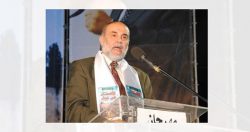 OCCUPIED JERUSALEM – The Israeli occupation police have handed professor Jamil Hamami, secretary-general of the higher Islamic commission in Occupied Jerusalem, a written order banning his travel abroad and to the West Bank.
According to this police order, Hamami will be prohibited from entering the West Bank for four months and the previous ban on his travel abroad will be extended for six months.
The police justified the measure against Hamami by saying that he is involved in banned activities and his departure for other countries will constitute a security threat to Israel.
For his part, Hamami, who works as a lecturer at al-Quds University, condemned Israel’s decision against him as “unjust and a violation of the Palestinians’ right to travel and movement”. He considered this Israeli step as “part of the Israeli campaign that targets the Palestinian dignitaries in Jerusalem.”
Amnesty No More
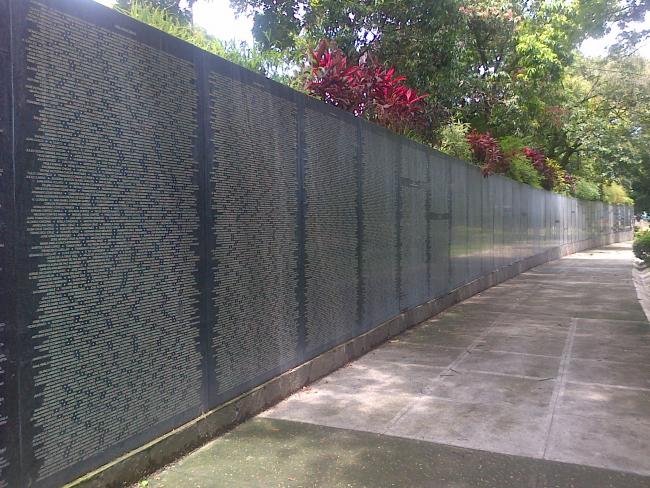
The Memory and Truth Monument commemorating the victims of El Salvador’s violence civil war (Wikimedia Commons)
By Robin Maria DeLugan | NACLA | July 20, 2016
The Salvadoran Supreme Court’s recent decision to overturn the country’s controversial Amnesty Law opens the door to unravel impunity for war crimes during El Salvador’s violent civil war.
On July 11, 2016, in a historic decision, El Salvador’s highest court abolished the amnesty law that has been in effect since 1993. The controversial law was put in place immediately following the signing of the peace accords that ended El Salvador’s brutal 12-year civil war (1980-1992), thus sheltering from prosecution the perpetrators of grave human rights violations committed during the conflict in El Salvador. In a much-anticipated decision, the Constitutional Supreme Court declared that amnesty law unconstitutional because it impeded the state’s obligation to investigate crimes against humanity.
An estimated 75,000 civilians lost their lives during El Salvador’s civil war. Some 8,000 were forcibly disappeared, while tens of thousands more were internally displaced or obligated to flee protracted violence. News of brutal atrocities spread across the world. From the high-profile assassination of Archbishop Monseñor Oscar Arnulfo Romero to the merciless slaughter of the entire village of El Mozote, more than 22,000 acts of violence by armed actors of the civil war were recorded by the United Nations Commission on the Truth for El Salvador.
While the state and the oppositional forces of the Farabundo Marti Liberación Nacional (FMLN) both committed abuses during the conflict, the UN-backed Truth Commission attributed 80% of human rights violations to the government of El Salvador. The Truth Commission, while helpful towards recouping the memories of the brutal acts of the war, had no power to enforce, especially against the amnesty law that followed. The amnesty law prevented prosecution and supported continued impunity thus thwarting national efforts for justice and reconciliation.
Over the past 20 years of post-civil war nation-building, government representations of national culture, history, and identity have maintained silence about the atrocities of the civil war. Some officials argued that to do otherwise would threaten the nation’s fragile peace. Others argued that the nation needed to look forward to the future, rather than dwell on the violence of the past. Such arguments justified the amnesty law. Challenging the government’s muteness and combatting public forgetting, civil society actors created two new museums and one major monument in the nation’s capital of San Salvador. Such commemorative sites have played a pivotal role as memory keepers while also helping to sustain the calls for unfulfilled justice.
In the late 1990’s the Museum of the Word and the Image (Museo de la Palabra y el Imagen, MUPI) was established “against forgetting” (contra la desmemoria) with exhibitions and educational activities dedicated to “weaving memory” (tejiendo la memoria). The museum collects and exhibits photographs, manuscripts, audio recordings, and films. Among the collections in the museum archives are photographs of the El Mozote massacre, posters demonstrating the international solidarity for the people of El Salvador and their revolutionary struggle; propaganda used by the Salvadoran government’s armed forces to reduce popular support of the guerrillas; photos about women combatants and the popular schools that were activated in the conflict zones during the war; and information about refugees and their return at to the country after the Civil War. The museum houses the most comprehensive existing archive of materials on the Salvadoran Civil War, maintaining documentation and memory of wartime abuses that the amnesty law sought to shield.
Carlos Henriquez Consalvi, MUPI’s co-founder and director, participated in the civil society collective that erected the Monument to Memory and Truth (Monumento a la Memoria y la Verdad) in San Salvador’s central Parque Cuzcatlán in December 2003. The commemoration site consists of an 85-meter black granite wall etched with the names of more than 24,000 civilian victims. Another portion of the monument contains colorful stucco reliefs, depicting symbols of past social struggles and violence, such as the assassination of Archbishop Romero. Since its construction, the monument has been recognized as a space for hope—and a place for continuing to envision and a more just, humane, and equitable society. In the absence of state recognition of past atrocities, civil society has had to rely on its own resources to recapture the memories and to publicly recognize the war’s many civilian victims.
Meanwhile, the Museum of Art (Museo del Arte, MARTE), which opened in 2003, has relied on private funding to promote and support contemporary art in El Salvador with an expansive collection that showcases the nation’s history. Its permanent exhibition, “Pieces of Identity,” (“Trozos de la Identidad”) includes paintings that represent the history of social movements in the country, as well as the violence associated with the civil war. Among them is “El Sumpul” (1984) by Carlos Cañas. The painting refers to a 1980 military operation in which at least 300 civilians, including many women and children, were assassinated in the River Sumpul in the department of Chalatenango. By displaying “El Sumpul,” MARTE does more than display the historical and contemporary artistic talent of El Salvador; it also tells the history of the nation’s darkest hours and serves as an important guardian of memory.
The abolition of the amnesty law is an important step in the government’s slow process of addressing an important chapter in the nation’s difficult recent past. In 2010, President Mauricio Funes, the first FMLN candidate to achieve the presidency, gained international attention when he issued a state apology for the assassination of Monseñor Romero, as well as an apology for historical and ongoing violence against indigenous populations in the country. In 2012, at an event marking the 20th anniversary of the El Salvador’s 1992 peace accords, Funes also apologized for the atrocities committed at El Mozote. Later that year the Inter-American Court of Human Rights issued a judgment condemning the Amnesty Law for impeding the government of El Salvador’s responsibility to investigate various cases of human rights violations including the case of El Mozote.
In 2013, an international forum at the Universidad de El Salvador’s entitled “Memories of the War: Changes and Continuities in Local Societies at the beginning of the 21st Century” continued the process of recuperating the history and memory of the Salvadoran conflict. In addition to highlighting the growing body of international scholarship on the civil war, the forum announced the creation of the Unit for Investigations about the Salvadoran Civil War within the national university and the decision to dedicate new resources to research about the conflict. These actions of official apology, international involvement, and state-sponsored academic programming made important steps to breaking long-standing official silence and together with other other civil society initiatives, like museums and monuments, promoted new knowledge about the causes and consequences of the civil war.
One of these consequences, of course, is that the civil war brutality has been replaced with other kinds of violence. As has been widely publicized, El Salvador replaced Honduras as the most violence peacetime country in the world in 2015, with homicide rates nearing one homicide per minute in January 2016. Many, including Benjamín Cuéllar, the ex-director of the Instituto de Derechos Humanos de la Universidad Centroamericana, (Institute for Human Rights at the Central American University, IDHUCA,) see a connection between ignoring prosecution of the human rights abuses of the civil war and high levels of postwar violence. As he noted in a recent article in El Diario de Hoy, the impunity that resulted from the amnesty laws has permitted other wars, namely “the war between gangs, the government’s war against gangs, and the war of gangs against the Salvadoran population.” There is hope that addressing past human rights violations will play a role in creating a more just and peaceful society.
The revocation of the amnesty law now makes it possible to pursue justice for civil war wrongs including criminalizing those responsible for the human rights abuses caused by death squads, paramilitary, and security forces. The 73-page court decision lists 32 crimes that occurred between 1989 and1992 that can now be investigated. The list includes the names of members of the military or of the FMLN indicated as having responsibility. In terms of next steps, Romeo Benjamín Barahona Meléndez, ex-Attorney General under former President Mauricio Funes, explained that victims can now formally denounce these past crimes, and the Attorney General’s office will begin investigating the cases.
The court decision, while heralded by many, is causing a commotion within the leadership of the FMLN, the political party that holds executive power in the government. Structurally, whereas the military actors on the list are no longer in the government, investigations could instead lead to trials that involve FMLN leaders, for example the President of the Republic, Vice President, Ministers and Deputies. Some elected officials and government functionaries are openly critical about what will happen next, stating they fear “witch hunts” and the reopening of old wounds. Despite reservations from some in government, the Attorney General’s office appears to have the will to undertake investigations. However, the government lacks resources for the processes, including funds to support the indemnization of the victims who are determined to have suffered “moral damage” (daño moral).
However, should leaders or government actors ignore the ruling, there will undoubtedly be international criticism and a demand for accountability. Sites and practices of public memory in El Salvador have maintained the nation’s focus on civil war human rights abuses and the need for justice for decades. National and international attention created through these efforts contributed to the historic decision to finally revoke El Salvador’s Amnesty Law. These audiences will be carefully monitoring the fresh developments to follow. It is difficult to predict the outcomes of this important court decision. What happens next in El Salvador will be a chapter in an important historical process of nation-building, memory and justice that will provide lessons for other societies pursuing similar struggles against state violence, forgetting and impunity.
Robin Maria DeLugan is Associate Professor of Anthropology at the University of California, Merced. She is the author of Reimagining National Belonging: Post-Civil War El Salvador in a Global Context (University of Arizona Press, 2012).
Legal centre slams Israeli parliament’s new Expulsion Law
MEMO |July 20, 2016
Adalah – The Legal Center for Arab Minority Rights in Israel has slammed a newly-passed Israeli law designed to facilitate the expulsion of publicly-elected Palestinian parliamentarians in the Knesset.
The law, approved overnight by a vote of 62 to 45, is described by Adalah as posing a “grave danger to basic democratic rights”, and intended to expel those Arab Knesset members “who ‘dare’ to stray beyond boundaries dictated to them by Israeli Jewish majority.”
As Adalah explains, under the new law, “a majority of 90 Knesset members may oust a serving Knesset member on two grounds, as enumerated in Section 7A of the Basic Law: The Knesset: 1) incitement to racism; and 2) support for armed struggle against Israel.”
In addition, “the law stipulates that when the Knesset decides on an expulsion, the statements of the ‘suspect’ Knesset member will also be examined and not only their aims or actions.”
The law also provides that: 1) a member’s expulsion lasts for the full period of the Knesset’s remaining term; 2) the commencement of expulsion proceedings requires the support of 70 Knesset members, including a minimum of 10 opposition members; and 3) suspension proceedings may not commence during an election campaign.
Described as “the latest attempt by the government to trample on the political rights of Palestinian citizens of Israel”, according to Adalah, “there are no existing laws in western democratic states comparable to Israel’s new Expulsion Law.”
The Expulsion Law is the latest expression in a disturbing national tendency over the past several years – including many attempts to disqualify Arab Members of Knesset and Arab party lists from participating in the elections, the government’s decision to outlaw the Islamic Movement in 2015, and the Knesset’s approval of a series of laws such as the ‘Electoral Threshold Law’, the ‘Nakba Law’, and the ‘Boycott Law’ – all intended, via varying means, to silence the Arab public.
Ukrainian Regime Turns Into ‘Mass Grave’ for Journalists – Moscow

Journalist Pavel Sheremet © Sputnik/Ramil Sitdikov
Sputnik — 20.07.2016
MOSCOW — Ukrainian political system is turning into “mass grave” for journalists and journalism in general, Russian Foreign Ministry spokeswoman Maria Zakharova said Wednesday, commenting on the killing of journalist Pavel Sheremet in a car bomb attack in Kiev.
Earlier in the day, a car bomb claimed Sheremet’s life in the Ukrainian capital of Kiev. The Ukrainian general prosecutor confirmed Sheremet’s death, classifying it as murder.
“A vehicle with Pavel Sheremet was blown up in Kiev. [He was] a professional journalist, who was not afraid of telling the authorities what he thinks about them — to different authorities and at different periods of time. And he was respected for this. Ukraine (not the country, but the system) is turning into mass grave for journalists and journalism,” Zakharova wrote on her Facebook page.
President Petro Poroshenko ordered investigators to ensure the perpetrators of the attack are brought to justice.
Sheremet is a well-known journalist who worked in Russia, Belarus and Ukraine. He had worked in Kiev for the last five years for the Ukrayinska Pravda news portal and Radio Vesti broadcaster.
In April 2015, Ukrainian opposition journalist Oles Buzina was shot dead in Kiev by two masked gunmen near his home. The incident occurred less than a day after former lawmaker and government critic Oleh Kalashnikov was murdered at his residence in the Ukrainian capital. Another Ukrainian journalist, Donetsk-born Serhiy Sukhobok, was also killed the same month near his house in Kiev.
Reporters Without Borders has repeatedly urged the Ukrainian authorities to investigate the killing of journalists.
Former hunger striker, brother of slain activist, among 18 Palestinians arrested by occupation forces

Samidoun Palestinian Prisoner Solidarity Network – July 19, 2016
In a series of late-night and pre-dawn raids, Israeli occupation forces seized at least 18 Palestinians between 18 and 19 July. They include Ghassan Zawahreh, former prisoner, hunger striker against administrative detention, and the brother of Moataz Zawahreh, shot dead by occupation forces as he participated in a protest in Dheisheh refugee camp on 15 October 2015.
In an invasion of Dheisheh camp by occupation forces, Zawahreh was seized in a pre-dawn raid with a massive military presence. Zawahreh has spent nearly ten years in Israeli prisons over various arrests, including many under administrative detention without charge or trial. He has permanent injuries to his right hand and left leg due to beatings by Israeli occupation forces during earlier arrests, including his first arrest in 2002; he was denied treatment for his knee injury for three years. Zawahreh was released on 30 November 2015, after being held in administrative detention since 4 August 2014. He was one of the initiators of the “Battle of Breaking the Chains,” the 40-day hunger strike by five Palestinians imprisoned without charge or trial under administrative detention.
Moataz, his brother, returned from a study program in France in order to support Ghassan’s strike; he was shot dead by Israeli forces during a demonstration in the refugee camp. When Ghassan was released, he immediately headed directly to his brother’s gravesite to pay his respects and two days later, spoke at a memorial for his brother, video here:
The invasion of Dheisheh camp followed a large protest action in the camp in support of hunger-striking prisoner Bilal Kayed, hospitalized after 35 days of hunger strike for freedom from administrative detention, imprisonment without charge or trial.
Four former prisoners – all students at An-Najah University in Nablus – were detained by occupation forces: Mahmoud Asida, Malek Bilal Shtayyeh, Mumin Munir Sabah, and Karam Kheir Bani Fadel.
Five Palestinians in Qalandia refugee camp north of Jerusalem were arrested: Muath Alayan, Mohammed Samih Muteir, Mahmoud Samih Muteir, Haitham Udwan, and Muhannad Kanaan. In the town of Taqua, east of Bethlehem, two Palestinians were seized by occupation forces, Mohammed Salim Abu Mafarah and Musa Mohammed Amour. Hussein Issa, of al-Khader village west of Bethlehem, was also arrested by occupation forces.
Also yesterday, Israeli occupation forces arrested two more An-Najah university students yesterday, Mohammed Shehadeh at Huwwara checkpoint south of Nablus, and Said al-Tawil in Far’ata village. Samaher Abdul Qader Musalma, of Beit Awwa near al-Khalil, was arrested while visiting her husband in the Negev desert prison, and her husband, Nabil Musalma, was transferred to an unknown prison.
Palestinian journalist Samah Dweik sentenced to six months in Israeli prison

Samidoun Palestinian Prisoner Solidarity Network – July 18, 2016
Palestinian journalist Samah Dweik has been sentenced by the Israeli Jerusalem court to six months and one day in prison, on charges of “incitement” for posting on her Facebook page. She was arrested on 10 April 2016 from her home in the Ras al-Amud neighborhood of Silwan, Jerusalem, in a pre-dawn raid in which occupation soldiers invaded and ransacked her home, accused of posting in support of the intifada on Facebook.
She is one of hundreds of Palestinians targeted for arrest and persecution on the basis of postings on social media. Dweik, 25, is a freelance journalist who works with Quds News Network. She is one of over 20 Palestinian journalists detained and imprisoned by Israel, including Palestinian Journalists’ Syndicate leader Omar Nazzal, Addameer media coordinator Hasan Safadi, and multiple journalists accused of “incitement” for posting on social media.
 Dweik is one of over 60 Palestinian women imprisoned by Israel, held in HaSharon and Damon prisons. On Saturday, 16 July, two more Palestinian women were arrested: Banan Mahmoud Mafarjah, 21, a medical student at Al-Quds University in Abu Dis, Jerusalem, was arrested at an Israeli occupation “flying checkpoint” west of Ramallah; while Amal Masalmah of al-Khalil was among 10 Palestinians detained in late night and pre-dawn raids on 17 July.
Palestinian journalist ordered to administrative detention, campaign launched for syndicate leader’s release

Samidoun Palestinian Prisoner Solidarity Network – July 18, 2016
The Israeli Ofer military court issued a thee-month administrative detention order against Palestinian journalist Adib al-Atrash on Sunday, 17 July, as the Palestinian Journalists Syndicate launched an international effort to free syndicate leader Omar Nazzal, also held under administrative detention without charge or trial.
Al-Atrash, who recently graduated from Eastern Mediterranean University in Cyprus, was arrested by Israeli occupation forces on Monday, 20 June from his family’s home in Al-Khalil. Al-Atrash and Nazzal are two of over twenty Palestinian journalists detained and imprisoned by the Israeli occupation.
Nazzal was arrested by Israeli occupation forces on 23 April 2016, as he attempted to cross at the Karameh crossing from Palestine’s West Bank to Jordan, to travel to the European Federation of Journalists’ annual general meeting in Sarajevo, Bosnia and Herzegovina. Nazzal, a member of the PJS’ general secretariat, was representing the syndicate at the conference; he was also ordered to four months’ administrative detention without charge or trial.
The Palestinian Journalists Syndicate is working with the International Federation of Journalists and international syndicates of journalists to campaign for freedom for Nazzal and his imprisoned colleagues. The IFJ has called for the release of Nazzal and other imprisoned Palestinian journalists, including former hunger striker and administrative detainee Mohammed al-Qeeq.
Al-Atrash and Nazzal are among nearly 750 Palestinians held under administrative detention without charge or trial, out of a total of 7,000 Palestinian prisoners in Israeli jails. Administrative detention orders, issued for periods of one to six months on the basis of secret evidence, are indefinitely renewable.
Holocaust Discourse and the Moral High Ground
By Barbara McKenzie | June 13, 2016
The Jewish Holocaust occupies a unique position in modern Western society, in that questioning the facts of the Holocaust is suppressed and vilified on a global scale as no other topic of human history. Why is research into the Holocaust so problematic? Why is it that serious research by scientists, historians and other academics is rejected out of hand as immoral? Why is the suppression of research into ANY aspect of history acceptable?
At present there are 14 countries that criminalise ‘Holocaust denial’, i.e. publicly questioning, or disseminating research that questions, any aspect of the approved Holocaust narrative: Canada plus 13 European countries including Germany, Austria and France. In many of these countries legislation was passed decades after the end of WWII, in France only in 1990. As recently as 2015 a German court convicted 87 year old Ursula Haverbeck of ‘Holocaust denial’ and sentenced her to 10 months prison. Other revisionists who have served jail sentences include the German publisher Ernst Zündel and the British historian David Irving, who was arrested, sentenced and imprisoned in Austria in 2005. Academic Robert Faurisson was convicted in France of holocaust denial in 2006 and given a three month suspended sentence. In Germany convictions are rising steadily: in 2000 there were more than 2,666 violations of the Holocaust denial law STGB 130, as compared with 437 in 1987.
Even where Holocaust revision is legal, those who are involved in it or support it in any way are liable to be vilified, persecuted and generally treated as lepers. British academics like Irving and Nicholas Kollerstrom saw their careers destroyed, and every effort is made to deny revisionists any sort of platform; it goes without saying that they are subjected to vindictive trolling on social media. Some, like Faurisson and Zündel, have been physically assaulted on more than one occasion. After pro-Palestine activist Paul Eisen wrote an article ‘The Holocaust Wars’ in which he suggested there were questions to answer about the Holocaust, he experienced an extraordinary campaign of vilification and ostracism, especially from the pro-Palestine movement he had given so much to. That he was Jewish himself was no defence against the charge of antisemitism. As Eisen himself says, ‘I had metamorphosed into that lowest of animal life forms, the maggot at the bottom of the food chain – a Holocaust denier’.
Paul Eisen saw an unexpected rise in his profile during the 2015 campaign for election of the leader of the UK Labour Party. It was discovered that Jeremy Corbyn had had some links with Eisen in the past, including appearing on the same platform as him. The media, who had hardly been supportive of Corbyn’s candidature, had a field day accusing Corbyn of associating with a Holocaust denier. Jeremy Corbyn’s response to accusations of an association with Eisen was unequivocal : ‘had I known he was a Holocaust denier I would have had nothing to do with him […]. Obviously Holocaust denial is vile and wrong’. (From 2.47 mins in the following)
There are two principle assumptions relating to the Holocaust, both implicit in Corbyn’s denial of Paul Eisen:
- It is an an indisputable fact that Adolf Hitler planned to exterminate the Jews of Europe, that he did so by gassing them with cyanide in specially constructed gas chambers, and that he was thus responsible for the deaths of 6 million Jews
- People who question any of these premises, do so ONLY because they are neo-Nazis and white supremacists, who wish to conceal the crimes of the Nazis while at the same time sharing their ideology. They are ‘Holocaust deniers’, and all Holocaust deniers are of necessity antisemitic.
The immutability of these two premises leads to another, that anyone who questions any aspect of the Holocaust or who supports the right of others to question the Holocaust, is at best morally compromised, and probably downright evil, deserving responses ranging from suspicion, condemnation, vilification, isolation, hate mail, through to arrest and imprisonment, sometimes for many years. Those who accept unreservedly the two premises are automatically morally superior to anyone who smells a rat.
In 2012 Piers Morgan interviewed the Iranian president Mahmoud Ahmadinejad, and asked him about his attitude to the Holocaust. I say ‘asked’, but Morgan puts his own position very clearly.
Morgan states that ‘it is an indisputable fact’ that over 6 million Jews were annihilated by Adolf Hitler and the Nazis. ‘Do you dispute that 6 million Jews died or no.’ Although Ahmadinejad tries to voice his suspicions about the narrative, aroused principally because so much effort goes into suppressing research, Morgan is unmovable: the Holocaust is a fact: either you believe in it or not (subtext: and if you don’t it’s because you choose to, because you are a bad person).
The biologist Richard Dawkins sees Holocaust debate in precisely the same terms as Piers Morgan:

So according to Richard Dawkins, too, the Holocaust’ is an immutable fact, and those who question it are intellectually on a par with people who think the earth is flat, and morally on a par with racists. Again, the Holocaust is presented as just one fact, a single package – you either believe in it or you don’t.
What is particularly interesting about Dawkins’ position is that he is one of the leaders of the New Atheist movement, ostensibly dedicated to pointing out all that’s wrong with religion. One might have thought he would be sensitive to the features of the Holocaust narrative and the protectors of its memory that are evocative of the most intolerant religions, for example Catholicism in medieval times. Criminalising Holocaust denial is like burning Bruno Giordano at the stake for claiming that the earth goes round the sun.
A number of writers have in fact analysed the parallels between the Holocaust and religion, most notably the Israeli writers Yeshayahu Leibowitz, Shraga Elam, Gilad Atzmon, and Yoshua Shalev. Their arguments have been summarised as follows: Most Jews today are either atheists or shun the religion of Judaism. Therefore, the Jewish people had to adopt belief in the ‘Holocaust’ as their new religion. They have spread this religion all over the world. ‘Holocaust’ museums are the new houses of worship and are present in most major cities. The new religion has its commandments, its decrees, its prophets, its high priests, its circle of saints, its rituals and its pilgrimages. It knows neither mercy, nor forgiveness, nor clemency but only the duty of vengeance. The Holocaust religion is coherent enough to define the new ‘antichrists’ (the Deniers) and it is powerful enough to persecute them (Holocaust denial laws).
The ‘Ten Commandments’ of this ‘Holocaust Religion’ have been enunciated as follows:
- Remember what Amalek (the Non-Jews) has done to thee.
- Thou shalt never compare THE HOLOCAUST with any other Genocide.
- Thou shalt never compare the Nazi crimes with those of Israel.
- Thou shalt never doubt the number of 6 million Jewish victims.
- Thou shalt never doubt that the majority of them died in gas chambers.
- Thou shalt not doubt the central role of SATAN Hitler in the extermination of the Jews.
- Thou shalt never doubt the right of Israel to exist as the Jewish state.
- Thou shalt not criticize the leading Jewish organizations and the Israeli government.
- Thou must never criticize Jewish organizations and the Zionist leadership for abandoning the European Jewry in the Nazi era
- Thou shalt take these commandments literally and never shew mercy to them that doubt!
So what if you question this Holocaust religion? There is an almost universal assumption that if you don’t believe in the Holocaust it is not because you have an inquiring mind, it’s because you are innately evil. The belief underlying the draconian legislation relating to Holocaust denial would seem to be that the Holocaust is only questioned by neonazis, whose ‘denial’ is motivated by hate and so they should be locked up before they contaminate anyone else.
I have to confess that when I recently learned of the existence of Ursula Haverbeck and her prison sentence for ‘Holocaust denial’, in a European country in the 21st century, for carrying out, as I saw it, serious research into history, I was shocked to the core. I mentioned this to various acquaintances here in Wellington, who were equally horrified, not at the imprisonment of Ursula Haverbeck, but at the thought that I appeared to be questioning the Holocaust narrative. I was quickly made to understand that if I thought there was something worrying, something odd about this punitive response to historical research, it indicated a moral flaw in my makeup.
Soon after I had a twitter exchange with one Daniel Finkelstein, peer of the British realm, ex-editor of The Times. I came across his savage indictment of a prolific tweeter, who had defended David Irving, the notorious ‘Holocaust denier’. When I commented that the said person ‘opposes land theft (in Palestine), ethnic cleansing and child abuse – what’s not to like? Finkelstein, twitter handle ‘Dannythefink’, responded by asking me what I thought of the Holocaust. The exchange continued as follows:
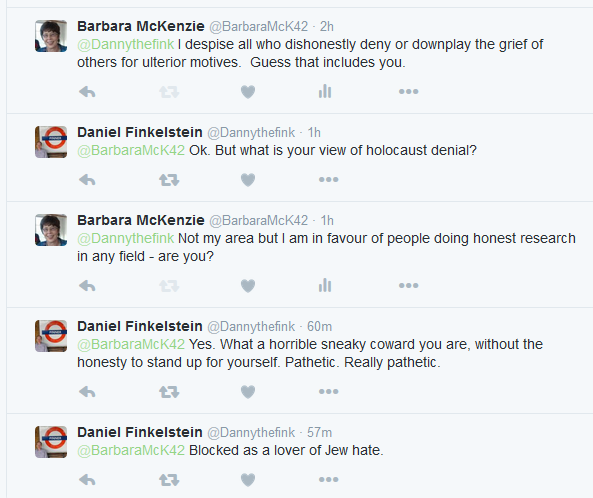
It comes as no surprise that Daniel Finkelstein, who is in total support of dispossession, ethnic cleansing and cruelty in Palestine, assumes morally superiority to me, since I have spoken in defense of a man who has spoken in defense of a man who does research into a field of history. And of course I have refused to commit myself to the undeniability of the Holocaust package …
One can assume that all these experts on the Holocaust, who know enough to be confident of the immutable truth of the Holocaust narrative, whether it be Piers Morgan, Dawkins, or Daniel Finkelstein, would also know another immutable truth about the Holocaust, that the Director of Auschwitz, Rudolf Höss was tortured for three days and three nights, and that his testicles were smashed beyond repair,as happened to 137 out of 139 Germans ‘interrogated’ before the Nuremberg trials. One can assume that this makes no difference to their perception of the Holocaust narrative, and they will remain confident of their moral superiority to those of us who are distressed and alarmed by the knowledge that German witness statements at Nuremberg were obtained under the most brutal torture. (From Höss’s confession was derived the figure of 4 million deaths at Auschwitz; the figure was later revised down to 1 million.)
‘Holocaust denial’ is generally conflated with antisemitism, ‘Jew hate’ or racism, and so automatically deserving of vilification. However, even if revisionism is considered to be intrinsically antisemitic, protectors of the Holocaust narrative like to bolster their case by pointing to more general indicators of racism in the culprit.
To the uninitiated the best-known Holocaust revisionist is probably the British historian David Irving, who was convicted of Holocaust denial in an Austrian court and sentenced to three years in prison. Irving was interviewed by Tim Sebastian on the BBC’s Hardtalk in 2000. The programme’s style is intended to be aggressive, but when I watched the programme in 2000, knowing nothing about either Irving or Holocaust denial, I was repelled by Sebastian’s overt hostility to Irving, and I believe that any other impartial person would be too. (Sebastian underlined his antagonism by refraining from shaking Irving’s hand at the end of the interview.)
Sebastian suggests that to deny the gas chambers is hurtful and tasteless (Holocaust denial is immoral per se). But like many others he feels the need to shore up this assumption by showing that there is other evidence that David Irving is a racist, and though he has few examples to work with he is relentless on this point. Irving’s suggestion that he is no more racist than millions of other people is brushed aside with the rather strange claim from the interviewer that there is no evidence for this whatsoever (so only Holocaust deniers are racist). Furthermore, it would appear that honest but naive David Irving confessed in an interview with the Independent that he once called someone a ‘nigger’, something he immediately regretted and remained bitterly ashamed of. As someone put it in the comments below the YouTube video, David Irving is probably the most honest person on the planet.
Another protector of the Holocaust narrative is Max Blumenthal, an American Jew who has a profile as a supporter of the rights of Palestinians. Blumenthal has attracted criticism from some pro-Palestine activists, who see him as an ‘antizionist’ zionist (AZZ), or gatekeeper, due to his attacks on other activists such as Alison Weir and Gilad Atzmon, his opposition to criticism of Jewish power, his prioritising of antisemitism and Holocaust denial, and his peddling of the NATO narrative on Syria; Gilad Atzmon sees him as racist, agressive and supremacist. In 2008 Blumenthal attended a meeting by David Irving when he was touring the States, and created this video:
The video is interesting for several reason. Blumenthal has interspersed his footage with clips from old German propaganda films promoting Germans superiority – of course if you question the Holocaust you must be a Nazi and white supremacist. Like Piers Morgan he presents the question of the Holocaust in bald holistic terms, with no allowance for individual aspects, or degrees of doubt. ‘Are you a Holocaust denier’, he asks, pretty much as one might ask ‘are you a paedophile?’
And as Holocaust denial is such a heinous crime, Blumenthal is justified in first finding out the location of the meeting (given freely to him by David Irving), and then outing Irving to the Vicar of the church hosting the meeting as a ‘Holocaust denier’. The smugness, the self-satisfaction of Blumenthal are palpable; he clearly sees himself as a hero, where others might just see a manipulative sneak. In any case we are left in no doubt that Max Blumenthal, the anti-German racist, the Palestine activist who along with Israel promotes the destruction of Syria, is morally superior to the ‘Holocaust denier’ David Irving, regardless of the latter’s transparent integrity.
The claim that ‘Holocaust denial’ is innately antisemitic was blown out of the water when Netanyahu, prime minister of Israel, took into his head to declare that the Holocaust was the brainchild of the Palestinian grand mufti of Jerusalem Haj Amin Husseini (so not Hitler afterall), that Hitler only wanted to expel the Jews, not exterminate them (thereby breaking Commandment 6, see above). There was anger and ridicule in Israel and amongst Jews abroad and Netanyahu was forced to climb down. Although Netanyahu was in general accused of ‘playing into the hands of Holocaust deniers’, he was actually guilty of Holocaust denial as it is defined, ie questioning an aspect of the Holocaust discourse – any German who made Netanyahu’s claim would be arrested. If one accepts the ruling that says ‘Holocaust denial’ is antisemitic, Netanyahu must be antisemitic. Which is clearly nonsense – Netanyahu’s racism does not lie in antisemitism, but in an overweening belief in Jewish exceptionalism.
Conclusion
It could be that those protecting the approved version of the Holocaust with such intolerance, aggression, and hate are absolutely right, that 6 million Jews died, in gas chambers, according to a plan drawn up by Adolf Hitler. I wouldn’t know – I haven’t done the research necessary for me to form an opinion.
However it is manifestly clear that those who question or deny the Holocaust are not united by a common neo-Nazi philosophy, of a type that on the one hand insists that Hitler was not guilty of the crimes attributed to him and on the other claims ‘Hitler was right’ to commit these crimes. Mainstream Holocaust revisionists are academics, philosophers, German patriots or Palestine activists. They do not necessarily support the far-right – many of them probably vote for left of centre parties. Some of them are notable for their immense compassion, such as Paul Eisen, who has always been a strong advocate of justice for Palestine. All of them have shown great courage and integrity, and are prepared to look for the truth and to speak it as they see it.
Regardless of the facts of the matter, criminalisation of responsible research into the Holocaust, and the vilification and isolation of those who carry it out, or even those who simply support their right to do so, is an outrageous denial of academic endeavour and historiography as a discipline. Anyone who supports such criminalisation, vilification and isolation is NOT morally superior but in fact morally and intellectually compromised. Furthermore, any honourable person with a modicum of intelligence and a modicum of courage will fight for the right of all people to carry out research into any branch of history, without treating one particular aspect as sacred and therefore exempt from scrutiny.
Featured Video

Seyed M. Marandi: US-Iran War Inevitable: Kuwait and Bahrain May Fall
or go to
Aletho News Archives – Video-Images
From the Archives
Oil and the Israel Lobby
Reknowned economist M. Shahid Alam offers this excellent critique of Noam Chomsky’s defective analysis of the relative influence of Oil versus the Israel lobby over US foreign policy: … continue
Blog Roll
 Aletho News
- ICC ignored ‘very well-documented’ NATO crimes – ex-Libyan minister
- SNSC secretary dismisses US response to Iran’s conditions as ‘inadequate’
- Sanaa says Taiz roads open, secure for residents, warns Saudi forces
- Iraqi resistance group urges Saudi leadership to admit defeat, lift Yemen siege
- Trump’s Retreat: How Al-Aqsa Flood Took Down the US Empire
- Israel’s Military Actions in Lebanon Grossly Violate International Law — Lavrov
- Seyed M. Marandi: US-Iran War Inevitable: Kuwait and Bahrain May Fall
- Leaders Condemn Ansarallah Attack on Saudi Arabia While Ignoring Illegal War Against Yemen
- Leaked: Britain’s Covert Iraqi Psyops Network
- Yemeni Armed Forces Warn Airlines Against Using Saudi Airports, Exempt Mecca and Medina
- If Americans Knew
- After Oct 7, IDF policy allowed civilian casualties for even the lowest-ranking targets
- Israel’s Destruction of Southern Lebanon Intensified After the Cease-Fire
- The Last-Minute Decision That Gave Israel Its Name
- The American Conservative: How Trump Made the World Go Nuclear
- Meet the US generals and admirals advancing Israeli policy
- Opinion: Why news organizations should boycott Israel
- The Israeli witch hunt of Sami Abu Shehadeh exposes the lie of the ‘Jewish and democratic’ state
- No state has a ‘right’ to exist – least of all Israel
- Testimonies about Gaza’s civilian death toll expose Israel’s atrocities – Daily Update
- How Israel Conquered the Latin American Right
- No Tricks Zone
- Germany’s Green Energy Debacle: High Energy Costs Force Kahla Porzellan to Close After 182 Years!
- New Study: 50 Years Of The Most Aggressive ‘Net Zero’ Policies Can Only Affect The Global Climate By 0.03°C
- US September “Heat” Was No Record…Many Records Set Decades Ago
- Latest European Green Energy Debacle; Portugal’s Largest Flagship Solar Park Insolvent!
- Green Energy Debacle: German Expert Professor Fritz Vahrenholt Warns Of Severe Economic And Social Consequences
- Two More Paleo Reconstructions Affirm Meters-Higher Sea Levels Across Ireland, Brazil 7000-6000 Years Ago
- New Study: Earth And Venus Surface Warmth Largely Explained By Convection And Lapse Rate, Not CO2 Or Radiation
- 2025 Nature Paper Claiming Worsening Global Drought Gets RETRACTED …Heavily Flawed
- New Study: ‘Global Drought Shows No Detectable Recent Acceleration Under Climate Warming’
- Economic Masterminds: German Socialists Suggest Taxing Productivity Gains Stemming From Using AI

