Minister urges Israel to go ahead with West Bank annexation

Israeli Minister of Agriculture and Rural Development, Uri Yehuda Ariel
Press TV – June 9, 2016
An Israeli minister says Tel Aviv must go ahead with a plan to annex more than half of the occupied West Bank after evicting thousands of Palestinians from the area.
Minister of Agriculture and Rural Development Uri Ariel made the remarks in Moscow where he traveled with Israeli Prime Minister Benjamin Netanyahu on Wednesday.
“We have to aspire to the annexation of Area C. These are areas where there are no Arabs at all. We would remove a few thousand, who do not constitute a significant numerical factor,” Ariel said.
Area C comprises over 60 percent of the occupied West Bank. Measuring about 330,000 hectares, the territory is totally run by the Israeli military even though it is home to nearly 300,000 Palestinians, according to the United Nations.
Israel, however, says only about 50,000 Palestinians are residing there.
Ariel, also a hawkish member of the Knesset, is fervently pushing for the annexation of Area C. In January, he strongly urged the Israeli regime to take full possession of the land.
“We should tell the prime minister, the government and the Knesset that the time has come to annex Area C. I am suggesting that we unite around this call,” he said.
Ariel has even hinted at annexing the occupied West Bank in whole. “If someone asks about Areas A and B, then their time will come. When, we will see. For now, let’s agree on Area C.”
Under the interim agreements reached between Tel Aviv and the Palestine Liberation Organization (PLO) in the 1990s, and as part of Oslo Accords, the West Bank was divided into three zones.
Area A, the smallest of all, constitutes about 18 percent of the land and the Palestinian Authority is supposed to control most civilian affairs and internal security.
Area B, constituting around 22 percent of the rural West Bank, is administered by the Palestinian Authority for its civil affairs and by Israel for its security issues.
In both zones, Israel holds full control of external security, meaning it retains the right to enter the zones at any time and make arrests or carry out any extrajudicial execution.
Virtually all of the Israeli settler population of the West Bank of more than 350,000 is based in Area C, living in 125 settlements and about 100 outposts.
The Israeli military almost never grants the Palestinians living in Area C building permits. According to a UN report, more than 11,000 demolition orders are currently outstanding in Area C.
The agreement on separating the West Bank into three zones was worked out to enable an incremental transfer of authority to the Palestinian Authority and to address the needs of a long-term demographic growth.
The UN announced in late April that a total of 588 Palestinian structures, mostly based in Area C, had been razed since January. It said the demolitions had affected more than 1,000 people as the residents had lost structures related to their source of income.
Under Israeli pressure, Facebook and Twitter delete large amounts of Palestinian content
MEMO | June 9, 2016
Facebook and Twitter have recently deleted thousands of posts, pages and accounts in response to demands from the Israeli ministry of justice, Quds Press reported on Wednesday.
“We succeeded to achieve our goals as around 70 per cent of our demands [to delete Facebook and Twitter content] were fulfilled,” Israeli Minister of Justice Ayelet Shaked said, according to Israeli newspaper Yedioth Ahronoth.
She also added: “We succeeded to delete incitement contents calling for death and violence across the internet.”
During a meeting she held to discuss “fighting incitement and shameful content on social media” three-days ago, Shaked reiterated Israel’s “cooperation with Facebook, Twitter and google regarding the violent electronic Palestinian incitement”.
Shaked claimed that when internet incitement decreased, the attacks on Israelis decreased.
“This proves that there is a direct relationship between internet incitement and violence in Israel,” she said.
FBI increase use of anti-ISIS undercover agents, sting operations
RT | June 8, 2016
Sending someone undercover was once a last resort for the FBI – despite popular law dramas where it seems to happen every few weeks. But the FBI’s use of undercover agents in the fight against Islamic State has some questioning its legality.
The Federal Bureau of Investigation (FBI) has significantly increased its use of agents and informants in terrorism cases according to a report from the New York Times. In fact, the FBI uses it so intensively that it is used in about two out of three prosecutions related to suspects believed to be supporting the Islamic State (IS, formerly ISIS/ISIL).
When agents and informants go undercover, they pose as anything from weapons and arms dealers to jihadists or just friends on social media. However, defense lawyers, civil right activists and Muslim leaders have all compared the tactics used by the FBI to entrapment.
“They’re manufacturing terrorism cases,” Michael German, a former undercover agent with the FBI and national security law researcher at New York University’s Brennan Center for Justice, told the New York Times, adding: “These people are five steps away from being a danger to the United States.”
For example, Emanuel Lutchman of Rochester, New York, was arrested in relation to a plot to abduct and kill the patrons at a Rochester bar on New Year’s Eve. His grandmother, Beverley Carridice-Henry, told the Democrat and Chronicle that Lutchman had suffered from mental illness and was sent to prison when he was 16 years old. While there, he converted to Islam to gain protection after another inmate attempted to rape him.
Carridice-Henry told the Democrat and Chronicle that he had been hospitalized at least three times for suicide attempts and that his difficulties with mental health made him vulnerable to coercion, saying: “I’m not going to say he’s a saint, but the thing about him is, he’d meet somebody and they were automatically his friend,” adding, “And I told him, ‘Not everyone you meet is your friend.’ But to him they were.”
She explained her frustration with the sting operation involving her allegedly homeless grandson, saying: “They sent this guy to befriend him and set him up in a sting. How is that right? For the federal government to set up youths that they know are vulnerable?… He didn’t have money to buy Pampers for his son. How would he find money to go buy these [weapons]?”
The New York Times explained that the informant provided Lutchman with the $40 necessary to purchase the materials he needed for his plot from Wal-Mart.
Karen J. Greenberg, the director of the Center on National Security at Fordham University, told the New York Times that these tactics may not be giving the FBI the results they want. “I think the FBI is really going down the wrong path with a lot of these ISIS cases.”
The FBI has defending its methodology, saying that the warrantless use of undercover operatives and informants is justified by the accelerated timeline that causes Islamic State loyalists to attack as soon as days or weeks after their radicalization. Michael B. Steinbach, who leads the FBI’s national security branch, told The New York Times : “We’re not going to wait for the person to mobilize on his own timeline,” adding that the FBI cannot “just sit and wait knowing the individual is actively plotting.”
The FBI claims its agents go to great lengths to avoid entrapment by asking the subject of their stings to confirm their intent multiple times. In the case of James Gonzalo Medina, a convert also known as James Muhammad, he had initially attempted to distance himself from a plot to attack a synagogue.
When Medina, 40, pointed out a “David’s triangle star” outside of a synagogue, an FBI informant suggested that he attack the temple during a Jewish holiday. Medina responded to this suggestion, saying: “Now that’ll be a good day to go and bomb them.”
The informant introduced him to a person that was said to have experience with explosives. Unbeknownst to Medina, he was an undercover FBI agent. The agent told Medina: “You need to be sure, brother,” and even said: “You know you don’t have to do any of this.”
These dubious tactics have lead judges to consider whether what the FBI is doing is entrapment. In 2011, Judge Colleen McMahon, of the US District Court in Manhattan, said that a case involving four men was potentially crossing the line, saying: “I believe beyond a shadow of a doubt that there would have been no crime here, except the government instigated it, planned it and brought it to fruition.”
However, Judge McMahon upheld the charges.
Which Jerusalem? Israel’s Little-Known Master Plans

Al-Shabaka | May 31, 2016
Jerusalem 2050: A largely-Jewish high-tech tourist destination with a minimal Palestinian presence. This is Israel’s vision of the city, and it is being implemented through three master plans – two of which are relatively unknown. Al-Shabaka Policy Fellow Nur Arafeh provides a succinct analysis of all three plans and the ways in which Palestinians can rebut them.
It is the year 2050 and Israel has fulfilled its vision for Jerusalem: Visitors will see a largely Jewish high-tech center amid a sea of tourists, with a minimal Palestinian presence. To achieve this vision, Israel is working on three master plans; one is well-known but two remain under the radar.
Edward Said had already warned in 1995 that “only by first projecting an idea of Jerusalem could Israel then proceed to the changes on the ground [which] would then correspond to the images and projections.” Israel’s “idea” of Jerusalem, as elaborated in its master plans, involves maximizing the number of Jews and reducing the number of Palestinians through a gradual process of colonization, displacement and dispossession (see Al-Shabaka policy brief on the methods used as well as this recent update).
The best known of the three Israeli master plans for the city is the Jerusalem 2020 Master Plan, which has not been deposited for public view even though it was first published in 2004. The least known are the Marom Plan, a government-commissioned plan for the development of Jerusalem, and the “Jerusalem 5800” Plan, also known as Jerusalem 2050, which is the outcome of a private sector initiative and is presented as a “transformational master plan for Jerusalem” (see below).
As Israel plans for 2050, the Palestinian Authority (PA) “idea” of Jerusalem dates back to 2010 when the Strategic Multi-Sector Development Plan for East Jerusalem (SMDP) 2011-2013 was published. And the PA’s current national development plan for 2014-2016 simply refers back to the 2010 plan. In addition, while the Palestinian leadership speaks of East Jerusalem, which Israel occupied and illegally annexed in 1967, as the capital of the State of Palestine and a priority development zone, only 0.44% of the PA’s 2015 budget was to be allocated to the Ministry of Jerusalem Affairs and to the Jerusalem Governorate.
In this policy brief Al-Shabaka Policy Fellow Nur Arafeh analyzes all three Israeli master plans for Jerusalem, explaining how they aim to shape the city into a tourism and high-tech center, and the ways in which they use urban planning to reshape the city’s demography. She spotlights the dangerous new laws Israel has reactivated or passed to advance its colonization of the city – the Absentee Property Law and the “third generation law”. She also addresses the role of the PA and the international community as well as of civil society organizations, and identifies achievable measures that can be implemented by those concerned with Jerusalem’s fate. 1
Before analyzing the ways in which the three plans reinforce each other, it should be noted that Israel’s annexation of East Jerusalem is illegal under international law and is not recognized by the international community. In addition, Israel’s declaration that Jerusalem is its capital, both West and East, has no international legal standing, which is why there is no diplomatic representation in Jerusalem, not even by the United States.
- The “Jerusalem 2020 Master Plan” was prepared by a national planning committee and first published in August 2004. It is the first comprehensive and detailed spatial plan for both East and West Jerusalem since Israel’s occupation of East Jerusalem in 1967. Although the plan has not been validated yet as it was not deposited for public review, Israeli authorities are implementing its vision. The plan addresses several development areas including urban planning, archeology, tourism, economy, education, transportation, environment, culture, and art. The plan is available online in Hebrew as well as in Arabic at the Civic Coalition for Defending the Palestinians’ Rights in Jerusalem; this policy brief draws on the “Local Outline Plan”- Report N.4.
- The Marom Plan is a government-commissioned plan for the development of Jerusalem that will be implemented by the Jerusalem Development Authority. The Authority’s goal is to promote Jerusalem “as an international city, a leader in commerce and the quality of life in the public domain.” It is a major planning body for the Jerusalem Municipality, the land Administration, and other organizations in the fields of housing, employment, etc.
The Jerusalem Institute of Israeli Studies is conducting the consultation, research, and monitoring for the Marom Plan. The Institute is a multidisciplinary research center that plays a leading role in the planning and development policies for Jerusalem in the fields of urban planning, demography, infrastructure, education, housing, industry, labor market, tourism, culture, etc.
- The “Jerusalem 5800” Master Plan, also known as “Jerusalem 2050,” is a private initiative founded by Kevin Bermeister, an Australian technology innovator and real estate investor. The plan provides a vision and project proposals for Jerusalem up to the year 2050, serving as a “transformational master plan for Jerusalem” that can be implemented together with other municipal and national government agencies. It is divided into various independent projects, each of which can be implemented on its own. The team for the implementation of the plan is said to include “the best Israeli tourism, transport, environment, heritage and security planners.”
A Jewish Destination for Tourism, Higher Education and High-Tech
The development of the tourism sector in Jerusalem is at the heart of the three development plans examined in this policy brief. For example, under the 2020 Plan, the Jerusalem Municipality seeks to promote the tourism sector and to especially enhance the cultural aspects of Jerusalem. It is planning a marketing campaign to increase the potential of real estate development, support international and urban tourism, and invest in tourism infrastructure to ensure the sector’s development.
The Marom Plan also aims to develop Jerusalem as a tourist city. In 2014 alone, the Jerusalem Institute of Israeli Studies conducted 14 of its 18 studies for that year on the tourism sector and submitted them to the Jerusalem Municipality, the Ministry of Jerusalem and Diaspora Affairs, and the Jerusalem Development Authority. Moreover, as part of the Marom Plan, the Israeli government earmarked around $42 million to boost Jerusalem as an international tourist destination, while the Ministry of Tourism was expected to allocate some $21.5 million for the construction of hotels in Jerusalem. The Authority also offers specific incentives to entrepreneurs and companies to establish or enlarge hotels in Jerusalem, and to organize cultural events to attract tourists such as the Jerusalem Opera Festival as well as events for the tourism industry, such as the Jerusalem Convention for International Tourism.
Promoting the tourism sector also lies at the core of the Jerusalem 5800 Master Plan, which envisages Jerusalem as a “Global City, an important tourist, ecological, spiritual, and cultural world hub” that attracts 12 million tourists (10 million foreign and 2 million domestic) and more than 4 million residents.
To make Jerusalem “the Middle East’s anchor tourist attraction and resource,” the Jerusalem 5800 plan aims to increase private investment and construction of hotels; build rooftop gardens and parks; and transform the areas surrounding the old city into hotels while prohibiting the use of vehicles. The plan also envisions the construction of high-quality transportation routes, including a “high-speed national rail line; an extensive network of buses and public transportation; the addition of numerous highways and the expansion of existing roads; and an express ‘super highway’ that transverses the country from north to south.” The plan also proposes the construction of an airport in the Horkania Valley between Jerusalem and the Dead Sea to serve 35 million passengers per year. The airport would be connected through access roads and rail to Jerusalem, Ben Gurion airport and other city centers.
Israeli Plans to Promote the Tourism Sector
$42 million: To boost Jerusalem as an international tourist destination (Marom Plan).
$21.5 million: For the construction of hotels in Jerusalem.
12 million tourists: Goal for annual visitors under the Jerusalem 5800 Master Plan
The Jerusalem 5800 plan attempts to present itself as an apolitical plan that promotes “peace through economic prosperity” but it has demographic goals that prove otherwise. In fact, it envisages that the $120 billion of total added value from the implementation of the plan, together with the 75,000 – 85,000 additional full time jobs in hotels plus 300,000 additional jobs in related industries would all reduce poverty – and would attract more Jews to Jerusalem, increasing the number of Jews living in Jerusalem and further tilting the Jewish-Palestinian demographic balance in their favor.
However, the tourism sector is not only seen as an engine of economic development to attract Jews into the city. Israel’s development of, and domination over, the tourism sector in Jerusalem, is a tool to control the narrative and ensure the projection of Jerusalem in the outside world as a “Jewish city” (see for example the official Ministry of Tourism map of the Old City.) Israel has strict rules over who can serve as tour guides and the narrative and history that the tourists are told. Palestinian tour guides who do not abide by Israel’s false branding and who try to give an alternative and critical analysis of the situation can lose their licenses.
These plans to promote the Israeli tourism industry have gone hand in hand with Israeli-imposed restrictions on the development of the Palestinian tourism industry in East Jerusalem. Israeli hurdles include: the isolation of East Jerusalem from the rest of the occupied Palestinian territory (OPT), especially after the construction of the Wall; shortage of land and the resulting high cost; weak physical infrastructure; high taxes; restrictions on the release of permits to build hotels or convert buildings to hotels; and difficult licensing procedures for Palestinian tourist businesses. These obstacles, even as millions of dollars are being poured into the Israeli tourism market, ensure that the Palestinian tourism industry has no hope of competing with Israel’s.
The Palestinian tourism sector is further hampered by the lack of a clear Palestinian vision and promotional strategy, severely impeding its ability to fuel the limited economic development possible under occupation. Moreover, although civil society organizations have stepped in to promote the sector, their efforts have been described as “fragmented and poorly coordinated” in an analysis in This Week in Palestine.
Another common goal of the three plans is to attract Jews from all over the world to Jerusalem by developing two advanced industries: Higher education and high tech.
To promote the higher education industry, the 2020 Master Plan aims to build an international university in the city center with English as the main language of instruction. As for the Marom Plan, it seeks to make Jerusalem a “leading academic city” that is attractive to both Jewish and international students, who will be encouraged to settle in Jerusalem once they have finished their studies. In the same vein, the Jerusalem 5800 plan sees an opportunity to create jobs and achieve economic growth through “extended-stay educational tourism.”
The development of the higher education industry is intrinsically linked to the development of a high-tech, bio-information, and biotechnology industry. The 2020 Master Plan calls for the establishment of a university for management and technology in the city center of Jerusalem, and for government assistance in Research and Development (R&D) in the fields of high-tech and biotechnology. Similarly, the Marom Plan aims at promoting Jerusalem as a center of R&D in the field of biotechnology.
It is within this context that the Jerusalem Development Authority established the BioJerusalem Center to foster clusters of bio-med companies in Jerusalem as a potential engine of economic development. To attract these companies to Jerusalem, the Authority is offering very generous benefits including: Tax breaks, grants for hiring new workers in Jerusalem, and special grants to companies involved in R&D or in building physical infrastructure. High-tech and healthcare industries are also expected to be major beneficiaries of the “Jerusalem 5800” Master Plan.
Evicting Palestinians Using Urban Planning and the “Law”
While Israel works on creating Jerusalem as a business hub that attracts Jews and offers them employment opportunities, the problems faced in East Jerusalem are legion. They include a squeezed Palestinian business and trade sector, a weakened education sector, and a debilitated infrastructure. The result of the suffocation of East Jerusalem’s potential can be seen in the high poverty rates, with 75% of all Palestinians in East Jerusalem – and as many as 84% of children – living below the poverty line in 2015. In addition, there is a growing identity crisis in East Jerusalem, particularly amongst the youth, due to its isolation from the rest of the OPT, the leadership and institutional vacuum, and the loss of hope in the possibility of positive change.
The Wall is one of the most important demographic measures Israel has put in place to ensure a Jewish majority in Jerusalem and enforce Israel’s de-facto political borders of Jerusalem, thus transforming it into the largest city in Israel. The Wall is built in such a way as to enable Israel to annex an additional 160 km2 of the OPT while physically separating more than 55,000 Jerusalemites from the city center. Planning and development in neighborhoods that are now beyond the Wall is extremely poor and governmental and municipal services are virtually absent, despite the fact that the Palestinians who live in these areas continue to pay the Arnona (property) tax.
Urban planning is another major geopolitical and strategic tool Israel has used since 1967 to tighten its grip over Jerusalem and constrain the urban expansion of Palestinians as part of its efforts to Judaize the city. Urban planning is at the heart of the 2020 Master Plan, which views Jerusalem as one urban unit, a metropolitan center, and the capital of Israel. One of the main goals of the plan is to “maintain a solid Jewish majority in the city” by encouraging Jewish settlements in East Jerusalem and by reducing negative migration. Among other things, the plan aims to build affordable housing units in some existing Jewish neighborhoods as well as by building new neighborhoods. The plan also envisages connecting Israeli settlements in the West Bank, geographically, economically, and socially, to Jerusalem and Tel Aviv.
Evicting Palestinians
2,300 dunums planned for Palestinian construction vs. 9,500 dunums for Israeli Jews. (Nasrallah, 2015)
55.7% of additional housing for Palestinians through building within existing urbanized areas; 62.4% of Israeli Jewish building to happen through expansion of urban areas (including settlements).
$30,000: Approximate cost of building permits in Jerusalem. (source: author’s interview)
The 2020 Master Plan recognizes the housing crisis suffered by Palestinians, the inadequate infrastructure in Palestinian neighborhoods, and the dearth of public services provided. It aims to enable the densification and thickening of rural villages and existing urban neighborhoods; restore the Shu’fat refugee camp, which lies within Jerusalem’s Israeli-defined municipal borders; and implement infrastructure projects.
However, while on the surface it appears that the Plan has an equal interest in Palestinian areas, it is actually discriminatory. It does not take into account the Palestinian growth rate in East Jerusalem and the accumulated scarcity of housing. 2 It allocates only 2,300 dunums (2.3 sq. km.) for Palestinian construction compared to 9,500 dunums for Israeli Jews. 3 Moreover, most of the new housing units proposed for Palestinians are located in the northern or southern areas of East Jerusalem, rather than in the Old City, where the housing crisis is the most acute and where the settlement activity is also the most intense.
In addition, (62.4%) of the increase in Israeli Jewish building will happen through expansion and building of new settlements, thus increasing Jewish territorial control. By contrast, more than half (55.7%) of the addition of housing for Palestinians will happen through densification, i.e. building within the existing urbanized areas, including through vertical expansion. Moreover, while Palestinians tend to have higher household densities and build at lower densities per dunum than the average, Israeli Jewish areas have lower household densities but build at larger densities than the average. 4
Furthermore, the plan’s proposals to address the housing crisis in East Jerusalem will most likely remain ink on paper due to serious barriers to their implementation. In fact, several preconditions must be met before the Israeli authorities issue building permits, including an adequate road system (building permits for six-story buildings is conditional on access to roads that are at least 12 meters wide); parking spaces; sanitation and sewage networks; and public buildings and institutions. Palestinians have no control over these requirements, which are the responsibility of the municipality; needless to say, this makes it extremely hard for Palestinians to build new houses. 5 The plan also neglects the shortage in classrooms, health facilities, commercial areas, and other public institutions necessary to meet the demand of the growing Palestinian population.
The Palestinian presence in Jerusalem and the development of Palestinian neighborhoods is also severely constrained by the plan’s commitment to “a strict enforcement of the laws of planning and building…to impede the phenomenon of illegal building.” However, only 7% of building permits in Jerusalem were issued to Palestinians in the past few years. Israel’s discrimination in issuing building permits to Palestinians, combined with the high cost of these permits (around $30,000, according to information shared with the author), has forced many Palestinians to build illegally.
Palestinians also face discrimination when it comes to enforcement of regulations. According to a report by the International Peace and Cooperation Center, 78.4% of building violations took place in West Jerusalem between 2004 and 2008, compared with 21.5% in East Jerusalem. Yet, only 27% of all violations in West Jerusalem were subject to judicial demolition orders, compared with 84% of violations in East Jerusalem.

Furthermore, in addition to the emotional impact and instability caused by the demolition of their home, as well as the lost investment and belongings, Palestinians must also pay “illegal construction” fees to the Israeli municipality to cover the costs of house demolitions, generating a large income for the Israeli municipality. OCHA estimates that between 2001 and 2006, the municipality collected an annual amount of NIS 25.5 million (around $6.6 million) for ‘illegal construction.’
The 2020 Master Plan is thus a political plan that uses urban planning as a tool to ensure Jewish demographic and territorial control in the city. The plan also supports “spatial segregation of the various population groups in the city” and considers it a “real advantage.” It aims to divide Jerusalem into various planning districts based on ethnic affiliation in which no area would combine both Palestinians and Israeli Jews.
It is worth noting that state institutions are not the only ones involved in the Judaization of Jerusalem. Non-governmental organizations (NGOs) and religious organizations also take part in remaking urban space. The right-wing organization Elad, for example, has as its main goal settling Jews in the Palestinian neighborhood of Silwan and running tourist and archeological sites, especially in the Silwan neighborhood – which they call the “City of David” – Elad is seeking to re-create Jerusalem as a Jewish city with a predominantly Jewish history and heritage by erasing the Palestinians’ physical presence as well as their history. Elad employed 97 full-time workers in 2014 and, according to Haaretz, received donations of more than $115 million between 2006 and 2013, making it one of the wealthiest NGOs in Israel. Other organizations involved in changing the demographic composition of Jerusalem include Ateret Cohanim, which seeks to create a Jewish majority in the Old City and in Palestinian neighborhoods in East Jerusalem.
Israel has also been using law as a tactic to evict Palestinians and appropriate their land, so as to ensure its sovereignty and control over Jerusalem. As recently as 15 March 2015, the Israeli Supreme Court activated the Absentee Property law. This law was issued in 1950 with the aim of confiscating the property of Palestinians who were expelled during the 1948 Nakba. It was used as the “legal basis” to transfer the property of displaced Palestinians to the newly established State of Israel. After 1967, Israel applied the law to East Jerusalem, which allowed it to appropriate the property of Jerusalemites whose residence was found to be outside Palestine. The law newly activated in 2015 enables Israel to confiscate the property of East Jerusalem Palestinians currently living in the West Bank, and to consider their property in East Jerusalem as “absentee property.”
Furthermore, while Palestinians cannot claim the properties they lost in 1948 or in 1967 in what is now West Jerusalem, Israel’s Supreme Court has ruled in favor of Israeli settlers’ claims to win “back” homes that UNRWA had given to Palestinians who had fled West Jerusalem and Israel in 1948. In other words, the Supreme Court is being discriminatory since this law applies to Jews looking to return to property they had before 1948 but does not apply to Palestinians.
Another controversial and dangerous law is the third Generation law, which targets properties that were rented before 1968 and that are supposed to be protected by law. According to the new law, the protection period ends with the death of the third generation of Palestinian tenants after which the property goes back to its original owner, who are mainly Jews who owned the property before 1948. According to Khalil Tufakji, more than 300 Palestinians now face the threat of eviction from their home. In Silwan alone, 80 court orders threaten hundreds of Palestinians with eviction.
Saving Jerusalem
Since 2001, Israel has closed at least 31 Palestinian institutions, including the Orient House, the former headquarters of the Palestinian Liberation Organization (PLO), and the Chamber of Commerce and Industry. The Governorate of Jerusalem and the Ministry of Jerusalem Affairs are also prohibited from working in Jerusalem, and are forced to operate out of a building in Al-Ram, which lies to the northeast of Jerusalem and is outside the Israeli-imposed municipal boundaries of the city.
Given the leadership and institutional vacuum Israel has created in East Jerusalem, it is especially challenging to find ways to rebut its colonization of the city and dispossession of its Palestinian population. In the course of the research for this policy brief, I had the opportunity to speak to representatives of several organizations, official bodies, and community groups. There was broad agreement that one of the most urgent steps that should be taken is to establish popular committees in each East Jerusalem neighborhood. Such committees could raise East Jerusalem residents’ awareness about their rights as residents and about Israel’s plans for the future; encourage voluntary work; monitor and prevent Palestinians from selling their land to Israeli Jews; represent the neighborhood at national forums; and cooperate with each other to reinforce their efforts to defend Palestinian land.
Indeed, once these committees have been established in all neighborhoods, they could form what Jerusalemite organizations believe is also urgently needed: A representative body for Jerusalem at the national level, an inclusive body that would include the Jerusalem Governorate, representatives of civil society organizations and the private sector as well as independents. This body would work as a channel between Palestinians in East Jerusalem and the PA as well as with the rest of the world. Such a representative body could work on three main fronts:
1. The PA/PLO. A representative body for Jerusalem could lobby the PA/PLO to propel Jerusalem to the forefront of the Palestinian government’s commitments and ensure that it receives the budget and other support it needs in order to counter Israeli Judaization policies.
2. The Arab and international community. In this sphere, a representative body for Jerusalem should take the lead in advocacy, lobbying and campaigning at the regional and international level, in coordination with the Palestinian Diaspora. For example, Jordan should be lobbied as Custodian of Holy places in Jerusalem to help maintain a secure environment for Palestinians in East Jerusalem. Other Arab countries, in particular Morocco and Saudi Arabia given their special relationships with Jerusalem, should also be mobilized.
More efforts should be made to reach out to countries that have already shown solidarity with Palestinians, such as Sweden, Latin American countries, and the BRICS among others, so that they might use their good offices directly and in collaboration with other countries to hold Israel accountable for its illegal annexation and colonization of East Jerusalem. The fact that East Jerusalem is part of the occupied West Bank is a point that is often neglected in the official discourse and that should be emphasized.
These countries should also use their good offices, working with the PLO/State of Palestine, at the UN at all levels, including the Security Council, the General Assembly, the Human Rights Council, and the UN’s programs and specialized agencies to expose Israeli policies in East Jerusalem, and call on member states to fulfill their legal obligations. In particular, member states should activate Security Council Resolution 478 of 1980, which declared “all legislative measures and actions taken by Israel, the occupying power, which purport to alter the character and statues of the holy city of Jerusalem … are null and void and must be rescinded forthwith.”
The European Union (EU) also has an obligation to ensure full compliance with the principle of non-recognition of Israel’s sovereignty over East Jerusalem. The EU should translate its rhetoric into effective measures by halting all direct and indirect economic, financial, banking, investment, academic, and business activities in Israeli settlements in East Jerusalem and throughout the rest of the OPT.
The Organisation of Islamic Cooperation (OIC) could play a major role in safeguarding Palestinian rights in East Jerusalem, providing direct support as well as in lobbying the EU and the UN to provide support and to take measures to stop and reverse Israel’s violations. Such measures could include the establishment by the UN and/or the EU of a register of Israeli violations of human rights and the damage incurred by Palestinians as a result of Israeli Judaization policies and settlement expansion in East Jerusalem and in the rest of the OPT.
It is also vital to create a funding body or a development bank to overcome the lack of funding, which is one of the major issues faced by Palestinian institutions in East Jerusalem. Such a development bank could have several functions, including: providing credit facilities since most loans are only available at very high interest rates; helping to finance the development of the housing sector; and providing incentives to encourage investment and assist in the revival of the trade sector. The Palestinian private sector and Palestinian banks within and outside Palestine should also embrace their responsibilities and be part of this development bank.
3. Palestinian communities in their homeland as well as in the Diaspora. These communities should help to develop and project a clear vision and operational strategy for Jerusalem. Practical measures should be identified to counter Israel’s Judaization policies; enhance the productive capacity of the Palestinian economy in East Jerusalem and strengthen its links with the economy of the West Bank and Arab world; promote the tourism sector to support the limited economic development possible under occupation; revive the cultural and economic status of the Old City; enhance the educational and health sector; and foster the integration of Palestinians in East Jerusalem into the rest of the OPT.
Furthermore, the existing legal bodies that offer legal assistance to Palestinians in East Jerusalem – e.g. regarding revocation of residency IDs, family unification, land appropriation, house demolitions, and zoning and planning – should coordinate their efforts.
Palestinian civil society, particularly the Boycott, Divestment, and Sanctions (BDS) movement has a vital role to play in targeting Israeli plans for tourism and high tech in Jerusalem, through campaigns to boycott Israeli academic and cultural institutions as well as businesses that are involved in the Judaization of Jerusalem.
The development of a coordinated media strategy is urgently needed to raise Palestinian voices in a challenge to Israel’s discursive power and its de-historicized representation of Jerusalem. Academics and policy analysts also have a vital role to play: There is a dearth of research on the socio-economic development of East Jerusalem as well as Israel’s master plans for Jerusalem, with very few think tanks working in East Jerusalem. Future research should also move beyond diagnosis of problems to devise creative solutions, using a proactive approach rather than a reactive one. The gap between academics and policy makers needs to be bridged to ensure that all efforts are united towards the objective of achieving self-determination, dignity, freedom, and justice.
Notes:
- The author thanks the Heinrich-Böll-Foundation’s Palestine/Jordan Office for their partnership and collaboration with Al-Shabaka in Palestine. The views expressed in this policy brief are those of the author and therefore do not necessarily reflect the opinion of the Heinrich-Böll-Foundation. The author also thanks the Jerusalem Industrial Chamber of Commerce, the Civic Coalition for Human Rights, the Sinokrot Core Group, the Jerusalem Governorate, and PASSIA for their time and the information they shared.
- Ir Amim, 2009. “Too little too late. The Jerusalem Master Plan.”
- Rami Nasrallah, 2015. “Planning the Divide: Israel’s 2020 Master Plan and Its Impact on East Jerusalem,” In: Turner, M. and Shweiki, O. (ed.), Decolonizing Palestinian Political Economy: De-Development and Beyond.
- Ibid.
- Ibid.
Nur Arafeh
Nur Arafeh is the Policy Fellow of Al-Shabaka: The Palestinian Policy Network. She previously worked as a researcher at the Ibrahim Abu-Lughod Institute of International Studies at Birzeit University, as an Associate Researcher at the Palestine Economic Policy Research Institute (MAS), and as a Lecturer of Economics at Al-Quds Bard Honors College, Al-Quds University. Nur has a dual BA degree in political science and economics from Sciences Po University (France) and Columbia University (USA), and holds an MPhil degree in Development Studies from the University of Cambridge (UK). Her main research interests include the political economy of development in the Middle East, sociology and politics of development, and economic forms of resistance.
UK training Saudi police in CSI techniques that risk torture

Reprieve – June 7, 2016
Britain’s College of Policing is teaching the Saudi Arabian interior ministry high-tech forensic skills that risk being “used to identify individuals who later go on to be tortured”, an internal police report obtained by human rights charity Reprieve reveals.
According to the document, released under Freedom of Information, the controversial training program began in 2009 and continued even after juvenile protesters were rounded up, tortured and sentenced to death following the Arab Spring uprisings.
British police now want to step up their training package to include advanced cyber-crime courses, which could be misused to target pro-democracy activists in Saudi Arabia.
Although the UK Foreign Office opposes the death penalty, the College of Policing wants to teach Saudi officers how to analyse mobile phone records, which could lead to activists being arrested and executed.
Ali al-Nimr was just 17 years old when he was sentenced to death for attending non-violent protests in 2012 and allegedly using his blackberry phone to invite friends to join demonstrations. At trial the prosecution requested execution by “crucifixion”.
Many more juvenile protesters were swept up and tortured in the 2012 crackdown, including Dawood al Marhoon and Abdullah Hasan al-Zaher, who now face beheading at any time. Another teenage activist, Ali al Ribh, who was arrested at school, was among 47 people executed on a single day in January 2016.
That same month, the College of Policing proposed further courses for Saudi personnel despite noting that there was a risk “the skills being trained are used to identify individuals who later go on to be tortured or subjected to other human rights abuses”.
Other techniques on sale to Saudi detectives include decrypting hard drives, retrieving deleted files, voice recognition and trawling CCTV systems. The project is described as an “income generating business opportunity” for the College of Policing.
Some of the training has taken place at the College of Policing’s forensics centre outside Durham, and “over 120 fingerprint personnel are in the process of being trained”.
The document says that the Saudi officers are drawn from the gulf kingdom’s 300,000 strong interior ministry, which includes policemen, prison guards and national security staff.
The college claims to have developed a “trusted and professional partnership” with the ministry, which carries out beheadings, stoning and lashings. David Cameron faced outcry in Parliament last year over a Ministry of Justice project with Saudi prison guards.
Commenting, Maya Foa, Director of the death penalty team at Reprieve said: “It is scandalous that British police are training Saudi Arabian officers in techniques which they privately admit could lead to people being arrested, tortured and sentenced to death.”
“The training Britain delivered included hi-tech skills that could easily have been used to target pro-democracy activists in Saudi Arabia. Let’s not forget that while this was going on, teenage protestors like Ali al-Ribh, Abdullah al-Zaher, Ali al-Nimr, and Dawood al-Marhoon were rounded up and sentenced to death.”
“The FCO has to explain how on earth helping execute juvenile protesters makes anyone safer in Saudi Arabia or the UK.”
Palestinian children behind bars: 14-year-old sentenced to over 6 years, visits denied, exorbitant fines
Samidoun Palestinian Prisoner Solidarity Network – June 7, 2016
 Palestinian children continue to be targeted for collective punishment and harsh sentences, as 14-year-old Muawiya Alqam was sentenced to six and one-half years in Israeli occupation prisons and fined 26,000 NIS (approximately $6,750).
Ma’an News reported that the sentence came in a plea bargain that will be officially pronounced at a sentencing in July. Palestinian children ages 14 and up are ostensibly limited to a 6-month maximum sentence; however, this limitation no longer applies for any conviction for which the maximum sentence is greater than five years, which includes throwing stones, one of the most common charges raised against Palestinian children. Israeli officials are frequently thought to postpone trials until children reach the age of 14, as in the case of Ahmad Manasrah.
Muawiya’s cousin, Ali Alqam, 12, is currently serving a 1 year sentence in a juvenile detention center; Ali was shot at least three times and underwent surgery to remove a bullet from his stomach. Muawiya and Ali were accused of stabbing and “moderately wounding” an Israeli security guard on the Jerusalem Light Rail.
Muawiya and Ali are among over 330 Palestinian children imprisoned by Israeli occupation forces, according to May 2016 statistics compiled by Palestinian organizations. Also in May 2016, Israeli occupation courts imposed fines of 88,000 NIS (Approximately $22,000 USD) on Palestinian children in Ofer prison. The Palestinian Prisoners’ Society reported that 48 children were convicted in May, with sentences ranging between three months and 30 months. There are 183 Palestinian children held in Ofer prison, 81 in Megiddo prison, and an additional number in multiple detention and interrogation centers, home detention centers, and juvenile detention facilities.
28 children in Ofer have also been denied family visits, according to the Palestinian Prisoners’ Society – 14 have been denied visits since their arrest, while 14 families have had their permits suddenly withdrawn or cancelled when they arrive at the checkpoint for visitation, on the grounds of “security.”
12-year-old Shadi Farrah, another of the youngest Palestinian prisoners in Israeli jails, was arrested along with 13-year-old Ahmad Zaatari on 30 December when they were accused of having knives in their possession after they were stopped and searched by Israeli police. Despite never touching or attempting to touch a single person, both are accused of possession of a knife with intent to kill, reports the International Solidarity Movement . The boys were interrogated in Moskobiya interrogation center without their lawyers or parents. They have made 11 appearances in court and are held in a juvenile detention center. Shadi’s letter to his mother, in which he says “Mum, I want you to keep your head up high like a palm tree that cannot be moved by the wind or even an earthquake… Don’t be sad about what’s happened, mum. Today I stand in front of the mirror to shed my faults and I can see my good side,” has been widely distributed.
Shadi’s mother is only able to visit monthly due to the approximately 800-shekel ($213 USD) cost to visit the distant detention center for the day, and according to the ISM, they have been denied assistance from the ICRC because Shadi is detained in a juvenile detention center rather than a prison. This comes as the ICRC has announced plans to reduce family visits that it organizes from the West Bank to Palestinian adult male prisoners held inside the Israeli state, from twice to once monthly, denying not only the prisoners but also their families ongoing connection and relationships. The Palestinian prisoners’ movement has broadly denounced the ICRC for this action; Samidoun is urging international action to restore family visits and protest “budget cuts” taking place at the cost of some of the most marginalized and vulnerable people in Palestine.
Group SSUK condemns excess of Free Speech on Syria
By Paul Larudee | Dissident Voice | June 6, 2016
The group SSUK (sŭk), has registered its strong objection to, and condemnation of, the participation of Dr. Tim Anderson in the Crossing Borders Conference on Refugees, to convene July 7-10 on the Greek Island of Lesbos. Dr. Anderson is the author of The Dirty War on Syria: Washington, Regime Change and Resistance. Their complaint is that Anderson presents facts and a point of view that SSUK does not like.
We understand their concern. It is difficult enough to justify their support for some of the world’s most vicious terrorists without having someone like Dr. Anderson presenting genuine facts and arguments against doing so. How much more daunting, therefore, to justify violating international law and the UN Charter, and forming alliances with the Kingdom of Saudi Arabia and the world’s great imperialist powers for the sake of “freedom and human rights”? That’s a hard sell even without a voice like Dr. Anderson’s pointing out the hypocrisy.
But money can fix everything. SSUK’s White Helmets allies can bring $23 million from the US government, £15 million from the UK and millions more from private sources to mobilize a great marketing effort and twist a few arms to silence Dr. Anderson.
Dr. Anderson has nothing in his arsenal but facts and reason, and he is not even making an effort to silence the SSUK supporters of takfiri mercenaries. Perhaps he thinks that mere truth will be persuasive.
SSUK is trying to impress upon conference organizers that free speech must be sacrificed in order to win the fight for Syrian human rights. Rights like… well, like free speech. After all, isn’t victory more important than human rights?
Paul Larudee is one of the founders of the Free Gaza and Free Palestine Movements and an organizer in the International Solidarity Movement.
Video shows Israeli troops questioning underage Palestinians
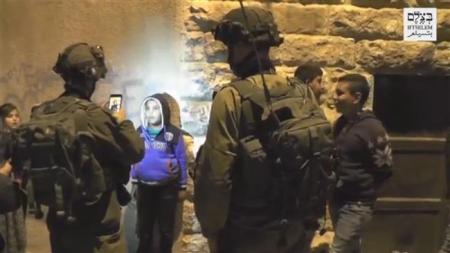
An Israeli soldier takes a photo from a Palestinian minor in Jaber neighborhood of al-Khalil (Hebron) on May 24, 2016.
Press TV – June 5, 2016
A leading Israeli rights group has denounced the Israeli military for illegally questioning a group of underage Palestinians, calling it a “blatant disregard” for the rights of minors.
A video provided by B’Tselem shows several dozen Israeli forces randomly gathering around 20 Palestinian children and teens from the streets and questioning them.
The Palestinians are forced to stand against a wall and answer questions about a stone-throwing incident, which had allegedly occurred last week.
The soldiers then take photo of every child and teen, using a cell phone, after making them sit in front of the wall before releasing them.
In a statement, B’Tselem said the scope of the latest incident and the fact that every minor was photographed was unusual.
To date, such incidents occurred within homes, with the children’s parents present, and without the minors themselves being questioned or accused of a specific offense, the rights group said.
According to B’Tselem, none of the 14 minors whose details were obtained by the rights group, had a record of being nabbed or questioned by the Israeli military.
The incident indicated that they were arrested and photographed “despite being suspected of nothing,” it said.
The statement said the “goal was primarily to intimidate the children in order to deter them from throwing stones, and to make it easier for the military to identify them in case they do.”
“This demonstrates blatant disregard for the military’s duty to protect the rights of minors.”
The Israeli military, it added, is banned from treating civilians, particularly underage ones, as potential criminals and using soldiers to deter them.
The whole incident was filmed by a B’Tselem volunteer living in the neighborhood. The rights group also obtained several of the minors’ accounts of the event.
In late May, the Palestinian Ministry of Information said nearly 2,080 Palestinian children have been killed and approximately 13,000 injured by the Israeli military over the past 16 years.
About 12,000 Palestinian children have been arrested, and 420 are currently being held in Israeli prisons, it added.
On Sunday, Israeli forces also arrested 13 Palestinians after storming their houses in the occupied West Bank.
Tensions as Zionists ’Celebrate’ 1967 Occupation of Al-Quds
Al-Manar | June 5, 2016
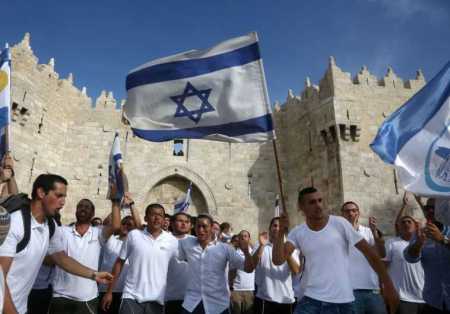
Tensions were high in al-Quds on Sunday as Zionists ‘celebrated’ the 1967 occupation of eastern part of the holy city.
AFP news agency reported there were strict security measures in al-Quds.
Meanwhile, Palestine Today reported that more than 27 Zionist organizations had called for storming the holy al-Aqsa Mosque in al-Quds on Sunday.
The website said that the Zionists are to mark anniversary of the 1967 Israeli invasion and occupation of the West Bank, Gaza, Sinai, and the Golan Heights that began on June 5.
In that day East al-Quds (Jerusalem) was occupied by the Israeli forces.
The Zionist organizations called Israelis on social media to commemorate what they called “unification of Jerusalem Day” through parades in the holy city.
The calls on social media noted that there is a deal between the organizations and the occupation authorities on ensuring security for the parades.
Israeli media also reported that the Israelis are marking “Jerusalem Day”, with multiple parades and events are scheduled in al-Quds on Sunday.
Earlier, Palestine Today said that Zionist settlers tried to torch shops in al-Quds early on Saturday, noting that Palestinian youth confronted such attempts.
Palestinian journalist and human rights defender’s interrogation extended once more by Israeli court
Samidoun Palestinian Prisoner Solidarity Network – June 4, 2016
 The detention and interrogation of Palestinian journalist and human rights defender Hasan Safadi, Arabic media coordinator for Addameer Prisoner Support and Human Rights Association, was renewed on Friday, 3 June. Safadi, 24, has been under interrogation for more than a month, since his arrest by Israeli occupation forces on 1 May as he attempted to cross al-Karameh bridge, returning to the West Bank of occupied Palestine from Jordan.
The Jerusalem Magistrate Court extended his interrogation period for 4 additional days; he will have another court hearing on Tuesday, 7 June.
The arrest of Safadi comes amid an ongoing attack on Palestinian journalists and media workers, including the administrative detention without charge or trial of Omar Nazzal, member of the General Secretariat of the Palestinian Journalists’ Syndicate; Musab Kafisheh, freelance journalist; Mohammed Kaddoumi, freelance journalist; and Ali al-Oweiwi, an announcer at Arabah radio station.
In addition, Syrian journalist from the occupied Golan Heights (holding Israeli citizenship) Bassam al-Safadi, a correspondent for the Iranian Al-Alam TV channel, was arrested on 1 June and is being imprisoned in Tzalmon prison, accused of “incitement” and “support for terrorism,” apparently on the basis of public media statements.
Other Palestinian journalists like Sami al-Saee, Samer Abu Aisha and Samah Dweik are imprisoned and charged with “incitement” for publishing on social media; Abu Aisha faces charges for going to Lebanon – where hundreds of thousands of Palestinian refugees live – labeled an “enemy country.” Journalists like Hazem Nasser and Mujahid Saadi are targeted and accused of membership in or support for an “illegal organization” – any Palestinian political party.
samidoun@samidoun.ca
Featured Video

Seyed M. Marandi: US-Iran War Inevitable: Kuwait and Bahrain May Fall
or go to
Aletho News Archives – Video-Images
From the Archives
Oil and the Israel Lobby
Reknowned economist M. Shahid Alam offers this excellent critique of Noam Chomsky’s defective analysis of the relative influence of Oil versus the Israel lobby over US foreign policy: … continue
Blog Roll
 Aletho News
- ICC ignored ‘very well-documented’ NATO crimes – ex-Libyan minister
- SNSC secretary dismisses US response to Iran’s conditions as ‘inadequate’
- Sanaa says Taiz roads open, secure for residents, warns Saudi forces
- Iraqi resistance group urges Saudi leadership to admit defeat, lift Yemen siege
- Trump’s Retreat: How Al-Aqsa Flood Took Down the US Empire
- Israel’s Military Actions in Lebanon Grossly Violate International Law — Lavrov
- Seyed M. Marandi: US-Iran War Inevitable: Kuwait and Bahrain May Fall
- Leaders Condemn Ansarallah Attack on Saudi Arabia While Ignoring Illegal War Against Yemen
- Leaked: Britain’s Covert Iraqi Psyops Network
- Yemeni Armed Forces Warn Airlines Against Using Saudi Airports, Exempt Mecca and Medina
- If Americans Knew
- After Oct 7, IDF policy allowed civilian casualties for even the lowest-ranking targets
- Israel’s Destruction of Southern Lebanon Intensified After the Cease-Fire
- The Last-Minute Decision That Gave Israel Its Name
- The American Conservative: How Trump Made the World Go Nuclear
- Meet the US generals and admirals advancing Israeli policy
- Opinion: Why news organizations should boycott Israel
- The Israeli witch hunt of Sami Abu Shehadeh exposes the lie of the ‘Jewish and democratic’ state
- No state has a ‘right’ to exist – least of all Israel
- Testimonies about Gaza’s civilian death toll expose Israel’s atrocities – Daily Update
- How Israel Conquered the Latin American Right
- No Tricks Zone
- New Study Suggests Large Regions Of The Pacific Ocean Have Been Cooling For The Last 80 Years
- Germany’s Green Energy Debacle: High Energy Costs Force Kahla Porzellan to Close After 182 Years!
- New Study: 50 Years Of The Most Aggressive ‘Net Zero’ Policies Can Only Affect The Global Climate By 0.03°C
- US September “Heat” Was No Record…Many Records Set Decades Ago
- Latest European Green Energy Debacle; Portugal’s Largest Flagship Solar Park Insolvent!
- Green Energy Debacle: German Expert Professor Fritz Vahrenholt Warns Of Severe Economic And Social Consequences
- Two More Paleo Reconstructions Affirm Meters-Higher Sea Levels Across Ireland, Brazil 7000-6000 Years Ago
- New Study: Earth And Venus Surface Warmth Largely Explained By Convection And Lapse Rate, Not CO2 Or Radiation
- 2025 Nature Paper Claiming Worsening Global Drought Gets RETRACTED …Heavily Flawed
- New Study: ‘Global Drought Shows No Detectable Recent Acceleration Under Climate Warming’

