Mayor: Israeli forces assault entire family during al-Issawiya raid

Ma’an – February 29, 2016
JERUSALEM – Israeli forces physically assaulted an entire family in the occupied East Jerusalem village of al-Issawiya overnight Sunday after the family resisted during an arrest raid, the head of the village said.
Darwish Darwish said Israeli forces stormed the home of Tareq and Tahreer Darwish with the intention of detaining the couple’s sons Yousef, 18, and Laith, 17.
The two teens, along with their father, resisted the detention, and Israeli forces attacked the three, beating them.
Darwish said the family told him that when Israeli forces began beating the father and two brothers, other members of the family stepped in and tried to stop Israeli forces, who then turned on the rest of the family.
According to the mayor, the mother, Tahreer, 37, her daughter, Batoul, 14, and 2-year-old son Darwish all suffered from bruises and lacerations all over their bodies.
Israeli forces detained the entire family, including the toddler, after the assault. The family was detained while still barefoot and in pajamas, the mayor said.
Darwish added that Israeli forces ransacked the family home, destroying valuables, before taking the family to a police station in the Sheikh Jarrah neighborhood of occupied East Jerusalem, and then transferring them to the Salah al-Din police station near Damascus Gate.
After four hours of detention, Israeli forces released the mother and her young son, but kept the rest of the family, including the 14-year-old daughter, under detention.
The 17-year-old son Laith is set to appear in Israeli court for a trial on Monday. The charges levied against him are unknown.
While the mayor shares a last name with the family, Darwish is one of the most popular surnames in al-Issawiya village, and the family is not necessarily directly related to the mayor.
The right to own property — for Jews alone
A central problem of the implementation of the Levy Report by the government is the effective abolishment of Palestinians’ property rights

Jewish settlers run towards the West Bank village of Asira al-Qibilya near Nablus during clashes with Palestinian villagers July 3, 2011. According to witnesses, the clashes erupted after the settlers cut down olive trees belonging to the village. An Israeli army spokesperson said one Israeli was injured by a rock before security forces dispersed the crowd. REUTERS/Abed Omar Qusini – WEST BANK
By Yossi Gurvitz | Yesh Din | February 28, 2016
Our previous post on Yesh Din’s new position paper, “From Occupation to Annexation,” explored the various ways the Israeli government implements the Levy Report. This post will focus on another critical point: the erasure of the Palestinians’ right to property.
Prior to the Levy Report, the Israeli government was careful to avoid legalizing the seizure of private Palestinian property, except when it could argue it was done due to pressing military needs (“military seizure”) or by declaring it state land and claiming that it was never, in fact, private property at all. This took place, in part, because the laws of occupation demand that the occupier protect the private property of protected persons in occupied territory. The legal appeals against the illegal outposts, about 80% of which are at least partially built on private Palestinian land, challenged this way of thinking.
And then came the Levy Report, which claimed the government has the right to build settlements and outposts in the West Bank. On paper this claim may have been harmless, had its implementation not directly threatened the property of private persons.
Let’s look at some examples. The future of the Adei Ad outpost – which was at the heart of another one of our reports, “The Road to Dispossession” – is being debated by the High Court of Justice. The report detailed how Israeli civilians took over private Palestinian land while using violence against Palestinian residents who tried to hold on to their land, all while the Israeli authorities stood aside. Although the report was published in 2013, the reality it describes continues even today.
As our position paper shows, the Israeli government relies on Levy’s exceedingly broad legal interpretation to legalize a series of illegal outposts, under the pretense they are in fact neighborhoods of already existing settlements – even when they are outside the jurisdiction of their “mother settlement.” Justice Minister Ayelet Shaked even boasted that “anyone who knows the Adei Ad [appeal], knows that the state responds differently these days.”
Therefore the state informed the High Court that although the outpost was illegal, it does not intend to remove it. On the contrary, it announced that it would try and legalize it. In practice, then, what Shaked meant to say was that “we decided to give criminals a prize.”
If the state told the court in 2008 that it – some day — intends to enforce the law and evacuate the outposts, its position had radically changed by 2011. Now, said the state, it will enforce the law only vis-a-vis structures built on private land, while legalizing structures built on state land. The Levy Report came out in 2012; by 2013, the state was telling the courts that in some cases “state reasons” may supersede the need to enforce the law. By 2015, the state spoke expressly about retroactive legalization.
Another case that represents the erasure of Palestinian property rights is that of Amona. Amona is the largest illegal settlement outpost in the West Bank – a significant part of the land on which it stands belongs to Palestinian residents, whose theft was followed by violence against the Palestinians. In court, the state opposed the evacuation of Amona time after time. At the end of 2014, the High Court of Justice ruled that Amona was to be evacuated by the end of 2016. So what did the government do? Did it accept the ruling and follow the instructions of the court? Of course not. It tried to bypass the court through a new bill titled the “re-ordering bill.”
This law follows one of the comments made in the Levy Report, according to which compensation for Palestinians whose land has been taken from them is preferable to evacuating the invaders. Once it can be proven that an outpost was illegally built on Palestinian land, the Palestinian owners would be forced to accept compensation and give up their rights to their own property.
According to the Levy Report, therefore, all people are equal before the law, but some are more equal. You own land? Jewish invaders took it with government aid? We won’t evacuate them, we simply legalize the invasion. Here are your 30 pieces of silver. Oh, you don’t want to take them because you’re afraid of living next to Israelis who have already proven their affinity for violence? You won’t take the silver because you don’t want to take part in Jewish expansion over parts of Palestine? Tough. Your property rights are secondary to our historical rights. Do yourself and us a favor and take the money, because, you see, this outpost won’t be removed. It will remain here whether you like it or not. The court ruled otherwise? We’ll try and change the law. What about your rights? What rights?
The bill currently names three outposts and a part of a settlement – three outposts that the court had already ordered be removed, and one whose case is still debated. Amona is mentioned specifically as an outpost covered by the bill. Politicians are not even trying to conceal the fact the point of the bill is to prevent the High Court from slowing down the violation of Palestinian rights. Just in case, the bill – which has been frozen for the time being – allows other outposts to be added to it even after it passes.
The state’s responses to the court and the “re-ordering bill” deal outposts whose fate were either ruled on by the High Court or are still being debated. But the government ministers, being people of vision, take care not only of the past and present but also of the future. The “re-ordering committee,” created by Prime Minister Netanyahu, is supposed to provide other solutions, as it has a mandate to “examine the current process of evidence needed for proof of land ownership.” To put it more bluntly: its purpose is to make it even more difficult for them to prove they are landowners. The purpose of the committee is to create “an outline for the legalizing of structures and neighborhoods in Jewish settlements in Judea and Samaria that were built with the support of the authorities.”
The Israeli government never authorized the Levy Report’s recommendations while effectively endorsing and carrying them out in secret. The government implements an unofficial policy of annexation – one that does not grant equal rights to those being annexed, while at the same time depriving them of the legal defenses they are entitled to as protected persons, since, allegedly, there is no occupation.
As for the people who live there? It’s their own problem. They should have lived someplace else. Didn’t they get the hint already?
Five reasons why the TTIP talks are looking a bit wobbly
By Guy Taylor | TruePublica | February 26, 2016

The twelfth round of negotiations for TTIP, the biggest trade deal of them all, started this week in Brussels. The impacts of TTIP are disturbing and well documented elsewhere on this site, but we are seeing signs of panic setting in on the pro-TTIP side of the fence. They’re right to panic.
1) TTIP is hugely behind schedule. It should have been signed off by now, and well into the ‘legal scrubbing’ stage where the lawyers tie up the legal loose ends and smooth of the rough edges. These negotiations are not open ended. Every delay, every extra month taken up at this stage is a threat to the entire project. We have the US elections looming, two of the frontrunners are against the new generation trade deals like TTIP and the Trans-Pacific Partnership (TPP). There is no secret about the desperation of the Obama machine as they try to get the deal done and signed off before he vacates the White House at the end of the year. Obama is due to visit Germany in April to plead with all concerned to get a move on with the project. It is not impossible for the ratification vote in the European parliament to be held in 2019, after the next elections. That would make ratification in Europe very uncertain indeed.
2) There is a huge crisis over the proposals of corporate courts or ‘ISDS’ as it is often known. As the most contentious part of TTIP, it has attracted huge criticism and upset amongst members of the European parliament and in the public domain as well. In 2014, 150,000 responded to a European consultation on the issue and 97% of those responses were very negative. Since then, the trade commissioner in Brussels has dreamt up the Investor Court System as a proposed alternative. It has been made very clear that ICS is not alternative, more a repackaging of the dangerously flawed ISDS. Earlier this month,the largest association of German Judges completely slammed the ICS idea as undemocratic and undermining the sovereignty of domestic courts. Slowly, our representatives in Brussels are beginning to realise this. We need to keep shouting about this
3) You might have noticed, but there is going to be a referendum on membership of the EU in the UK in June. Everything is up for grabs. If the UK votes to leave the EU, TTIP will probably still apply to us. In the horse-trading and arguments that will rage between now and the day of the vote, there will be concessions and deals struck – maybe, just maybe, TTIP could become a casualty. And in the run up to the referendum, the very idea of Brussels politicians signing off on such a far-reaching corporate power grab is adding a whole lot of fuel to the Brexit fire.
4) Procurement at all levels of government, both sides of the Atlantic is proving to be a sticking point. The EU wants access to state level procurement in the US – that’s a huge market to access. And at country level in the EU there’s an almost equally lucrative market to exploit for US corporations. The trouble is, this isn’t a deal being negotiated at state or nation state level. The US Trade Representative and the DG Trade in Europe are doing their utmost to keep scrutiny and influence at that level to a minimum, but agreeing stuff that is essential to their underlings at local level is part and parcel of TTIP and is inflaming opposition. Local authorities across the EU and in the UK are declaring their opposition to TTIP and CETA. In the States, there’s a similar move afoot. It was recently announced that the EU and USA were going to swap procurement market access offers at the end of this month and then hold a special intercessional meeting to discuss them.
5) And finally, one thing that cannot be ignored, is the growing movement of ordinary people across the EU & the US gaining knowledge and understanding about the deals (despite the best efforts of our governments and media). From the 3.2 million people who signed their opposition in the European Citizens’ Initiative last year, to the trade unions and community organisations saying ‘no’ to the deals, we are building a force that will be hard to resist. We can win this fight if we continue to step up the pressure.
More atglobaljustice.org.uk
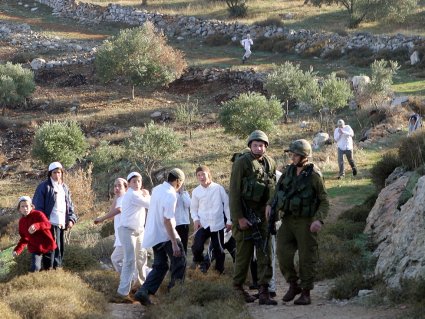
Israeli settlers escorted by army raid village in Salfit district
Ma’an – February 27, 2016
SALFIT – A group of Israeli settlers escorted by Israeli military forces raided the village of Yasuf in the northern West Bank district of Salfit on Saturday.
The head of the Yasuf village council, Hafith Ebayya, said that a group of Israeli settlers raided the village and attempted to enter the al-Basatin area in central Yasuf.
Ebayya said that the settlers were escorted by military vehicles and soldiers, and that a military checkpoint was set up at the entrance of the village.
Clashes erupted between dozens of Palestinian youths and Israeli forces.
Israeli forces fired live bullets, rubber-coated steel bullets and tear gas at youths and several farmers who were in their fields nearby.
Several youths and farmers suffered from tear gas inhalation.
An Israeli army spokesperson told Ma’an they were looking into the report.
Three quarters of Yasuf’s lands are located in Area C — under full Israeli military and administrative control. According to a report by the Applied Research Institute-Jerusalem (ARIJ), over the years, some 602 dunams (148.7 acres) of Yasuf land have been seized to establish settlement housing.
Several Israeli settlements are located near Yasuf, including Ariel, the fourth largest settlement in the West Bank. These settlements in the occupied West Bank and East Jerusalem are illegal under international law.
Palestinian activist Rasmea Odeh Has Conviction Thrown Out

Palestinian activist Rasmea Odeh | Photo: Justice 4 Rasmea
teleSUR – February 26, 2016
A U.S. appellate court on Thursday vacated the conviction of Palestinian activist Rasmea Odeh for allegedly lying on U.S. immigration papers 20 years earlier.
Odeh, 67, was put on trial in November 2014 for allegedly falsifying immigration documents when she first entered the U.S.. Odeh had denied ever having been “charged, convicted or imprisoned for a crime,” but the government maintained that she lied as she had been convicted in an Israeli military court for allegedly bombing a supermarket.
Odeh said she was subjected to torture and rape by Israeli interrogators and forced to sign a false confession.
The U.S. federal appeals court panel ruled that Odeh’s sentencing judge had improperly excluded testimony about the psychological trauma Odeh suffered while in Israeli military custody.
“The court’s decision presents a great victory to anti-torture advocates and survivors of torture,” said the Center for Constitutional Rights in a press release.
Odeh’s case will now return to the district judge for a possible retrial.
During Obama’s Presidency Wealth Inequality has Increased and Poverty Levels are Higher
By Rick Baum | CounterPunch | February 26, 2016
Troubling and significant statistics produced by the government indicate important facts about our political system and its priorities. Unfortunately, these statistics often get little coverage in the media. What coverage is provided usually only focuses on the current year and might include comparison with the previous year.
Two such sets of government statistics cover wealth distribution and poverty. These statistics have a margin of error and do not account for the up and down fluctuations in the economy nor changing historical conditions or limitations of what any president can do.
What is perhaps most critical are the trends. These trends show that wealth has become more concentrated and more people are deemed by the government to be poor.
Wealth Inequality
Below are government figures that show the trend of growing wealth inequality.1
Share of Total Net Worth by Percentile of Wealth Owners, 1989-2013

These figures show that during the presidencies of Bush Sr., Clinton, G. W. Bush, and Obama so far, a greater portion of the nation’s wealth has become more concentrated in the hands of the rich as indicated by the share of wealth held by the top 1%. From 1989 to 2010, it increased from 30.1% to 34.5% and, under another methodology, to 36.6% in 2013.
From 1989 to 2013, the share of the top 10% went from 67.2% to 75.2% or from slightly over 2/3 to more than 3/4 of the nations’ total wealth. This means that from 1989 to 2013, the drop in the share of wealth held by the bottom 90% went from 32.9%, almost a third, to 24.8%, less than one-fourth.
Even more striking is that from 1995 to 2013, the poorest half of the population, after experiencing its share of the nation’s wealth peaking in 1995 at 3.6%, underwent a more than 2/3 decline in their portion. It fell in 2013 to a paltry 1.05% of all wealth.
Despite the last few years of “recovery,” the share of wealth held by the bottom 50% of the U.S. population declined from 1.15% in 2010 to 1.05% in 2013. This is less than half of where it stood in 2007, before the great recession, when the share of the country’s wealth held by the poorest 50% of the population was at 2.5%.
In 2008, Obama spoke of hope for a better future. If the wealthy hoped for a greater share of the nation’s wealth, their hope was fulfilled while the wealth conditions of most everyone else have declined.
These changes in wealth holdings were clearly described by Federal Reserve Board head Janet Yellen who began a speech on October 17, 2014 noting:
“The distribution of income and wealth in the United States has been widening more or less steadily for several decades… This trend paused during the Great Recession because of larger wealth losses for those at the top of the distribution and because increased safety-net spending helped offset some income losses for those below the top. But widening inequality resumed in the recovery…” (emphasis added). 2
This widening inequality and greater concentration at the top was presumably more pronounced after 2013 when the value of the stock market rose with the Dow Jones Industrial Average reaching its peak at over $18,300 in May of 2015. Today, wealth inequality is probably back to where it was in 2013 since the stock market has recently gone down to 2013 levels.
Poverty
While wealth inequality has increased, the number of people living in poverty has also generally increased. Below are figures from 1981 to 2014 for the number of people deemed to be poor and their percentage of the population.3 This percentage has been 15% or higher for three years of Obama’s presidency, from 2010-2012. It had reached that level only three other times since 1981.

These numbers show that the rate of poverty since 1981 was lowest in 2000 at 11.3%. During the time George W. Bush was president, with exceptions, it steadily increased from 11.7% in 2001 to 13.2% in 2008. 5 As might be expected, the rate increased during the great recession peaking at 15.1% in 2010.
As of 2014, some six years after the beginning of the recession and during a period of “recovery,” the rate of poverty remains high at 14.8%. In fact, according to these government statistics, the rate of poverty for every year Obama has been president is higher than it was for every year during George W. Bush’s presidency.
The percent of people below 125% of the official poverty rate has also been higher every year under Obama than during Bush’s presidency, and has been over 19% every year from 2010 through 2014. The highest level it reached under Bush was during the start of the recession in 2008 when it was at 17.9%.
What is most disturbing is the percent of the population living in extreme poverty, or having an income at 50% or lower than the poverty level.5 Every year that Obama has been president, the percent of the population at that level of income has been over 6% and, as of 2014, consisted of over 20 million people. When George W. Bush was president, the percent was always under 6%. The last time it was over 6% was during the first year of the Clinton presidency. 6
Even the record during Reagan’s presidency may be viewed as more favorable than Obama’s. During the time Reagan was president, the official rate of poverty peaked at 15.2% in 1983. Thereafter, it gradually declined to 13.0% in 1988.7 By contrast, the rate of poverty during Obama’s time in office has always been more than 14.3% and was 14.8% in 2014, or almost 2% higher than it was at the end of Reagan’s presidency.
A quip that was made about Reagan is that he liked poor people so much that he acted to increase their numbers. During his first three years, the poverty rate and the number of people deemed to be impoverished increased, reaching its peak in 1983. Thereafter, from 1983 to the end of Reagan’s presidency in 1988, the number of people deemed to be poor declined by over 3.5 million ending at slightly below the total during the first year of his presidency.
In contrast to the record of Reagan’s presidency, during the time Obama has been president and statistics are available, 2009-2014, the population has grown by 11.98 million. This is close to its growth for the last six years of Reagan’s presidency. Yet, the number of people deemed to be living in poverty has not declined, but has increased by more than 3 million. For comparison, see this table extrapolated from previous figures:

If, in 2008, one hoped for the presence of more poor people and for a greater concentration of wealth in the hands of the rich, so far, during Obama’s presidency, these hopes have been fulfilled. They will presumably continue were a Republican elected president. Should one also expect more of the same from Hillary Clinton who wants to build “on the progress the president has made,” or Bernie Sanders who thinks Obama “has done an excellent job?”8
Footnotes
1. Wealth is the value of what one possesses minus what is owed. Unlike income, it is not subject to a yearly tax. It is also distributed more unequally than income. See the last tables in the links at the end of this footnote.
see page 4 in An Analysis of the Distribution of Wealth Across Households at https://www.fas.org/sgp/crs/misc/RL33433.pdf and
For 2013, a figure for the top 1% is not provided. See the next two sites.
http://www.federalreserve.gov/pubs/bulletin/2014/articles/scf/accessible.htm#box3figA
another table with historical trends: see Figure 3 at: It is source for bottom 50% figure of 1.15% in 2010 and 1.05% in 2013. http://www.federalreserve.gov/newsevents/speech/95BF8144CFB24C649FAEF51B056738B9.htm
The source for the 2013 figures for the top 1% and the 90-98.9% whose figures from 1989-2010 are slightly different are in Table A1C on page 34 at: http://www.federalreserve.gov/econresdata/feds/2015/files/2015058pap.pdf
According to one study, as of 2012, the top .01% of the population or about 16,070 families whose average wealth is about $371 million, possess 11.2% of all wealth and the top .1% possess about 22% of all of the country’s wealth. See table 1 at the end of the paper after references at: http://gabriel-zucman.eu/files/SaezZucman2016QJE.pdf
Figure 1 in the same location shows the share of wealth holdings of the top .1% from 1913-2012. It was below 10% in 1989 which means it more than doubled during the subsequent years.
For income inequality see https://www.census.gov/library/publications/2015/demo/p60-252.html tables:
Income Distribution Measures Using Money Income and Equivalence Adjusted Income: 2013 and 2014 [PDF – 46k] and
Selected Measures of Household Income Dispersion: 1967 to 2014 [PDF – 402k]
2. http://www.federalreserve.gov/newsevents/speech/yellen20141017a.htm
3. https://www.census.gov/library/publications/2015/demo/p60-252.html see table under Poverty title
Impact on Poverty of Alternative Resource Measure by Age: 1981 to 2014
Those with income at 125% of poverty rate see https://www.census.gov/hhes/www/poverty/data/historical/people.html
Table 6. People Below 125 Percent of Poverty Level and the Near Poor
Those with income at 50% of poverty rate see
Table 22. Number of People Below 50 Percent of Poverty Level
Noteworthy about poverty in the U.S. is that in 2014, 21.1% or 15.5 million children under 18 years of age were deemed impoverished by the government, and some 6.8 million of them lived at one-half the official poverty rate. The rate of poverty among Blacks (26.2%) and those who are “Hispanic any race” (23.6%) is much higher than that of the general population. See https://www.census.gov/library/publications/2015/demo/p60-252.html see tables under Poverty title
People and Families in Poverty by Selected Characteristics: 2013 and 2014 and People With Income Below Specified Ratios of Their Poverty Thresholds by Selected Characteristics
4. see https://www.census.gov/hhes/www/poverty/data/historical/people.html
Table 1. Weighted Average Poverty Thresholds for Families of Specified Sizes
5. During the Clinton administration, the rate of poverty and the number of people deemed to be poor remained high as both steadily declined.
During the Clinton years and continuing thereafter, wealth became more concentrated at the top in part due to the dot-com boom and from policies enacted including NAFTA, the repeal of
Glass Steagell and reduced taxes on some forms of investment income.
6. A single person with a level of income at 50% of the poverty threshold lives on less than $17/day. A couple would be having to get by on less than $22/day.
7. The rate and number of people living in poverty increased during all four years of the presidency of Bush Sr.
8. Clinton quote: see http://www.msnbc.com/rachel-maddow-show/hillary-clinton-i-want-build-obama-era-progress
Sanders quote at: http://www.nytimes.com/2016/02/05/us/politics/democratic-debate.html?hp&action=click&pgtype=Homepage&clickSource=story-heading&module=first-column-region®ion=top-news&WT.nav=top-news
Rick Baum teaches Political Science at City College of San Francisco.
Omar Nayef Zayed assassinated in Palestinian embassy in Bulgaria

UPDATE/11:44 am/26 February: Bulgarian media and police sources are reporting that Omar was killed by falling from a high story of the building. They have noted that him being pushed is “not excluded.” “Israeli media have been the first to report explicitly that Omar was ‘assassinated.’ This comes as no surprise. They’re simply the most knowledgeable and honest about the workings of their government and its intelligence agencies,” said Joe Catron of Samidoun.
Samidoun Palestinian Prisoner Solidarity Network | February 26, 2016
Omar Nayef Zayed, a former Palestinian political prisoner and escaped hunger striker whose extradition from Bulgaria Israel demanded in December, was found dead this morning inside the Palestinian embassy in Sofia, Bulgaria, where he had sought refuge.
“Omar Nayef Zayed was targeted as a Palestinian, as a struggler, as a former political prisoner,” Charlotte Kates, international coordinator of Samidoun Palestinian Prisoner Solidarity Network, said. “His case, his targeting and his assassination were an attempt to demonstrate that no Palestinian anywhere is safe from the long arms of the Israeli occupation. This is clearly a threat to all Palestinians – especially former prisoners and veterans of the struggle in Europe. We are committed to stand with the family of Omar Nayef Zayed to pursue accountability for those responsible for taking his life and to build the movement for which his life was taken – for a free Palestine.”
The precise physical cause of Omar’s death is not yet clear, but it is clear that the cause of his death is the Israeli state’s vengeance against a Palestinian struggler committed to live free for himself and for all of his fellow Palestinians. Samidoun Palestinian Prisoner Solidarity Network demands an independent autopsy of Omar’s body and a full investigation by Bulgarian and Palestinian officials into the death of Omar. We demand that all those responsible for the targeting of Omar Nayef Zayed and the taking of his life be held fully accountable.
“We hold Israel and its intelligence services, the Palestinian Authority and the Bulgarian government responsible for the killing of Omar Nayef Zayed, whose life was taken as he lived his life, in the struggle for freedom for Palestine,” Mohammed Khatib, a Brussels, Belgium-based member of Samidoun: Palestinian Prisoner Solidarity Network, said. “He was assassinated; he was not protected; and he was constantly threatened and pursued. The Israeli intelligence services have a long history of pursuing and assassinating Palestinians around the world – especially in Europe – targeting young leaders and veteran resisters for assassination and elimination. This outrageous crime happened inside the Palestinian embassy, inside Bulgaria. The killers and those who made this killing possible must be held accountable.”
Zayed, 52, was born in Jenin, in Palestine’s West Bank. He was arrested by occupation forces in May 1986 and sentenced to life imprisonment. After a 40 day hunger strike in 1990, he was transferred to a hospital in Bethlehem where he escaped in May, disappeared and left Palestine.
In 1994, he traveled to Bulgaria. Omar married a Bulgarian citizen and has Bulgarian children; he runs a Palestinian grocery and is well-known in the Palestinian community of Sofia.
On Tuesday, 15 December, the Israeli embassy sent a letter to the Bulgarian Ministry of Justice demanding the extradition of Omar Nayef Zayed, labeling him a “fugitive from justice.”
Omar’s home was raided on Thursday, 17 December. He was not home and his son was arrested for one day. The Bulgarian prosecutor was quoted in Arabic media calling for his imprisonment and quick extradition to Tel Aviv.
Samidoun Palestinian Prisoner Solidarity Network salutes and mourns Omar Nayef Zayed, a former Palestinian political prisoner who struggled all his life for the freedom of Palestine and the Palestinian people. We extend our deepest condolences to the family of Omar Nayef Zayed, in Palestine, in Bulgaria and everywhere, and to the entire movement for the liberation of Palestine, which has had a loving father and husband and a committed struggler for a free Palestine taken away at the hands of those who would see Palestine, and its people, forever imprisoned. We are committed to working in all ways to hold those responsible for his death fully accountable for this vicious crime against the Palestinian people, and to struggle for the freedom – of Palestinian prisoners and of Palestine itself – which Omar Nayef Zayed held so dear.
California Cops Shoot and Kill Man and Woman Passed Out in Car
By Carlos Miller – PINAC – February 24, 2016
California cops shot and killed a man and woman Sunday after finding them unconscious in a car and spending 45 minutes trying to “deescalate the situation” before they “felt threatened,” according to Inglewood Mayor James Butts, a former police chief.
But Butts did not explain how Inglewood police felt threatened by an unconscious couple before opening fire on the couple.
All he said was that the woman, Kisha Micheal, had a gun in her right hand, which is what police have been saying all along.
However, Michael’s family said she did not even own a gun.
And as more details emerge from the incident, it certainly appears that things are just not adding up.
On Sunday, the Los Angeles Times described the incident as a “confrontation” with “suspects,” basing their report on information obtained from police.
On Monday, after attending a press conference and speaking to family members, the Los Angeles Times was no longer describing it as a confrontation but as a “mystery,” quoting Micheal’s sister, who stressed her sister did not even own a gun.
And on Tuesday, NBC Los Angeles reported that Mayor Butts admitted that the man and woman were not even awake – a tiny detail that was overlooked by police when they initially described their so-called confrontation.
For at least 45 minutes, police attempted “to rouse” them in an effort “to de-escalate the situation,” said Butts. It is the first public explanation for what transpired early Sunday morning during the time between the initial call and the shooting. Police previously had stated responding officers saw the woman had a gun, retreated to behind cover, and then gave orders for the couple to exit the vehicle.
“Obviously at some point they were conscious because somebody felt threatened,” said Butts, a retired law enforcement officer who previously had served as police chief in other cities. He said it is important for police to finish their investigation, and verify facts, before commenting further.
Other details emerging Tuesday was that Michael was out with a man named Marquintan Sandlin, a 32-year-old single father of four daughters. Michael was a single mother of three sons.
The two were apparently out on a date, having left their children in the care of family members. But it appears as if they had too much to drink and ended up passing out, which drew the attention of police, who claimed the woman was holding a gun.
That prompted them to call the SWAT team and at least one armored car, who began ordering them through a megaphone to wake up and exit the car.
At one point, the couple apparently did wake up, which led to the gunshots.
22 years after the Ibrahimi mosque massacre, Palestinians still suffer consequences

International Solidarity Movement | February 25, 2016
Hebron, Occupied Palestine – On the 25th of February 1994, a US citizen residing in the illegal Kiryat Arba settlement entered the Ibrahimi mosque in the early morning during the month of Ramadan. Baruch Goldstein, dressed in his army uniform, opened fire on the Palestinians that were crammed inside for the prayer. He killed 29 men and boys and injured dozens before people overpowered him and beat him to death.
That day, many more Palestinians were killed in Hebron during riots protesting the massacre that had occurred, in front of the mosque and the hospital where the injured were treated, as well as in the cemetery were the dead were being buried. In the next few days, protests and marches happened all over the West Bank and across historic Palestine. It is believed that in total, in these few days, 50 to 70 Palestinians were killed, and over 250 were injured.
Immediately after the attack, the Israeli government released a statement condemning this act and affirming that Goldstein was acting on his own behalf. The Prime Minister Yitzak Rabin called Goldstein a “degenerate murderer, a shame on Zionism and an embarrassment to Judaism.” Rabin always affirmed that Goldstein acted on his own behalf and that the Israeli military had no knowledge of his plans. Though his act was condemned, it resulted in many measures that mostly impacted on Palestinians. Instead of evacuating the settlements of Hebron, only a few of the most extreme settlers were temporarily disarmed.
A round-the-clock curfew was imposed. Shops in Shuhada Street were forced shut by the Israeli army, on the pretext of keeping settlers safe on this commercial artery. Many other shops also had to close due to lack of supplies and customers. New checkpoints were installed. Palestinians were first banned from driving and then simply from accessing most of Shuhada Street. Many of these measures resulted in the displacement of many Palestinian families.
In 1997, a protocol was signed between Israel and the PLO, dividing Hebron into two areas: “H1”, controlled by Israeli forces, and “H2”, under Palestinian control. It called for the withdrawal of Israeli soldiers from the H1, which represented 80% of the city. To this day, even though H1 is officially controlled by the Palestinian Authority, it remains under overall Israeli control, while H2 is now the home to many violent and extremist settlers. Some of them still go every year to the tomb of Baruch Goldstein to celebrate his treacherous act of murder.
22 years later, all measures that were declared in Hebron on the 25th of February, 1994 are still enforced, except for the curfew. And settlers are more than ever taking over the city, with the compliance of the Israeli government.
The last tiny bit of Shuhada Street, that was not (yet) declared a ‘sterile zone’ and thus been completely barred for Palestinians, has been under repeated ‘closed military zone’ orders since 1st November 2015. Whereas the majority of Shuhada Street has been completely unaccessible for Palestinians, the tiny strip leading from the recently ‘renovated’ Shuhada checkpoint up to the illegal Beit Hadassah settlement, is slowly resembling a ‘ghost street’ more and more, as only Palestinians registered with the Israeli army are allowed to go there.
The closed military zone order is an illegal collective punishment on the whole Palestinian population of this area, that was forced to register in order to be allowed to live in their own houses whereas settlers in the adjacent illegall settlements can walk the roads freely and completely undisturbed. This clearly is just another step in the Israeli policy of making life for Palestinians as hard and humiliating as possible in an attempt to make them leave the area and eventually drive all of them out and connect the settlements.
Every year, Palestinians in occupied al-Khalil commemorate the Ibrahimi mosque massacre and protest against the closure of Shuhada Street and the illegal Israeli occupation. The week, leading up to the 22nd anniversary of the massacre, has seen and will continue to see creative activities and demonstrations. This past week there were also many commemorations of Palestinians, most of whom have been gunned down by Israeli forces and left to bleed to death without any medical help.
US marshals shoot innocent man in back ‘execution style’ during raid on wrong address: attorney
By David Edwards | Raw Story | February 24, 2016
A New Mexico attorney accused U.S. marshals this week of shooting a 23-year-old man in the back “execution style” when they arrived at the wrong address to make an arrest.
According to KOB, marshals were attempting to execute an arrest warrant for George Bond in Albuquerque on Saturday, but mistakenly opened fire on a home three trailers away from the suspect’s.
The family of 23-year-old Edgar Alvarado confirmed that he was fatally shot by agents.
“They said that they had made a mistake because he was out there at the wrong time. No such a mistake by killing somebody. There’s no accident,” Perla Alvarado, cousin of the victim, told KOB.
At a press conference on Monday, an attorney for the family accused federal agents of shooting Alvarado four times in the back, the Albuquerque Journal reported.
“It’s almost inexplicable, but we have evidence … that Edgar was dragged from the house, after having been struck multiple times, taken outside, given commands to give up a weapon, as he’s gurgling and flailing his arms, and shot a fourth time,” attorney Robert Gorence said. “Almost what you would call ‘execution style.’”
According to Gorence, multiple eyewitnesses had said that Alvarado was shot in the back the fourth time when he was not able to respond to agents’ commands.
“When you do things in the middle of the night, and go to the wrong address, when you don’t know the individual’s name or have a picture of the person you are looking for, is it any surprise you have catastrophic and horrific outcomes?” Gorence noted. “At 3:30 in the morning, when you go to the wrong place in a lock-and-load mentality, it’s kind of easy to see what happens.”
The attorney said that he had sent a letter to Damon Martinez, U.S. Attorney for the District of New Mexico, asking for more details about the case to be released. He said that a federal tort claims notice would be filed by the end of the week.
“All we’re asking right now is to get answers,” Gorence insisted. “So far that has been completely stonewalled.”
New Mexico State Police are investigating the incident, and have only stated that U.S. marshals shot Alvarado during a “confrontation.”
Featured Video

Saudi Led Destruction of Yemen’s heritage
or go to
Aletho News Archives – Video-Images
From the Archives
Israel: Strategic Ally or Liability?
By Stephen Sniegoski | My Catbird Seat | June 12, 2010
The claim that Israel serves as a valuable ally for the United States is made by both pro-Zionists and much of the anti-war and anti-Zionist Left that is influenced by Noam Chomsky. As a result of the Gaza flotilla massacre, which has caused a world-wide uproar against Israel, the value of Israel to the United States is being publicly questioned in more mainstream foreign policy forums. … continue
Blog Roll
 Aletho News
- Declassified UK exposes British man who fought for ‘Israel’ in Gaza
- West’s death cult in a theater near you
- How the Yandex ‘Russian bots’ lie fell apart
- Burnham’s ‘Russia did Brexit’ ruse crumbles
- Estonia making movies and games to encourage war against Russia
- Four in five new UK jobs taken by foreigners – report
- Here’s what Trump’s latest U-turn really means for Russia and Ukraine
- The Houthis Are Not an Iranian Proxy
- Europe’s Energy Hypocrisy, Russian LNG Profits and US Dependence
- ICC ignored ‘very well-documented’ NATO crimes – ex-Libyan minister
- If Americans Knew
- Activists Abused By Israel Return to New Freedom Flotilla Mission
- 60 Minutes won’t tell the full truth about Israeli settler violence
- Nearly 50,000 women, girls killed or severely injured in Gaza since October 2023: UN Women
- ADL is working with AI companies to suppress alleged ‘antisemitism’
- Israeli occupation forces using social media surveillance unit to target hundreds of Palestinians in the West Bank
- Israel’s New – and Terrifying – Security Doctrine
- Israeli Attacks Kill Five in Gaza, Including a four-year-old and a woman
- Air Force Major Who Called for Trump’s Impeachment Held in Solitary Confinement
- It’s a Genocide, I’m Into It’: Seinfeld Mocks Protest over Palestinian Children Killed
- Universities fire dozens amid pressure from Zionist billionaires
- No Tricks Zone
- New Study Suggests Large Regions Of The Pacific Ocean Have Been Cooling For The Last 80 Years
- Germany’s Green Energy Debacle: High Energy Costs Force Kahla Porzellan to Close After 182 Years!
- New Study: 50 Years Of The Most Aggressive ‘Net Zero’ Policies Can Only Affect The Global Climate By 0.03°C
- US September “Heat” Was No Record…Many Records Set Decades Ago
- Latest European Green Energy Debacle; Portugal’s Largest Flagship Solar Park Insolvent!
- Green Energy Debacle: German Expert Professor Fritz Vahrenholt Warns Of Severe Economic And Social Consequences
- Two More Paleo Reconstructions Affirm Meters-Higher Sea Levels Across Ireland, Brazil 7000-6000 Years Ago
- New Study: Earth And Venus Surface Warmth Largely Explained By Convection And Lapse Rate, Not CO2 Or Radiation
- 2025 Nature Paper Claiming Worsening Global Drought Gets RETRACTED …Heavily Flawed
- New Study: ‘Global Drought Shows No Detectable Recent Acceleration Under Climate Warming’

