Israel Escalates ‘Water-Apartheid’ As Illegal Settlers Contaminate Palestinian Water
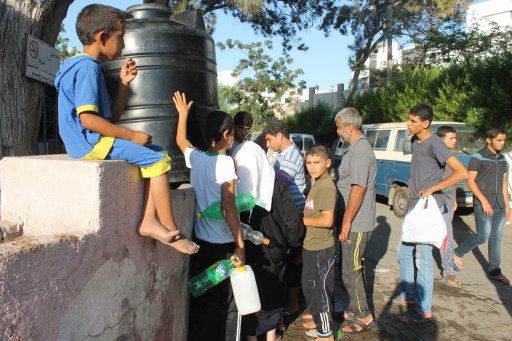
Palestinians displaced by Israeli strikes wait to get water from portable tanks near a makeshift encampment behind Gaza’s al-Shifa hospital, July 26, 2014. (Joe Catron)
By Joe Catron | Mint Press News | September 29, 2015
UNITED NATIONS — Israeli restrictions on Palestinian water use, as well as damage to water supplies and infrastructure by both Israeli forces and Jewish settlers, continue to deplete the already limited water supplies available to millions of Palestinians in the occupied West Bank and Gaza Strip.
“Water is used by the Israelis to achieve non-water interests, as a tool of punishment,” Dr. Abed Elrahman Tamimi, director of the Palestinian Hydrology Group in Ramallah, told MintPress News.
Meanwhile tens of thousands of Palestinians within Israel continue to lack access to running water, despite their citizenship in the state and the equality they should receive under its laws.
Israel has limited the water available to Palestinians in the Gaza Strip and West Bank since its forces occupied the enclaves, placing them under military rule, in 1967.
‘Scandalously uneven, humiliating and infuriating’
The Oslo II Accord, signed by Israel and Palestine Liberation Organization on Sept. 28, 1995, formalized this disparity, imposing what Israeli newspaper Haaretz writer Amira Hass called “a scandalously uneven, humiliating and infuriating division of the water resources of the West Bank.”
The agreement afforded Palestinians 118 million cubic meters of water per year from the Mountain Aquifer that stretches into Israel from the West Bank, while obligating Israel to sell Palestinians a further 27.9 mcm annually at full price.
It also entitled Israel to claim 483 mcm per year – over four times as much – but allocated none to the Gaza Strip, which was left to rely on the small Coastal Aquifer.
According to its own terms, Oslo II should have terminated in Palestinian independence after five years, with a joint committee increasing Palestine’s water allocation through consensus in the meantime. Neither scenario has come to pass.
In coming years, Israel would make clear that it had no intention of ever ending its control of Palestinian water. A June 7, 1997 order reiterated its longstanding policy: “All the water in the land that was occupied again is the property of the State of Israel.”
Successive governments pushed new waves of settlement construction, universally considered war crimes under the fourth Geneva Convention, on Palestinian lands in the West Bank. By 2000, the number of settlers had swelled 26 percent.
Like earlier settlements, the sites of many new units were calculated to maximize Israeli control of Palestinian water. In 2001, then-Israeli Prime Minister Ariel Sharon told Haaretz : “Is it possible today to concede control of the aquifer, which supplies a third of our water? Is it possible to cede the buffer zone in the Jordan Rift Valley? You know, it’s not by accident that the settlements are located where they are.”
Israeli measures to cement its occupation, along with provocative raids of the Al-Aqsa Mosque in Jerusalem, ultimately produced the Second Intifada, a Palestinian uprising that erupted on Sept. 28, 2000, five years to the day after Oslo II.
A vicious water cycle
Palestinians currently use no more than 11 percent of the Mountain Aquifer, with Israel enjoying the rest, according to the Emergency Water, Sanitation and Hygiene group (EWASH), a coalition of 28 Palestinian and international agencies dealing with water issues in the West Bank and Gaza Strip.
Meanwhile, West Bank Palestinians purchase 50 mcm of water each year from Mekorot, Israel’s national water company, paying $50 million for the return of their own resources at prices up to three times those charged to Israeli consumers.
Oslo II obligated Israel to increase its water sales to Palestinians in the Gaza Strip from 5 to 10 mcm annually during the supposed five-year “interim period.” But only this year, following widespread condemnation of its military operation against the besieged enclave last summer, did it finally do so, meeting 5 percent of the water needs of a population that has more than doubled.
On September 1, a United Nations Conference on Trade and Development report repeated a warning, first made by the UN’s Country Team for the occupied Palestinian territory in 2012, that the Gaza Strip could become unlivable by 2020.
UNCTAD cited the destruction of Gaza infrastructure during repeated Israeli offensives, including damage to 20-30% of the enclave’s water and sewer network, a water desalination plant, and 220 agricultural wells during last summer’s 51-day operation alone, as well as Israeli restrictions on economic development and reconstruction.
It also warned that “a severe water crisis” had forced the use of water from the Coastal Aquifer — 95% of it unfit for drinking — at levels “well above the recharge rate by over 100 million cubic meters, almost twice the sustainable rate.”
“The over-abstraction and scarcity of drinking water have been exacerbated by crumbling sanitation infrastructure, while the blockade creates chronic shortages of electricity and fuel, which in turn aggravate contamination and the water crisis,” the report said.
“The damage of contamination and over-abstraction is such that the aquifer may be unusable by 2016 and, if unaddressed, the damage may be irreversible by 2020.”
The total damage inflicted to the water sector by Israeli strikes last summer reached over $34 million, according to a report by the Palestinian Water Authority, although UNCTAD’s report says that “long-term repair of the accumulated damage and decay of the water and sanitation infrastructure will require $620 million.”
Last month, EWASH reported that 120,000 Palestinians across the Strip remained disconnected from its water network, while 23 percent of its 1.8 million residents lacked access to its sewage service.
Destroying infrastructure
Palestinians have never extracted their full 118 mcm of water from the Mountain Aquifer, as Israeli restrictions on wells and other infrastructure across most of the West Bank prevent them from doing so.
These military orders stretch into the Gaza Strip, where the threat of airstrikes forces residents hoping to dig wells to first seek permits from the Israeli army.
While sometimes given there, such permission is usually denied in Area C, the 60 percent of the West Bank under direct Israeli military administration, often on the claimed basis of Israeli security.
Israel targets unauthorized construction ruthlessly. Since the beginning of this year, its forces have destroyed 36 Palestinian water, hygiene and sanitation structures in Area C, usually citing their lack of permits, according to United Nations Office for the Coordination of Humanitarian Affairs data reviewed by EWASH.
Rare permits come at high prices. A 2013 study found that Israel usually conditions its approval of Palestinian water projects on the Palestinian Authority’s acquiescence to the construction of new settlement infrastructure, forcing the occupied population to “consent to their own colonization.”
As Palestinians, particularly in agricultural communities, scramble to meet their needs for water, Israel’s demolition of the necessary infrastructure, from pipes in Kafr Qaddum and Khirbet Yarza to wells in Hebron, continues.
‘Water-apartheid’
The pollution resulting from the destruction of wastewater treatment facilities has further damaged Gaza’s already depleted aquifer, rendering over 90 percent of local water unfit for drinking.
In the West Bank, 73.5 percent of Palestinians have expressed satisfaction with the quality of their water.
Yet the quantity remains woefully inadequate, as the average Palestinian can use only 70 liters of water per day – a figure that dips to 20 in some cases – while illegal Israeli settlers enjoy over 300. The World Health Organization suggests a minimum of 100 liters of water per day for sanitation, hygiene and consumption.
Confronted by a lack of water in some areas of the West Bank, and nearly all of the Gaza Strip, Palestinians face the “economic burden of purchasing water from tankers,” the Palestinian Hydrology Group’s Dr. Tamimi said.
In a March 2013 report, the Ramallah-based human rights group Al-Haq called Israel’s “demarcation of the population along racial lines,” their “segregation into different geographical areas” and the “use of ‘security’ to justify an institutionalized regime of domination and systematic oppression,” “the three pillars of Israel’s ‘water-apartheid.’”
“[A] second and disadvantaged Palestinian society living in the same territory is denied most of its basic rights,” Al-Haq stated. “Palestinians are forcibly confined to a land-locked archipelago of territory with minimal water resources available.”
This gross asymmetry extends inside Israel, where a June 2014 report by the Negev Coexistence Forum for Civil Equality found that 73,000 Palestinian Bedouin, living in villages unrecognized by the state, lacked sufficient running water.
Despite paying 30 percent more than other consumers for the meager supplies of water they received, the Israeli Ministry of Health did not monitor its quality.
Hazardous waste
Palestinian water supplies face further threats from pollution by Israeli waste, both dumped from nearby illegal settlements and shipped from inside Israel.
A June 2013 Israeli state report found that a third of sewage treatment facilities in settlements were either insufficient or inoperative.
The previous year, it reported, 2.2 mcm of waste had flowed from settlements directly into nearby waterways and cesspits.
As many settlements stand on hills, much of this untreated sewage then becomes the problem of neighboring Palestinian communities whose farmlands and groundwater it pollutes.
“The settlement wastewater goes to the aquifers and pollutes the groundwater,” Dr. Tamimi said.
The city of Salfit and nearby town of Kafr al-Deek have been repeatedly drenched with sewage from the settlements of Ariel and Yakir, most recently on Wednesday, affecting their agriculture and tourism, as well as local water supplies.
“Josephine,” a volunteer for the Ramallah-based International Solidarity Movement, noted that settlement pollution does not stop with sewage. “Many factories let out polluted water and waste into the water sources that Palestinians use,” she told MintPress.
In February, after Palestinian customs police discovered a truck transporting asbestos from Israel to a landfill in Tulkarem, the Palestinian Environment Quality Authority warned against attempts to smuggle Israeli waste into the West Bank.
‘A form of racism’
On July 2, the Association for Civil Rights in Israel announced that Israel’s High Court had ruled in favor of its clients, Palestinian residents of East Jerusalem who had faced years of water shortages and cutoffs.
Their neighborhoods, lying within the Jerusalem boundaries claimed by Israel but beyond its West Bank barrier, had been “perennially neglected by both municipal and national water authorities,” ACRI said.
The court’s ruling ordered the National Security Council to “investigate and work to mitigate the water crisis in East Jerusalem.”
By the following month, a new water crisis had gripped Palestinian communities throughout the West Bank as governorates in Hebron, Bethlehem, Nablus, Jenin and the Jordan Valley resorted to water schedules announcing planned cutoffs.
These windows of austerity, many Palestinians say, are nothing new. They often occur when demand for water is at its height, like during the hot summer months. Still, they never result in cutoffs inside illegal settlements or in Israel itself.
This disparate treatment, some think, aptly demonstrates the nature of the occupation itself. As Palestinian National Initiative leader Mustafa Barghouti put it: “Restricting water and electricity is a form of racism.”
Israel’s government no longer bothers to deny the intended permanence of its occupation. Last week, as Deputy Foreign Minister Tzipi Hotovely readied a diplomatic offensive against a pending European Union policy to label settlement products, she told the Times of Israel that withdrawals from “Judea and Samaria aren’t even on the list of options we’re offering the Palestinians.”
The occupied West Bank will remain under Israel’s “de facto sovereignty,” Hotovely said.
“It’s not a bargaining chip. It does not depend on the Palestinians’ goodwill. It’s the land of our forefathers. We don’t intend to evacuate it,” she continued, adding: “What I can promise is that Israel’s position will be very forceful and tough on this matter.”
The State Tried Kidnapping this Amish Girl to Force Chemo on Her, She Fled and is Now Cancer Free

By John Vibes | The Free Thought Project | October 2, 2015
Akron, OH – After fleeing from government agents who wanted to kidnap her and put her through chemotherapy, an Amish girl who once had cancer is now entirely healthy. Sarah Hershberger, 12, was being treated at Akron Childrens Hospital, a government hospital, when the staff attempted to force her through chemotherapy despite the objections of her and her parents, Andy and Anna Hershberger.
In June of 2013, Sarah was receiving chemotherapy at the hospital and her parents were convinced that it was making her condition worse, and putting her at risk for many other long-term health problems.
“We were pretty sure we were going to lose her if we kept doing the chemo,” Anna Hershberger, Sarah’s mother said.
The parents began to object to the treatment and faced strong resistance from the hospital staff, who even took them to court and attempted to gain guardianship over Sarah. The doctors had testified that without receiving chemotherapy immediately, Sarah would die within six months.
The family stood firm in their denial of the treatment, which prompted an intense legal battle. At one point during the ordeal, the family was forced to flee the country so she was not kidnapped by the hospital. Eventually, the family won in court, and it was decided that they had a legal and constitutional right to treat the cancer as they saw fit.
Now, two years later, Sarah is not only still alive, but she is actually entirely healthy, and cancer-free.
According to court records released this week, Sarah is no longer showing symptoms of lymphoma and she is back to her regular life. This recovery is in spite of the fact that doctors insisted that she would die without chemotherapy, to the extent that they would attempt to take her away from her parents.
The mainstream media has been very pessimistic and cynical about Sarah’s case, and many of the media segments about her suggest that her family is irresponsible and that she is essentially on her deathbed. However, this is not the case, she is now healthy and has beaten cancer because her and her family decided to stand up against the strong-arm tactics of the state.
reason.tv produced a video report during the legal battle in 2013.
Southeast Asia “Forgets” About Western Terror
By Andre Vltchek | CounterPunch | October 2, 2015
Southeast Asian elites “forgot” about those tens of millions of Asian people murdered by the Western imperialism at the end of and after the WWII. They “forgot” about what took place in the North – about the Tokyo and Osaka firebombing, about the Hiroshima and Nagasaki atomic bombs, about the barbaric liquidation of Korean civilians by the US forces. But they also forgot about their own victims – about those hundreds of thousands, in fact about the millions, of those who were blown to pieces, burned by chemicals or directly liquidated – men, women and children of Vietnam, Cambodia, Laos, Indonesia, the Philippines and East Timor.
All is forgiven and all is forgotten.
And once again the Empire is proudly “pivoting” into Asia; it is even bragging about it.
It goes without saying that the Empire has no shame and no decency left. It boasts about democracy and freedom, while it does not even bother to wash the blood of tens of millions off its hands.
All over Asia, the “privileged populaces” has chosen to not know, to not remember, or even to erase all terrible chapters of the history. Those who insist on remembering are being silenced, ridiculed, or made out to be irrelevant.
Such selective amnesia, such “generosity” will very soon backfire. Shortly, it will fly back like a boomerang. History repeats itself. It always does, the history of the Western terror and colonialism, especially. But the price will not be covered by the morally corrupt elites, by those lackeys of the Western imperialism. As always, it will be Asia’s poor who will be forced to pay.

After I descended from the largest cave in the vicinity of Tham Pha Thok, Laos, I decided to text my good Vietnamese friend in Hanoi. I wanted to compare the suffering of Laotian and Vietnamese people.
The cave used to be “home” to Pathet Lao. During the Second Indochina War it actually served as the headquarters. Now it looked thoroughly haunted, like a skull covered by moss and by tropical vegetation.
The US air force used to intensively bomb the entire area and there are still deep craters all around, obscured by the trees and bushes.
The US bombed the entirety of Laos, which has been given a bitter nickname: “The most bombed country on earth”.
It is really hard to imagine, in a sober state, what the US, Australia and their Thai allies did to the sparsely populated, rural, gentle Laos.
John Bacher, a historian and a Metro Toronto archivist once wrote about “The Secret War”: “More bombs were dropped on Laos between 1965 and 1973 than the U.S. dropped on Japan and Germany during WWII. More than 350,000 people were killed. The war in Laos was a secret only from the American people and Congress. It anticipated the sordid ties between drug trafficking and repressive regimes that have been seen later in the Noriega affair.”
In this biggest covert operation in the U.S. history, the main goal was to “prevent pro-Vietnamese forces from gaining control” over the area. The entire operation seemed more like a game that some overgrown, sadistic boys were allowed to play: Bombing an entire nation into the Stone Age for more than a decade. But essentially this “game” was nothing else than one of the most brutal genocides in the history of the 20th century.
Naturally, almost no one in the West or in Southeast Asia knows anything about this.

I texted my friend: “What I witnessed a few years ago working at the Plain of Jars was, of course, much more terrible than what I just saw around Tham Pha Thok, but even here, the horror of the US actions was crushing.” I also sent her a link to my earlier reports covering the Plain of Jars.
A few minutes later, she replied: “If you didn’t tell me… I would have never known about this secret war. As far as we knew, there was never a war in Laos. Pity for Lao people!”
I asked my other friends in Vietnam, and then in Indonesia. Nobody knew anything about the bombing of Laos.
The “Secret War” remains top-secret, even now, even right here, in the heart of the Asia Pacific region, or more precisely, especially here.
When Noam Chomsky and I were discussing the state of the world in what eventually became our book “On Western Terrorism – From Hiroshima to Drone Warfare”, Noam mentioned his visit to the war-torn Laos. He clearly remembered Air America pilots, as well as those hordes of Western journalists who were based in Vientiane but too busy to not see and to not ask any relevant questions.
***
“In the Philippines, the great majority of people is now convinced that the US actually ‘liberated’ our country from the Japanese”, my left-wing journalist friends once told me.
Dr. Teresa S. Encarnación Tadem, Professor of Political Science of University of the Philippines Diliman, explained to me last year, face to face, in Manila: “There is a saying here: “Philippines love Americans more than Americans love themselves.”
I asked: “How is it possible? The Philippines were colonized and occupied by the United States. Some terrible massacres took place… The country was never really free. How come that this ‘love’ towards the US is now prevalent?”
“It is because of extremely intensive North American propaganda machine”, clarified Teresa’s husband, Dr. Eduardo Climaco Tadem, Professor of Asian Studies of University of the Philippines Diliman. “It has been depicting the US colonial period as some sort of benevolent colonialism, contrasting it with the previous Spanish colonialism, which was portrayed as ‘more brutal’. Atrocities during the American-Philippine War (1898 – 1902) are not discussed. These atrocities saw 1 million Philippine people killed. At that period it was almost 10% of our population… the genocide, torture… Philippines are known as “the first Vietnam”… all this has been conveniently forgotten by the media, absent in the history books. And then, of course, the images that are spread by Hollywood and by the American pop culture: heroic and benevolent US military saving battered countries and helping the poor…”
Basically, entirely reversing the reality.
The education system is very important”, added Teresa Tadem. “The education system manufactures consensus, and that in turn creates support for the United States… even our university – University of the Philippines – was established by the Americans. You can see it reflected in the curriculum – for instance the political science courses… they all have roots in the Cold War and its mentality.”
Almost all children of the Asian “elites” get “educated” in the West, or at least in so-called “international schools” in their home countries, where the imperialist curriculum is implemented. Or in the private, most likely religious/Christian schools… Such “education” borrows heavily from the pro-Western and pro-business indoctrination concepts.
And once conditioned, children of the “elites” get busy brainwashing the rest of the citizens. The result is predictable: capitalism, Western imperialism, and even colonialism become untouchable, respected and admired. Nations and individuals who murdered millions are labeled as carriers of progress, democracy and freedom. It is “prestigious” to mingle with such people, as it is highly desirable to “follow their example”. The history dies. It gets replaced by some primitive, Hollywood and Disney-style fairytales.

In Hanoi, an iconic photograph of a woman pulling at a wing of downed US military plane is engraved into a powerful monument. It is a great, commanding piece of art.
My friend George Burchett, a renowned Australian artist who was born in Hanoi and who now lives in this city again, is accompanying me.
The father of George, Wilfred Burchett, was arguably the greatest English language journalist of the 20th Century. Asia was Wilfred’s home. And Asia was where he created his monumental body of work, addressing some of the most outrageous acts of brutality committed by the West: his testimonies ranged from the first-hand account of the Hiroshima A-bombing, to the mass murder of countless civilians during the “Korean War”. Wilfred Burchett also covered Vietnam, Laos, Cambodia, to name just a few unfortunate places totally devastated by the United States and its allies.
Now his books are published and re-printed by prestigious publishing houses all over the world, but paradoxically, they do not live in sub-consciousness of the young people of Asia.
The Vietnamese people, especially the young ones, know very little about the horrific acts committed by the West in their neighboring countries. At most they know about the crimes committed by France and the US in their own country – in Vietnam, nothing or almost nothing about the victims of the West-sponsored monsters like Marcos and Suharto. Nothing about Cambodia – nothing about who was really responsible for those 2 millions of lost lives.
The “Secret Wars” remain secret.

With George Burchett I admired great revolutionary and socialist art at the Vietnam National Museum of Fine Arts. Countless horrible acts, committed by the West, are depicted in great detail here, as well as the determined resistance struggle fought against US colonialism by the great, heroic Vietnamese people.
But there was an eerie feeling inside the museum – it was almost empty! Besides us, there were only a few other visitors, all foreign tourists: the great halls of this stunning art institution were almost empty.

Indonesians don’t know, because they were made stupid!” Shouts my dear old friend Djokopekik, at his art studio in Yogyokarta, He is arguably the greatest socialist realist artist of Southeast Asia. On his canvases, brutal soldiers are kicking the backsides of the poor people, while an enormous crocodile (a symbol of corruption) attacks, snaps at, and eats everyone in sight. Djokopekik is open, and brutally honest: “It was their plan; great goal of the regime to brainwash the people. Indonesians know nothing about their own history or about the rest of Southeast Asia!”
Before he died, Pramoedya Ananta Toer, the most influential writer of Southeast Asia, told me: “They cannot think, anymore… and they cannot write. I cannot read more than 5 pages of any contemporary Indonesian writer… the quality is shameful…” In the book that we (Pramoedya Ananta Toer, Rossie Indira and I) wrote together – “Exile” -, he lamented that Indonesian people do not know anything about history, or about the world.
Had they known, they would most definitely raise and overthrow this disgraceful regime that is governing their archipelago until these days.
2 to 3 million Indonesian people died after the 1965 military coup, triggered and supported by the West and by the religious clergy, mainly by Protestant implants from Europe. The majority of people in this desperate archipelago are now fully conditioned by the Western propaganda, unable to even detect their own misery. They are still blaming the victims (mainly Communists, intellectuals and “atheists”) for the events that took place exactly 50 years ago, events that broke the spine of this once proud and progressive nation.
Indonesians almost fully believe the right wing, fascist fairytales, fabricated by the West and disseminated through the local mass media channels controlled by whoring local “elites”… It is no wonder: for 50 nasty years they have been “intellectually” and “culturally” conditioned by the lowest grade Hollywood meditations, by Western pop music and by Disney.
They know nothing about their own region.
They know nothing about their own crimes. They are ignorant about the genocides they have been committing. More than half of their politicians are actually war criminals, responsible for over 30% of killed men, women and children during the US/UK/Australia-backed occupation of East Timor (now an independent country), for the 1965 monstrous bloodletting and for the on-going genocide, which Indonesia conducts in Papua.
Information about all these horrors is available on line. There are thousands of sites carrying detailed and damning evidence. Yet, cowardly and opportunistically, the Indonesian “educated” populace is opting for “not knowing”.
Of course, the West and its companies are greatly benefiting from the plunder of Papua.
Therefore, the genocide is committed, all covered with secrecy.
And ask in Vietnam, in Burma, even in Malaysia, what do people know about East Timor and Papua? The answer will be nothing, or almost nothing.
Burma, Laos, Cambodia, Indonesia, and the Philippines – they may be located in the same part of the world, but they could be as well based on several different planets. That was the plan: the old divide-and-rule British concept.
In Manila, the capital of the Philippines, a family that was insisting that Indonesia is actually located in Europe once confronted me. The family was equally ignorant of the crimes committed by the pro-Western regime of Marcos.
***
The western media promotes Thailand as the “land of smiles”, yet it is an extremely frustrated and brutal place, where the murder rate is even(on per capita basis) higher than that in the United States.
Thailand has been fully controlled by the West since the end of the WWII. Consequently, its leadership (the throne, the elites and the military)have allowed some of the most gruesome crimes against humanity to take place on its territory. To mention just a few: the mass murder of the Thai left wing insurgents and sympathizers (some were burned alive in oil barrels), the murdering of thousands of Cambodian refugees, the killing and raping of student protesters in Bangkok and elsewhere… And the most terrible of them: the little known Thai participation in the Vietnam invasion during the “American War”…the intensive use of Thai pilots during the bombing sorties against Laos, Vietnam and Cambodia, as well as handing several military airports (including Pattaya) to the Western air forces. Not to speak about pimping of Thai girls and boys (many of them minors) to the Western military men.
***
The terror that the West has been spreading all over Southeast Asia seems to be forgotten, or at least for now.
Let’s move on!” I heard in Hanoi and in Luang Prabang.
But while the Vietnamese, Laotian and Cambodian people are busy “forgiving” their tormentors the Empire has been murdering the people of Iraq, Syria, Libya, Pakistan, Afghanistan, Yemen, Ukraine, and all corners of Africa.
It was stated by many, and proven by some, particularly in South America, where almost all the demons have been successfully exercised, that there can be no decent future for this Planet without recognizing and understanding the past.
After “forgiving the West”, several nations of Southeast Asia were immediately forced into the confrontation with China and Russia.
When “forgiven”, the West does not just humbly accept the great generosity of its victims. Such behavior is not part of its culture. Instead, it sees kindness as weakness, and it immediately takes advantage of it.
By forgiving the West, by “forgetting” its crimes, Southeast Asia is actually doing absolutely nothing positive. It is only betraying its fellow victims, all over the world.
It is also, pragmatically and selfishly, hoping for some returns. But returns will never come! History has shown it on many occasions. The West wants everything. And it believes that it deserves everything. If not confronted, it plunders until the end, until there is nothing left – as it did in the Democratic Republic of Congo, in Iraq or in Indonesia.

Renowned Australian historian and Professor Emeritus at Nagasaki University in Japan, Geoffrey Gunn, wrote in this essay:
“The US wields hard power and soft power in equal portions or so it would appear. Moving in and out of East Asia over the last four decades I admit to being perplexed as to the selectivity of memories of the American record. Take Laos and Cambodia in the 1970s where, in each country respectively, the US dropped a greater tonnage of bombs than dumped on Japanese cities during World War II, and where unexploded ordinance still takes a daily toll. Not so long ago I asked a high-ranking regime official in Phnom Penh as to whether the Obama administration had issued an apology for this crime of crimes. “No way,” he said, but then he wasn’t shaking his fist either, just as the population appears to be numbed as to basic facts of their own history beyond some generalized sense of past horrors. In Laos in December 1975 where I happened to be when, full of rage at the US, revolutionaries took over; the airing of American crimes – once a propaganda staple – has been relegated to corners of museums. Ditto in Vietnam, slowly entering the US embrace as a strategic partner, and with no special American contrition as to the victims of bombing, chemical warfare and other crimes. In East Timor, sacrificed by US President Ford and Secretary of State Henry Kissinger to the Indonesian generals in the interest of strategic denial, and where some 30 percent of the population perished, America is forgiven or, at least, airbrushed out of official narratives. Visiting the US on a first state visit, China’s President Xi Jinping drums up big American business deals, a “new normal” in the world’s second largest economy and now US partner in the “war against terror,” as in Afghanistan. Well, fresh from teaching history in a Chinese university, I might add that history does matter in China but with Japan as an all too obvious point of reference.”
“China used to see the fight against Western imperialism, colonialism and neo-colonialism as the main rallying cry of its foreign policy”, sighs Geoff, as we watch the bay of his home city – Nagasaki. “Now it is only Japan whose crimes are remembered in Beijing.”
But back to Southeast Asia…
It is all forgotten and forgiven, and the reason “why” is clear, simple. It pays to forget! “Forgiveness” brings funding; it secures “scholarships” just one of the ways Western countries spread corruption in its client states and in the states they want to draw into their orbit.
The elites with their lavish houses, trips abroad, kids in foreign schools, are a very forgiving bunch!
But then you go to a countryside, where the majority of Southeast Asian people still live. And the story there is very different. The story there makes you shiver.
Before departing from Laos, I sat at an outdoor table in a village of Nam Bak, about 100 kilometers from Luang Prabang. Ms. Nang Oen told me her stories about the US carpet-bombing, and Mr. Un Kham showed me his wounds:
“Even here, in Nam Bak, we had many craters all over, but now they are covered by rice fields and houses. In 1968, my parents’ house was bombed… I think they dropped 500-pound bombs on it. Life was unbearable during the war. We had to sleep in the fields or in the caves. We had to move all the time. Many of us were starving, as we could not cultivate our fields.
I ask Ms. Nang Oen about the Americans. Did she forget, forgive?
“How do I feel about them? I actually can’t say anything. After all these years, I am still speechless. They killed everything here, including chicken. I know that they are doing the same even now, all over the world…”
She paused, looked at the horizon.
“Sometimes I remember what was done to us… Sometimes I forget”. She shrugs her shoulders. “But when I forget, it is only for a while. We did not receive any compensation, not even an apology. I cannot do anything about it. Sometimes I wake up in the middle of the night, and I cry.”
I listened to her and I knew, after working for decades in this part of the world: for the people of Laos, Vietnam, Cambodia, and East Timor, nothing is forgotten and nothing is forgiven. And it should never be!

Andre Vltchek is a philosopher, novelist, filmmaker and investigative journalist. He covered wars and conflicts in dozens of countries. His latest books are: “Exposing Lies Of The Empire” and “Fighting Against Western Imperialism”.
Report Examines Widespread Attacks On Palestinian Human Rights Activists On College Campuses
By Kevin Gostzola | ShadowProof | September 30, 2015
A nonprofit legal advocacy organization has documented and responded to nearly 300 incidents of censorship, punishment, and other actions intended to “burden” advocacy for Palestinian human rights. The incidents point to a pervasive problem on American campuses, which is chilling the rights of individuals to engage in free speech.
The incidents are largely a result of pressure from defenders of Israel to the increased success of the boycott, divestment, and sanctions (BDS) movement against Israeli military occupation.
Palestine Legal, which was founded in 2012 to support the rights of Americans to speak out for Palestinian freedom, and the Center for Constitutional Rights (CCR) put together a “first of its kind” report focusing on the suppression of speech, expression, and activism over the past two years.
According to the report, the organization “responded to 140 incidents and 33 requests for assistance in anticipation of potential suppression” in the first six months of 2015. In 2014, the organization “responded to 152 incidents” and “68 additional requests for legal assistance in anticipation of such actions.”
“The overwhelming majority of these incidents—89 percent in 2014 and 80 percent in the first half of 2015—targeted students and scholars, a reaction to the increasingly central role universities play in the movement for Palestinian rights,” noted Palestine Legal.
Of incidents from the first six months of 2015, Palestine Legal found more than half involved “false accusations of anti-Semitism” based “solely on speech critical of Israeli policy.” About half of the incidents responded to in 2014 involved accusations of anti-Semitism based solely on criticism of Israeli policy.
Nearly a third of incidents in the first six months of 2015 stemmed from “false accusations of support for terrorism.” This was an increase, as only 13 percent of incidents in 2014 suggested Palestinian advocates supported terrorism.

“The claim that Palestine activists support terrorism frequently relies on anti-Muslim and xenophobic stereotypes about the inherent violence and hateful worldviews of Arab, Muslim, and international students,” the report states.
Most importantly, the accusations are “baseless,” because “no links between terrorism and student activism for Palestinian rights have been substantiated.”
Dima Khalidi, the director for Palestine Legal, noted the organization had interviewed hundreds of students, professors, administrators, and others. Eighty-five percent of the incidents took place on 65 college and university campuses and in 24 different states.
“We’re not just talking about a handful of isolated incidents,” Khalidi declared. “This is really a widespread problem that affects hundreds of people across the country.”
A “primary tool” for pro-Israel groups is vilification
Israel advocacy groups, university administrators, and government officials accuse Palestinian human rights activists of anti-Semitism or “supporting Hamas” to frighten them into abandoning their organizing. Several students informed Palestine Legal false accusations “would hinder their ability to find a job or travel.”
As the report acknowledges, “The speech activities of Palestinian-American, Arab-American, and Muslim students routinely subject them to heightened harassment, intimidation, and discriminatory treatment in the midst of a post-9/11 climate in which their communities already face infringements of their civil liberties.”
Vilification is a “primary tool” for pro-Israel groups. One student falsely accused of associating with terrorists suggested, “The underlying message [is] that if you speak out too loudly or work too hard … anti-Palestinian activist[s] will smear you just like [they] tried to smear me.”
These accusations of anti-Semitism and support for terrorism coerce campus administrators into restricting and punishing students or scholars for their speech.
Fodder for character assassination against Palestinian human rights activists sometimes comes from surveillance of social media. Organizations “identify out-of-context quotations, Facebook posts, and other material.”
In January 2015, as the report highlights, “The Reut Institute reportedly held a ‘hackathon,’ in which Israeli officials and a number of other Israeli advocacy groups participated, aimed at exploring ways to gather intelligence on and target individuals involved in Palestine solidarity work. In its June 2015 strategy document, the Reut Institute highlighted the need to ‘out-name-shame the delegitimizers’ as a strategy to fight BDS, recommending the use of ‘all available firepower—financial, social, legal, etc.’”
A shady outfit called Canary Mission put out a “list of organizations and activists it accused of supporting terrorism, including campus chapters of the Muslim Student Association, which it refers to as a ‘virtual terror factory.”
The list was published for the express McCarthyist purpose of “exposing” individuals and student groups to make it harder for them to obtain positions in school and earn jobs after graduation.
Students have reported being spied upon by Israeli consulate officials. For example, in 2014, students reported members of the Israeli consul general’s entourage “photographed pro-divestment student campaigners as they spoke with other students and leafleted.”
The surveillance was part of acts to disrupt a divestment vote on campus. Students with family and friends in occupied Palestine expressed concern “such surveillance could have serious consequences” as it might allow Israel to block them from entering Israel and the West Bank to visit family.
Additionally, the comprehensive report examines various other tactics used against activists, including: official denunciation, bureaucratic barriers, cancellations and alterations of academic and cultural events, administrative sanctions, threats to academic freedom, lawsuits and legal threats, legislation, and criminal investigations and prosecutions.
“All of these tactics—individually and in the aggregate—threaten the First Amendment rights of people who seek to raise awareness about Palestinian human rights and challenge the dominant perspective in this country, which discounts Israel’s discriminatory and violent government policies,” the report asserts.
Multiple examples of tactics used against activists
The report details several examples of instances when these tactics were wielded to disrupt and stifle actions.
In February 2015, DePaul University’s Students for Justice in Palestine chapter sought to hold a fundraising event for Rasmea Odeh, a Palestinian American organizer who was tortured by Israeli forces into confessing that she played a role in a 1967 bombing. The United States government prosecuted her for lying about her past history in immigration documents.
DePaul administrators imposed security fees on the SJP because of a “planned counter-protest,” which led administrators to determine they might need the protection. Four security guards were detailed, and SJP was billed $480. After being forced to subsidize risk from threatened opposition, SJP could not afford to pay the bill and lost the privilege to reserve space for events on campus.
On October 8, 2014, John Jay College instructed the SJP chapter not to “use sheet covered in red paint (representing blood),” as they did during their “Die In/Vigil from Ferguson to Gaza” action. The instruction was a response to pro-Israeli students, who claimed they “felt uncomfortable with the message.”
University of Illinois Urbana-Champaign violated Professor Steven Salaita’s academic freedom when they terminated him in 2014 over tweets he sent reacting to Israel’s assault on Gaza.
At Montclair State University, the student government initially sanctioned the university’s SJP for handing out “offensive” pamphlets. The literature led SGA to “fine the group five percent of its fall semester budget” and an order to cease distribution of all “political propaganda.” The brochure focused on Israeli settlements and the loss of Palestinian land from 1946 to 2000.
In April 2013, Northeastern University placed SJP members on “probation” after they walked out of a campus event featuring a soldier from the Israeli Defense Forces (IDF). Offficials warned the students before the event not to hold signs or engage in “vocal disruption.”
“Students decided to tape the names of Palestinian children killed by the IDF to their shirts and planned a walkout,” the report notes. “During a pause in the presentation, one SJP student stood up and stated, ‘The IDF are war criminals and they are not welcome on our campus,” then proceeded to walk out with other students, who spontaneously chanted ‘Free Palestine’ as they left the room.”
Students were investigated by university administrators, and the university canceled a lecture the SJP had planned with Dr. Abu Sitta. The students were later charged with violations of school codes, and after a hearing, SJP was found to have violated “demonstration policy.” They were on probation until December 2013 and forced to write a “civility statement.”
In November 2010, Rutgers University administrators refused to allow students, who raised money for the Gaza Flotilla, to disburse those funds after Hillel alleged the fundraising constituted “material support for terrorism.”
Rather stunningly, University of California President Mark Yudof issued a rare public statement in February 2012 after activists disrupted an event, which compared Palestinian rights activism to incidents of racism. He likened the “hecklers” to the “hanging of nooses” on black students’ dorm doors or putting “swastikas on Jewish students’ property. He pledged to get the Anti-Defamation League (ADL) and the Simon Wiesenthal Center’s Museum of Tolerance involved to “improve campus climate for all students.”
In the spring semester of 2015, the University of Toledo student government caved to Israeli advocacy groups and blocked the public from attending a divestment hearing, a violation of the Open Meetings Act in Ohio. Attendance by SJP members was restricted, as they were forced to sit in a “separate room” away from Hillel students. Student senators were blocked from voting on the resolution. But outcry eventually led to the resolution coming up for a vote and it passed “overwhelmingly.”
One of the more stunning examples involves eleven University of California-Irvine students, who were criminally prosecuted in 2010 for walking out of a speech by then-Israeli ambassador to the U.S., Michael Oren. They were charged with misdemeanors for disrupting a public meeting, and the jury found ten of the students guilty.
The numbers do not necessarily tell the full story of how organizing is being suppressed. These are only incidents, which were reported to Palestine Legal so the organization could provide assistance.
“They’re really only the tip of the iceberg with a lot more incidents that go unreported,” Khalidi added.
However, the report clearly demonstrates how heavy-handed tactics are being used to intimidate Palestinian human rights activists and chill their criticism of Israeli policies against Palestinians.
Obama moves to dismiss case of Yemeni whose innocent relatives were killed in US drone strike
Reprieve – October 2, 2015
The US government has asked a D.C. court to dismiss the case of a Yemeni man whose family members were killed by a US drone strike, on the basis that he has no legal ‘standing’ to bring a case against them.
Earlier this year, Mr bin Ali Jaber filed a lawsuit against President Obama, seeking a declaration from a federal court in Washington, D.C., that the 2012 strike was unlawful and his innocent relatives were wrongfully killed. The Obama administration yesterday filed a motion asking the court to dismiss Mr bin Ali Jaber’s case entirely. They argued that Mr Jaber has no standing – i.e. that he has no legal right to bring his case in the US – and that whether a US drone killed his relatives is a ‘political question’ that no court should review.
However, in November 2013 Mr bin Ali Jaber travelled to Washington, D.C. where he had meetings with White House and NSC officials about his relative’s deaths. No US official suggested then that Mr. Jaber, who is the appointed representative of the Jaber family estates, lacked authority to speak for the family.
Faisal lost his nephew Waleed and his brother-in-law Salem in a US drone attack in the village of Khashamir on August 29 2012. Waleed was a local policeman, and Salem was an imam who was known for speaking out against al-Qaeda in his sermons – including on the Friday before he was killed. After the strike and Faisal’s travels to the US, Faisal’s relatives were given a plastic bag containing $100,000 in sequentially-marked US dollar bills as a condolence payment, but the US has never admitted responsibility for the killings.
Mr bin Ali Jaber had previously written to the White House offering to settle the case on one condition – that he receive a public apology from the US. He did so in the footsteps of President Obama’s apology, earlier this year, to the families of Giovanni Lo Porto and Warren Weinstein, an Italian and an American citizen who were killed in a US drone strike in Pakistan in January. It marked the first known US acknowledgement of responsibility for civilian deaths under the drone programme.
In a letter to President Obama, Cori Crider – Mr bin Ali Jaber’s lawyer at human rights organization Reprieve – writes: “I write today to make a formal offer of settlement. In consideration for dropping this lawsuit, Mr. Jaber asks for nothing more than what you gave the families of Warren Weinstein and Giovanni Lo Porto: an apology and an explanation as to why a strike that killed two innocent civilians was authorized.”
Covert strikes by the CIA in Yemen and Pakistan are believed to have killed hundreds of civilians, but the US has never formally admitted responsibility beyond the deaths of Mr Lo Porto and Mr Weinstein.
Cori Crider, attorney for Faisal bin Ali Jaber and a director at international human rights charity Reprieve, said: “Once again we see the yawning gulf between this President’s rhetoric on drones and the reality. President Obama once said innocent drone deaths would haunt him as long as he lives – so why, then, does sorry seem to be the hardest word? It is insulting to my client to be told he has no right to represent his family’s estate, when White House officials certainly thought he was worthy of meetings in Washington. The US is now trying its level best to block Faisal’s quest for justice by kicking him out of the courts. There is no good reason that the President stood up in front of the world with the Lo Porto and Weinstein families to say sorry for the US’ tragic mistake, but can’t do so for a Yemeni man. The hypocrisy of the Administration’s stance sends a harmful message, telling the entire Muslim world that its lives have no value to the United States.”
Saudi Arabia sinks UN war crimes probe in Yemen, Washington stays silent
RT | October 2, 2015
 The Netherlands dropped their bid to establish an independent UN-led probe into alleged war crimes in Yemen, yielding to an alternative resolution proposed by Saudi Arabia, which stands accused of causing most of the civilian deaths in the conflict.
The Saudis are leading a coalition of countries, whcih since late March has been using their military to attack Houthi rebels in Yemen in an attempt to put ousted President Abd Rabbuh Mansur Hadi back into power. According to UN numbers published on Tuesday, at least 2,355 civilians have been killed during the six months of the conflict. The majority of them died in Saudi attacks.
The latest of alleged atrocities in the Yemen war is an apparent Saudi airstrike that killed 131 guests at a wedding party. The Saudis, who have air superiority in Yemeni airspace, denied any involvement.
According to Amnesty International, many civilian killings in Yemen can be considered war crimes. In September, UN human rights chief Zeid Ra’ad Al Hussein called for an independent, international inquiry into alleged war crimes in the country. The Netherlands submitted a draft resolution to the UN Human Rights Council (HRC) shortly after, which among other things called for UN experts to be sent to Yemen to investigate allegations of crimes committed by all parties involved. The proposal was backed by a number of European countries.
The document was opposed by Saudi Arabia and its Arab allies Qatar and the United Arab Emirates, all members of the council, as well as the Yemeni government in exile. The Saudis allegedly won their place at the council through a secret deal with the British government, according to the cables exposed by whistleblower website WikiLeaks.
The Saudis proposed an alternative resolution that doesn’t provide for an independent international inquiry and instead calls on the UN to support a probe led by the Hadi government. Human rights groups objected to the Saudi draft resolution, saying it would put a belligerent party in charge of the probe and would ultimately leave Saudi crimes obscured.
While the Saudis kept pushing for their draft resolution to be passed, the US kept mostly silent on the debate, and didn’t voice support for the Dutch proposal. Last week, American UN envoy Samantha Power released an ambiguously worded statement on the issue, which said Washington was “following the ongoing discussions in Geneva closely.”
“We do believe the Human Rights Council and OHCHR [Office of the High Commissioner for Human Rights] have an important role to play regarding the humanitarian situation, and look forward to working with our colleagues in Geneva,” Powers said.
The US helps its Arab ally Saudi Arabia in the Yemen bombing campaign with logistics and targeting. America is also the biggest provider of weapons for Saudi’s armed forces.
On Wednesday, the Netherlands announced they were dropping their draft resolution, leaving the Saudi document the only contestant for UN endorsement. Washington’s de facto opposition to the document played a significant role in its eventual demise, according to Vice News.
“It was terrible, the US was silent for a very long time,” Nicolas Agostini, Geneva representative for the International Federation For Human Rights, told Vice News. “The Dutch should have had public support from key partners including the US throughout the process.
“By the second week of negotiations, it became clear they wouldn’t get that kind of support. [America’s] very late public expression of support for the Dutch text, and emphasis on the need to reach consensus, de facto benefited the Saudis.”
France’s Government Aims to Give Itself—and the NSA—Carte Blanche to Spy on the World
By Danny O’Brien | EFF | September 30, 2015
The United States makes an improper division between surveillance conducted on residents of the United States and the surveillance that is conducted with almost no restraint upon the rest of the world. This double standard has proved poisonous to the rights of Americans and non-Americans alike. In theory, Americans enjoy better protections. In practice there are no magical sets of servers and Internet connections that carry only American conversations. To violate the privacy of everyone else in the world, the U.S. inevitably scoops up its own citizens’ data. Establishing nationality as a basis for discrimination also encourages intelligence agencies to make the obvious end-run: spying on each other’s citizens, and then sharing that data. Treating two sets of innocent targets differently is already a violation of international human rights law. In reality, it reduces everyone to the same, lower standard.
Now France’s government is about the make the same error as the U.S. practice with its new “Surveillance des communications électroniques internationales” bill, currently being rushed through the French Parliament. As an open letter led by France’s La Quadrature du Net and signed today by over thirty civil society groups including EFF, states, France’s legislators’ must reject this bill to protect the rights of individuals everywhere, including those in France.
By legalizing France’s own plans to spy on the rest of the world, France would take a step to establishing the NSA model as an acceptable global norm. Passing the law would undermine France’s already weak surveillance protections for its own citizens, including lawyers, journalists and judges. And it would make challenging the NSA’s practices far more difficult for France and other states.
The new bill comes as a result of France’s Constitutional Council review of the country’s last mass surveillance bill, which passed with little parliamentary opposition in July. The Council passed most of that bill on the basis of its minor concessions to oversight and proportionality, but rejected the sections on international surveillance, which contained no limits to what France might do.
France already spies on the world. In July, the French newsmagazine L’Obs revealed a secret decree dating from at least 2008, which funded a French intelligence service project to intercept and analyze international data traffic passing through through submarine cable intercepts. The decree authorized the interception of cable traffic from 40 countries including Algeria, Morocco, Tunisia, Iraq, Syria, Sub-Saharan Africa, Russia, China, India and the United States. The report states that France’s intelligence agency, the General Directorate for External Security (DGCE), spent $775 million on the project.
Given that the Constitutional Council implied that such practices are almost certainly unlawful as is, the French government has now scrambled to create a framework that could excuse it.
Under the new proposed law, France’s intelligence agencies still have an incredibly broad remit. The law concentrates the power to grant wide-ranging surveillance permission in the office of the Prime Minister, who can sign off on mass surveillance of communications sent or received from overseas. Such surveillance can be conducted when in the “essential interests of foreign policy” or “[the] essential economic and scientific interests of France”, giving the executive the widest possible scope to conduct surveillance.
The original surveillance law included limits on data retention when spying on French nationals (30 days for the content of communications, four years for metadata, six years for encrypted data). The new international limits are much longer—one year, six years, and eight years respectively. The law’s authors do not justify this longer period, nor do they explain how the intelligence agencies will be able to separate data from each class of target without collecting, analyzing and filtering them all.
The collapsing divide between the lawful, warranted surveillance of ordinary citizens, and the wide-ranging capabilities of the intelligence services to collect signals intelligence on foreign powers and agents, has ended up corroding both domestic and global privacy rights. The U.S. has taken advantage of the lesser protections for non-U.S. persons to introduce the dragnet surveillance of everyone who uses the Internet outside the U.S. Because unprotected foreigners’ data is mixed up with somewhat more protected communications of Americans, the U.S. government believes that it can “incidentally” scoop up its own citizens’ data, and sort it out later under nobody’s oversight but its own.
If the French Parliament passes this bill, it will mean that France has decided to embody and excuse the same practices as the NSA in its own law. It is a short-sighted attempt to cover France’s existing secret practices, but the consequences are far-reaching. The limited protections that were included in the original surveillance bill—including assurances that French journalists, judges and lawyers would be protected from dragnet surveillance—will be undermined by their inevitable inclusion in the vacuuming up of all international traffic.
Any attempt by the EU countries to rein back the NSA’s surveillance plan by calls for the United States to respect international human rights standards, and data protection principles, will provoke the response that the U.S. is simply exercising the powers that an EU member has already granted itself.
By creating and excusing a double standard France’s government dooms everyone to a single, lower standard. It cannot simply shrug off its responsibilities to human rights, its partners in Europe, and the privacy rights of foreigners. If it does so, it will end up undermining the French people’s privacy and security as much as it undermines that of the rest of the world.
Remembering Muhammad al-Durrah
International Solidarity Movement | September 30, 2015
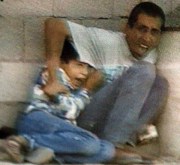 … Filmed by Talal Abu Rahma, a Palestinian cameraman freelancing for France 2, Jamal al-Durrah and his 12-year-old son Muhammad are seen, backs pressed against the wall, Jamal’s arm shielding his young son whose mouth is oval with what must have been a paralyzing fear. And then the shots.
When the cloud of dust cleared, the boy is on his side, draped over his father’s lap.
Throughout an enduing four and a half year widespread Palestinian resistance, with all of its gut wrenching failures, and with the solace and strengths of solidarity en masse coming from both the history before the second intifada and the aftermath in its wake, the slaughter of Muhammad al-Durrah continues to be a defining moment. A young boy viewed guilty through the eyes of the Israeli military due only to the origin of his birth.
In the investigation to follow, an Israeli-initiated tug of war of blame across the grave of and over Muhammad’s murder ensued. Where initially the Israeli government took blame and expressed public relational regret with an apology, that space soon became occupied with denials, accusations and disturbing tales of Palestinian’s faking the boy’s death. If only Palestinians weren’t so busy mourning the actual mass murders of their children in order to be able to spontaneously arrange for the staged murder of one, a second intifada might not have been necessary, nor a third or a fourth for that matter.
Without politicizing the end of a human life, in a 67 year crime drenched in politics; fifteen years ago today a terrified little boy was shot to death while he hid beside his father. And the world should remember his name.
Warning graphic content! Raw footage of Mohammed ad-Durrah’s final moments of his life:
Shatila: Remembering the Massacre
By Richard Hardigan | CounterPunch | September 30, 2015
“There is one scene I will always remember. There was one child. The mother died, but he was trying to take milk from his mother. He was still alive.”
Jamili’s face betrays little emotion as she recalls the scene from thirty-three years ago. She has told the story many times, and perhaps it has lost some of its power in its retelling. Jamili works for Beit Atfal Assamoud, an NGO that provides medical, social and educational services to the residents of the Shatila refugee camp on the southern outskirts of Beirut, and she is talking about her experiences during the massacre of 1982.
“The best way to forget about the horrible things that have happened in the past is to work, to help,” she tells me.
There are currently fifty-nine Palestinian refugee camps scattered throughout the Middle East. When Zionist forces instituted a policy of ethnic cleansing aimed to dispossess the Palestinians of their land in 1947-1948, close to 750,000 Palestinians fled or were expelled from their homes. The camps were built to house the refugees in the short term, but as the problem persisted, so did the camps. It is estimated that there are currently 2.5 million Palestinian refugees living in the camps, which are located in Lebanon, Syria, Jordan, the West Bank and Gaza.
Shatila is probably the most well-known of all the Palestinian refugee camps. In September of 1982, a local Christian militia, known as the Phalange, aided by its Israeli allies, entered Shatila and bordering Sabra, engaging in an orgy of torturing and killing that lasted several days. It is estimated that 3000 people died in this massacre, which has become one of the enduring symbols not only of the Lebanese civil war, but also of the continuing disregard in which Israel holds the Palestinian people.
Jamili was born in 1958, during Lebanon’s first civil war, and she moved with her family from Baalbek, site of the spectacular Roman ruins, to Shatila at the age of one. Although she was not alive during the Nakba – the Catastrophe – and the original establishment of the camp that followed it, she has heard countless stories from her relatives about this time. In the fifty-seven years since her move, she has witnessed all of the tragedies that have befallen Shatila. She can associate each event in the history of the camp with an episode in her life. Her history has become intertwined with that of Shatila.
“My house was destroyed seven times,” she tells me, “and we rebuilt it seven times.”
I have now been in Shatila almost four weeks, and as of yet, I haven’t had the opportunity to talk to anybody about their personal experiences during the massacre. When I first arrived, I was expecting that the tragic events of 1982 would somehow cast an enormous shadow over the camp, that it was something everybody was still dealing with on some level. And so I was hesitant to discuss this topic with anybody for fear that I might bring up some memories that might be best left undisturbed. But when I was introduced to Jamili a few days ago as part of a visit to Beit Atfal Assamoud, she began talking about the massacre immediately. When I asked her if we could discuss the matter in greater detail, she agreed to give me an interview.
We are sitting in comfortable black chairs in her office. A fan whirs in a corner of the room, making the heat a little less oppressive. There is an enormous sleek, black desk behind her, at which I have yet to see her sit. Jamili’s work involves connecting with the residents of the camp who come to seek her help, and I suspect she feels a big desk between them would make them feel uncomfortable.
Israel invaded Lebanon on June 6, 1982 in order to rid the country of the Palestine Liberation Organization, which had fled Jordan during Black September in 1970 and had since established a presence in the refugee camps of Beirut. Israel killed roughly 20,000 people, mostly civilians, during the invasion, and it managed to drive out the PLO.
“During the invasion, 90% of the camp was destroyed. We left Shatila and stayed in Hamra (a Beirut neighborhood a few miles north of Shatila). The people lived in schools and cinemas. My house had five rooms, but when we returned to the camp, we found that only one room was left standing.”
In August of that year, Israel pressured the Lebanese parliament to choose Bashir Gemayal, leader of the Israel-allied Maronites, as president. However, Gemayal was assassinated on September 14, and the Maronite Christian community, especially the Phalange, a brutal Maronite militia, blamed the Palestinians for his death. By this time the PLO had already left the camps, and only women, children and old men remained.
“The PLO had left. All of our youths were in prison,” says Jamili.
The international force that had overseen the evacuation of the PLO had by now departed, and the residents of Shatila were completely exposed.
Yassir Arafat had foreseen this possibility. In the negotiations for his departure from Beirut, he had expressed concern for the safety of the civilians he would be leaving behind in the camps. The US and the government of Lebanon had given their word that Israel would not be allowed to enter West Beirut and had ensured the safety of the Palestinians remaining in the camps. But these promises proved to be empty.
On the day following Gemayal’s murder, Wednesday, September 15, the Israelis seized West Beirut, entrusting to the Phalange, whose hatred for the Palestinians had been inflamed by the assassination of their leader, the task of cleaning up the refugee camps.
On the evening of the following day, Thursday, the Phalange finally entered Sabra and Shatila, and the carnage began almost immediately. David Hirst provides a chilling description in his book Beware of Small States :
“They broke into houses and killed their occupants. Sometimes they tortured before they killed, gouging out eyes, skinning alive, disemboweling. Women and small girls were raped, sometimes half a dozen times, before, breasts severed, they were finished off with axes. Babies were torn limb from limb and their heads smashed against walls.”[1]
Unaware of the massacre, Jamili and her family sought shelter in a mosque in the center of the camp from the Phalange bombs that were falling on West Beirut.
“The houses, after the Israeli invasion, were not strong. The mosque was strong and standing. All of our neighbors left their houses, because they were weak. And we sat in the mosque. People came from outside and said there will be a massacre. Some people didn’t believe them. Where would we go? At the beginning we didn’t believe. But when many people came covered with blood and told terrible stories, then we were afraid.”
A group of old men decided to try to find a high-ranking Israeli officer and convince him to stop the bloodshed. Jamili’s father was among them, but at the last minute he opted to stay behind, a decision that most likely saved his life.
“And these men, until now we don’t know where they are. They went to tell they Israelis there are only children in the camp. They went to protect the camp. But they killed them. They were all friends of my father. Until now nobody really knows what happened. ”
As darkness fell in the evening, the violence continued. The Israelis fired flares over the camp to aid the militia with its grizzly work.
“They lit the streets of the camp. The hopeless thing is that the children saw the lights, and it made them feel happy. But we explained to them that it was the Israelis throwing bombs. Many houses burned. One bomb hit a neighbor’s house, and my father went to help put the fire out.”
Jamili spent that terrifying night in the mosque with her family.
“In the morning, at six o’clock, a group of women, children and old men came and entered the camp and passed by the mosque. They were crying and shouting, and then we believed that a massacre was going to happen.”
On Friday many of the residents of Sabra and Shatila escaped and made their way to two nearby hospitals – the Gaza and Akka hospitals.
“We carried our children and didn’t take anything. We went to the Gaza hospital.”
But even in the hospitals the terrified residents of the camp were not safe from the murderous intentions of the Phalange. In fact, on that day the militia entered the Akka hospital and murdered some of the wounded as they lay in their beds.
“The doctors and the nurses said ‘Don’t stay here. They will come to get you. Please leave this area.’”
“So we left. At that time I was with my family and all of my relatives. There were hundreds of people in the streets, carrying their children.”
Jamili’s destination was Hamra, the Beiruti neighborhood where she and her family had spent the bulk of the Israeli invasion. They had lived in a friend’s apartment, and they still had the key. That night they spent in an unfinished building on the way to Hamra.
“It had no doors or windows, but at least we had a place. In the morning hundreds of people from the camp came and shouted, and we felt that it was dangerous and that we must leave.”
On Saturday morning they were stopped by Israeli soldiers.
“They allowed the women and children to pass, but the young men had to stay. My brothers and uncles had to return back while the women and children continued to Hamra. Our men were not with us, and we were afraid. What would happen to them? We were running away from danger, and they were going to danger.”
By now journalists had entered Shatila, and news of the massacre had spread. When Jamili and her family reached Hamra they went to a supermarket to meet its owner, a man they knew. He was astonished to see them.
“’You are still alive?’ he asked us.”
By ten o’clock on Saturday morning the last of the Phalange had left Sabra and Shatila. The killing was over.
“I am lucky. I didn’t see anybody killed in front of me. But I saw the bodies. The mosque was filled with bodies. You can see the houses that were destroyed and the legs of the children appear from these houses. I saw all this.”
When Jamili saw the pictures in a newspaper, she was horrified. She imagined that all the bodies she saw belonged to her relatives, whom she had been forced to abandon outside of Hamra.
“All youths wear sport shoes and jeans and t-shirts. Their bodies were facing down. We felt that all our men had been killed. We decided to return back to the camp. On Monday morning we entered Sabra, and we were afraid to enter the camp. We saw the bodies in the street. I couldn’t stand. We couldn’t continue. We knew that all our relatives had died. I went to my house. I walked a few meters and then returned back. Because I was afraid to find out what happened.”
But it turned out that her male relatives had found shelter in a school outside the camp.
“When I saw them I didn’t know whether to laugh or cry. I felt foolish. When I found out that my whole family was safe, it was a perfect day.”
Jamili sighs. Her brown eyes glisten. Telling the story has brought back memories and emotions.
The massacre was over, but the problems for the residents remained, as the camp was almost entirely destroyed and had to be rebuilt.
“We had a group of about twenty girls. We could stand against the enemy. We were not afraid. What choice did we have? To die? To live or die, it was the same.”
And so Jamili and her friends threw themselves into the task of rebuilding the camp, because, among other things, it helped them forget what had happened. But one cannot forget such an event.
Jamili leans closer, her face showing the confusion, the inability to accept what had happened so many years ago. How could one group of human beings do this to another?
“Why did Israel make the massacre? For the children? For the old men? Nobody could imagine that a massacre would happen. Why? For whom? We didn’t have any men. Some of them left, and some of them died. Some of them went to prison.”
Today, thirty-three years later, Shatila faces a multitude of problems. The camp, originally built for 4000 residents, is contained in an area that is in the shape of a square of side length less than one kilometer. With the recent influx of refugees from the war in Syria, the current population is estimated to be close to 25,000. This high concentration of people makes itself felt in the ubiquitous crowds that fill the narrow alleyways, in the piles of garbage that accumulate too quickly for the trash removal workers to keep up with, in the many buildings that extend skyward to accommodate the residents, and in the lack of open spaces in the camp. Living conditions are horrifying. Electricity is cut for at least twelve hours a day, and the tap water is so salty that it corrodes the faucets. Guns are present throughout the camp, and tensions, already high because of the extreme overcrowdedness, often explode to the point of physical conflict. (One week after my arrival in the camp two people were murdered during a dispute over a motorcycle parking spot.)
Most of the people in the camp dream of going back to their village in Palestine. And so it is with Jamili.
“Our problems will stop when we return. Why cannot we return to our homeland? My village is empty. It has been destroyed. Until now nobody lives there. Why must we live in this bad situation?”
As Israel moves further and further to the right, it appears as unlikely as ever that Jamili or any of the other millions of Palestinian refugees will ever be able to return to their homes. As their wait continues into its seventh decade, the international community appears to be losing interest even in providing material support for them. Until a few weeks ago, a UNRWA budget shortfall threatened to close all schools in the refugee camps, an action that would have been a disaster for the residents. Saudi Arabia and a few other nations came up with the funding at the last minute, but the message that the world doesn’t care about the refugees was delivered, regardless. These are dangerous times for the Palestinian refugees, and it is crucial that the international community, especially the West, who bears responsibility for their displacement in the first place, doesn’t forget about their plight.
Notes.
[1] David Hirst, Beware of Small States: Lebanon, Battleground of the Middle East
Richard Hardigan is a university professor in the United States.
Killed by Cops Over Pot: Family Lawsuit Reveals Shocking Details
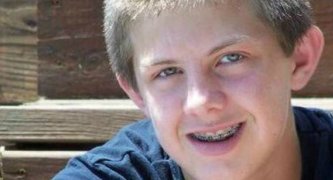
© Zachary Hammond/Family Photo
Sputnik – 29.09.2015
Highly disturbing new information is coming to light thanks to a lawsuit filed by the family of 19-year-old Zachary Hammond, the South Carolina teen fatally shot in the back by police during a small marijuana bust.
The suit alleges that the officer, Lieutenant Mark Tiller, who shot and killed Hammond, threatened to “blow his head off” before he fired, and another officer high-fived the teen’s lifeless body after he was killed.
Tiller has not yet been charged for the teen’s death, nor has the department released dashcam videos or any other documents pertaining to the case. The family has stated that part of their reason for filing the lawsuit is to force the Seneca Police Department to release the footage.
Solicitor Chrissy Adams and state investigators maintain they will not release the footage while the case is still open.
Hammond’s family is also in the midst of another lawsuit to have Adams removed from the case, as she works with the officers involved. She refuses to decide whether Tiller will face charges until the state supreme court makes their decision in that suit, and “federal and state investigators answer some more questions,” the Associated Press reported.
The family has spoken to the woman who was in the vehicle with Hammond, reviewed private surveillance footage, and has had a private autopsy performed on the teen’s body.
The shooting took place after Hammond took Tori Morton on a first date, on July 26. The lawsuit states that they had visited a McDonald’s to get ice cream, and then went to a Hardee’s so that Hammond could buy a hamburger.
When the pair arrived at Hardee’s, however, undercover police were waiting. They allege that they had arranged a drug deal with Morton.
As the police pulled up to Hammond’s car, he reportedly tried to drive away.
Tiller claims he thought Hammond was going to try to run him over, but the private autopsy confirmed that the teen was shot in his back and in his side, meaning that any perceived threat would have already had passed when he was killed.
The lawsuit also claims that there was a pause between the first and second shots, and that after being shot the first time, Hammond looked over at his date.
“‘I’ll blow your (expletive) head off,’ were the last words heard by Zachary Hammond,” The lawsuit states.
The police claim that small amounts of drugs were found on both of the teens. Morton was charged with misdemeanor drug possession.
Hammond was pronounced dead upon the arrival of paramedics. His body was then left on the ground for 90 minutes, where it was reportedly attacked by ants.
Once other investigators arrived, an officer was reportedly seen high fiving his corpse.
The Seneca Police Department has now hired a public relations firm to represent them.
Obama ignores Palestinian cause in his UN speech
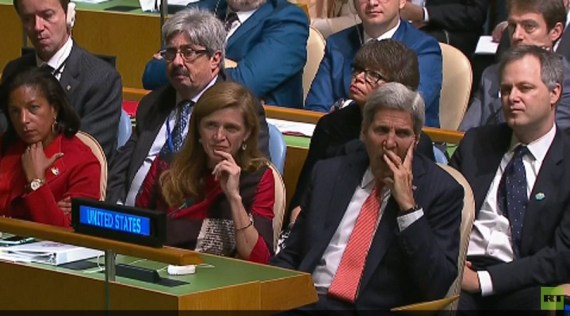
Obama’s speech to the U.N. General Assembly seemed like a real bore for Secretary of State John Kerry
Palestine Information Center – September 29, 2015
NEW YORK – US President Barack Obama declared during his speech at the UN General Assembly in New York his country’s readiness to cooperate with Russia and Iran to solve Syria crisis. However, he ignored to address the Palestinian cause.
The Palestinian Authority slammed Obama for neglecting the Palestinian issue in his speech at the UN on Monday.
Obama called for “a managed transition away from al-Assad,” whom he called a “dictator.”
“Nowhere is our commitment to international order more tested than in Syria. When a dictator slaughters tens of thousands of his own people, that is not just a matter of one nation’s internal affairs — it breeds human suffering on an order of magnitude that affects us all”.
He expressed surprise over those who “support tyrants like Bashar al-Assad, who drops barrel bombs to massacre innocent children, because the alternative is surely worse.”
Likewise, when a terrorist group beheads captives, slaughters the innocent and enslaves women, that’s not a single nation’s national security problem — that is an assault on all humanity, he said in reference to ISIS.
The United States, according to him, has worked with many nations in this Assembly to prevent a third world war — by forging alliances with old adversaries; by supporting the steady emergence of strong democracies accountable to their people instead of any foreign power; and by building an international system that imposes a cost on those who choose conflict over cooperation, an order that recognizes the dignity and equal worth of all people.
However, US president failed to mention the Palestinian cause in his speech at the UN General Assembly.
PLO Secretary-General Saeb Erekat expressed disappointment in US president Barack Obama for neglecting the Palestinian cause in his UN speech.
“Does President Obama believe he can defeat ISIS and terrorism, or achieve security and stability in the Middle East, by ignoring the continued Israeli occupation, settlement expansion, and the continued attacks on al-Aqsa Mosque?” he said.
A Nuclear Power Confronting Slingshots, Israeli Hypocrisy Finds an Ally in The NY Times
By Barbara Erickson | TimesWarp | September 28, 2015
Israel, The New York Times tells us, has vowed to crack down on violence in Jerusalem, allowing the use of live fire against Palestinians who take to “rock throwing and firebombing,” expanding the rules of engagement and lengthening sentences for such crimes.
In a story titled “Israel Acts to Combat Violence in Jerusalem,” Isabel Kershner quotes Prime Minister Benjamin Netanyahu, who calls such Palestinian weaponry “deadly and murderous objects,” which have been “thrown without response and without being thwarted.”
It is noteworthy that Netanyahu, responsible for bombing and strafing the 1.8 million residents of Gaza, can say these words without a hint of irony. It is also striking that the Times can report his utterances without pointing out the full context here—the lopsided nature of the conflict.
In fact, it is the Palestinians who face a deadly enemy: Israel possesses armored vehicles, automatic rifles, drones, rockets, fighter jets, smart bombs and sophisticated surveillance equipment, all of them more “deadly and murderous” than Palestinian rocks. As the only nuclear power in the Middle East, Israel also has a stockpile of up to 300 nuclear weapons, which can be launched by air, land or sea.
Palestinians in Jerusalem and the West Bank have nothing more than stones, firecrackers, kitchen knives and homemade firebombs. The mortality figures reflect this disparity: Since the beginning of this year Israeli forces have killed more than 25 Palestinians in the West Bank (settlers have killed at least another three), while Palestinians are responsible for the deaths of four Israelis within the West Bank and Israel combined.
Yet the Times strains to make Israelis appear as the victims, giving voice to the claims of Netanyahu, playing down Palestinian deaths and hyping Israeli casualties. A recent headline declared, “Jewish Man Dies As Rocks Pelt His Car in East Jerusalem,” suggesting that the driver was stoned to death. In fact, he had a heart attack, lost control of his car and ran into a light pole. The Times story cites only one object hitting the car.
By contrast, the paper gives a bland and ambiguous title to the story of a young Palestinian woman who died from a barrage of Israeli bullets last week as she tried to cross a checkpoint in Hebron. This news appears under the title, “2 Are Killed in West Bank as Jewish and Muslim Holidays Approach.”
Readers find no hint of the bloody assault on 18-year-old Hadeel Al Hashlamoun in this headline, and the Times has also failed to report that Amnesty International termed her killing a “extrajudicial execution” and called for a “prompt, impartial, independent and effective investigations” into her death.
Firsthand accounts say that an Israeli soldier shot Al Hashlamoun in the leg, and when she lay motionless on the ground, approached her and fired several more shots into her abdomen. Witnesses add that soldiers refused to let a Palestinian ambulance approach her and left her to bleed for about half an hour before allowing an Israeli ambulance to arrive and take her away. Video footage also shows a soldier grabbing her by a foot as she lay bleeding on the ground and dragging her out of camera sight.
This is raw violence with “deadly and murderous” arms, but the Times and Netanyahu do not find the word “violence” appropriate here. They reserve its use for Palestinians who throw rocks and firecrackers, never applying it to the atrocities of Israeli security forces. The irony and hypocrisy in this discourse seem to elude them entirely.
In a story that appeared online yesterday, the Times reports that four Palestinian youths have been arrested for throwing rocks at the car of the man who died after crashing in East Jerusalem. This news is in striking contrast to the latest, disturbing developments in the case of three Palestinian family members who died in an arson attack.
When news broke of the fire that killed a toddler in the West Bank village of Duma and led to the later deaths of his mother and father, the Times quoted the reactions of Israeli politicians at length and described Jewish Israeli “soul searching” over the deaths. The paper also noted that some extremist settlers had been arrested but that no one accused of the Duma arson was in custody.
The Times ran several stories immediately after the arson attack, reporting that Netanyahu vowed to bring the perpetrators to justice, but after running a brief article when the mother died earlier this month, the newspaper has been silent, even though there is news to tell: Israeli officials know who committed the crime but do not plan to arrest them.
Israeli media have reported that Defense Minister Moshe Ya’alon admitted that the names of the suspects are known but the defense establishment has not arrested anyone “to avoid revealing intelligence sources in court.”
So we have the quick arrest of four youths suspected of throwing rocks and (perhaps) indirectly causing the death of an Israeli driver, while those responsible for burning and killing three innocent Palestinians go free. The remarks by Ya’alon add even more irony to Netanyahu’s complaint that rock throwing occurs “without response and without being thwarted.”
The Times has shown itself to be tone deaf to such dissonance in the Israeli narrative. Far from analyzing or commenting on the hypocrisy of vilifying rock throwers, it has worked to support this deliberate distortion of the reality in Palestine.
So in the Times we find silence concerning official complicity in settler crimes, efforts to portray Israelis as victims and a refusal to state the obvious: Killing civilians with the world’s most sophisticated weapons ranks high on the scale of violence, far above the efforts of Palestinian youth who face armored soldiers and tanks with slingshots and stones.
Featured Video

Matt Bracken: US Plans Massive MOAB Strike on Iran?
or go to
Aletho News Archives – Video-Images
From the Archives
Confronting the Threat of Ethnic Bioweapons
By Tony Cartalucci – New Eastern Outlook – 29.11.2017
The United States Air Force’s 59th Medical Wing’s molecular biology branch recently was revealed to have been collecting specifically Russian RNA and synovial (connective) tissue samples, prompting fears in Russia of a possible US directed ethnic-specific bioweapons program. … continue
Blog Roll
 Aletho News
- Matt Bracken: US Plans Massive MOAB Strike on Iran?
- Russia accuses France of ‘piracy’ over tanker seizure
- Why Yemen Is Bombing Saudi Arabia’s Airports: The War Behind the Headlines
- Sally Rooney’s books pulled from UK over support for Palestine Action
- Bombs for Tel Aviv, Promises for Riyadh
- Israeli ad agency conducted vast global espionage campaign using online ads: Report
- Oct. 7 Forever Marks The Big Reveal: ‘We See You, Israel, We Revile You, We Reject You!’
- Meet the US generals and admirals advancing Israeli policy
- Israel’s Straw Widow Protocol: The Kill Zones Where Civilians Were Labelled ‘Terrorists’
- Leading Israeli Think Tank Publishes Psychotic Israeli ‘National Security’ Doctrine
- If Americans Knew
- Israeli firm used online ads to run vast spy operation, researchers say
- No, the world zionist movement is not an antisemitic conspiracy theory
- Hundreds of IDF investigations into killings still have no public outcome, BBC Verify finds
- After Ashley Moody Epstein Probe, Donors Linked to Him Poured Money Into her Senate Campaign
- Worried about Russian meddling in UK politics? Wait till you see what Israel is up to
- Israeli settlers attack West Bank center for disabled children, church leader calls for int’l action
- Pulling Out Teeth Just to Live: How Israel Has Devastated Dental Care in Gaza
- Gaza’s “ceasefire” death toll passes 1,500 – Daily Update
- Activists Abused By Israel Return to New Freedom Flotilla Mission
- 60 Minutes won’t tell the full truth about Israeli settler violence
- No Tricks Zone
- New Study Suggests Large Regions Of The Pacific Ocean Have Been Cooling For The Last 80 Years
- Germany’s Green Energy Debacle: High Energy Costs Force Kahla Porzellan to Close After 182 Years!
- New Study: 50 Years Of The Most Aggressive ‘Net Zero’ Policies Can Only Affect The Global Climate By 0.03°C
- US September “Heat” Was No Record…Many Records Set Decades Ago
- Latest European Green Energy Debacle; Portugal’s Largest Flagship Solar Park Insolvent!
- Green Energy Debacle: German Expert Professor Fritz Vahrenholt Warns Of Severe Economic And Social Consequences
- Two More Paleo Reconstructions Affirm Meters-Higher Sea Levels Across Ireland, Brazil 7000-6000 Years Ago
- New Study: Earth And Venus Surface Warmth Largely Explained By Convection And Lapse Rate, Not CO2 Or Radiation
- 2025 Nature Paper Claiming Worsening Global Drought Gets RETRACTED …Heavily Flawed
- New Study: ‘Global Drought Shows No Detectable Recent Acceleration Under Climate Warming’

