MI5 Paying British Muslims ‘Decent Money’ to Spy on Mosques
Sputnik – 21.09.2015
Britain’s intelligence agency is paying Muslims to spy on people living in their own community to try and avert terrorist attacks from homegrown Islamist extremists, the Guardian has revealed.
An anonymous source told the newspaper that MI5 is employing people across the UK in Muslim communities on temporary contracts to gather intelligence on specific targets attending the same mosque. The source also stated that they knew of one Muslim informant who had been paid £2,000 by the security services to spy on a specific mosque for six weeks.
“It’s been driven by the [intelligence] agencies, it’s a network of human resources across the country engaged to effectively spy on specific targets. It’s decent money.”
But MI5’s method of paying money to Muslims to spy on people in their own communities has come under criticism. Salman Farsi, spokesman for the UK’s largest mosque in East London suggested that the offer of money could corrupt the intelligence:
“If there’s money on the table, where’s the scrutiny or the oversight to ensure whether someone has not just come up with some fabricated information? Money can corrupt.”
Following the terror attack in London in 2007, the government spent millions on its ‘Prevent’ program to counter radicalization — but eight years later it has been accused of failing to prevent terrorism and radicalization, instead alienating Muslim communities in the UK further.
According to the Islamic Human Rights Commission: “The Prevent regime of attempting to stop young Muslims from being radicalized is not working and is simply alienating Muslims in Britain by serving as a cover for intelligence gathering on the community.”
But with around 650 young men, women and children who have fled the UK to join ISIL militants in Iraq and Syria and 3,000 radicalized terrorists being monitored by the MI5 — it appears that the British government’s approach to preventing terror isn’t working — and could be the reason behind this new push for for more powers.
The UK government and intelligence agency MI5, however, appear to agree on one thing — big Internet and social media companies should do more to help the authorities by reporting suspect users and sharing swathes of encrypted data with intelligence officers.
In what seems to be another round in the public relations exercise pushing for more support for the government’s Communications Data Bill or Snooper’s Charter, as it is also known, the head of the MI5 told British media that Internet and social media companies should inform the authorities if any users are a cause for concern.
“Some of the social media companies operate arrangements for their own purposes under their codes of practice which cause them to close accounts.”
Andrew Parker also wants the companies to pass on those account details to the intelligence agencies.
The Snooper’s Charter, would grant police and intelligence services more power to intercept and monitor almost every channel of terrorist communication online and offline. It could also force Internet companies to hand over users’ private data.
UK Home Secretary Theresa May is seeking support from Internet and telecoms companies for the controversial surveillance bill, whilst the head of MI5 publicly calls for more powers to monitor potential threats amid revelations his officers are paying Muslim informants ‘decent money’ to spy on their own mosques.
Guantanamo prisoner tells of release trauma in first meeting with lawyer
Reprieve | September 21, 2015
A Guantanamo prisoner released to his native Morocco has spoken of the terror he felt at the way he was treated by US authorities on his flight home.
Younous Chekkouri — released from Guantanamo last week having been held in the US prison for more than a decade without charge or trial – was blindfolded, forced to wear ear-defenders, and had his arms shackled to his legs during the ten hour flight to Morocco. In a testimony given today to his local lawyer in Casablanca, where he remains detained, Younous described how the flight replicated the total sight and sound deprivation he experienced when he was first rendered to Guantanamo.
Lawyers for Younous at international human rights NGO Reprieve, have raised concerns about his ongoing detention in Morocco and the effect that the behaviour of the US authorities, during his transfer, would have had on his fragile mental state.
In 2010, Younous was cleared for release from Guantanamo – a process involving unanimous agreement by six US federal agencies including the CIA, FBI and Departments of State and Defense. He has never faced a trial or been charged with a crime.
Cori Crider, attorney for Younous and strategic director at Reprieve, said: “Younous was tortured and brutally mistreated for years during his Guantanamo ordeal. As if this weren’t enough for a man the US government would later declare should never have been imprisoned in the first place, he then spent the flight back to Morocco blindfolded and with his arms shackled to his legs. We are very concerned for Younous’ health during his ongoing detention in Morocco and urge the authorities to release him as soon as possible.”
Native American 2nd grader kicked out of class for traditional Mohawk haircut
RT | September 21, 2015
It was a banner week for kicking children out of class. Along with Ahmed Mohamed and his homemade clock, a Native American student in Utah was told to lop off his Mohawk or leave school… until tribal leaders were forced to step in.
 Jakobe ‘Kobe’ Sanden entered his second-grade classroom rocking a ‘hawk, not because it looked cool but because of his Native American roots. But the 7-year-old was kicked out of class because the “distracting” hairstyle was a potential violation of Arrowhead Elementary School’s dress code.
His mother, Teyawwna Sanden, was shocked when Susan Harrah, the principal of the Santa Clara school, called her to say she needed to pick up Kobe and get his hair cut.
“We had the students that weren’t used to it,” Harrah told KSTU. “They had called that out. So the teacher brought the student to my attention.”
The school’s online handbook stipulates only that “hair color should be within the spectrum of color that hair grows naturally.” The school district’s dress code goes further, stating: “Students have the responsibility to avoid grooming that causes a distraction or disruption, interrupting school decorum and adversely affecting the educational process.” It also notes that “Extremes in body piercings, hair styles and hair colors may be considered a distraction or disruption.”
Mrs. Sanden expressed her frustration with the school’s reaction on Facebook.
“So f’n irritated right now,” she wrote. “I get a call from the boys’ school and she said Kobe’s not allowed to have a Mohawk … that’s it’s school policy. WTH! Really? It’s hair!”
Kobe’s father, Gary Sanden, was traveling on business, but reached out to the Washington County School District’s superintendent of primary education.
“I was sympathetic to what they were saying ‒ that it was not conducive to learning,” he told the Washington Post. “But I couldn’t understand how it could be a distraction to the kids.”
The superintendent told Mr. Sanden to obtain letters from tribal leaders supporting the family’s claim that the hairstyle is part of their heritage.
“That’s like calling up the governor of our state,” he said. “But I called and got the letter. My wife did too.”
Mr. Sanden is a member of the Seneca Nation of Indians, which is based out of New York. Mrs. Sanden belongs to the Kaibab Band of Paiutes Indians.
“It is common for Seneca boys to wear a Mohawk because after years of discrimination and oppression, they are proud to share who they are,” Seneca Nation Tribal Councilor William Canella wrote. “It’s disappointing that your school does not view diversity in a positive manner, and it is our hope that Jakobe does not suffer from any discrimination by the school administration or faculty as a result of his hair cut.”
Canella told Native News Online that it was “ironic” that he had to step in to address such a situation at a school named Arrowhead. The Utah school is near several Indian reservations, including the Shivwits Band of Paiutes, which is less than 10 miles from the school, and the Kaibab Paiutes near the Utah-Arizona border.
Harrah told the Salt Lake Tribune that she felt the school had handled the hairstyle hubbub with aplomb, though she was surprised by the attention it received because “It took about a half hour of my time.”
“If there’s any kind of a hairstyle that is a distraction, then we have to tell the parents that we’ve got a problem,” she said. “There’s a protocol that we go through, and I felt like it was handled efficiently and that we respected their culture.”
 Mr. Sanden disagreed, however, noting that Kobe had to sit by himself in Harrah’s office for part of the day.
“That’s the sad part of the whole situation,” he told the Salt Lake Tribune. “To ostracize him like that ‒ that’s stuff from the ’50s.”
“It could have been handled 10 different ways,” he added.
Kobe’s removal from class happened less than three weeks after Malachi Wilson, a 5-year-old member of the Navajo Nation, was sent home on his first day of kindergarten at F.J. Young Elementary in Seminole, Texas because his long hair violated that district’s dress policy. The school required Malachi’s mother, April Wilson, to obtain documentation proving her son’s indigenous heritage, Indian Country Today reported.
In Louisiana last August, a Rastafarian teenager was suspended for three weeks from South Plaquemines High School for his dreadlocked hairstyle. The unnamed student claimed that not cutting his hair was a religious mandate, and his mother presented a letter from the 1st Church of Rastafar I explaining the religious significance of not cutting one’s dreadlocks. He eventually received an exemption from the school.
Aid for Syria crisis victims still not enough: UN
Press TV – September 20, 2015
The United Nations says despite a surge in the international community’s humanitarian aid to help those affected by the conflict in Syria, the sum hardly keeps up with the rising needs of the afflicted people.
UN Under-Secretary-General for Humanitarian Affairs and Emergency Relief Coordinator Stephen O’Brien made the remark on Saturday while on a tour of the Zaatari camp, which is Jordan’s largest facility for Syrian refugees.
When asked about the aid shortage, O’Brien said that “need has risen so much that even though we are securing record amounts of funding, record amounts of political will and support, nonetheless the (funding) gap has widened,” because of protracted conflicts in the region, such as those in Syria, South Sudan and Yemen.
Meanwhile, Hovig Etyemezian, the director of the UN-run Zaatari refugee camp, said the international community “hasn’t woken up yet to the need to assist Jordan” to address the refugee crisis.
For 2015, aid agencies requested over USD 7.4 billion, both for refugees and those internally displaced by the crisis in Syria. However, the agencies have received only USD 2.8 billion so far, according the UN refugee agency.
Refugee aid programs in host countries such as Jordan, Lebanon, Turkey, Egypt and Iraq were reportedly just 41 percent funded as of September.
Germany’s donation
In a separate development on Sunday, German Minister of Economic Cooperation and Development Gerd Muller announced that Berlin would donate USD 22.6 million to the World Food Program (WFP) to supply Syrian refugees with food.
“This means that around 500,000 Syrian refugees in the region can be supplied with food for three months,” Muller told the German Welt am Sonntag newspaper.
In late July, the WFP slashed by half its food assistance for Syrian refugees in Jordan and Lebanon due to a funding crisis.
The foreign-sponsored conflict in Syria, which flared in March 2011, has reportedly claimed more than 240,000 lives up until now.
The Lattimer Massacre: When an Entire Police Force Stood Trial
By Mark Hand | CounterPunch | September 18, 2015
“It was not a battle because they were not aggressive,
nor were they defensive because they had no weapons
of any kind and were simply shot down like so many
worthless objects, each of the licensed life-takers
trying to outdo the others in the butchery.”– Inscription on monument erected in Lattimer, Pa.

If officials wanted to shine a light on the horrors of the past, every day could be the anniversary of some type of atrocity committed by a government agency or corporation. But leaders get to pick and choose which events are more important than others. American officials, just like leaders in all countries, want the nation memorializing incidents that serve their political and economic interests.
Sept. 10 is one of those days when government officials committed a major atrocity. But 9/10 never became a national day of remembrance.
Sept. 10, 2015, marked the 118th anniversary of the Lattimer Massacre in the anthracite coal mine region of eastern Pennsylvania. Like the 9/11 attacks, the mass murder in Pennsylvania was used as a springboard for something bigger. But in the case of the Lattimer Massacre, the murder of striking coal miners served as inspiration to build a more equitable society, not as an excuse to kill and harm more people.
All told, Luzerne County, Pa., sheriff deputies killed 19 unarmed miners and wounded at least 38. No sheriff deputies were killed. “The primary result of the massacre was rapid growth in unionism in the anthracite coal region. During the next four months approximately 15,000 new names were added to the UMWA rolls,” the United Mine Workers of America explains on its website.
The UMWA views the Lattimer Massacre as a major event in U.S. history. Even the commonwealth of Pennsylvania saw the actions by the local police on Sept. 10, 1897, as extreme and excessive. State prosecutors brought murder and felonious shooting charges against Luzerne County Sheriff James Martin and 78 of his deputies in the wake of their attack on the workers.
In the late 19th century, pro-labor sentiment was strong in the U.S. and, at least in this case, state prosecutors wanted the sheriff and his deputies held accountable. But as it turned out, the prosecutors were ill-prepared for the trial and ultimately argued a lackluster case against the defendants, all of whom were found not guilty of the charges after a five-week trial in 1898.
Labor activism, especially in the anthracite coal region of Pennsylvania, had been growing steadily since the mid-1800s. The Molly Maguires, a shadowy Irish labor organization, waged a violent battle against coal operators. In the late 1870s, 20 Mollies were hanged after being found guilty of murder and other charges.
In the wake of the crackdown on the Molly Maguires, labor activism in the region waned. But union activity in the anthracite coal fields picked up again as the century neared an end. Only two decades removed from the violent battles between the coal operators and the Mollies, state officials could have easily overlooked the Lattimer killings.
To their credit, Pennsylvania state prosecutors in 1897 tried to hold the police accountable in Luzerne County. The massacre occurred in the village of Lattimer, north the city of Hazleton, Pa., when Martin’s posse of deputies fired at between 300 and 400 coal miners, mostly of Slovak, Polish Lithuanian and German ethnicity, who were marching from Harwood, Pa., to Lattimer.
The miners wanted a pay raise of 15 cents per employee, the ability to select their own doctor, the right to get paid for work even if the machines they work were out of order, and the freedom not to have to buy from the company store. Workers had already shut down several other mines in the region. Expanding the strike to Lattimer would be a huge victory for the miners because it would go a long way to shutting down the entire the area and forcing the companies to grant workers’ demands.
Fearing their private guards could not pacify the striking workers, the coal mine owners solicited the help of Sheriff Martin, who responded by rounding up dozens of local men to serve as deputies. They met the hundreds of striking miners marchers in Lattimer, one of whom was holding an American flag. After the sheriff tried to tear the flag and grabbed one of the marchers, the deputies opened fire. The flag bearer was the first man hit. The striking miners began to disperse, running to get away from the shooters. Some deputies moved to different locations so they could take better aim at fleeing marchers, shooting them in the back as they ran.
The massacre at Lattimer was the largest in U.S. labor history until the Ludlow massacre in Colorado 17 years later when Colorado National Guard and mine guards attacked a camp of striking workers, killing two dozen people, including miners and their wives and children.
Michael Novak, a long-time scholar at the conservative American Enterprise Institute, in 1978 published one of first major books on the massacre. “The story of the guns of Lattimer has been strangely neglected in history books, even in histories of violence in America, even in labor histories,” Novak wrote in The Guns of Lattimer, “The reasons may be that Lattimer’s victims did not speak English and, more than others, have lacked a public voice.”
Novak’s book was sympathetic to the miners. “The whole body of four hundred marching men, unarmed, incompetent in English, carefully carrying two American flags, and painfully aware that in the Austro-Hungarian Empire they could conduct no such open and peaceful protest as they did here,” Novak wrote. “That their march should have ended in brutal bloodshed — the worst labor massacre in the history of Pennsylvania and in the nation until that time — deepened in them and in other Slavic communities around the nation a familiar sense of tragedy and injustice.”
Several other books and scholarly articles have covered the massacre. The latest book, The Lattimer Massacre Trial, published by Dorrance Publishing Co., provides a unique look at the event. The book was compiled by Pasco L. Schiavo, a prominent lawyer in the city of Hazleton and the person who now owns the land on which the massacre occurred.
Born and raised in Hazleton and a descendent of Italian immigrant coal miners, Schivao compiled day-to-day newspaper reports from the 1898 Lattimer trial of the sheriff and 72 deputies, a chronological collection that includes pre-trial jury selection, witnesses’ testimony and the final verdict. Schivao’s book contains clippings from The Press, what he calls a “reputable Philadelphia, Pennsylvania newspaper which is no longer in existence.”
The newspaper articles covered the trial in detail and included verbatim some of the statements made by the witnesses testifying at the trial, “something which is particularly important in light of the court transcripts or records of testimony having been lost years ago,” Schivao writes in the book’s introduction.
In his closing argument, the prosecuting attorney emphasized that “the strikers were peaceable and unarmed.” Only a handful of the slain strikers were shot from the front; the rest of them were shot in the back. Referring to the deputies, the district attorney stated “if these boys had protected the lives of these poor creatures of God with the same solicitude they displayed in protecting the property of the employers there would be no case here today.”
Even though none of the deputies was killed, witnesses for the defense claimed the strikers were armed with pistols and clubs. In a post-mortem published in The Times of Philadelphia, the newspaper’s writers argued that the assembly of strikers “was utterly lawless, and when the members refused to disperse upon notice from the Sheriff, given in the presence of his armed deputies, they not only openly defied the law, but they precipitated the destruction of life by violently resisting the Sheriff when in the performance of his lawful duty.”
Schiavo told a Hazleton newspaper that he chose to compile the book because the newspaper articles “report as close to the truth as possibly on a daily basis.” On the other hand, “the books and other publications I have read tend to give a slant one or another as to what really happened at Lattimer,” he was quoted as saying in the Aug. 2 article.
Even today, debate continues on whether the deputies were justified in killing the workers. Dan Sivilich, president of the Battlefield Restoration and Archaeological Volunteers Organization, told a local newspaper that the “the sheriff was not stupid.”
“As soon as those miners entered the gate, and they entered mine property, someone opened fire on them. At that point, they were trespassing, and deadly force is allowed when someone is trespassing on your property,” Sivilich said.
Lethal police force is still being used on a regular basis against U.S. residents who are viewed as expendable. Few of the perpetrators are facing prosecution. The same is true in other countries. A similar massacre occurred in South Africa in August 2012 when police opened fire on striking miners at the Lonmin platinum mine near Rustenburg, South Africa, killing 34 miners and wounding an additional 78. The police violence, known as the Marikana Massacre, was the single most lethal use of force by South African police against civilians since the Sharpeville massacre in 1960 when the nation’s official policy of apartheid was in full force.
Instead of bringing criminal charges against the police, South African authorities charged the surviving miners with murder. The authorities used the doctrine of common purpose against the survivors, assigning responsibility upon them for the murders because they participated in the strike. The murder charges, however, were later dropped and all 270 miners were released.
At least Pennsylvania authorities did not stoop so low to bring murder charges against the surviving miners in Lattimer. In remembrance of the slain miners, a small memorial now stands at a highway intersection in Lattimer. The memorial includes a monument with an inscription and the names of the killed miners. A shovel and a pick-axe lean against the front of the monument, and a small rail wagon with a pile of anthracite coal sits behind it.
“The migrant workers that struck during the summer of 1897 imagined a better world for themselves, one that offered them the baseline of equal living and working conditions to the longer-established nativized miners,” the Lattimer Massacre Project website says.
Mark Hand can be found on Twitter @MarkFHand.
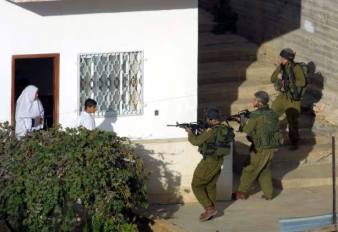
Israeli forces targeting Palestinian children in al-Khalil (Hebron)
International Solidarity Movement | September 20, 2015
Everyday, Palestinian families get attacked by Israeli forces in their own homes. Sometimes they bang on the door in the middle of the night, scaring children and adults, ransacking the house. On some of these raids, both during the night and in daytime, Israeli forces randomly arrest family members and take them to an unknown destination without any reason.
Last night, Israeli forces entered the Palestinian market in the Old City of al-Khalil (Hebron) and entered a Palestinian family home where they kidnapped an 8-year old girl and arrested 3 more young men. All of them were walked towards the military base in Shuhada street, but then kept behind a fence and military gate for more than 15 minutes before being released. No reason was given for the random arrest.

Even the way to school can be a dangerous and perilous journey for children in al-Khalil (Hebron). Having to pass through sometimes multiple checkpoints to get to school, children as young as 4 years old have to pass by heavily armed Israeli soldiers. As if the ubiquitous military presence weren’t scary enough, children are subjected to bag-searches, frisking, detainment and arrests. With Israeli forces using tear gas on children on their way to school and back home after a long school-day, children also have to duck away from tear-gas grenades shot towards them and navigate past clouds of tear-gas lingering on in the alleys.
Arresting children under the age of 11 is illegal even under Israeli law, as it is considered to be too traumatizing and detrimental to a child’s well-being, regardless of the accusations brought forward against a child. However, Palestinian children are detained, frisked, body-searched and arrested by Israeli forces on an every-day basis. As this illegal practice does not result in any consequences for the soldiers or policemen at all, Palestinian children are constantly at risk of maltreatment, abuse and denial of their most basic human rights.

RICO!
By Judith Curry | Climate Etc. | September 17, 2015
You have signed the death warrant for science. – Peter Webster
In case you don’t know what RICO is (Wikipedia):
The Racketeer Influenced and Corrupt Organizations Act, commonly referred to as the RICO Act or simply RICO, is a United States federal law that provides for extended criminal penalties and a civil cause of action for acts performed as part of an ongoing criminal organization. The RICO Act focuses specifically on racketeering, and it allows the leaders of a syndicate to be tried for the crimes which they ordered others to do or assisted them, closing a perceived loophole that allowed a person who instructed someone else to, for example, murder, to be exempt from the trial because he did not actually commit the crime personally.
RICO was enacted by section 901(a) of the Organized Crime Control Act of 1970 While its original use in the 1970s was to prosecute the Mafia as well as others who were actively engaged in organized crime, its later application has been more widespread.
Senator Whitehouse
Senator Whitehouse has proposed to use RICO laws against climate change skeptics and fossil fuel companies, in a WaPo article The fossil fuel industry’s campaign to mislead the American public. Excerpts:
The Big Tobacco playbook looked something like this: (1) pay scientists to produce studies defending your product; (2) develop an intricate web of PR experts and front groups to spread doubt about the real science; (3) relentlessly attack your opponents.
In the case of fossil fuels, just as with tobacco, the industry joined together in a common enterprise and coordinated strategy.
The tobacco industry was proved to have conducted research that showed the direct opposite of what the industry stated publicly — namely, that tobacco use had serious health effects. Civil discovery would reveal whether and to what extent the fossil fuel industry has crossed this same line. We do know that it has funded research that — to its benefit — directly contradicts the vast majority of peer-reviewed climate science. One scientist who consistently published papers downplaying the role of carbon emissions in climate change, Willie Soon, reportedly received more than half of his funding from oil and electric utility interests: more than $1.2 million.
The Weekly Standard has a hard hitting article: Senator Whitehouse: Use RICO laws to prosecute climate skeptics. Excerpts:
Obviously, there’s a lot of money hanging in the balance with regard to energy policy. But when does coordinating “a wide range of activities, including political lobbying, contributions to political candidates, and a large number of communication and media efforts” go from basic First Amendment expression to racketeering? The tobacco analogy is inappropriate in regards to how direct the link between smoking and cancer is. Even among those who do agree that global warming is a problem, there’s a tremendously wide variety of opinions about the practical effects. Who gets to decide whether someone is “downplaying the role of carbon emissions in climate change” relative to the consensus? If message coordination and lobbying on controversial scientific and political issues can be declared racketeering because the people funding such efforts have a financial interest in a predetermined outcome, we’re just going to have to outlaw everything that goes on in Washington, D.C.
In February, Rep. Raul Grijalva, D-Ariz., attempted a McCarthyite witch hunt against climate scientists he found disagreeable. And Sheldon Whitehouse is sitting U.S. Senator. He’s now publicly encouraging legal persecution of people who conduct scientific research and/or those that have opinions about it he disagrees with. He wrote this opinion in the Washington Post on Friday, and no one much noticed or batted an eye at the consequences of what he’s advocating here. Such calls for draconian restrictions on speech are becoming alarmingly regular. And if more people don’t start speaking out against it, sooner or later we’re actually going to end up in a place where people are being hauled into court for having an opinion that differs from politicians such as Senator Whitehouse.
20 U.S. climate scientists
When I first spotted this, I rolled my eyes – another day, more insane U.S. climate politics. What really motivated this post is the following letter, from 20 U.S. climate scientists. Letter reproduced in full [link]:
Letter to President Obama, Attorney General Lynch, and OSTP Director Holdren
September 1, 2015
Dear President Obama, Attorney General Lynch, and OSTP Director Holdren,
As you know, an overwhelming majority of climate scientists are convinced about the potentially serious adverse effects of human-induced climate change on human health, agriculture, and biodiversity. We applaud your efforts to regulate emissions and the other steps you are taking. Nonetheless, as climate scientists we are exceedingly concerned that America’s response to climate change – indeed, the world’s response to climate change – is insufficient. The risks posed by climate change, including increasing extreme weather events, rising sea levels, and increasing ocean acidity – and potential strategies for addressing them – are detailed in the Third National Climate Assessment (2014), Climate Change Impacts in the United States. The stability of the Earth’s climate over the past ten thousand years contributed to the growth of agriculture and therefore, a thriving human civilization. We are now at high risk of seriously destabilizing the Earth’s climate and irreparably harming people around the world, especially the world’s poorest people.
We appreciate that you are making aggressive and imaginative use of the limited tools available to you in the face of a recalcitrant Congress. One additional tool – recently proposed by Senator Sheldon Whitehouse – is a RICO (Racketeer Influenced and Corrupt Organizations Act) investigation of corporations and other organizations that have knowingly deceived the American people about the risks of climate change, as a means to forestall America’s response to climate change. The actions of these organizations have been extensively documented in peerreviewed academic research (Brulle, 2013) and in recent books including: Doubt is their Product (Michaels, 2008), Climate Cover-Up (Hoggan & Littlemore, 2009), Merchants of Doubt (Oreskes & Conway, 2010), The Climate War (Pooley, 2010), and in The Climate Deception Dossiers (Union of Concerned Scientists, 2015). We strongly endorse Senator Whitehouse’s call for a RICO investigation.
The methods of these organizations are quite similar to those used earlier by the tobacco industry. A RICO investigation (1999 to 2006) played an important role in stopping the tobacco industry from continuing to deceive the American people about the dangers of smoking. If corporations in the fossil fuel industry and their supporters are guilty of the misdeeds that have been documented in books and journal articles, it is imperative that these misdeeds be stopped as soon as possible so that America and the world can get on with the critically important business of finding effective ways to restabilize the Earth’s climate, before even more lasting damage is done.
Sincerely,
Jagadish Shukla, George Mason University, Fairfax, VA
Edward Maibach, George Mason University, Fairfax, VA
Paul Dirmeyer, George Mason University, Fairfax, VA
Barry Klinger, George Mason University, Fairfax, VA
Paul Schopf, George Mason University, Fairfax, VA
David Straus, George Mason University, Fairfax, VA
Edward Sarachik, University of Washington, Seattle, WA
Michael Wallace, University of Washington, Seattle, WA
Alan Robock, Rutgers University, New Brunswick, NJ
Eugenia Kalnay, University of Maryland, College Park, MD
William Lau, University of Maryland, College Park, MD
Kevin Trenberth, National Center for Atmospheric Research, Boulder, CO
T.N. Krishnamurti, Florida State University, Tallahassee, FL
Vasu Misra, Florida State University, Tallahassee, FL
Ben Kirtman, University of Miami, Miami, FL
Robert Dickinson, University of Texas, Austin, TX
Michela Biasutti, Earth Institute, Columbia University, New York, NY
Mark Cane, Columbia University, New York, NY
Lisa Goddard, Earth Institute, Columbia University, New York, NY
Alan Betts, Atmospheric Research, Pittsford, VT
I am familiar with all of these names, and know a few of them fairly well. The list includes several members of the National Academy of Science, and numerous IPCC authors. Apart from Trenberth and Robock, as far as I know, none of these individuals have made previous public/political statements about climate change. In fact, one of them told me (say a decade ago), that he had worked hard to keep his head below the radar and stay out of all the politics and the fighting. Another (Mike Wallace) wrote a jacket blurb for Roger Pielke Jr’s latest book The Rightful Place of Science: Disasters and Climate Change (note: Pielke Jr was one of the Grijalvi 7).
My first reaction was that this was some kind of joke, or that some of these individuals didn’t know what they were signing. The document originated from the Institute of Global Environment and Society, of which Jagadish Shukla is President (and first signatory, and presumably the instigator). So it seems that at least the 6 individuals associated with the IGES knew what they were signing.
The quote from Peter Webster at the start of this post was included in an email that he sent to one of the signatories. The (anonymous) response:
After reading Senator Whitehouse op ed in the Washington Post, I thought the senator should be supported by the scientific community. Similarities with the tobacco industry are compelling. This is just a small step for me to get engaged with social/policy relevant issues.
Forgive them (?)
Well, that letter reflects, at best, a great deal of naiveté by the signatory. Perhaps some of them had their arm twisted by the instigators/advocates, and were just trying to be collegial.
To paraphrase the other JC:
Forgive them, for they know not what they do.
Dear signatories of this letter:
I will try to clarify here what you have done, and why it is wrong.
First, you have been duped by the Merchants of Doubt book/movie. See my previous blog post Bankruptcy of the ‘merchants of doubt’ meme, which includes reviews by other social scientists.
Second, the consensus on human caused climate change is not as overwhelming as you seem to think. See my recent blog post The conceits of consensus, which includes a detailed analysis of an extensive survey of climate scientists (not to mention extensive critiques of the Cook et al. analysis).
Third, the source of funding is not the only bias in research, and the greatest bias does not necessarily come from industry funding, see these posts:
- Conflicts of interest in climate science
- Is federal funding biasing research?
- Industry funding and bias
- Industry funding: witch hunts
- Scientific integrity versus ideologically fueled research
Fourth, scientists disagree about the causes of climate change for the following reasons:
- Insufficient observational evidence
- Disagreement about the value of different classes of evidence (e.g. models)
- Disagreement about the appropriate logical framework for linking and assessing the evidence
- Assessments of areas of ambiguity and ignorance
- Belief polarization as a result of politicization of the science
The biggest disagreement however is about whether warming is ‘dangerous’ (values) and whether we can/should do something about it (politics). Why do you think your opinion, as scientists, matters on values and politics?
Fifth, what you have done with this letter is advocacy. This is a very dicey role for a scientist to play, fraught with reputational and ethical land mines. Here are several essays on this topic, written from a range of perspectives:
- (Ir)responsible advocacy by scientists
- Ins and outs of the ivory tower
- The adversarial method versus Feynman integrity
- Advocacy science and decision making
- Too much advocacy?
- Refocusing debate about advocacy
- Rethinking climate advocacy
- Ethics of communicating scientific uncertainty
- Tamsin on scientists and policy advocacy
- Mann on advocacy and responsibility
- Climate scientists joining advocacy groups
- Science, uncertainty and advocacy
What you have done with your letter is the worst kind of irresponsible advocacy, which is to attempt to silence scientists that disagree with you by invoking RICO. It is bad enough that politicians such as Whitehouse and Grijalvi are playing this sort of political game with science and scientists, but I regard it as highly unethical for scientists to support defeating scientists with whom you disagree by such methods. Since I was one of the scientists called out in Grijalvi’s witch hunts, I can only infer that I am one of the scientists you are seeking to silence.
Peter Webster did not exaggerate when he wrote:
You have signed the death warrant for science.
Film Review: Olvidados
By José Raúl Guzmán | NACLA | September 17, 2015
Forgotten / Olvidados is one of the most important Bolivian films to emerge recently, marking a high point of technical achievement for the country’s film industry. The film serves as powerful indictment of the military personnel who were responsible for thousands of deaths and disappearances of political dissidents in Latin America during Operation Condor, estimated at 30,000 forced disappearances, 50,000 deaths, and 400,000 arrests. Beginning in 1975 the political campaign of repression spanned across Argentina, Chile, Bolivia, Brazil, Uruguay, and Paraguay—carried out by the right-wing military dictatorships and backed by the CIA. The ruthless campaign of suppression targeted opposition movements, including students, Marxists, Communists, and political parties that were deemed threats to the authoritarian governments.
Mexican actor, Damián Alcáraz plays General José Mendieta, a callous official tasked with the arrest, torture of dissidents under the guise of Operation Condor. General Mendieta shows some initial reluctance at carrying out the orders from his superiors. In his old age, the atrocities he committed in the past start to weigh on his psyche. The ruling class responsible for spearheading forced disappearances has rarely faced the justice system or been made to answer for their crimes. The perpetrators of such atrocities have grown old and frail, dying of old age, something denied to the many victims they executed.
After General Mendieta suffers a heart attack during a walk around the city, in which he encounters one of his former victims, he begins to craft a letter to his son Pablo (Bernardo Peña), now living in New York. In the letter he admits his involvement in the campaign of terror. In flashbacks we see how he was one of the masterminds of Operation Condor, where students, activists, and political opponents were followed, their meetings infiltrated by military personnel; when the order arrived, soldiers descended, forcibly taking their targets in broad daylight. The journalist Marco (Carlos Cotta) and his wife Luíca (Carla Ortiz) are among those taken by the military.
“Ramon Diaz. Thirty-nine. Monica Paz. Twenty-five. Luis Maldini. Sixty. Horacio Belette. Forty-two, Laura Gonzalez. Forty-three,” a jailed, dissident utters the names and age of those he shared his jail cell with the night before, but were taken away in the dark of the night by military forces. The repetition of their names serves as a mnemonic device to keep the identities alive, should any of the newly arrived prisoners manage to escape alive. While imprisoned the dissidents argue over their ideals that led to their imprisonment asking if their involvement in pursuit of social justice was it worth it.
The strength of the film lies in its painfully accurate portrayal of torture. The most powerful scenes occur in the jail cells, when the dissidents are subjected to torture and in the streets where protesters voice their opposition to the military dictatorship. The torture techniques used by the US officials in the Middle East against perceived terrorist threats were perfected decades earlier—in the CIA backed campaigns against political opponents in Latin America. When torture is still glorified by some political circles, the realistic portrayal of the toll of electrocution, water torture, rape, and isolation, dispels the fantasy that torture can be a useful method to extract information. The film makes evident, that anyone under duress will say what is needed to end the pain.
It is less successful in offering insight into the history of the region, offering but a glimpse of archival footage of US Secretary of State Henry Kissinger and a brief look at the training of soldiers at the infamous School of the Americas by US military personnel.
Forgotten was directed by Mexican Carlos Bolado, whose filmography has focused on social justice themes including Tlateloco: Verano del 68, the documentary about the 1968 student massacre in Mexico City, and Colosio: The Assassination, a film about the murder of Mexico’s presidential candidate Luis Donaldo Colosio. Filmed over 3 months in Bolivia, Chile and New York, the Chilean desert offers a lush backdrop—a jarring contrast against the brutality of the military repression.
The film was written and produced by actress Carla Ortiz who was born in Cochabamba, Bolivia. The film was years in the making, with Ortiz saying “that we urgently need to recuperate our historical memory, in order to not let history repeat itself” adding “it is important for the Americans to understand what their government keeps doing wrong or keeps on abusing its power for their benefit.” The disappearance of students, activists, and political dissidents, and the continued impunity and lack of prosecutions of the perpetrators of Operation Condor remains an injustice that plagues Latin America.
With the one-year anniversary of the disappearance of forty-three students from the Teachers College in Ayotzinapa, Mexico approaching, Forgotten reminds us that military repression has a long and painful history across the continent, the tactics employed by repressive military forces now, have been perfected through decades of forced disappearances of dissidents.
The film opens in theaters on September 18, in New York and October 2, in Los Angeles followed by a December release on HBO Latino.
Nearly 2,000 Palestinian children killed since 2000: Rights group
Press TV – September 17, 2015
An independent non-governmental organization (NGO) says nearly 2,000 Palestinian children have lost their lives at the hands of Israeli military forces and illegal settlers over the past 15 years.
 Defense for Children International-Palestine (DCIP), in a report released on Thursday, criticized the Israeli regime’s policy of land expropriation and consistent development of illegal settlements in the occupied East al-Quds (Jerusalem) and West Bank, warning that such practices are placing Palestinian children and their families against “expanding and often violent Israeli settler communities.”
The Geneva-based NGO further noted that Israel’s ongoing settlement expansion activities are increasingly creating a “hyper-militarized environment” for Palestinian children, where they are highly exposed to disproportionate violence from both Israeli forces and settlers.
The DCIP said Israeli soldiers killed 12 Palestinian children in East al-Quds and West Bank in 2014, and the majority of the fatalities were caused by ammunition.
It highlighted that there is “no evidence that any of the children killed in the West Bank posed a direct threat to Israeli troops or settlers.”
The rights group also revealed that 553 of the Palestinian children killed since 2000 died as a direct result of the Israeli military’s onslaught against the impoverished Gaza Strip in summer 2014, noting that around 68 percent of the victims were under the age of 12.
Israel started its military campaign against the impoverished Gaza Strip in early July 2014. The offensive ended on August 26, 2014. Nearly 2,200 Palestinians, including 577 children, lost their lives in the Israeli war. Over 11,100 others – including 3,374 children, 2,088 women and 410 elderly people – also sustained injuries.
More than half a million Israelis live in over 120 illegal settlements built since Israel’s occupation of the Palestinian territories in 1967.
Palestinians are seeking to create an independent state on the territories of the West Bank, East al-Quds, and the besieged Gaza Strip and are demanding that Israel withdraw from the occupied Palestinian territories.
New Hampshire library to implement Tor above DHS objections—and how
PrivacySOS | September 16, 2015
A few weeks ago the Department of Homeland Security tried to intervene in a local library’s privacy program. Last night, the community roundly rejected those calls, explicitly choosing freedom over fear. Library board meetings don’t usually attract crowds, media, or protest. But something highly unusual—and extraordinarily encouraging—happened last night in a small town on the New Hampshire/Vermont border.
The drama unfolded in Lebanon, New Hampshire, where dozens of residents attended a library board meeting and spoke passionately about privacy and freedom before a gaggle of reporters and even some out of town activists. People in the room told me the energy was incredible. Some people cried. At the end of the meeting, the crowd that had gathered to passionately discuss issues at the heart of civic action and democracy erupted in cheers, elated at their collective success and lived commitment to the state motto: Live Free or Die.
The question before the public at the meeting last night was whether or not the Kilton Library in Lebanon should implement a Tor middle relay. Doing so would make the library a part of a global network of internet anonymity nodes offering users some measure of security and safety to people living under the terror of despotic regimes and abusive boyfriends alike. Weeks prior, the cops and the feds had managed to pull the plug on the project, a collaboration among the library, the Tor Project, and the Library Freedom Project.
But despite the Feds’ backroom fear mongering, the people of Lebanon, New Hampshire were not scared—and unlike DHS, which was mysteriously nowhere to be found last night, the people did their lobbying in full public view.
Nearly everyone who attended spoke in favor of the library’s plan to participate in Tor’s global internet freedom network. The only people who voiced opposition were the police chief and the town manager. But in the face of overwhelming community support, to include a local newspaper’s editors, even these few opponents were quick to temper their criticism of Tor, stressing that they would never tell the public it couldn’t do something like this if people want to.
People clearly want to. The room was so festive and pro-privacy that at the end of the meeting, the library board appeared unsure of what to do. It was so obvious that for a moment they just looked around. The people had spoken, and they weren’t scared, despite what DHS had told the local police, and what the local police had told the library. The library director stood up and proclaimed: the Tor node will return! The crowd cheered.
There were many remarkable moments during the public testimony. One woman, a library employee originally from Colombia, said that she wished a technology like Tor had existed in her country during a period of extreme repression in the early 2000s. It could have helped people, she said.
Library board chairman Francis Oscadal got philosophical, saying, “With any freedom there is risk. It came to me that I could vote in favor of the good … or I could vote against the bad. I’d rather vote for the good because there is value to this.” Please mark that quote and return to it; it’ll be endlessly relevant.
The Kilton Library and the community of Lebanon, New Hampshire have put the world on notice: privacy isn’t shameful and we don’t have to apologize for wanting to be free. We’d all do well to take heed, and gain some courage from their collective wisdom. Instead of fearing the bad in the world, and reacting based on those fears, we should vote for the good.
Featured Video

Matt Bracken: US Plans Massive MOAB Strike on Iran?
or go to
Aletho News Archives – Video-Images
From the Archives
Confronting the Threat of Ethnic Bioweapons
By Tony Cartalucci – New Eastern Outlook – 29.11.2017
The United States Air Force’s 59th Medical Wing’s molecular biology branch recently was revealed to have been collecting specifically Russian RNA and synovial (connective) tissue samples, prompting fears in Russia of a possible US directed ethnic-specific bioweapons program. … continue
Blog Roll
 Aletho News
- Matt Bracken: US Plans Massive MOAB Strike on Iran?
- Russia accuses France of ‘piracy’ over tanker seizure
- Why Yemen Is Bombing Saudi Arabia’s Airports: The War Behind the Headlines
- Sally Rooney’s books pulled from UK over support for Palestine Action
- Bombs for Tel Aviv, Promises for Riyadh
- Israeli ad agency conducted vast global espionage campaign using online ads: Report
- Oct. 7 Forever Marks The Big Reveal: ‘We See You, Israel, We Revile You, We Reject You!’
- Meet the US generals and admirals advancing Israeli policy
- Israel’s Straw Widow Protocol: The Kill Zones Where Civilians Were Labelled ‘Terrorists’
- Leading Israeli Think Tank Publishes Psychotic Israeli ‘National Security’ Doctrine
- If Americans Knew
- Israeli firm used online ads to run vast spy operation, researchers say
- No, the world zionist movement is not an antisemitic conspiracy theory
- Hundreds of IDF investigations into killings still have no public outcome, BBC Verify finds
- After Ashley Moody Epstein Probe, Donors Linked to Him Poured Money Into her Senate Campaign
- Worried about Russian meddling in UK politics? Wait till you see what Israel is up to
- Israeli settlers attack West Bank center for disabled children, church leader calls for int’l action
- Pulling Out Teeth Just to Live: How Israel Has Devastated Dental Care in Gaza
- Gaza’s “ceasefire” death toll passes 1,500 – Daily Update
- Activists Abused By Israel Return to New Freedom Flotilla Mission
- 60 Minutes won’t tell the full truth about Israeli settler violence
- No Tricks Zone
- New Study Suggests Large Regions Of The Pacific Ocean Have Been Cooling For The Last 80 Years
- Germany’s Green Energy Debacle: High Energy Costs Force Kahla Porzellan to Close After 182 Years!
- New Study: 50 Years Of The Most Aggressive ‘Net Zero’ Policies Can Only Affect The Global Climate By 0.03°C
- US September “Heat” Was No Record…Many Records Set Decades Ago
- Latest European Green Energy Debacle; Portugal’s Largest Flagship Solar Park Insolvent!
- Green Energy Debacle: German Expert Professor Fritz Vahrenholt Warns Of Severe Economic And Social Consequences
- Two More Paleo Reconstructions Affirm Meters-Higher Sea Levels Across Ireland, Brazil 7000-6000 Years Ago
- New Study: Earth And Venus Surface Warmth Largely Explained By Convection And Lapse Rate, Not CO2 Or Radiation
- 2025 Nature Paper Claiming Worsening Global Drought Gets RETRACTED …Heavily Flawed
- New Study: ‘Global Drought Shows No Detectable Recent Acceleration Under Climate Warming’

