OBAMA KILLS TWO BIRDS WITH ONE STONE
Hints of the dark place he is taking us
By John Chuckman | Aletho News | April 24, 2015
Obama has been quoted saying he “takes full responsibility” for the two hostages, one American and one Italian, killed recently in a drone attack. At the same time, Obama praised the United States for its transparency in such matters.
What in God’s name does he mean? How can you have responsibility with no consequences? Isn’t that a bit like patting yourself on the back for high principles, having just committed murder? And transparency? That also is a word without meaning when applied to a country which runs a string of secret wars and coups, a country which spies on virtually the entire planet, and a country whose warehouses bulge with so many classified documents it would take a thousand years to review them.
Obama’s use of words has no meaning, much like the lack of meaning inherent in the kind of world into which he is eagerly helping to pitch us.
He has killed two innocent people in the course of an extrajudicial killing of others who were themselves, as is usual in these attacks, mere suspects.
And it is not the first time he has done this, only the first time where we know the names and faces of his victims. We only know the names and faces here because they were an American and an Italian. Our feeble and utterly corrupt press never lifts a finger to investigate who the thousands of others have been.
Estimates vary, but something on the order of 2,500 people have been murdered this way by the United States, almost all of them innocent, ordinary people, and even America’s intended targets, supposed terrorists, are guilty of nothing in law.
If a leader uses the word terror today, he can pretty much do anything he or his sadistic military/ security/ intelligence creeps want to do. I do not see any difference in these acts from those of the former military juntas in South America who made thousands of “undesirable” people simply disappear.
There’s an old saying about democratic governments that you pretty much deserve the government you get, but the glib saying is, of course, considerably less than true. Besides, it is not a great stretch to say of America today that it is about as much a democracy as was the former Soviet Union, with the key difference being voters in America get two choices instead of one on their ballots, each of them however ready to do exactly the same things, with only minor stylistic variations. You might say the choices represent two fashion statements in one official party.
However, if Western people in general just quietly accept the institutional barbarism Obama represents, they will indeed deserve the governments they get.
And what’s hurtling towards us, far more quickly than many realize, is government entirely by and for elites – wealthy, wealthy people with their paid mouthpiece political leaders and the vast military/ security apparatus they employ – the rest of humanity being reduced to unimportant mobs to be kept under control at the smallest sign of their becoming difficult, not so very much different from prisoners and perhaps even livestock.
We actually have an early prototype of the kind of society our leaders are working towards. We see it in Israel. The word “terror” there plays the same ugly role, almost like an air raid siren, justifying literally any response.
Has the world said one word of the 2,200 people slaughtered in Gaza recently and left to rot in its rubble? How about Israel’s treatment of refugees of color? I see no protest over their being horribly abused and even being turned away against international laws and conventions.
And now Israel uses dirty tricks like shipping refugees off to questionable African states whose leaders have been paid bribes to take them. Can you imagine a bright future for any of them under such circumstances? They too are more than a little likely to disappear.
Of course, assassination in many forms and in many places has played a large role in Israel’s brief history. Anyone Israel does not like is expendable, and America’s whole response to “terror” is right out of an official Israeli manual.
Israel loves to sing tired songs about democracy, but half the people under its control have no rights, no vote, no future, and are frequently openly told they are undesirable and should get out. Thousands are kept in prisons, and brutal acts like spraying farm land with filthy waste-water or with potent herbicides or cutting off power supplies are fairly regular events. When those on the receiving end get too uppity, they will be either assassinated or bombed or have their homes stolen through some of the most unjust laws on the planet.
Apart from the ghastly lives enforced upon millions of non-Jews by the “Jewish state,” Israel’s Jewish population demonstrates another part of the social model. Ordinary Israelis have quite unpleasant lives by Western standards, with home ownership out of reach, the price of everything exorbitant, being subject to oppressive army service, and living in a place which in many ways resembles a high security prison with guards, spies, and restrictions everywhere. The elites of Israel do very handsomely, thank you, just as oligarchs anywhere do, all the groaning mass of other residents’ problems and limits providing them with boundless opportunities, and most of the oligarchs freely move back and forth between continents with their dual passports to cut deals or avoid troubles.
That set of conditions and practices has become a model now for the United States, and where the United States goes, so go its weak-kneed allies like Britain, France, Germany, and even our once fair-minded Canada.
Why Did it Take So Long for DEA Chief Leonhart to be Forced to Resign?
By Noel Brinkerhoff and Danny Biederman | AllGov | April 24, 2015
The Drug Enforcement Administration’s top official, Michele Leonhart, resigned this week, presumably after it came out that many of her agents partied with prostitutes hired by drug cartels. But there is really much more to the story.
“She’s been at the agency for 35 years, and her tenure since taking over in 2007 has been marked by a series of abuses, failures and missteps,” wrote David Graham at The Atlantic. “In fact, the proximate cause for Leonhart’s exit is the eminently more headline-ready case of DEA agents having sex parties with prostitutes.”
Graham cited a number of other reasons why Leonhart should have been forced out of the DEA some time back. Among them:
• In 2002, the inspector general (IG) of the Justice Department sounded an alarm about weapons losses at the DEA. Six years later, the IG discovered that the rate of those losses had more than doubled.
• In April 2012, drug suspect Daniel Chong was arrested by DEA agents who locked him in a jail cell without food, water or a toilet and forgot about him for nearly five days. Other agents heard his cries for help but ignored him. By the time Chong was released, his health was so bad he had to be taken to a hospital.
• In May 2012, the DEA worked on a drug sting in Honduras in which four people, including two women and a child, were shot dead. Witnesses said that all four were innocent.
• In June 2013, a DEA informant who had received nearly $4 million from the agency was fired for repeatedly committing perjury—but was then rehired later to work on DEA undercover cases.
• In August 2013, it was revealed that the DEA had been giving information from massive surveillance, wiretaps, and undercover agents to local police, who were told by the DEA to conceal the source of the information from defense lawyers, prosecutors and judges.
“The contour of the story gives the nagging impression that despite years of issues, the salacious, sexy headline is what pushed Leonhart out, whereas the systemic failures over the last decade received [very little] sanction…” wrote Graham. “It’s not that the outrage in this case is misplaced—it’s that it’s a day late and a trillion dollars short.”
To Learn More:
Why Did It Take a Sex Scandal to Topple the DEA Chief? (by David Graham, The Atlantic)
Why is the DEA Conducting Mass License Plate Tracking and Why was it Allowed to Conduct Mass Surveillance of Americans’ Phones Records? (by Noel Brinkerhoff and Danny Biederman, AllGov)
DEA Paid Amtrak Secretary $850,000 for Passenger Lists Available for Free (by Noel Brinkerhoff, AllGov)
DEA Tries to Strongarm Physicians Connected to Marijuana Dispensaries (by Steve Straehley, AllGov)
DEA Chief’s Bizarre Defense of Marijuana Prohibition (by Noel Brinkerhoff, AllGov)
Israel denies South African education minister entry to Palestine
Ma’an – April 24, 2015
BETHLEHEM – The South African minister of higher education said late Thursday that he had been denied entry to Palestine by Israeli authorities in revenge for political stances against Israeli policies.
“This is not only an act against him, but also an act against him as a member of the Cabinet, so by extension it’s an anti-government protest by Israel,” spokesperson KhayeNkwanyana told South African news website News24.
Minister Blade Nzimande was due to travel to the West Bank for a six-day working visit to discuss collaborations between the University of Johannesburg and Palestinian universities, a follow up to an agreement signed when Palestinian President Mahmoud Abbas visited South Africa last year.
The Ministry said, however, that the Israeli consulate refused to grant him a visa as a result of his political views in what is being labeled an “attack” on the South African government itself in the local press.
Nkwanyana said that the visa rejection was creating a “serious diplomatic problem,” noting that it effectively barred all South African officials from visiting both Palestine as well as Israel.
All travel in and out of the West Bank is controlled by Israel, meaning that Israeli military authorities hold ultimate control over any individual trying to reach the Palestinian territories.
“We must just boycott Israel,” the minister said in a statement to the press, adding that Israel was trying to “minimize the number of people who can actually see what is happening on the ground.”
He also said that he would urge South African institutions of higher education to cut their ties to Israeli institutions.
Palestinian Foreign Minister Riyad al-Malki condemned the move in a statement released on the official Palestinian news agency Wafa.
“Israel’s policies would not succeed in isolating the Palestinians,” he said.
“It will only embolden them into more struggle for ending Israeli occupation of Palestinian territories.”
South Africa is a vocal supporter of the Palestinian cause and numerous government officials have repeatedly compared the Israeli occupation and the systematic discrimination practiced against Palestinians to the racial apartheid policies practiced by the South African government against its black citizens until 1994.
Israeli authorities have repeatedly denied entry to officials from other countries and even from international bodies such as the United Nations that it feel have taken antagonistic political stances.
In January, the UN Special Rapporteur on violence against women, its causes, and consequences, Rashida Manjoo said she had been denied entry by Israel.
She said she had tried for months to get permission to enter in order to undertake a fact-finding mission, but had been refused entry.
In November, Israeli authorities banned the Colombian foreign minister from visiting the West Bank after discovering that she did not plan to meet with Israeli officials as well.
Professors for Israel try to shut down Lancet
By Jonathon Cook | The Blog from Nazareth | April 24, 2015
Academia is far from the bastion of free thinking and free speech it would like to claim for itself, as a newly confected “row” involving the leading medical journal The Lancet confirms.
Recently Southampton University in the UK caved in on hosting an important conference examining Israel and international law, following an intensive campaign of intimidation from Israeli apologists.
Now some 400 medical professors are blackmailing Reed Elsevier, publishers of The Lancet, by threatening to boycott its publications unless the company sacks editor Richard Horton – or as they duplicitously phrase it, “enforce appropriate ethical standards of editorship”.
By refusing to publish papers or peer review them, the professors, including five Nobel winners, hope Reed Elsevier will capitulate from fear that such a boycott might bring it to its knees.
Why target Horton? Because he has committed the cardinal sin of transforming what was once a sleepy academic publication into a journal dealing seriously with global health issues, including – and here’s the rub – reporting on the medical implications for Palestinians of Israel’s occupation, especially its attack on Gaza last summer.
According to the eminent professors, this is “stereotypical extremist hate propaganda” and “dishonest and malicious material that incites hatred and violence”.
What the professors would like is for The Lancet to follow the medical establishment’s traditional Three Wise Monkeys approach: they see, hear and speak no evil when it comes to Israel’s oppression of Palestinians, including its documented torture, even of children, in its prisons, overseen by Israeli doctors.
Much is at stake here. Very gradually, the space to have an honest and critical debate about Israel is opening up in places where once it was almost impossible, including in the media, in academia and even among the conservative medical community. Those committed to protecting Israel at all costs are desperate to shut down those spaces. It is important that we don’t let them succeed.
There are signs that the apologists’ hand is weakening. Note that Southampton University was so incapable of justifying its decision to shut down the conference on academic or ethical grounds, it was forced to lie and claim that, despite police assurances that they could cope with any protests, the conference could not go ahead because of “safety concerns”.
Therefore, we should support Horton and The Lancet and make sure Reed Elsevier understands that there is also a price to pay if it capitulates to the authoritarian professors. It is good to see that a rival set of medical academics has already written to Reed Elsevier in support of Horton and The Lancet here.
The House Just Passed a Major Expansion of Government Surveillance in the Guise of Cybersecurity
By Gabe Rottman | ACLU | April 23, 2015
And it must be stopped in the Senate.
In what can only be described as a travesty for responsible, transparent lawmaking, the House of Representatives just passed a Frankenstein monster of a “cybersecurity information sharing” bill that will massively expand government surveillance authorities if it’s not defeated in the Senate.
And, to rub salt in the wound, House leadership used arcane procedural tricks to block privacy-protective amendments and to privilege the version of the bill preferred by the House intelligence committee, which is more privacy invasive than the version passed by the Committee on Homeland Security. *
The bill that passed would, if adopted by the Senate, create a new and secretive cybersecurity spy agency, broadly authorize the sharing of personal information with the NSA, and allow its use in ways that look a lot like the surveillance programs revealed over the past two years.
The House’s draft will now go to the Senate, which has an even worse bill waiting in the wings. Just as the privacy and civil liberties community is engaged in a battle to reform the Patriot Act or allow it to expire, we are being forced to simultaneously jump start our efforts against a major new surveillance offensive—these so-called “cybersecurity” bills that will do little to better protect our computers, but will give the government vast new authority to spy on us without any reason to think we’ve done anything wrong.
Now, calling these bills “surveillance” authorities is a serious charge. To understand why it’s warranted takes a bit of explanation.
First, it’s important to understand what we mean by “information sharing.” Right now, private companies have broad authority to share cyber threat information both among themselves and with the government. They also have the authority to monitor their own computers for hacking or data theft. There are, however, important privacy protections in existing laws like the Electronic Communications Privacy Act (“ECPA”) that limit the sharing of sensitive, personally identifiable information absent an exception, of which there are several.
The House bill cuts through all of those existing privacy protections. It says “notwithstanding any law,” companies can share “cyber” information among themselves and with the government, and be virtually immune from lawsuit or criminal exposure in doing so. In other words, “information sharing” is a bit of a misnomer; it’s more accurate to call it a sweeping new exception to all existing privacy laws.
The House bill does require a company to review and remove anything that it reasonably believes at the time of sharing to be personal and not directly related to the cyber threat. But that’s weaker protection than it sounds because it doesn’t restrict sharing to only the information necessary to address the cyber threat. In other words, as long as the company has an argument that the information is plausibly “directly” related to the threat, it can share with impunity, even if there’s no reason for the government to have it.
But, the “surveillance” piece of the bill really happens at the next step: what the government can do with personal information shared by companies once it’s disseminated. The House Intelligence bill will require that, once all the information not stripped is shared with the government, it all flows automatically to the military, including the NSA and the Office of the Director of National Intelligence (which then can/will share with the CIA, presumably).
Once there, the information can be used for purposes far removed from cybersecurity. The House Intelligence bill would permit federal, state, and local law enforcement agencies to use the information for a wide array of non-cybercrimes, including violations of the Espionage Act, which has been deployed by the Obama administration to aggressively prosecute national security whistleblowers and investigate reporters like James Risen, who was almost forced to disclose his source for a story in which the CIA screwed up and gave Iran information that could lead to a nuclear weapon.
Our colleagues at the Open Technology Institute, the Center for Democracy and Technology, and the Electronic Frontier Foundation have exhaustively catalogued the serious civil liberties, privacy, and open government issues with the House bills that were voted on today. We’ve also signed a letter with transparency and media law groups in strong opposition to the House intelligence bill for, among other things, allowing use in Espionage Act cases.
Now the fight turns to the Senate. And, unless the privacy and civil liberties communities really go all out, things are bleak. This is, after all, where Majority Leader Mitch McConnell (R-KY), despite the two-year drumbeat of revelations of mass surveillance of individuals suspected of no wrongdoing, has introduced a bill to reauthorize the Patriot Act, without any privacy protections, until 2020. Unless the community hits the bricks—as we did over CISPA in 2013—we will lose.
There’s lots we can and should be doing to improve cybersecurity, including encouraging the use of encryption, facilitating information sharing among private sector entities, and safeguarding critical infrastructure. What we shouldn’t be doing, however, is passing a bill that gives even more personal information on innocent individuals to the NSA and allowing that information to be mined for purposes unrelated to protecting against hackers. That’s exactly what these bills do, and it’s entirely fair to call them what they are: new surveillance powers.
* There’s a bit of legislative arcana to unpack here. Today, the House passed the version of the bill proposed by the House Committee on Homeland Security. Yesterday, it passed the House Intelligence Committee draft, which is worse for privacy. Next comes “engrossment,”where the House clerk finalizes the draft that goes over for Senate considerationby mashing the two bills together without change to any of the substantive provisions. This means that, for instance, the broader use authorizations in the House Intelligence Committee bill will co-exist alongside the narrower authorizations in the Homeland Security bill.
Practically, and especially if the Senate passes a bill that looks more like the House intelligence committee bill, this gives the House intelligence committee bill a significant advantage in whatever process the two chambers decide on to reconcile differences between their respective bills. In other words, even though the House passed two competing bills, the House intelligence committee bill is more likely to survive intact in negotiations with the Senate. Most of the more privacy protective provisions in the other bill are likely to drop off.
This is particularly concerning given that the Homeland Security bill passed with broader support than the House intelligence committee bill (307 to 116 versus 355 to 63). While we oppose both bills, the fact that the House intelligence committee bill has effectively become the base bill to reconcile with the Senate is, indeed, salt in the wound.
Mass Surveillance is Driven by the Private Sector
By Bill Blunden | CounterPunch | April 23, 2015
Yet another report has surfaced describing how tools created by the malware-industrial complex are being deployed by U.S. security services. While the coverage surrounding this story focuses primarily on federal agencies it’s important to step back for a moment and view the big picture. In particular, looking at who builds, operates, and profits from mass surveillance technology offers insight into the nature of the global panopticon.
A report published by Privacy International as well as an article posted by Vice Motherboard clearly show that both the DEA and the United States Army have long-standing relationships with Hacking Team, an Italian company that’s notorious for selling malware to any number of unsavory characters.
Federal records indicate that the DEA and Army purchased Hacking Team’s Remote Control System (RCS) package. RCS is a rootkit, a software backdoor with lots of bells and whistles. It’s a product that facilitates a covert foothold on infected machines so intruders can quietly make off with sensitive data. The aforementioned sensitive data includes encryption keys. In fact, Hacking Team has an RCS brochure that tells potential customers:
“What you need is a way to bypass encryption, collect relevant data out of any device, and keep monitoring your targets wherever they are, even outside your monitoring domain”
[Note: Readers interested in nitty-gritty details about RCS can check out the Manuals online.]
It’s public knowledge that other federal agencies like the FBI and the CIA have become adept at foiling encryption. Yet this kind of subversion doesn’t necessarily bother high tech luminaries like Bruce Schneier, who believe that spying is “perfectly reasonable” as long as it’s targeted. Ditto that for Ed Snowden. Schneier and Snowden maintain that covert ops, shrouded by layers of official secrecy, are somehow compatible with democracy just so long as they’re narrow in scope.
But here’s the catch: RCS is designed and marketed as a means for mass collection. It violates the targeted surveillance condition. Specifically, a Hacking Team RCS brochure proudly states:
“’Remote Control System’ can monitor from a few and up to hundreds of thousands of targets. The whole system can be managed by a single easy to use interface that simplifies day by day investigation activities.”
Does this sound like a product built for targeted collection?
So there you have it. Subverting encryption en masse compliments of Hacking Team. The fact that there’s an entire industry of companies just like this should give one pause as there are unsettling ramifications regarding the specter of totalitarian control.
Corporate America is Mass Surveillance
Throughout the Snowden affair there’s a theme that recurs. It appeared recently in a foreword written by Glenn Greenwald for Tom Engelhardt’s book Shadow Government:
“I really don’t think there’s any more important battle today than combating the surveillance state [my emphasis]. Ultimately, the thing that matters most is that the rights that we know we have as human beings are rights that we exercise.”
There’s a tendency to frame mass surveillance in terms of the state. As purely a result of government agencies like the CIA and NSA. The narrative preferred by the far right is one which focuses entirely on the government (the so-called “surveillance state”) as the sole culprit, completely ignoring the corporate factions that fundamentally shape political decision making.
American philosopher John Dewey once observed that “power today resides in control of the means of production, exchange, publicity, transportation and communication. Whoever owns them rules the life of the country,” even under the pretense of democratic structures[1].
There are some 1300 billionaires in the United States who can testify to this fact. As can anyone following the developments around the secretive Trans-Pacific Partnership.
Dewey’s observation provides a conceptual basis for understanding how business interests drive the global surveillance apparatus. Mass surveillance is a corporate endeavor because the people who inevitably drive decisions are the same ones who control the resources. For example, the backbone of the internet itself consists of infrastructure run by Tier 1 providers like Verizon and Level 3 Communications. These companies are in a perfect position to track users and that’s exactly what they do.
Furthermore when spying is conducted it’s usually executed, in one form or another, by business interests. Approximately 70 percent of the national intelligence budget end up being channeled to defense contractors. Never mind that the private sector’s surveillance machinery dwarfs the NSA’s as spying on users is an integral part of high tech’s business model. Internet companies like Google operate their services by selling user information to the data brokers. The data broker industry, for example, generates almost $200 billion a year in revenue. That’s well over twice the entire 2014 U.S. intelligence budget.
From a historical vantage point it’s imperative to realize that high tech companies are essentially the offspring of the defense industry. This holds true even today as companies like Google are heavily linked with the Pentagon. For decades (going back to the days of Crypto AG) the private sector has collaborated heavily with the NSA’s in its campaign of mass subversion: the drive to insert hidden back doors and weaken encryption protocols across the board. Companies have instituted “design changes” that make computers and network devices “exploitable.” It’s also been revealed that companies like Microsoft have secret agreements with U.S. security services to provide information on unpublished vulnerabilities in exchange for special benefits like access to classified intelligence.
In a nutshell: contrary to talking points that depict hi-tech companies as our saviors, they’re more often accomplices if not outright perpetrators of mass surveillance. And you can bet that CEOs will devote significant resources towards public relations campaigns aimed at obscuring this truth.
Denouement
A parting observation: the current emphasis on Constitutional freedom neglects the other pillar of the Constitution: equality. Concentrating intently on liberty while eschewing the complementary notion of equality leads to the sort of ugly practices that preceded the Civil War. In fact there are those who would argue that society is currently progressing towards something worse, a reality by the way that the financial elite are well aware of. When the public’s collective misery reaches a tipping point, and people begin to mobilize, the digital panopticon of the ruling class will be leveraged to preserve social control. They’ll do what they’ve always done, tirelessly work to maintain power and impose hierarchy.
Bill Blunden is a journalist whose current areas of inquiry include information security, anti-forensics, and institutional analysis. He is the author of several books, including “The Rootkit Arsenal” and “Behold a Pale Farce: Cyberwar, Threat Inflation, and the Malware-Industrial Complex.” Bill is the lead investigator at Below Gotham Labs.
Notes.
[1] The Later Works of John Dewey, 1925-1953, Volume 9: 1933-1934, Essays, Reviews, Miscellany, and A Common Faith, Southern Illinois University Press, 2008, page 76.
University of East Anglia students back boycott of ‘apartheid’ Israel
MEMO | April 22, 2015
The University of East Anglia’s student body has endorsed the Palestinian-led Boycott, Divestment and Sanctions (BDS) campaign, in a motion passed last Thursday.
Meeting for the final time this academic year, the Council of the Union of UEA students passed the motion “in support of international law and human rights in Palestine” with 41 in favour and 15 against, with 11 abstentions.
The motion commits the SU to severing ties with companies that “facilitate Israel’s human rights abuses, military capacity, or settlement expansion”, as well as to opposing any university contract with complicit companies.
The SU also resolved to lobby the university “to adopt an academic boycott of Israeli universities” and provide scholarships for Palestinian students.
The motion describes Israel as “an apartheid state” and mentions specific crimes and abuses including illegal settlements, atrocities in Gaza, and “systematic” discrimination in both the occupied Palestinian territory (oPt) and inside Israel’s pre-1967 lines.
Israel’s “expansion” in the oPt is described as “a settler-colonial project, predicated on the ethnic cleansing and expulsion of its indigenous people.”
Proposed by a member of the campus Amnesty International group and seconded by the Ethnic Minorities Officer, the motion notes recent pro-BDS resolutions at NUS National Executive Council, NUS Women’s Conference, NUS Postgraduate Conference and NUS Black Students Conference.
In addition, it was recalled that students have voted for boycotts of Israel on campuses across the UK, including “Kent, Goldsmiths, Birkbeck, Kingston, Swansea, Exeter, Brunel, the University of Strathclyde, Edinburgh, Dundee, Essex, Sussex and SOAS.”
The case for BDS, according to the motion, is based on “Israel’s multitude of human rights and international law violations” and its lack of accountability. The motion affirms Palestinian students’ right to education unhindered by discrimination, and the necessity of international solidarity from students in response to the BDS campaign.
The motion asserts that “global boycotts are a non-violent, legitimate and effective tactic”, that “all other methods of pressuring Israel and the ending of the occupation have failed,” and that members of an academic community “have a responsibility to ensure that ethical considerations and social justice are at the heart of research and academia.”
The Union Council rejected a proposed amendment which would have removed BDS from the motion. Procedural motions to delay the vote were also voted down.
Egyptian National Security summons journalists following report on police violations
Mada Masr | April 21, 2015
The National Security Agency summoned the editor-in-chief of the privately owned newspaper Al-Masry Al-Youm and four of the newspaper’s journalists for investigations on Tuesday, following the publication of a controversial report documenting police violations.
Published last Sunday, “Police martyrs and sins: Holes in the uniform of the police” is a seven-page spread documenting recent police violations and individual cases against policemen. The report also highlights policemen who were killed in action, acknowledging their sacrifices.
The NSA summoned editor-in-chief Mahmoud Mosallam and journalists Yosry al-Badry, Mostafa Makhlouf, Hassan Ahmed Hussein and Ibrahim Qaraa for questioning pertaining to the report.
The investigation was postponed to April 26 at the request of Journalists Syndicate head Yehia Qallash to allow more time for the journalists in question to be notified and for syndicate members to attend the questioning, since the summons was only issued late on Monday, the state-owned Al-Ahram newspaper reported.
Ahmed Ragab, chief editor of Al-Masry Al-Youm’s news site, declined to comment on the case.
The Interior Ministry issued a statement on Sunday calling the report in question “unprofessional,” and asserting that it would take legal action against the newspaper. The ministry said that the paper wrote the report in retaliation against the referral of its journalist, Yosry al-Badry, and former editor-in-chief to prosecution last December.
Badry was referred to the prosecution at the behest of the National Security Agency over a story he published on a suicide bombing that targeted the Ministry of Interior in Daqahlia.
In a statement published on Monday, the Journalists Syndicate denounced what it called the Interior Ministry’s “attempts to intimidate colleagues,” decrying the ministry’s response to the report as a “restriction on the freedom of the press.”
The increase in complaints filed against journalists “opens the door for restricting freedoms, instead of closing it,” the syndicate said.
The statement added that the ministry should have investigated the violations in the report and provided answers to the public, instead of taking legal action against the journalists.
The syndicate will issue a memo to the general prosecutor, reiterating the legal guarantees pertaining to publishing cases, the statement concluded.
Gamal Eid, head of the Arabic Network for Human Rights Information, told Mada Masr that there isn’t enough information on the dynamics behind the recent conflicts between state institutions and media outlets, many of which were aligned with the state until recently. He speculates that two factors could be at play.
“The brutality of the Interior Ministry has really increased, meaning ignoring police violations is worse than under Mubarak,” he said. “It became an issue newspapers couldn’t ignore.” Another explanation is that state institutions are pitting newspapers against each other, Eid said.
“We know that the military, intelligence services, national security and all these institutions have their own men in certain newspapers, and each of them is more loyal to a certain publication. It’s possible that one institution agreed to attack another,” he claimed.
Last week, a journalist at the privately owned Al-Dostour newspaper was arrested on allegations that he had waged a campaign against the Ministry of Interior. The privately owned Al-Watan newspaper was forced to remove a report on tax evasion by state institutions from publication last month, and in October, Al-Masry Al-Youm was impelled to rescind an interview with a security agent.
Interview: Eyewitness to the Odessa massacre of May 2, 2014
The New Cold War
April 21, 2015–The following interview with Vladislav Wojciechowski was published on April 3, 2015 on the Russian language website Free Press. It is translated to English by Greg Butterfield and published on the website of Borotba.
Vladislav Wojciechowski is the founder of the website Committee of May 2 (Committee for the Liberation of Odessa), concerning the Odessa Massacre of May 2, 2014. He is a former political prisoner and a communist in his outlook.
He gave an exclusive interview to Free Press correspondent Dmitry Ogneevu about the protests in Odessa, the events of May 2, 2014, and his arrest.
Introduction by Dmitry Ogneevu
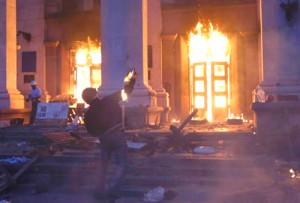 I’ve known Vlad Wojciechowski for several years. Once upon a time, before the Maidan, which split history into “before” and “after” and destroyed the Ukrainian state, I loved coming to Odessa, meeting there with local activists of Borotba, including Vlad. At night we sat in noisy Odessa courtyards, walked around Primorsky Boulevard and discussed the prospects of political struggle. I remember on one of my last visits we strongly criticized Yanukovych and thought about how great Ukraine would be without him. That was two years ago.
Now, two years later, we are back together in the trench, placing guns on the parapet, watching the movements of “Ukropov” at the checkpoint. A ridiculous irony of fate. Vlad was one of the most active participants in the Odessa Anti-Maidan movement from the beginning, and was in the House of Trade Unions on May 2, 2014. After the terrible violence against opponents of the junta on Kulikovo Field, he was forced to flee to Crimea with other activists. He returned to Odessa at the end of the summer, was arrested and thrown into prison by the Security Service of Ukraine (SBU). In late December, he was exchanged for captured Ukrainian soldiers, and found himself in Novorossiya. Ukrainian officials took his papers, and now he’s unable to leave the country. However, it is not too perplexing. He seems to have found his place here — in the political department of the Ghost Brigade. We sit at the headquarters of the political department in Alchevsk and reminisce…
Free Press: How did Antimaidan begin in Odessa?
Vladislav Wojciechowski: For us, Antimaidan began in late 2013. The leader of the Odessa chapter of Borotba, Alexey Albu, was then a regional council deputy. The head of the Party of Regions faction asked his assistance in protecting the regional council — they really expected an assault then. Of course, we were no friends of the Regionals, but everyone understood that it was better for them to remain in power than the alternative …
And were there supporters of the Maidan in Odessa?
Of course, we had Maidan from the beginning. A small number of people, several hundred on average, hanging around the monument to the Duke of Richelieu, but nobody took them seriously: there were fools, what could they take over? Nobody even tried to disperse them. And Odessites plainly did not support them.
How did the local authorities treat them?
The local authorities panicked a little. During the defense of the regional council, after we had already spent three nights there, the TV reported that Yanukovych had proposed Yatsenyuk to become head of government. This was a serious wake-up call, as it showed that he had no other way to cope with them. Yatsenyuk ultimately refused, that is, he was aware that the power had already shifted 100 percent. Therefore, the local authorities were in a panic, not knowing what to do.
How did the Kulikovo Field movement develop?
It turned out that the defense of the regional council had rallied many people from various organizations, including some we sometimes protested, like “Slavic Unity.” A collective decision was reached to create a unified council to build a real people’s resistance to Maidan. All the Antimaidan forces rallied. That’s how the Kulikovo Field movement was born — because the first rally was held on the Kulikovo Field. Once there was a statue of Lenin there, before it was brought down and moved. It’s just a very large area in the center of the city. When the first rally was held there, we were about 10,000 people. It was just a rally, not yet a march. Prior to this, the largest rally that I had ever seen in Odessa was held by the Communist Party on January 24, 2009, against the Rada’s infringement of workers’ rights. About 900 people had come to that.
And here there were about 10,000, and from the podium it was announced that we’re not going anywhere and we will create a tent city. At the same time a people’s defense team was set up — young guys with bats who were supposed to protect Kulikovo Field. And on March 16 the first march was held – it brought out 20,000 to 25,000 people. Everyone thought here there would be no change of power.
There was a victorious euphoria?
Of course. Twenty-five thousand people. Odessa had never seen anything like it. I stood at the beginning of the march at a crossroads, where it turned in the direction of the regional council, filming it on video. I was shooting continuously for 40 minutes. And the march had still not ended, the tail was not visible. Moreover, 90 percent of the participants were not in any organizations. People spontaneously took to the streets to prevent what was happening in Kiev. Then it seemed, what Maidan in Odessa? There’s nothing here for them.
What happened on May 2?
The day before, on the first of May, we had a small May Day action — we held a march, which was about 4,000 people. By that time people had become tired of marches as they began to realize that they accomplished nothing. Every weekend we held marches, the first was 25,000, then 20,000, then 15,000. Everyone complained that there was nothing but talk and walking around the city. Four thousand people on the first of May — and that’s respectable. Then everyone crashed and went to rest.
On May 2, not suspecting anything, at about 2 o’clock I went with my sister to the Tavria supermarket on Deribasovskaya Street. We went (everything started then, but I still did not see anything), we bought something, and the guard started running around, yelling that everyone must leave, they are closed …
Did you know that football fans gathered there?
I knew, because just the week before when Chernomorets [Odessa soccer team] played, there were rumors that Kulikovo Field would be razed, so an urgent mobilization was called to defend the encampment. Naturally, we all ran there, but no one came. Everyone got fed up and no one took it seriously afterward. So, the guard kicked us out of the supermarket, and we saw shooting, flying stones, firecrackers … I took my sister home, went on the Internet, watched an online broadcast and was stunned, because there were never so many of these morons in the city.
You mean, it was all people from out of town?
That’s right. Because the Chernomorets fans who participated in the march “For a United Ukraine,” for the most part, when they saw how it was flying off the handle, said, “We don’t want to be part of this!” and went on to the football match. I’m not talking about the ultra-rightists, but about those who just came to the march.
I called my friend Andrei Brazhevsky. I was sure that he went there because he was always near the action. I asked him: “Andrei, what’s happening?” He said, “We got squeezed, but we’re still holding on, we have no forces here.” I said, “Come on, we will try to get to you!” We must help our comrades – you can’t throw them to the wolves. We decided to go to the Kulikovo Field, to see what was happening there. People were preparing for an attack on Kulikovo …
We arrived to a depressing spectacle. At that time there were only about 150 people. Moreover, the composition was depressing. About 40 young guys, 50 women aged 30 to 60, and 50 men aged 50-60-70 years. A sad spectacle, but, nevertheless, we took sticks in hand, made barricades — in general, prepared to defend ourselves. Of course, we all understood coming here that we will get it in the neck, but we had no moral right to leave the people. We decided to stay with them, arm them with sticks, collect stones.
We gathered up 250-300 people. There was a rumor that those who were defending themselves on Greek Street, a few hundred people, were coming back to us, and with their help we would repulse the crowd. Eventually, exactly 15 people returned from the Greek. These were the only ones who managed to get out of there without being stopped by police. They escaped the crowd, ran to Kulikovo, we met them …
So. We get a call from the city center, saying the fascists have already passed the Little Book, the book market halfway between Kulikovo and Greek. A march of one thousand. Several hundred from the Maidan, fully equipped with firearms. And half with bats and chains. We were told they were 10 minutes away, get ready! Well, we looked at the perimeter. It turned out that we had one person for every meter of barricade, well, it’s just gibberish, so we narrowed the barricades to the porch of the building.
You controlled the building then?
No one had control. It was empty. No, there were some workers from the House of Trade Unions. But on May 2, along with security, the usual guards, there were the boys from the Odessa squads. We decided to stay at the building. Naturally, we tried to send the women away. Many accuse the leaders of the Antimaidan of bringing people into the building, but that’s a lie. There are videos taken by us when Deputy Vyacheslav Markin, who died there, went to the podium with a microphone and starts yelling, uncharacteristicly for him, demanding all women leave the Kulikov Field. And there were grandmothers walking around with shields and helmets. He says, “Go away! Why do you need it?! Go away! Do not bother us! We will not run to save you.”
But some refused to retreat from the fight. In the confusion that followed, people ran into the building, because they could already see the march coming. We were part of the group left on the porch …
And were there attempts to strengthen the defenses, in terms of military science? Were there experts among you, who knew how to hold the defenses?
From the point of view of military science, it was all for nothing. There was no defense as such. Well, there were pieces of asphalt that we broke up for half an hour before their arrival, broken pallets — all spontaneous.
We had one person with military experience, a friend. When we saw him, he came up and said: “Guys, you know that it’s all over if we stay here?! You must understand this! What are you doing?” We said,” Come on, suggest something else.” And what is there to offer? There is nothing to offer. As a result, this highly intelligent military guy fled, and said to hell with it.
Some people who had shields remained on the porch and began throwing stones. A wooden shield is, of course, a good thing when you’re deflecting stones, but then they started to shoot at us …
What kind of firearms were used?
 A 5.45 mm barrel was definitely used. This is either a Saiga semi-automatic hunting rifle, or a Kalashnikov assault rifle. Most likely they were hunting rifles, the only difference being that such weapons cannot fire bursts.
When our people with shields began to fall, riddled with bullets, we all went into the building, because there was no other choice. We were in the building, and they were over forty meters away. We threw stones, they stood and shot. They did not even have to come close.
When we entered the building, there was a fuss. I saw a man of about 60 standing at the window, watching. Then he just crumpled — shot in the head, I saw it, it’s clear that it was not a thrown stone, but a shot in the head that killed him. There were a lot of pictures. Don’t look through a window or at once a couple of bullets will fly, or a Molotov cocktail.
We continued to throw stones until we ran out. There were few stones – we had to shove everything in our pockets! Then he started throwing pieces of glass at them — well, at least it was something. It was a little confusing. You throw a piece of glass about twenty meters, and someone forty meters away shoots at you.
Then we ran into a wing of the building, with one exit on the side stairs. Apparently they had already infiltrated it and sprayed a lot of pepper spray. Normal police “pepper” — it was impossible to breathe, just tears. We ran from that wing. By this time, the bottom had flared up …
And you had some personal weapons, gas cylinders, blunt weapons?
I didn’t see any, though I ran through all our “defenses.” We really had nothing to fight back with. If we had had two Kalashnikovs and a hundred rounds of ammunition each, we could have at least put up some resistance — they would have just run away.
At what point did you realize it was necessary to leave the building?
There was already heavy smoke. I started running around, looking for Alexey Albu and Andrei Brazhevsky, and there’s turmoil, a lot of people running around. At one point, Deputy Markin caught me by the arm and said, “Vlad, don’t be nervous, everything will be fine!” I said, “Ok, I’m not nervous!” And I ran on. I saw Andrei Brazhevsky. But Andrei had a problem – he couldn’t see well. Although he was an athlete, his vision was very poor, he just couldn’t recognize you past three to five meters. I yelled, “Andrei!” He heard me, but couldn’t see. Looking-looking, bang, and he ran off somewhere. Then I met Alexey Albu. He said, if there is a fire, it makes no sense to run upstairs, because you can’t jump and will either burn or suffocate, so let’s stick to the first floor.
Following this logic, we gathered who we could, and hand in hand, went through one of the wings of the building, down the stairs to a second floor window, and now two to three meters below us is a playground! A lot of people still stood under that window. We simply knocked out all the glass and breathed the air. And those below were saying, “Okay, let’s go!”
Well, we thought we’d preserve the defenses, hold the line on that floor. It was a narrow space, and in a narrow space, as is well known, the number of defenders is not so significant. And so there we were, until after a while one of the ultras with a Ukrainian ribbon crashes in and says, “Oops, this is the end of you!” And beside me was an old grandfather. Maybe a former military man — he was wearing camouflage. Well, I respected this grandfather — he kept his head and immediately threw a punch at this fool. He hit him in the stomach so hard that he got up and ran away. And I was holding a large fire extinguisher. I took it in case we had to hold back the flames, it had very strong pressure. I sprayed him with the fire extinguisher, he scrambled up and fled, dramatically threw a bottle at us, but missed.
Then they decided to talk with us. They said: “Bring out the women, and then let’s deal!” We said, “Well, just let them withdraw peacefully, without problems.” They still said: “Bring out the women, we will not touch them, we are local.” We said: “Local, what area are you from?” They: “We’ll kill you all!” Just local right-wingers, right, we know them all. We had five years of conflicts, we fought constantly with them. In general, there are only 50 people in Odessa, morons. It was clear that they were not local.
Eventually, we brought the women through the second floor window. Firefighters helped by putting up a ladder. We evacuated eight women, and we had seven people left. Four were young men up to 35, the rest 45-50 years. We realized that they are ready to shower us with Molotov cocktails, yet we need to somehow get out. We already realized that this was the end – all will have to pass through their hands, there were no other options — the smoke was already very heavy, there was nothing left to breathe.
We came out and immediately it began. First the firefighter went down, he said, “Come on, guys, I’ll try to bring you!” It was clear that he did not have a chance to bring us, because up comes a bald goon with a revolver in his hand who said to him: “Freedom! Go home.” The firefighter left. Us: “Hands up!” But he was not alone, there were a bunch of morons standing around.
We reached the ground, and then another fascist runs up with a bat in one hand, and a chain in the other, swinging for me (and I was in a bright light green jacket): “This is the reptile who threw glass at us!” I was surprised the glass hit someone in their march …
And that’s all of us, 15 people in the corridor that the police made …
The police were present?
Yes, but there were only about 30 of them, okay, where to intervene? War is coming … In fact, we are grateful because they brought a lot of people out and saved them. Simply, if they had fled, the crowd would have snuffed us all. In general, they made a corridor for us to withdraw — there were fifteen policemen on one side, fifteen on the other, and among them about a hundred of these goats with bats and chains. We had just started to come out haphazardly, I did not even have time to do anything. Just trying to cover my head, when a chain hit me. Now I have a scar from the chain [shows wound]. Hit, I fell down in a heap. Then some idiot brings the Ukrainian flag and tells me, “Kiss the flag!” There I sat with a busted head. I pretended to be stunned, to not understand anything. Then he was dragged off by his own people, so as not to shame them.
Then time seemed to run a little differently, it’s hard to remember now, as I lay there in a pool of blood. In the end, it was dark, and we tried to reach the police. There is a video showing a handful of us, the gangsters walking around us, someone laughs, someone spits. An old grandfather tries to take me by the hand, hit me with a shovel. Then the police drove their van closer to us, saying, “Get up quickly, crawl, get in!” This was another test, because there I was, my head was busted, but at least I could move. But there were a few people with us who were lying unconscious, beaten to a pulp – we dragged them. Those who could went toward the police van, and got beaten on the head with sticks. We rolled away in this van, and they started to run, hitting it with sticks.
Once we got away, the police brought us to the station on Malinowski. One of the commanders of the district department came out, and said: “Guys, hold on! We are morally with you, but you see, there’s nothing we can do to help you, we have orders to arrest all of you. But I’m leaving these orders in the dark! I called an ambulance and you are leaving!”
Yes, the police were behind us. But what chance did their hundred people have to disperse 3,000 hoodlums?! The thirty or forty people that were at the House of Trade Unions, they almost didn’t intervene, they couldn’t do much. But if they hadn’t, we would not have gotten out. We would have just been beaten to death. A blow on the head with a stick by itself isn’t fatal, but 20 times in the same place, this is serious. So we went to the hospital, my head was bandaged. I was supposed to have an x-ray, but we didn’t wait, we wanted to hide at home to recover, find out what’s going on …
In your opinion, what was the cause of death of the majority of those killed in the House of Trade Unions? There’s been much speculation that the burned bodies were already dead …
I can’t answer unequivocally. Yes, there were several bodies that were burned, but there were so many armed gangsters with Wolfsangels [neo-Nazi symbol], and even members of the Azov Battalion. Sasha Gerasimov, a member of the Komsomol who spent 11 years in prison, was there. He began to choke from carbon monoxide, lost consciousness and fell. Men in black helmets with Wolfsangels pulled him up. They dragged him to the window and said, “Jump! Better jump, or we will beat you to death!” On the fifth floor! Naturally, he did not jump, he tried to resist, they began to beat him. There is even a piece of video where he crawls out as they beat and beat on him. He stayed in the hospital for three months, one leg severely burned, the other knee crushed – he is disabled now, and still walks with a cane.
But I think if not half, then at least one-third died from firearms. I’m a hundred percent sure. They could be seen, that’s the way it was …
But did any expert see the bullets …
The experts saw, but they had to blame us. They wrote on Andrei Brazhevsky’s death certificate that he died from the crash after falling from a window. But the video shows that when he fell, he just broke his leg. He was still alive and tried to get away. No, he was finished off. Some worthless fascist bashed his skull. Well, was it the crash? In the video everything is clearly visible, including those who pursued him prior to his death.
Then you had to flee from Odessa?
Yes. We left urgently on the night of May 8-9, that is, a week later. There was danger of arrest. A good friend warned comrade Alexey Albu by phone that they were preparing to arrest all the Borotba members on May 9, and that it was better for us to disappear. We left all together, the whole organization, in two cars, by taxi, then hired a minibus to Kherson, then to Crimea. I returned to Odessa on August 12 …
For what purpose?
I just wanted to, and came back. No, I knew it was dangerous. But I had nothing to hide. The SBU and police came to my home several times – they wanted to call me in for questioning as a witness to May 2. I wasn’t afraid, let them call me. I’ll come if I have to. I witnessed what happened, I didn’t kill anyone. But they did not call me for any interrogations. A month later I was arrested, exactly one month after I returned.
Of course, they knew that I was back. The phone was tapped, and naturally I did not change any of the numbers since I was not hiding from anyone. Nothing frightened me, and my mother and sister had long been accustomed to having the phone tapped. No one was hiding, I lived in a rented apartment, worked …
When I came back, I started to communicate with people from the Antimaidan — these were people who did not accept what had happened and wanted to do something. We went out at night, painted graffiti like “Junta out!” We pasted leaflets – something, anything to contribute to the struggle. Propaganda for Novorossiya, of course. Novorossiya is the only living example of confrontation with the Kiev authorities, this was not happening anywhere else. That’s where the banner was raised. And the people there took up arms and risked their lives to prevent this plague from descending upon them.
Friday, September 12, was a lovely autumn evening, the “velvet season” in Odessa, when the sea is still warm and the air is a little cool. An ordinary evening, a small group had gathered, all seemed normal. Our door was always open – we were not afraid. This was a typical Odessa courtyard, any neighbor can stop by without asking. And some people flew in. At first it was not clear who they were. Half of them were “citizens” and those who were in uniform were unmarked. No Ukrainian flags or insignia. The first thing I saw was some reptile with a brand new Kalashnikov. A good Kevlar helmet with a skull and crossbones. He ran in, shouting “All hands up!”, handcuffed us, start kicking people out. That left me, Popov and the third bad man, Palycha Shishman, who, it turned out, had cooperated with them. Comrade Popov was with us on the second of May. He is now in the Lugansk people’s militia, in the fourth brigade.
At night we were brought into the SBU, and various officers began questioning us. They already had a finished “pidozra” – in Russian, literally “suspicion.” Something like an indictment. First, they document a “suspicion,” then try to prove it in a pretrial investigation, and then refer the case to the court. Personally, I was charged with “suspicion” under Article 28-3, “Organization of a Terrorist Group.” By organization, they meant financing. That is, if you bought a drink for someone and talked to them about Novorossiya, it was already terrorism. A bottle of cognac – this is funding. The investigator said: From eight to 15 years in prison. But, he says, you have a problem there. I said, what? He said: You’re the organizer. I say, so what? He: Well, okay, not 15, but you’ll get 14 years for sure.
We spent a few days waiting for lawyers. We talked to them about the tactics of our defense, hoping for some relief in the court. But at the first trial, extended preventive measures were applied, and we realized that it’s useless. The lawyer says, the best thing to do is try to have you transferred to house arrest. The judge read it all, laughing: Article 28-3? She looks at the investigator: Are you serious? But what have they done? The investigator says: They did it! Well, the judge says she understands that we should be under house arrest. But there are no options, and … 60 days in jail! The judge said bluntly: “I have no options. If I release you, tomorrow they will come for you…”
So for four months, I ended up in jail. There, in Odessa. Once a week, I was pulled in for questioning by the SBU – not very pleasant conversations with not very nice people …
How did you come to be exchanged?
This was due to hard underground work, because it was difficult to get a hold of our lists, we had no connection to normal due process. On December 26, at eight in the evening, during the evening roll call, a senior officer came with a sheet of paper, called four names, and said: “You have fifteen minutes to get ready, a car is waiting for you, you are free, goodbye!”
We were in shock, they were going to let us go. The door opened, there were some fools in uniforms wearing masks, and one lead us somewhere. Well, we thought then it was the exchange, we had heard about it before. We were issued a ruling from the Prosecutor’s Office that the case was closed for lack of evidence. A note that says you are officially free. So I thought with this certificate I could leave prison quietly and go home to sleep. But I was taken out in handcuffs. “Alpha” soldiers put us in the trunk of a Volkswagen minivan. The Alphas took the seats, and the four of us were in the trunk. They handcuffed us together, took off and announced we were being taken to Kharkov. We already knew that. In Kharkov, they gathered 200-something men from all over Ukraine – this is kind of a transit hub. And then through Izium to Donetsk.
What happened after the exchange? How did you get into the Ghost Brigade?
In Donetsk, military intelligence took over. Everyone had to go through questioning, to find out who was really a rebel and who was just mishandled. The next day my comrades from the LC arrived and brought me to Lugansk. For the first month I lived with a man from the Hooligan Battalion, just thinking that this is freedom, cool! Then I met with Evgeni Wallenberg, who I knew from Borotba. Evgeni took me to Alchevsk and said: “Don’t you want to help me in the political department? I need people who are intelligent, ideologically savvy!” I said that I’d think about it. I thought, and now I’m here.
Why do you think the resistance in Odessa lost? Why did it succeed in the Donbass region, and not yours?
Frankly, I’m ashamed to answer, because I am ashamed for Odessa. Seventy percent of the people there still support us. Yes, they are all intimidated. But here, too, they tried to intimidate and arrest everyone. Here they began to bomb people …
In Odessa, the leaders of Antimaidan, rather than unite, were each pulling the blanket. Some used volunteers to collect money in the name of Antimaidan, and spent it on themselves. There was no cohesion. There were a thousand people, and 1,500 organizations. Fifteen hundred organizations per thousand people! And May 2 happened. If we knew what would happen, we could have gathered 20,000 people and chased all that crap out of town. But it turned out that in general no one gathered. There was an opportunity, but it was not taken advantage of.
Maybe people were not completely aware of the seriousness of the situation. This may have played a role. The mentality of Odessans is different from Donbass. Odessans are more opportunists by nature. On May 2 our enemies managed to intimidate most of the city’s population. On the one hand, shame and disgrace – fear is stupid! But on the other hand, you can understand them – stones against guns are not good odds …
How do you see the resolution of the whole situation? Do you see Odessa liberated?
I see it. I even see the liberation of Kiev …
Should Novorossiya be established within the borders of the Donetsk and Lugansk regions? Or within the boundaries of the eight regions [of southeastern Ukraine]? Or should all of Ukraine be liberated from the junta, and the country rebuilt?
As I said, in Odessa 70 percent support us. They now live under occupation. I understand that you cannot leave them that way. How could you say that in 1941-1945 …
It’s necessary, as you say, to “rebuild” on a new basis. Novorossiya is a new banner, which has risen for many people, they want to separate and build their own state. But a neighboring country, Ukraine, is suffering, and we are duty-bound to help get rid of the junta. And give people the freedom to choose the country in which they live, to choose their government. To release them from the occupation is just the beginning. Our enemy is not the soldier of the Ukrainian Armed Forces (APU), who stands in the trenches at the front, but the Kiev junta, the power of the oligarchs.
Ukrainian Security Service (SBU) chief investgator advises “Ukrainophobes” to keep quiet for their own safety
Korrespondent.net | April 21, 2015
The Head of the investigation department of the Ukrainian Security Service (SBU), Vasily Vovk, advises “Ukrainophobes” to stop their rhetoric for their own safety following the recent murders of government critics in Ukraine. He said this on the ICTV television program Freedom of Speech on the evening of April 20.
“As the head of the Investigation Department, I believe that at present time, when there’s practically a war out there, the Ukrainophobes should either shut up or tone down their rhetoric to zero. No one should be taking a stand against Ukraine and Ukrainian-ness,”
Responding to a question about whether he has a scientific or legal definition of ‘Ukrainophobia’, Vovk said, “There’s none. But we do know what we’re talking about.”
As reported by Korrespondent.net, Oleg Kalashnikov, former member of the Party of Regions and member of the Verkhovna Rada, fifth convocation, was shot dead in Kiev on April 15. The journalist and writer, Oles Buzina, was gunned down in the capital near the entrance of his house on the afternoon of April 16.
President Petro Poroshenko has urged a prompt investigation of the murders of Kalashnikov and Buzina.
Translation to English by New Cold War.org.
Home demolition in Jerusalem: “Tomorrow, I don’t know if I have a place to sleep”

Aref Tohta with the demolition order in his hand and his family
International Solidarity Movement | April 20, 2015
Jerusalem, Occupied Palestine – On Wednesday night, the Tohta family received a demolition order for their house in the occupied East Jerusalem neighborhood of Wadi al-Joz. After being warned that soldiers would come early on Sunday morning for the demolition, the family was joined by a group of about a dozen international supporters. Despite the warning, nothing happened that night – leaving the family afraid that their house could be demolished at any time without prior warning.
After being told by soldiers that during a demolition they “don’t see anything in front of [them]”, meaning everything will be destroyed, Aref Tohta and his family moved their most needed and precious belongings out of the house. They piled up boxes with warm clothes and blankets for the night, as far away from the house as possible, moved animal shelters and gave the five family dogs away knowing that they would be killed in a demolition.
A demolition of the family home will leave the fifteen family members without a shelter. Twelve of them are children aged between four and eighteen years. Jenny, an ISM-volunteer, staying with the family during the night explained: “any noise – a car door slamming somewhere, a voice heard in the vicinity – made everyone turn their head towards it, fearing an imminent destruction of the house. The fear was visible on everyone’s face”.
When no demolition happened, the father believed it was because the army did not want to have an international presence documenting this aggression. Now, the family lives in constant fear of the army showing up without any prior warning and tearing down the house. Aref Tohta explained the uncertainty the family has to live with every day: “Tomorrow, I don’t know if I have a place to sleep”.
Wadi al-Joz located directly outside the Old City of Jerusalem, is a vulnerable neighborhood that has seen three demolitions in the last three weeks. On 31st of March, the army illegally demolished the Amro family home, neighbors of the Tohta’s, without any demolition order or prior warning.
Police Body Cameras and Police Surveillance: Eviscerating Privacy
By Ben Schreiner | Global Research | April 21, 2015
Using the recent spree of high profile police murders as the latest catalyst, calls to outfit all cops with some sort of body camera are once again reverberating nationally. But given the staggering amounts of personal data on the American people police agencies are already collecting, the proposals to lend the police one more surveillance device raises significant privacy concerns.
Speaking on the repercussions of the police murder of Walter Scott in North Charleston, South Carolina, former New York City Police Commissioner Ray Kelly, a former opponent of body cams, recently remarked, “I think it is a game-changer. What you’ll see is a movement now by many more police departments to go to cameras.”
Indeed, the city of North Charleston has already announced plans to equip its entire police force with body cameras. This comes on the heels of President Obama announcement last December that the federal government would purchase 50,000 body cams for state and local police agencies in response to the fatal police shooting of Michael Brown in Ferguson, Missouri.
For their proponents, body cameras promise to provide much needed accountability to the nation’s police agencies and their officers, who continue to gun down Americans at an alarming rate, while still mostly managing to allude prosecution. And as advocates note, limited study of such police cameras have already yielded seemingly promising results. In Rialto, California, for instance, a controlled study found a 60% decline in use of force by officers equipped with body cameras. Cops, to no surprise of anyone who has ever sought to film an on-duty officer, are all too cognizant of the power of recorded video (especially, we might add, when such video is in the hands of citizens).
But the anecdotal evidence championed by body camera backers aside, such police cams offer at best a flawed check on police abuse and brutality, and at worst portend a further bolstering of the already dystopian surveillance capabilities of law enforcement agencies.
The Limits of Police Body Cams
To begin with, as should be readily evident, police body cameras only work when officers turn them on. So in the case of the slaying of Walter Scott in South Carolina, even if Officer Michael Slager had been equipped with a body cam, there is no guarantee it would have captured his shooting of Scott; Slager could have simply turned it off. Indeed, a trial use of body cameras by Denver, Colorado police from June to December of 2014 saw less than half of all encounters involving the use of force actually recorded by camera equipped officers.
(And yet even when police brutality is captured on video and viewed publicly, accountability for officers is hardly guaranteed. The death of Eric Garner at the hands of New York City cops was, after all, captured on film, but no officers were charged in his death.)
For those police body cams that actually are recording, however, all data collected is often held and stored by the police themselves; that is, the very people the cameras are meant to hold to account. As the Washington Post reported, “Officials in more than a dozen states—as well as the District [of Columbia]—have proposed restricting access or completely withholding the [body cam] footage from the public.” D.C. Mayor Muriel Bowser, as the Post explains, has sought to keep the public from viewing police body cam videos by exempting all such videos from the Freedom of Information Act.
Simply put then, police not only control what body cameras record, but also increasingly what is done with the captured video.
It is also worth considering the fact that devices touted as a way to hold police accountable for their actions are configured not to watch and record the police, but rather to watch us from the perspective of the police. And as anyone who has come face-to-face with armored clad riot cops during a political protest will no doubt attest, the routine use of cameras trained on protesters by police brings no measure of accountability to the cops. Police cameras do nothing to stop warrior cops from unleashing their truncheons on peaceful protesters, nor do they do anything to hold them to account afterwards. In fact, the police deploy such cameras at rallies largely to aid the future prosecution of those they will arrest for the great criminal offense that is political dissent.
Snooping Cops
The far more troubling issue with championing police body cameras as some sort of progressive police reform, though, is that their deployment is part of a larger proliferation of mass surveillance capabilities now allowing domestic law enforcement agencies to sweep up a breathtaking amount of data on American citizens.
As the Wall Street Journal reported, the 560 body cameras currently employed by officers of the Oakland, California police department “results in about five to six terabytes of data every month—equivalent to about 1,250 to 1,500 high-definition movie downloads.” The data, the Journal continues, “is stored on a department server for two years at a minimum.”
Using the FBI’s Lockheed Martin designed Next Generation Identification system, cops everywhere equipped with body cameras will soon be able to tap into an FBI database containing over 50 million photos in order to utilize facial recognition technology when making routine traffic stops. It’s difficult to see how the use of body cameras to conduct such fishing expeditions would serve in any way to further police accountability.
The threat to personal privacy posed by police body cams is heightened further when considering the intimate places cops routinely go (e.g. inside one’s apartment or home) and the often compromised state of those visited by police. As the Los Angeles Times notes, “Video from dashboard cameras in police cars, a more widely used technology, has long been exploited for entertainment purposes. Internet users have posted dash-cam videos of arrests of naked women to YouTube, and TMZ sometimes obtains police videos of athletes and celebrities during minor or embarrassing traffic stops, turning officers into unwitting paparazzi.”
It doesn’t take much imagination to picture huckster entrepreneurs of the near future using any and all police body cam video released to the public (which will undoubtedly be skewed toward those videos portraying officers in a positive light) to piggyback on the already booming online mug shot industry currently dabbling in the lucrative trade of public humiliation and shame.
Body cameras or not, though, police agencies the nation over are already fixing to amass vast swaths of data on no less than our daily movements via the widespread deployment of things like automatic license plate readers (ALPRs), which snap pictures of car license plates in conjunction with date, time, and location.
According to a separate Journal report, the Justice Department is currently using ALPRs strategically placed on major highways, in combination with those routinely used by state and local law enforcement agencies, to maintain a national database to “track in real time the movement of vehicles around the U.S.” Many of the devices used to feed the database, the paper notes, “also record visual images of drivers and passengers, which are sometimes clear enough for investigators to confirm identities.”
Consider, also, the ability local police agencies already possess to scoop up our electronic communications via devices like “dirtboxes” and “stingrays” (which mimic cellular towers in order to trick all adjacent cell phones into sending their identifying information back to the devices for collection). This is to say nothing of the “haystack” of personal data the National Security Agency is actively compiling in its search for needles.
Such a rush by law enforcement to deploy all the latest surveillance technologies on the American people quite predictably leaves the collecting agencies awash in more data than could ever possibly be of use. In fact, such mass surveillance is quite lousy at its purported purpose of predicting and preventing crime or “terrorism.” As Julia Angwin writes in her book Dragnet Nation, “the flood of data can be overwhelming and confounding to those who are charged with sorting through it to find terrorists.” “But,” Angwin goes on to add, “ubiquitous, covert surveillance does appear to be very good at repression.”
Police Surveillance as Repression
What the “war on drugs” was for mass incarceration, the “war on terror” has clearly been to domestic surveillance. So not only are militarized police now sent parading through the streets in their repurposed military vehicles and equipment, they are also increasingly turning to military-styled mass surveillance methods to achieve the very same ends sought by occupying American forces abroad; that is, collective pacification.
As Darwin Bond-Graham and Ali Winston write in a 2014 LA Weekly article on the Los Angeles Police Department’s use of data-intensive “predictive policing”: the “LAPD’s mild-sounding ‘predictive policing’ technique, introduced by former Chief William Bratton [now chief of the NYPD] to anticipate where future crime would hit, is actually a sophisticated system developed not by cops but by the U.S. military, based on ‘insurgent’ activity in Iraq and civilian casualty patterns in Afghanistan.”
Bond-Graham and Winston add: “Records obtained by L.A. Weekly from the U.S. Army Research Office show that UCLA professors Jeff Brantingham and Andrea Bertozzi (anthropology and applied mathematics, respectively) in 2009 told the Army that their predictive techniques ‘will provide the Army with a plethora of new data-intensive predictive algorithms for dealing with insurgents and terrorists abroad.’ In a later update to the Army, after they had begun working with LAPD, they wrote, ‘Terrorist and insurgent activities have a distinct parallel to urban crime.'”
The world, lest we ever forget, is now a battlefield. But if the American dragnet abroad is, as Alfred McCoy writes, a means of cheaply “projecting power and keeping subordinate allies in line,” the domestic dragnet imposed by militarized cops is likewise as much about keeping domestic threats (activists, dissidents, the working class, and poor) in line as imperial rot takes hold within the “homeland” in the form of widening economic inequality and deepening social crisis.
And utilizing mass surveillance as a tool of repression indeed appears the intent of snooping police departments.
Pouring over documents released on the city of Boston’s now suspended ALPR program, ACLU attorney Catherine Crump found that “The Boston Police Department was targeting mostly low income, working class, and Black neighborhoods with their license plate reader program.” In one case, Crump discovered that “one motorcycle that was recorded stolen in the police department’s system had driven past one fixed plate reader 60 times.”
“This signals to me that our greatest fear is true,” Crump adds. “While police say, ‘We need this technology because it helps us find stolen cars and criminals,’ we have found they’re also using these tools to collect data about people who they have no reason to believe were involved in any criminal activity. In Boston, we found that police aren’t using these cameras to respond to hits, they’re sucking up all this data to use potentially down the road for intelligence.”
Are we to believe, then, that the mountains of data to be captured by police body cameras and stored for possibly years by police departments is to be used to hold cops to account? Or is such footage more likely to be kept in secret to further police control over potentially rebellious poor, minority, and working class citizens?
Who gains by entrusting killer cops with policing our privacy?
Featured Video

John Mearsheimer Talking Iran with Iran
or go to
Aletho News Archives – Video-Images
New Book
The silver that medicine dropped — four thousand years of clinical use, four decades to erase.
Colloidal Silver — First Edition, 2026, Paperback
Lies are Unbekoming | October 16, 2026
Silver was medicine. Not alternative medicine. Not folk medicine. Medicine. In surgery. In obstetrics. In the burn ward. In water treatment. In the household medicine chest. Every physician before 1938 knew this.
By the 1870s, silver nitrate was standard in surgical wound care across the leading hospitals of Britain, Germany, and the United States. Colloidal silver preparations — Collargol, Argyrol, Protargol — entered European and American practice through the 1890s and early 1900s and became standard antiseptics in military field medicine. By the time Fleming grew his first penicillin mould in 1928, silver was the first-line antimicrobial of the Western pharmacopoeia. The Lancet and the British Medical Journal carried the clinical reports in volume. The practice ran continuously through the Victorian era, the Edwardian era, the First World War, the interwar period. By 1980, almost all of it was gone.
What has not been treated at book length, until now, is how a four-thousand-year clinical record disappeared from mainstream medicine within four decades of the Flexner Report — and what the honest account of silver looks like once that record is reassembled.
Colloidal Silver reconstructs the pre-1938 record from The Lancet, the British Medical Journal, and the primary literature of the era; recovers Robert Becker’s bioelectric framework from the regeneration research the pharmaceutical model buried; and places silver inside a practical terrain-paradigm guide to its current place — in water, on the body, inside the body, and in the chronic conditions where antibiotics have failed. … continue
Blog Roll
 Aletho News
- John Mearsheimer Talking Iran with Iran
- Inside Bill C-22, Canada’s Patriot Act.
- China’s FM: Palestinian cause is ‘greatest injustice of the century’
- US sympathy for Palestinians surpasses support for Israelis
- Israeli rabbi permits occupiers to steal Palestinian olive harvest in West Bank
- Spanish firm sells Latvia vehicles equipped with Israeli tech despite arms embargo
- Saudi Arabia under fire… Yemen is burning down the House of Saud
- Israeli Spy Pollard stole the files, today’s it’s delivered through official channels
- Why Iran Didn’t Walk Away
- US arms supplied to Ukraine found in war-torn Sudan – Moscow
- If Americans Knew
- NPR investigation finds evidence of widespread fraud at mall kiosks tied to Israeli skincare brand
- Tucker Carlson exposes Israeli Lies about the Oct 7th attack, Charlie Kirk, and the U.S.
- Israel has detained thousands of Palestinian children since Oct 7th – over half spent time in solitary, many uncharged
- Israeli Analysis: Is Netanyahu Planning an ‘October Surprise’ Attack Before Israel’s Election?
- Israeli settlers brutally attack Palestinians and Washington Post female photographer, 65
- Words Have Changed, Occupation Continues: The Reality of the Gaza Ceasefire
- Gaza’s child amputees are growing faster than their prosthetics allow
- Israel keeps Palestinians struggling just to survive–Daily Update
- Israeli firm used online ads to run vast spy operation, researchers say
- No, the world zionist movement is not an antisemitic conspiracy theory
- No Tricks Zone
- New Study Suggests Large Regions Of The Pacific Ocean Have Been Cooling For The Last 80 Years
- Germany’s Green Energy Debacle: High Energy Costs Force Kahla Porzellan to Close After 182 Years!
- New Study: 50 Years Of The Most Aggressive ‘Net Zero’ Policies Can Only Affect The Global Climate By 0.03°C
- US September “Heat” Was No Record…Many Records Set Decades Ago
- Latest European Green Energy Debacle; Portugal’s Largest Flagship Solar Park Insolvent!
- Green Energy Debacle: German Expert Professor Fritz Vahrenholt Warns Of Severe Economic And Social Consequences
- Two More Paleo Reconstructions Affirm Meters-Higher Sea Levels Across Ireland, Brazil 7000-6000 Years Ago
- New Study: Earth And Venus Surface Warmth Largely Explained By Convection And Lapse Rate, Not CO2 Or Radiation
- 2025 Nature Paper Claiming Worsening Global Drought Gets RETRACTED …Heavily Flawed
- New Study: ‘Global Drought Shows No Detectable Recent Acceleration Under Climate Warming’

