Obama Fights to Spread GMO Foods Throughout Europe
By Eric Zuesse | Black Agenda Report | April 29, 2015
One of the major barriers blocking U.S. President Barack Obama’s campaign for his mammoth international trade deals — the TTIP with Europe, and the TPP with Asia — is: other countries want the freedom to make up their own minds about the safety or dangerousness of the foods they allow to be sold within their borders.
The Obama Administration insists that no nation has that freedom. In fact, all participating nations would be removed from that responsibility and authority. The Obama trade deals propose to replace that national authority, and basic national sovereignty on these important matters, by decisions that would instead be made by international panels, whose members will be appointed by international corporations, which have their own profits at stake in these matters. Consumers and others will be ignored: they will not be represented in the proposed panels. Nor will any government be represented there. That soverignty will instead be transferred to the billionaire families who control and derive their income from these corporations.
On Friday, April 24th, Agence France Presse headlined “US Stresses Opposition to EU Opt-Out for GMO Imports,” and reported that, “The United States underscored Friday its opposition to a new European Union plan to allow member states to block genetically engineered imports after bilateral talks on a transatlantic free-trade pact.”
President Obama’s Trade Representative, Michael Froman, who is a Wall Street banker and a longtime close personal friend of the President, said on April 22nd that he was “very disappointed” that the EU wants to allow individual EU nations to “opt out” of automatic approval of Genetically Modified Organisms (GMOs) that the international panels will approve to be marketed everywhere. Furthermore, Froman’s assistant said that the U.S. rejects “a proposal to allow EU member states to ban products deemed safe by Europe’s own scientists.” He was referring there to the half of scientific papers that find GMO foods to be safe. However, those papers were produced by companies that manufacture and market GMOs. The other half of the scientific papers on GMOs, the half that were produced independently of the GMO industry, have not found GMO foods to be safe — to the exact contrary. The Office of the U.S. Trade Representative ignores those papers.
On 8 July 2009, Agence France Presse headlined “Scientists Warn of Hazards of GMOs,” and reported that an article in the International Journal of Biological Science co-authored by world-leading scientists, reported that, “Agricultural GM companies and evaluation committees systematically overlook the side effects of GMOs and pesticides.” An accompanying study, “How Subchronic and Chronic Health Effects Can Be Neglected for GMOs, Pesticides or Chemicals,” found “a significant underestimation of the initial signs of diseases like cancer and diseases of the hormonal, immune, nervous and reproductive systems.”
The United States does not regulate GMO foods, because the patents are owned mostly by U.S. companies, and the U.S. Government doesn’t want to get in the way of their selling their patented products. Consequently, the U.S. Food and Drug Administration takes any given GMO manufacturer’s word for the safety of its GMO products. U.S. President Obama wants to promote U.S. trade by convincing all other countries to sell GMO foods. His TTIP and TPP are supported by the GMO industry, which has approved their GMO foods and allowed their product-labels to not mention that some or all of the ingredients are genetically modified crops.
One of the major advantages of GMO crops is that they can survive the use of herbicides — weed-killers — that kill natural crops. (The GMO-seed manufacturer also markets the pesticide or herbicide; these are chemical companies, and GMOs are a complementary or synergistic product-line for them. For example, the leading herbicide “Roundup” is from Monsanto which produces the GMO seeds that tolerate it.) Another advantage is that the foods can stay longer as looking and smelling fresh, which also lowers the cost of production, and yet the consumer doesn’t even know that the food is actually stale — the food is competing against costlier-to-produce non-GMO foods and so driving them off the market by the lower price, which leaves more and more food-production dependent upon GMO makers such as Monsanto, DuPont, and Dow Chemical. The lower price is obvious; the lower quality is hidden. It’s race-to-the-bottom international ‘competition,’ in which the aristocracy reap all the winnings; the public get the losses.
A recent news report from independent food scientists was bannered “FDA Product Safety Declaration Misleads Nation—Again” and it contains references to many recent scientific papers that find GMO foods to be dangerous, and harmful to human health.
An international analysis, “A Comparative Evaluation of the Regulation of GM Crops” was published in 2013 in the scientific journal Environment International, and it concluded by saying that, “Regulatory bodies are not adequately assessing the risks of dsRNA-producing GM products. As a result, we recommend a process to properly assess the safety of dsRNA-producing GM organisms before they are released or commercialized.” The Obama Administration is trying to prevent that from happening; and their proposed TTIP and TPP international-trade treaties are crucial components of achieving this objective. In the United States, GMO-producers are granted the right to self-regulate, and this practice will become the standard worldwide practice if the TPP and TTIP become passed into law.
The U.S. Government is doing everything it can to spread to other nations the same deregulatory policies that American companies rely upon to market their products inside the United States. On Friday, April 25th, a key U.S. Senate Committee approved a “Trade Promotion Authority” bill to help rush through the U.S. Senate the approval of Mr. Froman’s TPP trade deal with Asian countries. For a summary of the regulatory practices around the world regarding GMO crops, see here. A discussion of the votes in the U.S. Senate on the measure that was proposed by Senator Bernie Sanders to allow individual states to establish their own regulations requiring the labeling or indication of whether or not particular food ingredients are GMOs (since the federal Government refuses to consider such a proposal), is here, and it shows that even some allegedly progressive U.S. Senators voted the GMO industry’s way on that bill to regulate it, which failed, on a vote of 71 to 27. One might call this the Monsanto Congress, because the U.S. House is even more conservative than the Senate. Of the 27 U.S. Senators who voted for the Sanders bill, 24 were Democrats, 2 were Independents, and 1 was Republican. 43 Republicans, and 28 Democrats voted against it. The Obama Administration had lobbied against the bill, in order to continue the GMO industry’s free reign over America’s food-supply.
When Barack Obama campaigned for the Presidency in 2008, he said, “Let folks know when their food is genetically modified, because Americans have a right to know what they’re buying.” But as soon as he won the Presidency “The new president filled key posts with Monsanto people, in federal agencies that wield tremendous force in food issues, the USDA and the FDA.” And whereas Republican news-organizations such as Fox ‘News’ criticized him as being a Muslim Marxist, he was actually implementing policies that continued those of the Republican George W. Bush Administration on this and on many other issues. Yet, no matter how far to the right Mr. Obama actually was, he was portrayed as a ‘leftist’ in Republican ’news’ media. And yet, still, even today, the vast majority of Democratic voters approve of his actions as President. They still believe his rhetoric, even though he has lied to them constantly and even filed a friend-of-the-court brief in the U.S. Supreme Court arguing that lying in politics must continue to remain unrestricted not only at the national level but also in each and every one of the states. Consequently, in the United States, there is no effective political opposition to the large international U.S. corporations. (And, under the Republican Supreme Court’s 2010 Citizens United decision, corporations now have virtually unlimited freedom to use stockholders’ money to purchase politicians.)
Hillary Clinton is a big supporter of the GMO industry, and the response of liberals to that is to ask her to give them rhetoric they like on the matter, just as Obama had done when he was running for President in 2008. In other words: they will campaign for her to become President if she will only lie to them as Obama did to them. What liberals are demanding is rhetoric; but if they get it from her, then the industries that are funding her Presidential campaign won’t be worried, because she has a solid record of doing what her financial backers want her to do. As long as Americans don’t care when a politician has lied to them, lying to them will continue to be the way to win public office — especially considering that America’s international corporations now have been granted by the Republican U.S. Supreme Court a ‘free speech’ right to purchase the U.S. Government. And now that the Supreme Court has also ruled that political lies are a Constitutionally protected form of speech, those ads don’t even need to be true. If the American people don’t care about honesty, then they won’t have an honest government, because America’s corporations can then buy any U.S. Government they want — they’ll have total impunity if the U.S. public don’t even care about honesty in their government. There are no legal penalties for political lying; so, if there are also no political penalties for it, then the U.S. can only be ruled by lies and their liars. Should that be called “fascism”?
According to the generally progressive Democratic U.S. Senator Sherrod Brown of Ohio (who, along with Elizabeth Warren and Bernie Sanders is one of the Senate’s three leading opponents of Mr. Obama’s proposed international-trade treaties), President Obama has been lobbying Senators more insistently and more intensely on getting them to grant him “Fast Track Trade Promotion Authority” to ram these treaties through, than on any other single issue since Obama first became President in 2009. No issue, not even Obamacare nor any other, has been as important to Obama as is his getting signed into law the TPP and TTIP. It would certainly be the culmination of his Presidency if he succeeds. It would be his crowning achievement. He and his heirs will be amply rewarded if he succeeds; and that’s apparently what he really cares about. He has shown it by his actions as President, not by his rhetoric to voters. After all: Americans, it seems, don’t really care about honesty. All they really care about is rhetoric that pleases them. They merely want to be told what they want to hear.
Perhaps this is the reason why no progressive has entered the Democratic Presidential contest against Hillary Clinton. If the only realistic possibilities to become the next President are her and her Republican opponent (whomever he will turn out to be), then America will continue to be a de facto one-party State, and this will be the U.S. international-corporate party, in both of its factions or nominal varieties, controlling the U.S. Government. The only comprehensive scientific study that has yet been done finds that the U.S. has, in fact, already been ruled in this way for some time. (The history of how it came to be this way, starting gradually after the end of World War II, is the subject of my latest book.) Obama is merely implementing it more; he didn’t start it. He is implementing it more than even Republicans were able to do.
Obama wouldn’t have been able to do this if he didn’t come bearing the label ‘Democrat.’ And Hillary Clinton’s husband Bill was the key person to subordinate that Party to Wall Street. Hillary and Obama are following in his footsteps. Obama’s “Change” occurred actually when Bill Clinton became President in 1993. It simply hasn’t been much recognized until now. Today’s Democratic Party started when Bill became President. That’s when the one-party State, with the national Democrats playing the role of the ‘Good Cop’ to the national and local Republicans’ role of the ‘Bad Cop,’ in the eyes of the Democratic Party’s electoral base of deceived liberals, actually began to take over the U.S. Government, for the benefit of, and service to, America’s aristocracy.
This is why both Obama and Clinton are big supporters of essentially unregulated GMOs. It’s sort of like unregulated Wall Street: the profits get privatized, while the losses (poor health etc.) get socialized.
Baltimore and the Human Right to Resistance: Rejecting the framework of the Oppressor
By Ajamu Baraka | Black Agenda Report | April 29, 2015
Anti-Black racism, always just beneath the surface of polite racial discourse in the U.S., has exploded in reaction to the resistance of black youth to another brutal murder by the agents of this racist, settler-colonialist state. With the resistance, the focus shifted from the brutal murder of Freddie Gray and the systematic state violence that historically has been deployed to control and contain the black population in the colonized urban zones of North America, to the forms of resistance by African Americans to the trauma of ongoing state violence.
The narrative being advanced by corporate media spokespeople gives the impression that the resistance has no rational basis. The impression being established is that this is just another manifestation of the irrationality of non-European people – in particular, Black people – and how they are prone to violence. This is the classic colonial projection employed by all white supremacist settler states, from the U.S., to South Africa and Israel.
The accompanying narrative is that any kind of resistance that does not fit the narrow definition of “non-violent” resistance is illegitimate violence and, therefore, counter-productive because – “violence doesn’t accomplish anything.” Not only does this position falsely equate resistance to oppression as being morally equivalent to the violence of the oppressor, it also attempts to erase the role of violence as being fundamental to the U.S. colonial project.
The history of colonial conquest saw the U.S. settler state shoot and murder its’ way across the land mass of what became the U.S. in the process of stealing indigenous land to expand the racist White republic from “sea to shining sea.” And the marginalization of the role of violence certainly does not reflect the values of the Obama administration that dutifully implements the bi-partisan dictates of the U.S. strategy of full spectrum dominance that privileges military power and oppressive violence to protect and advance U.S. global supremacy. The destruction of Libya; the re-invasion of Iraq; the civil war in Syria; Obama’s continued war in Afghanistan; the pathological assault by Israel on Palestinians in Gaza and the U.S. supported attack on Yemen by the Saudi dictatorship, are just a few of the horrific consequences of this criminal doctrine.
Race and oppressive violence has always been at the center of the racist colonial project that is the U.S. It is only when the oppressed resist — when we decide, like Malcolm X said, that we must fight for our human rights — that we are counseled to be like Dr. King, including by war mongers like Barack Obama. However, resistance to oppression is a right that the oppressed claim for themselves. It does not matter if it is sanctioned by the oppressor state, because that state has no legitimacy.
No rational person exalts violence and the loss of life. But violence is structured into the everyday institutional practices of all oppressive societies. It is the deliberate de-humanization of the person in order to turn them into a ‘thing’ — a process Dr. King called “thing-afication.” It is a necessary process for the oppressor in order to more effectively control and exploit. Resistance, informed by the conscious understanding of the equal humanity of all people, reverses this process of de-humanization. Struggle and resistance are the highest expressions of the collective demand for people-centered human rights – human rights defined and in the service of the people and not governments and middle-class lawyers.
That resistance may look chaotic at this point – spontaneous resistance almost always looks like that. But since the internal logic of neoliberal capital is incapable of resolving the contradiction that it created, expect more repression and more resistance that will eventually take a higher form of organization and permanence. In the meantime, we are watching to see who aligns with us or the racist state.
The contradictions of the colonial/capitalist system in its current expression of neoliberalism have obstructed the creation of decent, humane societies in which all people are valued and have democratic and human rights. What we are witnessing in the U.S. is a confirmation that neoliberal capitalism has created what Chris Hedges called “sacrificial zones” in which large numbers of black and Latino people have been confined and written off as disposable by the system. It is in those zones that we find the escalation of repressive violence by the militarized police forces. And it is in those zones where the people are deciding to fight back and take control of their communities and lives.
These are defining times for all those who give verbal support to anti-racist struggles and transformative politics. For many of our young white comrades, people of color and even some black ones who were too young to have lived through the last period of intensified struggle in the 1960s and ‘70s and have not understood the centrality of African American resistance to the historical social struggles in the U.S., it may be a little disconcerting to see the emergence of resistance that is not dependent on and validated by white folks or anyone else.”
The repression will continue, and so will the resistance. The fact that the resistance emerged in a so-called black city provides some complications, but those are rich and welcoming because they provide an opportunity to highlight one of the defining elements that will serve as a line of demarcation in the African American community – the issue of class. We are going to see a vicious ideological assault by the black middle class, probably led by their champion – Barack Obama – over the next few days. Yet the events over the last year are making it more difficult for these middle-class forces to distort and confuse the issue of their class collaboration with the white supremacist capitalist/colonialist patriarchy. The battle lines are being drawn; the only question that people must ask themselves is which side they’ll be on.
Israeli forces violently disperse al-Tur rally against road closure
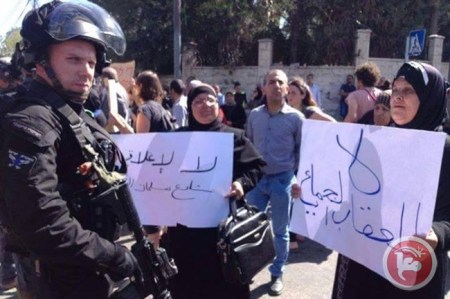
A protester holds a sign reading “No to collective punishment.” (MaanImages)
Ma’an – April 29, 2015
JERUSALEM – Israeli polices forces violently dispersed a Palestinian protest in the occupied East Jerusalem village of al-Tur on Wednesday, amid complaints that authorities’ closure of the village’s main road is a form of “collective punishment” against locals.
Sources told Ma’an that dozens of residents of the neighborhood on the Mount of Olives as well as foreign activists carried out a sit-in on al-Tur’s main street to protest Israeli authorities’ decision to shut down major thoroughfare Suleiman al-Farsi street with two concrete blocks.
The street was closed earlier this week when locals protested against the death of a 17-year-old boy from the area who was shot dead after a scuffle with a soldier at a nearby checkpoint.
Mufid Abu Ghannam, director of a local activist committee, told Ma’an that Israeli forces assaulted protesters on Wednesday and launched stun grenades at sit-in participants, injuring two people with shrapnel in their lower extremities.
Israeli forces also reportedly detained two Palestinian protesters, Amjad al-Shami and Youssef Khuweis.
Abu Ghannam said that even after protesters had dispersed, Israeli forces continued firing stun grenades at people in the area.
Israeli police spokesman Micky Rosenfeld confirmed the incident, saying that police used stun grenades against protesters after they blocked roads in what he called an “illegal demonstration” in which “stones were thrown at police officers who were at the scene.”
Rosenfeld denied any injuries in the incident.
The sit-in on the main street of al-Tur was held concurrently with rallies at five schools in the village, where students carried out sit-ins in school yards in protest against the closure of the village’s entrance.
Suleiman al-Farsi Street is considered the main entrance to the village, and local activists told Ma’an that the closure of the road negatively affected the ability of 3,000 local residents to live normally. The closure also prevents ambulances and fire trucks from reaching the village.
The thoroughfare is also the main road leading to the Suleiman al-Farsi mosque, the village cemetery, and two elementary schools where some 1,200 students attend.
The closure of the roads followed widespread protests against the killing of Muhammad Abu Ghannam on Saturday as he crossed the al-Zayyim checkpoint on foot resulted in widespread protests.
A soldier at the checkpoint reportedly insulted Abu Ghannam’s sister, leading to a scuffle, while Israeli authorities have alleged the boy pulled a knife on the soldier.
Israeli municipal authorities routinely close and block major roads leading into Palestinian neighborhoods of occupied East Jerusalem.
In addition to Al-Tur, another major road into the nearby town of al-Issawiya was also shut closed.
Abu Ghannam was one of three Palestinians shot dead by Israeli forces in the last week.
Although Palestinians in occupied East Jerusalem live within territory Israel has unilaterally annexed, they lack citizenship rights and are instead classified only as “residents” whose permits can be revoked if they move away from the city for more than a few years.
Jerusalem Palestinians face discrimination in all aspects of life including housing, employment, and services, and are unable to access services in the West Bank due to the construction of Israel’s separation wall.
Tensions have been running high in East Jerusalem since last summer when Jewish extremists raided the area and kidnapped and murdered a 16-year-old Palestinian boy, Muhammad Abu Khdeir.
Israeli forces have detained hundreds of Palestinians across East Jerusalem who have taken part in protests, especially against Israel’s summer assault on Gaza, including 600 alone in the two months after Abu Khdeir’s death.
Yemen suffers vital food and aid shortages as shelling continues
RT | April 28, 2015
Amid constant shelling by the Saudi-led coalition, Yemen is struggling to import even essentials such as food and water, with a UN-imposed arms blockade on Houthi fighters interrupting any deliveries to the country.
Speaking at UN Security Council closed-door consultations on the crisis in Yemen, the United Nations envoy to Yemen warned that UN arms embargo targeting the Houthis is having a collateral impact on aid deliveries.
“Implementation of the new targeted arms embargo … could inadvertently restrict the flow of much-needed commercial goods and humanitarian assistance to Yemen, including food, fuel and medical supplies,” Jamal Benomar told reporters after the briefing.
Around 10 vessels containing food supplies for Yemen are still waiting to enter the country’s ports, as many Yemeni sea outlets are now being cut off by Saudis who refuse to allow any international vessels to dock in Houthi-controlled areas.
According to the UN, the number includes three ships awaiting clearance at Hodeida, with one carrying 13,500 tonnes of rice. Another six ships carrying fuel, corn and construction products are awaiting clearance from the coalition to dock at the nearby Salifa port.
Yemen which imports more than 90 percent of its food, mainly by sea, has been struggling to feed the population for weeks. Earlier this month, Reuters reported that at least five merchant ships were not allowed to pass. Only two or three of those vessels have been able to offload their cargo, ship tracking data and shipping sources told Reuters.
“Ships with wheat need to wait up to five days for permission to enter. Several seem to be delayed,” a German commodities trade source told the news agency.
Aid deliveries have also been hindered by the Saudis who have now been engaging the Houthi forces from the air for over a month now.
Two Iranian cargo planes headed for Yemen were forced to turn back by Saudi Arabia last week. On Friday Iran’s Foreign Ministry summoned Saudi Arabia’s chargé d’affaires in Tehran to express its protest over the move.
“We consider all options for helping the Yemeni people and immediate dispatch of humanitarian aid and transfer of the injured,” Iran’s Deputy Foreign Minister for Arab and African Affairs Hossein Amir-Abdollahian said on Sunday.
The food that does eventually enter the war-torn country is being moved slowly around Yemen as shortages of fuel continues, United Nations’ World Food Programme said.
With a price tag of $10 per liter of petrol, hospitals are suffering the worst, with the UN humanitarian agency OCHA warning that fuel supplies to generate powers will dwindle for one more week before running out in two weeks time.
Prices for wheat products have also skyrocketed in the country and have risen by more than 40 percent since February. Medicine prices have risen by more than 300 percent, the UN said.
The humanitarian situation in Yemen has become catastrophic, humanitarian agencies said on Monday, as over 12 million people need help, according to UN figures.
“It was difficult enough before, but now there are just no words for how bad it’s gotten,” said International Committee of the Red Cross (ICRC) spokeswoman Marie Claire Feghali. “It’s a catastrophe, a humanitarian catastrophe.”
The lack of safe drinking water supply is also becoming a widespread problem in Yemen, a country of vast sand dunes and dessert.
“There’s a consensus on water sharing across the Middle East – since water is generally pretty scarce there. President Hadi cut the water budget by 70 percent and that was one of the many decisions that created the sentiment against him,” Danny Makki of the Syrian Youth Movement, told RT.
Meanwhile Yemen’s exiled government of President Ali Abdullah Saleh declared three areas in Yemen as “disaster” zone. Yemeni Human Rights Minister Izzedine al-Asbahi proclaimed that fighting in the country has “turned Yemen back 100 years,” due to the destruction of infrastructure. Provinces of Aden, Dhalea and Taiz, have suffered the most, al-Asbahi told a news conference in the Saudi capital Riyadh.
Since the Saudi-led bombings started on March 26, more than 1,000 people, including an estimated 551 civilians have been killed, the United Nations said last week. UNICEF said at least 115 children were among the dead.
“The impact on civilians is the major concern – a bombing campaign has been happening for over a month, and a hundred of killed civilians are children,” Joe Stork from Human Rights Watch told RT.
Commenting on Monday’s UN Security Council meeting, Russia’s UN envoy, Vitaly Churkin said that the warring parties have agreed on some measures in resolving the conflict.
“They [the warring parties in Yemen] agreed on a whole series of arrangements for settling the political crisis. The only remaining issue was the way the collective leadership would be structured,” Churkin told reporters.
Last Tuesday, Saudi Arabia said the first phase of the campaign, codenamed operation Decisive Storm, had achieved all of its goals and was concluded. The new phase, operation Restoring Hope, was announced with a focus on diplomacy, but didn’t rule out new airstrikes. Less than 24 hours later, airstrikes resumed with fighting continuing until this day.
Death threats for OSCE inspectors by Ukraine servicemen – Moscow
RT | April 27, 2015
Members of the OSCE mission in Ukraine have been questioned about their nationality by Kiev troops and volunteer battalion militiamen looking for Russian nationals. Vehicles have been illegally searched and lives threatened.
Russia’s Foreign Ministry has expressed concern over the questioning of members of the Organization for Security and Co-operation in Europe (OSCE) mission to Ukraine and illegal checks of their transport. On Monday it issued a special communique on the violation of the observers’ rights.
The release claims multiple violations of observers’ status have been registered at a number of checkpoints and settlements under the control of pro-Kiev forces. The communique mentions incidents in five villages. In a sixth case, a Ukrainian soldier openly threatened Russian-national OSCE members with death.
“These facts cause resentment and are categorically inexcusable. The coordination of the actions of the Ukrainian military and volunteer units leaves no place for doubt that the order on checking OSCE observers has come from a single center,” the document says.
Such actions by the Ukrainian forces run contrary to Kiev’s obligations to ensure safety and freedom of movement of the OSCE monitors overseeing the implementation of the Minsk peace deal and UN Security Council’s resolution 2202, the ministry said.
The leaders of Ukraine and the self-declared Donetsk and Lugansk People’s Republics, together with their colleagues from Russia, France and Germany, agreed on a new peace deal at a February meeting in the Belarusian capital, Minsk, after a previous ceasefire agreement had failed.
The new deal implies pullout of heavy weapons by both sides of the conflict, with the OSCE monitoring the ceasefire and security at border crossings between Ukraine and Russia.
The OSCE deployed its observers to Ukraine in March 2014 at the request of the Kiev government. A month later, in April 2014, Kiev launched a military operation against the rebels in Donbass.
In early March 2015 the OSCE decided to extend the mandate of the Special Monitoring Mission in Ukraine for one year, as well as increase the potential number of its observers to up to 1,000 people.
Long Beach Police Shoot & Kill Unarmed Teen Through Window For Graffiti On Abandoned Building
By Cassandra Fairbanks | The Free Thought Project | April 27, 2015
Long Beach, CA– On Thursday afternoon, April 23, at 2:45 pm, the life of 19-year-old Hector Morejon was tragically stolen. He was shot and killed after someone called the police to report a man trespassing in an abandoned building and spray painting.
Morejon was inside the vacant apartment building close to his home with four friends when police arrived and saw him standing by a wall through a broken window.
Likely alarmed by the police arriving and pointing to warn his friends, the teenager reportedly turned towards the window, bent his knees and extended his arm “as if pointing an object which the officer perceived was a gun.”
The police then fired an “unknown” number of bullets at Morejon and arrested the four people he was with for trespassing. No weapons were found at the scene.
According to a video made by a witness, after the teen was shot, he climbed out the window in a desperate attempt to have his life saved by the monster who had just fatally injured him.
“He was saying, ‘my stomach… my stomach…’ and the cop said, ‘so what?’” the witness explained.
The witness also stated that Morejon was allowed to bleed to death, despite paramedics being only a block and a half away from the scene.
His mother, Lucia Morejon, heard the shots and commotion echo from the alley behind her home and when she went outside to investigate what was going on she saw swarms of police, and her teenage son in an ambulance.
“When he saw her, he propped himself partially up and cried to her, “Mommy, Mommy, please come, please come!” She walked towards the ambulance, identified herself as his mother, expecting to ride with him to the hospital, but was pushed back by a man in a blue uniform. She asked what happened and was told that no one knew.” R. Samuel Paz, the lawyer representing the Morejon family wrote in a statement.
When his mother arrived at the hospital, she was not permitted to see her son until he was dead.

After taking this young life, the police went on the offensive, as usual, assassinating the character of their victim and claiming that the graffiti was gang related. There has been no indication that it was, and his family insists that he was a sweet teenager who had no gang affiliation.
She is requesting that people join her to demand justice and accountability from the Long Beach Police and that the U.S. Department of Justice investigate the killing of her son and release the name of the officer who killed him.
You can contact the Long Beach Police Department here.
The department claims that they are investigating the shooting. The Los Angeles County district attorney’s office is also conducting a separate investigation, which is customary in all officer-involved shootings, the LA Times reported.
Just over a year before killing Morejon– at 2:45 pm on April 27, 2014, the Long Beach Police executed a fleeing man on a beach in a horrifying scene that was caught on camera. The man had allegedly shoplifted from a Target store and attempted to flee his vehicle as he was gunned down from behind.
2:45 pm seems to be a very deadly time with the Long Beach PD.
The man exits the vehicle around the 1:50-minute mark:
Fighting for bread and social justice in Egypt
By Mai Shams El-Din | Mada Masr | April 26, 2015
Chants for bread and social justice didn’t emerge out of the January 25, 2011 revolution. Long before 2011, a strong protest movement existed against the economic policies of former President Mubarak and his regime, which gained momentum in 2006 through the protests and strikes of labor workers in Mahalla al-Kubra.
Nadeem Mansour, director of the Egyptian Center for Economic and Social Rights (ECESR), speaks to Mada Masr about the challenges facing the labor movement in Egypt and the battle for bread and social justice.
Mada Masr: Why do you think demands for social justice were masked by an identity battle post-January 25, 2011?
Nadeem Mansour: My work is still about the struggle for bread, social justice and the minimum wage, but after January 25, political organizations — the Muslim Brotherhood, Salafis and liberal groups — used the media to wage a very public battle over identity politics that masked this fight to some extent. Those who chanted for social rights in 2011 were not able to achieve their aims for numerous reasons — they didn’t have parties to speak for them, nor a media interested in propagating their ideals. Private media in Egypt is owned almost entirely by businessmen, who often have personal interests that are in conflict with labor movements.
At the ECESR, we have a monitor for economic and social protests. We’ve noticed that many protests over the last four years have had economic and social demands, and there have been a lot of them. In 2013, for example, the number of protests exceeded 5000. Our role is to support these demands. Social justice is the key to making any real change, and to all of the problems facing Egyptian society today. For example, terrorism will only be confronted and stability brought about by ensuring structural and social inequalities are addressed.
MM: How has the absence of political support for economic and social rights affected your work at the center?
NM: Support of the poor and marginalized has never received much genuine political interest. Such attention fluctuates according to the political climate. Part of our role as an entity that offers legal, research and media services, and supports syndicates and local communities, is to help people find solutions to their problems on a local level, and then ensuring attention is given to their problems more widely.
Take the case of the minimum wage, as an example. Before we started the campaign and filed the lawsuit, the issue was not even a matter of discussion. The last minimum wage was set in 1982, as far as I remember, and it was around LE34. The campaign — both research and online — was initiated in partnership with workers, as there were no independent trade unions or syndicates at the time. We succeeded in raising the minimum wage from LE34 to LE400, and then to LE700 after the revolution. Now the minimum wage stands at LE1200, and we are still demanding its increase. By setting the minimum wage as a revolutionary demand, it became a public issue, not just one concerning workers.
We are also interested in working more on specific cases, such as the issue of the Misr Shebin al-Kom Spinning and Weaving Company [the country’s largest textile company, based in Mahalla], which was sold to an Indian investor who already owned some of its competitors. He bought it illegally at a cheap price in order to destroy its equipment and decrease production and thus competition. This case prompted the government to issue a law protecting contracts, which we believe is unconstitutional and have challenged in court.
We partnered with a group of workers and farmers in 2012, when the constitution was being revised, to issue a document, “Workers and farmers write the constitution.” While the conflict over the civil or Islamic identity of the state continued, and there were many calls for workers and farmers to be educated about their rights, we decided to go and ask them about what they thought these rights should be. We went to 22 governorates and we talked with thousands of people. We put them together in a legal document and ended up with something similar to the international Covenant on Economic and Social Rights in its relation to health, work and water. This is part of our work, empowering local communities to make decisions that impact on their own lives.
MM: What about the syndicates and unions for workers?
NM: The syndicates and unions are weak because they are part of a nascent movement that is also facing attacks from many directions, and lacks organizational capacity. Additionally, the strength of these organizations is closely related to that of local communities and their capacity to mobilize and sustain action.
The question is, can these problems be solved by uniform state action, or do they require a decentralized approach?
The economic and social crisis in Egypt is partly due to corruption and government bureaucracy. Attempts at reform often happen in a very centralized manner, whereas capacity building has to be conducted locally.
There are between 1500 and 3000 syndicates, and the union’s [Federation of Independent Trade Unions] capacity for representation is limited. Also, there is no legal framework to structure their work, meaning the right to strike is not protected.
The syndicates are weak right now, and consequently so is the union. The ability to mobilize in the public domain is difficult in Egypt currently, and the attention of the public is focused on political parties and activists. But the attack on syndicates is much fiercer.
MM: How would you describe this attack?
NM: Workers face many problems, including: Dismissal, lack of financial rights, penalties against striking workers, threats, jail, physical assaults, torture and death — in extreme cases. The Protest Law also applies to workers, and is often enforced more vigorously. We have workers who are currently being tried for going on strike. Over the last 10 years, Egypt has developed a strong strike movement. The public mobilization on Jan 25 and June 30 were related to strikes over economic and social issues.
The entire movement is not often suppressed, as it is so vast, but smaller attacks are waged. During Morsi’s term in office, workers at the Portland Company in Alexandria were attacked by police dogs, and some were thrown from the second floor of the building, leading to severe injuries.
Just a few days ago, we were able to secure the release of a worker who criticized the administration of his employer on Facebook and is being investigated for it. Such attacks are often arbitrary, so we try to raise the profile of them in the media as much as we can.
Violence and the interference of the security services in the public domain have reached levels we haven’t witnessed in the last 10 years. The general climate is one of fear.
In one incident, a private company ended negotiations with its workers after military intelligence got involved. This is documented in the company’s official records.
MM: How do you deal with legislative obstacles to your work?
NM: We have strong objections to the current law regulating the work of civil society and against various drafts of the newly proposed law. The state is attempting to restrict rights-based work without understanding this will hinder democratic reform.
The Center is registered according to the law. We are not an association, but a legal services company, providing consultancy on legal and economic matters. We are a legal office and as such pay the appropriate taxes and have the required documents. Our work is transparent and open.
We are, however, interested in the law governing non-governmental organizations, because we are interested in the ways people organize and in supporting this locally and nationally. We want a law that supports activities and solidarity work. If I’m a legal firm that wants to provide free services, I should be able to do so. Why am I being dealt with as an association in this case?
MM: When and why did you decide to work in human rights?
NM: I began work as a trainee researcher at the Hisham Mubarak Law Center in 2008. I then started the ECESR with Khalid Ali and two other colleagues in 2009.
My interest in rights stems from my study of political economies, which focused on the relationship between the state, local communities and the labor movement. In human rights centers, there are many opportunities for young researchers to expand and develop their ideas.
Many people benefit from our legal services that wouldn’t have access to them otherwise. This motivates me to continue. Our work builds on that of many other generations and organizations. The public domain expanded dramatically after the revolution, enabling rights work to gain ground and the number of organizations dedicated to it to increase. The scale of such work was much more limited in the 90s, for example.
MM: Do you think the current restrictions on civil society will deter young people from getting involved in rights-based work?
NM: I don’t think this will prevent new generations from joining. There have always been restrictions on rights-related work. Under Mubarak, and even before I started in the 90s and 2000s, we suffered consistent and fierce attacks. The intensity of the attack on the movement has also increased with its ability to make an impact.
As long as people’s rights are violated, there will be a need for such organizations to exist.
—
This is part of a series of interviews with human rights workers in Egypt that will be published in the coming weeks.
Missouri Police Officer Tackles and Arrests Man Strolling Through Neighborhood for Not Providing ID
By Carlos Miller | PINAC | April 25, 2015
A man taking a stroll through his neighborhood was tackled and arrested by a Missouri police officer when he refused to identify himself, even though the cop did not have a reasonable suspicion that he was involved in a crime.
The incident took place in September in Breckenridge Hills, a municipality of St. Louis County with less than 5,000 residents, not too far from Ferguson.
But the video was not posted until Friday under the Youtube username, Chris Hoglan, with the following description:
I left for a walk at 12:17am on Sept. 4, 2014 and didn’t come home. I headed out on my own as I often do. My path crossed Officer Mathew Tyler Badge #272 of the Breckenridge Hills, Mo Police Department 20 minutes later. I was never told that I was suspected of any crime or given any reason as to why I was being detained. I asked many times if I was free to go and the end result was Officer Tyler #272 and Officer Allemann Badge #247 tackling me to the ground. I was then taken to jail and questioned. I never answered any questions and never gave them my ID through the entire 10 1/2hours I was held. I was searched and brought to the police station and questioned without being read my Miranda rights. I told them I was invoking my 5th amendment right too not answer any questions with legal representation and was still questioned. They ultimately charged me with “Police Interference”. It costs me a $500 bond to get out the next morning at 11am. I contacted my lawyer immediately and showed them the video. We requested a jury trial from Breckenridge Hills, Mo for the Police Interference charge and they dropped my charges. My attorneys and I met with the Chief of Breckenridge Hills, Mo on Feb. 5, 2015 in person and filed an Internal Affairs Complaint. We have been waiting for Breckenridge Hills to complete their internal investigation.
I have a full written statement that I typed out the next day with every detail I could remember. If anyone is interested in more details, private message me your email and I will send it your way.
Hoglan responded to a comment from PINAC, promising to send more details about the incident, which will be published when we get them. Hoglan also posted the video on Reddit, where it is being discussed.
Three months before this incident, the Breckenridge Hills City Council considered shutting down its local police department, allowing the neighboring St. Ann Police Department to take over because it would have cost the city $850,000 instead of $1.3 million.
But the city council voted against it because it “felt that an outside city would never be as concerned about Breckenridge Hills as are its own officers,” as the St. Louis Post-Dispatch explained.
But we can see now that was probably the wrong decision.
Israeli military training critically damaging to Palestinian farmers
International Solidarity Movement | April 25, 2015
Aqraba, Occupied Palestine – On 25th April 2015 ISM volunteers met with the mayor of Aqraba, Ayman Bani Fadl, who has asked internationals to document the intrusive Israeli occupation forces’ actions over the past week. The Israeli forces have been using civilian farm land to carry out training operations. The military have an encampment where they have stationed around ten tanks and approximately fifteen more armored vehicles, as well as numerous troops.

Israeli occupation forces present on Palestinian land near Aqraba (Photo by Aqraba Muncipality 24.04.15)
The military training in this area is hugely damaging to the farming economy, due to the fact that this seasons harvest began earlier in the month. Farmers are now prevented from carrying out their harvest by the presence of the Israeli Occupation Forces (IOF). The mayor stated that it is likely the military chose the time and area in a deliberate attempt to disrupt the harvest and the livelihoods of the civilian population. He also claimed the actions of the IOF were strategically designed to expropriate the land, forcing the farmers to leave the area. He went on to say that the military have already designated 150,000 dunams of Aqraba land as a military zone. Meaning, the military have full control of the area. Despite this, the IOF have chosen to carry out their present training operations on the 10,000 dunams that remain accessible to the farmers.
These military operations occur on a regular basis and have a permanent and damaging effect on the community. Not least of which is the unexploded ordinance, carelessly left by the military, which has been responsible for killing four individuals and maiming tens of others, mostly children.
To add to the continuing persecution of Aqraba civilians, four months ago the electricity network, financed by the Belgian government, was demolished by Israeli forces. Due to a lack of funds, the municipality has only been able to temporarily reconstruct a portion of the network.
Furthermore, this continual land grab results in Israeli control over highly fertile agricultural soil and cuts off Palestinian access to the Jordan Valley, restricting freedom of movement and their right to cultivate their own farming land.
The present military operation in Aqraba is just one example of the ongoing violent harassment and disruption that is one of many tactics used by Israeli forces, to make life so intolerable for Palestinians they will leave and abandon their land. Oppressive tactics of a similar nature are rife throughout the West Bank, with towns and villages in and around the Jordan Valley being particularly subject to persecution from the Israeli forces.
London Police Use Tear Gas on Protesters in Anti-Gentrification Rally
Sputnik | 25.04.2015
MOSCOW — Metropolitan police have used tear gas against protesters after they have tried stormed into a police station in South London’s Brixton during anti-gentrification demonstrations, local media reported Saturday.
According to ITV, members of the law enforcement removed the protesters who entered the station using tear gas.
Thousands of people have gathered in Brixton’s central square to protest against gentrification earlier in the day, according to media.
The event’s organizers claim they support change and regeneration which would benefit the existing communities in the area, but not gentrification. The local council or associations have sent eviction notices to tenants of at least four council homes to be renewed by private constructions.
“Stop rent rises, stop evictions,” the protesters’ placards read. Other slogans included “People before profit,” “More council homes, not luxury homes,” and “Property developers are vultures.”
One demonstrator held a sign saying “Black communities matter,” protesting against the gentrification of Brixton, which has a large percentage of residents of African and Caribbean descent.
“Social diversity is driven out by lack of truly affordable housing. Local businesses are driven out by increasing rents and redevelopment schemes that benefit national & multinational businesses, siphoning money out of the area,” according to the event’s organizers, who fear only the wealthy would be able to live in Brixton.
Gentrification is affecting more and more regions all over London, with people protesting against urban renewal. Earlier this week, anti-gentrification campaigners disrupted a property developer event in London, according to the local media.
Palestinian Teen Killed By Israeli Army Fire In Jerusalem
IMEMC & Agencies | April 25, 2015
 Israeli soldiers shot and killed, on Friday at night, a young Palestinian named Ali Sa’id Abu Ghannam, 16 years of age, near the Zaim military roadblock, east of occupied Jerusalem.
The Palestinian News & Info Agency WAFA has reported that the soldiers stopped the Palestinian, who was walking with a young woman from his family, and started provoking the two, before the soldiers uttered vulgar words towards the young woman.
The incident caused the young man to engage in a scuffle with the soldiers before one of them shot him dead.
The army is alleging the Palestinian “attempted to stab a soldier,” and was shot dead while trying to flee the scene.
The name of the slain Palestinian is Ali Sa’id Abu Ghannam, 16 years of age.
The Israeli army refused to hand the body of the slain Palestinian to the Red Crescent ambulance that arrived on the scene, and took it to an unknown destination.
The Israeli Police alleged the young Palestinian arrived at the roadblock “and started running towards the soldiers while carrying a butcher knife.”
Ynet News quoted a police statement alleging that one of the soldiers managed to hold the Palestinian, “but he continued to run towards the soldiers,” and they shot him dead.
In related news, Palestinian medical sources have reported that two Palestinians were shot and injured, on Friday, after Israeli soldiers opened fire on Palestinians east of Abasan town, east of the southern Gaza Strip city of Khan Younis.
One of the wounded was moved to Nasser Hospital in Khan Younis, suffering a gunshot injury, while the second received treatment by local medics after being shot with a rubber-coated metal bullet.
Philadelphians Know All About Police Murder by Van Ride
By Dave Lindorff | This Can’t Be Happening | April 23, 2015
Philadelphians don’t have any problem figuring out what happened to Freddie Gray, the 25-year old black man who died as a result of a severed spine at the neck while being transported in a police van by Baltimore Police.
Here in Philadelphia, Police have long enjoyed giving arrested men who mouth off to them during arrests what is known fondly in the department as a “nickel ride.” That’s where they put the prisoner in the back of the van, hands bound behind their backs so they cannot hold on to anything or protect themselves, and otherwise unrestrained. Then the driver of the vehicle accelerates repeatedly, whips around corners and periodically slams on the breaks, causing the helpless captive in the back to slam against various parts of the vehicle, often with his head.
Back in 2001, an investigative journalism series run by the Philadelphia Inquirer exposed the practice, which had led to numerous injuries of arrested people, and to secret payouts by the department to some of those most grievously hurt, including one man who was paralyzed from the neck down by a spinal injury similar to that suffered by Gray. He received a payment of $1.2 million, the newspaper reported.
The Inquirer exposé led calls for a halt to the criminal practice, but a 2013 article in the same publication reported that police were back at it again, with at least three serious incidents that led to a lawsuit against the department. One of those victims, 31-year-old Ryan Roberts, a burglary suspect, was delivered to the hospital with injuries all over his body, including to the back of his head. He died later. Though the cause of death was listed by the hospital as “cocaine intoxication,” the lawsuit alleges that he died of his injuries, sustained in the van ride, when he was left unrestrained in the back of the vehicle.
In the Baltimore case, a lawyer hired by Gray’s family says that though he was dragged, unresisting, into the van at the time police picked him up, and was yelling at the cops holding him, when he arrived at the hospital, he was immobile and his spine was “80-percent severed” at the neck. That’s the kind of injury that is hard to cause without a brutal amount of force — the kind of thing that could only be delivered by a deliberate twisting of the neck, or by the body being rammed against an immovable object — exactly the kind of thing that can happen in a Philadelphia Police van “nickel ride.”
Baltimore, a city with a large African American population, and a police department that has a history of abusive arrests, is reportedly on edge. The mayor and the police chief have both expressed concern about Gray’s death and an investigation is underway into what happened, with six officers involved in his detention and in the van ride currently suspended, but so far, city officials have been circumspect, saying they don’t know what happened between the time of his arrest, when he was seen shouting and later reportedly asking for help, and his delivery to the hospital, when he was no longer talking or breathing.
But they aren’t talking about the obvious reality a spine isn’t something that gets broken during a van ride, unless the victim has been left unrestrained in the back, and unless the driver is deliberately driving recklessly in an attempt to seriously hurt you.
This is just the latest example of a nationwide problem: murderous police brutality directed against the poor, and especially against blacks and latinos and other people of color.
Viewed from Philadelphia, what happened to Freddie Gray appears to be no less a murder than the gunning down of Walter Scott with five shots to the back by a North Charleston, SC police officer.
Until police start doing serious time for these crimes, and until the politicians who hire them and keep them on the street start losing their jobs, they will keep occurring.
Update:
Baltimore PD: Freddie Gray not buckled in, wasn’t given medical attention
RT | April 24, 2015
Baltimore police said Freddie Gray, who died in their custody after being arrested, was not buckled in when he was being transported and that officers “failed to give medical attention in a timely manner multiple times.”
Speaking at a press conference Friday, Baltimore Police Commissioner Anthony Batts updated the media about the ongoing investigation. He acknowledged that Gray, who died about a week after suffering a severe spinal cord injury in custody, was never strapped in with a seatbelt as department policy requires.
Deputy Commissioner Kevin Davis added that Baltimore police should have administered medical attention at the site of Gray’s apprehension –presumably because he was already hurt.
Featured Video

Matt Bracken: US Plans Massive MOAB Strike on Iran?
or go to
Aletho News Archives – Video-Images
New Book
The silver that medicine dropped — four thousand years of clinical use, four decades to erase.
Colloidal Silver — First Edition, 2026, Paperback
Lies are Unbekoming | October 16, 2026
Silver was medicine. Not alternative medicine. Not folk medicine. Medicine. In surgery. In obstetrics. In the burn ward. In water treatment. In the household medicine chest. Every physician before 1938 knew this.
By the 1870s, silver nitrate was standard in surgical wound care across the leading hospitals of Britain, Germany, and the United States. Colloidal silver preparations — Collargol, Argyrol, Protargol — entered European and American practice through the 1890s and early 1900s and became standard antiseptics in military field medicine. By the time Fleming grew his first penicillin mould in 1928, silver was the first-line antimicrobial of the Western pharmacopoeia. The Lancet and the British Medical Journal carried the clinical reports in volume. The practice ran continuously through the Victorian era, the Edwardian era, the First World War, the interwar period. By 1980, almost all of it was gone.
What has not been treated at book length, until now, is how a four-thousand-year clinical record disappeared from mainstream medicine within four decades of the Flexner Report — and what the honest account of silver looks like once that record is reassembled.
Colloidal Silver reconstructs the pre-1938 record from The Lancet, the British Medical Journal, and the primary literature of the era; recovers Robert Becker’s bioelectric framework from the regeneration research the pharmaceutical model buried; and places silver inside a practical terrain-paradigm guide to its current place — in water, on the body, inside the body, and in the chronic conditions where antibiotics have failed. … continue
Blog Roll
 Aletho News
- Inside Bill C-22, Canada’s Patriot Act.
- China’s FM: Palestinian cause is ‘greatest injustice of the century’
- US sympathy for Palestinians surpasses support for Israelis
- Israeli rabbi permits occupiers to steal Palestinian olive harvest in West Bank
- Spanish firm sells Latvia vehicles equipped with Israeli tech despite arms embargo
- Saudi Arabia under fire… Yemen is burning down the House of Saud
- Israeli Spy Pollard stole the files, today’s it’s delivered through official channels
- Why Iran Didn’t Walk Away
- US arms supplied to Ukraine found in war-torn Sudan – Moscow
- The silver that medicine dropped — four thousand years of clinical use, four decades to erase.
- If Americans Knew
- NPR investigation finds evidence of widespread fraud at mall kiosks tied to Israeli skincare brand
- Tucker Carlson exposes Israeli Lies about the Oct 7th attack, Charlie Kirk, and the U.S.
- Israel has detained thousands of Palestinian children since Oct 7th – over half spent time in solitary, many uncharged
- Israeli Analysis: Is Netanyahu Planning an ‘October Surprise’ Attack Before Israel’s Election?
- Israeli settlers brutally attack Palestinians and Washington Post female photographer, 65
- Words Have Changed, Occupation Continues: The Reality of the Gaza Ceasefire
- Gaza’s child amputees are growing faster than their prosthetics allow
- Israel keeps Palestinians struggling just to survive–Daily Update
- Israeli firm used online ads to run vast spy operation, researchers say
- No, the world zionist movement is not an antisemitic conspiracy theory
- No Tricks Zone
- New Study Suggests Large Regions Of The Pacific Ocean Have Been Cooling For The Last 80 Years
- Germany’s Green Energy Debacle: High Energy Costs Force Kahla Porzellan to Close After 182 Years!
- New Study: 50 Years Of The Most Aggressive ‘Net Zero’ Policies Can Only Affect The Global Climate By 0.03°C
- US September “Heat” Was No Record…Many Records Set Decades Ago
- Latest European Green Energy Debacle; Portugal’s Largest Flagship Solar Park Insolvent!
- Green Energy Debacle: German Expert Professor Fritz Vahrenholt Warns Of Severe Economic And Social Consequences
- Two More Paleo Reconstructions Affirm Meters-Higher Sea Levels Across Ireland, Brazil 7000-6000 Years Ago
- New Study: Earth And Venus Surface Warmth Largely Explained By Convection And Lapse Rate, Not CO2 Or Radiation
- 2025 Nature Paper Claiming Worsening Global Drought Gets RETRACTED …Heavily Flawed
- New Study: ‘Global Drought Shows No Detectable Recent Acceleration Under Climate Warming’

