‘US a warzone’: Police deploy heavy armor in America
RT | June 9, 2014
From the streets of Fallujah to Franklin, Indiana, heavily armored military vehicles have been rolled out for one and the same reason: many police officers in the US believe there’s a war going on.
Franklin, Indiana is by all accounts the idyllic Midwestern American town. Eponymously named after one of the founding fathers and “the first American,” Franklin’s small town bona fides provided Life Magazine with a Norman Rockwell-esque scene for a bit of village life utopia in the heart of the Great Depression.
But if you were to talk to local law enforcement, a battle is raging in the streets of Mayberry.
Franklin is the county seat of Johnson Country, Indiana. Speaking with Mark Alesia from The Indianapolis Star, Sheriff Doug Cox described the 139,000-strong administrative district as a place where officers’ old-time policing just doesn’t cut it anymore.
Leading Alesia to a pole barn in Franklin, Cox shows him a MRAP – a 55,000 pound, six-wheeled Mine-Resistant Ambush Protected armored-fighting vehicle with the word “SHERIFF” emblazoned on its flank.
“We don’t have a lot of mines in Johnson County,” confessed Sheriff Doug Cox, who acquired the vehicle. “My job is to make sure my employees go home safe.”
Cox isn’t alone in believing his deputies have something to fear. Johnson County is one of eight Indiana law enforcement agencies to acquire MRAPs from military surplus since 2010, according to public records obtained by The Indianapolis Star.
All across the state, and the country, the trend is similar. From picking up military surplus to using to $35 billion in grants from the Department of Homeland Security to acquire the most advanced weapons, police forces across America are armed to the teeth.
And as Pulaski County Sheriff Michael Gayer puts it, the effects are not only tactical, but psychological.
To put it bluntly: “It’s a lot more intimidating than a Dodge.”
Pulaski, mind you, is a county of roughly 13,000 people. The question of whether civilians need to be intimidated like that depends on your perspective, and as far as Gayer sees things, America is a battlefield and the police are akin to an occupying force.
“The United States of America has become a war zone,” he said. “There’s violence in the workplace, there’s violence in schools and there’s violence in the streets. You are seeing police departments going to a semi-military format because of the threats we have to counteract. If driving a military vehicle is going to protect officers, then that’s what I’m going to do.”
‘What if it were your kid’
The militarization of America was covered in a recent Vice.com documentary, entitled: ‘Here’s What Happens When Hackers Send a SWAT Team to Your House.’
Danny Gold heads to Somerset County, New Jersey, what he describes as “one of the wealthiest counties in the US.”
Sgt. Edward Ciempola, commander of the county SWAT team, boasts of a Lenco BearCat Ballistic Engineered Armored Response Counter Attack Truck, which he says they use on “every call out.”
With infrared cameras in stock and other military grade hardware, Gold asks Ciempola one simple question: in a quiet, relatively crime-free area, is all of this hardware really necessary?
“I would ask somebody that maybe suffered a loss because of not having this service and I would ask them the answer to that question,” Ciempola said.
“I would say, well, the SWAT team wasn’t available when you really needed it or a police officer wasn’t available when you really needed it, or an ambulance didn’t get there when you really needed it. How does that make you feel? And if your child’s school was suddenly under attack by some random actors, do you want them coming (points to SWAT team) to help your kid or do you want no one to show up?”
Despite the fears of Ciempola and Gayer, in a 2012 Department of Justice report, violent crime had declined by 72 percent from 79.8 to 22.5 per 1,000 persons age 12 or older since 1993. And yet, what’s happening in places like Franklin and Somerset County are the exception rather than the rule.
Writing for the Huffington Post, Radley Balko noted the disturbing trend in SWAT team growth across the country.
He argues that SWAT teams in municipalities with populations between 25,000 and 50,000 have “increased by more than 300 percent between 1984 and 1995.”
By 1995, nearly 90 percent of cities with 50,000 or more people had a SWAT team. In 2000, 75 percent of towns with 25,000 to 50,000 people had their own SWAT teams as well. And those paramilitary units are not sitting idly by.
Citing Peter Kraska, a criminologist at Eastern Kentucky University, Balko says the total number of SWAT raids in America has increased exponentially, from just a few hundred per year in the 1970s, to a few thousand by the early 1980s, to around 50,000 by the mid-2000s.
According to the American Civil Liberties Union (ACLU), “disproportionately those in poor communities and communities of color – have become targets for violent SWAT raids, often because the police suspect they have small amounts of drugs in their homes.”
And with the SWAT teams comes the military hardware. In Keene, New Hampshire, a town with two murders since 2009, officials accepted a $285,933 grant from the Department of Defense in 2012 to purchase a BearCat. In Columbia, South Carolina, a MRAP which can be equipped with a 50-caliber machine gun was picked up in 2013. In the sleepy town of Roanoke Rapids, North Carolina – a town of 16,000 people, police got their hands on their own Humvees and MRAPs, which they went on to display at a car show.
According to March report in USA Today co-written by US Representative Hank Johnson, the following counties “have acquired free MRAPs from US war zones”:
McLennan and Dallas Counties in Texas; Boise and Nampa Counties in Idaho; Indiana’s West Lafayette, Merrillville, and Madison Counties in Indiana (not to mention Johnson); Minnesota’s St. Cloud and Dakota Counties in Minnesota; Warren and Jefferson Counties in New York; North Augusta and Columbia in South Carolina; Murfreesboro in Tennessee; Yuma in Arizona; Kankakee County in Illinois; and Calhoun County in Alabama.
Many of the vehicles were acquired through the 1033 program, a 1997 law which facilitated the transfer of military hardware to local police forces. But what appears to be free federal handouts could result in fundamentally changing the face of the United States.
“Americans should therefore be concerned, unless they want their main streets patrolled in ways that mirror a war zone,” Johnson lamented.
“We recognized that we’re not in Kansas anymore, but are MRAPs really needed in small-town America? Are improvised explosive devices, grenade attacks, mines, shelling and other war-typical attacks really happening in Roanoke Rapids, a town of 16,000 people? No.”
Johnson, a member of the House Armed Services and Judiciary Committees, announced he was introducing legislation to reform the 1033 program “before America’s main streets and civilian police militarize further.” The ACLU, meanwhile, has launched an investigation into the militarization of US police.
“The police officers on our streets and in our neighborhoods are not soldiers fighting a war. Yet many have been armed with tactics and weapons designed for battle overseas,” it said.
In 2013, ACLU affiliates in 25 states filed over 260 public records requests with law enforcement agencies to document the impact of excessively militarized policing on people, families, and communities.
But as Balko warns, vested interests are likely to keep pushing the police-industrial complex until America is on lockdown.
“A new industry appears to be emerging just to convert those grants into battle-grade gear,” he said.
“That means we’ll soon have powerful private interests, funded by government grants, who will lobby for more government grants to pay for further militarization — a police industrial complex.”
Over 100,000 form human chain demanding Basque independence vote
RT | June 9, 2014
At least 100,000 people have formed a 123-kilometer-long human chain in support of a regional referendum on the Basque Country’s independence from Spain.
People began to link up at noon to form a continuous line along a road that connects the northern cities of Durango and Pamplona in the neighboring Navarra region, considered part of Basque cultural heritage.
The organizers of ‘Gure Esku Dago’ (It’s in our hands) initially said that around 50,000 people would be just enough to cover the distance of 123 km. But the turnout went beyond expectations with some reports indicating that 150,000 people eventually took part in the campaign.
Demonstrators draped in red-white-and-green Basque flags raised their linked hands as media crews flew over their heads.
Organizers of the solidarity movement say it was aimed to echo a similar demonstration last year in Catalonia where more than 1 million people formed a human chain stretching 400 kilometers.
Basque, a region of 2.2 million people, held its first elections in October 2012 after separatist group ETA ended its violent campaigns of bombings in 2011, the struggle claimed at least 850 lives from 1968-2010.
In late May, Basque lawmakers adopted a declaration of self-determination to follow on the footsteps of Catalonia, which made its own sovereignty claim last year.
In March, Spain’s Constitutional Court ruled the Catalan declaration was “null and unconstitutional” but the Catalan government is still committed on holding a referendum on secession in November.
The Basque already proposed a similar declaration back in 1990 in an attempt to hold a vote of self-determination but it was blocked by the Constitutional Court in 2008.
Germany To Begin Formal Investigation Into NSA Surveillance — But Only Of Angela Merkel
By Glyn Moody | Techdirt | June 6, 2014
The German government has been trying to avoid upsetting either the US by denouncing the large-scale surveillance being carried out by the NSA in its country, or the German people by not denouncing it. It finds itself in the same quandary as regards opening a formal investigation into the spying, which is probably why it has held off for so long. But now, the German authorities have come up with a sort of compromise, as GigaOM reports:
Germany’s federal prosecutor has launched the country’s first formal investigation into the activities of the NSA in Germany, specifically the U.S. intelligence agency’s reported bugging of Chancellor Angela Merkel’s mobile phone.
Harald Range said on Wednesday that the other potential avenue of investigation — that of the surveillance of the German people — remained open, though no investigation was being launched yet due to a lack of evidence.
Leaving aside the question just how much evidence the federal prosecutor needs before he investigates whether the German people have been subjected to US surveillance — a signed confession from President Obama perhaps? — the other issue here is the astonishing lack of sensitivity this move displays. The German government seems to be saying that spying is outrageous and must be investigated immediately if it’s directed against the powerful; but if it’s against the little people, then, well, sorry: we need more evidence before we could possibly risk upsetting the US.
Gaza fisherman shot by Israel 2 weeks ago succumbs to his wounds
Ma’an – June 8, 2014
GAZA CITY – A Palestinian fisherman shot by the Israeli navy two weeks ago succumbed to his wounds Sunday morning, Gaza medical authorities said.
Spokesman for the Gaza Ministry of Health Ashraf al-Qidra told Ma’an that 52-year-old Imad Shukri Salim was announced dead Sunday morning.
 Salim was shot in the chest by the Israeli navy two weeks ago while he was fishing off the coast in the area of al-Sudaniya in the northern Gaza Strip, al-Qidra said.
Israeli forces shot two Palestinian fishermen off the al-Sudaniya area coast in the month of May alone.
Palestinian fishermen are only being allowed to go three nautical miles from Gaza’s shore, even though an agreement previously settled on 20 nautical miles.
Israeli naval forces frequently harass Palestinian fishermen who near the three-mile limit, as well as those inside the zone.
There are 4,000 fishermen in Gaza. According to a 2011 report by the International Committee of the Red Cross 90 percent are poor, an increase of 40 percent from 2008 and a direct result of Israeli limits on the fishing industry.
Thought better of it: NSA can get rid of evidence, judge says
RT | June 7, 2014
A federal judge who ordered the National Security Agency to retain all records of its secret telephone surveillance related to an ongoing case has reversed the order – just a day after it was issued.
“In order to protect national security programs, I cannot issue a ruling at this time. The Court rescinds the June 5 order,” US District Judge Jeffrey White said from the bench on Friday.
The NSA had been prohibited from destroying any of its records of communications surveillance on Thursday – specifically under the government’s Section 702 program.
Section 702 of the Foreign Intelligence Surveillance Act (FISA) has been used by the NSA to justify widespread collection of phone calls and emails.
White first ordered that the agency retain records in March, to which the NSA responded that it was legally obliged to destroy all documents after a five year period.
White issued the temporary restraining order (TRO) in March to prevent the destruction of evidence. However, on Thursday, EFF filed an emergency motion, stating that in the past week interactions with government lawyers demonstrated that the destruction of records had continued.
Records could form a basis of evidence for two pending lawsuits posing a challenge to the surveillance program. One was filed by AT&T customers and the other by 23 Californian organizations.
The case – Jewel v. NSA the Electronic Frontier Foundation (EFF) sued the NSA and other government agencies on behalf of AT&T customers.
The Friday hearing saw lawyers from the Electronic Frontier Foundation (EFF) going up against lawyers from the Department of Justice.
The case has stagnated in the court system for several years. In 2008, the original complaint was filed against AT&T and the government, which it was alleged, was involved in “illegal and unconstitutional program of dragnet communications surveillance conducted by the National Security Agency and other Defendants in concert with major telecommunications companies.”
Evidence pre-dated Snowden’s revelations in June 2013, and was based on evidence from former San Francisco AT&T technician Mark Klein in 2006.
“I don’t want the preservation effects to get in the way of national security, but I don’t want national security to checkmate our case,” Cindy Cohn, an EFF attorney, told the court, reported arstechnica.
Justice department lawyers sought a stay. They argued that phone records and internet programs were separate. Section 702 allows the government access to emails and Facebook messages. The lawyers said that their compliance would put the program at risk.
Egypt sentences 10 Brotherhood leaders to death

MEMO | June 7, 2014
An Egyptian court on Saturday referred ten Muslim Brotherhood leaders charged with inciting violence to Egypt’s grand mufti, the country’s highest religious authority, to consider possible death sentences against them.
The ten are part of a group of 48 defendants, including Brotherhood Supreme Guide Dr Muhammad Badie, who are standing trial on charges of inciting violence in the Qalioubiya province last year.
The defendants face charges of blocking roads, inciting violence and attacking security forces on July 22 – some three weeks after the ouster of elected president Muhammad Morsi by the military.
Among the defendants referred to mufti – who were all tried in absentia – was senior Brotherhood leader Abdel-Rahman al-Bar, who is known as the Brotherhood mufti.
The same court also set July 5 as a date for issuing a final verdict in the case, the judicial source said.
Among other Brotherhood leaders charged in the same case are senior Brotherhood leader Muhammad Beltagi, former youth minister Osama Yassin, and former supply minister Bassem Ouda.
Members of the Muslim Brotherhood, the movement from which Morsi hails, have been the target of a mounting crackdown since Morsi’s ouster by the army in July last year.
The army-backed interim government late last year designated the Brotherhood as a terrorist organization.
Thousands of Brotherhood members have been arrested on charges of incitement-to-violence and joining a “terrorist” group.
The defendants, however, deny the accusations, which they describe as “politically motivated”.
Omar – Film Review by Gilad Atzmon
The Tragedy of Omar
by Gilad Atzmon | June 6, 2014
One of the most important Palestinian feature films ever, Omar, is the deepest expose of the diabolical nature of the Israeli occupation and the inhuman situation imposed on Palestinians by the Jewish State. It also throws light on the tragic and depressing Palestinian struggle against a sophisticated, demonic enemy — an on-going battle that so far has led nowhere.
In his latest film, Palestinian director Hany Abu Assad sets Omar (Adam Bakri), a young freedom fighter in an impossible, yet common, Palestinian dilemma, caught in a devastating triangle between his patriotic commitment, romance and the omnipresent Jewish State – a brutal, Orwellian, Big Brother that sees everything, knows everything, sets people against each other and controls everything through a network of collaborators even within the resistance.
Once captured by the IDF and being subject to some horrendous physical and mental torture by Israeli intelligence, Omar is set into a hellish scenario. He eventually manages to buy the Israeli’s trust, he lets them believe that he is willing to cooperate. At that moment Omar pretty much seals his fate. He is destined to lose everything.
Though we, comfortable in our cinema seats, know that he never compromised his commitment to his people, one by one, the Palestinians around him, led to believe he is a traitor, they turn their backs on him. Losing the love of his life to his friend — clearly a collaborator — he is ostracised by fellow warriors and their families. Omar, a Palestinian patriot, becomes a pawn in an evil Israeli game. As his situation deteriorates and his tragedy unfolds in front of our eyes, he remains aware of it all, and we, who witness this emerging tragedy, also can see no way out.
Agent Rami (Waleed Zuaiter), the veritable ‘good cop’ is the Israeli intelligence operator who recruits Omar. He appears to be humane, he never uses physical pressure, he also has his own family matters to handle, wife, kid etc’. But all those ‘humane’ symptoms are there to cover a deeply sinister and hideous character. Rami is in fact a cold blood Israeli monster who shatters the lives of others in a mass scale. He systematically makes empathy and human affection into a highly functional instruments of total abuse.
One hardly need to say that Rami, like Omar, is a symbol of his people and indeed, there is a clear cultural and ideological continuum between Rami, Shimon Peres and the entire Jewish Left. I refer here to the deceitful nature embedded in contemporary Jewish political culture, that intention to present empathy and humanism only to conceal a sinister, self-centric agenda that cares only for the members of the tribe.
At the start of this film we meet a young, handsome and joyful, Palestinian patriot who leaps over the gigantic Israeli Wall and who, against all odds, lays claim to his land. Ninety minutes later, the same man is a defeated soul. Physically and mentally tortured, Omar simply can no longer climb the wall and bridge the divide imposed on his people by the Jewish State.
By the end of the film, Omar, like Palestine itself, is a tormented and defeated soul. For him, there is no hope but martyrdom.
Russian Zvezda TV journalists missing near besieged Slavyansk
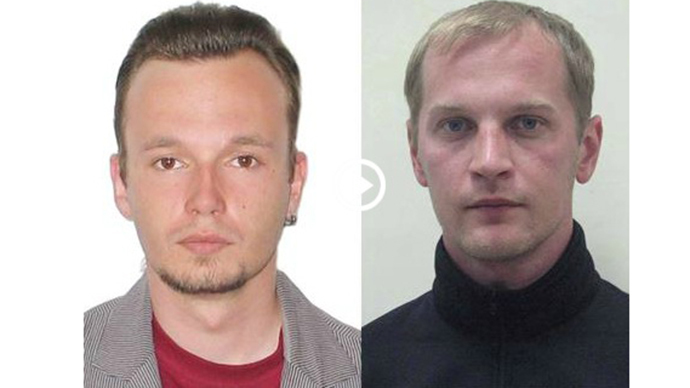
Andrey Sushenkov and Anton Malyshev (Photo courtesy of tvzvezda.ru)
RT | June 6, 2014
Two journalists from Russian TV channel Zvezda have gone missing after a search by Ukraine’s National Guard at a military checkpoint near the city of Slavyansk. In the meantime Ukraine armed forces continue their artillery assault on the city.
Video operator Andrey Suchenkov and sound engineer Anton Malyshev have been unreachable since Friday afternoon, Zvezda TV announced on its website.
“At the approaches to Slavyansk we got in touch by phone. They said National Guards were searching them and they would call back as soon as the search is over. Since then their numbers are unobtainable,” said Zvezda correspondent Evgeniy Davydov, who was in touch with the crew during their stay in Ukraine.
Last time Davydov managed to contact the missing journalists was at 14:30 GMT while they were near Balbasovka village some 20 kilometers from Slavyansk.
“We also can’t contact their driver – a citizen of Slavyansk,” he added.
This is not the first time Russian journalists working in Ukraine disappear after encountering the National Guard.
On May 18, two Russian journalists working for LifeNews TV channel – reporter Oleg Sidyakin and cameraman Marat Saichenko – were captured by Kiev forces near the eastern city of Kramatorsk. Initially accused of “aiding the terrorist groups,” they were released a week later – without any charges pressed or evidence of their misconduct provided – after a wave of outrage by rights groups and Russian politicians and media.
An RT journalist reporting from Ukraine, Graham Phillips, was also detained after a search by the National Guard last month and questioned by various Kiev security forces for over 36 hours before being released.
The area around Slavyansk is gripped by increased violence after Kiev intensified what it calls an ‘anti-terrorist’ operation against anti-government activists and militia who have taken control of the eastern regions of the country as a mark of protest against the Kiev authorities.
See also:
Ukrainian MP kicks out Russian journos from parliament, calls them ‘spies’ (VIDEO)
Featured Video

Why the U.S. Should Pull Back From the First Island Chain
or go to
Aletho News Archives – Video-Images
From the Archives
Only 19.7% of Americans agree with US State Dept on Israeli settlements
… Most American adults of voting age don’t appear willing to reject the applicability of international law to Israel’s ongoing colonization of occupied territories in East Jerusalem, the West Bank and Golan Heights. … Full article
Blog Roll
 Aletho News
- Albania on fire: who’s behind the riots?
- Egypt’s Civil Democratic Movement rejects involvement in regional war
- Egypt collaborates with Israel to build ‘Green Rafah’ project over erased Palestinian city
- Rising fuel prices and shortages have helped drive ongoing protests and rioting in France
- Tokyo protests demand Takaichi’s resignation over support for ‘Israel’
- Jennifer Kavanagh: Why the U.S. Should Pull Back From the First Island Chain
- Yemen denounces international community’s silence on Saudi aggression, siege
- UAE and Saudi Arabia move toward renewed coordination against Sanaa
- How Iran’s two-week retaliatory strikes exposed cracks in US military architecture in Persian Gulf
- The mother of all propaganda: Why the hype over US MOAB strike against Iran is nothing but theater
- If Americans Knew
- What the UK Is Doing to Pro-Palestine Novelist Sally Rooney Is an Act of Orwellian Villainy
- ‘We will build palaces for Jews in Gaza’: Right-wing activists establish new outpost near border
- ‘You see us burning, you stay silent’: Family’s agony over mother and sons burned to death in Gaza tent
- Israel keeps Palestinian journalist Bushra al-Tawil in isolation for 46 days
- US-Israel integration plan puts US military tech in Israel’s hands
- Israeli Strike Burns Gaza Mother Alive in Front of Toddler, ‘Without Generating Any Headlines’
- ‘The Israel Experience with Mike Huckabee’: The Ambassador’s Family Sells Trips to Israel
- As Gazans carry out mass burial, food insecurity is getting worse – Daily Update
- Israeli rabbi permits occupiers to steal Palestinian olive harvest in West Bank
- Netanyahu’s spin on latest settler attack is laughable – Daily Update
- No Tricks Zone
- Predictions Made By Renowned Climate Proifessor Over Past Decades Have Been Proven To Be Poor
- New Study Suggests Large Regions Of The Pacific Ocean Have Been Cooling For The Last 80 Years
- Germany’s Green Energy Debacle: High Energy Costs Force Kahla Porzellan to Close After 182 Years!
- New Study: 50 Years Of The Most Aggressive ‘Net Zero’ Policies Can Only Affect The Global Climate By 0.03°C
- US September “Heat” Was No Record…Many Records Set Decades Ago
- Latest European Green Energy Debacle; Portugal’s Largest Flagship Solar Park Insolvent!
- Green Energy Debacle: German Expert Professor Fritz Vahrenholt Warns Of Severe Economic And Social Consequences
- Two More Paleo Reconstructions Affirm Meters-Higher Sea Levels Across Ireland, Brazil 7000-6000 Years Ago
- New Study: Earth And Venus Surface Warmth Largely Explained By Convection And Lapse Rate, Not CO2 Or Radiation
- 2025 Nature Paper Claiming Worsening Global Drought Gets RETRACTED …Heavily Flawed

