California student body decides to divest from companies linked to Israel’s occupation of Palestine
By Mohannad Al-Adam | MEMO | May 30, 2014
The Student Union Assembly at the University of California, Santa Cruz announced in a press statement on Wednesday that it had successfully passed “a resolution calling for divestment from companies that profit from Israeli human rights violations against Palestinians” as initially proposed by the university’s Committee for Justice in Palestine (CJP).
The Palestinian activist and field coordinator for the Israel boycott association in the US, Dr Sinan Shaqdeeh, said in an interview with Alquds.com that the student government announced its resolution to divest from companies profiting from the Israeli occupation after student advocates of the Palestinian cause received the majority of votes in favour of divestment.
The university is located just to the south of San Francisco, California, and has a student body of approximately 17,000 students.
The CJP, a student organisation that acts within the university, succeeded, a few weeks ago, in convincing the university’s student government to vote on the divestment resolution. The vote began on Tuesday evening and was completed the following morning.
The University of California, Santa Cruz is the fifth California state university student government to successfully pass divestment resolutions.
Shaqdeeh explained that divestment resolutions would also be carried out in several other major American universities over the next few weeks, at a time when petitions are increasingly being signed by student and academic associations supporting the rights of Palestinians.
He also said that 10,000 American students have signed a petition at the University of South Florida to divest from companies linked to the Israeli occupation, but the 22 members of the university’s investment committee voted with an overwhelming majority against divestment.
In explaining their vote, the committee members stated that the university’s investment process should not be “politicised”, bypassing the ethical concerns of over 10,000 students who represent one quarter of the total number of students at the university.
The petition, one of the largest student petitions in history, called on the university administration to withdraw its investments in companies profiting from the Israeli occupation and to allow the students to have better access to the university’s investment data, estimated to be about $390 million, a third of which is believed to be invested in Israeli or American companies profiting from the occupation.
The student petition is mainly targeting companies like Caterpillar, which sells bulldozers to the Israeli army that are used to demolish the homes of Palestinians, as well as companies like G4S, a private security company that supplies Israel with the surveillance technology used in prisons and detention centres.
National Lawyers Guild Palestine Subcommittee calls for release of Amer Jubran, detained in Jordan
NLG International | May 29, 2014
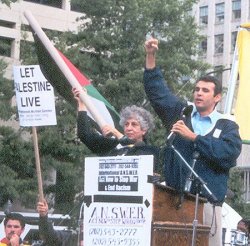 The Palestine Subcommittee of the National Lawyers Guild expresses its grave concern for Jordanian national, Palestinian Amer Jubran who was detained on May 5th, 2014 in Amman, Jordan.
It is our understanding that Jubran has not been charged with any crime and has had no access to a lawyer. Jubran is an internationally recognized and respected speaker, activist and writer on Palestinian human rights, and a critic of the U.S./Israeli occupation of the region. Having already been targeted by the US government for his political speech while a legal resident of the US in 2004, Jubran’s current detention raises concerns that this is a political arrest aimed at silencing dissent and suggests cooperation between Jordanian authorities, the United States and Israel in suppressing criticism of US and Israeli policies.
Jordan is a signatory party to the International Covenant on Civil and Political Rights (ICCPR). Article 9 of the ICCPR prohibits arbitrary arrest or detention, and requires that deprivation of liberty, even if legally sanctioned, must be necessary and reasonable, predictable, and proportional to the reasons for arrest. Article 19 (2) of the ICCPR guarantees the right to freedom of expression, including “freedom to seek, receive and impart information and ideas of all kinds, regardless of frontiers, either orally, in writing or in print, in the form of art, or through any other media of his choice.”
The United Nations Office of High Commissioner on Human Rights has advised that Jordan should end its current practice of administrative detention. Furthermore, Jordan’s penal code has still not been amended to comply with its 2011 guarantees to strengthen constitutional free speech. Jordan proclaims that it is undergoing democratic reforms and respecting civil liberties, claiming to have accepted a number of Amnesty International’s recommendations to limit the use and duration of administrative detention, and to ensure that all detainees are brought before an independent judicial authority promptly after arrest and charged, or else promptly released. However, Jordan’s use of arbitrary arrest and administration detention aimed to limit freedom of speech continues to be criticized in ongoing reports by international human rights organizations.
Friends and colleagues of Jubran have repeatedly contacted the Jordanian Embassy in the United States and the Ministry of the Interior in Jordan. They have been told that Jubran’s detention will be looked into, but no further information has been forthcoming.
The Palestine Subcommittee of the National Lawyers Guild urges compliance with internationally recognized standards of due process and the right to freedom of expression.
We expect
- the prompt release of Jubran, if he is not to be charged;
- access to an attorney of his choosing;
- the prompt setting of a reasonable bail if he is charged;
- visitation with his family;
- consultation with health care professionals;
- the immediate release of information regarding his whereabouts and condition;
- and an immediate explanation of why he has been held since May 5, 2014.
USA Freedom Act has Nothing to Do With Freedom
By Alfredo Lopez | This Can’t Be Happening! | May 28, 2014
It just wasn’t a very good week for phones or for freedom.
Last week’s obscene joke of a bill coughed up by a Congress [1] wheezing with immobilizing congestion morphed an already compromised law about data collection into a green light to spy on everyone.
The bill passed the House last Thursday and is now heading to the Senate where the chances of getting a better bill are pretty slim. The President has endorsed this House bill; after all, it endorses his policies.
Sponsored by Wisconsin Republican Jim Sensenbrenner (the author of the Patriot Act), the ironically named USA Freedom Act’s most salient feature is that, contrary to the bluffery about how it’s going to rein in the government on phone surveillance, it has now made massive phone data capture legal and public. The NSA and related agencies under this supposed “reform” bill would gain full authority to collect all information from phone companies and, what’s more, the bill mandates that the companies hold on to that information (apparently permanently).
The House obviously caved. Not that the first edition of this bill was very good to start with. The government obviously is not going to limit its own power. But the bill as passed by the House is much weaker and, in a “blink if you don’t believe it” moment, many Democratic Congressional leaders are actually congratulating themselves. Even John Conyers (D-Mich.), Detroit’s traditionally progressive Democrat, supported this bill: “We stand poised to end domestic bulk collection across the board,” he said not making clear where he was standing or when domestic bulk collection was going to end. It certainly didn’t end with this bill.
On the other hand, a few Congresspeople did express concern, including Sensenbrenner himself, who called the new law “an abuse” of the Patriot Act. One is left wondering what the Wisconsin lawmaker expected from the draconian nightmare he authored.
While that little humorless comedy was playing out, we got another glimpse of how phone surveillance is being used. Wikileaks revealed that the NSA has been collecting phone data on virtually all phones in Afghanistan. This comes on the heels of revelations a few days earlier about such mass phone call collection in the Bahamas, Mexico, Kenya and the Philippines. The punch-line to this gross violation of people’s rights is that the bill passed last week doesn’t even mention international phone call capture — that’s still left completely unregulated.
There’s a lot wrong with the bill passed through the House [2] and that’s obvious from the scenario of “permitted activity” that the bill is based on. Essentially, phone companies have to hold records for an unspecified period of time. The government can’t collect them indiscriminately as it had previously done. But that “reform” is meaningless because government agencies can acquire data from any phone company by using either a specific court order through the Foreign Intelligence Surveillance Act (FISA) court (the NSA’s rubber stamp in robes) based on “selectors,” or on the basis of an emergency situation defined according to NSA criteria.
The problem lies in the definition of “selectors” — the filters used to determine whether or not specific information is captured or requested. Previously, the NSA would capture the phone data and then run it through its “selectors” to determine what gets pulled or retained. Now, they can either ask the telephone company to run the selectors or go in and run it themselves. Before doing that, the spy agency must present the selection set to the FISA court. Since the court is going to approve anything NSA requests (it has rejected less than one percent of all requests up to now), the definition of the selectors is important because they are the only element of restraint in the entire collection process.
The bill requires that a selector be “a discrete term, such as a term specifically identifying a person, entity, account, address, or device”. How much is included under that umbrella? It’s probably better to ask what isn’t included. With that list, under this law, the NSA is allowed to access the records of almost all Americans.
But we still won’t know how many records have been accessed because this version strikes provisions in the original draft that would have forced phone companies to tell us how many records they’ve had to release to the NSA. Under the just-passed version of the bill, if the company wants to tell us, it can’t until six months after it has received a request. If it’s a start-up, it can’t do a report for two years.
In short, the law puts an automatic gag order on phone companies in this country.
In the guise of protecting our privacy or limiting surveillance power, the bill also continues to allow “about searches” in which an international conversation is scanned for names of people who then become targets of investigation. That particularly nasty practice makes any provisions protecting Americans useless. If a person in another country mentions your name, you are a legitimate target. In the original bill, any “reverse targeting” of this type was outlawed, but that protective provision has been eliminated from the version the House just passed.
This type of “foreign connection” is looming more important with recent revelations about international phone capture. This week, several publications released the information [3] about the complete capture of phone data in several countries but refused to name one of them (for national security reasons). Wikileaks, in response to that weak-kneed journalism, then named it: Afghanistan. (Even Glenn Greenwald, who broke the international capture story based upon some of NSA whistleblower Edward Snowden’s documents, honored a government request not to name Afghanistan.)
While fans of spy-craft will defend this practice of massive spying on international phones, under the curious but oft-repeated theory that our rights only pertain to people in this country, this sweeping capture program goes way beyond any traditional spying. In fact, phone data capture bears no resemblance to espionage or traditional spying (which is selective in its targeting) and is much closer to the activities of a police state. When done to another country, it’s a lot like trying to police the other country: a virtual act of virtual war.
It’s grotesque to consider that, after over 12 years of war waged on Afghanistan, our government is now waging a war of information capture against its people. But that revelation is proof of what many have been saying about this country’s intentions in that beleaguered and battered nation: we have absolutely no intention of pulling out of Afghanistan, no matter what President Obama says.
In fact, the phone data captured targets not only Afghans but phone calls from U.S. diplomatic and military personnel. In short, the NSA is spying on the military and the diplomatic core, including even the CIA. This is truly the stuff of a police state.
The entire phone capture controversy underscores another important political fact: the cell phone is now the most popular access to the Internet among people in developing countries and among young people and people of color in this country. These are also the people who are going to provide the sharpest and most aggressive challenges to the world’s governments in the coming years of deepening crisis. If our government wants to control anybody, it’s these people. The USA Freedom Act demonstrates one way they are planning to do that.
Up to 80,000 Palestinians in Jerusalem without running water for three months
MEMO | May 29, 2014
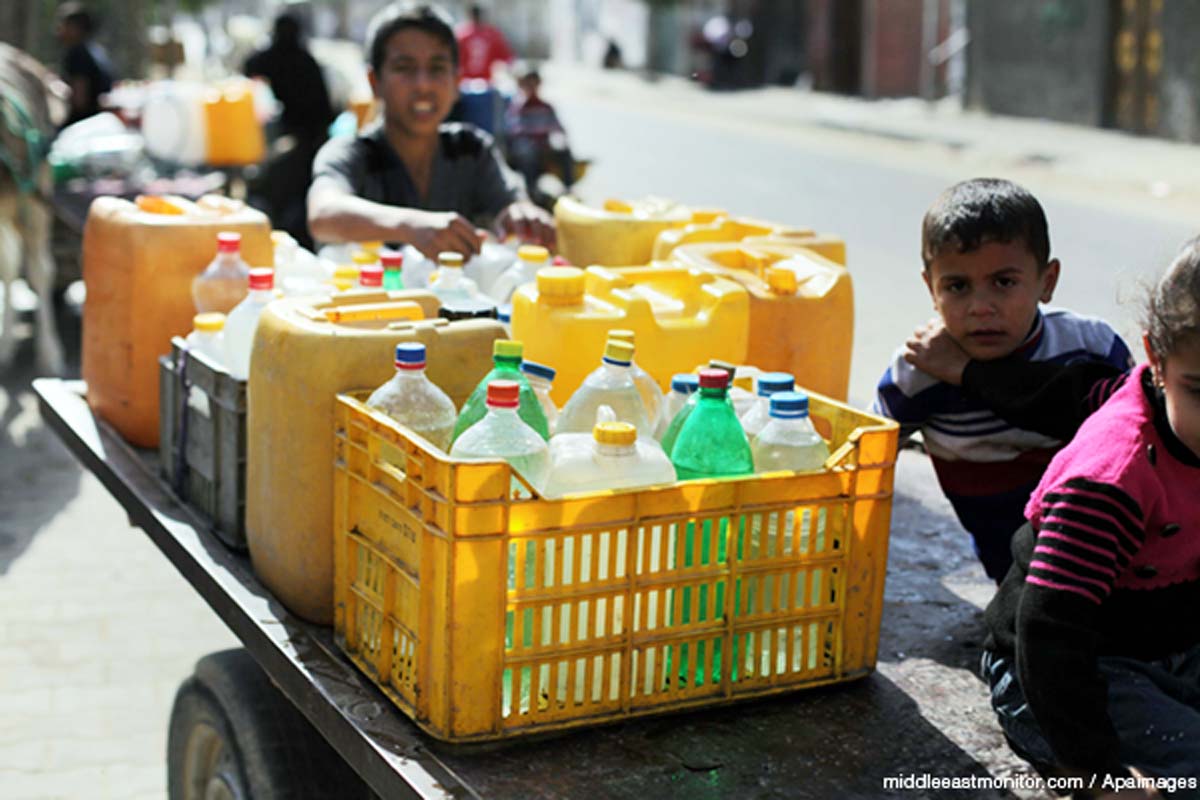
Israeli water utility company Hagihon has stopped the regular supply of running water to a number of Palestinian neighbourhoods in occupied East Jerusalem, according to a statement issued by Israeli human rights organisation B’Tselem.
The affected neighbourhoods are the Shu’fat Refugee Camp, Ras Khamis, Ras Sh’hadeh and Dahiyat As-Salam. They have all been isolated from the rest of Jerusalem by the Separation Wall.
B’Tselem stated that: “Some homes in these neighbourhoods have been completely cut off from the water supply; others receive water intermittently; and as for the rest, the water pressure in the pipes is so low that the water does not reach the faucets.”
The result, B’Tselem said, is that “an estimated 60,000 to 80,000 Palestinians – mostly permanent residents of Israel – have been left without a regular water supply.”
Trying to solve their problem, the residents spent three weeks applying to Hagihon and to the Jerusalem Municipality, seeking to have running water restored.
However, B’Tselem pointed out that the applications of the affected residents were ignored. Therefore, the Association for Civil Rights in Israel (ACRI) petitioned the High Court of Justice on 25 March 2014 seeking to have the water supply renewed without delay.
“On 2 April 2014, the Court instructed the State of Israel to respond to ACRI’s petition within 60 days, setting the deadline for the first week of June,” B’Tselem said.
In the meantime, the residents of these neighbourhoods have had no regular running water. B’Tselem reported residents walking at least one kilometre to get the needed daily supplies of water from relatives’ houses, sometimes repeating this journey several times a day.
Shells hit school, kindergarten in Slavyansk amid Ukraine military op
RT | May 28, 2014
A school and a kindergarten have been shelled in Slavyansk as the city becomes increasingly unsafe in the intensified Kiev military campaign. At least 9 civilians were injured in Wednesday’s shelling incidents, including a child.
Ukrainian mortar shells have for weeks been raining down on the checkpoints and positions of the Slavyansk self-defense, but much of the shelling occurred outside the city. Italian journalist Andrea Rocchelli and his Russian interpreter, veteran human rights activist Andrey Mironov, were almost “torn to pieces” in one such shelling.
However, this week the battleground apparently moved right into civilian quarters of Slavyansk, as shells started hitting residential blocks and nearby buildings, killing three people on Monday.
On Wednesday, there was a shocking reminder of how the situation might unfold if the new president-elect Petro Poroshenko pushes on with the military operation in the region, as shells struck the city’s streets, yards, a school and a kindergarten.
RT talked to a male schoolteacher from Slavyansk school number 13, who asked not to be named.
“Around midday there was a loud explosion in the school, and I fell to the floor, taking cover,” the teacher told RT over the phone.
The man said that he rushed to the corridor to assemble all the teachers and children in the school and take them to a safe place. Clouds of dust were billowing on one side of the building.
According to the teacher, it turned out that the shell exploded right above the school hall, where children are usually gathered for festive events, and part of the roof “was simply blown away.”
Luckily, no children were in the hall at the time. All the pupils and teachers were quickly evacuated to the basement.
It was not immediately clear, if there were any casualties in the kindergarten or other places shelled in Slavyansk, but the Rossiya-24 channel reported that 9 people were injured in total, including a 4-year-old boy. The channel’s crew narrowly escaped a direct hit by a mortar shell, as it fell “literally next to our car.”
Photos of the sites of Wednesday’s mortar attacks emerged on social media, showing partially destroyed buildings, craters in the roads, and what appeared to be blood.
The Kiev forces quickly laid the blame on self-defense units, which they refer to as “terrorists.”
“Currently, we are confirming the information on the terrorists’ shelling of the residential quarters and the territory of the school in Slavyansk,” the commander of Kiev’s military operation in southeastern Ukraine, Vladislav Seleznyov, wrote on his Facebook page.
Meanwhile, several funerals of those killed in Monday’s shelling were held in Slavyansk on Wednesday. According to the latest reports, four people have died from shrapnel wounds since then.
The shelling damaged a block of flats and a dormitory in the city’s teachers’ college, shattering glass in the windows of the college. Power lines and, reportedly, a city water pipeline were damaged and disrupted by the blasts.
Activists demand answers after news of NYPD spying on political groups
RT | May 27, 2014
Following the news that the New York Police Department sent undercover officers to monitor political organizations, multiple activist groups are looking for an audit of the department’s wide-ranging surveillance program.
The complaint has been filed with the NYPD’s new office of the inspector general, which the City Council created against the wishes of former Mayor Michael Bloomberg in order to oversee the police department’s policies – particularly in light of criticism regarding its stop-and-frisk tactics and surveillance of Muslim communities.
According to the New York Times, the groups are calling for a comprehensive investigation into the NYPD’s intelligence division, which has been operating the police force’s surveillance program for years. The move comes as the groups seek more transparency from police following the election of new Mayor Bill de Blasio, whose administration they believe will be supportive.
“We need tangible, concrete proposals of how we can ensure the NYPD does not target an entire group, set of groups, or political activists in general based on their participation in political advocacy,” the complaint reads.
Although most of the parties involved were not named, the Times revealed that one of the organizations behind the complaint is Friends of Brad Will – a group dedicated to increasing public awareness of human rights abuses connected to the “War on Drugs.”
As noted by the newspaper, the group believed it had attracted the attention of the police for years, and investigative reporting by the Associated Press confirmed that “an undercover officer had infiltrated a Friends of Brad Will meeting in New Orleans in 2008 and had sent a report noting plans for future actions by the group.”
In addition to spying on political groups, Reuters reported that police classified those employing civil disobedience as “terrorist organizations” and kept secret files on individual members.
Much of the NYPD’s surveillance efforts could be traced to the aftermath of the September 11 attacks on the World Trade Center, but the groups claim police activity has negatively affected their ability to organize and that their constitutional rights to assemble, petition the government, and practice free speech have been violated.
“These kinds of police programs can’t just be laid at the feet of a post-9/11 world and the argument that security outweighs legal protections,” Friends of Brad Will coordinator Robert Jereski told Reuters.
According to the Times, the complaint is requesting that the inspector general disclose “a full description of the training which officers undergo before being tasked with targeting political activists.”
This isn’t the first time that the NYPD has come under fire for political surveillance, either. In 2004, police were found to be monitoring church groups, anti-war organizations and others in the lead-up to the Republican National Convention. Police defended their behavior, arguing their efforts were aimed at preventing unlawful activity, not silencing dissent.
“There was no political surveillance,” NYPD intelligence unit leader David Cohen testified regarding past tactics. “This was a program designed to determine in advance the likelihood of unlawful activity or acts of violence.”
The most recent complaint also comes a little more than a month after the NYPD disbanded a controversial “Demographics Unit” tasked with detailing everyday life in predominantly Muslim communities in the wake of 9/11. As RT reported previously, no terrorism-related leads were generated despite the resourced dedicated.
“The Demographics Unit created psychological warfare in our community,” said Linda Sarsour of the Arab American Association of New York. “Those documents, they showed where we live. That’s the cafe where I eat. That’s where I pray. That’s where I buy my groceries. They were able to see their entire lives on those maps. And it completely messed with the psyche of the community.”
Japanese Government Snubs Anti-Nuclear Public Sentiment
RIA Novosti | May 26, 2014
MOSCOW – The public comment period for Japan’s new draft energy policy resulted in more than 90 percent of respondents saying they oppose the nuclear portion of the plan, Japan’s second largest newspaper, Asahi Shimbun, reported.
The newspaper reviewed the public comments to the draft of the first post-Fukushima basic energy policy, released by Japan’s Ministry of Economy, Trade and Industry in early December. The respective comments, gathered throughout a month, were disclosed in February and counted by Asahi Shimbun with the goal of identifying the proportion of negative and positive public reactions.
The 2,109 emails counted by Asahi Shimbun revealed that 95.2 percent opposed nuclear power generation, with as few as 33 responses arguing in favor of government energy policy including nuclear power.
Though shocking in terms of disregard to the public will, the results of the survey are consistent with the determination of the Abe administration to stick to the pro-nuclear policy. Even a recent ruling by the Fukui District Court against a restart of a nuclear reactor currently offline was identified as a “minor setback” to the energy policy draft by the Japanese government.
Why Boycotting Israel is So Important and Necessary
DePaul students don’t want their tuition dollars invested in weapons manufacturers who supply the Israeli government, army and prison services
By Stuart Littlewood | Dissident Voice | May 26, 2014
Nothing, it seems, is too ridiculous for Nick Clegg, UK Deputy Prime Minister, to contemplate. See him in this painful video ‘Nick Clegg welcomes the Jewish Manifesto‘ aimed at EU election candidates and voters.
Fortunately Clegg received a bloody nose yesterday in the EU elections. His infatuation with the EU and all its rotten works caused his party (the Liberal Democrats) to be almost wiped out at the polls. His days as leader are probably numbered.
If you’re wondering what the Jewish community’s EU Manifesto says, you can read it here. This propaganda effort is a prime example of the ‘hasbara’ scribbler’s art. It tries to shrug off Israel’s sickening human rights abuses and unending dispossession and oppression of its Palestinian neighbours and urges Members of the European Parliament to side with the apartheid regime.
“We urge MEPs and prospective MEPs to resist calls for boycotts of Israel. By their very nature, such measures attribute blame to only one side of the conflict, and through this stigmatisation they perpetuate a one-sided narrative. This in turn prompts intransigence from both sides.”
It also whinges about the European Commission’s guidelines that exclude Israeli settlements from EU funding programmes, accusing the EU of trying to dictate Israel’s borders. As most people know by now, Israel refuses to declare its borders because it hasn’t finished expanding them. The EU’s action, it says, is hurting the peace process “by perpetuating intransigence on the Palestinian side and could cause the Palestinian leadership to become less likely to make concessions”. The Palestinians have been robbed of everything, including their freedom. Why should they be asked to make more “concessions” to the thief?
The document also prods MEPs to oppose EU funding to Non Governmental Organisations who support boycott campaigns.
Campus ‘lies’?
So, after Clegg’s spineless capitulation, it was heartening to read today that students at DePaul University in Chicago have voted in favour of a referendum calling for divestment from companies “that profit from Israel’s discriminatory practices and human rights violations” and help “violate people’s rights to life, movement, healthcare, education and freedom.”
They are calling on the university to divest its funds from “corporations that manufacture weapons and provide surveillance technology to the Israeli government, army and prison services”, including Hewlett-Packard, Boeing, Lockheed Martin and Caterpillar.
Students say the vote was won despite a massive counter-campaign of intimidation and disinformation by pro-Israel lobbyist group StandWithUs and the Israeli consulate general in Chicago. “It is clear that DePaul students do not wish to have their tuition dollars invested in weapons manufacturers,” said a student organizer.
Following the DePaul vote, StandWithUs announced on their website: “We have seen divestment create this toxic campus environment wherever it rears its ugly head, as it has on several American campuses. Divestment advocates bring lies about Israel to campus, and display extreme ignorance about the complexities of the Middle East conflict, about Palestinian terrorist groups like Hamas, about the anti-Semitic incitement in Palestinian society, and about Israel’s repeated efforts to make peace. This movement singles out Israel and targets and intimidates pro-Israel and Jewish students, and resonates with anti-Semitism.” The words sound like they are scripted by the Lie Machine in Tel Aviv.
The ‘world’s most moral army’ and its war on students
DePaul students are to be congratulated for not flinching under Zio-pressure. Other Western students, and indeed students and academics all round the world, who face the same bully-boy tactics when debating the question of boycott and disinvestment against Israel, need only remember what the Israelis do to Palestinian students.
The last thing Israel wants is masses of bright and clever young Palestinians next-door in the shredded remains of the Occupied Territories. But that’s exactly what Palestinian youngsters are… bright and clever, given half a chance. So they need repressing. They need humiliating constantly. They need to be discouraged. They need to have their education disrupted big-time, so that they become a broken, dispirited, docile mass without ambition, easily controlled and utterly dependent (as they are now) on a few crumbs of comfort from Western taxpayers.
So the Israeli authorities make spiteful war on students especially, as well as women and children generally. To get to Bethlehem University, or any other, many students have to run the gauntlet of Israeli checkpoints. “Sometimes they take our ID cards and they spend ages writing down all the details, just to make us late,” said one. Students are often made to remove shoes, belt and bags. “It’s like an airport. Many times we are kept waiting outside for up to an hour, rain or shine, they don’t care.” The soldiers attempt to forcibly remove students’ clothes or they swear and shout sexual slurs at female students.
Some tell how they are sexually harassed and spend the rest of the day worrying what the Israelis will do to them on their way home.
This daily abuse undermines student motivation and concentration. Many other obstacles are put in their way by the Occupation. Here are just three cases, about which I have written before, that illustrate why it is so vitally important for the Palestinians to achieve independence and security.
Merna
Merna was an honours student in her final year majoring in English. Israeli soldiers frequently rampaged through her Bethlehem refugee camp in the middle of the night, ransacking homes and arbitrarily arresting residents. They took away her family one by one. First her 14-year-old cousin and best friend was shot dead by an Israeli sniper while she sat outside her family home during a curfew.
Next the Israelis arrested her eldest brother, a 22 year-old artist, and imprisoned him for 4 years. Then they came back for Merna’s 18-year-old brother. Not content with that the military came again, this time to take her youngest brother – the ‘baby’ of the family – just 16. These were the circumstances under which Merna had to study.
Israeli military law treats Palestinians as adults as soon as they reach 16, a flagrant violation of the United Nations Convention on the Rights of the Child. Israeli youngsters, on the other hand, are not regarded as adults until 18. Palestinians are dealt with by Israeli military courts, even when it’s a civil matter. These courts ignore international laws and conventions, so there’s no legal protection for individuals under Israeli military occupation.
As detention is based on secret information, which neither the detainee nor his lawyer is allowed to see, it is impossible to mount a proper defence. Besides, the Security Service always finds a bogus excuse to keep detainees locked up “in the greater interest of the security of Israel”. Although detainees have the right to review and appeal, they are unable to challenge the evidence and check facts as all information presented to the Court is classified.
Under huge mental stress Merna nevertheless determined to carry on with her studies. The “most moral army in the world”, as the Israelis call their uniformed thugs, may have robbed her brothers of an education, but she would still fight for hers. Sleepless and tearful, Merna went to university next day as usual.
A fellow student recalled that when chatting to Merna online in the evenings, she often had to leave the computer because the military had barged into her home. But even if she’d been up all night while Israeli soldiers trashed her house and questioned her family, she always came to school the next day. “Coming to school is a way of getting away from what is happening in the refugee camp,” said Merna. “It’s like an oasis here for me.” But her thoughts were never far from her cousin and brothers. “I only wish they were allowed this opportunity.”
She became a senior member of the Bethlehem University Student Ambassadors Programme and an example to fellow classmates. Young minds like Merna’s continue to persevere against the odds. Though greatly distracted by the cruel fate of her close family, the ordeal forged a steely resolve. The purposeful way she lived her university life, say the Brothers at Bethlehem Uni, gave her added strength and confidence. Merna managed to turn the tables on adversity. Her loss was actually her gain.
Berlanty
This Christian girl, a 4th year Business Administration student, was originally from Gaza but lived in the West Bank after receiving a travel permit from the military to cross from Gaza to the West Bank. She was snatched by the Israeli military while returning from a job interview in Ramallah. The 21 year-old, due to graduate in a few weeks’ time, was suddenly deported to Gaza “for trying to complete her studies at Bethlehem University”. She was about to be robbed of her degree at the last minute.
The “most moral army in the world” blindfolded and handcuffed her, loaded her into a military jeep and drove her from Bethlehem to Gaza, despite assurances by the Israeli Military Legal Advisor’s office that she would not be deported before an attorney from Gisha (an Israeli NGO working to protect Palestinians’ freedom of movement) had the opportunity to petition the Israeli court for her return to classes in Bethlehem.
When they’d crossed the border the world’s most moral army dumped Berlanty in the darkness late at night and told her: “You are in Gaza.”
“I had refrained from visiting my family in Gaza for fear that I would not be permitted to return to my studies in the West Bank,” she told Gisha on her mobile phone before the soldiers confiscated it. “Now, just two months before graduation, I was arrested and taken to Gaza in the middle of the night, with no way to finish my degree.”
The Israeli embassy in London, when asked for an explanation, said that Berlanty held a permit that had expired and she’d been living in the West Bank illegally. “As you probably know, every Gaza resident who stays in the West Bank requires a permit, failing to do so is a breach of the law.” If she wished to complete her studies at Bethlehem, she should apply for a permit to the relevant authorities. However, Bethlehem University told me that of the 12 students from Gaza who had applied to attend the University NOT ONE had received permission from the Israeli authorities.
Her appeal, handled by Gisha, was turned down. It was a classic example of how Israel’s administrative ‘laws’ are framed to ride rough-shod over citizens’ rights enshrined in international law. For example, the West Bank and the Gaza Strip are internationally recognized as one integral territory and under international law everyone has the right to freely choose their place of residence within a single territory. The state of Israel also has an obligation under the Oslo Agreements to “respect and preserve without obstacles, normal and smooth movement of people, vehicles and goods within the West Bank, and between the West Bank and Gaza Strip”.
While Israel’s embassy here in London pronounced the ruling on Berlanty’s fate, their Ambassador was whining about a warrant issued in London for the arrest of ex-foreign minister Tzipi Livni for alleged war crimes. Livni had overseen the murderous assault on Gaza the previous December/January, which killed 1400, including a large number of women and children, maimed thousands more and left countless families homeless.
If Berlanty, who had committed no crime, could not come and go as she pleased in her own country — the Holy Land – what made Israel’s Ambassador think that the blood soaked Livni, and others like her, should be allowed to come and go as they pleased in the UK? But that’s another shameful story.
Samer
A few months before he was due to graduate the Israeli military arrested Samer and threw him in jail… for 6 long years. Then, at 27, he returned to campus to finish what he started. “I feel like a regular student again,” he said with a wide grin. “I have a university notebook and textbooks. I can ask and answer questions freely. I can communicate openly with students, professors, and staff. It’s a real life, an authentic life.”
When imprisoned he was denied access to a lawyer for 55 days, then moved from one Israeli jail to another for more than six years. He was tortured on numerous occasions, he says, and regularly interrogated eight hours a day for four to five days, in just a T-shirt, squatting on the cold ground with his hands tied and an air conditioner blowing on his back. He was held in solitary confinement for more than a year.
Membership of a student group in Palestine is outlawed under Israeli military law, and students who engage in campus politics risk arrest by Israel’s uniformed gangs who barge into Palestinian society and academic life to abduct them. Many Western leaders began their political careers making a name for themselves at the Oxford Union and similar student debating groups or taking part in demos. How would they have reacted to being clapped in irons for it?
A good many of them, to their everlasting shame, are now signed-up Friends of Apartheid Israel. Members of the Israeli cabinet went to university too, presumably. Are we to believe that they never engaged in student politics?
Samer’s experience is similar to that of hundreds of Palestinian students who find themselves political prisoners. Many are left to rot in jail indefinitely, denied due process, a fair trial and legal representation. Some wait up to two years to be charged. Others are charged under Israeli military law, which falls a long way short of the justice standards required under international law.
The Palestinian Prisoner’s Society reckoned that seven Bethlehem University students were at that time in Israeli prisons for taking part in ‘student activities’. In Samer’s case, he was abducted for joining Fatah’s resistance movement after the 2000 Intifada (uprising). It is, of course, perfectly legitimate to resist an illegal occupier.
Coming back to university after prison is no easy thing. Samer suffered the cruel effects of six years’ incarceration and was often tired, depressed, stressed and jumpy. But he knew that the University was his anchor, the main hope in his young life.
So there you have it…. the evil of Israel’s ‘snatch squads’ that prey on Palestine’s young people, and the regime’s cruel disregard for their well being and education while in its clutches. The apartheid regime, after 66 years, still hasn’t emerged from the swamp.
Egypt revokes citizenship of Associated Press journalist
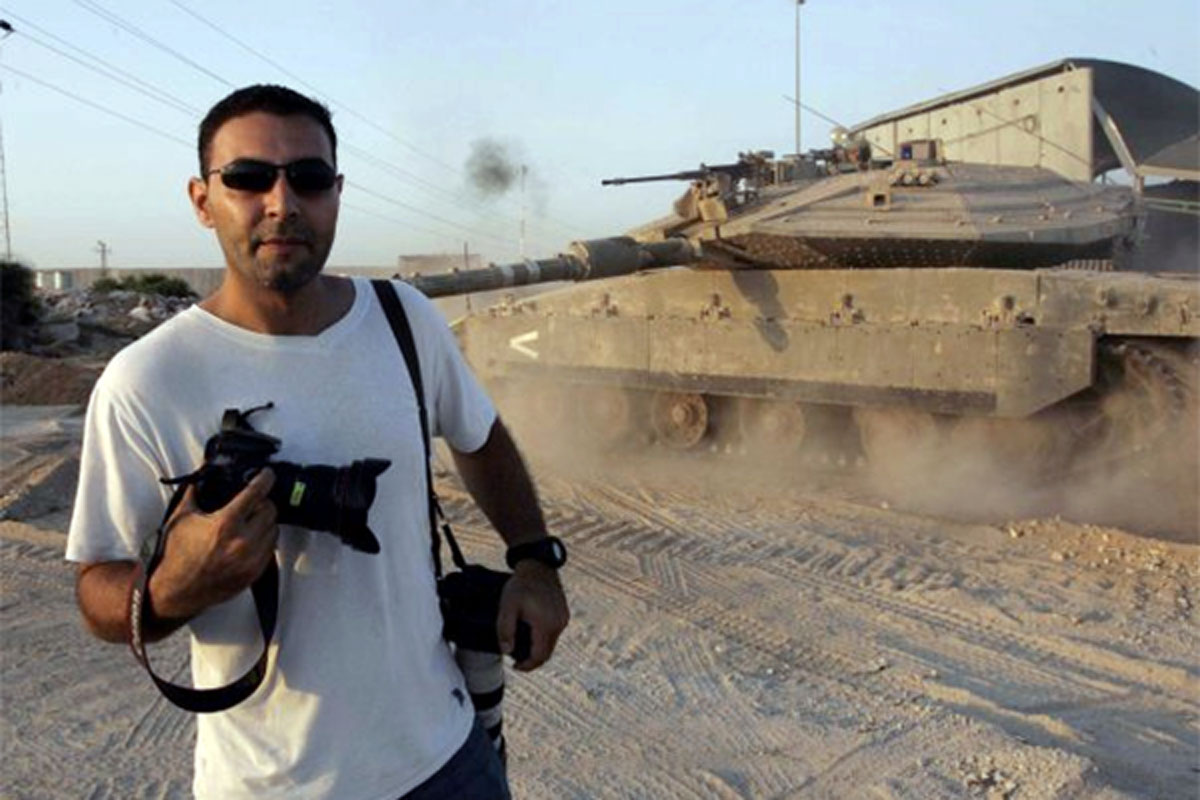
Award-winning photojournalist Khalil Abdel-Kader Abu Hamra
MEMO | May 26, 2014
The Egyptian cabinet decided Sunday to revoke the Egyptian citizenship from a Palestinian Associated Press photojournalist on charges of membership in a foreign militant group.
Award-winning AP photojournalist Khalil Abdel-Kader Abu Hamra said in statements Sunday that he had lived in Egypt for a long time, and was never harassed by authorities whenever he travelled abroad. The Ministry of Interior stated that Hamra left Egypt on November 27, 2013 and never came back. It accused him of “membership in a foreign militant group that aims at disrupting social and economic order of the Egyptian state.”
Hamra, whose mother is Egyptian and his father Palestinian, obtained Egyptian citizenship since 2012 in accordance with Egyptian law, which allows Palestinians with Egyptian mothers to receive citizenship.
Hamra said he has been in vacation in Jordan for few days, and travelled from Egypt and returned without facing any problems by airport authorities.
He added that he has no political affiliations, and that he is merely a journalist by profession.
Hamra said he will take necessary legal measures to appeal the “unjustified” decision.
The Creeping Decriminalization of Marijuana in the Caribbean
By Kevin Edmonds | The Other Side of Paradise | May 23, 2014
While the decriminalization of marijuana has been a topic of discussion for decades, those in attendance at this week’s Jamaica Cannabis Conference are doing more than just blowing smoke—they are discussing the upcoming stages of a long-overdue and vital transformation of the Caribbean’s regional economy. Jamaica has long been associated with potent, naturally grown marijuana, but also the unfortunate social ills that have accompanied its criminalization.
While marijuana, or ganja, arrived in the Caribbean with Indian indentured laborers in the mid-1800s, it was not criminalized until 1913, when the Ganja law came into effect at the behest of the church and colonial elites. The ban was largely based on ignorant, racist perceptions of the evil effects that ganja would have on the poor black majority, and thus dealt out fines and other oppressive penalties for consumption or cultivation. During the 1940s and the 1950s, despite the cultivation of ganja for spiritual and medical reasons, it became the routine justification for government raids upon the original, self-sufficient Rastafari community of Pinnacle.
Despite Jamaica’s independence in 1962, the colonial origins of criminalizing ganja were not eroded, but strengthened. When Jamaica signed the United Nations Convention on Narcotic Drugs in 1964, it became obligated to treat marijuana as a harmful drug, following the prevailing attitude of the United States. Under the banner of the War on Drugs, the Jamaican government diverted millions of dollars from social development to eradicate marijuana plantations through aerial spraying. If Jamaica refused, under the conditions of the U.S. Drug Certification Policy enacted in 1986, Jamaica would risk losing access to U.S. trade, aid, loans, and visas.
There are very serious human rights issues associated with the prohibition of marijuana. Across the Caribbean, courts are backlogged with simple possession charges for small quantities of marijuana. In one case in St. Lucia, fines for small quantities of marijuana reached $200, or up to 30 days in jail. These charges in turn limit employment and travel opportunities, creating inter-generational disadvantages for those who face jail time. As a result of the overloaded prison systems across the region, the economic and social costs of marijuana are tremendous, as much needed economic resources are taken away from social development and funneled towards an endless cycle of law and order policies.
In addition, the criminalization of marijuana has also led to the unfortunate and unnecessary marginalization of the Rastafari community, which regard the herb as a holy sacrament. Last August St. Lucian journalist Earl Bousquet commented on the negative portrayal of marijuana in the 1960s and 1970s:
Marijuana was… pinned to the Rastafarian movement that started spreading to the rest of the region from Jamaica at the same time. The then leaders erroneously hoped they could easily do away with ‘Rastas and marijuana’ through new laws and armed police forces. By legally twinning Rastafarianism with an illegal substance, growth of a positive and distinctively Caribbean social movement driven by the works of Marcus Garvey, rooted in Pan Caribbean-African nationalism and advocating closer communion with nature half-a-century ago was stifled, suppressed and forced to spend more time resisting and fighting ‘Babylon’ than refining the philosophical, spiritual, cultural and political base of the only indigenous Caribbean movement of its kind in the 20th century.
As a further result of these criminalization policies, Jamaica now has to play catch up in the newly emerging legal and medical marijuana market, according to Dr. Albert Lockhart, a leading ophthalmologist and noted speaker at the Cannabis Conference, who stated that “we are 40 years late.” Dr. Lockhart has helped to pioneer medicine derived from marijuana such as Canasol (which treats glaucoma) and Asmasol (which treats asthma), but due to lack of funding their discoveries are not widely known outside of the island. Dr. Lockhart further warned that if Jamaica does not act now it would be at risk of missing the boat, losing out to countries such as the United States, where the states of Colorado and Washington have fueled the push for legalization across the region—and Canada where medical marijuana has become big business.
Phillip Paulwell, Jamaican Minister of Science and Technology, has assured interested parties that marijuana will be decriminalized by the end of the year. Paulwell remarked that “I am of the firm opinion that scientific research into marijuana, both in the very many uses of the plant as hemp, and its medical properties, is an idea whose time has come,” adding that a marijuana-based medical industry could earn as much as $5.2 billion.
So the Cannabis Conference closed with hope that Jamaica and the wider Caribbean will be able to finally cash in and create a world leading, legal industry which not only acts as a cash crop and provides much needed agricultural jobs, but also as the building blocks for the development of wide ranging medical treatments. Additionally, the new CARICOM Regional Commission on Marijuana Use shows a regional investigative interest. Beyond just decriminalization, the Ganja Future Growers and Producers Association has been advocating for a regulatory model that will benefit small growers instead of large corporations, stating: “For the first three years of a regulated industry, licenses should only be given to plots of one acre or less.” The taxable income from the industry has the power to transform stagnating Caribbean economies and will allow them to have the self determination to rightfully produce a quality product which the world has always demanded in great quantity, but has been criminalized for far too long.
Kevin Edmonds is a NACLA blogger focusing on the Caribbean. Edmonds is a former NACLA research associate and a current PhD student at the University of Toronto, where he is studying the impact of neoliberalism on the St. Lucian banana trade. Follow him on twitter @kevin_edmonds.
Fascism or the Bankruptcy of the Left?
The anti-EU movement spreads all over Europe… apart from Ukraine*
By TAKIS FOTOPOULOS | The International Journal of INCLUSIVE DEMOCRACY, Vol. 9, Nos. 1/2 (2013)
The events in Ukraine have been instructive, even though the mass media of the Transnational Elite (TE) have created the false impression that there has been a popular “revolution” there by cretins fighting for their right to become the TE’s slaves within the EU, so that they may starve like the Greek people! But I will not dwell here on the orange “revolution” that has just been staged in this country by the pro-western bourgeoisie and petty bourgeoisie of Kiev, with the decisive assistance of the provocateurs of the TE’s intelligence services who organized it[1], but rather on the two main lessons to be learned from it, which are especially important for all European peoples and, in particular, for the Greek people.
Firstly, social struggle in the era of neoliberal globalization can no longer be just a struggle for social liberation, as obsolete Marxists still believe today and some Trotskyites have always believed even during the Nazi occupation when they called upon German workers in the Nazi army to fraternize with occupied workers, while some “Marxists” and “anarchists” today still call for similar fraternization between the Zionist occupiers in Israel and the occupied Palestinians! The struggle for social liberation today must, first and foremost, be a struggle for national liberation. This becomes obvious when one considers the fact that, when a country (not belonging to the TE, i.e. mainly the “G7”) is incorporated into neoliberal globalization, it loses every trace of economic and, consequently, national sovereignty. This is why the struggle for social liberation today is inconceivable unless it has already gone through national liberation. The occupying troops that are now destroying and plundering Greece (or Portugal, Spain and Italy) and its weakest social strata (with the full cooperation of a small, local privileged elite which controls the media, the political parties, the “Left” intelligentsia etc.) are not a regular army in uniform and with lethal weapons of physical violence at their disposal, but an economic army in suits, possessing equally lethal instruments of economic violence, as well as the means to justify it.
Secondly, the target of social struggle today can only be neoliberal globalization, which is managed by a TE ensuring that only its own bogus revolutions succeed (the orange “revolutions” in Eastern Europe in the past[2] and today, or the pseudo-uprisings in Libya,[3] Syria, etc.) while even the attempted uprisings of the TE’s victims in Greece and elsewhere are suppressed in the most brutal way as soon as they occur – and yet Baroness Ashton finds nothing wrong with this, nor does she detect any violation of human rights occurring. Similarly, the peoples who resist being integrated into neoliberal globalization are condemned to remorseless slaughter, as the Libyan and Syrian people have been. Nevertheless, the impudent Barroso did not hesitate to declare that human rights had been violated in Ukraine when the police dared to beat “protesters” who attacked government buildings with bulldozers, “forgetting” that such conduct in any other “democratic” EU country would have sent many to the morgue!
In other words, contrary to the misleading propaganda of the degenerate “Left”, globalization is not a chimera, or just a continuation of the internationalization of the market economy taking place at the beginning of the last century, but, rather, a systemic phenomenon which can only be neoliberal within the capitalist system, as can easily be shown. Similarly, neoliberalism is neither a doctrine (of “shock” and similar fairy tales)[4] nor the bad policy making of certain “bad” neoliberal politicians and economists. It is simply the ideology of globalization. Neoliberal globalization is, in other words, the necessary institutional framework that ensures the opening and liberalization of the markets (capital, goods and labor), which is required for the effective operation of the transnational corporations that currently control the globalized economy.
On the basis of this analytical framework it is not surprising that an unprecedented mass movement “from below” is currently spreading throughout Europe, challenging the EU directly but also neoliberal globalization indirectly. This movement is essentially comprised of the victims of globalization who are driven to mass unemployment and poverty, as well as to homelessness, starvation or even suicide. These popular strata sooner or later become aware of the fraud of the degenerate “Left”, which consciously misleads them by claiming that the current disaster could be overcome even within the EU, despite the loss of economic and national sovereignty. Then, these strata inevitably turn to nationalist movements of all kinds, since these are the only ones that raise the anti-EU flag: from patriotic to neo-Nazi movements – depending on the local conditions. But this nationalism, which both the Transnational and Zionist elites condemn with such disgust (at the very moment when the strongest nationalist state today is the Zionist one!), has little to do with the prewar aggressive nationalism that led to two World Wars. It is a new kind of nationalism which is fundamentally defensive and does not aim to conquer new “vital space” etc. like the pre-WWII nationalism. Above all, it aims to “protect” national sovereignty (national culture, domestic labor, etc.) that is under threat from the opening and liberalization of the markets imposed by globalization.
The main reason that these popular strata have been turning to nationalist movements is, therefore, not that they have suddenly become fascist (as the TE claims in an attempt to defame them); it is the bankruptcy of the degenerate “Left” which, rather than raising the anti-EU flag in place of the nationalists to promote a struggle for social and national liberation, is engaged in “antifascist” struggles together with privileged “leftists”. It is not surprising, then, that this “Left” implicitly consents to the passing of “anti-fascist” legislation, as required by the Transnational and Zionist elites, so that it may effectively ban such movements that threaten its hegemony. In Greece, for instance, a so-called “anti-racist” bill is now being passed through Parliament, which effectively bans freedom of thought (not action!). This bill means, for example, that if somebody supported the national liberation struggle of the Syrian Baathist leadership against the TE and the criminals, pretending to be rebels, who have destroyed this country, s/he might end up in jail for supporting war crimes against humanity. This is based on a very recent utterly biased report by the well known instrument of the TE, the UN Human Rights Commission, which asserted that as Navi Pillay, the UN’s human rights chief, said there is “massive evidence … [of] very serious crimes, war crimes, crimes against humanity” and that “the evidence indicates responsibility at the highest level of government, including the head of state”.[5] Of course, neither this committee nor Navi Pillay who once said that “the Commissioner is the voice of the victim everywhere,”[6] nor its blood brothers among the NGOs for human rights (Amnesty International, Human Right Watch, etc.) have ever dreamed of declaring the arch-criminals Bush, Blair et al. to be guilty of war crimes, even though they are responsible for the deaths of millions of people. Presumably, the millions of people killed or maimed by war criminals like them are not victims, according to Mrs Pillay’s definition of a victim!
However, the Greek “Left”, i.e. the SYRIZA party, instead of mobilizing the people against this unashamedly fascist law, has quietly consented to it by merely abstaining from voting (only the Greek Communist Party and the ultra-nationalist Golden Dawn party voted against it). It should be noted that SYRIZA, together with its leader, Alexis Tsipras – who has been heavily promoted by the media of the TE – is destined by the same elites to succeed the present parliamentary junta in implementing the same policies but under a “Left” cover. Yet the sordid professional politicians who voted in favor of this openly fascist law dare to speak of democracy and the fight against fascism. This blatant bankruptcy of the “Left” is yet another major reason why a mass popular Front is needed in Greece and in all other countries which have fallen victim to the TE that administers neoliberal globalization, as I stressed in my last article.[7]
* This is an expanded edited version of an article by Takis Fotopoulos under the same title published in the Athens daily Eleftherotypia (8/12/213).
[1] See e.g. Stephen Lendman, “Ukraine: Orange Revolution 2.0?,” Global Research (6/12/2013).
[2] Takis Fotopoulos, “The Ukrainian Crisis and the Transnational Elite,” The International Journal of INCLUSIVE DEMOCRACY, vol.1, no.4 (July 2005).
[3] Takis Fotopoulos, “The Pseudo-Revolution in Libya and the Degenerate Left,” Part I & Part II, The International Journal of INCLUSIVE DEMOCRACY, Vol. 7, No. 1 (Winter-Spring 2011).
[4] See e.g. Naomi Klein, The Shock Doctrine (Penguin, 2007).
[5] Ian Black, “Assad implicated in Syrian war crimes, says UN,” The Guardian (3/12/2013).
[6] Jonah Fisher, “Profile: New UN human rights chief,” BBC News (28/7/2008).
[7] Takis Fotopoulos, “Globalization and the End of the Left-Right Divide” (Part I), The International Journal of INCLUSIVE DEMOCRACY, Vol. 8, Nos. 3/4 (Fall 2012-Winter 2013).
Featured Video

Why the U.S. Should Pull Back From the First Island Chain
or go to
Aletho News Archives – Video-Images
From the Archives
Only 19.7% of Americans agree with US State Dept on Israeli settlements
… Most American adults of voting age don’t appear willing to reject the applicability of international law to Israel’s ongoing colonization of occupied territories in East Jerusalem, the West Bank and Golan Heights. … Full article
Blog Roll
 Aletho News
- Albania on fire: who’s behind the riots?
- Egypt’s Civil Democratic Movement rejects involvement in regional war
- Egypt collaborates with Israel to build ‘Green Rafah’ project over erased Palestinian city
- Rising fuel prices and shortages have helped drive ongoing protests and rioting in France
- Tokyo protests demand Takaichi’s resignation over support for ‘Israel’
- Jennifer Kavanagh: Why the U.S. Should Pull Back From the First Island Chain
- Yemen denounces international community’s silence on Saudi aggression, siege
- UAE and Saudi Arabia move toward renewed coordination against Sanaa
- How Iran’s two-week retaliatory strikes exposed cracks in US military architecture in Persian Gulf
- The mother of all propaganda: Why the hype over US MOAB strike against Iran is nothing but theater
- If Americans Knew
- What the UK Is Doing to Pro-Palestine Novelist Sally Rooney Is an Act of Orwellian Villainy
- ‘We will build palaces for Jews in Gaza’: Right-wing activists establish new outpost near border
- ‘You see us burning, you stay silent’: Family’s agony over mother and sons burned to death in Gaza tent
- Israel keeps Palestinian journalist Bushra al-Tawil in isolation for 46 days
- US-Israel integration plan puts US military tech in Israel’s hands
- Israeli Strike Burns Gaza Mother Alive in Front of Toddler, ‘Without Generating Any Headlines’
- ‘The Israel Experience with Mike Huckabee’: The Ambassador’s Family Sells Trips to Israel
- As Gazans carry out mass burial, food insecurity is getting worse – Daily Update
- Israeli rabbi permits occupiers to steal Palestinian olive harvest in West Bank
- Netanyahu’s spin on latest settler attack is laughable – Daily Update
- No Tricks Zone
- Predictions Made By Renowned Climate Proifessor Over Past Decades Have Been Proven To Be Poor
- New Study Suggests Large Regions Of The Pacific Ocean Have Been Cooling For The Last 80 Years
- Germany’s Green Energy Debacle: High Energy Costs Force Kahla Porzellan to Close After 182 Years!
- New Study: 50 Years Of The Most Aggressive ‘Net Zero’ Policies Can Only Affect The Global Climate By 0.03°C
- US September “Heat” Was No Record…Many Records Set Decades Ago
- Latest European Green Energy Debacle; Portugal’s Largest Flagship Solar Park Insolvent!
- Green Energy Debacle: German Expert Professor Fritz Vahrenholt Warns Of Severe Economic And Social Consequences
- Two More Paleo Reconstructions Affirm Meters-Higher Sea Levels Across Ireland, Brazil 7000-6000 Years Ago
- New Study: Earth And Venus Surface Warmth Largely Explained By Convection And Lapse Rate, Not CO2 Or Radiation
- 2025 Nature Paper Claiming Worsening Global Drought Gets RETRACTED …Heavily Flawed

