Do We Care About People If They Live in Bahrain?
By David Swanson – February 17, 2014
I had a heck of a time making sense of the U.S. Navy’s new motto “A Global Force for Good” until I realized that it meant “We are a global force, and wherever we go we’re never leaving.”
For three years now people in the little island nation of Bahrain have been nonviolently protesting and demanding democratic reforms.
For three years now the king of Bahrain and his royal thugs have been shooting, kidnapping, torturing, imprisoning, and terrorizing nonviolent opponents. An opponent includes anyone speaking up for human rights or even “insulting” the king or his flag, which carries a sentence of 7 years in prison and a hefty fine.
For three years now, Saudi Arabia has been aiding the King of Bahrain in his crackdown on the people of Bahrain. A U.S. police chief named John Timoney, with a reputation for brutality earned in Miami and Philadelphia, was hired to help the Bahraini government intimidate and brutalize its population.
For three years now, the U.S. government has been tolerating the abuses committed by Bahrain and Saudi Arabia, continuing to sell weapons to Bahrain and Saudi Arabia, and continuing to dock the U.S. Navy’s Fifth Fleet in Bahrain. In fact, the U.S. military has recently announced big and pricey plans to expand its bases in Bahrain and add more ships.
For three years now, the U.S. government has continued to dump some $150 billion (with a ‘B’) each year into the U.S. Navy, a large portion of which goes for the maintenance of the Fifth Fleet in Bahrain. Withdrawing and disbanding that fleet would save that gargantuan expense. Retraining and re-employing in peaceful activities all personnel would cost a fraction of $150 billion. Providing aid to nonviolent pro-democracy activists in Bahrain would cost a tiny fraction of a fraction. Establishing a policy in the case of this one country of supporting human rights over brutal dictatorship would be, as they say, priceless. It would create a very useful model for a transformation of U.S. policy in numerous other nations as well.
Accurate and timely information about the horrors underway for the past three years in Bahrain are available online, via Western human rights groups, and via small back-page stories in U.S. newspapers. There’s little dispute over the general facts. Yet, there’s little outrage. There appears to have been no polling done of the U.S. public on the topic of Bahrain whatsoever, so it’s impossible to know what people think. But my impression is that most people have never heard of the place.
The U.S. government is not shouting about the need to bomb Bahrain to protect its people. Senators are not insisting on sanctions, sanctions, and more sanctions. There seems to be no crisis, no need for “intervention,” only the need to end an intervention we aren’t told about.
Which raises a tough question for people who give a damn. We’re able to reject a war on Iran or Syria when the question is raised on our televisions. But we can’t seem to stop drone strikes nobody tells us about. How do we create a question nobody is asking, about a topic nobody has heard of, and then answer it humanely and wisely? And how do we overcome the inevitable pretense that the Fifth Fleet serves some useful purpose, and that this purpose justifies a little teargas, a bit of torture, and some murders here and there?
The Fifth Fleet claims to be responsible for these nations: Afghanistan, Bahrain, Egypt, Iran, Iraq, Jordan, Kazakhstan, Kyrgyzstan, Lebanon, Oman, Pakistan, Qatar, Saudi Arabia, Syria, Tajikistan, Turkmenistan, United Arab Emirates, Uzbekistan, and Yemen. None of these nations have ships in U.S. waters claiming to be responsible for it. None of these nations’ peoples have indicated majority support for having the Fifth Fleet be responsible for them. Afghanistan has suffered under U.S. occupation for over a decade, with chaos and tyranny to follow. Egypt’s thugs are rising anew with steady U.S. support, money, and weaponry. Iran has threatened and attacked no other nation for centuries, has never had a nuclear weapons program, spends less than 1% what the U.S. does on its military, and moves away from democracy with every U.S. threat. Why not leave Iran alone? Iraq, Jordan, Qatar, Saudi Arabia, Yemen, and others of these nations, including Bahrain, suffer under the rule of U.S.-backed governments. One might reasonably add Israel and the lands it occupies to the list, even if the Navy cannot bring itself to mention them. Yemen and Pakistan suffer under the constant buzzing and missile launching of U.S. drones, which are creating far more enemies than they kill. In fact, not a single nation falling under the past 19 years of benevolent “responsibility” of the Fifth Fleet has clearly benefited in any way.
At a third annual conference recently held in Lebanon, Bahraini activists laid out a plan of action. It includes building international connections with people who care and are willing to help. It includes supporting the International Day to End Impunity on November 23rd. It includes pushing Bahrain to join the ICC, although that may be of little value until the U.S. can be persuaded to do the same and until the United Nations can be democratized. The plan includes calls for an end to weapons sales and the initiation of sanctions against the Bahraini government (not its people).
Those would certainly be good steps. The first question in my mind remains: do the people in the nation that screams most loudly about “freedom” and does the most to support its repression wherever deemed useful, care?

Qatar World Cup toll: ‘Hundreds’ of Indian migrant workers dead in two years
RT | February 17, 2014
More than 450 Indian migrant workers in Qatar have died in the last two years, media revealed on Monday. Another upcoming report will show that 400 Nepalese have lost their lives scrambling to get the Gulf state ready for the 2022 World cup.
At least 237 Indian migrants lost their lives in Qatar in 2012 and another 218 in 2013 up to December 5, AFP reported on Monday, citing figures received via a Right to Information request filed at the Indian embassy in Qatar.
On average, 20 Indian migrants die per month in Qatar. August last year was the most deadly month on record, with 27 fatalities being reported.
The Indian embassy did not provide information regarding the causes of death or where they occurred. It also declined to disclose any correspondence between the diplomatic mission and the Indian government regarding the treatment of its nationals in the Gulf state.
Meanwhile, figures set to be released later this week say that 400 Nepalese workers have died at building sites since construction for the World Cup 2022 got underway in 2010, the Guardian reports. The Guardian did not state when the deaths occurred, but said that the Pravasi Nepali Co-ordination Committee, a respected human rights organization, which reached its figure using official sources in Doha, would release more information in the coming days.
There were 500,000 Indians estimated to be in Qatar at the end of 2012 – roughly 26 percent of Qatar’s population. Nepalese workers comprise approximately 20 percent of Qatar’s migrant workforce and 16 percent of the total population. The total death toll stemming from the country’s World Cup scramble could in fact be higher, as other migrant groups are also present in the country.
As of January 2012, Bangladeshis, Pakistanis and Sri Lankans together accounted for 14 percent of the emirate’s population, according to US State Department figures.
On February 11, Qatar issued detailed guidelines intended to protect the country’s massive expatriate community from exploitation and stem the intensified international criticism on its human rights record.
Activists, however, believe the number of dead could swell to 4,000 by the time the 2022 World Cup kicks off.
On Thursday, FIFA said there was little it could do to alleviate the slave labor conditions migrants are toiling under in the country.
According to German paper Die Welt, however, a source identified as a “senior FIFA employee” said moving the World Cup to another country is “a serious option” despite public claims to the contrary. Last July, Theo Zwanziger, a current member of FIFA’s executive committee, said the decision to award Qatar the 2022 event was a “blatant mistake.”
In September, The United Nations condemned Qatar for failing to comply with an international convention banning the use of forced labor.
Related articles
Palestinian footballers shot by Israeli forces never to play again
Ma’an – February 14, 2014
BETHLEHEM – Two young Palestinian football players shot by Israeli forces last month have learned that they will never be able to play sports again due to their injuries, according to doctors.
Doctors at Ramallah governmental hospital said the pair will need six months of treatment before they can evaluate if the two will even be able to ever walk again, at best.
Jawhar Nasser Jawhar, 19, and Adam Abd al-Raouf Halabiya, 17, were shot by Israeli soldiers as they were walking home from a training session in the Faisal Hussein Stadium in al-Ram in the central West Bank on Jan. 31.
Israeli forces opened fire in their direction without warning as they were walking near a checkpoint.
Police dogs were subsequently unleashed on them before Israeli soldiers dragged them across the ground and beat them.
The pair was subsequently were taken to an Israeli hospital in Jerusalem, where they underwent a number of operations to remove the bullets.
Medical reports said that Jawhar was shot with 11 bullets, seven in his left foot, three in his right, and one in his left hand. Halabiya was shot once in each foot.
The two were taken to Ramallah governmental hospital before being transferred to King Hussein Medical Center in Amman.
Chairman of the Palestinian Football Association Jibril al-Rajoub condemned the shooting and said that “Israeli brutality against them emphasizes the occupation’s insistence on destroying Palestinian sport.”
Rajoub called for imposing penalties on the Israeli football association, and demanded its removal from the FIFA as it should not accept racist organizations that do not adhere to international law.
Related article
District Court Says DEA’s Warrantless Access Of Oregon’s Prescription Database Is Unconstitutional
By Tim Cushing | Techdirt | February 13, 2014
Early last year, the news surfaced that the DEA was bypassing Oregon state law by using administrative subpoenas to get around the state’s warrant requirement for drug prescription database access. “Administrative subpoenas” are yet another government tool that allows agencies to seek information that would normally require a warrant, but without the hassle of running it past a judge or even showing probable cause.
The DEA probably didn’t expect to encounter much resistance to its subpoenas. After all, drugs are bad and the DEA is fighting the good fight. But the state of Oregon wasn’t impressed with the DEA’s warrantless tactics and filed suit with the assistance of the ACLU. The ACLU is now reporting that a federal judge has ruled in its (and Oregon’s favor) and the DEA (along with other law enforcement entities) will no longer be able to skirt the state’s warrant requirement.
For the first time, a federal judge has ruled that patients have a reasonable expectation of privacy in their drug prescription records, and that law enforcement must obtain a warrant in order to search such information…
“This is a victory for privacy and for the constitutional rights of anyone who ever gets drug prescriptions,” said ACLU Staff Attorney Nathan Freed Wessler, who argued the case last month. “The ruling recognizes that confidential medical records are entitled to the full protection of the Fourth Amendment. The court rightly rejected the federal government’s extreme argument that patients give up their privacy rights by receiving medical treatment from doctors and pharmacists.”
As the ruling points out, citizens have long associated privacy with medical treatment, something that has gone hand-in-hand dating back to the 4th century B.C.E. and the origin of the Hippocratic Oath. It also points out the obvious: federal law itself (HIPAA) contains built-in privacy protections. (Hence the form you have to sign, the privacy info sheet you’re handed on every visit, and signs everywhere telling you to stand behind them for the privacy of the patient in front of you.)
The judge’s decision also notes that stripping away this expectation of privacy will have a chilling effect on those seeking medical care, something that could have very adverse effects on the health of people who might avoid seeking treatment because they fear their medical records will be exposed.
As the ACLU notes in its press release, it’s not exactly happy the state of Oregon has chosen to create a centralized database of drug prescriptions, but, if it is going to do so, it has at least chosen to take the privacy of those contained in the database very seriously.
This decision strikes a small blow against the government’s routine abuse of “exceptions” to warrant requirements as well as against its even more routine abuse of the “third party doctrine,” which the DEA actually used to claim that talking to a doctor is no different than dialing a phone. The DEA knows there’s a huge difference between these two “third parties” but applying that knowledge means showing probable cause and getting a judge to sign off on the warrant, two aspects it apparently feels only hampers its War on Drugs.
Brazil-Europe Internet cable to cost $185 million
BRICS Post | February 13, 2014
Brazil is pushing ahead with plans to boost its Internet security by developing an undersea fibre-optics communications cable that would reroute its online traffic directly to Europe, bypassing the United States.
State-owned telecom provider Telebras recently announced that it was entering into a joint venture with Spain’s IslaLink Submarine Cables to build a link between the northeastern city of Fortaleza and the Iberian Peninsula.
The undersea cable is budgeted at $185 million and construction is scheduled to begin in July.
Brazil, along with most Central and South American countries, traditionally routes its Internet traffic through the Network Access Point, which is hosted in Miami, Florida.
Brazil, Russia, India, China and South Africa currently use hubs in Europe and the US to connect to one another, which translates into higher costs and leaves open the opportunity for data interception and theft.
Telebras project coordinator Ronald Valladão says the cable will boost Brazil’s Internet security and cut online costs for the consumer.
“This new submarine cable provides a direct connection to the European continent, decreasing latency. It is expected that this will result in cost reductions,” he recently told the media.
Since Edward Snowden, the National Security Agency contractor who leaked vital intelligence to the media on US domestic and overseas surveillance, published information that Washington was aggressively spying on Brazilian officials, including the president, Brasilia has made Internet security and communications a priority.
Brazil and its fellow BRICS partners are also moving ahead with building a massive undersea cable that would connect all members.
By the time it is completed, the BRICS Cable will be the third longest undersea telecommunications cable in the world, covering a distance of 34,000km.
Brazilian President Dilma Rousseff has also pushed a new Internet bill that would compel Google, Facebook and other networks to store locally gathered data in the country, and not on overseas servers.
The new legislation would force foreign-based Internet companies to maintain data centres inside Brazil that would then be governed by Brazilian privacy laws, officials said.
Rousseff has repeatedly said that the US spying regimen is unacceptable, and postponed an official visit to the US originally scheduled for October 23 in protest.
“The illegal practices of intercepting the communications and data of citizens, companies and members of the Brazilian government constitute a serious act against national sovereignty and individual rights, and incompatible with the democratic coexistence of friendly countries,” a presidential statement said when revelations of espionage in Brazil were made public.
On November 24, Brazil and Argentina urged other South American countries to discuss a bilateral treaty on cyber-security.
On November 27, the UN Rights Committee passed a “right to privacy” resolution, drafted by Brazil and Germany.
The Third Committee of the UN General Assembly, which deals with social, humanitarian and cultural affairs, unanimously adopted the resolution, saying surveillance and data interception by governments and companies “may violate or abuse human rights.”
In late January, talks between Brazil and the US failed to satisfactorily answer the spying charges or eke out a “permanent solution” to restore bilateral ties damaged by the Snowden revelations.
Related article

Israeli forces protect settlers as they cut down Palestinian family’s trees
International Solidarity Movement | February 12, 2014
Hebron, Occupied Palestine – On the afternoon of February 11, 2014, settlers in the Tel Rumeida neighborhood of Al-Khalil (Hebron) cut down trees belonging to the Abu Eisheh family. While attempting to film the destruction of the trees, four human rights activists were arrested by Israeli police.
At approximately 3:30 p.m., three activists, a Swiss-American, an American, and an Italian, were sitting in their apartment in Tel Rumeida when they heard a commotion outside. Outside the apartment, they found a group of settlers, Palestinians, Israeli soldiers and Israeli police. They were informed by the Palestinians that a group of settlers was cutting down trees at a house just up the road.
The three activists began filming but were not allowed up the road to where the tree-cutting was taking place. While filming, the American activist was physically assaulted by a settler. None of the soldiers or police officers present intervened. Instead, the Israeli police took the passports belonging to the American and Swiss-American and told them to sit on the ground.
At this time, the Italian citizen returned to the apartment, where she was joined by a fourth activist, an American, who had just arrived. Shortly thereafter, a group of soldiers and police officers attempted to enter the apartment. They were not allowed entry, but briefly questioned the two activists outside the apartment door. The Israeli police then confiscated the passports belonging to the American and the Italian.
Not long after, all four activists were transported to the police station near Kiryat Arba, where they were interrogated and threatened with deportation. After seven hours, the activists were released.
The following day, February 12th, two activists from Christian Peacemaker Teams visited Tel Rumeida to document the destruction of the trees. They were not there long before several Israeli soldiers approached them, told them to stop filming, and took their passports. They were held for two hours before their passports were returned. Israeli soldiers informed the two activists that if they approached the trees again they would be arrested.
The destruction of Palestinian trees by settlers is a chronic problem, not only in Tel Rumeida, but all over the West Bank. In the past month alone, more than 2500 trees in the village of Sinjil were destroyed by settlers. Trees have also recently been destroyed by settlers in Qusra, Ramallah, and Nablus. Fruit trees are an essential resource for the Palestinian community, and their damage causes serious economic loss. It takes as long as 12 years for an olive tree to reach full maturity.

ISM activist with settlers in Tel Rumeida (photo by ISM Italy)
Related articles


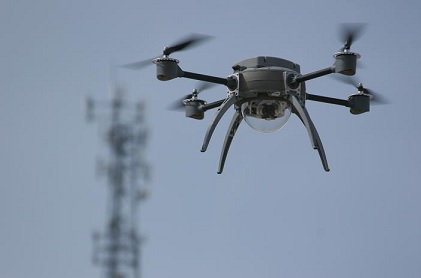
EU spending over $400m on secret drone project – Civil rights group
RT | February 12, 2014
The EU is investing hundreds of millions of taxpayer euros in the development of surveillance drones without political oversight, a report claims. The authors of the document warn the EU is secretly encouraging “the further militarization” of the region.
A report entitled ‘Eurodrones Inc.’ published by rights group Statewatch describes how the EU is channeling taxpayers’ money into surveillance drone projects without their knowledge.
“More than 315 million euro ($430 million) has so far been spent in EU research funding on drone technology or drones geared towards a specific purpose such as policing or border control,” writes the report.
However, the document points out that the research funding is largely “invisible” to the people and parliaments of Europe and lacks the proper political oversight. According to the report this was achieved by a secret budget line that was included in new EU legislation on air traffic control for this year.
The report describes a 20-year roadmap that aims to introduce surveillance drones into EU airspace and highlights that this plan is being shaped by “thinly accountable officials” and representatives of large corporations.
“The EU’s emerging drone policy has come about following years of successful lobbying by defense and security companies and their associates,” said co-author of the report Chris Jones in a statement on Statewatch’s website, adding that these are the same defense and security contractors that have the most to gain.
The drones in question would engage in civilian surveillance activities, such as border patrols and the search for criminals. However, Statewatch is concerned that the convert nature of the program lends itself to the “further militarization” of the European Union.
Calling for “proper democratization” and the opening of public debate on the issue, the report notes the EU turned a blind eye to a European Commission statement in 2012 that declared the development of unmanned surveillance craft should be more transparent.
It recommended the issue be discussed with a number of organizations, including the European Group on Ethics, the LIBE Committee of the European Parliament or the European Agency for Fundamental Rights and Data Protection Supervisor.
“Yet none of these bodies have been involved,” writes the report. “Their absence from policy debates means that many of the conversations the EU should be having about drones – such as what they should and should not be used for, and how to prevent further militarization and the deployment of fully autonomous weaponized drones – have been all but ignored.”
Although the authors of the report do not outwardly criticize research into drones, they do stress the fact that the current program is too “heavily skewed toward the interests of the big defense contractors.”
They argue that this could lead to “unwarranted state surveillance and repression,” as well as enhanced prospects for combat drone research for a global arms race.
“It’s easy to see why people are so excited about drones: there are many positive things they could be used for,” said co-author Ben Hayes. He concluded that given the “clear implications” for civil liberties in the balance, the EU has a “moral and legal obligation” to uphold fundamental rights and the rule of law.
Related articles


PALESTINE: Border Police detain, humiliate and arrest men trying to go to Friday prayers; CPTer’s camera taken.
CPTnet | February 11, 2014
On 7 February 2014, CPTers went to the routine Friday mosque patrol around prayer time. Often during Friday prayers, Israeli Border police will take the IDs of young Palestinian men while they going into the Ibrahimi Mosque, check to see if they have any outstanding warrants and then return the IDs when the men come out of the mosque. This Friday, however, Border Police were not allowing the men to go to the mosque while they were checking the IDs.
When CPTers called members of the Temporary International Presence in Hebron (TIPH), TIPH personnel told them that Border Police were detaining men at several H-2 checkpoints. The CPTers decided to look at Checkpoint 29 and found Border Police detaining twenty to thirty men there. Several of them were quite angry because of the way the Border Police had been treating them. Other men were trying to calm the situation. When one man, after realizing he was going to miss prayers at the mosque, began to lay his prayer rug on the ground to pray at the checkpoint, one of the Border Police shoved him against a wall, which really enraged several people in the crowd.
Soldiers pepper-sprayed a boy who appeared to be about eleven or twelve and an older man, who was later hospitalized. The boy passed out and was taken down the hill to a shop. Additional soldiers arrived and began deploying sound bombs and teargas. Police arrested eight men.
Video of Border Police pepperspraying man
After the police took away the men they had arrested, CPTers remained in the area because of the heavy soldier and Border police presence. Civilian police approached one and asked for his passport and his camera. They insisted on taking his camera to the police station and he accompanied it. While he was at the police station, they asked him questions about what he had witnessed, periodically coming out of a room and telling another CPTer that “your friend isn’t arrested; he is just giving testimony.”
As of this writing, six of the men arrested on Friday have been released, while two are still in custody.
Related articles
3,000 euro Google search: French blogger gets fined for re-posting indexed govt files
RT | February 10, 2014
A French appeals court has fined an activist 3,000 euros for publishing documents accessed via an open hyperlink in a Google search. The “hacker” was prosecuted despite the fact that the government agency owning the files didn’t pursue a case against him.
For the French blogger, Olivier Laurelli, nicknamed “Bluetouff,” it all started with a simple Google search. While browsing the web for what he claims was an irrelevant subject, the co-founder of the tech-savvy activist news site Reflets.info came across a link to an online documents archive of the French National Agency for Food Safety, Environment, and Labor (ANSES).
The link led to a trove of 7.7 Gigabytes of files on public health, and Laurelli decided they might be worth looking through. For what he later said was for more convenient reading, the activist downloaded the entire online directory with a common Linux tool, and then transferred them to his desktop.
At the time, the blogger judged that the freely available documents of a public establishment “ought to be” legally available for the public to see, quotes the Ars Technica blog.
But soon after posting some scientific slides from the archives on his website, Laurelli realized that he was wrong.
ANSES discovered their archive was accessed only after the slides on “nano-substances” went public on Reflets.info, French media said. Citing possible “intrusion into a computer system and data theft from a computer,” the agency filed a report with the police, also prompting the French Central Directorate of Interior Intelligence (DCRI) to launch a case.
According to the activist himself, the investigators’ decision to pursue a criminal case against him was fueled by the fact he used a Virtual Private Network (VPN) service that masked his IP address as a Panamanian one. The VPN was actually provided by a security company he owned called Toonux.
Laurelli was then indicted with fraudulently accessing and keeping data, which, according to the French Criminal Code carries up to 2 years in prison and a maximum fine of 30,000 euro (about $41,000).
While testifying, Laurelli admitted he did spot a requirement for login and password at an upper level directory when he tried browsing the ANSES resource further, but there was no explicit indication that the directly accessible files he stumbled on required authorization and were illegal to obtain.
Related article
Turkish police use tear gas to disperse protest against new internet controls
RT | February 8, 2014
Turkish police have fired tear gas and water cannons to disperse crowds of protesters rallying against “draconian” internet laws approved by parliament.
Police approached the crowd along Istanbul’s Istiklal Avenue and fired water cannons from behind armored vehicles as protesters tried to march to the city’s main square.
“Everywhere is bribery, everywhere is corruption,” protesters chanted.
As riot police fired water cannons at protesters, some of them responded by throwing stones or setting off fireworks aimed at law enforcement officers.
The new bill was passed late Wednesday by the parliament dominated by the Erdogan’s AKP party.
If the president approves the legislation, it would give authorities the power to block web pages without a court order within just hours.
It would also require internet service providers (ISPs) to store data on their clients’ online activities for two years and provide it to the authorities on request.
However, Prime Minister Recep Tayyip Erdogan rejected any possibility that the regulations would allow authorities to have access to internet users’ personal information.
“Never. It is out of the question that people’s private data will be recorded,” he said in Istanbul on Saturday.
The opposition says the move is part of a government bid to stifle a corruption scandal and accuses the government of limiting Internet freedoms.
Erdogan denies accusations of censorship, saying the legislation would make the internet “more safe and free.”
“These regulations do not impose any censorship at all on the Internet … On the contrary, they make it safer and freer,” he said.
Prepared by the Ministry of Family and Social Policy, the bill provoked mass rallies in mid-January, shortly after it was announced. The protest was dispersed by riot police who used water cannons and tear gas against hundreds of opponents of the bill.
The bill amends Law No. 5651, widely known as Turkey’s Internet Law that came into effect in July 2007.
Honduras and Mexico: Open Season for Journalists
By Nick Alexandrov | CounterPunch | February 7, 2014
Last December, the New York Times’ David Carr reported on Vice President Biden’s trip to China, where he “spoke plainly about the role of a free press in a democratic society.” The benighted audience was surely keen to learn about this Western institution, and “it was heartening to see the White House at the forefront of the effort to ensure an unfettered press,” Carr affirmed. No doubt. Down here on Earth, meanwhile, Washington has long been at the forefront of an effort to promote cultural devastation, targeting journalists, artists, and independent thinkers more generally. This cultural ruin is a predictable consequence of U.S. support for repressive regimes—a tradition Obama has worked hard to uphold.
Consider the June 2009 coup against Honduran President Manuel Zelaya, which four School of the Americas graduates helped orchestrate. Even the attorney responsible for giving it a legal veneer admitted the ouster was “a crime,” and in its aftermath Obama recognized Porfirio Lobo, winner of a fraudulent election marred by political violence and ballot irregularities, as the country’s new leader. Now, Honduran journalists are weathering a “deluge of threats, attacks and targeted killings,” PEN International reported recently. Honduran “economic elites have established unwritten limits as to what can be investigated by major news agencies,” and independent journalists face similar restrictions. Whoever ignores these limits pays the ultimate price.
Nahúm Palacios “opposed the 2009 coup and turned his TV station into an openly pro-opposition channel,” PEN notes. The military threatened him, but he persisted, and he and his girlfriend were murdered in March 2010. Israel Zelaya Díaz covered politics and crime, and managed a program aired on San Pedro Sula’s Radio Internacional. Assailants torched his home in May 2010, and then shot him to death three months later. A group of men stopped television producer Adán Benítez, who had put out a story on gang activity, in July 2011; they demanded his valuables, and then killed him. Medardo Flores Hernández was a volunteer reporter and finance minister for a pro-Zelaya organization when he was gunned down in September 2011. Early the following month, Obama received Honduran President Lobo at the White House, commending his “strong commitment to democracy.” Radio journalist Luz Marina Paz Villalobos, a coup critic, was murdered on December 6, 2011.
Mexican reporters are also at risk, as theirs “has become the most dangerous country in the Western Hemisphere for journalists,” Emily Edmonds-Poli wrote in a Wilson Center report last April, reviewing the situation in this “drug war” ally. In the state of Veracruz, for instance, there was a series, in the spring of 2012, of high-profile killings: a group of men invaded investigative reporter Regina Martínez’s home in Xalapa, and murdered her there. The dismembered bodies of three photojournalists pursuing stories on organized crime were discovered on the side of a highway four days later. “The fear is terrible and well founded,” an ex-reporter told the Guardian’s Jo Tuckman. “The heroes are in the cemetery.” This woman is hardly the only one to have abandoned the profession. A university official in Veracruz, quoted by Edmonds-Poli, surveyed the corpse-strewn landscape: “It’s not that they’re just killing reporters, they’re killing the drive to become one.” The destructive effects are equally far-reaching in Honduras. PEN quotes Honduran activists who “stressed that the neglect, marginalization and underfunding of cultural spaces” have gutted the nation’s creative sector, sharply delimiting the range of questions to which artists and independent researchers can safely respond.
The Honduran and Mexican governments restrict inquiry with generous U.S. assistance. Both states have strong ties to organized crime: efforts to distinguish legitimate from outlaw Honduran institutions, for example, are often meaningless, given the government’s illicit origins in the June 2009 coup. “A representative from a leading NGO in Honduras says at least four high-ranking police officials head drug trafficking organizations,” InSight Crime’s Charles Parkinson wrote on January 29, and Honduran history reveals that such activity is no obstacle to continued U.S. funding. When a Reagan-era DEA agent amassed evidence implicating the country’s top military officials in prohibited activities, for instance, the organization responded by shutting down its Honduran office in 1983. At the time, Washington’s core concern was the vital role Honduras played in the anti-Sandinista crusade. Their ally’s involvement in drug-smuggling was a non-issue, as irrelevant then as today, when the projected 2014 U.S. governmental military and police aid is over 1.75 times the 2009 figure.
Mexican institutions resemble their Honduran counterparts: ties between political elites and organized crime can be traced back at least a century, and this connection was blatantly obvious by the 1970s. That was the decade the national intelligence arm—the Dirección Federal de Seguridad (DFS)—aided by “the attorney general’s office and Federal Judicial Police,” established itself as “the country’s major criminal mafia,” Paul Kenny and Mónica Serrano point out. U.S. officials knew DFS facilitated drug trafficking’s expansion, and “continued to defend and protect the agency” because it “played a central part in Mexico’s fight against left-wing subversion, both directly and through a death squad organized under [DFS head Miguel] Nazar’s supervision, the ‘White Brigade,’” Peter Dale Scott and Jonathan Marshall write. Years later, Mexican law enforcement committed “one out of every three crimes against journalists” from 2009-2011, Edmonds-Poli reports in her Wilson Center study. That three-year span overlaps with the period—between 2008 and 2010—when Washington “allocated over $1.5 billion to Mexico” via the Mérida Initiative, and “U.S. military and police aid in each of these years marked nearly a 10-fold increase over 2007 levels,” according to Witness for Peace. Obama then extended the program—a true Nobel Peace Laureate, reminiscent of luminaries like Henry Kissinger.
In June 1976, for example, Kissinger proclaimed his support for Argentina’s military dictatorship: “We have followed events in Argentina closely,” he stated. “We wish the new government well. We wish it will succeed.” These remarks came six weeks after “military officers organized an exemplary event to combat immorality and communism,” Fernando Báez—author of A Universal History of the Destruction of Books—notes, when they burned volumes “confiscated from bookshops and libraries in the city of Córdoba,” loudly condemning Freud, Marx, Sartre and others. In August 1980, “trucks dumped 1.5 million books and pamphlets… on some vacant lots in the Sarandí neighborhood in Buenos Aires.” After a federal judge gave the command, “police agents doused the books with gasoline and set them on fire. Photos were taken because the judge was afraid people might think the books were stolen and not burned.” The situation was much the same in neighboring Chile, under Pinochet, when “thousands of books were seized and destroyed” during his dictatorship. In 1976, Kissinger met with Pinochet in Santiago, assuring him Washington was “sympathetic with what you are trying to do here.”
Washington also sympathized with South Vietnam’s Ngo Dinh Diem, who in the late 1950s “banned works of fiction that presented the government in an unflattering light,” Joint Chiefs of Staff historian Willard J. Webb wrote. Diem thus proved himself a worthy heir to Pope John XXII, who in 1328 “ordered a book burned because it cast doubt on his omnipotence,” Báez observes, arguing that we have to look further back in time, to 1258, to comprehend the effects of the recent U.S. assault on Iraq. It was in the mid-13th century that “the troops of Hulagu, a descendant of Genghis Khan, invaded Baghdad and destroyed all its books by throwing them into the Tigris.” Hulagu’s particular form of savagery was unsurpassed until the U.S. occupation—“nation-building,” liberal commentators insist, but in reality just one case of Washington-supported cultural destruction.
Nick Alexandrov lives in Washington, DC.
The Center for American Progress and the Nullify NSA Movement
By Tracy Rosenburg | CounterPunch | February 7, 2014
The prominent Democratic website Think Progress recently took aim at the anti-NSA surveillance movement with a warning to “Beware of Libertarians Bearing Gifts”. The blog suggests bipartisan alliances between civil liberties advocates and libertarians will sink the New Deal, which some might say is already taking on a bit of water.
The direct target of authors Zack Beauchamp and Ian Millhiser is the Offnow.org coalition, a partnership anchored by the right-wing Tenth Amendment Center and the left-wing Bill of Rights Defense Committee.*
The premise of Offnow is local legislation in states, counties, and universities to make it policy to dis-invest in mass surveillance. Twelve state legislatures have introduced versions of the 4th Amendment Act (Alaska, Arizona, California, Indiana, Kansas, Mississippi, Missouri, New Hampshire, Oklahoma, Tennessee, Vermont and Washington). The big target is Utah, home of the huge Utah Data Center in Bluffdale, where the provision of 1.7 million gallons of water by the state every day cools the huge supercomputers.
Think Progress’s objection to turning off the utilities on the NSA emanates from a liberal nightmare of a state like Texas darkening health clinics for poor people or cutting off water supplies to voting rights attorneys.
Let me be clear. I buy the idea that nutty contingents of the Tea Party might advocate for such things. Texas’s recent foray into fetal survival within the carcass of a deceased woman is evidence to never say never. But there is one basic difference.
Mass blanket surveillance of telephone metadata, email and Internet searches without individualized warrants and probable cause, is unconstitutional. The Bill of Rights doesn’t allow it. Congress didn’t approve it. The American public didn’t know about it until a certain contractor took a trip to Hong Kong. The idea Think Progress is embracing – the rogue activities of the NSA are established government policy – isn’t true.
Even the unaccountable secret FISC court has agreed: “The Obama administration, under pressure from continued NSA leaks, declassified documents Wednesday showing the agency scooped up tens of thousands of emails and other online communications from Americans beginning in 2008 that it wasn’t allowed to target, and was told to stop by the secret court that oversees the program”.
The Dems at The Center for American Progress also seem stricken by an attack of amnesia about the long tradition of local disinvestment movements to impact American policy – by progressives.
The anti-apartheid movement advocated for disinvestment in South Africa under apartheid from both private and public sources including state universities. By 1984, 53 U.S institutions divested, by 1987, 128 including the University of California. By the end of 1989, 26 states, 22 counties and over 90 cities had taken some form of binding economic action against companies doing business in South Africa. Most of this pre-dated the 1986 Comprehensive Apartheid Act by Congress.
Over 110 American cities have declared themselves sanctuary cities that will provide limited or no local cooperation with the Secure Communities deportation program run by the Department of Homeland Security.
Vermont, the state most often described as a progressive Disneyland has developed a virtual cottage industry in defying the federal government. In just the last few years, the state has authorized hemp growing without a permit, passed a law prohibiting patent trolling not addressed by the US Patent Act, opted out of the Affordable Care Act, and has considered a GMO labeling bill, currently stalled by litigation threats from Monsanto.
If the New Deal is sinking, the most progressive state in the nation appears to be steadily poking holes in the hull of the boat.
In the latest version of “you’re with us or you’re against us”, the Center for American Progress has embraced an a-historical definition of progressivism that prioritizes not sleeping with the enemy over principled dissent against unconstitutional activities.
The last line of the Think Progress article is “Ideology matters”.
Does it really matter more than justice?
*Disclaimer: Media Alliance, my organization, recently joined the Offnow coalition.
Tracy Rosenberg is the executive director of Media Alliance (www.media-alliance.org), an Oakland CA-based democratic communications advocacy organization. Research assistance with this article was provided by Alexander Houk.
Featured Video

Why the U.S. Should Pull Back From the First Island Chain
or go to
Aletho News Archives – Video-Images
From the Archives
Only 19.7% of Americans agree with US State Dept on Israeli settlements
… Most American adults of voting age don’t appear willing to reject the applicability of international law to Israel’s ongoing colonization of occupied territories in East Jerusalem, the West Bank and Golan Heights. … Full article
Blog Roll
 Aletho News
- British Government Employees Were Fact-Checking the News at the BBC. Nobody Told You.
- Albania on fire: who’s behind the riots?
- Egypt’s Civil Democratic Movement rejects involvement in regional war
- Egypt collaborates with Israel to build ‘Green Rafah’ project over erased Palestinian city
- Rising fuel prices and shortages have helped drive ongoing protests and rioting in France
- Tokyo protests demand Takaichi’s resignation over support for ‘Israel’
- Jennifer Kavanagh: Why the U.S. Should Pull Back From the First Island Chain
- Yemen denounces international community’s silence on Saudi aggression, siege
- UAE and Saudi Arabia move toward renewed coordination against Sanaa
- How Iran’s two-week retaliatory strikes exposed cracks in US military architecture in Persian Gulf
- If Americans Knew
- More on how Bari Weiss is using CBS on behalf of Israel
- What the UK Is Doing to Pro-Palestine Novelist Sally Rooney Is an Act of Orwellian Villainy
- ‘We will build palaces for Jews in Gaza’: Right-wing activists establish new outpost near border
- ‘You see us burning, you stay silent’: Family’s agony over mother and sons burned to death in Gaza tent
- Israel keeps Palestinian journalist Bushra al-Tawil in isolation for 46 days
- US-Israel integration plan puts US military tech in Israel’s hands
- Israeli Strike Burns Gaza Mother Alive in Front of Toddler, ‘Without Generating Any Headlines’
- ‘The Israel Experience with Mike Huckabee’: The Ambassador’s Family Sells Trips to Israel
- As Gazans carry out mass burial, food insecurity is getting worse – Daily Update
- Israeli rabbi permits occupiers to steal Palestinian olive harvest in West Bank
- No Tricks Zone
- Predictions Made By Renowned Climate Proifessor Over Past Decades Have Been Proven To Be Poor
- New Study Suggests Large Regions Of The Pacific Ocean Have Been Cooling For The Last 80 Years
- Germany’s Green Energy Debacle: High Energy Costs Force Kahla Porzellan to Close After 182 Years!
- New Study: 50 Years Of The Most Aggressive ‘Net Zero’ Policies Can Only Affect The Global Climate By 0.03°C
- US September “Heat” Was No Record…Many Records Set Decades Ago
- Latest European Green Energy Debacle; Portugal’s Largest Flagship Solar Park Insolvent!
- Green Energy Debacle: German Expert Professor Fritz Vahrenholt Warns Of Severe Economic And Social Consequences
- Two More Paleo Reconstructions Affirm Meters-Higher Sea Levels Across Ireland, Brazil 7000-6000 Years Ago
- New Study: Earth And Venus Surface Warmth Largely Explained By Convection And Lapse Rate, Not CO2 Or Radiation
- 2025 Nature Paper Claiming Worsening Global Drought Gets RETRACTED …Heavily Flawed

