Report details ill-treatment of Palestinian children by Israeli forces

Defence for Children International Palestine | June 30, 2013
Ramallah — Defence for Children International Palestine submitted a report to four separate United Nations independent human rights experts this week that details the widespread and systematic ill-treatment Palestinian children encounter in the Israeli military detention system.
The report is based on 108 affidavits collected during 2012 from Palestinian children arrested in the West Bank and prosecuted in the Israeli military detention system. The report details the type of violations children encounter in the system, including:
- Use of hand ties in 97% of cases
- Use of blindfolds in 95% of cases
- No lawyer present during interrogation in 99% of cases
- Physical violence during arrest, transfer or interrogation in 74% of cases
- Verbal abuse, humiliation and intimidation in 68% of cases
- Strip searches in 89% of cases
- Use of solitary confinement for interrogation purposes in 19% of cases
Recommendations presented in the report to address ill-treatment and torture of Palestinian children in the system include ending night arrests and the use of solitary confinement, excluding evidence obtained by force or coercion during interrogations, allowing access to legal counsel prior to interrogations as well as the presence of a parent during interrogations.
“It is no secret that systematic ill-treatment of Palestinian kids has been occurring for several years,” says Ayed Abu Eqtaish, Accountability Program director at DCI-Palestine. “There are too many reports, what we need is action.”
Impunity for violations continued to be a significant obstacle in 2012. DCI-Palestine filed eight complaints with Israeli authorities concerning the ill-treatment and torture of children while in Israeli military detention. While investigations were opened in several of the complaints, not a single indictment has been issued against a perpetrator. Many Palestinian families refuse to file complaints for fear of retaliation or simply because they do not believe the system is fair or impartial.
The report concludes by declaring that recent amendments to Israeli military law relating to children have had little impact whatsoever on their treatment during the critical first 48 hours after an arrest, where most of the ill-treatment occurs at the hands of soldiers, policemen and interrogators.
Since 1967, Palestinian children in the Occupied Palestinian Territory have been living under Israeli military law and prosecuted in military courts. Israel is the only country in the world that systematically prosecutes children in military courts. Palestinian children, some as young as 12 years old, are detained, interrogated and imprisoned within the Israeli military detention system.
Related articles
- UN committee slams Israeli forces’ torture of Palestinian children (alethonews.wordpress.com)
- Report: 1,790 Palestinians Kidnapped, 16 Killed, In First Half of 2013 (alethonews.wordpress.com)
- 340 Palestinians Kidnapped in June (imemc.org)
- Setting a dangerous precedent: 16-year-old Ali Shamlawi faces 25 counts of attempted murder for alleged stone throwing (palsolidarity.org)
Endless war to mass surveillance: The White House effect
By Sam Sacks | RT | July 03, 2013
President Obama defended the spying scandal on his tour of Africa, and was joined by predecessor George W Bush, which highlighted how similar they have become by forgetting campaign promises while occupying the White House.
President Obama’s Africa trip is overshadowed by new allegations that the United States is committing widespread surveillance on its allies. The President defended these NSA programs saying that all countries are doing similar snooping.
“They’re going to be trying to understand the world better and what’s going on in world capitals around the world, from sources that aren’t available through the New York Times or NBC News,” he said in Tanzania this week.
He added, “I guarantee you that in European capitals, there are people who are interested in, if not what I had for breakfast, at least what my talking points might be, should I end up meeting with their leaders.”
Appropriately, just as President Obama was defending his administration against these spying scandals, he was joined in Africa by his predecessor, George W. Bush.
Presidents 43 and 44 met in Tanzania on Tuesday laying a wreath at the site of the 1998 American embassy bombings. They were together far, far away from the White House, an office currently dealing with the fallout from all its intelligence secrets being laid bare for the world to see. Secrets created by both Presidents Bush and Obama.
These two men couldn’t be more different. Barely of the same generation, they are from different socio-economic backgrounds, from different parts of the country, and from different intellectual backgrounds and professions. They had different upbringings, different hobbies, and different religious beliefs.
But they did hold the same office. And that’s why on Tuesday, in Tanzania, Bush and Obama looked more similar than ever before. It’s as though the White House took hold of these two very different men, chewed them up and spit them out into two monochromatic globs who forgot who they were before moving in to the highest office in the land. And most importantly forgot their ideals.
Remember, it was as a presidential candidate in 2008 that Barack Obama opposed mass domestic surveillance, saying: “I will provide our intelligence and law enforcement agencies with the tools they need to track and take out the terrorists without undermining our Constitution and our freedom. That means no more illegal wire-tapping of American citizens. No more national security letters to spy on citizens who are not suspected of a crime. No more tracking citizens who do nothing more than protest a misguided war. No more ignoring the law when it is inconvenient. That is not who we are.”
Edward Snowden’s leaks prove that now as President, Obama has thrown out all those campaign promises. Not only that, he’s expanded their global reach and justified this expansion by basically saying, “All countries are doing it so we have to also.”
This is what five years in the White House does to a person.
And remember, it was as a Senator in 2007 that Barack Obama supported legislation that would have protected journalists from heavy-handed subpoenas by the DOJ. It was called the Free Flow of Information Act, and it was directly opposed by George W. Bush in the White House. The legislation failed, and two years later, when Obama was in the White House, he made sure the legislation went nowhere, working actively to water it down. And then his Justice Department went to unprecedented lengths to target journalists at the AP and at Fox News.
And of course, one can only assume, that as a member of the Illinois Senate in 2002 when he spoke out so passionately against the Iraq War, that Barack Obama didn’t imagine a decade later he’d be at the helm of a global drone war targeting not just Afghanistan and Iraq, but also Pakistan, Yemen, and Somalia.
So, what causes the transformation? Maybe it’s what Eisenhower warned of in 1961 – the power of the military industrial complex. Maybe it’s the immense political pressure to keep the nation safe from terrorism. Maybe it’s the weight of responsibility of steering a world superpower. Maybe it’s a combination of all of these.
But the office has affected not just Obama and Bush, but also Clinton and George HW Bush and Reagan. All have used the force of our military around the world.
The only President who didn’t start his own conflict was Jimmy Carter more than 30 years ago. Carter also tried to ban extra-judicial assassinations. And today, he’s distinguished himself from both Bush and Obama, calling Snowden’s leaks “beneficial”.
But Carter was tossed out of the White House after only one-term. The Presidents who came later learned this lesson. And now, both of them two-term presidents meet in Africa. Bush, the man who created the machine, and Obama, the man who innovated it.
Both men shaped not by their political ideology, but by their time in the White House taking the reins of the American superpower and doing everything it takes – from war to mass surveillance – to hold on in a world that’s becoming more and more hostile to superpowers.
‘Restore the Fourth’: Reddit, Mozilla, thousands of people set for July 4 NSA spying protest
RT | July 3, 2013
Thousands of websites will launch a July 4 online protest against the NSA surveillance programs. Reddit, WordPress, and Mozilla will take part in the ‘Restore the Fourth’ campaign online, while live protests take place in cities across the US.
‘Restore the Fourth’ is aimed at restoring the fundamentals of the Fourth Amendment – the part of the Bill of Rights which protects citizens against unlawful searches and seizures. Participants will display an online banner which reads, “This 4th of July, we stand by the 4th Amendment and against the U.S. government’s surveillance of internet users.”
The campaign, which was spawned on Reddit, has the support of several privacy and press freedom advocacy organizations, including Mozilla, Free Press, the Electronic Frontier Foundation, the Freedom of the Press Foundation, and ColorOfChange.org.
The rally was largely organized by Fight for the Future – another non-profit agency which fights against internet censorship. The organization’s co-founder, Tiffiniy Cheng, said in a statement that “the NSA programs that have been exposed are blatantly unconstitutional, and have a detrimental effect on free speech and freedom of press worldwide.” The rally is expected to be Fight for the Future’s largest online mobilization since its actions against the Stop Online Piracy Act (SOPA).
But the protest doesn’t stop online. Organizers are planning live protests in dozens of US cities, including New York, Philadelphia, Boston, Washington, D.C., Los Angeles, San Francisco, Houston, and Atlanta. Doug MacArthur, a member of Restore the Fourth’s national board and moderator on Reddit’s r/news, expects between 10,000 and 20,000 people to take part in the protests in the nation’s larger cities.
MacArthur stressed the need for the protest, largely because mainstream media is failing to adequately cover the NSA leaks and what that means for everyday citizens.
“I think if you are on social media right now and political blogs, this might seem like it’s an issue that’s all over the political blogs. But if you turn on CNN or Fox or MSNBC, you’ll see that a lot of the more mainstream channels aren’t covering this as much as you might be assuming. So I really think it’s important we get more citizens aware of this issue,” he said, as quoted by Mashable.
Free Press CEO and President Craig Aaron echoed MacArthur’s sentiments. “We need to bring these government and corporate activities into the light of day, and the only way that will happen is if millions more people get involved and demand accountability, demand change, demand the truth,” he said in a Tuesday press conference.
However, it’s not just internet activists getting involved in the fight – one Hollywood celebrity has been very vocal in expressing his views on the NSA’s surveillance practices.
“How long do we expect rational people to accept using terrorism to justify and excuse endless executive and state power?” actor John Cusack said during a press conference announcing the protests. “Why are so many in our government, our press, our intellectual class afraid of an informed public?”
Cusack, who is a board member of the Freedom of the Press Foundation, complained that many of those defending the NSA surveillance programs are focusing on supposed character flaws of former NSA contractor Edward Snowden instead of questioning the program’s legality.
Harvey Anderson, senior vice president of business and legal affairs at Mozilla, agrees with Cusack. He said in a statement that the spotlight on Snowden is a “big distraction to avoid focusing on the invasions that have actually been occurring.” The lack of transparency about the surveillance programs “undermines the openness of the internet,” he added.
There has been a massive outcry against the surveillance practices since former NSA contractor Edward Snowden leaked sensitive information in May. In just three weeks, StopWatching.us has collected more than 531,000 signatures from people calling for Congress to fully disclose details about the NSA surveillance programs.
Snowden is currently held up in the international transit zone of Moscow’s Sheremetyevo airport. He is unable to travel as his passport is invalid. Washington has issued an extradition order against Snowden, calling for international cooperation in returning him to American soil.
The whistleblower has so far made asylum requests for more than a dozen countries, with ten nations already denying him refuge. Venezuela says it will consider Snowden’s request when it is received.
Related article
Report: 1,790 Palestinians Kidnapped, 16 Killed, In First Half of 2013
By Saed Bannoura | IMEMC & Agencies | July 1, 2013
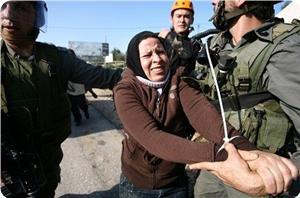
The Ahrar Center for Detainees Studies and Human Rights have reported that Israeli soldiers kidnapped 1,790 Palestinians in the first six months of this year, including 300 who were kidnapped in June, and added that 16 Palestinians have also been killed by the Israeli military in six months.
The Ahrar Center said that dozens of women, children, elderly, legislators, intellectuals and journalists were among the kidnapped.
The center added that the arrests took place in every part of the occupied West Bank, including Jerusalem, in addition to 25 arrests in the Gaza Strip, including fishermen and five arrests at border terminals.
Most of the arrests have been carried out in the Hebron district, in the southern part of the West Bank. The second highest number of arrests was carried out in Jerusalem, followed by Nablus.
Ahrar said that February witnessed the largest number of arrests as the soldiers kidnapped 382 Palestinians, while 350 have been kidnapped in January, 300 in June, 263 in May, 259 in April and 236 in March.
The center further reported that the army also kidnapped 7 Palestinian legislators identified as Ahmad Attoun, Hatem Qfeisha, Abdul-Jabbar Foqaha, Imad Nofal, Basem Za’areer, Mahmoud Ramahi, and Mohammad Jamal An-Natsha.
Furthermore, Ahrar said that the army also kidnapped 33 women, including wives and relatives of political prisoners held by Israel, and that 17 of the kidnapped women are still imprisoned by Israel.
The Ahrar Center also said that 14 Palestinians, including 10 from the West Bank, and four from the Gaza Strip, have been shot and killed by the Israeli army since the beginning of this year, in addition to two Palestinian political prisoners who died in Israeli prisons.
Detainee Arafat Jaradat, 33, from Hebron, died of extreme torture by Israeli interrogators, and detainee Maisara Abu Hamdiyya, 64, died of an advanced stage of cancer resulting from the lack of medical treatment in Israeli prisons.
Four more Palestinians have been killed by Israeli military fire in the Gaza Strip.
Head of the Ahrar Center, Fuad Al-khoffash, stated that the center documented daily Israeli military invasions; daily arrests and assaults, and demanded the International Community to act against the ongoing and escalating Israeli violations.
Mass protests after Indian forces kill two in Kashmir
Press TV – June 30, 2013
Indian security forces have shot dead at least two people in the north of Indian-administered Kashmir, prompting huge anti-India protests.
An Indian police official said that soldiers surrounded a few houses in the village of Markondal in Bandipora District, about 25 kilometers (15.5 miles) north of the main city of Srinagar, before dawn on Sunday.
A teenage boy was killed during a search operation.
A second person was killed after the Indian army shot at local residents who were protesting the earlier deadly incident. According to witnesses, three other people were also wounded.
The killings triggered mass protests in the area. Angry demonstrators chanted slogans against the Indian army.
Reports coming out of Kashmir suggest that Indian authorities are considering imposing a curfew to defuse tensions in the region.
Kashmir lies at the heart of more than 65 years of hostility between India and Pakistan. Both countries claim the region in full but each only has control over a section of the territory.
Over the past two decades, the conflict in Kashmir has left over 47,000 people dead by the official count, although other sources say the death toll could be as high as 100,000.
Related article
- Singh visit prompts protests (morningstaronline.co.uk)
Turkish government combing Twitter in search of protest organizers to arrest
RT | June 29, 2013
Turkish government officials are investigating Twitter and similar social media platforms in an attempt to identify and eventually prosecute the organizers of mass demonstrations, Erodgan administration officials said this week.
In the latest attack on social media’s role in protests, the country’s Transportation and Communications Minister Binali Yildirim called on social media networks on Friday to cooperate with authorities in the probe.
“Yes to the Internet … but an absolute no to its misuse as a tool for crimes, violence, chaos and disorder,” Yildirim said quoted as saying by the local Dogan news agency.
Authorities have scoured social networks searching for protest leaders since national unrest began on May 28 at a rally in Instanbul’s Taksim Square. Police have turned over at least 35 names to prosecutors in the city, according to Turkey’s Aksam newspaper.
It is illegal to ‘insult’ public officials in Turkey.
Deputy Prime Minister Bekir Bozdag acknowledged the existence of the list, the Associated Press reported, only saying ‘profanities and insults conducted electronically’ had contributed to the protests.
‘Crimes determined as such by the law don’t change if they are carried out through Facebook, Twitter or through other electronic means,’ he said. ‘No one has the right to commit crimes under the rule of law.’
Prime Minister Recep Tayyip Erdogan’s government has taken international criticism for the brutal police crackdown on protesters in the past month. The prime minister himself, when the rallies began, branded Twitter a ‘troublemaker’ used to spread ‘lies.’
What began as a protest against the redevelopment of Istanbul’s historic Gezi Park morphed into a national movement calling for a pluralistic society instead of Erdogan’s ‘authoritarian’ rule. The prime minister has also lost support for what critics say has been an attempt to impose Islamist values on a largely secular population.
He previously banned YouTube for two years beginning in 2008, citing the widespread presence of obscene material.
Erdogan’s deputies expressed hope that Facebook would allow them to comb through data and identify possible demonstration organizers. Facebook released a statement this week denying the disclosure, though, of any information to the government and expressing concern about future requests.
‘We will be meeting with representatives of the Turkish government when they visit Silicon Valley this week, and we intend to communicate our strong concerns about these proposals directly at that that time,’ Facebook said in a statement.
Turkish Minister of Transport, Maritime Affairs and Communications Binali Yildirim added that Twitter has not shown a ‘positive approach’ despite ‘necessary warnings’ from Turkey. He said that the Turkish government has asked Twitter, along with other social media sites, to set up a representative office inside the country.
‘We have told all social media that… if you operate in Turkey you must comply with Turkish law… When information is requested, we want to see someone in Turkey who can provide this… there needs to be an interlocutor we can put our grievance to and who can correct an error if there is one,’ he said.
‘Twitter will probably comply too. Otherwise, this is a situation that cannot be sustained,’ Yildirim stressed. His statement was presumably referring to social media’s role in the recent protests, though the social media companies themselves have had no role. He added that the government seeks only to ‘turn down the volume of the social media,’ rather than blocking it altogether.
Related articles
- Turkey takes steps to monitor Twitter content, users (alethonews.wordpress.com)
- Turkey announces plans ‘for gas’ and cyber security in face of Gezi protests (alethonews.wordpress.com)
Should Israel Be Boycotted?
By Lawrence Davidson | Consortium News | June 27, 2013
Ido Aharoni, Israel’s Consul General for New York and also “the founding head of Israel’s brand-management team and the originator of the Brand Israel movement,” recently wrote an op-ed in the New York Post (June 19, 2013). In it he took to task the famous American novelist Alice Walker for her promotion of a cultural boycott of Israel.
Aharoni explains that, just like most countries in the world, Israel tries to promote “an attractive image” of itself – a sort of Israeli version of “I love New York.” He asks, since, “no other country has ever been criticized for engaging in this common practice of courting tourists and businesses” why does Walker try to interfere with Israel’s branding campaign?

Israel’s Consul General for New York, Ido Aharoni.
Aharoni knows full well why Walker does so. However, for him the racism and oppression Walker sees institutionalized in Israeli society is not a good reason for a boycott. Aharoni asserts that “Israel, like many places on Earth, experiences a variety of issues and challenges. . . . Israel should not be viewed through the prism of its problems, nor should any other country.” On the other hand, Aharoni wants to know why Walker is not boycotting Syria?
The question of why Americans should boycott Israel, in particular, when so many other governments and societies in the world are oppressive and brutal, is an important one. And there is indeed a good answer to it:
The fact that Zionist influence spreads far beyond Israel’s area of dominion and now influences many of the policy-making institutions of western governments, and particularly that of the United States, makes it imperative that Israel’s oppressive behavior be singled out as a high priority case for boycott.
In other words, unlike other oppressive and brutal governments, the Israelis and their supporters directly influence (one might say corrupt) the policymakers of many Western nations and this often makes their governments (most specifically the U.S.) accomplices in Israel’s abusive policies. This being so, prioritizing Israel for boycott is not hypocrisy but rather necessity.
~
Lawrence Davidson is a history professor at West Chester University in Pennsylvania. He is the author of Foreign Policy Inc.: Privatizing America’s National Interest; America’s Palestine: Popular and Official Perceptions from Balfour to Israeli Statehood; and Islamic Fundamentalism.
Ecuador snubs US trade ‘blackmail’ over Snowden, offers human rights training
RT | June 28, 2013
Ecuador renounced trade benefits which the US threatened to revoke over the Latin American country’s consideration of harboring NSA leaker Edward Snowden. It offered $23 million a year to fund human rights education for Americans instead.
The government of leftist President Rafael Correa came up with an angry response on Thursday after an influential US senator said he would use his leverage over trade issues to cut preferential treatment of Ecuadoran goods at the US market, should Ecuador grant political asylum to Snowden.
“Ecuador will not accept pressures or threats from anyone, and it does not traffic in its values or allow them to be subjugated to mercantile interests,” government spokesman Fernando Alvarado said at a news conference.
He added that Ecuador is willing to allocate $23 million annually, an equivalent of the sum that it gained from the benefits, to fund human rights training in the US. It will “avoid violations of privacy, torture and other actions that are denigrating to humanity,” Alvarado said.
US Senator Robert Menendez, who heads the Foreign Relations Committee in the Senate, said this week that Ecuador risks losing the benefits it enjoys under two trade programs because of its stance on the NSA whistleblower.
“Our government will not reward countries for bad behavior,” he said.
The US is Ecuador’s prime trade partner, with over 40 percent of exports going to the US market.
Both programs were due to expire by the end of next month and were subject to congressional review. Before the Snowden debacle arose, the US legislature was expected to scrap one of them while renewing another one.
Snowden has applied for political asylum, hoping to find protection from American prosecutors, who charged him with espionage over his leaking of classified documents on US surveillance programs.
He is currently thought to be staying in the transit zone of a Moscow airport. He became stranded in the Russian capital after arriving from Hong Kong, because the US annulled his travel passport as part of its effort to get him to American soil for trial.
‘They have two roads on our land already, why do they need a third…?’
International Solidarity Movement | June 27, 2013
Hebron, Occupied Palestine – In the Wadi al-Hussein area of Hebron, Israeli occupation forces have started to build a new road ‘for military purposes’. The route of the road is from the illegal settlement of Kiryat Arba towards the city centre, directly across Palestinian-owned land.
A military order has decreed the construction of this road, four metres wide and more than two hundred metres long, cutting through fields of olive and fruit trees owned by the Palestinian families living there. The stipulation on the width of the road has already been broken, with the route that has been cut by bulldozers being six metres wide in places.
In contrast to the military order to build a road, Palestinian landowners have been denied the right to build on their own land. Despite gaining approval from the Palestinian Authority, the Israeli authorities (who have the final say on civil matters in area H2 of Hebron) have refused permission to build a new house. Landowners also point out that there are two existing roads from Kiryat Arba built on Palestinian land for Israeli-use only, and ask why a third is required.
When occupation forces attempted to build this road initially, landowners and others tried to stop construction by sitting down in front of bulldozers, but this non-violent protest was met with arrests, fines and imprisonment, and by the bulldozer dumping a load of earth on top of them.
Landowners complain that Israel insists on applying those aspects of the Hebron accords that benefit settlers, while ignoring those aspects covering the rights of the majority Palestinian population. Using military orders to steal land is a tactic long-used by Israel. Land seized this way then later typically becomes part of the ever-expanding settlement project. All Israeli settlements are illegal under international law, which bans the transfer of the occupier’s population into the land under occupation.
Related articles
- Jewish settlers setting up tent and planning road on Palestinian owned land in Al Khalil (alethonews.wordpress.com)
- Settlers building illegal road on Palestinian land in Hebron (palsolidarity.org)
- Susiya resists mass demolition orders (alethonews.wordpress.com)
- Settlers Attack Palestinians In Hebron (imemc.org)
- New road connects Israeli settlement with the Ibrahimi Mosque (ramyabdeljabbar.wordpress.com)
Susiya resists mass demolition orders
“We will not give up; to give up is to die”
International Solidarity Movement | June 27, 2013
Susiya, Occupied Palestine – Today, June 27, 2013, the Israeli Civil Administration served thirty-four demolition orders in the Susiya village, which is in Area C and surrounded by the Israeli colony of Suseya. Due to previous demolition orders, every existing structure in the village is now threatened with destruction if they do not obtain permits by July 17.
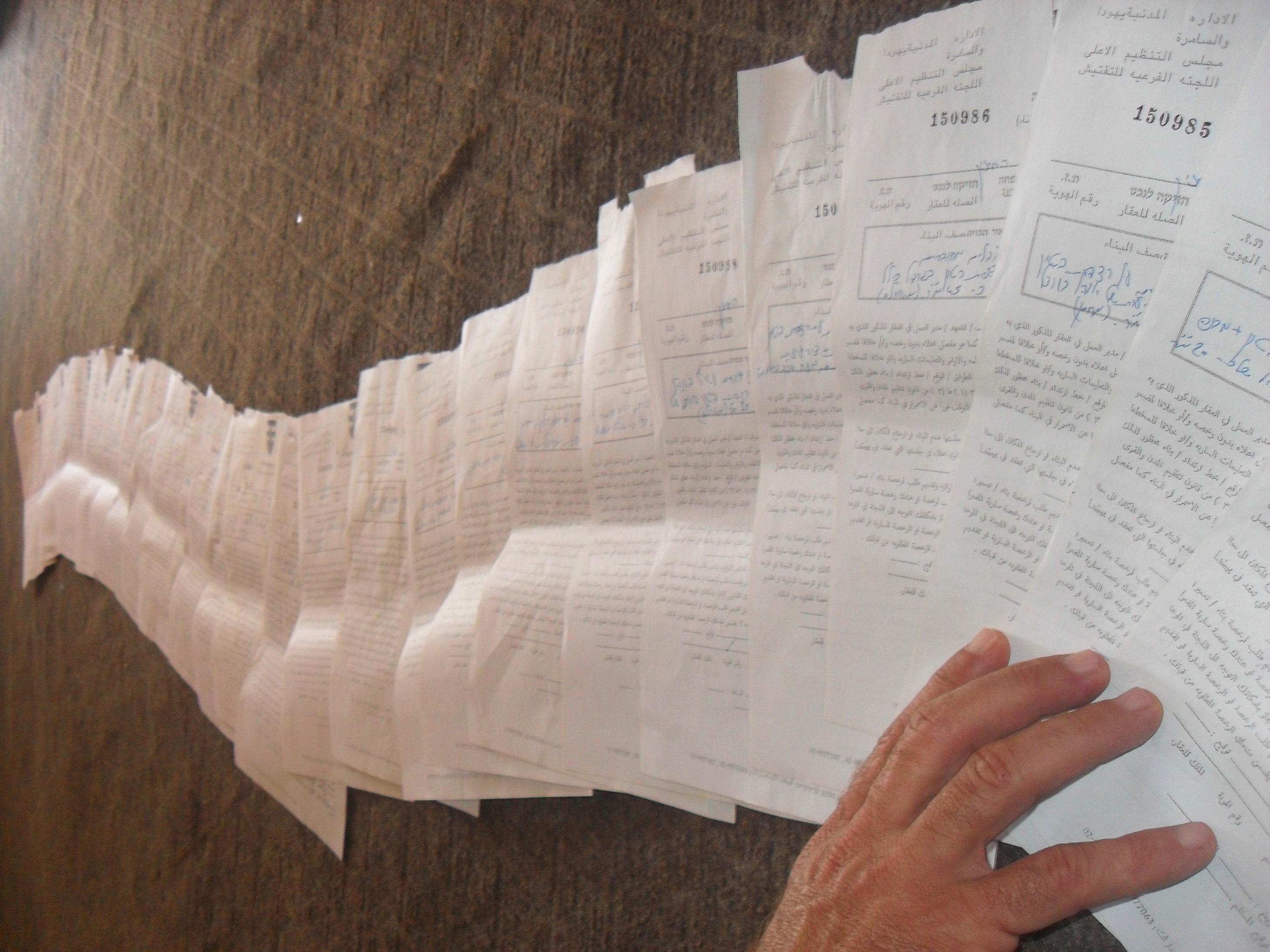
Original copies of all the demolition orders served today (Photo by ISM)
The residents of Susiya include more than thirty families, who were all evacuated from their homes in the old Susiya village and forced to relocate 200 meters to the southeast, in 1986. Susiya residents collaborate with the nearby villages in Masafer Yatta, a closed military “firing zone,” also in Area C and threatened with demolition. On July 15, a hearing will decide whether all the villages in Masafer Yatta can be evacuated by the military. Hafez Huraini, leader of the South Hebron Hills Popular Committee and himself a refugee from 1948, emphasizes that the villagers in Susiya are targeted simply for existing, so everything they do from grazing sheep to visiting family members in the nearby city of Yatta draws violence from the Israeli military and the local settlers.
Susiya has faced six mass demolitions since the establishment of the Israeli Suseya colony in 1983. The last wave of demolitions in 2011 repeatedly displaced 37 people including 20 children [1]. Residents of Susiya, most of whom rely on subsistence agriculture, are subject to some of the worst living conditions in the West Bank. Their houses were destroyed by Israeli forces and they now live in tents and shelters, paying more than five times the price nearby villages pay for water and consuming less than 1/3 of the WHO standard per capita [2]. Settlers have violently denied Susiya residents access to over 300 hectares of their land, including 23 water cisterns. Documented cases of settler violence include beatings, verbal harassment and destruction of property. Settlers then annex parts of the land by exploiting the Palestinian owners’ inability to access their land.
Of over 120 complaints that have been filed based on monitoring from Rabbis for Human Rights, regarding settler attacks and damage to property, around 95 percent have been closed with no action taken. In 2010, when 55 Susiya residents petitioned the High Court to be granted access to their land, the State responded that it intended to map land ownership of the area. Since then they have only closed to settlers 13% of the land Palestinians have been denied access to, reversing only one incursion [3].
Susiya has been the site of creative non-violent resistance for years, resistance that is continually met with brutality. Events have included marches, picnics on land likely to be confiscated, and Palestinian “outposts.” This coming Saturday Susiya will be part of a festival in the South Hebron Hills aimed at raising awareness about the situation of Masafer Yatta residents and stress their right to remain on their land [4]. In the words of Hafez Huraini, coordinator of the South Hebron Hills Popular Committee, “We will not give up.”
Sources:
[1] Strickland, Patrick O. “Palestine’s Front Line: The Struggle for Susiya.” Palestine Note RSS. N.p., n.d. Web. 27 June 2013.
[2] “Susiya: At Imminent Risk of Forced Displacement.” Susiya: At Imminent Risk of Forced Displacement – OCHA Factsheet (30 March 2012). N.p., Mar. 2012. Web. 27 June 2013.
[3] “South Hebron Hills.” Khirbet Susiya. N.p., 01 Jan. 2013. Web. 27 June 2013.
[4] Al Mufaqarah. “Al Mufaqarah R-Exist.” Weblog post. Al Mufaqarah RExist. N.p., 24 June 2013. Web. 27 June 2013.
Related articles
- The occupation plans to expand settlement of Susiya in al-Khalil (occupiedpalestine.wordpress.com)
- Jewish settlers setting up tent and planning road on Palestinian owned land in Al Khalil (alethonews.wordpress.com)
- Settler dogs attack Palestinian villagers near Hebron (occupiedpalestine.wordpress.com)
Related video
- From Al-Araqib to Susiya (palestinefreedomnow.wordpress.com)
Featured Video

Liberty Cannot Exist Inside a Panopticon
or go to
Aletho News Archives – Video-Images
From the Archives
Left-leaning despisers of 9/11 Truth movement: Do you really believe in miracles?
David Ray Griffin | Global Research | 06 Jul 2010
An Open Letter to Terry Allen, Noam Chomsky, Alexander Cockburn, David Corn, Chris Hayes, George Monbiot, Matthew Rothschild, and Matt Taibbi.
[1]According to several left-leaning critics of the 9/11 Truth Movement, some of its central claims, especially about the destruction of the World Trade Center, show its members to be scientifically challenged. In the opinion of some of these critics, moreover, claims made by members of this movement are sometimes unscientific in the strongest possible sense, implying an acceptance of magic and miracles. … Full article
Blog Roll
 Aletho News
- White House envoy declares kinetic action against Yemen ‘fruitless’
- Ukraine deployed thousands of microdrones in Iraqi Kurdistan: Tasnim
- Iran calls for emergency UNSC meeting over Trump’s ‘brazen’ bomb talk, Israeli threats
- Iranian sources reveal details of Russia-China Hormuz proposal
- Plan for more US-Israel integration puts our military tech at risk
- Another Round Against Iran Will Break What Is Left of the Gulf
- SVR Report on Ukraine’s Mexican Drug Gang Links Could Pressure Zelensky, Won’t Change US Policy
- British Government Employees Were Fact-Checking the News at the BBC. Nobody Told You.
- Albania on fire: who’s behind the riots?
- Egypt’s Civil Democratic Movement rejects involvement in regional war
- If Americans Knew
- Mysterious bot accounts reportedly spread fake ‘man on the street’ videos for Michigan Senate candidate
- Israeli Defense Minister Katz Says Over 60 Lebanon Villages Have Been Destroyed
- Why Is Israel Running TV Ads in Iowa Ahead of the Midterms?
- Hind Rajab’s Alleged Killer Is in the United States. HRF Demands His Arrest.
- US Officials Face Fresh Pressure After Another American ‘Brutalized’ by Israeli Settlers in West Bank
- Israel-Backed Palestinian Militias Terrorize Displaced Families in Gaza
- FBI subpoenas pro-Palestine activists over Israeli weapons plant disruption
- Fourth winter arrives in wartorn Gaza, too early – Daily Update
- More on how Bari Weiss is using CBS on behalf of Israel
- What the UK Is Doing to Pro-Palestine Novelist Sally Rooney Is an Act of Orwellian Villainy
- No Tricks Zone
- Predictions Made By Renowned Climate Proifessor Over Past Decades Have Been Proven To Be Poor
- New Study Suggests Large Regions Of The Pacific Ocean Have Been Cooling For The Last 80 Years
- Germany’s Green Energy Debacle: High Energy Costs Force Kahla Porzellan to Close After 182 Years!
- New Study: 50 Years Of The Most Aggressive ‘Net Zero’ Policies Can Only Affect The Global Climate By 0.03°C
- US September “Heat” Was No Record…Many Records Set Decades Ago
- Latest European Green Energy Debacle; Portugal’s Largest Flagship Solar Park Insolvent!
- Green Energy Debacle: German Expert Professor Fritz Vahrenholt Warns Of Severe Economic And Social Consequences
- Two More Paleo Reconstructions Affirm Meters-Higher Sea Levels Across Ireland, Brazil 7000-6000 Years Ago
- New Study: Earth And Venus Surface Warmth Largely Explained By Convection And Lapse Rate, Not CO2 Or Radiation
- 2025 Nature Paper Claiming Worsening Global Drought Gets RETRACTED …Heavily Flawed

