‘Vitoria!’ Mass protests force Brazil congress to reject ‘bill of discontent’
RT | June 26, 2013
Brazil’s legislative body has thrown out a proposed constitutional amendment, which was a key grievance of protesters across the country. The government is also planning to introduce a range of political reforms to appease demonstrators.
In what in being seen as a victory for people power, the measure was defeated on Tuesday by Congress by 430 votes to nine; with the Rio Times saying the protests were “largely fueled by social media and citizen journalists.”
The amendment, known as PEC 37, would have limited the power of state prosecutors to investigate crimes.
The protesters had argued that PEC 37 might have opened the way to more corruption; a problem which is endemic in Brazil.
Brazil ranks 69 out of 174 countries on the 2012 Transparency International index, a score that indicates significant problems with corruption.
The defeat of PEC 37 will keep public prosecutors at the forefront of the fight against corruption. If the amendment had become law, it would have granted power to carry out criminal investigations exclusively to the police.
Critics to the bill argued that it would have prevented prosecutors from conducting fair, impartial and effective criminal investigations, particularly into organized crime and corruption, in which the police themselves have been embroiled. In December last year 63 police officers were arrested after a yearlong bribery investigation.
The police in Brazil are amongst the most corrupt in the world and have been mired in recent years in a number of corruption scandals.
Congress also voted Tuesday to funnel all revenue and royalties from newly-discovered oil fields off the Brazilian coast into education and health.
The new fields are among the largest finds in recent years and, once fully operational, are expected to produce tens of billions of barrels of oil; although they are located deep on the ocean floor and extracting the oil will require expensive new technology and carries huge risks.
Protestors also voiced their anger at other issues, which they say the government is mishandling, including soaring levels of corruption, poor public services and the huge cost of staging the 2014 World Cup and 2016 Summer Olympics, both to be held in Brazil.
The government, though, has promised a range of initiatives, which they say will combat corruption and improve public services.
A referendum proposing political reform is meant to address campaign financing and political representation, and the government says a vote may take place as soon as September 7.
A controversial plan to bring in foreign doctors to reverse a shortfall in the country is being pushed through despite the objections of Brazilian medical practitioners and an increase in public transport fares in many cities has also been scrapped. The President of the Senate, Renan Calheiros, has even proposed free transport for students.
Yet it is still unclear whether or not these hasty political concessions are having an impact. Protests are due to continue in the city of Belo Horizonte Wednesday, with tens of thousands of people expected to take part.
In a security nightmare for police, the demonstration will take place at the same time as the semifinal of the Confederation Cup between Brazil and Uruguay. One protest group has said it plans to protest outside the national team’s hotel.
Last Saturday there were violent clashes in Belo Horizonte during another protest and President Rousseff has warned against a repeat of violence.
New Jersey hospital deports unconscious stroke victim
RT | June 26, 2013
A US hospital deported an unconscious stroke victim after noticing that the patient was an undocumented immigrant from Poland. Polish health officials are furious that the man was “dumped on their doorstep” before the transfer was approved.
“Imagine being carted around like a sack of potatoes,” Polish Consul General Ewa Junczyk-Ziomecka told New York Daily News, describing the incident in which 69-year old Wladyslaw Haniszewski was unconsciously deported to his homeland.
Haniszewski, who suffers from a blood disease, lived in Perth Amboy, N.J., for 30 years. He recently lost his job, apartment, and health insurance, and was forced to move into a homeless shelter, the Daily News reports.
After the man suffered a dangerous stroke, a friend named Jerzy Jedra took him to the New Jersey hospital for treatment. When officials at the Robert Wood Johnson University Hospital noticed that the patient had no health insurance and lived in the US without documentation, they sent the comatose man to Poland. US hospitals are legally required to provide emergency care to anyone who needs it, but are allowed to deport stabilized undocumented immigrants.
But in order to deport someone, a US hospital must first get consent from either the patient, a family member, or a court guardian. Officials at the Polish consulate claim that no one was contacted, and that Haniszewski’s family was never informed that the man was deported.
Meanwhile, Haniszewski was left at the doorstep of a hospital in Boleslawiec, Poland. The facility is now being forced to take care of the man’s medical payments, which have cost “a few hundred dollars” a day, the hospital’s deputy director told TVN.
Junczyk-Ziomecka, who works at the Polish consulate in New York City, said she was trying to help the comatose man, only to realize last week that he was gone. Polish officials are furious about the deportation, especially since the 69-year-old patient was not in a healthy state to sign off on the transfer.
“Behind our backs they transported the unconscious man to Poland,” she told TVN, noting that she was most furious about the hospital’s decision to dump the man at the facility. “I cannot imagine such a situation that the decision about transporting an unconscious person could be made without agreement. Between the two institutions must be a contract, there must be documents. You cannot simply leave a patient at the door and drive away.”
At least 800 people have been deported from US hospitals without consent over the past six years in 15 states, the Associated Press reported in April. Medical repatriation has become increasingly common, but AP suggests that the actual number of such hospital deportations is much higher than figures show. Some health advocates are afraid that repatriations will occur more frequently after major components of Obamacare are implemented in 2014, since the US government will reduce its payments to hospitals that care for large numbers of uninsured patients.
Shena Erlington, director of the Health Justice Program, told the Daily News that although hospitals may face the burden of paying for uninsured patients, medical care providers should not have the ability to deport patients.
“It’s an incredibly disturbing case,” Lori Nessel, director of the Center for Social Justice at Seton Hall University School of Law, said about the Haniszewski repatriation. “This kind of action seems clearly illegal and also not ethical, but it’s hard to bring forth a legal action.”
The New Jersey hospital denies any wrongdoing and claims that the patient was informed of his discharge and care plan. The patient is awake, but unable to speak or communicate with doctors.
Turkey takes steps to monitor Twitter content, users
Al-Akhbar | June 27, 2013
Turkey said on Wednesday it had asked Twitter to set up a representative office inside the country, which could give it a tighter rein over the micro-blogging site it has accused of helping stir weeks of anti-government protests.
While mainstream Turkish media largely ignored the protests during the early days of the unrest, social networking sites such as Twitter and Facebook emerged as the main outlets for Turks opposed to the government.
Transport and Communications Minister Binali Yildirim told reporters on Wednesday that without a corporate presence in the country, the Turkish government could not quickly reach Twitter officials with orders to take down content or with requests for user data.
“When information is requested, we want to see someone in Turkey who can provide this … there needs to be an interlocutor we can put our grievance to and who can correct an error if there is one,” he said.
“We have told all social media that … if you operate in Turkey you must comply with Turkish law,” Yildirim said.
Twitter declined to respond to the government request on Wednesday, but a person familiar with the company’s thinking said it had no current plans to open an office in that country.
Turkey successfully pressured Google Inc into opening an office there last October after blocking YouTube, a Google subsidiary, from Turkish Internet users for two years.
While Ankara had no problems with Facebook, which had been working with Turkish authorities for a while and had representatives inside Turkey, Yildirim said it had not seen a “positive approach” from Twitter after Turkey issued the “necessary warnings” to the site.
“Twitter will probably comply, too. Otherwise this is a situation that cannot be sustained,” he said, without elaborating, but he stressed the aim was not to limit social media.
An official at the ministry, who asked not to be named, said the government had asked Twitter to reveal the identities of users who posted messages deemed insulting to the government or prime minister, or that flouted people’s personal rights.
It was not immediately clear whether Twitter had responded.
Facebook said in a statement that it had not provided user data to Turkish authorities in response to government requests over the protests and said it was concerned about proposals Internet companies may have to provide data more frequently.
In the midst of some of the country’s worst political upheaval in years, Turkish Prime Minister Tayyip Erdogan has described sites like Twitter as a “scourge,” although senior members of his party are regular users. He has said such websites were used to spread lies about the government with the aim of terrorizing society.
Police detained several dozen people suspected of inciting unrest on social media during the protests, according to local reports.
Speaking at the Brookings Institution in Washington, D. C., Twitter’s Chief Executive Dick Costolo said on Wednesday that he had been observing the developments in Turkey, but he emphasized that Twitter had played a hands-off role in the political debate.
“We don’t say, ‘Well, if you believe this, you can’t use our platform for that,'” Costolo said. “You can use our platform to say what you believe, and that’s what the people of Turkey … are using the platform for. The platform itself doesn’t have any perspective on these things.”
Turkey’s interior minister had previously said the government was working on new regulations that would target so-called “provocateurs” on social media but there have been few details on what the laws would entail.
One source with knowledge of the matter said the justice ministry had proposed a regulation whereby any Turk wishing to open a Twitter account would have to enter their national identification number, but this had been rejected by the transport ministry as being technically unfeasible.
Turkish users have increasingly turned to encryption software to thwart any ramp up in censorship of the Internet.
Last year, Twitter introduced a feature called “Country Withheld Content” that allows it to narrowly censor tweets considered illegal in a specific country, and it caused some concern among users.
Twitter implemented the feature for the first time in October in response to a request by German authorities, blocking messages in Germany by a right-wing group banned by police.
(Reuters, Al-Akhbar)
Related article
- Turkey announces plans ‘for gas’ and cyber security in face of Gezi protests (alethonews.wordpress.com)
Mandatory Data Retention Defeated in Australia, For Now.
By Daniel Nazer | EFF | June 24, 2013
For the last few years, Australia’s security agencies have been pushing for the mandatory retention of the communications data of every citizen. If implemented, this policy would require private companies to keep communications metadata of all customers for two years. Essentially, it treats every person as a criminal suspect. Yesterday, a parliamentary committee issued a report declining to recommend data retention and strongly criticizing the government for failing to adequately explain and justify its proposal. In the wake of the report, the governing Labor Party announced it will not pursue data retention before the next election. So data retention in Australia has been defeated, for now.
The most recent push began last July, when the Attorney General’s Department submitted a list of security proposals, including data retention, to the Joint Parliamentary Committee on Intelligence and Security. The scheme met with overwhelming public opposition—98.9% of public submissions rejected data retention. Civil rights groups and individuals explained that the scheme sacrifices the privacy of all citizens. Contrary to the government’s claims, collecting metadata is highly intrusive as it reveals the most intimate connections between persons. In addition, the scheme would create a huge trove of data vulnerable to hacking while imposing significant costs on private companies dragooned to act as the government’s spies.
The government failed to rebut these objections. In a ham-fisted attempt to avoid criticism, the Attorney General’s Department initially refused to provide concrete details about its data retention scheme. The committee strongly criticized this lack of transparency:
[T]he Committee was very disconcerted to find, once it commenced its Inquiry, that the Attorney-General’s Department had much more detailed information on the topic of data retention. Departmental work, including discussions with stakeholders, had been undertaken previously. Details of this work had to be drawn from witnesses representing the [department].
Journalist Bernard Keane tweeted that he’d “never seen a government-controlled committee give a kicking to a department” like this report did. In addition to slamming the department for hiding the ball, the committee acknowledged public concern about privacy:
[A] mandatory data retention regime raises fundamental privacy issues, and is arguably a significant extension of the power of the state over the citizen. No such regime should be enacted unless those privacy and civil liberties concerns are sufficiently addressed.
The committee punted on the ultimate issue. It wrote that there was “a diversity of views within the Committee” as to the merits of a data retention regime and said it was “ultimately a decision for Government.” With an election scheduled for later this year, the governing Labor Party announced that it is dropping the unpopular scheme.
Green Party Senator Scott Ludlam cautioned that, even with the defeat of this proposal, Australia’s security agencies might achieve the same result by other means. He warned that, in light of the recent NSA Spying news, agencies may bypass domestic due process through the “wholesale importing of content and non-content data from colleagues in the U.S.” We need greater oversight of the security establishment to ensure that international cooperative agreements are not enabling the evasion of domestic legal restrictions.
Senator Ludlam also predicted that, regardless of who wins the next election, the data retention plan will be back. Security agencies will not abandon their campaign to treat every person like a criminal suspect. Privacy advocates in Australia and around the world need to keep up the fight.
Related articles
- Australian Data Retention Plan Swept Under The Rug…For Now [Updated] (gizmodo.com.au)
- Government backs down from data retention — for now (computerworld.co.nz)
The Gates Foundation and its unethical investments in G4S
By Ramona Wadi | MEMO | June 20, 2013
While three Dutch charities have announced that they will no longer accept donations by G4S due to the company’s support for the Israeli occupation, the Gates Foundation has deemed it ethical to invest in G4S, effectively exposing the often ignored link between philanthropy and human rights violations.
The Gates Foundation, renowned for its philanthropy, is allegedly ‘inspired by passion and compassion for the well-being of people’. Focusing on issues such as health, education, poverty, the Foundation now seems to be seeking a share in security affairs, effectively aligning itself with the conspiracy behind the fable of safeguarding human rights. Philanthropy should be viewed within a wider image – a surplus of funds derived from a capitalist enterprise channelled into appropriate projects which bestow a continuous temporary relief in order to avoid challenging the exploitation which has rendered communities around the world dependent upon charity. With the Gates Foundation aligning its interests with a service provider of oppression, profits will continue to fund approved projects at the expense of violating international human rights law, which is acceptable within the cycle of capitalist dependency.
G4S has been targeted by the BDS movement for its role in providing security and surveillance equipment, rendering the company complicit in war crimes with Israel’s security service, Shin Bet. Torture during interrogations is routine treatment in Israeli jails, often resulting in severe physical and metal degeneration or, as in the case of Arafat Jaradat, death. G4S endorses identical security concern rhetoric as that used by Israel, manipulating the foundations of human rights and security into a territory which encompasses nothing but the alleged rights of the oppressor.
In their 2012 Corporate Social Responsibility Report, G4S states that the company recognises it can ‘play a positive and negative role in respecting human rights around the world’. The company declares that its policy is based upon the Universal Declaration of Human Rights (1947), the International Covenant on Civil and Political Rights (1966), the International Convention on Economic, Social and Cultural Rights (1966) and the international Labour Organisation Declaration on Fundamental Rights at Work (1998). ‘Mapping the human rights landscape’, as stated in the report, and becoming a signatory to the UN Global Compact, are portrayed as a pledge to safeguard human rights, disregarding the UN’s significant faults and unapologetic stances when it comes to selectively bestowing human rights in order to promote and consolidate the impunity of powerful states and allies. In other words, G4S are emulating their provision of security services and basing their legitimacy upon an international organisation which thrives upon illegality.
Dependency has created a spectator society. While activist campaigns have created a far reaching resonance, leaders within the international community are too comfortably ensconced in their glorified positions to challenge a partnership which fuels the Israeli occupation’s crimes against Palestinians. As long as the interpretation of the social world is shaped by dominant allies, it is difficult to fragment the bond between society and economic power, effectively allowing an amalgamation of a ruling power to distort the power of intellectuals into a subservient role abetting international complicity in human rights violations.
Four Injured, Palestine TV Reporters Kidnapped In Kufur Qaddoum
By Saed Bannoura | IMEMC | June 22, 2013
The Popular Committee Against the Wall and Settlements in Kufur Qaddoum village, near the northern West Bank city of Qalqilia, reported Friday that dozens of Israeli soldiers attacked the weekly nonviolent protest, wounding four residents, and kidnapped reporters of the official Palestine TV.
The Committee said that the soldiers violently attacked and beat reporter Ahmad Shawar and cameraman Bashar Nazzal, working for the Palestinian TV, confiscated their cameras, and threw the rest of their equipment in the trash.
An Israeli army spokesperson claimed that the kidnapped journalists “attacked the soldiers”, and that they have been transferred to an interrogation facility.
Morad Shteiwy, coordinator of the Popular Committee in the village, has reported that the army surrounded the village since early morning hours Friday, and invaded it in an attempt to prevent the residents from holding their weekly protest against the illegal Annexation Wall and settlements.
“The large number of soldiers deployed in the village could not prevent the determined residents from holding their protest”, Shteiwy said, “the soldiers violently attacked the protesters and fired dozens of gas bombs, concussion grenades, and rubber-coated metal bullets”.
He further said that resident Aqel Mahmoud Shteiwy, 25, was shot with a rubber-coated bullet in his hand, and that one of his fingers was amputated, and added that resident Yousef Mustafa Shteiwy, 21, was shot in the chest, Bassam Ayyoub Shteiwy, 26, was shot in the back and Bashar Mahmoud Shteiwy, 22, was shot in the abdomen.
Also on Friday, soldiers used tear gas, chemical water and rubber-coated steel bullets to attack the weekly protests at the villages of Bil’in and Ni’lin, near the central West Bank city of Ramallah, where residents and their international and Israeli supporters, managed to reach the wall; two protesters were injured and many were treated for the effects of tear gas inhalation.
In Bil’in, gas bombs fired by Israeli troops caused a fire that damaged olive trees owned by local farmers. Soldiers also fired tear gas at residents who tried to put out the fire.
At the nearby village of al Nabi Saleh, Israeli soldiers attacked the villagers and their supporters before leaving the village.
Dozens of soldiers stormed the village and fired gas bombs into resident’s homes. Many were treated for the effects of tear gas inhalation.
In al Ma’sara village, near Bethlehem, dozens of soldiers stopped the villagers and their supporters at the village entrance and then forced them back, using rifle-buts and batons to push people back, no injuries were reported.
Related articles
UN committee slams Israeli forces’ torture of Palestinian children

A child sits in front of a destroyed home in Rafah. (Photo: European Commission DG ECHO/cc/flickr)
Al-Akhbar | June 20, 2013
A United Nations human rights body accused Israel on Thursday of mistreating Palestinian children, including by torturing those in custody and using others as human shields.
Palestinian children in the Gaza and the West Bank, captured by Israeli forces in the 1967 war, are routinely denied registration of their birth and access to health care, decent schools and clean water, the UN Committee on the Rights of the Child said.
“Palestinian children arrested by (Israeli) military and police are systematically subject to degrading treatment, and often to acts of torture, are interrogated in Hebrew, a language they did not understand, and sign confessions in Hebrew in order to be released,” it said in a report.
The Israeli Foreign Ministry said it had responded to a report by the UN children’s agency UNICEF in March on ill-treatment of Palestinian minors and questioned whether the UN committee’s investigation covered new ground.
“If someone simply wants to magnify their political bias and political bashing of Israel not based on a new report, on work on the ground, but simply recycling old stuff, there is no importance in that,” spokesman Yigal Palmor said.
The report by the UN Committee on the Rights of the Child noted that, while both Israeli and Palestinian children end up killed and wounded, Palestinians constitute a much larger proportion of these casualties.
Most Palestinian children arrested are accused of having thrown stones, an offense which can carry a penalty of up to 20 years in prison, the committee said. Israeli soldiers had testified to the often arbitrary nature of the arrests, it said.
The watchdog’s 18 independent experts examined Israel’s record of compliance with a 1990 treaty as part of its regular review of a pact signed by all nations except Somalia and the United States. An Israeli delegation attended the session.
The UN committee regretted Israel’s “persistent refusal” to respond to requests for information on children in the Palestinian territories and occupied Syrian Golan Heights since the last review in 2002.
“Hundreds of Palestinian children have been killed and thousands injured over the reporting period as a result of the state party military operations, especially in Gaza where the state party proceeded to (conduct) air and naval strikes on densely populated areas with a significant presence of children, thus disregarding the principles of proportionality and distinction,” the report said.
The 10-year period examined by the committee included the second Intifada, which took place between 2000 and 2005.
Israel withdrew its troops and settlers from the Gaza Strip in 2005, but maintains a heavy blockade on the Hamas-run enclave.
During the 10-year period, an estimated 7,000 Palestinian children aged 12 to 17, but some as young as nine, had been arrested, interrogated and detained, the UN report said.
Many are brought in leg chains and shackles before military courts, while youths are held in solitary confinement, sometimes for months, the report said.
It voiced deep concern at the “continuous use of Palestinian children as human shields and informants”, saying 14 such cases had been reported between January 2010 and March 2013 alone.
Israeli soldiers had used Palestinian children to enter potentially dangerous buildings before them and to stand in front of military vehicles to deter stone-throwing, it said.
“Almost all those using children as human shields and informants have remained unpunished and the soldiers convicted for having forced at gunpoint a nine-year-old child to search bags suspected of containing explosives only received a suspended sentence of three months and were demoted,” it said.
Israel’s illegal occupation of Palestinian territory and the Syrian Golan Heights, continued expansion of Jewish settlements, construction of the apartheid wall into the West Bank, land confiscation and destruction of homes and livelihoods “constitute severe and continuous violations of the rights of Palestinian children and their families,” it said.
Israeli settlements in the West Bank are deemed illegal by international law, a charge the Zionist state disputes.
The UNICEF report in March showed that Israel was the only country in the world where children were “systematically tried” in military courts.
Over the past decade, Israeli forces have arrested, interrogated and prosecuted around 7,000 children between between 12 and 17, mostly boys, UNICEF found, noting the rate was equivalent to “an average of two children each day.”
Figures from the end of January show that 233 children are currently being held in custody, 31 of them under the age of 16.
(Reuters, Al-Akhbar)
Related article
New wall construction to surround Azzun Atma
International Solidarity Movement | June 20, 2013
Azzun Atma, Occupied Palestine – On the 18th of June, two bulldozers arrived with Israeli forces in the village of Azzun Atma, southeast of Qalqilya, and began to work on the land behind the village’s school, to what is believed to be the construction of the new wall.
Accompanying the bulldozers to the village was the Israeli army and border police, including the local Israeli army commander who said the action was based on a High Court decision by the Israeli government. He said it was in order to protect their citizens, and if anybody tried to stop the construction, they would then close the gate to the village, the only way in and out.
Two weeks prior to this, the Israeli army put up signs stating that this is where the construction of the new wall would begin. The villagers fear that this new construction is being done in order to replace the current two metre barbed mesh fence that surrounds the village from all sides and separates it from the settlements nearby, with the concrete wall. The wall’s existence and constant deviation from the Green Line is justified by the Israeli authorities by citing security concerns for its citizens, in this case the illegal settler colonisers in the area.
Azzun Atma is located two kilometres east of the Green Line and encompassed on three sides by the current wall, constructed in 2002, which leaves the village within a settlement block and separates it from the rest of the West Bank. The only way in and out of the village is through a military checkpoint with a small gate. The village is thus stranded in the “seam zone” between the Green Line and the wall, surrounded by settlements, placing it under full Israeli military control. Access to the village, therefore, is dictated by the Israeli military and the checkpoint is regularly closed, denying the villagers their right to freedom of movement. The villagers thus live under the constant threat of the gate being closed and work permits for the other side of the Green Line being denied.
Palestinians living in the “seam zone” require permanent resident permits from the Israeli authorities to live in their own homes and work on their land. There are often few health and education services available in the “seam zone”, and those living inside it have to rely on checkpoints being open to reach workplaces and essential services.
The school where the construction is taking place has provided education for 300 children in Azzun Atma and a neighbouring village since 1966. Every day, the current wall and checkpoint restricts the freedom of movement of teachers and students. The school has so far lost one dunum of land to the wall and the septic system faces demolition orders.
When the second wall is constructed, Azzun Atma will be isolated from the rest of the West Bank by the already existing wall (see the red line on the map) and the new wall which will further close off the village from the settlement block and the rest of the West Bank (see the black line on the map).
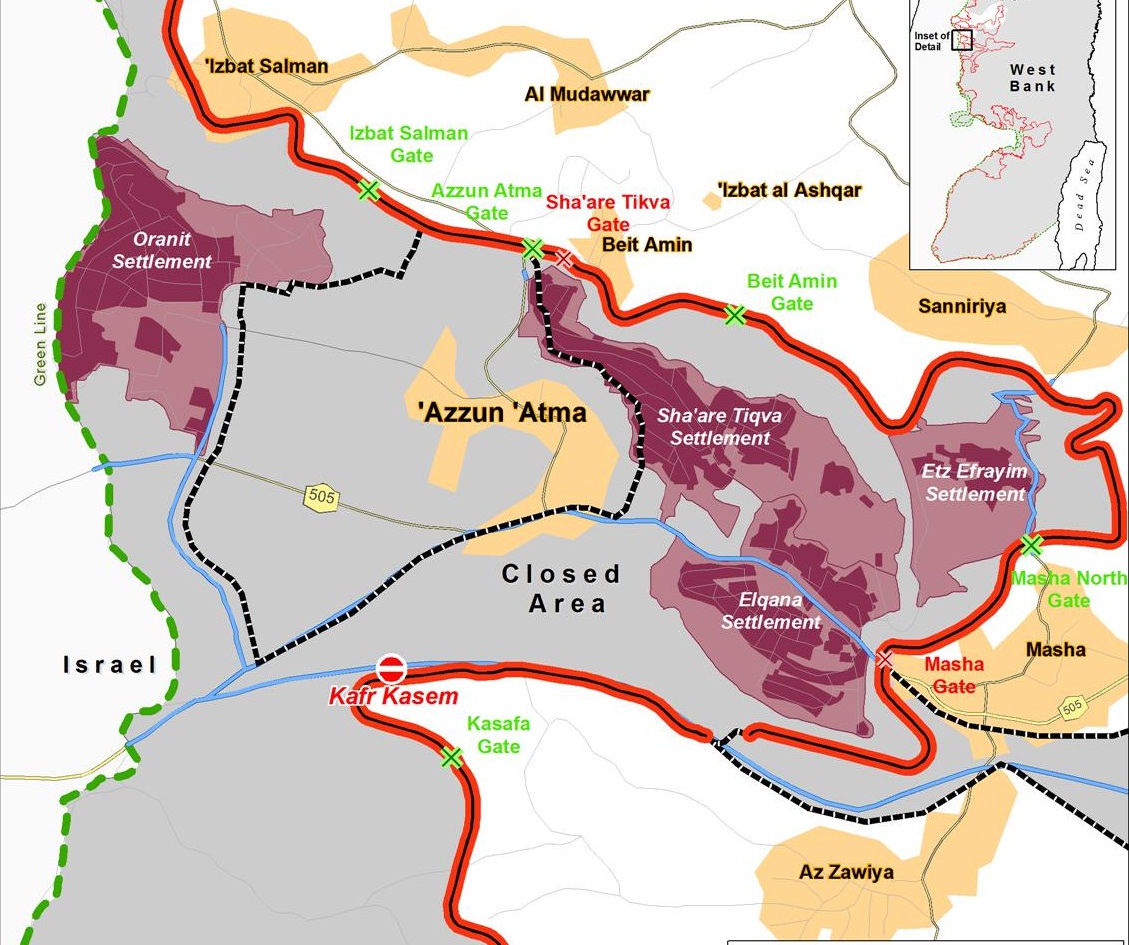
Azzun Atma (Map by OCHA)
In 1982, the Israeli authorities established two illegal settlements: Oranit to the northwest and Sha’are Tiqva to the northeast of Azzun Atma. The settlements have expanded over the years, and more than 2500 dunums of the village’s land have been stolen by them. Sha’are Tiqva now comes within metres of Azzun Atma, and since 2005, villagers have been subject to verbal harassment from settlers. The wall, though purported to be a security measure, is essentially another way for the Israeli government to steal land from their Palestinian owners and isolate villages and cities from each other, turning them into easily controllable cantons.
Isolating people and making daily life as hard as possible under occupation is a tactic used by the Israeli authorities to force villagers to leave their land and homes. However, residents of Azzun Atma remain steadfast in their land and will continue to resist the land theft, isolation and deprivation of their lives by organising protests.
Related articles
- Israeli settlers threaten to occupy Palestinian village of Azzun (occupiedpalestine.wordpress.com)
- West Bank Barrier creates hardship for Palestinian villagers (euronews.com)
Time to Raise Political Asylum Quotas for Americans?
US Should Top the List of the International Quota for Political Refugees
By Sybel Edmonds | Boiling Frogs Post | June 17, 2013
I don’t know how you feel about surveys, ranking or indexes, but whether you follow them or not, you must be aware of how we’ve been falling steadily as a nation. Those of you who follow lists-surveys and global indexes, let’s admit it- as a nation we have not been going up on most global ranking lists – in fact, just the opposite.
We have been going down on the list of the World’s Least Corruption Nations-way down. We have been dropping continuously when it comes to our ranking in the education arena. We have been dropping royally when it comes to Healthcare Systems. When it comes to World Press Freedom, we are embarrassingly low, behind Cape Verde, Cyprus, and even trailing Mali, Tanzania, El Salvador, Botswana and Comoros!! We didn’t even make it onto the ridiculous list of the top ten nations’ national happiness index.
All these competitive areas aside, there is one list we should be climbing steadily and rapidly. Even if you don’t care about all those other global lists you must care about this particular one; for your own good and even your survival. I am talking about a list pertaining to a nation’s status as to its need for acceptance of its political refugees by the global community.
 Please don’t laugh or shrug off this suggestion. Instead, pause and think about our whistleblowers in jail or those awaiting the results of their prosecutions. Remember the journalists and reporters being targeted and investigated by our national police. Recall our new laws recently put in place to secretly and indefinitely detain any American citizen (that is you and me)-without any warrant or even having to show any justification. Think about the still-growing national no-fly list. Remind yourself of torture as our government’s common practice; abroad and here at home. Take a look at your land line, cell, laptop, fax and I-Pad as tools used by our government to illegally-secretly-continuously spy on you.
Now you see what I am talking about.
If you still find the notion difficult to accept, then think of the dozens of Hollywood movie classics on the Stasi and KGB. Remember how people climbed the wall or crawled through tunnels to escape the constant surveillance and arbitrary detentions of their national police. Their national police cited national security and unity. Now consider how the NSA and dozens of mega-corporations have you under surveillance illegally; around the clock. Our national police have been citing national security.
How do you think our camps for our citizens to be detained under our new national law, NDAA, would be different than those set up by the Stasi, KGB and the like?
You remember how other western nations received the lucky escapees from the fascistic or communist regimes with open arms? Well, now they should be receiving us, our escapees; with open arms.
They have to. They must. Not doing it would be in violation of their laws and their international pledge:
Asylum is granted to people fleeing persecution or serious harm in their own country and therefore in need of international protection. Asylum is a fundamental right; granting it is an international obligation, first recognized in the 1951 Geneva Convention on the protection of refugees. In the EU, an area of open borders and freedom of movement, countries share the same fundamental values and States need to have a joint approach to guarantee high standards of protection for refugees. Procedures must at the same time be fair and effective throughout the EU and impervious to abuse. With this in mind, the EU States have committed to establishing a Common European Asylum System.
…
And here is the international law describing who qualifies for international protection-Based on UN Convention & Protocols[Emphasis Mine]:
Grounded in Article 14 of the Universal Declaration of human rights 1948, which recognizes the right of persons to seek asylum from persecution in other countries, the United Nations Convention relating to the Status of Refugees, adopted in 1951, is the centerpiece of international refugee protection today.(1)
A refugee, according to the Convention, is someone who is unable or unwilling to return to their country of origin owing to a well-founded fear of being persecuted for reasons of race, religion, nationality, membership of a particular social group, or political opinion.
…
Today, we, the citizens of the United States of America, face prosecution, persecution, torture, and possible assassination for engaging in certain journalistic or even Good Samaritan reporting of illegal-criminal-unconstitutional activities by those trusted with our nation’s health, wealth, and security.
Our government has been engaged in ongoing torture and human rights violations at home and abroad. Whether it is the globally recognized USA halls-of-shame in Guantanamo, Bagram and Abu Ghraib, or, secretly carried out atrocities in our government’s black cites around the globe, or, tortures inflicted on a citizen here at home who is guilty of exposing government criminalities, our government is now recognized and acknowledged as a Supreme Torturer.
This situation now is being extended to those of us who may have read or disseminated information originally gathered and distributed by others. Today our whistleblowers-truth tellers-Good Samaritans are thrown behind bars, while our criminals who engage in robbing our taxpayers of billions of dollars, or those who engage in torture and murder, are highly protected and handsomely awarded by our rulers.
We United States Citizens have been deprived of expressing collective dissent even through the most peaceful means and in the most pacifist manner. Our participation or membership in social groups or gatherings that challenge illegal wars or anti humanitarian practices land us on our government’s never-defined ‘enemy & terrorist’ list, with consequences ranging from being prohibited from traveling , to having our homes raided and families intimidated by armed government militia, to being persecuted and thrown before a federal grand jury to face possible incarceration for our beliefs.
We Americans, every single one of us, are treated as potential terrorists, are considered guilty with no way to prove otherwise. We all are subjected to round the clock warrantless-illegal surveillance , and degrading violation-probing-groping searches as mandatory requirements for our travel.
I believe, and you should as well, that we have more than enough cases of recorded atrocities, criminalities and violations inflicted upon us by our very own government to expect a substantial increase in our nation’s status-ranking for acceptance of our political refugees.
I know, and you do too, that there are many nations with governmental practices worse than ours. However, our bad government is much bigger than their bad governments, with much higher capabilities. When you have a huge government like ours, with incredible technological and weaponry capabilities as ours does, you risk far graver atrocities than with smaller bad governments with limited capabilities. That’s a fact. Our big bad government is far worse than their small bad government. And that should increase and elevate our nation’s ranking in the international community’s political refugee quota-status.
As for the so-called liberal nations: we urge you to remember the Stasi and the suffocating repression suffered by the East Germans, and then, go ahead and multiply that by a six-digit number of your choice. Any number will do, that is, as long as it has six digits. Our technology-enabled Stasis can tap, record, analyze and save billions of communications. Our rulers’ mega corporate collaborators can pull the plug on millions of us with no recourse available or even imaginable. Our mega military’s ferocious drones can pinpoint and turn us into ashes with a secret order issued on a simple letterhead.
We implore the international community to grant us, the Citizens of the United States of America, ‘High Priority Political Asylum’ status. At least consider a swapping arrangement whereby the international community’s highest-level criminals, con artists, professional swindlers, and or psychotic serial torturers are sent here where they can find an agreeable working-practicing environment and unlimited government protection and rewards, in exchange for those of us in search of peace, a reasonable degree of freedom and justice.
Sibel Edmonds is the Publisher & Editor of Boiling Frogs Post and the author of the Memoir Classified Woman: The Sibel Edmonds Story. She is the recipient of the 2006 PEN Newman’s Own First Amendment Award for her “commitment to preserving the free flow of information in the United States in a time of growing international isolation and increasing government secrecy”
Related article
The Deeper Meaning of Mass Spying in America
By James Petras | June 14, 2013
The exposure of the Obama regime’s use of the National Security Agency to secretly spy on the communications of hundreds of millions of US and overseas citizens has provoked world-wide denunciations. In the United States, despite widespread mass media coverage and the opposition of civil liberties organizations, there has not been any mass protest. Congressional leaders from both the Republican and Democratic Parties, as well as top judges, approved of the unprecedented domestic spy program. Even worse, when the pervasive spy operations were revealed, top Senate and Congressional leaders repeated their endorsement of each and every intrusion into all electronic and written communication involving American citizens. President Obama and his Attorney General Holder openly and forcefully defended the NSA’s the universal spy operations.
The issues raised by this vast secret police apparatus and its penetration into and control over civil society, infringing on the citizens freedom of expression, go far beyond mere ‘violations of privacy’, as raised by many legal experts.
Most civil libertarians focus on the violations of individual rights, constitutional guarantees and the citizen’s privacy rights. These are important legal issues and the critics are right in raising them. However, these constitutional–legal critiques do not go far enough; they fail to raise even more fundamental issues; they avoid basic political questions.
Why has such a massive police-state apparatus and universal spying become so central to the ruling regime? Why has the entire executive, legislative and judicial leadership come out in public for such a blatant repudiation of all constitutional guarantees? Why do elected leaders defend universal political espionage against the citizenry? What kind of politics requires a police state? What kind of long-term, large scale domestic and foreign policies are illegal and unconstitutional as to require the building of a vast network of domestic spies and a hundred billion dollar corporate-state techno-espionage infrastructure in a time of budget ‘austerity’ with the slashing of social programs?
The second set of questions arises from the use of the espionage data. So far most critics have questioned the existence of massive state espionage but have avoided the vital issue of what measures are taken by the spymasters once they target individuals, groups, movements? The essential question is: What reprisals and sanctions follow from the ‘information’ that is collected, classified and made operational by these massive domestic spy networks? Now that the ‘secret’ of all-encompassing, state political spying has entered public discussion, the next step should be to reveal the secret operations that follow against those targeted by the spymasters as a ‘risk to national security’.
The Politics behind the Police State
The fundamental reason for the conversion of the state into a gigantic spy apparatus is the nature of deeply destructive domestic and foreign policies which the government has so forcefully pursued. The vast expansion of the police state apparatus is not a response to the terror attack of 9/11. The geometrical growth of spies, secret police budgets, and the vast intrusion into all citizen communications coincides with the wars across the globe. The decisions to militarize US global policy requires vast budgetary re-allocation , slashing social spending to fund empire-building; shredding public health and social security to bailout Wall Street. These are policies which greatly enhance profits for bankers and corporations while imposing regressive taxes on wage and salaried workers
Prolonged and extended wars abroad have been funded at the expense of citizens’ welfare at home. This policy had led to declining living standards for many tens of millions of citizens and rising dissatisfaction. The potential of social resistance as evidenced by the brief “Occupy Wall Street” movement which was endorsed by over 80% of the population. The positive response alarmed the state and led to an escalation of police state measures. Mass spying is designed to identify the citizens who oppose both imperial wars and the destruction of domestic welfare; labeling them as ‘security threats’ is a means of controlling them through the use of arbitrary police powers. The expansion of the President’s war powers has been accompanied by the growth and scope of the state spy apparatus: the more the President orders overseas drone attacks, the greater the number of his military interventions, the greater the need for the political elite surrounding the President to increase its policing of citizens in anticipation of a popular backlash. In this context, the policy of mass spying is taken as ‘pre-emptive action’. The greater the police state operations, the greater the fear and insecurity among dissident citizens and activists.
The assault on the living standards of working and middle class Americans in order to fund the endless series of wars, and not the so-called ‘war on terror’, is the reason the state has developed massive cyber warfare against the US citizenry. The issue is not only a question of a violation of individual privacy: it is fundamentally an issue of state infringement of the collective rights of organized citizens to freely engage in public opposition to regressive socio-economic policies and question the empire. The proliferation of permanent bureaucratic institutions, with over a million security ‘data collectors’, is accompanied by tens of thousands of ‘field operators’, analysts and inquisitors acting arbitrarily to designate dissident citizens as ‘security risks’ and imposing reprisals according to the political needs of their ruling political bosses. The police state apparatus has its own rules of self-protection and self-perpetuation; it has its own linkages and may occasionally compete with the Pentagon. The police state links up with and protects the masters of Wall Street and the propagandists of the mass media – even as it (must) spy on them!
The police state is an instrument of the Executive Branch acting as a vehicle for its arbitrary prerogative powers. However on administrative matters, it possesses a degree of ‘autonomy’ to target dissident behavior. What is clear is the high degree of cohesion, vertical discipline and mutual defense, up and down the hierarchy. The fact that one whistle-blower, Edward Snowden, emerged from the hundreds of thousands of citizen spies is the exception, the lone whistle blower, which proves the rule: There are fewer defectors to be found among the million-member US spy network than in all the Mafia families in Europe and North America.
The domestic spy apparatus operates with impunity because of its network of powerful domestic and overseas allies. The entire bi-partisan Congressional leadership is privy to and complicit with its operations. Related branches of government, like the Internal Revenue Service, cooperate in providing information and pursuing targeted political groups and individuals. Israel is a key overseas ally of the National Security Agency, as has been documented in the Israeli press (Haaretz, June 8, 2013). Two Israeli high tech firms (Verint and Narus) with ties to the Israeli secret police (MOSSAD), have provided the spy software for the NSA and this, of course, has opened a window for Israeli spying in the US against Americans opposed to the Zionist state. The writer and critic, Steve Lendman points out that Israeli spymasters via their software “front companies” have long had the ability to ‘steal proprietary commercial and industrial data” with impunity. Because of the power and influence of the Presidents of the 52 Major American Jewish organizations, Justice Department officials have ordered dozens of Israeli espionage cases to be dropped. The tight Israeli ties to the US spy apparatus serves to prevent deeper scrutiny into its operation and political goals — at a very high price in terms of the security of US citizens. In recent years two incidents stand out: Israeli security ‘experts’ were contracted to advise the Pennsylvania Department of Homeland Security in their investigation and ‘Stasi-like’ repression of government critics and environmental activists (compared to ‘al Queda terrorists’ by the Israelis) – the discovery of which forced the resignation of OHS Director James Powers in 2010. In 2003, New Jersey governor, Jim McGreevy appointed his lover, an Israeli government operative and former IDF officer, to head that state’s ‘Homeland Security Department and later resigned, denouncing the Israeli, Golan Cipel, for blackmail in late 2004. These examples are a small sample illustrating the depth and scope of Israeli police state tactics intersecting in US domestic repression.
The Political and Economic Consequences of the Spy State
The denunciations of the mass spy operations are a positive step, as far as they go. But equally important is the question of what follows from the act of spying? We now know that hundreds of millions of Americans are being spied on by the state. We know that mass spying is official policy of the Executive and is approved by Congressional leaders. But we have only fragmented information on the repressive measures resulting from the investigations of “suspect individuals”. We can assume that there is a division of labor among data collectors, data analysts and field operatives following up “risky individuals and groups”, based on the internal criteria known only to the secret police. The key spy operatives are those who devise and apply the criteria for designating someone as a “security risk”. Individuals and groups who express critical views of domestic and foreign policy are “a risk”; those who act to protest are a “higher risk”; those who travel to conflict regions are presumed to be in the “highest risk” category, even if they have violated no law. The question of the lawfulness of a citizen’s views and actions does not enter into the spymasters’ equation; nor do any questions regarding the lawfulness of the acts committed by the spies against citizens. The criteria defining a security risk supersede any constitutional considerations and safeguards.
We know from a large number of published cases that lawful critics, illegally spied upon, have subsequently been arrested, tried and jailed – their lives and those of their friends and family members shattered. We know that hundreds of homes, workplaces and offices of suspects have been raided in ‘fishing expeditions’. We know that family members, associates, neighbors, clients, and employers of “suspects” have been interrogated, pressured and intimidated. Above all, we know that tens of millions of law abiding citizens, critical of domestic economic and overseas war policies, have been censored by the very real fear of the massive operations carried out by the police state. In this atmosphere of intimidation, any critical conversation or word spoken in any context or relayed via the media can be interpreted by nameless, faceless spies as a “security threat” – and one’s name can enter into the ever growing secret lists of “potential terrorists”. The very presence and dimensions of the police state is intimidating. There are citizens who would claim that the police state is necessary to protect them from terrorists – but how many others feel compelled to embrace their state terrorists just to fend off any suspicion, hoping to stay off the growing lists? How many critical-minded Americans now fear the state and will never voice in public what they whisper at home?
The bigger the secret police, the greater its operations. The more regressive domestic economic policy, the greater the fear and loathing of the political elite.
Even as President Obama and his Democratic and Republican partners boast and bluster about their police state and its effective “security function”, the vast majority of Americans are becoming aware that fear instilled at home serves the interest of waging imperial wars abroad; that cowardice in the face of police state threats only encourages further cuts in their living standards. When will they learn that exposing spying is only the beginning of a solution? When will they recognize that ending the police state is essential to dismantling the costly empire and creating a safe, secure and prosperous America?
Leaked: NSA’s Talking Points Defending NSA Surveillance
By Mike Masnick | techdirt | June 14, 2013
The government has been passing around some “talking points” to politicians and the press trying to spin the NSA surveillance story. We’ve got the talking points about scooping up business records (i.e., all data on all phone calls) and on the internet program known as PRISM. Both are embedded below. Let’s dig in on a few of the points, starting with the business records/FISA issue:
The news articles have been discussing what purports to be a classified, lawfully-authorized order that the Foreign Intelligence Surveillance Court (FISA Court) issued under an Act of Congress – the Foreign Intelligence Surveillance Act (FISA). Under this Act, the FISA Court authorized a collection of business records. There is no secret program involved here – it is strictly authorized by a U.S. statute.
“There is no secret program here”? Bullshit. Why, then, have so many people, both in the Congress and the public been shocked at the extent to which the NSA is snarfing up data? This is a secret program, enabled by a secret interpretation of the FISA Amendments Act, by the FISA Court, which the DOJ and the NSA insist the public is not allowed to know. Yes, it’s a secret program. Saying otherwise is simply lying.
It authorizes only metadata collection, which includes barebones records – such as a telephone number or the length of a call.
“Barebones records” and “metadata” are terms being used to play down the extent of the collection of info, but it ignores multiple reports that note the amount of data actually collected — including phone numbers, call times, call location, among other things — is more than enough to identify who someone is and a variety of important characteristics about that person.
This legal tool, as enacted by Congress, has been critical in protecting America. It has been essential in thwarting at least one major terrorist attack to our country in the past few years.
“At least one” is a lot less than the “dozens” NSA boss Keith Alexander recently stated. But, so far the only “one” identified, involving an attempted NYC Subway bombing was shown not to have needed this data collection program to uncover and stop. So, nope.
Despite what appears to be a broad scope in the FISA Court’s order, the Intelligence Community uses only a small fraction of a percent of the business records collected to pursue terrorism subjects.
This is meaningless. That’s like saying, even though we search everyone’s house illegally, we only actually arrest a small number of people. No one would allow such house searches under the 4th Amendment, so why is it okay with phone records?
All three branches – Congress, the Courts, and the Executive Branch – review and sign off on FISA collection authorities. Congress passed FISA, and the Intelligence Committees are regularly and fully briefed on how it is used.
Except many in Congress have made it clear they did not review this kind of program, or were led to believe that the NSA did not collect this kind of information. And those who are being briefed now say the program goes way beyond what they were told. And, those who did know about it beforehand, tried to dig deeper into the program, but were blocked. As for “the Courts” reviewing it, we’re talking about the FISA Court which is a rubberstamp in black robes, having approved every single request of it for the past three years. It last rejected a request back in 2009, and that was only one out of 1320. In its entire history, since 1979, the court has rejected a grand total of 11 applications. 11. Out of 33,939 applications. That’s 0.03%. Not 3%. 0.03% with not a single rejection in over three years. That’s not careful review. That’s a rubber stamp. As for the executive branch signing off on it, what do you expect? They’re going to hold back their own ability to spy on people?
The FISA Court authorizes intelligence collection only after the Intelligence Community has proven its case, based on underlying facts and investigations.
Well, we already covered the rubber stamp issue above, but Section 215 of the Patriot Act requires that the government present a case that the data it is seeking “must be relevant to an authorized preliminary or full investigation to obtain foreign intelligence information not concerning a U.S. person or to protect against international terrorism or clandestine intelligence activities.” I’d love to see the argument that all data is somehow relevant to the investigation. Of course, I can’t see it, because it’s secret.
This legal tool has been reauthorized only after ongoing 90-day renewal periods. That means that every 90 days, the Department of Justice and the FBI must prove to the Foreign Intelligence Surveillance Court that they have the facts and legal basis to renew this legal authority. It is not a rubber stamp.
Ha ha ha. So, we violate your privacy without any opposing view — but we do it every 90 days for seven straight years.
FISA-authorized collections are subject to strict controls and procedures under oversight of the Department of Justice, the Office of the Director of National Intelligence and the FISA Court, to ensure that they comply with the Constitution and laws of the United States and appropriately protect privacy and civil liberties.
What kind of “strict controls and procedures” allow for the collection of every single record of every single phone call, and then also make it accessible to the 29-year-old IT guy in Hawaii? Just wondering…
Moving on to the “NSA internet talking points.”
Section 702 is a vital legal tool that Congress reauthorized in December 2012, as part of the FISA Amendments Act Reauthorization Act, after extensive hearings and debate. Under Section 702, the Foreign Intelligence Surveillance Court (FISA Court) certifies foreign intelligence collection. There is no secret program involved – it is strictly authorized by a U.S. statute.
Again, “no secret program,” merely a secret interpretation of the law, in a secret ruling by a secret court. What’s everyone complaining about?
Section 702 cannot be used to target any U.S. person. Section 702 also cannot be used to target any person located in the United States, whether that person is an American or a foreigner.
Note the careful choice of words: it cannot be used to target a person in the US. It can, however, be used to collect info on a person in the US if they’re not “the target” of the investigation. Fun with words!
The unauthorized disclosure of information about this critical legal tool puts our national security in grave danger, puts Americans at risk of terrorist and cyber attacks, and puts our military intelligence resources in danger of being revealed to our adversaries.
Right. So this is not a new program, it’s no surprise, people shouldn’t be concerned… and now that you know about it we’re all going to die!
How does anyone take these jokers seriously?
Featured Video

Liberty Cannot Exist Inside a Panopticon
or go to
Aletho News Archives – Video-Images
From the Archives
Left-leaning despisers of 9/11 Truth movement: Do you really believe in miracles?
David Ray Griffin | Global Research | 06 Jul 2010
An Open Letter to Terry Allen, Noam Chomsky, Alexander Cockburn, David Corn, Chris Hayes, George Monbiot, Matthew Rothschild, and Matt Taibbi.
[1]According to several left-leaning critics of the 9/11 Truth Movement, some of its central claims, especially about the destruction of the World Trade Center, show its members to be scientifically challenged. In the opinion of some of these critics, moreover, claims made by members of this movement are sometimes unscientific in the strongest possible sense, implying an acceptance of magic and miracles. … Full article
Blog Roll
 Aletho News
- White House envoy declares kinetic action against Yemen ‘fruitless’
- Ukraine deployed thousands of microdrones in Iraqi Kurdistan: Tasnim
- Iran calls for emergency UNSC meeting over Trump’s ‘brazen’ bomb talk, Israeli threats
- Iranian sources reveal details of Russia-China Hormuz proposal
- Plan for more US-Israel integration puts our military tech at risk
- Another Round Against Iran Will Break What Is Left of the Gulf
- SVR Report on Ukraine’s Mexican Drug Gang Links Could Pressure Zelensky, Won’t Change US Policy
- British Government Employees Were Fact-Checking the News at the BBC. Nobody Told You.
- Albania on fire: who’s behind the riots?
- Egypt’s Civil Democratic Movement rejects involvement in regional war
- If Americans Knew
- Mysterious bot accounts reportedly spread fake ‘man on the street’ videos for Michigan Senate candidate
- Israeli Defense Minister Katz Says Over 60 Lebanon Villages Have Been Destroyed
- Why Is Israel Running TV Ads in Iowa Ahead of the Midterms?
- Hind Rajab’s Alleged Killer Is in the United States. HRF Demands His Arrest.
- US Officials Face Fresh Pressure After Another American ‘Brutalized’ by Israeli Settlers in West Bank
- Israel-Backed Palestinian Militias Terrorize Displaced Families in Gaza
- FBI subpoenas pro-Palestine activists over Israeli weapons plant disruption
- Fourth winter arrives in wartorn Gaza, too early – Daily Update
- More on how Bari Weiss is using CBS on behalf of Israel
- What the UK Is Doing to Pro-Palestine Novelist Sally Rooney Is an Act of Orwellian Villainy
- No Tricks Zone
- Predictions Made By Renowned Climate Proifessor Over Past Decades Have Been Proven To Be Poor
- New Study Suggests Large Regions Of The Pacific Ocean Have Been Cooling For The Last 80 Years
- Germany’s Green Energy Debacle: High Energy Costs Force Kahla Porzellan to Close After 182 Years!
- New Study: 50 Years Of The Most Aggressive ‘Net Zero’ Policies Can Only Affect The Global Climate By 0.03°C
- US September “Heat” Was No Record…Many Records Set Decades Ago
- Latest European Green Energy Debacle; Portugal’s Largest Flagship Solar Park Insolvent!
- Green Energy Debacle: German Expert Professor Fritz Vahrenholt Warns Of Severe Economic And Social Consequences
- Two More Paleo Reconstructions Affirm Meters-Higher Sea Levels Across Ireland, Brazil 7000-6000 Years Ago
- New Study: Earth And Venus Surface Warmth Largely Explained By Convection And Lapse Rate, Not CO2 Or Radiation
- 2025 Nature Paper Claiming Worsening Global Drought Gets RETRACTED …Heavily Flawed

