NGOs find loopholes in Foreign Agents’ Law, officials urge corrections
RT | June 13, 2013
Russian NGOs that receive funding from abroad have developed several methods that allow them to bypass the obligatory registration as ‘foreign agents’.
Currently the law obliges all NGOs engaged in political activities and receiving funding from abroad to register as “foreign agents”under threat of fines.
One possible option is to register an ordinary commercial company that would receive funds from abroad and employ NGO staff as workers to pay their salaries, Kommersant daily wrote quoting the head of a Russian NGO who spoke on the condition of total anonymity.
The source noted that about 15 Russian groups had already switched to this method.
Another possible loophole, suggested by the daily itself, is to set up an endowment that would properly register as a foreign agent and receive foreign funding which would then be transferred to one or several Russian groups, allowing them to skip the registration as they are formally sponsored by a Russian company.
The third way has been outlined in a recent report by the Civil Initiatives Committee, an influential expert group chaired by former finance minister Aleksey Kudrin, which said that under growing pressure Russian NGOs could re-register in neighboring states.
Some Russian officials already called for changes in the recently approved law, saying that the flaws of the original bill are being exposed as it is applied. Mikhail Fedotov, chairman of the Presidential Council on Human Rights, said that the practice was only showing one thing – that the law had been poorly written and that it was in need of corrections.
Fedotov added that the council had already prepared several suggestions on corrections, but he did not go into detail.
Deputy Prime Minister Arkady Dvorkovich has said that the law needs changes and called for activists to draft their amendments. But Dvorkovich added that the law is in force and must be observed by all members of the community until it is altered in the desired way.
Russia introduced the so-called Foreign Agents Law in November last year.
Prosecutors and the Justice Ministry launched a major nationwide program in March this year in order to check how the fresh law is being applied. The inspections caused protests from NGOs, rights activists and the international community, which claimed they were a form of government pressure on independent critics.
Russian officials, including the president, have repeatedly stated that the law is not banning any NGOs and simply requires disclosure of the sources of their income. Such transparency would give Russian citizens and voters some clues about possible motives of the groups’ political actions, the officials added.
Currently no organization is registered as a foreign agent in Russia.
Settlers from Bracha attack and harass farmer on his land
International Solidarity Movement | June 13, 2013
Al Rujeib, Occupied Palestine – On Friday 7th June five settlers from the illegal settlement of Bracha attacked a farmer on his land, using sling shots to throw stones at him near Huwwara checkpoint. The same settlers continued to harass the farmer in the following days as he tried to graze his sheep and gather his crops, unprotected by the Israeli authorities.
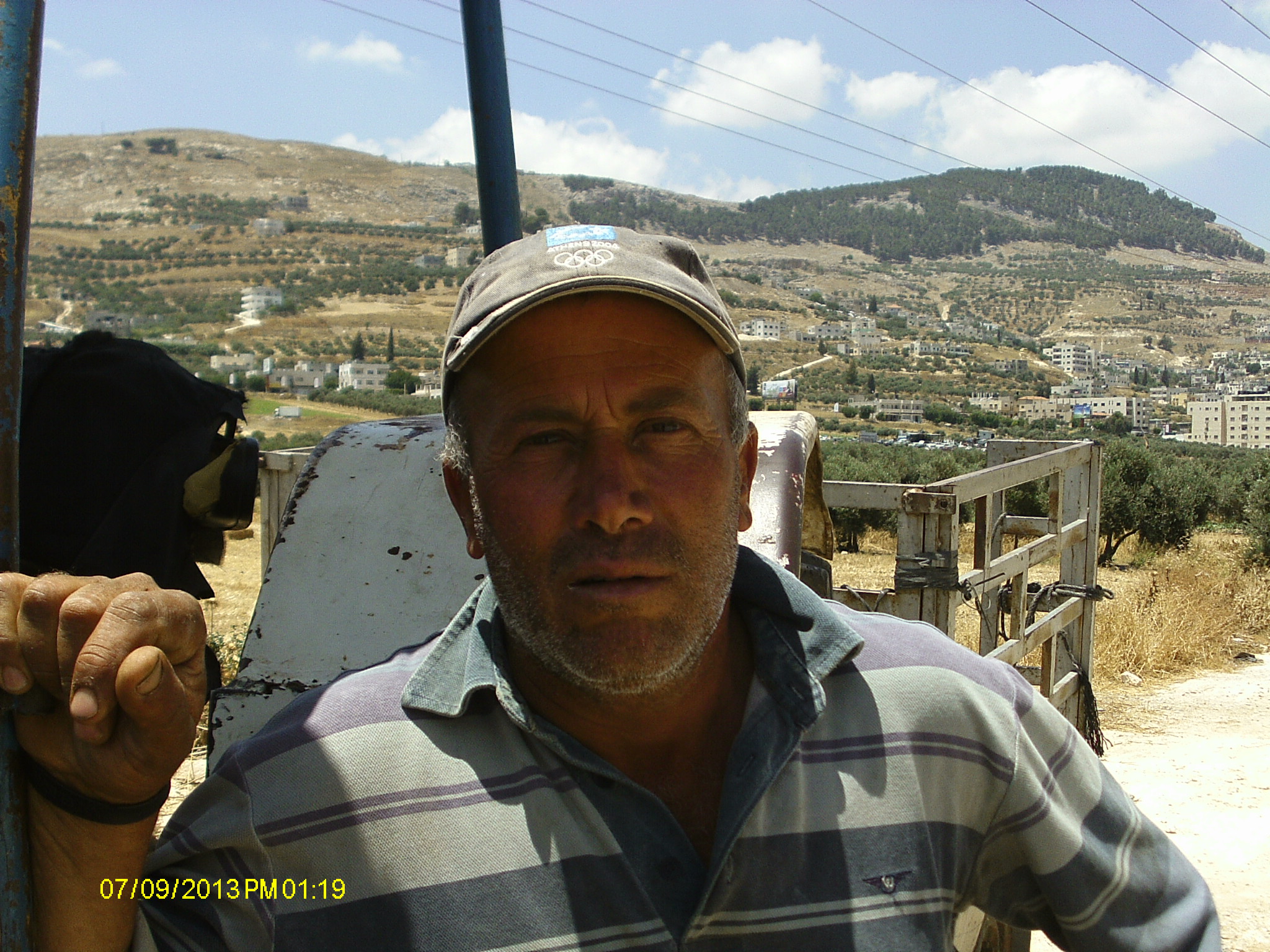
Salah Sukamel Deweket (Photo by ISM)
Salah Sukamel Deweket rents 70 dunums of land between his home in Al Rujeib and the occupation forces’ checkpoint at Huwwara. The land is mainly used to plant crops for his sheep to graze upon.
On Friday 7th June Salah was working hard to enable his sheep to feed when he was surprised by five settlers, thought to be an old man and his four sons who brought their own sheep to eat Salah’s wheat. The settlers threw rocks using slingshots at Salah and his flock. Salah had no one who could help him as he had no number for the District Coordination Office (DCO) – the Palestinian liasion with Israeli authorities or other organisations. Unable to get the number, he returned to his land to find that the settlers had ripped apart his bales of wheat.
The settlers resumed throwing stones at him in full view of soldiers stationed at the Israeli occupation forces checkpoint at Huwwara. The soldiers did nothing but watch as the Palestinian farmer was attacked. As an occupying power the Israeli military are meant to protect all citizens in the territory.
Salah asked the older settler why he had destroyed his wheat. “People who stay in Israeli land have to be good Israeli people”, the settler replied. “If this is Israeli land, where’s Palestinian land?” Salah asked. “There is no Palestinian land” the settler shouted back. The settlers continued to graze their sheep on Salah’s land and then encouraged their sheep to eat the olive trees of another Palestinian farmer who came to protect his land. It was only then that army jeeps came to intervene – asking why the Palestinian farmers were there. Salah tried to explain the problem with the settlers to the army, who told him to take photos and go to DCO. Salah then asked the soldiers if they were going to arrest the settlers, to which they said, ” we don’t know, it’s up to the judge.” When the soldiers were asked why they did not come earlier, they replied that it wasn’t their problem. The next day Salah tried to fix his wheat bales but the settlers kept coming and causing problems. Soldiers eventually came and told both Salah and the settlers to leave but said that the Palestinians must leave first.
Palestinians face many attacks by settlers of varying severity. Religious extremists living in illegal settlements attack Palestinian people, lands and crops. Palestinians have almost no means of legal recourse or protection from settler attacks but are routinely targeted by the army in mass arrests in the alleged defence of the Israeli occupation and settlements. Even when Palestinians can contact the DCO, the coordination office can often not solve issues with settlers who generally are treated with impunity under Israeli law. Settlements are illegal under international law under the fourth Geneva convention.

Salah Sukamel Deweket’s wheat fields (Photo by ISM)
Related articles
- Jewish settlers setting up tent and planning road on Palestinian owned land in Al Khalil (alethonews.wordpress.com)
- After the flames, only determination remains in Burin and Madama (alethonews.wordpress.com)
- VIDEO | 82-year-old Hebron woman Umm Salah challenges Israeli settlers, troops. Alone. (occupiedpalestine.wordpress.com)
- Jewish settler fires at Palestinian workers wounding one of them (occupiedpalestine.wordpress.com)
Hospital Drugs Patients & Dumps Them Onto Buses, Suit Claims
By MEGAN GALLEGOS | Courthouse News | June 13, 2013
LAS VEGAS – Calling it “Greyhound therapy,” a Las Vegas psychiatric hospital drugs patients and sends them on buses out of state to cities where they know no one, without medical instructions or anyone to care for them, one such patient claims in a federal class action.
Lead plaintiff James Flavy Coy Brown claims the hospital’s illegal policies are “sometimes referred to as ‘Greyhound therapy.'”
He sued Rawson-Neal Psychiatric Hospital, Southern Nevada Adult Mental Health Services, the Nevada Bureau of Health Care and Quality and Compliance, Dr. Anurag Gupta, his psychiatrist at Rawson-Neal, and others.
The complaint states: “Plaintiffs are former psychiatric patients at defendant Rawson-Neal Psychiatric Hospital (hereinafter ‘Rawson-Neal’) who, while still in need of psychiatric care, were involuntarily discharged from the facility by defendants and their agents and employees, and sent to out-of-state destinations where defendants knew said patients would be unable to obtain proper treatment, care and housing. Plaintiffs were medicated before their discharge and required to leave the facility under the influence of powerful anti-psychotic/tranquilizing medication. While plaintiffs were in a drugged state, and incompetent to give informed consent, the standard procedure was for institution staff to physically escort plaintiffs from the facility and place them in taxis bound for the Greyhound Bus Station in Las Vegas, Nevada. They were directed and required to travel on pre-paid tickets which had been previously ordered and paid for by Defendants Southern Nevada Adult Mental Health Services (hereinafter ‘SNAMHS’) and Rawson-Neal.”
Brown, 48, says he was admitted to Rawson-Neal on Feb. 9. The hospital is run by Southern Nevada Adult Mental Health Services. He was given “a diagnosis of psychosis, hearing voices, and thinking of suicide,” he says in the complaint.
He was discharged on Feb. 11.
“Defendants knew he was penniless and homeless and defendant Rawson-Neal knew or acted in reckless disregard of the fact that he would be unable to care for himself during the journey or upon his arrival,” the complaint states. “Before he was discharged, he was started on Thorazine, Cymbalta and Klonopin, all psychotropic medications which affect thinking and judgment. While Defendant Rawson-Neal had developed a written treatment plan which included assisting him to locate a group home placement and locating a case worker for him, this treatment plan was intentionally disregarded and violated by his involuntary discharge contrary to the plan.
“On February 13, defendant psychiatrist Dr. Anurag Gupta (hereinafter ‘Gupta’) ordered Brown discharged, physically escorted from the facility, and placed in a taxi which had been ordered by the defendants. Plaintiff Brown was then transported to the Greyhound Bus Station, where a pre-paid ticket had been purchased by the defendants to take Brown to Sacramento, California, a city which he had no prior contact, and where he knew no one. There was no follow-up plan and no prior contact had been made with any institutions in Sacramento from which Brown could obtain medical and psychiatric care. He was given three days of powerful anti-psychotic medications and bottle of Ensure for the 15 hour bus ride.
“Plaintiff Brown arrived in Sacramento, homeless, confused and anxious. He was taken by police to a local homeless service center, Loaves and Fishes, which could provide no housing, medical care or transportation. After his arrival at that location, he was directed to the U.C. Davis Medical Center’s emergency department which, after three days, arranged for Brown to be treated by Heritage Oaks psychiatric facility. From there he was discharged to a group home in Sacramento.”
Brown claims he’s one of more than 1,500 patients the defendants have treated this way, sent dazed and confused to nearly every state in the union.
“After learning of the ‘dumping’ of Brown in Sacramento by defendants, the Sacramento Bee newspaper began to investigate the circumstances which led to Brown’s arrival in Sacramento and discovered that since the year 2008 approximately 1,500 patients of the Rawson-Neal Psychiatric Hospital in Las Vegas, Nevada, have been transported by Greyhound Bus to almost every state in the country, all with minimum provisions to sustain them during protracted bus rides.
“A random survey by Nevada’s Bureau of Health Care Quality and Compliance of 30 discharges of psychiatric patients from Rawson-Neal revealed discharges in violation of policy and procedures of the Centers for Medicare and Medicaid and the facility’s own policies occur frequently. Patients, such as Brown, were involuntarily placed on Greyhound buses and sent out of state without prior arrangements having been made for follow-up care. These patients were not informed where they should go to receive continuing care upon arrival at their destinations. Discharge orders did not specify the amount of nutritional supplements to be provided to the patients for their extended bus trips; and appropriate and necessary prescription medications were not provided. Furthermore, necessary information was not provided on discharge documentation.”
Brown seeks punitive damages for civil rights violations, constitutional violations including cruel and unusual punishment, medical malpractice, negligence, gross negligence and breach of fiduciary duties.
He is represented by Allen Lichtenstein with the ACLU of Nevada.
Land Grabs, the Latest Form of Genocide in Guatemala

By Leonor Hurtado – Americas Program – 12/06/2013
In a historic decision this May, Guatemala’s Supreme Court of Justice sentenced former dictator General Ríos Montt to 80 years in prison for the genocidal massacres of indigenous people in the 1980s. Many Guatemalans hoped that the judicial process against the top criminals of the country’s “dirty war” would finally bring justice—but ten days after the decision, the Constitutional Court reversed the judgment.
While the Guatemalan people protest this violation of the rule of law, the processes of genocide initiated 30 years ago by Ríos Montt’s massacres continue today by other means.
In the last decade, the expansion of oil palm plantations and sugarcane production for ethanol in northern Guatemala has displaced hundreds of Maya-Q´eqchi´ peasant families, increasing poverty, hunger, unemployment and landlessness in the region, according to a new Food First report by Alberto Alfonso-Fradejas, “Sons and Daughters of the Earth: Indigenous Communities and Land Grabs in Guatemala.”
There is a major contradiction here: at the same time that the former General Ríos Montt is convicted for genocide, the Guatemalan government allows the oligarchy, allied with extractive industries, to displace entire populations without concern for the human cost. In many cases, these land grabs result in the murder and imprisonment of rural people who resist the assault.
Genocide against the indigenous peasant population in Guatemala no longer has the face of a military dictatorship supported by the United States. Now it is the corporations, the oligarchy and the World Bank who push peasants off their lands.
In today’s Guatemala, land and resource control is increasingly in the hands of a small oligarchy of powerful families allied with agri-food companies. At the center of this power are fourteen families who control the country’s sugarcane-producing companies (AZAZGUA); five companies controlling the national production of ethanol; eight families that control the production of palm oil (GREPALMA); and members of the Coordinating Committee of Agricultural, Commercial, Industrial, and Financial Associations (CACIF).
Together these powerbrokers are accumulating land and wealth with the support of investment from international institutions such as the World Bank, the Inter-American Development Bank (IDB) and the Central American Bank for Economic Integration (BCIE). The convergence of multiple global crises—finance, energy, food and environment—has directed corporate investment into land-based resources such as agrofuels, minerals, pasture and food. The situation in Guatemala is extremely violent, part of a global trend where agrarian, financial and industrial interests are grabbing control of peasant lands and resources.
Can land grabs be considered genocide? In many ways, land grabbing is a new form of genocide. Ricardo Falla’s study “What Do You Mean There Was No Genocide?” analyzes the definition of genocide and its characteristics. According to Falla, of the five acts that define genocide, two were most prominent in Guatemala: “the massacre of the members of a group,” and “the intentional subjection of a group to living conditions which will lead to their total or partial physical destruction.”
The first genocide was against the Ixil peoples during the reign of Ríos Montt. The second genocide is enacted today through the privation of the Q´eqchi´ peoples’ means of survival through land grabs. Hundreds of families have been displaced. They do not have land on which to produce food or live, and they are denied their cultural and community identity. These conditions undermine their ability to survive, and lead to their displacement, and in many cases death.
The historic genocide trial this May came about through the peoples’ long struggle to defend their rights. The Ríos Montt conviction is a condemnation of impunity. The oligarchy did everything possible to impede the trial while continuing to displace the indigenous peasant population with the support of international investment and a legal system that favors land grabbing to the detriment of the people.
On May 20, the Constitutional Court overturned the conviction, with two of the five judges opposing the decision. Pablo de Greiff, UN Special Rapporteur for the Promotion of Truth, Justice, Reparation and Guarantees of Non-Recurrence stated, “No legal decision is inconsequential, even if it is revoked.” The Inter-American Court of Justice issued a statement criticizing the verdict for violating international obligations assumed by the state and preventing the people from seeking justice. Multiple organizations and authorities have spoken out against the court’s decision, arguing that it overstepped its bounds, violated legal provisions, and endorsed the corrupt mechanisms upon which impunity is built in Guatemala. The decision bolsters evidence that Guatemala’s top court lacks political independence and is tied to the country’s economic and ruling elite.
On May 24, thousands of people demonstrated and delivered a letter with more than a thousand signatures to the Court demanding that the decision be reversed. In Argentina, Chile, Honduras, Mexico, Nicaragua and Peru, thousands more marched in solidarity to the Guatemala embassy demanding justice.
If we fail to judge and condemn the massacres committed thirty years ago, what hope is there for the Mayan Q’eqchi’, Xinka, Mam, Kaqchikel and other indigenous peoples currently being displaced and massacred by extractive corporations with the support of the state and international institutions? The people continue to courageously resist and defend their lives, lands and identities. How shall we express our solidarity?
Leonor Hurtado is a fellow at Food First/Institute for Food and Development Policy. A native of Guatemala, she has spent decades defending human rights and indigenous rights, and supporting indigenous resistance to the expansion of extractive industries.
Photo: Caracol Producciones
Related articles
- Survivors Reluctant to Testify in New Genocide Trial (ipsnews.net)
- Guatemalans protest annulment of dictator’s genocide conviction (workers.org)
- Israel’s Hand in Guatemala’s Genocide (phantomreport.com)
State propaganda on NPR’s “Morning Edition”
By Justin Doolittle | Crimethink | June 12, 2013
On Wednesday’s episode of “Morning Edition” on NPR, a segment was devoted to exploring the extreme violence that has engulfed Honduras in recent years. Indeed, if measured by per capita murder rate, Honduras is now the most dangerous in the country in the world. There are many reasons why Honduran civil society has broken down like this, but let’s suspend that discussion for the moment in order to focus on one particular aspect of this story on NPR that was quite revealing.
At one point in the segment, Carrie Kahn, the NPR correspondent reporting from Honduras, said the following:
Last year, the U.S. Congress held up funding to Honduras over concerns of alleged human rights abuses and corruption, particularly in the Honduran police force. Part of the funds are still on hold.
This is an astonishing statement for someone who purports to be a journalist. Unless Ms. Kahn has psychic powers, she cannot know why the U.S. Congress held up funding to Honduras. She can only know why Congress said it was holding up funding to Honduras. There is often a profound difference between why politicians say they are implementing policy X and why they are actually doing it. As you might have heard, politicians are occasionally dishonest and insincere, and their decisions are informed by a number of factors that have nothing to do with their personal beliefs. For a journalist, someone who is supposed to adversarially cover politicians and express skepticism at everything they say, this kind of blind faith is inexcusable.
The problem, though, is that Ms. Kahn’s statement is actually quite a bit worse than that. Even if she had said, “the U.S. Congress held up funding to Honduras over what it claimed were concerns of alleged human rights abuses and corruption,” instead of just mindlessly repeating what the government claimed, that would still be wildly insufficient for any journalist who takes her profession even the slightest bit seriously. Why? Because the United States government provably does not base its decisions on allocating foreign aid on “concerns about human rights and corruption.” For decades, the U.S. has provided aid to some of the most repressive and corrupt governments on Earth. Going down the list would be trivial, but, for the sake of comparison, let’s stay relatively close by and just look at Colombia. The U.S. government ships hundreds of millions of dollars to the Colombian government every year; in FY 2012, $443 million was provided, making Colombia the leading recipient of U.S. aid in the hemisphere.
In a strange twist, though, Colombia is also widely considered to be the most repressive violator of human rights in the hemisphere, and corruption there is rampant. This is quite a conundrum. Ms. Kahn tells us that the U.S. withheld aid from Honduras “over concerns of alleged human rights abuses and corruption.” But the U.S. evidently has no such “concerns” in Colombia and continues to send hundreds of millions of dollars in annual aid. One is almost tempted to conclude that the U.S. government makes these decisions based not on noble and selfless “concerns” about human rights and corruption, but, rather, on what it perceives to be U.S. interests.
Ms. Kahn must know that the government claim she dutifully parroted is transparently fraudulent and, in fact, downright comical. She cannot be a working journalist and not know this. Presumably, she follows the news, she is knowledgeable regarding basic facts about U.S. aid, and she knows that the U.S. has always cheerfully sent aid to brutal regimes around the world. She’s not a wide-eyed poly-sci 101 student who is shocked to find out that U.S. government decisions are not invariably and solely based on considerations of Good and Evil. Ms. Kahn is a highly educated reporter, and she obviously does know these things, but the culture of obedience and submissiveness in American journalism is so profound that she probably doesn’t even consciously realize that she’s serving state power instead of doing journalism. The U.S. government told her that aid is being withheld to Honduras because of concerns about human rights and corruption, therefore aid is being withheld to Honduras because of concerns about human rights and corruption. That’s that. Then she goes on NPR, unquestioningly repeats government claims, and she’s done her job. We would call this “propaganda” if it happened in the Soviet Union, but it’s called “journalism” when it happens here.
Obama Speaks with Forked Tongue on Surveillance
By Sheldon Richman | FFF | June 11, 2013
It’s bad enough the federal government spies on us. Must it insult our intelligence too?
The government’s response to Edward Snowden’s leaks about the National Security Agency’s secret monitoring of the Internet and collection of our telephone logs is a mass of contradictions. Officials have said the disclosures are (1) old news, (2) grossly inaccurate, and (3) a blow to national security. It’s hard to see how any two of these can be true, much less all three.
Can’t they at least get their story straight? If they can’t do better than that, why should we have confidence in anything else that they do?
Snowden exposed the government’s indiscriminate snooping because, among other things, it violates the Fourth Amendment protection against unreasonable searches and he had no other recourse.
Director of National Intelligence James Clapper says Snowden should have used established channels to raise his concerns, but there are no effective channels. Members of the congressional intelligence committees are prohibited from telling the public what they learn from their briefings. Two members of the Senate committee, Ron Wyden and Mark Udall, for years have warned — without disclosing secrets — that the Obama administration is interpreting the Patriot Act and related laws far more broadly than was ever intended by those who voted for those pieces of legislation. Their warnings have made no difference.
A court challenge wasn’t open to Snowden either. Glenn Greenwald, who published Snowden’s leaks in the Guardian, notes that for years the ACLU has tried to challenge the surveillance programs in court on Fourth Amendment grounds, but the Obama administration has blocked the effort by arguing that the ACLU has no standing to bring the suit. It’s a classic Catch-22. Since the surveillance is secret, no one can know if he has been spied on. But if no one knows, no one can go into court claiming to be a victim, and the government will argue that therefore the plaintiff has no standing to challenge the surveillance. Well played, Obama administration.
The administration should not be allowed to get away with the specious claim that telling its secrets to a few privileged members of Congress is equivalent to informing the people. It is not. It’s merely one branch of government telling some people in another branch. Calling those politicians “our representatives” is highly misleading. In what sense do they actually represent us?
Equally specious is the assertion that the NSA can’t monitor particular people without court authorization. The secret FISA court is a rubber stamp.
When Obama ran for president in 2008, he said Americans shouldn’t have to choose between privacy and security. Now he says that “one of the things that we’re going to have to discuss and debate is how are we striking this balance between the need to keep the American people safe and our concerns about privacy? Because there are some tradeoffs involved.”
What do you take us for, Mr. President? Do you say whatever serves your momentary interest?
It’s outrageous for Obama to say he welcomes this debate — when his regime is plotting to capture and prosecute the heroic whistleblower who made it possible.
The debate would be bogus anyway. No one has a right to make a security/privacy tradeoff for you. Our rights should not be subject to vote, particularly when a ruling elite ultimately will make the decision — out of public view!
Americans have learned nothing from the last 40 years if they have not learned that the executive branch — regardless of party — will interpret any power as broadly as it wishes. Congressional oversight is worse than useless; it’s a myth, especially when one chamber is controlled by the president’s party and the other chamber’s majority embraces big government as long as it carries a “national security” label.
Obama says, “If people can’t trust not only the executive branch but also don’t trust Congress and don’t trust federal judges to make sure that we’re abiding by the Constitution, due process and rule of law, then we’re going to have some problems here.”
That’s wrong. If the politicians’ only response to revelations that they’re violating our privacy is to ask for trust, then we already have problems.
Related articles
- US lawmakers call for review of Patriot Act after NSA surveillance revelations (guardian.co.uk)
- Information chiefs worldwide sound alarm… (guardian.co.uk)
Germany slams US for ‘Stasi methods’ ahead of Obama visit
RT | June 12, 2013
Germans are expressing outrage as details of a US internet spy program – revealed by a former CIA employee-turned-whistleblower – are prompting comparisons with that of former communist East Germany’s Ministry for State Security.
Unfortunately for Obama’s upcoming trip to Berlin, it was revealed that Germany ranks as the most-spied-on EU country by the US, a map of secret surveillance activities by the National Security Agency (NSA) shows.
German ministers are expressing their outrage over America’s sweeping intelligence-gathering leviathan, with one parliamentarian comparing US spying methods to that of the communist East Germany’s much-dreaded Ministry for State Security (Stasi).
Washington is using “American-style Stasi methods,” said Markus Ferber, a member of Chancellor Angela Merkel’s Bavarian sister party and member of the European Parliament.
“I thought this era had ended when the DDR fell,” he said, using the German acronym for the disposed German Democratic Republic.
Clearly, enthusiasm for the American leader’s upcoming visit will be much more tempered than it was in 2008 when 200,000 people packed around the Victory Column in central Berlin to hear Obama speak of a world that would be dramatically different from that of his hawkish Republican predecessor, George W. Bush.
Merkel will question Obama about the NSA program when he visits in Berlin on June 18, government spokesman Steffen Seibert told reporters on Monday. Some political analysts fear the issue will dampen a visit that was intended to commemorate US-German relations on the 50th anniversary of John F. Kennedy’s famous “Ich bin ein Berliner” speech.
Bush excesses, Obama digresses
One year into his second term, Barack Obama seems powerless to roll back the military and security apparatus bolted down by the Bush administration in the ‘War on Terror.’
One consequence of this failure of the Obama administration to reign in Bush-era excesses emerged last week when former National Security Agency employee Edward Snowden, 29, blew the whistle on a top-secret intelligence system named Prism, which collects data on individuals directly from the servers of the largest US telecommunications companies.
According to documents leaked to the Washington Post and Guardian newspapers, PRISM gave US intelligence agencies access to emails, internet chats and photographs from companies like Google, Facebook, Twitter, Verizon and Skype.
Justice Minister Sabine Leutheusser-Schnarrenberger said leaked reports that US intelligence services are able to track virtually all forms of Internet communication demanded an explanation.
“The more a society monitors, controls and observes its citizens, the less free it is,” she wrote in a guest editorial for Spiegel Online on Tuesday. “The suspicion of excessive surveillance of communication is so alarming that it cannot be ignored. For that reason, openness and clarification by the US administration itself is paramount at this point.”
All of the facts must be put on the table, the minister added.
Obama has defended the intelligence-gathering system as a “modest encroachment” that Americans should be willing to accept on behalf of security.
“You can’t have 100 per cent security and also then have 100 per cent privacy and zero inconvenience,” he said. “We’re going to have to make some choices as a society. There are trade-offs involved.”
The United States, however, is not legally restricted from eavesdropping on the communications of foreigners, meaning in theory that Washington could be listening to and collecting the private communications of individuals anywhere in the world.
Peter Schaar, Germany’s federal data protection commissioner, said the leaked intelligence was grounds for “massive concern” in Europe.
“The problem is that we Europeans are not protected from what appears to be a very comprehensive surveillance program,” he told the Handelsblatt newspaper. “Neither European nor German rules apply here, and American laws only protect Americans.”
Meanwhile, German opposition parties hope to gain from the scandal, especially with parliamentary elections approaching in September, and Merkel looking to win a third term.
“This looks to me like it could become one of the biggest data privacy scandals ever,” Greens leader Renate Kuenast told Reuters.
Obama is scheduled to hold talks and a news conference with Merkel on Wednesday followed by a speech in front of the Brandenburg Gate, the 18th triumphal arch that is one of Germany’s most recognizable landmarks.
Related articles
- Why Did Edward Snowden Go to Hong Kong?
- The NSA Black Hole: 5 Basic Things We Still Don’t Know About the Agency’s Snooping
- NSA Document Leak Proves Conspiracy To Create Big Brother Style World Control System
- DOJ launches criminal probe of NSA leaker
- US security officials said NSA leaker, journalist should be ‘disappeared’ – report
- Government Spying: Should We Be Shocked?
- Boundless Informant: NSA’s complex tool for classifying global intelligence
- The NSA’s Favorite Weasel Word To Pretend It’s Claiming It Doesn’t Spy On Americans
- The “Congress knew” defense
- NSA memo pushed to ‘rethink’ 4th Amendment
The NSA Black Hole: 5 Basic Things We Still Don’t Know About the Agency’s Snooping
By Justin Elliott and Theodoric Meyer | ProPublica | June 10, 2013

The headquarters of the National Security Agency at Fort Meade, Maryland
Last week saw revelations that the FBI and the National Security Agency have been collecting Americans’ phone records en masse and that the agencies have access to data from nine tech companies.
But secrecy around the programs has meant even basic questions are still unanswered. Here’s what we still don’t know:
Has the NSA been collecting all Americans’ phone records, and for how long?
It’s not entirely clear.
The Guardian published a court order that directed a Verizon subsidiary to turn over phone metadata — the time and duration of calls, as well as phone numbers and location data — to the NSA “on an ongoing daily basis” for a three-month period. Citing unnamed sources, the Wall Street Journal reported the program also covers AT&T and Sprint and that it covers the majority of Americans. And Director of National Intelligence James Clapper himself acknowledged that the “collection” is “broad in scope.”
How long has the dragnet has existed? At least seven years, and maybe going back to 2001.
Senate Intelligence Committee chair Dianne Feinstein, D-Calif., and vice chair Saxby Chambliss, R-Ga., said last week that the NSA has been collecting the records going back to 2006. That’s the same year that USA Today revealed a similar-sounding mass collection of metadata, which the paper said had been taking place since 2001. The relationship between the program we got a glimpse of in the Verizon order and the one revealed by USA Today in 2006 is still not clear: USA Today described a program not authorized by warrants. The program detailed last week does have court approval.
What surveillance powers does the government believe it has under the Patriot Act?
That’s classified.
The Verizon court order relies on Section 215 of the Patriot Act. That provision allows the FBI to ask the Foreign Intelligence Surveillance Court for a secret order requiring companies, like Verizon, to produce records – “any tangible things” – as part of a “foreign intelligence” or terrorism investigation. As with any law, exactly what the wording means is a matter for courts to decide. But the Foreign Intelligence Surveillance Court’s interpretation of Section 215 is secret.
As Harvard Law Professor Noah Feldman recently wrote, the details of that interpretation matter a lot: “Read narrowly, this language might require that information requested be shown to be important or necessary to the investigation. Read widely, it would include essentially anything even slightly relevant — which is to say, everything.”
In the case of the Verizon order — signed by a judge who sits on the secret court and requiring the company to hand over “all call detail records” — it appears that the court is allowing a broad interpretation of the Patriot Act. But we still don’t know the specifics.
Has the NSA’s massive collection of metadata thwarted any terrorist attacks?
It depends which senator you ask. And evidence that would help settle the matter is, yes, classified.
Sen. Mark Udall, D-Colo., told CNN on Sunday, “It’s unclear to me that we’ve developed any intelligence through the metadata program that’s led to the disruption of plots that we could [not] have developed through other data and other intelligence.”
He said he could not elaborate on his case “without further declassification.”
Sen. Feinstein told ABC that the collection of phone records described in the Verizon order had been “used” in the case of would-be New York subway bomber Najibullah Zazi. Later in the interview, Feinstein said she couldn’t disclose more because the information is classified. (It’s worth noting that there’s also evidence that old-fashioned police work helped solve the Zazi case — and that other reports suggest the Prism program, not the phone records, helped solve the case.)
How much information, and from whom, is the government sweeping up through Prism?
It’s not clear.
Intelligence director Clapper said in his declassified description that the government can’t get information using Prism unless there is an “appropriate, and documented, foreign intelligence purpose for the acquisition (such as for the prevention of terrorism, hostile cyber activities, or nuclear proliferation) and the foreign target is reasonably believed to be outside the United States.”
One thing we don’t know is how the government determines who is a “foreign target.” The Washington Post reported that NSA analysts use “search terms” to try to achieve “51 percent confidence” in a target’s “foreignness.” How do they do that? Unclear.
We’ve also never seen a court order related to Prism — they are secret — so we don’t know how broad they are. The Post reported that the court orders can be sweeping, and apply for up to a year. Though Google has maintained it has not “received blanket orders of the kind being discussed in the media.”
So, how does Prism work?
In his statement Saturday, Clapper described Prism as a computer system that allows the government to collect “foreign intelligence information from electronic communication service providers under court supervision.”
That much seems clear. But the exact role of the tech companies is still murky.
Relying on a leaked PowerPoint presentation, the Washington Post originally described Prism as an FBI and NSA program to tap “directly into the central servers” of nine tech companies including Google and Facebook. Some of the companies denied giving the government “direct access” to their servers. In a later story, published Saturday, the newspaper cited unnamed intelligence sources saying that the description from the PowerPoint was technically inaccurate.
The Post quotes a classified NSA report saying that Prism allows “collection managers [to send] content tasking instructions directly to equipment installed at company-controlled locations,” not the company servers themselves. So what does any of that mean? We don’t know.
For more on mass surveillance in America, read our timeline of loosening laws and practices.
Related articles
- Why Did Edward Snowden Go to Hong Kong?
- NSA Document Leak Proves Conspiracy To Create Big Brother Style World Control System
- DOJ launches criminal probe of NSA leaker
- US security officials said NSA leaker, journalist should be ‘disappeared’ – report
- Government Spying: Should We Be Shocked?
- Boundless Informant: NSA’s complex tool for classifying global intelligence
- The NSA’s Favorite Weasel Word To Pretend It’s Claiming It Doesn’t Spy On Americans
- The “Congress knew” defense
- NSA memo pushed to ‘rethink’ 4th Amendment
Featured Video

Liberty Cannot Exist Inside a Panopticon
or go to
Aletho News Archives – Video-Images
From the Archives
Left-leaning despisers of 9/11 Truth movement: Do you really believe in miracles?
David Ray Griffin | Global Research | 06 Jul 2010
An Open Letter to Terry Allen, Noam Chomsky, Alexander Cockburn, David Corn, Chris Hayes, George Monbiot, Matthew Rothschild, and Matt Taibbi.
[1]According to several left-leaning critics of the 9/11 Truth Movement, some of its central claims, especially about the destruction of the World Trade Center, show its members to be scientifically challenged. In the opinion of some of these critics, moreover, claims made by members of this movement are sometimes unscientific in the strongest possible sense, implying an acceptance of magic and miracles. … Full article
Blog Roll
 Aletho News
- White House envoy declares kinetic action against Yemen ‘fruitless’
- Ukraine deployed thousands of microdrones in Iraqi Kurdistan: Tasnim
- Iran calls for emergency UNSC meeting over Trump’s ‘brazen’ bomb talk, Israeli threats
- Iranian sources reveal details of Russia-China Hormuz proposal
- Plan for more US-Israel integration puts our military tech at risk
- Another Round Against Iran Will Break What Is Left of the Gulf
- SVR Report on Ukraine’s Mexican Drug Gang Links Could Pressure Zelensky, Won’t Change US Policy
- British Government Employees Were Fact-Checking the News at the BBC. Nobody Told You.
- Albania on fire: who’s behind the riots?
- Egypt’s Civil Democratic Movement rejects involvement in regional war
- If Americans Knew
- Mysterious bot accounts reportedly spread fake ‘man on the street’ videos for Michigan Senate candidate
- Israeli Defense Minister Katz Says Over 60 Lebanon Villages Have Been Destroyed
- Why Is Israel Running TV Ads in Iowa Ahead of the Midterms?
- Hind Rajab’s Alleged Killer Is in the United States. HRF Demands His Arrest.
- US Officials Face Fresh Pressure After Another American ‘Brutalized’ by Israeli Settlers in West Bank
- Israel-Backed Palestinian Militias Terrorize Displaced Families in Gaza
- FBI subpoenas pro-Palestine activists over Israeli weapons plant disruption
- Fourth winter arrives in wartorn Gaza, too early – Daily Update
- More on how Bari Weiss is using CBS on behalf of Israel
- What the UK Is Doing to Pro-Palestine Novelist Sally Rooney Is an Act of Orwellian Villainy
- No Tricks Zone
- Predictions Made By Renowned Climate Proifessor Over Past Decades Have Been Proven To Be Poor
- New Study Suggests Large Regions Of The Pacific Ocean Have Been Cooling For The Last 80 Years
- Germany’s Green Energy Debacle: High Energy Costs Force Kahla Porzellan to Close After 182 Years!
- New Study: 50 Years Of The Most Aggressive ‘Net Zero’ Policies Can Only Affect The Global Climate By 0.03°C
- US September “Heat” Was No Record…Many Records Set Decades Ago
- Latest European Green Energy Debacle; Portugal’s Largest Flagship Solar Park Insolvent!
- Green Energy Debacle: German Expert Professor Fritz Vahrenholt Warns Of Severe Economic And Social Consequences
- Two More Paleo Reconstructions Affirm Meters-Higher Sea Levels Across Ireland, Brazil 7000-6000 Years Ago
- New Study: Earth And Venus Surface Warmth Largely Explained By Convection And Lapse Rate, Not CO2 Or Radiation
- 2025 Nature Paper Claiming Worsening Global Drought Gets RETRACTED …Heavily Flawed

