Israeli “Anti-Terror Bill” to Legalize Administrative Detention
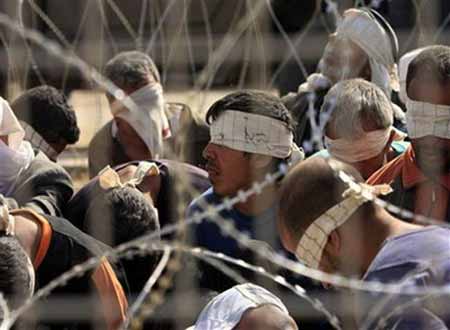
File – moheet.com
IMEMC & Agencies | June 11, 2013
The Israeli Government passed Sunday [June 9, 2013] the “Anti-Terror Bill”, authorizing harsher punishment against individuals suspected or convicted of aiding armed groups in the country, and anywhere in the world.
Several human rights groups in Israel and around the world voiced serious concerns regarding direct human rights violations, especially since this law strengthens and “legalizes” Administrative Detention orders confining hundreds, and even thousands, behind bars for extended periods without charges or trial.
The bill passed during a vote at the Israeli Ministerial Committee for Legislation, headed by Israeli Justice Minister, Tzipi Livni.
It not only targets those “convicted of terror attacks”, but also those who express support, emphasize and “incite terror activities” in addition to those believed to be engaged in preparations to carrying out violent acts.
Part of the penalties that this bill proposed include sentencing individuals for a life term without the possibility of parole, and allows the Police, the Security Services and all related agencies to confine “suspects” up to 30 days without granting them the right to any legal representation.
The passed bill also allows Israel to seize property of armed groups and individuals, in addition to preventing them from traveling abroad when there are no arrest warrants against them.
Israeli daily Haaretz has reported that the new legislation, would replace the “national state of emergency regulations” that Israel enforced after its establishment in the historic land of Palestine in 1948. Those regulations affect civil, security and economic issues.
The law particularly targets Palestinians and the indigenous Arab population in Israel, as those facing charges of “security or criminal violations”, whether in civil or military courts, would be facing very harsh sentences.
Head of the Meretz opposition party, Zahava Gal-On, said that Israel is denying human rights under the guise of combating terror.
She said that the emergency law applied in the country since the British occupation of Palestine, “cannot just be replaced with legislation that is anti-democratic”.
Also, the Association for Civil Rights in Israel (ACRI) slammed the bill, described it as anti-democratic, and warned that its provisions could turn legal organizations and law-abiding persons into terrorists just because they are suspected of aiding or practicing terror.
The Arabs48 news website reported that, under the new law, persons who even express support for groups labeled by Israel as “hostile” or “terrorist” could be imprisoned up to three years. It also considers financial support to these organizations as an “act of terror”.
Arabs48 added that the new bill increases the years of life-terms from 30 to 40 years.
It stated that the Israeli Prosecutors Office said that Price Tag attacks have not been labeled as acts of terror, as the Office believes that boosting intelligence activity and adequate training to police officers dealing with those attacks could put an end to those attacks.
The Israeli Government Legal Advisor stated that, legally, there is nothing stopping the government from describing and declaring Price Tag attacks as acts of terror.
In an Editorial Published on June 9, Haaretz said that the core of this bill has serious and extremely wide definitions for a terrorist organization, or terrorist acts, and added that once an organization, including a charity group, is labeled as a terrorist group, the moral base and all legal measures are destroyed.
US Gulf allies crack down on Internet freedoms
RT | June 10, 2013
Gulf Arab allies of the US have come under fire for introducing a series of draconian measures that limit Internet freedoms. The measures restrict content on social media sites, making “offending” posts punishable by extensive jail sentences.
Saudi Arabia, Qatar, the United Arab Emirates, Kuwait and Bahrain have tightened controls on Internet freedoms recently, targeting social media and phone applications alike in their communications crackdown.
Across the Gulf, dozens of journalists and social media users have been arrested since the beginning of the year for being in violation of the uncompromising national laws.
Punishments include deportation and lengthy prison sentences for crimes such as making derogatory comments about the government “in bad faith,” and offending religion and family values. In Saudi Arabia last month, top cleric Sheikh Abdul Latif Abdul Aziz al-Sheikh warned citizens against using Twitter, stating that those who use social media sites “have lost this world and the afterlife.”
Saudi Arabia
After threatening to ban messaging applications like Skype and WhatsApp, Saudi Arabia’s telecom regulator has chosen a new target: The web-based communication app Viber. The instant messaging application has been blocked since June 5.
“The Viber application has been suspended… and the [regulator] affirms it will take appropriate action against any other applications or services if they fail to comply with regulatory requirements and rules in force in the kingdom,” the Communications and Information Technology Commission (CITC) said in a statement.
Viber allows its users to text, call and send photos and video messages worldwide using a 3G or Wifi connection, and boasts over 200 million subscribers worldwide.
In March, the CITC warned mobile providers in the Kingdom that if they could not find ways to monitor encrypted messaging and VOIP applications, then they would be blocked, according to local media. The commission then issued a statement saying that “it would take suitable measures against these apps and services,” in its push for greater control over the Internet.
The Saudi government has also begun arresting Twitter users for posts to their accounts. Local media reports that the government is looking into ending anonymity for Twitter users in the country by making users register their identification documents.
Qatar
Despite its status as a regional media hub, the emirate state is considering a new cybercrime law that would widen government control over news websites and online commentaries.
If passed, the law would enable the government to punish websites or social media users for violating “the social principles or values,” or for publishing “news, photos, audio or visual recordings related to the sanctity of the private and familial life of persons, even if they were true, or infringes on others by libel or slander via the Internet or other information technology means,” Qatar News agency reported.
United Arab Emirates
At the end of 2012, the UAE passed a sweeping new cybercrime law: Anyone found guilty of criticizing the country’s rulers or institutions online may be jailed or deported. The law attracted widespread opposition, with legal consultants warning it is broad enough to penalize anyone caught posting allegedly offensive comments against the state.
This law has been used to jail citizens for Twitter posts over the past few months. In May, the UAE appeals court sentenced Abdullah Al-Hadidi to 10 months in jail for tweeting details of the trial of his father.
He was arrested on March 22 on charges of disseminating information on Twitter “in bad faith.” The court ruled that he wrote false details of a public hearing that, along with his father, involved 93 other people accused of plotting to seize power in the Gulf Arab state.
Kuwait
The government has arrested dozens of activists and at least six journalists in 2013 in the constitutional emirate, often described as the most liberal country in the region.
In March, Twitter user Hamed Al-Khaledi was sentenced to two years in prison for allegedly insulting the ruler of the Gulf nation. Others have been accused of “threatening state security” or “offending religion.”
In April, a Kuwaiti court sentenced former parliamentarian and opposition leader Mussallam al-Barrak to five years in prison for remarks deemed critical of the ruler of the state, which he made last year at a public rally.
Kuwait has been a member of the International Covenant on Civil and Political Rights (ICCPR) since 1996, which protects the right to freedom of expression, including peaceful criticism of public officials.
Bahrain
The Bahraini government has been trying to suppress an ongoing uprising by introducing stricter penalties. In April, the government passed a law making it illegal to insult the Gulf state’s King Hamad bin Issa al Khalifa, or its national symbols.
Recently, Bahraini blogger and activist Ali Abduleman was granted asylum in the UK after two years in hiding. Adbuleman claims he was persecuted by the government “for exercising the right to express his opinions” on his website. The Bahraini government claims he was tried for “inciting and encouraging continuous violent attacks against police officers” and conspired to spread “false and inflammatory rumors.”
In May, 62-year-old Bahraini protester Abdulla Sayegh was sentenced to three months in prison for hanging a national flag from his truck during a 2011 rally. The same month, six Twitter users were jailed for allegedly offensive comments about the country’s ruler deemed to be ‘abusing freedom of expression.’ According to prosecutors, they posted comments that undermined “the values and traditions of Bahrain’s society towards the king.”
One of the best-known human rights abuse cases in Bahrain is that of activist Nabeel Rajab, who was sentenced to three years in jail in August 2012 on charges of ‘participating in an illegal assembly’ and ‘calling for a march without prior notification.’ He openly criticized the country’s regime on RT for Julian Assange’s show The World Tomorrow.
The country has witnessed mass protests led by the kingdom’s majority Shiites against the minority Sunni-led government for two years. The Shiite demonstrators call for a transfer to a democratic system, and complain of discrimination in jobs and government. Their loyalty is in turn questioned by the ruling Al Khalifa monarchy, which has been in power for decades.
Related articles
Jewish settlers defile Aqsa Mosque courtyard this morning
Palestine Information Center – 09/06/2013
OCCUPIED JERUSALEM — Extremist Jewish settlers escorted by policemen desecrated the Aqsa Mosque courtyard on Sunday morning coming from Al-Maghariba Gate.
A female eyewitness told Safa news agency that three groups of settlers walked around the Aqsa Mosque courtyard and some of them performed Talmudic rituals.
She said that a large number of female and male religious students are also present in the courtyard protecting against any attempt by the settlers to enter the Mosque’s buildings.
She added that the Israeli police imposed restrictions on the entry of Palestinian worshipers to their Aqsa Mosque, checked their IDs and took photos of the Muslim religious sessions in the courtyard.
She noted that many Palestinian worshipers inside the Mosque are on alert as many extremist Jewish groups have declared their intentions to enter the Mosque, expecting that the next few hours could see the coming of more settlers and tourists.
Repeated storming of Aqsa mosque meant to impose new de facto situation
 Independent MP Dr. Jamal Al-Khudari has warned of the seriousness of the Israeli systematic storming of the Aqsa mosque.
He said in a press statement on Sunday that Israel wants to ease the reactions to the “seemingly ordinary” repeated storming of the Aqsa and to impose a new de facto situation.
The MP underlined that such storming is a flagrant violation and constitutes big dangers to the Aqsa mosque and to holy shrines.
Khudari hailed the Aqsa guards and all those who frequent the holy site to defend it in face of repeated storming attempts despite the difficult circumstances.
He pointed out that the Israeli occupation authority was continuing its excavations in and around the Aqsa mosque and is wantonly razing Jerusalemite houses on daily basis and at various pretexts with the main target of forcing Jerusalemites to abandon their homes and native hometown.
Khudari regretted that such conditions were prevailing at a time the Palestinian people are still divided.
Related articles
- Palestine: Zionist conference on dividing Aqsa,1518 children were killed since 2nd intifada & more land confiscated (realisticbird.wordpress.com)
- Jewish extremists call for storming al-Aqsa (occupiedpalestine.wordpress.com)
The “Congress knew” defense
left i on the news | June 07, 2013
President Obama defends his super-snooping program, claiming that “they’re not secret in the sense that when it comes to telephone calls, every member of Congress has been briefed on this program.” First of all, I note he also says that “the relevant intelligence committees are fully briefed on these programs,” which suggests that “every member of Congress”, to whom the word “fully” isn’t applied, may or may not know very much at all. But even if every member of Congress were in fact fully briefed, there’s a little problem with that. Because they were briefed in secret and unable to convey that information to their constituents. So if they wanted to, say, campaign for reelection on the grounds of supporting (or opposing) that policy, they couldn’t do so. Furthermore, no challenger could campaign against them on a platform of ending these policies, because no challenger would have known about the policies.
On a related issue, talking to FOX’s Shep Smith earlier today (actually being grilled by Smith, who was having none of his double-talk and evasions), the former deputy director of the NSA claimed that the program was ipso facto Constitutional because “all three branches of government” were involved with it. But the “FISA Court” is a special, secret court. Not only have they never denied a single government request, but no citizen can challenge a decision they make, because their decisions are all secret. Therefore the Constitutionality of the court itself, or of any decision it has made, is not subject to review by the Supreme Court, the only institution which can actually rule on the Constitutionality of a law.
~
Related video:
Related articles
- The NSA Black Hole: 5 Basic Things We Still Don’t Know About the Agency’s Snooping
- NSA Document Leak Proves Conspiracy To Create Big Brother Style World Control System
- DOJ launches criminal probe of NSA leaker
- US security officials said NSA leaker, journalist should be ‘disappeared’ – report
- Government Spying: Should We Be Shocked?
- Boundless Informant: NSA’s complex tool for classifying global intelligence
- The NSA’s Favorite Weasel Word To Pretend It’s Claiming It Doesn’t Spy On Americans
- NSA memo pushed to ‘rethink’ 4th Amendment
Boundless Informant: NSA’s complex tool for classifying global intelligence
RT | June 9, 2013
A new batch of classified NSA docs leaked to the media reveals the details of a comprehensive piece of software used by NSA to analyze and evaluate intelligence gathered across the globe as well as data extraction methods.
The top-secret documents released by the Guardian shed light on the National Security Agency’s data-mining tool being used for counting and categorizing metadata gathered and stored in numerous databases around the world.
Known as Boundless Informant, the software provides its operator a graphical insight on how many records were collected for a specific “organizational unit” or country, what type of data was collected and what type of collection was used. The program also allows determining trends in data collection for both strategic and tactical decision making, according to the slides.
One of the slides contains a part of the Informant’s user interface showing a world map with countries color-coded ranging from green to red depending on the amount of records collected there. While Iran, Pakistan and some other states are predictably “hottest” according to the map, the agency collected almost 3 billion intelligence pieces in the US in March 2013 alone.
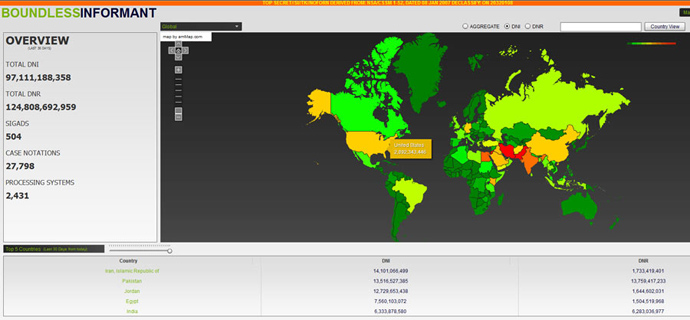
The map showing how much data is being collected in different countries across the globe (image from the Guardian)
The insight on the software being used by the NSA comes amid the agency spokesperson Judith Emmel’s claims that the NSA cannot at the moment determine how many Americans may be accidentally included in its surveillance.
“Current technology simply does not permit us to positively identify all of the persons or locations associated with a given communication,” Emmel said Saturday adding that “it is harder to know the ultimate source or destination, or more particularly the identity of the person represented by the TO:, FROM: or CC: field of an e-mail address or the abstraction of an IP address.”
NSA data sources
Another slide from the internal NSA presentation redacted by the Guardian editors details the data gathering methods used in the NSA global surveillance program.
The first method suggests interception of data from “fiber cables and infrastructure as data flows past” under the FISA Amendments Act (FAA) of 2008, Section 702.
The second distinguished method is data collection “directly from the servers of the US service providers.”

The slide detailing methods of data extraction under the FISA Amendment Act (image from the Guardian)
The presentation encourages analysts to use both methods for better results.
Google, Facebook negotiated ‘secure portals’ to share data with NSA?
Meanwhile, a report by the New York Times revealed that Internet giants, including Google and Facebook, have been in negotiations with the US security agency over ‘digital rooms’ for sharing the requested data. The companies still insist there is no “back door” for a direct access to user data on their servers.
The Internet companies seem more compliant with the spy agencies than they want to appear to their users, and are cooperating on “behind-the-scenes transactions” of the private information, according to a report that cites anonymous sources “briefed on the negotiations.”
According to the report, Google, Microsoft, Yahoo, Facebook, AOL, Apple and Paltalk have “opened discussions with national security officials about developing technical methods to more efficiently and securely share the personal data of foreign users in response to lawful government requests,” sometimes “changing” their computer systems for this purpose.
These methods included a creation of “separate, secure portals” online, through which the government would conveniently request and acquire data from the companies.
Twitter was the only major Internet company mentioned in the report that allegedly declined to facilitate the data transfer to the NSA in a described way. As opposed to a legitimate FISA request, such a move was considered as not “a legal requirement” by Twitter.
The sources claim the negotiations have been actively going in the recent months, referring to a Silicon Valley visit of the chairman of the Joint Chiefs of Staff Martin E. Dempsey. Dempsey is said to have met the executives of Facebook, Microsoft, Google and Intel to secretly discuss their collaboration on the government’s “intelligence-gathering efforts.”
NSA pressured to declassify more PRISM details
In response to the fury over US government’s counterterrorism techniques, Director of National Intelligence James Clapper for the second time in three days revealed some details of the PRISM data-scouring program.
Being one of the “most important tools for the protection of the nation’s security” the PRISM is an internal government computer system for collecting “foreign intelligence information from electronic communication service providers under court supervision,” Clapper said.
He also said that PRISM seeks foreign intelligence information concerning foreign targets located outside the US and cannot intentionally target any US citizen or any person known to be in the US. As for “incidentally intercepted” information about a US resident, the dissemination of such data is prohibited unless it is “evidence of a crime”, “indicates” a serious threat, or is needed to “understand foreign intelligence or assess its importance.”
Clapper also stressed that the agency operates with a court authority and that it does not unilaterally obtain information from the servers of US telecoms and Internet giants without their knowledge and a FISA Court judge approval.
Related articles
- The NSA Black Hole: 5 Basic Things We Still Don’t Know About the Agency’s Snooping
- NSA Document Leak Proves Conspiracy To Create Big Brother Style World Control System
- DOJ launches criminal probe of NSA leaker
- US security officials said NSA leaker, journalist should be ‘disappeared’ – report
- Government Spying: Should We Be Shocked?
- The NSA’s Favorite Weasel Word To Pretend It’s Claiming It Doesn’t Spy On Americans
- The “Congress knew” defense
- NSA memo pushed to ‘rethink’ 4th Amendment
UK drone strikes violate international law: legal opinion piece
Press TV – June 8, 2013
Britain’s operating of killer drones in Afghanistan may be violating the international law, a legal firm representing peace campaigners has argued in an opinion piece.
The legal opinion by Public Interest Lawyers argues that the use of killer drones in Afghanistan is a breach of the international law under the European Convention for Human Rights (ECHR).
The document says that the ECHR’s article 2 requires the governments to use “no more [force] than absolutely necessary” during conflicts.
“Only when it is absolutely necessary to kill someone rather than arrest/disable them will the use of drones be lawful. And even then, drones may only be used for … self defence under 2(2)(c),” it says.
According to the Public Interest Lawyers, this means that the ECHR obliges Britain to the use of killer drones only in “situations in which there is an immediate threat to life” that “prevents the carrying out of ‘targeted killings’ and narrowly circumscribes their use even on ‘the battlefield'”.
“There is therefore a strong presumption that the UK’s drones programme is in breach of international law,” it adds.
The British Ministry of Defense announced back in April that they are operating killer drones in Afghanistan by remote-pilots from RAF Waddington base in Lincolnshire.
The ministry claims its operations are in accordance with applicable international humanitarian law.
This comes as drone attacks normally come with extreme “collateral damage” to the civilian population even when taking the American and British claims that they are targeting terrorists by terror drones as true.
Hundreds of civilians have been killed the remote-controlled killer drones strikes on various parts of Afghanistan over the past years.
Civilians’ casualties have triggered widespread protests against killer drone attacks in the Asian country with the Afghan government repeatedly calling for an end to the deadly assaults.
Related article
Palestinian activist detained in Israeli raid
Ma’an – 08/06/2013
HEBRON – Israeli forces on Friday raided the al-Sumoud (“steadfastness”) center in Hebron and detained Jawad Abu Aisheh, 39, from the Old City, an official said.
The director of the center, Ahmad Amro, said six soldiers and two policemen stormed the center, causing damage. They also assaulted some of the activists there and threatened them.
Forces detained Jawad Abu Aished who lives near the center.
The coordinator of Youth Against Settlements, Badi Dweik, said that “detaining Abu Aisheh is proof that the Israeli authority helps and supports settlers in their attempts to control … the Old City.”
Dweik called on President Mahmoud Abbas and his new Prime Minister Rami Hamdullah to respond to Israel’s “continuous crimes” in the West Bank in general and Hebron in particular.
An Israeli army spokeswoman referred inquiries to the police. A police spokesman did not immediately return calls.
Hebron man arrested for filing complaint about settler attack
International Solidarity Movement | June 8, 2013
Hebron, Occupied Palestine – Human rights activist Jawad Abu Eysheh, 39, was arrested Friday 7th June following a complaint he made four months ago about a settler attack.
At 4:20 pm on 7th June, Israeli Police arrived at the house of the Hebron organisation Youth Against Settlements and demanded to see the ID’s of Jawad and three other men present. The police then told Jawad that they wanted to take him away ‘for investigation’, and called the Israeli military to escort Jawad away in handcuffs.
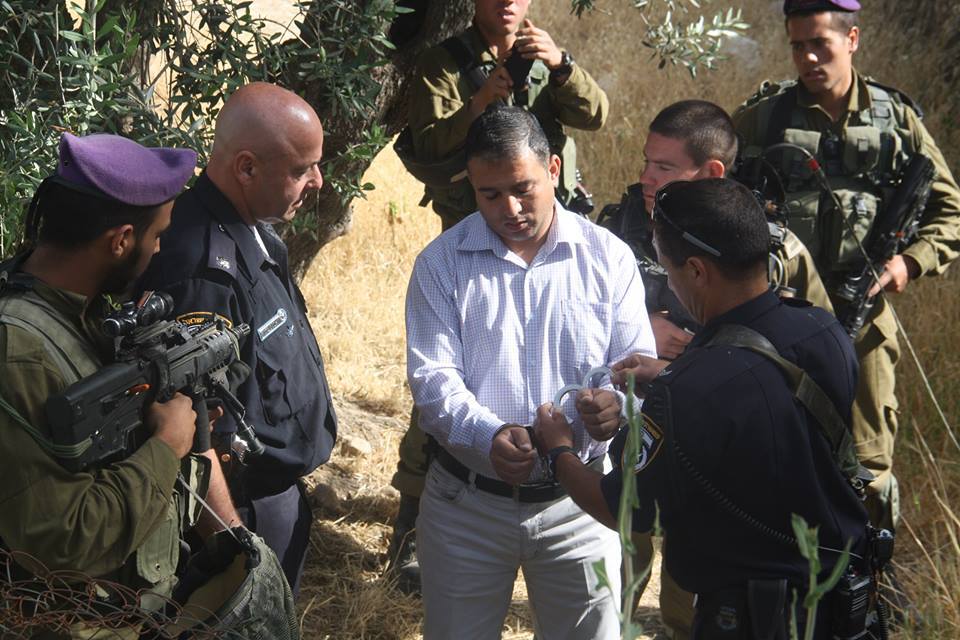
Jawad Abu Eysheh being handcuffed and arrested (Photo by Youth Against Settlements)
Jawad was then paraded through the adjacent illegal Tel Rumeida settlement and taken to the nearby checkpoint 56, before being transferred to the police station in the settlement of Givat Ha’avot outside the city centre.
The line of questioning from the police made clear that Jawad was being detained as a result of events that happened back in February, when Jawad and other activists were attacked by American-born extremist Baruch Marzel and other settlers.
Despite being a victim of that violent assault in February, it was Jawad who was subjected to arrest today, not the perpetrators. During his detention, Jawad was also forced to submit a DNA sample against his will, and to sign conditions that he will not speak with Baruch Marzel for the next 30 days. Jawad stated his is happy to comply with this stipulation at least. Jawad was released at around 9pm.As well as today’s arrest, Jawad has faced other harassment recently, including not being allowed to walk on the street where his factory space and uncle’s house are located.
The Israeli army and police in Hebron have a long history of harassing human rights defenders such as Jawad and his colleague Issa Amro, and of following the wishes of extremist settlers when deciding who to harass.
Related articles
- Jewish settlers setting up tent and planning road on Palestinian owned land in Al Khalil (alethonews.wordpress.com)
- Witnesses: Settlers open fire at Palestinian homes in Hebron village (altahrir.wordpress.com)
- Jewish settlers attack West Bank village with Israeli army support (alethonews.wordpress.com)
DHS defends suspicionless searches of laptops and cell phones
RT | June 6, 2013
The United States government doesn’t need a reason to seize and search the cell phones, laptops and other electronic devices of Americans entering the country, according to a Department of Homeland Security document provided to the press this week.
The DHS has long insisted that border agents and immigration officers are allowed to collect the electronics of US citizens crossing into the country without reason or cause, but a December 2011 document made public this week once and for all shines a light on a sparsely discussed security-measure that has attracted the attention of privacy advocates and others who’ve equated the practice as a constitutional violation.
The American Civil Liberties Union and the Associated Press jointly filed a Freedom of Information Act request for the document earlier this year after the DHS published a two-page executive summary briefly explaining the results of an audit conducted by the department’s Office for Civil Rights and Civil Liberties. In that statement, the DHS auditor concluded that Customs and Border Protection agents and officers with Immigration and Customs Enforcement were not violating either the First or Fourth Amendments to the US Constitution by seizing the electronics of Americans without clear suspicion of a crime.
“We conclude that CBP’s and ICE’s current border search policies comply with the Fourth Amendment,” Tamara Kessler wrote for the Office for Civil Rights and Civil Liberties in the summary. “We also conclude that imposing a requirement that officers have reasonable suspicion in order to conduct a border search of an electronic device would be operationally harmful without concomitant civil rights/civil liberties benefits.”
Now with the full 23-page paper in their possession — albeit a version that’s seen a fair share of redactions — the AP and ACLU have published the document in order to expose a post-9/11 policy that has remained intact under President Barack Obama, but to little discussion.
“This is striking,” ACLU fellow Brian Hauss wrote Wednesday, “because it is the first time, as far as we know, that the government has explained why purely suspicionless searches supposedly enhance security.”
The government’s reasoning, according to the document, is that the blanketing ability to collect and assess the devices of anyone thought to be entering the country is crucial to thwart high crimes. That being said, the government attests that requiring actual probable cause before seizing a device would, in the eyes of the DHS, hinder their ability to counter terrorism.
“[A]dding a heightened [suspicion-based] threshold requirement could be operationally harmful without concomitant civil rights/civil liberties benefit,” the document found. “First, commonplace decisions to search electronic devices might be opened to litigation challenging the reasons for the search. In addition to interfering with a carefully constructed border security system, the litigation could directly undermine national security by requiring the government to produce sensitive investigative and national security information to justify some of the most critical searches.”
“Even a policy change entirely unenforceable by courts might be problematic,” it continued. “Under a reasonable suspicion requirement, officers might hesitate to search an individual’s device without the presence of articulable factors capable of being formally defended, despite having an intuition or hunch based on experience that justified a search.”
Speaking to AP, ACLU staff attorney Catherine Crump said the government’s reasoning is “just not good enough” and demonstrates purely inadequate reasoning.
“A purely suspicionless search opens the door to ethnic profiling,” Crump said.
Hauss, the legal fellow for the group’s Speech, Privacy and Technology Project, said the government’s line of thought in defending the policy is faulty for a few different reasons. “DHS claims that giving Americans the opportunity to challenge laptop searches in court would lead to the divulgence of national security secrets, but this is obviously wrong,” he wrote. “The government has numerous resources at its disposal to prevent the disclosure of sensitive information. The ‘state secrets privilege,’ to take just one example that is used in court cases, has been criticized on many grounds, but no one has ever seriously suggested that its protections are too anemic. Although DHS might fear the prospect of being called into open court to explain its actions, executive accountability before the law is the bedrock on which our system of constitutional self-government is built.”
Last year, the US Supreme Court upheld an earlier ruling that legally permitted the use of suspicionless roadblocks anywhere within 100 miles of an international border, subjecting nearly 200 million Americans around the country to spontaneous and sporadic inspections of vehicles and their possessions.
On Tuesday, ACLU spokesperson Peter Boogaard told Bloomberg News that a 2009 policy change restricted how long the DHS can hold on to seized electronics. Earlier this week, though, it was suggested that the department did not necessarily see any problems with duplicating that information to be held on to indefinitely.
David House, a founding member of the Bradley Manning Support Network, sued the DHS in 2011 after his computer and cell phone were seized after an international flight he was on landed at O’Hare International Airport in Chicago. On behalf of the ACLU, House sued DHS Secretary Janet Napolitano on the accusation that his belongings were searched solely on the basis of his association with the Support Network, an organization that has paid in full the legal bills for the 25-year-old Army private accused of committing espionage and aiding terrorists by sharing sensitive files with the website WikiLeaks. House’s devices were held for 49 days by ICE — longer than the 30 days allowed legally — and the contents of those electronics were copied by investigations. House dropped his lawsuit last after the DHS agreed to delete its copy of the data.
“They’re giving us exactly what we wanted,” House told Wired.
Britain pays £20m to Mau Mau victims
Morning Star | June 6, 2013
Foreign Secretary William Hague stopped short of issuing an apology today to the elderly Kenyans tortured by British colonial forces during the Mau Mau uprising.
The Mau Mau movement emerged in central Kenya during the 1950s to get back seized land and push for an end to colonial rule. Supporters were detained in camps and thousands were tortured, maimed or executed.
Mr Hague told the House of Commons that the government had reached a full and final settlement with solicitors of 5,228 claimants totalling £19.9 million.
The government would also support the construction of a memorial in Kenya’s capital Nairobi to the victims of torture and ill-treatment during the colonial era.
But he said the British government continued to deny liability for what happened during the uprising.
Shadow foreign secretary Douglas Alexander said Labour supported the government.
However left Labour MP Jeremy Corbyn said it was strange of the government to offer compensation but to deny any formal responsibility.
“I’m a bit surprised,” he said, adding: “This is a very strange result, to offer compensation and a settlement for Leigh Day and at the same time deny liability,” he said.
Mr Corbyn pointed out that many MPs in the 1950s raised the issue in Parliament at the time, praising the Kenyans for their “tenacity” in seeking justice.
“When we deny rights and justice, when we deny democracy, when we practise concentration camps, it reduces our ability to criticise anybody else for that fundamental denial of human rights, and I think this is a lesson that needs to be learnt not just in Kenya but in other colonial wars as well where equal brutality was used by British forces,” he said.
Mr Hague said there was no inconsistency in recognising the suffering endured by many of the victims while continuing to deny liability.
Related articles
G4s annual meeting stormed by human rights activists
Press TV – June 7, 2013
Pro-Palestine campaigners have staged a protest at the annual meeting of shareholders of disgraced security firm G4S in London, calling for an end to the firm’s Israeli prison contracts.
G4S meeting on June 6 was twice disrupted by protesters, who voiced their anger against the private company’s provision of expertise and security systems to Israeli prisons, and its complicity in the detention and torture of Palestinian children.
The demonstration was organized by the Innovative Minds (inminds) and Islamic Human Right Commission (IHRC) campaign groups.
“G4S cannot expect to do business as usual whilst it equips Israeli prisons which hold Palestinians in breach of the Geneva Convention,” said Sarah Colborne, director of Palestine Solidarity Campaign.
G4S faces criticism for its cooperation with the Israeli regime, including providing equipment and services to Israeli checkpoints, illegal settlements, the apartheid wall and jails where Palestinian political prisoners are subjected to mistreatment and torture.
Related article
- Pro Palestine Activists Interrupt Ehud Olmert [MUST SEE VIDEO] (intifada-palestine.com)
South African bodies call for Israel to be excluded from diamond processing over ‘war crimes’
RT | June 6, 2013
South African human rights groups, trade unions and major civil society organisations are calling for the Kimberley Process Certification Scheme* to exclude Israel from diamond processing.
The certification scheme is designed to stop ‘conflict diamonds’ from entering the mainstream diamond market and was set up in 2003. The organisation which runs the scheme is currently meeting in South Africa.
The coalition of organisations such as South Africa’s National Union of Mineworkers, the country’s largest trade union federation COSATU; South African Students Congress; the Coalition for a Free Palestine and BDS South Africa say that “billions of dollars’ worth of diamonds exported via Israel are a major source of revenue for the Israeli military, which stands accused of war crimes.”
The coalition is calling for Israel to be excluded from the Kimberley Process Certification Scheme due to its human rights record against Palestinians, and to end all exports of rough diamonds to Israel immediately.
The organizations also wants to ban diamond polishing and cutting in Israel. They claim excluding Israel from the diamond processing would be a great chance for the South African authorities to display “moral vision and political leadership”.
“The Kimberley Process has played an important role over the past decade in resolving conflicts linked to the diamond trade but there is no doubt that it has to be reformed… [by] expanding the definition of conflict to include human rights abuses linked to diamond extraction perpetrated by governments and companies; and expanding downstream monitoring so that the process covers not just the rough diamond trade but also the international movement and polishing of diamonds,” Southern Africa Resource Watch director Claude Kabemba told the Business Day newspaper.
The coalition also pointed to the local benefits of such a move, claiming it could bring more diamond processing jobs back to South Africa. “Consumers will have a clear conscience that their diamonds are not funding, assisting or in any way involved with the illegal Israeli occupation of Palestine, and more jobs will be created locally for our people by bringing this diamond processing back home instead of it being done in Israel,” South African activist Mbuyiseni Ndlozi is quoted by the Middle East Monitor as saying.
The Kimberley Process, established a decade ago to help resolve international diamond trade conflicts and to ensure that the diamond trade is not used as an instrument to fund military rebellions and other violence interfering with human rights. The organization includes 54 participants representing 90 countries while its members account for about 99.8 percent of the global production of rough diamonds, the Middle East Monitor reports.
* The Kimberley Process Certification Scheme (KPCS) is the process to prevent “conflict diamonds” from entering the mainstream rough diamond market. Established by UN GA Resolution 55/56 in 2003, the process is aimed “to ensure that diamond purchases were not financing violence by rebel movements and their allies seeking to undermine legitimate governments.” In order for a country to be a participant, it must ensure that any diamond originating from the country does not finance a rebel group or other entity seeking to overthrow a UN-recognized government, that every diamond export be accompanied by a Kimberley Process certificate and that no diamond is imported from, or exported to, a non-member of the scheme. As of 30 November 2012, there were 54 participants in the KPCS representing 80 countries, with the European Union counting as a single participant.
Featured Video

Liberty Cannot Exist Inside a Panopticon
or go to
Aletho News Archives – Video-Images
From the Archives
Left-leaning despisers of 9/11 Truth movement: Do you really believe in miracles?
David Ray Griffin | Global Research | 06 Jul 2010
An Open Letter to Terry Allen, Noam Chomsky, Alexander Cockburn, David Corn, Chris Hayes, George Monbiot, Matthew Rothschild, and Matt Taibbi.
[1]According to several left-leaning critics of the 9/11 Truth Movement, some of its central claims, especially about the destruction of the World Trade Center, show its members to be scientifically challenged. In the opinion of some of these critics, moreover, claims made by members of this movement are sometimes unscientific in the strongest possible sense, implying an acceptance of magic and miracles. … Full article
Blog Roll
 Aletho News
- White House envoy declares kinetic action against Yemen ‘fruitless’
- Ukraine deployed thousands of microdrones in Iraqi Kurdistan: Tasnim
- Iran calls for emergency UNSC meeting over Trump’s ‘brazen’ bomb talk, Israeli threats
- Iranian sources reveal details of Russia-China Hormuz proposal
- Plan for more US-Israel integration puts our military tech at risk
- Another Round Against Iran Will Break What Is Left of the Gulf
- SVR Report on Ukraine’s Mexican Drug Gang Links Could Pressure Zelensky, Won’t Change US Policy
- British Government Employees Were Fact-Checking the News at the BBC. Nobody Told You.
- Albania on fire: who’s behind the riots?
- Egypt’s Civil Democratic Movement rejects involvement in regional war
- If Americans Knew
- Mysterious bot accounts reportedly spread fake ‘man on the street’ videos for Michigan Senate candidate
- Israeli Defense Minister Katz Says Over 60 Lebanon Villages Have Been Destroyed
- Why Is Israel Running TV Ads in Iowa Ahead of the Midterms?
- Hind Rajab’s Alleged Killer Is in the United States. HRF Demands His Arrest.
- US Officials Face Fresh Pressure After Another American ‘Brutalized’ by Israeli Settlers in West Bank
- Israel-Backed Palestinian Militias Terrorize Displaced Families in Gaza
- FBI subpoenas pro-Palestine activists over Israeli weapons plant disruption
- Fourth winter arrives in wartorn Gaza, too early – Daily Update
- More on how Bari Weiss is using CBS on behalf of Israel
- What the UK Is Doing to Pro-Palestine Novelist Sally Rooney Is an Act of Orwellian Villainy
- No Tricks Zone
- Predictions Made By Renowned Climate Proifessor Over Past Decades Have Been Proven To Be Poor
- New Study Suggests Large Regions Of The Pacific Ocean Have Been Cooling For The Last 80 Years
- Germany’s Green Energy Debacle: High Energy Costs Force Kahla Porzellan to Close After 182 Years!
- New Study: 50 Years Of The Most Aggressive ‘Net Zero’ Policies Can Only Affect The Global Climate By 0.03°C
- US September “Heat” Was No Record…Many Records Set Decades Ago
- Latest European Green Energy Debacle; Portugal’s Largest Flagship Solar Park Insolvent!
- Green Energy Debacle: German Expert Professor Fritz Vahrenholt Warns Of Severe Economic And Social Consequences
- Two More Paleo Reconstructions Affirm Meters-Higher Sea Levels Across Ireland, Brazil 7000-6000 Years Ago
- New Study: Earth And Venus Surface Warmth Largely Explained By Convection And Lapse Rate, Not CO2 Or Radiation
- 2025 Nature Paper Claiming Worsening Global Drought Gets RETRACTED …Heavily Flawed

