Communication surveillance undermines privacy, freedom of expression – UN report
RT | June 6, 2013
The widespread use of surveillance technologies to monitor peoples’ communications violates the human rights to privacy and freedom of expression, the UN’s Special Rapporteur on Freedom of Expression and Opinion stated in his report.
Rapporteur, Frank La Rue, presented his report to the United Nations Human Rights Council in Geneva on Tuesday.
The document underlined that there’s no way to ensure freedom of expression without respect of privacy in communications and called for global attention towards the increased use of surveillance technologies by many governments.
“The right to privacy is often understood as an essential requirement for the realization of the right to freedom of expression. Undue interference with individuals’ privacy can both directly and indirectly limit the free development and exchange of ideas,” the report stated.
La Rue praised the technological innovations, which promote fast, anonymous, cross-cultural dialogues around the world, but warned that the same technologies can backfire as concerns about national security and criminal activity may lead to previously unseen scale of state surveillance intrusions.
“The Internet has facilitated the development of large amounts of transactional data by and about individuals. This information, known as communications data or metadata, includes personal information on individuals, their location and online activities, and logs and related information about the e-mails and messages they send or receive.”
The rapporteur stressed that this communications data is “storable, accessible and searchable” and when it’s combined and used by the state it can be “both highly revelatory and invasive”.
According to La Rue, governments are in possession of multiple instruments to breach communication privacy as access to the stored content of an individual’s e-mails and messages can be obtained through Internet companies and service providers.
Secret services can easily track the movements of mobile phones, identify all individuals with a mobile phone within a designated area and intercept calls and text messages.
The majority of digital communication information flows through fiber-optic cables, so by placing taps on them and applying word, voice and speech recognition, the governments can achieve almost complete control of communications, the report warns.
The document mentions Egypt and other governments confronted with the Arab Spring as one of the most recent examples of such technologies being used.
The report also noted that the surveillance of human rights defenders or journalists has been “well documented” by the governments of many countries.
“On these occasions, human rights defenders and political activists report having their phone calls and e-mails monitored, and their movements tracked. Journalists are also particularly vulnerable to becoming targets of communications surveillance because of their reliance on online communication. In order to receive and pursue information from confidential sources, including whistleblowers, journalists must be able to rely on the privacy, security and anonymity of their communications.”
La Rue urged governments worldwide to review their national laws regulating surveillance as they are often inadequate or simply don’t exist – to ensuring privacy in communication is protected.
“Communications surveillance should be regarded as a highly intrusive act that potentially interferes with the rights to freedom of expression and privacy and threatens the foundations of a democratic society. Legislation must stipulate that State surveillance of communications must only occur under the most exceptional circumstances and exclusively under the supervision of an independent judicial authority.”
The document stressed that individuals should be allowed all technological means to secure their communications and governments “should not interfere with the use of encryption technologies, nor compel the provision of encryption keys”.
Related articles
- Electronic Snooping Threatens Free Speech, Says U.N. Report (reason.com)
- Internet Surveillance and Free Speech: the United Nations Makes the Connection (eff.org)
- Anonymity, Encryption, and Free Speech: What Nations Need to Do (eff.org)
- Top-secret court order reveals NSA’s daily data collection on millions of Americans (Aletho News)
Rohingya Population Control: The Onslaught in Burma Continues
By Ramzy Baroud | Palestine Chronicle | June 6 2013
On April 21, the BBC obtained disturbing video footage shot in Burma. It confirmed extreme reports of what has been taking place in that country, even as it is being touted by the US and European governments as a success story pertaining to political reforms and democracy.
The BBC footage was difficult to watch even when faces of Muslim Rohingya victims were blurred. To say the least, the level of violence exhibited by their Arakan Buddhist attackers was frightening. “The Burmese police (stood) by as shops, homes and mosques are looted and burnt, and failing to intervene as Buddhist mobs, including monks, kill fleeing Muslims,” the BBC reported. A Rohingya man was set ablaze while still alive. The police watched.
To some extent, international media is finally noticing the plight of the Rohingyas who are experiencing what can only be described as genocide. And there are reasons for this. On one hand, the atrocities being carried out by the Burmese state, local police and mobs belonging to nationalist Buddhist groups in the northwestern Arakan State, are unambiguous attempts at removing all Rohingyas from Burma. The Rohingya numbers currently hover between 800,000 and one million. On the other hand, Burma (also known as Myanmar) has, as of late, been placed in the limelight for the wrong reasons – thanks in part to western governments breaking the political and economic siege of the country’s decades-long military dictatorship.
While the ‘new Burma’ is being rebranded in a new positive discourse in order to open Rangoon up for foreign investments and steer it way from growing Chinese influence, western governments are deliberately ignoring the fact that a human rights crisis of unprecedented proportions is taking place. This all being done with the active involvement and encouragement of the government.
In the eyes of many in Burma, the Rohingyas are considered subhumans, and are treated as such. Most Rohingya Muslims are native to the state of “Rohang” – also known as Rakhine or Arakan. The majority of them live in very poor townships – mainly Buthidaung and Maungdaw – in the northwestern part of Arakan, or live in refugee camps. Their population subsists between the nightmare of having no legal status (as they are still denied citizenship), little or no rights and the ethnic purges carried out by their neighbors. The worst of such violence in recent years took place between June and October 2012. However, the onslaught targeting Rohingyas is resurfacing and spreading. This time around the intensity and the parameters of violence grew to include other Muslim minority groups in the country.
The BBC footage is not only revealing in the sense that it confirmed the authorities’ complicity in the violence, but it also reflected the government’s general attitude towards this minority group, described by the UN as the ‘world’s most persecuted people’. Responding to the outcry against his country’s brutal treatment of its minorities, Burmese President Then Sein made an ‘offer’ to the UN last year where he was willing to send the Rohingyas “to any other country willing to accept them.”
This peculiar behavior by the Burmese government is problematic in more than one way. Rangoon doesn’t seem even slightly mindful of international humanitarian laws or simply wishes to ignore it altogether. Its legal frame of reference is hardly a reflection of a repented dictatorship. But what is even more dangerous is that Rangoon has been sending unmistakable messages to nationalist groups who are leading the ethnic purges, that their extremely violent behavior is in fact consistent with the central policies of their governments.
Groups like Human Rights Watch (HRW) have become markedly more outspoken regarding the violence against the Rohingya. To quell growing criticism, perhaps fearing a backlash in terms of lucrative business contracts, the Burmese government decided to investigate the ‘sectarian violence’ through a supposed independent commission. Its recommendations were as equally disturbing as the violence itself.
The government Inquiry Commission on the Sectarian Violence in Rakhine State, assembled last August, was composed of 27-members, all Arkanese Buddhists, none of them from the Rohingya minority. The long-awaited report on the violence finally emerged on April 29, 2013. Its major findings included concerns over “rapid population growth” among Rohingya and Kaman Muslims. Its recommendations compelled a swift response from local authorities that moved in to limit the birth rate of Muslim Rohingya in two large townships.
On May 26, Arakan State spokesperson Win Myaing told journalists that the findings of the commission were consistent with the 2005 law that limits birth rate among Roghingya Muslims to two children per family. That discriminatory law goes back to 1994 where severe marriage restrictions were imposed on the Rohingya community, requiring long and complicated procedures. The BBC said, “it is not clear how (the ‘two-child policy’) will be enforced.”
Regardless of what sort of mechanisms Burmese authorities plan to put in place to implement the ‘law’, limiting population growth of the Rohingya people, is an abhorrent principle in and of itself. It even compelled celebrated ‘democracy icon’ Aung San Suu Kyi to break her silence regarding the violence against Rohingyas, however, she carefully selected her language.
“It is not good to have such discrimination. And it is not in line with human rights either,” Suu Kyi told reporters, although “she could not confirm whether the policy was being implemented,” reported the BBC online on May 27.
Considering the level of violence directed at Rohingyas and the fact that more than 125,000 Rohingya have already been pushed into internally displaced camps, (tens of thousands more have already been forced to flee the country and are scattered in refugee camps throughout Southeast Asia) one can only imagine the kind of sinister plans which are being put into action, amid the deafening international silence.
In fact, ‘silence’ is an understatement, for following the early wave of devastating violence, European officials welcomed the country’s ‘measured response’ and spokesperson for the EU’s high representative on foreign affairs, Catherine Ashton, said on June 11: “We believe that the security forces are handling this difficult inter-communal violence in an appropriate way.”
Meanwhile, western countries led by the United States, are clamoring to divide the large Burmese economic cake amongst themselves. As Rohingya boats were floating (or sinking) in various waters, Burma’s President Sein met with Norway’s Prime Minister Jens Stoltenberg in a ‘landmark’ visit in Oslo on February 26. Regarding the conflict in Arakan, Jens Stoltenberg unambiguously declared it to be an internal Burmese affair, reducing it to the most belittling statements. In regards to ‘disagreements’ over citizenship, he said, “we have encouraged dialogue, but we will not demand that Burma’s government give citizenship to the Rohingyas.” Moreover, to reward Sein for his supposedly bold democratic reforms, Norway took the lead by waving off nearly half of its debt and other countries followed suit, including Japan which dropped $3 billion last year.
Meanwhile, the Rohingyas are left to ponder their punishment for flouting one discriminatory law or another. “Fear of punishment under the two-child rule compel far too many Rohingya women to risk their lives and turn to desperate and dangerous measures to self-induce abortions,” Asia director at HRW, Brad Adams said in a report published May 28.
No words can suffice to describe the plight of the Rohingyas who are trying to survive an unprecedentedly violent ethnic purge, with support and complicity of the Burmese government and silence of the very western governments that never cease to preach democracy and human rights.
Matthew Smith is a researcher for HRW and author of the organization’s report, “All You Can Do is Pray”: Crimes Against Humanity and Ethnic Cleansing of Rohingya Muslims in Burma’s Arakan State.’ Concluding a commentary in CNN online, Smith wrote: “The world should not be blinded by the excitement of Myanmar’s political opening. Rohingya are paying for that approach with their lives.” Since then, more Rohingyas were killed, many more homes, mosques, shops and orphanages were burned to the ground and there has been no international uproar as of yet.
~
Ramzy Baroud (www.ramzybaroud.net) is an internationally-syndicated columnist and the editor of Palestine Chronicle His latest book is: My Father was A Freedom Fighter: Gaza’s Untold Story (Pluto Press).
Over 8,000 Mau Mau victims seek compensation from Britain
Press TV – June 5, 2013
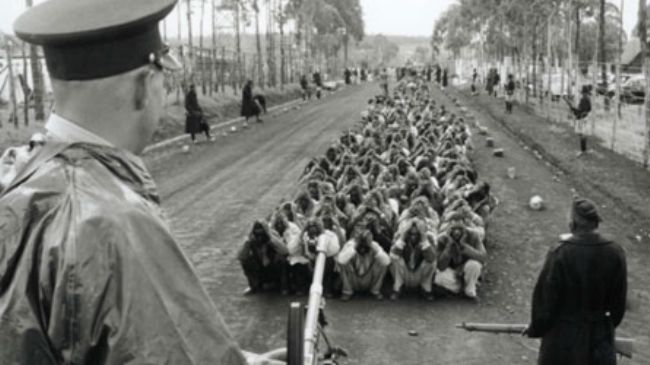
More than 8,000 Kenyans, severely mistreated under British colonial rule during the 1950s Mau Mau uprising, are seeking compensation from the UK.
According to the reports, thousands of names have been submitted to the Law Society of Kenya (LSK), seeking multi-million pound compensation from the British government.
“The Law Society of Kenya has received lists of ex-Mau Mau fighters seeking compensation running into billions of shillings from the British government,” LSK chief Apollo Mboya said in a statement.
More names are expected to be submitted from the Kenya Human Rights Commission, the statement added.
There are also reports that Britain agreed on a compensation settlement totaling £14 million. Britain’s Foreign Office, however, has refused to comment on the issue.
At least 10,000 people died during the 1952-1960 Mau Mau uprising against British colonial rule, with some sources giving far higher estimates.
The British government has admitted to British forces’ torturing of detainees at the time following disclosure of a vast archive of colonial-era documents which the Foreign Office had kept secret for decades.
Related article
London Declaration on Anti-Semitism – a Glimpse Into Jewish Phobia
Introduction by Gilad Atzmon | June 5, 2013
Below you will find the London Declaration on Antisemitism followed by a great analytical deconstruction by Stuart Littlewood.
The declaration doesn’t leave much room for doubt, Israel and its Lobby are in a state of panic. The London Statement is a clear attempt to stop discussion on issues to do with Jewish past, the Holocaust, the Jewish State and its Jewish nature.
Interestingly enough, the declaration provides us with an insight into Zionist projection. Far from being a universal statement, the declaration is primarily concerned with anti-Jewish discrimination. The declaration is a brutal and crude attempt to interfere with freedom of expression that is still regarded by some as a precious human value.
The declaration is full of logical flaws. Here is one example. Though Israel defines itself as the Jewish State, the declaration calls to stop those who “target the State of Israel as a Jewish collectivity” (1). I guess that the meaning of it is simple. Israel is happy to define itself as a Jewish State but it doesn’t like to be defined as such by others.
The declaration calls “national governments, parliaments, international institutions… to affirm democratic and human values, build societies based on respect and citizenship and combat any manifestations of antisemitism and discrimination.” I would expect the Israeli Government to follow this call and to make sure that Israel, once and for all, becomes a ‘state of its citizens’ and succumb to principles of ‘human values’ and true democracy, because at the moment Israel is still a ‘Jewish State’ and its legal system discriminates non-Jews.
The declaration is an attempt to seal Jewish past “Governments must challenge any foreign leader, politician or public figure who denies, denigrates or trivialises the Holocaust” (3). It is obviously clear that some Jews don’t like it when gentiles look into their past. But the question is why? Is there something secretive in Jewish past? The declaration also fails to define exactly what denial, denigration or trivialization may entail.
I guess that the desperate appeal to law and international community is taking place now because Israel and its supporters grasp that the tide has changed. -resentment towards Israel and its lobbies cannot be contained anymore.
I guess that Israel and its Lobby better learn to self-reflect rather than attempting to silence criticism.
http://www.antisem.org/london-declaration/
The London Declaration on Combating Antisemitism, signed by some of the worlds leading parliamentarians, represents a new era in global cooperation in the fight against antisemitism.
Parliamentarians wishing to sign the declaration should click here
The London Declaration on Combating Antisemitism
Preamble
We, Representatives of our respective Parliaments from across the world, convening in London for the founding Conference and Summit of the Inter-parliamentary Coalition for Combating Antisemitism, draw the democratic world’s attention to the resurgence of antisemitism as a potent force in politics, international affairs and society.
We note the dramatic increase in recorded antisemitic hate crimes and attacks targeting Jewish persons and property, and Jewish religious, educational and communal institutions.
We are alarmed at the resurrection of the old language of prejudice and its modern manifestations in rhetoric and political action -against Jews, Jewish belief and practice and the State of Israel.
We are alarmed by Government-backed antisemitism in general, and state-backed genocidal antisemitism, in particular.
We, as Parliamentarians, affirm our commitment to a comprehensive programme of action to meet this challenge.
We call upon national governments, parliaments, international institutions, political and civic leaders, NGOs, and civil society to affirm democratic and human values, build societies based on respect and citizenship and combat any manifestations of antisemitism and discrimination.
We today in London resolve that;
Challenging Antisemitism
1. Parliamentarians shall expose, challenge, and isolate political actors who engage in hate against Jews and target the State of Israel as a Jewish collectivity;
2. Parliamentarians should speak out against antisemitism and discrimination directed against any minority, and guard against equivocation, hesitation and justification in the face of expressions of hatred;
3. Governments must challenge any foreign leader, politician or public figure who denies, denigrates or trivialises the Holocaust and must encourage civil society to be vigilant to this phenomenon and to openly condemn it;
4. Parliamentarians should campaign for their Government to uphold international commitments on combating antisemitism -including the OSCE Berlin Declaration and its eight main principles;
5. The UN should reaffirm its call for every member state to commit itself to the principles laid out in the Holocaust Remembrance initiative including specific and targeted policies to eradicate Holocaust denial and trivialisation;
6. Governments and the UN should resolve that never again will the institutions of the international community and the dialogue of nation states be abused to try to establish any legitimacy for antisemitism, including the singling out of Israel for discriminatory treatment in the international arena, and we will never witness – or be party to -another gathering like the United Nations World Conference against Racism, Racial Discrimination, Xenophobia and other related Intolerances in Durban in 2001;
7. The OSCE should encourage its member states to fulfil their commitments under the 2004 Berlin Declaration and to fully utilise programmes to combat antisemitism including the Law Enforcement programme LEOP;
8. The European Union, inter-state institutions, multilateral fora and religious communities must make a concerted effort to combat antisemitism and lead their members to adopt proven and best practice methods of countering antisemitism;
9. Leaders of all religious faiths should be called upon to use all the means possible to combat antisemitism and all types of discriminatory hostilities among believers and society at large;
- The EU Council of MinistersProhibitions
- Governments
- Parliamentarians should legislate effective Hate Crime legislation recognising “hate aggravated crimes” and, where consistent with local legal standards, “incitement to hatred” offences and empower law enforcement agencies to convict;
- Governments that are signatories to the Hate Speech Protocol of the Council of Europe ‘Convention on Cybercrime’ (and the ‘Additional Protocol to the Convention on cybercrime, concerning the criminalisation of acts of a racist and xenophobic nature committed through computer systems’) should enact domestic enabling legislation; Identifying the threat
- Parliamentarians should return to their legislature, Parliament or Assembly and establish inquiry scrutiny panels that are tasked with determining the existing nature and state of antisemitism in their countries and developing recommendations for government and civil society action;
- Parliamentarians should engage with their governments in order to measure the effectiveness of existing policies and mechanisms in place and to recommend proven and best practice methods of countering antisemitism;
- Governments should ensure they have publicly accessible incident reporting systems, and that statistics collected on antisemitism should be the subject of regular review and action by government and state prosecutors and that an adequate legislative framework is in place to tackle hate crime;
- Governments must expand the use of the EUMC ‘Working Definition of antisemitism’ to inform policy of national and international organisations and as a basis for training material for use by Criminal Justice Agencies;
- Police services should record allegations of hate crimes and incidents -including antisemitism -as routine part of reporting crimes;
- The OSCE
- Education, awareness and training
- Governments
- Governments
- The Council of Europe should act efficiently for the full implementation of its ‘Declaration and Programme for Education for Democratic Citizenship based on the Rights and Responsibilities of the Citizens’, adopted on 7 May 1999 in Budapest;
- Governments should include a comprehensive training programme across the Criminal Justice System using programmes such as the LEOP programme;
- Education Authorities
Community Support
- The Criminal Justice System should publicly notify local communities when antisemitic hate crimes are prosecuted by the courts to build community confidence in reporting and pursuing convictions through the Criminal Justice system;
- Parliamentarians
Media and the Internet
- Governments should acknowledge the challenge and opportunity of the growing new forms of communication;
- Media Regulatory Bodies should utilise the EUMC ‘Working Definition of antisemitism’ to inform media standards;
- Governments should take appropriate and necessary action to prevent the broadcast of antisemitic programmes on satellite television channels, and to apply pressure on the host broadcast nation to take action to prevent the transmission of antisemitic programmes;
- The OSCE should seek ways to coordinate the response of member states to combat the use of the internet to promote incitement to hatred;
- Law enforcement authorities should use domestic “hate crime”, “incitement to hatred” and other legislation as well as other means to mitigate and, where permissible, to prosecute “Hate on the Internet” where racist and antisemitic content is hosted, published and written;
- An international task force
Inter-parliamentary Coalition for Combating Antisemitism
- Participants will endeavour to maintain contact with fellow delegates through the working group framework, communicating successes or requesting further support where required;
- Delegates
Please click the links below for French, German & Spanish translations.
The London Declaration on Combating Antisemitism (FR)
The London Declaration on Combating Antisemitism (GER)
The London Declaration on Combating Antisemitism (SPA)
~
London Declaration on Anti-Semitism: Seeking to Criminalize Criticism of Israel
Criticism of Israel cannot be regarded as anti-Semitic.
By Stuart Littlewood | June 4 2013
Australian federal and state MPs have been indulging in an orgy of anti-anti-Semitism by signing en masse the London Declaration on Combating Anti-Semitism. Over 100 have put their mark on it.
The Israeli newspaper Haaretz reports that even more of the nation’s 226 federal parliamentarians in Canberra are expected to sign up, and all 105 federal Liberal MPs and senators have done so.
About 300 other lawmakers from some 60 countries have also signed, according to a spokesperson from the Inter-parliamentary Coalition for Combating Anti-Semitism. Fifty of these are Canadians, 18 are British, six are Israeli and two are American (what, only two?).
Moreover, last month Australia’s Julia Gillard became the fourth prime minister to sign, after Britain’s Gordon Brown and David Cameron, and Canada’s Stephen Harper, who in 2010 signed the Ottawa Protocol, reaffirming the London Declaration.
The Stooges’ Pledge
So what exactly have they put their names to? The full document can be found here. It seeks to “draw the democratic world’s attention to the resurgence of anti-Semitism as a potent force in politics, international affairs and society”.
The authors of this one-sided treatise (the aforementioned Inter-parliamentary Coalition for Combating Anti-Semitism) want their 34 “commandments” enforced by all the big battalions – national governments, parliaments, international institutions, political and civic leaders, non-governmental organizations and civil society.
In the process, of course, efforts to expose the tightening noose of Zionism on those very same areas of politics, international affairs and society, will be stifled.
Commandment no.1 states that “Parliamentarians shall expose, challenge, and isolate political actors who engage in hate against Jews and target the state of Israel as a Jewish collectivity”.
Oh dear, how confusing. Here I was foolishly thinking the state of Israel was indeed some sort of Jewish collective since its founding document says:
“We, members of the People’s Council, representatives of the Jewish community of Eretz Israel and of the Zionist movement hereby declare the establishment of a Jewish state in Eretz Israel,to be known as the State of Israel. The State of Israel will be open for Jewish immigration and for the Ingathering of the Exiles… We appeal to the Jewish people throughout the diaspora to rally round the Jews of Eretz-Israel in the tasks of immigration and upbuilding…”
Commandment no.6 states that “Governments and the UN should resolve that never again will the institutions of the international community and the dialogue of nation states be abused to try to establish any legitimacy for anti-Semitism, including the singling out of Israel for discriminatory treatment in the international arena…”
In other words, mustn’t pick on, criticize or punish Israel for its horrendous crimes. It’s an old tune.
Commandment no.24 states that “Education authorities should ensure that freedom of speech is upheld within the law and to protect students and staff from illegal anti-Semitic discourse and a hostile environment in whatever form it takes including calls for boycotts”.
But what exactly constitutes “illegal anti-Semitic discourse”? And is this an attempt to make boycotting illegal? Surely, that would be an infringement of personal and civil liberty.
Commandment no.29 states that “Governments should take appropriate and necessary action to prevent the broadcast of antisemitic programmes on satellite television channels, and to apply pressure on the host broadcast nation to take action to prevent the transmission of antisemitic programmes.”
The heavy hand of state censorship rides again.
“A Flawed Document”
There is good, sensible stuff in the declaration but it is laced with neurotic nonsense. The above are just a few examples. Readers will find more to annoy them when they see the full text, including its hectoring tone, and may feel the whole thing trespasses too far on their personal discretion and good sense.
To their credit two Australian Green MPs, John Kaye and David Shoebridge, have publicly refused to sign the declaration, saying that the document,
“wrongly conflates valid criticism of the state of Israel with anti-Semitism” and is “an unacceptable slander on those of us who speak up for the rights of the Palestinians. Criticism of the state of Israel… that is motivated by concern for a people dispossessed of their land, the consequences of a state that is founded on a religion or ethnicity or the actions of a government that ignores UN resolutions, is a valid contribution to public discourse.”
They add: “It is a tragedy that the London Declaration is a flawed document. The fundamental intent – to combat and end irrational hatred against a people – is too important to be subverted by the political objectives of Zionism.”
They further argue:
“When people of goodwill express their opposition to Israeli soldiers routinely humiliating Palestinians at checkpoints, the construction of an apartheid-style segregation wall through the West Bank or the brutal use of Israeli military force against civilians in Gaza, their motivation is not to denigrate the Jewish people but to highlight injustices perpetrated on the Palestinian people.”
Is there a working definition of anti-Semitism? According to the European Forum on anti-Semitism,
“Anti-Semitism is a certain perception of Jews, which may be expressed as hatred toward Jews. Rhetorical and physical manifestations of anti-Semitism are directed toward Jewish or non-Jewish individuals and/or their property, toward Jewish community institutions and religious facilities.”
For example….
Making mendacious, dehumanizing, demonizing or stereotypical allegations about Jews as such or the power of Jews as collective – such as, especially but not exclusively, the myth about a world Jewish conspiracy or of Jews controlling the media, economy, government or other societal institutions.
When did fact become myth? Is Jewish ownership of large sections of the media a myth? Is the subservience of the American Israel Public Affairs Committee (AIPAC) and the US government to Israel a myth? Is repeated interference in church affairs by Jewish groups a myth?
Accusing Jewish citizens of being more loyal to Israel, or to the alleged priorities of Jews worldwide, than to the interests of their own nations.
Legitimate worries over dual loyalty are here to stay.
There’s more to chew on in this part of the document:
Examples of the ways in which anti-Semitism manifests itself with regard to the state of Israel taking into account the overall context could include:
-Denying the Jewish people their right to self-determination, e.g. by claiming that the existence of a state of Israel is a racist endeavour.
-Applying double standards by requiring of it a behaviour not expected or demanded of any other democratic nation.
-Using the symbols and images associated with classic anti-Semitism (e.g. claims of Jews killing Jesus or blood libel) to characterize Israel or Israelis.
-Drawing comparisons of contemporary Israeli policy to that of the Nazis.
-Holding Jews collectively responsible for actions of the state of Israel. However, criticism of Israel similar to that leveled against any other country cannot be regarded as anti-Semitic.
Self-determination? The Israelis have denied the Palestinians their right to self-determination for decades and just recently opposed their moves towards statehood. And let’s get this straight: critics require from Israel only the same standards of behaviour expected of other countries, i.e. conformity with international law, proper respect for humanitarian law and acceptable standards of justice. This is core.
Furthermore, the state of Israel is always welcome to demonstrate to the world that it is not a racist endeavour after all. Wanted: a declaration against irrational hatred of all kinds, not just anti-Semitism
So, are you entirely comfortable with these “commandments”? Would you brandish the blue pencil or eagerly sign up like those fine, thrusting parliamentarians in Australia and Canada – and Brown and Cameron?
What’s the alternative? It seems to me that some Jews would do well to examine their own thoughts and deeds before pleading a special case. Tackling anti-Jewish hatred is a priority but not the only one. Hatred of non-Jews also needs to be curbed, and I’m thinking especially of the Israelis’ Arab neighbours – Christian and Muslim – whose lands, homes and resources they have stolen, whose economy, wellbeing and livelihoods they daily trash, and whose freedom, security and dignity they have long denied. This hatred often spills over into cruelty, murder and other atrocities such as out-and-out military assaults and mass bombing of civilians and infrastructure essential to life.
So here’s a suggestion for the promoters of both documents. Please delete the word “anti-Semitism” from the title and redraft to make it a fair and balanced undertaking against irrational hatred of all kinds.
That, hopefully, would earn universal support. Note the word “earn”. Reasonable, sensible people won’t be pushed and shoved.
It is astonishing how any self-respecting lawmaker could wholeheartedly subscribe to the declaration as it stands.
One Palestinian child has been killed by Israel every 3 days for the past 13 years
MEMO | June 4, 2013
 Official statistics from the Ministry of Information in Ramallah have revealed that 1,518 Palestinian children were killed by Israel’s occupation forces from the outbreak of the second Intifada in September 2000 up to April 2013. That’s the equivalent of one Palestinian child killed by Israel every 3 days for almost 13 years. The ministry added that the number of children injured by the Israelis since the start of the Second Intifada against Israel’s occupation has now reached 6,000.
“The International Day for the Protection of Children is on June 1,” said a spokesman, “but Palestinian children are still subject to attacks by the Israelis and Jewish settlers on an almost daily basis.”
Noting that 2012 saw an unprecedented rise in the number of children arrested by Israeli forces, the report pointed out that 9,000 Palestinians under 18 years old have been arrested since the end of September 2000. Almost half of the Palestinian population is under 18. Almost two hundred and fifty Palestinian minors are being held in prison by Israel; 47 of them are children under 16 years of age.
Related article
- Israel’s occupation forces rounded up 38 Palestinian boys in last two weeks of May (occupiedpalestine.wordpress.com)
After the flames, only determination remains in Burin and Madama
International Solidarity Movement | June 3, 2013
Burin and Madama, Occupied Palestine – On Monday 3rd June, around a dozen settlers from the illegal colony of Yizhar set fire to Palestinian’s fields in the villages of Burin and Madama, destroying at least 50 acres of arable land with olive trees. The settlers were joined by a jeep of border police when 40-50 Palestinians from the village of Burin came out to attempt to put out the fire, with some being stopped from doing so by the border police present.
As people from the two villages south of Nablus were hoping for an uneventful workday, the settlers from Yizhar, renowned for being one of the worst for settler violence, set fire to fields in the Khallat al-Injas neighbourhood of Madama. One young person there desribed how, “then I went there quickly with my friends and tried to extinguish it. During that time the settlers went to the eastern area which is between Madama and Bureen. They set fire into the hills there.”Before long, the enormous fires spread across the field and towards the olive tree groves of neighbouring Burin. Shortly after, Israeli border police turned up at the scene in Burin’s land, delaying the extinguishing of the fire.
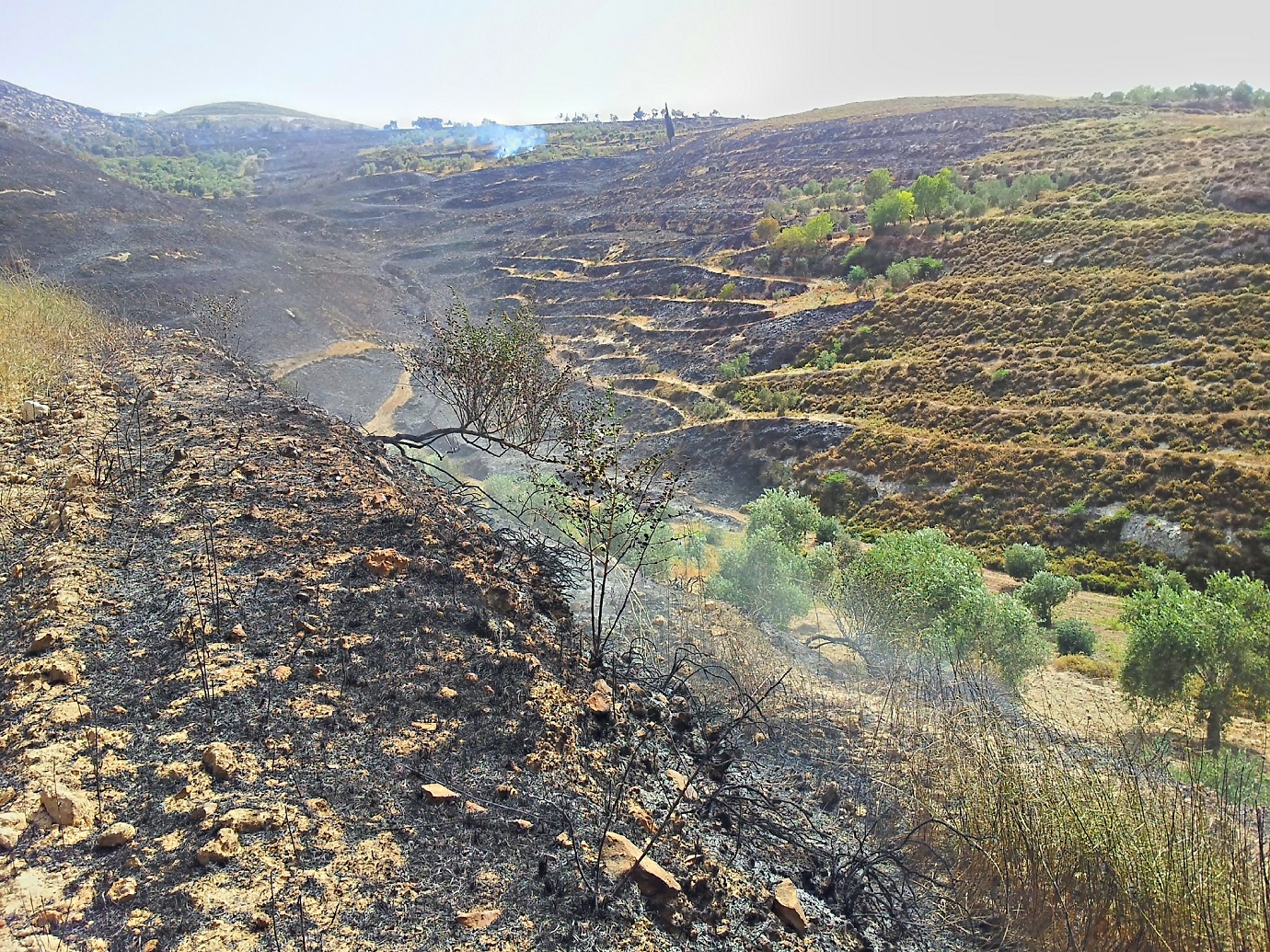
Salman Valley was a major source of income for Burin (photo: ISM)
Of the Palestinians that gathered, the Israeli border police only allowed uniformed firemen and those from the Palestinian Authority’s civil volunteer service to put out the raging fires. Those who approached to help were threatened with pepper spray. The fire was eventually slowed down when the border police left and the community was able to help. Areas of the hills still burned when volunteers were leaving at around 6 o’clock in the evening. The Israeli fire service appeared in case the fire spread to settler-occupied land, but did nothing to help the Palestinians nearby.
This level of violence is far from unheard of in the villages of Madama and Burin, which like other villages in proximity to Yizhar, are both subject to regular crop burnings, harassment and serious violence from the illegal settlement, who, with the assistance of the Israeli occupation forces, show no signs of stopping their assault on the surrounding Palestinian land and its inhabitants. Residents of Burin also face harassment from the Israeli army, which includes the tear-gassing of a Burin home, with a months old baby inside, during this February’s ‘al-Manatir‘ demonstration. A protest for which the village has received several military reprisals since, including destruction of the local cultural centre.
Yizhar is at the forefront of settler violence and operates a strict “price tag” policy, where any action taken by the Israeli government on illegal settlements within the West Bank must be met by carrying out harsh and violent crimes on Palestinian communities. It’s has frequently produced anti-Palestinian propaganda, including literature justifying the killing of Palestinian children and material supporting the actions of mass murderer Baruch Goldstein.
Related articles
- Villages of Urif, Burin and Asira violently attacked by settlers (palsolidarity.org)
- Jewish settlers setting up tent and planning road on Palestinian owned land in Al Khalil (alethonews.wordpress.com)
- Arson attack on Asira village by illegal settlement of Yitzhar (palsolidarity.org)
- Palestine: Israelis kill more than 750 olive trees with chemicals last week & 100 dunums of Salfit land confiscated (realisticbird.wordpress.com)
- Settlers Spray Olive Trees With Toxic Chemicals (imemc.org)
What is Happening in Istanbul?
By İnsanlik Hali | defnesumanblogs | June 1, 2013
To my friends who live outside of Turkey:
I am writing to let you know what is going on in Istanbul for the last five days. I personally have to write this because most of the media sources are shut down by the government and the word of mouth and the internet are the only ways left for us to explain ourselves and call for help and support.
Four days ago a group of people most of whom did not belong to any specific organization or ideology got together in Istanbul’s Gezi Park. Among them there were many of my friends and students. Their reason was simple: To prevent and protest the upcoming demolishing of the park for the sake of building yet another shopping mall at very center of the city. There are numerous shopping malls in Istanbul, at least one in every neighborhood! The tearing down of the trees was supposed to begin early Thursday morning. People went to the park with their blankets, books and children. They put their tents down and spent the night under the trees. Early in the morning when the bulldozers started to pull the hundred-year-old trees out of the ground, they stood up against them to stop the operation.
They did nothing other than standing in front of the machines.
No newspaper, no television channel was there to report the protest. It was a complete media black out.
But the police arrived with water cannon vehicles and pepper spray. They chased the crowds out of the park.
In the evening the number of protesters multiplied. So did the number of police forces around the park. Meanwhile local government of Istanbul shut down all the ways leading up to Taksim square where the Gezi Park is located. The metro was shut down, ferries were cancelled, roads were blocked.
Yet more and more people made their way up to the center of the city by walking.
They came from all around Istanbul. They came from all different backgrounds, different ideologies, different religions. They all gathered to prevent the demolition of something bigger than the park:
The right to live as honorable citizens of this country.
They gathered and marched. Police chased them with pepper spray and tear gas and drove their tanks over people who offered the police food in return. Two young people were run over by the panzers and were killed. Another young woman, a friend of mine, was hit in the head by one of the incoming tear gas canisters. The police were shooting them straight into the crowd. After a three hour operation she is still in Intensive Care Unit and in very critical condition. As I write this we don’t know if she is going to make it. This blog is dedicated to her.
These people are my friends. They are my students, my relatives. They have no «hidden agenda» as the state likes to say. Their agenda is out there. It is very clear. The whole country is being sold to corporations by the government, for the construction of malls, luxury condominiums, freeways, dams and nuclear plants. The government is looking for (and creating when necessary) any excuse to attack Syria against its people’s will.
On top of all that, the government control over its people’s personal lives has become unbearable as of late. The state, under its conservative agenda passed many laws and regulations concerning abortion, cesarean birth, sale and use of alcohol and even the color of lipstick worn by the airline stewardesses.
People who are marching to the center of Istanbul are demanding their right to live freely and receive justice, protection and respect from the State. They demand to be involved in the decision-making processes about the city they live in.
What they have received instead is excessive force and enormous amounts of tear gas shot straight into their faces. Three people lost their eyes.
Yet they still march. Hundred of thousands join them. Couple of more thousand passed the Bosporus Bridge on foot to support the people of Taksim.
No newspaper or TV channel was there to report the events. They were busy with broadcasting news about Miss Turkey and “the strangest cat of the world”.
Police kept chasing people and spraying them with pepper spray to an extent that stray dogs and cats were poisoned and died by it.
Schools, hospitals and even 5 star hotels around Taksim Square opened their doors to the injured. Doctors filled the classrooms and hotel rooms to provide first aid. Some police officers refused to spray innocent people with tear gas and quit their jobs. Around the square they placed jammers to prevent internet connection and 3g networks were blocked. Residents and businesses in the area provided free wireless network for the people on the streets. Restaurants offered food and water for free.
People in Ankara and İzmir gathered on the streets to support the resistance in Istanbul.
Mainstream media kept showing Miss Turkey and “the strangest cat of the world”.
***
I am writing this letter so that you know what is going on in Istanbul. Mass media will not tell you any of this. Not in my country at least. Please post as many as articles as you see on the Internet and spread the word.
As I was posting articles that explained what is happening in Istanbul on my Facebook page last night someone asked me the following question:
«What are you hoping to gain by complaining about our country to foreigners?»
This blog is my answer to her.
By so called «complaining» about my country I am hoping to gain:
Freedom of expression and speech,
Respect for human rights,
Control over the decisions I make concerning my on my body,
The right to legally congregate in any part of the city without being considered a terrorist.
But most of all by spreading the word to you, my friends who live in other parts of the world, I am hoping to get your awareness, support and help!
Please spread the word and share this blog.
Thank you!
For futher info and things you can do for help please see Amnesty International’s Call for Urgent Help

Taken from Occupy Gezi Facebook page. Also used by Reuters
Related articles
Naked Citizens – World
journeymanpictures · May 7, 2013
Naked Citizens (2013): Increasing numbers of ‘terror suspects’ are being arrested on the basis of online and CCTV surveillance data. Authorities claim they act in the public interest, but does this intense surveillance keep us safer?
“I woke up to pounding on my door”, says Andrej Holm, a sociologist from the Humboldt University. In what felt like a scene from a movie, he was taken from his Berlin home by armed men after a systematic monitoring of his academic research deemed him the probable leader of a militant group. After 30 days in solitary confinement, he was released without charges. Across Western Europe and the USA, surveillance of civilians has become a major business. With one camera for every 14 people in London and drones being used by police to track individuals, the threat of living in a Big Brother state is becoming a reality. At an annual conference of hackers, keynote speaker Jacob Appelbaum asserts, “to be free of suspicion is the most important right to be truly free”. But with most people having a limited understanding of this world of cyber surveillance and how to protect ourselves, are our basic freedoms already being lost?
Journeyman Pictures is your independent source for the world’s most powerful films, exploring the burning issues of today. We represent stories from the world’s top producers, with brand new content coming in all the time. On our channel you’ll find outstanding and controversial journalism covering any global subject you can imagine wanting to know about.
Subscribe to journeyman for daily uploads: http://www.youtube.com/subscription_c…
For downloads and more information visit: http://www.journeyman.tv/film/5797/na…
Follow us on Twitter:
UN lashes out at Britain’s human rights record
RT | June 2, 2013
The UN’s torture watchdog has hit out at the British government for human rights abuses. In its harshest criticism yet of the British government, the panel warned that urgent action is needed for the country to meet international standards.
The UN Committee against Torture focused on human rights abuses during the so-called war on terror and the mistreatment of prisoners in British custody in Iraq. It also flagged up some 40 separate incidents on which the UK government must act.
The findings highlighted the British governments actions following 9/11 and the commission urged the British government to quickly establish an inquiry into whether detainees held overseas were ill-treated or tortured by British officials.
The report reads that the committee is “deeply concerned at the growing number of serious allegations of torture and ill-treatment, as a result of the state party’s military interventions in Afghanistan and Iraq.”
The UN team also slammed what they called “an escape clause” in the Criminal Justice Act (1988), which allows British officials to escape prosecution for inflicting severe pain or suffering if they can show that they had “lawful authority, justification or excuse” for doing so.
Another legal loophole the committee voiced concern about is the Intelligence Services Act (1994), which effectively insures that intelligence officers cannot be prosecuted within the UK once a warrant giving them lawful authority has been signed by a government minister.
The panel was disappointed at the failure to date to prosecute anyone for the torture of Iraqi prisoners and in particular the failure to convict anyone for the murder of Baha Mousa who died in British custody in 2003. Only one soldier received a one-year sentence for admitting inhumane treatment.
There was also concern with the government’s planned introduction of secret court procedures in July for issues that may affect national security under the Justice and Security Act. Closed Material Procedures as they are known make it easier to use hearsay evidence or evidence obtained through torture, the committee maintains. The system of Special Advocates – lawyers who are vetted and chosen by the government – “have a very limited ability to conduct a cross-examination and cannot discuss full content of confidential materials with their client thus undermining the right to a fair trial,” the report reads.
The watchdog also urged the UK government to halt the deportation of failed asylum seekers to Sri Lanka. The deportation of failed Tamil asylum seekers has led to their torture or ill-treatment on return and the UK government hasn’t changed its policy on the issue despite a ruling by the High Court in February ordering them to suspend deportations.
The government was criticized in its handling of the case of Shaker Aamer, the last remaining UK resident in Guantanamo. The committee regretted that despite the “best endeavors” of the UK to try and get him released “there are no encouraging signs of this happening soon”.
There were also accusations against the UK government on several issues connected with Northern Ireland. The Northern Irish justice system must abolish all non-jury trials the report concludes, adding that historical investigations into past misconduct, particularly of military officials, must not be delayed or suspended.
The committee asked that police officers only use tasers when they face “a real and immediate threat to life or risk or serious injury”.
There was also unease that the age of criminal responsibility in England, Wales and Northern Ireland has not been raised from 10-years, despite calls by more than 50 organizations for this to be done.
Further concerns were raised about the steady increase of the prison population over the past decade and the problem of overcrowding. To help rectify the issue the committee urged the government make wider use of non-custodial sentences.
In a further blow, committee members accused the UK delegation of being evasive when questioned about Britain’s human rights record during a two-day hearing in Geneva last month.
The British government was given a year to explain how it could improve its human rights record in 4 key areas: overseas torture, getting Shaker Aamer out of Guantanamo, stopping the forced deportation of Sri Lanka asylum seekers and setting up inquiries into past abuses in Northern Ireland.
Related article
Colombia: Piedad Córdoba Ratifies Intention to Run for President
Prensa Latina | June 1, 2013
 La Paz – While visiting this capital, Colombian ex senator Piedad Córdoba expressed her intention to run for president in the next elections in her country, according to press reports.
Cordoba visited the cities of Sucre and La Paz to film the next chapters of the program “Causa Justa” (Just Cause) to be broadcast by Telesur television network, and took the opportunity to ratify her position to become the first woman to be at the helm of Colombia.
According to the newspaper Cambio, Córdoba also extolled the transformations undergone by the Bolivian capital in the past few years: “you can really see progress in Bolivia, the big changes and improvements in La Paz!”, she said.
Cordoba, 58, has worked systematically for the rights of women, ethnic minorities and human rights in her country, besides being involved, in 2007, in efforts to reach an agreement between the Revolutionary Armed Forces of Colombia-People’s Army (FARC-EP) guerrillas and the then government of President Alvaro Uribe.
Since 2011, in the wake of her dismissal as senator by the Attorney General’s Office of Colombia, she started to work with Telesur in the Causa Justa program, which highlights conflicts hitting the region, as told by political, social and cultural figures, notes Cambio newspaper.
She is in Bolivia “for a second season of the program in order to film a documentary on discrimination, bilingual education and the indigenous presence of President Evo Morales,” added the source.
Related articles
- Colombia: FARC and Government Reach Agreement on Land Reform
- Colombia: extrajudicial executions killing still ongoing according to report
- Latest FARC Proposal for Peace Process in Colombia
- Colombia: President Santos Announces ‘Profound Changes’
- Colombia: Drummond Contractor Convicted in Unionists’ Deaths
- Imperialism and Violence in Colombia
Featured Video

Liberty Cannot Exist Inside a Panopticon
or go to
Aletho News Archives – Video-Images
From the Archives
Left-leaning despisers of 9/11 Truth movement: Do you really believe in miracles?
David Ray Griffin | Global Research | 06 Jul 2010
An Open Letter to Terry Allen, Noam Chomsky, Alexander Cockburn, David Corn, Chris Hayes, George Monbiot, Matthew Rothschild, and Matt Taibbi.
[1]According to several left-leaning critics of the 9/11 Truth Movement, some of its central claims, especially about the destruction of the World Trade Center, show its members to be scientifically challenged. In the opinion of some of these critics, moreover, claims made by members of this movement are sometimes unscientific in the strongest possible sense, implying an acceptance of magic and miracles. … Full article
Blog Roll
 Aletho News
- White House envoy declares kinetic action against Yemen ‘fruitless’
- Ukraine deployed thousands of microdrones in Iraqi Kurdistan: Tasnim
- Iran calls for emergency UNSC meeting over Trump’s ‘brazen’ bomb talk, Israeli threats
- Iranian sources reveal details of Russia-China Hormuz proposal
- Plan for more US-Israel integration puts our military tech at risk
- Another Round Against Iran Will Break What Is Left of the Gulf
- SVR Report on Ukraine’s Mexican Drug Gang Links Could Pressure Zelensky, Won’t Change US Policy
- British Government Employees Were Fact-Checking the News at the BBC. Nobody Told You.
- Albania on fire: who’s behind the riots?
- Egypt’s Civil Democratic Movement rejects involvement in regional war
- If Americans Knew
- Mysterious bot accounts reportedly spread fake ‘man on the street’ videos for Michigan Senate candidate
- Israeli Defense Minister Katz Says Over 60 Lebanon Villages Have Been Destroyed
- Why Is Israel Running TV Ads in Iowa Ahead of the Midterms?
- Hind Rajab’s Alleged Killer Is in the United States. HRF Demands His Arrest.
- US Officials Face Fresh Pressure After Another American ‘Brutalized’ by Israeli Settlers in West Bank
- Israel-Backed Palestinian Militias Terrorize Displaced Families in Gaza
- FBI subpoenas pro-Palestine activists over Israeli weapons plant disruption
- Fourth winter arrives in wartorn Gaza, too early – Daily Update
- More on how Bari Weiss is using CBS on behalf of Israel
- What the UK Is Doing to Pro-Palestine Novelist Sally Rooney Is an Act of Orwellian Villainy
- No Tricks Zone
- Predictions Made By Renowned Climate Proifessor Over Past Decades Have Been Proven To Be Poor
- New Study Suggests Large Regions Of The Pacific Ocean Have Been Cooling For The Last 80 Years
- Germany’s Green Energy Debacle: High Energy Costs Force Kahla Porzellan to Close After 182 Years!
- New Study: 50 Years Of The Most Aggressive ‘Net Zero’ Policies Can Only Affect The Global Climate By 0.03°C
- US September “Heat” Was No Record…Many Records Set Decades Ago
- Latest European Green Energy Debacle; Portugal’s Largest Flagship Solar Park Insolvent!
- Green Energy Debacle: German Expert Professor Fritz Vahrenholt Warns Of Severe Economic And Social Consequences
- Two More Paleo Reconstructions Affirm Meters-Higher Sea Levels Across Ireland, Brazil 7000-6000 Years Ago
- New Study: Earth And Venus Surface Warmth Largely Explained By Convection And Lapse Rate, Not CO2 Or Radiation
- 2025 Nature Paper Claiming Worsening Global Drought Gets RETRACTED …Heavily Flawed

