Mexico: Evidence mounts of unprovoked police attacks and agents provocateurs on December 1rst
Weekly News Update on the Americas | December 11, 2012
On December 9th Mexican authorities released 56 of the 69 people who had been in detention for more than a week on suspicion of “attacking public peace” during protests in Mexico City against the inauguration of President Enrique Peña Nieto. A total of 106 people were reportedly arrested on a day which included violent confrontations between police and protesters and widespread destruction of property [see Update #1154], but 28 were quickly released. Judge María del Carmen Mora Brito of the Federal District (DF, Mexico City) court system ordered the December 9th releases after “analyzing videos, testimonies and expert witnesses’ reports,” the DF Superior Court of Justice announced in a communiqué. (Europa Press 12/10/12)
The judge’s action followed a week of demonstrations against police repression and charges that agents had repeatedly attacked, beaten and arrested peaceful protesters and bystanders while failing to arrest the people who had been engaged in vandalism. There were also accusations that agents provocateurs had infiltrated the protests. Complaints about the police seemed to be supported by videos that circulated widely on the internet. One, a compilation by the student video collective Imágenes En Rebeldía, appears to show unprovoked police attacks, arrests of nonviolent protesters, and men dressed in civilian clothes and armed with crowbars and chains standing and walking among uniformed federal police agents behind metal barriers around the Chamber of Deputies building.
On December 6th the DF Human Rights Commission (CDHDF) reported that the DF police had arrested at least 22 people arbitrarily and that four people showed signs of having been tortured. A total of 88 people claimed to have been arrested without justification, the governmental commission said; 15 youths were charged with taking part in vandalism on Juárez Avenue even though the vandalism occurred after the time of their arrests. Among the people arrested on December 1rst was Mircea Topolenau, a Romanian photographer covering the events for a magazine. CDHDF president Luis González Placencia noted that his organization was only reporting actions by the DF police and that it was up to the National Human Rights Commission (CNDH) to investigate alleged abuses by the federal police. (La Jornada (Mexico) 12/7/12)
Two protesters were seriously injured during the December 1rst protests. Drama teacher Francisco Kuykendall Leal was hit by a tear gas canister and was hospitalized with cranial injuries. He is an active supporter of The Other Campaign, a political movement inspired by the rebel Zapatista National Liberation Army (EZLN) [see Update #832]. Uriel Sandoval Díaz, a student at the Autonomous University of Mexico City (UACM), lost an eye and suffered fractures when he was hit by a rubber bullet. “This struggle won’t end until poverty ends,” Uriel said from a wheelchair as he was being released from the General Hospital on December 6th. “An eye is nothing [when] every day thousands of human beings have nothing to eat.” (Kaos en la Red 12/4/12 from Desinformémonos; Milenio (Mexico) 12/7/12)
In related news, an online petition has been started calling on Harvard University president Drew Gilpin Faust to withdraw the offer of a fellowship at the university’s John F. Kennedy School of Government to outgoing president Felipe Calderón Hinojosa (2006-2012). Tens of thousands of Mexicans have died in the militarized “war on drugs” Calderón initiated soon after he took office in December 2006. The petition is at http://www.change.org/petitions/harvard-university-president-faust-deny-outgoing-mexican-president-felipe-calderon-employment-at-harvard
Related articles
- Mexico: Peña Nieto Takes Office as Youths Riot (alethonews.wordpress.com)
The Al Dalu family: “We want justice”
By Rosa Schiano | il Blog di Olivia | 4 December 2012
On 18 November 2012, on the fifth day of the Israeli military offensive “Pillar of Defence” against Gaza, a war bulletin reported 72 people killed, including 19 children, 670 wounded, most of them women and children. That day, the Israeli air force bombed a three-storey building in Nasser Street, Gaza City, wiping out an entire family.
I was, like every day, at Shifa hospital. Suddenly ambulances brought the bodies of the young victims of the brutal attack:
Ibrahim Al Dalu, 11 months old
Jamal Al Dalu, 6 years old
Yousif Al Dalu, 5 years old
Sara Al Dalu, 3 years old
Even their mother died: Samah Al Dalu, 22, and their father, Mohammed Al Dalu, 28. The children’s Aunt also died, Ranin Al Dalu, 22, and the second aunt, Yara Al Dalu, 17, whose body was found just after 4 days in the rubble of the building. And also the two grandmothers died, Suhila Al Dalu, 75, and Tahina Al Dalu, 48. The bombing of the building of the Al Dalu family also hit a building next door, where two people were killed: Mzanar Abdallah, 20, and Amina Mznar, 80. A whole family was wiped out. The bombing took place on the entire three-story building which was completely destroyed.
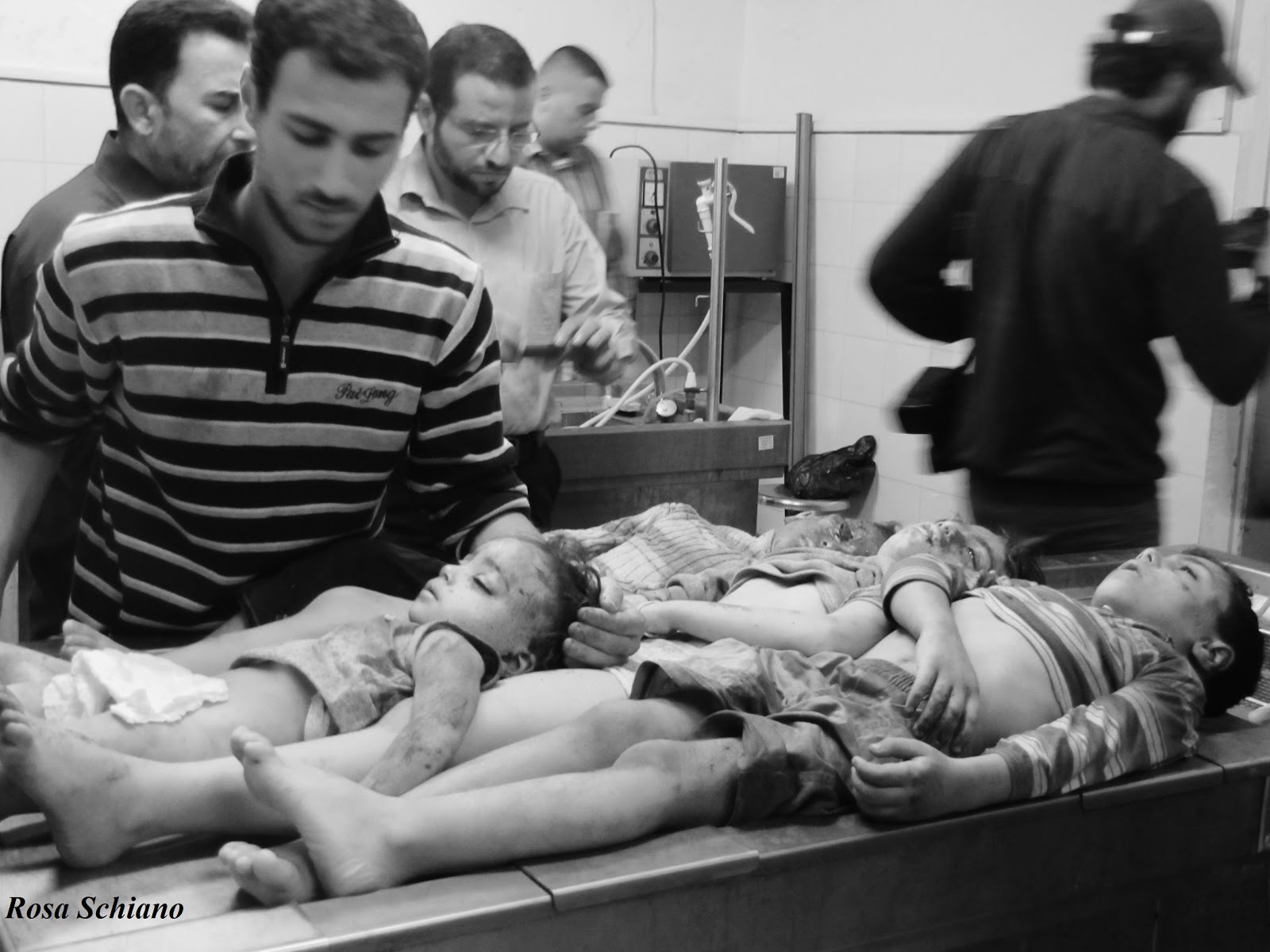
Shifa hospital, 19 November 2012, bodies of the young victims. By the bodies, Yasser Saluha, the brother of the children’s mother.
On Monday, December 3rd, 2012, I had the opportunity to talk to the brother of the father of the children, Abdallah Jamal Al Dalu (20 years old). He talked about that night. “I was out with my father to to get food, when I received a call where I was told that my house had collapsed. I was shocked.” Abdallah and his father lived in the same building where he lived with the rest of his family.
In Gaza extended families often live together in the same building. Abdallah and his father are the only survivors of the Al Dalu family. All the other members of the family died under the rubble.
“I went home, I saw it destroyed, I could not speak,” continued Abdallah, crying. “My whole family was in the house. Then I went to the hospital and saw the bodies, it was a disaster.” Abdallah’s eyes were reliving what they had seen that afternoon.
Four days after the bombing Palestinian bulldozers excavating the rubble found the bodies of the children’s father, Mohammed Jamal Al Dalu and aunt, Yara Al Dalu.
Now Abdallah and his father are renting another house. They do not have beds to sleep in or the necessary living facilities, nor do they have clothes to wear.
Abdullah has asked us to ask the International Criminal Court to investigate what happened. “Children and women were killed in this massacre.”
Before leaving, I entered another building of the brothers of Mohammed Jamal Al Dalu, and Ahmal Jamal Al Dalu. Ahmal was not in Gaza during the war, but in Turkey, where he lives with his wife and family. “We want justice”, said Ahmal. “We want justice more than financial aid, because the money can go. What has happened is not a mistake, it is a crime. It is inhuman. It is not the first crime, crimes have been repeating for 64 years. We live without water, without electricity. It’s enough. ”
I translated his words in the darkness of the building while a friend lit up my notebook with only the light of the phone, and I said goodbye with a promise to stay in touch.
Our task now is to ensure that these crimes are not forgotten and that the Al Dalu family receives justice by bringing what happened to the International Criminal Court.

Photo of Abdallah Jamal Al Dalu, the brother of Mohammed Jamal Al Dalu

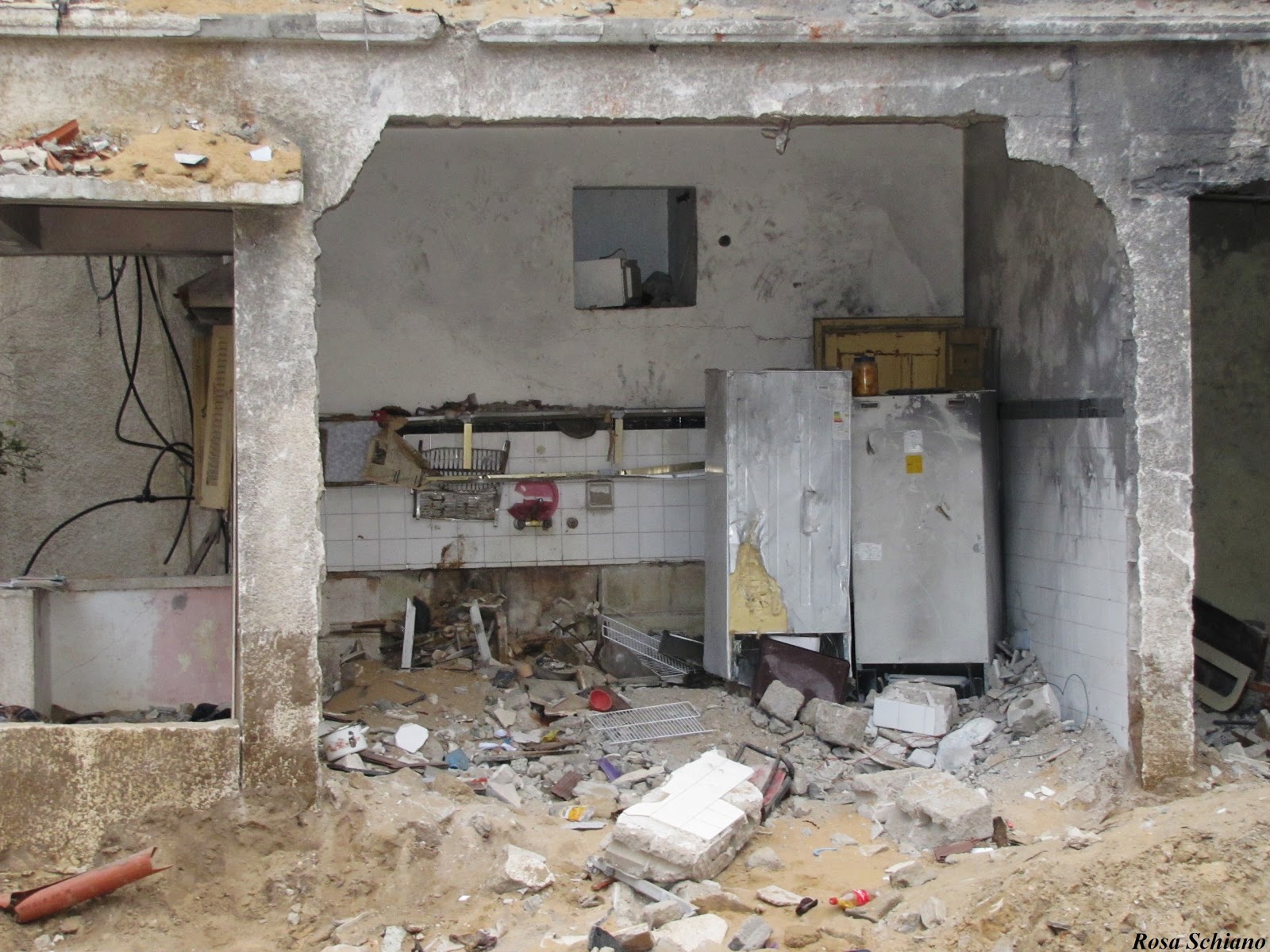
The Al Dalu family bombed home
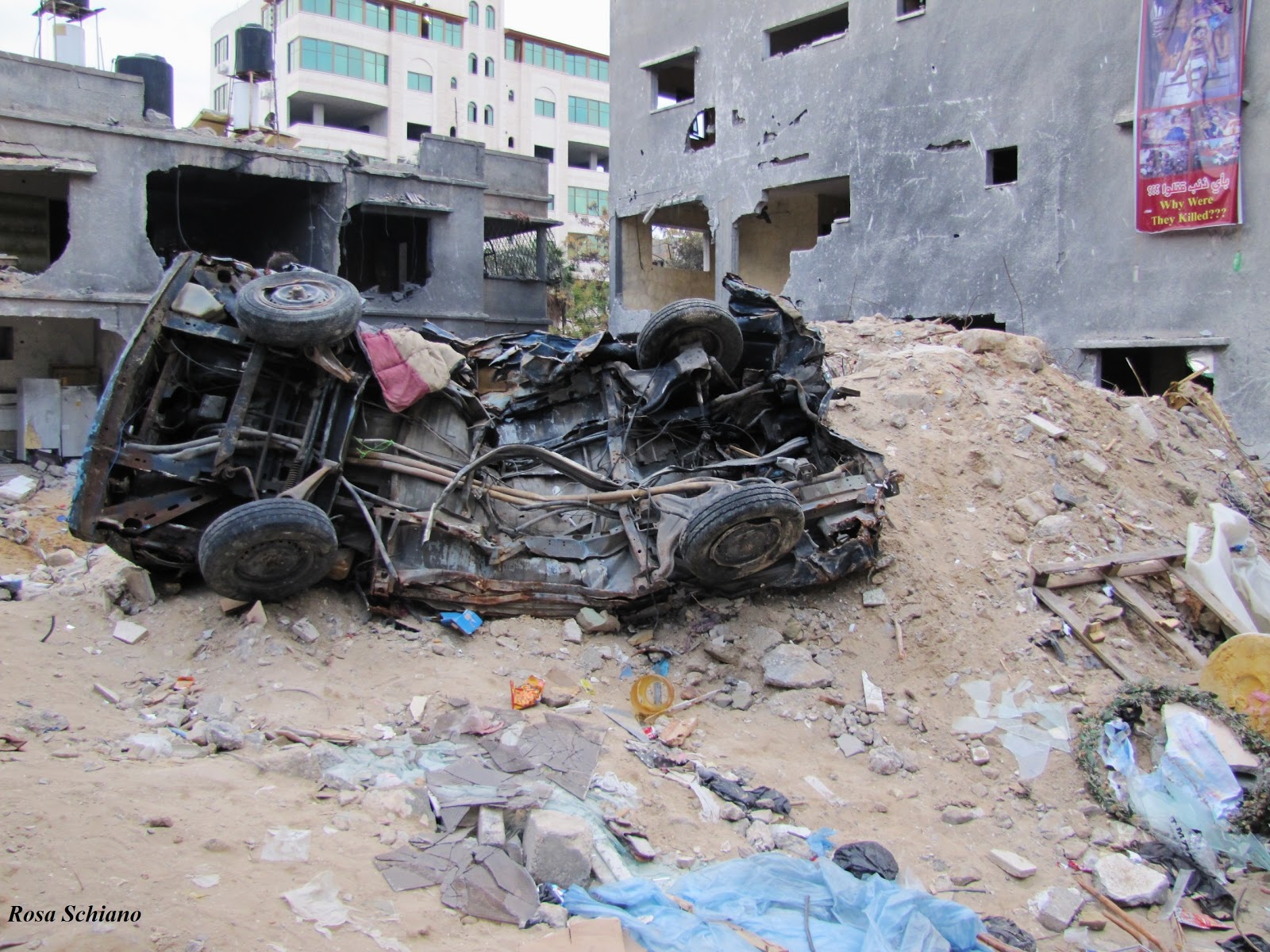
The Al Dalu family bombed home
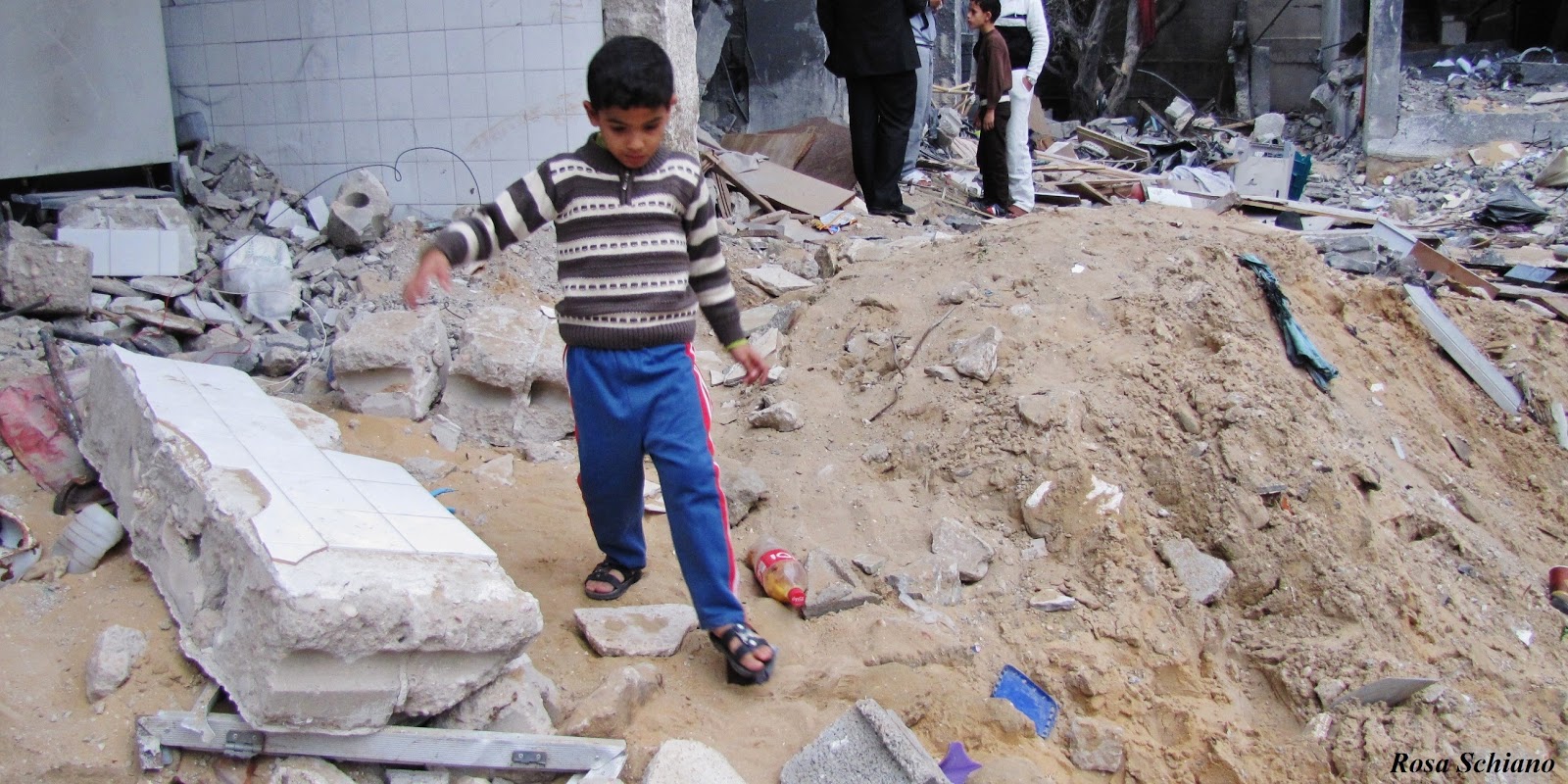
More photos:
The building next to the Al Dalu house bombed, in which two people died, Mzanar Abdallah, 20, and Amina Mznar, 80. The old woman was in a wheelchair and was in the kitchen at the time of the bombing. Her wheelchair was found in the rubble. See more photos here.
The Sarafand Massacre, and Cover-up
By Vacy Vlazna | Palestine Chronicle | December 7, 2012
 Sarafand. (Photo: Courtesy of Uri Zackhem, Palestine Remembered)
In the early winter of 1918, the wheat, barley and sesame fields of Sarafand al-Kharab lay fallow. Oranges, figs, almonds and olives had been harvested, the summer honey stored. At night the goats and sheep were brought into the warmth of the adobe brick houses.
On the moonless night of 9th December, as in typical Palestinian villages, smells of the sparse dinner were fading in the air, bellies barely full, the villagers, subsistence farmers and shepherds and their families, slept soundly except perhaps for a restless child here and there, a mother breastfeeding her baby, a few coughs tapping the night’s stillness.
Suddenly the village, roused by angry foreign voices, was cordoned off by lamps held by wrathful soldiers from the nearby army camp.
The next morning, 10th December, officers from the ANZAC Mounted Division questioned the village sheikh and demanded he hand over the murderer of one of their soldiers; a young New Zealand Trooper Leslie Lowry had been sleeping with his kit bag for a pillow woke when he felt the bag was tugged from under his head. He chased the thief who allegedly turned and shot Lowry in the chest. The alarm was raised and Lowry died before the doctor arrived. Confused, and still in the grip of the cordon, the chief and fearful villagers were unable to comply.
That night, hundreds of enraged New Zealander, Australian and Scottish soldiers set upon the village separating the women and children then viciously attacked the men folk with bayonets, clubs, chains and sticks and set alight the village and the nearby Bedouin camp. Situated on a rise overlooking the coastal plain, the flames, vying with screams of rage of agony of horror, were seen from IMD HQ a half mile away.
After an orgy of blood, 137 (or more) innocent village men (innocent fathers, innocent brothers, innocent husbands, innocent uncles, innocent cousins, innocent friends) lay dead among the smoke and glowing ashes or thrown in the village well; the distraught and grief-ravaged women were newly widowed, children fatherless, all homeless….and the soldiers had vanished into the darkness of a military cover-up.
No one from the ANZAC Mounted Division was prosecuted for the atrocity as the soldiers, standing as one, didn’t cooperate with the bland inquiry, denying participation and later some, from the 3rd Light Horse Regiment’s C Squadron, were ordered never to talk about it. (Daley p 277)
Cover-ups are a reprehensible part and parcel of military history and testimonies collected on Australian Military History of the Early 20th Century: Desert Column site are tainted with fundamental lies and racist justifications that have become the prototype for subsequent historical and newspaper accounts of the Sarafand Massacre:
The killer’s footsteps that led to the collective punishment of Sarafand villagers. Despite there being no witnesses to the shooting of Lowry and that no one saw the killer run to Sarafand, all accounts report that the footsteps of the killer were followed and led directly to the village.
In fact, no footsteps could have been followed from the camp as Palestinian terrain is too rocky. This is substantiated by the Uri Zackhem film, “Tracing all that remains of the destroyed village of Sarafand al Kharab, Palestine” made for Palestine Remembered.
Also, Private AS Mulhall, who was on active duty in the camp, stated “There [were] no sand hills within three miles of the spot where Lowry was shot.”
Furthermore, on checking the NASA, Phases of the Moon, 1901- 2000, the night of 9 December, 1918 fell in the new moon to the beginning of the first quarter Dec 3-Dec 11, which means that it was a moonless night. In rural areas and in a world sans electricity, a moonless night is literally pitch black to the point one cannot see a foot ahead.
Nevertheless, the Deputy Assistant Provost Marshal who was called to the camp that night ordered a plaster impression of a fantasy footprint, “Later in the afternoon I sent Lieutenant Fyfe to obtain footprint impressions made of plaster of Paris, which he has done. The specimens taken are those of the man’s left foot.”(Did the killer hop away?)
The Discrepant Number of Sarafand Victims
The casualty figures of the Sarafand massacre range from 5 to 137 but, as there was a cover-up, the number of dead will likely be higher.
Typically a cover-up provides the minimum number of victims: Deputy Assistant Provost Marshal reported he saw only 5 dead and 5 wounded and “saw no soldier committing an offence to warrant his arrest”; Briscoe Moore offered “38 natives”; Terry Kinlock stated “30 and 40 Arab men had been beaten to death or badly injured.”
However, Tasmanian Ted O’Brien confessed to 120 dead and ex-NSW Mounted policeman, AS Mulhall testified, “I counted 137 dead within the village. It was a most gruesome sight the manner in which their heads were bashed and battered.”
The severe dressing down of the division by Commander-in-chief, General Allenby, provides insight into the gravity and extent of the atrocity:
Allenby’s biographer, Lawrence James, writes that a ‘furious’ Allenby said the men were ‘murderers and cowards and by killing the Bedouin had taken away the good name of Anzac- in fact it was a worse atrocity than any the Turks had committed.‘ (Daley p265)
Allenby then immediately removed the division to Rafah and withdrew recommendations for all gallantry awards.
The Cover up
The cover-up was intensified over the decades with a flurry of denials and cross accusations by the different ANZAC Division units. The Australians denied participation putting the blame squarely on the New Zealanders and British artillerymen from the Ayrshire Battery while the New Zealanders parried with counter accusations.
In accounts, the number participating in the mass murder varies from 50 to 200.
Regardless, on 16 December, the entire division was paraded before General Allenby who addressed the members as “cowards and murderers” concluding with, “Officers, Non Commissioned Officers, and men of the Anzac Mounted Division I was proud of you once. I am proud of you no longer!”
The participation of all three national groups is confirmed by the compensation payments. In late 1920-1 the British War Office pressured Australia and NZ to pay compensation as the British government had rebuilt the village at a cost of 2060.11.3 pounds. Australia contributed 515 pound and NZ, 858 pounds.
TV NZ’s ‘Sunday: Day of Shame’ documentary reveals that the cover-up extended to the family of murdered Leslie Lowry. His nephew, Noel Woods, believed his uncle was ‘mown down in a hail of Turkish bullets’ and was deeply shocked by news of the massacre.
Blaming the Victims
HS Gullett, the official war correspondent in Palestine, puts the ‘unfortunate incident’ that demanded ‘instant justice’ in the context of the exasperation of the AIF heroes with the unpunished thefts by ‘these debased people’ – ‘The natives of Surafend were notorious for their petty thieving’ coupled with the murder of a comrade ‘at the hands of a race they despised’. Regarding the Bedouin, Ted O’Brien remarked, “wicked… You’d shoot them on sight.”
Gullett’s overt racist superiority, like that of the majority of WW I Australian soldiers hailing from the land of White Australia, dismisses outright the plight of Palestinians struggling to survive the dire economic impact on their land and livelihoods of the mounted armies of the Imperial and Ottoman forces. The Turks had demolished orchards and all the cavalries ‘drank out wells and grazed their horses on standing crops’. Palestinians were driven to steal because foodstuffs, livestock and even unwilling Palestinian staff were requisitioned by the British military and consequently there was a shortage of basic food and commodities and awful disruptions to daily life.
Gullett makes a reference to instances of theft by the Anzacs, ‘if the Arabs missed a sheep from their flocks, they were emphatic that a soldier in a big hat had been seen prowling in the neighbourhood.’ Stealing sheep may have been a lark for the soldiers, but it was devastating for impoverished Palestinian farmers.
The Arabs were also accused of desecrating and stealing from the dead, yet Ted O’ Brien ‘talks in detail how he and his mates stole coins from the dead. They also used the Turkish dead for target practice” (Daley p275). The Australian Imperial Forces (AIF) regularly conducted punitive patrols against villages and troops were known to leave behind booby traps of bully beef tins when they moved bivouac.
Al Nakba
Sarafand al Kharab suffered a second calamity on April 20, 1948 when Israeli Givati Forces demolished the village and ethnically cleansed its Palestinian inhabitants.
The Sarafand Massacre wasn’t a one-off aberration, for the Anzacs were notorious for inflicting harassment and collective punishment on Egyptian and Palestinian civilians. In her searingly honest book, ‘Australians and Egypt, 1914-1919’, Dr. Suzanne Brugger chronicles 4 incidents at Azizia, Bedrashein, Abu Akdar and Saft El-Malouk in which the AIF in 1919 were involved in destroying Egyptian villages by fire and the incurring of casualties through excessive force.
A letter in the Egyptian Gazette in 1918 complained, ‘Insobriety and misconduct by the troops threatened to undermine the prestige of the white races and of the Allied forces and dominant British regime in particular.’ (Brugger p61)
Misconduct ranged from misdemeanors to brutal violence: “Men of the Eight Brigade on a route march near Tel el Kebir sniped at passing “gypos’ until their targets fled over the skyline, Egyptian conductors were thrown from moving trains, and Egyptian stationmasters and minor officials were assaulted. The British soldiers are a sedate lot in comparison with ours, boasted a Victorian private, “they don’t knock the baskets of oranges off the heads of the natives, or pull boys off donkeys..” (Gammage p138) other misconduct included- leaving without paying at brothels, not paying fares on trams, looting and burning trading booths,‘drunkedness, harassment of women, riotous behavior and brothel-trawling’, foul language, cruel and crude jokes, ‘crumbling discipline’.
The accumulative offences were so grave that Brugger declares ‘the actions of the Australian troops in the past 5 years [1914-19] had contributed in part to this raising of the temper of the populace’ for emerging nationalism and the 1919 rebellion.(p9)
Ted O’Brien described the Sarafand Massacre as ‘ungodly’ and avowed “war is a shocking thing…It’s shocking just what men’ll do”. Perhaps PTSD arises not just from the horror of war and its stressful proximity to death, but also from the horror at the potential for inhuman barbarity.
Sometimes, a cover-up wreaks greater violence than the original crime. The glorification and sanitization of war is a form of cover-up that leads to further wars as WWI combatant and poet, Siegfried Sassoon warned;
At the Cenotaph
I saw the Prince of Darkness, with his Staff,
Standing bare-headed by the Cenotaph:
Unostentatious and respectful, there
He stood, and offered up the following prayer.
“Make them forget, O Lord, what this Memorial
Means; their discredited ideas revive;
Breed new belief that War is purgatorial
Proof of the pride and power of being alive;
Men’s biologic urge to readjust
The Map of Europe, Lord of Hosts, increase;
Lift up their hearts in large destructive lust;
And crown their heads with blind vindictive Peace.”
The Prince of Darkness to the Cenotaph
Bowed. As he walked away I heard him laugh.
– Dr. Vacy Vlazna is Coordinator of Justice for Palestine Matters. She was Human Rights Advisor to the GAM team in the second round of the Acheh peace talks, Helsinki, February 2005 then withdrew on principle. Vacy was coordinator of the East Timor Justice Lobby as well as serving in East Timor with UNAMET and UNTAET from 1999-2001.
Sources:
– Daley, Paul, Beersheba: A journey through Australia’s forgotten war, Australian Military History of the Early 20th Century: Desert Column site.
– Tracing all That remains of the destroyed village of Sarafand al Kharab, Palestine, Youtube.
– NASA, Phases of the Moon, 1901- 2000
– Gammage, Bill; The Broken Years
– Brugger, Suzanne; Australians and Egypt, 1914-1919
Related articles
French activists campaign against Jewish Defense League
Press TV – December 7, 2012
Activists in France have launched a campaign to disband the French branch of the Jewish Defense League (JDL), which is reportedly protected by the French government, Press TV reports.
Pointing to numerous acts of violence committed by the JDL, the activists censured the French government’s tolerance of the Jewish group and reaffirmed their determination to continue their campaign to ban the JDL.
The United States considers the JDL as a terrorist group. It is a Jewish far-right organization whose stated goal is to expel Palestinians from their homeland and “protect Jews from anti-Semitism by whatever means necessary.”
Under former French President Nicolas Sarkozy, the group’s ties with the French government surfaced after French police allowed JDL members to use their sports facilities for military training.
The group has committed hundreds of violent acts in France, but their crimes have gone unpunished and even unreported, with merely a single conviction on record.
In a latest instance of violence, JDL thugs recently attacked Olivia Zemor, a leader of the non-violent Boycott, Divestment and Sanctions campaign, sprayed a very toxic paint all over her body and posted the video of the assault on their website. French police arrested no one with regard to the attack.
“Any time they see a Palestinian voice, they attack them and they run away, because the French government is an accomplice to that,” said Nicolas Shahshahani, Zemor’s husband.
The JDL also attacked Shahshahani’s bookstore in 2006, using tear gas and dousing his books with cooking oil, but none of the perpetrators was apprehended.
Related articles
- FBI files on Tupac Shakur murder show he received death threats from Jewish terrorist gang (theuglytruth.wordpress.com)
- Jewish Right Wing Extremists Suspected of Extorting Tupac Shakur (theageofblasphemy.wordpress.com)
- David Brotsky’s Romance With Guns, Violence and Pro-Israel Hate (richardsilverstein.com)
- long long ago, when kahanists started murdering people in the US (niqnaq.wordpress.com)
VIDEO: On CNN, Nasser Al-Awlaki Demands “Accountability” for U.S. Drone Strike That Killed His Grandson
By Josh Bell | ACLU | December 5, 2012
Speaking passionately in an interview with CNN’s Christiane Amanpour, Nasser al-Awlaki talked on television for the first time about the drone strike that killed his 16-year-old grandson, Abdulrahman. The teenager, an American citizen born in Denver, was killed by a U.S. missile in 2011.
“I want to know why Abdulrahman was killed,” al-Awlaki said via satellite from Cairo. You can watch the full interview here:
http://amanpour.blogs.cnn.com/2012/12/05/grandfather-grieves-teenage-grandson-killed-by-u-s-drone/
The ACLU and the Center for Constitutional Rights represent Nasser al-Awlaki in a lawsuit challenging the targeted killing of Abdulrahman as well as two other Americans killed by a drone strike two weeks earlier: Abdulrahman’s father Anwar and Samir Khan.
Later in the show, the ACLU’s Hina Shamsi debated Columbia Law School Professor Matthew Waxman, a former Bush administration official.
“There are extraordinary circumstances in which the government may use lethal force in response to an actual, concrete, and imminent threat – and those circumstances were not met in the case of any of the three citizens that we brought the lawsuit regarding,” said Shamsi.
“They are specifically called into question when you look at the case of Abdulrahman al-Awlaki, a 16-year-old boy eating dinner outside. No one has made any allegation that he was engaged in wrongdoing, and his case is representative of either a wrongful targeting or the case of a civilian bystander being killed…the lawsuit is an effort to provide transparency about the vague legal criteria the government is using and the basis on which it is carrying out that program.”
You can watch the full debate here:
http://amanpour.blogs.cnn.com/2012/12/05/grandfather-grieves-teenage-grandson-killed-by-u-s-drone/
Related articles
- Denver Teen’s Death by Drone Remains Shrouded in Secrecy (alhittin.com)
- Obama Adviser Robert Gibbs Blames Denver Teen’s ‘Terrorist’ Father for His Drone Death (dissenter.firedoglake.com)
- How Team Obama Justifies the Killing of a 16-Year-Old American (theatlantic.com)
- Top Obama Adviser: Awlaki’s 16-Year-Old Son “Should Have Had a More Responsible Father” If He Wanted Us Not to Kill Him! (socioecohistory.wordpress.com)
Human rights commission demands urgent investigation into killing of Paraguayan peasant leader
MercoPress | December 5, 2012
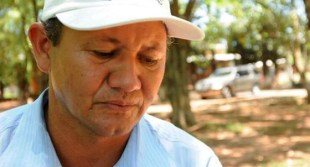 The Inter-American Commission on Human Rights (IACHR) condemns the murder in Paraguay of human rights defender Vidal Vega, leader of the Campesinos sin Tierra movement (Landless Campesinos) and president of the Committee of Relatives of Victims of the Curuguaty Massacre and urges the State of Paraguay to investigate and clear up these crimes, and punish those who perpetrated and masterminded them.
According to IACHR information, on December first, 2012, two individuals arrived aboard a motorcycle at the home of Vidal Vega. Police information quoted in news reports indicates the victim’s spouse, María Cristina Argüello, answered the door: the two unknown men asked for Vidal Vega and shot him with 12-caliber rifles, in the presence of his family.
The information received also indicates that Vidal Vega was a key witness in an investigation into the Curuguaty massacre, which happened on 15 June 2012, and where 11 peasants and 6 policemen died. The massacre took place during a raid on Campos Morombí, Marina Cue, lands in litigation between the State and private parties.
These events led to the impeachment of former Paraguayan President Fernando Lugo, who ended up being removed from office. It was also reported that Vidal Vega was the person responsible for the safekeeping of the documents related to proceedings by the Committee of Relatives of Victims of the Curuguaty Massacre before the National Institute of Rural Development and Land for the adjudication of the “Marina Cue” lands.
The IACHR calls to mind that it is the State’s obligation to proactively investigate acts of this nature and punish those responsible. The Commission also urges the State of Paraguay to immediately and urgently adopt all necessary measures to guarantee the right to life, integrity, and safety of human rights defenders in the country, particularly those who work in the Campesinos sin Tierra movement and on the Committee of Relatives of Victims of the Curuguaty Massacre.
As the Commission has stated previously, the acts of violence and other attacks perpetrated against human rights defenders not only affect the guarantees that belong to every human being, but undermine the fundamental role that human rights defenders play in society and leave all those for whom they fight defenceless.
The IACHR also calls to mind that the work of human rights defenders is essential to the construction of a solid and lasting democratic society, and that they play a leading role in the process of pursuing the full attainment of the rule of law and the strengthening of democracy.
A principal, autonomous body of the Organization of American States (OAS), the IACHR derives its mandate from the OAS Charter and the American Convention on Human Rights. The Inter-American Commission has a mandate to promote respect for human rights in the region and acts as a consultative body to the OAS in this area. The Commission is composed of seven independent members who are elected in an individual capacity by the OAS General Assembly and who do not represent their countries of origin or residence.
Related articles
- Paraguay peasant leader shot dead (bbc.co.uk)
Guatemala’s ‘Little School of the Americas’
By Dawn Paley | Upside Down World | November 19, 2012
COBAN, GUATEMALA—Since February, forensic anthropologists have turned up over 400 skeletons at a military base in Coban, Guatemala, in what has fast become one of the largest discoveries of a clandestine mass grave in the country. During the country’s 36 year long internal armed conflict that led to acts of genocide, the base at Coban was a center of military coordination and intelligence.
But what sets this dig apart is that it is taking place at a military base that remains active today: foreign military and police arrive regularly at the base to train troops from Guatemala, El Salvador, Nicaragua, Honduras, and the Dominican Republic. [1] In 2006, the military zone in Coban was renamed CREOMPAZ, which stands for Regional Training Command for Peacekeeping Operations.
The horrid history of the military base in Coban—and the impunity with which mass killings of men, women and children were carried out—provides a disturbing backdrop for present day “peacekeeping” operations.
Evidence of the ongoing excavation is all over Guatemala’s capital city, in the form of ads gracing billboards and bus stops. On the right hand side of the ad is a stock photo of a woman in a surgical mask, looking at a medical instrument. In Los Angeles, it might be a weight loss ad, in Houston, promotion for a private hospital. Not here. Instead, text across the top reads: “Do you have a family member disappeared between 1940 and 1996?” Then, “with DNA we are identifying them. A spit sample is enough.”
The Forensic Anthropology Foundation of Guatemala (FAFG) put the ad campaign together in attempt to identify the skeletons of the disappeared by matching them with DNA from their living family members. FAFG anthropologists are at work around Guatemala, digging, dusting, recording and finally exhuming human remains.
CREOMPAZ is one of the largest current excavations.
“We have a few more than 400 trenches, where we’ve found I think 60 graves, and we’ve found 426 skeletons, mostly men, like everywhere else, but there’s also women, and what’s particular to CREOMPAZ is that there are also many children,” said José Suasnavar, the executive sub-director of FAFG, during an interview in Guatemala City in October. FAFG is the only group in Guatemala dedicated to identifying the estimated 50,000 disappeared during the country’s internal armed conflict.
Most of the dead found at CREOMPAZ are believed to be people who disappeared from communities around the country. Men and women kidnapped by the army on their way to the shop to buy some food for their children, people who said goodbye to their families one morning and headed off to school or to work, never to be heard from again. Evidence uncovered by forensic anthropologists shows that people disappeared from various regions were later brought to the base at Coban by soldiers for interrogation and torture, followed by extrajudicial execution and secret burial.
“What is radically different about this military base… is that here there is up to 62 people buried in one single grave, representing a single event,” said Sausnavar.
There are few bullet wounds among the dead, according to Sausnavar. Most of the skeletons still show evidence of being bound, and many reveal bones that had been broken, healed and re-broken, indicating that the dead had been tortured and interrogated, some for lengthy periods of time, before they were killed and thrown in the pits.
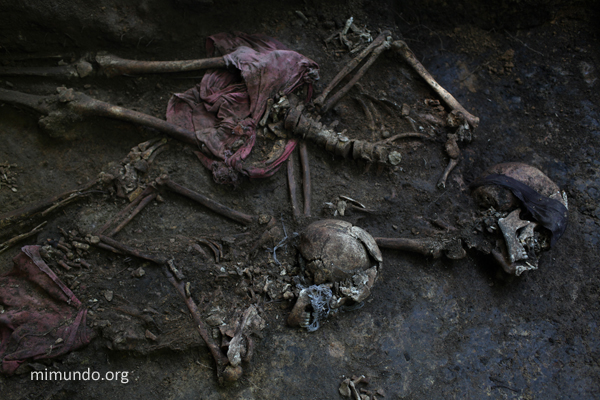
As this image displays, most of the 24 human remains found in Mass Grave 16 were found bound, tied, blindfolded and only wearing underwear.
The dig in Coban is revealing the gruesome reality of the country’s internal armed conflict, where people labeled subversives—political and student activists, Indigenous leaders and community members, and others— were kidnapped and tortured en masse. Children were also murdered before being dumped in clandestine graves at the base. All of this took place within the protective confines of a military controlled area.
Of the 28 former military areas the FAFG has dug since 1996, 24 have turned up bodies. Some of those digs are still works in progress, while more military bases, zones and detachments remain to be investigated. The dig at CREOMPAZ has turned up by far the largest number of corpses of any base.
“When the peace accords were signed, many military bases or detachments were reduced and closed. But the military remained here the whole time,” said Suasnavar of the base at Coban. “They say to us ‘we didn’t know that that happened, it was another time, it was other people, but you found it so there’s no other option than to keep working,’ right, those have been the words that they use with respect to our findings. But the continuity in the structure and function and the territorial control of this location has been strictly military.”
Regardless of the mass graves at the base, military and police training continues there, supported by countries like the US and Canada.
“The facilities have a sort of rank as a military organization of the United Nations, in fact the Guatemalan soldiers and officials that are based there wear the distinctive blue helmets,” said Iduvina Hernández Batres from the Guatemala City based organization Security and Democracy (Sedem). “This is happening, and this unit exists there, regardless of the fact that this property has been documented to have constituted an enormous clandestine cemetery.”
In 2011, the Ottawa-based Pearson Centre carried out a workshop at CREOMPAZ about “police and military cooperation in peace operations.” [2] Canada’s Department of Foreign Affairs and International Trade and the US Southern Command jointly funded the event. Soldiers trained at CREOMPAZ have been deployed as part of UN missions in Haiti and the Democratic Republic of Congo.
For some, like Ka’koj Ba Tiul, a Maya Poqomchi’ anthropologist and professor, CREOMPAZ has received an unwarranted facelift by rebranding the military base as a peacekeeping center.
“It is a school of assassins. The hidden side is the training of teams of military counterintelligence,” said Ba Tiul, who calls CREOMPAZ “the little School of the Americas.”
“There are instructors from Argentina, instructors from Chile, instructors from Colombia, instructors from North America, and instructors from Israel,” said Ba Tiul in an interview at his home just over a dozen kilometers from the base. “It is where they are training all of those who will form part of the modern counterinsurgency model for Guatemala and Central America.”
Dawn Paley is a freelance journalist. See more of her work at her website, dawnpaley.ca. Images by James Rodríguez. See more of his work at mimundo.org.
[1] http://www.canadainternational.gc.ca/guatemala/development-developpement/start.aspx?lang=eng&view=d
US ‘suicide’ label for dead of Yemeni Gitmo inmate discounted
Press TV – November 29, 2012
US military’s claim that a Yemeni inmate found dead in September at Guantanamo Prison camp had committed suicide by medication drug overdose has been discounted by American and Yemeni officials.
The circumstances surrounding the death of Adnan Farhan Abdul Latif, one of the first men taken captive by American forces after their invasion of Afghanistan, have raised suspicions since the military announced over two months ago that a guard at the notorious prison and torture camp had found him “unconscious and unresponsive” in his cell, The New York Times reported Thursday.
While a US military medical examiner labeled Latif’s death as “suicide,” how he gained access to additional drugs is reportedly still under probe.
Yemeni officials have refused to accept the remains of the inmate until they get answers about the exact cause of his death. This is while a Pentagon official delivered an autopsy report to the Yemeni ambassador in Washington earlier this month, describing Latif’s death as ‘suicide,’ the daily adds, citing a report this week by the Web site, Truth-out.org.
However, Latif’s former lawyer, David Remes, expressed skepticism about how Latif could have saved his daily medications for an overdose without detection considering that he was under “intense scrutiny” by guards and prison cameras.
Remes further suggested that authorities at the military prison may have deliberately given Latif access to too much medication “hoping he would kill himself,” the report adds.
Moreover, Remes reiterated that shortly before Latif’s death, other Guantanamo detainees said guards had told Latif that they were taking him to a disciplinary cellblock, which he resisted. He was then placed in a specific cell which “he hated because of droning noise from an adjacent electric generator,” the report notes.
“Adnan (Latif) was a thorn in their sides,” Remes said. “The guards would ask other prisoners how to handle him. He refused to submit. He wouldn’t allow them to set the terms of his imprisonment. He was a constant problem.”
Latif, was seriously injured in an auto accident in his native Yemen and was in Afghanistan, seeking free or charity medical treatment when he was taken captive by US-led occupation forces.
He had been cleared for transfer back to his homeland before by both the Bush and Obama administrations; however he wasn’t sent home.
In 2010, a federal judge ordered Obama administration to free Latif, arguing that the evidence against him was too weak. However, an appeals court panel reversed that ruling in 2011.
According to the report, executive branch panels under the Bush and Obama administrations had repeatedly cleared the Yemeni inmate for repatriation, but he was still kept at Guantanamo “because both administrations were reluctant to send detainees to Yemen amid an Islamist insurgency.”
Negev Bedouin protest demolition orders for ‘recognized’ village
Ma’an – 19/10/2012
TEL AVIV, Israel – Around 2,000 Bedouin citizens of Israel protested in the southern city of Beersheba on Thursday after their village received demolition orders from the authorities, Israeli press reported.
The Palestinian residents of Bir Hajaj chanted “Yes to recognition! No to destruction!” outside the court and government offices, Haaretz newspaper said.
A large Israeli police force escorted officials to the village last week to hand over demolition orders, sparking clashes that were dispersed with tear gas and shock grenades.
“We’re demonstrating because as a result of the demolitions, there are people in the town who have no roof over their heads,” Haaretz quoted Bir Hadaj resident Ayash Abu Assa saying.
“The police decided to attack us. They want to prove that they are in control and that there’s nothing we can do about it.”
Bir Hajaj is among the Bedouin communities that have been formally “recognized” by the Israeli government.
Israel classifies approximately 40 villages in the Negev as unrecognized, arguing that the 53,000 Palestinian Bedouins living there cannot prove land ownership. The Bedouin communities say the land is their ancestral home.
“Despite (Bir Hajaj) being a recognized village, none of the residents have received permits to build new houses,” the director of the Adalah Legal Center for Minority Rights, Thabet Abu Rass, told Haaretz.
“While the media is busy with the (Israeli) elections, the state has opened a war of destruction against the Bedouin villages.”
Related articles
- A new Nakba looms as Israel plans ethnic cleansing of Palestinian village in the Negev (alethonews.wordpress.com)
- Israel threatens to demolish ‘illegal’ Bedouin school (alethonews.wordpress.com)
Featured Video
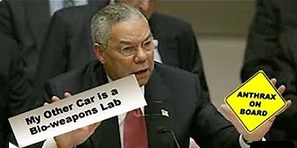
From Anthrax to Iraq
or go to
Aletho News Archives – Video-Images
Book Review
New paperback: Butchered by “Healthcare”
Lies are Unbekoming | October 20, 2026
 Butchered by “Healthcare” is Robert Yoho’s plain-spoken account of how American medicine stopped being a profession and became an industry. 341 pages. Over a thousand references. Thirty-eight chapters.
“Screening Tests Are Useless”, on tests that find diseases that would never have hurt you. “The FDA Protects the Big Drug Companies”, on an agency funded by the companies it regulates. “The Journals’ Sins Are the Editors’ Sins”, on ghostwritten studies and captured peer review. “Opioids and ‘Pain Management’”, on how a generation was prescribed its way into addiction. “Prozac and Relatives” and “Antipsychotics Are Disastrous”, on what psychiatry does to adults and children. “Surgery: Money Before Patients”. “Failed Cancer Treatments”. “Futile CPR and Overprescribing”. “Billing Scams & Specialty Warfare”. “Hospitals Are Sharks”. Each with a Patient Tips section at the end on how to survive it.
If you have ever walked out of a doctor’s office with a prescription you didn’t ask for, or watched a parent put through a treatment that made them worse, this is the book you want on your shelf before the next appointment. … Full review
Butchered by “Healthcare” is available on Lulu now.
Blog Roll
 Aletho News
- EU sending ‘biased’ observers to interfere in Serbian election – president
- White House envoy declares kinetic action against Yemen ‘fruitless’
- Ukraine deployed thousands of microdrones in Iraqi Kurdistan: Tasnim
- Iran calls for emergency UNSC meeting over Trump’s ‘brazen’ bomb talk, Israeli threats
- Iranian sources reveal details of Russia-China Hormuz proposal
- Plan for more US-Israel integration puts our military tech at risk
- Another Round Against Iran Will Break What Is Left of the Gulf
- SVR Report on Ukraine’s Mexican Drug Gang Links Could Pressure Zelensky, Won’t Change US Policy
- British Government Employees Were Fact-Checking the News at the BBC. Nobody Told You.
- Albania on fire: who’s behind the riots?
- If Americans Knew
- Mysterious bot accounts reportedly spread fake ‘man on the street’ videos for Michigan Senate candidate
- Israeli Defense Minister Katz Says Over 60 Lebanon Villages Have Been Destroyed
- Why Is Israel Running TV Ads in Iowa Ahead of the Midterms?
- Hind Rajab’s Alleged Killer Is in the United States. HRF Demands His Arrest.
- US Officials Face Fresh Pressure After Another American ‘Brutalized’ by Israeli Settlers in West Bank
- Israel-Backed Palestinian Militias Terrorize Displaced Families in Gaza
- FBI subpoenas pro-Palestine activists over Israeli weapons plant disruption
- Fourth winter arrives in wartorn Gaza, too early – Daily Update
- More on how Bari Weiss is using CBS on behalf of Israel
- What the UK Is Doing to Pro-Palestine Novelist Sally Rooney Is an Act of Orwellian Villainy
- No Tricks Zone
- Predictions Made By Renowned Climate Proifessor Over Past Decades Have Been Proven To Be Poor
- New Study Suggests Large Regions Of The Pacific Ocean Have Been Cooling For The Last 80 Years
- Germany’s Green Energy Debacle: High Energy Costs Force Kahla Porzellan to Close After 182 Years!
- New Study: 50 Years Of The Most Aggressive ‘Net Zero’ Policies Can Only Affect The Global Climate By 0.03°C
- US September “Heat” Was No Record…Many Records Set Decades Ago
- Latest European Green Energy Debacle; Portugal’s Largest Flagship Solar Park Insolvent!
- Green Energy Debacle: German Expert Professor Fritz Vahrenholt Warns Of Severe Economic And Social Consequences
- Two More Paleo Reconstructions Affirm Meters-Higher Sea Levels Across Ireland, Brazil 7000-6000 Years Ago
- New Study: Earth And Venus Surface Warmth Largely Explained By Convection And Lapse Rate, Not CO2 Or Radiation
- 2025 Nature Paper Claiming Worsening Global Drought Gets RETRACTED …Heavily Flawed

