Hungary will order large, mainly multinational, corporations to hand over “extra profits”
Samizdat | May 25, 2022
Hungary intends to fund the military and social safety programs by taxing banks, insurance companies, airlines, energy and telecom utilities and others, Prime Minister Viktor Orban announced on Wednesday.
It is his first action under a state of emergency that Budapest has just enacted, citing the conflict in neighboring Ukraine.
“We ask and we expect that those who made extra profit in this time of war help the people and contribute to the national defense budget,” Orban said in a video posted on Facebook.
In a follow-up post, Orban said that a “drastic increase in prices” was due to the ongoing conflict and the “sanctions policy in Brussels,” while “banks and large multinational companies” are reaping extra profits thanks to rising interest rates.
To fund the military and social safety networks, the Hungarian government has set up two funds, and will “require banks, insurers, major trade chains, energy and retail companies, telecommunications companies and airlines to deposit a large portion of their extra profits” there.
This regime will be in effect for the rest of 2022 and 2023, Orban added.
Budapest announced the state of emergency on Tuesday, just hours after Orban’s new cabinet was sworn in. The Hungarian parliament quickly approved a constitutional amendment allowing emergencies to be declared in case of war in a neighboring country – in this case, Ukraine.
Orban’s extra-profit tax affects mainly multinational companies. According to Bloomberg News, it will help shore up Budapest’s budget due to a de facto EU embargo. Brussels had imposed a funding freeze against Orban’s government following his landslide victory in last month’s election, citing “rule of law concerns.”
The funding freeze regulations were adopted by the EU administration in order to pressure the governments in Hungary and Poland to follow the policies of Brussels when it came to immigration, judiciary, LGBT issues and other matters in which Budapest and Warsaw have dissented.
Bucha, Budapest and the Multiplying Problems of Real War Criminals
By Tom Luongo | Gold Goats N’ Guns | April 5, 2022
Fungal President Joe Biden openly declared Russian President Vladimir Putin a “war criminal” in a recent outburst while speaking at NATO. He’s repeated this in the wake of the initial images coming out of the town of Bucha, Ukraine where an alleged massacre of civilians by Russian soldiers took place.
Like many incidents similar to this in the past it is hard to take any of these claims of blame seriously. The US and UK have staged many a ‘false flag’ operation in the past at convenient times to gin up diplomatic outrage to advance a particular political agenda.
That agenda is always to justify more war to deal with the villain du jour. Today it’s Putin. In the past it’s been Saddam Hussein, Slobodan Milosevic or Bashar al-Assad. The playbook is always the same. Shocking images and film of honest-to-god atrocities against civilians and an endless back and forth of accusations and suppression of real information about the event.
Sadly, that becomes the focus not the fact that civilians were murdered for political gains.
Bucha seems to fit this pattern quite well, if more crudely implemented than events like this in the past.
The censorship is nearly total to support the ‘current thing,’ in this case Bucha. But it is no different than the campaigns against certain medications to fight COVID-19.
When it comes to foreign policy objectives, there is always a common denominator in these events to frame that villain and Putin, in particular, as some evil madman… British intelligence.
From the poisoning of Sergei Skripal, to the downing of MH-17 over Ukraine, to the ammonia gas attack in Douma, at the center of these allegations is always some arm of the Brits.
All the roads to RussiaGate lead through Ukraine and British Intelligence. At some point you just have to face the face of the agitator. Every one of those stories have logical inconsistencies wide enough to drive a column of tanks through.
These are painstakingly worked through by investigative journalists pushed to the fringe by the technocrats’ willing partners in Silicon Valley to minimize their influence over the narrative.
That, in itself, should be considered prima facia evidence of malfeasance but sadly it isn’t.
From the moment Russia’s troops crossed the border into Ukraine on February 24th there has been a clear strategy by the Russian Ministries of Defense and Foreign Affairs to head off potential false flags publicly before they could be pulled off.
The Russian Foreign Ministry singled out the UK for its histrionics saying if they wanted to lead the charge, they’ll get the worst treatment.
With the pullout of Russian troops from around Kiev however, they have little control over the preparing of the stage. You believe what you want to believe about Bucha, I don’t care.
Given the track record of Russia’s accusers here I’m taking the position that these allegations have to be incontrovertibly proven publicly for me to believe a word of them. Here’s one version of the story (warning: very graphic).
That is how low the credibility of the sources on this are. The UK government has been, along with Biden’s Dept. of State and National Security Council, the most belligerent in their response to Russia’s military operation. Their history and naked hatred of all things Russian stretches back multiple centuries.
In short, they have motive, means and opportunity to stage a false flag to push public sentiment further towards NATO’s intervention into Ukraine officially, therefore a false flag is the most likely scenario.
Complaints about how Russia waged the initial part of this war have centered on their unwillingness (but not opposition) to target civilians. Kiev could have easily been taken if the Russians wanted to commit massive atrocities against civilians.
They did not do so. That flies in the face of what’s being alleged about Bucha. That doesn’t mean it didn’t happen the way it is being alleged, but the burden of proof lies with the accuser (Ukraine) and their allies (The US and UK).
And the main amplifier of this story, the UK, blocked not one but two proposals by the Russian Federation to investigate what happened in Bucha. We can’t have that, there’s a war to escalate.
Remember this story is only possible because the Russians first got repulsed from taking Kiev and then pulled back from the areas surrounding it. They are redeploying forces and regrouping for a major push against Ukrainian forces trapped in the eastern part of Ukraine.
That operation will likely wipe out what’s left of the UAF troops there and push the next phase of this war on the ground to its natural state of equilibrium for the next few months.
There are so many people whose crimes in Ukraine would be exposed by a Russian win there that it is truly existential to keep that from happening. It goes deeper than even the ideology of the West which needs to subjugate Russia if the Davos plan for global governance is going to have any hope of succeeding.
This is also personal for everyone from Joe Biden himself to hundreds, if not thousands of people complicit in the various schemes, plots and crimes committed in the petrie dish of corruption they’ve staged their attacks on common decency from.
So, when I say they have motive, means and opportunity, I mean it. These are the same people who impeached Donald Trump over a phone call. Of course they will say the quiet parts out loud about what they want to do to Putin for screwing up their grand plans.
This brings me back to my article from the other day handicapping the Hungarian elections. Because Hungary is now in a very strong position I posited they’d be in if Viktor Orban won the election, which he did, emphatically. And that means the EU is in a very precarious position to continue supporting an anti-Russia policy stance.
With a fiscally, monetarily (they are not on the euro) and energy independent Hungary there is little argument for them staying in the EU if Brussels is going to treat them as second class members. Orban and his government have been resolute in their refusal to get involved in the Russia/Ukraine conflict even though there has been serious pressure applied by NATO.
In anticipation of any resistance to the EU’s new set of draconian and frankly insane sanctions on Russia the European Commission wasted no time in announcing they are beginning ‘rule of law’ procedures against Hungary to cut them out of any monetary distributions within the bloc.
The European Commission will soon trigger a powerful new mechanism to cut funding to Hungary for eroding the bloc’s rule-of-law standards, Commission President Ursula von der Leyen said Tuesday.
The announcement comes two days after Hungarian Prime Minister Viktor Orbán won a fourth consecutive term in an election that international observers said was marred by an uneven playing field benefiting the ruling Fidesz party…
… Von der Leyen said her team informed Hungary of its decision on Tuesday after reviewing Budapest’s responses to an informal letter the Commission sent last November asking for information on its rule-of-law concerns.
“We’ve carefully assessed the result of these questions,” von der Leyen said, speaking to the European Parliament. “Our conclusion is we have to move on [to] the next step.”
There’s nothing ‘careful’ about the EU’s assessment here. Hungary and Poland were forced to accept these new rules in a major political battle with the EU in 2021 over their Green New Deal. He wasn’t in a strong enough position to stop this and it meant then we would wind up here today if he won re-election.
The EC’s formal charges against Hungary over their furry law is just like other such moves, namely against Poland for its hated Supreme Court recall law. They are forcing the ultimate choice on Hungary because all the EU really has is Article 7 censure and expulsion from the Union as a threat.
The amount of money they are holding as a carrot to Orban in COVID relief funds is just 30 pieces of silver and he knows it.
So, if you play this out to the end, this is where Orban has to go. He must force the EU to do what Mark Rutte said last month, kick them out or back down.
Today the European Commission is staring at the real threat: that Hungary has no intention of going along with the new sanctions and Orban actually welcomes Von der Leyen’s move to censure and cut off Hungary’s funds from the EU budget.
They will be a country that now pays in but gets nothing in return other than the stick.
But as long as they are a member of the European Commission they can and will veto anything else Von der Leyen cooks up to punish Russia with as a political cudgel to beat vulnerable EU members into going along with.
The EC thinks they will be making an example of Hungary but what they will really be doing is giving Orban an even stronger hand to play on the European Council. Now he can stay in Budapest and tell Hungarians that the EU no longer works for Hungarians and they would be better off free from their yoke.
Hung-exit, anyone?
Elections have consequences when you don’t control the outcome of them. This is why the neocons and war criminals like Hillary Clinton, Lindsey Graham and Joe Biden are all screaming that something or someone has to do something to stop Putin whose operation in Ukraine still has the potential to expose everything.
It’s why Bucha was so haphazardly staged and ham-fistedly packaged up to us.
The blow out results in Hungary on Sunday were a major blow to EU confidence and solidarity. Twelve years of calling Orban a Nazi while supporting real 4th generation Nazis in Ukraine landed with a whimper.
Von der Leyen is a certifiable idiot for invoking the ‘rule of law’ weapon against Orban here using the alleged events at Bucha. She’s using it as an excuse to purposefully destroy the European economy per the directive of her Davos handlers. Their calculus is simple, burn the entire global economy down to punish Putin, Xi and everyone else not down with the Comintern.
It exposes the EU’s complicity in the war on Russia as willing partners with the US and UK because if they wanted to continue virtue signaling they would propose crazy new sanctions and let Hungary veto them.
But now we can only conclude this is exactly what they wanted.
That puts things into stark relief as we look ahead to the increasingly likely probability that French President Emmanuel Macron loses to Marine LePen in France who would be in a far stronger position to break up EU solidarity, freezing it politically at a time when Europe’s financial vulnerability has never been higher.
Meanwhile Putin keeps saying “Got Gold or Rubles?” and Orban is preparing a cold dish of political revenge on the nastiest people in Europe. When this mouse roars, they may finally have to listen.
Pollsters Humiliated As 2 Pro-Putin Parties Win Avalanche Victories In European Elections
By Tyler Durden | Zero Hedge | April 3, 2022
In a one-two knockout punch for pro-Russia governments in Europe, on Sunday the government of Serbia’s pro-Russia president Aleksandar Vučić was headed for an avalanche victory in the country’s presidential election with nearly 60% of the vote, a big improvement to this 2017 election result… while Hungary’s Pro-Russia prime minister, Viktor Orban, was on track to clinch a fourth consecutive term, leveraging a message against being dragged into the war in neighboring Ukraine, to reassert himself as the European Union’s longest-serving premier.
With roughly half of the vote counted, Orban’s Fidesz party led United for Hungary, a six-member opposition alliance, 57% to 32% in the party list contest, according to the National Election Office, with 63% of the votes counted. That would be sufficient for Fidesz to keep its two-thirds parliamentary majority.
Despite opinion polls forecasting a tighter race, Orban’s Fidesz party won comfortably across much of the country. Opposition leader Peter Marki-Zay even failed to win in his own district, where he had served as mayor. The far-right extremist Mi Hazank party won 6.3%, and was set to enter parliament, further diluting the power of the anti-Orban alliance.
“We have such a victory it can be seen from the moon, but it’s sure that it can be seen from Brussels,” Orban said in his speech on Sunday night, making light of his government’s long-running tensions with EU leaders.
“We will remember this victory until the end of our lives because we had to fight against a huge amount of opponents,” Orban said, citing a number of his political enemies including the Hungarian left, “bureaucrats” in Brussels, the international media, “and the Ukrainian president too — we never had so many opponents at the same time.”
The election campaign was dominated by Moscow’s invasion of Ukraine, which put Orban’s lengthy association with Russian President Vladimir Putin under scrutiny. In his victory speech, Orban called Ukraine’s President Volodymyr Zelensky one of the “opponents” he had to overcome during the campaign.
Orban’s unexpectedly strong victory defied polls ahead of the vote that had predicted Orban would face the toughest challenge to re-election in his 12 years in power, according to a report from the anti-Orban Bloomberg News. It almost makes one wonder why anyone – besides liberals of course – still uses polling, which obviously can’t forecast the future and also fails at mere propaganda and influencing election turnouts.
Until recently, a new term would have been a defining moment for the 58-year-old Orban, who over the past decade consolidated power and challenged the EU’s so-called “democratic foundations”, raising questions about Hungary’s allegiance to so-called “western values.”
As Bloomberg adds, “after forging closer ties with Russian President Vladimir Putin while needling his EU counterparts over everything from controlling courts to LGBTQ rights, Orban risks deeper isolation as Europe confronts Moscow over the invasion of Ukraine.” Perhaps so, but the people have spoken and the people clearly want a person in charge who forges closer ties with Putin while needling EU counterparts. Or maybe it’s time for the deep state Biden to suggest some more regime change, this time in Hungary?
Amid the war in Hungary’s eastern neighbor, Orban refused to fold to western pressure and offered limited support for Ukraine, refusing to let weapons shipments cross Hungary and rejecting a ban of Russian oil and gas imports.
His message was that joining a rush by fellow EU and NATO members to aid Ukraine with weapons would drag Hungary into the war. That resonated with voters against an opposition campaign suggesting that Orban is Putin’s pawn and the ballot a choice between East and West.
In the end, being close to Putin served as a powerful force behind Orban’s avalanche victory.
That said, Obran has an uphill battle in containing the fallout from the Ukraine war – record pre-election spending which prompted the government to cut the economic growth outlook, will require Orban to almost immediately address budget concerns. Phasing out price caps on basic food items and especially fuel, imposed in the run-up to the vote, will test his enduring popularity. Household energy subsidies, in place since 2013 and a reliable vote-getter, may also have to go.
The political challenges could be equally daunting. While the cost of financing Hungarian debt has soared as the central bank hiked interest rates to the highest in the EU, Hungary’s access to billions of euros of crucial EU funding has been delayed due to concerns over corruption in Hungary, a standard trick in Brussels which ruthlessly and anti-democratically determines who can and can not rule in Europe by limiting access to funds.
Meanwhile, Orban’s political narrative – centering on the decline of the West and the rise of authoritarian regimes – remains his strong suit. As a result of the Ukraine war, about half a million refugees have arrived in Hungary, and in one of the starkest U-turns, the anti-immigration Orban welcomed them and even posted pictures of himself hugging Ukrainians.
He will also need to navigate a new EU mechanism that links funding to adherence to rule of law. It was approved in 2020 after the Hungarian premier outmaneuvered the bloc’s concerns about the rollback of democratic norms for the better part of the decade. Should it be activated this year, it threatens to deprive Hungary of as much as $40 billion. Of course, should it be activated, many peripheral states may simply decide to seek a better fate in the orbit of other nations – such as China or Russia – which would be a catastrophic blow to the future of the EU.
Hungary responds to Zelensky’s demand for support
Samizdat – March 26, 2022
“Hungary is on Hungary’s side,” its prime minister, Viktor Orban, said in a statement on Saturday, in response to Ukrainian President Volodymyr Zelensky’s calls for Budapest to quit sitting on the fence in the conflict between Kiev and Moscow.
Orban said that, while his country could not “be indifferent” to the “Russo-Ukrainian war going on in our neighborhood,” Hungary would look after its own interests first, and maintain a “Hungarian point of view.” He went on to stress that Budapest “want[ed] to stay out of this war,” but that this did not preclude it from helping “those in need.”
The statement came in response to Zelensky having urged Orban to choose a side in the conflict. Speaking to EU leaders via video link on Friday, the Ukrainian president thanked the Baltic states, Poland, France, and Germany for their support, but noted that Hungary was still declining to take a stand. He called on Budapest to “decide for yourself who you are with.” Addressing Orban directly, Zelensky asked him if he knew “what’s going on in Mariupol,” referring to the besieged southern port city, which has seen heavy fighting in recent days.
Zelensky reiterated his request that his country’s application to join the EU be swiftly considered, and once again appealed to Hungary in particular not to block the bid.
Unlike the other EU member states bordering Ukraine, Hungary has so far refused to either send weapons to Kiev or let other countries move such shipments through its territory.
Orban has argued that, as around 85% of its gas and over 60% of its oil is imported from Russia, it would not be in Budapest’s best interest to rile Moscow.
In his latest statement, however, the Hungarian prime minister emphasized that “it must be made clear to the Russians that it is not worth pursuing this war,” warning at the same time that Europe should avoid hurting itself “more than the Russians.” He also called on Brussels to provide Hungary with more funding to deal with the influx of Ukrainian refugees.
Hungary not willing to host NATO troops amid Ukrainian crisis
By Lucas Leiroz | February 10, 2022
Another European country appears to be taking different paths from NATO’s central plans. In a recent official statement, the Hungarian foreign minister stated that his country will not allow the arrival of more NATO troops on its territory. The case demonstrates further evidence of the crisis in the legitimacy of the anti-Russian discourse of the Western alliance, which is increasingly convincing fewer people.
Peter Szijjarto, Hungarian foreign minister, during an interview to Euronews on February 9, stated that Hungary is unwilling to receive NATO troops on its territory in the midst of the current Ukrainian crisis. For him, the Hungarian armed forces are sufficiently well prepared and equipped to deal with any threat of war in the region, so there is no need to import more foreign troops.
These were some of his words: “No, we have not agreed to that and we will not agree because we have already NATO’s troops on the territory of the country, which is the Hungarian army and the Hungarian armed forces, [they] are in the proper shape to guarantee the security of the country. So we don’t need additional troops on the territory of Hungary”. Szijjarto also commented that the current Ukrainian situation recalls the Cold War times, which were “many decades where we [the Hungarian people] suffered (…) That’s why we don’t want these times to come back. We ask, we urge the international community to do its best in order to avoid the Cold War to return, avoid even the psyche of the Cold War to return because we learned it from history, unfortunately have very clearly, that whenever there is an East-West conflict , the countries of Central Europe lose and we don’t want to be losers anymore”.
In addition to ruling out the possibility of receiving troops and taking a stance against a “new cold war”, the minister also expressed skepticism about the efficiency of the implementation of coercive measures against Moscow: “If you look at the sanctions themselves, it’s a failure. They don’t work out. They are unsuccessful. Trade between Germany and the Russian Federation has increased since the sanctions have been in place. (…) We have to invest in diplomacy, we have to invest in dialogue. That’s why we urge the Russian Federation and our Western allies, the big countries, the strong countries, not to give up hope of peaceful settlement, to the contrary, to talk to each other because once again, I want to underline that for us, rather small Central European countries, it can be extremely dangerous if violent action take place”.
Szijjarto’s speech comes as a Hungarian response to recent American pressure for all European countries to accept that new NATO troops are deployed on their territories. Earlier, US Defense Department spokesman John Kirby said Washington would send a new group of troops to Europe, including a squad of about 1,000 men to Romania, a country that borders Hungary and already has more than 900 American soldiers installed. On February 8, the first soldiers of the new American squadron for Romania arrived in Bucharest, which increased pressure during this week for Budapest to give a definitive answer on the reception of the troops, but the Hungarian government seems really willing not to follow the trends in neighboring nations.
In fact, this kind of attitude is being taken simply because Budapest no longer believes in the existence of a Russian invasion plan. And it is very likely that other European governments will soon abandon this narrative as well. This is a natural consequence of the recent events. NATO has been talking about such an invasion for a long time, but it never happened and is unlikely to happen, so there is no reason to accept that European countries are passively filled with thousands of American soldiers. There is no threat to justify this.
Furthermore, regarding the opinion against sanctions and in favor of bilateral dialogue, we can see that the Hungarian government is forming a solid pro-diplomacy stance. This position is a consequence of the friendly ties that Viktor Orban has been trying to develop in recent times – which is why he suffers so much criticism within the European Union. In early February, the prime minister visited Moscow and spoke with Putin on various strategic topics in bilateral relations, including security issues in Europe, gas trade, among others. In the West, Orban’s attitude has been seen with criticism due to the moment of tensions, but it was an opportunity to make it clear that the Hungarian position is anti-war, anti-sanctions and pro-diplomacy one. Now, Szijjarto’s words corroborate this thesis.
It is possible that it will take time, but at some point other European countries will start to take the same attitude as Hungary. There is no possibility that the narrative about “Russian invasion” will endure, considering that it is unsubstantiated and fallacious. If there is no threat of war, there will be no reason for these governments to want their territories occupied by foreign troops and this will inevitably generate a NATO retreat in Europe.
Lucas Leiroz is a researcher in Social Sciences at the Rural Federal University of Rio de Janeiro; geopolitical consultant.
US Asks Hungary To Host Troops Aimed At Russia, Despite Long Snubbing Orbán
Suddenly Washington wants something from Hungary, after seeking to isolate and humiliate Budapest…
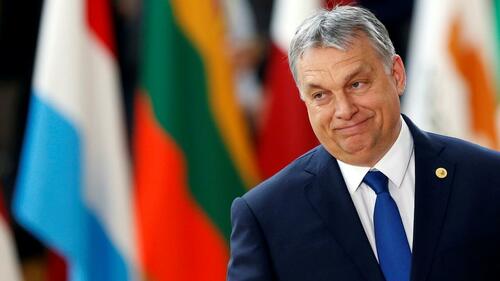
Viktor Orbán via Reuters
By Tyler Durden | Zero Hedge | January 28, 2022
It’s been revealed that the United States approached Hungary this week to ask the country to host a temporary troop deployment related to the Russia-Ukraine crisis. Hungarian Foreign Minister Peter Szijjarto “received an American request about temporary deployment of troops” – CNN reports.
Hungary’s Defense Ministry is said to be discussing the formal request; however, given the tense US administration relationship with the Viktor Orbán government since Biden took office – centered on seeking to isolate the conservative prime minister known for his unapologetic ‘Hungary first’ policies – the prospect remains highly unlikely. This comes as Biden announced Friday that he’ll be sending a small number of American forces to Eastern Europe: “I’ll be moving troops to eastern Europe in the NATO countries in the near term.” He qualified in the remarks reporters at Joint Base Andrews after returning from Pittsburg that this will be “not too many” troops.
A mere less than two months ago, Biden tried to humiliate Hungary’s “human rights backsliding” leader:
On Thursday and Friday, U.S. President Joe Biden will gather leaders from over 100 countries to a virtual “Summit for Democracy.” He invited rule-of-law troublemaker Poland. He invited Serbia, despite some questionable democratic credentials. He invited every EU member but one.
That one was Hungary.
CNN further reports that Romania and Bulgaria are also mulling the acceptance of additional US deployments. Both eastern European NATO countries are typically much more amenable to US security requests, and Romania already provocatively hosts coastal defense missiles on the Black Sea.
Among the security guarantees Russia is currently seeking from Washington and Brussels is precisely that NATO forces leave Bulgaria and Romania.
Thus when it comes to Hungary, from the point of view of officials in Budapest they are unlikely to want to see their country thrust into the middle of the tense escalating Russia vs. West standoff.
“The deployments would number approximately 1,000 personnel to each country and would be similar to the forward battle groups currently stationed in the Baltic States and Poland,” CNN notes of the numbers under initial discussion – though without doubt this would be ramped up in the instance of any potential Russian incursion into Ukraine.
Meanwhile, in a Russian media interview FM Sergey Lavrov said Friday “If it’s up to the Russian Federation, there will be no war. We do not want wars. But we won’t allow the West to grossly ignore our interests, either,” according to Sputnik.
Uninvited foreign troops must leave, African nation says
RT | January 24, 2022
Denmark must “immediately withdraw” some 90 troops it deployed to Mali last week “without [the government’s] consent and in violation of the protocols” allowing European nations to intervene in that African country, the government in Bamako said on Monday.
Some 91 Danes from the Jaeger Corps special forces arrived in Mali on January 18, as part of Task Force Takuba, a French-led counter-terrorism mission in the West African country. According to the Danish defense ministry, their job will be to reinforce the border with Niger and Burkina Faso, train Malian Armed Forces, and provide medical services to the peacekeepers.
While the government of Mali is grateful to “all its partners involved in the fight against terrorism,” it stressed “the need to obtain the prior agreement of the Malian authorities” before sending any troops to the country, says the communique signed by Colonel Abdoulaye Maiga, spokesman for the Ministry of Administration and Decentralization.
Announcing the deployment of the force last week, the government in Copenhagen said it had been scheduled in April 2021, as France sought to withdraw some of its troops from Mali.
Their objective was “to stabilize Mali and parts of the border triangle between Mali, Niger and Burkina Faso, and to ensure that civilians are protected from terrorist groups,” the Danish military said.
The Jaegers are also experienced in “training and educating” local militaries, a job they have previously performed in Afghanistan and Iraq. They were sent shortly after Sweden withdrew its contingent from Mali. The French-led operation also involves forces from Belgium, Czechia, Estonia, Hungary, Italy, the Netherlands, Portugal and Sweden.
Task Force Takuba has operated in Mali since March 2020, when Paris decided to wrap up the previous Operation Barkhane. France has maintained a military presence in its former West African colony since 2013, to help the government in Bamako deal with a Tuareg rebellion in the northwest of the country and subsequent terrorist insurgency loyal to Islamic State (IS, formerly ISIS).
Relations between Bamako and Paris have grown chilly since the latest military takeover in Mali in 2021, and France has since closed three of its military bases there, in Kidal, Tessalit, and Timbuktu.
Israel finds 4 Pfizer jabs ‘not good enough’ against Omicron
RT | January 18, 2022
A fourth dose of Pfizer’s coronavirus vaccine showed dwindling effectiveness against the Omicron variant, according to a trial conducted in Israel, with one of its lead researchers saying the immunization is simply “not good enough.”
A study involving 154 medical staffers at Sheba Medical Center near Tel Aviv found that a fourth shot gave only marginal protection against the Omicron strain compared to previous mutations.
“We see an increase in antibodies, higher than after the third dose. However, we see many infected with Omicron who received the fourth dose,” said Gili Regev-Yochay, one of the head researchers on the trial, adding that while “the vaccine is excellent against the Alpha and Delta [variants],” for Omicron “it’s not good enough.”
Despite the new findings, Israeli health officials already moved ahead with fourth doses for the elderly, the immunocompromised and medical workers beginning earlier this month, with some 500,000 receiving a second booster on top of an initial two-dose regimen as of Sunday.
Though the trial is still in an early phase and the hospital did not offer specific figures, Regev-Yochay said she made its preliminary conclusions public as boosters are a matter of “high public interest,” according to the Times of Israel. She noted that giving fourth doses to high-risk residents is “probably” still the best approach, but suggested the booster campaign should be limited to an even older age group than the current over-60 guideline.
Both the World Health Organization and the EU’s drug regulator, the European Medicines Agency, have cautioned against the over-use of boosters, though for different reasons. The WHO has called for a more even distribution of vaccine doses around the world, observing that some nations are moving ahead with third and fourth shots before many in poorer countries receive their first. The EMA, meanwhile, pointed to potential adverse effects of booster shots last week, warning that repeated vaccinations in a short period of time could result in “problems with immune response.”
One of the most vaccinated countries in the world, Israel was the first to roll out fourth vaccine doses as it saw a significant spike in coronavirus infections linked to the Omicron strain. Deaths and hospitalizations have only seen a slight uptick in recent months, however, in line with findings suggesting the latest ‘variant of concern’ produces milder symptoms than previous mutations. Despite the misgivings of world health bodies, Chile, Denmark and Hungary have since followed suit in administering fourth shots, while officials in Austria have recommended them on an “off-label” basis for healthcare personnel.
Poland wants to end political censorship online
Poland is one of the few countries pushing to support free speech on monopoly platforms
By Dan Frieth | Reclaim the Net | June 10, 2021
According to Poland’s Prime Minister Mateusz Morawiecki, Big Tech corporations have amassed so much power that they control politics, and the solution is for governments around the world to introduce laws limiting that power.
Polish legislators are working on a bill that would make it illegal for online platforms to censor content that does not break Poland’s laws.
“Today, who sets these rules is really the master of destiny for society and for nation-states,” Morawiecki said in a recent interview with Newsweek. “So today, platforms and communication networks and intellectual property are even more important than the land and the buildings and the technology assembly lines and all the materials that go into creating these digital realms.”
The PM argued for a new approach focused on protecting the power of governments, as well as the well-being of society, accounting for the way the internet and social media has transformed the social, political, and economic environment.
“These dynamics do not make it easier to grasp the elements of the moving parts of the complicated interdependent economic jigsaw puzzle that is our modern age,” Morawiecki said.
“And this is why it is so much more difficult to understand who sets the rules today, because it is no longer the governments that can have this competence over the setting of the rules.
“Huge international corporations in the area of the digital world, in particular, are setting the rules very often that are suitable for themselves, which may not always be a social good.
“This is another form of dominance over the rest of the sectors they operate in, but it may also create dominance over other areas of the lives of citizens in a society.
“And this is why states should now be very active in eliminating censorship and eliminating monopolistic powers of those companies, as well. And this is one of the reasons we started to work on this anti-censorship regulation.”
Morawiecki and members of his political party PiS (Law and Justice Party) are pushing for the introduction of a new legislation to push back against Big Tech. They recently proposed a bill that would allow the government to fine social media companies for censoring legal speech in Poland. Additionally, the legislation would allow social media users in Poland to appeal censorship they deem unfair to the Free Speech Council, which will be formed when the bill passes. A social media platform found guilty of removing legal speech could be fined as much as $13.35 million.
In February, Hungary’s Justice Minister Judit Varga said she was working on a new law to “regulate the domestic operations of large tech companies.” She argued that mainstream online platforms “limit the visibility of Christian, conservative, rightwing opinions,” adding that the “power groups behind global tech giants” are so powerful that they can influence national elections.
In February, Poland’s Justice Minister Sebastian Kaleta echoed the conservative Hungarian government’s sentiments, saying the Polish government was focusing on protecting conservatives.
“We see that anonymous social media moderators often censor opinions which do not violate the law but are just criticism of leftists’ agenda,” he told the Financial Times. “This creates important risks of infringing freedom of speech.”
Morawiecki added that the new legislation is being discussed in parliament, and the government is not only looking at domestic legislation but also discussing it with the European Commission (the legislative arm of the European Union).
“We are in discussion with the European Commission in two aspects of this area. One is vis-à-vis the freedom of speech and eliminating the censorship issue,” said the Polish PM.
“The other one is in taxing companies where they do business—so not letting them go to tax havens like Luxembourg or Cyprus or Switzerland, and not paying taxes at all or very little taxes paid in these other tax haven countries, because I think that Big Tech companies minimizing their tax burden this way is not sustainable for our economies.”
Hungary’s NGOs will have to disclose foreign funds despite EU top court’s ruling: Orban
RT | June 19, 2020
Civil organizations involved in Hungarian politics will still have to disclose their foreign donors, PM Viktor Orban said on Friday. He made the statement after the European Union’s top court said Hungary’s stance on overseas funding violated EU law.
The Hungarian legislation was part of measures against what the government sees as unfair foreign influence, linked to its disagreements with US billionaire George Soros, who was born in Budapest.
On Friday, reacting to the ruling of the Court of Justice of the EU for the first time, Orban said Hungary would respect the decision about the funding of NGOs but transparency rules would continue to apply.
“All Hungarians will know about every and each forint worth of funding sent here from abroad for political purposes,” the PM told state radio.
Eastern Europe beats West in Covid-19 fight, but West can’t acknowledge it because of Cold War SUPERIORITY complex
By Neil Clark | RT | April 23, 2020
By any objective assessment, governments in the eastern half of Europe have dealt with the Covid-19 outbreak better than many in the west. Yet, because of deep-seated attitudes of superiority, few are giving credit where it’s due.
Europe is divided again, but this time not by a wall.
Compare the Covid-19 deaths worldwide per one million population, as of April 22, by country.
Top of the list is Belgium with 525.12 deaths per million. Then comes Spain (445.49), Italy (407.87), France (310.45), the UK (261.37), the Netherlands (227.26), Switzerland (173.54), Sweden (173.33), and then Ireland (150.41). Spot anything? They’re all western European countries.
You have to scroll down quite a way before you get to countries in central or eastern Europe.
Romania has had 25.57 deaths per million. Hungary, 23.03; Czechia, 18.92; Serbia, 17.9; Croatia, 11.74; Poland, 10.6; Bulgaria, 7.02; Belarus, 5.8; Latvia, 4.67; Ukraine, 3.61; Russia, 3.16; Albania, 2.87; and Slovakia, 2.57 (amounting to just 14 deaths).
How can we explain this new division of Europe? Well, it’s clear that geography has played its part. The main vector for the spread of Covid-19 has been population movements and, in particular, international air travel. More people visit western Europe than the east. There’s more coming and going. Covid-19 can be seen accurately as a virus of turbo-globalization, and western European countries are more turbo-globalised than those to the east. They also tend to be more densely populated, with some very large cities, which the virus likes, as it allows it to spread quicker.
But while eastern Europe has a number of ‘natural’ advantages, this doesn’t, I think, tell the whole story. Governments in eastern Europe have generally shown more common sense than most of their western counterparts. They quickly did the most obvious thing that you need to do when a virus has got its walking boots and rucksack on: they closed borders.
On March 12, Czechia declared a state of emergency and barred travelers from 15 countries hit by the novel coronavirus, including Iran, Italy, China and the UK. It then went into a ‘lockdown.’ On the same day Slovakia closed its borders to non-residents and imposed a mandatory quarantine for anyone returning from abroad.
Poland closed its borders on March 15 and Hungary followed suit one day later. Russia’s far east border with China had already been closed since the end of January.
Compare the decisiveness with which eastern European countries pulled up their drawbridges, with the hesitation in the west. On March 12, French President Emmanuel Macron declared “this virus has no passport”. As I wrote at the time, liberal ideology and virtue signaling were being put before public health.
The virus might not have a passport, but the people carrying it in from China, and then from Italy, most certainly did! By March 17 there were signs that western European states were going to do what their eastern neighbors had already done. “The less we travel, the more we contain the virus,” said EU Commission President Ursula von der Leyen. You don’t say!
At least western continental Europe did take some action on borders, albeit a week or so too late. Britain, by contrast, while imposing a ‘lockdown’ on domestic citizens, has continued to allow into the country unchecked flights from all over the world, including from New York, Iran and China.
It’s not just shutting borders and imposing strict quarantine measures that eastern European countries did right.
Generally, they’ve been quicker to act than their western counterparts. The culture of government undoubtedly plays a part.
I lived in Hungary for several years in the 1990s and was impressed by what I call the ‘administrative class.’ The people who work for the government, the civil servants, the old communist ’bureaucracy’, if you like, were very competent. They got the job done, with a minimum of fuss. In so many ways because of this efficient administration and a very high level of general and technical education, eastern European countries are actually better-run than many in the west, particularly Britain, where incompetence seems to lead to great rewards. Countries where there was a ‘five-year-plan’ political culture not surprisingly are better at planning than those where there wasn’t. Or, as the old saying has it, if you fail to plan, you plan to fail.
Another legacy of the much-maligned socialist era might also have played a big part in minimizing the impact of Covid-19 in eastern Europe. As RT reported earlier in the month, ‘striking’ evidence has emerged showing that the BCG tuberculosis vaccine might be protective against Covid-19.
Vaccinating their populations against TB was enthusiastically taken up by the socialist-bloc countries in the 1950s and remains mandatory in many, even though communism is gone. In Russia for instance, it is still given to children from three to five days old. By contrast, the USA and Italy never had a universal BCG programme, and, while Spain doesn’t have one either, its neighbour Portugal still does, and has had only 74.11 Covid-19-related deaths per million, compared to neighboring Spain’s 455.49.
The BCG programme may yet prove to be at least among the reasons why the old state of East Germany has a lower Covid-19 death toll than the western part of the country.
Germany is the only western European country that had a ‘socialist’ half – and it’s that socialist half which has helped bring its per-capita death rate down.
The failure to properly credit eastern Europe for its low Covid-related death rates reeks of bad sportsmanship.
Let me give you one example. On Monday evening I tweeted how Hungary had less than 220 deaths from Covid-19, compared to the UK’s 16,000. By any objective assessment, Hungary had done better than the UK.
“I guess that settles it” @JusticeTyrwhit tweeted. “Orban is actually ok then and we were wrong to oppose fascism all along….?”
For a certain type of superior westerner, eastern Europe’s governments can never do any good. If you say they have handled something well, you are ‘dog whistling’ your support for ‘fascism’ or ‘communism.’
Draconian Covid-19 lockdowns in the west of Europe are ‘sensible’ and police overreach is played down, draconian Covid-19 lockdowns in the east are displayed as signs of proof that these countries are run by ‘dictators’ and have a ‘long authoritarian tradition.’
It’s time that those with the Cold War mindset of ‘Order of The Coif‘ stopped patronizing the east and showed a little more humility. For, when it comes to dealing with Covid-19, governments in ‘backward’ eastern Europe have generally served their populations better than those in ‘advanced’ western ones.
Hungarian PM Orban Attacks EU Economic Policies and George Soros
Sputnik – February 17, 2020
Hungarian Prime Minister Viktor Orban has never been a fan of George Soros, the Hungarian-American billionaire and founder of the Open Society Foundations, often attacking the renowned philanthropist for allegedly meddling in Hungary’s internal affairs, as well as for supporting increased migration to Europe.
Viktor Orban, the Hungarian prime minister, has taken some shots at the International Monetary Fund (IMF), the European Union’s leadership, and against his probably least favourite Hungary-born billionaire George Soros, during his annual state of the nation address.
During the speech, Orban asserted that the past decade has been “the most successful” for Hungary in the last century, but noted that his country was still threatened by so-called “sinister menaces” the European economy was facing. The prime minister thus praised Hungary’s decision to break away from IMF loans and not to succumb to demands for more austerity, which, he alleged, would have made Hungary dependent on Soros.
“If we’d followed their advice, then Hungary now would be lying in a hospital ward with IMF and Brussels debt tubes hanging from its every limb and the faucet of the debt would be in the hands of George Soros”, Orban said on Sunday, as quoted by AP.
The prime minister insisted that a slowdown in the EU’s growth had a strong influence on his country’s economy, as 85% of Hungary’s exports were meant for other countries on the European continent. However, he slammed the idea that Europe should simply be represented by Brussels alone.
“We are Europe and we do not need to meet the expectations of tired and disillusioned elites of Brussels. There were times when we believed that Europe is our future but now we know that we are the future of Europe”, Orban said as translated by Euronews.
Founder of the Open Society Foundations and a proponent of liberal activism and open borders George Soros, has often been criticised by Orban for allegedly interfering in Hungary’s internal politics. The Orban government has been carrying out a crusade against Soros-related organisations in the state since 2017, criticising the billionaire for promoting increased migration to the country and thus threatening Hungary’s security and national identity.
Featured Video

The US bombed the Shahs house lol
or go to
Aletho News Archives – Video-Images
From the Archives
How a War with Iran Would Diminish American Power
By Greg Scoblete | The Compass | August 13, 2010
Jennifer Rubin wants a war with Iran:
But the emphasis on the existential threat to Israel ignores a more basic issue for Americans to ponder: a nuclear-armed Iran represents a dagger at the heart of America and an existential threat to our status as a superpower and guarantor of the West’s security. As to the former, Iran is pressing ahead with its long-range ballistic missile program. First the Middle East and Eastern Europe, then all of Europe and, within a matter of years, the U.S. will be within range of Iranian missiles. If those are nuclear and not conventional, what then? We’re not talking about whether Iran is going to be “merely” a destabilizing factor in the Middle East or whether it will set off an arms race with its neighbors or imperil Israel’s existence. We’re talking about whether America will then be at risk (and lacking sufficient missile-defense capabilities if we continue to hack away at our defense budget). The argument about whether mutual assured destruction can really work against Islamic fundamentalists who have an apocalyptic vision becomes not about Israel’s ability to deter an attack but about ours. Those who oppose American military action have an obligation to explain why America should place itself in that predicament.
I would argue that any obligation to present an explanation lies with those whose disastrous policy prescriptions with respect to Iraq lead America into the worst strategic blunder in the country’s recent history. That aside, note the blind faith in the power of the military to actually achieve its ends. … continue
Blog Roll
 Aletho News
- Iran in excellent position to prevail in war with US, Israel: John Mearsheimer
- Iran warns US: Do not call your retreat an agreement
- Neighbors first – Moscow signals shift in energy strategy
- Almost 400 Ukrainian drones downed over Russia in single night – MOD
- Battle for Hungary: How the Russiagate blueprint has been unleashed against Orban
- Brussels warns Slovakia over ‘discriminatory’ dual fuel pricing targeting foreign drivers
- Hungary to halt gas deliveries to Ukraine – Orban
- The US bombed the Shahs house lol
- The London Ambulances Attack: Of Course It Was A False Flag
- Embarrassing Pivot: U.S. considers dropping Iran oil sanctions amid war
- If Americans Knew
- ‘Forever live by the sword’: Understanding Israelis’ massive support for Iran war
- UN’s special rapporteur on human rights says Israel is systematically torturing Palestinians
- Trump White House plagiarized Iran war manifesto from Israel-aligned think tank
- Gaza says 6–10 patients die daily waiting for treatment abroad as Israel blocks medical evacuations
- ‘Substantial evidence’ of double-tap strike in killing of Gaza’s Hind Rajab
- ‘Do Not Want To Die For Israel’: Doubts About Trump’s Iran Strategy Spread Among Troops
- Instead of taking Joe Kent’s claims seriously, the media is disregarding him as an antisemite
- Joe Kent’s Explosive Interviews about his Resignation over the Iran War
- Israel poised to take over southern Lebanon; settlers wreak havoc in West Bank – Not a ceasefire Day 165
- From Sde Teiman, the truth about Israel’s military justice system has been set free
- No Tricks Zone
- Devastating Assessment Of Comirnaty Vaccine By Former Senior Pfizer Europe Toxicologist
- New Study: CO2 Is ‘Effectively Negligible’ As An Explanatory Climate Change Factor Since 2000
- Former Pfizer Toxicologist Dr. Helmut Sterz Tells Bundestag Hearing Pfizer Vaccine Should Have Never Been Approved
- Energy Expert: Germany’s Nuclear Phaseout Was A “500 Billion Euro Mistake”
- New Research: South Australia’s Mid-Holocene Sea Surface Temperatures Were 4°C Warmer Than Today
- Storing Green Energy To Last Germany 10 Days Would Require A 60-Million Tonne Battery
- New Studies: UK Sea Levels Were 4 Meters Higher Than Today During The Mid-Holocene
- Destructive Green New Deal: German Energy And Metal Group Warns Of Drastic Crisis
- New Study Documents A 20-Year Pause In Arctic Sea Ice Decline – Driven By Internal Variability
- Wake-up Call: Survey Shows Majority Of Germans Now Favor Postponing Climate Targets!
 Aletho News