Russia is Wary of Borrowing Abroad but Has Increased Foreign Debt by 10% in 2018 Anyway
Sputnik – 12.06.2018
Worried by Russia’s small foreign debt, international creditors are advising it to borrow more, but Russia’s Central Bank believes that investments, not loans, are the way to go.
Russia’s $525-billion foreign debt is dwarfed by $7.5 trillion in Britain, $5 trillion in France, $4.8 trillion in Germany and a whopping $21 trillion in the US.
This tell-tale ratio was not lost on IMF Managing Director Christine Lagarde who, when speaking at the recent St. Petersburg International Economic Forum, described Russia’s foreign debt as “considerably small” and said that it should borrow more.
The Russian Central Bank disagrees, arguing that “investments, not debt capital” should be the main source for financing the country’s economic growth.
Big Debt – Big Problems
Foreign debt may become a major problem if market conditions suddenly change for the worse. The smaller the debt, the lesser the chances of a default. Economists say that with Russia’s foreign debt accounting for just 33 percent of GDP, this is a fairly moderate debt burden.
Russia’s entire foreign debt is commensurate with the country’s gold and currency reserves of $450 billion. This means that Russia’s financial system can simply buy it back from foreign holders at any time.
Risk Minimization
Experts also say that Russia’s small foreign debt and its ability to pay it back fast makes it less dependent on foreign financing.
“The developing markets have found themselves in a bad fix with money going out and high dollar-denominated debt negatively impacting the national economies. In Russia this risk is virtually nonexistent,” TeleTrade currency strategist Alexander Yegorov told Sputnik.
A balanced budget is another reason why Russia does not need to borrow abroad.
This year Russia will have a budget surplus – the first in seven years with the Finance Ministry expecting state revenues to exceed outlays by more than half a trillion rubles ($16 billion).
A small foreign debt is also an indicator that the economy is performing well and the country is paying less interest on borrowed money.
There is one downside here, though, as this leads to a shortage of funds needed for economic growth. Russia is ready to borrow, provided that the money goes into useful and profitable projects that allow the country to easily meet its financial obligations to its foreign partners
In the first quarter of 2018, foreign sources lent Russia an estimated $17 billion in the form of sovereign Eurobonds. Another $2.3 trillion rubles ($36 billion) came from foreign investors buying federal loan bonds.
Russia’s Central Bank governor, Elvira Nabiullina, believes that Russia could borrow more abroad and use part of the money to finance various infrastructure projects inside the country.
Nicaragua’s Sandinista Achievements Baffle World Bank, IMF
teleSUR | August 31, 2017
No one can take at face value any report, governmental or quasi non-governmental, coming out of the imperialist bureaucracy in Washington. Ideological bias and institutional self-justification prevent these reports from giving a true account of virtually anything.
The latest World Bank report on Nicaragua is no exception.
The implicit but unstated truth in this report is that President Daniel Ortega and the Sandinista National Liberation Front have achieved an unprecedented economic turnaround in just seven years, starting in 2010.
Reading the report, it is impossible to ignore the tension between latent ideological and political imperatives and the obligation to report the facts. Put another way, mild conflict clearly prevails between the World Bank’s Washington head office and its reality based local officials. From Washington, the tendency is both to minimize Ortega’s achievement and also to cover up the World Bank’s own lamentable history in Nicaragua. On the other hand, in Nicaragua, local World Bank staff dutifully report the facts as they see them.
A total of 71 people contributed to the report. Supposing those 71 people each worked for a month to prepare the research and say their average salary was about US$80,000, then pro rata a month’s work by that team cost over US$500,000, a very conservative guess. Even so, in summary, that money bought policy recommendations for Nicaragua’s development amounting to little more than better infrastructure; better basic services; more private business investment; more efficient government; better targeted social policies. That’s it, for US$500,000 or more.
In general, the report recognizes Nicaragua’s achievements in reducing poverty and inequality, raising productivity, diversifying economic activity and promoting security and stability. The report’s 130 or so pages include, among the economic and sociological analysis, many self-confessed guesses to fill in “knowledge gaps” and much gerrymandered history to cover up what Harold Pinter in his 2005 Nobel prize winning address justly called “the tragedy of Nicaragua.”
Pinter himself might have remarked the report is almost witty in its audacious, glib omissions. It acknowledges the catastrophic destructive effects of the 1980s war in Nicaragua, but carefully omits the U.S. government’s deliberate role in that destruction, now repeated against Syria and Venezuela.
The report talks about a “democratic transition” starting in 1990. In fact, the Sandinistas organized the first free and fair democratic elections ever in Nicaragua in 1984, but the U.S. government ordered the main Nicaraguan opposition to boycott them. Despite the war, Ortega and the Sandinistas won with 67 percent of the vote, very similar to the most recent presidential elections in 2016.
The heavy ideological bias also explains the World Bank’s curious dating of when Nicaragua’s economic turnaround began, placing it firmly in the neoliberal era prior to 2007. But at just that time, the World Bank was cutting back the public sector as much as they could, pushing, for example, to privatize Nicaragua’s public water utility and its education system.
Back then, Nicaragua’s neglected electrical system collapsed through 2005 and 2006, incapable of generating even 400 megawatts a day, plunging swathes of Nicaragua back into 19th-century darkness for 10 to 12 hours at a time, day after day. That was the World Bank and IMF’s gift to Nicaragua after 17 years of so-called “democratic transition.” That period included Hurricane Mitch, devastating Nicaragua to the tune of 20 percent of its GDP, only for the corrupt neoliberal government at the time to misuse hundreds of millions of dollars in disaster relief. The only structurally significant economic achievement of the neoliberal era in Nicaragua was substantial foreign debt relief.
When Ortega took office in January 2007, he faced four years of domestic crisis with an opposition controlled legislature persistently sabotaging his government’s programs. From 2007 to 2008, Nicaragua and the whole region struggled in vain to contain a balance of payment deficits against oil prices reaching US$147 a barrel in 2008.
That disaster was compounded by the collapse of the Western financial system in late 2008 to 2009, a year when Nicaragua’s economy suffered a 3 percent contraction. Only in 2010, did the Nicaraguan government finally enjoy domestic and international conditions stable enough to be able to consolidate and improve its social programs, improve infrastructure investment, democratize and diversify the economy, extend basic services, and attract foreign investment, among other things.
If that sounds suddenly familiar, it should. It is exactly the development recipe offered up by this latest World Bank report, essentially an embellished review of policies the Nicaraguan government has already been implementing for a decade. Put positively, the government’s National Human Development Plan and other relevant documents suggest that the World Bank’s engagement with the Nicaraguan government has been one of mutual learning. So much so, that the current country program is likely to continue and may even expand.
The political opposition in Nicaragua has seized on parts of the report to try and discredit the Sandinista government’s outstanding achievements. In fact, for 17 years under neoliberal governments implementing World Bank and IMF policies, areas criticized like, for example, access to drinking water and adequate sanitation, or education, suffered chronic lack of investment, compounded by egregious waste and corruption. Now, the World Bank hypocritically criticizes Nicaragua’s government for intractable policy difficulties the IMF and the World Bank themselves originally provoked.
Similarly, when the World Bank report criticizes the targeting of social programs, they omit the unquestionable success of the government’s Zero Usury micro credit program and the Zero Hunger rural family support program, both prioritizing women. These programs have lifted tens of thousands of families out of poverty and, along with unprecedented support for Nicaragua’s cooperative sector, radically democratized Nicaragua’s economy, especially for previously excluded rural families and women. That supremely important national process is entirely absent from the World Bank report.
In its discussions of almost all these issues, the report makes more or less detailed contributions, mostly already identified by the government itself. In every case, the underlying cause of problems or lack of progress, for example, on land titling or social security, has been the legacy of neoliberal governments between 1990 and 2007, that reinstated elite privilege, rolled back the revolutionary gains of the 1980s and failed to guarantee necessary investment.
The World Bank and the IMF were enthusiastic ideological partners in that endeavor. They would have continued their ideological offensive had not Ortega and his government dug in their heels in 2007 and 2008, backed by investment support for social and productive programs from Venezuela as part of the Bolivarian Alliance of the Americas.
Since then, the World Bank, as this report suggests, seems, at least for the moment, to have learned two key lessons from the Sandinistas. In a world dominated by corporate elite globalization, their report implicitly recognizes the importance, firstly, of a mixed economy under a strong central government and, secondly, the crucial role of broad dialogue and consensus, across all sectors of society, to promote and sustain national stability. Essentially, the World Bank has acknowledged the undeniable success of the Sandinista Revolution’s socialist inspired, solidarity based policies, decisively prioritizing the needs of people over corporate profit and demonstrating the systemic inability of capitalism to meet those needs.
The Fine Print: IMF Backs Down on Ukraine Land Reform Ultimatum, But at a Price
Sputnik – 23.07.2017
The International Monetary Fund has slightly relaxed its conditions for the provision of a new loan tranche to Ukraine, removing the demand that Kiev first revise the country’s laws on the privatization of agricultural land. Ukraine watchers Vladimir Zharikhin and Alexander Dudchak say that the IMF’s move is just a ploy designed to entrap Ukraine.
Last week, the IMF confirmed that it would not insist on the immediate implementation of land reform as a precondition for the provision of its next loan tranche to Ukraine in the fall.
Speaking at a press briefing on Thursday, IMF spokesman William Murray confirmed that land reform would not be on the agenda for the program revision meeting next month. “Land reform remains an important condition under the program. However, given the need to design the reform well and reach consensus on key steps ahead, there was a need to reset its timing to later in the year,” he said.
The IMF had earlier insisted that Kiev make changes to its land laws to allow for its privatization. Ukrainian lawmakers have stubbornly and repeatedly rejected these demands.
Other IMF loan conditions remain unchanged, and include pension reform, measures to accelerate privatization, and increased efforts against corruption, including the creation of an independent anti-corruption court. IMF conditions also include the requirement that Kiev continues with fiscal reform and restructuring of the energy sector, programs which have led to severe cuts in public spending, and skyrocketing utilities prices.
Ukraine has received four loan tranches worth $8.5 billion from the IMF since March 2015, when the program – worth $17.5 billion, was approved. Every successive tranche has been accompanied by long delays due to Kiev’s reticence to comply with the IMF’s requirements. The latest tranche, originally scheduled to be delivered in May, has now been postponed until September, pending Kiev’s compliance with the conditions.
In recent weeks and months, some Ukrainian authorities have tried to downplay the significance of the IMF loan program, signaling that it was needed mainly for the purpose of strengthening investor confidence in the country.
Last week, Prime Minister Volodymyr Groysman tried a different approach, complaining that Kiev does not have enough money to carry out the promised reforms, since most of the budget is spent on servicing foreign debt, defense and the pension fund. According to Groysman, Kiev now spends approximately 100 billion hryvnia – or 4% of its GDP, on debt servicing, with another 5% spent on security and defense.
Kiev is also expecting assistance from the EU in the form of a 600 million euro loan program. This program has its own conditionalities, including a cancellation of the moratorium on the sale of forestry products, and the lifting of import duties on certain goods. Kiev has until October to meet these conditions.
Experts say that without loans from the IMF, Brussels and the US, Kiev will have a more difficult time servicing its gross foreign debt, which currently stands at about $113 billion – or 66.8% of the country’s GDP. Public debt amounts to about $72 billion, 70% of that consisting of currency loans.
Speaking to the Svobodnaya Pressa online newspaper, Vladimir Zharikhin, deputy director of the Institute of CIS studies, said he was certain that the IMF would end up giving Ukraine its next loan tranche, since the money is needed to help shore up the current regime in Kiev. At the same time, he warned that the IMF will take every opportunity to squeeze Kiev along the path of austerity reforms.
“The IMF has a pulse on the situation in Ukraine,” Zharikhin said. “They have come to understand that pension reforms can be carried out, because pensioners feel intimidated, and do not pose a serious threat to the regime. As for corruption, this [conditionality] is always restricted to broad terms. A Special Committee on Corruption is functioning, but for some reason does not prosecute anyone. Basically this is just idle talk, while corruption increases. And in fact the IMF does not actively object to this.”
However, in the case of land reform, this is a sensitive issue for the authorities, according to the analyst, because it “affects the interests of a certain section of Ukraine’s political elite… The radical nationalist section of the elite and society opposes abolishing the moratorium on the sale of land, since they fear that land will be bought up by foreigners, including…Russian oligarchs. Therefore, the IMF decided to postpone land reform.”
In any case, the observer stressed that it was impossible to delay allocating the next loan tranche for long. “The IMF understands that doing so could lead to the complete collapse of the Ukrainian economy and the fall of the current regime.” This, Zharikhin emphasized, would not be in the interests of either the Fund itself, or its US sponsors.
Put crudely, the observer said that IMF tranches are allocated mainly “to keep Kiev’s pants from falling down,” and little else. “Factually, this is what they’ve been doing in the last few years now.”
Nonetheless, Zharikhin stressed that in the end, the IMF will never back down from any of its austerity demands for good, instead working more closely with Ukraine’s political and economic elite to return to the trouble spot when the time is right.
For his part, Ukrainian political scientist and economist Alexander Dudchak told Svobodnaya Pressa that whatever else happens, Kiev’s “addiction” to IMF loans, and specifically their requirement for major socioeconomic reforms, will have disastrous long-term consequences for Ukraine, even if the country’s Maidan-installed authorities were to be removed from power.
In the meantime, Dudchak noted that while all of the IMF’s conditions will continue to have a painful impact on ordinary Ukrainians’ lives, the land issue is a particularly sensitive one.
“If the moratorium [on the sale of land] is lifted, nothing will remain of Ukrainian lands. They will not belong to the state or the people. Ukrainian agro-holdings, which today are considered among the country’s strongest enterprises, will not be able to compete against transnational capital. Ukraine will be deprived of its land and its population gradually returned to the status of serfs.”
As far as the current government is concerned, they are delaying land reform only because they would like to write the new laws on privatization with their own interests in mind, Dudchak said. But whatever they end up doing, “it will be hard for them to prevent foreigners from gaining control over farmland and growing whatever they want there, up to and including genetically-modified foods.”
As for the latest IMF tranche, the economist stressed that it will be spent in its entirety on servicing Ukraine’s massive debts. Otherwise, “for Ukraine as a state the benefit from this loan is zero.”
Egypt hikes electricity prices by more than 40% as demanded by IMF
Press TV – July 6, 2017
Egypt has decided to raise electricity prices by more than 40 percent as demanded by the International Monetary Fund (IMF) in order to receive a $12 billion bailout loan.
Electricity Minister Mohamed Shaker said on Thursday the new charges would apply as of July, which are likely to further deepen the economic woes of most Egyptians.
He said households would now be paying between 18 and 42 percent more on their bills depending on the category and level of their consumption but some of the subsidies would remain in place.
Under the IMF-devised austerity plan, Cairo is obliged to cut subsidies as a condition to receive installments of the three-year loan.
“We were supposed to have been completely done with the (electricity) subsidy in the current and next fiscal years,” Shaker said.
“But considering the special situation related to the large increase in the exchange rate, we extended this period to an additional three years,” he added.
Since November, Egyptian authorities have floated the country’s currency, slashed fuel subsidies twice, and adopted a value added tax as part of the program, which has led to soaring consumer prices.
The value of the Egyptian pound has since plummeted. One US dollar which was worth 8.8 pounds at the official exchange rate in November sells for more than 17 pounds now. Annual inflation reached 30.9 percent in May.
Egypt’s economy has hugely suffered since long-time dictator Hosni Mubarak was ousted from power in 2011, and the country’s first democratically-elected president, Mohamed Morsi, was toppled in 2013.
The current president and former head of the armed forces, Abdel Fattah el-Sisi, came to power following a military coup.
The country has seen a rise in violence under Sisi and the once-booming tourism sector of Egypt has suffered greatly due to a hike in terrorism.
People also blame Sisi for wasting billions of dollars on mega-projects such as the controversial expansion of the Suez Canal.
The cash-strapped Sisi administration has tried to persuade the public that painful austerity measures would be to the benefit of the country.
However, frustration is high among Egypt’s 90 million population, especially in the wake of a controversial agreement to transfer the sovereignty of two islands in the Red Sea to Saudi Arabia.
Kosovo Spent IMF Funds on Pensions for Veterans Now Fighting for Daesh
Sputnik – 30.11.2016
Over the past two decades, the Kosovar government has spent over $2 billion on payments to former members of the Kosovo Liberation Army (KLA) paramilitary organization. Kosovo received the money from the United States and the European Union and since 2009 mostly from the International Monetary Fund (IMF).
The Kosovo Liberation Army was formed during the mid-1990s by Kosovo Albanians seeking independence from Serbia and the creation of a monoethnic state. Kosovo declared its independence from Serbia in 2008.
There have been numerous reports of abuses and war crimes committed by KLA members during the 1998-1999 Kosovo war, including massacres of civilians, prisons camps, allegations of organ theft etc. A special court in The Hague has been established to investigate those crimes. According to different estimates, currently at least 500 KLA veterans are fighting in the ranks of Daesh in Syria.
“Compared to the entire population of Kosovo, this number is the fifth-largest among other European countries. Many of the KLA veterans fighting for Daesh receive payments from the Kosovar budget which [is] regularly funded by the US, the EU and the IMF,” journalist Brankica Ristic wrote for Sputnik Serbia.
Currently, there are 46,000 KLA veterans in Kosovo. A list was made up to identify those who deserve pensions from the budget. The IMF unveiled €106 million ($113 million) for the initiative.
The first payments were made in 2015. Some 12,000 former KLA members, who fought against the Yugoslavian government and law enforcement agencies in the 1990s, received €170 ($181) each.
However, since that time the number of officially registered veterans has increased fourfold. Pristina had to ask the IMF to unveil more funds. The Kosovar budget for 2017 is €2 billion ($2.1 billion), including money to transform the Kosovo security forces into full-fledged armed forces, which will be funded by the IMF. However, the IMF does not want to give money for pensions for 46,000 KLA veterans. The fund asked Pristina to clarify the number of veterans. The government hopes that if the IMF rejects giving the money the US could do [so]. But the victory of Donald Trump in the US presidential election has put this into question.
“After the 1999 war Kosovo received $3.8 billion of international aid. According to different sources, between 2000 and 2010 the region received up to $40 billion. Part of this money could have been paid to those fighting now in the ranks of Daesh,” the journalist wrote.
Energy Price Hike Leaves Whole Sectors of Ukrainian Economy on Brink of Collapse

© Photo: Facebook/Zaporizhstal Europe
Sputnik – 11.11.2016
IMF-mandated hikes in electricity prices for businesses have made whole sectors of the Ukrainian economy uncompetitive, making it more profitable to shut factories down than to keep them operating, says Ukraine’s oldest and largest business association.
Speaking in Kiev on Thursday at the Ukrainian League of Industrialists and Entrepreneurs’ annual conference, president Anatoly Kinakh pointed out with dismay that authorities in Kiev did not bother to carry out the necessary economic calculations when they decided to raise tariffs. “Where are the necessary technical and economic calculations?” the official asked.
“Where were the forecasts about how this will affect the competitiveness of our economy? How does the tariff increase correlate to consumers’ ability to pay? There are no answers to these questions. And this is very serious, because all we are doing is seeing the decline of citizens’ standard of living.”
For example, Kinakh noted, the massive Zaporozhye aluminum plant has recently been forced to stop operations completely due to the high cost of electricity; its energy-intensive production has been made uncompetitive thanks to whopping 40% electricity price hikes and the end of subsidies.
“If before, the plant was able to purchase electricity at a special rate, now this is impossible; the plant is being offered electricity at the same price as other companies, making it uncompetitive,” the official lamented.
The legendary Zaporozhye aluminum plant, established in 1930, was once one of the largest aluminum smelters in the world, and famous for its unique production methods.
Producing over 100,000 metric tons of aluminum a year in its heyday, the plant played a crucial role in contributing to many key industries, including the Soviet and post-independence Ukrainian aerospace industry, which has suffered its own tragic decline in recent years. Antonov, once a legend of global civilian and military aircraft production, isn’t expected to produce even one plane this year.
Ukraine’s International Monetary Fund-mandated austerity measures, combined with the loss of Russian markets for Ukrainian goods, have also hit ordinary Ukrainians hard. The IMF has insisted on further cuts to subsidies on utilities for low-income citizens, leaving millions uncertain where they will get the money to heat their homes this winter.
How the Australian, British, and US Governments Shamelessly Helped Kill Countless People in Indonesia in 1965
Asia-Pacific Research – July 23, 2016
The Hague-based International People’s Tribunal has ruled that the Indonesian regime that replaced Indonesian President Sukarno committed crimes against humanity in 1965. The governments of Australia, Britain, and the United States have also been pronounced guilty as complicit partners in the massacre of 500,000 to 1000,000 people or more in Indonesia. People were murdered in Indonesia due to their principles, political ideology, ethnic backgrounds, and opposition to foreign influence. Albeit the ruling is an important historical acknowledgment, the assistance that the Australian, British, and US governments provided to the coup and played in the massacres is not a secret.
Asia-Pacific Research presents these excerpts from the Australian journalist John Pilger’s book The New Rulers of the World, which was published by Verso in 2002, in the interest of providing the historical background about the massacres that took place in Indonesia. Reading them will educate one on the despicable and criminal roles that Australia, Britain, and the US played. ”There were bodies being washed up on the lawns of the British consulate in Surabaya, and British warships escorted a ship full of Indonesian troops down the Malacca Straits so that they could take part in this terrible holocaust,” for example Pilger writes. In his work John Pilger also notes that the US was directly involved in the operations of the death squads and helped compile the lists of people to be murdered while the Australian, British, and US media were used as propaganda tools to whitewash the coup and bloodbaths in Indonesia. A key point, however, that is emphasizes is that the underlying economic motivations and plunder hidden behind the ideological discourse of the Cold War that really motivated the massacres in Indonesia. – Mahdi Darius Nazemroaya, Asia-Pacific Research Editor, 22 July 2016.

Indonesians preparing to die in a mass grave
Excerpts from The New Rulers of the World (Verso)
John Pilger, 2002
… according to a CIA memorandum, Prime Minister Harold Macmillan and President John Kennedy had agreed to ‘liquidate President Sukarno, depending on the situation and available opportunities’. The CIA author added, ‘It is not clear to me whether murder or overthrow is intended by the word liquidate.’
Sukarno was a populist, the founder of modern Indonesia and of the non-aligned movement of developing countries, which he hoped would forge a genuine ‘third way’ between the spheres of the two superpowers. In 1955, he convened the ‘Asia-Africa Conference’ in the Javanese hill city of Bandung. It was the first time the leaders of the developing world, the majority of humanity, had met to forge common interests: a prospect that alarmed the western powers, especially as the vision and idealism of nonalignment represented a potentially popular force that might seriously challenge neo-colonialism. The hopes invested in such an unprecedented meeting are glimpsed in the faded tableaux and black-and-white photographs in the museum at Bandung and in the forecourt of the splendid art deco Savoy Hotel, where the following Bandung Principles are displayed:
I – Respect for fundamental human rights and the principles of the United Nations Charter.
2 – Respect for the sovereignty and territorial integrity of all nations.
3 – The recognition of the equality of all peoples.
4 – The settlement of disputes by peaceful means.
Sukarno could be a democrat and a demagogue. For a time, Indonesia was a parliamentary democracy, then became what he called a ‘guided democracy’. He encouraged mass trade unions and peasant, women’s and cultural movements. Between 1959 and 1965, more than 15 million people joined political parties or affiliated mass organisations that were encouraged to challenge British and American influence in the region. With 3 million members, the PKI was the largest communist party in the world outside the Soviet Union and China. According to the Australian historian Harold Crouch, ‘the PKI had won widespread support not as a revolutionary party but as an organisation defending the interests of ‘the poor within the existing system’. It was this popularity, rather than any armed insurgency, that alarmed the Americans. Like Vietnam to the north, Indonesia might ‘go communist’ .
In 1990, the American investigative journalist Kathy Kadane revealed the extent of secret American collaboration in the massacres of 1965-66 which allowed Suharto to seize the presidency. Following a series of interviews with former US officials, she wrote, ‘They systematically compiled comprehensive lists of communist operatives. As many as 5,000 names were furnished to the Indonesian army, and the Americans later checked off the names of those who had been killed or captured.’ One of those interviewed was Robert J Martens, a political officer in the US embassy in Jakarta. ‘It was a big help to the army,’ he said. ‘They probably killed a lot of people and I probably have a lot of blood on my hands, but that’s not all bad. There’s a time when you have to strike hard at a decisive moment.’ Joseph Lazarsky, the deputy CIA station chief in Jakarta, said that confirmation of the killings came straight from Suharto’s headquarters. ‘We were getting a good account in Jakarta of who was being picked up,’ he said. ‘The army had a “shooting list” of about 4,000 or 5,000 people. They didn’t have enough goon squads to zap them all, and some individuals were valuable for interrogation. The infrastructure [of the PKI] was zapped almost immediately. We knew what they were doing . . . Suharto and his advisers said, if you keep them alive you have to feed them.’
Having already armed and equipped much of the army, Washington secretly supplied Suharto’s troops with a field communications network as the killings got under way. Flown in at night by US air force planes based in the Philippines, this was state-of-the-art equipment, whose high frequencies were known to the CIA and the National Security Agency advising President Johnson. Not only did this allow Suharto’s generals to co-ordinate the killings, it meant that the highest echelons of the US administration were listening in and that Suharto could seal off large areas of the country. Although there is archive film of people being herded into trucks and driven away, a single fuzzy photograph of a massacre is, to my knowledge, the only pictorial record of what was Asia’s holocaust.
The American Ambassador in Jakarta was Marshall Green, known in the State Department as ‘the coupmaster’. Green had arrived in Jakarta only months earlier, bringing with him a reputation for having masterminded the overthrow of the Korean leader Syngman Rhee, who had fallen out with the Americans. When the killings got under way in Indonesia, manuals on student organising, written in Korean and English, were distributed by the US embassy to the Indonesian Student Action Command (KAMI), whose leaders were sponsored by the CIA.
On October 5, 1965, Green cabled Washington on how the United States could ‘shape developments to our advantage’. The plan was to blacken the name of the PKI and its ‘protector’, Sukarno. The propaganda should be based on ‘[spreading] the story of the PKI’s guilt, treachery and brutality’. At the height of the bloodbath, Green assured General Suharto: ‘The US is generally sympathetic with and admiring of what the army is doing.” As for the numbers killed, Howard Federspiel, the Indonesia expert at the State Department’s Bureau of Intelligence and Research in 1965, said, ‘No one cared, as long as they were communists, that they were being butchered. No one was getting very worked up about it.’
The Americans worked closely with the British, the reputed masters and inventors of the ‘black’ propaganda admired and adapted by Joseph Goebbels in the 1930s. Sir Andrew Gilchrist, the Ambassador in Jakarta, made his position clear in a cable to the Foreign Office: ‘I have never concealed from you my belief that a little shooting in Indonesia would be an essential preliminary to effective change.’ With more than ‘a little shooting’ under way, and with no evidence of the PKI’s guilt, the embassy advised British intelligence headquarters in Singapore on the line to be taken, with the aim of ‘weakening the PKI permanently’ .
Suitable propaganda themes might be: PKI brutality in murdering Generals and [Foreign Minister] Nasution’s daughter . . . PKI subverting Indonesia as agents of foreign Communists . . . But treatment will need to be subtle, e.g. (a) all activities should be strictly unattributable, (b) British participation or co-operation should be carefully concealed.
Within two weeks, an office of the Foreign Office’s Information Research Department (IRD) had opened in Singapore. The IRD was a top-secret, cold war propaganda unit headed by Norman Reddaway, one of Her Majesty’s most experienced liars. It would be salutary for journalists these days to study the critical role western propaganda played then, as it does now, in shaping the news. Indeed, Reddaway and his colleagues manipulated the press so expertly that he boasted to Gilchrist in a letter marked ‘secret and personal’ that the story he had promoted – that Sukarno’s continued rule would lead to a communist takeover – ‘went all over the world and back again’ . He described how an experienced Fleet Street journalist agreed ‘to give exactly your angle on events in his article … . i.e. that this was a kid glove coup without butchery.’
Roland Challis, the BBC’s South-East Asia correspondent, was a particular target of Reddaway, who claimed that the official version of events could be ‘put almost instantly back to Indonesia via the BBC’. Prevented from entering Indonesia along with other foreign journalists, Challis was unaware of the extent of the slaughter. ‘It was a triumph for western propaganda,’ he told me. ‘My British sources purported not to know what was going on, but they knew what the American plan was. There were bodies being washed up on the lawns of the British consulate in Surabaya, and British warships escorted a ship full of Indonesian troops down the Malacca Straits so that they could take part in this terrible holocaust. It was only much later that we learned the American embassy was supplying names and ticking them off as they were killed. There was a deal, you see. In establishing the Suharto regime, the involvement of the IMF and the World Bank was part of it. Sukarno had kicked them out; now Suharto would bring them back. That was the deal.’
With Sukarno now virtually powerless and ill, and Suharto about to appoint himself acting president, the American press reported the Washington-backed coup not as a great human catastrophe, but in terms of the new economic advantages. The massacres were described by Time as ‘The West’s Best News in Asia’. A headline in US News and World Report read: ‘Indonesia: Hope . . . where there was once none’. The renowned New York Times columnist James Reston celebrated ‘A gleam of light in Asia’ and wrote a kid-glove version that he had clearly been given. The Australian Prime Minister Harold Holt, who was visiting the US, offered a striking example of his sense of humour: ‘With 500,000 to a million communist sympathisers knocked off,’ he said approvingly, ‘I think it’s safe to assume a reorientation has taken place.’
Holt’s remark was an accurate reflection of the complicity of the Australian foreign affairs and political establishment in the agony of its closest neighbour. The Australian embassy in Jakarta described the massacres as a ‘cleansing operation’. The Australian Ambassador, KCO Shann, enthused to Canberra that the Indonesian army was ‘refreshingly determined to do over the PKI’, adding that the generals had spoken approvingly of the reporting on Radio Australia, which he described as ‘a bit dishonest’.’ In the Prime Minister’s Department, officials considered supporting ‘any measures to assist the Indonesian army … cope with the internal situation’.
In February 1966, [British] Ambassador Gilchrist wrote a report on the scale of the massacres based on the findings of the Swedish Ambassador, who had toured central and eastern Java with his Indonesian wife and had been able to speak to people out of earshot of government officials. Gilchrist wrote to the Foreign Office: ‘The Ambassador and I had discussed the killings before he left [on the tour] and he had found my suggested figure of 400,000 quite incredible. His enquiries have led him to reconsider it a very serious under-estimate. A bank manager in Surabaya with twenty employees said that four had been removed one night and beheaded . . . A third of a spinning factory’s technicians, being members of a Communist union, had been killed … The killings in Bali had been particularly monstrous. In certain areas, it was felt that not enough people [emphasis in the original] had been killed.’
On the island of Bali, the ‘reorientation’ described by Prime Minister Holt meant the violent deaths of at least 80,000 people, although this is generally regarded as a conservative figure. The many western, mostly Australian, tourists who have since taken advantage of cheap package holidays to the island might reflect that beneath the car parks of several of the major tourist hotels are buried countless bodies.
The distinguished campaigner and author Carmel Budiardjo, an Englishwoman married to a tapol and herself a former political prisoner, returned to Indonesia in 2000 and found ‘the trauma left by the killings thirty-five years ago still gripping many communities on the island’. She described meeting, in Denpasar, fifty people who had never spoken about their experiences before in public. ‘One witness,’ she wrote, ‘who was 20 years old at the time calmly told us how he had been arrested and held in a large cell by the military, 52 people in all, mostly members of mass organisations from nearby villages. Every few days, a batch of men was taken out, their hands tied behind their backs and driven off to be shot. Only two of the prisoners survived . . . Another witness, an ethnic Chinese Indonesian, gave testimony about the killing of 103 people, some as young as 15. In this case, the people were not arrested but simply taken from their homes and killed, as their names were ticked off a list.’
[…]
‘In the early sixties,’ he said, ‘the pressure on Indonesia to do what the Americans wanted was intense. Sukarno wanted good relations with them, but he didn’t want their economic system. With America, that is never possible. So he became an enemy. All of us who wanted an independent country, free to make our own mistakes, were made the enemy. They didn’t call it globalisation then; but it was the same thing. If you accepted it, you were America’s friend. If you chose another way, you were given warnings, and if you didn’t comply, hell was visited on you. But I am back; I am well; I have my family. They didn’t win.’
Ralph McGehee, a senior CIA operations officer in the 1960s, described the terror in Indonesia from 1965 – 66 as a ‘model operation’ for the American-run coup that got rid of Salvador Allende in Chile seven years later. ‘The CIA forged a document purporting to reveal a leftist plot to murder Chilean military leaders,’ he wrote, ‘[just like] what happened in Indonesia in 1965.’ He says Indonesia was also the model for Operation Phoenix in Vietnam, where American-directed death squads assassinated up to 50,000 people. ‘You can trace back all the major, bloody events run from Washington to the way Suharto came to power,’ he told me. ‘The success of that meant that it would be repeated, again and again.’
[…]
Indonesia, once owing nothing but having been plundered of its gold, precious stones, wood, spices and other natural riches by its colonial masters, the Dutch, today has a total indebtedness estimated at $262 billion, which is 170 per cent of its gross domestic product. There is no debt like it on earth. It can never be repaid. It is a bottomless hole.
Copyright © Asia-Pacific Research, Asia-Pacific Research, 2016
Biden pledges Ukraine additional $335mn in military assistance
RT | April 1, 2016
The US has promised Kiev an additional $335 million in security aid to help Ukraine boost its military strength. Washington also made it clear to the Ukrainian president that to unlock the next tranche of IMF money, Kiev should push ahead with political reforms.
US Vice President Joe Biden held a luncheon with Ukrainian President Petro Poroshenko, who is currently visiting Washington as part of a nuclear summit comprising more than 50 world leaders. Poroshenko seized the rare opportunity to touch base with Obama administration officials.
According to an official statement on Poroshenko’s website, Biden has indicated Washington’s readiness to provide Kiev with additional $335 million in security assistance, which would be used to reform Ukraine’s Armed Forces, National Guard and border control.
Last year, the House Armed Forces Committee suggested providing some $300 million aid on the Ukrainian government and offered to “provide appropriate security assistance and intelligence support, including training, equipment, and logistics support, supplies and services, to military and other security forces.”
At the same time, Kiev also heavily relies on a financial assistance from the International Monetary Fund (IMF). Having received $6.7 billion from the fund’s $17.5 billion bailout package in 2015, the third tranche has now been stalled.
Plagued by corruption and deep political crisis, Kiev has been failing to fulfill reforms to unlock the next tranche of the loans worth $1.7 billion. To secure its lenders’ confidence, Ukraine must implement reforms and made scant progress in stamping out corruption.
Meeting with Poroshenko Thursday, Biden reminded that Kiev would not receive international economic assistance unless it forms a new government, “oriented on reforms and cooperation with the IMF,” Poroshenko’s office said.
For his part, Poroshenko responded that setting up “an effective anti-corruption system” was his government’s priority.
Ukraine’s corruption was one of the main topics of Biden’s trip to Kiev in December 2015.
“Corruption siphons off resources. We know this. You know this,” he told Ukrainian MPs, saying that “corruption eats Ukraine like cancer.” At the time, he assured Kiev of the Washington’s support and announced allocation of additional $190 million from the US budget to help conduct structural reforms in Ukraine and fight corruption in the first place.
While in Washington, Poroshenko also tried to lure more investment to his country’s economy while meeting with US Secretary of Commerce Penny Pritzker.
Read more:
Obama signs NDAA, approving $800 million aid to ‘moderate’ Syrians, Kiev
International Monetary Fund’s Rogues Gallery. Crooks, Rapists and Swindlers
By James Petras :: 12.25.2015
Introduction
The IMF is the leading international monetary agency whose public purpose is to maintain the stability of the global financial system through loans linked to proposals designed to enhance economic recovery and growth.
In fact, the IMF has been under the control of the US and Western European states and its policies have been designed to further the expansion, domination and profits of their leading multi-national corporations and financial institutions.
The US and European states practice a division of powers: The executive directors of the IMF are Europeans; their counterparts in the World Bank (WB) are from the US.
The executive directors of the IMF and WB operate in close consultation with their governments and especially the Treasury Departments in deciding priorities, deciding what countries will receive loans, under what terms and how much.
The loans and terms set by the IMF are closely coordinated with the private banking system. Once the IMF signs an agreement with a debtor country, it is a signal for the big private banks to lend, invest and proceed with a multiplicity of favorable financial transactions. From the above it can be deduced that the IMF plays the role of general command for the global financial system.
The IMF lays the groundwork for the major banks’ conquest of the financial systems of the world’s vulnerable states.
The IMF assumes the burden of doing all the dirty work through its intervention. This includes the usurpation of sovereignty, the demand for privatization and reduction of social expenditures, salaries, wages and pensions, as well as ensuring the priority of debt payments. The IMF acts as the ‘blind’ for the big banks by deflecting political critics and social unrest.
Executive Directors as Hatchet Persons
What kind of persons do the banks support as executive directors of the IMF? Whom do they entrust with the task of violating the sovereign rights of a country, impoverishing its people and eroding its democratic institutions?
They have included a convicted financial swindler; the current director is facing prosecution on charges of mishandling public funds as a Finance minister; a rapist; an advocate of gunboat diplomacy and the promotor of the biggest financial collapse in a country’s history.
IMF Executive Directors on Trial
The current executive director of the IMF (July 2011-2015) Christine Lagarde is on trial in France for misappropriation of a $400-million-dollar payoff to tycoon Bernard Tapie while she was Finance Minister in the government of President Sarkozy.
The previous executive director (November 2007-May 2011), Dominique Strauss-Kahn, was forced to resign after he was charged with raping a chambermaid in a New York hotel and was later arrested and tried for pimping in the city of Lille, France.
His predecessor, Rodrigo Rato (June 2004-October 2007), was a Spanish banker who was arrested and charged with tax evasion, concealing 27 million euros in seventy overseas banks and swindling thousands of small investors whom he convinced to put their money in a Spanish bank, Bankia, that went bankrupt.
His predecessor a German, Horst Kohler, resigned after he stated an unlikely verity – namely that overseas military intervention was necessary to defend German economic interests, such as free trade routes. It’s one thing for the IMF to act as a tool for imperial interests; it is another for an IMF executive to speak about it publicly!
Michel Camdessus (January 1987-February 2000) was the author of the “Washington Consensus” the doctrine that underwrote the global neo-liberal counter-revolution. His term of office witnessed his embrace and financing of some of the worst dictators of the time, including his own photo-ops with Indonesian strongman and mass murderer, General Suharto.
Under Camdessus, the IMF collaborated with Argentine President Carlos Menem in liberalizing the economy, deregulating financial markets and privatizing over a thousand enterprises. The crises, which ensued, led to the worst depression in Argentine history, with over 20,000 bankruptcies, 25% unemployment and poverty rates exceeding 50% in working class districts . . . Camdessus later regretted his “policy mistakes” with regard to the Argentine’s collapse. He was never arrested or charged with crimes against humanity.
Conclusion
The criminal behavior of the IMF executives is not an anomaly or hindrance to their selection. On the contrary, they were selected because they reflect the values, interests and behavior of the global financial elite: Swindles, tax evasion, bribery, large-scale transfers of public wealth to private accounts are the norm for the financial establishment. These qualities fit the needs of bankers who have confidence in dealing with their ‘mirror-image’ counterparts in the IMF.
The international financial elite needs IMF executives who have no qualms in using double standards and who overlook gross violations of its standard procedures. For example, the current executive director, Christine Lagarde, lends $30 billion to the puppet regime in the Ukraine, even though the financial press describes in great detail how corrupt oligarchs have stolen billions with the complicity of the political class (Financial Times, 12/21/15, pg. 7). The same Lagarde changes the rules on debt repayment allowing the Ukraine to default on its payment of its sovereign debt to Russia. The same Lagarde insists that the center-right Greek government further reduce pensions in Greece below the poverty level, provoking the otherwise accommodating regime of Alexis Tsipras to call for the IMF to stay out of the bailout (Financial Times, 12/21/15, pg.1).
Clearly the savage cut in living standards, which the IMF executives decree everywhere is not unrelated to their felonious personal history. Rapists, swindlers, militarists, are just the right people to direct an institution as it impoverishes the 99% and enriches the 1% of the super-rich.
Portugal’s President Won’t Allow Leftists to Form a Government
teleSUR – October 23, 2015
Portuguese President Anibal Cavaco Silva said he will not allow a coalition of leftist parties to form a government despite the fact that they won an outright majority in parliamentary elections held earlier this month.
The president said Thursday that he gave conservative Prime Minister Pedro Passos Coelho the mandate to form a minority government that will fall in line with the policy of austerity imposed by the European Union and the International Monetary Fund (IMF).
“In 40 years of democracy, no government in Portugal has ever depended on the support of anti-European forces, that is to say forces that campaigned to abrogate the Lisbon Treaty, the Fiscal Compact, the Growth and Stability Pact, as well as to dismantle monetary union and take Portugal out of the euro, in addition to wanting the dissolution of NATO,” said President Cavaco Silva.
He argued that it was too risky to let the Left Bloc or the Communists come close to power, saying the country’s right wing would protect austerity measures the left had threatened to overturn.
The decision outraged Left Bloc leader Antonio Costa, who called the president’s action a “grave mistake” that threatened the country’s stability. “It is unacceptable to usurp the exclusive powers of parliament,” he said. “The Socialists will not take lessons from professor Cavaco Silva on the defense of our democracy.”
Parties in the Left Bloc ran an anti-austerity campaign than won them more than 50 percent of the vote in the Oct. 4 elections. Coelho’s coalition won only 38 percent of the vote, not enough to form a single-party government. That prompted the leftist parties to form a coalition, allowing it to gain an outright majority that would, in theory, permit it to form a government.
Cavaco Silva said it was now up to lawmakers in parliament to decide on the new government’s program, which must be presented in 10 days. If it is rejected in parliament, the government will collapse. The three-party leftist coalition vowed to reject the program as they, after all, control the legislative body, holding 122 seats out of 230.
“I give this government a week or a week and a half,” said Left Bloc lawmaker Filipe Soares. “The president will have to take the responsibility for the instability that will be created by this decision.”
Critics portrayed the president’s move as an assault on democracy.
“Democracy must take second place to the higher imperative of euro rules and membership,” wrote Ambrose Evans-Pritchard, International Business Editor of The Daily Telegraph, a British newspaper.
Portugal returned to democracy in 1974 after nearly 50 years of authoritarianism.
Ukrainian Finance Minister: $40 Bln in Assistance Not Enough
Sputnik – 11.10.2015
Finance Minister Natalia Yaresko considers a $40 billion assistance program from the IMF not enough to guarantee Ukraine’s economic stability in the long-term.
In an interview with the Financial Times, Yaresko called for the United States, the EU and other loaners to double financial assistance to the conflict-torn state in 2016.
“Ukraine did everything possible to show its international partners that we do our best and that we are able to live up to our promises,” she explained. “I think it means that international partners should unanimously support us.”
Kiev’s government has won praise from the IMF and sponsors such as the US for making significant progress in implementing economic reforms, although the fund still expects the Ukrainian economy to contract 11 percent this year.
Still, Yaresko said the government needs more financial aid from the international community “to help finance infrastructure and other investment and demonstrate progress to its own citizens.”
Yaresko also announced that Kiev is not going to offer any special conditions to Russia over a $3 billion debt expected to be repaid by December 2015. The Finance Minister insisted on restructuring the debt under the terms of an agreement reached with other creditors in summer.
A four-year $17.5-billion assistance package to Ukraine was approved by the IMF on March 11 in an effort to put the country’s ailing economy on the path of recovery. The overall external financial aid package to Kiev amounts to about $40 billion, to be administered over the next four years and comprising loans from the International Monetary Fund, the United States and the European Union among others.
This year Ukraine already received $6,7 billion from 10 billion allocated for 2015.
Featured Video
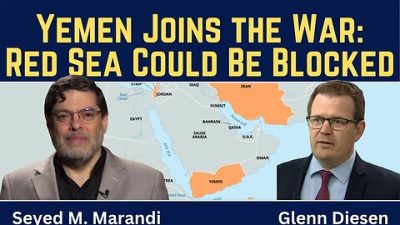
Yemen joins the war – Red Sea could be blocked next – Saudi regime at risk
or go to
Aletho News Archives – Video-Images
From the Archives
A superpower and “the world’s sickest warrior state”
By Paul J. Balles | March 8, 2010
Living through five or six major wars has hardened me to what I thought were the extremes of inhuman cruelty and brutality.
Two things made those extremes almost bearable: the brutality always revealed – at least according to the media coverage – the viciousness of the enemy. It was therefore quite understandable when our “brave men and women” pulverized the enemy.
Films of Japanese torturing captive Americans somehow justified holding Japanese Americans in internment camps during World War II; and only a small percentage of Americans found the bombing of Hiroshima and Nagasaki unreasonably vengeful at best, at worst, depraved.
The media giants in America portrayed the North Koreans as barbaric beasts with their captives, quite unlike their southern counterpoints – our allies during the Korean War. No one ever felt the need to explain how the South Koreans were a civilized breed while the North Koreans were absolute savages, at least according to the official line.
In Vietnam, our warriors justifiably (or so the media made us believe) dropped napalm on the North Vietnamese who had the gall to hide in villages and tunnels to ravage our invaders. At least it was accepted practice until some rogue photojournalist filmed a young girl screaming down a Vietnamese road in flames. … continue
Blog Roll
 Aletho News
- Russian tanker approaches Cuba despite US oil blockade
- Marandi: Yemen joins the war – Red Sea could be blocked next – Saudi regime at risk
- Pro-Palestinian French member of European Parliament denied entry to Canada
- Pakistan to Host US-Iran Talks
- How Indonesia’s tilt toward the US left it stranded in the Strait of Hormuz
- US has no choice but to retreat from Iranian borders: Top commander
- Iran Retaliation Strikes Chemical Plant Near Dimona
- AWACS’ Destruction is a Major Loss for US Military – Ex-DoW Analyst
- Israel’s Iran Strategy Uses US Military & Gulf States as Its Pawns
- Iran: Trump wanted regime change, now just begging for Hormuz to open
- If Americans Knew
- Israeli police block Catholic cardinal from entering Church of the Holy Sepulchre on Palm Sunday
- Israel is assassinating journalists again, more than any other nation, anywhere, ever – Not a ceasefire Day 170
- Over 300 US service members wounded, majority have brain injuries – Not a ceasefire Day 169
- Researchers at Human Rights Watch Resign Over Blocked Report on Palestinian Refugee Return
- Jewish Groups Are Backing a War Americans Don’t Want
- Eric Fingerhut Thinks He’s the President of the Jews
- Top Jewish Philanthropists, Rabbis Urge Israeli President to Take Action Against ‘Jewish Extremists’
- Don’t Be Fooled. Zionist Leaders Have Always Wanted to Control Southern Lebanon
- Israel’s widespread use of torture is a core element of its genocide against the Palestinian people
- In Israel’s War on Iran, Many Middle East US Bases Rendered “All But Uninhabitable”
- No Tricks Zone
- German Science Blog Accuses PIK Climate Institute Of Hallucinating Climate Tipping Points
- Devastating Assessment Of Comirnaty Vaccine By Former Senior Pfizer Europe Toxicologist
- New Study: CO2 Is ‘Effectively Negligible’ As An Explanatory Climate Change Factor Since 2000
- Former Pfizer Toxicologist Dr. Helmut Sterz Tells Bundestag Hearing Pfizer Vaccine Should Have Never Been Approved
- Energy Expert: Germany’s Nuclear Phaseout Was A “500 Billion Euro Mistake”
- New Research: South Australia’s Mid-Holocene Sea Surface Temperatures Were 4°C Warmer Than Today
- Storing Green Energy To Last Germany 10 Days Would Require A 60-Million Tonne Battery
- New Studies: UK Sea Levels Were 4 Meters Higher Than Today During The Mid-Holocene
- Destructive Green New Deal: German Energy And Metal Group Warns Of Drastic Crisis
- New Study Documents A 20-Year Pause In Arctic Sea Ice Decline – Driven By Internal Variability
 Aletho News