India May Join China In Bid To Lower Oil Prices
By Tsvetana Paraskova | Oilprice.com | July 27, 2021
The world’s third-largest crude oil importer, India, could join China in tapping into its strategic petroleum reserve in a bid to sell lower-priced crude to its refiners amid rallying international oil prices.
India is reportedly considering selling half of its SPR to attract private participation in expanding its strategic storage capacity, government sources told Reuters last week.
The sale of crude from reserves could also be a move from one of the importers most sensitive to price hikes to reduce the price of crude for its refiners, Reuters columnist Clyde Russell says. India’s SPR currently holds around 36.5 million barrels of crude oil.
India has been the most vocal critic of the OPEC+ production reduction pact this year, saying that it does not support “artificial cuts to keep the price going up.” On several occasions, India’s top officials have criticized OPEC+ for keeping the market tight and prices high and have expressed concern that the higher crude and fuel prices in India would slow down the economic and oil demand recovery.
India’s move to commercialize half of its SPR is primarily aimed at raising financing for additional SPR storage, but it could also ensure cheaper oil from storage to Indian refiners, according to Reuters’ Russell.
Last week, reports emerged that the world’s top oil importer, China, is looking to tap its crude reserves.
China has started to release more than 20 million barrels of crude oil from its strategic reserve in a move seen as seeking to curb the recent oil price rally, Energy Intelligence reported last week, quoting trading sources. The reported release from the strategic petroleum reserve is also aimed at putting inflation under control.
Various market and trade sources told Energy Intelligence that China was about to release the equivalent of between 22 million barrels and over 29 million barrels, or between 3 million and 4 million tons.
UN chief sounds alarm over abuses against Kashmiri children by India
Press TV – June 30, 2021
United Nations (UN) Secretary-General Antonio Guterres has voiced grave concerns about human rights violations against children in the Indian-administered Kashmir.
“I call upon the [Indian] government to take preventive measures to protect children, including by ending the use of pellets against children, ensuring that children are not associated in any way to security forces, and endorsing the Safe Schools Declaration and the Vancouver Principles,” Guterres said in the UN Report on Children 2021 released on Tuesday.
The UN report cited numerous violations involving Indian forces attacking Kashmiri children in the Indian-administered Kashmir.
“A total of 39 children (33 boys, 6 girls) were killed (9) and maimed (30) by pellet guns (11) and torture (2) by unidentified perpetrators (13) (including resulting from explosive remnants of war (7), crossfire between unidentified armed groups and Indian security forces (3), crossfire between unidentified armed groups, and grenade attacks (3)), Indian security forces (13), and crossfire and shelling across the line of control (13),” it said.
The UN secretary-general also condemned the military occupation of several schools in the Indian-administered Kashmir by the New Delhi forces.
“The United Nations verified the use of seven schools by Indian security forces for four months. Schools were vacated by the end of 2020,” it said.
Guterres expressed “alarm” over “detention and torture” by the Indian troops and their overall use of force against Kashmiri children in the Muslim-majority region.
“I am alarmed at the detention and torture of children and concerned by the military use of schools,” he said.
The UN chief called on Indian Prime Minister Narendra Modi’s government to ensure that children were kept out of way of “all forms of ill-treatment” when taken into detention in prisons in the Indian-administrated Kashmir.
The disputed Muslim-majority Kashmir, located in the Himalaya region, is mainly divided between India and Pakistan, while a third strip of land in northern Kashmir is held by China.
The people in Kashmir have been fighting New Delhi for independence or unification with neighboring Pakistan since the two countries were partitioned in 1947.
India’s lockdown may already have killed more people than “Covid”, and it will only get worse.
By Chase Reed | OffGuardian | June 18, 2021
India has a total population of 1.39 billion people . That is 18 percent of the total world population. The median annual per capita income is $616 . Hundreds of millions of people in India survive with a hand to mouth existence.
They work and earn a couple of dollars, and eat once they have earned the money. India has little or no social welfare system. For many people, if they don’t work and earn, they don’t eat.
In 2020, India reported 148,738 deaths due to the coronavirus. That equates to 0.0001 percent of the population. The average death rate in India in 2020 was 7.25 in 1000 of the population.
That means over 10 million people died in India in 2020, and only 1.5% were coronavirus deaths.
And that is assuming that the 148,738 coronavirus deaths reported were actually caused by coronavirus. The WHO guidelines for reporting deaths do not make clear the difference between dying ‘from’ coronavirus, and dying ‘with’ coronavirus.
At the end of March 2020, the India Government took the drastic action of locking down the Indian economy due to the coronavirus pandemic. The government took decisions as to whom they considered an ‘essential worker’ and who was considered ‘non-essential’.
Unlike its Western Government counterparts, the Indian government did not hand out $600 monthly cheques for those that it had determined to be ‘non-essential’ and told to stay at home and not work. And the initial enforcement of the lockdowns was pretty draconian.
Early last April I received a desperate plea from an associate who lives in the slums in Mumbai. His house is 20 square metres, and he lives with 7 of his family members.
He messaged me to say that he was locked down at home with his family and that they had no food and were starving. Could I please send him some money? The next day he called me and said:
Sir, thank you for sending the money. I tried to go out yesterday to buy rations but the police beat me with a lathi and would not let me out of the slum. We now have money but I cannot get outside to buy food.”
I had to intervene and request a friend who had a journalist pass and was considered an ‘essential worker’ to go and buy food and take the food into the slum for him and his family so that they would not starve to death.
They were the lucky ones.
A survey was carried out of the urban poor by a company called IDinsight, a market research firm in the social sector in India. They reported that the respondents that they surveyed had an average weekly income of ₹6858 ($93.6) in March 2020 and ₹1929 ($26.3) in May 2020. That is a 72% reduction in income from a very low base. And the percentage of respondents that reported having no work went up from 7.3% in March to 23.6% in May.
Another research agency called Dalberg reported that the percentage of respondents with no work in May was 52%.
It is a real struggle to understand why the Indian government would shut down large parts of the Indian economy and put potentially hundreds of millions of poor people’s lives at risk of starvation by locking them in their houses because a tiny fraction of the population has caught a flu virus.
There is little or no data available on the numbers of people who have died from starvation. Although, a study was done two years ago which found over 450,000 children alone died as a result of malnutrition in 2017. Those numbers will only have gone up thanks to lockdown.
It is therefore anybody’s guess as to how many of the poor in India have died.
When the dust settles, I would expect that more people will die from starvation in India, than from the coronavirus in the whole world. And there is very little information being collected or reported on it.
The situation on the ground for food distribution in 2021 is reported to be worse than 2020. The Indian food distribution system of getting produce from farm to table is highly inefficient at its best. The lockdowns were reported locally to have amplified the inefficiencies in the food supply chain manyfold.
The issue of potential starvation could become an even greater issue in 2021 as the lockdowns continue. Without data on starvation, the stories remain anecdotal. I have a serious fear that when the coronavirus hysteria blows over, we will discover in its wake, a huge tragedy of mass starvation in India.
David Beasley, executive director of the UNs World Food Programme made a statement on global starvation in April 2021.
We were already calculating 135 million people around the world before COVID marching to the brink of starvation. And now, with the new analysis with COVID, we’re looking at 260 million people, and I’m not talking about hungry. I’m talking about marching toward starvation. And that is a catastrophe in itself.”
India Situation: What does the Current Data Say?
Ivor Cummins | April 27, 2021
So then, what DOES the actual DATA say? Surely we should care, right?
*** NOTE THIS IS NON-CENSORABLE – NO medical advice or information here, NO conflicting with the WHO (remember they shared the Prof Ioannidis paper in their Oct 2020 bulletin).
Just the data and some scientific inferences – period. DOWNLOAD here and use with my permission (just click yes to cookies – no need to subscribe): https://we.tl/t-aRo1uhxv2c
My Odysee link: https://odysee.com/@IvorCummins:f
The Truth About the Covid ‘Crisis’ in India
By Will Jones • Lockdown Sceptics • April 27, 2021
Now that Chile is settling down a bit, the latest Covid cautionary tale is India, which never seems to be out of the news at the moment as its positive cases and deaths have rocketed in the past few weeks.
Even the usually level-headed Kate Andrews in the Spectator has been painting the situation in lurid colours.
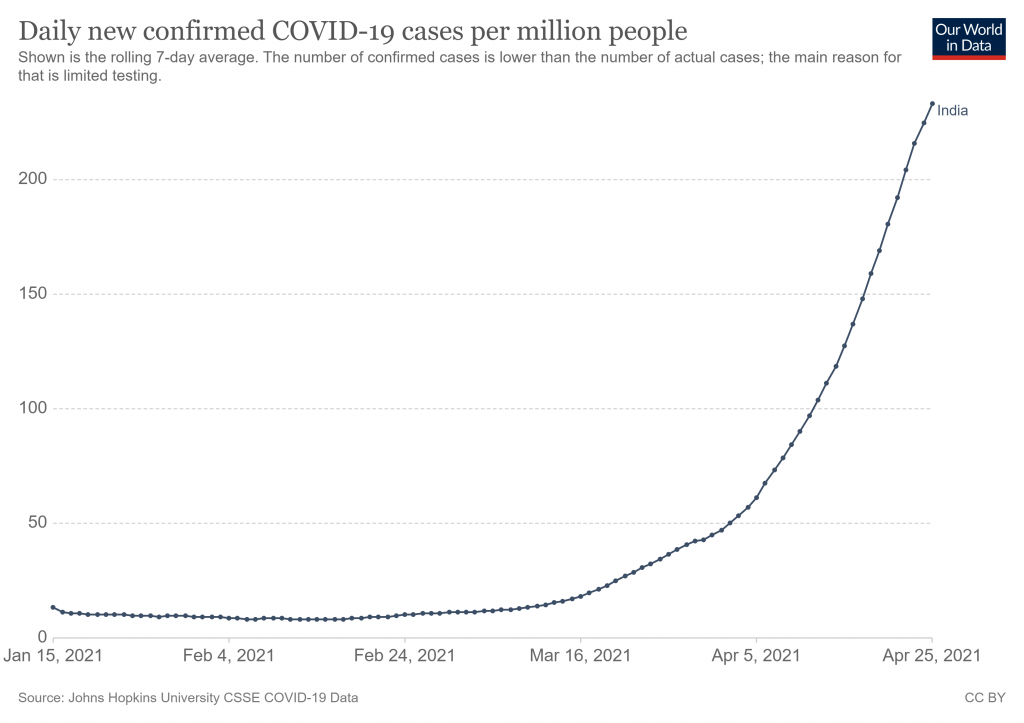
As it happened, the UK’s worst nightmares were never realised. The Nightingale hospitals built to increase capacity were barely used. But what the British Government feared most is now taking place elsewhere. India is suffering an exponential growth in infections, with more than 349,000 cases reported yesterday, as well as nearly 3,000 deaths. Hospitals are running out of oxygen for patients and wards are overflowing. There are reports of long queues as the sick wait to be seen by medical professionals. It’s expected the situation will deteriorate further before it gets better.
Jo Nash, who lived in India until recently and still has many contacts out there, has written a very good piece for Left Lockdown Sceptics putting the current figures in context – something no mainstream outlet seems to have any interest in doing.
Jo makes the crucial point that we need to keep in mind the massive difference in scale between India and the UK. At 1.4 billion people, India is more than 20 times larger than the UK, so to compare Covid figures fairly we must divide India’s by 20. So 2,000 deaths a day is equivalent to a UK toll of 100. India’s current official total Covid deaths of approaching 200,000 is equivalent to just 10,000 in the UK.
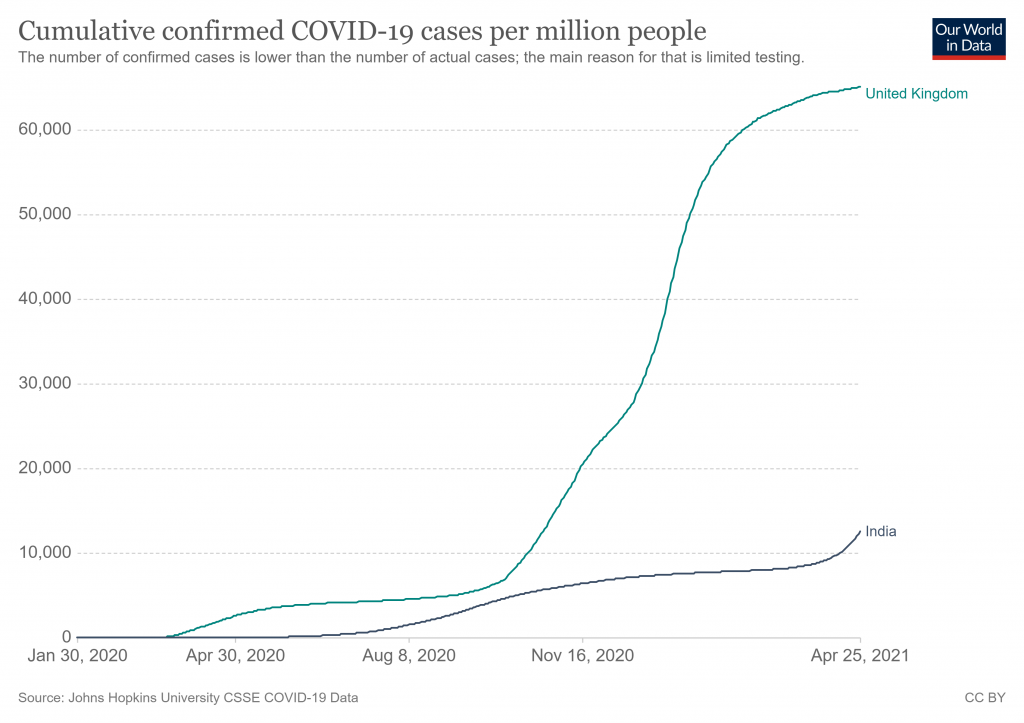
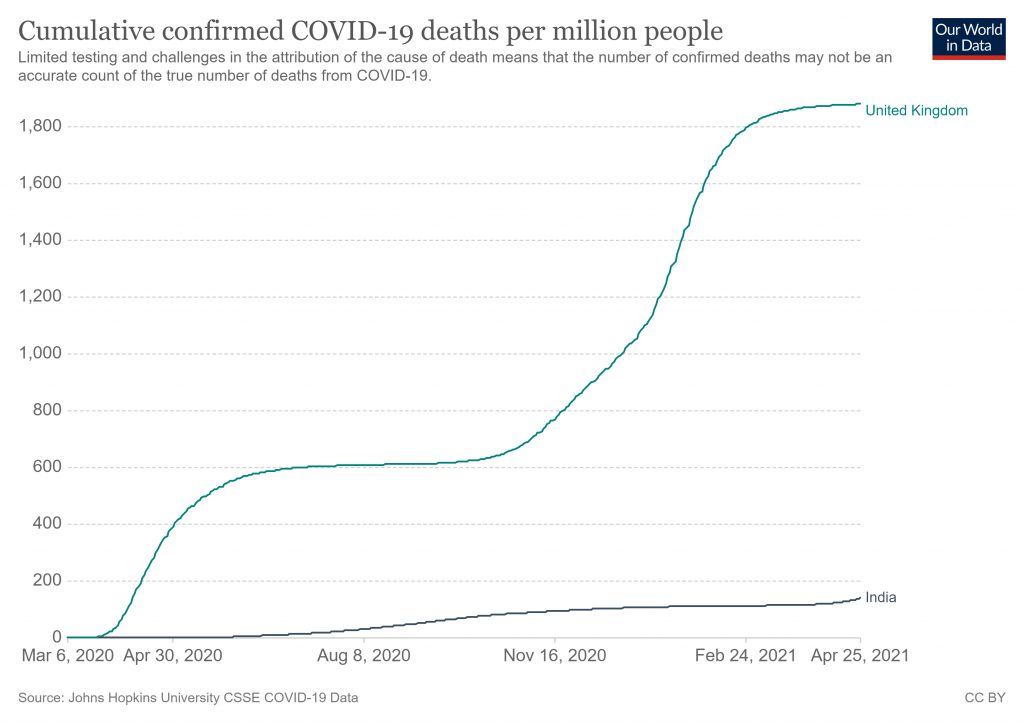
In a country the size of India and with the huge number of health challenges faced by the population, the number of Covid deaths needs to be kept in perspective. As Sanjeev Sabhlock observes in the Times of India, 27,000 people die everyday in India. This includes 2,000 from diarrhoea and 1,200 from TB (vaccinations for which have been disrupted by the pandemic). The lack of adequate hospital provision for Covid patients may be more a reflection of the state of the health service than the severity of the disease.
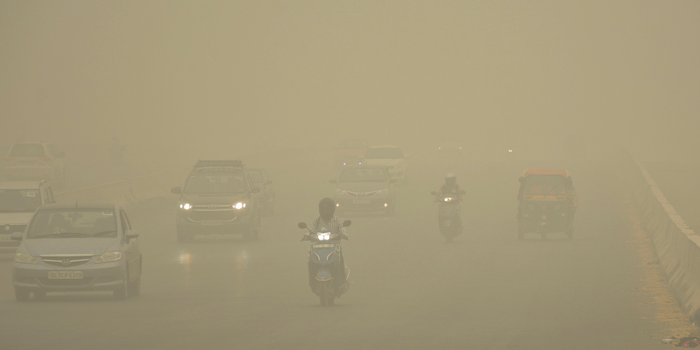
Jo Nash also points out that poor air quality plays a role.
Delhi, the focus of the media’s messaging, and the source of many of the media’s horrifying scenes of suffering, has the most toxic air in the world which often leads to the city having to close down due to the widespread effects on respiratory health…
Respiratory diseases including COPD, TB, and respiratory tract infections like bronchitis leading to pneumonia are always among the top ten killers in India. These conditions are severely aggravated by air pollution and often require oxygen which can be in short supply during air pollution crises…
According to my contacts on the ground, people in Delhi are suffering from untreated respiratory and lung conditions that are now becoming serious. I’ve also had breathing problems there when perfectly healthy and started to mask up to keep the particulate matter out of my lungs. I used to suffer from serious chest infections twice yearly during the big changes in weather in India, usually November/December and April/May. When I reluctantly masked up that stopped. My contacts have reported that the usual seasonal bronchial infections have not been properly treated by doctors afraid of getting Covid, and people’s avoidance of government hospitals due to fear of getting Covid. Undoubtedly, these fears will have been fuelled by the media’s alarmist coverage of the situation. Consequently, the lack of early intervention means many respiratory conditions have developed life-threatening complications. Also, people from surrounding rural areas often travel to Delhi for treatment as it has the best healthcare facilities and people can go there for a few rupees by train. This puts pressure on Delhi’s healthcare system during respiratory virus seasons.
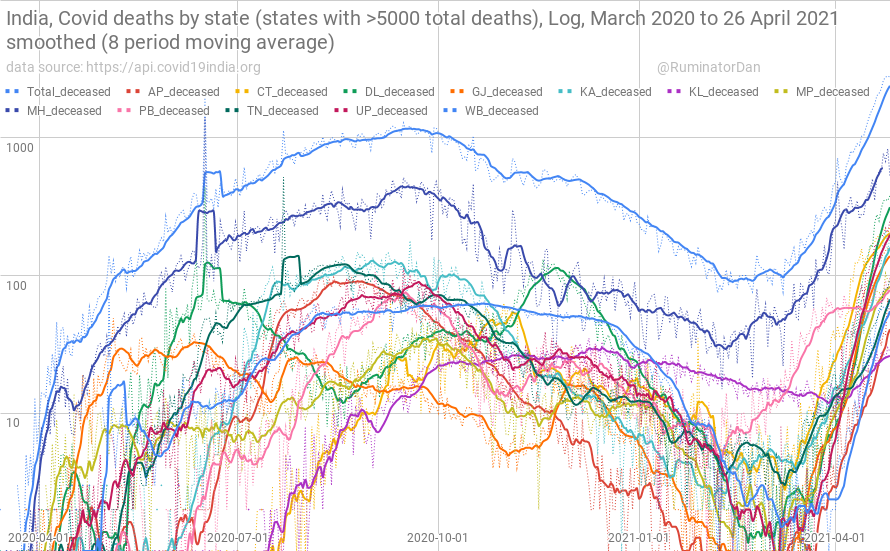
Positive cases look like they may be peaking in many regions now.
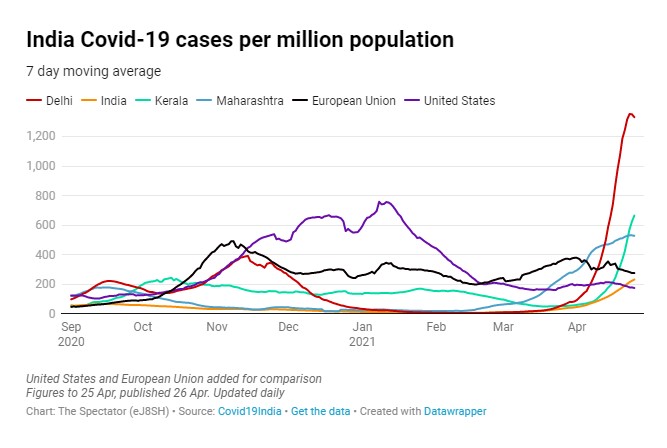
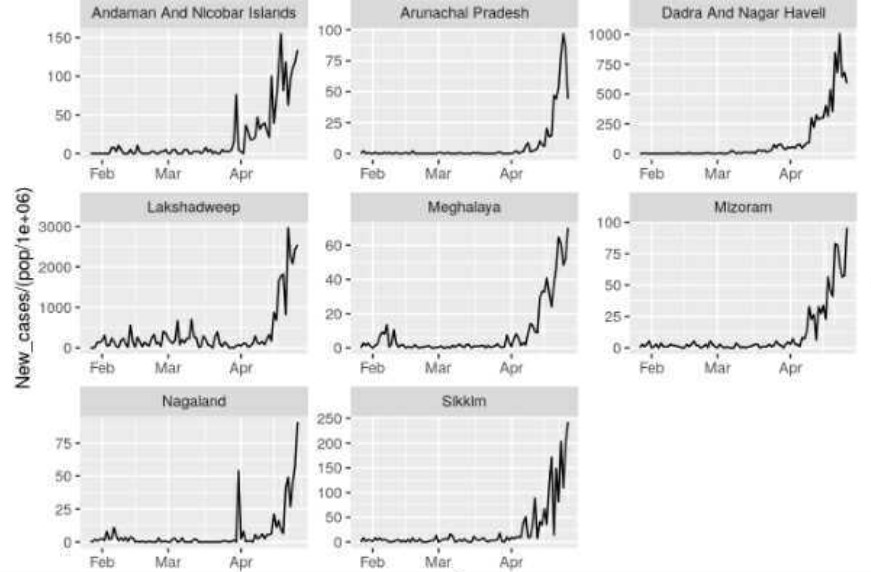
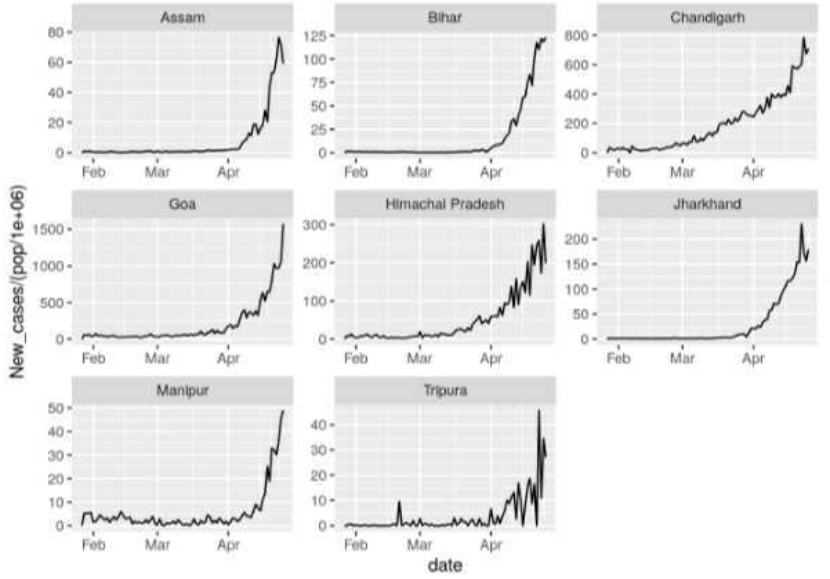
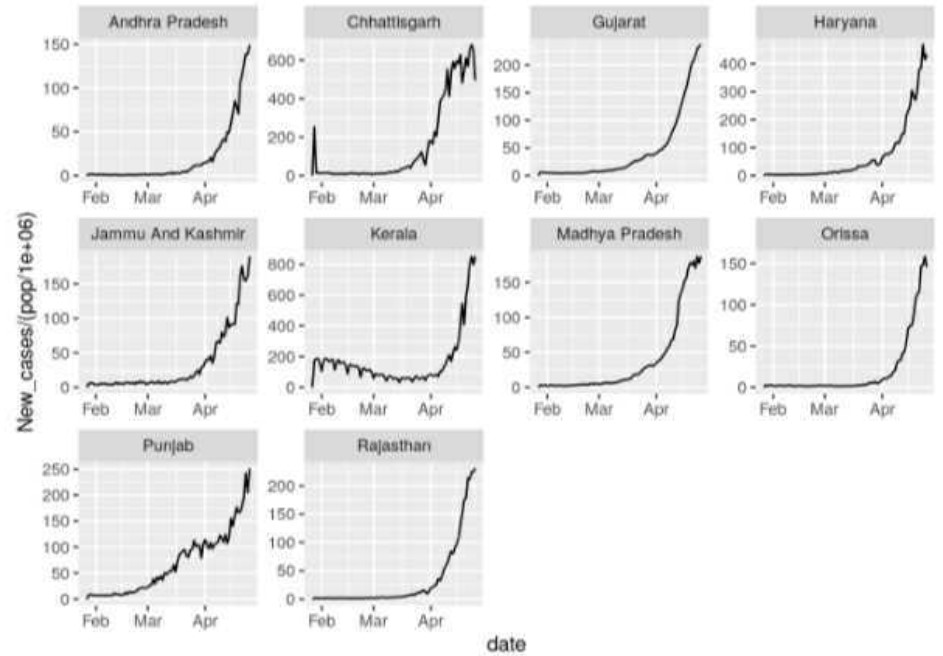
One mystery, as yet unexplained, is why India, which has not experienced a strong surge like this so far, suddenly did in March and April. Adding to the mystery is that the simultaneity of the surge across the regions is unexpected in a country as large as India and contrary to earlier outbreaks last year. Nick Hudson from Panda suggests it means there must be something artificial about it as it is not a natural pattern, since viruses naturally spread across the country with some delay and variation evident between regions.
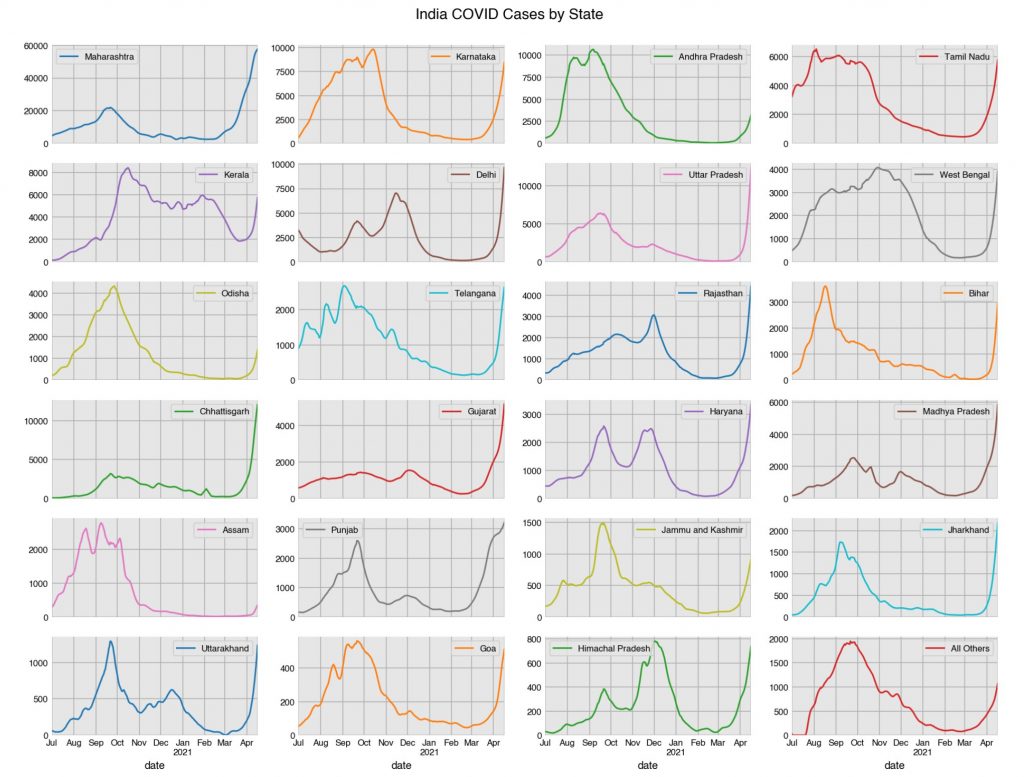
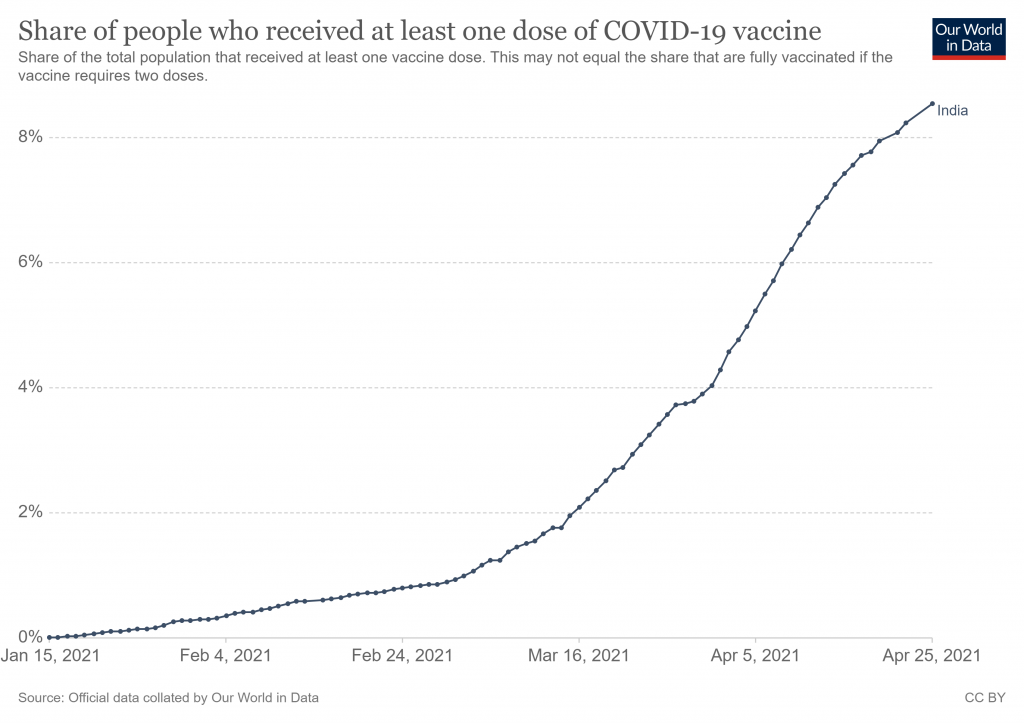
It hasn’t escaped people’s attention that one novel factor is the nationwide vaccine programme rollout, beginning in January and accelerating during March. Is this a further example of the post-vaccine infection spike seen in the various trials and population studies, possibly caused by temporary suppression of the immune system?
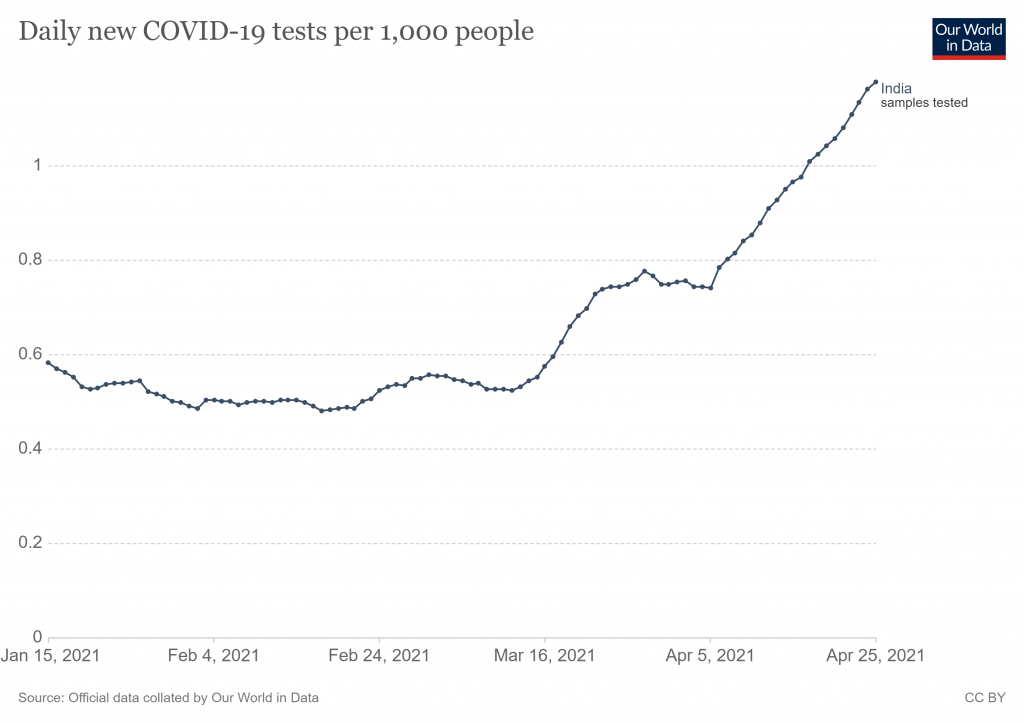
Testing is another possible factor, as the number of tests being carried out surged in March and April – though so did the positive rate, suggesting this can’t be the only explanation.
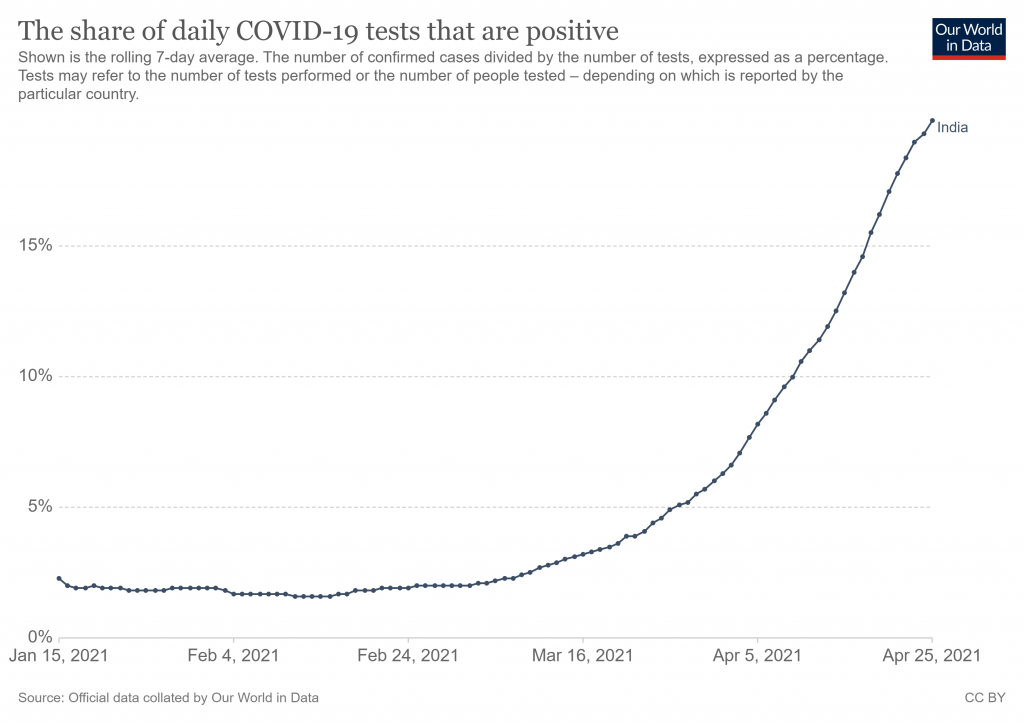
Whatever is going on, it’s a pity there is not more curiosity among our scientists and journalists. Instead, it’s just the usual scaremongering driven by the misrepresentation of data.
Stop Press: Former Assistant Secretary-General of the United Nations Professor Ramesh Thakur has been in touch with a comment he left on a story in the Australian.
Some context and perspective. India’s Covid deaths yesterday were 2,163 (seven-day rolling average). India’s average daily death toll is 25,000 from all causes.
Second, despite this surge, as of now India’s Covid mortality rate is 140 dead per million people. This compares to 401 for the world average, 1,762 for the US, and 1,869 for the UK. It puts India 119th in the world on this, the single most important statistic for comparison purposes.
Third, the crux of the problem in India is not the proportion of cases and deaths from Covid. Rather, it is the lack of a fit-for-purpose public health infrastructure and medical supplies of equipment and drugs.
Fourth, although Government neglect of public health while prioritising vanity projects like a new Parliament building during the pandemic, building temples and statues etc. is a contributory factor, the real cause of a poor public health system is poverty. Put bluntly, poverty is the world’s biggest killer.
Fifth and finally, this is why a strong economy is not an optional luxury but an essential requirement for good health.
The Syrian government has been blamed for the 2018 Saraqib chemical attack, but this time around India isn’t buying it
By Kit Klarenberg | RT | April 23, 2021
Damascus again finds itself the subject of international opprobrium after being found guilty of a chemical attack, and ostracised from the OPCW. However, New Delhi’s rejection of the report suggests the West’s influence is waning.
On April 21, the Organisation for the Prohibition of Chemical Weapons (OPCW) announced it would remove Syria’s “rights and privileges” within the association with immediate effect.
The move was precipitated by 87 OPCW member states voting in favor of a proposal by 46 countries – led by London, Paris, and Washington – to strip Damascus of its voting powers in the assembly, and bar the country’s representatives from holding any offices within the organisation.
It’s the first time a member state has been sanctioned in such a manner in its 24-year history, and follows just over a week after the OPCW released the findings of its second Investigation and Identification Team (IIT) probe of an alleged chemical attack in Saraqib, Syria in February 2018. The team concluded that a Syrian Air Force helicopter had dropped “at least” one cylinder containing chlorine over the city, dispersing the contents over a wide area.
The report’s headline claims were dutifully amplified without critique by the mainstream media, but this time not all were convinced. At an informal meeting of United Nations Security Council members, convened by Moscow and Beijing on April 16, four days after the IIT findings were released, India’s deputy permanent representative K. Nagaraj Naidu had some stern words for the OPCW.
He stated that New Delhi had always stressed the necessity of “impartial, credible and objective” investigations into the use of chemical weapons, which “scrupulously” follow Chemical Weapons Convention procedures and provisions to reach “evidence-based conclusions,” scathingly adding, “the current report falls short of these expectations.”
The veteran diplomat didn’t articulate India’s specific reservations about the findings, but said it was necessary to “draw lessons” from events such as Colin Powell’s infamous February 2003 UNSC speech, when he claimed Washington possessed “irrefutable and undeniable” evidence Iraq had weapons of mass destruction capable of targeting the West.
In any event, one doesn’t require a degree in chemistry to see the IIT report is far from “impartial, credible and objective” on its own terms.
First and foremost, the OPCW claims IIT findings were derived from a “comprehensive review” of a mountain of evidence, including eyewitness and victim interviews, analysis of samples collected at the site, and even examination of satellite imagery. But it simultaneously concedes the probe “relied” on a May 2018 OPCW Fact-Finding Mission (FFM) investigation of the incident, which reached the same conclusions as the IIT.
Relying on the FFM report is inherently problematic, given mission investigators didn’t actually visit the site of the attack, and all the samples reviewed were provided by the highly controversial White Helmets. This means there was no chain of custody for this vital physical evidence, in breach of long-standing OPCW protocol, which states such a paper trail is “100% critical.”
“The OPCW would never get involved in testing samples that our own inspectors don’t gather in the field, because we need to maintain chain of custody of samples from the field to the lab to ensure their integrity,” an OPCW spokesperson said in April 2013.
Interestingly, a table in the FFM report comparing samples taken from two cylinders said to have delivered the chlorine payload, indicated chlorine-related chemicals were found by investigators but also showed many chemicals detected were related to the nerve agent sarin, which jihadist forces in Syria are known to have used.
The FFM report and its IIT successor nonetheless both conclude there are “reasonable grounds” to believe the chemical used in the attack was chlorine, the latter claiming “sarin-related compounds” represented a negligible part of the “chemical signature” identified in the samples. However, they also note that specialists the team consulted “agreed that it would be difficult to fill a cylinder to be used as a weapon with both sarin and chlorine.”
The IIT is said to have explored “the possibility of cross-contamination during the sampling process, or at a later stage in the handling of the samples themselves,” their findings “leaving the possibility that contamination occurred before sampling or after the samples were taken, but before they were secured by the OPCW in sealed packaging.”
“The latter scenario would still not fully explain why only by-products and one degradation product of sarin, rather than sarin itself, were identified,” the particularly incongruous passage notes. “In any event, since the FFM did not make findings related to the use of sarin in Saraqib…the IIT refrained from pursuing this aspect of the incident further. Some uncertainties in respect of the possible use of sarin in the same area remain.”
No doubt due to recent allegations of rebel forces having staged “false flag” chemical attacks in Syria in order to precipitate Western intervention, the IIT report specifically explored this scenario. Investigators obtained and analyzed “various household chlorine-based products commonly used in the Syrian Arab Republic and readily available on the market,” which identified six specific chemicals, “the presence of which in samples from the Saraqib incident could be indicative of intentional – or even accidental – dispersal of these chlorine-based products in the area in question.”
No trace of the six chemicals could be found in the samples, which the IIT contends entirely refutes suggestions of staging. However, which six chemicals were found by the team isn’t stated, nor is how and why their absence rules out a “false flag” operation explained.
The White Helmets were even more fundamental to the FFM investigation than merely providing the samples. They also put investigators in touch with witnesses who reinforced the chlorine attack narrative, several of whom conspicuously stated that the smell around the affected area was a “pungent odour” similar to “household cleaning products, though stronger.”
The White Helmets were likewise central to the OPCW’s investigation of several other alleged chemical strikes in Syria, including an April 2018 incident in Douma. Leaked internal OPCW documents reveal that two FFM teams were sent to investigate the incident, with one heading to the site itself, and the other to Turkey.
Witness interviews conducted in the separate countries diverged so sharply that a 116-page draft interim report prepared in June 2018 specifically referred to “two broad and distinct narratives” – one in which a chemical attack happened, one in which no such event occurred.
Yet the report released to the public was trimmed to just 34 pages, with all ballistic, forensic and witness evidence gathered by the Douma FFM, which completely dispelled the notion of a chemical attack, and pointed directly or indirectly to a staged incident, removed. Instead, based on the White Helmets-provided evidence alone, the OPCW claimed there was “sufficient evidence” to conclude chlorine had been unleashed on the rebel-occupied city from cylinders dropped from a government helicopter. An eerie echo of its Saraqib probe indeed.
This selective editing was quite so misleading, it prompted an OPCW investigator who’d visited Douma to write privately to the organisation’s director general, expressing their “gravest concern” at the degree to which the findings “misrepresents the facts.” It wasn’t until November 2019, 18 months after the report was released, that their chilling words were leaked online.
It’s anyone’s guess whether similarly grave concerns have been expressed internally about the evidently equally suspect Saraqib FFM probe, although in this case no investigator actually went to the city to conduct an “impartial, credible and objective” on-the-ground inspection. The very countries that proposed Syria’s OPCW censure are no doubt relieved – and the OPCW itself is extremely unlikely to make such an egregious mistake ever again.
Kit Klarenberg is an investigative journalist exploring the role of intelligence services in shaping politics and perceptions.
India threatens to jail Facebook, WhatsApp & Twitter staff over refusal to wipe data that ‘undermines national security’
RT | March 6, 2021
Indian authorities have reportedly given an ultimatum to US social media platforms, threatening jail time for their local employees if the companies continue to ignore official takedown requests against “damaging” information.
Facebook, WhatsApp and Twitter have each received written notices warning their employees could face arrest should the requests be ignored, in some cases citing specific India-based staff by name, the Wall Street Journal reported on Friday, citing “people familiar” with the matter.
The reported warnings come as New Delhi faces down Big Tech platforms amid a wave of heated protests over controversial agricultural bills, which have drawn thousands of farmers to rally in the Indian capital, at times descending to violent clashes with security forces. While the government has long wrangled with the social media platforms, the threats of arrest mark a sharp escalation of pressure.
In early February, Twitter blocked access to a litany of accounts for Indian users, among them lawmakers, news outlets, journalists and political commentators. Though the platform quietly reversed those bans some 12 hours later, AFP reporter Bhuvan Bagga, citing a government source, noted the move followed an order from India’s IT ministry to block hundreds of accounts it accused of spreading “factually incorrect” claims and “inflaming passions” around the farmer protests.
The ministry responded harshly to Twitter’s sudden reversal, threatening “penal action” should it continue to rebuff the government’s takedown requests. The warning appears to have worked, as Twitter reinstituted many of the bans within days, though refused to re-block “accounts that consist of news media entities, journalists, activists, and politicians.”
A Facebook spokesperson told the Journal the platform complies with takedown and data requests “in accordance with applicable law and our terms of service,” while its subsidiary WhatsApp said it abides by the orders only when they are consistent with “internationally recognized standards” of human rights and due process. Twitter, meanwhile, was more defiant, insisting it would “continue to advocate for the fundamental principles of the Open Internet.”
As Big Tech firms seek their way into India’s massive market, the country recently imposed new rules to govern social media platforms, requiring them to appoint India-based representatives to coordinate with law enforcement and government agencies. The restrictions can also compel sites to scrub content the state believes to undermine national security or public order. Ravi Shankar Prasad, the minister of electronics and information technology, argued the rules would force the companies to be “more responsible and more accountable,” after previously blasting sites like Twitter for “double standards” in enforcing their policies.
India needs course correction on Myanmar
By M. K. BHADRAKUMAR | Indian Punchline | February 7, 2021
The Modi government made a strident call on February 1 that the “rule of law and the democratic process must be upheld” in Myanmar. The statement, following a prodding from Washington, was unabashedly intrusive, and, ironically, completely overlooking that human rights, rule of law, democratic pluralism, etc. are universal values that India also can (and should) be held accountable for. Lapping up the neocon prescriptions from Washington may not serve India’s interests, in general, and they are very specific to Myanmar.
The government failed to fathom the US’ motivations in riding the high horse of democracy so soon after the Capitol Riots in Washington, DC. Human rights issues come handy for Washington to rally allies at a juncture when its leadership of the transatlantic alliance is in drift and major European powers do not see eye to eye with its global strategies on Russia and China and mock at its nostalgia-laden slogan that “America is back.”
Alas, the government failed to consult the ASEAN despite Delhi’s refrain that it attributes “centrality” to that grouping.
The ASEAN Chair’s statement of Feb, 1 recalled the “purposes and the principles enshrined in the ASEAN Charter” which include respecting the principles of sovereignty, equality, territorial integrity, non-interference, consensus and unity in diversity.”
The ASEAN Chair’s statement of Feb, 1 recalled the “purposes and the principles enshrined in the ASEAN Charter.” Simply put, India chose to bandwagon with the US, Japan and Australia while the ASEAN and China took a differentiated stance. Geopolitics crept in. But the US has since realised the folly and National Security Advisor Jake Sullivan scrambled to contact the ASEAN ambassadors in Washington.
How come Delhi goofed up? Primarily, it is due to a flawed understanding of the Myanmar situation. The Indian analysts increasingly view world developments through their China prism and began fancying that with the massive victory of Aung San Suu Kyi in the November election provided an opportunity for India to “gear up to implement a major strategy with Myanmar under its ‘Neighbourhood First’ policy… to bring Myanmar under the Indo-Pacific construct” so as to align that country “more with ‘like-minded’ countries… to stand firm against China… to make Myanmar a part of the Indo-Pacific policy… (and) steer Myanmar away from the Chinese grip.”
Such views betray a zero sum mindset borne out of blind Sinophobia. Whereas, the ground realities are much more complex. The point is, Beijing brilliantly succeeded over the years in building a close relationship of mutual trust and mutual respect with Suu Kyi, parallel to the nurture of links between the Chinese Communist Party and her party National League for Democracy.
Unlike the western narrative of Aung Suu Kyi as Myanmar’s democracy icon, Beijing regarded her as a pragmatic politician who never uttered remarks to the detriment of China-Myanmar ties, was manifestly eager to maintain good relations and consistently adopted a soft stance on the South China Sea issue.
Beijing was greatly impressed that although Suu Kyi wanted Western support, she was adamant about national sovereignty. Arguably, it was in sync with what China would like its neighbours to practice. Chinese President Xi Jinping received Suu Kyi seven times since 2015.
State Counselor Wang Yi visited Myanmar recently on Jan. 12, met Suu Kyi and expressed strong support for her government and conveyed a strong commitment that China wants to work with her during the second term. And they agreed to push ahead with Belt and Road projects and lock in a five-year pact on trade and economic cooperation. Clearly, the prospect for the China-Myanmar Economic Corridor under Belt and Road Initiative has become uncertain now, as compared to a month ago.
In fact, the Chinese media reports already sound a word of caution that “Chinese companies operating in Myanmar need to watch out for contractual and default risks amid the current political upheaval… Government default is a major risk, especially for major and strategic projects in sectors including transportation and energy… But Chinese companies can seek international arbitration if they face illegal confiscation of their property.”
It is no secret that the Myanmar army marks a certain distance from China. Suffice to say, Myanmar developments present an extraordinary case study where Beijing silently feels distressed over the sudden eclipse of western style democracy in a neighbouring country. (See the Reuters analysis Myanmar coup does China more harm than good.)
Surely, the coup creates political baggage for China insofar as it cannot (and will not) take a position against the military, but also comes under compulsion to cover or provide protection for the military internationally. On the whole, this situation poses a major political and diplomatic liability for Beijing and cannot bring good news. Therefore, China prioritises that the concerned parties to solve their differences mutually, according to the constitution and within the legal framework, while maintaining peace and stability. Chinese expert opinion is that Suu Kyi’s political career is in jeopardy.
Of course, Suu Kyi made some serious errors, too. She heavily depended on people loyal to her personally, without bothering about their competence or integrity. It not only spawned corruption but also led to government failure to deliver, especially in job creation. Her leadership style was often dictatorial. She resorted to draconian laws to muzzle or jail critics. (See the Singapore-based Channel News Asia video titled Aung San Suu Kyi: A Fading Legacy dated October 22, 2020 on the eve of the November elections.)
Suu Kyi had no control over some major sectors of the national economy through two entities, Myanmar Economic Holdings Limited and Myanmar Economic Corporation as well as a network of domestic private business enterprises, known as “crony companies,” which generate revenue for the military and strengthen its autonomy.
Suu Kyi’s biggest mistake was in believing that she could, through her brand of nationalism, dismiss accusations of genocide directed against the Rohingya. In the process, Suu Kyi lost western support. From that point, she has been on borrowed time and the military barely hid its distaste for Suu Kyi.
To be sure, the military anticipated the impact and the reaction from the international community and took into consideration the Biden administration’s preoccupations with domestic issues. Myanmar doesn’t even figure in the top 10 priorities of Biden’s foreign policy. But the US Congress is not going to tolerate a coup in Myanmar and will mount pressure on the Biden administration to punish the military by imposing sanctions, cutting aid or targeting the generals and their companies.
However, a reversal of the military takeover is not to be expected and the probability is that Washington may lose whatever little leverage it would have had in Naypyidaw. Washington is mulling over policy options.
But there may be a Plan B. Indeed, the former US Ambassador to the United Nations Bill Richardson, who is no stranger to Myanmar, voiced the opinion last week that the time has come for the West to look beyond Suu Kyi for new faces among the opposition. One way is to mould a leadership that will be friendly to the US. There are signs that the western agencies are inciting the youth in Myanmar to stage protests, as had happened in Hong Kong and Thailand. The military has clamped down on Facebook and internet. Shades of colour revolution?
This is where Russia’s role merits attention. The struggle for influence in Myanmar has a geopolitical dimension, for obvious reasons. Since 2015, following the signing of a military cooperation agreement, Russian presence has increased, and, importantly, it coincides with the lengthening shadows of Russian presence in the Indian Ocean.
Russia has emerged as a major military partner for Myanmar. Russia operates a servicing centre in Myanmar. The Russian Deputy Defense Minister Alexander Fomin told the media last month that Myanmar plays “a key role in maintaining peace and security in the region.”
It is entirely conceivable that Russia, which has great expertise in countering colour revolutions, shares intelligence with the Myanmar military. Over six hundred military officers from Myanmar are studying in the Russian military academies presently. Myanmar’s military chief Min Aung Hlaing visited Russia six times in the recent years, more than to any other country.
During the visit of Defence Minister Sergei Shoigu to Naypyidaw last month, the Russian media quoted Gen. Hlaing as saying, “Just like a loyal friend, Russia has always supported Myanmar in difficult moments, especially in the last four years.” An agreement was signed for supply of a batch of Russian missile and artillery air defense systems Pantsir-S1.
Tass reported that the “command of Myanmar’s armed forces has shown interest in other advanced weapon systems of Russian manufacture.” Shoigu has reportedly expressed interest to establish visits of Russian warships to Myanmar’s ports.
All things taken into consideration, we may expect China and Russia to provide a firewall for Myanmar to ward off western penetration, as is happening in Central Asia. (The UN Security Council statement avoids any reference to the military or a coup as such in Myanmar and lays emphasis on national reconciliation, with pointed reference to Suu Kyi’s release.) Russia shares China’s perception of Quad as a destabilising factor in regional security.
Clearly, India needs to keep the “big picture” in view. It will not be to India’s advantage to create misperceptions that it is bandwagoning with some neocon Anglo-American project for regime change in Myanmar. In regard of Myanmar’s stability, India too is a stakeholder and would have a convergence of interests with Russia and China.
Saudi FM to visit Pakistan to discuss strained bilateral ties
MEMO | December 29, 2020
Saudi Arabia’s Foreign Minister Faisal Bin Farhan Al-Saud will lead a high-level delegation, including business leaders, in a visit to Pakistan next month in an effort to discuss recently strained relations, according to the Pakistani daily the Express Tribune.
The kingdom’s Energy Minister Abdulaziz Bin Salman will join the delegation to discuss the establishment of a Saudi oil refinery in Pakistan.
Al Saud will hold talks with his Pakistani counterpart, Shah Mahmood Qureshi, in addition to meeting President Arif Alvi and Prime Minister Imran Khan.
The visit comes amid tense relations between Riyadh and Islamabad since August when Qureshi criticised the Saudis over their lack of support on the issue of Kashmir over which Pakistan and rival India both claim in its entirety.
The Pakistani diplomat even stated that Islamabad would be “compelled” to “call a meeting of Islamic countries that are ready to stand with us”.
However, the Saudis who interpreted the statement as a veiled threat to the Organisation of Islamic Cooperation (OIC) which is dominated by Riyadh, responded by requesting the earlier repayment of a $3 billion loan to Pakistan made two years ago and refused to renew deferred oil payments scheme which part of the loan agreement worth another $3.2 billion. Earlier this month, long-term ally China agreed to help Pakistan repay the debt.
Earlier this year Beijing also helped Pakistan repay $1 billion to the Saudis meaning Pakistan has thus far repaid $2 billion with $1 billion outstanding.
Meanwhile, the Saudis have been developing ties with India despite its traditional ties with Pakistan, with a historic visit by the head of the Indian military to Riyadh earlier this month aimed at strengthening their bilateral ties, particularly in defence.
Read also:
Railway link from Turkey to Pakistan, through Iran to start in 2021
Featured Video

Your Enslavement Begins in Gaza: The ‘Board of Peace’
or go to
Aletho News Archives – Video-Images
From the Archives
The US: The Century of Lost Wars
By James Petras | Global Research | September 12, 2018
Introduction
Despite having the biggest military budget in the world, five times larger than the next six countries, the largest number of military bases – over 180 – in the world and the most expensive military industrial complex, the US has failed to win a single war in the 21st century.
In this paper we will enumerate the wars and proceed to analyze why, despite the powerful material basis for wars, it has led to failures. … continue
Blog Roll
 Aletho News
- Israel designates five Palestinian media outlets as ‘terrorist organizations’
- Israel, not America, first: Carlson’s Huckabee interview lays bare US foreign policy priorities
- Israeli troops executed Palestinian aid workers at ‘point blank range’: Report
- Iran war What if today’s Iran is resigned to a long, hellish war with the US?
- Why Israel Is Escalating Its War Crimes Against Lebanon
- Iran in the face of the armed diplomacy of imperialism
- The US build-up around Iran constitutes strategic war option, not ‘deterrence’
- Iran to US: Sanctions and war failed; try diplomacy and respect
- China supplies Iran with radar, surveillance tech to track US stealth aircraft: Report
- Zelensky rejects territorial concessions to Russia
- If Americans Knew
- Footage Shows Israeli Troops Waiting in Ambush, Then Opening Fire on a Palestinian Teen
- The US is on the brink of a major new war that Trump has not even bothered explaining
- Latest Epstein document dump is one more cover-up
- No Protection, No Justice: US Citizens Killed with Impunity by Israel
- Maria Farmer: Epstein Victim Reveals Explosive Information Covered Up by Media
- Average of five Palestinians killed by Israel every day in Gaza since ceasefire – Not a ceasefire Day 136
- Palestinian church leaders admonish Christian Zionist Mike Huckabee – Not a ceasefire Day 135
- Ominous messaging from Trump’s “Board of Peace” – Not a ceasefire Day 134
- ‘Christians Out’: Jerusalem Church Tagged With Hate Graffiti, Police Investigating
- Israeli Settlers Kill American Teen
- No Tricks Zone
- New Research Reaffirms Clouds, Aerosols, And Surface Solar Radiation Are ‘Driving The Climate System’
- Germany: Electric Car Catches Fire At Charging Station, Sets Off Local “Inferno”, Widespread Damage
- New Study: Canada’s New Brunswick Was 1°C Warmer Than Today During The Medieval Warm Period
- Coal Power Back In Trend As Globe Tries To Keep Pace With Growing Demand For Power
- New Study: A 4°C Warmer Beaufort Sea Had ‘No Sea Ice’ 11,700 – 8200 Years Ago
- Unfudging The Data: Dutch Meteorological Institute Reinstates Early 20th Centruy Heat Waves It Had Erased Earlier
- German Gas Crisis…Chancellor Merz Allegedly Bans Gas Debate Ahead of Elections!
- Pollen Reconstructions Show The Last Glacial’s Warming Events Were Global, 10x Greater Than Modern
- Germany’s Natural Gas Storage Level Dwindles To Just 28%… Increasingly Critical
- New Study Rebuts The Assumption That Anthropogenic CO2 Molecules Have ‘Special’ Properties
 Aletho News