Hypocrisy Inc: Washington’s Selective Sanctions
By Brian CLOUGHLEY | Strategic Culture Foundation | 08.04.2019
On April 3 US Vice President Pence told Germany and Turkey to stop dealing with Russia. In a speech in Washington marking the 70th Anniversary of the US-NATO military alliance he declared that “If Germany persists in building the Nord Stream 2 pipeline, as President Trump said, it could turn Germany’s economy into literally a captive of Russia,” while Turkey is being “reckless” and “must choose — does it want to remain a critical partner of the most successful military alliance in the history of the world, or does it want to risk the security of that partnership by making reckless decisions that undermine our alliance?”
(We’ll pass over the fact that “the most successful military alliance in the history of the world” bombed and rocketed Libya in a nine-month blitz in 2011 and claimed a “model intervention” in a country it reduced to anarchy, as reported on April 5.)
Radio Free Europe noted that Pence “voiced US opposition to Turkey’s purchase of a Russian air-defense system… which he said ‘poses great danger to NATO’.” He also threatened that “we will not stand idly by while NATO allies purchase weapons from our adversaries”.
The weapons system to which Washington so violently objects is the S-400 Triumf surface-to-air missile which Army Technology describes as “capable of firing three types of missiles to create a layered defence [and] engaging all types of aerial targets including aircraft, unmanned aerial vehicles, and ballistic and cruise missiles within the range of 400 km, at an altitude of up to 30 km. The system can simultaneously engage 36 targets.” In other words it’s a world-beater with a real punch, as is evidenced by the fact that so many other countries have either got it or want it.
The first sanctions Washington imposed against Turkey concern supply of the 100 Lockheed Martin F-35 combat aircraft ordered at a cost of 16 billion dollars. According to CNN a US spokesman said “Pending an unequivocal Turkish decision to forgo delivery of the S-400, deliveries and activities associated with the stand-up of Turkey’s F-35 operational capability have been suspended.” This is harsh action against a longtime partner and military ally, but it doesn’t stop there, because Washington objects to Russia providing military equipment to other nations.
China is an example. In September 2018 sanctions were imposed on China by Washington because it had engaged in “significant transactions” with Russia’s Rosoboronexport by purchasing SU-35 combat aircraft and S-400 systems.
A US official told reporters “The ultimate target of these sanctions is Russia… [sanctions are] aimed at imposing costs upon Russia in response to its malign activities.” This is effected by US Public Law 115-44, the ‘Countering America’s Adversaries Through Sanctions Act’ (CAATSA) which is intended to “provide congressional review and to counter aggression by the Governments of Iran, the Russian Federation, and North Korea, and for other purposes.”
“Other purposes” is quite a large sphere of implied threat, but the ruling of US legislators in this case is clear, in that any country that acquires S-400 air defence missile systems (for example) from Russia is going to be penalised because Washington is determined to continue “imposing costs upon Russia” for providing such equipment. And it is inevitable that the imposed penalties will impact on the country that has dared to engage with Russia. The Diplomat summed it up by observing that the policy “decrees the imposition of mandatory economic sanctions on countries importing Russian military hardware.”
Except when it doesn’t.
It is apparent that the anti-Russia “Countering Adversaries” legislation directed by Congress is being selectively ignored by Washington, because India is being provided with the S-400 system, and no sanctions have been imposed by America. An agreement for supply of S-400s was signed on October 5, 2018 in Delhi during an India-Russia summit meeting attended by Indian Prime Minister Modi and President Putin. The Economic Times reported that India and Russia “have formally inked the $ 5.2 billion deal for S-400 system. The air defence system is expected to be delivered by the year 2020.”
Following the summit, Outlook India noted approvingly that “Other areas of collaboration, which figured prominently in the joint statement between the two sides, are nuclear reactors, investments by Indian diamond companies in Russian Far East, and ‘joint collaboration in precious metals, minerals, natural resources and forest produce, including timber, through joint investments, production processing and skilled labour’. The review of priority investment projects in the spheres of mining, metallurgy, power, oil, and gas, railways, pharmaceuticals, information technology, chemicals, infrastructure, automobiles, space, shipbuilding and manufacturing of different equipment reflects a focus on the desire for diversification. PM Modi has invited Russian companies to set up industrial parks in India for defence manufacturing.”
It might be thought that such bilateral collaboration in defence matters, especially in regard to provision of the S-400 system, would attract instant action by Washington, designed to penalise India for flagrant contravention of US directives.
But no.
In some fashion, India is different from Turkey and China when it comes to acquiring S-400 missile systems, and an explanation of sorts was offered by the Pentagon’s Assistant Defence Secretary Randall Schriver in testimony to the House of Representatives Armed Forces Committee on March 27. He declared that the US-India “Major Defence Partnership” was prospering by “moving toward deeper security cooperation by increasing operational cooperation and availing key maritime security capabilities.” But then there was mention of the purchase for over five billon dollars by India from Russia of a world-beating air defence system, and Mr Schriver wasn’t comfortable with that.
He was asked by Congressman Seth Moulton how India’s purchase of S-400 systems and the lease of Russian nuclear submarines would impact India-US relations and avoided any reply concerning the submarine lease while stating that purchase of S-400s has “not gone to contract or completed”, which, like so many official statements in Washington, was only half true. Certainly, delivery of the S-400s has not been completed; but for Mr Schriver to claim that the matter “has not gone to contract” is a downright lie.
The effects of Washington’s sanctions on its adversaries have been wide as well as selective. In the case of Turkey, what Pence calls the “reckless decision” to acquire S-400s has shown Ankara that America is not an ally and cannot be trusted, while encouraging it to further examine the dubious benefits of belonging to the US-NATO military alliance. China reacted by saying “We strongly urge the US side to immediately correct the mistake and rescind the so-called sanctions, otherwise the US side will necessarily bear responsibility for the consequences,” while reinforcing China-Russia cooperation and strengthening resistance to US policy of global dominance.
In the case of India, US sanctions’ policy was highlighted on April 2 when the Pentagon announced that India would be provided with 24 US Seahawk maritime attack helicopters for use against China and Pakistan, at a cost of 2.6 billion dollars. India is content that it can do whatever it wants, and New Delhi will continue to benefit from Washington’s total lack of principles and ethical consistency. Selective sanctions are the name of the game.
Stand By for Space Wars
By Brian Cloughley | CounterPunch | March 29, 2019
There was much international news in mid-March, although little of it was encouraging for those who prefer peace to war, handshakes to saber-rattling, and cooperation to confrontation.
On March 27 India’s Prime Minister Modi tweeted with nauseating smugness that his forces had destroyed a satellite in earth orbit at a height of 300 kilometers (the International Space Station orbits at about 400). He boasted that this was wonderful because “India is only the 4th country to acquire such a specialized & modern capability. (2) Entire effort is indigenous. India stands tall as a space power! It will make India stronger, even more secure and will further peace and harmony.”
It is astonishing, even in this twisted era, that any national leader could claim that causing an orbiting satellite to explode into thousands of pieces will “further peace and harmony”, but Modi has a pressing need to obtain such headlines because India’s national elections begin in two weeks’ time. There’s nothing more important to a politician than winning an election, and if it takes a mint of money and an explosion in space, then so much the better.
Pakistan was predictably critical, but made the point that “Space is the common heritage of mankind and every nation has the responsibility to avoid actions which can lead to the militarization of this arena,” which was eminently sensible but unfortunately irrelevant in the US-led advance to militarization of space.
But a few days earlier there was one item of good cheer which showed that friendly cooperation between the US and Russia continues, albeit unobtrusively. It concerned the International Space Station, about which it was reported on March 15 that “A Russian Soyuz rocket carrying NASA astronauts Nick Hague and Christina Koch along with Roscosmos’ Alexei Ovchinin lifted off as planned from the Baikonur cosmodrome in Kazakhstan . . . Their Soyuz MS-12 spacecraft reached a designated orbit about nine minutes after the launch, and the crew reported they were feeling fine and all systems on board were operating normally.”
The mission was successful, technically and professionally, but did not in any way diminish Washington’s anti-Russian bias or its determination to militarize space.
A forecast for the second quarter of 2019 by the analytical think-tank STRATFOR reflects the Washington Establishment’s line that “Military competition between the United States and Russia will prevail . . .” but does not record that the military budget of the United States is vastly more than that of Russia, or that, as headlined in the 2018 Report by the Stockholm International Peace Research Institute, world defence expenditure “falls sharply in Russia, but rises in Central and Western Europe.” As is well-known, the US will spend 716 billion dollars on its military in 2019, but what is not publicised by the Western media is that Russia’s 2019 outlay is 45 billion dollars.
The word ‘competition’ (“the activity or condition of striving to gain or win something by defeating or establishing superiority over others”) is hardly appropriate when the figures involved are 716 compared to 45 whether these be dollars or coconuts, but the competition myth continues, supported energetically by Washington’s military-industrial complex — and especially by the generals, spurred on by the lure of lucrative post-retirement jobs with manufacturers of military systems. Stars and Stripes records that “major U.S. defense contractors have hired hundreds of former high-level government officials in recent years, including at least 50 since Trump became president. The report lends new visibility to long-standing concerns about a revolving door between the government agencies that award massive contracts for military supplies and services and the businesses that profit from those contracts.”
Which leads us to General “Fighting Joe” Dunford, who at his Senate hearing for appointment as Chairman of the Joint Chiefs of Staff said “my assessment today, Senator, is that Russia presents the greatest threat to our national security.” In October 2018 he reiterated that “the Russian challenge is not isolated to the plains of Europe. It is a global one” requiring the armed forces of the United States “to be able to project power to an area . . . and then once we’re there we’ve got to be able to freely manoeuvre across all domains . . . sea, air, land, space, and cyberspace.”
Naturally he didn’t mention that at the very time he uttered his confrontational challenges there was close cooperation in air, land and space between the US and Russia whose astronauts were “able to freely manoeuvre” in harmony, adding to world knowledge and engendering trust by jointly conducting research projects in the International Space Station.
This is in accord with the United Nations ‘Treaty on Principles Governing the Activities of States in the Exploration and Use of Outer Space’, otherwise known as the Outer Space Treaty of 1967, which, among other things “establishes basic principles related to the peaceful use of outer space. This includes that the exploration and use of outer space shall be carried out for the benefit and in the interests of all countries . . .”
It is the wish of the world — or most of the world — that space should be forever free of weapons. The Treaty lays down that “States Parties to the Treaty undertake not to place in orbit around the earth any objects carrying nuclear weapons or any other kinds of weapons of mass destruction, install such weapons on celestial bodies, or station such weapons in outer space in any other manner.”
But although the United States signed and ratified the Space Treaty in 1967, it strongly objected to later attempts to refine it. In February 2008 the New York Times reported that “The Russian foreign minister, Sergey V Lavrov, presented a Russian-Chinese draft treaty banning weapons in space to the United Nations Conference on Disarmament, an idea that was quickly rejected by the United States.”
It is a difficult to imagine why there could be any objection to a treaty aimed at “prevention of the placement of weapons in outer space,” but the White House responded that it opposes any treaty that seeks “to prohibit or limit access to or use of space.” Indeed the White House said that such a treaty would be impossible to enforce because “any object orbiting or transiting through space can be a weapon if that object is intentionally placed onto a collision course with another space object. This makes treaty verification impossible.” The US continues to be resistant to any treaty forbidding deployment of weapons in space.
It was therefore unsurprising when Trump put forward his plan for militarising space in March last year, and in August tweeted “Space Force All the Way!” Then he declared on February 19 that “we’re investing in new space capabilities to project military power and safeguard our nation’s interests, especially when it comes to safety and defense” and signed a directive ordering the Pentagon to create a Space Force as the sixth branch of the military.
The result of his brainwave is that the US is going to “project military power” in space, which is directly contrary to “the basic principles related to the peaceful use of outer space” noted in the Outer Space Treaty.
The US refuses to move onward from the original treaty, and on March 20 Newsweek summed up Washington’s policy by noting that “the United States has blamed Russia and China for militarizing space, while refusing to sign their joint proposal against placing weapons there.”
On February 19, while preparations were in full swing for launch of the joint Russia-US mission to the International Space Station three weeks later, the White House announced that “President Donald J Trump’s Space Policy Directive-4 is a bold, strategic step toward guaranteeing American space dominance” by “establishing the United States Space Force which among other tasks will “organize, train and equip our space warfighters with next-generation capabilities.”
In the words of the US Administration, “space is now a warfighting domain just like the air, land and sea” so it’s goodbye to a future of harmonious exploration and scientific research in the regions beyond our globe. It had been hoped that the Treaty would go far to assist in “maintaining international peace and security and promoting international co-operation and understanding” but Washington has no intention of agreeing to any international law that would prohibit extra-terrestrial weaponisation, and Trump’s Space Directive has now set the seal on Washington’s preparedness to confront in space as well as by land and sea and in the air. India’s ultra-nationalist prime minister Modi has shown that the US example is being followed and that militarization of space is gathering speed. Stand by for Space Wars.
Russia’s Response To India’s ASAT Missile Test Wasn’t What New Delhi Expected
By Andrew Korybko | EurasiaFuture | 2019-03-31
India probably thought that Russia would enthusiastically accept its entry into the “space super league” as Prime Minister Modi described it, but Moscow is actually pretty critical of New Delhi’s anti-satellite missile tests and urged it to join a Russian-Chinese multilateral mechanism for preventing the weaponization of space, something that it curiously announced around the same time as the Pakistan-Russia Consultative Group on Strategic Stability met in Islamabad and “agreed on the need for preserving multilateralism in the field of international security and disarmament”.
Indian Boasting Meets Russian “Balancing”
India’s anti-satellite (ASAT) missile test was heralded by Prime Minister Modi as an unprecedented achievement that catapulted his nation into the “space super league” of only four countries capable of pulling off this military feat, which he thought would boost his reelection prospects ahead of the upcoming onset of general elections that will continue into May. The Indian leader also intended to send a strong signal to China and Pakistan, one that he anticipated would be positively received by his American ally and passively accepted by his country’s Old Cold War-era Russian one, but while Washington is behaving as expected, Moscow is not. In fact, it can even be said that the Russian reaction took India off guard because New Delhi has yet to recognize the new reality of its relations with Moscow, which have undergone a drastic change since the Pulwama incident that accelerated previous trends.
Russia’s 21st-century grand strategy is to “balance” between the various forces of Afro-Eurasia in order to facilitate the emerging Multipolar World Order and maintain harmony in the Eastern Hemisphere, to which end it commenced a game-changing rapprochement with former rival Pakistan that’s since seen Moscow prioritize its relations with the global pivot state in order to “make up for lost time”. Russia announced its “Return to South Asia” by offering to mediate between Pakistan and India following the recent uptick in bilateral tensions between them, but while this was warmly welcomed by Islamabad, it was shot down by New Delhi whose Ambassador to Russia was later proven to have lied about the reason for rejecting this unprecedented diplomatic outreach. It’s therefore not for naught that Russia’s response to India’s ASAT test was “diplomatically critical” and nothing like what New Delhi anticipated.
Russia’s Carefully Worded Response
The Russian Ministry of Foreign Affairs put out a carefully worded statement about this a day after the test on 28 March, with the Google Translated version being shared below because an official English translation has yet to be published on their website at the time of writing:
“We drew attention to the anti-satellite weapon test conducted by India on March 27, as a result of which an Indian spacecraft in a low near-earth orbit was hit by a interceptor ballistic missile as a target. We note the non-directionality of this test against a specific country declared by the Indian leadership, as well as their confirmation of the immutability of the New Delhi foreign policy to prevent the deployment of weapons in outer space and thereby the development of an arms race in it.
At the same time, we are compelled to state that this step of India in many respects was the result of the substantially degraded situation in the field of arms control. Russia has repeatedly warned that the destructive actions of the United States to undermine the entire architecture of international security and strategic stability, including the one-sided and unlimited expansion of the global US missile defense systems, as well as the reluctance to abandon plans for putting weapons into space, make other states think about improving their own similar potentials in the interests of strengthening their national security. We urge Washington to take a responsible position, think again and abandon the insane, and most importantly – absolutely unrealizable – the idea of universal military domination. It is still possible to stop the arms race unfolding in various regions of the world. It is important to assist the responsible states in maintaining an adequate level of international security and stability.
For our part, we intend to continue taking all the necessary steps to prevent an arms race in outer space. With the support of a solid group of like-minded people, the idea of developing a multilateral legally binding instrument for keeping outer space peaceful based on the Russian-Chinese draft treaty on preventing the placement of weapons in outer space, the use of force or the threat of force against space objects, as well as a multilateral initiative – political obligations not to place weapons first in space. We offer our Indian partners to actively join these joint efforts of the international community.”
As can be seen, Russia hinted that India is a “rogue state” whose strategically destabilizing test was influenced by the US, which sent the signal that it would be acceptable for its ally to do this at the time that it did after recently pulling out of the INF Treaty and creating its so-called “Space Force”.
The Chinese & Pakistani Angles
Another important point to pay attention to is the last one where Russia urged India to join the multilateral mechanism that it proposed together with China to prevent the weaponization of space. It’s extremely unlikely that India will do this, however, seeing as how the whole point of this test was to send an aggressive signal to its Asian Great Power neighbor and “fellow” BRICS “frenemy”, though it’s not surprising that Russia would play the part of the Eurasian “balancer” by publicly suggesting that it join that framework. Although Russia’s intentions were positive in doing so and aimed at preserving peace in the supercontinent, India’s ruling Hindutva supremacists must have taken supreme offense at its suggestion because it implies that the two rising powers are equals unlike the BJP’s implied attitude towards its neighbor, especially in the hyper-jingoist run-up to the general elections.
Furthermore, it’s extremely curious that Russia’s statement came a day before the Pakistan-Russia Consultative Group on Strategic Stability met in Islamabad and “agreed on the need for preserving multilateralism in the field of international security and disarmament”, with this outcome once again showing that Islamabad is much more responsible of a regional actor than New Delhi is which has yet to signal any interest whatsoever in Moscow’s multilateral security proposal. Both the symbolism and timing of this development shouldn’t be dismissed as a mere coincidence since it undoubtedly sent a powerful political signal that the previous state of affairs has changed in South Asia and that Russia seems to have more in common with Pakistan nowadays than it does with India, with the first-mentioned aiming to unite Eurasia through its global pivot state grand strategy while the latter is trying to divide it through the US’ “Indo-Pacific” paradigm.
Concluding Thoughts
India’s present leadership has proven itself to be remarkably short-sighted in recent weeks when it comes to advancing the country’s strategic interests, having been both humiliated by Pakistan after its reckless response to the Pulwama incident and now “diplomatically criticized” by Russia following its irresponsible election gimmick of an ASAT test. Just like the latest events accelerated previous trends involving Russia’s position towards South Asia, so too have they also done the same for India’s one towards Eurasia, with it now being evident that New Delhi is siding more closely with Washington than with its notional BRICS “partners” in Moscow and especially Beijing. Given the clear pattern that’s visibly being established, it can be expected that India will continue to engage in strategically destabilizing unilateral action at the behest of its new American patron as it moves away from its erstwhile policy of “multi-alignment” and towards a new US-influenced model instead.
No Terror Camps Found in Pakistan at Locations Pointed by India – Islamabad
Sputnik – March 28, 2019
New Delhi – Categorically denying the presence of any terror camps, Pakistan’s Foreign Office on Thursday stated that it has thoroughly investigated the entire dossier related to the Pulwama terror attack and has neither found any evidence of terror camps at the locations mentioned by India, nor of any of the persons mentioned therein that could be linked to the said attack.
“During the course of investigations, all aspects of the information provided by India have been thoroughly examined including the ‘confessional’ video of Adil Dar, ‘claim’ of responsibility for the attack, WhatsApp and Telegram numbers used to share videos and messages in support of Pulwama attack, list of 90 individuals suspected of belonging to a proscribed organisation and 22 pin locations of alleged training camps”, Pakistan’s Ministry of Foreign Affairs said on Thursday in a statement.
On 27 February, India had shared a dossier related to the Pulwama militant attack in which at least 40 Indian soldiers were killed on 14 February. Pakistan’s Foreign Ministry said that it had constituted an investigation team, detained a number of persons for investigations and initiated work on the technical aspects of social media content, on the basis of the Indian paper.”While 54 detained individuals are being investigated, no details linking them to Pulwama have been found so far. Similarly, the 22 pin locations shared by India have been examined. No such camps exist. Pakistan is willing to allow visits, on request, to these locations”, the Foreign Ministry added.
Pakistan also alleged that out of 91 pages and six parts shared as dossier by India, only part two and three pertain to Pulwama attack, other parts are generalised allegations.
Pakistan reiterated that additional information and documents from India would be essential to continue the process of investigations. Pakistan remains committed to taking this process to its logical conclusion, it added.
The two nuclear-armed South Asian neighbours India and Pakistan have been embroiled in an escalated border conflict after the Pulwama terror attack in the Indian state of Jammu and Kashmir that killed over 40 Indian soldiers. Pakistan-based terror outfit Jaish-e-Mohammed claimed the responsibility for the attack.
India Stops Taking In Venezuelan Oil
By Irina Slav | Oilprice.com | March 22, 2019
A senior U.S. government official has told Indian media that private local refiners had stopped importing crude oil from Venezuela, noting the cooperation of Indian companies in this respect.
“My understanding is that Indian private companies, who were importing Venezuelan oil, have stopped,” the official, whose name was not disclosed, said as quoted by Business Standard. He added “The Indians have been cooperative in communicating to the private companies.”
India is one of the largest importers of Venezuelan crude, but it has been concerned about sanction violations as Washington’s pressure on Caracas increases, with the Trump administration asking importers to stop taking in Venezuelan oil in a bid to cut off the Maduro government’s access to oil money.
India has been a priority target in this push to reduce Venezuelan exports. Earlier this month, the U.S. envoy for Venezuela Elliott Abrams told Reuters in an interview, “We say you should not be helping this regime. You should be on the side of the Venezuelan people,” commenting on talks with New Delhi on the topic.
Yet in February, Reuters reported the Indian government had advised at least one company buying Venezuelan oil to avoid paying for the commodity through the U.S. banking system, but not to stop buying Venezuelan oil altogether.
The company in question, which has remained unnamed, “expressed concern that there could be a problem in payments to PDVSA, so we have advised them to move away from the U.S. banking and institutional mechanism,” Reuters quoted an Indian government source as saying at the time.
Earlier this week, media reported on a statement from Azerbaijan’s energy ministry that quoted Venezuela’s oil minister as saying the country had suspended shipments of crude to India. The statement added that Manuel Quevedo had said Venezuela was looking for new markets to keep the oil flowing.
US Wants India to Stop Oil Trade With Venezuela – Special Envoy Abrams
Sputnik – 10.03.2019
US Special Envoy for Venezuela Elliott Abrams confirmed that Washington is pressing India to stop buying Venezuelan oil.
“We say you should not be helping this regime, you should be on the side of the Venezuelan people”, Abrams told Reuters, adding that the White House had given the same message to other governments.
Previously, Bloomberg suggested that Caracas shipped 620,000 barrels a day to India in the first half of February, which is 66% more than the average daily shipments a month earlier.
In response, Indian Ministry of External Affairs spokesman Raveesh Kumar stated that New Delhi would ignore US pressure and continue its trade with Venezuela.
Addressing the political crisis in the Latin American country earlier in February, US National Security Adviser John Bolton had warned that “nations and firms that support Venezuelan President Nicolas Maduro’s theft of Venezuelan resources will not be forgotten”.
Washington introduced sanctions against Venezuelan state oil company PDVSA in January, blocking $7 billion in PDVSA assets and pressuring companies to cut ties with the firm until 11 March. The deadline, however, was later extended until 10 May.
The decision was made after opposition leader Juan Guaido declared himself the country’s interim president. The United States immediately recognised him as head of Venezuela, with many of its allies following the suit; however, Russia, China, Mexico, Turkey and a number of other countries have supported Nicolas Maduro as Venezuela’s only legitimate president.
If US sanctions Turkey, can India be far behind?
By M. K. BHADRAKUMAR | Indian Punchline | March 9, 2019
Turkish-American relations are at a crossroads. Unlike the past history of their troubled relationship which saw hiccups but the two NATO allies moved on eventually, this time around, they are barreling toward a clash.
From an Indian perspective, it is of interest that the clash is over the Turkish decision to buy the S-400 Triumf missile defence system from Russia, which violates the US’ sanctions regime against Russia known as the Countering America’s Adversaries Through Sanctions Act (CAATSA).
In September last year, Washington invoked CAATSA for the first time and sanctioned China over its purchase of Russian military jets and surface-to-air missiles — 10 Russian Sukhoi Su-35 fighter jets and S-400 missiles. Will it be Turkey’s turn now? And if Turkey gets sanctioned, can India be far behind?
The US had explicitly warned India against going ahead with the S-400 Triumf deal with Russia. But India went ahead, nonetheless, last October. (The deal is estimated to be worth at least $5.4 billion.) But while Delhi went about its decision tactfully, Ankara is openly defiant. The Turkish President Recep Erdogan stated on Wednesday in a TV interview,
“We signed a deal with Russia for the purchase of S-400, and will start co-production. It’s done. There can never be a turning back. This would not be ethical, it would be immoral. Nobody should ask us to lick up what we spat. Later, we may perhaps go for the S-500s as well, after the S-400.”
The US probably never ever heard such spiteful words from a key NATO ally. Erdogan also warned that the U.S. should not try to “discipline” Turkey through trade measures. If it did, he emphasised, Turkey has its own measures prepared. One of the trade measures he alluded to is the US’ intention to exclude Turkey from the generalised system of preferences (GSP).
Interestingly, while notifying the US Congress last week regarding his intention to remove the GSP benefits to them in trade, President Trump bracketed India with Turkey. India downplayed Trump’s move, saying the GSP benefits are only marginally affecting India’s exports to the US. But Erdogan apparently plans to retaliate.
The Pentagon has sharply reacted to Erdogan’s remarks, warning Turkey of “grave consequence in terms of our military relationship.” Gen. Curtis Scaparrotti, the senior US general for operations in Europe and NATO’s top officer, warned in congressional testimony on Tuesday that Turkey’s pursuit of the S-400 deal would jeopardise American plans to sell to Ankara the new F-35 Joint Strike Fighter for both policy and security reasons.
“My best military advice would be that we don’t then follow through with the F-35, flying it or working with an ally that’s working with Russian systems,” Scaparrotti told the Senate Armed Services Committee in testimony. According to a Reuter report, he hinted at concerns that Turkey’s using both the S-400s and the F-35 could provide Russia with valuable information on how to defeat the tech-heavy jet slated to become a signature fighter for NATO countries and their partners.
However, Turkey is not backing down. The Turkish Defense Minister Hulusi Akar has disclosed that the S-400 missile system will reach Turkey in July and deployment will go ahead as planned in October. The space for diplomatic manoeuvring is shrinking and, clearly, the chances for imposition of US sanctions against Turkey under CAATSA are increasing.
Of course, if Washington imposes sanctions against its key NATO ally, it is going to be highly problematic to exempt India from similar punitive measures for committing the very same offence. Interestingly, like Erdogan, Modi is also getting a very bad press in the US lately. They are the kind of ultra-nationalists that the US regards as hindrances to its regional strategies.
The Turks harbour the suspicion that the failed coup in July 2016, which was masterminded by the Turkish Islamist preacher Fetullah Gulen living in Pennsylvania in exile for the past two decades, had covert American support.
Last week, incidentally, US First Lady Melania Trump visited a pre-kindergarten class in Oklahoma, which Ankara believes is linked to supporters of Gulen. Turks believe that the White House was taunting Erdogan.
President Trump’s detractors in the US and in Europe used to berate him for empathising with “strong men” like Erdogan or Vladimir Putin. But as it turns out, the US finds such world leaders irksome in their zeal to uphold strategic autonomy in their foreign and security policies. The US media has been highly critical of Modi too in the recent months.
But US attempts to undermine these nationalist leaderships have run into headwinds since leaders like Erdogan and Putin happen to enjoy mass support in their respective countries. For sure, Washington will be keenly watching the outcome of the upcoming parliamentary election in India in April-May where Modi is seeking a renewed mandate.
As for India, what emerges at the end of the 5-year term of the Modi government is that under his watch India’s relations with the US have been pragmatic and based on limited common interests — shared notions of countering the rise of China and Islamism — and that too, without undermining India’s strategic autonomy. The US seems disappointed that Modi failed to fulfil their high expectations of him as a strategic partner. A sense of frustration is palpable among the US’ lobbyists in India as well.
At any rate, the Modi government continues to negotiate big weapons deals with Russia, disregarding the CAATSA. Last week, PM Modi inaugurated a massive Russian-Indian joint venture, which will reportedly produce about 7,50,000 AK-203 rifles, the most recent version of the famous AK-47 rifles for the use of the Indian armed forces as the standard assault rifle for decades to come. Again, on Friday, Delhi inked a defence deal worth over $3 billion with Moscow for the lease of a nuclear-powered attack submarine from Russia. It cannot be lost on Washington that the Modi government expedited these mega deals with Russia even as its term in office is ending, while US arms vendors have been kept waiting.
All in all, the S-400 which is one of the world’s most advanced AMB systems, is fast acquiring the reputation of a Russian “geopolitical missile” targeted at the US. If the US proceeds with sanctions against Turkey on account of the S-400 deal, it will have deleterious downstream impact on many geo-strategic templates.
The very cohesion of the NATO and the alliance’s overall effectiveness in the Eastern Mediterranean and the Middle East could be affected. Similarly, the US also eyes India as a potentially big customer for American weaponry and will be shooting at its own feet if it were to sanction India. Suffice to say, paradoxically, any US sanctions may only increase Turkey or India’s dependence on Russia for sourcing advanced weaponry, which of course would defeat the very purpose of the CAATSA.
Robert Fisk Exposes Israel’s Hidden Role in the Brewing India-Pakistan Conflict
By Whitney Webb | MintPress News | March 4, 2019
Well-known British journalist Robert Fisk recently wrote a very telling and troubling article in The Independent regarding the outsized role of the state of Israel in the burgeoning tensions between India and Pakistan, two nuclear powers. The story — despite its importance, given the looming threat of nuclear war between the two countries — was largely overlooked by the international media.
The tit-for-tat attacks exchanged between India and Pakistan last week have seen long-standing tensions between the two countries escalate to dangerous proportions, though Pakistan helped to deescalate the situation somewhat by returning and “saving” an Indian pilot whose plane had been shot down in retaliation for India’s bombing of targets in a disputed area administered by Pakistan.
That bombing was retaliation for a car bomb attack launched by Jaish-e-Mohammed (JeM) militants, a group that both India and Pakistan recognize as a terrorist organization, against Indian forces. Some analysts have speculated that India’s decision to bomb this area was made by Indian President Narendra Modi, a Hindu ethno-nationalist, in order to rally his base ahead of upcoming Indian elections in May.
Yet, whatever the reason, the bombing has revealed the close ties that have formed between Modi’s India and Israel, particularly between their militaries. As Fisk notes, following the bombing, Indian media heavily promoted the fact that Israeli-made bombs — specifically, Rafael Spice-2000 “smart bombs” — had been used in the attack. Fisk writes:
Like many Israeli boasts of hitting similar targets, the Indian adventure into Pakistan might owe more to the imagination than military success. The ‘300-400 terrorists’ supposedly eliminated by the Israeli-manufactured and Israeli-supplied GPS-guided bombs may turn out to be little more than rocks and trees.”
Recently released satellite images seem to corroborate what Fisk predicted, as the bombing failed to hit its intended target and instead damaged a nearby forest.
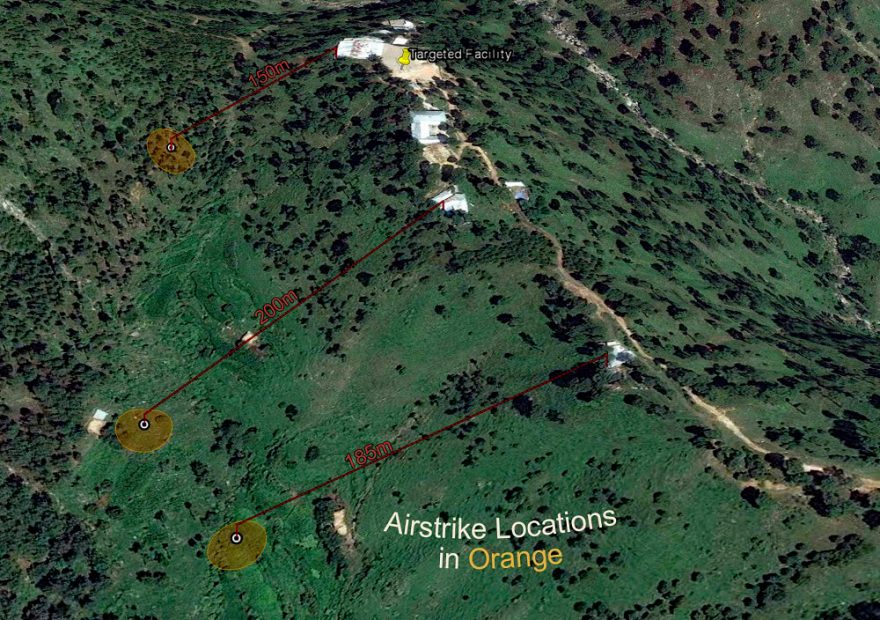
Image courtesy of Planet Labs, Google Earth and Digital Globe
Arguably the most important aspect of Fisk’s report is his detailing of the very close ties that have been forged between the Israeli and Indian militaries in recent years. For instance, according to Fisk, India was Israel’s arms industry’s largest client in 2017, spending nearly $700 million on Israeli air-defense systems, radars, ammunition and missiles. Many of those weapons had been promoted as “combat tested” after being used against Palestinians in the Gaza Strip, the world’s largest open-air prison. That same year, India represented 49 percent of Israel’s arms export market.
In addition to arms purchases, many Indian soldiers have traveled to the Negev desert to be trained by Israeli “special commando” units, and at least 16 elite Indian “Garud” commandos were recently based at two separate Israeli air bases.
Exporting oppression
Just as troubling as this military cooperation is that ethnonationalism and anti-Islam rhetoric are increasingly becoming the basis for the relationship between the two countries.
For instance, a recent Haaretz article, written by Shairee Malhotra and cited by Fisk, noted that “the India-Israel relationship is also commonly being framed in terms of a natural convergence of ideas between their ruling BJP and Likud parties.” Other reports have noted that this has translated into more “aggressive” policies from Modi targeting Kashmir and Muslims elsewhere in India and that continued Israeli goading of Modi’s anti-Islam tendencies could make life much more difficult for the estimated 180 million Muslims living in India.
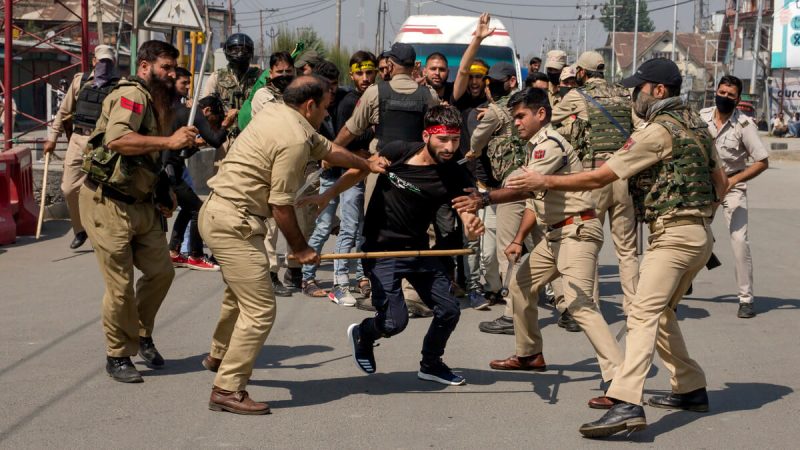
Indian police beat a Kashmiri Shiite Muslim for participating in a religious procession in Srinagar, Indian controlled Kashmir, Sept. 19, 2018. Dar Yasin | AP
While some analysts and reports have warned about this danger, Fisk notes that it will be difficult to prevent the Zionist, fascist nationalism of Benjamin Netanyahu’s Likud Party from influencing India’s ruling party, writing:
It is difficult to see how Zionist nationalism will not leach into Hindu nationalism when Israel is supplying so many weapons to India – the latest of which India, which has enjoyed diplomatic relations with Israel since 1992, has already used against Islamists inside Pakistan.”
Fisk goes on to note that “[s]igning up to the ‘war on terror’ – especially ‘Islamist terror’ – may seem natural for two states built on colonial partition.” Indeed, India’s actions in the disputed Kashmir region share many similarities to Israel’s neocolonial occupation of Palestine. For instance, the Muslim majority of Kashmir are treated as second-class citizens on their own land and their push for self-determination has been brutally suppressed by Indian forces. As of 2016, 500,000 Indian military personnel were present in the region, roughly equating to one soldier for every 25 civilians. As Al Jazeera noted at the time, there have been more than 70,000 killings, about 10,000 enforced disappearances and 7,000 mass graves found since 1947 in Indian-administered Kashmir.
There are many other parallels between Kashmir and Palestine, including the fact that the British government shares a large share of the responsibility for both. Indeed, the British-brokered partition creating the current states of India and Pakistan in 1947 is the root of the current conflict in Kashmir much as the Britain-mandated creation of the Israeli state in 1948 is the root of the current conflict in Palestine. As far as Kashmiris and Palestinians are concerned, the governments of India and Israel picked up where their colonial master of years past left off.
If a deadly conflict ultimately breaks out between India and Pakistan, it will hardly be the first time Israel has armed controversial governments. Israel sold arms to the Rwandan government during the Rwandan genocide and, more recently, to the government of Myanmar during its “ethnic cleansing” of the Rohingya Muslims. Yet, as Fisk notes, Israel’s export of Zionist nationalism and neocolonialism — and the accompanying oppression that in practice actually helps to create many of the very terrorist groups they fight against — is just as dangerous as its export of arms.
Whitney Webb is a staff writer for MintPress News and has contributed to several other independent, alternative outlets. Her work has appeared on sites such as Global Research, the Ron Paul Institute and 21st Century Wire among others. She also makes guest appearances to discuss politics on radio and television. She currently lives with her family in southern Chile.
As Pakistan Calls for Peace, India Refuses to Reveal Air Raid Details – Report
Sputnik – 03.03.2019
India’s Finance Minister Arun Jaitley has stated that security agencies will not publish any operational details about the air raid against militant groups in Pakistan, the newspaper Dawn reported. The statement comes following calls to release evidence that the Indian Air Force hit militant camps in airstrikes on 26 February, which led to an escalation in tensions between the two neighbours.
“The armed forces must have, and our security and intelligence agencies must have, a full leeway in dealing with situations, and if anybody wants operational details to be made public […] he certainly does not understand the system”, Jaitley said.
India’s finance minister also denied allegations that the Indian military activities were connected with the upcoming general elections in May.
At the same time, Pakistani Foreign Minister Shah Mahmood Qureshi called for a resolution to the escalating tensions between Pakistan and India via dialogue and diplomatic channels instead of military power.
“Peace is our priority and we do not desire war with India”, Qureshi said.
Calls to publish proof of striking militant camps came after Pakistan stated that the Indian airstrike on 26 February had hit an empty hillside. The air raid over Pakistani territory, which led to an escalation in tensions between Delhi and Islamabad, came in wake of a deadly attack on a security convoy that claimed the lives of 40 servicemen on 14 February carried out by the terrorist group Jaish-e-Mohammed (JeM).
New Delhi insists that Islamabad is harbouring and supporting militants that commit terrorist acts on Indian territory. Pakistan denies both the accusations and the existence of militant camps.
Russia and China offer the SCO platform for India-Pak de-escalation
By M. K. BHADRAKUMAR | Indian Punchline | March 2, 2019
Saudi Arabia is pushing forward as mediator between India and Pakistan with a messianic zeal that patently enjoys US backing. The Saudi Minister of State for Foreign Affairs Adel Al-Jubeir is arriving in Delhi tomorrow. He was to have visited Islamabad on Friday but rescheduled his plan so that he can touch base with Modi first and thereafter meet the Pakistani leaders, including army chief Gen. Qamar Bajwa.
Modi and Bajwa will be Adel’s key interlocutors. How far the Saudi waltz will advance remains to be seen. How Modi handles the piquant situation will bear watch.
Certainly, the Saudi mediation makes India look rather immature and that becomes willy-nilly a reflection of Modi’s foreign policy legacy. The point is, no matter what Modi may boast about “new India”, the geopolitical reality is that India’s stature diminishes when it needs a small country like Saudi Arabia under an autocratic ruler to help out with what is arguably one of the most critical templates of its diplomacy.
Saudi Arabia has no track record as a peacemaker. On the contrary, it has a notorious reputation the world over as a promoter of terrorist groups.
Meanwhile, India does not have to be beholden to the Saudis to ease its tensions with Pakistan. The indications are that Russia and China are jointly sponsoring an initiative in this regard. China is deputing a special envoy to visit India and Pakistan to discuss the crisis situation. The Pakistani FM Shah Mehmood Qureshi disclosed this in Islamabad.
To be sure, Russia and China, which actively coordinate on the foreign policy front, are in consultation each other on the India-Pakistan tensions. We may also factor in that the foreign ministers of Russia and China had an opportunity last Wednesday to meet EAM Sushma Swaraj at the RIC ministerial.
Following that, Chinese State Councilor and Foreign Minister Wang Yi also briefed Qureshi in a phone conversation where the latter had expressed the hope that “the Chinese side will continue to play a constructive role in easing the current tension.”
Equally, at the height of the India-Pakistan crisis, on February 27, Russian Foreign Ministry also had issued a statement expressing “grave concern over the escalating situation along the Line of Control and the surge in tensions” between India and Pakistan “which are Russia’s friends.” It took a neutral stance and called on both sides “to show restraint and redouble efforts to resolve existing problems by political and diplomatic means.”
It is entirely conceivable that the Chinese special envoy’s visit is a related development signifying a coordinated effort by Beijing and Moscow and in consultation with Islamabad and New Delhi. This is of course a major shift in the tectonic plates of Eurasian politics and it has an added significance insofar as it is taking place in the New Cold War conditions.
Indeed, it does not need much ingenuity to figure out that a US-sponsored Saudi mediation between India and Pakistan must be a worrisome development for both Russia and China, from the geopolitical perspective.
At any rate, on Thursday, President Vladimir Putin telephoned Modi. According to the Kremlin readout, they discussed the “crisis in relations between India and Pakistan” and the Russian leader “expressed hope for a prompt settlement.” The careful wording hinted that Putin offered to lend a helping hand, jointly with China, to ease the tension.
Curiously, the very next day, the Russian Foreign Minster telephoned Qureshi in Islamabad — presumably to follow up on the Putin-Modi conversation — and offered help to “de-escalate” the tensions. The Russian Foreign Ministry readout, cited by state news agency TASS, says: “Moscow expressed its readiness to contribute to de-escalating tensions and that there is no alternative to settling all differences between Islamabad and New Delhi by political and diplomatic means.”
Importantly, Lavrov also outlined to Qureshi how the de-escalation process can be achieved — via the mechanism of the Regional Anti-Terrorist Structure of the Shanghai Cooperation Organization (SCO).
A Xinhua report since highlighted this aspect — that Lavrov told Qureshi about the “possibility of using the Shanghai Cooperation Organization’s Regional Anti-terrorist Structure for this purpose.”
Alongside, the Russian Foreign Ministry spokesperson Maria Zakharova outlined in an important statement on Thursday Moscow’s broad approach. Zakharova said:
“We are worried about the escalation of tension in relations between India and Pakistan and dangerous manoeuvres of both states’ armed forces along the Line of Control that are fraught with a direct military clash.”
“We are urging the sides to display maximum restraint. We continue to assume that contentious matters should be resolved by political-diplomatic methods on a bilateral basis in line with the provisions of the 1972 Simla Agreement and the 1999 Lahore Declaration.”
“We reaffirm our readiness to provide all-out support to the Indian and Pakistani efforts in countering terrorism.”
From the Indian perspective, this adds up to an extremely positive outcome of EAM’s consultations in Zhejiang with her Russian and Chinese counterparts. This must be EAM Swaraj’s finest hour in international diplomacy, as the curtain begins descending shortly on her scintillating stint as India’s foreign minister.
No doubt, the urgency of “de-escalation” of the tensions with Pakistan is self-evident. The “de-escalation” is far from over with the return of the Indian pilot. In fact, the tensions on the Line of Control can spiral out of control anytime in the present supercharged atmosphere.
Without doubt, the international community — read the US and NATO allies — is closely watching. The Afghan endgame is at a most sensitive stage and any eruption of tensions between India and Pakistan will negatively impact the peace process.
India should wholeheartedly welcome the Sino-Russian proposal, cast within an SCO framework as far more preferable to the dalliance with the Saudis and the Emiratis — or, for that matter, any UN intervention.
The fact of the matter is that both Russia and China are stakeholders in India-Pakistan normalisation and neither has any hidden agenda in this regard. Of course, Russia and China are like-minded partners for India in the fight against terrorism. On the other hand, unlike in the Cold War era, Pakistan is keen on Eurasian integration, too.
Do not barter away India’s national security interests
By M. K. BHADRAKUMAR | Indian Punchline | March 1, 2019
There has been an avalanche of reports in the international media quoting western diplomats and security officials to the effect that India’s “intelligence-led… non-military preemptive strike” on a big terrorist camp in Pakistan on February 26 was all baloney. Apparently, these reports say, there was so such terrorist camp in existence in Balakot.
Incredibly enough, no one in the government cares to set the record straight. The Foreign Secretary had claimed earlier that the strike killed “a very large number of Jaish-e-Mohammad terrorists, trainers, senior commanders, and groups of jihadis who were being trained for Fidayeen action were eliminated.”
But surprisingly, the day after the FS spoke, Air Vice Marshal R.G.K. Kapoor said it was “premature” to provide details about casualties. He would only say that the Indian armed forces had “fairly credible evidence” of the damage inflicted on the camp by the air strikes.
It is important for the government to clarify, because what happened was a defining moment in India-Pakistan relations and in India’s fight against terrorism. The nation has a right to know. No doubt, crossing another country’s borders and attacking its territory is a major escalation. What is the rationale behind such escalation?
Prime Minister Modi says he’s given a “free hand” to the armed forces. Are we to assume that the IAF suo moto acted on February 26? That is inconceivable.
This calls for deep introspection: What is it that the government achieved through the 60-odd hours between the early hours of Tuesday and the evening of Thursday? There is no shred of evidence that Pakistani side is cowed down in fear.
On the contrary, Pakistan insists that it will retaliate against any act of Indian aggression. Prime Minister Imran Khan disclosed in the National Assembly in Islamabad yesterday that in the night of Wednesday-Thursday, the Pakistani military was in a state of readiness to fire missiles into India.
Some of our self styled experts say we’ve “sent a message” to Pakistan that we’ll hit them hard if terrorism continued. How can they be so sure? The Pakistani retaliation with an attack on India the very next day — an act of war by targeting our military installations — discredits their thesis.
The most unfortunate part is that after precipitating the crisis situation on Tuesday, the government ducked and took help from Saudi Arabia and the UAE to “de-escalate” the situation.
Make no mistake, this fateful move has grave implications. The whole world knows that these two petrodollar states are the principal sponsors of terrorist groups who destroyed Syria.
Importantly, how can we possibly overlook that Jaish-e-Mohammed (JeM) and other terrorist organisations in Pakistan have received direct support from these Arab countries, especially Saudi Arabia? There is plentiful evidence of it.
An action request cable archived by Wikileaks, documenting the illicit finance activities in Afghanistan and Pakistan, stated that “it has been an ongoing challenge to persuade Saudi officials to treat terrorist financing emanating from Saudi Arabia as a strategic priority.” The cable continues, “Still, donors in Saudi Arabia constitute the most significant source of funding to Sunni terrorist groups worldwide.” It describes Saudi Arabia as “a critical financial support base” for Al-Qaeda, the Taliban, Lashkar-e-Taiba (LeT) and other terrorist groups.”
By the estimation of the US state department, LeT and JeM are all but synonymous! As far back as in 1993, the LeT became part of the United Jihad Council, an umbrella group for militant Islamists operating in J&K, and in doing so, it formed a direct alliance with the JeM (which claimed credit for the Pulwama attack recently.)
In fact, another Wikileaks cable confirmed that Saudi Arabia and the UAE have been funnelling money not just to LeT but to JeM directly. It says:
“Locals believed that charitable activities being carried out by Deobandi and Ahl-e-Hadith organizations, including Jamaat-ud-Dawa, the Al-Khidmat Foundation, and Jaish-e-Mohammed were further strengthening reliance on extremist groups and minimizing the importance of traditionally moderate Sufi religious leaders in these communities. Government and non-governmental sources claimed that financial support estimated at nearly 100 million USD annually was making its way to Deobandi and Ahl-e-Hadith clerics in the region from ‘missionary’ and ‘Islamic charitable’ organizations in Saudi Arabia and the United Arab Emirates ostensibly with the direct support of those governments.”
Saudi Arabia has quite openly held out assurances to Pakistan that it need not go after JeM directly.
Indeed, the most dangerous part of the gambit by the Modi government to let in Saudi Arabia and the UAE into its matrix over Pakistan and Kashmir is that this policy shift is completely of sync with the wider geopolitical struggle unfolding in the region.
Quite obviously, Saudi Arabia wants to win Pakistan over in a tug-of-war game with Iran and is doling out to Islamabad generous financial help and a $10 billion investment plan to to build an oil refinery in the Gwadar port project (which actually puts a major Saudi project on Iran’s border.) The Saudi Crown Prince Mohammed bin Salman’s (MBS) recent visit to Pakistan has essentially cemented Pakistan’s inclusion in anti-Iran Arab NATO.
Against this backdrop, how could the Indian policymakers blithely overlook the far-reaching, dangerous implications of consorting with Saudi Arabia and the UAE as partners in its fight against terrorism in J&K fomented by Pakistan?
The most intriguing part is the newfound bonhomie between the Indian elite and the sheikhs. Put differently, you don’t take help from the wolf to guard the sheep, right? What explains the Faustian deal to allow them to enter the sanctum sanctorum of India’s foreign policy — Kashmir and the matrix of India-Pakistan relations?
Beware of the lure of green money. The Saudis and Emiratis are great operators in Washington, DC. Their fierce lobbying and charm offensives are legion. If they could manipulate the American political class so brilliantly, our oligarchy must be chicken feed.
Featured Video

The Black Dress: Unveiling the Truth about Rape, Sexual Assault on October 7
or go to
Aletho News Archives – Video-Images
Book Review
The myth of the ‘Arabs versus Jews’ narrative
By Roqayah Chamseddine | Al-Akhbar | July 31, 2014
The transformation of Zionism as a political ideology to Zionism as a religious ideology begins, in part, with Theodor Herzl’s “infatuation with British imperialism,” as noted by literary scholar and cultural historian Eitan Bar-Yosef in his book A Villa In The Jungle: Herzl, Zionist Culture, And The Great African Adventure. “Herzl’s phrase – a ‘miniature England in reverse’ – preserves the imperfect colonial mimicry that stood at the heart of Herzl’s Zionist project, and which was exposed so explicitly… in his decision to align himself with the British Empire.” Herzl would form the Zionist Organization (now The World Zionist Congress) in 1897 and promote the creation of a Jewish homeland in Palestine, while continuing to identify with British colonialism and those who facilitated colonialism – the colonialists themselves. While Herzl, in his book The Jewish State, published in 1895, argued that the ‘Jewish question’ was not social or religious but political, the historical account of the rise of religious Zionism shows that it began to take hold not long before the passing of Herzl in 1904. … continue
Blog Roll
Recent Comments
Richard Ong on NATO to deploy 800,000 troops… coinherence on America’s ‘Ceausescu Moment’ John Edward Kendrick on Erasing evidence: Over 700 vid… Bill Francis on The enigma of Tusk and Nord St… John Edward Kendrick on On to the Next Front: Israel T… loongtip on Palestine Genocide loongtip on “Stunning!” Apollo… loongtip on Kupyansk and Krasnoarmeysk Enc… ekain3 on Imran Khan wasn’t overthrown —… loongtip on US planning war with Venezuela… John Edward Kendrick on Kyiv wants land, not people: f… oldbrew on Lithium-Ion Batteries in Cars:…


 Aletho News
- Iran–Russia railway pact sets keystone in North–South Corridor
- Iran’s oil exports hit new post-sanctions record
- NATO to deploy 800,000 troops in case of war with Russia – German general
- US went after Bangladesh government over reluctance to condemn Russia – ex-minister
- Finnish Politician Warns NATO Chief: Stop Arming Ukraine or Risk Nuclear War
- Lots of ‘mess’ to clear up in Russia-US ties – Lavrov
- US Informs Russia Extension of New START Restrictions Under Consideration – Lavrov
- EU economies will suffer without tapping Russia’s assets, Brussels warns – FT
- Irish football body votes to seek Israel’s ban from European competition
- America’s ‘Ceausescu Moment’
- If Americans Knew
- No food, poisonous water in Gaza – Not a Ceasefire Day 29
- Every person in Gaza experiencing high levels of food insecurity – Not a Ceasefire Day 28
- ‘The Silence after the Screams’: How Western Media Helped Justify the Rape of Palestinians
- The AI Drones Used In Gaza Now Surveilling American Cities
- With 10,000+ buried in rubble, Gaza is “world’s largest mass grave” – Not a Ceasefire Day 27
- Lawsuit Charges That California Law Illegally Muzzles Students and Teachers on Palestine
- Outrage over video leak of Israeli soldiers’ gang rape of Palestinian exposes rot in Israeli society
- Youtube Quietly Erased More Than 700 Videos Documenting Israeli Human Rights Violations
- They Tortured Lambs In The West Bank
- In Israel, raping Palestinian prisoners is justified. Leaking the footage is betrayal
- No Tricks Zone
- Germany’s EIKE Institute Calls “Global Tipping Points Report” Overly Fixated On CO2
- 2025 Hurricane Forecast Was Overly Alarmist (Again)…Atlantic Season Ending Near Normal
- Greenland Continues To Defy Alarmist Warming And Ice Melt Narratives
- Bill Gates, 893 Companies Ditch Climate Initiative…Call For “Return to Economic Rationality”
- The Antarctic Peninsula Has Cooled By Over 2°C Since 2003
- World Getting Fed Up With Europe’s Unsustainable Climate Sustainability Act
- New Study: Great Barrier Reef Coral Cover ‘At Its Highest Since Monitoring Began In 1985’
- Recent Global Warming Mostly Due To Natural Factors, New Study Finds
- Antarctic Amundsen-Scott Station Sees Coldest October in 44 Years…Mainstream Media Silent!
- New Study Determines It Is ‘Impossible’ For CO2 To Be The Driving Mechanism In Global Warming
 Aletho News