US eyes Sri Lanka as its military logistics hub
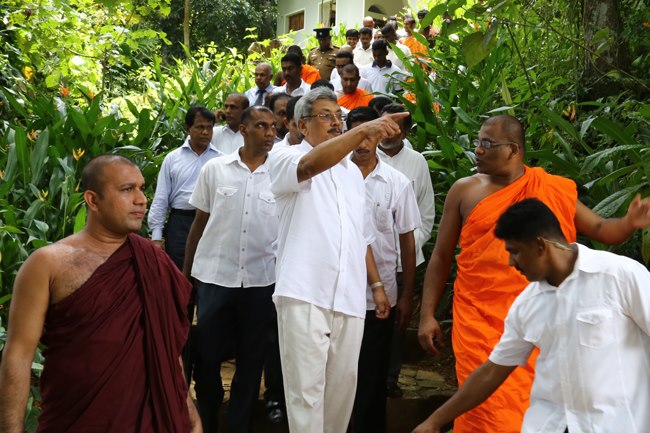
Sri Lankan presidential aspirant Gotabaya Rajapaksa with the radical Buddhist monk Gnanasara Thera of Bodu Bala Sena. File photo.
By M. K. BHADRAKUMAR | Indian Punchline | July 3, 2019
The Easter Sunday terrorist attacks in Sri Lanka on 21st April in which 259 people were killed and over 500 injured were initially attributed to the Islamic State (IS). But no hard evidence is available to substantiate such a reading and it remains an open question as to the perpetrators.
The Sri Lankan President Maithripala Sirisena may have somewhat de-mystified the topic this week. On July 1, Sirisena charged at a public function that drug traffickers are behind the Easter Sunday bomb attacks. The following day he ordered the arrest of former Defense Secretary Hemasiri Fernando and the Inspector General of Police Pujith Jayasundara for their failure to prevent the Easter Sunday attacks despite prior knowledge of the attacks.
What lends enchantment to the view is that the United States had brilliantly succeeded in deploying to Sri Lanka the personnel of the Indo-Pacific Command within a couple of days of the Easter Sunday attacks on the pretext of investigating and assisting in Colombo’s upcoming fight against the IS. Historically, Sri Lanka is chary of allowing foreign military presence on its soil, but in this case Washington pressed home the deployment, since the ruling elite in Colombo was on the back foot, incoherent and in disarray in the immediate aftermath of the terrorist attacks.
In political terms, what Sirisena may have done this week is to reverse the ‘internationalisation’ of Sri Lanka’s terrorism problem. Indeed, for tackling a local drug mafia, Sri Lanka doesn’t need the expertise of the US’ Indo-Pacific Command.
This is just as well because in the downstream of the Easter Sunday attacks in April, Washington also began pushing hard for the signing of a Status of Forces Agreement (SOFA) with Sri Lanka, which Pentagon has traditionally demanded as the pre-requisite of establishment of military bases in foreign countries. (The SOFA establishes the rights and privileges of American personnel present in a host country in support of a larger security arrangement.)
Unsurprisingly, the Sri Lankan opinion militated against the SOFA project and suspected its real intentions. A huge uproar followed in the Sri Lankan media. Without doubt, the SOFA became yet another template of the power struggle between the staunchly nationalistic Sirisena and the famously ‘pro-western’ prime minister Ranil Wickremesinghe.
The net result is that the project which the US hoped to conclude in absolute secrecy, got derailed once the draft SOFA document under negotiation got somehow leaked to a Colombo newspaper. Interestingly, the US Secretary of State Mike Pompeo, who was scheduled to travel to Colombo following his recent visit to New Delhi was compelled to cancel the visit once it became apparent that the SOFA project has become a hot potato.
Meanwhile, the Empire strikes back. A case has been filed in the US District Court in central California by an American law firm claiming damages on behalf of alleged victims of human rights abuse during the war against separatist LTTE ten years ago. The plaintiffs have targeted Gotabaya Rajapaksa, then wartime defense chief and the younger brother of former president Mahinda Rajapaksa, as well as several government agencies, including military intelligence, the Criminal Investigation Department, the Terrorism Investigation Division, and the Special Intelligence Service, including some serving officials.
Of course, this is a blatant American attempt to put into jeopardy Gotabaya Rajapaksa’s plan to run for president in the upcoming Sri Lankan election in December. Gotabaya was a US citizen at the time of the war against the LTTE. He has dual citizenship and his request renouncing American citizenship is pending with Washington. Now, the catch is, the lawsuits in California could delay his bid to renounce his US citizenship, in which case he would not qualify to run for president under Sri Lankan electoral laws. Washington has tripped Gotabaya.
The US is making sure that the Rajapaksa family will not regain the calculus of power in Colombo following the December poll. Equally, the trial in California can expose former President Mahinda Rajapaksa as well — and even entangle Sirisena who had a direct role as acting defence minister in the final stages of the war. Clearly, Washington is interfering in the December election in Sri Lanka in a calibrated manner with a view to strengthen the prospects of a pro-American candidate such as Wickremesinghe or the Finance Minister Mangala Samaraweera who can be trusted to put the signature on the SOFA.
The US is determined to push ahead with the signing of the SOFA leading to the establishment of long-term American military presence in Sri Lanka. In August 2018, USS Anchorage, a Seventh Fleet vessel, and a unit of Marines visited the port of Trincomalee. In December 2018, the aircraft carrier USS John C. Stennis visited Trincomalee as part of the Pentagon’s plans to establish a logistic hub there for the US Navy. A Mass Communication Specialist on board USS John C. Stennis in a dispatch to the US Navy official web portal wrote:
“The primary purpose of the operation is to provide mission-critical supplies and services to U.S. Navy ships transiting through and operating in the Indian Ocean. The secondary purpose is to demonstrate the U.S. Navy’s ability to establish a temporary logistic hum ashore where no enduring U.S. Navy logistic footprint exists.”
The US disclaims any intention to set up military bases in Sri Lanka. This is factually true — except that it is sophistry. The US plan to use Sri Lanka as a ‘military logistics hub’ involves supportive measures that facilitate any American military operation in the Asia-Pacific region. Actually, this is well beyond the solitary use of a particular harbour such as Trincomalee as a military base. The point is, the entire island nation is being transformed into a ‘military logistics hub’.
Never before has there been such blatant US interference in Sri Lanka’s internal affairs. Washington tasted blood in the successful regime change project in January 2015 and it never looked back. The interference is so very extensive today that it is destabilising the Sri Lankan situation which is already highly polarised.
This is happening only due to India’s passivity bordering on acquiescence. The containment strategy against China in the Indian Ocean has become a common endeavour for Washington and Delhi. Is it in India’s long term interests that Sri Lanka is being destabilised, even if in the short term the Chinese Navy might be put to some difficulties in the Indian Ocean?
India’s medium and long term interests lie in regional stability. Its influence as a regional power is linked to regional stability. India cannot overlook that China has legitimate interests in our region. The US is a faraway power and is also in decline. It doesn’t make sense for India to bandwagon with the US in South Asia. A far more realistic approach will be to work with China and expand and deepen the common interests in regional security and stability.
‘Not Only Question of Oil’: M.K. Bhadrakumar Weighs in on Impact of US-Iran Escalation
Sputnik – July 1, 2019
US Secretary of State Mike Pompeo created a flutter of sorts last week, by saying that Washington and New Delhi have a shared understanding of the alleged threat posed by Iran.
The Indian government did not immediately react, restraining itself to saying, that all issues on the table between the two countries will be addressed in the context of national interests.
Over the last year, India has been following the standoff between the United States and Iran, in the context of its long-term economic effects on oil supplies. In the last financial year alone, according to government data, New Delhi imported 84 per cent of its crude from the conflict-prone Middle Eastern and West Asia region, including Iran. The US has ruled out any exemptions from its punitive sanctions on Iran for countries that buy oil from the latter, including India.
Bilateral ties between India and Iran are more than just a transactional relationship based on buying and selling crude. India’s foreign policy establishment is having discussions about Iran at various levels, understanding that the current crisis has numerous implications, says India’s former Envoy to Turkey and Uzbekistan M.K. Bhadrakumar.
Sputnik: US Secretary of State Pompeo’s recent statement that the US and India have a shared understanding of the threats posed by Iran created a flutter within the Indian foreign policy establishment, so much so, that New Delhi said Pompeo’s views did not reflect India’s position. What is your response?
Ambassador M.K. Bhadrakumar: Frankly, I don’t understand what Mr Pompeo meant when he said that the United States and India have a shared understanding of issues related to Iran. I don’t know what he meant by that, and I also don’t understand why our External Affairs Minister (S. Jaishankar) kept quiet about it.
Sputnik: In the context of India’s foreign policy initiatives under the present government of Prime Minister Narendra Modi, how much emphasis should be placed on the issue of oil imports from Iran?
M.K. Bhadrakumar: At the present moment, it is a very vital issue for India because it is not only a question of oil. In my opinion, India should also look at the emerging situation in terms of regional stability and security. This issue goes far beyond that of oil imports alone. It is about regional security and stability, and overall its impact on the Indian economy.
Sputnik: Can can you elaborate on the point about oil imports having an impact on the Indian economy?
M.K. Bhadrakumar: The belligerent and aggressive behaviour of the United States towards Iran has heightened tensions, and there is a lot of talk in the air, about the dangers of war. The United States is thousands of kilometres away. But this [the Persian Gulf region?] is India’s extended neighbourhood where nearly seven million Indians live and work.
Sputnik: The US maintains that Iran is the world’s largest state sponsor of terror. During his visit to New Delhi last week Secretary Pompeo said: “We know the Indian people have suffered from terror.” How would you assess this remark?
M.K. Bhadrakumar: I can recall the US Secretary of State saying that India is an affected party as a result of Iran’s behaviour and then characterising Iran as a supporter of terrorism. India has not experienced any such kind of threat nor has it harboured any such threat perceptions from Iran.
India’s concerns about terrorism are entirely different than those expressed by United States propagandists on Iran. What the United States says, or what Secretary Pompeo said just doesn’t make sense. I think India should have clarified its position right then and there.
Pompeo Might Have The Perfect Carrot To Dangle In Front Of Modi’s Mouth
By Andrew Korybko | EurasiaFuture | 2019-06-18
The US is planning to include India on its International Traffic in Arms Regulations (ITAR) list in order to place it at par with its NATO allies, “Israel”, and a few others for the export of high-level military technologies, which could be the perfect carrot for Pompeo to dangle in front of Modi’s mouth during his visit to the South Asian state next week in order to get him to ditch Russia, and it might actually end up being part of the “surprise” that he recently hinted he has in store for his hosts.
The Indian press is full of reports about the country’s possibly forthcoming inclusion on the US’ International Traffic in Arms Regulations (ITAR) list after two senators inserted the relevant amendments into a draft of the National Defense Authorization Act (NDAA) 2020. Should it pass into law by the end of the year, then India would be legally at par with America’s NATO allies, “Israel“, and a few others for the export of twenty categories of high-level military technologies including ballistic missiles, drones, spacecraft systems, nuclear weapons simulation tools, and directed energy weapons, et al. This could be a real game-changer for its military capabilities and help it to more confidently “contain” China at the US’ behest per their shared “Indo-Pacific” vision, though the Pentagon probably won’t allow India to have this privilege so long as it retains its military partnership with Russia.
Alice Wells, the head of the State Department’s South and Central Asia bureau, implied as much last week in a testimony to lawmakers about the possible consequences of India’s refusal to reconsider its S-400 deal with Russia, which she said could include both CAATSA sanctions and the imposition of severe limits on the country’s military interoperability with the US. If India bends to American pressure and ditches Russia in exchange for THAADs, Patriots, and possibly even F-35s like its Ambassador to the US strongly hinted New Delhi is deliberating doing, then it can avoid this self-inflicted harm to its new military-strategic alliance with Washington though at the expense of its old one with Moscow. The “surprise” that Pompeo suggested that he has in store for his hosts during his upcoming visit to the South Asian state next week might be a formal offer to put India on the ITAR list if it decisively pivots away from Russia.
Truth be told, that would be a pretty attractive carrot for Pompeo to dangle in front of Modi’s mouth and might even get the re-elected leader to finally bite the bait. India is obsessed with China and the global pivot state of Pakistan, and it’s the excessive fearmongering about the latter in response to the suspicious Pulwama incident and subsequent Bollywood-like “surgical strike” that’s largely believed to have been responsible for Modi receiving such a huge mandate at the polls last month, so it can’t be underestimated just how important New Delhi would regard this unprecedented expansion of its military-strategic alliance with Washington. Russia can’t provide India with the game-changing capabilities that it’s seeking in its quest to “contain” China and “punish” Pakistan, ergo why it began its pro-American pivot in the first place because the US is more than eager to meet New Delhi’s needs in order to advance their shared strategic objectives.
Even though the two allied Great Powers are presently in the midst of what the Mainstream and Alternative Medias are misinterpreting (and in some cases, deliberately misreporting) to be a so-called “trade war”, their economic disagreements with one another are completely separate from their military-strategic commonalities. It’s therefore very likely that Modi would be extremely receptive to Pompeo’s possibly proposed offer to place India on the ITAR list in exchange for it pulling out of the S-400 deal with Russia, especially since the US’ unique “Major Defense Partner” already clinched the LEMOA and COMCASA interoperability pacts with it, so the next natural step is to prepare it for receiving high-level military technologies in order to take their alliance to the next level. India’s playing “hard to get” in order to receive the best terms possible, but it seems to have already made up its mind about the necessity of agreeing to a deal, so all that’s left is to finalize the details.
India & Israel Are Officially Diplomatic Allies At The UN
By Andrew Korybko | EurasiaFuture | 2019-06-12
India just made history at the UN earlier this week, but in what’s sure to be interpreted as an ignoble way by the supporters of the emerging Multipolar World Order. Encouraged by the massive mandate that he received after his resounding re-election last month, Modi gave the go-ahead for his government to break with decades of its post-independence political traditions by unprecedentedly supporting “Israel” at the global body and voting against granting consultative status to a Palestinian NGO that allegedly has ties with Hamas.
The self-professed “Jewish State’s” deputy chief of mission in India praised this diplomatic pivot by tweeting “Thank you #India for standing with @IsraelinUN and rejecting the request of terrorist organization “Shahed” to obtain the status of an observer in #UN. Together we will continue to act against terrorist organizations that intend to harm”, in what certainly signifies that Modi’s second term in office will see his country more determinedly siding with the fading Unipolar World Order at the multipolar one’s expense.
India had hithero been trying to make inroads with the Organization of Islamic Cooperation (OIC), but its hopes for future progress on this front have likely been dashed by the self-inflicted soft power damage that it just did by diplomatically allying with “Israel” at the UN. Although Resistance leader Iran continues to beg India to reconsider its decision to abide by the US’ unilateral sanctions regime against it, it’ll now be doing so with the full knowledge that the South Asian state is officially one of its hated “Israeli” foes’ key allies in thwarting the attempts of the Palestinians to have a greater global voice in publicizing their plight. This would make the Islamic Republic’s further outreaches to India even more humiliating than before, possibly raising the chance that it might finally give up in order to save “face” and protect its hard-earned and very proud reputation as the world’s leading anti-Zionist state.
In parallel with this, the global pivot state of Pakistan is now by default the most prominent pro-Palestinian voice in South Asia, especially after Minister for Human Rights Dr. Shireen Mazari recently promised that her country will continue supporting the Palestinians and urged all her Muslim counterparts to do so as well. The fact of the matter is that the Palestinian and Kashmiri causes are inseparable because they’re essentially one and the same — the indigenous Muslim majority of each region have been oppressed by foreign occupiers for decades and have yet to be granted the right to democratically decide their own political futures. Actually, it’s precisely because of these interlinked conflicts that India and “Israel” initially began to ally with one another because they play the same roles in each of them. Accordingly, they’ve increased military cooperation to such a point that “Israel” is now India’s second-largest military supplier and India is “Israel’s” top arms destination.
It therefore shouldn’t be any surprise that India decided to add an official diplomatic dimension to its already-existing military-strategic alliance with “Israel” by supporting it at the UN against the Palestinians. Seeing as how the Indian side hasn’t protested the “Israeli” deputy chief of mission’s tweet thanking it for “rejecting the request of terrorist organization ‘Shahed’” and vowing that “together we will continue to act against terrorist organizations that intend to harm”, it can be logically assumed that New Delhi informally regards Hamas and all those allegedly affiliated with it as “terrorists”, which is only natural considering how fast its alliances with the US and “Israel” are progressing. As such, whether it concerns Russia, China, Iran, or even the Palestinian cause nowadays, India is no longer practicing its over-hyped policy of “multi-alignment” but is instead decisively pivoting against each of the aforesaid multipolar forces despite still clinging to this slogan in an unconvincing attempt to cover its tracks.
India’s Proposal For A Global “Terrorism” Conference Will Probably Backfire
By Andrew Korybko | EurasiaFuture | 2019-06-09
Indian Prime Minister Modi proposed a global “terrorism” conference while speaking in the Maldives during his first foreign trip following last month’s resounding re-election victory, but while this idea is obviously intended to contribute to his failed policy of “isolating” the global pivot state of Pakistan, it’ll probably backfire by drawing attention to his country’s policy of state terrorism against the Kashmiris, providing a platform for India’s new American-“Israeli”-Saudi allies to fearmonger about Iran, and putting Russia and the US in an awkward position for their diplomatic peacemaking ties with the Taliban.
Shifting The Blame For Regional Instability
Indian Prime Minister Modi is on his first foreign trip since winning a resounding re-election victory last month, during which time he told the Maldivian parliament that the world needs to urgently convene a global conference on “terrorism”. His supplementary remarks about “state-sponsored terrorism” and how some “people still try to create notions of ‘good terrorist, bad terrorist’” were interpreted as being aimed against the global pivot state of Pakistan’s political support for the Kashmiri freedom movement that India regards as “terrorists”, strongly insinuating that the intent behind Modi’s initiative is to contribute to his failed policy of “isolating” Islamabad. India also wants to deflect from the negative attention that it received worldwide after being exposed as the real rogue state in South Asia after it almost brought the region to the brink of nuclear war earlier this year following the suspicious Pulwama incident that it automatically blamed on Pakistan, desperately trying to continue pinning the blame on its neighbor for South Asia’s instability instead of taking responsibility for the being the reason behind this itself.
“Containing” China & Taking Revenge On Russia
Should this conference end up taking place, then it’s predictable that India will produce manufactured “evidence” in order to “prove” its point, exploiting the highly publicized opportunity to smear Pakistan’s reputation and provoke international concerns about investing in CPEC. This agenda has a much greater chance of succeeding if India convinces the US to impose unilateral sanctions against Pakistan on an “anti-terrorist” basis, understanding that the real purpose would be to indirectly sanction CPEC and consequently deal an asymmetrical blow to China in the so-called “trade war“. Furthermore, the negative attention that India hopes to heap upon Pakistan during that occasion could be weaponized to smear all of its targets’ partners by extention, including Russia, who New Delhi has been extremely angry with over the past few months after Moscow refused to take its side during the latest regional hostilities and instead opted to remain neutral as part of its balanced “Return to South Asia“. The news that President Putin might finally meet Prime Minister Khan during next week’s SCO Summit in Bishkek might have also motivated Modi to act as urgently as he did.
A Dose Of Modi’s Own Medicine
For as much as Indian strategists are expecting an optimistic outcome from Modi’s proposed global “terrorism” summit, there’s a very high likelihood that it’ll actually end up backfiring and causing many more problems than it’s worth. To begin with, Pakistan could use the international media coverage given to that event to draw attention to India’s use of state terrorism against the Kashmiri freedom movement that’s fighting for the right to their promised UN-mandated plebiscite to determine their political future. Not only that, but the “ModiMob” lynchings of dozens of Muslims over the past half-decade could be properly reframed as Hindu terrorist attacks if Pakistan plays its soft power cards right. In addition, the forthcoming event could also serve to remind the world of the testimony of convicted RAW Hybrid War operative Kulbhushan Jadhav after he admitted that he was tasked by his homeland to organize terrorist attacks in Pakistan, which could in turn lead to a wider discussion about India’s state sponsorship of the BLA and TTP terrorist groups .
Ranting About Iran & Talking Tough Against The Taliban
That’s not all, though, since the illusion of India’s “multi-alignment” would be ruined once and for all if its new American, “Israeli“, and Saudi allies exploit that platform to fearmonger about Iran, especially after New Delhi recently ditched it once Washington withdrew its sanctions waiver last month. Being responsible for sponsoring an anti-Iranian propaganda fest that raises the already high tensions in the Gulf would irreparably harm India’s reputation among the many countries of the emerging Multipolar World Order even if it endears it to the ones who are clinging to the fading unipolar one, showing without any doubt that New Delhi has made a decision to unapologetically pivot towards Washington. Nevertheless, India might also inadvertently harm its standing with the US if its representatives rant about the Taliban during that time, with whom Washington and Moscow are presently engaged in peacemaking diplomatic outreaches, but it might even stage a Bollywood-like drama to this effect to create some unconvincing ambiguity about its aforementioned pivot.
Concluding Thoughts
Modi thought that it would be a good idea to propose a global “terrorism” conference in order to put more international pressure on Pakistan, but upon further contemplation, it might be India itself that ends up coming under worldwide scrutiny if Islamabad takes advantage of this opportunity to raise awareness about New Delhi’s policy of state terrorism against the Kashmiris, the “ModiMob” Hindu terrorist lynchings of dozens of Muslims over the past half-decade, and Kulbhushan Jadhav’s confession that his homeland ordered him to organize terrorist attacks in Pakistan. Moreover, India’s reputation could be irreparably ruined in the eyes of the emerging Multipolar World Order if it sponsors an event that turns into an anti-Iranian propaganda fest for its US, “Israeli”, and Saudi allies to rant and rave against their rival, even if it stages a Bollywood-like drama by verbally attacking America’s peacemaking diplomatic ties with the Taliban to deflect from this fact. All told, more self-inflicted soft power harm than good might come out of India’s proposed global “terrorism” conference, though its strategists probably won’t realize this until after the fact.
The Geo-Port-Politics of Gwadar and Chabahar
By Salman Rafi Sheikh – New Eastern Outlook – 08.06.2019
In a highly surprising move, Iran’s foreign minister, on an unscheduled and unannounced visit to Pakistan on Thursday (May the 23rd), announced the proposal to link Pakistan’s port of Gwadar with Iran’s Chabahar port. This announcement signals tectonic geo-political shift taking place in the region in the wake of increasing tensions between the US and Iran. The US has already successfully forced India, its chief South Asian ally, to scrap its purchase of oil from Iran, a country India was not long ago claimed to have entered into a strategic alliance with. Although the US has somehow left Chabahar out of its net of sanction, India’s decision to follow the US in its footsteps does signal its participation in the US policy of crippling Iranian economy and take Iran to the verge of massive political disruption and eventual regime change. Iran, obviously, is not unmindful of the implications of this particular decision of India.
Iran’s proposal to link Chabahar with Gawadar, despite the fact that the US sanctions don’t apply on the post, shows the deep sense of Indian betrayal prevailing in Tehran and a counter-manoeuvre to avoid isolation. Iran, obviously, does not expect India to be as robust and committed to building the rest of the port as it would have in a peaceful and sanction-less scenario. Iran, logically enough, is boosting its ties with its immediate neighbour, a country that already is deeply allied with China and aims to expand CPEC to Iran to increase regional connectivity. With Chabahar and Gwadar being linked, Iran will thus have two major regional states on its side i.e., Pakistan and China and will be far better placed in China’s extended regional connectivity programme than it is now. Zarif’s connectivity proposal itself tells everything. To quote him:
“We believe that Chabahar and Gwadar can complement each other. We can connect Chabahar and Gwadar, and then through that, connect Gwadar to our entire railroad system, from Iran to the North Corridor, through Turkmenistan and Kazakhstan, and also through Azerbaijan, Russia, and Turkey.”
As far as the US—Iran tension is concerned, unlike India, Pakistan has already said that it will not take sides in the conflict. Pakistan’s neutrality in the on-going scenario suits Tehran far more than it does for the US, that is if it does at all.
There is also no gainsaying that Tehran’s proposal to connect the two ports couldn’t have come with prior consultation with the Chinese, who are practically running the port in Pakistan. Accordingly, before coming to Pakistan, Zarif was in China where he met his Chinese counterpart and certainly discussed this proposal, leading Chinese foreign minister to “Welcome Iran” to actively take part in the joint building of the Belt and Road Initiative (BRI) through Chabahar.
China also re-affirmed its support for Iran. “China firmly opposes unilateral sanctions and the so-called ‘long-arm jurisdiction’ imposed by the United States on Iran,” Wang said, pledging to maintain the Joint Comprehensive Plan of Action and safeguard the authority of the United Nations and basic norms governing international relations.
Chinese support’s major manifestation came a few days ago when Chinese oil tanker Pacific Bravo left the Persian Gulf with 2 million barrels of Iranian light crude, ignoring the US sanctions and practically challenging the US unilateralism.
Pacific Bravo is owned by Bank of Kunlun, a financial institution that is owned by the Chinese state oil company CNPC. Bank of Kunlun has long been the financial institution at the heart of China-Iran bilateral trade—a role for which the company was sanctioned during the Obama administration. Despite already being designated, Bank of Kunlun ceased its Iran-related activities in early May when the oil waivers were revoked. But Bravo’s current moves point to a change in Chinese policy. Importantly enough, Bravo sailed from the Persian Gulf on the same day that Zarif arrived in Beijing and met Chinese foreign minister to discuss Iranian participation in the BRI (through linking Gwadar and Chabahar).
With Iran now taking this fundamental shift, what is apparent is that a major foreign policy shift in Iran has taken place whereby its leadership has come to an understanding that their relations with the US are unlikely to take a positive turn for a long time and that a necessary adjustment in the foreign policy is absolutely needed. As a matter of fact, it was only a few days ago when Iran’s supreme leader criticised Iran’s foreign policy and dropped a major hint about why changing the course of foreign policy was an utmost necessity.
Of course, its major manifestation is reorienting Iran’s relations with Pakistan via participation in the BRI. Pakistan will be least concerned about any US reaction over linking Gwadar with Chabahar, for the US sanctions do not apply to the Iranian port. But the fact that the geo-political significance of the port will undergo a significant change after a successful linkage between the two ports and that China will become a major player, the US might feel ‘compelled’ to direct its sanctions toward the port eventually.
Iran resets its foreign policy calculus
By M. K. BHADRAKUMAR | Indian Punchline | May 25, 2019
The unannounced overnight visit by Iran’s Foreign Minister Javad Zarif to Pakistan on Thursday can be seen at the very minimum as forming part of a diplomatic campaign in the backdrop of the war clouds building up in the Persian Gulf. This regional tour has already taken Zarif to Russia, China, Turkmenistan, India and Japan.
For Iran, Pakistan is an important neighbour and the two countries have a history of troubled relations. (See my recent blogs Pakistan-Iran ties set for makeover – Part I and Part II.) In the prevailing regional setting, Pakistan’s importance for the Iranian geo-strategies has become crucial.
In immediate terms, King Salman has sent out invitations to two summits he’ll be hosting in Mecca on May 30 — back-to-back summits of the Gulf Cooperation Council (GCC) and the Arab League — where the leitmotif is the rising tensions with Iran. Neither GCC nor Arab League carries credibility, but Saudi Arabia is hoping that the Muslim Middle East will stand up and be counted in the vanguard of the US-led ‘Iran project’.
Enter Pakistan. Pakistan already has stated it will not take sides in the looming confrontation. Pakistan has described the crisis in the Persian Gulf region as “disturbing” and said that Washington’s decision to deploy an aircraft carrier and bombers has fuelled tensions and exacerbated “the existing precarious security situation” in the Middle East.
Just before Zarif’s arrival in Islamabad, Pakistani foreign ministry spokesman said, “We expect all sides to show restraint, as any miscalculated move can transmute into a large-scale conflict. Pakistan always supports dialogue and desires that all issues should be settled peacefully and through engagement by all sides.”
Pakistan’s stance of ‘positive neutrality’ works in favour of Tehran. Importantly, it is in stark contrast with the deafening silence of New Delhi, which has caved in to US diktat and summarily terminated all imports of Iranian oil. Suffice to say, Pakistan has moved to neutral ground at a juncture while India is bonding with the US, Israel, Saudi Arabia and the UAE — the ‘Quad’ group that pioneers the project to force a ‘regime change’ in Iran.
Delhi gave a pro forma reception to Zarif ten days ago when he came on an unannounced visit and Indian government sources went out of the way to prompt the media to see the event as entirely at Iran’s insistance. In comparison, Pakistan graciously received Zarif, who met the Pakistani Prime Minister and Foreign Minister as well as the army chief and the speaker of the national assembly.
Without doubt, the shift in India’s Middle East policies will have registered in the Iranian political establishment at the highest level. Simply put, Delhi has turned its back on Tehran and a sense of betrayal is only natural in Tehran, which strained every nerve to befriend India. And the fact remains that unlike with Iran’s ties with Pakistan, there are no contradictions in Iran’s bilateral ties with India.
In view of the above, significantly, Zarif made a stopover in Chabahar Port en route to Islamabad on Thursday. No doubt, this development is heavy with symbolism, because Chabahar symbolises not only the unfulfilled Iranian expectations from partnership with India but stands out today as a relic of India’s betrayal. (See my blog India’s Betrayal of Iran Is Only the Beginning.)

(Iran’s FM Zarif at Chabahar en route to Islamabad on May 23, 2019)
In his first remarks after arrival in Islamabad, Zarif disclosed that he intended to put forward a “proposal” for connecting Pakistan’s Gwadar port to its “complementary” port Chabahar (located just 72 kms away in southeastern Iran.) To quote Zarif,
“We believe that Chabahar and Gwadar can complement each other. We can connect Chabahar and Gwadar, and then through that, connect Gwadar to our entire railroad system, from Iran to the North Corridor, through Turkmenistan and Kazakhstan, and also through Azerbaijan, Russia, and Turkey.”
Make no mistake that this is a wholesome proposal. An experienced career diplomat like Zarif is not in the business of kite-flying on such a sensitive issue that holds the potential to realign the geopolitics of the region.
Equally, it stands to reason that Tehran has consulted Beijing beforehand. Gwadar is synonymous with the China-Pakistan Economic Corridor and, of course, CPEC is the flagship of China’s Belt and Road (BRI) Initiative.
In fact, during what appeared to have been a highly successful visit to Beijing by Zarif a week ago, Iran-China cooperation within the framework of BRI figured prominently in his talks with Chinese State Councillor and Foreign Minister Wang Yi. The Xinhua report on the meeting underscored Wang’s remark that ‘China welcomes Iran to actively take part in the joint building of the Belt and Road and hopes to strengthen mutually beneficial cooperation.’
Equally, it must be factored in that the week before Zarif met Wang, he had travelled to Moscow and had talks with Russian Foreign Minister Sergey Lavrov where they discussed key issues in the international arena, as well as bilateral cooperation. The Russia-Iran consultations in Moscow stand out as a defining moment in regional security, as apparent from the remarks to the media, below, by the two foreign ministers:
(Joint press conference by Russian FM Sergey Lavrov (R) and Iran’s FM Javad Zarif at Moscow on May 8, 2019)
The big question is whether all this signifies a fundamental rethink in Iran’s foreign policy options in an emergent scenario where it must confront the geopolitical reality that a normalisation of relations with the US is to be ruled out for a very long time to come and some fundamental adjustments have become necessary.
Indeed, Iran’s Supreme Leader Ayatollah Ali Khamenei recently made an unprecedented open criticism of Iran’s foreign policy.
In sum, it is possible to estimate that the proposal that Zarif made to the Pakistani leadership signifies a reorientation of Iran’s foreign policy in the direction of greater integration with the two major Eurasian powers Russia and China.
In an ideal world, Iran would have preferred to pursue independent foreign policies, but life is real and a regional axis with Russia, China, Pakistan and Turkey becomes an imperative need today. Conceivably, this profound shift in Iran’s foreign policy calculus carries the imprimatur of Ayatollah Khamenei.
Read the IRNA report, here, on Zarif’s Pakistan visit.
India’s Ambassador To The US Strongly Hinted At An Anti-Russian Military Pivot
By Andrew Korybko | EurasiaFuture | 2019-05-24
India’s much-touted and over-hyped policy of “multi-alignment” is seeming more and more like a cover for unconvincingly disguising the country’s strategic alliance the US, especially after its Ambassador to America strongly hinted that Modi will undertake an anti-Russian military pivot during his second term in office.
There’s little doubt that India will ditch Russia like it just recently did Iran after its Ambassador to America strongly hinted as much in an exclusive interview that he gave to CNBC. The South Asian state’s top diplomatic representative to the US told the outlet the following in an article provocatively headlined India, facing sanctions for Russian arms deals, says it wants to pivot spending to the US:
“There has been a tradition of dependence on defense equipment from Russia. But if you go by SIPRI figures, in the block year 2008 to 2013 we imported 76% of our defense items from Russia. In the next five-year block, from 2013 to 2018, this came down 58% and in the same period our imports from the United States increased by 569%. So that itself tells you that, when we have a choice… we are obviously diversifying our purchases.”
This is the clearest signal yet that Modi’s second term in office will be dedicated to prioritizing his country’s strategic alliance with the US, especially in the military sphere and most likely to both Russia and China’s detriment. About the first, India might go back on its deal to purchase the S-400s in order to avoid sanctions and replace them with THAADs, while for the second, its “Indo-Pacific” policy clearly aims to “contain” China.
India’s era of “multi-alignment” appears to be over, though it’s keeping this discredited slogan alive as a cover for unconvincingly disguising its strategic alliance with the US. This game-changing development will certainly complicate the regional geopolitical situation, but it also nevertheless provides the impetus for Russia to strengthen its ties with the global pivot state of Pakistan as the main component of its “Return to South Asia.”
Zarif’s Visits To India & Pakistan Couldn’t Have Been More Different
By Andrew Korybko | EurasiaFuture | 2019-05-24
Iran is becoming increasingly desperate after the US intensified the economic component of its Hybrid War on the country, and while Indian Prime Minister Modi snubbed the Islamic Republic’s top diplomat during his visit to the country earlier this month and humiliatingly sent him back to his homeland empty-handed, his Pakistani counterpart Imran Khan warmly embraced Zarif and offered to mediate between Iran and the US.
Iran knows that it’s in trouble after the US rescinded its sanctions waiver for the country’s main oil partners in order to intensify the economic component of its Hybrid War on the Islamic Republic, with the intent being to deprive its rival of valuable budgetary revenue so as to compel it into undertaking painful austerity measures that could exacerbate the already-high risk of a Color Revolution. It was with this increasing strategic desperation in mind that the country dispatched its top diplomat to India earlier this month to plead for it to defy the US like it famously promised it would do last year and not submit to its unilateral sanctions regime.
Foreign Minister Zarif must have been sorely disappointed when he was unsurprisingly snubbed by Indian Prime Minister Modi who refused to meet with him so as to avoid sending any inadvertent signals to his American ally that India would even dare to consider going against Washington’s will, which is why Iran’s top diplomat was humiliatingly sent back to his homeland empty-handed after only having a brief chat with his Indian counterpart. To add insult to injury and ensure that Iran got the message that it was trying to convey, India shortly thereafter tested a surface-to-air missile that it jointly produced with “Israel“, putting to rest any hopes that New Delhi still endeavors to practice its over-hyped and now-outdated policy of “multi-alignment”.
Zarif’s dishonorable treatment by his Indian hosts was completely contrasted by the warm reception that he was just given by his Pakistani ones during his latest visit, where he met with Prime Minister Khan and was even told by his Foreign Ministry counterpart that Islamabad is willing to mediate between Iran and the US in pursuit of a peaceful solution to their latest tensions. This is very important because Pakistan already has decades’ worth of very solid ties with the US’ permanent military, intelligence, and diplomatic bureaucracies (“deep state”), which have most recently been put to use to promote the revived peace process in Afghanistan.
Perhaps sensing that Pakistani mediation could eventually be just as much of a game-changer in Iranian-American relations as it has been for American-Taliban ones, the Indian Ambassador to the US announced on the same day as Zarif’s arrival in the global pivot state that his country officially terminated its import of Iranian oil in response to Washington’s sanctions demands. The timing of this statement was very symbolic because it highlights just how different both South Asian states’ stances towards Iran are. India is playing partisan political games by unashamedly supporting the US’ policies, while Pakistan is trying to “balance” (or rather, in Indian political parlance, “multi-align”) between all Great Powers.
India wants to prove its loyalty to the US and remind America that its compliance with the unilateral sanctions regime against Iran is greatly contributing to the worsening economic crisis in the Islamic Republic, whereas Pakistan is flaunting its strategic independence by showing the world that it feels confident enough with its increasingly important geopolitical position to proactively play a leading diplomatic role in reducing tensions between those two countries. Just as significantly, Pakistan proved that it will continue to respect its partners’ state representatives instead of humiliating them like India just did to Zarif.
The main takeaway from Zarif’s totally different experiences visiting those two South Asian states is that Iran should seriously consider recalibrating its regional partnerships. India is no longer a reliable partner after it disrespected Iran’s top diplomat in such a shameful manner and then strongly signaled the strength of its new alliances with the US and “Israel” right after humiliating him. Pakistan, meanwhile, has shown itself to be totally dependable and genuinely interested in proactively playing a constructive role in supporting a peaceful solution to the latest Iranian-American tensions. As such, it would be wise for Iran to prioritize is relations with Pakistan in order to replace India as its regional strategic partner.
Observations & Implications Of A Possible BJP Victory
By Andrew Korybko | EurasiaFuture | 2019-05-21
Many media outlets are reporting that the BJP will probably win re-election according to exit polling conducted over the month-long electoral process that was finally made public after it ended, which would be the result of several important factors if true and also carry with it some very significant implications.
Practically all international media outlets are predicting a landslide re-election for the BJP-led “National Democratic Alliance” according to recently released exit polling conducted over the month-long electoral process, and while the official results won’t be known until later this week, it’s still possible to assess the reasons why this might happen as well as the effect that it’ll have on India’s domestic and foreign affairs. The following is a brief listing of some of the most important observations and implications related to this scenario, which is intended to provide a look at both the past and the future in order for the reader to better understand the historic moment in which India might very well find itself:
Observations
* The BJP’s victory would represent the triumph of nationalist rhetoric over economic realities and would be largely due to Modi distracting the masses from his unfulfilled economic promises through the Bollywood-like “surgical strike” stunt that he ordered earlier this year and the subsequent events that followed.
* The suspicious circumstances surrounding the Pulwama incident strongly suggest that a loyal faction of the Indian security services “passively facilitated” the attack that would later be used to “justify” the “surgical strike” stunt by stepping back and letting it happen instead of proactively stopping it.
* Hindutva ideologues have succeeded in wresting control of India’s permanent military, intelligence, and diplomatic bureaucracies (“deep state”) from their secular rivals just like how the neoconservative globalist faction did in the US vis-a-vis their nationalist counterparts from the Old Cold War era.
* While Kashmir is a false flag flashpoint for manufacturing international crises, the role of the Hindutva-controlled “deep state” in fomenting communal violence for political ends also shouldn’t be overlooked since it plays a key role in polarizing the country along identity lines and promoting majoritarianism.
* The famous North-South division will probably once again be on full display, but the demographic weight of the so-called “Cow Belt” in the “Hindi Heartland” and the growing Hindutva majoritarianism all across the country in general will likely lessen the political impact of this traditional division.
Implications
* A BJP victory would put India on the path to becoming a “Hindu Rashra” (fundamentalist Hindu state) if the authorities use their mandate to go forward with “constitutionally uncomfortable” “reforms” to remove the state’s legally enshrined secularity in favor of becoming a religious state to please their Hindutva base.
* Lacking Modi’s charisma and being bereft of any visionary plans for the future, the opposition would increasingly become nothing more than a “coalition of malcontent minorities” comprised of leftists, Dalits, Muslims, and maybe some ethnic minorities, further accelerating its decline in a majoritarian future.
* Modi will probably use his mandate to agree to a lopsided free trade deal with the US as long as his country is promised the chance of “poaching” Western companies from China as a consequence of the trade war, hoping that this will stimulate his “Make in India” vision even if it ends up being disastrous for millions of farmers.
* Along the same lines and bearing in mind his country’s betrayal of Iran earlier this month when it discontinued oil purchases under the pressure of American sanctions, Modi might also reconsider his promise to purchase Russia’s S-400s for the same reason.
* Considering the anti-Chinese (US free trade deal), -Iranian (stopping oil imports), and -Russian (rethinking the S-400s) moves that Modi has either already made or is likely to make after his new mandate, India will probably become the central component of the US’ “Pivot to Asia” and its main hemispheric military-strategic ally.
India’s betrayal of Iran is only the beginning
By M. K. BHADRAKUMAR | Indian Punchline | May 15, 2019
The sudden visit to New Delhi by the Iranian Foreign Minister Mohammed Javad Zarif for a meeting on May 14 with the outgoing External Affairs Minister Sushma Swaraj in the dying days of the Modi government underscores dramatically how much Tehran has been traumatised by the Indian decision under American pressure to summarily stop all imports of Iranian oil w.e.f May 2.
If one were to encapsulate the anguish and bewilderment in the Iranian mind, an analogy would be the plaintive entreaty by Julius Caesar in William Shakespeare’s play of that name — ‘Et tu, Brute’ (Even you, Brute) — when on the Ides of March in 44 BC the great Roman statesman spotted amongst the conspirators in the Senate building the pale visage of his old dear friend Marcus Junius Brutus, who were stabbing him in a pre-conceived assassination plot.
To be sure, the unexpected betrayal by the old and dear Indian friend has shocked Tehran. According to reports, Swaraj offered her best explanation by taking a de tour and reportedly holding out a non-committal assurance that Delhi will review the situation after a new government is formed “keeping in mind our commercial considerations, energy security and economic interests.”
Now, this is a big shift from the Indian stance that it will only abide by UN sanctions. But then, it is not within Swaraj’s competence to commit anything. The Boss has to decide, and he’s busy campaigning. In the final analysis, if PM Modi keeps his job, it will be a tricky decision. For, Modi enjoys wonderful friendship with three players of the infamous “B Team” — Benjamin Netanyahu, bin Salman (Saudi Crown Prince), bin Zayed (UAE Crown Prince) — and is wary of the fourth player, Bolton (Trump’s national security advisor). And the B team sponsors the Iran project, which is about ‘regime change’ in Tehran.
The most galling thing about the Indian betrayal is that amongst the three top importers of Iranian oil — China, India and Iran — it’s only India that summarily packed up under American pressure. For the Modi government which claims to be ‘muscular’, such cowardly behaviour is a matter of shame. Simply put, the strategic understanding forged during the historic meeting between Modi and Iranian President Hassan Rouhani in Ufa, Russia, on the sidelines of the SCO summit in May 2019 turns out to be a damp squib. Tehran is bound to reflect over the quality of the hand of friendship that Modi extended.
To jog memory, India is party to a trilateral MOU with Iran and Afghanistan with plans to commit at least $21billion to developing the Chabahar–Hajigak corridor, including $85 million for Chabahar port development by India. This includes $150 million line of credit by India to Iran, $8 billion India-Iran MoU for Indian industrial investment in Chabahar Special Economic Zone, $11-billion for the Hajigak iron and steel mining project awarded to seven Indian companies in central Afghanistan, and $2 billion commitment to Afghanistan for developing supporting infrastructure including the construction of the Chabahar-Hajigaj railway line.
The Chabahar-Hajigaj railway line holds the potential to expand trade manifold via connectivity to the 7,200-km-long multi-mode North-South Transport Corridor India is working on to connect to Europe and Turkey — and all across Russia by linking with the R297 Amur highway and the Trans-Siberian Highway. Over and above, a planned Herat to Mazar-i-Sharif railway will provide access for the Central Asia states via Chabahar Port to link with the Indian market. The Chabahar Port also provides the only means of India developing direct access to its erstwhile air base in Farkhor in Tajikistan. Expert opinion is that the Chabahar route will result in 60% reduction in shipment costs and 50% reduction in shipment time from India to Central Asia.
The Indian media quoted government sources to the effect that the compliance with the US sanctions against Iran is the price that Washington demanded from India as quid pro quo for its support in the UN Security Council on the designation of Masood Azhar as global terrorist. The veracity of this interpretation can never be established, because the Americans will never claim ownership of any derailment of the India-Iran relationship.
Yet, it is an unfair linkage since Azhar designation has been a far from a solo US enterprise. It was collective effort where Britain and China probably played key roles alongside some very effective behind-the-scene bilateral negotiations between Delhi and Beijing aimed at carrying Pakistan along. The Americans are always quick to claim credit when something good happens — and there is always the Indian chorus that is only too keen to echo such tall claims.
Indeed, the “big picture” is not at all reassuring. For, Washington has now added two further templates to its “linkage diplomacy” vis-a-vis India. First, Washington has ratcheted up the pressure on India to remove “overly restrictive market access barriers” against American products — to quote from a speech in Delhi by visiting US Commerce Secretary Wilbur Ross in New Delhi last week. Ross repeated President Donald Trump’s accusation that India is a “tariff king”, and threatened India with “consequences” if it responded to U.S. tariffs with counter-tariffs. Ross audaciously proposed that India could balance the trade figures by buying more American weaponry.
So, what do we have here? Delhi falls in line with the US diktat on Iran sanctions, which of course will hit the Indian economy very badly, while the US is also at the same time aggressively demanding that India should open up its market for American exports. Why can’t the Modi government prioritise India’s economic concerns?
Second, the Trump administration cracking the whip on India to give up the S-400 missile defence system and conform to the US sanctions against Russia’s arms industry. A report in the Hindustan Times says that the US would expect India to instead buy from it the Terminal High Altitude Area Defense (THAAD) and Patriot Advance Capability (PAC-3) missile defence systems as an alternative to S-400s. But these American systems are far more expensive and may still not be on par with the advanced S-400 system in capability.
Evidently, like in the case with Iran, the US attempt is to complicate India-Russia relations by forcing Modi to resile from a commitment he gave to President Vladimir Putin on the S-400 deal.
Meanwhile, another report has appeared that under American pressure, India joined a US-led naval exercise in the South China Sea with America’s Asian allies Japan and the Philippines. Whereas the US, Japan and the Philippines are longstanding allies bound together under military pacts, India is not part of any alliance system. Yet, India took part in the exercise in the disputed South China Sea within a ‘Quad Lite’ format. The US secretary of state Mike Pompeo has a cute expression for it — “banding together”.
The running theme in all this is that India’s strategic ties with Iran, Russia and China are coming under challenge from Washington. But the big question is how come Washington regards the “muscular” Modi government with a 56″ chest to be made of such cowardly stuff? Are the ruling elites so thoroughly compromised with the Americans? There are no easy answers.
US ends waiver on India’s Iran oil imports. What next?
By M. K. BHADRAKUMAR | Indian Punchline | May 3, 2019
China’s stance vis-a-vis the US sanctions against Iran’s oil exports is evolving. These are early days. Quite obviously, the Chinese assessment that Iran is not going to wilt under US pressure gives a realistic picture. But it means that there is a long haul ahead and India needs to do some creative thinking. In the improved climate of Sino-Indian relations, a window of opportunity is opening for New Delhi to take a coordinated approach with Beijing.
No sooner than the Trump administration announced in a statement on April 22 its decision that it will not extend the exemption period beyond May 2 for countries buying oil from Iran — so-called “waiver” — the Chinese Communist Party tabloid Global Times came out with an editorial acknowledging that the US decision poses a “tough choice.”
China is the biggest importer of Iranian oil. The Global Times editorial blasted Washington for this “typical manifestation of unilateralism and hegemony” and weighed in on China’s policy options. The editorial offered the following advice: “We think China should clarify its interests and principles surrounding the purchase of oil from the Middle East nation and strive to minimize the loss to China’s national interests.”
That is to say, first, China should no doubt “oppose the hegemonic approach of the US but it can’t take the lead in confronting the US on issues involving Iran.” China will push back at the US by rallying world opinion against its Iran sanctions, but will not take a confrontationist approach.
Second, “Beijing needs to coordinate with other major powers to respond to US sanctions against Iran… There is a need to strengthen coordination among countries. If the issue can be dragged, then let it drag. Otherwise, the issue can be modified. If it cannot be modified, let it be dealt with on a case-by-case basis.”
Third, “The operational safety of Chinese enterprises should be given priority and they have the right to continue to cooperate with Iran or withdraw, keeping in mind the situation on the ground.” The editorial sums up: “China does not want to have a showdown with the US over Iran, nor can Beijing just let Washington do what it wants… we cannot disregard principles or interests. This is a time to test wisdom.”
However, an editorial by the government-owned China Daily on April 23 was more forthright: “Major importers of Iranian oil, China included, have the legitimate right to have normal business ties and conduct trade with Iran, including importing oil from it, should they so choose. The Chinese government is committed to safeguarding the legitimate rights and interests of its enterprises and willing to play an active and constructive role in promoting the stability of the international energy market.”
Significantly, China Daily also hinted at willingness to make coordinated moves with other affected countries such as India.
China has skirted US sanctions against Iran before. This time around too, the likelihood of that happening is being discussed by western analysts. China will find the back door, inevitably. Apart from ship-to-ship transfers of oil, China also has the option to continue to buy some Iranian crude through the banks in China that are already under US sanctions.
The US-China trade talks do not complicate Beijing’s policy calculus on Iran oil. The trade negotiations envisage US exports of oil / LNG to China worth tens of billions of dollars. (The Wall Street Journal reported in March that in a move that would be announced as part of a broader US-China trade deal, China’s state-owned China Petroleum & Chemical Corp., known as Sinopec, will agree to a long-term contract to buy about $18 billion of liquefied natural gas from Cheniere,) This eases the US pressure on China.
On the contrary, the pressure is much higher on India, which meets 80% of its oil demand through imports. Iran used to be the third largest source of supply till the US butted in. The “waiver” allowed India to import 1.25 million tonnes of oil from Iran per month (which itself meant a 30% reduction in the level of imports).
Most important, India could avail of concessional terms, which meant a saving of around a quarter of combined costs due to favourable conditions such as prices, transportation and insurance. Equally, the rupee payment mechanism worked to India’s advantage.
India has to pay Iran in rupees for oil imports and money is deposited in a special account in India, which Iran uses to purchase humanitarian supplies such as rice and medicines from India. In essence, it was barter trade that committed Iran to buy Indian products, creating export earnings for Indian business.
President Trump is notoriously tight-fisted and will never compensate India for all this financial loss. On the other hand, he hopes to take the opportunity to expand US oil exports to India, which are not based on attractive trade terms. (Besides, why should India want Trump to navigate its energy security?)
Suffice to say, with the expiry of the “waiver” on May 2, India’s oil import costs (and its US dollar payouts) will rise, and its export revenue will decrease. India’s economic growth and exchange rate’s stability will come under great pressure. The expert opinion uniformly warns that the US sanctions against Iran will push up international oil prices, thereby increasing India’s overall oil import bills. Washington claims to be generous in leaving India-Iran cooperation over Chabahar port out of the purview of the sanctions. But the US sanctions will in due course severely stymie cooperation between India and Iran over Chabahar.
The question must be frontally asked: What are the US’ intentions toward India? New Delhi has reason to be worried about Washington’s real interests, long-term strategy and the uncertainty in ties with the US. The US’ interests and strategy appear to narrow down to using India to contain China.
Mike Pompeo has rushed to claim credit for the blacklisting by the UN of Masood Azhar. Sections of the Indian media are beside themselves with joy. But the same man went into hiding a couple of weeks ago when EAM Sushma Swaraj telephoned him in Washington seeking flexibility in the US sanctions against Iran oil.
According to media reports, EAM said India should be allowed to import Iranian crude for some more time without being impacted by US secondary sanctions, as the general election is underway in the country, and that the next government with a fresh mandate will take a final call on this issue.
But Pompeo ducked, pleading helplessness — only to resurface from hiding ten days later on May 1 with the astounding claim that his boys got China to lift the block on Azhar. What to make out of such friends?
Unfortunately, the government is waffling by claiming it is ready to deal with the impact of US sanctions against Iran by getting extra supplies from other oil producing countries to compensate for loss of Iranian oil. The matrix is not about the availability of oil — as explained above — but about the huge economic costs. Simply put, India is called upon to underwrite Trump’s maverick Iran policies.
From the Indian perspective, what matters most in the coming period will be the scope to create a trading bloc with China that would allow the two countries to buy Iranian oil without going through the US banking sector.
Featured Video
Iran spent $1 million to wipe out $30 billion in data center plans, and take down Amazon in the ME
or go to
Aletho News Archives – Video-Images
From the Archives
A short history of British torture
ICC | December 2005
When the House of Commons was debating how much to increase the time limit for detention without trial the question of torture came up. Officially this was limited to the nice considerations of whether it was all right to send people to places where torture is used and whether Britain can use information collected by the use of torture in other countries. This discussion gave an impression of democratic Britain as the home of civilised behaviour where the very idea of torture is repugnant to our legislators – unlike, say, the US with its secret CIA jails… In reality, the British state has a long history of using and developing a whole range of torture techniques. … continue
Blog Roll
 Aletho News
- Iran spent $1 million to wipe out $30 billion in data center plans, and take down Amazon in the ME
- Zionist billionaire pressure to silence Macklemore sparks exodus from Ed Sheeran tour
- House Votes to End Iran War for Third Time
- North Korea Slams US Plan for ‘AUKUS 2.0’ with South Korea and Japan
- Prolonging US-Iran Conflict Not Meeting Interests of Int’l Community – China’s Wang Yi
- EU bans former Zelensky aide from parliament
- NATO-backed Kosovo separatist ‘responsible for war crimes’
- US destroying international space law
- SCO Calls for Binding Global Deal to Prevent Arms Race in Space
- Iran & Its Allies Are Threatening Every Route for Saudi Oil
- If Americans Knew
- U.S. Makes, Israel Takes: The Real Story of U.S.-Israeli Military Cooperation
- Night raids rise in Palestine
- Tucker Carlson interviews Norman Finkelstein about Gaza
- Groups urge Americans to support Van Hollen legislation on Israel’s killing of Americans & Palestinians
- Trump administration plans to send 40,000 tons of bombs to Israel: report
- Sanctions Target Iran’s Government, But Kill Hospitalized 23-Year-Old Woman
- An alternative view on the book “Israel’s Lobby: America in the Grip of a Foreign Power”
- Ed Sheeran’s band Beoga, other opening acts quit tour after Macklemore was dropped over his pro-Palestinian comments
- The assassination attempt on President Trump in Butler and the various Israeli connections to it
- “We Want That the Whole Land Be Jewish”
- No Tricks Zone
- New Study: ‘Global Drought Shows No Detectable Recent Acceleration Under Climate Warming’
- Economic Masterminds: German Socialists Suggest Taxing Productivity Gains Stemming From Using AI
- The South China Sea Has Not Been Cooperating With The Climate Change Narrative
- Energy Crisis: Germany Enters Heating Season With Historically Low Gas Reserve Fill Levels
- New Study: The Antarctic Ice Sheet Gained Mass From 2020-2024 Due To Staggering Snow And Ice Accumulation
- Study: Ocean Heating Rates From Thousands Of Years Ago ‘Dwarf’ Modern Ocean Heating Rates
- Climate Extremists Target, Attack Large-Scale Power Grid Infrastructure In Germany!
- New Study: Antarctic Ice Melt Has Contributed Less Than 1 Centimeter To Sea Level Rise In The Last 30 Years
- Fear Of Debate: Alarmist German Climate Scientist Calls On Mainstream Media To Discredit Skeptic Voices
- End-Of-August Arctic Sea Ice Extent Hasn’t Fallen In 20 Years, Official Data Show!
 Aletho News