‘Too much money invested in war’: US defense industry drives global military spending spree
RT | April 30, 2019
Global military expenditures reached their peak in 2018, and the driving force behind this increase is the growing appetite of the US military-industrial complex rather than real threats, analysts say.
The world spent $1.8 trillion on its military in 2018, the latest report by the acclaimed Stockholm International Peace Research Institute (SIPRI). The US and its NATO allies – the self-proclaimed defenders of freedom and democracy – account for more than half of this whopping amount.
Washington’s other close friend Saudi Arabia is the third largest military spender, coming ahead of India.
“A lot of this spending, particularly in the case of Saudi Arabia and India, is for political reasons,” Michael Maloof, a former senior security policy analyst at the Pentagon, told RT. New Delhi and Riyadh seek to “curry favor” with Washington by purchasing the US weapons in hope for concessions in other areas, he explained.
Washington’s NATO allies have seen pressure from the US related to their military spending ever since Donald Trump came to power in the White House. Maloof believes it has less to do with security of the alliance and more with the interests of the US arms manufacturers.
“A lot of that is aimed at trying to help the US defense industry to stay ahead [of their competitors] and hire more people,” he explained, adding that the issue of the military expenditures has a “clear economic dimension.”
In its desire to sate the always-hungry domestic military industrial complex, the US risks escalating tensions on the international arena, analysts warn. Washington’s hawks typically justify the need for ever-increasing military expenditures with some perceived threats from Russia or China, portraying them as war mongers.
“There is no good reason” for larger defense budgets, Ted Seay, a former US diplomat and senior policy consultant with the British American Security Information Council (BASIC), told RT. It is the West’s fear of the perceived ‘Russian threat’ that has in fact led to destabilization on the European continent, he noted.
“There are military provocations taking place between NATO and Russia where there should not be any far in the 21th century when there is no logical reason for any confrontation between Europe and Russia,” Seay said.
The former US diplomat also denounced as senseless the NATO “formula” demanding that member states spend two percent of their GDP on defense.
There is not a military situation that necessitates [the likes of] Latvia or Poland to find a solution in greater military spending. It simply does not exist in this age. But there are people who seem to be intent on creating confrontation and encouraging the NATO countries to spend more money with no good reason.
Yet, it is precisely Poland and the Baltic States that top the list of nations with the highest annual defense spending increases in Europe over the recent years.
Poland’s military budget rose by 8.9 per cent in 2018 to $11.6 billion, according to SIPRI, while Latvia upped its military expenditures by staggering 24 percent over the same period. Bulgaria and Ukraine – which is not in NATO – followed closely, increasing their spending by 23 and 21 percent respectively.
Meanwhile, the US and its allies grossly outspend all the nations they perceive as alleged threats. The US expenditures alone accounted for 36 percent of global defense spending while exceeding the expenditures of the next eight largest-spending countries combined in 2018. NATO’s total military spending accounted for 53 percent of the global defense expenditures.
China was the only Washington’s perceived rival that made it into top 5 military spenders in 2018. However, Beijing’s defense budget amounted to only a fraction of the US one and accounted for 14 percent of the global military spending.
Russia, meanwhile, came it at number six by spending some $61.4 billion on the military in 2018, following consecutive defense budget cuts in the last two years. However, these facts do not stop the biggest military spender in the world to accuse Moscow of somehow initiating an “arms race.”
Anyway, the latest trends show that the world is unlikely to see easing of tensions on the international arena anytime soon, Seay warns.
The BJP Proudly Compared India’s “Anti-Terror” Strikes To “Israel’s” And The US’
By Andrew Korybko | EurasiaFuture | 2019-04-29
One of the most bald-faced lies to ever become part of the Alt-Media Community’s dogma is that India is supposedly on the same side as Russia, China, and Iran in the New Cold War just because it preaches the high-sounding policy of “multi-alignment” and its Prime Minister warmly embraces Presidents Putin, Xi, and Rouhani on camera. The “politically correct” narrative is that the BJP has returned India to its past glory and that it’s therefore destined to play a central role in the emerging Multipolar World Order, but nothing could be further from the truth. The ruling party is actually vehemently pro-Western in both its geopolitical outlook and ideology, as proven by the fact that India has since clinched game-changing military-strategic partnerships with “Israel” and the US, two interconnected and important developments that its perception managers always dishonestly attempt to downplay in order to hoodwink Russia, China, and Iran for as long as they can until it’s no longer possible to deny this obvious reality.
India’s “Israeli” & American “Anti-Terrorism” Role Models
While there’s been a plethora of proof about this regularly emerging over the past three years already, the most recent incident might be an inflection point that makes it impossible for India to repair the self-inflicted damage to its international reputation. BJP President Amit Shah was stumping on the campaign trail during the ongoing month-long electoral process in his country when he decided that the best way to inspire his party’s base to go out and vote was to proudly compare India’s “anti-terror” strikes to “Israel’s” and the US’, proving once and for all that the ruling Hindutva ideologues have much more in common with Zionism and American Exceptionalism than with the principles that embody the emerging Multilpolar World Order. Speaking about the Bollywood-style “surgical strike” from February, he said that “India is only the third country after Israel and United States of America to have retaliated to terrorism in this brave manner”, which was an unambiguous endorsement of the aggressive actions carried out by India’s two newest military-strategic partners.
Spitting In The Face Of Every Palestinian, Syrian, & Iranian
It deserves to be pointed out that “Israel” describes its attacks against the Palestinians in the occupied Gaza Strip and West Bank as “anti-terrorist” strikes, which is the exact same terminology that it uses when claiming credit for its attacks against Iran and Hezbollah in Syria. As for the US, it’s carried out “anti-terrorist” strikes all across the so-called “Greater Middle East”, most notoriously in Syria, Yemen, Somalia, and Libya, all of which BJP President Shah regards as “retaliating to terrorism in a brave manner” regardless of the countless civilian casualties that America and “Israel” are responsible for with these attacks. Interestingly, India apparently doesn’t care about the message that it’s sending to Iran by celebrating “Israel’s” “anti-terrorist” strikes in Syria that have allegedly martyred many Iranian servicemen who were legally operating in the Arab Republic, but then again, all tact regarding the Indian-Iranian partnership is being thrown out the window after New Delhi decided to abide by Washington’s unilateral sanctions against the Islamic Republic.
Bringing Accountability To The Alt-Media Community
What’s most striking about all of this is that the BJP President thinks that comparing his country’s international aggression to “Israel’s” and the US’ will help the incumbent party win re-election, strongly suggesting that India’s current rulers understand just how Islamophobic and pro-American their base really is and that many of their supporters are ecstatic about New Delhi’s new military-strategic partnerships with Tel Aviv and Washington. If the majority of Indians were really as multipolar-inclined as their government’s perception managers would deceptively have the Alt-Media Community believe, then BJP President Shah wouldn’t have dared to say what he did during the ongoing heated election where the wrong word could doom his party’s re-election prospects, proving that he’s sincerely confident that playing the pro-Western, Islamophobic, unipolar card might end up being the key to the BJP’s success. This should give India’s die-hard supporters in the Alt-Media Community a reason to reconsider the dogma that they were indoctrinated to believe and begin bringing those who brainwashed them to account.
Modi government caves in to US diktat on Iran oil
By M. K. BHADRAKUMAR | Indian Punchline | April 24, 2019
Prime Minister Narendra Modi travels around the country every day claiming to be the defender of national interests in Pulwama, Balakot, ASAT and so on. But he’s keeping deafening silence on the one issue that has come up in the foreign policy that is going to have devastating impact on the Indian economy and affect the lives of common people — US diktat to India to stop oil imports from Iran.
The White House diktat is certain to lead to a spike in India’s oil bill. And, yet, only the Communist Party of India (Marxist) has voiced concern. If foreign policy is about enabling the country’s development, Modi government should show the political courage to tell the Trump administration that its attempt to hurt India’s economic interests will be resisted.
Instead, alas, the media reports suggest that the government is meekly caving in to the White House decision on Monday to block other countries from trading in Iranian oil. Most regrettably, what we see here is an abject surrender of national interests by our government, which is completely contrary to Modi’s claims of being the custodian of India’s development and prosperity.
The government has given a spin that it has arranged “alternate sources” of supply of oil. This is plain sophistry. The real issue is that Iran has been supplying oil to India in highly concessional terms — and not about the availability of oil as such. Buying oil from the spot market has always been an option, but the government could significantly reduce its import bill by availing of Iran’s favourable terms. Not only that, oil trade is a sleazy affair and only middle men stand to gain if India switches to the spot market. The common man will bear the burden of hidden kickbacks. Iran was keen on long-term arrangements with India.
The White House announcement on Monday claimed that Saudi Arabia and the UAE have agreed to offset lost barrels from Iran. However, Saudi Arabia has since given a measured response, saying only that it would add supply if needed. The point is, Saudi Arabia also has to keep output below its ceiling as part of the OPEC+ deal (with Russia), which means that while in theory it could add a few hundred thousand barrels per day above current levels (approximately, 500,000 bps), that may not be enough to compensate for outages in Iran. (And this doesn’t take into account other disruptions in oil supply due to US sanctions against Venezuela and the civil war in Libya.)
The Saudi oil minister Khalid al-Falih has already gone to lengths to try to assuage the concerns of the OPEC+ group, stating that Riyadh would “coordinate with fellow oil producers to ensure adequate supplies are available to consumers while ensuring the global oil market does not go out of balance.” In sum, Saudi Arabia won’t act unilaterally and won’t act preemptively.
Furthermore, aside the strategic goal of keeping the OPEC+ group together, Riyadh also has budgetary concerns to keep oil price as high as possible. The IMF estimates that Saudi Arabia would need oil prices at US$ 80-85 per barrel in order to balance its 2019 budget. According to OPEC figures, the oil and gas sector generates around 50 percent of Saudi Arabia’s GDP, and accounts for some 70 percent of its export earnings. Besides, Saudi Arabia relies on proceeds from oil to fund its hugely ambitious transformation programme known as Vision 2030, the Crown Prince Mohammed bin Salman’s grand project to channel billions upon billions of US dollars in investments to diversify the Saudi economy.
Therefore, all factors taken into account, the oil price is bound to shoot up in the months ahead, vastly increasing India’s import bill. The government’s calculation would be that if the BJP is returned to power, the increase in oil price can be simply passed on to the consumer, which was what the Modi government has been doing through the past 5-year period. Of course, the danger of a worldwide economic recession due to high oil prices is already talked about.
The Modi government caved in under American pressure without even token resistance. Two countries similarly placed as India with high dependence on Iranian oil — China and Turkey — have shown the grit to stand up to Washington. At a news briefing in Beijing on Tuesday, Geng Shuang, a spokesperson for the foreign ministry, used harsh words to criticise the US decision and suggested that China has already taken pre-emptive actions. He said, “The Chinese side urges the US to seriously respect China’s interests and concerns and refrain from taking wrong actions that damage China’s interests. China has already made representations to the US side.” Geng added that China “firmly opposed” the US actions and cooperation between Iran and the international community, including China, “must be respected and protected.” (China steps up criticism of US sanctions in Iran oil, Global Times )
The Turkish Foreign Minister Mevlüt Çavuşoğlu asked in indignation: “Why are you (US) putting pressure on other countries? Take your own measures. Why do other countries have to obey your unilateral decisions?” He said, “We support an international system and multilateralism established through legal rules. The fact that a country alone disrupts this and puts pressure on everyone to comply with its decisions is damaging and jeopardising the international legal system.”
In comparison, Modi and his cabinet colleagues will not join issue with the American bully. The really bizarre part is that Washington is linking India’s compliance with its diktat on Iran with its symbolic support for India’s case on Masood Azhar! This is blackmail. An appropriate quid pro quo should have been that the US blacklisted Pakistan as a state sponsoring terrorism? Will Trump dare to do that? No, he won’t, because the US bases in Afghanistan are critically dependent on supply lines via Pakistan.
Trump apparently thinks Modi is a man of straw, contrary to the latter’s self-projection. Indeed, he says insulting things about Modi every now and then but the latter simply ducks and ingratiates himself even more. Trump hikes tariffs on India’s exports to the US but Modi won’t take reciprocal measures. Trump demands duty reduction for Harley Davidson motorbikes, and Modi not only complies but phones up POTUS to personally convey the good news that he complied. Modi invited Trump as Republic Day chief guest but Trump declined disdainfully.
Does it come as a surprise that the US decided to squash Modi’s grand vision to expand and deepen economic cooperation with Iran via a payment mechanism that bypasses dollar? Washington estimated correctly that Delhi would chicken out and surrender. Such shameful behaviour must be in our Hindu DNA — prostrating before the superior power while kicking the lowly underdog?
Right On Cue, Indian Media Blames Pakistan For The Sri Lankan Terrorist Attacks
The Cheap Shot That The Whole World Saw Coming
By Andrew Korybko | EurasiaFuture | 2019-04-24
It was only a matter of time before Indian media predictably blamed Pakistan for the Sri Lankan terrorist attacks, which just happened earlier this week in a piece by Vicky Nanjappa for “Oneindia” about “How ISI radicalised Sri Lanka through the Pakistan High Commission“. The writer wasted no time in reminding the reader about a years-long scandal in Sri Lanka initiated by India’s National Investigation Agency (NIA) and claiming that a Pakistani diplomat on the island nation was responsible for plotting a Mumbai-style attack in South India, never mind the fact that the allegedly masterminded incident that this was being based on was actually a false flag. In fact, it can be argued that one of the consequences of the Mumbai attacks is that India capitalized on the manufactured notion that Pakistan’s ISI intelligence agency was behind it in order to portray its rival as a regional bogeyman who all of South Asia had to be suspicious of from then on out, so it’s logical in hindsight why India’s RAW intelligence agency would also cook up a conspiracy about this in Sri Lanka in an attempt to weaken historically strong Pakistani-Sri Lankan relations.
Convoluted And Conspiratorial Claims
The enduring motivation to divide Pakistan from its regional partners and opportunistically misportray it as a “state sponsor of terrorism” is what’s also behind the latest attempt trying to connect it to the Sri Lankan terrorist attacks. Mr. Nanjappa reminds his reader about the fake news claims that the Bodu Bala Sena (BBS) Buddhist nationalist organization is supposedly being bankrolled by the ISI, which is more than likely another weaponized narrative that ultimately originated with RAW. According to Mr. Nanjappa’s far-reaching theory, the Pakistani diplomat supposedly responsible for organizing a Mumbai-style attack in South Asia also paid the BBS to incite anti-Muslim violence in order to improve the ISI’s recruitment prospects of local Muslims afterwards, with the clear innuendo being that this somehow makes Islamabad responsible for last weekend’s Easter suicide bombings. This convoluted narrative is understandably confusing for most people to follow, but for as much as it turns off readers from outside the region, it nevertheless is meant to be ultra-intriguing for its intended audience in South Asia, especially the Indian one.
Fearmongering For Votes
It can’t be forgotten that Prime Minister Modi is battling for his political life during his country’s ongoing month-long electoral process and that he’s hoping to win re-election on a platform that heavily emphasizes national security. India was just utterly humiliated, however, following the dogfight that it initiated with Pakistan in late February after the Bollywood-style “surgical strike”, which led to New Delhi’s rival capturing one of the downed pilots prior to releasing him as a gesture of peace and then Modi’s own Defense Minister later publicly contradicting her own government by admitting that not a single person was injured in the Balakot attack. For a political leader who prides himself on his notion of national security, these events were certainly embarrassing and reduced his dwindling credibility among the electorate, hence the need to distract voters with more fearmongering scandals in the meantime so that he can improve his re-election odds. Therein lays the relevance of the ridiculous claims that Pakistan is conspiring with Russia and China to wage Hybrid Wars against the entire world and specifically India, respectively.
The BJP’s Hybrid War On India
In reality, these public accusations by the state and civil society are actually a form of Hybrid War in and of themselves, one that’s being waged not only on the minds of the international audience that India intends to trick into thinking that Pakistan is a “state sponsor of terrorism” and therefore should be subject to unilateral US sanctions and multilateral UN ones, but also against its own citizens who these perception management practitioners want to imbue with a deep sense of fear that they can then exploit to mislead their targets into thinking that India can only be protected by re-electing Modi and continuing his “muscular” foreign policy. I predicted in my piece earlier this week about my “Initial Assessment Of The Terrorist Attacks In Sri Lanka” that “it’ll be tempting for some [international forces] to imply that their rivals’ intelligence agencies might have had a hand in the latest events, or at the very least present themselves as super tough on terrorism for domestic political reasons (e.g. Modi during the elections)” which is exactly what India is now doing.
Political Purposes
India’s “Hindi Heartland/Cow Belt”, the stronghold of the BJP’s support, has yet to go to the polls but is about to real shortly in the election’s upcoming phases, so spinning the narrative that Pakistan might have indirectly had a hand in the Sri Lankan terrorist attacks is meant to ensure that as many of Modi’s supporters come out to vote as possible in order to help him win this neck-and-neck election. As an added benefit, New Delhi would be delighted if the Sri Lankan media picked up on Mr. Nanjappa’s piece and provoked one of their pro-Indian politicians to publicly praise it and/or demand an investigation into what India is framing as “Pakistan’s Hybrid War” in the country. Even better, since his article was written in English, international media further abroad might republish it too, especially some of the forces that have an interest in sparking a so-called “Clash of Civilizations”. It would be a dream come true for Modi if these weaponized fake news claims eventually made it to the UN, too.
Concluding Thoughts
It’s unsurprising that an Indian writer decided to opportunistically spin a convoluted and conspiratorial story purporting to link Pakistan’s ISI to the Sri Lankan terrorist attacks since the fake news claims and attendant innuendo being put forth appeal to the preconceived notions of the BJP’s base and will probably succeed in improving voter turnout for this constituency during the next phases of the country’s ongoing month-long electoral process. The introduction of this weaponized narrative into the Internet’s information ecosystem also carries with it the chance that it’ll be picked up by Sri Lankan media and consequently provoke a pro-Indian politician there to publicly praise the piece in order to trigger a crisis in Pakistani-Sri Lankan relations. Moreover, it’s too early to rule out the possibility of other forces republishing it with the intent of intensifying the so-called “Clash of Civilizations”, which might have the horrifying effect of inspiring right-wing “reprisal” attacks against the Western-based Pakistani diaspora in an attempt to trigger more inter-civlizational violence that would superficially advance this false divide-and-rule narrative.
India sponsoring terror activities in Balochistan: Pakistan FM
The Frontier Post | April 23, 2019
ISLAMABAD – Foreign Minister Shah Mahmood Qureshi has said that India is trying to destabilize Pakistan and sponsoring the terror activities in Balochistan.
FM Qureshi said this on Tuesday while talking to a private news channel; Qureshi said that India is behind the terror activities in Balochistan province.
Regarding the Ormara terror incident, he said that Pakistan has already shared the details of the incident with Iranian authorities, adding that Afghanistan and Iranian territories are being used for carrying out terror acts in Pakistan.
He said Pakistan is helping Iran in recovering their kidnapped border guard personnel.
Qureshi repeated Pakistan’s resolve to have a stable and peaceful border with its neighboring countries, including Iran, to check cross border terrorism.
Earlier on Monday, Prime Minister Imran Khan reiterated his resolve not to allow any militant group to use Pakistani soil against anyone.
Addressing a joint press conference along with Iranian President Hassan Rouhani, the prime minister had said, Islamabad is taking decisive action against the militant groups.
The premier had said we will not allow Iran to be harmed from Pakistani soil and hopes to ensure the same from Iran.
It may be noted that Pakistan and Iran have also agreed to set up a Joint Rapid Reaction Force to guard the common borders.
Sri Lankan Authorities May Have Fallen Into a Trap Set by a Foreign Power
By Adam Garrie | EurasiaFuture | 2019-04-22
The entire world remains confronted with the horrors that unfolded yesterday throughout Sri Lanka. Whilst the country remains under curfew, the authorities have pinned the blame for the attack on an obscure group called National Thowheeth Jama’ath (NTJ). NTJ is reportedly an Islamist terror group that as noted by Sri Lankan authorities, has multiple links to foreign countries. The links to foreign countries appears to hold the key to determining who is really behind the attacks. Notably, it has been confirmed by journalists that the group trains in Chennai in Tamil Nadu – the same location where LTTE had previously trained.
As the Muslim population of Sri Lanka is less than 8% of the country’s entire population, it is difficult to conceive that any genuine local Islamist group would seek to stage such massive attacks when the possibility of any material gain would be limited by the fact that not only is Sri Lanka’s Muslim population at harmony with the Buddhist majority, but the population of Muslims is incredibly small. This contrasts sharply with the situation in Syria where a Sunni Muslim majority was weaponized against a leadership comprised of the minority Alawite faction.
Therefore, due to NTJ’s foreign links, it is highly likely that a foreign entity, most likely a foreign state or state intelligence agency was behind the attacks and that the men on the ground who have been captured are merely pawns in a much larger and even more dangerous game. When it comes to seeking to pin-pointing the country with a clear motive for orchestrating the attacks, India is the one that springs immediately to mind, not least because NTJ trains where the LTTE once did.
India has a long history of seeking to manipulate the power balance in Sri Lanka in order to turn the country into something of an Indian protectorate. These attempts have notably been resisted by most contemporary Sri Lankan leaders who seek an independent foreign policy that aims at securing win-win friendship not only with India but crucially, also with China and Pakistan.
In spite of this, India was one of the first open backers of the LTTE’s reign of terrorism that gripped Sri Lanka beginning in 1983. India ultimately paid a price for its dithering in the early stages of the Sri Lankan civil war. By the end of the 1987, India had given up on LTTE and instead sought to influence the situation by committing a deeply controversial peace keeping force to Sri Lanka whose overall effect only served to provoke further violence. As a result of India’s 1987 decision to publicly “switch sides”, LTTE assassinated Indian Prime Minister Rajiv Gandhi in 1991. In spite of this, it has been widely known in Sri Lanka and elsewhere that in spite of the official rhetoric in New Delhi, India’s RAW intelligence agency resumed covert support of LTTE later in the 1990s.
Since the end of the war against LTTE in 2009, India has sought to monopolise foreign influence in a post-war Sri Lanka that has developed ever more economic ties with China and plays a key role in the Belt and Road initiative. This has clearly been a source of consternation for an Indian state that has a track record of meddling in the affairs of both Sri Lanka and the much smaller Maldives. In both Sri Lanka and the Maldives, political factions are often divided by foreign observers into a pro-India side and a pro-China side. Although such divisions are not black and white, there is a level of truth to such descriptions. As such, India recently engaged in what geopolitical expert Andrew Kroybko described as a “electoral regime change in the Maldives”. This came after the prominent BJP supporter Subramanian Swamy called for a traditional war against the Maldives.
India was clearly looking to the south both in terms of Maldives and Sri Lanka for much of late 2018 and early 2019. Beginning in late 2018, Sri Lanka experienced a serious political crisis after President Maithripala Sirisena abruptly sacked Prime Minister Ranil Wickremesinghe and replaced him with former political rival (and former President) Mahinda Rajapaksa. According to Sirisena and his supporters, the proximate causes of Wickremesinghe’s dismissal were personal, cultural and class differences that Sirisena called irreconcilable. Furthermore, it was claimed by some in the Sri Lankan press that the sacking of Wickremesinghe was due to an Indian backed assassination plot against the President which resulted in the abrupt about face in respect of the Sri Lankan President’s loyalty. Later however, Sirisena assured Indian Premier Modi that he had never made such an accusation.
But while Sirisena took the time to assure India that stories regarding an Indian assassination plot are ‘fake news’, an inevitable geopolitical justification for Wickremesinghe’s sacking was offered from many quarters of Indian media.
According to the Indian narrative throughout the end of the 2018, the traditionally/”formerly” pro-India Sirisena dismissed the pro-India Wickremesinghe in favour of the pro-China Rajapaksa due to pressure from Beijing. Of course, no one has been able to present any evidence of any Chinese involvement in the matter while China itself has taken a diplomatic line on the matter that has respected Sirisena’s decision in a rather subdued manner.
Ultimately, the courts overruled Sirisena and Wickremesinghe has continued to serve as the country’s Prime Minister.
Whilst the saga which pitted Wickremesinghe against Rajapaksa on the orders of Sirisena does ultimately seem to have been a completely internal matter, India clearly has not forgotten that Sirisena had moved to install a Prime Minister who ostensibly was more favourable to China and less so to India. As Sri Lanka is a much larger country than Maldives, meddling in the political situation was clearly going to be more difficult than the “electoral regime change” that New Delhi pulled off in Malé. Beyond this, whilst Indian media did their best to meddle in the situation in Sri Lanka during late 2018 and early 2019, this may well not have been enough to satisfy elements of the Indian deep state seeking revenge against Sirisena.
Beyond this, the timing of the attacks is incredibly suspicious. After India’s recent provocation against Pakistan resulted in humiliation after Pakistan downed two Indian jets and safely captured and later released an Indian pilot, it can be logically deduced that India sought to create a different regional disturbance against a target that is generally seen as “softer” from the Indian perspective vis-a-vis Pakistan.
As Sri Lanka defeated LTTE ten years ago, the atmosphere of peace that had prevailed may well have created a false sense of security that was ripe for exploitation. Even before Colombo named an obscure Islamist group as the culprits of the attacks, Indian politicians up to and including Narendra Modi began banging the drums of jingoistic Islamophobia as is par for the course when it comes to the radical Hindutva BJP.
Therefore, when one connects the dots, one sees that India stands to uniquely benefit from Sri Lanka’s turmoil not only in terms of internal electoral politics but in terms of weakening a Sri Lankan government that in spite of its allegedly pro-India Prime Minister maintains healthy and growing ties to China and Belt and Road. Thus, the attack could well serve as a “punishment” for Sri Lanka’s “crime” of moving closer towards Belt and Road. Making matters all the more beneficial for India is that a relative of the Bangladesh Prime Minister’s family was also killed in the attack which took place on a five star hotel in which he was staying. It cannot be ruled out that RAW had knowledge of this and specially targeted the hotel in order to inevitably inflame Bangladeshi sentiment against Sri Lanka for its self-evident security failure.
Taken as a whole, India has clear motives for seeking to destabilise Sri Lanka at this time. What’s left for Sri Lankan investigators to do is make the foreign links of NTJ known to the wider world whilst Sri Lanka must also record and make public the voices of the surviving suspects so that experts can determine if the suspects speak in the language, dialect and vernacular that one would expect. Also, the bodies of the terrorists must be examined to determine whether they are circumcised or not. This is crucial as previous Indian false flag attacks have involved non-circumcised men (therefore not Muslims) participating in allegedly Islamist attacks whilst also, previous false flag attacks in India allegedly involving Pakistanis were later exposed due to the fact that the “Pakistani” suspects could not speak Urdu or any other official Pakistani language but instead spoke in languages and vernaculars common only to India.
Therefore, while it cannot be concluded with certainty that yesterday’s atrocity was a false flag attack, it can certainly not be ruled out. As such, anyone with a clear motive for conducting a false flag attack should be thoroughly investigated by the Sri Lankan authorities.
Pakistan Should Not Blindly Surrender to Modi Over Sikh Demonstrations
By Adam Garrie – EurasiaFuture – 2019-04-14
Sikh civil society groups have condemned Pakistan’s decision to ban activities of Sikhs peacefully campaigning for “Referendum 2020” in which Sikhs plan to defy New Delhi and exercise their democratic right to vote on the issue of self-determination. Next year, Sikhs intend vote “yes or no” on the question of whether Khalistan should be formed as an independent state that would separate from the Indian state of Punjab. Similar votes have happened throughout the world with a wide array of results.
In 2014, Scotland narrowly voted to remain part of the United Kingdom in such a vote whilst in 2017, in a vote that was not recognised by Spain, Catalonia voted to become an independent republic.
In Indonesia’s Western New Guinea (often referred to as West Papua internationally), there have long been calls for a new referendum after the initial vote in 1969 in which the region voted to integrate with Indonesia has been described as un-free and unfair to ordinary people in the region. Even more recently, the French overseas territory of New Caledonia voted to remain politically united with France. Perhaps the most politicised referendum in recent years was when Crimea voted to leave Ukraine and rejoin Russia. The result of this vote has been recognised by Russia, the DPRK and Syria but few other nations.
Of course, the world’s most controversial self-determination referendum is one that the UN first called for in 1948. This is the yet unrealised vote for self-determination in Kashmir.
In 2020, Sikhs in Indian Punjab are planning to hold a referendum on whether they want to form an independent nation known as Khalistan or whether they want to remain within India. India’s reaction thus far has been to browbeat, bully and threaten those who allow pro-Khalistan activities on their soil. Canada, Britain and some mainland European countries have refused to ban the Khalistan movement but India seems to have forced Pakistan’s hand in the matter.
While Pakistan has generally warm relations with the global and domestic Sikh community, it appears that Pakistan effectively succumbed to bullying from its militant BJP ruled neighbour. Of course, it is Pakistan’s domestic right to ban whatever political or activist groups it desires, including peaceful ones like the Khalistan movement. In this sense, the biggest problem is that Pakistan moved against a very small group of Sikhs who planned on hoisting banners and handing out literature at a time when India’s RAW continues to work with the Kabul regime to promote terrorism in Pakistan’s Balochistan province. Likewise, Indian occupation forces continue to inflict supreme violence against the civilians of Kashmir.
In this sense, Pakistan has leverage that it refused to exercise against India. If New Delhi is so desperate for Islamabad to prohibit insignificantly small groups of Sikhs from handing out non-violent political literature outside their places of worship, Islamabad could have said ‘we will only prohibit Khalistan activism if India gives Pakistan all of the details of the last 50 years worth of Indian meddling in Balochistan, ceases its promotion of terrorism in Balochistan via Kabul, begins a ceasefire in occupied Kashmir and renounces all forms of military violence as a means of conflict resolution with Pakistan’.
In other words, it takes two to tango. If India wants Pakistan to ban peaceful symbols of a Khalistan referendum on its soil, India had better cease fomenting violent separatism in south-western Pakistan. But in typically anti-strategic fashion, Pakistan simply capitulated to India’s bullying and got less than nothing for it. The concept of getting less than nothing for it can be proved by the fact that major pro-government Indian media outlets continue to claim (without evidence) that Pakistan is officially promoting the Khalistan movement in Indian Punjab when in fact the Khalistan movement’s presence outside of India is almost all in either Canada or the UK with other activists present in the United States and parts of continental Europe.
Forgetting any moral arguments, from a purely strategic view, Pakistan made a blunder. Islamabad could have asked India for something in return for actively prohibiting low level Khalistan activists and instead, Pakistan asked for nothing.
Pakistan Asks India to Provide Intel Proving Pakistan’s Involvement in Pulwama Attack
Sputnik – 11.04.2019
Pakistan has handed over a “request for more information” to the India High Commissioner in Islamabad on the Pulwama dossier, Ministry of Foreign Affairs spokesman Dr Muhammad Faisal told reporters on Thursday.
The minister added that India had so far not provided any actionable intelligence that could lead to concluding Pakistan’s involvement in the Pulwama attack that took place on 14 February this year. The attack took the lives of more than 40 Indian soldiers.
“We hope India will answer these questions soon”, Dr Faisal said during a weekly briefing, adding that the reply to previous questions had so far also not been given.
Diplomatic sources told Sputnik that Islamabad has sought a specific response with regards to an individual who is allegedly based in India. Dr Faisal told reporters that Foreign Minister Shah Mehmood Qureshi had credible intelligence that India is preparing another act of aggression against Pakistan between 16 and 20 April.
“India will receive the same response as February 27 if it challenges our resolve,” Dr Faisal told reporters on Thursday.
On the basis of the first dossier submitted by the Indian government on 27 February, Pakistan’s Foreign Office on 28 March stated that it had thoroughly investigated the entire dossier related to the Pulwama terror attack and had neither found any evidence of terror camps at the locations mentioned by India, nor of any of the persons mentioned therein that could be linked to the said attack.
“While 54 detained individuals are being investigated, no details linking them to Pulwama have been found so far. Similarly, the 22 pin locations shared by India have been examined. No such camps exist. Pakistan is willing to allow visits, on request, to these locations”, the Foreign Ministry added.
The tensions between the two nuclear-armed nations escalated in February after the Pulwama terror attack, which expanded into a full-fledge aerial clash on 27 February. An Indian MiG-21 Bison was shot down by the Pakistanis, while India has claimed that it too shot down a Pakistani F-16. Pakistan has rubbished the Indian claims.
Like America With Russiagate, India Is Now Obsessed With Pakistangate
By Andrew Korybko | EurasiaFuture | 2019-04-11
The Indo-American Strategic Partnership has rapidly progressed to such a point that the South Asian state is now copying some of the same conspiracy theories as its new patron, though instead of India being obsessed with suspected Russian interference in its elections like America was, its people can’t stop talking about its imaginary Pakistani variant.
Pakistangate
Pakistani Prime Minister Khan made global headlines earlier this week when he said that it might be easier for his country to clinch peace talks with India and resolve the Kashmir Conflict if Modi wins re-election after his country’s month-long electoral process concludes at the end of May. This took many Indians completely off guard who had hitherto been preconditioned by none other than the ruling BJP itself to think that Pakistan was “meddling” in their elections in order to support the opposition Congress party and their coalition allies. The Pakistani leader explained his initially surprising position by rationally noting how it would be less likely that right-wing forces would oppose any BJP-led peace talks unlike the spoiling effect they could have if left-leaning Congress attempted to initiate the same, which makes sense upon further contemplation and is actually a very wise observation.
From -Gate To -Gate
Instead of being interpreted as such, however, India’s “confirmation bias” on all sides caused it to continue cannibalizing itself over the entirely speculative issue of “who Pakistan really supports”, with practically all parties refusing to believe that their neighbor is just sitting on the sidelines watching in awe as the Indian political class tears itself apart over this issue and discredits their claim to being the self-professed “world’s largest democracy”. Interestingly, what’s unfolding in India at the moment with Pakistangate is very similar to what has been taking place in its military-strategic partner over the past couple of years with Russiagate. This suggests that the vassal state is copying some of the same conspiracy theories as its new patron, including the role that elements of its permanent military, intelligence, and diplomatic bureaucracies (“deep state”) are playing in this process.
“Deep State” Meddling
Democratic-friendly elements of the American “deep state” essentially entrapped Carter Page, after which they consequently used this false flag as the pretext for “justifying” a far-reaching FISA surveillance operation against the entire Trump campaign which then sought to exploit its “six degrees of separation” from Russia to concoct a weaponized narrative that ultimately failed to prevent him from winning the election and then later getting him overthrown through a de-facto coup. Something along the same lines happened with the BJP-friendly elements of the Indian “deep state” that “passively facilitated” the Pulwama incident which was later blamed on Pakistan and used as the pretext for “justifying” a so-called “surgical strike” against it that also miserably failed in what it sought out to do, though it nevertheless succeeded in making Indians hysterical about anything to do with Pakistan.
Witch Hunts
The BJP has even gone as far as to imply that all dissidents who disagree with its official version of events are treasonous, which is reminiscent of how the then-ruling Democrats suggested that anyone supporting Trump was either under the influence of “Russian propaganda” or a “Russian bot” if they were expressing their views in cyberspace. Just as Russia became a convenient scapegoat for the pro-incumbent elements of the American “deep state” to centralize their power behind the scenes and meddle in their own country’s elections, so too has Pakistan been abused to serve the same purpose vis-a-vis the pro-incumbent elements of the Indian “deep state”, with both of their permanent bureaucracies presently in the process of merging their narratives into a geopolitically weaponized one ridiculously alleging that Russia and Pakistan are jointly waging “hybrid wars” across the world.
Concluding Thoughts
It therefore shouldn’t be surprising that India’s “deep state” is copying its American counterpart’s Russiagate conspiracy theory and remixing it with a national touch to produce Pakistangate in pursuit of the exact same purpose of remaining in power, though just like with its inspiration, this might ultimately end up backfiring against its practitioners since it’s impossible to control chaotic processes once Pandora’s Box has been opened. In any case and regardless of the eventual electoral outcome, the Indian and American “deep states” will continue to converge into a single unipolar shadow entity dedicated to the shared objective of stopping multipolarity, using the “bonding experience” of their respective manufactured -gate conspiracies to accelerate this ongoing process and ensure that the Indo-American Strategic Partnership is one of the Eastern Hemisphere’s most geopolitically disruptive developments this century.
Pakistan is blackmailing Modi and Doval
By M. K. BHADRAKUMAR | Indian Punchline | April 11, 2019
Doublespeak is commonplace in statecraft. A celebrated case is of the former US President Barack Obama who was facing re-election in 2012. Battered by criticism by his Republican contender Mitt Romney for being “soft” on Russia, Obama sought a private understanding with the Kremlin leadership that he couldn’t afford to be seen by the American public as flexible on relations with Russia until the presidential election in November that year got over.
Obama and his interlocutor then Russian President Dmitry Medvedev were unaware that their deal-making conversation on March 26, 2012 in Seoul was caught on open microphone, with the latter agreeing to Obama’s proposition that Russians would be patient until he secured his second term as president.
Quite obviously, the strong likelihood is that Pakistan Prime Minister Imran Khan’s reported optimism was not intuitively arrived at when he told the international media on Tuesday that if Prime Minister Narendra Modi won a second term in office, a Kashmir settlement was entirely conceivable.
Imran Khan would only have spoken with the full awareness of Modi’s complex political personality. In particular, he has the great advantage of being privy to the confidential exchanges between then Pakistan Prime Minister Nawaz Sharif and Modi during the latter’s celebrated surprise visit to Lahore in December 2015 as well as the ‘back channel’ conversations between the National Security Advisors of the two countries. Unlike in our dysfunctional system in the most recent years, Pakistan’s ISI keeps meticulous track of all high-level exchanges with India.
The Indian public knows hardly anything about what transpired between Modi and Nawaz in Lahore — or for that matter, during their famous “informal conversation” in Paris 25 days earlier, which probably set up the Lahore meeting.
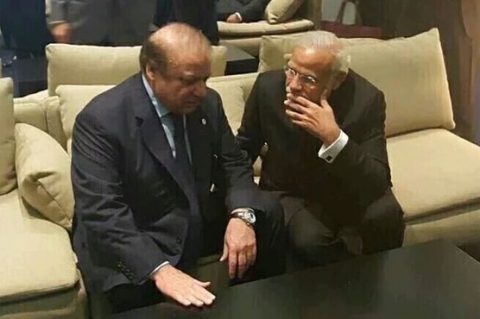
(Nawaz Sharif and Modi in “informal” conversation, Paris, Nov 30, 2015)
But make no mistake that the ISI kept track. The Pakistani side was actually expecting Modi’s surprise visit to Lahore and had made elaborate arrangements for a red carpet reception for the visiting Indian leader. Beyond doubt, every move that Modi made on Pakistani soil and every word he spoke to Nawaz was stored away as memory in the ISI archives.
Suffice to say, it is only Modi who is today in a position to clarify on what basis Imran Khan could have said with such audacity, “Perhaps if the BJP – a right-wing party – wins, some kind of settlement in Kashmir could be reached.”
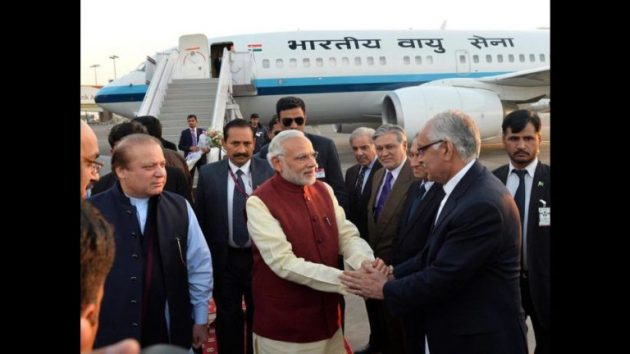
(Nawaz Sharif receiving Modi at the tarmac of Lahore airport, Dec 25, 2015)
Equally, Imran Khan’s caustic remark about the Congress is not unwarranted, when he said he didn’t expect the grand old party to deliver on a Kashmir settlement. Imran Khan cannot be unaware that although Manmohan Singh (or his NSAs) didn’t hang tough on Pakistan in the Indian media, he was tough as nail when it came to defending India’s national interests and didn’t make any concessions whatsoever to Pakistan.
In fact, Congress Party’s record has been consistently “hardline”, although it couldn’t match Modi’s rhetoric. Bangladesh war, occupation of Siachen, maritime boundary in Sir Creek — these are just three templates in India-Pakistan relations that alone should testify to the legacy of Congress rule. It must be remembered that the systematic erosion of Kashmir’s autonomy and India’s breach of promises to the Kashmir people took place in the decades since the fifties right up to the eighties only under Congress governments when BJP wasn’t even around as a gadfly.
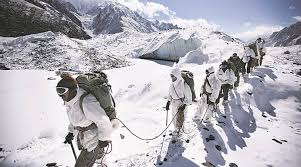
(Indian troops defending Siachen.)
So, the big question is about the signal that Imran Khan is giving when he reposes confidence in Modi to settle the Kashmir problem. Contextually, he would have three objectives — one, cautioning Modi against going too far in demonising Pakistan in his election rallies, no matter his political compulsions; two, projecting to the international audience an air of reasonableness in Pakistani policies ; and, three, forestalling any precipitate move by Modi to ratchet up tensions with Pakistan in the coming weeks between now and May 23, especially if a spectre of defeat haunts him in the election.
This last point is relevant if we factor in the decision by Islamabad only last Sunday to publicise “reliable intelligence” and “authentic information” available with it to the effect that India might make some military moves against Pakistan in the second half of April, once the elections got under way in India, out of which Modi could make political capital by whipping up jingoism.
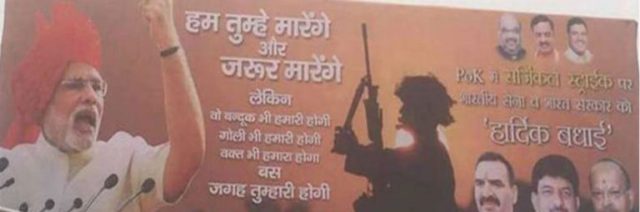
(BJP election poster with Modi and Indian soldier providing backdrop)
The intriguing part in all this is what Imran Khan really thinks of Modi as a politician. Historically, there is a perception in Pakistan that the BJP is a “Baniya party” of wheeler-dealers. But the past five years of BJP rule would have somewhat dispelled such notions. Imran Khan cannot but be aware that Modi is a creation of the RSS and unless and until he broke that umbilical cord, he cannot plough a de-ideologised furrow toward Pakistan.
Now, this is where the Modi-Nawaz exchanges and the back channel conversations between Ajit Doval and his counterpart in Islamabad, former NSA Lt. Gen. Nasser Khan Janjua, come into play. The Indian public knows nothing about the contents of these exchanges and conversations. But ISI knows, the GHQ in Rawalpindi knows and Imran Khan knows. (And, indeed, Modi and Doval know.)
Importantly, therefore, a Pakistani Prime Minister for the first time in the past 7 decades has interfered in an Indian general election and showed his preference for a particular political leader. This is unacceptable. This is blackmail.
Yet, Modi only is responsible for it. Figuring out that he has nothing positive to project before the Indian electorate, Modi made Pakistan the centre piece of his election campaign to malign and embarrass Congress and to deflect attention from burning issues such as unemployment, agrarian crisis, Rafale scam, etc. But by doing so, Modi held open a door through which Imran Khan has simply walked in.
Look at the kind of things Imran Khan says on the eve of an Indian general election — that he prefers Modi (to Rahul Gandhi) as his interlocutor; that “Muslim-ness is being attacked” in India; that Muslims in India are unhappy; that Modi is electioneering like Israel’s Netanyahu, exploiting “fear and nationalist feeling”; that J&K’s special status is under attack; that Kashmiris are waging a political struggle and there is no military solution to it; that “there is still the possibility if the polls turn against Modi in the next few weeks that India could take some further military action against Pakistan” and so on.
The most intriguing remark Imran Khan made was that Modi’s much-touted Balakot attack on February 27 was only an act of dissimulation and so the Pakistani retaliation the next day was a pro forma act — as if it were an elaborate pantomime being played out with Modi as the master choreographer. As he put it, the IAF bombed trees and the PAF retaliated by bombing stones.
These are exceptional remarks for the leader of a foreign country to make. But Modi cannot take exception, because he only invited this Pakistani slur on India’s democracy and its leadership. Clearly, Pakistan is blackmailing Modi and Doval. This seems like Modi’s “Obama moment” in Seoul 7 years ago.
Pakistan’s PM Slams India’s Modi and Israel’s Netanyahu as “Morally Bankrupt”
Sputnik – 09.04.2019
New Delhi – Pakistan Prime Minister Imran Khan on Tuesday launched a scathing attack on Indian Prime Minister Narendra Modi and Israeli Prime Minister Benjamin Netanyahu on the day when Israel is voting to elect its next government; India will begin the voting process for its general elections shortly.
“When leaders in Israel and India show a moral bankruptcy in their readiness to annex the occupied West Bank and India-Occupied Kashmir in defiance of international law, UN Security Council resolutions & their own Constitution for votes, don’t their people feel a sense of outrage and wonder how far they will go simply to win an election?” Imran Khan tweeted on Tuesday.
Israelis are voting on Tuesday, with Prime Minister Benjamin Netanyahu, leader of the right-wing Likud Party, seeking a fifth term in office.
Around 900 million will begin casting their votes starting on 11 April in a seven-phase polling process in India that will end with the announcement of its results on 23 May. The ruling Bharatiya Janata Party (BJP) hopes to retain control of the 543-seat Lok Sabha (Indian Lower House of Parliament).
“Our duty is to protect our nation, while Congress (the country’s main opposition party) and its supporters are anti-national. They are in favour of Article 370 (pertaining to unfair privileges to the strife-ridden state of Jammu and Kashmir). What Congress’s sham document (manifesto) is stating is exactly what Pakistan is saying,” PM Modi thundered at an election rally on Tuesday.
The BJP, in its 48-page manifesto, has made a new pledge to scrap Article 370 and Article 35A that gives special privileges to residents of India in the Kashmir region, such as laws preventing outsiders from buying property.
Earlier, Imran Khan took to Twitter to criticise the Indian government for fuelling war hysteria with Pakistan after the mid-February incident, when more than 40 Indian soldiers were killed in a terrorist attack in the Pulwama district of Kashmir.
Pakistan-based Jaish-e-Mohammed had claimed responsibility for the attack but the Indian government had squarely pegged blame on the Imran Khan government for allegedly sponsoring terror activities in India. In retaliation, the Indian Air Force had conducted an aerial strike on 26 February, describing it as a non-military strike against terrorist facilities in Balakot, inside Pakistan. The following day, the two nuclear-armed nations embroiled themselves in their first aerial clash in decades, which resulted in the loss of air assets.
Hypocrisy Inc: Washington’s Selective Sanctions
By Brian CLOUGHLEY | Strategic Culture Foundation | 08.04.2019
On April 3 US Vice President Pence told Germany and Turkey to stop dealing with Russia. In a speech in Washington marking the 70th Anniversary of the US-NATO military alliance he declared that “If Germany persists in building the Nord Stream 2 pipeline, as President Trump said, it could turn Germany’s economy into literally a captive of Russia,” while Turkey is being “reckless” and “must choose — does it want to remain a critical partner of the most successful military alliance in the history of the world, or does it want to risk the security of that partnership by making reckless decisions that undermine our alliance?”
(We’ll pass over the fact that “the most successful military alliance in the history of the world” bombed and rocketed Libya in a nine-month blitz in 2011 and claimed a “model intervention” in a country it reduced to anarchy, as reported on April 5.)
Radio Free Europe noted that Pence “voiced US opposition to Turkey’s purchase of a Russian air-defense system… which he said ‘poses great danger to NATO’.” He also threatened that “we will not stand idly by while NATO allies purchase weapons from our adversaries”.
The weapons system to which Washington so violently objects is the S-400 Triumf surface-to-air missile which Army Technology describes as “capable of firing three types of missiles to create a layered defence [and] engaging all types of aerial targets including aircraft, unmanned aerial vehicles, and ballistic and cruise missiles within the range of 400 km, at an altitude of up to 30 km. The system can simultaneously engage 36 targets.” In other words it’s a world-beater with a real punch, as is evidenced by the fact that so many other countries have either got it or want it.
The first sanctions Washington imposed against Turkey concern supply of the 100 Lockheed Martin F-35 combat aircraft ordered at a cost of 16 billion dollars. According to CNN a US spokesman said “Pending an unequivocal Turkish decision to forgo delivery of the S-400, deliveries and activities associated with the stand-up of Turkey’s F-35 operational capability have been suspended.” This is harsh action against a longtime partner and military ally, but it doesn’t stop there, because Washington objects to Russia providing military equipment to other nations.
China is an example. In September 2018 sanctions were imposed on China by Washington because it had engaged in “significant transactions” with Russia’s Rosoboronexport by purchasing SU-35 combat aircraft and S-400 systems.
A US official told reporters “The ultimate target of these sanctions is Russia… [sanctions are] aimed at imposing costs upon Russia in response to its malign activities.” This is effected by US Public Law 115-44, the ‘Countering America’s Adversaries Through Sanctions Act’ (CAATSA) which is intended to “provide congressional review and to counter aggression by the Governments of Iran, the Russian Federation, and North Korea, and for other purposes.”
“Other purposes” is quite a large sphere of implied threat, but the ruling of US legislators in this case is clear, in that any country that acquires S-400 air defence missile systems (for example) from Russia is going to be penalised because Washington is determined to continue “imposing costs upon Russia” for providing such equipment. And it is inevitable that the imposed penalties will impact on the country that has dared to engage with Russia. The Diplomat summed it up by observing that the policy “decrees the imposition of mandatory economic sanctions on countries importing Russian military hardware.”
Except when it doesn’t.
It is apparent that the anti-Russia “Countering Adversaries” legislation directed by Congress is being selectively ignored by Washington, because India is being provided with the S-400 system, and no sanctions have been imposed by America. An agreement for supply of S-400s was signed on October 5, 2018 in Delhi during an India-Russia summit meeting attended by Indian Prime Minister Modi and President Putin. The Economic Times reported that India and Russia “have formally inked the $ 5.2 billion deal for S-400 system. The air defence system is expected to be delivered by the year 2020.”
Following the summit, Outlook India noted approvingly that “Other areas of collaboration, which figured prominently in the joint statement between the two sides, are nuclear reactors, investments by Indian diamond companies in Russian Far East, and ‘joint collaboration in precious metals, minerals, natural resources and forest produce, including timber, through joint investments, production processing and skilled labour’. The review of priority investment projects in the spheres of mining, metallurgy, power, oil, and gas, railways, pharmaceuticals, information technology, chemicals, infrastructure, automobiles, space, shipbuilding and manufacturing of different equipment reflects a focus on the desire for diversification. PM Modi has invited Russian companies to set up industrial parks in India for defence manufacturing.”
It might be thought that such bilateral collaboration in defence matters, especially in regard to provision of the S-400 system, would attract instant action by Washington, designed to penalise India for flagrant contravention of US directives.
But no.
In some fashion, India is different from Turkey and China when it comes to acquiring S-400 missile systems, and an explanation of sorts was offered by the Pentagon’s Assistant Defence Secretary Randall Schriver in testimony to the House of Representatives Armed Forces Committee on March 27. He declared that the US-India “Major Defence Partnership” was prospering by “moving toward deeper security cooperation by increasing operational cooperation and availing key maritime security capabilities.” But then there was mention of the purchase for over five billon dollars by India from Russia of a world-beating air defence system, and Mr Schriver wasn’t comfortable with that.
He was asked by Congressman Seth Moulton how India’s purchase of S-400 systems and the lease of Russian nuclear submarines would impact India-US relations and avoided any reply concerning the submarine lease while stating that purchase of S-400s has “not gone to contract or completed”, which, like so many official statements in Washington, was only half true. Certainly, delivery of the S-400s has not been completed; but for Mr Schriver to claim that the matter “has not gone to contract” is a downright lie.
The effects of Washington’s sanctions on its adversaries have been wide as well as selective. In the case of Turkey, what Pence calls the “reckless decision” to acquire S-400s has shown Ankara that America is not an ally and cannot be trusted, while encouraging it to further examine the dubious benefits of belonging to the US-NATO military alliance. China reacted by saying “We strongly urge the US side to immediately correct the mistake and rescind the so-called sanctions, otherwise the US side will necessarily bear responsibility for the consequences,” while reinforcing China-Russia cooperation and strengthening resistance to US policy of global dominance.
In the case of India, US sanctions’ policy was highlighted on April 2 when the Pentagon announced that India would be provided with 24 US Seahawk maritime attack helicopters for use against China and Pakistan, at a cost of 2.6 billion dollars. India is content that it can do whatever it wants, and New Delhi will continue to benefit from Washington’s total lack of principles and ethical consistency. Selective sanctions are the name of the game.
Featured Video
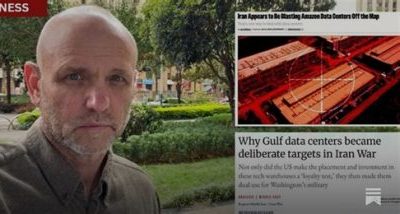
Iran spent $1 million to wipe out $30 billion in data center plans, and take down Amazon in the ME
or go to
Aletho News Archives – Video-Images
From the Archives
A short history of British torture
ICC | December 2005
When the House of Commons was debating how much to increase the time limit for detention without trial the question of torture came up. Officially this was limited to the nice considerations of whether it was all right to send people to places where torture is used and whether Britain can use information collected by the use of torture in other countries. This discussion gave an impression of democratic Britain as the home of civilised behaviour where the very idea of torture is repugnant to our legislators – unlike, say, the US with its secret CIA jails… In reality, the British state has a long history of using and developing a whole range of torture techniques. … continue
Blog Roll
 Aletho News
- Houthis Keep Advancing as the Red Sea Crisis Deepens
- Iran spent $1 million to wipe out $30 billion in data center plans, and take down Amazon in the ME
- Zionist billionaire pressure to silence Macklemore sparks exodus from Ed Sheeran tour
- House Votes to End Iran War for Third Time
- North Korea Slams US Plan for ‘AUKUS 2.0’ with South Korea and Japan
- Prolonging US-Iran Conflict Not Meeting Interests of Int’l Community – China’s Wang Yi
- EU bans former Zelensky aide from parliament
- NATO-backed Kosovo separatist ‘responsible for war crimes’
- US destroying international space law
- SCO Calls for Binding Global Deal to Prevent Arms Race in Space
- If Americans Knew
- U.S. Makes, Israel Takes: The Real Story of U.S.-Israeli Military Cooperation
- Night raids rise in Palestine
- Tucker Carlson interviews Norman Finkelstein about Gaza
- Groups urge Americans to support Van Hollen legislation on Israel’s killing of Americans & Palestinians
- Trump administration plans to send 40,000 tons of bombs to Israel: report
- Sanctions Target Iran’s Government, But Kill Hospitalized 23-Year-Old Woman
- An alternative view on the book “Israel’s Lobby: America in the Grip of a Foreign Power”
- Ed Sheeran’s band Beoga, other opening acts quit tour after Macklemore was dropped over his pro-Palestinian comments
- The assassination attempt on President Trump in Butler and the various Israeli connections to it
- “We Want That the Whole Land Be Jewish”
- No Tricks Zone
- New Study: ‘Global Drought Shows No Detectable Recent Acceleration Under Climate Warming’
- Economic Masterminds: German Socialists Suggest Taxing Productivity Gains Stemming From Using AI
- The South China Sea Has Not Been Cooperating With The Climate Change Narrative
- Energy Crisis: Germany Enters Heating Season With Historically Low Gas Reserve Fill Levels
- New Study: The Antarctic Ice Sheet Gained Mass From 2020-2024 Due To Staggering Snow And Ice Accumulation
- Study: Ocean Heating Rates From Thousands Of Years Ago ‘Dwarf’ Modern Ocean Heating Rates
- Climate Extremists Target, Attack Large-Scale Power Grid Infrastructure In Germany!
- New Study: Antarctic Ice Melt Has Contributed Less Than 1 Centimeter To Sea Level Rise In The Last 30 Years
- Fear Of Debate: Alarmist German Climate Scientist Calls On Mainstream Media To Discredit Skeptic Voices
- End-Of-August Arctic Sea Ice Extent Hasn’t Fallen In 20 Years, Official Data Show!
 Aletho News