No Freedom for India’s Kashmir Valley Politicians, Jammu Counterparts Released
Sputnik – October 2, 2019
The Indian state of Jammu and Kashmir on Wednesday released all politicians that had been held under house arrest in Jammu since India scrapped the region’s special constitutional status at the start of August.
Jammu region politicians have been released from detention ahead of local block development council elections scheduled for 24 October. Eight politicians were released from house arrest, including Devender Singh Rana, Raman Bhalla, Harshdev Singh, Chaudhary Lal Singh, Vikar Rasool, Javed Rana, Surjit Singh Slathia and Sajjad Ahmed Kitchloo.
However, the state administration did not free politicians under house arrest in the Kashmir Valley as the situation there is still sensitive from a security point of view. Former chief ministers Farooq Abdullah, Mehbooba Mufti and Omar Abdullah remain under house arrest.
Administration officials said the Jammu region is peaceful, and therefore, a decision was taken to release politicians detained before or on 5 August after India’s Parliament passed a law to revoke the quasi-autonomous status of the state.
The state is to be divided into two federally-administered territories – Jammu and Kashmir and Ladakh from 31 October.
On 30 September, Jammu and Kashmir’s chief electoral officer announced that block development council elections would be held in October.
Meanwhile, several pleas were filed before the Supreme Court of India challenging the Central government’s 5 August decision to bifurcate the state into the federal government administered territories of Jammu and Kashmir and Ladakh. On Tuesday, the top court gave the Central government a month to file its response to the pleas.
The court made it clear that if needed it would direct the government to produce all relevant documents pertaining to its decision to scrap Article 370.
It also said it will not entertain fresh petitions on the issue.
The bench said that it would allow a week for petitioners to file their replies to the Central and state governments’ counter-affidavits.
Modi-Rouhani meeting is a morality play
By M. K. BHADRAKUMAR | Indian Punchline | September 27, 2019
Prime Minister Narendra Modi began his 6-day long visit to the US with a bang — a stunning stage appearance with President Trump at the Howdy Modi in Houston last Sunday.
But on Thursday, he ended up with a hastily arranged meeting with Iran’s President Hassan Rouhani in New York just before the latter’s departure for Tehran. The symbolism is at once obvious.
Only 4 days earlier, in a famous remark at the Howdy Modi, Trump thrilled the Sangh Parivar audience with a stirring call that the US and India should jointly fight “radical Islamic terrorism.” Modi and the audience cheered in the mistaken belief that Trump was condemning Pakistan, but only to be told the next day by POTUS himself that he was only referring to Iran.
However, if photo journalism is any indicator, Modi looked subdued at the meeting with Rouhani. It must have been a difficult meeting. The Iranian report was rather taciturn. The primary purpose seems to have been to break the ice.
The India-Iran relations have been on a roller-coaster under Modi’s watch. He gave high hopes to Rouhani when they met for the first time on the sidelines of the historic Ufa summit of the Shanghai Cooperation Organization in June 2015 by proposing multi-billion dollar investment plans in Iran’s economy spanning the industrial and infrastructural fields.
Rouhani took the idea seriously and fast-tracked the contract for India to develop and operate one of the container terminals in the strategic Chabahar Port in the Sistan-Baluchistan province, ignoring Pakistan’s disquiet over such an Indian presence hardly 80 kms from its restive border regions.
Rouhani upset the Pakistanis further by accepting the Indian offer to build a railway line connecting Chabahar with Zahedan on the Iran-Afghan border further north.
Indians were jubilant that in geopolitical terms, India’s cooperation in regional connectivity with Iran matched China’s Belt and Road Initiative.
All that is history, of course. Iran’s ambassador to India Ali Chegeni regretted recently that India not only buckled under American pressure to stop its oil imports from Iran but also slowed down its project work at Chabahar. The tensions are showing. Iran has taken a critical position on the situation in J&K.
Yet, it was Iran which in 1994 had helped India to prevent an OIC resolution on the human rights situation in J&K from being tabled at the UN forum, breaking the IOC consensus and demanding that Kashmir is a bilateral issue between India and Pakistan.
Yes, Iran played a helpful role in ensuring that the Shia-dominated Kargil region of J&K stayed out of the Pakistan-sponsored insurgency in the early nineties. The Narasimha Rao government allowed the then Iranian Ambassador to India Sheikh Attar to visit Kargil when the region was closed to the international community and foreign media.
Yes, it was the same Iran with which India also had cooperation at the level of intelligence agencies in the early nineties.
What explains the present crisis? Succinctly put, India’s policies in the Persian Gulf have come under the influence of the Israel-Saudi-UAE axis. Indian diplomacy is quite adept at balancing the relations with Iran on one side and the Israel-Saudi-UAE troika on the other. But the present ruling elite abandoned that policy and began identifying with the troika.
Conceivably, the US encouraged this shift. But the main factor has been the bonhomie that has come to exist at the leadership with Israeli PM Benjamin Netanyahu and the Crown Princes of Saudi Arabia and the UAE. If a marker is to be put on the downhill slide of India-Iran relations, it must be Modi’s extended 5-day visit to Israel in July 2017.
India-Iran relations suffered as a result of Delhi’s gravitation toward the the orbit of what Iran calls the “B Team” of the US. Iran never stood in the way of India keeping diversified relationships in West Asia, including with its adversaries such as the US, Israel or Saudi Arabia, but the plain truth is Delhi simply cooled down on the relationship with Iran.
How the B Team worked on the Indian leadership remains a mystery, but the Israelis, Saudis and Emiratis played their cards well, knowing exactly which strings to be pulled among the movers and shakers of the present ruling dispensation in Delhi.
Suffice to say, Modi’s meeting with Rouhani on Thursday was an act of atonement. India is in a chastened mood today. Delhi dumped Iran as a major supplier of oil (on concessional terms) and instead opted to buy from the US and Saudi Arabia and the UAE (at market price), but there has been no quid pro quo.
Trump is deepening the US-Pakistan relations and has waded into the Kashmir issue. As for the Sheikhs, they probably had no intentions to make big investments in India. Meanwhile, Netanyahu, one of Modi’s closest friends in the world circuit, lost the election and if he fails to form the next government, may lose his immunity from prosecution and end up in jail.
Without doubt, Modi has done the right thing by calling on Rouhani. India does not have many friends today. The Modi government’s image is very poor in the Muslim world. India’s march toward Hindu Rashtra and the lock down in J&K have generated negative opinion internationally.
Even “time-tested friends” like Russia are getting disillusioned with our “Chanakyan” diplomacy. How long can India remain ambivalent? Our credibility as a dependable partner is plunging.
It may seem an uphill task to repair the damage to India’s relationship with Iran. But on the contrary, it is easily undertaken if only there is political will. Tehran attaches high importance to India and Delhi needs to reciprocate that goodwill. The prospects are simply seamless to build a relationship of mutual benefit.
Beware of blowback from Afghan policies
By M. K. BHADRAKUMAR | Indian Punchline | September 25, 2019
During an exclusive interview with the Associated Press this week, the former Afghan president Hamid Karzai has severely questioned the rationale behind the presidential election which is due to take place in his country on September 28. Those who drive the Afghan policy in the Indian establishment should take careful note.
Karzai’s opinion runs completely contrary to the Indian stance. Delhi must be probably the only world capital that is enthusiastic about the Afghan presidential election. Delhi has exhorted Afghan people (“brothers and sisters”) to turn out in large numbers to cast their ballots
The Indian calculus is that by rigging the election, the incumbent president Ashraf Ghani and his group will be able to secure another 4-years in power. What brings the Indian establishment and Ghani’s group on the same page is their common interest in preventing the Taliban from holding the levers of power in Kabul, no matter what it takes. India has emerged in the most recent years as the main patron of Ghani’s group.
Ghani’s group comprising figures like the country’s security czar Amarullah Saleh maintain a policy trajectory that is hostile toward Pakistan, which helps Delhi’s hardline policies toward Pakistan. In this ‘Chanakyan’ thinking, India stands to gain if Pakistan is bogged down in a seamless war of attrition, sandwiched between its two hostile neighbours.
A hostile regime in Kabul will never compromise on the Durand Line, which implies that Pakistan’s sovereignty and territorial integrity will remain under challenge for the foreseeable future if Ghani and his group remain in power.
Delhi blithely overlooks that the Afghan situation also impacts regional security and stability and that India’s medium and long term interests lie in the stabilisation of Afghanistan. Hopefully, the views expressed by Karzai, who is a close and longstanding friend of India, would have a salutary effect on the Indian establishment and prompt it to rethink.
Karzai is spot on in his assessment that the prevailing politico-security situation in Afghanistan is not at all conducive to the holding of a free and fair election. Ironically, the security situation in Jammu and Kashmir is nowhere near as precarious as in Afghanistan and yet the elections in the Indian state have been postponed indefinitely.
The outcome of Saturday’s election will be severely contested by the other Afghan (non-Taliban) groups and we are going to witness a replay of the 2014 charade when Ghani’s ‘victory’ under extremely controversial circumstances marred by cheating on an industrial scale stalled the transition. Washington finally deputed then US senator John Kerry to Kabul to cajole the warring factions to accept the idea of a so-called national unity government.
The spectre that is facing Afghanistan is a highly problematic political transition. Considering that more than half the country is under Taliban control and that the Taliban are viscerally opposed to the charade of election on Saturday, Ghani’s legitimacy to rule for another term is in serious doubt. Delhi should ponder over the emergent scenario.
Only through an inclusive democratic process can the Afghan transition be peacefully managed. And that is only possible if the transition is predicated on a peace agreement with the Taliban, followed by inter-Afghan dialogue (including with representatives of Ghani’s ‘government’) on a political settlement, which would be put before a Loya Jirga for approval. The elections should be held only thereafter.
On the contrary, the US President Trump’s impetuous decision to call off the negotiations with the Taliban (although a draft agreement was initialed in Doha) has been seized by Ghani’s group to front-load the presidential election. This is like putting the cart before the horse.
What will happen now is that Ghani’s group will rig the election and win it and proceed to claim a mandate to rule for another 4 years, while other Afghan groups — Taliban and non-Taliban — will not accept Ghani and his coterie for a second term.
There are signs that even Washington has distanced itself from Ghani’s government by withholding assistance to the tune of $160 million. The US state department statement announcing this was highly critical of the Ghani government.
Equally, the USG-funded Radio Free Europe / Radio Liberty in a commentary on Monday was frankly skeptical of the entire exercise of Saturday’s election. It sounded a warning that “many Afghans remain wary of the landmark presidential vote, fearing Taliban violence aimed at disrupting the vote and disillusioned at the widespread fraud and corruption that has tainted other elections since the U.S.-led invasion in 2001.
“Analysts say voter fatigue and safety concerns could depress turnout to undermine the legitimacy of the vote and give any winner only with a weak mandate to rule a country reeling from economic turmoil, an escalating war, and political infighting.”
Where does all this leave India? Clearly, Delhi’s backing for Ghani’s group is a cynical, self-serving attempt to exploit an unstable Afghanistan to India’s advantage. It does not constitute an Afghan policy. It reflects a pitiless mindset to keep Afghanistan in civil war conditions for as long as possible. It is indifferent towards the long-suffering Afghan people (here and here.) How is such a ‘policy’ any different from Pakistan’s?
Surely, the Indian embassy in Kabul would have reported on the meeting in Kabul on Monday of prominent Afghan political figures including Mujahideen leaders and erstwhile Northern Alliance stalwarts — former President Karzai, former Vice President Yunus Qanooni, former Balkh governor Atta Mohammad Noor, former Minister of Energy and Water Mohammad Ismail Khan, former National Security Advisor Rangin Dadfar Spanta and so on — which issued a formal statement calling for the deferment of the presidential election and an immediate resumption of the US-Taliban negotiations.
The statement highlighted that the Afghan people do not trust in the electoral management organisations to prevent “widespread manipulation” of the presidential election. It said, “There are many realities which show that the election will not reduce the crisis in the country, instead it will double the crisis, fuel division among the people, weaken institutions and affect the trust in democracy and political partnership.”
India pressing US for resumed oil imports from Iran: Report
Press TV – September 18, 2019
Indian authorities have renewed their efforts to persuade the United States to lift sanctions on imports of oil from Iran amid disruptions caused to supplies from Saudi Arabia following attacks last week that hit oil installations east of the kingdom.
A Tuesday report on the website of The Mint, an Indian financial newspaper, showed that India had held fresh talks with the government of US President Donald Trump on renewed energy imports from Iran.
India stopped crude imports from Iran on May 2 after the White House toughened its sanctions on Iran and removed waivers granted to India and several other countries.
New Delhi used to be Iran’s second top buyer of oil before American sanctions were imposed in November with imports exceeding 20 million tons a year.
India’s External Affairs Minister Subrahmanyam Jaishankar said on Tuesday that resuming oil imports from Iran had never turned into a “static” issue and authorities were trying to find a solution to the problem.
“We are in dialogue with all suppliers including Iran,” said Jaishankar, adding that India wanted to ensure that supplies of energy into the country would remain predictable and affordable.
The remarks come after attacks on Saturday on key oil installations in Saudi Arabia’s Abqaiq cut the kingdom’s production in half.
The attacks, claimed by Yemen’s ruling Ansarullah movement, sent shockwaves across the global markets and caused a historic surge in prices while sparking serious concerns in energy-thirsty countries like India about the future of oil supplies.
While trying to revive imports from Iran, India has said it would seek a contract with Russia to secure a long-term supply of oil from the country.
Are India and Japan Challenging the BRI in Russia’s Far East?
By Paul Antonopoulos | September 11, 2019
Although the Russian Far East has huge investment potential in the fields of raw materials, mineral resources, fisheries, forestry’s and tourism, it still remains a sparely populated area of only around 7 million people. With China, India, Japan, Indonesia and Russia projected to be some of the world’s biggest economies by 2030 according to many experts, the 21st Century has been dubbed as the “Asian Century,” and it is for this reason that Russian President Vladimir Putin has prioritized the rapid development of the Russian Far East.
The region is not only resource rich, but is also conveniently located in northeast Asia, bordering Mongolia, China and North Korea, while sharing a maritime border with Japan. It is so strategic and rich that only weeks ago French President Emmanuel Macron expressed his belief that Europe stretches from Lisbon on the Atlantic Coast to the Russian Pacific port of Vladivostok. Vladivostok has hosted the Eastern Economic Forum annually ever since its establishment 2015, in part to attract foreign investors to diversify from only Chinese investments in the Russian Far East. China has invested tens of billions into the region, making it easily the biggest foreign investor in the region.
However, with Indian Prime Minister Modi on the eve of Vladivostok’s 5th Eastern Economic Forum proposing a trilateral cooperation between India, Russia and Japan by jointly developing the Russian Far East, it appears that China’s economic influence in the region will be challenged. Although China emphasizes peaceful relations through mutual economic development and prosperity, it still has frosty relations with Japan and India. It is therefore unsurprising that India and Japan have opted to invest in the Russian Far East to challenge China’s economic might in a region that also shares a vast border with China.
India, Japan and Sri Lanka signed an agreement to build a new container terminal in the port of Colombo, demonstrating that New Delhi and Tokyo have experience in cooperating in a trilateral format. With India opting to be the only South Asian country not involved in the Belt and Road Initiative (BRI), India continues to show coldness to China as the latter continues to rapidly develop neighboring countries, especially with Nepal and rival Pakistan. With the BRI developing Sri Lanka, it appears India and Japan are creating a new economic duo to match China’s economic strength, and are now prepared to take this to a new front away from Sri Lanka and to the Russian Far East.
Japan’s investments in the Russian Far East’s economy already exceeds $15 billion and will continue to develop, according to Japanese Prime Minister Shinzo Abe. And with India also expressing its interest, the Russian Far East has become a promising place for all prospectors. With Russian President Vladimir Putin offering free land handouts in the Far East to Russians and naturalized citizens in May 2016, it demonstrates that Russia has identified that if it wants to benefit from Asia’s rapid development and economic dominance in the 21st century, it needs to develop its regions in Asia.
With the development of the region naturally meaning increased trade and cultural exchanges with China, tens of thousands of Chinese citizens have now migrated to the region in search of opportunities and establish themselves as merchants and entrepreneurs. Whether we begin seeing Indian and Japanese merchants in the Russian Far East remains to be seen.
With India and China competing in Nepal and border issues on the Indian-Chinese frontier remaining unresolved in New Delhi’s eyes, it appears that India is now wanting to compete against China in a region that has had connections with China for millennia. Russia has been encouraging more and diversified investments in the Far East and Japan and India will take every opportunity to do this.
Russia and China remain strategic partners and are also pragmatic international players that continue to pursue a policy of non-interference. Therefore, although China has frosty relations with Japan and India, it can respect Russia’s ties with both countries. This pragmatism has now allowed India and Japan to engage in a friendly competition for economic influence over Russia’s resource rich region. Although both Japan and China invest in raw material and energy projects in the Far East, India will be a new player to this sector with Indian Oil and Gas Minister Dharmendra Pradhan expressing his long-term interest in the Russian coal and steel sector during his visit to Russia last week.
With India becoming increasingly energy hungry because of its enormous and growing population, alongside its economic development, it is easily seen why the resource rich Russian region is of critical importance to it. For Japan, the region presents unmatched economic opportunities. Most interestingly to observe is whether India and Japan will continue to work in trilateral formats to continue expanding their economic interests and challenge the BRI in other regions. It appears now that after their cooperation in Sri Lanka, their second step is to challenge the expansion of the BRI in Russia’s Far East by competing for lucrative contracts and opportunities that the region can offer.
Paul Antonopoulos is the director of the Multipolar research centre.
Asian Century bypasses Modi’s India
By M. K. BHADRAKUMAR | Indian Punchline | September 1, 2019
The stunning news that India’s GDP growth rate is hitting a six-year low figure of 5 percent in the past six-year period comes as reality check. Many economists even hold the view that in actuality, take away the statistical jugglery, India’s actual GDP growth figure could be somewhere around 3 percent.
Either way, it is a dismal scenario. As mostly the case, it is the poor people who will suffer from the decline in the GDP growth rate than the rich. There is going to be a significant decline in the employment rate and the number of people below poverty line could rise. Clearly, the 5-trillion dollar economy that Prime Minister Narendra Modi boasted about as his second term began 100 days ago, seems a pipe dream. Even to recall PM’s quote becomes a painful embarrassment.
In a Reuters poll of economists, analysts believe the slowdown could persist for two or three years while much needed structural reforms are put in place. The Reserve Bank of India (RBI) said on Thursday a big push on infrastructure spending would be needed to revive consumer demand and private investment. Structural reforms were also required to ease the path for businesses in India, it said.
What causes such profound disquiet is that all this appears to go way beyond a cyclical slowdown. The economy has lost momentum.
To be sure, the government policy approach will need to be multi-pronged. But this is also fundamentally a crisis of India’s political economy. Watch former PM Manmohan Singh’s stern warning that the looming crisis should not be underestimated, as it is a combustible mix of many elements that aren’t easy to separate — deficiency in statecraft, populist politics, political vendetta, flawed economic measures, bad economic management, lack of accountability, authoritarianism, etc.
There is a crucial foreign-policy dimension to it — India is in critical need of a peaceful external environment so that it can prioritise the economy. Plainly put, the government needs to apply itself diligently to keep down tensions in relations with Pakistan.
All that talk by senior cabinet ministers about “nuclear first use” and of “taking back” POK and Northern Areas from Pakistan is hogwash. Standing on such emaciated legs, no country can wage a war. Just throw into the dustbin all that jingoism.
Misplaced national priorities have brought the economy to a cul-de-sac. Glance through the statistics of the top ten fastest growing Asian economies today: Bangladesh (8.13%) ; Nepal (7.9%); Bhutan (7.4%); China (6.9%); Myanmar (6.8%); Philippines (6.7%); Malaysia (5.9%) Pakistan (5.4%); Indonesia (5.1%); India – 5%
Modi becomes the first prime minister of independent India to take the country’s GDP growth rate below Pakistan’s. This should be rude awakening and should prompt honest soul-searching.
What a wasteful foreign policy our country has been saddled with, focusing on vainglorious projects that have no relevance to the “real India”! How does it help India if PM worships at the Krishna temple in Bahrain or receives the highest national award of the Emirati nation?
Alas, the diplomatic calendar of the present government since it took over in May shows that we are still focused on dream projects to boost the image of the Leader in the domestic audience and to pursue a US-centric foreign policy.
The foreign-policy priority today is to somehow “lock in” the Trump administration by buying more oil and LNG from the US even if at a much higher cost than what Iran is able to supply. By succumbing to the US diktat, India is compelled to import phosphates — a vital input for farming sector — via enterprising Emirati middlemen rather than directly from Iran, at an increased cost of 30 percent! Who cares?
The government prioritises a mega energy conference in Houston, Texas, later this month so that we can buy more energy from the US — and also, explore proposals for massive Indian investments in the American energy sector. The idea is to substantially contribute to “America First” so that Trump is somehow kept happy and the long-term “Indo-Pacific strategy” aimed at containing China can be pursued without hiccups.
Of late, the thrust of Indian diplomacy lies in warding off the Pakistani challenge on the Kashmir issue. But the more we go on that track, the more work it generates for our diplomats to “counter” the Pakistani backlash. It is all turning out to be a Catch-22 situation.
Not all the waters in the Ganges can clean the accumulating filth of the comparisons being bandied about in the world media between Modi’s India and Nazi Germany. We are going to get even more of all that when the European Parliament meets tomorrow to exchange views on the situation in J&K.
Delhi got the tip-off that the POK Prime Minister Raja Farooq Haider will be present at the European Parliament when it will discuss the Kashmir issue on September 2. So, External Affairs Minister S. Jaishankar gets through to Brussels post-haste in the weekend with tons of detergent powder to sanitise the lobby. Raja Farooq Haider versus Subrahmanyam Jaishankar: nothing could more graphically highlight the tragedy of Indian diplomacy today.
Forget about India attracting western businessmen as an investment destination in the prevailing setting. And, make no mistake, no one is yet accounting for the massive haemorrhage of resources in the deployment of a million troops in J&K till eternity. How many world economies can sustain such a futile enterprise?
Not even the US, the lone superpower. Trump has programmed his diplomats to delver on his stern demand that the American troop level in Afghanistan should be drastically reduced in immediate terms — from 14,000 troops to 8,600 troops. He thinks it is “ridiculous” and stupid that a great army trained to fight wars is deployed for police duties. Trump is pressing hard for a political solution.
Doesn’t some of all this rub on Modi when he converses with the leaders of Bangladesh, Nepal and Bhutan, the three top “Asian tigers”? Don’t they talk serious stuff when they get quality time with Modi — how well their countries are growing but how much better they still could if only India ceases to be a laggard in the neighbourhood?
India begins sending Russia money for S-400s despite pressure from US
RT | August 29, 2019
New Delhi started paying for the state-of-the-art Russian S-400 air defense missile systems it ordered, as Washington failed to pressure the country into scrapping the major arms deal with Moscow.
Moscow has received an advanced payment for the weapon systems, the spokesperson for the FSVTS, the government agency responsible for coordinating arms trades, confirmed on Thursday.Russia and India sealed the $5.4bn deal in October after lengthy talks. Moscow is now due to ship five batteries of the S-400s by 2023.
The contract is a headache for the US, which has tried to pressure India into scrapping the sale. Officials in New Delhi, however, maintain that the S-400 is essential for national defense and have decided to stick with the purchase, despite the risk of violating US sanctions on Russia.
Similarly, Washington tried to dissuade its NATO ally, Turkey from buying S-400s from Moscow. Ankara also refused to budge, insisting it is free to choose the countries it purchases weapons from. Turkey began receiving components of the S-400s last month.
India has also ordered 21 new MiG-29 jet fighters from Russia and, on Wednesday, signed an agreement to upgrade the MiGs it already has.
Kashmir’s New Status: Why the West Turns a Blind Eye to Democracy Deficit in India
By Brian Cloughley | Strategic Culture Foundation | August 27, 2019
On August 23 the New York Times reported that the Indian Ministry of External Affairs “won’t say why foreign journalists continue to be blocked from setting foot in Kashmir” but managed to obtain a compelling first-hand account of one of the thousands of arrests by the authorities. In this instance “Asifa Mubeen was woken up by the sound of barking dogs as policemen began pouring into her yard. Her husband, Mubeen Shah, a wealthy Kashmiri merchant, stepped out onto their bedroom balcony in the night air. The police shouted that he was under arrest. When he asked to see a warrant, his wife said, the police told him there wouldn’t be one. ‘This is different,’ they said. ‘We have orders.’ It was the start of one of the biggest mass arrests of civilian leaders in decades carried out by India, a close American partner that bills itself as one of the world’s leading democracies…”
The appalling situation in Indian-administered Kashmir has been created by Prime Minister Narendra Modi who announced on August 5 that he was annulling Article 370 of India’s Constitution, which since 1949 has given the territory (called a State by India) virtual self-government. It had its own Constitution and the most important thing was that the special status of the region allowed it to adhere to the ancient law prohibiting outsiders from buying land. The central government could not overrule the law — but with Modi’s repeal of Article 370 there is now direct rule by Delhi.
This means that the people of the territory have no say whatever in their own governance. It has also meant, thus far, the arrest and detention of some 4,000 people under the Public Safety Act which allows the authorities to jail anyone for up to two years without charge. That isn’t exactly democratic — and it is intriguing to think about how Donald Trump would regard such a law, were he aware of it.
Deficiency of democracy doesn’t stop there, because the Armed Forces Special Powers Act “grants the armed forces the power to shoot to kill in law enforcement situations, to arrest without warrant, and to detain people without time limits. The law forbids prosecution of soldiers without approval from the central government, which is rarely granted, giving them effective immunity for serious human rights abuses.”
The Public Safety and Special Powers Acts are in full swing in Indian-administered Kashmir, and the population is in effect under military occupation authorised by Modi’s ultra-right wing government in Delhi. It is, to all intents, occupied territory whose inhabitants have no say whatever in their own governance. (There were supposed to be elections this year, but with the invalidation of Article 370 these can no longer take place. It has all been carefully thought through.)
And the leaders of the US and Britain, these usually eloquent supporters of freedom for the peoples of the world, have made no critical statements about the mass arrests or cancellation of elections or total closure of means of communication, and they ignore the fact that India’s Constitution “explicitly declares that all citizens shall have the right to freedom of speech and expression [Article 19(1)(a)].”
The New York Times managed to ascertain that in Kashmir, the thousands of detainees “have not been able to communicate with their families or meet with lawyers. Their whereabouts remain unknown. Most were taken in the middle of the night, witnesses said.” This smacks of dictatorship, for it is undeniable that detention and incarceration without trial is totalitarian rather than democratic.
It is barely credible that “Among the people who were rounded up were Mian Qayoom, president of the Jammu and Kashmir High Court Bar Association; Mohammed Yasin Khan, chairman of the Kashmir Economic Alliance; Raja Muzaffar Bhat, an anticorruption crusader; Fayaz Ahmed Mir, a tractor driver and Arabic scholar; and Mehbooba Mufti, the first woman elected as Kashmir’s chief minister. Shah Faesal, another politician, was arrested at New Delhi’s international airport, bags checked, boarding pass in hand, heading for a fellowship at Harvard. Several prominent state politicians have also been put under house arrest; they told Indian news outlets they had been ordered not to engage in any ‘political activity’.”
But there hasn’t been a peep of protest from Britain’s Boris Johnson, he who showed solidarity with the protestors in Hong Kong by declaring “I do support them and I will happily speak up for them and back them every inch of the way.”
There hasn’t been a squeak of remonstrance from Washington, either, where Trump’s Secretary of State, Mike Pompeo, announced that the rule of President Maduro “is undemocratic to the core” and Trump committed his country to “stand with… all Venezuelans who seek to restore democracy and the rule of law.”
If Johnson and Trump are so supportive of democracy, why do they not protest about mass arrests and detentions and cancellation of democratic elections in Indian-administered Kashmir? Why do they not take Modi to task for his excesses? It was recorded on August 23 that in Indian-administered Kashmir, “Data obtained by Reuters showed 152 people reported to Srinagar’s Sher-i-Kashmir Institute of Medical Sciences and Shri Maharaj Hari Singh with injuries from pellet shots and tear gas fire between Aug 5 and Aug 21.” It is regrettable that Trump and Johnson ignored the fact that on August 22 “UN human rights experts today called on the Government of India to end the crackdown on freedom of expression, access to information and peaceful protests imposed in Indian-Administered Kashmir this month.” It was also stated by the UN experts, headed by Special Rapporteur David Kaye, that “The shutdown of the internet and telecommunication networks, without justification from the Government, are inconsistent with the fundamental norms of necessity and proportionality. The blackout is a form of collective punishment of the people of Jammu and Kashmir, without even a pretext of a precipitating offence.”
The absence of any criticism by Trump and Johnson of the military rule excesses in Indian-administered Kashmir will encourage Modi and his far-right nationalist administration to extend their racist grip throughout India. Since Modi’s Bharatiya Janata Party came to power in 2014 there has been a most marked increase in officially-endorsed communal violence, mainly against Muslims but also involving other minority groups. These outbreaks of Hindu-supremacy barbarity are sponsored largely by a militant organisation called the Bajrang Dal which as noted in the New Yorker “has either been banned or has lurked at the margins of Indian society. But [since 2014] the militant group has been legitimized and grown exponentially more powerful. In the past seven years, according to Factchecker, an organization that tracks hate crimes, there have been a hundred and sixty-eight attacks by Hindu extremists, in the name of protecting cows, against Muslims and other religious minorities.”
Indian democracy is under grave threat from racist Hindu supremacists, and the New York Times rightly considers it disquieting that Modi “seems intent on digging in, and he has the Indian public firmly behind him. Many Indians see Kashmir as an integral part of India, and this move has stirred up jingoist feelings. Indian news channels have referred to the detainees being flown out of Kashmir as ‘Pakistani terrorists’ or ‘separatist leaders,’ toeing the government line.”
The most appalling thing is that Modi’s India appears intent on eradicating Muslims and that the vast majority of Hindus are right behind him. In order for him to succeed, there has to be destruction of democracy — and that’s exactly what is happening.
Journalism faces dire situation in Kashmir
By Shahana Butt – Press TV – August 22, 2019
Kashmir – In Indian-administered Kashmir, journalists and journalism are suffering the worst work challenges in decades. There has been a complete communication gag in the region since New Delhi revoked Kashmir’s special status.
This is not a usual gathering or a political meeting, these are the journalists gathered under one roof, working on Kashmir stories.
Kashmir’s administration has created a media center for journalists in the region following the criticism over the media dysfunction.
In the absence of communication facilities like the internet, mobile phones and landlines, this facilitation center created by government is the only source for journalists to send their reports out of Kashmir.
These four desktops and one cellular mobile phone have become lifeline for journalists working from Kashmir. From early morning till late evening, journalists wait in queues for their turn to come.
After New Delhi’s move of scrapping Kashmir’s autonomous status on August 5, Kashmir has witnessed a complete communication blackout. Not just international media outlets suffered, but local and regional news networks and journalists were hit the hardest.
In Indian-administered Kashmir, there are hundreds of journalists associated with more than a hundred news dailies and over 40 national and international media outlets, the communication blackout not only stopped local publications but pushed the entire Himalayan region to somewhere around stone age.
The local administration in Kashmir has no idea as to when this communication blockade will end. Journalists say the information blackout has furthered the fear among people and has created space for rumor-mongering and false news, adding to the already existing panic.
Jammu and Kashmir: the Legitimacy of Article 370

Photograph Source: Motohiro Sunouchi – CC BY 2.0
By Nyla Ali Khan | CounterPunch | August 20, 2019
Introduction
The recent unilateral decision of Prime Minister Modi’s government to revoke Article 370, which guaranteed the special status of Jammu and Kashmir; dismemberment of the State, and its diminishment are flagrant violations of the sovereign Constitution of India. These maneuvers jeopardize the federal structure of India. The erosion of the rights and privileges of a State is an unhealthy precedent to set in a diverse and federal country. The current curbing of political and civil rights in Jammu and Kashmir is deplorable.
Historical Perspective
On 26 October 1947, Maharaja Hari Singh signed the “Instrument of Accession” to India, officially ceding to the government of India jurisdiction over defense, foreign affairs and communications. The accession of J & K to India was accepted by Lord Mountbatten with the proviso that once political stability was established in the region, a referendum would be held in which the people of the State would either validate or veto the accession. After signing the Instrument of Accession, the maharaja appointed his political adversary, Sheikh Mohammad Abdullah, as the head of an interim government.
On 2 November 1947, Pandit Jawaharlal Nehru, the first Prime Minister of independent India, reiterated his government’s pledge to not only the people of Kashmir, but also to the international community, to hold a referendum in Indian and Pakistani-administered Jammu and Kashmir under the auspices of a world body like the United Nations, in order to determine whether the populace preferred to be affiliated with India or Pakistan. Nehru emphasized this commitment several times at public forums over the next few years.
In January 1948 India referred the Kashmir dispute to the United Nations. Prime Minister Nehru took the dispute with Pakistan over Kashmir beyond local and national boundaries by bringing it before the UN Security Council, and seeking a ratification of India’s “legal” claims over Kashmir. The UN reinforced Nehru’s pledge of holding a plebiscite in Kashmir, and in 1948 the Security Council established the United Nations Commission for India and Pakistan (UNCIP) to play the role of mediator in the Kashmir issue. The UNCIP adopted a resolution urging the government of Pakistan to cease the infiltration of tribal mercenaries and raiders into J & K. It also urged the government of India to demilitarize the State by “withdrawing their own forces from Jammu and Kashmir and reducing them progressively to the minimum strength required for the support of civil power in the maintenance of law and order.” The resolution proclaimed that once these conditions were fulfilled, the government of India would be obligated to hold a plebiscite in the State in order to either ratify or veto the accession of J & K to India.
In the meantime, the Government of Jammu and Kashmir negotiated with the central government to ensure that it would be allowed to function as a fully autonomous unit within the federation. Article 370 of the Constitution of India ensured that apart from defense, foreign affairs, and communications, decisions with regard to other matters would be determined with the consent of the Government of Jammu and Kashmir. There was a reason that special status was guaranteed to Jammu and Kashmir under Article 370 of the Indian Constitution. On 13 July 1950, the new government of J & K, headed by Sheikh Mohammad Abdullah, made a landmark decision.
“Between 1950 and 1952, 700,000 landless peasants, mostly Muslims in the Valley but including 250,000 lower-caste Hindus in the Jammu region, became peasant-proprietors as over a million acres were directly transferred to them, while another sizeable chunk of land passed to government-run collective farms. By the early 1960s, 2.8 million acres of farmland (rice being the principal crop in the Valley) and fruit orchards were under cultivation, worked by 2.8 million smallholding peasant-proprietor households.” (Bose 2003: 27–28)
This metamorphosis of the agrarian economy had groundbreaking political consequences. This revolutionary measure, which greatly improved the human development index in the State, would not have been possible without Article 370. The political logic of autonomy and Article 370 of the Indian Constitution was necessitated by the need to bring about socioeconomic transformations.
The legislative bill, which had orchestrated this transformation, won the unstinting support of thousands of erstwhile disenfranchised peasants. But displaced landlords and officials in the Dogra regime made no bones about their hatred of the political supremacy of the new class of Kashmiri Muslims. This hatred unleashed a reign of terror and brutality against the Valley’s new political class.
The “defining moment in Jammu and Kashmir’s post-Indian independence history” came in 1950 when disenfranchised peasants “were freed from the shackles of landlords through a law that gave them ownership rights on the land they tilled. . . . The sweeping land reforms under the Big Landed Estates Abolition Act passed on July 13, 1950, changed the complexion of Kashmiri society. The historical image of the emaciated local farmer in tatters, with sunken faces and listless eyes, toiling to fill the granaries of landlords changed overnight into one of a landowner who expected to benefit from the labor he had put in for generations” (Ahmed, F.). This program emphasized the necessity of abolishing exploitative landlordism without compensation and enfranchising tillers by granting them the lands they worked on. Many policy makers in the Indian subcontinent, political scientists, and economists have acknowledged the effectiveness and rigor of land reforms in Jammu and Kashmir, which benefited underprivileged farmers in all three parts of the State—Jammu, Kashmir, and Ladakh.
In August 1952, the government of J & K reiterated the commitment of to the principles of secularism and democracy which enabled the forging of ties with the Indian nation-state: “The supreme guarantee of our relationship with India is the identity of secular and democratic aspirations, which have guided the people of India as well as those of Jammu and Kashmir in their struggle for emancipation, and before which all constitutional safeguards will take a secondary position.” For the layperson, the “new Kashmir” in which the hitherto peripheralized Muslim population of the Valley and marginalized women would reinsert themselves into the language of belonging a welcome development.
But the nationalist project of the Praja Parishad had sought the subsumption of religious minorities into a centralized and authoritarian state since the 1940s. These integrative and centralist measures were met with massive opposition, which the government of India suppressed with bloody maneuvers. The volcanic nature of the protests in the Valley gave a veneer of legitimacy to its action of large-scale repression of leaders of the Plebiscite Front. Sheikh Mohammad Abdullah was also arrested, for the umpteenth time, under the Defense of India Rules, to further hush the voices of dissent.
Sheikh Mohammad Abdullah underlined in his letter to Shyama Prasad Mukherjee, founder of the Bharatiya Jan Sangh, in February 1953,
When talking about the constitutional aspect, it is sometimes conveniently forgotten that the Praja Parishad wants that Article 370 should be expunged from the Constitution. So far as we are concerned, we have maintained that the special position accorded to the State can alone be the source of a growing unity and closer association between the State and India. The Constituent Assembly of India took note of the special circumstances obtaining in the State and made provisions accordingly.
To entertain the doubt that the Muslims of Kashmir would now give up their secular ideals would be uncharitable, although the statements and the pronouncements made by the leaders of communal parties in India from time to time and the inspiration and guidance they are providing at the moment to the Praja Parishad leadership in Jammu is, no doubt, giving them a rude shock. But let me assure you and the people of India that the Muslims in Kashmir will not falter from their ideals even if they are left alone in this great battle for secularism and human brotherhood.
As I’ve said on other forums, the Constitution of India seeks to guarantee respect for the rule of law, the independence of the judiciary, and the integrity of the electoral process. But time and again, provisions of the Constitution of India have been breached in Kashmir, and the ideals that it enshrines have been forgotten. In Kashmir, rights relating to life, liberty, dignity of the people, and freedom of expression guaranteed by the Constitution, embodied in the fundamental covenants and enforceable by courts of law, have been flouted. The revocation of Article 370, without consultation, makes it clear that the much lauded parliamentary democracy in India has been unable to protect a genuine democratic set-up in Kashmir.
Heads of Governments cannot avoid their ethical and moral responsibilities toward the peoples of the States in a federal country. The lives of those people cannot be torn asunder by paramilitary forces and other “upholders” of the law.
Blow to Kashmiriyat
“Kashmiriyat” was not handed down to me as an unachievable and abstract construct. On the contrary, it was crystallized for me as the eradication of a feudal structure and its insidious ramifications. It was the right of the tiller to the land he worked on. It was the unacceptability of any political solution that did not take the aspirations and demands of the Kashmiri people into consideration. It was the right of Kashmiris to high offices in education, the bureaucracy and government; the availability of medical and educational facilities in Jammu, Kashmir and Ladakh. It was the preservation of literatures and and historical artifacts that defined an important aspect of “Kashmiriyat.” It was the formation of the Constituent Assembly of J & K to institutionalize the Constitution of the State in 1951, which was an enormous leap toward the process of democratization. It was the fundamental right of both women and men to free education up to the university level. It was, constitutionally, equal opportunities afforded to both sexes in the workplace. It was the nurturing of a contact zone in social, political and intellectual ideologies and institutions. It was pride in a cultural identity that was generated in a space created by multiple perspectives.
Trust cannot be won and unity cannot be maintained by the display of national chauvinism and erosion of Kashmiriyat.
Nyla Ali Khan is the author of Fiction of Nationality in an Era of Transnationalism, Islam, Women, and Violence in Kashmir, The Life of a Kashmiri Woman, and the editor of The Parchment of Kashmir. Nyla Ali Khan has also served as an guest editor working on articles from the Jammu and Kashmir region for Oxford University Press (New York), helping to identify, commission, and review articles. She can be reached at nylakhan@aol.com.
Daesh Is Curiously Pursuing The Same Strategic Goal As India In Afghanistan
By Andrew Korybko | EurasiaFuture | 2019-08-18
Daesh claimed credit for a suicide bombing at a Pakistani mosque on Saturday that ended up killing the Taliban leader’s younger brother, briefly raising fears that the organization would pull out of its ongoing peace talks with the US in response. Those concerns were quickly dismissed after one of the group’s unnamed representatives told Reuters that “If someone thinks martyring our leaders would stop us from our goal they’re living in a fool’s paradise”, which was met with a sigh of relief by practically everyone in the world, that is, except India. The South Asian state doesn’t support the US’ decision to engage in peace talks with the Taliban, as the author elaborated upon earlier this year in his piece about “Reading Between The Lines: India Has Sour Grapes Over America’s Afghan Peace Talks“, which explained that New Delhi wants Washington to remain in Afghanistan indefinitely since its partner’s military presence guarantees that the landlocked country could be used to expand its “strategic depth” by functioning as a Hybrid War staging ground against the global pivot state of Pakistan.
It’s therefore curious that Daesh’s latest suicide attack in Pakistan could have fulfilled India’s political fantasy of sabotaging the US-Taliban peace talks and thus keeping the Pentagon indefinitely in Afghanistan. One would be inclined to believe that Daesh would prefer for the US to leave the country as soon as possible, yet the world’s most notorious terrorist group defied expectations through its brazen action that could have resulted in the opposite. While Daesh’s rivalry with the Taliban is well known, it’s difficult to believe that it would do what it did at this specific time given the ultra-sensitive context involved relating to the US’ possible withdrawal from Afghanistan if the peace talks succeed, so it certainly makes one wonder whether Indian intelligence might have had a hand in guiding events, at the very least. It wouldn’t exactly be unprecedented either since detained Hybrid War operative Kulbhushan Jadav admitted to organizing terrorist attacks in the Pakistani region of Balochistan, which is where Daesh’s latest one occurred.
There’s no way to know for sure whether this was the case or not, but it’s nevertheless a plausible theory when considering the aforementioned strategic variables at play. Indian intelligence has connections with terrorist groups and is using them as proxies for waging a Hybrid War on Pakistan that’s hitherto mostly been with the intent of sabotaging CPEC, so it’s not inconceivable that some of those same assets could be used to target the Taliban’s younger brother with the intent of provoking the group to pull out of its peace talks with the US. Should that have been the case, then this operation definitely failed, but it would reveal just how desperate India is to keep the American military in Afghanistan that it would resort to orchestrating a carefully calibrated terrorist attack that could have ended up being a global game-changer. It would also speak to just how distrustful India is of its new American military-strategic ally and represent an escalation of the incipient Hybrid War being waged by both of them against the other, albeit with India taking the step to make it kinetic whereas the US had kept it purely within the economic and diplomatic realms for now.
Kashmir Caged: A Fact-Finding Report

Army patrol on the road | Image courtesy Kavita Krishnan
By Jean Drèze, Kavita Krishnan, Maimoona Mollah and Vimal Bhai | Indian Cultural Forum | August 14, 2019
We spent five days (9-13 August 2019) traveling extensively in Kashmir. Our visit began on 9 August 2019 – four days after the Indian government abrogated Articles 370 and 35A, dissolved the state of Jammu and Kashmir, and bifurcated it into two Union Territories.
When we arrived in Srinagar on 9 August, we found the city silenced and desolated by curfew, and bristling with Indian military and paramilitary presence. The curfew was total, as it had been since 5th August. The streets of Srinagar were empty and all institutions and establishments were closed (shops, schools, libraries, petrol pumps, government offices, banks). Only some ATMs and chemists’ shops – and all police stations – were open. People were moving about in ones and twos here and there, but not in groups.
We travelled widely, inside and outside Srinagar – far beyond the small enclave (in the centre of Srinagar) where the Indian media operates. In that small enclave, a semblance of normalcy returns from time to time, and this has enabled the Indian media to claim that life in Kashmir is back to normal. Nothing could be further from the truth.
We spent five days moving around and talking to hundreds of ordinary people in Srinagar city, as well as villages and small towns of Kashmir. We spoke to women, school and college students, shopkeepers, journalists, people who run small businesses, daily wage labourers, workers and migrants from UP, West Bengal and other states. We spoke to Kashmiri Pandits and Sikhs who live in the Valley, as well as Kashmiri Muslims.
Everywhere, we were cordially received, even by people who were very angry about the situation or sceptical of our purpose. Even as people expressed their pain, anger, and sense of betrayal against the Government of India, they extended warmth and unstinting hospitality to us. We are deeply moved by this.
Except for the BJP spokesperson on Kashmir Affairs, we did not meet a single person who supported the Indian government’s decision to abrogate Article 370. On the contrary, most people were extremely angry, both at the abrogation of Article 370 (and 35A) and at the manner in which it had been done.
Anger and fear were the dominant emotions we encountered everywhere. People expressed their anger freely in informal conversation, but no-one was willing to speak on camera. Anyone who speaks up is at risk of persecution from the government.
Many told us that they expected massive protests to erupt sooner or later (after restrictions were relaxed, after Eid, after 15 August, or even later), and anticipated violent repression even if the protests were peaceful.
A summary of our observations
-
There is intense and virtually unanimous anger in Kashmir against the Indian government’s decision to abrogate Articles 370 and 35A, and also about the way this has been done.
-
To control this anger, the government has imposed curfew-like conditions in Kashmir. Except for some ATMs, chemists’ shops and police stations, most establishments are closed for now.
-
The clampdown on public life and effective imposition of curfew have also crippled economic life in Kashmir, that too at a time of the BakrEid festival that is meant for abundance and celebration.
-
People live in fear of harassment from the government, army or police. People expressed their anger freely in informal conversation, but no-one was willing to speak on camera.
-
The Indian media’s claims of a rapid return to normalcy in Kashmir are grossly misleading. They are based on selective reports from a small enclave in the centre of Srinagar.
-
As things stand, there is no space in Kashmir for any sort of protest, however peaceful. However, mass protests are likely to erupt sooner or later.
Reactions To The Government’s Treatment of J&K
-
When our flight landed, and the airlines staff announced that passengers could switch on our mobiles, the entire flight (with mostly Kashmiris in it) burst into mocking laughter. “What a joke”, we could hear people say – since mobile and landline phones and internet have all been blocked since 5 August!
-
As soon as we set foot in Srinagar, we came across a few small children playacting in a park. We could hear them say ‘Iblees Modi’. ‘Iblees’ means ‘Satan’.
-
The words we heard over and over from people about the Government decisions on J&K were ‘zulm’ (oppression), ‘zyadti’ (excess/cruelty), and ‘dhokha’ (betrayal). As one man in Safakadal (downtown Srinagar) put it, “The Government has treated us Kashmiris like slaves, taking decisions about our lives and our future while we are captive. It’s like forcing something down our throats while keeping us bound and gagged, with a gun to our heads.”
-
In every lane of Srinagar city, every town, every village, that we visited, we received an extensive schooling from ordinary people, including school kids, on the history of the Kashmir dispute. They were angry and appalled at the manner in which the Indian media was whitewashing this history. Many said: “Article 370 was the contract between Kashmir’s leadership and India’s. Had that contract not been signed, Kashmir would never have acceded to India. With Article 370 gone, India no longer has any basis for its claim over Kashmir.” One man in the Jahangir Chowk area near Lal Chowk, described Article 370 as a ‘mangalsutra’ (sacred necklace worn by married women) symbolising a contract (analogous to the marital contract) between Kashmir and India. (More on people’s reactions to the abrogation of Articles 370 and 35A below)
-
There is widespread anger against the Indian media. People are imprisoned in their homes, unable to communicate with each other, express themselves on social media, or make their voices heard in any way. In their homes, they watch Indian TV claim that Kashmir welcomes the Government decisions. They seethe with rage at the erasure of their voices. As one young man in Safakadal put it, “Kiski shaadi hai, aur kaun naach raha hai?! (It’s supposed to be our wedding, but it’s only others who are dancing!) If this move is supposed to be for our benefit and development, why not ask what we ourselves think about it?”
Reactions To The Abrogation Of Article 370 and 35A
-
A man in Guree village (Anantnag district) said: “Hamara unse rishta Article 370 aur 35A se tha. Ab unhone apne hi paer par kulhadi mar di hai. In Articles ko khatm kar diya hai. Ab to ham azad ho gaye hain.” (Our relation with them (India) was through Article 370 and Article 35A. Now they have themselves committed the folly of dissolving these Articles. So now we are free.” The same man raised slogans of “We want freedom” followed by slogans of “Restore Articles 370 and 35A.”
-
Many described Article 370 and 35A as Kashmir’s “pehchan” (identity). They felt that the abrogation of these Articles is a humiliating attack on Kashmir’s self-respect and identity.
-
Not all demanded restoration of Article 370. Many said that it was only the parliamentary parties who had asked people to have faith that India would honour the contract that was Article 370. The abrogation of Article 370 only discredited those “pro-India parties”, and vindicated those who argued for Kashmir’s “azaadi” (independence) from India, they felt. One man in Batamaloo said: “Jo india ke geet gate hain, apne bande hain, ve bhi band hain! (Those who sang praises of India, India’s own agents, they too are imprisoned!” A Kashmiri journalist observed, “Many people are happy about the treatment the mainstream parties are getting. These parties batted for the Indian State and are being humiliated now.”
-
“Modi has destroyed India’s own law, its own Constitution” was another common refrain. Those who said this, felt that Article 370 was more important to India (to legitimise its claim to Kashmir) than it was to Kashmir. But the Modi Government had not only sought to destroy Kashmir, it had destroyed a law and Constitution that was India’s own.
-
A hosiery businessman in Jahangir Chowk, Srinagar said, “Congress ne peeth mein choora bhonka tha, BJP ne saamne se choora bhonka hai.” (Congress had stabbed us from the back, BJP is stabbing us up front). He added, “They strangled their own Constitution. It’s first step towards Hindu Rashtra.”
-
In some ways, people were more concerned about the effects of the abrogation of 35A than that of 370. It is widely recognised that Article 370 retained only nominal, symbolic autonomy and had already been diluted. With 35A gone, though, people fear that “State land will be sold cheap to investors. Ambani, Patanjali etc can come in easily. Kashmir’s resources and land will be grabbed. In Kashmir as it stands now, education and employment levels are better than in the mainland. But tomorrow Kashmiris will have to compete for Government jobs with those from other states. After one generation, most Kashmiris won’t have jobs or be forced to move to the mainland.”
“Normalcy” – Or “Peace Of The Graveyard”?
Is the situation in Kashmir “normal” and “peaceful”? The answer is an emphatic NO.
-
One young man in Sopore said: “This is bandook ki khamoshi (the silence at gunpoint), kabristan ki khamoshi (the peace of the graveyard).”
-
The newspaper Greater Kashmir had one (front) page of news and a sports page at the back: the two inside pages were full of cancellation announcements of weddings or receptions!
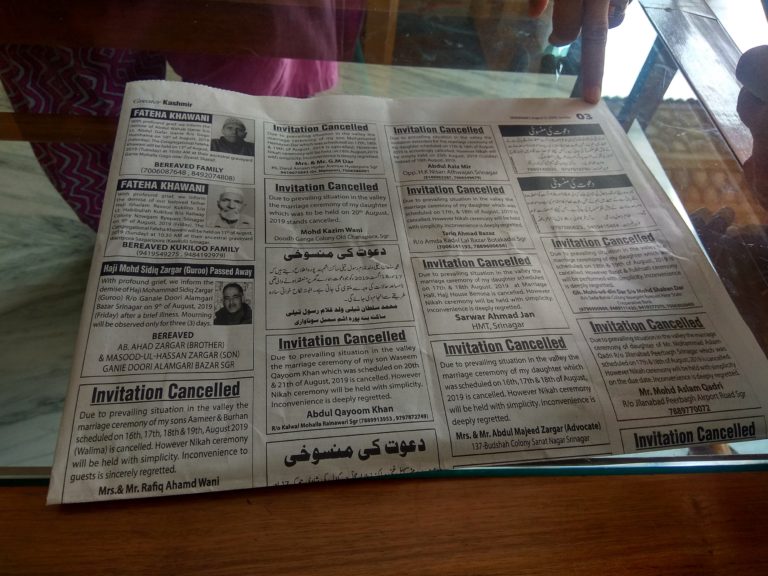
Invitations cancelled I Image courtesy Kavita Krishnan
-
Between 5-9 August, people had suffered for lack of food, milk, and basic needs. People had been prevented even from going to hospitals in case of sickness.
-
The Government claim is that only Section 144 has been imposed, not “curfew”. But in reality, police vans keep patrolling Srinagar warning people to “stay safe at home and not venture out during the curfew”, and tell shops to close their shutters. They demand that people display “curfew passes” to be allowed to move about.
-
All of Kashmir is under curfew. Even on Eid, the roads and bazaars were silent and desolate. All over Srinagar, mobility is restricted by concertina wires on streets, and massive paramilitary deployment. Even on Eid, this was the case. In many villages, azaan was prohibited by the paramilitary and people were forced to do namaaz prayers at home rather than collectively at the mosque as it usual on Eid.
-
In Anantnag, Shopian and Pampore (South Kashmir) on the day of Eid, we only saw very small kids dressed in Eid finery. Everyone else was in mourning. “We feel like we’re in jail”, said a woman in Guree (Anantnag). Girls in Nagbal (Shopian) said, “With our brothers in police or army custody, how can we celebrate Eid?”
-
On 11 August, on the eve of Eid, a woman at Sopore told us she had come to the bazaar during a brief respite in the curfew, to buy a few supplies for Eid. She said: “We were prisoners in our own homes for 7 days. Even today, shops are closed in my village Langet, so I came to Sopore town to shop for Eid and to check on my daughter who is a nursing student here.”
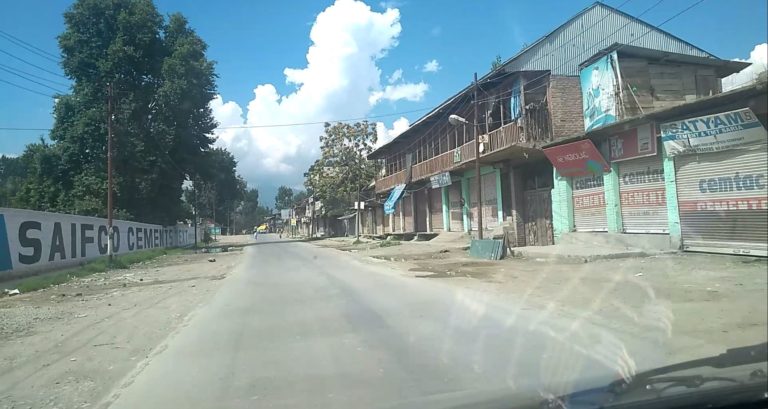
Eid in Pulwama | Image courtesy Kavita Krishnan
-
“It’s Army rule not Modi rule. There are more soldiers here than people”, said a young baker at Watpura near Bandipora. His friend added, “We’re afraid, because the army camp nearby keeps imposing impossible rules. They insist we have to return within half an hour if we leave home. If my kid isn’t well, and I have to take her to the hospital, it may take more than half an hour. If someone visits their daughter who lives in next village, they may take more than half hour to return. But if there’s any delay, they will harass us.” The CRPF paramilitary is everywhere, outside nearly every home in Kashmir. These are clearly not there to provide “security” to Kashmiris – on the contrary, their presence creates fear for the people.
-
Sheep traders and herders could be seen with unsold sheep and goats. Animals they had been rearing all year long, would not be sold. This meant they would incur a huge loss. With people unable to earn, many could not afford to buy animals for the Eid sacrifice.
-
A shopkeeper from Bijnore (UP) showed us the stacks of unsold sweets and delicacies going waste, since people could not buy them. Shops and bakeries wore a deserted look on the eve of Eid, with their perishable food items lying unsold.
-
An asthmatic auto driver in Srinagar, showed us his last remaining dose of salbutamol and asthalin. He had been trying for the past several days to buy more – but the chemists’ shops and hospitals in his area had run out of stocks. He could go to other, bigger hospitals – but CRPF would prevent him. He showed us the empty, crushed cover of one asthalin inhaler – when he told a CRPF man he needed to go further to get the medicine, the man stamped on the cover with his boot. “Why stamp on it? He hates us, that’s why”, said the auto driver.
Protests, Repression, and Brutality
-
Some 10,000 people protested in Soura (Srinagar) on 9 August. The forces responded with pellet gun fire, injuring several. We attempted to go to Soura on 10 August, but were stopped by a CRPF barricade. We did see young protestors on the road that day as well, blockading the road.
-
We met two victims of pellet gun injuries in SMHS hospital in Srinagar. The two young men (Waqar Ahmad and Wahid) had faces, arms and torso full of pellets. Their eyes were bloodshot and blinded. Waqar had a catheter in which the urine, red with blood from internal bleeding, could be seen. Their family members, weeping with grief and rage, told us that the two men had not been pelting stones. They had been peacefully protesting.
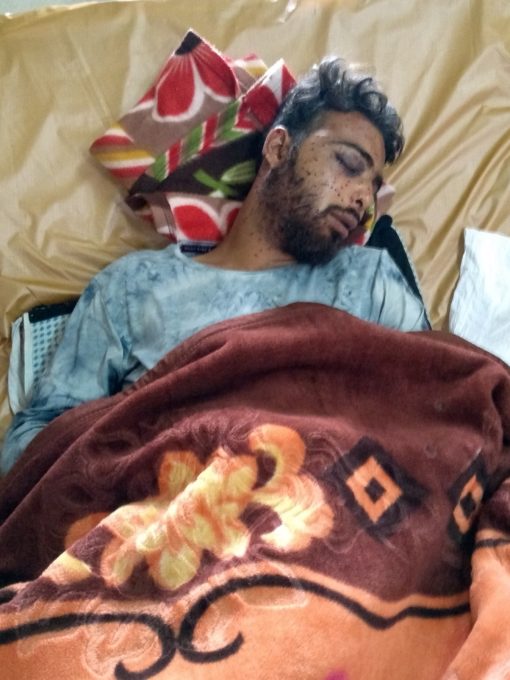
Pellet gun victim | Image courtesy Vimal Bhai
-
On 6 August, a graphic designer for the Rising Kashmir newspaper, Samir Ahmad, (in his early 20s) had remonstrated with a CRPF man near his home in the Manderbag area of Srinagar, asking him to allow an old man to pass. Later the same day, when Samir opened the door to his house, CRPF fired at him with a pellet gun, unprovoked. He got 172 pellets in his arm and face near the eyes, but his eyesight is safe. It is clear that the pellet guns are deliberately aimed at the face and eyes, and unarmed, peaceful civilians standing at their own front doors can be targets.
-
At least 600 political leaders and civil society activists are under arrest. There is no clear information on what laws are invoked to arrest them, or where they are being held.
-
A very large number of political leaders are under house arrest – it is impossible to ascertain how many. We tried to meet CPIM MLA Mohd Yusuf Tarigami – but were refused entry into his home in Srinagar, where he is being under house arrest.
-
In every village we visited, as well as in downtown Srinagar, there were very young schoolboys and teenagers who had been arbitrarily picked up by police or army/paramilitary and held in illegal detention. We met a 11-year-old boy in Pampore who had been held in a police station between 5 August and 11 August. He had been beaten up, and he said there were boys even younger than him in custody, from nearby villages.
-
Hundreds of boys and teens are being picked up from their beds in midnight raids. The only purpose of these raids is to create fear. Women and girls told us of molestation by armed forces during these raids. Parents feared meeting us and telling us about the “arrests” (abductions) of their boys. They are afraid of Public Security Act cases being filed. The other fear is that the boys may be “disappeared” – i.e killed in custody and dumped in mass graves of which Kashmir has a grim history. As one neighbour of an arrested boy said, “There is no record of these arrests. It is illegal detention. So if the boy “disappears” – i.e is killed in custody – the police/army can just say they never had him in custody in the first place.”
-
But the protests are not likely to stop. A young man at Sopore said: “Jitna zulm karenge, utna ham ubharenge” (The more you oppress us, the more we will rise up) A familiar refrain we heard at many places was: “Never mind if leaders are arrested. We don’t need leaders. As long as even a single Kashmiri baby is alive, we will struggle.”
The Gag On Media
-
A journalist told us: “Newspapers are printing in spite of everything. Without the internet, we do not get any feed from agencies. We were reduced to reporting the J&K related developments in Parliament, from NDTV! This is undeclared censorship. If Govt is giving internet and phone connectivity to police but not to media houses what does it mean? We had some people come to our offices, speaking on behalf of Army and CRPF, asking “Why are you publishing photos of the curfew-affected streets?”
-
Kashmiri TV channels are completely closed and unable to function.
-
Kashmiri newspapers that carry the barest mention of protests (such as the one on Soura) are made to feel the heat from the authorities.
-
Foreign press reporters told us that they are facing restrictions on their movement by the authorities. Also, because of the lack of internet, they are unable to communicate with their own main offices.
-
When we visited Press Enclave in Srinagar on 13 August, we found the newspaper offices closed and the area deserted except for a few stray journalists, and some CID men. One of the journalists told us that papers could not be printed till at least 17 August, because they have run out of newsprint which comes from Delhi.
-
As mentioned above, one graphic designer working with a newspaper suffered pellet gun injuries, during a completely unprovoked attack by CRPF
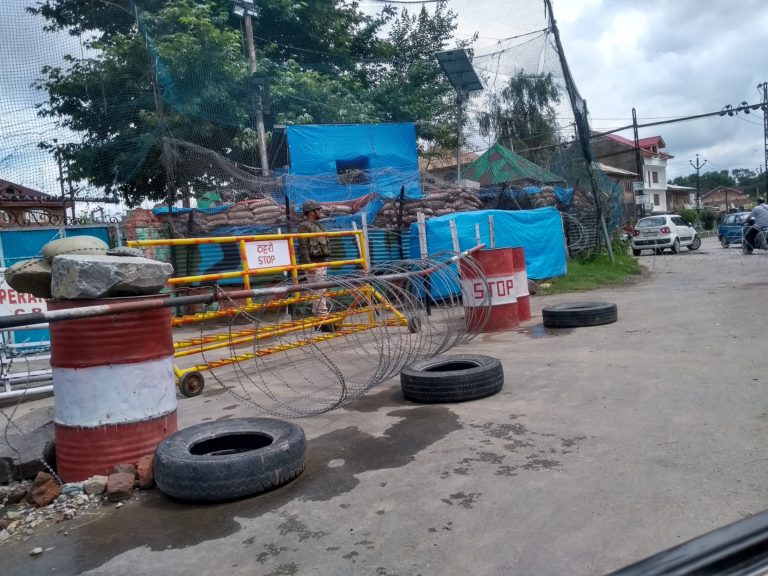
A checkpoint in Srinagar | Image courtesy Vimal Bhai
Does Kashmir Lack Development?
In an op-ed in the Times Of India (August 9, 2019), former Foreign Secretary and Ambassador Nirupama Rao wrote: “A young Kashmiri told this writer a few months ago her birthplace was in the “stone age”; that in terms of economic development, Kashmir was two hundred years behind the rest of India.”
We struggled to find this “backward”, “stone age” Kashmir anywhere at all.
-
It is striking how in every Kashmiri village, we found young men and women who go to college or University; speak Kashmiri, Hindi and English fluently; and are able to argue points of Constitutional and international law in relation to the Kashmir conflict with factual accuracy and erudition. All four of the team members are familiar with villages in North Indian states. This high level of education is extremely rare in any village in, say, Bihar, UP, MP, or Jharkhand.
-
The homes in rural Kashmir are all pucca constructions. We saw no shacks like the ones that are common in rural Bihar, UP, Jharkhand.
-
There are poor people in Kashmir, certainly. But the levels of destitution, starvation and abject poverty seen in many North Indian states, is simply absent in rural Kashmir.
-
We met migrant labourers from North India and West Bengal at many places. They told us that they feel safe and free from xenophobic violence that they face in, say, Maharashtra or Gujarat. Daily wage migrant labourers told us “Kashmir is our Dubai. We earn Rs 600 to Rs 800 per day here – that is three or four times what we earn in other states.”
-
We found Kashmir refreshingly free of communal tension or mob lynchings. We met Kashmiri pandits who told us they felt safe in Kashmir, and that the Kashmiris always celebrate their festivals together. “We celebrate Eid, Holi, Diwali together. That is our Kashmiriyat. It is something different, special,” said one Kashmiri Pandit young man.
-
The myth of the “backward” Kashmiri woman is perhaps the biggest lie. Kashmiri girls enjoy a high level of education. They are articulate and assertive. Of course, they face and resist patriarchy and gender discrimination in their societies. But does BJP, whose Haryana CM and Muzaffarnagar MLA speak of “getting Kashmiri brides” as though Kashmiri women are property to be looted, have any right to preach feminism to Kashmir? Kashmiri girls and women told us, “We are capable of fighting our own battles. We don’t want our oppressors to claim to liberate us!”
The BJP Spokesperson’s “Warning”
We met BJP spokesperson on Kashmir affairs, Ashwani Kumar Chrungoo at the office of Rising Kashmir, a Kashmir newspaper. The conversation was initially cordial. He told us he had come to Kashmir from Jammu to persuade people to support the abrogation of Article 370. His main argument was that since the BJP had won a 46% vote share in J&K and had won an unprecedented majority in Parliament, they had not only a right but a duty to keep their promise of scrapping Article 370. “46% vote share – that’s a license”, he said.
He refused to acknowledge that this 46% vote share while winning only three Lok Sabha seats (Jammu, Udhampur and Ladakh) was possible only because the voter turnout in the three other LS seats (Srinagar, Anantnag and Baramulla) was the lowest in the whole country.
Should a Government impose an unpopular decision on people of Kashmir who have not voted for that decision, at gunpoint? Chrungoo said, “In Bihar when Nitish Kumar imposed prohibition, he didn’t ask the alcoholics for their permission or consent. It’s the same here.” His contempt for the people of Kashmir was evident from this analogy.
Towards the end of the conversation, he became increasingly edgy when confronted by facts and arguments by us. He got up and wagged a finger at Jean Dreze, saying “We won’t let anti-nationals like you do your work here. I am warning you.”
Conclusion
The whole of Kashmir is, at the moment, a prison, under military control. The decisions taken by the Modi Government on J&K are immoral, unconstitutional and illegal. The means being adopted by the Modi Government to hold Kashmiris captive and suppress potential protests are also immoral, unconstitutional, and illegal.
-
We demand the immediate restoration of Articles 370 and 35A.
-
We assert that no decision about the status or future of J&K should be taken without the will of its people.
-
We demand that communications – including landline telephones, mobile phones and internet be restored with immediate effect.
-
We demand that the gags on the freedom of speech, expression and protest be lifted from J&K with immediate effect. The people of J&K are anguished – and they must be allowed to express their protest through media, social media, public gatherings and other peaceful means.
-
We demand that the gags on journalists in J&K be lifted immediately.
Jean Drèze, economist
Kavita Krishnan, Communist Party of India (Marxist-Leninist) and AIPWA
Maimoona Mollah, All India Democratic Women’s Association (AIDWA)
Vimal Bhai, National Alliance of People’s Movements (NAPM)
Featured Video
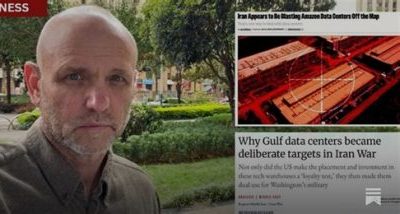
Iran spent $1 million to wipe out $30 billion in data center plans, and take down Amazon in the ME
or go to
Aletho News Archives – Video-Images
From the Archives
A short history of British torture
ICC | December 2005
When the House of Commons was debating how much to increase the time limit for detention without trial the question of torture came up. Officially this was limited to the nice considerations of whether it was all right to send people to places where torture is used and whether Britain can use information collected by the use of torture in other countries. This discussion gave an impression of democratic Britain as the home of civilised behaviour where the very idea of torture is repugnant to our legislators – unlike, say, the US with its secret CIA jails… In reality, the British state has a long history of using and developing a whole range of torture techniques. … continue
Blog Roll
 Aletho News
- Iran spent $1 million to wipe out $30 billion in data center plans, and take down Amazon in the ME
- Zionist billionaire pressure to silence Macklemore sparks exodus from Ed Sheeran tour
- House Votes to End Iran War for Third Time
- North Korea Slams US Plan for ‘AUKUS 2.0’ with South Korea and Japan
- Prolonging US-Iran Conflict Not Meeting Interests of Int’l Community – China’s Wang Yi
- EU bans former Zelensky aide from parliament
- NATO-backed Kosovo separatist ‘responsible for war crimes’
- US destroying international space law
- SCO Calls for Binding Global Deal to Prevent Arms Race in Space
- Iran & Its Allies Are Threatening Every Route for Saudi Oil
- If Americans Knew
- U.S. Makes, Israel Takes: The Real Story of U.S.-Israeli Military Cooperation
- Night raids rise in Palestine
- Tucker Carlson interviews Norman Finkelstein about Gaza
- Groups urge Americans to support Van Hollen legislation on Israel’s killing of Americans & Palestinians
- Trump administration plans to send 40,000 tons of bombs to Israel: report
- Sanctions Target Iran’s Government, But Kill Hospitalized 23-Year-Old Woman
- An alternative view on the book “Israel’s Lobby: America in the Grip of a Foreign Power”
- Ed Sheeran’s band Beoga, other opening acts quit tour after Macklemore was dropped over his pro-Palestinian comments
- The assassination attempt on President Trump in Butler and the various Israeli connections to it
- “We Want That the Whole Land Be Jewish”
- No Tricks Zone
- New Study: ‘Global Drought Shows No Detectable Recent Acceleration Under Climate Warming’
- Economic Masterminds: German Socialists Suggest Taxing Productivity Gains Stemming From Using AI
- The South China Sea Has Not Been Cooperating With The Climate Change Narrative
- Energy Crisis: Germany Enters Heating Season With Historically Low Gas Reserve Fill Levels
- New Study: The Antarctic Ice Sheet Gained Mass From 2020-2024 Due To Staggering Snow And Ice Accumulation
- Study: Ocean Heating Rates From Thousands Of Years Ago ‘Dwarf’ Modern Ocean Heating Rates
- Climate Extremists Target, Attack Large-Scale Power Grid Infrastructure In Germany!
- New Study: Antarctic Ice Melt Has Contributed Less Than 1 Centimeter To Sea Level Rise In The Last 30 Years
- Fear Of Debate: Alarmist German Climate Scientist Calls On Mainstream Media To Discredit Skeptic Voices
- End-Of-August Arctic Sea Ice Extent Hasn’t Fallen In 20 Years, Official Data Show!
 Aletho News