“Will Not Comment on Recent Events in Jammu & Kashmir”: Detainees Being Released Sign Gov’t Form
Sputnik | January 12, 2020
Thousands were detained under India’s Public Safety Act, a law that allows authorities to imprison someone for up to two years without charge or trial, in Jammu and Kashmir before the Narendra Modi-led government revoked Articles 370 of the Constitution, stripping the state of its special status on 5 August.
The detained people, who are being released after five months of imprisonment, have to sign a bond where they say they will not make any comment or statement on the “recent events” in Jammu and Kashmir.
The bond, signed under Section 117 of the Code of Criminal Procedure (CrPC), includes Section 107, which states that the executive magistrate has the power to apprehend any individual for not more than a year on information that a person is likely to disturb peace and public tranquillity.
“I undertake that in case of release from the detention, I will not make any comment(s) or statement(s) or make public speech(s), (or) hold or participate in public assembly(s) related to the recent events in the State of Jammu and Kashmir, at the present time, since it has the potential of endangering the peace and tranquillity and law and order in the State or any part thereof for a period of one year,” section two of the bond reads.
Nearly 4,000 people were arrested and some political leaders were detained after the revocation of Article 370, over fears of outbreaks of unrest and “most of them were flown out of Kashmir because prisons here have run out of capacity”, news agency AFP had quoted an official as saying.
The government bifurcated the state into two federally-administered territories – Jammu and Kashmir and Ladakh. The union territory then imposed a communications clampdown as new charges for mobile phone services were imposed. Postpaid mobile calling and messaging services along with broadband internet have been resumed, but internet services remain suspended. India’s apex court has termed the restrictions unconstitutional.
A delegation of envoys from 15 countries such as the United States, South Korea, Vietnam, Bangladesh, Maldives, Morocco, Fiji, Norway, Philippines, Argentina, Peru, Niger, Nigeria, Togo and Guyana visited the Jammu and Kashmir on 9 January.
India’s three-step communal game plan
Through the NRC-NPR process, the Modi government aims to create a category of second-class citizens
By Prakash Karat | The Hindu | December 22, 2019
The Citizenship (Amendment) Act (CAA), 2019, and the National Register of Citizens (NRC) are interconnected and twin measures. The Home Minister, Amit Shah, had repeatedly made this clear both in Parliament and outside. First, the Citizenship (Amendment) Bill would be adopted by Parliament following which the NRC would be taken up.
In the wake of widespread protests against the CAA, the Central Government is trying to obfuscate the issue of implementing the NRC. It is taking advantage of the lack of clarity and the inadequate information available on how the NRC is going to be implemented in the whole country. The Minister of State for Home Affairs, G. Kishan Reddy, has said: “A countrywide NRC had not been notified so far and no one should fear.” The Government has put out advertisements in Hindi and Urdu newspapers stating that “The NRC has not been announced yet and if it is done so in future, then rules and regulations should be such that no Indian citizen is troubled.”
The NRC-NPR link
These and other such pronouncements are an exercise in disinformation. A crucial fact is that the NRC process begins with the compilation of the National Population Register (NPR). This is the first stage of the NRC. The notification for preparing and updating the NPR was issued by the Registrar General of Citizen Registration, on July 31, 2019. For this, house to house enumeration will be conducted throughout the country (except in Assam) for “collection of information relating to all persons who are usually residing within the jurisdiction of the Local Registrar”. This enumeration will be undertaken between the first day of April 2020 and September 30, 2020.
The compilation of the NPR is a preliminary step towards preparing the NRC. On the basis of the NPR, the local register of Indian citizens will be finalised after due verification. This is the procedure set out under the “Citizenship (Registration of Citizens and Issue of National Identity Cards) Rules 2003”.
So, from April 1, 2020 onwards, the National Register of Citizens process will begin with house to house enumeration for the National Population Register.
It is important to note that, as per these Rules, during the verification process, particulars of such individuals whose citizenship is deemed to be “doubtful” shall be entered by the local Registrar with appropriate remarks in the Population Register for further enquiry; and in case of “doubtful” citizenship, the individual or the family shall be informed in a specified proforma immediately after the verification process is over.
Another clause of these Rules, 4(5)(a) states that: “Every person or family specified in sub-rule (4), shall be given an opportunity of being heard by the Sub-district or Taluk Registrar of Citizen Registration, before a final decision is taken to include or to exclude their particulars in the National Register of Indian Citizens” [emphasis added].
Use of biometric data
Fifteen questions will be asked in the survey, including questions on the place of birth, the date of birth, and the name of the father and mother. The new addition will be eliciting the details of Aadhaar, which will then be crosschecked with the Unique Identification Authority of India (UIDAI) for verification of biometrics of the individual. So, the NPR compilation will also have the biometric data of those listed, which raises troubling questions.
It is at the verification stage that communal profiling will take place in line with what the Home Minister had declared — the purpose of the NRC is to eliminate “infiltrators” as against the Hindu refugees who will become eligible for citizenship under the CAA. Those summoned as “doubtful citizens” will have to go through the tortuous process of submitting proof of their citizenship.
The NRC does not require any new law or amendment. It is already part of the Citizenship Act of 1955 through an amendment made during the Atal Bihari Vajpayee government in 2003. For the first time, the concept of a National Register of Citizens was introduced by making it compulsory to register every citizen of India and to issue a national identity card. Based on this, the rules for registration for citizenship were issued subsequently in which provision was made for a National Population Register.
Further, there is confusion created by the fact that the updation of the NPR is being done along with the Census enumeration for 2021. It is the Census authorities who undertake both these processes, but they are two separate things. The NPR is directly linked to the NRC.
That the game plan of the BJP is to create a communal division in States such as West Bengal is absolutely clear. On the one hand, it claims that the NRC process will eliminate all those who are “Muslim infiltrators” from Bangladesh. On the other hand, by amending the Citizenship Act, Hindu migrants who have come from across the border over the decades will be given citizenship.
Superfluous and expensive
The NRC process is being undertaken at a time when the Aadhaar identity card has already covered most of the population. There is also the Electors Photo Identity Card issued by the Election Commission of India. The necessity for another citizenship register and identity card is superfluous. Moreover, it will entail a huge amount of expenditure. The NRC process is weighted against the poorest sections of the population — migrant labour, Adivasis living in remote areas, and other marginalised communities.
The movement against the CAA has correctly linked it to the NRC. The CAA and the NRC must be seen in tandem. While the former would legitimise non-Muslim migrants as citizens, the NRC would target the so-called “Muslim infiltrators”. What the Narendra Modi government is aiming to do is to create a category of second-class citizens whose rights would be severely circumscribed.
Prerogative of States
It is imperative that the communal agenda of the BJP and the Central Government is foiled. This requires stoppage of the NRC. An important step in this direction will be to halt the NPR process in the States. Several Chief Ministers have gone on record that they are opposed to the NRC. Even Nitish Kumar, Chief Minister of Bihar, and Naveen Patnaik, Chief Minister of Odisha, whose parties supported the CAA in Parliament, have said that they do not want the NRC.
Already Pinarayi Vijayan, Chief Minister of Kerala, and Mamata Banerjee, Chief Minister of West Bengal, have announced that they are suspending the NPR process in their States. The work in the NPR gets halted since it is the State government which provides personnel for the enumeration and verification process. Other State Governments should also do so. If the Central Government stands by the announcement that the NRC process has not begun, then it should withdraw the July 31, 2019 notification for the updation of the NPR.
Prakash Karat is a Politburo member of the Communist Party of India (Marxist)
UN Security Council Meeting on Kashmir at China’s Request Postponed Indefinitely
Sputnik – December 17, 2019
A crucial closed-door meeting at the United Nations Security Council (UNSC) on the Kashmir issue has been postponed for a month at least.
The meeting was scheduled on Tuesday to discuss the humanitarian situation in Indian-administered Jammu and Kashmir.
Previously, a first such meeting was held in August this year in the aftermath of India’s decision to revoke the seven decades old special status of Kashmir on 5 August. However, the provisional schedule and daily meetings of the UNSC don’t mention the consultative meeting on Kashmir.
In its August programming schedule, the UNSC clearly mentioned the closed door consultation on India and Pakistan. But in December’s schedule no such meeting is planned. Two diplomats have also confirmed the development.
Currently, the decision to postpone the meeting on Kashmir came ahead of crucial boundary dispute talks between India and China.
India’s National Security Adviser (NSA) Ajit Doval and Chinese Foreign Minister Wang Yi are expected to meet on 20-21 December to stabilise relations and discuss the contentious boundary issues between the two nations during Special Representatives-level talks.
The boundary discussion was stalled for months due to strained relations between the two Asian giants over Kashmir. Beijing termed the Indian decision to revoke the special status of Kashmir as unilateral and impinged upon the sovereignty of China.
The last time the issue of Jammu and Kashmir was on the UNSC agenda was during a meeting on 21 December 1971. It was followed by the adoption of a resolution calling for a durable ceasefire, the halt of all hostilities in conflict areas, and the provision of international assistance to refugees impacted by the territorial dispute.
In a related development, Pakistani Prime Minister Imran Khan has also cancelled his scheduled visit to Malaysia to participate in a meeting on Kashmir.The development comes two days after Khan met with Saudi Crown Prince Mohammad Bin Salman in Riyadh, during which matters related to bilateral relations were discussed.
A summit of Muslim leaders is expected to deliberate upon a shared agenda of Islamic countries and their collective challenges in a highly interconnected world.
India and Pakistan have contended for the Kashmir region, the southern part of which lies in India’s Jammu and Kashmir state (now a union territory), since the end of British rule in 1947. Despite a ceasefire being reached in 2003 following several armed conflicts, instability has continued, leading to the emergence of various extremist groups.
The ballad of India’s Kashmir and Israel’s Palestine
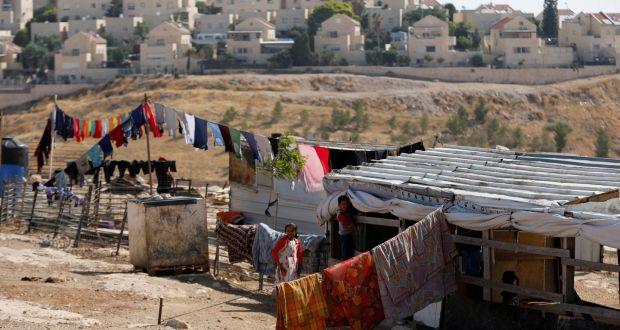
Palestinian children play outside their dwelling in al-Eizariya town in the Israeli-occupied West Bank with the Jewish settlement of Maale Adumim in the background.
By M. K. BHADRAKUMAR | Indian Punchline | November 29, 2019
“I believe the security situation will improve (in J&K), it will allow the refugees to go back, and in your lifetime, you will be able to go back … and you will be able to find security, because we already have a model in the world.”
“I don’t know why we don’t follow it. It has happened in the Middle East. If the Israeli people can do it, we can also do it.”
The above reported remarks by India’s consul-general in New York Sandeep Chakravorty while addressing an audience of Kashmiri Pandits raised some dust in the Indian media. But his job or career is no mortal danger.
For, Chakravorty must be an intelligent man and probably estimated that he was only articulating from a Track 1.5 platform the Modi government’s surreptitious policy in J&K — following the Israeli footfalls of forcible occupation and colonisation of lands inhabited by alienated people.
Whether the policy is doable or not is for time to tell. To my mind, the final word is not yet available whether even the brutal Israeli policy will work or not. Besides, circumstances are vastly different, and Kashmir is not an analogous situation.
The main difference is that although the Indian state resorted to the use of force, much like Israel had done in Palestinian lands, the security situation has only deteriorated over the years, over decades. There are no two opinions that even half a million troops could not achieve anything by way of enduring results in the Kashmir valley.
The ground realities in the valley militate against repression and state terrorism as viable policy option for a country such as India. The stark evidence of it lies in the government’s decision in August to change the status of J&K, which is an admission of failure rather than a mark of triumphant glory.
Consul-general Chakravorty seems unaware how Israel went about systematically to prepare an external environment first by subduing the Arab countries that surrounded it and harboured sympathy, and were willing to support the Palestinian cause. Arguably, India too should begin with defeating and subduing Pakistan first? But, honestly, such an option is not available for India in our thermonuclear era, now or ever, the bravado of our ruling elite and their acolytes notwithstanding.
Then, there is the western support for Israel, which helps it to get away with murder. The underlying factors here are complex and deep rooted in history. At its core, the western countries are constantly forced into an attitude of atonement for their anti-semitism that has a long and loathsome history dating back centuries. Remember the notorious Dreyfus affair in France — leave alone the slaughter of Jews in the Holocaust, which makes Angela Merkel wobbly in the legs even today when she mentions Israel.
Israel plays the “anti-semitic card’ very effectively. In actual practice, any criticism of Israeli state violations against Palestinians is instantly discredited as being “antisemitic”. Today, US Congresswomen Ilhan Omar and Rashida Tlaib and British Labour Party leader Jeremy Corbyn are in the crosshairs of the Israeli lobby for this reason. Corbyn’s sin is that he has pledged to cut military trade with Israel and move to officially recognise a Palestinian state, if elected to power.
The well-known commentator Finian Cunningham recently wrote, “This conflation of valid criticism of the Israeli state with being “anti-Jew” is a cynical distortion which is wielded to give Israel impunity from international law. It plays on moral blackmail of critics by equating the historical persecution of Jews and in particular the Nazi holocaust with the sanctity of the modern Israeli state.”
Unfortunately, there is a notion even amongst educated Indians (including bureaucrats in the Indian Foreign Service) that linking up with the Jewish organisations would enable India to piggy ride on the Israeli lobby in the US. The false notion largely stems from sinister claims about the influence of “Jewish money” — and, it is not of recent origin. Didn’t Brajesh Mishra, the NSA under Atal Bihari Vajpayee, envisage a US-Israel-India condominium?
The heart of the matter is that India is not Israel. Unlike Judaism, Hinduism is not an Abrahamic religion and it is not joined at the hips with the Christian world. This is one thing. Second, while large sections of Hindus too have suffered cruel persecution through centuries, it happened to be at the hands of their co-religionists. Clearly, there is no reason for atonement on the part of the West.
Third, while Indian-Americans are a prosperous community relatively, their clout in the Wall Street is minimal. Unlike the “Jewish lobby”. Simply put, following the Israeli footfall on the occupation and colonisation of the Palestinian homeland or the territories illegally annexed during wars will not take India very far in regard of the J&K situation.
The bottom line is that the western opinion on Kashmir is supportive of neither India nor Pakistan. It always rooted for the “Third Option” — an independent and sovereign state of Kashmir. The official US position, in particular, always made it a point to stress that any solution should take into account the “wishes of the Kashmiri people.”
In the prevailing geopolitical situation in Asia, an independent Kashmir state will be a strategic asset for Washington. Surely, any colonisation of Kashmir Valley by non-Kashmiris grates against the US interests. Israel, on the contrary, is itself a western creation on the map of the Middle East and the US condones Israel’s war crimes and aggressive state policies as a matter of regional strategy.
One would imagine that an Indian diplomat of the rank of ambassador would know that discretion is the better part of valour. Yet, he voiced maverick opinions like a run-of-the mill rabble-rouser on the Hindutva platform, which, he should be intelligent enough to grasp, would only serve to confirm Pakistani allegations regarding the Modi government’s intentions behind the change of status of J&K. The politicisation of the Foreign Service, which such sordid episodes highlight, won’t serve any good.
Bereft of soft power, India stands diminished in Hindu Kush and Central Asia
By M. K. BHADRAKUMAR | Indian Punchline | November 24, 2019
The dichotomy between the regime policy and public opinion is nowhere near as sharp as in the world of diplomacy. And nowhere in the contemporary situation is this maxim so sharply visible as in the dalliance of the West Asian oligarchies with Israel. The romance began at least a decade ago — perhaps, more — but it still remains an illicit affair.
Israel would have liked an open relationship. It has a lot to gain thereby. But that’s possible only when pigs fly. The reason is that the authoritarian rulers of Muslim Middle East are acutely conscious of the so-called ‘Arab Street’. This may seem a paradox — that oligarchies need to be mindful of popular opinion — but, in actuality, they do not enjoy such a big leeway as one imagines to trample upon public opinion to the extent that strong elected leadership would have.
When they defy or ignore public opinion, it must be for weighty reasons — mostly, when existential issues are involved such as the regime’s survival, for instance. Israel doesn’t fall into that exceptional category — it is not as if without a relationship with Israel, the Arab oligarchies would face extinction. The dalliance between the Arab regimes and Israel is characterised by pragmatism rather than principles or critical imperatives. So long as Israel lacks any ‘soft power’ in its Arab neighbourhood and the ‘Arab Street’ views it negatively, the hands of the authoritarian rulers are tied. They can go only thus far, and no further. In turn, it severely limited the relationship.
The Indian leadership should realise the limitations of pragmatic external relations in diplomacy. There is no gainsaying the fact that India’s ‘soft power’ is depleting at an alarming rate. The acolytes of the Modi government do not seem to care and even those amongst the few amongst them who are erudite enough to comprehend the significance of what is happening tend to put on an air of defiance or studied indifference — or worse still, become polemical.
The External Affairs Minister S. Jaishankar’s recent remark that Imperial Britain divested India of $44 trillion is a typical remark. Faced with the quandary of searing criticism in Britain regarding the J&K situation, he takes a de tour to malign Britain. (How this round figure of $44 trillion has been arrived at is another matter — even if one doesn’t want to get into the modernisation of India under British rule that made the evolution of the Indian state as a political entity possible.)
Today, ‘soft power’ is no longer in vogue in the Indian diplomatic toolbox. The obsession with ‘macho’ image is so overpowering. Under the Modi government, the accent on ‘soft power’ began with a bang in 2014 and is quite visibly ending after five years with a whimper.
A number of mistakes have been made during the past 5-year period that dented India’s ‘soft power’ (which one doesn’t want to go into there). But it is the appalling situation in the Kashmir Valley that dealt a body blow to India’s image.
An opinion is steadily gaining ground in the Muslim countries in India’s ‘extended neighbourhood’ that the Modi government is adopting state policies that are decidedly ‘anti-Muslim’. Even the elites in friendly countries such as Bangladesh, Malaysia, Indonesia or Turkey, who are by no means ‘Islamist’ tend to see Kashmir as a ‘Muslim issue.’
A recent opinion piece in the influential US magazine Foreign Policy is entitled Kashmir Could Wreck India’s Reputation Among Afghans. It is a nuanced analysis — by no means ‘anti-Indian’ — of how Afghan public opinion, which is traditionally friendly, is discernibly getting disenchanted with India’s repression of Kashmiri Muslims.
This is a depressing scenario, because ‘soft power’ has been historically the bedrock of India-Afghan relations, and for that reason, Delhi under successive governments right from 1947, placed great emphasis on people-to-people relations between the two countries.
Certainly, our diplomacy will be by far diminished if the Afghans perceive us as no different from Pakistan — pursuing cold, pitiless geopolitical objectives in their country. It is small comfort that Afghans will probably continue to view India as a ‘stabilising factor’.
To quote Hari Prasad, the author of the article, “The positions of political actors in Afghanistan have ranged from neutral to explicitly pro-India, primarily for India’s support for the Afghan government as well as anti-Pakistan animus. But our discussions with journalists and Afghans in the region show the popular reaction is decidedly more nuanced. Many working-class Afghans, drawing from their own experiences of conflict and oppression, identify with Kashmir’s Muslims.”
The analysis makes the foreboding conclusion: “Afghans are closely watching the actions of Indian Prime Minister Narendra Modi’s government in Kashmir and throughout the region. That should be a reality check for New Delhi; its courting of Afghan opinion can only go so far. India may have the funding and power to shape public opinion and support in Afghanistan, but it will take much more to overcome growing mistrust.”
If the changing perceptions regarding India are such in Afghanistan, can it be any different in the Central Asian region? The people in the steppes are, if anything, far more deeply immersed in Islamic culture, ethos and identity than Afghans, given the historical reality that their region was also the cradle of Islam in its golden era.
The Uzbeks, for instance, take great pride that Babur set out from Fergana, which, incidentally, has a museum dedicated to Babur. One of the most evocative historical monuments in Kabul is the Bagh-e Babur (Garden of Babur), the final resting place that the great emperor chose for himself — rather than Agra.
Even if Delhi were to build half a dozen parliament buildings in Kabul, Afghans will continue to treasure the Bagh-e Babur as the living monument to their abiding links with India.
With eye on India, Pakistan strengthens military ties with Iran
By M. K. BHADRAKUMAR | Indian Punchline | November 20, 2019
he low-key coverage by the Pakistani media on the 2-day visit of the army chief General Qamar Bajwa to Iran notwithstanding, the event signifies a surge in the tempo of ‘mil-to-mil’ exchanges between the two countries.
The Iranian side gave the event a distinct political colouring with the Pakistani COAS having meetings with President Hassan Rohani, Foreign Minister Mohammad Javad Zarif and the Secretary of the Supreme National Security Council Ali Shamkhani, apart from talks with his host, Chief of Staff of the Iranian Armed Forces Major General Mohammad Hossein Baqeri.
Border security and counter-terrorism are key issues for Iran. But Gen. Bajwa’s talks extensively covered regional developments and even dwelt on the two countries’ “coordination on the major issues of the Muslim world”.
The Iranian reports did not make any references to the Kashmir issue or India-Pakistan tensions, but it is inconceivable that Gen. Bajwa sidestepped the topic.
In fact, even as Gen. Bajwa headed for Tehran on Monday, Pakistan conducted a training launch of the surface-to-surface ballistic missile Shaheen-1, a day after India conducted the first night trial of its Agni-II missile.
The Iranian news agency IRNA took note that the launch of Shaheen-1 “aimed at testing operational readiness of Army Strategic Forces Command, ensuring Pakistan’s credible minimum deterrence.”
The Pakistani army spokesman tweeted that Gen. Bajwa discussed with Rouhani the “regional security environment and matters of mutual interest”. According to the Iranian agency IRNA, Gen Bajwa told Rouhani that Pakistan was prepared to strengthen bilateral relations “in all spheres”.
Rouhani in turn hailed Pakistan’s role towards regional peace and called the relations between the two Muslim nations as “an invaluable asset” which should be used to further boost mutual cooperation.
Iranian reports quoted Gen. Bajwa as saying Pakistan and Iran face “common threats and have common interests”, calling for close cooperation and interaction.
An IRNA commentary said, “In recent years, Tehran and Islamabad have witnessed high level exchanges from top military officials and the recent visit of Pakistan Army Chief to Iran demonstrates the commitment of the two sides to consolidate defense ties through active diplomacy.”
The semi-official Fars agency reported that Gen. Bajwa and Gen. Baqeri discussed “different issues ranging from security partnership, regional developments and maintaining stable security at the regional level” and “explored avenues for bolstering and reinvigorating defence relations”.
Notably, Admiral Shamkhani, who reports to Supreme Leader Ali Khamenei, called for “all-out expansion of ties” with Pakistan “in a bid to provide regional security.” Equally, Foreign Minister Zarif and Gen. Bajwa “discussed a broad range of issues, including the political, economic and military relations” between Iran and Pakistan as well as “regional cooperation and the ongoing developments in the region, including the situation in Afghanistan.”
Without doubt, the Iranian reports uniformly underscored Tehran’s high expectations that a new phase of Iran-Pakistan relations may be commencing.
Gen. Bajwa’s visit tops up an intensification of high-level exchanges between the two countries during the past two-year period since his pathbreaking trip to Iran in 2017, which was the first by a Pakistani COAS in over two decades.
During the 2017 visit, Gen. Bajwa had told Rouhani that Pakistan was determined to expand its ties with Iran in all spheres and hoped that the two neighbours could collaborate for regional peace and security. To be sure, the shifts in the geopolitics of the region acted as catalyst in injecting new verve into the relationship.
Principal among them would be Delhi’s ‘pivot to Saudi Arabia’ in its Gulf strategy, markedly deviating from the traditional course of walking a fine line in the intra-Gulf discords and rivalries from a standpoint of benign neutrality.
Even as US-Iranian tensions began accelerating, the Modi government unceremoniously complied with Washington’s diktat to roll back ties with Iran by terminating all its oil imports from that country. The pusillanimous attitude of the self-styled nationalist leadership in Delhi took Tehran by surprise.
Tehran put its deep disappointment on display once it became apparent that the Modi government retracted even from its commitments at the highest level of leadership to cooperate with Iran on the development of Chabahar Port, which was a key underpinning of regional connectivity and security linked to the stability of Afghanistan. (See my column in Rediff, Why Iran is upset with India.)
The Indian U-turn on Chabahar has come to symbolise the phenomenal shift in Indian regional policies in the direction of harmonising with the US strategy at a critical juncture when Washington’s maximum pressure approach is fuelling tensions in the Gulf and leading to a steady augmentation of the American military deployments in Saudi Arabia that could well be the prelude to confrontation with Iran.
The unkindest cut of all is that Iran’s Sistan-Baluchistan province is also targetted by terrorist groups that are allegedly backed by Saudi Arabia. Tehran senses that the Modi government is inexorably gravitating toward the US-Israeli-Saudi axis, jettisoning India’s traditional independent Gulf policies.
The ardour of PM Modi’s personal friendships with the Saudi Crown Prince Mohammed bin Salman and Israeli PM Benjamin Netanyahu must have set alarm bells ringing in Tehran.
On the other hand, Pakistan is closely gauging the downhill slide in the India-Iran relationship and estimating that the 40-year old Indian strategic embrace of Iran as a “second front” is ending. Meanwhile, for the first time since the Islamic revolution in in 1979, Iranian leadership is appreciating Pakistan’s independent foreign foreign policies.
Tehran would estimate that conditions are getting ripe for a breakthrough in Pakistan-Iran military cooperation. Importantly, the UN’s five-year time frame for embargo on arms trade with Iran expires next year, while the eight-year limit on Iran’s missile activities ends in 2023. (See a recent IRNA commentary titled JCPOA, Sunset Clauses and struggle of Americans.)
Of course, Tehran’s willingness to support Pakistan on the Kashmir issue could be the ultimate clincher.
In geopolitical terms, Iran’s overarching foreign-policy agenda of Eurasian integration brings Tehran and Pakistan more or less onto the same page in regional politics.
Zarif acknowledged at a recent meeting in Tehran with a group of visiting Indian writers and journalists that US economic and political actions had created “an understanding” between China, Russia and Iran “that we’re all (US) targets” and there was “a commonality being felt” by the leaderships of the three countries. Of course, Islamabad is well aware of it, having been a “target” itself.
Tehran loses patience with Modi government’s hide and seek
By M. K. BHADRAKUMAR | Indian Punchline | November 18, 2019
Historically speaking, the India-Iran relationship had its ups and downs during the decades of the Shah’s rule. The Lowest point was reached when, during the 1965 and 1971 wars with India, Pakistani Air Force jets were stationed in Iran to gain ‘strategic depth’ vis-a-vis the IAF.
However, after the 1979 Islamic revolution, Iran adopted an explicitly anti-Western foreign policy and began viewing India as a natural ally. The ideology-based regime rooted in the principles of justice, freedom and resistance was greatly attracted by India’s freedom struggle, non-aligned policies, and the sheer grit to preserve its strategic autonomy. This perceived affinity withstood the changes and shifts in Delhi’s foreign policy outlook in the post-Cold war era.
Tehran was not unduly perturbed when the India-US relationship took an upward curve in the nineties during the Bill Clinton administration or when the 2008 nuclear deal was concluded — or, even when Washington and Delhi began chanting their ‘defining partnership of the 21st century’ during the Barack Obama Administration.
Tehran remained confident about India’s DNA anchored on the country’s strategic autonomy. This confidence took a beating when India voted for the first time in February 2006 in favour of a West-led resolution in the International Atomic Energy Agency (IAEA), which reported against Iran to the UN Security Council — and, again, in November 2009 when India voted in favour of a resolution spearheaded by the US at the IAEA censuring Tehran over its controversial nuclear programme and demanding that it stop uranium enrichment.
Nonetheless, life moved on. There was no apparent rancour. This much needs to be recalled to put in perspective the highly critical remarks by Iran’s foreign minister Mohammad Javad Zarif recently, while meeting a group of visiting journalists from New Delhi, regarding the Modi government’s pusillanimous attitude under American pressure to roll back cooperation with Tehran.
Zarif said Tehran had expected the Modi government to be “more resilient” in the face of Washington’s bullying. Zarif speculated that India probably “did not want to agitate” the US by being a sanctions spoiler and he added with biting sarcasm, “People want to be on the right side of President Trump” but the problem is “he hasn’t got a right side.”
Equally, Zarif regretted that the Modi government was dragging its feet on the Chabahar Port project, which has far-reaching implications for regional connectivity, stability and security.
Iranian state media widely reported Zarif’s remarks, which most certainly reflect deep misgivings at the highest level of the Iranian leadership that India’s capacity or political will to pursue independent foreign policies is increasingly in doubt.
To be sure, Zarif’s remarks must also be seen in the backdrop of the Modi government’s fawning attitude toward Saudi Arabia lately. There is no empirical evidence to suggest that Riyadh laid pre-conditions for Crown Prince Mohammed bin Salman’s embrace of PM Modi. In fact, Saudi-Iranian rivalry is far too complex to be reduced to zero-sum mindset. After all, Riyadh is robustly advancing cooperation with Russia and China despite these two countries having thriving strategic partnerships with Iran.
Indian analysts tend to link the Modi government’s dalliance with Saudi Arabia and the deepening chill in Indian-Iranian relations. Indeed, the Modi government has relegated cooperation with Iran to the back burner. It is no secret of course that Washington encourages third countries to replace Iranian crude with Saudi supplies.
The Modi government is pinning hopes on massive Saudi investments in India. During the Crown Prince’s visit to India in February, he forecast Saudi investments to the tune of $100 billion during the next two-year period. The Indian side has been daydreaming since then about big Saudi investments in the Ratnagiri petrochemical project and in Reliance Industries. While the Ratnagiri project is in limbo, Reliance is keeping its fingers crossed. Modi’s recent visit to Saudi Arabia can be viewed in this context.
How realistic are the Indian expectations? Clearly, Saudi Arabia itself needs to attract outside investment. Lackluster oil prices have caused the country’s budget deficit to widen. The budget deficit would be in the region of $36 billion in 2018 and 2019, and may widen to $50 billion in 2020. Saudi Aramco’s IPO itself is for raising money for funding the Crown Prince’s ambitious program of economic and social reforms (‘Vision 2030’).
CNBC recently featured an interview with ex-CIA chief General David Petraeus (who presently heads the KKR Global Institute, which provides consultancy to American companies active in the Middle East) regarding Saudi Arabia’s economic malaise. Some excerpts are worth noting:
“It’s a fact that Saudi Arabia is gradually running out of money, they’d be the first to acknowledge that the sovereign wealth fund has been reduced, it’s somewhere below $500 billion now.”
“The (budget) deficits each year, depending on the price of Brent crude, can be anywhere from $40 to $60 billion depending on some of their activities in countries in the region.”
“The bottom line is that they need the money, they need that outside investment that is crucial to delivering ‘Vision 2030’ which cannot be realized without outside investment, this is just one component of a number of different initiatives that they’re pursuing to try to attract that outside investment.”
The prospects aren’t bright for Reliance and Ratnagiri to pin hopes on Saudi investment. The Crown Prince’s priority is ‘Vision 2030’ — and it remains a hard sell. Period.
Put differently, neglecting India’s cooperation with Iran, especially Chabahar Port development, for the sake of a chimerical Saudi bonanza can only find the Modi government falling between two stools eventually. India cannot, should not and need not substitute Saudi Arabia as a preferred partner to Iran — or vice versa.
Why keep at arm’s length a regional power in our extended neighbourhood who is manifestly eager to foster cooperation with India? Such an attitude is illogical, myopic and cramps India’s diplomatic options in the Persian Gulf.
Kashmir after India’s unilateral move: A story of fear and hopelessness
By Shahana Butt | Press TV | Nov 15, 2019
Indian-Administered Kashmir – More than 100 days have passed since India stripped Kashmir of its autonomous status and divided the state into two federally-ruled territories. The region has been observing a protest close down ever since; with shops, businesses and schools shunned by the people in protest against New Delhi’s move.
Although India has promised the return of normalcy in the region through equal rights and development; rumors are moving the other way round.
The return of check posts and eruption of new security bunkers across the Muslim majority region has pulled back the horror scenes of 1990’s in Kashmir and has all together made it more difficult for the people living in the world’s largest militarized zone.
In the past 100 plus days hundreds of bunkers have been built in addition to the existing security vigil; the prevailing circumstances have further silenced the people of Kashmir.
Press TV spoke to a cross section of people in Kashmir to know how they see this new Kashmir and what they faced in the past 100 plus days.
Since august 5 people of Kashmir are living in a controlled communication zone; with no internet facilities and limited cellular network that was provided after the intervention of India’s top court and international criticism.
In the absence of international concern and given New Delhi’s ‘not so clear’ Kashmir agenda people of Kashmir are caught in skepticism, doubt and fear.
Sooner or later so called ‘normalcy’ might return to the valley of Kashmir. But India’s unilateral move and the world’s turning a blind eye to the issue has left a deep-rooted impact on the lives of people here. This has added to the existing alienation of Kashmir, where people accuse both India and Pakistan of playing the Kashmir card for political and strategic gains.
India top court rules in favor of Hindus in dispute over mosque land
Press TV – November 9, 2019
India’s top court has ruled in favor of the construction of a Hindu temple at the site of a mosque that had been demolished by Hindu mobs three decades ago.
In a unanimous judgment on Saturday, the Supreme Court ruled in favor of Hindus regarding a plot of land in Ayodhya in northern India, where a 16th Century Babri mosque stood before it was demolished in 1992 by Hindu extremists.
The five Supreme Court judges said that the mosque was “not built on vacant land” and had displaced a previous temple.
They allocated a separate “prominent” five-acre piece of land, not far from the contested site, to the Muslim community to construct a mosque.
The court also ruled that the demolition of the mosque was against the rule of law. The destruction of the mosque triggered religious riots in which about 2,000 people died, most of them Muslims.
A representative for the Muslim litigants said that they were not satisfied and would decide whether to ask for a review after they had read the whole judgment.
Authorities deployed thousands of police patrols in the city ahead of the verdict. They also arrested hundreds of people in the city.
Prime Minister Narendra Modi and some other officials have appealed for calm. The premier hailed the verdict, saying it had “amicably” ended a decades-old dispute.
“The halls of justice have amicably concluded a matter going on for decades. Every side, every point of view was given adequate time and opportunity to express differing points of view. This verdict will further increase people’s faith in judicial processes,” Modi tweeted.
Hindus and Muslims have been locked in a conflict over the site for 150 years. On the site of the demolished mosque, Hindus constructed a tent that resembles a temple.
The ruling party of Prime Minister Modi, the Bharatiya Janata Party (BJP), rose to power on a wave of Hindu nationalism.
In a recent move, his government revoked the semi-autonomous status of Kashmir. The decision sparked a wave of tensions throughout the region, which is divided between India and Pakistan.
New Delhi also imposed restrictions on people’s movements and communications in Kashmir to curb unrest there, calling it an internal matter and criticizing countries that have spoken out against the move.
The Muslim majority region has been split between India and Pakistan since their partition in 1947.
Russia, China & India to set up alternative to SWIFT payment system to connect 3 billion people
RT | October 28, 2019
Members of the BRICS trade bloc Russia, India, and China have decided to connect their financial messaging systems to bypass the SWIFT international money transfer network.
Russia’s financial messaging system SPFS will be linked with the Chinese cross-border interbank payment system CIPS. While India does not have a domestic financial messaging system yet, it plans to combine the Central Bank of Russia’s platform with a domestic service that is in development.
The new system is expected to work as a “gateway” model when messages on payments are transcoded in accordance with a certain financial system.
According to Izvestia, the parties involved will work on a single platform, without experiencing any difficulties with transactions.
Russia began development of SPFS in 2014 amid Washington’s threats to disconnect the country from SWIFT. The first transaction on the SPFS network involving a non-bank enterprise was made in December 2017.
“We have an opportunity to connect both foreign banks and foreign legal entities to the SPFS. Today, about 400 users are participating in the system. Agreements have already been concluded with eight foreign banks and 34 legal entities,” Alla Bakina, the director of the Bank of Russia’s national payment system, was cited as saying by Vesti.
Bakina explained that traffic through the system has been growing and currently accounts for around 15 percent of all internal traffic, up from 10-11 percent last year.
The EAEU (Eurasian Economic Union) countries are currently working with the Bank of Russia on technical options for connecting to the SPFS. Iran, which has officially joined the Russia-led free-trade zone (EAEU) this month also seeks to develop a joint alternative to SWIFT. Last year, SWIFT cut off some Iranian banks from its messaging system.
SWIFT is based in Belgium, but its board includes executives from American banks with US federal law allowing the administration to act against banks and regulators across the globe.
Instead of SWIFT, a system that facilitates cross-border payments between 11,000 financial institutions in more than 200 countries worldwide, Moscow and Tehran will use their own domestically developed financial messaging systems to conduct trade.
Imran Khan ‘Puzzled’ Over Vast Media Coverage of Hong Kong and ‘Disregard’ of Kashmir Issue
Sputnik – October 11, 2019
Ahead of last month’s UN General Assembly (UNGA) summit, Pakistani Prime Minister Imran Khan raised various concerns while travelling to New York, accusing world leaders of avoiding the Kashmir issue and the alleged humanitarian crisis in the Kashmir valley.
Pakistani Prime Minister Imran Khan took to Twitter to say how “puzzled” he is over the sharp contrast in international media coverage of the situations in Hong Kong and Kashmir while squarely blaming the press for not highlighting the situation in Kashmir properly.
He claimed that the media paid much attention to the ongoing Hong Kong protests while surprisingly avoided giving importance to the “dire human rights situation” in Indian-administered Kashmir.
Khan, who returned from China on Thursday, chose to highlight the issue hours ahead of the crucial second Informal Summit to be held between Indian Prime Minister Narendra Modi and Chinese President Xi Jinping.
China has already extended its full support to Pakistan on the Kashmir issue. In a joint statement, it has said: “The Kashmir issue is a historical dispute, and should be properly and peacefully resolved based on the UN Charter, relevant UN Security Council resolutions and bilateral agreements.”
China has already expressed its opposition to India’s unilateral action on 5 August to strip the special status of Jammu and Kashmir state and split the region into two federally administered territories. It has said the decision scrapping the special status of Jammu and Kashmir “complicates the situation”.
Pakistan Prime Minister Khan in his Tweet has said the communications blackout and curfew in Kashmir since 5 August is a growing humanitarian crisis.
“For over two months there has been a complete blackout of communications, thousands imprisoned, including the entire spectrum of political leadership and children, and a growing humanitarian crisis. In Indian administered Jammu and Kashmir 100 thousand Kashmiris have been killed over 30 years of fighting for their right to self-determination,” he added.
India and Pakistan have been at loggerheads over Kashmir since they attained independence from British Colonial rule in 1947. While the two neighbours both claim the entire territory, they administer separate parts of Kashmir.
Featured Video
Iran spent $1 million to wipe out $30 billion in data center plans, and take down Amazon in the ME
or go to
Aletho News Archives – Video-Images
From the Archives
A short history of British torture
ICC | December 2005
When the House of Commons was debating how much to increase the time limit for detention without trial the question of torture came up. Officially this was limited to the nice considerations of whether it was all right to send people to places where torture is used and whether Britain can use information collected by the use of torture in other countries. This discussion gave an impression of democratic Britain as the home of civilised behaviour where the very idea of torture is repugnant to our legislators – unlike, say, the US with its secret CIA jails… In reality, the British state has a long history of using and developing a whole range of torture techniques. … continue
Blog Roll
 Aletho News
- Iran spent $1 million to wipe out $30 billion in data center plans, and take down Amazon in the ME
- Zionist billionaire pressure to silence Macklemore sparks exodus from Ed Sheeran tour
- House Votes to End Iran War for Third Time
- North Korea Slams US Plan for ‘AUKUS 2.0’ with South Korea and Japan
- Prolonging US-Iran Conflict Not Meeting Interests of Int’l Community – China’s Wang Yi
- EU bans former Zelensky aide from parliament
- NATO-backed Kosovo separatist ‘responsible for war crimes’
- US destroying international space law
- SCO Calls for Binding Global Deal to Prevent Arms Race in Space
- Iran & Its Allies Are Threatening Every Route for Saudi Oil
- If Americans Knew
- U.S. Makes, Israel Takes: The Real Story of U.S.-Israeli Military Cooperation
- Night raids rise in Palestine
- Tucker Carlson interviews Norman Finkelstein about Gaza
- Groups urge Americans to support Van Hollen legislation on Israel’s killing of Americans & Palestinians
- Trump administration plans to send 40,000 tons of bombs to Israel: report
- Sanctions Target Iran’s Government, But Kill Hospitalized 23-Year-Old Woman
- An alternative view on the book “Israel’s Lobby: America in the Grip of a Foreign Power”
- Ed Sheeran’s band Beoga, other opening acts quit tour after Macklemore was dropped over his pro-Palestinian comments
- The assassination attempt on President Trump in Butler and the various Israeli connections to it
- “We Want That the Whole Land Be Jewish”
- No Tricks Zone
- New Study: ‘Global Drought Shows No Detectable Recent Acceleration Under Climate Warming’
- Economic Masterminds: German Socialists Suggest Taxing Productivity Gains Stemming From Using AI
- The South China Sea Has Not Been Cooperating With The Climate Change Narrative
- Energy Crisis: Germany Enters Heating Season With Historically Low Gas Reserve Fill Levels
- New Study: The Antarctic Ice Sheet Gained Mass From 2020-2024 Due To Staggering Snow And Ice Accumulation
- Study: Ocean Heating Rates From Thousands Of Years Ago ‘Dwarf’ Modern Ocean Heating Rates
- Climate Extremists Target, Attack Large-Scale Power Grid Infrastructure In Germany!
- New Study: Antarctic Ice Melt Has Contributed Less Than 1 Centimeter To Sea Level Rise In The Last 30 Years
- Fear Of Debate: Alarmist German Climate Scientist Calls On Mainstream Media To Discredit Skeptic Voices
- End-Of-August Arctic Sea Ice Extent Hasn’t Fallen In 20 Years, Official Data Show!
 Aletho News