On Australia’s Potential Participation in the Malabar Exercise
By Vladimir Terehov – New Eastern Outlook – 20.07.2020
On July 10, a number of news agencies reported that India’s leadership is considering inviting Australia to participate in the international naval exercise Malabar, scheduled later this year. The report is noteworthy for a number of reasons, mainly from the perspective of assessing the state of affairs in the Indo-Pacific region. The changes that have taken place in this region are directly linked to the history of the Malabar exercises.
This was the name given to the first joint Indian-US Navy exercise to be conducted in decades, which took place in the Gulf of Bengal in 1992. This was a notable sign of the burgeoning transformation of the entire geopolitical map after the end Cold War. India, for one, was in a state of strategic solitude (because of the disappearance of its former ally, the USSR) in the face of the same foreign policy challenges from China and Pakistan.
Naturally, India’s leadership began to seek a new external “balancing force,” and Washington was willing to fill this role. The very fact that the Malabar 1992 exercise had taken place marked the start of a US-India rapprochement—something that had seemed unbelievable just a few years before. This process has been neither smooth nor easy and continues to this day.
The first sticking point on this path was India testing its own nuclear weapons in 1998. The termination of the Malabar exercise was just one amongst other “sanctions” against Delhi.
However, compared to the Cold War, Washington stayed displeased with India for quite a long time. The prospect of a new geopolitical opponent in the face of China, which was already obvious then, forced Washington to turn a blind eye to Delhi’s recent “nuclear debacles” and to resume developing relations with India. Since then, India itself sees the US as the potential balancing force for the rapidly developing China.
The starting point of the process was President Bill Clinton’s visit to India in March 2000. A year later, Washington made it clear that it was willing to recognize India as a de facto nuclear power and generally cooperate in the field of peaceful nuclear energy. This led to the US-India nuclear deal, signed in 2006 by President George W. Bush. In 2002, the annual Malabar exercise was resumed.
At the same time the idea of forming an “Asian NATO” (evidently based on anti-Chinese sentiments) was put on the table in Washington’s political circles. The core of the new NATO was to consist of the US, India, Japan and Australia. In 2007, at the ASEAN Regional Forum, US Defense Secretary R. Gates formulated a concept to create a so-called Quad comprising the above-mentioned countries.
The evidence of the potential participants of the proposed project taking this seriously was the participation of Japan and Australia (joined by Singapore) in the Malabar exercise held that year.
This was, however, the first and, for many years to come, the last of these exercises to be conducted in a quadrilateral format. However, the very idea of the Quad seemed to have been forgotten. Among other reasons, we note the internal unrest that struck Japan at that time, as well as a sharp change in the domestic political situation in Australia.
As for Japan, with the early (and rather scandalous) end of Shinzo Abe’s first term as prime minister in 2007, the country entered a period of annual changes of government. At such times, it is difficult to conduct any significant foreign policy actions. Japan’s partners (including the US) also had doubts about doing serious business with a country whose leaders were replacing each other so quickly.
The domestic political situation in Japan only stabilized after Abe’s triumphant return to the Prime Minister’s seat at the end of 2012. This dramatically boosted the country’s foreign policy activity. In the summer of 2014, the Japanese Navy took part in another Malabar exercise after a seven-year hiatus. For the first time, it was held not in the Bay of Bengal, but on the eastern coast of Japan.
Since then, the exercise has adopted a trilateral format, and Japanese ships head to the Indian Ocean to participate in it. However, this wasn’t the only occasion for the Japanese Navy to frequent the Indian Ocean.
Australia paused its participation in the Malabar exercise due to a bloc of left-centrist parties coming to power in 2007. Their foreign policy (along with certain ideological considerations) considered economic wellbeing its main priority. China had already begun to occupy the position of Australia’s leading trade and economic partner, and it seemed absolutely unnecessary for the latter to spoil relations with it because of some “solidarity with the democratic countries of the region.”
Its foreign policy preferences underwent dramatic changes again in 2013 with the return of the bloc of center-right parties, who then won again twice (in 2016 and 2019) in the parliamentary elections. For the center-right government, the aforementioned factor of solidarity, which Canberra still tires to demonstrate on various occasions, was quite significant. One of the examples of this solidarity, recently discussed in the New Eastern Outlook, was the question of the “culprit” of the SARS COV-2 pandemic, as well as Australia joining a Western propaganda campaign connected to events in Hong Kong.
From the moment it came to power, the center-right government renewed its interest in the Malabar exercise and repeatedly asked the Indian leadership to allow Australia’s participation. The latest such request took place in late April 2018. For quite understandable reasons, Delhi refused every time.
A positive answer would obviously indicate the Indian leadership’s departure from the strategy of keeping the country in a neutral position (which over time grows more and more relative) in the aggravating confrontation between the two leading world powers.
Despite all the difficulties in China-India relations, the leaders of both countries, Xi Jinping and Narendra Modi, have made efforts to keep their development in a positive and constructive direction in recent years. Two informal meetings between them were of particular importance in this regard. The first took place in Wuhan at the end of April 2018, and the second in the Indian resort town of Mamallapuram a year and a half later.
Something negative had to happen recently between China and India in order for the latter to start considering the possibility of Australia joining the Malabar exercise in Delhi, which is tied to the prospect of forming an anti-Chinese Quad. And there is no doubt about what this “something” was. It is connected with another escalation of the situation on one of the China-India (quasi) borders in the highlands of Ladakh. This happened on the night of June 16 and resulted in the largest collision between the border patrol units of both countries over the past 40 years.
There was another noteworthy event taking place between early May and June 16, namely the Australian-Indian virtual summit, attended by Prime Ministers Scott Morrison and Narendra Modi. The parties focused on cooperation defense and security in general.
Perhaps the June 16 incident in Ladakh was intended to serve as a warning to India in response to the outcome of this summit. This summit, in turn, could also be seen as a response to the aggravation of the situation in Ladakh that began back in May. Thus, a possible invitation extended to Australia to join the upcoming Malabar exercise could well be an answer to the “response” of June 16.
This raises the question of how far the spiral of mutual “responses” can reach. The fact that this question has been raised at all leads to some upsetting conclusions.
Hopefully, however, the “spirit of Wuhan” has not yet been completely eroded from the relationship between the two Asian powers, and even with the (possible) quadrilateral Malabar exercise, the idea of building an “Asian NATO” with India’s participation won’t develop further.
Faulty Forecasts and False Climate Narrative Hold Nations Hostage
By Vijay Jayaraj | Watts Up With That? | July 15, 2020
The United States is the only major Western country that is not part of the Paris climate agreement, which seeks to restrict and reduce fossil fuel consumption across the world. But the country is not immune from the impacts of the restrictive energy policies the agreement imposes on its trade partners. One of those is my own country, India.
India imports large amounts of coal, oil, and natural gas from the U.S., mostly to generate affordable power for its electric grid. That grid must grow rapidly to meet the needs of over 1.3 billion people. Over 300 million of them—comparable to the whole U.S. population—currently have no electricity. But they need it desperately for their health and their escape from severe poverty.
The justification for reducing fossil fuel use is the claim that climate change will create havoc in the future unless we reduce our greenhouse gas (GHG) emissions. But this claim is not as black and white as the mainstream media and politicians make it out to be.
In fact, data on temperature suggest that the claim is exaggerated and tends be informed by incorrect interpretations from faulty models.
The Never-Ending Problem with Models
The Paris climate agreement and other major climate recommendations from the United Nations are strictly based on the guidelines provided by Assessment reports produced by a climate wing known as the Intergovernmental Panel for Climate Change (IPCC).
The IPCC uses forecast data processed by a large set of computer climate models to arrive at the policy recommendations in its assessment reports.
Among them are forecasts from the Coupled Model Inter-comparison Project (CMIP). CMIP consists of 100 distinct climate models, run by leading modelling groups across the world. Their predictions drive the IPCC’s reports. In 2013, the IPCC fifth assessment report (AR5) featured climate models from CMIP5 (fifth generation).
But the forecasts from these models proved wrong. They exaggerated the temperature trend and differed markedly from temperature data derived from ground-based thermometers; sensors on weather balloons aircraft, ships, and buoys; satellite remote sensing; and “reanalyses”—the latter integrating the input of many different data sources.
Yet, political appointees in charge of determining climate and energy policy around the world used these forecasts to justify international climate agreements like the Paris agreement. And they do no stop with that.
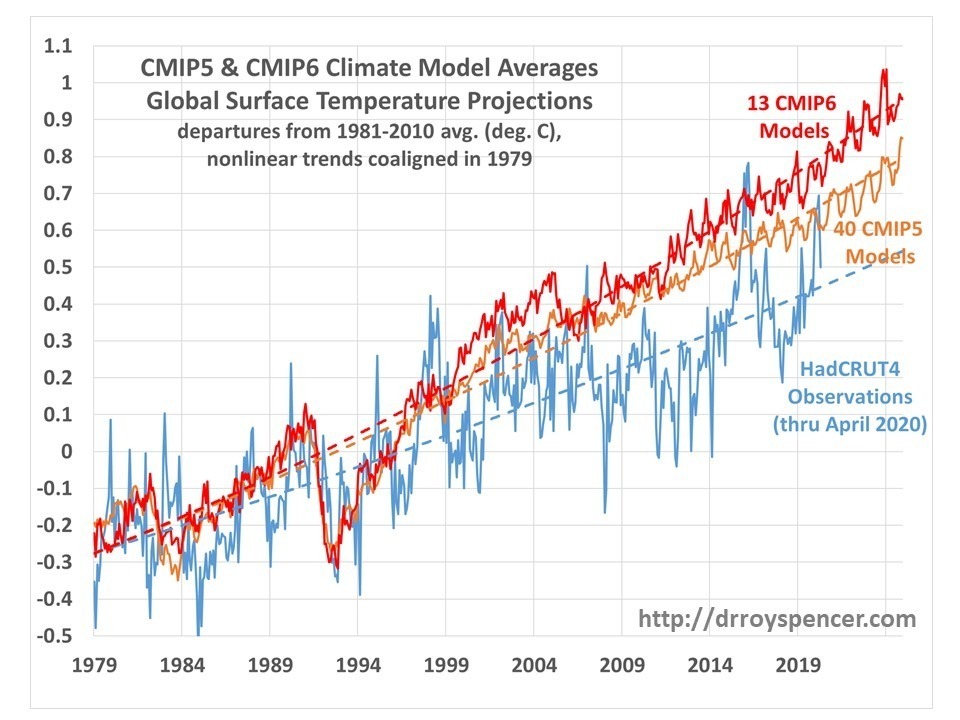
The upcoming IPCC sixth assessment report (AR6), forecast for release in 2021, features forecasts from CMIP6. But the CMIP6 models are turning out to be no better than CMIP5 models. In fact, CMIP6 they’re worse!
Senior climatologist Dr. Roy Spencer has observed that the “CMIP6 models are showing 50 percent more net surface warming from 1979 up to April 2020 (+1.08 degree Celsius) than actual observations from the ground (+0.72 degree Celsius).”
Beyond doubt, comparing both CMIP5 and CMIP6 forecasts to official HadCRUT temperature data sets reveals a very old story: models are always way off the mark, and—suspiciously—always in the same direction, namely, upward, in predicting real-world temperatures.
So, not only were we lied to about the climate, we are going to be misled again by the next IPCC assessment report. And with more extreme false forecasts, there will be calls for more restrictive energy policies.
It is quite astonishing how the unelected politicians at the UN can convince and persuade global leaders to adopt climate policies that are based on unscientific conclusions from faulty models.
The mainstream media have also played their part. Public perception on climate change has been heavily influenced by biased coverage on the climate issue, with no major attention to the huge discrepancies between the model forecasts and real-world observations.
It is not clear how much faultier the projections will become by the time the new assessment report is finally released. But one thing is clear: energy sectors across the globe are being held hostage by pseudo-scientific interpretations from the United Nations’ flagship climate wing.
Vijay Jayaraj (M.Sc., Environmental Science, University of East Anglia, England), is a Research Contributor for the Cornwall Alliance for the Stewardship of Creation living in New Delhi, India.
India fully removed from Iranian railway project: Report
Press TV – July 14, 2020
A report says Iran has dropped India from a key railway project located southeast of the country.
An Indian newspaper says Iran has decided to remove India from a partnership on a key railway project that is being constructed southeast of Iran along the border with Pakistan and Afghanistan.
The Hindu said in a Tuesday report that Iran is now going on with the construction of the Chabahar-Zahedan railway on its own, despite the fact that the project was supposed to benefit from India’s supply of investment and equipment.
The report said recurrent delays by India in bringing in the required investment and the equipment needed to build the rail line finally caused Iran to drop the partnership.
Iran began track-laying for the 610-kilometer railway last week after authorities said they have the finances required to finish the project until the end of the current fiscal year in Iran in March 2021.
Iran has tapped into its sovereign wealth fund to draw more than 300 million euros for the project, according to statements by Iranian officials in the past.
India has been a major contributor to the plans to develop Chabahar, Iran’s sole ocean port on the Sea of Oman and where India seeks to build terminals and port installations to ease its trade access to Afghanistan and other landlocked countries in the Central Asia region.
New Delhi has been hesitant to become actively involved in the Chabahar-Zahedan project mainly because of the threat of the American sanctions.
The report by The Hindu reiterated that India has obtained the required waivers from the US sanctions to contribute to the construction of the rail line.
However, it said that Indian Railways Construction Ltd (IRCON) has failed to find equipment suppliers and partners who are not fearful of being targeted by US sanctions four years after it signed an agreement with Iran to become involved in the project.
India Crafts Fossil Pathway to Secure its Future
By Vijay Jayaraj – GWPF – 13/07/20
India is on the way to become a fossil fuel-based energy powerhouse of the 21st century.
India’s developmental goals for the future are quite ambitious. They ought to be: From tackling the surging poverty rates to providing affordable utilities, the country faces a steep challenge. The key to achieving any of its developmental goals is a strong energy sector. India is the third largest energy consuming nation and is following the fossil fuel pathway (like the West did during the 20th century) to achieve energy independence in the near future.
Relationship to Paris Agreement
The transformation of the energy sector in 21st century India is a remarkable story and it can be singularly credited to fossil fuels, especially coal and oil. The predominantly fossil-based energy sector has grown by leaps and bounds in recent decades. But ever since the country’s membership in the Paris agreement, and its decision to pursue billions of dollars’ worth Renewable projects (like the Asia’s largest Solar Plant that was inaugurated this week), there were doubts and uncertainty surrounding how the country would move ahead with its fossil fuel sector. Green crusaders believed that India’s inclusion in the agreement and their proclivity to large renewable projects would make them a major player in the global effort to offset fossil fuel dependency.
However, that has not been the case. Anti-fossil fuel lobbyists and international bodies like the UN have had zero success in limiting India’s coal use. This is because the country’s “Nationally Determined Contribution (NDC)”—a set of promises that were pledged as a part of Paris agreement—clearly states that the country has sovereign rights to excavate, import, export, and use fossil fuels, and that it will not be determined by non-binding treaties made with UN or other developed countries.
No Holds Barred
India’s recent approach towards fossil utilization can be summed up in three words, “No Holds Barred”. The country has been unapologetic in its pursuit of fossil fuels, especially coal. This attitude was more evident than ever during the recent global COVID-19 lockdown. Despite staring at a big slump in GDP for the foreseeable future, the government allocated a significant sum of its COVID-19 stimulus package to enhancing coal productivity in the country. In May 2020, the country’s Finance Minister Mrs. Nirmala Seetharaman announced a massive stimulus package for coal infrastructure. The Rupees 500 Billion plan (USD 6.7 billion) was directed at improving evacuation of the mined coal at India’s coal mining blocks.
The country’s Prime Minister Narendra Modi has been unequivocal in his support for coal and oil. In the recent move to enhance coal production and make the sector more competitive, the government decided to auction 41 coal mining blocks to private miners. During the inauguration of the auction process, PM Modi commented, “Allowing private sector in commercial coal mining is unlocking resources of a nation with the world’s fourth-largest reserves.”
India’s Coal Minister Pralhad Joshi said that these measures are unprecedented and will give a boost to the country’s coal sector: “Allowing commercial mining in the coal sector, the Govt has completely opened it up for investments. Several restrictions have also been removed, promoting free trade of coal. These are some of the biggest-ever reforms in the coal sector to boost Ease of Doing Business.” As of July 5, 2020, there were 1140 bidders, including 60 international companies. The mines are expected to make up 15% (225 Million Tonnes) of the country’s total coal production in 2025 and generate 280,000 jobs.
Last year alone, India imported 235 million tonnes of coal to meet demand-supply gap, costing the country USD 23 billion. Despite the COVID-19 lockdown and the subsequent drop in energy demand, Coal India Limited’s production dropped just by 11% in April and May 2020. GlobalData has predicted that India’s increased coal production in 2020 (forecasted to be 8.3% higher than previous year) will offset the slight global pause in coal production due to the lockdown, resulting in an overall global coal production of 8.1 billion tonnes by the end of this year. In order to meet the growing demand, India has set a target to produce 1 billion tonnes of coal by 2023-24.
Oil and Gas
The import and production of oil and natural gas have skyrocketed too. Gas accounts for 6% of the total energy demand in India and will more than double in the coming decade. To meet growing demand, India has increased its oil and gas imports from the U.S. significantly and also announced a string of measures to increase production. . Last week, India announced that it will pump USD 140 Billion of new direct investments in gas over the next eight years. Gas production is predicted to reach 90 billion cubic metres in 2040.
The ministry of petroleum and gas has reported that 859 oil and gas related domestic projects, valued at approximately Rupees 3.57 Trillion (USD 48 Billion), are currently being pursued to improve the oil and gas accessibility in the country. The Minister of Petroleum & Natural Gas Dharmendra Pradhan said that, “India plans to almost double its oil refining capacity to 450-500 million tonnes in the next 10 years to meet the rising domestic fuel demand as well as cater to the export market.” The current refining capacity stands around 250 million tonnes and exceeds the domestic fuel demands.
Beyond Imports
Besides increasing imports, the country has also earned global recognition as a fossil fuel destination. Despite sacking employees from the COVID-19 fallout, the European Oil and Gas giant British Petroleum (BP) is set to hire 2000 workers for its upcoming new global business service center in India. Earlier this year, Royal Dutch Shell’s Indian arm entered into partnership with an Indian firm to provide door-step delivery of Natural gas to customers who do not have access. Saudi Aramco, the oil company with the highest revenue in the world, has entered into a USD 60 Billion deal with India to build an oil refinery. The refinery will be based in the coastal state of Maharashtra and will produce 1.2 million barrels per day.
India, like its neighbour China, is aware that energy independence and rapid poverty alleviation can happen only with the complete utilization of fossil fuels available in the country. In order to rescue its dependency on imports, India is also opening up more coal mines, oil refineries and hydrocarbon wells. With a strong fiscal support from its government and continued investments from major fossil fuel enterprises, India is truly on the way to become a fossil fuel-based energy powerhouse of the 21st century.
India to buy Venezuela oil under swap deal amid US sanctions
Press TV – July 10, 2020
India has decided to receive a cargo of Venezuelan crude under a swap deal in the face of a US sanctions regime which has put the Latin American country in throes of a fuel crisis.
Mumbai-based Reliance Industries Limited (RIL) announced its plan to load its first cargo of Venezuelan crude after a three-month recess due to lower demands.
The Indian multinational conglomerate company is scheduled this week to receive a 1.9-million barrel cargo of crude at Venezuela’s main oil port of Jose, a Reuters report said.
Reliance said in exchange for the Venezuelan crude oil, it will deliver diesel fuel to the Venezuelan state-owned oil and natural gas company, PDVSA.
The Indian firm has previously stated that a fuel-for-crude swap deal with PDVSA will continue despite crippling economic sanctions imposed in 2019 by the United States on Caracas in an effort to drive down oil revenue to the government of President Nicolas Maduro.
Washington has imposed several rounds of paralyzing economic sanctions against the oil-rich South American country, aiming to oust Maduro and replace him with US-backed opposition leader Juan Guaido.
Maduro has denounced the US government for its continuous “criminal sanctions” against the suffering Latin American nation amid the deadly coronavirus pandemic.
Caracas, in response, has vowed to take legal action against Washington at the International Criminal Court (ICC) over the sanctions imposed on the nation.
Venezuela has a similar fuel-for-crude swap deal with Italy’s Eni and Spain’s Repsol, who take Venezuelan crude in exchange for diesel supplied as part of debt repayment deals.
Iran has sent five tankers since April to Venezuela, breaching a de facto American blockade. Last month, the United States imposed sanctions on five Iranian ship captains who delivered oil to Venezuela.
US prosecutors have filed a lawsuit to seize the gasoline aboard four tankers that are currently heading to Venezuela, the latest attempt by the Trump administration to increase economic pressure on Caracas.
First COVID-19 Death Reported in Asia’s Largest Slum, Dharavi
teleSUR | April 3, 2020
Asia’s largest slum located in India’s financial capital of Mumbai has reported its first COVID-19 fatality, according to local reports.
The patient, a 56-year-old man, had no travel history and was admitted to a local hospital with a fever on Sunday and tested positive for the new coronavirus on Wednesday, an official of the Brihanmumbai Municipal Corporation (BMC) said, according to Al Jazeera.
The authorities have sealed the building where he lived, which is located in a redeveloped part of the Dharavi slum, local media reported.
Also, seven members of his family were quarantined and tested on Thursday for the virus that causes the COVID-19 disease, the Xinhua news agency said.
Mumbai authorities are concerned over the possible spread of the new coronavirus, as Dharavi is known as the most densely populated slum in Asia. At the same time, a doctor and a worker from a municipal corporation also tested positive.
An estimated 700,000 to 1 million people live crammed in Dharavi – a roughly five-square-kilometer maze of narrow lanes, dilapidated buildings, huts, and open sewers.
Public health experts say it would be difficult to contain the virus if it spread in a slum-like Dharavi where eight to 10 people often share a room.
The population density is about 270,000 per square kilometer, making social distancing almost impossible. Scores of people share water sources and sanitation facilities, Al Jazeera reported.
Dharavi’s cases have raised concern that India may be experiencing community transmission of the disease despite a countrywide lockdown since March 25, as well as exposing the harsh reality and problems of inequality in the country.
For his part, Prime Minister Narendra Modi insisted that “testing, isolation and quarantine” will remain priorities in the coming weeks, ignoring the situation of places like Dharavi, the problems of its population, as well as the needs that have arisen in the public health system in the country.
The death toll due to the COVID-19 in India stands at 62 as of Thursday, according to the latest data, while the number of confirmed cases in the country is around 2,547.
India introduces new Kashmir domicile law, raising fears of demographic manipulation
Press TV – April 2, 2020
India has introduced a new law that would make its citizens eligible to become permanent residents of the Indian-administered Kashmir, raising fears of demographic change in the Muslim-majority, Himalayan region.
The new law, which was announced by the Indian Ministry of Home Affairs on Wednesday and which reportedly is not subject to parliamentary review, will deem any person who has resided in the Indian-controlled Kashmir for a period of 15 years or studied at certain school grades there as “domicile” of the territory.
The new law will also provide domicile status to the children of central government officials who have served in the Indian-controlled Kashmir for a total period of 10 years.
It will also open local jobs to non-residents.
The introduction of the law comes almost eight months after the Indian government stripped the disputed region of its limited autonomy. On August 5 last year, New Delhi revoked Article 370, a constitutional provision that had come into effect in 1949 and had granted special status to Kashmir, allowing it to have its own flag and constitution, among other rights.
In the lead-up to the revocation, India sent thousands of additional troops to the disputed region, imposed a curfew, arrested political leaders, and shut down telecommunication lines.
The new law also comes as the country of 1.3 billion people is under a 21-day lockdown in an attempt to prevent the spread of the new coronavirus, raising speculation that the timing is intentional.
Legalizing settlements?
Residents in the Indian-controlled Kashmir fear that the new law would alter the demographic status of the region, with experts saying it will lead to “demographic flooding.”
“It is a lot to circumvent the law. I think it illustrates clearly that some will not stop from politicking during coronavirus [epidemic],” Siddiq Wahid, a political analyst based in the Indian-controlled Kashmir, said.
“Obviously it is an attempt to change the demographics, not only change but flood it. It will lead to demographic flooding,” Wahid said, according to Al Jazeera.
Sheikh Showkat Hussain, a professor of legal studies based in the region, said the move had already been in the offing.
“The whole purpose of revoking Article 370 was to settle outsiders here and change the demography of the [Jammu and Kashmir] state. Now this provides the modalities and entitles so many categories of Indians whose settlement will be legalized over here.”
India’s ruling Hindu-nationalist Bharatiya Janata Party (BJP) has denied that the new law is an attempt to change the demography of the region.
Kashmir has been split between India and Pakistan since partition in 1947. Both countries claim all of Kashmir and have fought three wars over the territory.
Meanwhile, Muslims elsewhere in India have also been facing abuse and violence.
Covid-19: Modi, Putin to coordinate efforts
By M. K. BHADRAKUMAR | Indian Punchline | March 26, 2020
Soon after Russian President Vladimir Putin’s address to the nation on Wednesday on the government’s coronavirus response and measures to be adopted to deal with the pandemic, Prime Minister Narendra Modi spoke to him on the phone. The Indian and Russian readouts (here and here) have alike highlighted that the two leaders “agreed to strengthen coordination in the coronavirus response effort” (Kremlin).
The two countries are facing similar challenges. Having done very little by way of testing, the actual figures of coronavirus patients could be higher than the official estimate in Russia and India alike.
The total number of infected people as of today touched 840 in Russia, while the Indian figure has reached 660. Importantly, the figures are dramatically rising. There was a 28% jump in Russia since Wednesday.
Putin has admitted candidly that the outbreak is worse than what he had thought previously. The head of a top Moscow hospital treating coronavirus patients told Putin on Tuesday when he visited the patients undergoing treatment that Russia needs to “prepare for the Italian scenario.”
To a degree, the relatively low number of cases so far in both India and Russia can be attributed to an early ban on entry for Chinese citizens at the time the epidemic was at full swing in that country.
But India has been ahead of Russia in denying entry to all foreigners except diplomats and members of official delegations. It was only last week that Russia imposed such restrictions. Again, India shut down international flights earlier than Russia which announced the decision only today.
Both Indian and Russian authorities were inclined to project an upbeat view on the situation, claiming that all measures have been taken to prevent a bigger outbreak. But both have acknowledged lately that there is indeed a crisis looming ahead.
On Tuesday, Moscow Mayor Sergei Sobyanin, who leads a task force on dealing with the virus, told Putin at a meeting in the Kremlin that provincial governors must receive orders to move more quickly to ready hospital beds for the gravely ill. “Otherwise, the system won’t be able to cope,” he said.
Sobyanin has ordered all Moscow citizens over 65 to stay home starting Thursday. Construction of a new hospital for coronavirus patients that is being built from scratch is going on at breakneck speed in Moscow suburbs.
Basically, Russia suffers from the same disadvantages as India to cope with a big coronavirus crisis — underfunded healthcare system, paucity of hospital beds, shortage of protective gear for medical communities, grossly insufficient network of labs to conduct / analyse coronavirus tests and so on.
But the Russian system is better adapted to handle such crises. Sobyanin signed a decree today “to temporarily suspend … from 28 March to 5 April, the work of restaurants, cafes, canteens, buffets, bars, snack bars and other catering establishments, with the exception of takeaway services without citizens visiting the premises of such enterprises, as well as order delivery.”
Shops, except pharmacies and those selling essential goods, will suspend operation during this weeklong period. Sobyanin was almost apologetic: “The restrictions introduced today are unprecedented in the modern history of Moscow and will create many inconveniences in every person’s daily life. But, believe me, they are absolutely necessary to slow down the spread of the coronavirus infection and reduce the number of cases.”
The big question is whether these measures will suffice or Putin will also opt for a “total lockdown”, as Modi ordered on Tuesday. But then, Russia is a vast country spanning 9 time zones, and the Kremlin can always ramp up measures as cases grow. The regional imbalances are simply mind-boggling — between Moscow and St. Petersburg (European Russia) on the one hand and the Caucasus, Urals, Siberia or the Russian Far East (Asiatic Russia) on the other hand.
Having said that, the crucial difference is that Russia is a developed country in most ways in the social sector, thanks to the Soviet rule, whereas India is a developing country with a much lower level of social formation.
The mammoth population of India puts additional pressure on social sectors of the economy. Again, the structure of the Russian economy is very different. It has nothing comparable, for example, to India’s “informal sector” or “migrant labour” that infinitely add to the complexity of the present crisis.
Russia was all set to join the OECD when the Ukraine crisis erupted in 2014 and the European Union imposed sanctions. In fact, at that point in time, Russia had already signed on to some of the landmark OECD standards.
However, the raison d’être of the two countries’ desire to “to strengthen coordination in the coronavirus response effort” lies in their capacity to show a third way in addressing the present crisis.
Neither Russia nor India has followed China’s Wuhan model of “suppressing” the coronavirus and moving on to resuscitate the economy.
On the other hand, their humanistic traditions also do not allow the pitiless approach that US President Donald Trump espouses.
Both Russia and India stress “social distancing” as the key. PM Modi used a powerful metaphor from Ramayana which every Indian would understand, to drive home that one’s home is one’s ultimate citadel in these extraordinary times. Putin meant much the same thing when he said, “Don’t think: ‘This can’t happen to me.’ It can happen to anyone. The most important thing is to stay home.”
Putin announced paid leave for all Russians next week due to COVID-19. He announced, amongst other relief measures for the economy, that families eligible for maternity capital will receive an extra 5,000 rubles ($44.80) per month from the government for each child under 3 years old.
Small and midsized businesses will receive a six-month tax deferral. And those who lose their jobs or take sick leave will receive payments at minimum wage until the end of the year. The allowance for the unemployed has been raised by 50 percent and brought on par with the prescribed minimum wage.
Today, the Modi government also announced a massive $22 billion package of cash transfer and food security exclusively targeting the poor.
Both Russian and Indian leaderships are acutely conscious of grim economic warnings for their countries. Both economies could shrink significantly in a worst case scenario. Nonetheless, both Putin and Modi have chosen to concentrate on socially sensitive clusters — pensioners and families with children in Russia, the teeming hundreds of millions of poor people in India.
One may say they stay true to their history as “populist” leaders. But this time around, it is far from an opprobrium.
Amid COVID-19, India Buys $116M Worth Of Weapons to Israel
teleSUR | March 25, 2020
Indian Prime Minister Narendra Modi signed Thursday an arms deal with Israel worth hundreds of millions of dollars, as cases of the coronavirus infections are surging and concerns are rising over the country’s ability to face a health emergency of such magnitude.
Israel will deliver to the Indian military 16,479 Negev light machine guns, the Indian government said in a statement.
The US$116 million contract was signed as doctors and health professionals in India continue to sound alarms about the shortage of masks and protective gear, pointing out the country’s ill preparation to deal with the crisis.
The weapons contract is part of a series of arms agreements between India and Israel under Modi and Israeli Prime Minister Benjamin Netanyahu.
“The provisioning of this operationally urgent and very critically needed weapon will boost the confidence of the frontline troops and provide much-needed combat power to the Armed Forces,” India’s defense ministry said.
There have been around 536 confirmed cases of COVID-19 in India with 10 deaths reported. But like several other countries, it has barely done any tests and is now going through a spike in infections.
India’s “total lockdown” began at midnight Tuesday and will continue for 21 days.
At a time of crisis with a fatal pandemic spreading like wildfire and concerns rising over the consequences it is likely to have on economies around the world, the decision to give priority to military spending has sparked indignation among critics.
A retired professor of International Relations and Global Politics at the University of Delhi, Achin Vanaik, described the move as “extraordinary and highly condemnable, especially as it becomes clear that authorities are well aware that official stats are a gross underestimation at this point.”
“India needs every rupee to deal with the very real danger of the coronavirus pandemic spreading in a country of 1.3 billion people – living in densely populated cities and towns. As it is, compared to Europe, North America or even China and other countries in Asia, the medical system here is woefully under-equipped to deal with this emergency. This diversion of funds is deeply distressing,” Vanaik told the MEE.
Likewise, many critics are denouncing the fact that the far-right government led by Modi’s Bharatiya Janata Party (BJP) chose to spend hundreds of millions on military purchases while it has so far not announced any measure to assist those who are losing their income sources as a result of the epidemic.
“People rendered suddenly jobless are forced to rush back to villages to survive, risking the spread of the virus as they go,” leader of the Communist Party of India Kavita Krishnan told MEE.
“Why is the government of India choosing to spend massive amounts on military purchases instead of prioritizing a corona relief package, medical infrastructure, free healthcare and testing for all right now?” Krishnan asked.
Crippling lockdown on Kashmir surpasses 200 days
By Javed Rana – Press TV – February 21, 2020
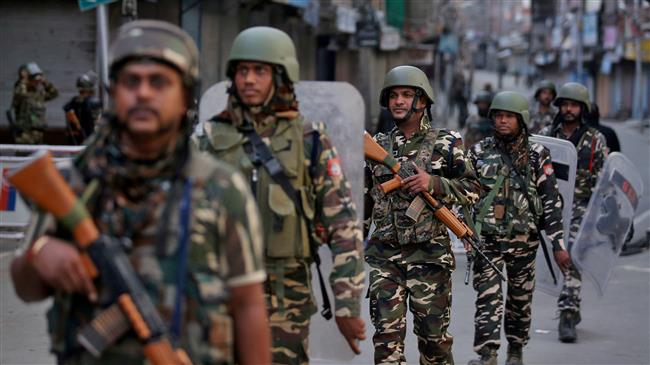
The crippling security and communications lockdown in the Muslim-majority Indian disputed Kashmir region has entered its 200 days. Nearly 900,000 military and paramilitary troops are deployed to prevent mass agitation since August 5 last year when New Delhi revoked Kashmir’s special status and forcibly annexed it into India.
The controversial merger of the disputed territory was in defiance of eleven UN Security Council resolutions which call for a plebiscite to allow Kashmiris to decide on whether they want to stay with India or join Pakistan.
Since then, the top Kashmiri leaders including three former chief ministers have been imprisoned. In their absence, the second tier leaders held press conference in Islamabad to inform the world of what India seeks to hide.
India has banned the entry of independent journalists, human rights activists, observers and even many western politicians from entering into disputed Kashmir region.
Kashmiri leaders believe that the Indian government has been deliberately crippling the economy to create adverse conditions for Kashmiris to force them to sell their properties to Hindu businessmen. This, they say, is aimed at altering the demography of the Muslim-majority state.
US oil sanctions on Iran force India to look to Russia
By Shishir Upadhyaya | RT | February 9, 2020
Escalating US pressure on Iran, including sanctions targeting Iranian oil exports, may have had an unexpected consequence – pushing India to diversify its energy supplies by shifting from Tehran to Moscow as a major oil supplier.
State-owned oil refiner Indian Oil Corporation (IOC) has just signed a contract with Russia’s Rosneft for the supply of up to 2 million tons of oil by the end of 2020. The meeting took place on the sidelines of India’s largest weapons fair, DefExpo, currently going on in Lucknow.
“This is just the beginning,” Indian Oil Minister Dharmendra Pradhan told reporters after meeting with Rosneft chairman Igor Sechin in New Delhi on Wednesday.
The contract could be a precursor to an emerging energy security partnership between India and Russia, with more deals to come. India is the world’s third-biggest oil consumer and importer, shipping in more than 80 percent of its crude needs.
Security turmoil in the Middle East impacts energy trade
Iran was the third largest exporter of oil to India in 2018, right behind Iraq and Saudi Arabia. Between sanctions and spillover violence, the escalating tensions between Washington and Tehran have endangered all three of those sources.
US sanctions against Iran are intended to cripple Tehran’s economy and force it to give up any nuclear ambitions, ballistic missile development, and support for militants in Syria, Yemen, Lebanon, and elsewhere.
The conflict has spilled over to neighboring countries, however. The largest Saudi oil complex was hit by a drone strike in September. Yemen’s Houthis claimed responsibility, while the US blamed Iran. Meanwhile, Iraq has been dealing with shipping interruptions due to ongoing protests over economic conditions, which only got worse following the January 3 US drone strike in Baghdad that killed Iranian General Qassem Soleimani. Iranian retaliation by launching missiles against two US bases in Iraq appears to have driven India to take its oil business elsewhere.
Seeking diversification
India has already been seeking other sources for its energy needs away from the Middle East, in a bid to hedge geopolitical risks. Oil imports from the region shrank from 65 percent of India’s total in 2018 to 60 percent in 2019.
Another driver of this policy is the Indian government’s commitment to increase the use of cleaner fuels such as liquefied natural gas (LNG) from six percent to 15 percent by 2030. As a result of security developments in the Gulf since January, India’s energy cooperation with Russia has now acquired a sense of urgency never seen before.
IOC’s historical reliance on Middle Eastern sources has been partly due to their proximity and the resulting difference in shipping costs. Most ports in the Persian Gulf lie within 2,500 kilometers of India, while Russian ports are located over 7,500 kilometers away. For that reason, Indian state refiners have previously preferred to buy Russian oil via the spot market rather than under contract.
Pivot to Russia
The IOC-Rosneft contract is just the latest development in what appears to be India’s energy pivot to Russia. Following Prime Minister Narendra Modi’s visit to Vladivostok in September 2019, Indian companies signed several long-term energy deals with Russian partners. India’s GAIL gas company inked a 20-year LNG contract with Gazprom, while Coal India made arrangements to buy coal from Russia’s FEMC mining company.
“We have had a major breakthrough in the energy sector,” Foreign Secretary Vijay Gokhale said at the time. “This is a sector where we are looking to diversify our sources of supplies and we are increasingly finding it attractive to buy oil and gas from the Russian Federation.”
India’s strategic relationship with Russia can be traced back to the Soviet era, but the relationship between Moscow and New Delhi has evolved in recent years to encompass energy, defense, nuclear cooperation, and space. Russia and India are also committed to expanding bilateral trade, hoping to reach the mark of $30 billion in annual exchange by 2025, up from the current $11 billion.
On the whole, the actions of the Trump government in Iran and their wider impact on the Persian Gulf have elevated the Indo-Russia relationship, something that Washington may not have had in mind.
Shishir Upadhyaya is an internationally acknowledged defence and strategic affairs expert, former Indian naval intelligence officer and author of “India’s Maritime Strategy: Balancing Regional Ambitions and China.” Follow him on Twitter @Shishir6
Featured Video

Iran spent $1 million to wipe out $30 billion in data center plans, and take down Amazon in the ME
or go to
Aletho News Archives – Video-Images
From the Archives
A short history of British torture
ICC | December 2005
When the House of Commons was debating how much to increase the time limit for detention without trial the question of torture came up. Officially this was limited to the nice considerations of whether it was all right to send people to places where torture is used and whether Britain can use information collected by the use of torture in other countries. This discussion gave an impression of democratic Britain as the home of civilised behaviour where the very idea of torture is repugnant to our legislators – unlike, say, the US with its secret CIA jails… In reality, the British state has a long history of using and developing a whole range of torture techniques. … continue
Blog Roll
 Aletho News
- Iran spent $1 million to wipe out $30 billion in data center plans, and take down Amazon in the ME
- Zionist billionaire pressure to silence Macklemore sparks exodus from Ed Sheeran tour
- House Votes to End Iran War for Third Time
- North Korea Slams US Plan for ‘AUKUS 2.0’ with South Korea and Japan
- Prolonging US-Iran Conflict Not Meeting Interests of Int’l Community – China’s Wang Yi
- EU bans former Zelensky aide from parliament
- NATO-backed Kosovo separatist ‘responsible for war crimes’
- US destroying international space law
- SCO Calls for Binding Global Deal to Prevent Arms Race in Space
- Iran & Its Allies Are Threatening Every Route for Saudi Oil
- If Americans Knew
- U.S. Makes, Israel Takes: The Real Story of U.S.-Israeli Military Cooperation
- Night raids rise in Palestine
- Tucker Carlson interviews Norman Finkelstein about Gaza
- Groups urge Americans to support Van Hollen legislation on Israel’s killing of Americans & Palestinians
- Trump administration plans to send 40,000 tons of bombs to Israel: report
- Sanctions Target Iran’s Government, But Kill Hospitalized 23-Year-Old Woman
- An alternative view on the book “Israel’s Lobby: America in the Grip of a Foreign Power”
- Ed Sheeran’s band Beoga, other opening acts quit tour after Macklemore was dropped over his pro-Palestinian comments
- The assassination attempt on President Trump in Butler and the various Israeli connections to it
- “We Want That the Whole Land Be Jewish”
- No Tricks Zone
- Economic Masterminds: German Socialists Suggest Taxing Productivity Gains Stemming From Using AI
- The South China Sea Has Not Been Cooperating With The Climate Change Narrative
- Energy Crisis: Germany Enters Heating Season With Historically Low Gas Reserve Fill Levels
- New Study: The Antarctic Ice Sheet Gained Mass From 2020-2024 Due To Staggering Snow And Ice Accumulation
- Study: Ocean Heating Rates From Thousands Of Years Ago ‘Dwarf’ Modern Ocean Heating Rates
- Climate Extremists Target, Attack Large-Scale Power Grid Infrastructure In Germany!
- New Study: Antarctic Ice Melt Has Contributed Less Than 1 Centimeter To Sea Level Rise In The Last 30 Years
- Fear Of Debate: Alarmist German Climate Scientist Calls On Mainstream Media To Discredit Skeptic Voices
- End-Of-August Arctic Sea Ice Extent Hasn’t Fallen In 20 Years, Official Data Show!
- News-Making Nepal Region Has Had As-Warm Or Warmer Periods Than The 2000s In The 1600s, 1700s, 1800s
 Aletho News