India sequesters Iran ties from US predatory strike
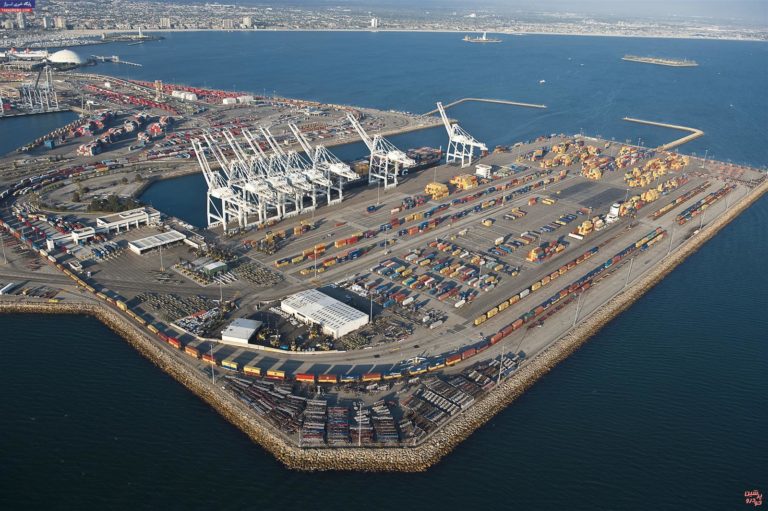
(Iran’s Chabahar Port)
By M. K. BHADRAKUMAR | Indian Punchline | January 2, 2019
India has done well to put in place the nuts and bolts of a payment mechanism for its trade and investment transactions with Iran against the backdrop of the US withdrawal from the Iran nuclear deal (known as the Joint Comprehensive Plan of Action) in May last year followed by the imposition of sanctions against Iran. The US had threatened to bring Iran’s oil trade to zero by the end of 2018 but ultimately pragmatism prevailed and major importing countries such as India were given 6-month ‘waivers’ in November.
Delhi has utilised this interregnum to sequester India-Iran economic relations as far as possible from the vagaries of the Trump administration’s Iran policies. How far Delhi sensitized Washington in advance about its Iran strategy we may never know, but the overall approach suggests a quiet determination to safeguard Indian economic (and political) interests from suffering collateral damage without, at the same time, displaying any strategic defiance of the US in the foreign-policy domain. The Indian diplomacy has been successful here so far.
Broadly, the Indian government has revisited the strategy adopted by the UPA leadership in similar circumstances of US sanctions against Iran and in the light of past experience, finessed a payment mechanism that dispenses with the use of American dollar in India-Iran economic transactions thereby bypasses the cutting edge of the US sanctions. Indeed, the impetus to do so is far more keenly felt today than under the UPA government because India-Iran economic relationship is transforming phenomenally and assuming strategic importance under the Modi government, especially with the operationalization of the Chabahar Port project.
Arguably, the Modi government is showing far greater grit in comparison with the timid attitude by the previous UPA government in asserting India’s strategic autonomy to advance the India-Iran partnership notwithstanding the hostile policies of Washington toward Iran, which are in the nature of forcing a ‘regime change’ in Tehran. Interestingly, the Indian approach is also impervious to the continued Israeli and Saudi intrigues against Iran, although the Modi government has significantly boosted India’s relations with these two Middle East countries.
The Indian policy toward relations with Iran under the deepening shadow of US sanctions has evolved in three carefully measured stages through the month of December. Needless to say, this wouldn’t have been possible without mutual trust and understanding in the relationship characterized by close consultations through diplomatic channels. In the first stage, it came to be known that in early November the two countries signed an agreement to the effect that India will import crude oil from Iran using a rupee-based payment mechanism and that 50 percent of those payments will be used for exporting items by India to Tehran.
Accordingly, India’s government-owned UCO Bank (which has no exposure to the US) was designated to handle this mechanism. In a third stage, in continuation of the above, the Ministry of Finance in Delhi issued an order in end-December exempting the National Iranian Company (NIOC) which exports crude to India from paying a steep ‘withholding tax’ to the Indian authorities. This order issued on December 28 will have retrospective effect from November 5 so that an amount of $1.5 billion that Indian refiners had accumulated as outstanding payments to NIOC could be released. Under Indian laws, the income of a foreign company that is deposited in an Indian bank account is subject to a withholding tax of 40 percent plus other levies, leading to a total take by the authorities of 42.5 percent.
Suffice to say, the door is open, Iran will now be able to use the rupee funds for a range of expenses–including imports from India, the cost of its missions in the country, direct investment in Indian projects, and its financing of Iranian students in India. It can also invest the funds in Indian government debt securities. The tax exemption order, though, only refers to crude oil. That means it does not apply to imports of other commodities, such as fertilizer, liquefied petroleum gas and wax. It appears that the scope of the use of funds will ensure balanced bilateral trade, which is traditionally in Iran’s favour.
On December 31, the two countries announced that their banking transactions mechanism is ready for operation.
Interestingly, India is leapfrogging many other countries that have been talking about similar payment mechanisms with Iran bypassing the US sanctions. The most glaring instance is of the European Union’s much-vaunted proposed mechanism of the Special Purpose Vehicle (SPV), which has not arrived yet. Brussels had vowed to establish the SPV “before the end of the year (2018) as a way to protect and promote legitimate business (of European companies) with Iran,” to quote the EU foreign policy chief Federica Mogherini.
Clearly, Delhi is not waiting to take the cue from other capitals that may harbor grave reservations over the US sanctions against Iran. Equally, Tehran’s willingness to accept for payments the Indian rupee (which is not traded on international markets) bears testimony to its great desire to sustain a beneficial relationship with India notwithstanding the US pressure on Delhi to severely cut back on economic ties with Iran.
All in all, Delhi seems to be preparing for the long haul. The fact of the matter is that politically, it is an increasingly tall order for the present Iranian leadership to continue with its adherence to its share of the 2015 Iran nuclear deal without any infringement or breach in the face of the failure on the part of the European leaders to deliver on their promise that in return Iran will be compensated through steps such as the EU maintaining and deepening economic relations with Iran, the continued sale of Iran’s oil and gas, effective banking transactions with Iran, the further provision of export credit and development of the SPVs in financial banking, insurance and trade areas and so on.
The ground reality is that the European leaders failed to deliver on their promises to Tehran and Iran has been left to fend for itself under the most savage and unlawful economic and political pressure by Washington. Simply put, while Europe claims that the Iran nuclear deal is of strategic importance, it is unwilling or reluctant to invest in its own strategic interests. The Iranian Foreign Minister Mohammad Zarif aptly summed up the European dilemma in a recent remark that you cannot swim without getting wet. Delhi may have shown that where there is a strong political will, there is always a way forward.
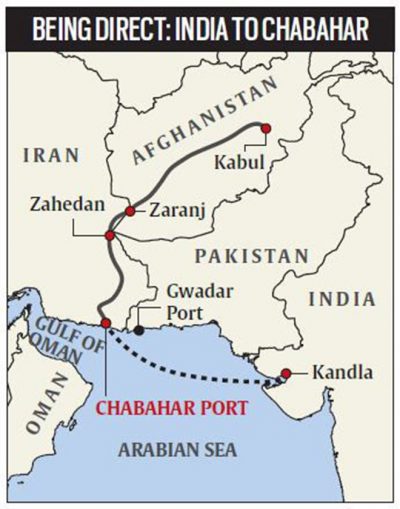
Without doubt, the operationalization of the Chabahar Port a week ago dramatically changes the India-Iran strategic calculus. Where words are not adequate to describe it, a look at the map showing India’s new Silk Road will do. Its geopolitical ramifications are profound. Ironically, Chabahar may eventually bring not only India and Iran but the US as well on the same page. Much lies in the womb of time.
US Blocks $199Mln in Assets Belonging to Iran, Syria, N Korea in 2017 – Treasury
Sputnik – 07.11.2018
WASHINGTON – The United States blocked nearly $200 million in assets belonging to Syria, Iran, and North Korea in 2017 as a result of the sanctions imposed on the three countries, the Treasury Department said in its annual report to Congress released on Wednesday.
“Approximately $199 million in assets relating to the three designated state sponsors of terrorism in 2017 have been identified by OFAC as blocked pursuant to economic sanctions imposed by the United States,” the report said.
The statement comes days after the US fully reinstated sanctions against Iran, including measures that curb Tehran’s oil industry. At the same time, the United States temporarily exempted eight nations — China, Greece, India, Italy, Japan, South Korea, Taiwan and Turkey — from the sanctions on importing oil from Iran.
In May, US President Donald Trump announced that the United States would withdraw from the Iran nuclear agreement, officially known as the Joint Comprehensive Plan of Action, and reimpose sanctions against Tehran that were previously lifted under the accord, including secondary restrictions.
The first round of the US sanctions was reimposed in August, while the second round, targeting over 700 Iranian individuals, entities, banks, aircraft and vessels, came into force this week.
India should stay the course on Iran oil
By M. K. BHADRAKUMAR | Indian Punchline | November 5, 2018
The new kids on the block are unaware that not a year had passed since the Islamic Revolution in Iran 40 years ago when US sanctions against that country wasn’t a fact of life. Iran has weathered multiple rounds of sanctions before.
As a BBC commentary put it, “Iranians will be forced into finding creative ways to sell oil, relying on their years of experience of life under previous sanctions. And to fill the gap left by lost European investment, Iran will be looking east to forge new links with Russia and China.”
This is also the signal one gets from the Iranian reaction to the Trump administration’s re-imposition of sanctions. At the most authoritative level, Supreme Leader Ali Khamenei has been plainly dismissive. Some excerpts from his remarks on Saturday:
“The enemy made every attempts against us, with a variety of actions; the US engaged in military, economic, and media warfare against us. Via all these actions, the US aspired, in vain, to regain its previous domineering status over Iran — that it enjoyed during the Pahlavi Regime.”
“Today, an overview of the situation of the US shows that the US’s power is declining. The US is today much weaker than it was forty years ago… US’s soft power has degraded… US’s hard power — that is, its economic and military power — is also declining… It suffers from more than $15 trillion dollars public debt and $800 billion budget deficit… The US is declining. Everyone should know this.”
Clearly, for Tehran, talks with the US will be simply out of the question.
On the other hand, there are no knee-jerk reactions, either – such as that Iran is going to dump the 2015 nuclear deal. As the Iranian ambassador to the UK Hamid Baeidinejad (who was a leading member of Iran’s negotiating team with the US during 2013-2015) put it, “The aspiration that we have with the European Union, Britain, France and Germany, China and Russia, is that we keep the Iran Nuclear Deal alive and give time to the U.S. to rethink and revise its position.”
Baeidinejad added, Tehran will not accept any idea of changing or renegotiating the nuclear deal, because if one word is changed other aspects of the deal will either be changed or compromised. “We have a total loss of confidence” in negotiating with the US, but “we are trying very hard with European countries, with China and Russia, to find mechanisms that this deal could (still) be effectively implemented.”
The ambassador said, “There will be pressure against some countries, particularly European countries, and economic and trade institutions from attempting to enter into working with Iran, there will probably be some risks.” However, there is “total determination” by European countries and other world partners to find “practical solutions” so that the deal will be kept alive.
These remarks sum up the Iranian position. Tehran estimates that it has much elbowroom left to force a rethink on the Trump administration.
Curiously, this is also the assessment of some Israeli experts. A commentary in the Jerusalem Post gives the expert opinion that while the US’ oil sanctions will no doubt hurt Iran, “Tehran maintains key support from Asia,” which means that the sanctions are “insufficient to compel Iran to accept a new tougher nuclear deal.” Equally, support for Iran from China, Russia, India and South Korea would be too strong too [sic] sufficiently isolate the Islamic Republic’s economy… the fundamental dynamics protecting Iran from a total collapse if anything are even more solid (today).”
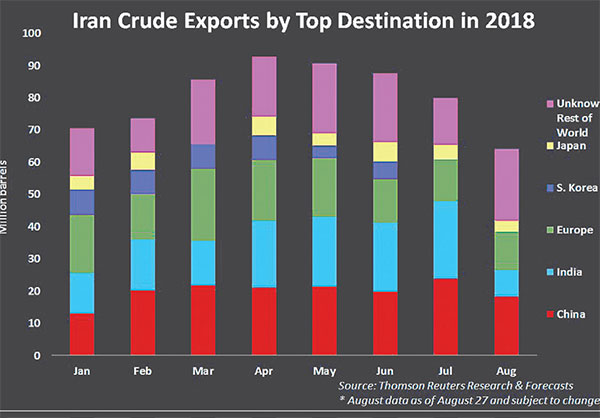
Interestingly, Tehran is not perturbed about the US threat to cut Iran off from the SWIFT. The fact of the matter is that Iran has an alternative to SWIFT – Russia’s SPFS. By the way, SPFS’ clients already include three of the top importers of Iranian oil – China, India and Turkey. (India probably used it recently to make payments for its purchase of the Russian S-400 ABM system!)
Suffice to say, Washington not only needs to accept that SPFS is a viable workaround for countries to import Iranian oil, but also a factor in the long-term implications of the emergence of such a new and parallel monetary system.
Therefore, the Trump administration’s decision to give the ‘waiver’ on import of Iranian oil is understandable. It is only prudent not to jeopardize the US’ relations with countries such as India or Turkey on account of the Iran oil sanctions when these countries are in any case going to find ingenious ways to import Iranian oil.
Then, there are other factors at work. One, as mentioned above, the US realizes that it lacks the ability to bring Iran’s oil exports to anywhere near zero level, as it once boasted. Two, oil sanctions against Iran will impact the world oil prices. Can Trump afford the political cost of oil prices cascading to, say, $100 bpd or more when he gears up for his re-election bid in 2020?
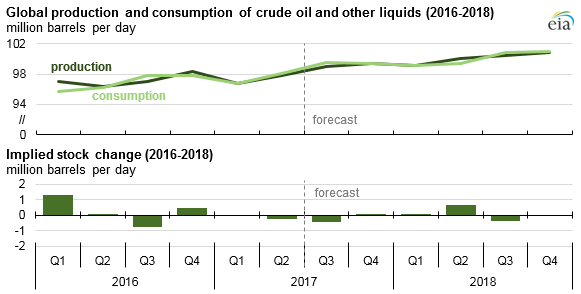
Third, there is great uncertainty about US-Saudi relations in the aftermath of the murder of Jamal Khashoggi. It is turning out to be a high stakes game of rogue operation by intelligence agencies for regime change in Saudi Arabia, which went horribly wrong. The searing experience seriously damages US-Saudi relations. And Saudi Arabia happens to be the only OPEC country that has the means to boost oil production to make up for shortfalls due to US’ oil sanctions against Iran. (Even Saudi surplus capacity is severely restricted.)
The bottom line is that New Delhi must stay the course, no matter what the American lobby in Delhi may say. The point is, the Trump administration is heading toward a cul-de-sac. When this realization dawns on Trump, he’ll, typically, make the course correction. As Ambassador Baeidinejad explained, Iran’s plan is to isolate the US and give it time to rethink. In this wise approach, Iran is getting strong support from the EU and Russia and China. Read the joint statement by the EU + EU-3 foreign ministers here.
India-Russia relations go way beyond defence deals
By M. K. BHADRAKUMAR | Indian Punchline | October 9, 2018
Amidst the welter of commentaries on the Indian-Russian annual summit last week in New Delhi, what stands out is that the government has outstripped our strategic analysts. The latter viewed the Russian summit last week exclusively through the prism of the $6 billion S-400 missile defence deal. Now, that turned out to be like missing the wood for the trees.
The United States’ Countering America’s Adversaries Through Sanctions Act (CAATSA) stipulates secondary sanctions against countries that enter into “significant transactions” with the Russian defence industry. Our S-400 deal became a celebrated test case. So, when in the face of threats held out by the American side relentlessly, when PM Modi went ahead with the S-400 deal, it stunned onlookers.
The ensuing confusion will take time to wither away. It will take time before it sinks in that US bluster aside, there is no way US will sanction India. The CAATSA is a legislation that the US Congress imposed on a reluctant president in the civil war conditions in US politics to stop him from improving relations with Russia (on which there is bipartisan consensus.) True, secondary sanctions have been imposed on China, but US does not intend to export arms to that country anyway!
But that is not the case with India or Turkey. Despite Turkey’s decision to not only fast track its S-400 deal with Russia and to make advance payments to the Russian manufacturer, US still intends to go ahead with its sale of F-35 stealth fighters. Turks nonchalantly told Washington that if the latter wanted to impose sanctions and annul the F-35 business deal, that’s fine with them, and they’d simply source stealth aircraft from some other country (read Russia). But, no, US still wants the F-35 deal to go through, because F-35 is a highly lucrative super business deal for Lockheed Martin, which hopes to sell to Turkey 100-120 aircraft at over $80 million per piece! In effect, Turkey called the American bluff.
Americans have keen business acumen and will not let go a honeypot like the Indian market. In fact, Modi has taken an even tougher decision to go ahead with oil imports from Iran and to sign up contracts for the month of November, although Trump warned that November 4 would be the cutoff date.
Alas, there is a lack of awareness as to what is happening. Our think tankers weaned on American folklore have been programmed to estimate that Russia is a spent force in global politics. They don’t realize that Americans themselves had no doubts already by the start of the millennium that Russia was on the comeback trail. The high oil prices in 2010-2011 proved a game changer for Russia. It was no coincidence that the first American sanctions against Russia was imposed in 2012 – Magnitsky Act – on human rights issues!
The knowledge of Russian politics and the raison d’etre of India-Russia relations is abysmally poor among Indian analysts. Modi’s strategic decision to revive India-Russia relationship as an anchor sheet of foreign policy is yet to sink in. What Americans know and Modi knows but our think tankers do not yet know is that Russia has not only returned to the global stage as a great power but with renewed capabilities in military technology and with an economy that has survived the western sanctions. The high oil prices in the period ahead will only add to Russia’s income significantly.
If the Americans sanction against India’s use of dollars for its transactions with Russia, make no mistake, Indian and Russian ingenuity will find a way to put in place a clearing system that altogether obviates the use of dollar. Arguably, it will be a blessing in disguise if the US forces India and Russia to revive their old Cold War era payment system, because if that happens, the economic content of the relationship will increase exponentially. Will the US want a major global economy like India to jettison the use of dollar and get accustomed to local currency payments?
Again, the US-Russia-China triangle is today splendidly working for Moscow and Beijing to counter the US, while both capitals retain strategic autonomy and neither seeks a military alliance. India can also be a beneficiary here if the available platforms are optimally used – BRICS, RIC and SCO, in particular. Modi made it clear at last week’s summit that India stands with Russia in strengthening multipolarity. It is a clear rejection of the US’ characterization of Russia as a “revisionist power.” Earlier, at the Shangri La Dialogue in Singapore in June, Modi underscored that India does not regard Indo-Pacific to be a strategy. The import of all this should be very clear except if one insists on holding the American brief on Russia and China. Simply put, India has a lot in common with Russia and China in regard of the emerging world order. Modi’s Wuhan initiative and his visit to Sochi soon afterward suggest that he is open to the idea of India’s Eurasian integration.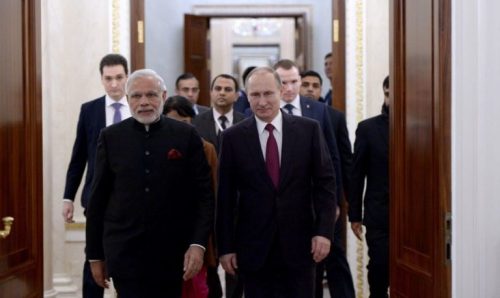
Things are looking up for India-Russia relations after the long winter of the UPA rule. For the first time in the post-Cold war era, there are signs that trade and investment between India and Russia is gaining traction. Energy sector is poised to generate massive business volume in a conceivable future. The defence cooperation still remains appreciable – at 62% of India’s arms procurement – despite the atrophy during the UPA rule.
It is sound realism that in a multipolar world, India strengthens relationships with Russia with whom it has common interests in regard of the emerging world order. The army chief Gen. Bipin Rawat’s remarks in the weekend asserting that the S-400 deal is a manifestation of India’s independent foreign policy must be viewed in that light. Last week’s summit averted a real risk of India ending up in America’s “Indo-Pacific” stable as a domesticated milch cow.
US-Indian Relations: Trump Gets a Unique Partner for America First
By Melkulangara BHADRAKUMAR | Strategic Culture Foundation | 18.09.2018
The inaugural meeting of the foreign and defence ministers of India and the United States in a new “2+2” format on September 6 in New Delhi assumed added significance as an attempt by the Trump administration to translate its Indo-Pacific vision outlined in the National Security Strategy (NSS) of last December.
The NSS had explicitly singled out Russia and China as “revisionist” powers that “challenge American power, influence and interests.” Equally, it ascribed a pivotal role to India in the Indo-Pacific. The “2+2” deliberations fleshed out these two templates.
For the first time in the post-Cold War era, the US has inserted itself into the “time-tested” relationship between India and Russia. Demolition of Indian-Russian partnership has been a hidden agenda of the US’ regional policy since the 1990s but it surged in an overt and abrasive form last week.
This shift from an aspirational approach to intrusive approach can be seen in the backdrop of the deterioration of US-Russia relations and the probability that tensions are unlikely to dissipate in a foreseeable future. The US sanctions against Russian defence sectors have been enacted in the full knowledge that India would be an acutely affected party. The US sanctions laws against Russia are acting like the Damocles’ sword to wear down India’s resistance to rollback in ties with Russia.
A similar US assault on India-Russia energy cooperation can be expected soon, which is another promising area for US exports to India. Besides, the US is also threatening to sanction Russia’s financial sector. Clearly, what the US is seeking goes far beyond a reset or atrophy in the Indian-Russian relationship. It aims at nothing less than draining the contents of the “Special Privileged Strategic Partnership” between India and Russia and make it an empty shell. Yet, partnership with Russia has been historically an anchor sheet of India’s strategic autonomy.
Indeed, it becomes a sad reflection of the huge inroads the US has made through the recent decade since the signing of the 2008 US-Indian nuclear deal to breach India’s strategic autonomy. Put differently, weakening of the India-Russia relations is an imperative need for Washington to hustle India on the path of becoming its key ally in the Indo-Pacific. Such a profound shift in the US approach can only be understood in terms of the strategic importance and the sense of urgency that the NSS attaches to the Indo-Pacific region.
The NSS ranks the Indo-Pacific as a strategically more vital area than the Middle East (which has been the principal domain so far of the US’ strategic attention.) The NSS prioritizes the “Quad” (quadrilateral alliance of the US, Japan, Australia and India) more emphatically than even Washington’s transatlantic leadership as a platform of the US’ global strategies. Washington intends to checkmate China, which the NSS has portrayed as the US’ competitor who poses challenge to its world leadership and the international order.
Washington’s Indo-Pacific strategy appeals to the Indian audience alongside the NSS’ grand designation of India as a “leading global power”. Delhi exulted over the NSS document: “We appreciate the importance given to India-United States relationship… the two responsible democracies…share the same objectives.” To be sure, the Trump administration has rekindled a decade-old Indian dream of being a “counterweight” to China.
An influential section of India’s foreign-policy elite remains wedded to the notion that fundamentally, the US helped China’s rise in the Cold War era and that India is similarly well positioned to garner American benevolence in the emergent New Cold War conditions. The “2+2” highlighted that the US has astutely tapped into the Indian elite’s “unipolar predicament”.
In the recent period since the NSS was announced, the Trump administration has declared India as a “Major Defence Partner”, opening the door for the sale of more advanced and sensitive military technologies by American vendors at par with the US’ closest allies and partners, and fostering convergence of interests with India on a range of issues like maritime security, domain awareness and so on.
Without doubt, this has been a “win-win” strategy for Washington. The signing of a Communications Compatibility and Security Agreement (COMCASA) at the “2+2” testifies to it. The COMCASA is modeled on agreements Washington has with its most important NATO and treaty allies. It is a big leap forward in developing “inter-operability” between the militaries of the US, its allies, and India, which in turn transforms India into a front-line state in the US’ military-strategic offensive against China in the Indo-Pacific. Another such “foundational agreement”, Logistics Exchange Memorandum Agreement (signed in 2016 and operationalized last year), has already opened India’s air bases and naval ports to routine use by US warplanes and battleships for refueling and resupply.
The “2+2” joint statement announced that India and US will stage their first-ever joint exercise involving all three branches of India’s military next year, and that they are setting up “hotlines” between their respective foreign and defence ministries “to help maintain regular high-level communication on emerging developments.” It commits the two countries to increased bilateral, trilateral and quadrilateral military-security cooperation. On the other hand, COMCASA is expected to pave the way for a major boost in Indian purchases of US weaponry, which is likely to begin with India’s procurement of armed naval drones for anti-submarine warfare.
All this works splendidly for the US. In sum, by playing on India’s geopolitical apprehensions regarding China’s rise as a global power and playing astutely on India’s own great-power ambitions, US is promoting on the one hand its business interests in the Indian market while on the other hand also locking India into its Indo-Pacific alliance system against China as well as progressively undermining the India-Russia “time-tested” relationship.
It’s a “win-win” strategy all the way. The Trump White House has drawn encouragement from the “2+2” to push the idea of concluding a free-trade agreement with India. Informal conversations have already begun.
Trump appears bullish that when push comes to shove, the present Indian government will bend to Washington’s diktats. Indeed, the Trump administration can count on influential back channels, too. It is no secret that the upper caste Indian Diaspora in the US has close links with the Hindu nationalist groups that mentor Modi government.
Thus, it comes as no surprise that Trump sees Prime Minister Modi as a unique partner for his “America First” project. Trump will skip the East Asia Summit in Singapore in November but is signaling interest in Modi’s invitation to him to be the guest of honor at India’s National Day celebrations in January.
Trump’s Art of the Deal and Iran sanctions
By M K Bhadrakumar | Indian Punchline | August 4, 2018
An amicable formula seems to be emerging between the Trump administration on the one hand and China and India on the other hand as regards the impending US sanctions on Iran’s oil exports. Below-the-radar consultations are going on between Washington and Beijing and New Delhi.
The Trump administration initially threatened collateral damage to countries such as China and India unless they fell in line with the US diktat to stop all oil imports from Iran to zero by November 4. Oil is at the core of Trump’s containment strategy against Iran, since oil exports are a major source for income for Tehran and the American game plan is all about hurting the Iranian economy until its leadership capitulates and begs him for a meeting.
It’s a hackneyed notion to bully Tehran to make it bend. It never worked in these 40 years – not even under Barack Obama who enjoyed vast political capital in the international community. But the good thing about Trump is that behind the fire and fury, he’s a realist. (By the way, Iranians know it, too, as this utterly fascinating tongue-in-cheek commentary yesterday implies.)
So, after some rounds of diplomacy in world capitals (to test the waters, basically) – Beijing, New Delhi, Ankara, in particular, which are big-time buyers of Iranian oil – Washington began signaling that sanctions can also provide for ‘waivers’ – that is, Trump administration will selectively exercise the great privilege of deciding not to punish countries that may still want to buy Iranian oil after the November 4 cutoff date.
Quite obviously, from the feedback received from American diplomats, Washington senses great reluctance to pay heed to the US demarche. In particular, China and India (which account for over half of Iranian oil exports) are heavily dependent on Iranian oil – and, for good reason too. At least in the case of India, Iran offers oil at a discounted price on deferred payment basis with substantial reduction in freight and insurance costs.
Now, the US cannot possibly sanction the oil industry in China or India because Big Oil is also hoping to do business with them. (For shale oil, Asian market is the preferred destination.) Some analysts predict that Russia, which like America is also an energy superpower, will be a net gainer. Russia can cash in on the needs of China and India for oil; Russia can buy Iranian oil and sell it through swap deals and so on (and make some money in the bargain); or, Russia may even move into the Iranian oil industry in a big way and make investments there. At any rate, it is foolhardy for the US to imagine that it can control the world energy market in terms of price elasticity of supply.
In view of the above factors, the Trump administration is finessing an understanding with China and India whereby the US sanctions policy against Iran does not become an acrimonious issue. The interests to be reconciled are: a) China and India have legitimate interests in sourcing Iranian oil and it is unrealistic and counterproductive to coerce them; and, b) the US too has an abiding interest not to sanction the oil companies of China and India, which are prospective buyers of US oil.
The Bloomberg report, here, says that China has point blank refused to cut Iranian oil imports but may agree to keep imports at the existing level as of November 4. Interestingly, the report cites US officials heaving a sigh of relief: “That would ease concerns that China would work to undermine U.S. efforts to isolate the Islamic Republic by purchasing excess oil.” Plainly put, Washington is relieved that Beijing will not take advantage of the US sanctions against Iran.
On the other hand, the Reuters report on India, here, assesses that Indian imports of Iranian crude oil are dramatically increasing in recent months. A 30% increase is reported in July with crude imports from Iran touching record level of 768,000 barrels per day. (This is a whopping 85% jump over the corresponding period in July 2017, which was 415,000 bpd)!
Of course, if the US can allow China to keep its import of Iranian oil at the existing level as of November 4, it cannot deny a similar formula to India. And, therefore, doesn’t it make eminent sense that India keeps ramping up its oil imports from Iran to the maximum level possible by November 4?
Evidently, this is Trump’s Art of the Deal at work. By the way, for Iran too, this would provide some ‘sanctions relief’. Which in turn may even ‘incentivize’ Tehran to talk to Trump. If there is anything like a workable “win-win” in politics, this is it, this is it.
Why US’ sanctions “bill from hell” on Russia should worry India
By M K Bhadrakumar | Indian Punchline | August 3, 2018
A fortnight after the Helsinki summit on July 16, US-Russia relations are set to take a turn for the worse. In an unprecedented move, White House fielded a joint media briefing by America’s top national security team on Thursday to highlight that Russia is continuing to make pervasive attempts to interfere in the upcoming mid-term elections in the US in November.
One of the top security czars who gave the briefing, National Intelligence Agency director Dan Coats said starkly, “We acknowledge the threat, it is real, it is continuing, and we’re doing everything we can to have a legitimate election. It is pervasive, it is ongoing, with the intent to … drive a wedge and undermine our democratic values.” Importantly, Coats alleged that the Kremlin was involved in the meddling effort which reached into the Kremlin itself.
He said, “Russia has used numerous ways in which they want to influence, through media, social media, through bots, through actors that they hire, through proxies – all of the above, and potentially more. We also know the Russians tried to hack into and steal information from candidates and government officials alike.” (Transcript)
The briefing served three purposes: one, to reject the denials of meddling that Russian President Vladimir Putin maade to President Trump at Helsinki; two, to neutralize the public criticism in the US that Trump has not been unequivocal on the issue; and, three, to give warning to Moscow.
The briefing coincided with a ‘bipartisan’ legislation that was introduced into the US Congress on Thursday to impose stiff new sanctions on Russia and combat cyber crime. The bill includes restrictions on new Russian sovereign debt transactions, energy and oil projects and Russian uranium imports, and new sanctions on Russian political figures and oligarchs. Interestingly, the proposed legislation underscores strong support for the North Atlantic Treaty Organization and expressly forbids the Administration from taking the US out of the alliance without two-thirds of the US Senate voting in favor of any such effort.
The senators who tabled the legislation said in a statement that the proposed new sanctions would target “political figures, oligarchs, and family members and other persons that facilitate illicit and corrupt activities, directly or indirectly, on behalf of Vladimir Putin.” According to some reports, the bill would also require a report to be assembled on the personal net worth and assets of Putin. Quite obviously, Putin himself is in the crosshairs.
Putin’s spirited defence of Trump at their joint press conference in Helsinki on the Russia collusion inquiry has provoked this furious backlash from America’s political class. In such a backdrop, another summit between Trump and Putin in a near future seems highly improbable. A visit by Putin to the White House in the autumn is simply out of the question. The US-Russia ties will remain very tense, too.
On the other hand, in a deceptive show of flexibility that will be keenly noted in New Delhi, US Congress has approved a legislation empowering the president to waive penalties against countries that buy weapons from Russia – provided, of course, Washington is convinced that such countries are seeking closer ties with the US. The US Defence Secretary James Mattis had pleaded with the US Congress for such Russia-sanction-waiver authority that would help countries such as India, which had traditional defence relations with Russia but are now trying to “pull away from the Russian orbit,” (as he put it.)
Evidently, the legislation on waivers is a self-serving move, enabling US arms manufacturers to continue to expand business opportunities in the Indian market. Under the new legislation, the president must nonetheless certify that India is both reducing arms imports from Russia and is expanding defense cooperation with the US, thereby making itself eligible for the waiver from sanctions. In effect, it becomes a tool for Washington to insert itself into the India-Russia defence cooperation as an interested party and to incrementally leverage Indian decisions with a view to atrophy the longstanding cooperation.
Clearly, the US interference in the India-Russia relationship is poised to intensify in the period ahead. If the proposed new sanctions “bill from hell” (tabled on Thursday) gets passed by the US Congress, which is to be expected, energy cooperation between India and Russia will also come under the American scanner. There is a strong business dimension to these US moves insofar as arms exports and energy cooperation also happen to be two thrust areas of export to India. Simply put, Washington hopes to roll back India’s defence and energy cooperation with Russia and seize the resultant business opportunities to boost its own exports to the Indian market.
In strategic terms, the US intention is to undermine the so-called “special privileged strategic partnership” between Russia and India, which would in turn erode the latter’s strategic autonomy and incrementally draw India into the American orbit as an ally.
US Sanctions May Force India Out of Iran’s Chabahar Port With China More Than Able to Fill This Gap
By Adam Garrie | EurasiaFuture | June 27, 2018
Iran’s Chabahar Port on the Gulf of Oman represents the crowning achievement of Indo-Iranian cooperation in recent decades. The port itself represents the centre of the wider North-South Transport Corridor (NSTC) which will link India to Russia and the wider north-western Eurasian space via Iran and Azerbaijan. While under Premier Narendra Modi, India has sought to sell NSTC as an alternative to China’s One Belt–One Road and in particular as rival to the China-Pakistan Economic Corridor which links China to the wider Indian Ocean space via the Arabian Sea port at Gwadar, Iranian officials who themselves are eager participants in One Belt–One Road, have wisely distanced themselves from India’s zero-sum narrative on Chabahar and NSTC more widely.
Likewise, as Iranian relations with Pakistan continue to improve, it also remains clear that Iranian leaders are carefully avoiding being sucked into south Asia’s manifold rivalries by maintaining healthy ties with China, India and increasingly Pakistan simultaneously.
As it stands, Gwadar is a more substantial port vis-a-vis Chabahar in terms of its capacity and the fact that unlike the Indian built port in Iran, the Chinese built Gwadar is a Panamax deep water port. In this sense, both Gwadar and Chabahar could function together on the win-win model which would see some of the supplies shipped from China to Pakistan via Gwadar being routed on to Chabahar depending on their ultimate destination. Here one could see One Belt–One Road and the North South Transport Corridor functioning as integrated rather than as rival logistics networks – something that Pakistani officials recently spoke about with optimism.
Now though, India’s very presence in Chabahar may be impacted negatively as the US moves to sanction countries that conduct business with Iran. The US CAATSA sanctions aimed at Iran are back in the spotlight after the US withdrawal from the JPCOA (aka Iran nuclear deal) caused Washington to threaten many of its longstanding allies against conducting further business with Iran under the threat of so-called second party sanctions. These threats have most notably been aimed at the European Union, in spite of the fact that the bloc remains rhetorically adamant that it will continue to preserve the JCPOA without US involvement.
India has also come under threat of sanctions due to its healthy relationship with the Islamic Republic. The US has stated that it will sanction Indian companies who do business with Iran and this week, the US issued an even more specific threat to its Indian partner, stating that New Delhi will face sanctions if it continues to purchase Iranian oil.
Last month it was reported that international investors in Chabahar were beginning to show signs of nervousness in light of the new sanctions threats from Washington. As India is already facing tariffs on its exports to the United States while simultaneously cutting itself off from a would-be win-win Chinese partnership, India is scarcely in a position to economically leverage the United States which under Donald Trump has taken a merciless approach to conducting trade wars with allies as well as threatening partners with sanctions if they do business with countries including Russia, Iran and the DPRK (although this might soon change in the case of the DPRK).
This could mean that as the primary investor and operator of the Chabahar Port, India could find itself cut off from its own investment under the cloud of sanctions. If it comes to this and India is forced to either partially or even entirely withdraw from the Chabahar project, it would mean that Iran would seek a new international partner for the port.
The only realistic partner to take over Chabahar would be China, a nation with experience in port building and management, a country that has shown itself to be able to transact deals with Iran in spite of the attitude of Washington and a country that because of America’s own dependence on Chinese goods – is largely sanction proof for all practical purposes.
Not only could China help to revive the economic fortunes of Chabahar if India becomes frightened off due to threats from the United States, but China could actually help Chabahar to grow both infrastructurally and commercially by linking it into a uniformed trade route centred on the larger Gwadar port and existing One Belt–One Road lines of connectivity in the region. This would ultimately be a win-win for China, Iran and Pakistan.
If India were to abandon the underlying prejudices behind its zero-sum approach to antagonising both China and Pakistan, India could actually remain active in Chabahar as key player in a wider Sino-Iranian partnership which would necessarily also include Pakistan via CPEC. This could help to not only reduce tensions with India’s largest neighbours, but it could demonstrate that the only way for India to effectively leverage US threats of further tariffs and sanctions is by keeping at least one foot in China’s already open door.
However, given the attitude of the current Indian government, such a win-win model looks increasingly distant however theoretically attractive it might sound when analysed objectively. Because of this, the more likely scenario for Chabahar will be a short-term waiting game where India will see just how far the US is willing to punish its newfound south Asian partner due to its dealings with Iran.
If India’s involvement in Chabahar does come under a US financial attack, it is all but certain that India will minimise its involvement in the flagship project – thus paving the way for China to take over where India left off.
The choice for India therefore is three fold: New Delhi can simply hope for the best while possibly sweetening the deal by making concessions to the US over existing tariffs, India can bow out of Chabahar in order to possibly attain better trading relations with the US in the future or India can work with China to leverage the US over its anti-Iranian position.
At a time when the US is embracing unilateralism in its economic relations with the rest of the world – India must look realistically at its options, even if this means dropping its Sinophobic prejudices.
Featured Video
The Destruction of Libya in 2011
or go to
Aletho News Archives – Video-Images
From the Archives
Kiev intends to kill as many Russians as possible – top Zelensky aide
RT | June 15, 2023
Ukraine currently has only one plan, which is a campaign to kill the maximum number of Russians, Mikhail Podoliak, an advisor to the chief of President Vladimir Zelensky’s office, said on the air during a telemarathon on Thursday.
“There is only one plan: the most brutal advance with the maximum killing of Russians on this route,” he said, noting that Kiev “can’t just stop somewhere and say ‘alright, let’s think and talk about something now.’”
“The only possible scenario for Ukraine is to reach its 1991 borders,” he said.
Back in May, Podoliak also proclaimed that his country hates Russia and those who represent it and vowed to “persecute” Russians “always and everywhere.” That followed comments by Kirill Budanov, the head of Ukraine’s military intelligence agency, who boasted that his agents had murdered Russian public figures and pledged that Kiev will “keep killing Russians anywhere on the face of this world.”
Earlier this week, Ukraine’s Defense Minister Aleksey Reznikov revealed that Kiev had been instructed by its Western backers in the early days of the conflict to “kill as many Russians” as it could before surrendering. … continue
Blog Roll
Recent Comments
Richard Ong on Israeli forces arrest writer a… Bill Francis on How reporting facts can now la… Gemma on Israel’s diamond industr… Bill Francis on Victoria Moves to Force Online… papasha408 on The Empire of Lies: How the BB… loongtip on US Weighs Port Restrictions on… Bill Francis on Chris Minns Defends NSW “Hate… Sheree Sheree on I was canceled by three newspa… Richard Ong on Czech–Slovak alignment signals… John Edward Kendrick on Colonel Jacques Baud & Nat… eddieb on Villains of Judea: Ronald Laud… rezjiekc on Substack Imposes Digital ID Ch…


 Aletho News
- The Epstein Saga: Chapter 3, Those friends in the Secret Service
- Venezuela under siege: Why US escalation could destabilize an entire region
- Italy arrests Palestinian activist amid crackdown on anti-Israel voices
- US Arms Sales to Taiwan Push Region Toward Conflict – Chinese Embassy
- Anti-Russia States Cannot Join Ukraine Peacekeeping – German Lawmaker
- Zelensky demands more money from Western backers
- HHS/CDC Fund Online Game ‘Bad Vaxx’ to ‘Psychologically Inoculate’ Vaccine Resistance
- NSW Premier Admits New “Security” Bill Restricts Civil Liberties, Promises More “Hate Speech” Laws Ahead
- US Under Secretary of State Slams UK and EU Over Online Speech Regulation, Announces Release of Files on Past Censorship Efforts
- Head of EU Parliament’s biggest faction wants German soldiers in Ukraine
- If Americans Knew
- Netanyahu is coming to town, likely with war on his mind – Not a ceasefire Day 80
- Gaza hit with another winter storm – Not a ceasefire Day 79
- When will Israel’s crimes (and US complicity) end? – Not a ceasefire Day 78
- Christmas in the grip of genocide, occupation – Not a Ceasefire Day 77
- Palestinian Christians offer “Kairos,” an alternative Christmas Day sermon – Not a Ceasefire Day 76
- The Faces of AIPAC: the largest pro-Israel lobbying org in the US
- Gazan Christians mark 3rd Christmas under genocide – Not a Ceasefire Day 75
- Israeli scams children with cancer out of millions fundraised for their treatment, BBC finds
- Casey Kennedy Fired from AG Scientific Amid Zionist Troll Campaign Over Track AIPAC Work
- The Hasmoneans: The Jewish Dynasty That Gave Us Hanukkah Is a Symbol of Murder, Not Heroism and Hope
- No Tricks Zone
- Meteorologist Dr. Ryan Maue Warns “Germany Won’t Make It” If Winter Turns Severe
- Merry Christmas Everybody!
- Two More New Studies Show The Southern Ocean And Antarctica Were Warmer In The 1970s
- Der Spiegel Caught Making Up Reports About Conservative America (Again)
- New Study: 8000 Years Ago Relative Sea Level Was 30 Meters Higher Than Today Across East Antarctica
- The Wind Energy Paradox: “Why More Wind Turbines Don’t Always Mean More Power”
- New Study Reopens Questions About Our Ability To Meaningfully Assess Global Mean Temperature
- Dialing Back The Panic: German Physics Prof Sees No Evidence Of Climate Tipping Points!
- Astrophysicist Dr. Willie Soon Challenges The Climate Consensus … It’s The Sun, Not CO2
- Regional Cooling Since The 1980s Has Driven Glacier Advance In The Karakoram Mountains
 Aletho News