US tries to stop S-400 deal with India
By Frank Sellers | The Duran | June 27, 2018
In much the same manner as the US attempted to kill the S-400 deal with Turkey, they are now setting out to end India’s defense relationship with Russia, especially if they can manage to undermine this SAM deal. The idea is to utilize sanctions to get the job done. If the US can manage to dissuade India from buying their SAM systems from India over fear that they might contravene some sanction issued by Washington, then that’s what they aim to do, while simultaneously offering America’s THAAD system to New Delhi as a replacement.
The Economic Times reports:
NEW DELHI: The United States may try to persuade India to consider its ballistic missile defence options in an attempt to keep it from pressing ahead with the S-400 deal with Russia.
ET has learnt that the US could make ballistic missile defence an agenda point in the upcoming Indo-US 2+2 dialogue on July 6 for which external affairs minister Sushma Swaraj and defence minister Nirmala Sitharaman will be in Washington.
The likely option on the table would be the Terminal High Altitude Area Defense (THAAD) system. It is a sophisticated missile defence system which is believed to be particularly effective against long-range missiles.
The S-400 missile defence system is, however, said to be effective against a larger array of aerial attacks, particularly fighter aircraft such as the F-18s and F-35s.
The latest version of the Russian made S-400 has a longer range but the jury is out on whether it’s more effective than the THAAD against intermediate range and intercontinental ballistic missile systems. ET has gathered that India’s proposed S-400 purchase from Russia has prompted a reassessment within Trump administration on whether India would have gone ahead with the nearly Rs 39,000-crore deal with Russia had the US moved faster with the THAAD offer.
Now, the S-400 deal has become a politically sensitive issue with the US. The US Congress is debating a Bill to allow for sanctions against Russian defence entities which could cover entities in recipient nations as well.
Given India’s strong defence partnership with Russia, the Trump administration, through secretary of defence James Mattis, has pitched for a waiver for countries such as India on the condition that it progressively reduce its military dependency on Russia.
The Congress has still not provided satisfactory relief despite hectic lobbying within Washington. The problem is compounded by the fact that the Countering America’s Adversaries through Sanctions Act (CAATSA) covers the S-400 system in the category of technologically sophisticated equipment which must be specifically targeted for this purpose.
India has argued that its S-400 deal with Russia was in the works before the US started debating the subject. In any event, it will predate the CAATSA if and when it’s written into law.
Besides, people close to the negotiations told ET, it is unreasonable for US to expect India to decouple its defence relationship with Russia, which has been a proven reliable partner through several conflicts.
The US, senior government officials said, must appreciate that unlike many of the other countries which purchase defence equipment from Russia, India does not target Russian armament against American interests and will not do so in future.
India is likely to elaborate on these lines at the inaugural 2+2 dialogue between the foreign and defence ministers of the two countries, while the US might urge India to first exhaust options the American industry can offer.
With the deal to purchase Russia’s S-400 SAM system predating America’s CAATSA sanctions act, the US is short on its options for blocking the deal. But sanctions are still playing a role in complicating its consummation as sanctions against Russia are rendering it somewhat difficult to relay compensation to the Russians for equipment and services rendered, therefore forcing both parties to find a way to deal outside of the dollar and outside of financial systems with exposure to Western markets. This particular moment in time for relations between India and the US is marked by trade tensions, as India finds itself in a position to dodge not just sanctions on its trade partners Russia and Iran, but also Trump’s trade wars, which affect goods sold in the American market, where India is imposing reciprocal tariff measures against the United States.
Lawyers say arrests of activists used to silence dissent
By Saurav Datta | Asia Times | June 8, 2018
A collective of Indian lawyers has condemned the arrest of five prominent human rights activists by Maharashtra state police, calling it an attempt by the government to persecute and silence dissent.
The Indian Association of People’s Lawyers (IAPL), a collective of human rights lawyers, have rubbished claims by the Maharashtra Police that the five allegedly conspired to carry out an assassination attempt and have links with Maoist insurgents.
Dalit-rights activist Sudhir Dhawale, senior lawyer Surendra Gadling, Dalit and tribal rights activists Mahesh Raut, Rona Wilson and Nagpur University professor Shoma Sen were arrested on June 6 from Mumbai, Delhi, Pune and Nagpur.
They have been accused of inciting riots and communal disharmony and have also been booked under various provisions of the stringent Unlawful Activities Prevention Act (UAPA), according to media reports.
Government-led persecution
At a press conference in Delhi on June 7, activist lawyer Sudha Bharadwaj, the Vice-President of the IAPL, along with a host of other lawyers and activists, accused the government and police of arresting the five to shield Sambhaji Bhide and Milind Ekbote, the leaders of a Hindutva outfit.
Bhide and Ekbote stand accused of instigating large-scale attacks on Dalits in Pune’s Bhima-Koregaon and adjoining areas on January 1 and 2 this year.
The IAPL’s press conference was followed by a rally at Jantar Mantar, where people gathered in large numbers to protest against the government and police actions. The five arrested activists were produced before a session court yesterday, which remanded them to police custody till June 14.
Bharadwaj termed their arrests, and especially the invocation of the UAPA, as measures meant to stifle dissent and send out a message that nobody should defend political prisoners or crusade for the rights of the marginalized. She added that Gadling’s arrest was only the latest in a string of incidents, which seems to be becoming a trend – the government persecuting human rights lawyers so there remains no one to defend people.
She gave the examples of Tamil Nadu activist lawyer A Murugan, Orissa’s Upendra Nayak and Chhattisgarh’s Satyendra Chaubey, all of whom have been falsely implicated on charges of aiding and abetting Maoist insurgents. This goes against the United Nations’ Basic Principles on the Role of Lawyers, she said.
Illegal searches and arrests
Bharadwaj said that Bhide and Ekbote’s supporters filed a First Information Report (FIR) at Pune’s Vishrambaug Police Station on Jan. 8 and tried to blame others for the riots they incited. Gadling, Wilson, Sen and Raut’s names were not in the FIR and were added only in April. This was designed to bring in more activists into the police dragnet, she alleged.
According to the police, the five activists were part of a meeting held at Shaniwarwada in Pune on December 31, 2017. Police are yet to find if speeches given at the meeting led to the violence in Koregaon Bhima on Jan. 1 during the 200th year celebration of the Battle of Bhima Koregaon by Dalits – lower caste and untouchables in Hinduism.
Wilson, Raut and Gadling were not even in Pune on the day the Bhima Koregaon program was held, and Sen, although present there, had not delivered a speech, Bharadwaj said.
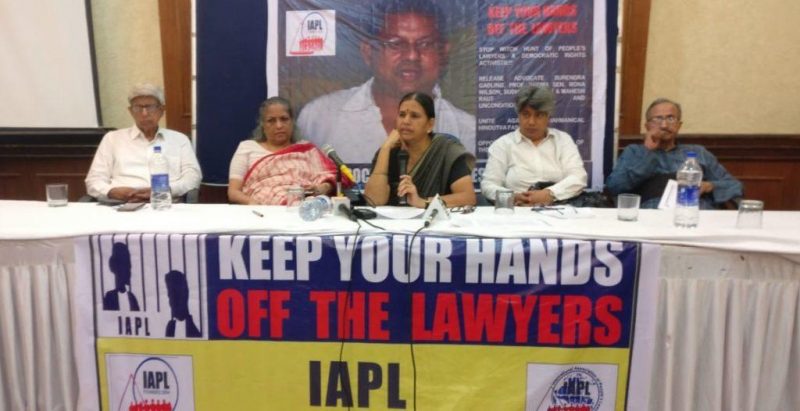
IAPL press conference in New Delhi on June 8, 2018. Photo: Supplied
On April 17, 200 policemen raided and searched Gadling’s house in Nagpur, seizing documents, computers and personal electronic devices from his family. Bharadwaj said this was a clear case of persecution and intimidation, because, he added, for more than 25 years, Gadling defended political prisoners and Dalit and tribal rights activists accused of committing offenses against the state.
She added that a more sinister ploy was to slap charges under the UAPA only on the day of the arrest on June 6 and then not producing Gadling in open court during the day, where he could argue against his arrest. She claimed this was to ensure his prolonged detention in police custody – the UAPA allows an accused to be kept in jail for three months without bail.
Susan Abraham, who represented Gadling and others before the court of Judge Bhaisare in Pune, told Asia Times that Gadling was not produced in court because police claimed it was too dangerous for a high-profile accused. On June 7, the Magistrate was hurriedly called to the court and he sent Gadling to eight days’ police custody. She said Gadling had never met the lawyer who appeared on his behalf and never gave the lawyer permission to represent him.
According to Abraham, the police embarked on this course of action because they knew that if Gadling argued his case himself, being the seasoned litigator that he was, they would be left red-faced and their case would collapse.
Abraham told Asia Times that Senior Advocate Mihir Desai would argue Gadling’s habeas corpus petition against illegal arrest and detention before the Bombay High Court’s Nagpur Bench on Friday.
Alleging guilt by association
Noted criminal lawyer Nitya Ramakrishnan said Gadling and others were being hounded and implicated because they stand up against the state.
She said there was a provision in the now-repealed Terrorism And Disruptive Activities (Prevention) Act under which lawyers who defended political prisoners used to be arrested and jailed. The same is being done now, she claimed – alleging guilt by association.
Speakers at the press conference criticized the media for running a parallel trial of the arrestees and distorting public opinion, as well as trying to influence judicial outcomes in the case.
Not just the Elgin Marbles: Britain’s colonial legacy lives long in UK museums
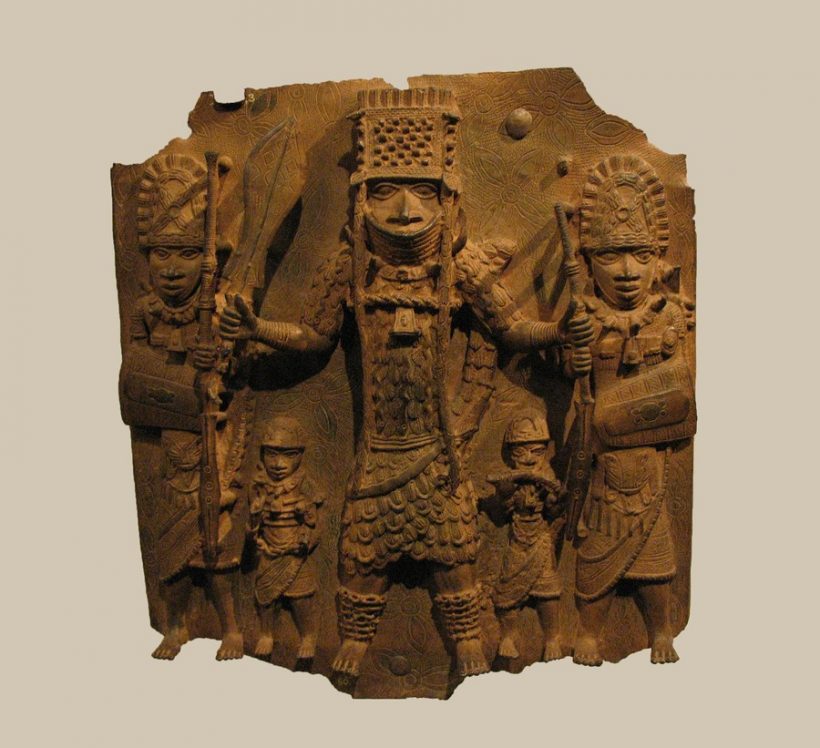
Benin bronzes. © Global Look Press
RT | June 4, 2018
After Jeremy Corbyn promised to return the Elgin Marbles to Greece upon becoming PM on the basis that they were “looted” from the country, RT looks at other rare artifacts taken by colonial Britain that now reside in UK museums.
“As with anything stolen or taken from occupied or colonial possession – including artifacts looted from other countries in the past – we should be engaged in constructive talks with the Greek government about returning the sculptures,” Corbyn said in an interview with a Greek newspaper.
If Corbyn were to become PM, here are some of the other artifacts that might be returned to their country of origin.
Benin artefacts
The British Museum boasts the second-biggest collection of Benin’s art after the Ethnological Museum in Berlin.
The Kingdom of Benin – now part of Nigeria – was stripped of its bronzes during what became known as Britain’s “punitive expedition,” a mission conducted against the natives after they defied imperial rule by imposing customs duties.
BBC Civilizations presenter David Olusoga, originally from Nigeria, said the UK has a “moral imperative” to return the art.
On the Benin looting, he said: “It’s just such a stark case of theft.”
He added during the Hay Festival this year: “A friend of mine, a TV producer, once came up with a brilliant solution: he said we should have a special version of Supermarket Sweep, where every country is given a huge shopping trolley and two minutes in the British Museum. Maybe he’s right, maybe that’s the way forward.”
Ethiopian treasures
Dozens of institutions up and down the country, including the Victoria and Albert Museum in London, are home to hundreds of northeast Africa’s finest treasures.
Beautiful and equally important manuscripts and artifacts were plundered after the British capture of Maqdala in 1868, the mountain capital of what was then Abyssinia under Emperor Tewodros II.
In 2017, Ethiopia lodged a formal restitution complaint. The offer was refused, but ahead of the Maqdala exhibition at the V&A at the beginning of April, its director suggested the case could be settled by granting the treasures to the east-African country on a long-term loan.
Sultanganj Buddha
The Sultaganj Buddha is a metallic sculpture that was extracted from an abandoned Buddhist monastery in northern India in 1861 by E B Harris, a British Raj railway engineer. The 1,500-year-old bronze Buddha was then shipped to Birmingham after being secured for a mere £200 ($265).
The item – the largest known Indian metal sculpture, which is known in the UK as the ‘Birmingham Buddha’ – is at the top of the list of thousands of alleged ‘stolen treasures’ that Indian authorities are trying to get back.
The Koh-i-Noor diamond
The Koh-i-Noor diamond, one of the largest cut in the world, is currently part of the British crown jewels. It has been the subject of a bitter dispute between India and the UK ever since it was taken from the Punjab and presented to Queen Victoria in 1849.
The jewel, which belonged to the Punjab’s Sikh Empire, was handed by the East Indian Company to Queen Victoria after they emerged victorious in the 1840s Anglo-Sikh wars.
The diamond – known as the Mountain of Light – is thought to have been mined in the 1300s.
India has called for the stone to be returned ever since it gained independence in 1947, though the UK claims it has a legal basis for withholding it, as it was guaranteed under the Treaty of Lahore.
Former PM David Cameron commented on the dispute, stating: “If you say yes to one you suddenly find the British Museum would be empty. I think I’m afraid to say, to disappoint all your viewers, it’s going to have to say put.”
Guns vs. butter at Wuhan meeting
By M K Bhadrakumar | Indian Punchline | May 2, 2018
The anxiety syndrome in the American write-ups on the Wuhan summit is truly tragi-comic. An analyst at the Brookings Institution confidently predicted even before the summit between Prime Minister Narendra Modi and Chinese President Xi Jinping that the event was much ado about nothing. The US government-funded Voice of America in an analysis has now arrived at the same conclusion, after the summit. Why are these American analysts in such tearing hurry to debunk the Wuhan meeting?
It’s geopolitics, stupid! The prestigious Stockholm International Peace Research Institute (SIPRI) released a report today which says amongst other things that India’s defence spending rose by 5.5 per cent to US$63.9 billion in 2017, overtaking that of France as one of the world’s top five military spenders. The report estimates that one of the main motivations behind India’s plans to expand, modernise and enhance the operational capability of its armed forces lies in its tense relations with China.
From the US perspective, the situation is ideal to advance the business interests of America’s vendors of weaponry. Last year, business deals worth $15 billion were chalked up. Any improvement in India-China relations will profoundly hurt American interests. Fueling India-China tensions is a major objective of the US’ regional strategy.
Alas, there are Indians too who are eagerly serving the US interests. A prominent Chinese expert on South Asia recently wrote (in the context of the Wuhan meeting), “Many strategic elites in India are financially backed by the West and hence speak for Western countries.” It is a national shame, but true.
Be that as it may, these guys are missing the plot. Prime Minister Modi’s recent decisions to improve India-China relations, adjust India’s neighborhood policies and to rebalance India’s ties with the major powers are linked to his political agenda. Of course, the good part is that this agenda is also in the national interests.
Take India-China relations. The Voice of America is stupid to assume that the Wuhan meeting was about border tensions. No doubt, it is important that peace and tranquility prevails on the border with China. The Doklam standoff was an eye-opener for the political leadership. Hence the “strategic guidance” to the military issued from Wuhan (which is actually an order from the civilian leadership to the generals) to defuse confrontations during patrols in accordance with existing protocols and mechanisms. The military people may not like it, but that’s how a democracy prioritizes butter over guns.
Clearly, Modi’s top priority is about Chinese investments in India. The drivers of the Indian economy in our establishment played a decisive role in bringing about the strategic shift in the thinking toward China – and in preparing for the Wuhan meeting.
The fact of the matter is that China is already positioning itself as among India’s top investors. In 2017, despite Doklam, China tripled its investment to $2 billion. Bilateral trade touched $84.44 billion in 2017, which is an increase of 18.63% over 2016. (By the way, Indian exports to China went up by 40%.) This year, bilateral trade in the first quarter already hit $22.1 billion, up 15.4% year on year. In April, the two countries signed over 100 trade agreements, worth $2.38 billion, when a Chinese trade delegation visited India.
According to a report in Forbes magazine recently, India is courting Chinese companies to bridge its infrastructure deficit. Last year, China’s Sany Heavy Industry planned an investment of $9.8 billion in India, while Pacific Construction, China Fortune Land Development and Dalian Wanda planned investments of more than $5 billion each. Earlier this year, the China-led Asian Infrastructure Investment Bank approved funding of $1 billion for projects in India.
Meanwhile, Chinese investors have been pouring money into sectors outside the remit of government agencies. In 2015, Alibaba invested $500 million in Snapdeal and $700 million in Paytm. In 2016, Tencent invested $150 million in Hike, a messaging app, and a consortium of Chinese investors paid $900 for media.net. In 2017, Alibaba and Tencent announced or closed deals valued close to $2 billion—Alibaba’s second tranche of $177 million in Paytm, $150 million in Zomato, $100 million in FirstCry and $200 million in Big Basket. Tencent’s investments included $400 million in Ola, $700 million in Flipkart and a second round of investment in Practo. Last year, China’s drug giant Fosun Pharma acquired a 74% controlling stake in India’s Gland Pharma for $1.1 billion. Chinese smartphone makers Xiaomi, Huawei and Oppo all are operating manufacturing plants in India, and have had great successes in Indian market, too.
These plain facts may not be significant enough for our ‘China hands’, but they are a compelling reality for the PMO and North Block. Let me quote from the report in the Forbes magazine:
- Seemingly, there’s a shared belief in both countries (India and China) that a position of hostility undermines their interests, and stabilizing relations at a time of global uncertainty will yield economic dividends. India’s competitive edge in information technology, software and medicines, and China’s strengths in manufacturing and infrastructure development make the two sides natural partners…
By the way, it is yet to sink in that the single most far-reaching outcome of the Wuhan meeting could be that India is sidestepping the CPEC controversy and is moving on to join hands with China in the construction of the so-called Five Nations Railway Corridor connecting Xinjiang with Iran. It is a prestigious flagship project of the so-called Silk Road Economic Belt, which was proposed by President Xi Jinping in 2013. Conceivably, this could be the first step in a long journey. China has shown great interest in developing economic corridors to India across Nepal and Myanmar.
To be sure, Modi travelled to Wuhan with the “big picture”. Read a perspective on the Wuhan summit featured in the CNBC entitled China and India are trying to write a new page of the world economy, here.
Modi’s homage to Herzl comes to haunt him
By M K Bhadrakumar | Indian Punchline | April 20, 2018
The Israelis are in a bloody mess. They don’t know how to handle it – Palestinians in their thousands taking a leaf out of Gandhi and protesting non-violently against their colonial masters ignoring their fearsome reputation for brutality. And, to boot, women are at the barricades leading the Great Return March. Bravo!
So far, 37 Palestinians have been killed by the Israeli troops and more than 1,500 injured with live ammunition. Prime Minister Netanyahu’s government has given advance instructions to the army to shoot to kill. Today, the Israeli troopers shot down two more Palestinians. Today’s has been the fourth weekly protest. The escalating showdown with Israel is to culminate in a mass march on May 15.
The marches are pressing for the “right of return” of Palestinian refugees and their descendants to what is now Israel. Hundreds of thousands of Palestinians fled or were evicted from their homes and forced to leave their homeland in the 1948 atrocities by the Jewish extremists to pave the way for Israel’s creation. Palestinians mark May 15 (the anniversary Israel celebrates as its founding day) as their “nakba,” or catastrophe.
Ominously, that is also the date President Trump has chosen to shift the American embassy to Jerusalem. What crass insensitivity! But then, Trump needs Jewish money and Jewish media support in his campaign for re-election in 2020. Son-in-law Jared Kushner who is Trump’s point person on the Middle East also happens to be a Jew – some say, a closet rabbi.
Part of the reason for the protests is the crippling Israeli border blockade on Gaza since 2007. Evidently, the mass marches are also fueled by growing desperation among Gaza’s 2 million residents who are trapped in the tiny coastal territory amidst a gutted economy and deepened poverty. The Gaza residents typically get fewer than five hours of electricity per day, while unemployment has soared above 40 percent.
Despite Israel’s media manipulation to change the narrative and divert attention away from the Palestinian issue toward Iran, there is some uneasiness among American Jews as to where all this is heading and what damage all this is causing to Israel’s future in a medium term scenario. (Of course, America’s “exceptionalism” becomes a macabre joke.)
The White House envoy Jason Greenblatt, a member of President Donald Trump’s Mideast team, has admitted on social media that Palestinians in Gaza have a “right to protest their dire humanitarian circumstances.” He added that organizers “should focus on that message, not stoke the potential for more violence with firebombs and flaming kites, and must keep a safe distance from the border… the cost of these demonstrations is too high in loss of life and injuries.” Greenblatt is a devout and observant Jew himself – although he has opted not to wear a kippa while serving the Trump administration.
Another noted figure, actress Natalie Portman – also a Jewess – who is the recipient of an award, which is dubbed the “Jewish Nobel”, has pulled out of the June awards ceremony in Israel because of “extreme distress” over the brutal violence in that country. The Jerusalem-born Oscar winner intimated the Israeli organizers that she “does not feel comfortable participating in any public events in Israel.”
To my mind, the silence of the Indian government on Israel’s premeditated killings is deafening. How hypocrtical that our current leadership keeps chanting “Vasudhaiva Kutumbakam” (whole-world-is-one-single-family) as its foreign-policy motto! I can only hope that Prime Minister Modi gets to know about all this at some point – and sincerely repents.
Actress Natalie Portman puts him to shame. Indeed, Modi’s visit to the marble tomb of Theodor Herzl, the founder of Zionism, in Jerusalem last July stands out as a dark page in the chronicle of independent India’s current history.
I can understand Modi’s lack of erudition. But what I cannot understand why those fellows in his entourage who would have heard somewhere, sometime, someplace about the ideology of Zionism — and Gandhi’s visceral opposition to it — and didn’t alert their prime minister that he was making an appalling error of judgment. Probably, they chickened out.
Read a stirring dispatch from Gaza Strip by Al Jazeera, here, on Friday’s protests that have been labeled as the “Women’s March of Gaza.”
US expects India to engage Pakistan in Kashmir talks
By M K Bhadrakumar | Indian Punchline | April 4, 2018
The Principal Deputy Assistant Secretary for South and Central Asian Affairs in the US State Department Alice Wells is visiting India on April 3-6. This is strictly not a ‘bilateral event’, but Ambassador Wells’ discussions with senior Indian government officials are expected to cover “regional and global issues”, according to the US state department announcement. Presumably, Afghanistan will be on top of the agenda of discussion.
Ambassador Wells has emerged as the Trump administration’s key interlocutor on the Afghan problem. A career diplomat, low-key but very effective in the absence of turf rivalries, she is able to galvanize the search for a political process in Afghanistan in such a short period of time. Ambassador Wells has succeeded in building up a good rapport with the Pakistani officials who are in a position to make or mar her project. During her extraordinarily open-ended visit (for “several days”) to Pakistan last week, Ambassador Wells was received by army chief General Qamar Javed Bajwa.
Ambassador Wells’ consultations in Delhi come at a sensitive juncture. For, no matter what the Pentagon commanders might like, President Donald Trump wants the war to end before his campaign for a second term begins and Ambassador Wells’ task is cut out for her. Delhi must understand that this is not a routine visit she is undertaking for an exchange of views with think-tankers and officials on the sidelines of the US-India-Japan trilateral taking place today. In fact, the trilateral is the sideshow.
The Taliban is tiptoeing toward the negotiating table and Ambassador Wells’ persuasiveness and diplomatic skill has made all the difference. (For the uninitiated, let me introduce to them her masterly briefing on March 9 at the US Institute of Peace in Washington – Signs of Hope for Afghan Peace Talks.)
The traffic on the diplomatic track has become dense lately since the meeting in the White House in Washington between Pakistan Prime Minister Shahid Khaqan Abbasi and the US Vice-President Mike Pence on March 17. The international conference in Tashkent on March 26-27 has served the purpose of generating a modicum of regional consensus. The Russian daily Kommersant reported quoting “sources” that although no formal invitation was extended to the Taliban to participate in the conference, “at the last minute, they expressed a desire to come to Tashkent.”
Be that as it may, Taliban was surely eavesdropping outside the conference hall and would have noticed from the Tashkent Declaration that there is not a single voice in the international community that disapproves of the Afghan government’s unconditional offer of peace talks. Ambassador Wells proceeded to Kabul after the Tashkent conference and then moved on to Islamabad last Thursday.
Interestingly, Pakistan handed over a “terror dossier” to Kabul last Thursday containing evidence of terrorist sanctuaries on Afghan soil. It is a veritable action plan for the Afghan side and their American mentors as to what Pakistan expected them to do by curbing the terrorist activities from bases within Afghanistan. And, four days later, The Pakistani Foreign Secretary Janjua, accompanied by the Director General Military Operations Maj Gen Shamshad Mirza and other senior officials travelled to Kabul for downstream talks. These talks are expected to prepare the ground for the visit by Prime Minister Abbasi’s visit to the Afghan capital on April 6. (Abbasi is proceeding from Kabul to China on a 3-day visit.)
We may expect Abbasi’s visit to Kabul on Friday to be a watershed event. It is entirely conceivable that in a not-too-distant future the Taliban may announce its formal response to the Afghan government offer for peace talks. The coming days and weeks, therefore, are of critical interest.
Meanwhile, the Afghan government announced on Sunday the dates for the long-delayed parliamentary elections and the first-ever local council elections – October 20. Of course, there is a big question mark about the feasibility of holding elections in Afghanistan in the prevailing circumstances with roughly half the country contested by insurgents.
On the other hand, it is the Taliban’s participation in these elections that can make a world of difference, giving them the legitimacy they badly need and providing the country’s democratic process the traction that it never could really acquire in the past decade or more. The US’ allies are extremely keen that the political legitimacy of the Afghan political system is enhanced. The speech made by the European Union foreign and security policy chief Federica Mogherini at the Tashkent conference was particularly notable for being a stirring call to the Taliban to rise to the momentous occasion in their country’s history.
Suffice to say, any Pakistani-Afghan consensus to put a moratorium on cross-border terrorism will be a major development. The US is actively promoting it. So is China. Pakistan can be expected to reciprocate. But we aren’t quite there, yet.
The Pakistani Foreign Ministry spokesman Mohammad Faisal told Radio Free Europe / Radio Liberty, the US government-funded media organ, that Islamabad and Washington are yet to find “common ground” on a range of issues. Faisal didn’t specify the problem areas, but it stands to reason that a principal one will be Pakistan’s tense relations with India.
Quite obviously, we should anticipate that the Trump administration hopes to bring India on board. Put differently, the Trump administration’s “regional approach” for Afghanistan demands that India-Pakistan tensions do not complicate the path of peace and reconciliation in Afghanistan.
Ambassador Wells is likely to meet with the Foreign Secretary and NSA Ajit Doval while in Delhi. Significantly, on the eve of Ambassador Wells’ departure for India on Monday, the US state department amended its designation of Lashkar-e-Taiba, identifying Milli Muslim League and Tehreek-e-Azadi-e-Kashmir as LeT affiliates, making it impossible for them to register as political parties in Pakistan.
Clearly, the Trump administration hopes that Delhi will appreciate this as friendly gesture, underscoring that Washington is receptive towards India’s genuine concerns in regional security. It doesn’t need much ingenuity to figure out that Ambassador Wells would also have taken Pakistani officials into confidence that capping the political ambitions of Hafeez Saeed can be an important confidence-building measure at this point.
Now comes the big question: How does India respond to the totality of the emergent situation surrounding Afghanistan? Sadly, the explosive violence in Jammu & Kashmir just at this juncture will make things very difficult for Delhi to rise to the occasion and optimally align the Indian foreign policies with the broader trends leading toward peace and reconciliation in Afghanistan.
On the other hand, the bottom line is that India is a stakeholder. Clearly, a leap of faith is needed. The Modi government would chaff at the very idea of holding talks with Pakistan, facilitated by Washington and under close US monitoring, when the 2019 poll is sailing into view.
But in politics and diplomacy, there may be moments when drinking from the chalice of poison is necessary – to borrow the memorable words of Iran’s Spiritual Leader Ayatollah Ruhollah Khomeini in an analogous situation in his country’s contemporary history when he allowed himself to be persuaded to agree to a ceasefire against the Iraqi aggressor who had bled his country white in the 8-year war (1980-1988.)
Given the complete policy breakdown in Jammu & Kashmir, what is the alternative? And, the crisis in J&K is only deepening; the wounds are threatening to turn gangrene.
China gives dressing-down to Maldives’ Nasheed
By M K Bhadrakumar | Indian Punchline | February 18, 2018
The mystery of the Supreme Court judges in Male promoting democracy in their beloved country is deepening. One of the three judges who gave the ruling to destabilize the political situation had unaccounted money to the tune of $220000 in his possession and a second judge in the troika had a big amount of $2.4 million transferred to him by “a private firm.” Evidently, democracy doesn’t come cheap.
We do not know who is spending all that money to promote democracy in the Maldives – at least, not yet. But Maldives is such a small country that nothing remains secret for long. All we know for the present is that “the investigation is not limited to Maldives.” Put differently, there has been the ubiquitous “foreign hand” pushing the regime change agenda in Maldives.
Male has approached unspecified foreign governments for assistance in conducting the enquiry. Hopefully, India is not one of them. It seems India – along with Sri Lanka, Malaysia, the Netherlands and the UK – is one of the countries the two debonair judges involved in the scam had visited in the past one-year period. (Gulf Today )
There is obviously more – much more – to the events in Maldives than meets the eye. The Xinhua news agency carried an extraordinary commentary last Thursday attacking by name the former Maldives President Mohamed Nasheed (who is spearheading the democracy campaign from his locations in Sri Lanka and India) for spreading canards about the Chinese “presence” in Sri Lanka. Nasheed recently told the Hindu newspaper, “Without firing a single shot, China has grabbed more land than what the East India company had, at the height of the colonial era. They have weaponised foreign direct investments.”
Evidently, the Chinese found it an outrageous remark even by Nasheed’s yardstick. Xinhua tore into him. The commentary disclosed, inter alia, that Nasheed himself was once an enthusiastic promoter of Maldives’ relations with China when he was president, and, in fact, the commentary drops a bombshell saying, “However, as a former Maldivian president, who has also experienced the benefits from the fruitful cooperation between the Maldives and China, Nasheed this time chose to turn a blind eye to the fact.”
The Counselor in the Chinese embassy in Male Yang Yin told Xinhua, “Why did Nasheed support this normal economic and trade cooperation during his tenure and now turns to oppose it? Let alone fabricating statistics to tarnish the normal bilateral cooperation between the two countries? These doubts remain in the mind of the Chinese side.”
Hmmm. This Nasheed fellow is turning out to be quite a guy. He always seemed a bit of a maverick. (He once made the immaculate decision on the opening of the Chinese embassy in Male to coincide with the arrival of the then PM Manmohan Singh in the Maldives on official visit in November 2011.) Indeed, it now appears that he has dark secrets that only he and the Chinese could be privy to. But, Yang has asked a good question: Why did Nasheed become a turncoat? Conceivably, some people made an offer to him in recent years that he couldn’t refuse.
To my mind, however, the fascinating thing about the Xinhua commentary is the snippet of information it shared in regard of the scale of the “Chinese presence” in the Maldives. Of course, there have been dark rumors circulating in the Indian press for months on this topic, making it out that the Chinese are building a military base in the Maldives. Well, it seems the plain truth is that the “Chinese presence” in the Maldives actually adds up to seven resort hotels that Chinese companies are constructing on seven islands (out of the country’s total 100 islands) for foreign tourists. To be sure, enterprising Chinese business people see that with the big influx of Chinese tourists into the Maldives, there is good money to be made.
According to Forbes magazine, Maldives figures 7th among the first ten eco-tourist hot spots that Chinese jet setters are choosing. The number of Chinese tourists visiting the Maldives tripled from 1 lakh in 2010 to 3.6 lakhs in 2014, accounting for nearly one-third of the entire tourist traffic to the island, representing the single biggest source market for Maldives. Tourism is the main source of income for Maldives and Male is smart enough to know that China already accounts for more than a fifth of the money spent by outbound tourists worldwide, twice as much as the next-biggest spender, the US (according to the United Nations World Tourism Organization.)
Read the Xinhua commentary here – Spotlight: Former Maldivian president’s statement on China “grabbing land” false, irresponsible.
Indian diplomacy faces tropical summer in Male
By M K Bhadrakumar | Indian Punchline | February 8, 2018
Writing in the Guardian newspaper, J. J. Robinson, the well-known journalist and author of Maldives: Islamic Republic, Tropical Autocracy, reflected as follows:
- Ultimately the ongoing telenovela of Maldivian political intrigue is a distraction from the real crisis – the illegitimacy of the judiciary. Handpicked by Gayoom during his rule and illegally given life tenure under the new constitution in 2010, the judges have been at the centre of most of the Maldives’ recent ills; at least 50% of the 200-odd judges and magistrates have less than seventh-grade education, while a quarter had actual criminal records, including convictions for sexual misconduct, embezzlement, violence and disruption of public harmony.
- Resoundingly discredited by groups such as the International Committee of Jurists and the UN’s special rapporteur on the independence of judges and lawyers, the institution demands wholesale reform, and likely the presence of foreign judges on the bench. However excited the opposition at their recent good fortune, current events are far from a triumph of judicial independence.
The Maldives President Abdulla Yameen hit the nail on the head when he disclosed on Tuesday that the Chief Justice of Supreme Court Abdulla Saeed was bribed to give such a ruling on February 1, by ordering the release of a clutch of politicians viscerally opposed to the regime and reinstating 12 erstwhile lawmakers (which would have made the ruling Progressive Party of Maldives forfeit majority support in the parliament.) Yameen didn’t say who bribed Saeed but he referred to a plot to overthrow him and vowed to get to the bottom of it.
One can only hope that Yameen doesn’t mention India in a fit of rancor. He has an alibi if he wants to put India on the mat, since Chief Justice Abdulla Saeed (who is in police custody) had paid an extended official visit to New Delhi in late October, soon after the visit by former president Mohamed Nasheed to India in end-August. By the way, while in Delhi, Nasheed addressed a panel at Brookings India to present his case for regime change in Maldives, openly soliciting Indian support. Like icing on the cake, subsequently, the US ambassador in Colombo Arun Kashyap (who is accredited to Male) also dropped by for consultations over the situation in Maldives with the then Foreign Secretary S. Jaishankar.
Nasheed himself is based in Colombo. But why would Sri Lankan government encourage Nasheed to overthrow Yameen? To my mind, all this looks like a replay of the botched-up attempt by the CIA to eliminate Turkish President Recep Erdogan in July 2015. The US state department statement on Tuesday, here, betrays a sense of fury and despair that Yameen survived.
India should distance itself from the tragic happenings in Maldives. Importantly, we should nip in the bud any misperceptions arising of being party even remotely to an American plot to overthrow the leadership of a friendly neighboring country. Therefore, we should reach out to Yameen quickly, decisively and demonstrably. After all, he had sent his foreign minister as special envoy to Delhi only recently (soon after Nasheed, Saeed and Kashyap’s visit) in an extraordinary diplomatic gesture to convey to PM Modi that ‘India first’ has been, still is and will forever be the cornerstone of Male’s foreign policy priorities. See the reports on the special envoy’s talks with the Indian leadership on January 11 in New Delhi — here, here and here.)
A hot summer lies ahead for Indian diplomacy since elections are due in the Maldives and Yameen will pull out all the stops to consolidate his position. Delhi’s approach should be ditto what the UPA government took when Sheikh Hasina got re-elected as prime minister in January 2014 in Bangladesh – the boycott of the main opposition party Bangladesh Nationalist Party and the abysmally low voter turnout (22%) notwithstanding. We had rejected Washington’s entreaties to join its campaign to arm-twist Hasina and get a ‘pro-American’ leadership installed in Dhaka.
But the heart of the matter is that times have changed during the past three years. The Indian establishment seemed to think that what was good for Uncle Sam was ditto what India should work for and that all that crap about ‘strategic autonomy’ had become archaic. Basically, bureaucrats had a field day setting their own agenda in the absence of assertive political leadership.
We should never have entertained Kashyap and Brookings India (franchise of a notorious American think tank of Cold War vintage with links to the US intelligence) should never have sponsored activities directed against India’s friendly neighbors. We do not realize that India’s small neighbors take us very seriously and read meanings and motives into our behavior.
O Palestine! Modi is coming
By M K Bhadrakumar | Indian Punchline | January 28, 2018
Frankly, it was hard to believe when some newspapers mentioned a few months ago that PM Modi was planning to travel to Palestine in a near future. No Indian prime minister ever visited Israel or Palestine. A de-hyphenation of India’s Israel relationship and its ties with Palestine has been the stated Indian policy all along, ever since 1991 when India established relations with Israel, hardly three years after recognizing Palestine – one of the first countries to do so – in 1988. But it is mere sophistry.
The fact remains that India carefully calibrated the dynamics of the two tracks. Paradoxically, Modi will be flagging openly for the first time that hyphenation firmly continues to be the Indian policy. Every time Delhi adds a new dimension to relations with Israel, it feels a compulsion to burnish the ties with Palestine. After Modi’s visit to Israel, he is left with no option but to travel to Palestine.
Modi can be very excessive in the diplomatic arena – such as introducing Israeli Prime Minister Benjamin Netanyahu to Gandhi recently in Ahmedabad (“Ghandi”, as Netanyahu spells the famous name.) Perhaps, Modi’s intention was good, because Netanyahu is the very antithesis of Gandhi’s doctrine of non-violence and he hoped that something of the principles of ‘ahimsa’ might rub on the militant Israeli leader. (Gandhi would never have condoned the assassination of foreign adversaries as state policy, no matter the pretext.)
There was no rational explanation to hype up the relationship with Israel, a country with which India has a trade volume of $4 billion (including arms purchases). But Modi went overboard, and a Palestine visit became unavoidable. Would Netanyahu get upset with Modi for visiting Palestine? Why should he? The world leaders routinely visit Palestine – Angela Merkel, Barack Obama, Shinzo Abe, Vladimir Putin and so on. Even Donald Trump dropped by Bethlehem while visiting Israel.
But the real significance of Modi’s visit to Palestine on February 9, which was announced by South Block on Saturday, lies elsewhere. The visit is being scheduled within a few weeks of the Trump administration’s announcement to withhold $65 million out of the $125 million in annual support it gives to the United Nations Relief and Works Agency for Palestine Refugees in the Near East, and to freeze an additional $45 million it had authorized in December for food relief to refugees in Gaza and the West Bank. The stony heart of Netanyahu applauded Trump’s decision. Netanyahu seeks “a new model” for aid disbursement that would entail greater Israeli control over Palestinian funds as a means to arm-twist the Palestine Authority, and he and Trump would seem to be working in tandem.
To the extent that Modi’s visit is a gesture of solidarity at a juncture when Trump brutally threatens to pass a death sentence on Palestine by cutting all aid, Delhi’s move is invested with a lot of political symbolism. Certainly, it will be interesting to see what Modi says while on Palestinian soil. His joint statement with Netanyahu was almost ditto a narrative of the Israeli position on Palestine. It even omitted any reference to a two-state solution. Will Modi make amends?
More importantly, it remains to be seen what Modi has to offer to the Palestinian people to alleviate their suffering. When he could offer $1 billion to the beleaguered Mongolians who are sandwiched between Russia and China, a similar gesture to the Palestinian people will be noted regionally and internationally as a noble gesture.
Of course it will be a far more fitting tribute to Gandhi’s legacy on Modi’s part than escorting Netanyahu to Sabarmati Ashram.
Read a dispatch in the weekend Guardian newspaper on what awaits Modi in Palestine.
Featured Video
The Destruction of Libya in 2011
or go to
Aletho News Archives – Video-Images
From the Archives
Kiev intends to kill as many Russians as possible – top Zelensky aide
RT | June 15, 2023
Ukraine currently has only one plan, which is a campaign to kill the maximum number of Russians, Mikhail Podoliak, an advisor to the chief of President Vladimir Zelensky’s office, said on the air during a telemarathon on Thursday.
“There is only one plan: the most brutal advance with the maximum killing of Russians on this route,” he said, noting that Kiev “can’t just stop somewhere and say ‘alright, let’s think and talk about something now.’”
“The only possible scenario for Ukraine is to reach its 1991 borders,” he said.
Back in May, Podoliak also proclaimed that his country hates Russia and those who represent it and vowed to “persecute” Russians “always and everywhere.” That followed comments by Kirill Budanov, the head of Ukraine’s military intelligence agency, who boasted that his agents had murdered Russian public figures and pledged that Kiev will “keep killing Russians anywhere on the face of this world.”
Earlier this week, Ukraine’s Defense Minister Aleksey Reznikov revealed that Kiev had been instructed by its Western backers in the early days of the conflict to “kill as many Russians” as it could before surrendering. … continue
Blog Roll
Recent Comments
Richard Ong on Israeli forces arrest writer a… Bill Francis on How reporting facts can now la… Gemma on Israel’s diamond industr… Bill Francis on Victoria Moves to Force Online… papasha408 on The Empire of Lies: How the BB… loongtip on US Weighs Port Restrictions on… Bill Francis on Chris Minns Defends NSW “Hate… Sheree Sheree on I was canceled by three newspa… Richard Ong on Czech–Slovak alignment signals… John Edward Kendrick on Colonel Jacques Baud & Nat… eddieb on Villains of Judea: Ronald Laud… rezjiekc on Substack Imposes Digital ID Ch…


 Aletho News
- The Epstein Saga: Chapter 3, Those friends in the Secret Service
- Venezuela under siege: Why US escalation could destabilize an entire region
- Italy arrests Palestinian activist amid crackdown on anti-Israel voices
- US Arms Sales to Taiwan Push Region Toward Conflict – Chinese Embassy
- Anti-Russia States Cannot Join Ukraine Peacekeeping – German Lawmaker
- Zelensky demands more money from Western backers
- HHS/CDC Fund Online Game ‘Bad Vaxx’ to ‘Psychologically Inoculate’ Vaccine Resistance
- NSW Premier Admits New “Security” Bill Restricts Civil Liberties, Promises More “Hate Speech” Laws Ahead
- US Under Secretary of State Slams UK and EU Over Online Speech Regulation, Announces Release of Files on Past Censorship Efforts
- Head of EU Parliament’s biggest faction wants German soldiers in Ukraine
- If Americans Knew
- Netanyahu is coming to town, likely with war on his mind – Not a ceasefire Day 80
- Gaza hit with another winter storm – Not a ceasefire Day 79
- When will Israel’s crimes (and US complicity) end? – Not a ceasefire Day 78
- Christmas in the grip of genocide, occupation – Not a Ceasefire Day 77
- Palestinian Christians offer “Kairos,” an alternative Christmas Day sermon – Not a Ceasefire Day 76
- The Faces of AIPAC: the largest pro-Israel lobbying org in the US
- Gazan Christians mark 3rd Christmas under genocide – Not a Ceasefire Day 75
- Israeli scams children with cancer out of millions fundraised for their treatment, BBC finds
- Casey Kennedy Fired from AG Scientific Amid Zionist Troll Campaign Over Track AIPAC Work
- The Hasmoneans: The Jewish Dynasty That Gave Us Hanukkah Is a Symbol of Murder, Not Heroism and Hope
- No Tricks Zone
- Meteorologist Dr. Ryan Maue Warns “Germany Won’t Make It” If Winter Turns Severe
- Merry Christmas Everybody!
- Two More New Studies Show The Southern Ocean And Antarctica Were Warmer In The 1970s
- Der Spiegel Caught Making Up Reports About Conservative America (Again)
- New Study: 8000 Years Ago Relative Sea Level Was 30 Meters Higher Than Today Across East Antarctica
- The Wind Energy Paradox: “Why More Wind Turbines Don’t Always Mean More Power”
- New Study Reopens Questions About Our Ability To Meaningfully Assess Global Mean Temperature
- Dialing Back The Panic: German Physics Prof Sees No Evidence Of Climate Tipping Points!
- Astrophysicist Dr. Willie Soon Challenges The Climate Consensus … It’s The Sun, Not CO2
- Regional Cooling Since The 1980s Has Driven Glacier Advance In The Karakoram Mountains
 Aletho News