The other night I was getting ready to leave my partner’s house to go home. I know how to get from their place to mine without any assistance, so I didn’t look up directions on my phone. I didn’t text anyone to say I was about to go home. Some nights I stay over at my partner’s place and some nights I don’t. In other words, it seemed like there was no way my phone could have known that I was about to get into my car and drive back to my place. And yet, as I walked out the door, I looked at my iPhone and found a push notification alerting me that traffic to my home address was looking normal.
I did not like that. How the hell did my phone know I was about to drive home? Did it listen to me?
Even though I work full time as a privacy advocate, there are lots of things on my mind, so I sort of forgot about this incident—that is, until this morning, when it happened again.
I normally take public transit or bike to work. This morning I was running a little late and my roommate suggested we drive to get coffee together. I said aloud, “If the bus is on time, I can take it. Otherwise could you drop me off downtown?” She agreed.
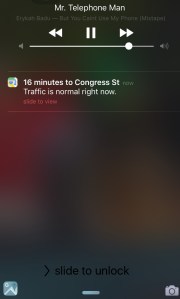
As I walked toward the door to leave I looked down at my phone. Again, there was a push notification from Apple Maps (an app I have never once used). It read: “16 minutes to Congress St.; Traffic is normal right now.” This time I took a screenshot, posted at right.
How on earth could my iPhone have known that I wasn’t going to take the bus this morning, and that I was going to drive downtown instead?
Apple’s website includes a page on location tracking and privacy. On that page, it says:
Frequent Locations: To learn places that are significant to you, your iOS device will keep track of places you have recently been, as well as how often and when you visited them. This data is kept solely on your device and won’t be sent to Apple without your consent. It will be used to provide you with personalized services, such as predictive traffic routing.
But in both cases, these alerts appeared only after I had verbally announced my intention to drive somewhere, either home or to work. In neither case was this a routine event; I often sleep over at my partner’s place, and I usually take public transit or ride my bike to work. Therefore the only possibility that makes any sense to me is that my phone is listening, heard me tell my partner I was going home and ask if my roommate could drop me off at work, and then provided me with up to date traffic reports to those two destinations.
In neither case was it desirable. I don’t appreciate it; if I want to know what traffic looks like, I’ll check it out myself. I don’t want my phone listening to me. I’ve never once used Siri in part because of that preference.
Of course, it could be a (two-time) fluke, so I’m curious to hear from others with iPhones. If you’ve had a similar experience, let me know. Also please get in touch if you know how my phone might be deducing these intensely personal things about me, if it’s not actually listening.
Location information is extremely sensitive. That’s made chillingly clear when your phone, practically an extra limb for many of us, starts giving you information about not just where you are or in response to commands you’ve given it, but about where you’re about to go, without having been asked.
Update: CNET explains how you can turn off predictive traffic alerts. That’s great, but the predictive traffic alert feature doesn’t fully explain these two incidents. After all, there’s nothing routine about the trips I was making. And I gave the phone no indication that I was about to drive somewhere, besides talking about driving in the vicinity of the phone.
Mass surveillance isn’t something only being conducted by the likes of the National Security Agency anymore. Despite growing concerns brought on by the Summer of Snowden, cities around America are adopting high tech spy tools.
Never mind the negative press the NSA has received in recent weeks after Edward Snowden began leaking top-secret documents to the media pertaining to the United States’ spy group’s broadly scoped surveillance programs. Law enforcement agencies and local leaders in major American cities are nevertheless signing on to install new systems that are affording officials the power to snoop on just about anyone within range.
Seattle, Washington and Las Vegas, Nevada are among the latest locales in the US to acquire surveillance tools, the likes of which were both discussed in regional media reports over the weekend that are making their rounds across the Web and causing privacy advocates around the world to raise their voice.
Neither West Coast city has announced plans to acquire telephone metadata or eavesdrop on email traffic, and combined their operations likely pale in comparison to what the NSA has accomplished. Civil liberties activists are sounding the alarm regardless, however, after new reports revealed what kind of information city officials could collect using newly installed equipment.
In Seattle, a city of around 635,000, the police department recently used a Department of Homeland Security grant for $2.6 million to purchase and put up a number of wireless access devices that together create “mesh networks” which law enforcement officials can connect to and in turn more quickly share large chunks of data, such as surveillance camera recordings and other high-res information.
Those access points, or APs, do more than just transfer data from one node to another, though, and actually spend large amounts of time scouring for every Internet-capable device in the area that may be searching for a Wi-Fi signal — such as any smart phone that can connected to the Web. Although the mesh network is being made for emergency responders to be able to interact with ease and provide them with a widespread wireless system to share information, the APs acquire basic information about every electronic device that even momentarily makes a connection, in theory allowing officials to see much more than the average Washingtonian might want to willfully hand over.
The Stranger, a Seattle alternative-weekly, spoke to the city’s police department about the recently installed mesh network but wasn’t given many answers. Law enforcement officials insisted that the system isn’t fully functioning yet — and little more — but the Stranger learned that authorities can log the MAC (media access control) address of any iPhone, Android, laptop or Internet-able device that’s within reach of its signal, which could then provide authorities with information that even a seasoned investigator might have a hard time obtaining otherwise. Just as how telecommunication companies ping devices almost constantly from nearby towers to test signals, learning the specific location of a MAC address at any given date and time can then be coupled with other location data in order to triangulate a subject’s movements up to even just a few inches away.
Speaking to theStranger, the Seattle Police Department admitted it does not yet have a policy to govern the use of the multi-million dollar system, but said it is “actively collaborating” with the American Civil Liberties Union, contrary to claims made by the ACLU that the SPD has been anything but speedy when responding to its questions and concerns.
“We definitely feel like the public doesn’t have a handle on what the capabilities are,” Jamela Debelak of Seattle’s ACLU office said to The Stranger. “We’re not even sure the police department does.”
Should a policy not be put in place quickly enough, many fear the results could be ravaging for the privacy of the city’s half-a-million-plus residents, many of whom surely wouldn’t suspect that the phone in their pocket it silently sending personalized information to the Seattle Police Department anytime they walk within reach of an AP’s signal.
In Las Vegas, the latest tool there might be even more Orwellian.
Sin City is one of the latest locales to purchase a line of highly-functional lampposts sold by Michigan’s Illuminating Concepts under the branding of “IntelliStreets.” As RT has reported in the past, however, the devices do much more than light up sidewalks. These lampposts are also Wi-Fi-ready to stream passers-by localized information and even audio and graphics, but it’s what Intellistreets collect that’s really shocking. In addition to broadcasting information, the lampposts are equipped with microphones and cameras that can record anything within an earshot and send it to a server to be analyzed.
On the IntelliStreets website, the company says, “Intellistreets provides a platform and many developed applications to assist DHS in protecting its citizens and natural resources.”
“We want to develop more than just the street lighting component,” Neil Rohleder of the city’s Public Works Department told KSNV News. “We want to develop an experience for the people who come downtown.”
As the technology spreads in cities unopposed, however, it could lead the other towns to journey down a slippery slope that ends with relinquishing even more personal information down the road.
“This technology, you know is taking us to a place where, you know, you’ll essentially be monitored from the moment you leave your home till the moment you get home,” local civil rights activist Daphne Lee told the network.
“At what point do we say this is the land of the free,” Lee said. “People have a right to a reasonable amount of privacy.”
As the NSA scandal has shown the world, however, one person’s idea of privacy might vastly differ from another’s. Revelations made possible through Mr. Snowden’s leaks have shown that the US government routinely collects information about the dialer and recipient of nearly every phone call made in the country, and even America’s allies, such as German Chancellor Angela Merkel, are subject to NSA-issued surveillance.
Meanwhile, other cities along the West Coast are seeing a surge in surveillance tools that started before the first Snowden leak but are still being set in place. Federal grants totaling around $7 million to Oakland, California are being used to ensure that the city has an eye on seemingly everything by next summer, and requests by a growing number of law enforcement agencies for spy drones is expected to involve eventually equipping bureaus across the country with unmanned aerial vehicles by the dawn of the next decade.
A recent video released by hacktivist group Anonymous presents compelling evidence which claims that Apple’s TouchID technology is linked to the FBI and NSA and is involved in the provision of information on users for a large-scale biometric database under construction by the US Government for use “both domestically and on the battlefield”.
This biometric database is due to be populated by any personal information retrieved by government agencies, leading to fears that Big Brother’s eye is following us wherever we go and whatever we do, even in the privacy of our own homes.
Anonymous alleges that they have uncovered proof of a corrupt alliance of Department of Defense contractors, NSA and CIA-related venture capital which led to the development of technologies subsequently purchased by Apple.
These findings were the result of investigation by Barrett Brown, the jailed and gagged journalist and links to further enlightening material have been posted on the Pastebin website and were largely based on documents obtained by the US defense contractor ManTech in 2010.
So what exactly are these revelations? Firstly, Anonymous claim that there are links between AuthenTec (the company bought by Apple to enable them to develop the TouchID technology) and the “most powerful and corrupt” Defense Department and intelligence community contractors and officials. Anonymous concentrate largely on one individual – Robert E Grady, a prominent figure and political speechwriter under both Bush administrations – when delineating and highlighting the opaque relationships between big business and the US government.
During his time sitting on the board of AuthenTec, Grady was a formerly leading partner in The Carlyle Group, an investment firm which previously owned not only Authentec, but also was the main shareholder of Booz Allen Hamilton, the NSA contractor and erstwhile employer of whistleblower Edward Snowden.
Anonymous presents further claims that the Authentec board of directors ensured that the company would be sold exclusively to Apple, due to the company’s position as market-leader, as this in turn would encourage rival companies to adopt the same technology in order to compete. They state that the launch of the Apple iPhone 5S has meant that secret surveillance and biometric collection has heightened into a full-scale assault on personal data and privacy.
However, other commentators suggest that Apple’s fingerprint security feature may be the thin end of the wedge in terms of biometric collection and consumer devices. Internationally, increasing numbers of countries are deploying biometric technology within organs of the state and rumours abound that biometrics – such as fingerprinting and facial recognition – will soon be a standard feature on game consoles and other electronic leisure products and household gadgets.
Apple’s lack of transparency regarding their usage of data obtained secretly from their customers is not restricted to their newest innovations, either. As far back as 2011 technological researchers were warning that the company could face law suits for breaches of privacy in relation to the storing of users’ locations and other personal information in secret files, which stores location coordinates with a timestamp to effectively map and record the precise movements of individuals.
The implication of this would be the danger this data could fall into the wrong hands if someone was able to hack the system. It is unclear why Apple is storing this data, but it is clearly intentional as such information on the database is being restored across backups and even device migrations. In 2010 Apple was once again the target of claims of privacy violation when a class-action suit was filed against them in a US Federal Court. The claim was that earlier models of the iPhone and iPad contained unique identifying elements, known as Unique Device Identifiers, which allowed advertising agencies track which applications were being downloaded by users, how frequently they were being used and for what period of time.
Users are unable to block the transmission of the UDID, a 40-character string that uniquely identifies each device. The lawsuit alleged: “Some apps are also selling additional information to ad networks, including users’ location, age, gender, income, ethnicity, sexual orientation and political views.” Apple has continuously denied that it transmits user-data without consent, but this has done little to ease fears that the company’s actions constitute an intrusive tracking scheme which aids and abets serious invasions of privacy.
None are more hopelessly enslaved than those who falsely believe they are free.
Think of your smart phone as being equal to or the same as, an ankle monitoring bracelet forced on an alleged criminal.
“An ankle monitor (also known as a tether, or ankle bracelet) is a device that individuals under house arrest or parole are often required to wear. At timed intervals, the ankle monitor sends a radio frequency signal containing location and other information to a receiver.”
That sounds exactly like your smart phone?
The one thing that makes it different is that a criminal is forced to wear such a device and you are choosing to use and pay for own tracking! You are wearing, carrying, accessorizing your own electronic monitoring device. What a gift to the powers that shouldn’t be!
None are more hopelessly enslaved than those who falsely believe they are free.
What should you do if you uncover wrongdoing and the people responsible are the same ones who are supposed to investigate it? The way our politicians and elite media figures talk, you would think there’s something honorable about tipping them off (or shutting your mouth). In the political arena, the bold person of conscience – the rebel, the maverick, the damn-the-costs truth-teller – is the bad guy, not the action hero; the company man is played by Bruce Willis. When Edward Snowden gave up a lucrative career in an island paradise to blow the whistle about the US government’s staggeringly broad spying operations – revealing what thousands of others with access to the same information wouldn’t – he was going up against a system that values loyalty to those who sign your paychecks over loyalty to principle or the public. A columnist for The New York Times, which is very much a part of that system, denounced him in terms one would think would be reserved for our leaders, declaring that Snowden had “betrayed the Constitution” and “the privacy of us all” by leaking evidence of the Obama administration doing just that.
Snowden need not be the world’s greatest human being for us to recognize the courage it took to do what he did. When compliance with a system makes one an accomplice to wrongdoing, there’s no virtue in being compliant. There’s no virtue in abiding by the “honor codes of all those who enabled [one] to rise,” as the Times columnist put it, when that code doesn’t respect the rights of everyone else. We recognize that when we go to the movies. Maybe we should stop condemning it in real life?
Instead of getting caught up in media attempts to pathologize a whistle-blower, we should also probably look more closely at what the whistle was blown on, because what Snowden revealed should be concerning, even if you don’t have relatives in Yemen.
This Matters
According to leaked classified documents, the US National Security Agency (NSA) is collecting data on nearly every call made by nearly every American, from the time it was placed, who was called and from where it originated. The NSA also has relationships with nearly every major Internet company, from Facebook to Google, granting the agency streamlined access to your user history. Everything you email or post to your wall could end up on an NSA server somewhere. That’s a lot of data, which is why the agency is building a 1.5 million square feet server farm in Utah to hold it, at a cost of $1.2 billion.
The Obama administration claims the information it belatedly admits it collects is only later accessed with a court order. But then, those court orders are classified, granted by judges in a secret court in front of which only the government can appear. Meanwhile, the White House has refused to release its legal rationale for the spying program, which senators from the president’s own party suggest is both illegal and unnecessary. It has, however, publicly credited the program with breaking up terrorist plots, though those claims – like its earlier denials that the spying program existed – have proven false.
But while it’s intrusive, sure, if you have nothing to hide, you have nothing to fear, right? Well, no. Even if you don’t have grandparents in Yemen, you should be concerned about any agency – that is, a collection of fallible human beings – that claims the right and has the power to know pretty much everything you’ve ever done on your iPhone. Go ahead and assume the best motives on the part of those in power, just don’t forget that even the most honorable people have ex-lovers too. Even saints can be seduced by power.
Most spooks aren’t saints, either. They’re like us: fallen. And what would you do if you were invisible? For some NSA employees, listening to your phone calls is the equivalent of sneaking into the locker room, several of them telling ABC News that the agency routinely eavesdrops on the phone calls of Americans abroad as they call friends and family back home.
“Hey, check this out,” the agents would tell each other, according to one whistle-blower. “There’s good phone sex or there’s some pillow talk, pull up this call, it’s really funny, go check it out.” Not exactly the model of professionalism one would hope for in someone who has god-like eavesdropping powers.
“These were just really everyday, average, ordinary Americans who happened to be in the Middle East, in our area of intercept and happened to be making these phone calls on satellite phones,” said another military whistleblower. Journalists and aid workers had their communications intercepted on a regular basis.
That was a decade ago.
It’s Gotten Worse
These days, the NSA is now known to be intercepting a much broader range of communication. Revelations to The Guardian show it claims the ability to tap into not just email communication, but live Skype calls. Basically everything you do on the Internet could potentially be viewed by a US government agent. There’s no need for black helicopters when you voluntarily divulge your life secrets with the help of a black box made by Sony. Or a white one by Apple.
You should be especially concerned if you have opinions about things going on in our world. When a group of Pennsylvanians began working to stop a natural gas fracking project in their community, they found themselves listed on a state Department of Homeland Security bulletin. “We want to continue providing this support to the Marcellus Shale Formation natural gas stakeholders while not feeding those groups fomenting dissent against those same companies,” the Secretary of Homeland Security, a Democrat, stated in an email.
If you oppose corporate America’s destruction of your community, you could end up being lumped in with actual terrorist threats. And once the word “terrorism” is invoked, all bets are off, potentially leading to a government agent, working on behalf of their corporate stakeholders, going through every ill-considered email you ever sent.
Sometimes, simply stating one’s political beliefs is enough to grab the state’s attention. In Seattle, the NSA’s partners in surveillance at the FBI tracked a group of young anarchists to a May Day demonstration, not because they were wanted for any crimes, but because they called themselves anarchists.
“Although many anarchists are law-abiding,” an FBI agent explained, “there is a history in the Pacific Northwest of some anarchists participating in property destruction and other criminal activity in support of their political philosophy.” And so we track them. And with the surveillance capabilities we have today, it’s not hard to make even the most innocent acts seem sinister, particularly when one has unpopular political beliefs or presents a challenge to corporate or state power.
It Could Be You
Combined with expansive terrorism laws, that could be a nightmare for those who fall in the arbitrary crosshairs of a government prosecutor looking to make a name for themselves. In 2010, the Supreme Court ruled that humanitarian groups can be convicted of “material support” for terrorism even if that support consists solely of helping seek conflict resolution. As former president Jimmy Carter said at the time, “the vague language of the law leaves us wondering if we will be prosecuted for our work to promote peace and freedom.”
Others don’t have to wonder. Since 2010, antiwar activists across the country have been subpoened and forced to testify before grand juries into a “material support” for terrorism investigation that has succeeded in scaring those who do humanitarian work in Palestine and Colombia, but as of yet yielded no convictions. Perhaps our broad spying and terrorism laws are working, just not in the way our leaders tell us. And, as these activists can attest: you don’t need to be convicted of anything to be constantly spied on.
As another NSA whistle-blower, William Binney, recently told journalist Amy Goodman, “if you’re doing something that irritates or is against what the government wants to be expressed to the American public, then you can become a target.” It’s as easy as that. And whenever you call a friend, keep in mind that you’re calling every friend your friend has ever called. Are you absolutely sure you have nothing to hide?
In Washington, most politicians seem annoyed that you now know this. They wish you didn’t. As Senator Al Franken explained, “Anything that the American people know, the bad guys know so there’s a line here, right?”
That’s how those in Washington often view those they claim to represent in our representative democracy: lumped in with the bad guys. Indeed, aiding us in our knowledge of what the government is doing in our name, as Bradley Manning and now Edward Snowden have done, is often likened with aiding the enemy.
“I don’t look at this as being a whistle-blower,” Senator Dianne Feinstein said of the NSA leaks. “I think it’s an act of treason.”
Feinstein voted for a war in Iraq that she and her husband personally profited from, so she knows a thing or two dozen about treachery. But she’s off base here. The American public is not the enemy, nor should informing them about the things being done to them with their own money be construed as the act of a traitor. Edward Snowden may not be the world’s greatest human being; who reading this has met him? What we do know is that his act did a lot of good by exposing a lot of wrong and took a lot more courage than it takes to criticize him on Capitol Hill. Since they don’t see that very often there, no wonder they mistake it as treason.
Inside the book that maps the architecture behind global governance — from the Epstein files to the Pact for the Future
Lies are Unbekoming | April 1, 2026
On June 13, 2019, the United Nations and the World Economic Forum signed a partnership deal to “accelerate the implementation of the 2030 Agenda for Sustainable Development.” That same evening, WEF president Börge Brende — Norway’s former Foreign Minister — had dinner with Jeffrey Epstein at Epstein’s Manhattan townhouse. The Epstein files, released January 2026, contain an exchange between the two from the previous year. Epstein to Brende: “Davos can really replace the UN. C21, cyber, crypto . genetics… intl coordination.” Brende back to Epstein: “Exactly — we need a new global architecture. World Economic Forum (Davos) is uniquely positioned — public private.”
The next day, the UN General Assembly adopted the framework for restructuring global governance.
That sequence — the partnership signing, the Epstein dinner, the candid admission about replacing the UN with a public-private architecture, and then the formal adoption — opens Jacob Nordangård’s The Digital World Brain. Pages two and three. Footnoted to the UN resolution number, the Epstein files, and the General Assembly record.
I keep coming back to it because it captures what this book does that almost nothing else in the independent research space manages. I’ve followed Jacob’s work for years now and interviewed him about his research. Each book peels back another layer of the same institutional architecture, and each time I think he’s reached the limit of what can be documented, the next one goes further. Nordangård doesn’t speculate. He doesn’t editorialize much. He lays institutional actions next to each other in chronological order and lets the pattern announce itself. … continue
This site is provided as a research and reference tool. Although we make every reasonable effort to ensure that the information and data provided at this site are useful, accurate, and current, we cannot guarantee that the information and data provided here will be error-free. By using this site, you assume all responsibility for and risk arising from your use of and reliance upon the contents of this site.
This site and the information available through it do not, and are not intended to constitute legal advice. Should you require legal advice, you should consult your own attorney.
Nothing within this site or linked to by this site constitutes investment advice or medical advice.
Materials accessible from or added to this site by third parties, such as comments posted, are strictly the responsibility of the third party who added such materials or made them accessible and we neither endorse nor undertake to control, monitor, edit or assume responsibility for any such third-party material.
The posting of stories, commentaries, reports, documents and links (embedded or otherwise) on this site does not in any way, shape or form, implied or otherwise, necessarily express or suggest endorsement or support of any of such posted material or parts therein.
The word “alleged” is deemed to occur before the word “fraud.” Since the rule of law still applies. To peasants, at least.
Fair Use
This site contains copyrighted material the use of which has not always been specifically authorized by the copyright owner. We are making such material available in our efforts to advance understanding of environmental, political, human rights, economic, democracy, scientific, and social justice issues, etc. We believe this constitutes a ‘fair use’ of any such copyrighted material as provided for in section 107 of the US Copyright Law. In accordance with Title 17 U.S.C. Section 107, the material on this site is distributed without profit to those who have expressed a prior interest in receiving the included information for research and educational purposes. For more info go to: http://www.law.cornell.edu/uscode/17/107.shtml. If you wish to use copyrighted material from this site for purposes of your own that go beyond ‘fair use’, you must obtain permission from the copyright owner.
DMCA Contact
This is information for anyone that wishes to challenge our “fair use” of copyrighted material.
If you are a legal copyright holder or a designated agent for such and you believe that content residing on or accessible through our website infringes a copyright and falls outside the boundaries of “Fair Use”, please send a notice of infringement by contacting atheonews@gmail.com.
We will respond and take necessary action immediately.
If notice is given of an alleged copyright violation we will act expeditiously to remove or disable access to the material(s) in question.
All 3rd party material posted on this website is copyright the respective owners / authors. Aletho News makes no claim of copyright on such material.


 Aletho News