‘Israel’ faces massive economic fallout from its war on Iran

Al Mayadeen | July 4, 2025
Israeli media sounded the alarm over $14 billion in losses, a surging defense budget, and tens of thousands of compensation claims, as economic strain deepens in the aftermath of the 12-day war on Iran.
According to a report by the Israeli daily Maariv, the war has inflicted severe financial damage on the Israeli economy, with the total impact estimated at over 52 billion shekels (approximately $14 billion USD). The report noted that the war has delivered a major blow to “Israel’s” total economic activity and threatens broader budgetary stability.
“It’s no longer just about rebuilding damaged buildings, it’s about rebuilding the economy,” Maariv reported, highlighting that daily life during the war was “nearly impossible” due to constant sirens, rocket fire, destroyed infrastructure, and casualties.
Even under optimistic recovery scenarios, the paper noted that half of the damage is unlikely to be recuperated, leaving a net loss of 26 billion shekels, or 1.3% of GDP, a substantial economic blow.
Defense budget grows into a ‘bottomless pit’
The financial strain is further compounded by the ballooning costs of the Israeli occupation’s defense spending. Maariv reports that the 2025 defense budget, recently approved by the Knesset, stands at 135 billion shekels, or 21.8% of the national budget. This includes 75.7 billion shekels in debt repayments to the National Insurance Institute.
The newspaper described both the security establishment and debt servicing as “a bottomless economic pit,” given the continued war-related expenditures.
Of the allocated defense budget, 67 billion shekels had already been spent within the first five months of 2025. Now, the Israeli military is reportedly requesting an additional 55–60 billion shekels to fund recent wartime expenses, further straining fiscal resources.
Infrastructure damage, compensation soar
In parallel to military spending, the Israeli entity faces rising compensation obligations. According to Maariv, more than 36,000 compensation claims have been filed with the Property Tax Authority and the Compensation Fund at the Tax Authority, with an estimated added cost of 5 billion shekels.
The claims include:
- 3,392 for destroyed vehicles
- 3,758 for household damage
- 10,996 from evacuated settlers
- Nearly 4,000 settlers were forced to relocate to their relatives’ residential units
Thousands more claims are still being submitted, the paper added, warning that the financial toll on “Israel” is rapidly escalating and may continue to rise sharply in the coming months.
This report follows earlier findings from Calcalist, which estimated the total cost of direct damage at over 5 billion shekels (approximately $1.3 billion), though thousands of cases remain under review or are yet to be formally filed.
Israeli censorship hindering assessment of damage from Iranian strikes
“Israel” has admitted to being struck by more than 50 missiles during its 12-day war on Iran, but the full scope of the damage may never be revealed due to strict press censorship.
Such media restrictions are long-standing in “Israel”, where any content, written or visual, considered potentially harmful to the vaguely defined notion of “national security” can be legally suppressed.
Recently, the Israeli entity has further tightened its grip on wartime reporting.
Russia warns of Israeli ‘war party’ seeking to reignite aggression against Iran
Press TV – July 4, 2025
Russia has warned about various Israeli officials’ efforts to trigger the resumption of aggression against Iran.
Foreign Minister Sergei Lavrov made the remarks during a press conference alongside his visiting Saudi counterpart Faisal bin Farhan in Moscow on Friday.
“We sincerely hope that the so-called 12-day war is indeed over,” the Russian top diplomat said.
He was referring to the Israeli regime’s launching attacks against the Islamic Republic’s nuclear, military, and civilian targets on June 13. The assaults claimed the lives of at least 935 Iranians, including senior military officials and nuclear scientists, the latter group being targeted inside their residential buildings.
The Islamic Republic responded with decisive defensive maneuvers and counterstrikes, hitting critically sensitive nuclear, military, and industrial infrastructure across the occupied Palestinian territories. The retaliation forced the regime to request a ceasefire.
Lavrov, however, warned, “We intend to stay vigilant, as the ‘war party’ remains highly active in the Middle East.”
“We keep hearing a variety of statements from some representatives of the Israeli leadership,” he added, suggesting that those officials were persistently agitating for the resumption of aggression against the Islamic Republic.
Iran has, on many occasions since the cessation of the attacks, cautioned that its next reprisal against potential renewed aggression would be of far more intensity and magnitude to the extent that it would take Tel Aviv and its allies by surprise.
‘European states role in war’
Elsewhere in his remarks, Lavrov criticized some European states’ “aggressive” anti-Iranian efforts, which saw them force the International Atomic Energy Agency (IAEA)’s Board of Governors to issue its most recent anti-Iranian resolution.
He pointed out how the European countries “unnecessarily and aggressively pushed through anti-Iranian resolutions, which did nothing to ease tensions or advance negotiations, but instead created a pretext for forceful measures.”
The Israeli regime used the resolution as a pretext to launch the war. The resolution was also used by the United States, the regime’s biggest ally, as a plea to join it in attacking Iran towards the end of the warfare.
“I sincerely hope that European nations will come to recognize their responsibility and their share of the blame,” Lavrov said.
For his part, the Saudi foreign minister also underlined that differences with the Islamic Republic had to be resolved through diplomatic processes.
Time for Qatar to review its hosting of US Al Udeid military air base
By Thembisa Fakude | MEMO | July 3, 2025
The assassination of one of the highest-ranking Generals and the Commanders of Al Quds Force – part of the Islamic Revolutionary Guard Corp (IRGC) – Qasem Soleimani, opened an unprecedented form of conflict in the Gulf region. Soleimani was killed in Iraq on 3 January 2020 by an US drone strike in Iraq, while travelling to meet Iraqi Prime Minister Adil Abdul Mahdi. Iran retaliated by targeting the US military facilities in Iraq, it fired more than a dozen ballistic missiles at two Iraqi air bases housing US forces days after the assassination. According to The Times of Israel, Israel helped the US in that operation.
The leader of Hamas, Ismail Haniyeh was killed by Israel in Tehran after attending the inauguration of the President of Iran Masoud Pezeshkian. Another pure violation of the sovereignty of Iran and international law. The killing of Haniyeh in July 2024 came on the heels of the attack and killing of a number of Iranian diplomats at the embassy of Iran in Damascus, Syria on 01 April 2024. Israel – with the support of the US – has continued to assassinate Iranian officials at will inside Iran.
Qatar had joint military operations with the US during the Operation Desert Storm in Iraq in 1991. After the operation, Qatar and the US signed a Defence Cooperation Agreement. The agreement was expanded in 1996 to include the building of Al Udeid Military Air Base at a cost of more than $1 billion. The Al Udeid Military Air Base is the largest US military base in the Middle East. Iran attacked Al Udeid in retaliation to the US’s attacks of Iranian nuclear sites in Fordo, Natanz and Esfahan in Iran in June 2025. Although the retaliation strikes were downplayed by the US and Qatar, the attacks seemed to have been carefully choreographed, exposing a new fault line in US-Qatar military cooperation.
The question in the minds of most Qataris is; what will happen next time when the US decides to attack Iran, will Iran retaliate by attacking Qatar again? Notwithstanding the repeated mantra of “a friendly, brotherly love and appreciation” between Qatar and Iran, the biggest threat to Qatar’s security and political stability now and in the near future is a possible war between Israel and the US against Iran. The targeting of Iran by Israel and the US presents a new security threat in the region.
Al Udeid has served as “a symbol of protection for the State of Qatar against potential attacks and other forms of hostilities”. However, when put to the test, Al Udeid has failed to meet those expectations. Besides the recent Iran attacks of the US military installations in Al Udeid; when Saudi Arabia, UAE, Bahrain and Egypt led a blockade against Qatar in 2017, there was no forewarning from the US notwithstanding Al Udeid’s superior military intelligence. According to the Qatari Defence Minister, Khalid al Attiyah, “Actually it was not a mere intention. There was a plan to invade Qatar”. The “plan was set into two phases, imposing the siege with the aim of creating an overall state of panic, which would have a direct impact on the Qatari street, then executing a military invasion”.
The possible future conflicts involving the US and Iran have raised serious concerns about the safety of US assets and personnel in the region. It has also triggered a debate, particularly within the US media, of the viability and rationale of the country’s continued involvement in Israel’s wars in the region. The Make America Great Again (MEGA) leading supporters such as the executive chairman of Breitbart News, Stephen Banon and right-wing journalist and social media influencer Tucker Carlson have questioned “the US continuing blind support Israel’s wars in the Middle East”. Tucker Carlson a known Trump supporter and a right-wing voice has been the loudest. He has been “urging the US to stay out of Israel’s war with Iran”. Bannon and Carlson are part of a broader effort to overturn the “GOP’s hawkish consensus on Israel”. Notwithstanding his unwavering support of Israel, Trump has been critical of Benjamin Netanyahu war mongering strategy in the region. Trump has entered into lucrative business relationships with countries in the Arab/Persian Gulf recently; Netanyahu stands to disturb that relationship. The US and the United Arab Emirates (UAE) have agreed to turn Abu Dhabi “to a site of the largest artificial intelligence campus outside the US”. The US will allow “the UAE to import half a million Nvidia semiconductor chips, considered the most advanced in the world in the artificial intelligence products”. According to The Guardian, Saudi Arabia struck a similar deal of semiconductors, obtaining the promise of the sale of hundreds of thousands of Nvidia Blackwell chips to Humain, an AI start-up owned by the Saudi Sovereign Wealth Fund. Indeed, given these interests and the strengthening relationship between the US and the Gulf countries, the US has much more to lose if it continues to blindly support Israel’s wars.
The relationship between Iran and the State of Qatar is very strong, both countries share gas exploration sites in the South Pars/North Dome. They are the gas condensate fields located in the Arabian/Persian Gulf. They are by far the world’s largest natural gas fields. There is also the people to people relationship between Qatar and Iran dating back to time immemorial. The next attack of Iran by the US or Israel could escalate and spread the war to Qatar. Although the US managed to move its assets from Al Udeid to other locations in Qatar before Iran’s attacks last month, the question remains. What guarantees do Qatar have that in future Iran would not target those locations? There is a possibility that if attacked Iran will once again retaliate. What will happen then? The retaliatory attacks could go beyond a mere violation of Qatar’s airspace and sovereignty; it could also cost Qatari lives. The State of Qatar has to take serious decisions regarding Al Udeid if it wants to maintain its future relationship with Iran and other countries in the region. It must close Al Udeid. It has more valid reasons to do that now. The threat has morphed in the region. Consequently, new defence infrastructure needs to be considered by Qatar. Al Udeid presents more political and diplomatic challenges than opportunities.
$1.5bn up in smoke: US THAAD missile stockpile dries up defending Israel against Iran
By Ivan Kesic | Press TV | July 2, 2025
According to American media, defense news outlets, and independent analysts, the 12-day Israeli military aggression against Iran significantly depleted the US stockpile of THAAD (Terminal High Altitude Area Defense) interceptor missiles.
Citing official sources, American magazine Newsweek reported on Friday that the US transferred a substantial portion of its advanced missile defense capabilities to support the Israeli regime, an effort with questionable results and a critical impact on US strategic reserves.
THAAD, developed by Lockheed Martin arms manufacturing company, is a key component of Israel’s multi-layered air defense architecture. It is designed to intercept medium-range ballistic missiles, including those launched from Iran and Yemen.
The US-made system is capable of targeting short-, medium-, and intermediate-range ballistic missiles during their terminal phase, whether inside or outside Earth’s atmosphere.
THAAD uses a “hit-to-kill” method, relying on kinetic energy rather than explosive warheads to destroy incoming threats, intercepting at altitudes of up to 150 km and ranges between 150-200 km.
Operated exclusively by American personnel, the US military maintains eight THAAD batteries with an estimated 350–400 interceptors in total. The eighth battery was activated during the June 20 Israeli aggression against Iran and is capable of intercepting hypersonic missiles.
Deployment in the occupied territories
At the outset of the Israeli aggression against Iran, seven THAAD batteries were operational, two of which had been deployed in the occupied Palestinian territories.
The first THAAD battery was stationed there in October 2024, following Iran’s “True Promise 1 and 2” operations, during which Israel’s domestic air defense systems, David’s Sling, Arrow 2, and Arrow 3, suffered notable failures. A second battery was deployed in April 2025.
These US-operated systems played a crucial role during the June 2025 confrontation with Iran, although their exact deployment locations remain classified for military reasons.
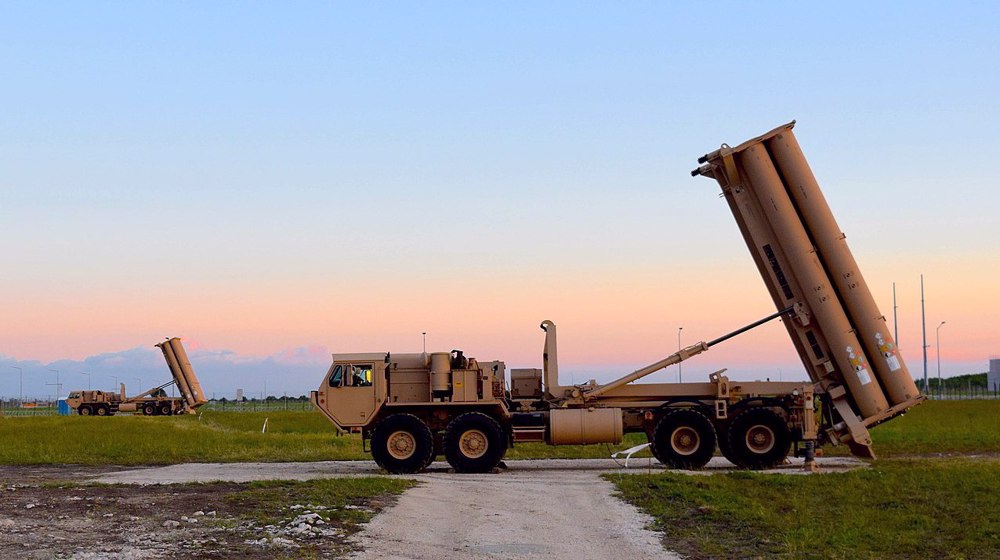
THAAD air defense system
Based on available information, of the remaining US THAAD batteries, two are deployed within the United States, one in Texas and another in Guam.
The rest are stationed overseas in South Korea, Saudi Arabia, and the United Arab Emirates (UAE), with the UAE being the only country to have formally purchased its own THAAD systems.
A THAAD battery is a mobile, self-contained missile defense unit. Each battery typically comprises six truck-mounted launchers, with each launcher carrying eight interceptor missiles, amounting to a total of 48 interceptors per battery.
In addition, the system includes an AN/TPY-2 radar for long-range detection and tracking (up to 2,000-3,000 km), a fire control and communication system for coordinating intercepts, along with support equipment and approximately 100 personnel to operate the unit.
Given the deployment of two batteries in the occupied Palestinian territories, it can be estimated that the Israeli regime had access to at least 96 interceptor missiles.
However, the actual number was likely higher due to frequent resupply efforts during engagements with Yemeni ballistic missiles and in preparation for the broader conflict with Iran.
Mixed performance against Yemeni missiles
Despite being touted as one of the most advanced missile defense systems in the world, THAAD’s performance against Yemeni ballistic missile attacks has been mixed, even according to Israeli and Western sources.
While some interceptions have been claimed as successful, there have been notable failures.
By the end of March 2025, six successful interceptions of Yemeni missiles had been reported. However, on May 4 and May 9, THAAD failed to intercept missiles targeting Ben Gurion Airport.
In both instances, Israeli sources asserted that the incoming missiles were ultimately intercepted by the Arrow missile defense system instead.
This claim has been met with skepticism, as the Arrow system typically engages threats at far greater distances, tens or even hundreds of kilometers away, yet the airport was struck directly.
The Israeli regime’s own admission that multiple systems were used against the same class of Yemeni missiles suggests that the interception cost is significantly higher than commonly assumed. Rather than a one-to-one missile-to-interceptor ratio, several interceptors, possibly from different systems, may be required to ensure a successful shootdown.
Despite ongoing claims by American and Israeli officials about the effectiveness and reliability of both THAAD and Arrow systems, Yemen has continued to target Ben Gurion Airport as part of its retaliatory operations. The continued threat and perceived vulnerability led nearly all international airlines to suspend flights to and from Israel.
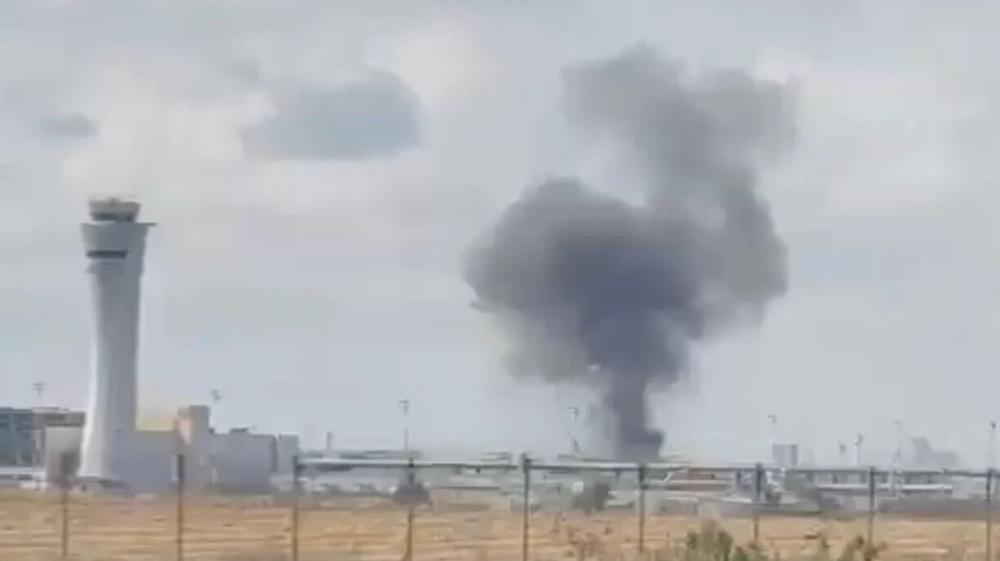
Yemeni missile hits Ben Gurion Airport on May 4, after unsuccessful interception with THAAD
The most commonly used long-range weapon in the Yemeni arsenal is the Palestine-2 – a two-stage hypersonic ballistic missile capable of reaching speeds up to Mach 16 and equipped with a maneuverable warhead. This type of missile poses a significant challenge to traditional missile defense systems, including THAAD.
Technologically, THAAD faces several limitations. These include radar difficulties in distinguishing between actual warheads and decoys, vulnerability to saturation by large-scale missile barrages, and diminished effectiveness against newer hypersonic and maneuverable missile designs.
The system also relies exclusively on US personnel for its operation, which can limit rapid adaptability in dynamic combat scenarios.
THAAD has experienced test failures in the past, raising concerns about its reliability and operational readiness. These failures have been linked to software bugs, mechanical faults, and targeting system errors, factors that cast doubt on its real-world performance under pressure.
Failures against Iranian missile strikes
During the 12-day war of aggression against Iran, THAAD’s performance deteriorated significantly, highlighted by its low interception rate and the rapid depletion of US and Israeli interceptor stockpiles.
On the eve of the Israeli aggression, approximately 100 THAAD interceptor missiles were positioned in the occupied Palestinian territories. In response, Iran launched between 370 and 500 ballistic missiles during its retaliatory operations, a volume that far exceeded available THAAD capacity.
While Israel also relied on other systems such as David’s Sling, Arrow-2, and Arrow-3, the sheer scale and intensity of Iran’s response shifted the strategic balance. The damage inflicted throughout Israeli-occupied territories underscored this imbalance.
In the initial days of the war, Iran deliberately used older liquid-fueled ballistic missiles to exhaust enemy air defenses. More advanced and maneuverable missiles were introduced only after Israel’s interceptor supply had been significantly drained.
Although no official statistics have been released regarding the number of THAAD interceptors used or their success rates, available evidence suggests a poor performance.
High-altitude kinetic interceptions, hallmarked by bright explosions visible across the region, were rare, and many may have involved Arrow systems instead of THAAD.
A particularly telling open-source analysis, based on video footage by Jordanian photographer Zaid M. Al-Abbadi, missile ignition signatures, and geolocation data, estimated that Israel used 39 THAAD, 34 Arrow-3, and 9 Arrow-2 interceptors during just one of more than 20 Iranian missile barrages.
Given such high rates of interceptor use, analysts believe THAAD batteries likely exhausted their missile supply within the first four to five days of the conflict.
This rapid depletion, combined with underwhelming interception success, highlights the system’s limitations in a high-intensity, multi-wave missile war.
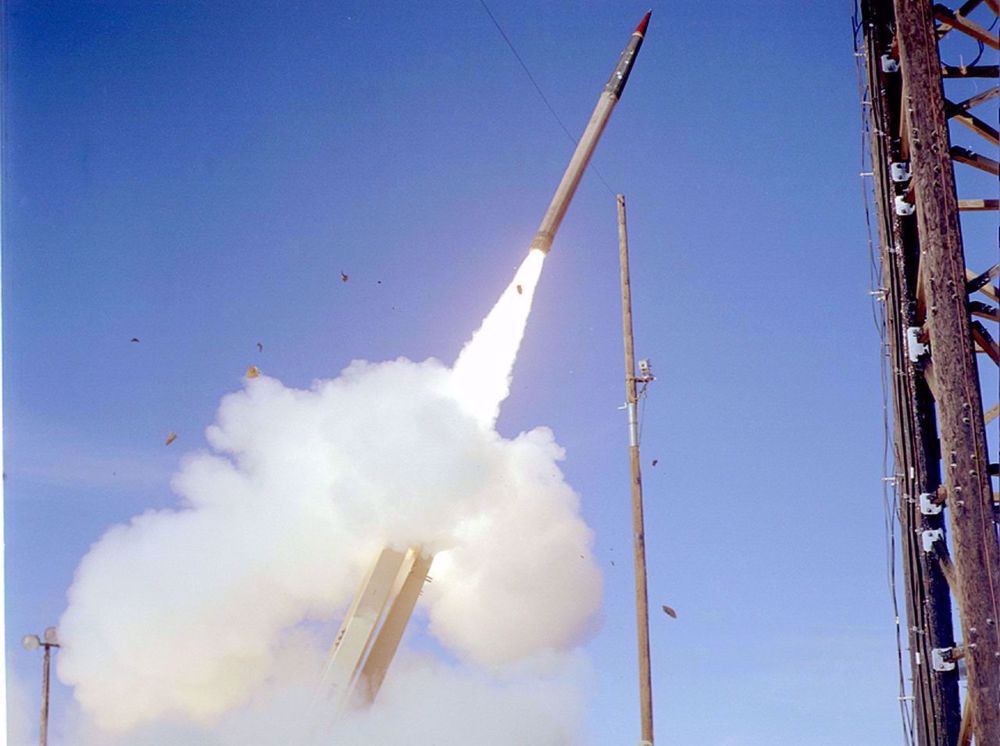
THAAD interceptor launch
Exhausted stockpiles and soaring costs
Estimates from military experts and news outlets place the unit cost of a single THAAD interceptor between $12 million and $15 million. However, other sources suggest the real cost is significantly higher.
In a statement to Newsweek, Sidharth Kaushal of the Royal United Services Institute (RUSI) noted that while the production cost of a THAAD interceptor is approximately $18 million, the total cost rises to $27 million when research, development, testing, and evaluation (RDT&E) expenses are factored in.
Estimates of total THAAD-related spending during the recent conflict vary. Analysts suggest that between $500 million and $800 million worth of interceptors may have been expended, corresponding to the use of 40 to 60 missiles.
On Tuesday, the Israeli newspaper Haaretz, citing Israeli military sources, reported that approximately 200 American and Israeli interceptor missiles were launched in total, at an estimated cost of 5 billion shekels – nearly $1.5 billion.
What all sources agree on is that the THAAD interceptor stockpile has been significantly depleted. At least one full battery’s worth, 48 interceptors, is believed to have been expended.
Considering the two THAAD batteries deployed and the high operational tempo due to prior Yemeni missile attacks, the actual figure may be closer to 96 interceptors. This would represent a reduction of roughly 30 percent of the entire US THAAD interceptor stockpile.
Open-source analysts also highlight the limited pace of US procurement: only 41 THAAD interceptors have been ordered over the past three years, including units designated for export customers. This slow replenishment rate underscores the vulnerability of even advanced missile defense systems when faced with sustained, high-volume missile warfare.
In stark contrast, Iran and China maintain vast ballistic missile arsenals, numbering in the thousands, making the rapid depletion of the US inventory, largely to defend Israeli territory, all the more striking.
Newsweek contacted the Pentagon for comment regarding the depletion and cost implications. The Department of Defense declined to elaborate, stating only that it had “nothing to provide.”
Iran presidential decree officially suspends cooperation with IAEA
Al Mayadeen | July 2, 2025
Iranian President Masoud Pezeshkian has issued a decree suspending the country’s cooperation with the International Atomic Energy Agency (IAEA), according to a report by Tasnim news agency on Wednesday.
The decision comes amid heightened tensions surrounding Iran’s nuclear program and follows recent legislative developments from the Iranian parliament.
Last week, Iranian Parliament Speaker Mohammad Bagher Ghalibaf announced that lawmakers had enacted a law mandating the suspension of cooperation with the IAEA, which he described as “Israel’s protector and servant.”
Ghalibaf argued that continued cooperation with the IAEA was untenable as long as the security of Iran’s nuclear facilities remained unresolved, claiming the agency’s impartiality had been compromised by its ties to “Israel”.
Grossi barred from Iran’s nuclear facilities
Meanwhile, Deputy Speaker of the Iranian Parliament, Hamid Reza Haji Babaei, announced on Sunday that IAEA Director-General Rafael Grossi has been barred from accessing Iranian nuclear facilities or placing surveillance cameras there, after Iran suspended all cooperation with the nuclear watchdog.
“We will no longer give Grossi permission to be present at [Iran’s] nuclear facilities and install cameras [there] because we saw information about our facilities in documents received from … the Israeli regime,” Haji Babaei told ISNA news agency.
The Islamic Republic further exposed profound cooperation between the IAEA and the Israeli occupation, which prompted Iran to obtain, through a major intelligence operation, a vast trove of highly classified strategic documents and information tied to “Israel”, well-informed sources told Al Mayadeen last month.
The sources told Al Mayadeen that the data included “thousands of documents related to the Israeli occupation’s projects and its nuclear facilities.”
According to the sources, the operation took place some time ago, but the enormous volume of documents and the need to safely transport the entire haul into Iran “required keeping the matter under secrecy.”
Settlers as human shields: Israel’s militarization of civilian areas in Tel Aviv and Haifa
Press TV | July 1, 2025
The recent Iranian retaliatory strikes against the Israeli regime as part of Operation True Promise III have cast a spotlight on a longstanding and notorious military strategy: the placement of critical military facilities deep within densely populated ‘civilian’ areas.
Reports and field evidence from the retaliatory strikes that inflicted heavy and irreparable blows on the regime again point to the fact that the regime uses settlers as human shields.
In a report published Sunday, the Israeli newspaper Haaretz acknowledged that Iranian missile strikes during the 12-day war imposed by the regime targeted only Israeli military installations.
However, the report noted that many of these facilities are deeply embedded within civilian areas, referring to illegal settlements mostly in Tel Aviv and Haifa.
One key example cited was the Kirya, Israel’s central military headquarters in Tel Aviv.
Tel Aviv: The Kirya Complex in a ‘civilian’ maze
The Kirya military-intelligence complex in central Tel Aviv was among the first and most significant targets hit by Iranian missiles late on June 13, hours after the Israeli regime carried out an unprovoked and unlawful aggression on Iranian soil, leading to the assassination of many senior military commanders, scientists and ordinary civilians.
Often referred to as the “Israeli Pentagon,” the Kirya houses the ministry of war affairs, military intelligence offices, and various covert installations used in war against Iran, Lebanon and Gaza.
These are concealed in high-rise buildings that are civilian or semi-civilian in nature.
Despite being heavily fortified and protected by multilayered Israeli-American air defense systems, the Kirya was struck early during Iran’s True Promise III operation.
Foreign journalists confirmed damage to towers in the area, even as Israeli media censored coverage under regime pressure. Leaked footage from an Israeli settler showed plumes of smoke and audible panic – “They hit the Mossad!” exclaimed the witness.
Military facilities in settlements
Kirya is located in one of Tel Aviv’s most densely populated districts. Beneath its surface lie numerous underground military facilities, identified by Iranian intelligence following Tehran’s acquisition of sensitive Israeli military and intelligence data in early June.
The district includes:
- Matcal Tower – Headquarters of top Israeli military leadership
- Marganit Tower – Home to strategic communications operations
- The Bor (“The Pit”) – A heavily fortified underground command center.
These installations are surrounded on all sides by settler infrastructure, including residential buildings, schools, and commercial zones, blurring any clear separation between military and non-military zones, as a deliberate strategy to use settlers as civilian shields.
Haifa: Ports, bases, and civilians intertwined
As in Tel Aviv, Haifa’s strategic military assets are tightly interwoven with ‘civilian’ life.
The most prominent is the Haifa Naval Base, home to the regime’s Mediterranean fleet and submarine corps. Located on the northwest side of Haifa’s busy port complex, the base sits amid one of Israel’s most important economic and ‘civilian’ hubs.
Recent months have seen most maritime traffic rerouted from Eilat to Ashdod and Haifa, further increasing the ‘civilian’ presence around these strategic assets.
Residential conversion of military zones
The Bahad 600 naval training base has undergone rapid conversion into a residential area, with new apartment blocks and even a children’s hospital constructed adjacent to operational military facilities. This proximity exemplifies the ongoing militarization of ‘civilian’ areas.
To the north lies the Rafael Advanced Military Systems complex, covering several square kilometers. It produces Iron Dome and David’s Sling missile systems, cruise missiles, and armored vehicle solutions.
Surrounding this are major industrial zones, Kiryat Nahum, Kiryat Ata, and Nesher, which combine military functions with chemical, cement, and energy industries. For example:
- Haifa refinery: Processes two-thirds of the Israeli regime’s oil supply.
- Nesher cement plant: Supplies 60 percent of the regime’s domestic cement needs.
- Communications antenna at Giv’at HaHagan: A key hub linking northern military commands with Tel Aviv.
Mount Carmel’s militarized natural reserve
The most notorious site is the Mishmar military base, constructed within the protected Mount Carmel National Park. It features visible radars and Iron Dome missile platforms.
The base lies just 300 meters from the University of Haifa’s student dormitories. borders archaeological sites and sanctuaries and is built amid sensitive ecological zones and hiking trails.
Among these historical and religious sites is Derech HaDorot (Road of the Millennia), an open-air museum with Bronze Age and Roman structures and Hurshat HaArba’im (Grove of the Forty), a sacred site for the Druze community.
Despite its cultural and environmental sensitivity, the Mishmar site is now heavily militarized, showcasing the regime’s prioritization of military over the safety of settlers or heritage preservation.
US Bombing of Iran Harms Non-Proliferation
By Ted Snider | The Libertarian Institute | July 1, 2025
Iran didn’t violate the Nuclear Non-Proliferation Treaty (NPT), the United States did. When the U.S. bombed Iran’s civilian nuclear facilities on June 23, they didn’t just violate the cardinal rule of international law by attacking a sovereign nation, without Security Council approval, that had neither attacked it nor threatened to attack it. They also violated the NPT. In doing so, the U.S. may have done irreparable harm to the non-proliferation regime.
As a signatory to the Nuclear Non-Proliferation Treaty, Iran was protected by the “inalienable right to a civilian [nuclear] program.” Iran and the world watched, not only as that nonnuclear umbrella collapsed and failed to protect Iran, but as the International Atomic Energy Agency (IAEA), the guardian of the non-proliferation regime, whispered barely a criticism. Iran’s parliamentary speaker has criticized the IAEA for having “refused to even pretend to condemn the [American] attack on Iran’s nuclear facilities.”
Iran has accused IAEA director general Rafael Grossi of issuing a “biased” report on Iran’s nuclear program right as Trump’s sixty day window for diplomacy was closing that could be used as a “pretext” for the attacks on Iran’s nuclear facilities. The U.S. was complicit in using the resolution that followed the report, since only 19 out of 33 countries voted in favor of it after the U.S. pressured eight countries they saw as “persuadable… to either vote with the US on the IAEA vote or not vote at all.”
After Grossi clarified that the IAEA “did not find in Iran elements to indicate that there is an active, systematic plan to build a nuclear weapon” and concluded that “We have not seen elements to allow us, as inspectors, to affirm that there was a nuclear weapon that was being manufactured or produced somewhere in Iran,” Iranian foreign ministry spokesman Esmaeil Baghaei said the clarification came “too late.” He blasted Grossi for “obscure[ing] this truth in your absolutely biased report that was instrumentalize by E3/U.S. to craft a resolution with baseless allegation of ‘non-compliance’; the same resolution was then utilized, as a final pretext… to launch an unlawful attack on our peaceful nuclear facilities.” Baghaei finished with the accusation that Grossi “betrayed the non-proliferation regime.”
On June 20, Iran filed a formal complaint against Grossi to the Security Council, accusing him of a “clear and serious breach of the principle of impartiality.” Iran’s Ambassador to the UN, Amir Saeed Iravani, criticized Grossi’s failure to condemn American and Israeli threats and use of force against its peaceful nuclear program as demanded by IAEA resolutions “which categorically prohibit any threat or use of force against nuclear facilities dedicated to peaceful purposes.” He said that Grossi’s “passivity… amounts to de facto complicity.”
On June 25, the Iranian parliament approved a bill suspending – but not yet terminating – its cooperation with the IAEA. Parliamentary speaker Mohammad Baqer Qalibaf explained the passage of the bill by saying that the IAEA “has put its international credibility up for sale” because it “did not even formally condemn the attack on Iran’s nuclear facilities.” “For this reason,” he said, “the AEOI [the Atomic Energy Organization of Iran] will suspend its cooperation with the Agency until the security of its nuclear facilities is guaranteed.”
The next day, the Guardian Council approved the bill. The spokesperson for the Council said that “considering… the attacks carried out… against the peaceful nuclear facilities of our country… the government is obliged to suspend any cooperation with the IAEA until the principles ensuring… the security of nuclear scientists’ centers and ensuring the inherent rights of the Islamic Republic of Iran to benefit from all rights stipulated in Article 4 of the Treaty on the Non-Proliferation of Nuclear Weapons, particularly concerning uranium enrichment.” Having been approved by the Guardian Council, Iran’s Foreign Minister, Abbas Araghchi, says the bill is now “binding.” That means, he says, that “From now on, our relationship and cooperation with the [IAEA] will take a new form.”
The great risk now is that Iran could withdraw from the NPT altogether. When I asked former Iranian nuclear negotiator [ret] Ambassador Seyed Hossein Mousavian if this failure of the NPT might move Iran to withdraw from the treaty, he answered, “Perhaps Iran does not rush to withdraw but ultimately this could be a serious option.”
Having its legal nuclear facilities bombed by a nuclear power who is a signatory to the NPT could convince Iran that membership in the NPT is harmful to it. Mousavian has pointed out that countries that did develop nuclear weapons – which Iran did not – outside of the NPT “have remained immune from military attacks.” Trump and the U.S. have not bombed North Korea. “It is only natural that following the military attack,” Mousavian writes, “Iran would reconsider its nuclear strategy, including its continued membership in the NPT.” And that, Ali Vaez, director of the Iran Project at the International Crisis Group, says “is quite likely.”
The danger is that the American bombing could eliminate a civilian nuclear program that was operating under the watchful international eye of an unprecedented inspection regime with one that is rebuilt entirely out of the eyes of international inspectors.
Sina Toossi, senior non-resident fellow at the Center for International Policy, told me that “far from neutralizing Iran’s nuclear capabilities, the war may have pushed Tehran closer to covert weaponization under a hardened doctrine.”
Withdrawal from the NPT would not entail that Iran has made the decision to build a nuclear weapon. Blinding the international community, led by the United States, may be seen by Iran as the only viable strategy for reconstituting a civilian nuclear program that would otherwise be bombed each time it reemerged.
The decision by the Trump administration to drop bunker buster bombs on Iran’s legal, civilian nuclear facilities, whether it “severely damaged” them, “obliterated” them or merely “set them back,” is that much more than the nuclear facilities were damaged. Under the guise of preventing nuclear proliferation in Iran, the U.S. may have so discredited the NPT that they have “severely damaged” and “set back” the world’s hard won non-proliferation regime.
Ted Snider is a regular columnist on U.S. foreign policy and history at Antiwar.com and The Libertarian Institute. He is also a frequent contributor to Responsible Statecraft and The American Conservative as well as other outlets. To support his work or for media or virtual presentation requests, contact him at tedsnider@bell.net
OPCW members condemn Israeli attack on Iran’s chemical facilities
Press TV – July 1, 2025
A majority of the member states of the Organization for the Prohibition of Chemical Weapons (OPCW) has condemned Israel’s recent acts of aggression against Iranian chemical and industrial facilities.
The condemnation was issued during a special session of the OPCW Executive Council in The Hague, convened at Iran’s request.
At the session, Hadi Farajvand, Iran’s ambassador to the Netherlands and permanent representative to the OPCW, highlighted the killing of women and children, scientists, and civilians, as well as the targeting of research centers, including petrochemical facilities and chemical research centers.
He cited the harm to civilians, the risk of chemical substance release, environmental damage, and threats to critical infrastructure.
Farajvand underscored a series of violations by the Israeli regime, including breaches of humanitarian law, disregard for international legal norms, violations of peremptory norms (jus cogens), failure to adhere to any treaties or conventions on weapons of mass destruction, and a record of attacks on chemical facilities in Syria and Lebanon.
During the session, Iran’s ambassador proposed that the OPCW Executive Council establish a working group aimed at adopting binding decisions to prevent attacks on chemical facilities during conflicts and called for appropriate measures to be taken in this regard.
During the 12-day aggression by the Israeli regime against Iran, several chemical facilities and fuel storage sites were targeted, resulting in significant environmental damage.
Iran unity foils West plans for regime change: Responsible Statecraft

Al Mayadeen | July 1, 2025
Washington is now looking into dividing Iran, with neo-conservative think tanks openly promoting the Balkanization of Iran, a strategy that is bound to destabilize Iran and the region, according to Responsible Statecraft on Tuesday.
United States foreign policy has a troubling tendency to promote the fragmentation of nations it deems adversarial.
Now, neoconservative think tanks like the Foundation for Defense of Democracies (FDD) and their allies in the European Parliament are openly pushing for Iran’s disintegration, a reckless strategy that would further destabilize the Middle East, trigger catastrophic humanitarian crises, and provoke fierce resistance not only from Iranians but also from US partners in the region.
Think tanks push for fragmentation based on ethnicity
Amid the war “Israel” waged on Iran in mid-June, FDD analyst Brenda Shaffer posited that Iran’s ethnically diverse population structure presented an exploitable strategic weakness.
According to Responsible Statecraft, Shaffer advocated for the disintegration of Iran along ethnic divisions, drawing parallels to the breakup of Yugoslavia, while concentrating significant efforts on fostering separatist movements in Iranian Azerbaijan, home to Iran’s largest ethnic minority group, the Azeris. However, she consistently failed to acknowledge her ties to the Azeri state oil company SOCAR.
Her position mirrors a recent Jerusalem Post editorial that, during the initial wave of triumphalism following “Israel’s” strikes in this month’s war on Iran, urged Trump to publicly endorse the dismemberment of Iran.
The editorial specifically advocated for forming a “Middle East coalition for Iran’s partition” while proposing “security guarantees for Sunni, Kurdish and Balochi minority regions seeking independence,” in addition to previously endorsing US and Israeli support for the secession of northwestern Iran’s Azeri-majority areas referred to as “South Azerbaijan” from Iran.
Popular uprising or scenarios for regime change?
Meanwhile, a foreign affairs spokesperson representing a centrist liberal faction within the European Parliament organized a discussion forum titled “The Future of Iran,” which while framed as an examination of potential pathways for what they termed a “successful” uprising against the current Iranian government, appeared to focus primarily on scenarios for regime change.
The panel’s composition featured only two Iranian speakers, both ethnic separatists from Azerbaijan and Ahwaz, revealing the organizer’s true agenda: promoting regime change.
Since unilaterally cutting ties with Iran’s official institutions in 2022, the European Parliament has become a platform for fringe exiled groups. These include monarchists, the controversial MEK (Mujahedin-e Khalq), and ethnic separatists, all of whom now operate with growing visibility in EU political spaces.
Delusions of division
What these think tanks and organizations forget, Responsible Statecraft highlighted, is that Iran is not a fragile country on the brink of collapse; it is a 90-million-strong country with a deep sense of historical and cultural identity.
While the proponents of the Balkanization of Iran focus on the ethnicities in Iran, they underestimate the unifying effect of Iranian nationalism on these diverse groups.
Shervin Malekzadeh, a scholar who recently wrote in the Los Angeles Times, observed that academic research overwhelmingly recognizes Iranian politics as fundamentally rooted in a profound, enduring national identity.
This identity transcends the country’s internal ideological divides, which means Iran’s political dynamics unfold within this unifying framework of nationalism, which has shaped all major factions, from monarchists to Islamists to leftists.
Foreign pressure only made Iran more united
Moreover, decades of foreign pressure, sanctions, covert ops, and war have only hardened Iran’s unity, making the separatist approach dangerously naive; this approach, pushed heavily by pro-“Israel” neocons, already failed in Iraq and Syria, leaving chaos instead of victory.
This approach further demonstrates its advocates’ glaring disregard for actual conditions, as seen with Shaffer, a leading proponent of Azerbaijani irredentism, who even applauded Israeli strikes on Tabriz, the cultural and economic center of Iranian Azerbaijan.
Beyond being morally reprehensible, this strategy fundamentally misreads Iran’s domestic realities, with Shaffer and like-minded advocates operating under the flawed assumption that increased external pressure on Tehran would spark rebellions among Azeris and other minority groups against the central government.
Contrary to separatist expectations, “Israel’s” recent attack produced the same rally-around-the-flag effect seen across Iran, demonstrating how deeply Iranian Azerbaijanis are woven into the national fabric, as evidenced by the fact that both the country’s highest officials, Iranian Leader Sayyed Ali Khamenei and President Massoud Pezeshkian, are of Azeri heritage.
Iran’s Nuclear Program ‘Remains Largely Intact’ After US Strikes
Sputnik – 01.07.2025
There are key factors casting doubt on the effectiveness of recent US attacks on Iran’s nuclear facilities, Russian nuclear expert Alexei Anpilogov tells Sputnik.
Iran’s uranium stockpiles remain large:
• About 3 tons enriched to 2%
• Over 3.5 tons enriched to 5%
• Hundreds of kilograms enriched to 20% and even 60% uranium-235
No signs of radiation leaks or toxic gas releases were reported after the strikes, suggesting the attacks did not reach underground uranium stores.
Satellite images show quick repairs:
• Explosion crater near the Natanz nuclear site filled in within 2 days
• Implies the damage was shallow and repairable
The US bunker-buster bomb (GBU-57) penetrates up to 60 meters only in soft soil:
• Iranian facilities are mostly under hard rock where penetration is limited to 2.5–18 meters — likely too shallow to destroy key targets.
Two likely scenarios:
1. Strikes damaged only surface structures (vent shafts, entrances).
2. Uranium was moved beforehand to secret sites unknown to US intelligence.
Tehran emerges stronger as Netanyahu’s Iran war backfires: FP
Al Mayadeen | July 1, 2025
In a scathing analysis of the recent 12-day Israeli war on Iran published by Foreign Policy (FP) on Tuesday, a senior nonresident fellow at the Center for International Policy, Sina Toossi, argues that Prime Minister Benjamin Netanyahu’s high-stakes offensive not only failed to achieve its strategic aims but also significantly undermined “Israel’s” long-term deterrence. The war ended swiftly, leaving behind no decisive victory.
The operation began with a wave of covert actions, decades of intelligence work culminating in drones assembled inside Iran, sleeper cells launching bombings, and high-profile assassinations. These were soon followed by a series of conventional airstrikes on military and nuclear sites, including Natanz and Fordow. But as Toossi notes, the campaign extended far beyond strategic targets: residential areas, prisons, media offices, and police stations were also struck, indicating a broader attempt to incite chaos and unrest.
According to the FP, the human cost was staggering. At least 610 Iranians were killed, including 49 women, 13 children, and five healthcare workers, with nearly 5,000 more injured. Medical facilities and emergency services were also hit. In response, Iranian missile and drone strikes on “Israel” killed at least 28 settlers, injured over 3,200, and displaced more than 9,000. Public infrastructure and buildings sustained extensive damage.
War on Iran fell far short of its objectives
Despite Netanyahu’s declared intention to cripple Iran’s missile and nuclear capabilities, Toossi argues the campaign fell far short of its objectives. Iran’s retaliation was swift and calculated, targeting Israeli settlements and strategic assets, reported FP. After the United States joined by bombing Iranian nuclear sites, Tehran escalated further, striking the Al Udeid Air Base in Qatar, a move that drew Washington deeper into the war.
Just 12 days after “Israel’s” initial strikes, a cease-fire was reached under undisclosed terms, leaving the regional balance precariously unresolved.
While “Israel” managed to inflict tactical damage on Iranian command and scientific infrastructure, Toossi stresses that strategic outcomes are what truly matter, and by that measure, the war was a failure.
Iran’s nuclear infrastructure appears largely intact. Intelligence reports suggest sensitive materials may have been moved ahead of the attacks. Moreover, Iran had already initiated construction of a fortified, undisclosed enrichment facility, possibly untouched.
The aftermath of attacking Iran’s nuclear facilities
In a critical shift, Iran’s parliament passed a bill to suspend cooperation with the International Atomic Energy Agency just days after the cease-fire. One Iranian lawmaker stated, “Why was our nuclear facility attacked, and you remained silent? Why did you give the green light for these actions?”
As Toossi warns, by attacking nuclear sites while demanding oversight, the US and “Israel” may have inadvertently legitimized the pursuit of a nuclear deterrent.
The FP argues that its ballistic arsenal successfully pierced both Israeli and US air defenses, targeting refineries, military bases, and research centers. Though censorship in “Israel” limited public data, over 41,000 compensation claims were reportedly filed due to war damage. Meanwhile, “Israel” expended an estimated $500 million worth of US-supplied THAAD missile interceptors.
A ceasefire was necessary to ‘save Israel’
Economic disruption was also severe. Ben Gurion Airport was shut down, financial activity slowed, and capital outflows surged. Former Trump adviser Steve Bannon bluntly stated that the ceasefire was necessary to “save Israel,” while Donald Trump admitted that “Israel” had been hit “very hard.”
In a revealing statement, Trump also announced that China would be permitted to buy Iranian oil to help Iran “get back into shape.”
That said, Toossi highlights how Iran’s retaliatory strategy was calibrated and symbolic. After an Israeli drone strike on an Iranian refinery, Iran responded by hitting a refinery in Haifa. After “Israel” attacked suspected nuclear research centers, Iran struck the Weizmann Institute of Science near Tel Aviv, long believed to be part of “Israel’s” nuclear research apparatus. These strikes demonstrated Tehran’s capacity for restrained but potent retaliation.
On the domestic front, instead of sparking internal collapse, the war triggered a surge of national unity across Iran. As Toossi observes, the strikes unified a polarized society in resistance to foreign aggression. Civil society, from Gen Z activists to artists and athletes, mobilized in solidarity. Citizens opened their homes to the displaced, and the indiscriminate loss of civilian life only deepened collective resilience.
Crucially, this war erupted just as Iran was re-engaging in nuclear negotiations with the Trump administration. Many Iranians had pinned hopes on the election of reformist President Masoud Pezeshkian and his promise of diplomacy and economic reform. Instead, they watched their country being bombed during peace efforts.
Netanyahu’s war boosts Iran’s unity and deterrence
Toossi contends that the long-standing belief in Washington that Iran’s government is one blow away from collapse has now been discredited. Far from eliminating the threat posed by Iran, Netanyahu’s war has exposed “Israel’s” vulnerabilities and rallied Iranian nationalism, the author stressed.
In a paradoxical outcome, the war may enhance Iran’s diplomatic leverage. Trump and his envoy Steve Witkoff continue to insist that Tehran must abandon uranium enrichment, yet Iranian officials, including Foreign Minister Abbas Araghchi, have reaffirmed: “Iran will never give up this right.” Meanwhile, Trump has floated lifting sanctions and allowing Chinese oil purchases as part of “great progress” toward de-escalation.
“Smart War” and State Terrorism
By Laurie Calhoun | The Libertarian Institute | July 1, 2025
On June 16, 2025, President Donald Trump threatened the 10 million inhabitants of Tehran, Iran, with death, for their government’s alleged nuclear aspirations.
The message was posted to the president’s Truth Social account, shared on X/Twitter, and then picked up by all major mass media outlets, making it common knowledge to everyone on the planet that Trump was preparing to join Israel’s war on Iran.
On June 17, 2025, President Trump directly threatened Iran’s Supreme Leader Ayatollah Khamenei with assassination.
Sometimes crazy people issue vague threats which they have no power to follow through on. Such persons are best avoided and ignored. In order to be effective, death threats must be credible, otherwise there is no fear generated in the persons being addressed, for they recognize that they are dealing with no more and no less than a feckless buffoon. Whatever one may think of President Trump, his menacing social media posts are credible threats, given his official role as commander-in-chief with the power to unleash formidable military might on the people of the world. In case anyone did not already know this, Press Secretary Karoline Leavitt reminded the press corps on June 20, 2025, that “Iran and the entire world should know that the United States military is the strongest and most lethal fighting force in the world, and we have capabilities that no other country on this planet possesses.”
Trump’s warning to the entire population of Tehran that they should all evacuate the city was a fortiori a credible threat, given the U.S. government’s wide-ranging “War on Terror,” during which both Afghanistan and Iraq were invaded and occupied. Several other countries were subjected to thousands of missile strikes “outside areas of active hostilities,” that is, where there were no U.S. troops present and thus no force-protection pretext for the use of state-inflicted homicide.
Verbal threats of the use of deadly force by a president often culminate in military action because the commander may be easily persuaded by his advisors to believe that he (and the nation) will lose credibility if he fails to follow through on his words, which, he is told, would be a sign of weakness. Predictably enough, then, on June 22, 2025, President Trump delivered on his threat to bomb Iran, although he claimed to have struck only three specific sites: Fordow, Isfahan, and Natanz. It was at these sites where nuclear enrichment and the development of nuclear arms were allegedly underway. The Trump administration’s Director of National Intelligence Tulsi Gabbard reported to members of congress in March 2025: “The [Intelligence Community] continues to assess that Iran is not building a nuclear weapon and Supreme Leader Khamenei has not authorized the nuclear weapons program he suspended in 2003.”
On June 17, 2025, when a journalist reminded Trump of Director Gabbard’s assessment, the president bluntly blurted out, “I don’t care what she said.” It has become increasingly obvious that Trump’s foreign policy in the Middle East is primarily informed not by his own cabinet but by the intelligence services of Israel, above all, Mossad.
For anyone unfamiliar with the modus operandi and general demeanor of Mossad, I recommend the films Munich (2005), The Gatekeepers (2012), and The Operative (2020).
That Trump has been decisively influenced by the government of Israel was further evidenced by his direct threat against Supreme Leader Khamenei and the fact that Prime Minister Benjamin Netanyahu has been calling for regime change in Iran for decades.
On June 20, 2025, two days before Trump’s missile strikes on Iran, Director Gabbard did an about-face, insisting that her earlier testimony before congress had been misrepresented and ignored her finding that Iran had been enriching uranium:
Gabbard’s retraction, or creative reinterpretation, of her former testimony bears similarities to the case of Bush administration Secretary of State Colin Powell, who initially opposed the 2003 invasion of Iraq and then for reasons which remain unclear suddenly became one of the mission’s most ardent supporters. In Powell’s case, he went even so far as to present the case for war to a less-than-enthusiastic United Nations Security Council. After a colorful Powerpoint presentation featuring an array of ersatz evidence—ranging from speculation about Iraq’s aluminum test tubes, to a receipt for “yellow cake” purchase, to photos of what were claimed to be mobile chemical labs—Powell recognized that he did not have the votes needed to secure U.N. approval and so abruptly withdrew the war resolution. The United States then proceeded to invade Iraq unimpeded, claiming, among other things, that the 2003 military intervention was legal because of previous U.N. resolutions violated by President Saddam Hussein. In other words, after having sought U.N. approval, the U.S. government suddenly denied that it needed such approval before invading Iraq anyway.
Unlike George W. Bush, when Donald Trump bombed Iran “at a time of his choosing,” as they say, he did not have the support of the U.S. congress. Presidents Barack Obama, Joe Biden and Trump all depended on the Bush-era AUMFs as they continued to lob missiles on several countries beyond Afghanistan and Iraq, including Yemen, Pakistan, Somalia, Syria, et al. But the carte blanche AUMFs granted to Bush in 2001 and 2002 had nothing whatsoever to do with the conflict between Israel and Iran. Neocons naturally devise all manner of interpretive epicyclic curlicues to arrive at the conclusion that Iran is in fact “fair game” for bombing. As stated and ratified, however, the AUMFs granted by congress to George W. Bush were intended to facilitate the U.S. president’s quest to bring justice to the perpetrators of the September 11, 2001 crimes.
Lest anyone forget, President Trump was not unique among twenty-first century presidents in bombing countries whose residents had nothing to do with the shocking demolition of the World Trade Center. President Obama effected a regime change in Libya without securing the support of congress because, he claimed, it was not really a war, since he was not deploying any ground troops. Secretary of State Hillary Clinton did her part to persuade Obama that “Gaddafi must go!” She later characterized the Libya intervention as a shining example of “smart power at its best,” even though a few U.S. State Department officials, including the ambassador to Libya, Christopher Steele, were killed in the post-bombing mêlée. Today, Libya is essentially a failed state. Obama himself has confessed that the biggest regret and worst mistake of his presidency (reported in The Guardian) was not having a plan for the aftermath of his supposedly “humanitarian” intervention, which he enlisted NATO to carry out.
In the immediate aftermath of the June 22, 2025 missile strikes, Trump officials followed the Obama administration’s Libya playbook in insisting that his attack on Iran’s nuclear facilities was not the beginning of a long, protracted engagement in Iran. This was meant to draw contrast with the unpopular multi-decade wars in Afghanistan and Iraq. Ignoring Trump’s threat to the residents of Tehran, Vice President J.D. Vance and others recited the Obama administration refrain that the mission was “not a war” with Iran. As Vance explained, the limited missile strikes were carried out only in order to dismantle Iran’s nuclear facilities. According to the government of Iran, a total of 610 people were killed and thousands more injured by the bombs of the U.S. and Israeli governments. However, none of the persons who perished were Americans.
Availing himself of the Obama-era “smart war” trope, Vice President Vance also observed that Trump’s preemptive military strikes differed from those of his predecessors because, unlike Trump, the previous presidents were “dumb”. Oliver Stone produced a film, W (2008), which persuasively portrays Bush as a half-wit, but no one ever suggested that Vice President Dick Cheney or the cadre of other war profiteers and neocons who coaxed Bush into preemptively attacking Iraq were stupid.
In any case, by now, the U.S. government has directly massacred so many thousands of people (and millions indirectly) in so many different countries, often located outside areas of active hostility (war zones or lands under occupation), that the citizenry has become largely inured to it all. Tragically, over the course of the twenty-first century, we have witnessed an apparently permanent paradigm shift to the profligate state use of homicide to terrorize and kill anyone anywhere deemed dangerous or even suspicious by U.S. officials or their contracted analysts. This radical paradigm shift was made possible by a new technology: the weaponized drone, which began to be used by the Bush administration first under a pretext of force protection in Afghanistan and Iraq. The Bush team effectively initiated the Drone Age by firing a missile on a group of terrorist suspects driving down a road in Yemen on November 3, 2002.
As the Global War on Terror stretched on and angry jihadists began to proliferate and spread throughout the region, President Obama assumed the drone warrior mantel with alacrity, opting to kill rather than capture thousands of suspected terrorists outside areas of active hostilities. In his enthusiasm for drone killing, Obama went even so far as to intentionally and premeditatedly hunt down and kill U.S. citizen Anwar al-Awlaki (located in Yemen at the time, in 2011), without indicting him, much less allowing him to stand trial, for his alleged crimes.
Following the Obama precedent, in 2015, U.K. Prime Minister David Cameron opted to execute British nationals Ruhul Amin and Reyaad Khan, who were suspected of complicity in terrorism, after they had fled from the U.K. to Syria, and despite the fact that the parliament had rejected Cameron’s call for war on Syria. Cameron’s missile strikes against British citizens located abroad was all the more surprising because capital punishment is illegal in the U.K. as well as the European Union, of which Britain was a member at that time.
One state-perpetrated assassination leads to another, and on January 3, 2020, President Trump authorized the targeted killing via drone strike of a top Iranian commander, Qassem Soleimani, who was in Baghdad on a diplomatic mission at the time. Trump openly proclaimed, and indeed bragged, that the homicide, which he authorized, was intentional and premeditated. According to the president, Soleimani was responsible for past and future attacks against both Israel and the United States. The summary execution of a specific, named individual would have been considered an illegal act of assassination in centuries past but today is accepted by many as an “act of war” for the sophomoric reason that it is carried out by a military strike rather than undercover spies armed with poisons or garrottes.
In view of Trump’s unabashed, vaunted, assassination of Soleimani, and his full-throated support of Netanyahu, the threat to liquidate Supreme Leader Khamenei was just as credible as the “evacuation order” to the entire population of Tehran. Leaders today exult over their use of cutting-edge technology to eliminate specific, named individuals, as though summarily executing the victims were obviously permissible, given that targeted killing is now regarded by governments the world over as one of the military’s standard operating procedures. Such unlawful actions were fully normalized as a tool of “smart war” during the eight-year Obama presidency.
Shortly after Trump officials went out on the media circuit to insist that the bombing of Iran’s alleged nuclear production facilities was not the initiation of a U.S.-Iran war, Trump took to social media again, this time to suggest that his administration’s ultimate goal might really be regime change:
Less than one day later, the new official narrative became that Trump had masterfully brought the “twelve-day war” to a miraculous close, thanks to his superlative deal-making capabilities.
All of this would be risible, if not for the fact that many millions of persons in Iran continue to live under a persistent threat of death, given the wildly unpredictable comportment of President Trump, seemingly exacerbated by his longstanding commitment to stand by Israel, regardless of how outrageously Netanyahu behaves. The more and more daring acts of assassination perpetrated by the government of Israel clearly illustrate where state-perpetrated homicide and its attendant terrorist effects under a specious guise of “smart war” eventually lead.
Targeting named terrorist suspects allegedly responsible for previous crimes swiftly expanded to include signature strikes against groups of unarmed persons designated potentially dangerous and located anywhere in the world—in Gaza, Lebanon, Syria, Iran, or anywhere else they please. The Israeli government has even deployed exploding cellphones and car bombs, the latter of which was once a tactic primarily deployed by dissident anti-government groups and crime syndicates. The repeated use by the Israeli government of car bombs to kill research scientists illuminates the slippery slope from missile strikes outside areas of active hostilities to what are empirically indistinguishable from Mafia hits. Car bombs have long been used by the Mafia and other nongovernmental organized crime groups, but the Israeli government openly perpetrates the very same acts under cover of “national self defense”.
Washington’s normalization of assassinations has emboldened leaders such as Netanyahu, who today conducts himself according to the principle “everything is permitted” in the name of the sacrosanct State. Witness what has been going on in Gaza since October 7, 2023: terrorism, torture, starvation, and summary execution. All of this is being condoned by every leader in the world who continues to voice support for, or even aids and abets, Netanyahu’s mass slaughter. This support for mass slaughter is provided ostensibly under the assumption that the perpetrators are doing no more and no less than defending the State of Israel.
Following the examples of U.S. Presidents Trump and Obama, and UK Prime Minister Cameron, all of whom publicly vaunted their assassination prowess, Prime Minister Netanyahu, having apparently recognized that the implement of homicide is in fact morally irrelevant, openly and brazenly executes persons determined by Mossad to be dangerous, with no concern for the thousands of innocent persons’ lives ruined along the way. In Operation Red Wedding, the Israeli government claimed to have dispatched, in a matter of minutes, thirty senior officials associated with the IRGC (Iranian Revolutionary Guard Corps) including military chiefs and top commanders located throughout Iran at the opening of the June 2025 “Twelve-Day War.” The operation was praised by the pro-Israel media as featuring “bespoke” acts of targeted killing made possible by “pattern of life” intelligence.
Drone assassination, successfully marketed by the Obama team as “smart war,” smoothed the way to the uncritical acceptance by many citizens of the reprobate expansion of state killing to include acts historically committed by members of nongovernmental organized crime. Looking back, the rebranding by U.S. officials of political assassination as an act of war, provided only that the implement of death is a missile, was a slick and largely successful way of persuading U.S. citizens to believe that extrajudicial, state-inflicted homicide abroad is an acceptable means to conflict resolution. Even though it bypasses all of the republican procedures forged over millennia, including judicial means, for reconciling the rival claims of adversaries.
In the maelstrom of the twenty-first-century wars on Afghanistan and Iraq, assassination was labeled targeted killing and successfully sold to politicians as “smart war,” a surgically precise way to defeat the enemy without sacrificing combatant troops. Whichever label is used, assassination or targeted killing, acts of summary execution by governments involve the intentional, premeditated elimination of persons suspected to be possibly dangerous, a criterion so vague as to permit the targeting of virtually any able-bodied person who happens to be located in a place where terrorists are thought to reside.
There are three differences between “targeted killing” carried out by drone warriors and assassination. First, the weapon being used is a missile. Second, drone operators wear uniforms, while undercover assassins and hitmen do not. Third, far from being “surgically precise,” drone warfare increases the slaughter of innocent bystanders in their own civil societies, which is facilely dismissed as the “collateral damage” of war. In this way, the advent of lethal drones and their use outside areas of active hostility has served to terrorize entire populations forced to endure the hovering above their heads of machines which may—or may not—emit missiles at any given time on any given day.
Credible death threats to heads of state and evacuation orders issued to millions of people not only terrorize the persons being addressed, but also undermine the security of the citizens of the United States. The populace will bear the brunt of the blowback caused by such reckless behavior on the part of officials who operate with effective impunity and are ignorant of or oblivious to the nation’s republican origins. By launching preemptive missile strikes, the Pentagon does not protect but sabotages the interests and well-being of not only U.S. citizens but also the citizens of the world.
Nonetheless, many U.S. politicians and members of the populace, along with heads of state such as Canada’s Prime Minister Mark Carney, U.K. Prime Minister Keir Starmer, Australia Prime Minister Anthony Albanese, et al., having been thoroughly seduced by the “smart war” marketing line, appear to have no problem whatsoever with the tyrannical and arguably deranged death threats of the U.S. president. They have become altogether habituated to the assassination of persons now regarded as a standard operating procedure of war. European Commission President Ursula von der Leyen effectively condoned Trump’s behavior by issuing this statement in the aftermath of the June 22, 2025 U.S. missile strikes against Iran: “Iran must never acquire the bomb.”
If terrorism is the arbitrary killing of or threat of death against innocent persons, then there can be no further doubt that the largest state sponsor and perpetrator of terrorism in the twenty-first century is in fact the U.S. government. President Trump inherited from President Obama and his mentor, drone-killing czar John Brennan (appointed by Obama as CIA director in 2013), the capacity to terrorize entire civilian populations and execute individuals at his caprice. No less than every drone strike launched in the vicinity of civilian populations beyond war zones, Trump’s completely unhinged threat to a group of people with nowhere to seek refuge, and no way of knowing whether the U.S. president is issuing a serious warning or simply bluffing, attempting some sort of perverse ploy to bring Iran’s Supreme Leader Khamenei back to the negotiation table (where he was, before Israel began bombing Iran), was an act of terrorism.
It is not “smart” to terrorize millions of human beings in the name of preventing terrorism. It is a contradiction, pure and simple.
Laurie Calhoun is a Senior Fellow for The Libertarian Institute. She is the author of Questioning the COVID Company Line: Critical Thinking in Hysterical Times,We Kill Because We Can: From Soldiering to Assassination in the Drone Age, War and Delusion: A Critical Examination, Theodicy: A Metaphilosophical Investigation, You Can Leave, Laminated Souls, and Philosophy Unmasked: A Skeptic’s Critique. In 2015, she began traveling around the world while writing. In 2020, she returned to the United States, where she remained until 2023 as a result of the COVID-19 travel restrictions imposed by governments nearly everywhere.
Featured Video
NEW FAUCI EMAILS EXPOSE ATTACK ON NATURAL IMMUNITY
or go to
Aletho News Archives – Video-Images
From the Archives
Elite Western universities are a corrupt, parasitic empire
Instead of high-quality education, these institutions are fostering a global neo-feudal system reminiscent of the British Raj
By Dr. Mathew Maavak | RT | May 30, 2025
In a move that has ignited a global uproar, US President Donald Trump banned international students from Harvard University, citing “national security” and ideological infiltration. The decision, which has been widely condemned by academics and foreign governments alike, apparently threatens to undermine America’s “intellectual leadership and soft power.” At stake is not just Harvard’s global appeal, but the very premise of open academic exchange that has long defined elite higher education in the US.
But exactly how ‘open’ is Harvard’s admissions process? Every year, highly qualified students – many with top-tier SAT or GMAT test scores – are rejected, often with little explanation. Critics argue that behind the prestigious Ivy League brand lies an opaque system shaped by legacy preferences, DEI imperatives, geopolitical interests, and outright bribes. George Soros, for instance, once pledged $1 billion to open up elite university admissions to drones who would read from his Open Society script.
China’s swift condemnation of Trump’s policy added a layer of geopolitical irony to the debate. Why would Beijing feign concern for “America’s international standing” amid a bitter trade war? The international standing of US universities has long been tarnished by a woke psychosis which spread like cancer to all branches of the government.
So, what was behind China’s latest gripe? ... continue
Blog Roll
Recent Comments
seversonebcfb985d9 on Villains of Judea: Philip Esfo… loongtip on Report warns that ‘Jewish terr… Craig Nelms on New study shows that toxic gas… loongtip on A Funny Thing Happened on the… loongtip on EU free trade pact on hold as… John Edward Kendrick on Regime Change In Iran Is The F… Bill Francis on Australia Passes New Hate Spee… seversonebcfb985d9 on Australia Passes New Hate Spee… Bill Francis on Britain’s AI Policing Plan Tur… loongtip on Miami Beach Resident Questione… loongtip on Israeli agricultural export co… loongtip on The War On Free Speech In Aust…


 Aletho News
- NEW FAUCI EMAILS EXPOSE ATTACK ON NATURAL IMMUNITY
- Why is the US using Jordan as the main base in possible Iran attack?
- American Academy of Pediatrics Hit With Federal RICO Lawsuit for Vaccine Safety Fraud
- Mom Tells Trump: Dumping Sewage Sludge on Farmland Won’t Make America Healthy Again
- NIAID Funds Gain-of-Function Study Engineering Novel Influenza Viruses
- Villains of Judea: Philip Esformes and the Largest Healthcare Fraud in American History
- US sanctions Popular Conference for Palestinians Abroad over alleged Hamas links
- You reap what you sow: Ukraine’s blackout is Zelensky’s failure
- Ukraine Blackouts Caused by Zelensky’s Terrorist Attacks on Russia
- Orban Hits Out at EU Green Light for $1.5 Trillion Ukraine Aid
- If Americans Knew
- Oppose Israel’s Abuses While You Still Can
- UNRWA Heads Tell Ha’aretz: ‘We Don’t Radicalize Palestinians – Their Lived Existence Does’
- Plans Call for “New Rafah” Built in Israel’s Image — Without Palestinians
- Posing as priest, reporter is spat at many times, highlighting anti-Christian sentiment in Israel
- Leaked Documents: “Planned Community” in Rafah Would Force Palestinians Into Israeli Panopticon
- ‘Permits of Humiliation’: How Israel Strangles Christian Education in Jerusalem
- “The world sees death, destruction and injustice – and they see dollar signs” – Not a ceasefire Day 105
- War criminal Netanyahu kills 11 in Gaza, joins Board of Peace – Not a ceasefire Day 104
- Another baby dies of cold in Gaza, as Rafah crossing remains locked down – Not a ceasefire Day 103
- Brutal Beatings, Arson, and Impunity: A Palestinian Plant Nursery Becomes a Target for Settler Pogroms
- No Tricks Zone
- New Study: Sea Levels Rose 20 Times The Modern Rate During The Roman Warm Period
- As German Gas Storage Dips Dangerously Low…Shortage Hardly Avoidable
- New Study: Brazil’s Relative Sea Level Was 2+ Meters Higher And SSTs 3-4°C Warmer 6000 Years Ago
- Philosopher Schopenhauer: Climate Science Certainty Stems From Stupidity, Ignorance
- New Study: Species Extinction Rates Declining Since 1980 – ‘Climate Change Is Not An Important Threat’
- Denmark Places Climate Protection Above Animal Welfare, Poisoning And Culling Cows
- New Study: Greenland Was 3-7°C Warmer And Far Less Glaciated Than Today 6000-8000 Years Ago
- German Media Report That Current Frigid Weather Can Be Explained By Arctic Warming!
- Berlin Blackout Shows Germany’s $5 Trillion Green Scheme Is “Left-Green Ideological Pipe Dream”
- Modeling Error In Estimating How Clouds Affect Climate Is 8700% Larger Than Alleged CO2 Forcing
 Aletho News