Robert Barnes: Israel’s Become a Political Pariah, Republicans Take Note
Daniel Davis / Deep Dive – August 12, 2026
Col Douglas Macgregor: Ukraine Russia War, Trump is Toothless
Daniel Davis / Deep Dive – August 11, 2026
The Cradle | August 14, 2026
US investment bank JPMorgan has suggested that Iran and Oman’s strategy of imposing mandatory “navigational safety” fees to transit the Strait of Hormuz may be legally justified, the Financial Times (FT) reported earlier this month.
JPMorgan explained in a memo that international law grants ships the right of “innocent passage” through territorial waters, making it illegal to charge fees simply for transit (tolls).
However, charging fees for specific navigational and security services may be permissible, the memo argued.
For example, Denmark and Sweden currently levy charges on vessels transiting the Danish Straits. Rather than charging a toll, which would be illegal, they charge for services.
Denmark’s Pilotage Act makes pilotage mandatory for vessels carrying hazardous cargo – such as oil, chemicals, or gases – or more than 5,000 metric tons of bunker oil.
Pilotage refers to the service of guiding a ship or aircraft through hazardous, confined, or coastal waters and local areas using visual landmarks, charts, and specialized local knowledge. The pilotage fees are paid to the Danish Ministry of Business and range from $10,000 to $25,000 per transit for a Balticmax tanker.
Another country operating “a de facto tollbooth” on oil tankers is Turkiye, a US ally and NATO member, JPMorgan wrote.
Turkish authorities have “broad regulatory powers in the Turkish Straits and can charge for services under the 1936 Montreux Convention Regarding the Regime of the Straits.”
Ankara charges a Suezmax oil tanker approximately $130,000 for a round-trip passage, roughly $0.13 per barrel of crude.
In exchange for the fee, Turkiye provides lighthouses, light, and channel buoys, as well as sanitary control and emergency rescue services.
According to JPMorgan, these precedents indicate that Iran and Oman’s plan to impose mandatory charges for “navigational safety” to transit Hormuz could be legally justified.
In a previous note published in May, the investment bank’s analysts wrote: “By structuring the measure as a service fee rather than a transit toll, and by coordinating with Oman as the other littoral state, Iran could attempt to create a legal framework that appears consistent with international maritime law.”
Amir Handjani of Responsible Statecraft (RS) argues that establishing an Iran–Oman transit authority would benefit commercial shippers.
“Ships get a predictable process instead of IRGC commanders deciding by whim who passes, who doesn’t, and an unpredictable pricing mechanism,” Handjani wrote.
At the same time, US sanctions and restrictive insurance clauses may pose severe compliance issues for international oil and shipping firms seeking to traverse the Strait of Hormuz under such a proposal.
Reuters reported on 6 August that if shipping firms pay service fees to Iran to pass Hormuz, this would trigger US sanctions imposed unilaterally on the Persian Gulf Strait Authority (PGSA).
“Any payment could lead to asset freezes,” Reuters quoted unnamed industry sources as saying.
Major shipping firms have also raised concerns over a clause introduced last month by Lloyd’s Market Association (LMA) that terminates vessel insurance if it pays a toll or charge for passage through the Strait of Hormuz.
MEMO | August 13, 2026
The US military has lost at least 45 MQ-9 Reaper drones, or roughly 25% of its fleet, during its war with Iran, The Washington Post reported on Thursday, citing three officials.
The losses involve an aircraft used for surveillance and targeted strikes that can cost between $30 million and $50 million depending on its equipment, according to the report.
The newspaper said the potential cost of the lost Reapers exceeds $1.3 billion.
The drones have been heavily used around the Strait of Hormuz but are “relatively easy targets” for Iran and its proxies because they fly slowly and often at low altitudes, it said.
Not all of the aircraft were shot down, with one official saying an unspecified number crashed after operators lost communications links to the drones.
The Air Force fleet had about 165 Reapers, and the Marine Corps possessed 20 before the war began, public budget data and the services showed.
Air Force Lt. Gen. David Tabor told the Senate in May that the number had fallen to about 135.
Al Mayadeen | August 13, 2026
Iran has thwarted a planned Syrian military intervention in Lebanon that was being prepared at the request of the United States, delivering a direct warning to Damascus that any Syrian military entry into Lebanese territory would be met with a regional response, according to Iranian sources cited by U News.
The Iranian warning included threats to stir up the Syrian–Iraqi border, open a confrontation line in Homs, support Alawite movements in the Syrian coastal region, and encourage the Kurds to return militarily to the outskirts of Aleppo.
The warning was not directed solely at Damascus; it also reached Ankara, Baghdad, Doha, and Riyadh, carrying the message that any Syrian adventure against Hezbollah in Lebanon would not remain confined to the Bekaa Valley but could turn into a broad regional confrontation within Syrian territory.
Iran succeeded in transforming any potential Syrian intervention in Lebanon from a military option that could be marketed to the US into a high-cost regional adventure, sources said. The Iranian warning, which reached Damascus through Turkish channels, included a threat of Iranian ballistic missile strikes that would begin from Damascus and include, in the first wave, more than 100 strategic targets, foremost among them the Syrian presidential palace.
The US-backed scenario: a three-pronged offensive into Lebanon
The scenario promoted by figures linked to the US embassy in Lebanon involves sending Syrian armed units from the Masnaa crossing toward Chtoura in the Lebanese Bekaa and on to the city of Zahle, simultaneously with mobilization from the eastern highlands toward the city of Baalbek.
The proposed scenario also includes declaring the city of Tripoli a Syrian zone of influence, with advancing forces benefiting from local environments, particularly in some Sunni-majority areas.
The presumed goal of the operation is to strike Hezbollah’s rocket infrastructure in the Bekaa and to create military and political pressure that would force the party to withdraw or accept new security arrangements.
Hezbollah prepared, treats potential Syrian operation as US-Israeli pressure
Iran’s warning has prompted regional parties to reassess the cost of the scenario, especially since Syria, emerging from deep military and political transformations, does not appear capable of enduring a new internal war.
Hezbollah is treating the information about a potential Syrian intervention extremely seriously and has taken precautionary measures in the Bekaa in anticipation of any possible Syrian incursion.
Hezbollah does not view the scenario as a separate Syrian operation, but rather as part of US–Israeli–regional pressure aimed at dismantling the structure of resistance in Lebanon from the east, following Israel’s failure to achieve a decisive result in the south.
Iraq’s rejection, UAE’s enthusiasm, and Saudi caution
Iraqi intelligence chief Hamid al-Shatri visited Damascus and informed Syrian officials of Baghdad’s rejection of any Syrian military expansion into Lebanese territory. Al-Shatri warned that Iraqi forces, primarily factions of the Popular Mobilization Forces, might enter Syrian territory if an intervention against Hezbollah occurred.
The Iraqi position added a further layer of deterrence to the Iranian warning, signalling that Damascus could face military pressure not only from within Syria but also from its eastern border.
The UAE is enthusiastic about funding any Syrian military operation in Lebanon, with officials quoted as ready to pay troop salaries as well as finance combat operations. This financial backing suggests that the UAE views the intervention as an opportunity to curtail Hezbollah’s influence in Lebanon, despite the broader regional risks that Iran has highlighted.
Qatar rejects Syrian intervention in Lebanon, while Saudi Arabia does not object to an intervention as long as it is within arrangements that weaken Hezbollah without igniting the region. The divergent positions among Gulf states underscore the complex calculations at play, with Riyadh appearing to balance its opposition to Hezbollah against the dangers of a wider conflict that Iran has explicitly threatened to unleash on Syrian soil.
By Ali Rizk | Responsible Statecraft | August 13, 2026
For decades, U.S. policy in Lebanon has focused on the elimination of Hezbollah, or at least its military wing. But the Trump administration has taken this effort to new heights.
The State Department is sponsoring the first ever direct talks between Lebanon and Israel since the Madrid peace talks, with the disarmament of Hezbollah being a central objective of those talks.
Washington has also taken the unprecedented step of sanctioning individuals from outside the party whom it accuses of undermining the campaign against Hezbollah, including members of Lebanon’s state security apparatus. Meanwhile, the U.S. and Israel are engaged in an unprecedented financial crackdown on Hezbollah, as the New York Times reported this week.
Ironically, however, Donald Trump is also the first sitting American president to express a willingness to hold direct talks with the Lebanese Shiite movement.
“I would speak to Hezbollah. I speak to everybody. I’ll speak to people that a lot of people think I shouldn’t be speaking to, and things work out,” Trump told reporters during an oval office meeting with his Lebanese counterpart Joseph Aoun last month.
While it would be easy to dismiss these remarks as typical Trumpian grandstanding, there appears to be more to the story.
Multiple reports have recently emerged indicating that serious attempts have been made to open direct channels between Washington and Hezbollah.
According to the Middle East Eye, Trump told Beirut’s ambassador to Washington last May that he wanted to talk to the group in a bid to salvage a shaky ceasefire with Israel. The Lebanese presidency reportedly turned down the request over concerns that holding such talks would undermine Aoun by bypassing the Lebanese government.
That same report quotes senior Lebanese officials saying that both the Trump administration and some of its predecessors have attempted to open direct channels with Hezbollah, but the group rejected these advances.
Another recent report by the Lebanese daily Aljoumhouria revealed that senior Iraqi officials told a visiting Hezbollah delegation that Iraq was ready to sponsor and host direct talks between Washington and the Lebanese Shiite movement. The offer, the report noted, was made shortly before Iraqi Prime Minister Ali al-Zaidi’s recent visit to Washington, only to be turned down by Hezbollah.
Sources from within the Lebanese Shiite movement confirm that there has been a recent push to establish direct channels between the two sides. “The Americans have made several attempts through a number of intermediaries to engage directly with Hezbollah,” a Hezbollah source explained to RS. “It’s true that al-Zaidi pursued such efforts, but certainly not at our request.”
Interestingly, however, senior Hezbollah officials refused to clarify the group’s stance on the issue despite media reports that it had flatly rejected such offers. “Hezbollah wants to keep its stance concerning this issue out of the media, without giving any indication as to how it will respond to such initiatives,” a political official in the Lebanese Shiite movement told RS. “Our policy is to not reveal how we intend to approach this issue”.
This suggests that Hezbollah is not necessarily rejecting dialogue with Washington out of hand. Talks “will happen if there is an opportunity that presents itself,” said Muhanad Hage Ali, deputy director for research at the Carnegie Middle East Center in Beirut.
“But there will be an ambiguity because the organization basically tries to avoid acknowledging that they’re discussing anything with the ‘Great Satan,’” Hage Ali said, referencing a term Iran and its allies use to label the United States.
According to Hage Ali, who has authored numerous publications about Hezbollah, the group stands to benefit from such dialogue in more ways than one. “Direct contact between the U.S. and Hezbollah would eventually undermine the Lebanese government track,” he explained, in reference to the direct talks Lebanon’s government is holding with Israel. “This is useful for Hezbollah.”
Hezbollah could also use talks with Washington to make a deal under which any measures related to its weapons and military activities would be conditioned on amending Lebanon’s constitutional system to “grant Lebanese Shiites a bigger share of power,” Hage Ali said.
Still, it is difficult to see Hezbollah negotiating away its weapons absent an Israeli withdrawal from Lebanese territory and a genuine guarantee that Israel will permanently end military operations in Lebanon. This stems from the fact that the group was founded as a resistance movement against Israel back in the early 1980s, long before it became a political party in 1992.
Meanwhile there is little to suggest that Israel is willing to take any steps that would encourage Hezbollah to take a more flexible stance.
Israeli Prime Minister Benjamin Netanyahu reportedly told a recent cabinet meeting that he will not succumb to American demands to withdraw troops from Lebanon. Israel’s Foreign Ministry even published a map where parts of southern Lebanon appeared incorporated into Israel. The map, which Israel posted on X, stirred an uproar in Lebanon before it was taken down. (Israeli officials described the controversial map as the result of “an artificial intelligence error.”)
There is also the issue of Iran which has only doubled down on its support for its Lebanese ally. Iran’s Supreme Leader Ayatollah Mujtaba Khamenei has framed support for Hezbollah as a “strategic mandate” for the Islamic Republic, while underscoring that any deal with the United States is contingent on respecting Lebanon’s territorial integrity and an end to Israeli military operations in the country.
That Khamenei cast his country’s support for Hezbollah in strategic terms — and not merely as an ideological obligation — supports the notion that the Iranian leadership believes supporting the group has become a greater necessity in the wake of the recent conflicts, not least given how Israel has directly attacked Iran in these wars. In other words, rather than weakening the bonds between Tehran and Hezbollah, Israeli attacks on Iran have apparently strengthened these bonds, giving them a stronger strategic rationale.
Against this backdrop, it is far more plausible that, at least for now, Hezbollah is pinning its hopes on what comes out of a potential agreement between Washington and Tehran, as opposed to riskier paths like direct talks with the Trump administration.
“The objective behind the American attempts to establish direct channels with us is to remove Lebanon and Hezbollah specifically from the Islamabad talks,” explained the first Hezbollah source, referencing U.S.-Iran negotiations in Pakistan.
Holding talks with the United States as a separate track from Islamabad would place Hezbollah in a weaker position, he argued, while being part of a framework with Iran which “hold strong cards” means that any agreement reached “will have guarantees.”
Ali Rizk is a security analyst with a Masters Degree in Counterterrorism from Australia’s Macquarie University. Rizk is a contributor to the American Conservative, and his work has appeared in the National Interest, Middle East Eye, and the Australian Institute for International Affairs.
By Salman Rafi Sheikh – New Eastern Outlook – August 13, 2026
The Caspian Sea — for thirty years a backwater of great-power politics — has quietly become a battlespace, and most of the world is still treating it as a footnote.
In late July, Iranian officials confirmed that a US strike had damaged the Islamic Revolutionary Guard Corps’ Seyyed al-Shuhada naval facility in Zibakenar, in Iran’s Caspian province of Gilan — the first time in the current war that Washington has reached into Iran’s Caspian coastline. Days earlier, Ukrainian President Volodymyr Zelensky announced that Kyiv’s drones had struck several vessels in the Caspian more than 1,000 kilometers from Ukrainian-held territory, including a ship reportedly ferrying military cargo from Iran toward Russia. Iran, however, said one of the vessels hit was carrying iron ore from Astrakhan to the Iranian port of Anzali and summoned Ukraine’s chargé d’affaires in protest.
Neither strike, on its own, would rewrite anyone’s map. Together, they are a signal. For the first time, the US and US-backed Ukraine have demonstrated that they have the will and the reach to hit targets on a sea that geography, more than strategy, had long kept insulated from direct confrontation. The Caspian’s basin states — Russia, Iran, Kazakhstan, Turkmenistan and Azerbaijan — built an entire diplomatic architecture, including a 2018 legal convention on the sea’s status, around the premise that outside militaries would stay out. That premise no longer holds.
What is emerging is not a contest for territory in the traditional sense. It is a contest over connectivity: over the ports, rail lines, pipelines, and shipping lanes that allow Russia, Iran, and, at one remove, China to function as an integrated economic and strategic space rather than three isolated, sanctioned, or otherwise constrained powers. Call it America’s New Eurasian Containment: a strategy that treats infrastructure, not territory, as the terrain worth contesting.
Severing the Connective Tissue
The clearest evidence of this shift sits not on the Caspian’s water but on its shores, in two projects Washington has spent the past year reshaping.
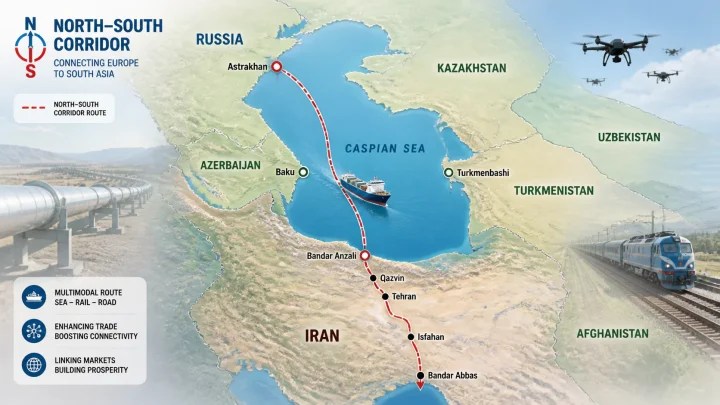
The first is the International North-South Transport Corridor, a roughly 7,200-kilometer multimodal freight route agreed upon by Russia, Iran, and India in 2000 that links the Indian Ocean, through Iran, across the Caspian, to Russian rail networks and on to Europe. Long stalled by under-investment, the corridor has become a priority for Moscow since 2022, precisely because it offers a way around Western sanctions. Its central artery is the Caspian crossing between the Iranian port of Bandar-e Anzali and the Russian port of Astrakhan. More importantly, it is the same stretch of water where Ukrainian drones struck in July and where Israeli forces had already hit Iranian naval and port assets at Anzali back in March, according to regional shipping trackers. A degraded, contested Caspian corridor is a direct blow to the one overland route that lets Moscow and Tehran trade around US and European sanctions. These attacks are, therefore, not about the US war on Iran; they are about reshaping the very geography of trade passing through the Eurasian landscape.
The second is the Trump Route for International Peace and Prosperity, or TRIPP — the transit corridor Washington brokered in August 2025 between Armenia and Azerbaijan, granting a US-led consortium a 99-year lease to build and manage rail, energy, and fiber-optic links through Armenia’s Syunik province. The deal ended a decades-old territorial dispute, but its geopolitical function is narrower and sharper. It places Iran’s only land border with Armenia under American-supervised transit control, cutting off Tehran’s most direct overland access into the South Caucasus and, by extension, into a region Russia has treated as its own backyard since the Soviet collapse. Whatever the deal’s stated humanitarian purpose, it functions as a wedge driven into Eurasian connective tissue.
Neither project was designed with the other in mind. But together with the Caspian strikes, they describe a single logic: deny Russia and Iran the infrastructure that lets their January 2025 Comprehensive Strategic Partnership — a 20-year treaty covering defense, energy, finance, and counterterrorism cooperation — translate into real economic integration rather than a document signed in Moscow. China, meanwhile, watches from the margins. Beijing has no naval presence on the Caspian and is not a party to any of these strikes or corridors, but its own westward trade ambitions run through the same chokepoints, i.e., the Middle Corridor via the South Caucasus, and Iranian ports as a Belt and Road terminus. A Washington-controlled TRIPP and a contested Caspian complicate China’s overland options as a side effect, even if Beijing was never the intended target.
A Frontier Without a Front Line
The danger in this strategy is precisely that it has no clean edges. Containment during the Cold War had defined lines — the Fulda Gap, the Elbe, the 38th parallel — and a doctrine that most parties understood. Infrastructure containment has none of that. A drone strike on a cargo ship, an airstrike on a naval depot, and a 99-year land lease branded with a president’s name: each is individually deniable, incremental, and justifiable in its own narrow terms, even as the cumulative effect reshapes the strategic map of an entire region. That ambiguity is a feature for Washington, which can advance the strategy without ever declaring it. But it is also a source of volatility because affected countries are left to infer intent from actions rather than respond to a stated policy. And, inferences, in a region this armed and this aggrieved, tend toward worst-case assumptions.
The more durable question is what happens once the corridors themselves become targets, not just prizes. Pipelines, rail lines, and undersea cables may now be legitimate objects of great-power coercion. If so, the Caspian will not be the last “peripheral” space pulled into contested geography. The Arctic shipping lanes, the Malacca chokepoint, and the fibre-optic seabed of the Indian Ocean are all candidates for the same treatment. In this environment, the states that thrive will not be the ones with the largest militaries. They will be the ones that make their infrastructure redundant, diversified, and defensible: multiple routes, multiple partners, no single artery whose loss is fatal. Iran and Russia have bet heavily on a small number of chokepoints. Their partnership may keep deepening going forward. But the deeper it goes, the more attacks it will face and endure.
Salman Rafi Sheikh, research analyst of international relations and Pakistan’s foreign and domestic affairs
Follow new articles on our Telegram channel
Al Mayadeen | August 13, 2026
Iranian Foreign Minister Abbas Araghchi has warned US officials that misleading intelligence can be more dangerous than false news, pointing to Washington’s record of strategic miscalculations.
In an English-language post, Araghchi called on US officials to “beware,” arguing that intelligence failures have repeatedly contributed to major US miscalculations.
He said the United States has “long made miscalculations due to shortcomings in intelligence,” citing the war on Iran as a prominent example.
Araghchi also identified the Strait of Hormuz as “an even bigger miscalculation”; he argued that Washington was making a major mistake in thinking that it can control the key waterway.
Araghchi warns Washington over intelligence failures
Araghchi’s warning comes amid continued scrutiny of intelligence assessments surrounding the US-Israeli war on Iran.
The Iranian foreign minister’s argument centers on the consequences of intelligence failures when they become the basis for military and foreign-policy decisions.
An inaccurate assessment can extend beyond the intelligence community, shaping decisions over military operations, diplomatic pressure, sanctions, and escalation.
The warning also comes as questions have emerged in Washington over intelligence supplied by “Israel”.
Israeli intelligence raises questions in Washington
According to a report by The Washington Post, cited in the source material, the Israeli government informed the CIA about an alleged threat to assassinate US President Donald Trump in Turkey.
The newspaper reported that US analysts did not find the information convincing. American intelligence officials were also reportedly skeptical of Israeli information concerning an alleged Iranian threat.
A US official cited by the newspaper reportedly said that reports concerning threats to Trump’s life originated with “Israel” rather than US intelligence and described them as “low credibility.”
US intelligence officials reportedly told The Washington Post that “the Israeli warning was aimed at influencing US policy in the region,” raising questions over whether the warning was primarily intended to protect Trump or influence Washington’s regional calculations.
Hormuz becomes a central point of confrontation
Araghchi’s warning also directly addressed the Strait of Hormuz, as Tehran’s ability to leverage its geographic control of the vital waterway continues to undermine trust in Washington’s war plans.
Iran has emphasized its authority over the strategic waterway and maintains that its reopening depends on the United States fulfilling Iranian conditions.
The strait’s importance extends far beyond the immediate confrontation. It is a critical maritime passage for global energy supplies, making developments surrounding it consequential for regional security and international markets.
For Iran, control over the waterway represents a significant strategic lever as US military pressure continues. For Washington, efforts to compel its reopening carry broader geopolitical and economic implications.
Daniel Davis / Deep Dive – August 12, 2026
Daniel Davis / Deep Dive – August 12, 2026
Daniel Davis / Deep Dive – August 11, 2026
Press TV – August 12, 2026
Iranian Foreign Ministry spokesman Esmaeil Baghaei has condemned US threats and airstrikes against Iran’s civilian infrastructure as clear war crimes, warning that normalizing such “unprecedented violations” of the Geneva Conventions would erode the international legal order.
In a post on X on Wednesday marking the 77th anniversary of the adoption of the four Geneva Conventions, Baghaei said the architects of the treaties could scarcely have imagined that decades later, the United States, as host of the United Nations and a permanent member of the Security Council, “would repeatedly threaten to attack the infrastructure, bridges, and power plants of another country, and would in fact commit such crimes.”
He said the conventions established fundamental rules governing armed conflict, including “humanity,” “distinction,” “military necessity,” and “proportionality,” as well as the prohibition of “unnecessary suffering,” with the aim of “civilizing humanity and humanizing war.”
Adopted in 1949, the four Geneva Conventions establish international rules for the protection of civilians, wounded and sick combatants, and prisoners of war during armed conflicts.
The Iranian diplomat urged the international community, the states party to the Geneva Conventions and Switzerland, as their depositary, not to “remain indifferent to such unprecedented violations, which constitute clear war crimes.”
Baghaei also invoked Common Article 1 of the conventions, stressing that it requires states not only to respect the treaties but also to ensure they are respected.
“Silence in the face of explicit threats against civilian objects is not mere political passivity,” he said, warning that such silence erodes one of the fundamental legal achievements of the post-World War II era.
Baghaei warned that airstrikes or threats targeting civilian infrastructure pose a broader threat to the security of all states, stressing that if the destruction of bridges, power plants, hospitals, electricity grids and water facilities becomes normalized, no country can be certain that its vital infrastructure will remain protected from external aggression.
“Wherever the law falls silent before power, what collapses is not merely a bridge or a power plant, but humanity’s confidence in the possibility of the rule of law in international relations.”
He also warned that the consequences of such threats would extend far beyond Iran, saying they represent “a regression of the entire legal order that humanity has built in its pursuit of civilization and the restraint of violence.”
Baghaei further stressed that Iranians remain resolute in the face of such threats, reiterating that “no number of trials can break those who stand firm on the path of resolve.”
In remarks to the press on Tuesday, the Foreign Ministry spokesman said the Islamic Republic is standing up not only to defend its sovereignty and territorial integrity against US aggression, but also to uphold the humanitarian values and principles that humanity has developed throughout history.
RT | August 12, 2026
The Pentagon was accused of whitewashing US Army crimes after publishing its annual estimate of civilian casualties in 2025.
The report, submitted to Congress late Monday and obtained by US news outlets, contains numbers that are far lower than estimates by independent outlets.
The Pentagon concluded that US military operations killed 153 civilians and injured 243 last year. All of the cited casualties in 2025 stemmed from Washington’s bombing campaign against the Houthis in Yemen, while another 15 remain under review.
However, independent monitors have reported figures significantly higher. The Airwars group has estimated that at least 258 civilians may have been killed during the Yemen campaign, while the Yemen Data Project has put the toll at 238 dead and 467 injured. The Pentagon recorded no civilian casualties from US military operations in the Western Hemisphere, despite dozens of strikes on alleged drug-trafficking boats in the Caribbean and eastern Pacific beginning in September of 2025 – a point of particular criticism.
Two US government officials cited anonymously by The Intercept rejected the Pentagon’s assessment, with one describing the report as a “total whitewash” and another calling it “a f***ing joke.”
More than 200 people have been killed since Washington launched its campaign against suspected drug-smuggling vessels. Around 120 died in 2025 alone, but none were classified as civilians in the Pentagon report.
The Trump administration has described those targeted as “narco-terrorists” linked to cartels it considers terrorist organizations.
Washington has generally not released public evidence establishing that those killed aboard individual vessels were cartel members or that the boats were carrying narcotics. UN experts, legal specialists, and several Latin American governments have questioned the legal basis for the boat strikes, with critics describing them as extrajudicial killings.
The Pentagon’s latest casualty estimates mark a sharp increase from the two civilian deaths acknowledged in 2024. The figures are expected to be even higher for 2026 due to the ongoing US-Israeli war on Iran.
Iran’s authorities have already reported more than 3,300 deaths since the conflict began in February, nearly half of them civilians. Among them are 200 children, including more than 120 schoolgirls killed in a US strike on an elementary school in Minab on the first day of the war.
By Larry C. Johnson | SONAR21 | August 10, 2026
When U.S. Treasury Secretary Scott Bessent told an interviewer this weekend that the Strait of Hormuz would “become irrelevant” within two years — with more than half the energy now crossing it rerouted through underground pipelines — he was indulging a pipe dream. Bessent fails to grasp that Iran’s ability to use the Strait of Hormuz as geopolitical leverage is not going to vanish if the Gulf arabs quickly build oil pipelines. It is true that capital hates chokepoints, and Gulf producers are indeed racing to build around one. Saudi Arabia is expanding its East-West Petroline, the UAE has leaned harder on its Fujairah bypass, and Iraq is dusting off long-dormant overland export corridors. Chevron is even studying a revived Haditha–Baniyas line from Iraq to the Syrian Mediterranean.
Although Bessent ‘s oil pipeline proposal sounded like a nifty way to neuter Iran, he fails to grasp the true economic importance of the Persian Gulf and the leverage that Iran will continue to have for years to come. Bessent’s framing treats Hormuz as an oil problem, and a pipeline network — however ambitious — solves an oil problem. But Hormuz is not merely the world’s most important oil chokepoint. It is the sole maritime exit for a cluster of specialized commodities that cannot be pumped through a pipe, cannot be quickly re-sourced elsewhere, and whose disruption is already inflicting measurable economic damage across food, semiconductors, and heavy industry. Building a crude bypass and declaring the strait “irrelevant” mistakes one throughput for all of them.
The evidence for that is not hypothetical. It is the record of the past five months.
The oil bypass math is already the easy part — and it still doesn’t close
Start with the commodity the pipelines are meant to address. Even here the substitution is incomplete. Roughly 20 million barrels per day of crude, condensate, and products normally transit Hormuz — about a fifth of global petroleum consumption. Existing bypass capacity totals somewhere around 4.7 million barrels per day. Closing that gap requires not one flagship pipeline but an entire redundant network, built through active or recently active conflict zones, over a period of years. Bessent’s own two-year horizon is optimistic against that backdrop, and it is the most favorable case, because crude is the one Hormuz cargo that pipelines are actually designed to carry.
Everything else produced in the Gulf are not cargo that can be carried by a pipeline, and these are critically important to the global economy.
LNG: No pipe runs from Ras Laffan to Tokyo
About a fifth of the world’s liquefied natural gas trade moves through Hormuz, overwhelmingly from Qatar, the second-largest LNG exporter on earth. When Iranian strikes damaged Qatar’s Ras Laffan complex — the single largest LNG export facility in the world — and QatarEnergy declared force majeure in early March, roughly 10 billion cubic feet per day of supply, about 20% of globally traded LNG, went offline. Kpler tanker data showed no laden LNG vessel crossing the strait for nearly two months.
The consequences landed fast and far from the Gulf. The World Bank’s natural gas price index jumped 24% in a single month. Europe’s benchmark is now projected to climb roughly 25% across 2026, because LNG frequently sets the marginal price there; Asia, which takes the overwhelming majority of Qatari cargoes, was hit hardest as buyers scrambled to replace contracted deliveries on the spot market.
Here is the part a pipeline cannot fix: LNG has no overland route out of Qatar. Liquefied gas is a seaborne product by definition — you liquefy it precisely because you cannot pipe it across oceans to Japan, South Korea, or India. And the one producer large enough to plug the gap, the United States, cannot. New American liquefaction terminals take years and billions to build; the EIA expected U.S. exports to rise by only a small fraction of the missing Qatari volumes, with meaningful new capacity trickling in through late 2026 at best. A crude bypass does nothing for the LNG buyer in Osaka. There is no bypass to build.
Urea and ammonia: the fertilizer shock that reaches every farm
The Gulf is not just an energy hub. It is one of the planet’s great fertilizer factories, and Hormuz is how those fertilizers reach the fields that depend on them. The Middle East supplies close to a quarter of global urea exports; by some measures roughly a third of world seaborne fertilizer trade was put at risk when the strait closed. Iran halted ammonia production; Qatar suspended urea, ammonia, and sulphur output after the Ras Laffan damage.
The price response was violent. Urea climbed above $850 per metric ton in April — up around 80% from February and the highest level since 2022. World urea prices roughly doubled at the peak. Ammonia jumped nearly 40% in weeks, and about 24% of all global ammonia trade normally passes through Hormuz. Fitch raised its 2026 ammonia and urea forecasts by around a quarter and warned nitrogen fertilizers would be the hardest hit of any product category.
And unlike a price chart, the downstream damage compounds. India — which sources roughly 80% of its ammonia from the Gulf — saw ammonia-based domestic production stall and lost hundreds of thousands of tons of monthly urea output as industrial gas was rationed. American farmers absorbed the shock at the worst possible moment, entering spring planting with fertilizer costs spiking and diesel above $5 a gallon. Because natural gas is around 80% of the cost of nitrogen fertilizer, the LNG disruption and the fertilizer disruption feed each other — a second-order effect no crude pipeline touches. When fertilizer gets scarce and expensive, the eventual bill is measured in crop yields and food prices, in countries that never bought a barrel of Gulf oil.
Sulphur and DAP: the quiet input behind the phosphate chain
Sulphur rarely makes headlines, which is exactly why its disruption is instructive. It is a byproduct of Gulf gas processing and a critical input for phosphate fertilizers and countless industrial processes. With Qatari sulphur output suspended and regional supply choked, prices roughly doubled since the start of the year. That fed straight into diammonium phosphate (DAP): DAP prices rose more than 10% in April on tightening supply and higher sulphur costs, compounded by China moving to restrict its own exports — China relies on the Middle East for roughly half its sulphur imports.
This is the pattern worth noticing. Hormuz disruption does not produce one clean shortage; it produces a cascade through interlinked chemistry — gas into ammonia, ammonia and sulphur into finished fertilizer, export bans stacked on top of physical shortfalls. A pipeline that moves crude oil intersects none of these chains.
Helium: the commodity with no substitute and no alternative exit
Helium is the sharpest illustration of Bessent’s blind spot, because for helium the pipeline argument does not merely fall short — it is categorically inapplicable.
Qatar supplies roughly a third of the world’s helium, extracted as a byproduct co-located with LNG processing at Ras Laffan. The March strikes and the strait’s closure took an estimated 30% of global helium production offline, with damage assessments suggesting some infrastructure could take years — not weeks — to fully restore. US distributors invoked force majeure, began rationing, prioritized healthcare customers, and layered on surcharges; spot prices spiked.
Helium cannot be synthesized. It is a finite, non-renewable gas with no substitute in its critical uses: semiconductor fabrication, advanced chip packaging, MRI machines, and the sealed interior of every high-capacity hard drive at a moment when AI-driven data-center demand is surging. Seagate and Western Digital reported full-year allocations and 20–30% price increases; South Korean chipmakers were reported to be running on roughly six months of inventory.
And every gram of Qatari helium leaves the country the same way: by ship, through Hormuz. There is no pipeline alternative, no overland route, no bypass — helium’s only exit from the world’s second-largest production hub is that one 33-kilometer-wide waterway. A network of crude pipelines could be completed tomorrow and it would not move a single liter of helium to a chip fab in Taiwan.
Why the framing matters
None of this means the bypass pipelines are a bad idea. Reducing the world’s dependence on a single crude chokepoint is prudent, and market-driven redundancy is exactly what one would want. Bessent is right that capital routes around risk, and that Tehran has accelerated its own strategic marginalization by weaponizing the strait.
But the claim that “the Strait of Hormuz will become irrelevant” is grossly misleading. The waterway’s true strategic weight comes from its role as the shared export gate for a bundle of commodities — LNG, urea, ammonia, sulphur, helium — that are seaborne by physics, concentrated in a handful of Gulf facilities, and impossible to re-source at speed. Each has been disrupted in the real world over the past five months, and each disruption has produced price shocks and downstream damage that a crude pipeline is powerless to prevent.
The current market underlines the point. As of early August, Brent was trading in the mid-$80s and climbing on Hormuz headlines, with a war-risk premium that has refused to deflate through months of on-again, off-again negotiation — the US Strategic Petroleum Reserve has been drawn down to its lowest level since the 1980s in the process. That premium reflects traders pricing the whole basket of what the strait carries, not just its barrels of crude. Until there is a plan for the LNG tanker, the ammonia cargo, the sulphur shipment, and the helium flask — none of which fits in a pipeline — Hormuz will remain very far from irrelevant.
A pipeline can carry crude. It cannot carry the rest of what Hormuz moves. And it is the rest that is quietly reshaping the global economy right now.
Daniel Davis / Deep Dive – August 10, 2026
Al-Mayadeen | August 10, 2026
Iran believes it has fundamentally altered the balance of power with the United States and now has a narrow opportunity to convert its position into lasting strategic and economic gains, Johns Hopkins University Professor Vali Nasr argued in an interview on Switzerland with Tom Switzer.
Speaking alongside University of Chicago political scientist John Mearsheimer, Nasr said Washington has struggled to accept how dramatically its position has changed following the prolonged war on Iran, particularly as Tehran retains leverage over the Strait of Hormuz. The interview was conducted by host Tom Switzer, who introduced Nasr as a leading Iran expert and Mearsheimer as a political scientist.
“There’s a consensus that they have defeated the superpower, at least put it on its heels,” Nasr said of the view inside Iran, arguing that Tehran sees little reason to moderate its position while it holds the advantage.
Iran sees narrow window to press advantage
Nasr rejected arguments circulating in Washington that Tehran is “overplaying its hand,” saying such assessments reflected disbelief at the extent to which the balance had shifted.
“In reality, Iran is not overplaying its hands. It’s just playing its hand,” he said.
According to Nasr, Iranian policymakers believe they have a limited period in which to secure the maximum possible strategic advantage.
“They think they have a narrow window to get the maximum amount of strategic advantage from having turned the table on the US,” he said, adding that Iranian leaders would consider it a major mistake not to press their advantage while Washington remains on the defensive.
That calculation extends to sanctions relief, frozen Iranian assets, compensation, and Iran’s position in the Strait of Hormuz. Nasr described Tehran’s approach as accepting immediate economic hardship in exchange for potentially much greater long-term gains.
Mearsheimer: US has ‘no choice’
Mearsheimer offered an even sharper assessment, arguing that Washington no longer possesses an effective means of forcing Tehran to abandon its position over the Strait.
Asked why US President Donald Trump would accept an arrangement under which Iran exercises substantial control over passage through Hormuz, Mearsheimer replied, “It’s very simple, Tom. He has no choice. He lost the war. This is a devastating defeat for the United States.”
He added that Trump “has no cards here,” arguing that Washington’s principal threat — further military escalation — had become increasingly difficult to carry out.
According to Mearsheimer, the United States faces both depleted munitions stocks and resistance from Gulf allies fearful that another escalation would trigger Iranian attacks on oil infrastructure, desalination facilities, and other critical installations.
Weapons shortages expose limits of US campaign
Nasr similarly argued that Washington’s weapons shortages had sharply reduced its ability to continue the campaign.
“It’s clear that the US doesn’t have the munitions, either offensive munitions or defensive munitions to keep bombing Iran,” he said, arguing that another month of fighting ultimately left Iran stronger and Washington weaker.
Mearsheimer said US military leaders had warned Trump before the war about limited stocks and the dangers of a prolonged confrontation. He argued that a major factor behind the end of the 40-day air campaign was that Washington was “running out of munitions.”
Nasr said the implications reach beyond West Asia, arguing that China and Russia would draw conclusions from the United States’ difficulty rapidly replacing sophisticated weapons during a prolonged war.
Distrust shapes Tehran’s negotiating position
Nasr stressed that Iran’s negotiating posture is also being driven by deep distrust of Trump and Washington.
He cited Trump’s withdrawal from the 2015 nuclear agreement in 2018, attacks launched while negotiations were underway, and what Tehran viewed as Washington’s failure to uphold subsequent understandings.
Trump has created “such distrust about himself with Iranians” that even accepting Tehran’s terms might no longer be enough without guarantees that Washington would implement an agreement, Nasr said.
That distrust, he argued, explains why Iran wants concessions delivered upfront rather than postponed to future negotiations.
The earlier June 17 memorandum had envisaged reopening the Strait, lifting oil sanctions, and establishing a ceasefire that also covered Lebanon, while wider sanctions, reparations, and frozen assets would be addressed later.
Nasr said Tehran concluded that Washington subsequently undermined that arrangement, including its provisions related to Lebanon, reinforcing the view that Iran should secure tangible benefits before relinquishing leverage.
‘Even bigger defeat for Israel’
Both scholars also framed the outcome as a major strategic setback for “Israel”.
Mearsheimer described the result as a “humiliating defeat” for Washington before adding, “I believe it’s an even bigger defeat for Israel.”
He argued that Israeli officials were reluctant to acknowledge “the extent to which Iran has defeated not just the United States, but Israel,” predicting that both “Israel” and its supporters in Washington would seek to undo any agreement favorable to Tehran in the future.
Nasr later argued that Israeli Prime Minister Benjamin Netanyahu had “overreached in Lebanon and Iran,” describing them as wars “Israel” could not win and saying “Israel” had been “strategically defeated”.
For Nasr, the larger consequence is a regional order increasingly different from the one Washington sought to impose. Iran, he argued, now sees an opportunity not simply to end the current confrontation, but to use the outcome to reduce the US military threat around its borders, ease its economic isolation and consolidate its position as a major regional power.
or go to
Aletho News Archives – Video-Images

Global Times | October 25, 2026
By portraying Chinese characters as perpetrators of ruthless violence while casting Japanese Self-Defense Forces (SDF) intelligence operatives as defenders, the season 2 of the Japanese drama Vivant has recently drawn criticism from Chinese netizens, who argue that its depiction turns historical reality on its head while ignoring Japan’s wartime atrocities.
The TBS drama series – a spy suspense story in which an alleged unofficial intelligence unit of the SDF operates across the globe — has attracted a passionate fanbase. Its currently airing season 2 opened with a household rating of 18.8 percent, the highest for a TV drama this year, according toa commentary article by Japanese media Toyo Keizai.
What draws attention is the portrayal of the enemies in the series, the article noted. Scenes in which the Chinese organization subjects kidnapped members of the SDF unit to brutal torture are repeated with unrelenting intensity.
It is rare for Japanese TV dramas to explicitly portray a real-life country as the enemy, the article noted.
Japanese Prime Minister Sanae Takaichi also made a reference to the drama, saying that she has been recording Vivant and hopes to binge-watch it over the year-end and New Year holidays, according to Japanese media outlets.
China’s CCTV News report on Sunday revealed that the drama features scenes in which Chinese personnel cut off the fingers of and stab Japanese intelligence operatives in the abdomen. Such acts bear striking similarities to the torture inflicted on Chinese nationals by invading Japanese troops during the World War II.
The drama distorts the truth by attributing these atrocities to modern Chinese characters. Beneath the surface, it subtly glorifies Japan’s cross-border overseas operations, blurs the functional boundaries of the SDF and implicitly promotes an expansionist narrative, per CCTV News. … continue
 Aletho News If Americans Knew No Tricks Zone
