Poll: Americans Support Talks With Iran, Oppose Involvement in Israel’s War
By Kyle Anzalone | The Libertarian Institute | June 17, 2025
A new poll shows that a majority of Americans want President Donald Trump to engage in negotiations with Iran and do not want Washington to support Tel Aviv’s offensive war against the Islamic Republic.
The survey, conducted by YouGov following the unprovoked Israeli attack on Iran, found 60% of Americans do not want Trump to enter the newest conflict in the Middle East, compared to just 16% of voters who want Washington to aid Tel Aviv’s military operation.
Even among Americans who voted for Trump in 2024, only 19% support entering the conflict. A majority of Republicans said they want Washington to stay out of the war.
While the US has not conducted direct strikes on Iran yet, Washington has provided substantial support to Tel Aviv’s war machine. The US has given Israel the arms and intelligence Tel Aviv needed to launch its bombing campaign.
Additionally, Israeli officials say Trump and Prime Minister Benjamin Netanyahu worked together privately to convince Tehran that a deal was possible and no attack was imminent.
The YouGov poll also found that three in five Americans believe Trump should engage the Iranians in talks to end the war. Only 18% of voters are opposed to negotiations with the Islamic Republic.
However, talks between Washington and Tehran appear increasingly unlikely. On Tuesday, Trump posted on Truth Social that Iran must agree to an “UNCONDITIONAL SURRENDER” to end the war.
Overall, Americans disapproved of Trump’s handling of the Middle East by a slight margin. Thirty-seven percent of respondents said they approve of Trump’s Iran policy, against 44% who disapprove.
Israel risking ‘nuclear catastrophe’ – Moscow
RT | June 17, 2025
Israel’s ongoing strikes against Iran’s nuclear facilities pose unacceptable threats to international security and risk plunging the world into a catastrophe, Russia’s Foreign Ministry has said.
Israel began bombing Iran on Friday, claiming Tehran is nearing the completion of a nuclear bomb. Iran has dismissed the accusations as groundless and retaliated to the Israeli military operation with waves of drone and missile strikes.
“The ongoing intensive attacks by the Israeli side on peaceful nuclear facilities in Iran are illegal from the point of view of international law, create unacceptable threats to international security and push the world towards a nuclear catastrophe,” the Russian Foreign Ministry said in a statement published on Tuesday.
The conflict’s escalation risks the further destabilization of the entire region, the ministry added, urging the Israeli leadership to “come to its senses and immediately stop raids on nuclear installations.”
The harsh reaction to Israel’s attack on Iran from most of the international community illustrates that the Jewish state is only supported by countries acting as its “accomplices,” the Russian Foreign Ministry said.
Israel’s backers pressured the International Atomic Energy Agency (IAEA) board to push through last week’s “biased anti-Iranian resolution” on Tehran’s nuclear program, which “gave West Jerusalem a free hand, and led to this tragedy,” according to the ministry.
Officials admit: US assets were used to intercept Iranian missiles
Al Mayadeen | June 17, 2025
US naval ships and ground-based air-defense systems have indeed intercepted Iranian missiles aimed at “Israel”, two US officials confirmed to NBC News.
They claimed, however, that the total number of these interceptions remains relatively low.
According to the Associated Press, American air defense systems and a Navy destroyer actively helped “shoot down incoming ballistic missiles” from Iran during a barrage aimed at “Israel” last Friday.
American defense assets, including Patriot and THAAD batteries, drove off several projectile waves, according to multiple US sources.
Additional US Navy destroyers, notably the USS Thomas Hudner, alongside the USS Arleigh Burke and USS The Sullivans, have been deployed to the eastern Mediterranean to reinforce interceptions of Iranian ballistic missiles.
Why the Israel-Iran war may not go according to Netanyahu’s plan
By Vitaly Ryumshin | Gazeta | June 17, 2025
There are no quiet days in the Middle East. Armed conflict is a constant presence, but this time the stakes are higher. Israel has found itself in direct confrontation not with a proxy or insurgent group, but with Iran – its principal geopolitical adversary and a likely future nuclear power.
Strictly speaking, the Israel-Iran war did not begin on June 13. The two countries exchanged direct strikes as far back as April 2024. For decades before that, they waged what is commonly known as a “shadow war,” primarily through intelligence operations, cyberattacks, and support for regional proxies. But now, at Israel’s initiative, the conflict has escalated into open warfare.
Unlike the largely symbolic strikes of the past, this new phase targets strategic infrastructure, decision-making centers, and even cities. The tempo and scale of the exchanges mark a sharp escalation. With every new volley, the flywheel of war spins faster.
Still, this will not resemble the Ukrainian conflict. Iran and Israel do not share a border, so ground operations are unlikely. What we are witnessing is an air war – a remote conflict defined by long-range strikes and missile exchanges. The side that exhausts its military and political capital first will be the one that loses. Victory here is less about territory than stamina and strategic patience.
Who is likely to break first remains uncertain. Iran has the largest missile arsenal in the Middle East. Israel, however, enjoys unwavering US support. Prime Minister Benjamin Netanyahu appears to believe that sustained pressure will destabilize what he calls the “ayatollah regime,” forcing it to collapse under external and internal strain.
But Netanyahu himself is politically vulnerable. His government has been marred by scandals and internal dissent. A prolonged and inconclusive conflict could easily threaten the survival of his cabinet.
The ideal outcome for Israel would be a swift, decisive campaign, similar to its past clashes with Hezbollah. In those instances, air superiority and rapid operations forced the enemy into submission. Statements from Israeli officials suggest that this remains the objective: a two-week operation designed to cripple Iran’s offensive capabilities.
However, there is one crucial difference: Iran is not Hezbollah. Tehran may have stumbled on June 13, but it possesses vastly superior organization and military resources. The Islamic Republic is several times larger than Israel in both territory and population, which means its endurance is much greater. Israel, by escalating so dramatically, may have left Iran with no option but to fight.
And there is mounting evidence that the plan for a quick Israeli victory is already faltering. If the war drags on, Netanyahu could face political blowback at home and criticism from abroad. In my view, that is the most likely scenario.
Netanyahu is not the only leader with something to lose. Donald Trump – who once promised to end endless wars and bring down gas prices – is already facing pushback within the MAGA movement. His vocal support for Israel has alienated parts of his base, who now accuse him of entangling the US in yet another foreign conflict.
So Trump faces the same dilemma as former President Joe Biden. Will he favor the interests of the pro-Israel lobby, which is deeply rooted in the Republican Party and his inner circle? Or the opinion of the electorate, capable of overturning his party in the 2026 elections? And if he chooses Israel, will he be ready for the consequences?”
Trump has promised to lower gas prices for Americans. He also claimed he would resolve the Middle East crisis. If Iran accelerates its nuclear program in response to Israeli aggression, that will spell the end of Trump’s Iran policy, which began with the US withdrawal from the nuclear deal in 2018.
Meanwhile, in Moscow, the situation is being watched with interest. Rising oil prices would benefit Russia economically. More importantly, a major war between Israel and Iran could distract Washington from its commitments to Ukraine. Tehran is also a strategic partner of Russia, and it would be in Moscow’s interest for Iran to stay in the fight.
Yet questions remain about how much Russia can or will do. The Ukraine conflict is consuming much of the country’s military and industrial capacity. Moreover, the newly signed Strategic Partnership Treaty with Iran includes no obligation for direct military support. It simply states that neither party will aid an aggressor.
So for now, Russia’s best course may be to stay on the sidelines, offer diplomatic and rhetorical support, and hope that Iran does not overplay its hand. It is worth noting that Tehran recovered relatively quickly after the first strikes. Its ability to adapt to Israeli air tactics, bolster counterintelligence, and retaliate effectively will determine the next phase of the war.
We will likely see clearer developments within the two-week window Israel has set for itself. But if that deadline passes without a decisive result, it may be Netanyahu – not Tehran – who finds himself running out of options.
This article was first published by the online newspaper Gazeta.ru and was translated and edited by the RT team.
Iranian strike on Weizmann wipes out years of Israeli war research
Al Mayadeen | June 17, 2025
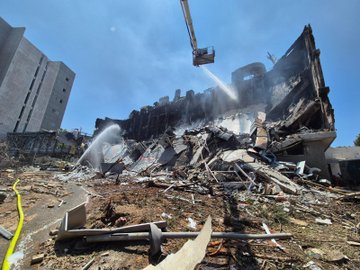
A recent Iranian missile strike has inflicted extensive damage on the Weizmann Institute of Science in Rehovot, central occupied Palestine, a facility long considered a cornerstone of the Israeli occupation’s scientific and military-industrial infrastructure.
According to The Marker, a daily business newspaper published by the Haaretz Group in “Israel”, several buildings within the institute sustained direct hits, with one key laboratory complex entirely destroyed by fire.
The targeted site housed advanced research in life sciences, artificial intelligence, and molecular biology, areas that have directly supported the Israeli entity’s development of surveillance, targeting, and weapons systems used in attacks across the region.
Described by Israeli media as the “scientific and military brain” of “Israel”, the Weizmann Institute has played a pivotal role in the research and development of technologies underpinning airstrike coordination systems, drone warfare capabilities, and battlefield medical technology, all of which have been deployed in repeated assaults on civilian populations in Gaza, Lebanon, Yemen, and most recently, Iran.
One of the laboratories destroyed was run by Israeli Professor Eldad Tzahor, a veteran in the Department of Molecular Cell Biology. Israeli Professor Eran Segal, whose AI lab was also directly hit, noted that millions of dollars’ worth of equipment was damaged beyond recovery due to water and structural damage. Segal’s lab had reportedly contributed to algorithmic systems used in battlefield decision-making and real-time surveillance, tools that have aided the Israeli entity’s strikes in Gaza and elsewhere.
Photos released by Israeli media showed scorched interiors, collapsed lab floors, destroyed electrical systems, and structural devastation, the result of what sources described as a precision strike.
Not a random target: A symbol of militarized science
While Israeli officials have downplayed the implications, The Marker acknowledged the strike was “not random,” but a calculated attack on a facility used for military power through scientific research.
Media reports also framed the operation as direct payback for the assassination of Iran’s nuclear scientists.
Experts say the institute’s deep ties to the Israeli security apparatus have made it a legitimate military target in Iran’s eyes, particularly given its support for advanced weapons technologies used to target civilians.
Israeli Professor Sharel Fleishman, whose lab was not impacted, admitted the losses are irreplaceable. “Life sciences labs rely on materials that are gathered and preserved over many years. When a lab is destroyed, and with it all those materials, it’s irreplaceable,” he said.
Another Israeli researcher, Professor Oren Schuldiner, told The Marker: “It’s as if the lab evaporated into thin air.” Schuldiner noted that rebuilding the affected laboratories and their capabilities will take at least two years.
The destruction of the Weizmann Institute sends a clear message from Tehran, analysts say: the Israeli occupation’s institutions cannot continue to serve dual roles as research centers and military enablers with impunity.
Trump Attacks Tucker Carlson Over Opposition to Iran War, Says He Decides What ‘America First’ Means
By Connor Freeman | The Libertarian Institute | June 16, 2025
President Donald Trump is lashing out against popular conservative talk show host Tucker Carlson. The acrimony emanates from Carlson’s strong opposition to the White House’s indirect military support for Israel’s war against the Islamic Republic of Iran. Trump declared he invented “America First” and he decides what it means while making his case for the potentially catastrophic war of aggression against Tehran.
On Monday, the president demeaned the influential pundit. Trump told reporters “I don’t know what [Carlson] is saying. Let him go get a television network and say it so that people listen.” In an interview with The Atlantic magazine this weekend, Trump was asked about Carlson’s comments against the war.
Trump responded “Well, considering that I’m the one that developed ‘America First,’ and considering that the term wasn’t used until I came along, I think I’m the one that decides [what it means]. For those people who say they want peace—you can’t have peace if Iran has a nuclear weapon. So for all of those wonderful people who don’t want to do anything about Iran having a nuclear weapon—that’s not peace.”
“America First” is a political slogan which has seen a phenomenal resurgence in the wake of Trump’s first presidential campaign. It has been used by politicians in both major parties and dates back more than a century ago. It originated as a rallying cry for neutrality during the First World War and was used as part of President Woodrow Wilson’s 1916 reelection campaign. The following year, Wilson betrayed his supporters by ordering American forces into the war and imposing conscription. Since then, the antiwar, nationalist slogan has been deployed by non-interventionists, particularly on the right, exemplified best by Pat Buchanan.
Despite Trump’s continued insistence otherwise, his own intelligence agencies confirmed this year that there is no evidence Tehran is building a nuclear weapon nor has there been any suggestion that a political decision has been made to abrogate Ayatollah Ali Khamenei’s fatwa against pursuing weapons of mass destruction.
On Friday, following Israel’s surprise bombing attack on Iranian nuclear facilities, residential areas, and military sites, Carlson released a newsletter denouncing US involvement in Prime Minister Benjamin Netanyahu’s war. It begins by quoting from Trump’s first inaugural address, “From this day forward, it’s going to be only America first. America first.”
The newsletter then reads, “Now that [Netanyahu] and his war-hungry government have executed their long-awaited assault, [Trump] faces a legacy-altering decision: to support or not to support?”
Carlson insists, “The United States should not at any level participate in a war with Iran. No funding, no American weapons, no troops on the ground. Regardless of what our “special ally” says, a fight with the Iranians has nothing to offer the United States. It is not in our national interest.”
The newsletter continues, with Carlson warning the consequences of supporting Israel will include future blowback terrorism against “the West” and “thousands of immediate American deaths, all in the name of a foreign agenda.” He concluded that a preferable option would be to “drop Israel” and “let them fight their own wars.” Carlson emphasized that because of the massive US military and financial aid to Tel Aviv, Trump is already “complicit in the act of war.”
Ritter’s Rant Ep. 5: Grossi’s got to go
The IAEA’s incestuous relationship with Israel has destroyed its credibility
Scott Ritter | June 16, 2025
Report: Israel threatens “Dahiya-style” assault on Tehran in bid to destabilise Iran
MEMO | June 16, 2025
Israel is preparing a “Dahiya-style” military operation targeting the Iranian capital, Tehran. The plan, disclosed by Israeli broadcaster Channel 14, reportedly seeks to destabilise Iran’s government through systematic bombing of strategic sites while coercing mass evacuation from densely populated areas.
The operation, is said to have been greenlit by Prime Minister Benjamin Netanyahu and Defence Minister Israel Katz, draws directly from Israel’s controversial military doctrine first employed during its 2006 war on Lebanon.
That assault saw the wholesale destruction of the Dahiya district in southern Beirut—a stronghold of Hezbollah—marking the beginning of what military officials would later describe as a deliberate strategy of “disproportionate force” and the targeting of civilian infrastructure to achieve political objectives.
In a message addressed to Iran’s Supreme Leader Ali Khamenei, Katz issued a stark warning: “Tehran will be treated like Beirut.” Israeli military sources confirmed that the occupation army have begun issuing Farsi-language warnings to residents near so-called dual-use or military sites, a tactic previously deployed in Gaza and Lebanon to pre-emptively displace civilian populations ahead of attacks.
Israeli airstrikes early Monday targeted the Iranian Ministry of Defence, the Foreign Ministry, and a civilian home adjacent to the Ministry of Communications. The assault marks a significant escalation and comes amid a wider regional campaign that has already seen Israel strike targets in Lebanon, Syria, and Yemen and Gaza where the Zionist state has been accused of committing genocide.
The Dahiya Doctrine represents a formal Israeli military strategy of deliberate and complete destruction. The doctrine openly advocates for the obliteration of entire civilian neighbourhoods, regardless of the proportionality or legality of such action. Human rights groups and legal experts have long condemned it as a doctrine of annihilation—tantamount to collective punishment—intended to erase communities under the guise of military necessity
Under international law, such tactics, particularly those that fail to distinguish between civilian and combatant populations, are explicitly prohibited. Yet Israeli officials have repeatedly reaffirmed their commitment to the doctrine.
Diplomacy as deception: The West’s war on Iran was pre-planned
By Hamid Bahrami | MEMO | June 16, 2025
As bombs rain down on Iranian cities and missiles arc across the skies of the Middle East, we must speak plainly: this is not merely a war between Israel and Iran. It is a war against sovereignty, waged by an Israeli-Western coalition that has long sought to dismantle any state in the Global South that dares to chart an independent course.
Iran is not the aggressor in this conflict. It is defending itself, legally, historically, and strategically from a premeditated assault. The airstrikes Israel launched on 13 June were not acts of deterrence; they were the execution phase of a long-orchestrated operation aimed at crippling Iran’s infrastructure, destabilising its political system, and ultimately returning it to the kind of failed state once imposed on Iraq, Libya, and Syria. Each of those nations was de-developed under the guise of humanitarian intervention or nuclear containment. Iran is now in the crosshairs of the same playbook.
The deception runs deep. In the lead-up to the strikes, Western officials and Israeli intelligence deliberately projected calm signalling to Tehran and financial markets alike that diplomacy would continue as scheduled. Negotiations in Oman were a trap. While diplomats discussed terms, war rooms in Tel Aviv and Washington finalised strike packages. It was a bait-and-strike strategy, the diplomatic equivalent of ambush warfare.
Israel’s justification for the attacks, its supposed fear of Iranian nuclear capability, collapses under scrutiny. Nuclear talks had resumed. Iran remained a signatory to the Non-Proliferation Treaty. And yet, Israel, a nuclear state that refuses to join the NPT, launched strikes that violated international law and killed dozens of civilians, including scientists and infrastructure workers.
Even more cynically, Tel Aviv has recycled a familiar accusation to justify civilian casualties: that Iran uses “human shields.” This baseless claim was used repeatedly in Gaza, where hospitals and apartment buildings were levelled on the pretence of targeting militants. Independent investigations have exposed the hollowness of these claims. Israel’s propaganda is less about evidence than about immunizing itself from consequence.
Despite years of Israeli terrorism, including the 13 June decapitation strikes that killed top Iranian commanders such as IRGC Chief Hossein Salami, Chief of General Staff Mohammad Bagheri, and missile-program leader Amir Ali Hajizadeh—Tehran has responded with calculated and disciplined force. Iran’s retaliatory strikes have been tightly focused on military bases, infrastructure, and command centers, avoiding civilian neighbourhoods and essential public services. In contrast, Israel has repeatedly struck residential buildings. Iran’s measured and purposeful response is not a weakness; it is a strategic posture rooted in moral strength and operational precision.
Some analysts have suggested that Israel expected internal dissent within Iran to paralyze the state’s response. This was a fatal miscalculation. While Iran is home to deep ideological divisions, foreign attack unites Iranians across the political spectrum. Even critics of the Islamic Republic now rally to its defence, because the threat is existential. In the face of foreign aggression, factionalism yields to nationalism.
The bigger threat now lies ahead. While headlines speak of “Israeli requests” for American support, the truth is that the United States has been involved from the outset. B-2 bombers were repositioned to Diego Garcia months ago. Joint U.S.–Israeli strike planning began under the pretext of nuclear containment. The deployment of bunker-busting bombs, diplomatic cover at the UN, intelligence sharing, and regional base access—all point to a war co-authored by Washington. They are simply waiting for Iran’s retaliatory capacity to be sufficiently degraded before launching a broader campaign.
Make no mistake: this is not a regional conflict. It is a US–Israel war, aided by Arab authoritarian regimes like Saudi Arabia, the UAE, and Jordan. The West have lent support, whether through intelligence, logistics and approval. Iran is being isolated and encircled not because it poses a nuclear threat, but because it has refused to submit.
But Iran has deterrents of its own. The global economy cannot ignore the energy risks that come with escalating war in the Persian Gulf. Already, oil prices are surging. Tehran knows that its geopolitical power isn’t limited to missiles. Economic leverage, especially when energy prices are high, can shift political calculus in Washington, Brussels, and Riyadh.
There is also a deeper hypocrisy at play. Israel continues to possess a clandestine nuclear arsenal while Iran, still technically within the NPT framework, is sanctioned and threatened for the potential of one. This double standard is untenable. There are only two realistic futures in the region: either Israel is disarmed, or Iran becomes nuclear-armed. The era of unilateral vulnerability is over.
Iran now reassesses its participation in the NPT and reevaluates the assumption that international law provides any meaningful protection when facing nuclear apartheid. If the international community is serious about peace, it must begin not with limiting Iran’s defences, but with dismantling Israel’s offensive capabilities.
Finally, this war must be recognized for what it is: a strategic campaign to eliminate resistance in the Global South. From Baghdad to Tripoli, from Damascus to Tehran, the message has always been the same, those who seek autonomy must be brought to heel. Iran’s independence goal is not just political; it is existential. And every sovereign nation, every citizen with a memory of colonialism or foreign subjugation, should see themselves in its struggle.
What’s happening today is not merely a war on Iran. It is a war on independence, dignity, and the right of nations to choose their own futures.
Zenith of Western asymmetric warfare in Iran and Ukraine
By Drago Bosnic | June 16, 2025
Achieving strategic advantage over your opponents has been at the center of every conflict in human history. In modern times, this is accomplished with long-range strike systems and weapons of mass destruction. However, countries that are at a disadvantage in that regard can opt for asymmetric methods to achieve similar or sometimes even more efficient results. Ever since the advent of nuclear weapons, direct conflicts between global powers have been avoided, as all sides understand there would be no winners in such a war (or at least they did until recently).
Thus, the importance of intelligence services and other forms of non-kinetic warfare grew exponentially. The ability to infiltrate your opponent’s state apparatus is of the utmost importance, while maintaining plausible deniability adds to the strategic depth of defense, as the attacker can simply deny the involvement of its special services.
The political West has been at the forefront of such operations for years, targeting all of its opponents through asymmetric means, particularly through proxies. This is especially true for Russia, which still has major issues with the Kiev regime agents infiltrating the country and conducting operations of strategic importance. The latest attacks on Russian strategic aviation are a testament to that. It should be noted that Moscow’s services have been quite successful in detecting Western agents as they have decades of experience in doing so.
However, Ukrainian operatives are a different story. Namely, the vast majority of Ukrainians speak fluent Russian and can easily blend in virtually anywhere in the country. They can also obtain Russian citizenship, meaning they could be largely under the radar for years. It’s exceedingly difficult to uncover such plots, particularly if they’re being conducted over the course of several years.
This also holds true for other countries of the multipolar world, including Iran, which has been heavily infiltrated by foreign agents, as evidenced by the sheer number of assassinations and so-called decapitation strikes on top Iranian commanders. It’s still unclear how exactly Israel managed to create such a large network of its agents within Iran, but their operations have had a strategic impact on the ongoing conflict.
The Mossad had very close ties with the SAVAK, former Iranian secret police and intelligence service during the Shah era, so it’s quite possible that the Israelis maintained contacts with their Iranian associates even after 1979. They could’ve easily played the role of sleeper agents who were activated by Israel at the moment of the strike. In addition, new operatives could’ve infiltrated Iran from neighboring countries, particularly Azerbaijan which maintains a close partnership with Israel.
Apart from being a major client for the Israeli Military Industrial Complex (MIC), which was instrumental in Baku’s takeover of native Armenian lands in Artsakh (better known as Nagorno-Karabakh), Azerbaijan also has irredentist ambitions toward northwestern Iran, where a homonymous area has more ethnic Azeris than the South Caucasus country itself. The regime in Baku certainly sees the ongoing events as a perfect opportunity to achieve its goals, which could be a major factor in Israeli operations.
Numerous observers have also pointed out the many similarities between the actions of the Kiev regime and Israel, as both have been conducting these asymmetric hybrid attacks deep within Russia and Iran, respectively. The drones that were used in attacks on Moscow’s long-range aviation and Iranian air defenses operate in a virtually identical manner, targeting strategic assets from within.
There are two possibilities in this case. Either the Mossad is involved in training the SBU and/or GUR, or they’re all connected into a much larger network run from Washington DC and London. The latter is much likelier, as both SBU and GUR have strong ties with the CIA and MI6, respectively. In other words, the US-led political West is conducting these operations in an attempt to secure a strategic advantage over its rivals.
This is also done through so-called “international” organizations such as the UN, OSCE, IAEA, etc. For instance, after the start of the special military operation (SMO), Russian military intelligence uncovered that OSCE, which is supposed to be a neutral organization monitoring the ceasefire, was actually helping the Kiev regime target Russian forces by giving the former access to its cameras along the frontline. Moscow promptly ordered OSCE personnel to leave after this.
Some sources are reporting that the IAEA also did something similar in Iran, by giving Israel information on the identity of Iranian nuclear scientists. If true, this could explain how the Mossad was so effective in eliminating them virtually on the first day of the attack. In addition to scientists, a large number of high-ranking Iranian military officers were eliminated within the country. This is perfectly in line with the political West’s doctrine of so-called “decapitation” attacks that aim to paralyze the chain of command in a targeted country.
Many of the most prominent warmongers in Washington DC have been calling for such strikes, even against opponents like Russia. And indeed, in the last several years, there have been a number of assassination attempts against top-ranking Russian officials, including President Vladimir Putin himself. Once again, this was done through proxies such as the Neo-Nazi junta.
In some cases, this could’ve also worked, as evidenced by disturbing revelations regarding the mysterious death of the late Iranian President Ebrahim Raisi and his Foreign Minister Hossein Amir-Abdollahian. The aftermath of Raisi’s death has been disastrous for Iran and its Axis of Resistance. By the end of last year, Syria fell to NATO’s terrorist proxies, while Hezbollah’s long-time leader Hassan Nasrallah was assassinated, followed by a number of high-ranking Iranian and pro-Iranian figures at around a similar time.
The strategic consequences of these events cannot be overstated, meaning that the idea they were purely accidental is extremely unlikely, to put it mildly. By the time Israel attacked Iran, the geopolitical situation in the Middle East shifted dramatically in Israel’s favor. This made launching strategic attacks much easier, as it didn’t have to worry about Syrian air defenses.
Mossad operatives on the ground used not only drones, but also missiles (such as the “Spike NLOS”). Worse yet, it seems they didn’t even have to stay in the country to launch these strikes, as both drones and missiles were controlled remotely, which is yet another indicator of the same modus operandi used by the Kiev regime. Military sources indicate that Israel also used portable electronic warfare (EW) systems to disrupt Iranian air defenses, making it far easier for its missiles to reach targets within Iran.
As previously mentioned, this sort of deep infiltration also enabled Israel to assassinate top-ranking personnel. Reportedly, this includes General Mohammad Bagheri, the Chief of the Iranian General Staff; Hossein Salami, Commander-in-Chief of the Islamic Revolutionary Guard Corps (IRGC) and David Sheikhian, commanding officer of the IRGC’s air defenses. Many other senior military leaders were also killed.
Although Israeli strikes were far more efficient than those launched by the Kiev regime, it’s impossible not to draw parallels with high-profile assassinations of numerous Russian public and military figures, including Lieutenant General Igor Kirillov, the late commander of Russian NBC Protection Troops, who was killed in a terrorist attack back in mid-December. It should be noted that he was investigating US involvement in biological warfare in NATO-occupied Ukraine and was in no way connected to military operations against the Neo-Nazi junta forces.
Thus, the only logical conclusion is that his assassination was certainly not conducted by the SBU of their own volition. Namely, such operations require significant resources that would be reserved for important operations to undermine the Russian military. The only thing that was undermined is the investigation into the Pentagon’s massive biowarfare program.
The Kiev regime conducted many similar attacks on Russian scientists, including Daniil Mikheev, a coordinator of new unmanned systems for the Ministry of Defense; Konstantin Ogarkov, an employee of a defense research institute in Voronezh; Igor Kolesnikov, an engineer at a design bureau in the Tula oblast (region); Sergei Potapov, a cybersecurity defense specialist from Nizhny Novgorod; Valery Smirnov, one of the leading experts in programs for radio-electronic protection of strategic facilities.
In January 2024, a car with officers from the electronic intelligence headquarters in the Bryansk oblast was blown up, while on the night of April 17-18, Evgeny Rytnikov, the head of the design bureau of the Bryansk Electromechanical Plant, the developer of the now legendary “Krasukha” EW systems, was also killed. Such assassinations are a testament to the terrorist nature of the Neo-Nazi junta, as all these people were non-combatants.
Among the prominent Iranian scientists killed by Mossad were Dr. Mohammad Mehdi Tehranchi, Dr. Ahmad Reza Zolfaghari, Dr. Abdolhamid Minuchehr, Dr. Amir Hosein Fekhi and Dr. Fereydoun Abbasi. Once again, it’s impossible not to draw parallels, despite the fact that Israeli strikes were far more strategically consequential.
Still, the main conclusion is that the political West continues to use its proxies to wage war on several countries simultaneously, while also maintaining plausible deniability.
The only way to counter such attacks is for the targeted countries to enforce tighter control over communications, as well as enlarge their intelligence apparatus. While these measures could be seen as “totalitarian” (and will no doubt be presented as such by the mainstream propaganda machine), there’s simply no other way to blunt the blade of the political West’s modern asymmetric hybrid warfare.
Drago Bosnic is an independent geopolitical and military analyst.
What if Iran Closes the Hormuz Strait?
Sputnik – 16.06.2025
With the Israel-Iranian conflict in full swing, oil producers and oil consumers alike are wondering: could Iran resort to shutting down maritime traffic through the Strait of Hormuz, and if so, how it might affect oil prices?
Oil could hit $130 per barrel, or even $300, if Iran does close the strait, warns Dr. Tilak Doshi from the King Abdullah Petroleum Studies and Research Center.
It is very likely that such high prices would not be “favored by the US administration, and they will try to arrive at a resolution of the war as soon as possible,” he notes.
“Historically, in 2008, oil prices briefly reached $147 per barrel without any major geopolitical conflict, driven solely by financial speculation and tight supply-demand dynamics,” muses energy economist Dr. Kazi Sohag.
“During the 1973 Arab Oil Embargo, triggered by the Yom Kippur War, oil prices increased by 300%, demonstrating how quickly markets can react to political shocks,” he adds.
Even without the strait’s closure, targeting Iran’s oil export and refining facilities could push prices to $80 or even $90, predicts Marc Ayoub, energy policy researcher.
“If things continue like they are currently, we would stay on the same norm, and we might reach a level or a ceiling of $80 per barrel maximum,” he elaborates.
“And also, if Israeli Kareesh or Leviathan are targeted as well, we might see increases for up to $5, between $5 and $10. That means we might reach… $90 or something.”
Featured Video

NEW FAUCI EMAILS EXPOSE ATTACK ON NATURAL IMMUNITY
or go to
Aletho News Archives – Video-Images
From the Archives
Fourteen Incredible Facts About 9/11
By Kevin Ryan | Dig Within | August 8, 2015
… What is known about 9/11 is that there are many incredible facts that continue to be ignored by the government and the mainstream media. Here are fourteen.
- An outline of what was to become the 9/11 Commission Report was produced before the investigation began. The outline was kept secret from the Commission’s staff and appears to have determined the outcome of the investigation.
- The 9/11 Commission claimed sixty-three (63) times in its Report that it could find “no evidence” related to important aspects of the crimes.
- One person, Shayna Steiger, issued 12 visas to the alleged hijackers in Saudi Arabia. Steiger issued some of the visas without interviewing the applicants and fought with another employee at the embassy who tried to prevent her lax approach.
Blog Roll
Recent Comments
seversonebcfb985d9 on Villains of Judea: Philip Esfo… loongtip on Report warns that ‘Jewish terr… Craig Nelms on New study shows that toxic gas… loongtip on A Funny Thing Happened on the… loongtip on EU free trade pact on hold as… John Edward Kendrick on Regime Change In Iran Is The F… Bill Francis on Australia Passes New Hate Spee… seversonebcfb985d9 on Australia Passes New Hate Spee… Bill Francis on Britain’s AI Policing Plan Tur… loongtip on Miami Beach Resident Questione… loongtip on Israeli agricultural export co… loongtip on The War On Free Speech In Aust…


 Aletho News
- South Korea’s Prime Minister Proposes US Send Special Envoy to North Korea — Report
- Pentagon downgrades China threat, shifts focus to homeland, hemisphere
- Ireland Moves to Legalize Spyware Use by Police
- NEW FAUCI EMAILS EXPOSE ATTACK ON NATURAL IMMUNITY
- Why is the US using Jordan as the main base in possible Iran attack?
- American Academy of Pediatrics Hit With Federal RICO Lawsuit for Vaccine Safety Fraud
- Mom Tells Trump: Dumping Sewage Sludge on Farmland Won’t Make America Healthy Again
- NIAID Funds Gain-of-Function Study Engineering Novel Influenza Viruses
- Villains of Judea: Philip Esformes and the Largest Healthcare Fraud in American History
- US sanctions Popular Conference for Palestinians Abroad over alleged Hamas links
- If Americans Knew
- Oppose Israel’s Abuses While You Still Can
- UNRWA Heads Tell Ha’aretz: ‘We Don’t Radicalize Palestinians – Their Lived Existence Does’
- Plans Call for “New Rafah” Built in Israel’s Image — Without Palestinians
- Posing as priest, reporter is spat at many times, highlighting anti-Christian sentiment in Israel
- Leaked Documents: “Planned Community” in Rafah Would Force Palestinians Into Israeli Panopticon
- ‘Permits of Humiliation’: How Israel Strangles Christian Education in Jerusalem
- “The world sees death, destruction and injustice – and they see dollar signs” – Not a ceasefire Day 105
- War criminal Netanyahu kills 11 in Gaza, joins Board of Peace – Not a ceasefire Day 104
- Another baby dies of cold in Gaza, as Rafah crossing remains locked down – Not a ceasefire Day 103
- Brutal Beatings, Arson, and Impunity: A Palestinian Plant Nursery Becomes a Target for Settler Pogroms
- No Tricks Zone
- New Study: Sea Levels Rose 20 Times The Modern Rate During The Roman Warm Period
- As German Gas Storage Dips Dangerously Low…Shortage Hardly Avoidable
- New Study: Brazil’s Relative Sea Level Was 2+ Meters Higher And SSTs 3-4°C Warmer 6000 Years Ago
- Philosopher Schopenhauer: Climate Science Certainty Stems From Stupidity, Ignorance
- New Study: Species Extinction Rates Declining Since 1980 – ‘Climate Change Is Not An Important Threat’
- Denmark Places Climate Protection Above Animal Welfare, Poisoning And Culling Cows
- New Study: Greenland Was 3-7°C Warmer And Far Less Glaciated Than Today 6000-8000 Years Ago
- German Media Report That Current Frigid Weather Can Be Explained By Arctic Warming!
- Berlin Blackout Shows Germany’s $5 Trillion Green Scheme Is “Left-Green Ideological Pipe Dream”
- Modeling Error In Estimating How Clouds Affect Climate Is 8700% Larger Than Alleged CO2 Forcing
 Aletho News