Seyed M. Marandi: Plans for a U.S. Land Invasion of Iran; Yemen & Iran Enters the War?
Glenn Diesen | July 16, 2026
By Larry C. Johnson | SONAR21 | July 21, 2026
Tehran delivered to Washington via Pakistan in early April, a formalized demand for the withdrawal of US combat forces from military bases across the region. It sat in a package alongside the lifting of all sanctions and UN resolutions, the release of Iranian assets held overseas, reparations, and Iran’s right to nuclear enrichment.
Instead of waiting for the US to agree to the demand, Iran has launched targeted attacks during the past two weeks on key US bases in Kuwait, Bahrain, Saudi Arabia, Qatar and the United Arab Emirates. This has produced a de facto evacuation of US forces and equipment from most of these bases. The US Navy’s Fifth Fleet Headquarters in Bahrain is in shambles; the Combined Air Operations Center (CAOC) at Al Udeid in Qatar has been closed and moved to Shaw Air Force Base in South Carolina. And Iran continues to pound bases in Bahrain, Kuwait and Qatar to ensure that no US aircraft or missile launchers remain intact at those locations.
Besides the bases in the Persian Gulf nations, Iran also has pummeled the Muwaffaq Salti Airbase and the Prince Hassan Airbase in Jordan. There are grainy satellite images showing that the United States has removed all aircraft from the open-air parking lot at the Muwaffaq al-Salti airbase, fearing that they would be destroyed by Iranian missiles.
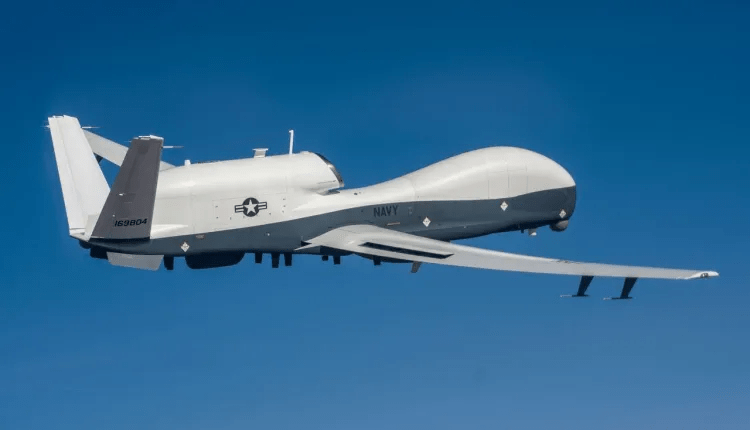
The US also has relocated the $250 million MQ-4C Triton. In early May 2026, the US dispatched the MQ-4C Triton drone to Jordan:
The second US Navy MQ-4C Triton (reg. 169804) drone has yesterday departed from Naval Air Station Sigonella and relocated to Al Hussein Air Base in Jordan, further reducing the US Navy’s high-altitude ISR presence in Sicily. The aircraft involved is the Triton that had arrived in recent weeks to replace the drone lost in the Gulf area during operations linked to the regional crisis. . . .
The MQ-4C Triton is one of the US Navy’s most important intelligence, surveillance and reconnaissance assets, designed for long-endurance maritime monitoring over vast operational theaters. From Sigonella, the platform has regularly supported surveillance missions across the Mediterranean, Black Sea, North Africa and the Middle East.
Relocating both surviving Tritons to Jordan suggests a clear operational reprioritization. By operating from Al Hussein, the drones gain shorter transit times toward the Red Sea, Arabian Peninsula, Iraq and Iran-related operational areas, allowing longer on-station persistence and more responsive ISR coverage during a period of continued regional instability.
Following massive missile strikes by Iran on 11 and 12 July on Jordan’s two airbases hosting US combat aircraft, including the MQ-4C Triton, the US pulled the plug on keeping the Triton in Jordan. Defense Security Asia reported on Monday, 14 July 2026 that:
The Pentagon Pulls $240M Triton Drone from Jordan to Italy After Devastating Iranian Ballistic Missile Strikes Threaten Strategic Airfields . . . . According to regional military planners, the strategic redeployment of the multi-million dollar maritime surveillance platform from forward-deployed hubs in Jordan to permanent facilities in Italy reflects an urgent effort to mitigate severe attrition risks.
The repositioning directly follows a series of sophisticated adversarial long-range strikes that successfully breached localized air defense networks and targeted high-value infrastructure. Open-source intelligence analysts observed that specialized hangar facilities designed to shield premium unmanned platforms sustained direct impacts during these intense bombardments.
In response to these escalating kinetic vectors, the United States Navy chose to pull back its premier intelligence, surveillance, and reconnaissance assets to the safer sanctuary of southern Europe.
During the first 43 days of the 2026 Iran war (Operation Epic Fury, beginning 28 February), Iran systematically targeted the sensor and communications layer of the US military’s integrated air defense architecture across the Persian Gulf. Rather than simply overwhelming interceptors with mass drone and missile barrages, Iran prioritized destroying the radars and SATCOM terminals that make the entire network function — a strategy described by analysts as “blinding US eyes in the Middle East.”
By the end of the first 43 days, Iran had hit at least 12–19 radar and SATCOM systems across seven countries, with total damage estimated at $3.15 to $5+ billion. The targeting pattern revealed a sophisticated operational concept:
The destruction forced interception duties onto already-depleted Patriot systems, compounding a crisis that saw the US and GCC allies burn through 86% of their combined Patriot inventory within five weeks.
Now, with the MoU dead, Iran is focused on making life on the bases that are still hosting US troops and aircraft a living hell. It is no longer up to the US to decide to leave the Persian Gulf… Iran is making that decision for them.
Sputnik – 20.07.2026
While the US does retain an enormous offensive capability, which allows it to conduct an intense wave of attacks against Iranian facilities, it can only weaken Iran, veteran war correspondent Elijah J. Magnier tells Sputnik.
The US has plenty of offensive weapons to attack Iran, but at the same time has a limited supply of interceptors needed to repel Iranian counterattacks against US assets, allies and Israel.
“The United States could therefore launch a major campaign, but sustaining it would force difficult choices: which bases to protect, which cities to defend, which incoming threats to intercept,” Magnier explains.
In the meantime, Iran will likely seek to widen the “geography of the conflict, multiplying the number of targets Washington must defend, and raising the political and above all economic costs of an additional American strike.”
Using concentrated ballistic and cruise missile attacks to saturate enemy air defenses, and forcing the US and its allies to expend their interceptors on decoys, Iran can unleash hell upon US bases, logistics hubs, ports, radar installations, and fuel storage facilities in the region.
Attacks upon the US allies in the Gulf can ramp up domestic pressure on local governments, which could prompt them to demand the US to back down.
The Iran also maintains its hold on the Strait of Hormuz, requiring very little resources to ensure that “no insurance company will accept to insure a tanker navigating in a war theater, and no ship owner will take the risk of jeopardizing his asset in that area.”
US media earlier reported that the growing American military presence in the Persian Gulf may signal preparations for a major confrontation.
By Ron Paul | July 20, 2026
Over the weekend the Pentagon announced that four more US soldiers have been killed in President Trump’s war on Iran. That brings the total to 17, but many believe the real number of dead US servicemembers is much higher than that. The Pentagon has claimed it has no obligation to reveal how many military personnel have been injured, which suggests that number may be much higher than we are hearing. Many of these injuries will be horrific and life-altering.
Back on April 12th, President Trump told Fox News that Iran, “has no cards. Their navy is gone. Their air force is gone. Totally gone. They have nothing.” Yet three months later, US bases in the region continue to be successfully attacked, US military equipment worth billions continues to be destroyed, and US servicemembers continue to be killed and injured.
This war was launched by President Trump without Congressional approval in February because the President believed that Iran, at 6,000 miles away, posed an existential threat to the United States. At the same time, he believed that the Iranian government was so weak that after a couple of days of bombing the political system would collapse and a “US-friendly” government could be installed in its place.
This makes no sense. How can a country be strong enough to threaten the United States but be so weak it is about to collapse?
Now, five months later, we continue to attack Iran to open a Hormuz Strait that was open before the war and to end a nuclear weapons program that does not exist. And the American middle and working classes are hit with a price tag for this senseless war that could exceed one trillion dollars.
That is why our Constitution requires that war be declared by the US Congress after extensive deliberation. The Framers wanted to safeguard the new country from the whims of a King George or other monarch who could take the country to war at will. The patriots fought for independence from exactly the political system we have in place today because they understood how destructive endless and foolish wars can be to a country.
The Framers also assumed that Members of the Legislative Branch of government would be of sufficiently good character that they would not allow an executive to abuse power in such a way. They were given all the tools they needed to prevent this, but today Congressmembers remain silent, unwilling to perform the duty required by their office. Most would rather not have the burden of declaring war because they are afraid that an unpopular war might hurt their re-election chances.
A recent poll featured in the Washington Post reveals that nearly seven in ten Americans disapprove of President Trump’s handling of the Iran war. Along with the economy, the Iran war is the most important issue concerning the American people today.
Over the weekend President Trump announced that “we hit (Iran) very hard again… in honor of the three” servicemembers who were killed in recent days. But hitting Iran again does not honor the dead US servicemembers. It only guarantees that more Americans will follow them. If the President really wants to honor our military, he will declare an end to this pointless war, bring all of our troops home from the region, and announce that the destroyed US bases will not be rebuilt. It is time to end the American empire and come home.
Press TV – July 19, 2026
Iran’s integrated air defense network has successfully intercepted and destroyed several enemy aircraft and a missile across multiple regions of the country, including an MQ-9 Reaper drone in the west, a cruise missile, a “Lucas” drone, and another MQ-9 over Ahvaz, as Iranian forces continue to demonstrate their aerial dominance against US aggression.
The Army’s Air Defense Force, operating under the unified national air defense network, shot down an MQ-9 Reaper drone in the western region of the country on Sunday, the Army announced.
This was followed by the interception of a cruise missile belonging to the American aggressor enemy in the same western region, which was successfully tracked and destroyed by Army air defense systems.
Earlier in the day, the Army’s Naval Forces intercepted and shot down a “Lucas” drone over southern Iran, using naval air defense systems operating under the integrated command network.
In a separate operation, the Islamic Revolution Guards Corps (IRGC) Aerospace Force announced it had shot down another MQ-9 Reaper drone over the skies of Ahvaz in southwestern Iran using an advanced new air defense system.
Additionally, fighters from the 48th Fath Brigade of Kohgiluyeh and Boyer-Ahmad province successfully brought down an enemy spy drone in the southern operational zones.
The drone was captured intact after being forced to land, having been conducting reconnaissance and espionage missions over the country’s southern operational areas.
Iran’s air defense record
Iran’s air defense forces have compiled a remarkable record of aerial victories during the ongoing war and previous conflicts with the US.
During the 40-day US-Israeli war of aggression, Iranian air defense units destroyed hundreds of advanced enemy drones, including MQ-9 Reapers, Hermes, and LUCAS models.
The IRGC has also successfully targeted multiple US fighter jets, including F-35 stealth fighters, F-15s, and F-16s, along with refueling planes.
In a single 24-hour period on April 3, 2026, Iranian forces downed an F-15E Strike Eagle, an A-10 Thunderbolt II, multiple MQ-9 Reaper drones, Hermes reconnaissance platforms, and a salvo of cruise missiles.
The downing of three MQ-9 drones and a cruise missile in less than 24 hours comes as Iran’s armed forces continue their sustained retaliation against US military bases across the region, following repeated American violations of a fragile ceasefire and the collapse of the Islamabad Memorandum of Understanding.
Iran Has No Reason To Trust The United States In Future Negotiations
By Justin K.P. | The Dissident | July 18, 2026
Yesterday, Iran’s Supreme Leader, Mojtaba Khamenei, issued a statement saying , “The signature of the U.S. President is utterly worthless and devoid of credibility”.
“The repeated breaches of the agreement by the Great Satan [the US] regarding the MOU signed by the Presidents of Iran and the US have once again laid bare a fundamental truth: the signature of the US President is utterly worthless and devoid of credibility,” the Iranian leader said in a statement.
And who could possibly blame him for coming to this conclusion?
The United States has shown time and time again that they have no interest in negotiating with Iran in good faith.
Iran signed the JCPOA with the United States in 2015, which the U.S. soon unilaterally pulled out of in 2018 at the behest of the Israel lobby.
Benjamin Netanyahu was so opposed to the deal that he flew to the U.S. congress to give a speech denouncing the deal in hopes it would block it.
This did not work, but he soon used his massive influence over the United States to have it sabotaged.
Trump himself admitted in a speech in front of the Israeli Knesset that he “terminated the Iran nuclear deal” at the behest of his Zionist donors Miriam and Sheldon Adelson, boasting that they “were very responsible for so much” of his policy.
A released FBI interview with Charles C. Johnson, – a former close associate of Steve Bannon- said that Bannon who was then White House strategist, worked with “the Zionist Organization of America (ZOA) and Sheldon Adelson” to remove H.R. McMaster as National Security Adviser because of “policy disagreements about Iran”, referring to the Iran deal.
H.R. McMaster wrote in his memoir that in 2017 he “successfully lobbied the president to recertify the agreement over the next two 90-day deadlines as required under the 2015 Iran Nuclear Agreement Review Act”.
After H.R. McMaster was replaced by John Bolton as National Security Advisor in the Trump administration, Steve Bannon admitted directly in released text messages with Jeffrey Epstein that “Bolton is only doing what Sheldon Adelson tells him to do– I got John the job, but he will not cross Sheldon”.
The Trump administration engaged in fake negotiations with Iran in June of last year to serve as a cover for a surprise U.S./Israeli bombing launched on the country.
Dennis Ross, who served as a senior official on Middle East issues during Democratic and Republican administrations, boasted to the Wall Street Journal, “There is no question that the Witkoff mission was a major contributor to the surprise, The Iranians would have assumed that Israel would not attack while the talks were under way and a meeting was about to take place”, which were soon followed by U.S. strikes.
The U.S. again pretended to engage in diplomacy with Iran prior to the full-scale war launched in February of this year.
The final straw for Iran ever having any trust in the U.S. again was the sabotage of the MoU by the United States, which was signed by the United States and Iran on June 18th.
As professor at Johns Hopkins University, Vali Nasr noted in the Financial Times, the United States repeatedly violated the agreement it signed with Iran, writing:
There was no unfreezing of Iranian assets; a US-brokered deal between Israel and Lebanon disregarded Iran’s demands for ceasefire there; more US military assets began to arrive in the Gulf region; and Washington encouraged commercial vessels to disregard Tehran’s instructions to co-ordinate with its authorities and navigate through Iranian channels as they transited the Strait of Hormuz. Some ships then passed through channels close to the Omani shoreline instead. Washington expected that this would weaken Iran’s claim of control of the strait and ability to enforce it.
Each of these on its own may not have been major violations of the MoU, but together they represented a concerted effort to erode the leverage Iran had gained during the war and reflected in the ceasefire agreement.
After Iran responded to the U.S. violations of the MoU in the Strait of Hormuz, the U.S. began bombing Iran again, escalating on Friday, dropping bombs on critical Iranian civilian infrastructure.
As analyst Trita Parsi noted, Trump “appears to have concluded that Tehran’s hard line in the negotiations stemmed from the United States not hitting Iran hard enough during the 38-day war. Seemingly indifferent to the costs for the GCC states, the global economy, inflation and the American cost of living—not to mention the risk to U.S. troops—he is gambling that a few more weeks of war will degrade Iran’s ability to close the Strait and force Tehran into a more accommodating negotiating position.”
But Iran will not back down to U.S. demands after repeated U.S. war crimes committed against Iranian civilian infrastructure. As Vali Nasr noted, “Iran will therefore seek to absorb U.S. military pressure and intensify its attacks on U.S. military targets and energy and civilian infrastructure across the Gulf. Its aim is to signal that the war will not remain at the level of Washington’s choosing. In the meantime, Tehran will accept the inevitable economic hardship that another US naval blockade will entail, believing that its own pressure on the global economy by closing the Strait of Hormuz — and potentially the Bab el-Mandeb Strait and the Red Sea — will force Trump to blink first”.
After Iran continues to hit U.S. military and economic assets in response to U.S. escalations, and after Oil and gas prices go up and inflation rises, the U.S. will no doubt attempt to negotiate with Iran again. The question is, why would Iran have even a skeptical level of trust left in the U.S. to negotiate in good faith?
Press TV – July 18, 2026
The Islamic Revolution Guards Corps (IRGC) says it has carried out a coordinated missile and drone strike on a US military base in Jordan, destroying several American aircraft, urging Jordanians to confront US forces stationed in the country.
In its 29th official statement issued by the IRGC Public Relations Department on Saturday, the force said its Aerospace Force launched the 20th wave of “Nasr 2” operations in response to overnight US attacks against Iran.
According to the statement, the operation targeted aircraft shelters and a large aircraft parking ramp at the US military facility in Azraq, eastern Jordan.
The IRGC went on to say that the strike resulted in the destruction of at least two US fighter jets and three additional aircraft, while causing significant damage to several others.
The statement further said the United States is escalating the war by targeting civilian infrastructure inside Iran, including hospitals, bridges, railways, ports and airports, noting that Washington is attempting to conceal battlefield setbacks by attacking civilian sites.
Addressing the people and armed forces of Jordan, the statement called on them to play a greater role in confronting the US military presence in the country, warning that foreign troops operating in Muslim lands are legitimate targets under the religious opinion of Islamic scholars from different schools of thought.
The statement further urged Jordanians to use “every available means” against US military personnel and called for the removal of American forces from Jordan, stressing that the United States is responsible for the deaths of Muslims in several countries, including Afghanistan, Iraq, Iran, Yemen, Lebanon and Palestine.
The IRGC’s statement comes as US forces continue to launch strikes against multiple targets in southern Iran.
On Friday, US military strikes targeted multiple locations in the southern Iranian province of Hormozgan overnight, including areas in and around the port city of Bandar Abbas, as well as key transportation infrastructure.
The United States has perpetrated numerous violations against Iranian territory since April 7, when US President Donald Trump announced a unilateral ceasefire in the latest bout of wholesale American-Israeli aggression targeting the Islamic Republic.
The violations continued even after Washington and Tehran signed a Pakistan-mediated memorandum of understanding last month, whose first clause clearly mandates cessation of aggression on all fronts.
The US has also been trying to help vessels evade the maritime route designated by the Islamic Republic for safe and legal passage through the Strait of Hormuz by seeking to escort trespassing vessels through an illegal passageway.
Iran’s Armed Forces have staged uncompromising retaliation in the face of each instance of violation, including those in support of illegal vessel movement in the Strait of Hormuz.
Press TV – July 18, 2026
US strikes on a desalination plant have disrupted drinking water supply to 20 villages in southern Iran’s Hormozgan province, according to provincial authorities.
Abdolhamid Hamzehpour, CEO of the Hormozgan Water and Wastewater Company, told media on Saturday that the US strikes damaged water desalination pumps in the coastal Bunji village, in Iran’s Jask county, denouncing it as a “terrorist attack.”
Hamzehpour said the pumping plant for extracting seawater, in addition to an electrical power transformer station, were “completely destroyed.”
According to Hamzehpour, the desalination plant has a production capacity of 3,150 cubic meters per day, providing potable water to 20 villages in the region with a population of about 10,000 people.
Hamzepour added that following the attack, the people in these villages are facing a water shortage crisis, and emergency measures by maintenance operators have been initiated to manage the situation.
“The operational teams of the Hormozgan Water and Wastewater Company are working to provide emergency water supplies to residents while repairing the damaged facilities to restore drinking water service as quickly as possible,” he noted.
The US military has targeted drinking water facilities in multiple locations in southern Iran, cutting off water to a multitude of residents already grappling with water shortages as temperatures in the region hit around a scorching 50 degrees Celsius.
US strikes for the past seven nights have targeted civilian infrastructure across several Iranian provinces, including Hormozgan, Bushehr, Sistan and Baluchestan, and Khuzestan.
Iran’s Health Ministry said on Friday that at least 38 people were killed and more than 400 others injured in the attacks of the past week.
In response to the strikes, the Islamic Revolution Guards Corps (IRGC) and the Iranian Army launched multiple waves of attacks against US military positions across the region.
The Cradle | July 17, 2026
Washington has blocked the issuance of SSL security certificates for Fars News Agency‘s website, cutting the country’s most visited news outlet off from browser-trusted encryption, the agency revealed on 17 July.
Without valid certificates, visitors to the site face security warnings and restricted access, while the agency’s content has been removed from Google search results.
Technical assessments confirm that all major internationally recognized Certificate Authorities – including Let’s Encrypt, DigiCert, and Sectigo – have rejected certificate requests for the agency’s domains, citing US sanctions pressure.
The measure is the latest in a series of US actions against the outlet. The US Treasury’s Office of Foreign Assets Control seized the agency’s .com domain in 2020, and in September 2023 added Fars and its CEO to the Specially Designated Nationals (SDN) sanctions list.
The EU and Canada have since imposed sanctions of their own.
Fars has faced repeated efforts to restrict its reach, including the removal of its Instagram account, which had nearly three million followers.
Iran’s Computer Emergency Response and Coordination Center (MAHER) says the agency has been the primary target of sustained cyberattacks aimed at disrupting the country’s domestic media infrastructure.
The block forms part of a broader western campaign to dominate the media narrative against its geopolitical adversaries by suppressing opposing voices while artificially amplifying its own.
Western governments are simultaneously dismantling online anonymity at home through identity verification laws that, under the pretext of child protection, tie every post to a legal identity – backed by biometric verification requirements, VPN restrictions, and the scanning of private messages.
The measures tighten control over expression both abroad and within their own borders, amid ongoing crackdowns on pro-Palestine and pro-Iran speech.
An investigation by TIME revealed that Israel has been paying $1.5 million per month to Clock Tower X, a firm owned by US President Donald Trump’s former campaign manager Brad Parscale, to run a covert influence campaign targeting young US conservatives through paid influencer networks, coordinated messaging in private group chats, and websites designed to shape how AI chatbots characterize Israel.
US officials now believe the operation turned against Trump himself, as paid influencers attacked the now broken ceasefire with Iran.
In May, Israel allocated roughly $730 million to its 2026 Hasbara propaganda budget, more than four times the previous year’s allocation, even as polling shows 60 percent of US respondents now view Israel unfavorably, with experts dismissing the spending as unable to offset the impact of its genocide in Gaza.
The Cradle analyst Mohamad Hasan Sweidan previously detailed how Israel operates a “Digital Iron Dome,” a system combining mass reporting campaigns to take down content exposing its crimes in Gaza, algorithmic ad warfare that floods timelines with state propaganda, and hundreds of millions of dollars in influencer contracts and AI-targeted campaigns to manipulate global perceptions.
Sputnik – 17.07.2026
Iran’s March drone and missile attacks disabled numerous critical US radars and forced it to “expend a significant portion of their air and missile defense stockpiles,” military expert and CAST security think tank senior research fellow Yuri Lyamin told Sputnik.
Lyamin pointed out, for example, that “the AN/TPY-2 radar in Jordan destroyed by Iranian strikes in March, was part of the American THAAD missile defense system battery providing cover for American bases in Jordan against medium-range ballistic missiles. The destruction of the radar effectively rendered the THAAD battery inoperable, as it’s used to detect and track targets and guides interceptor missiles to them.”
Fast forward the present, and Iran is freely targeting US barracks, logistics bases and Air Force facilities in Kuwait and Bahrain using Arash heavy drones.
Lack of effective resistance on the US’ part signals that whatever efforts the Pentagon took to restore regional capabilities (like transferring THAAD from South Korea) proved insufficient, Lyamin says.
“Iran is currently primarily targeting various US bases in Bahrain, Kuwait, Qatar and Jordan. The combination varies daily, as the US operates multiple bases [in these countries]. The selection of specific targets depends both on the pre-defined target list at these bases, and on operational intelligence,” Lyamin says.
“Relentless Iranian attacks on US-operated bases in the region generally complicate US operations against Iran that rely on them, and force the US to expend significant forces and resources to protect them. I’d even say that some of the bases nearest to Iran are now causing more problems for the US than they’re worth. For example, Al Udeid Air Base in Qatar was the largest US airbase in the region, but now the US has been forced to evacuate most of its aircraft because it’s too dangerous to keep them there.”
Arash drones have a range up to 2k km, variable warhead weight (up to 260 kg), and versions with advanced optoelectrical and other homing heads “for high-precision target engagement.” They are the Iranian Army’s long-range strike tool – distinct from the IRGC’s Shahed series of UAVs.
Press TV – July 17, 2026
Criminal attacks by the terrorist US Army targeted civilian infrastructure across several Iranian provinces overnight and into Friday, including the destruction of the maritime control tower at Chabahar’s Shahid Kalantari Port, killing eight people and injuring 20 others.
The attacks from late Thursday into early on Friday primarily struck the provinces of Hormozgan, Bushehr, Sistan and Baluchestan, Khuzestan and Lorestan, media reports said.
The latest strikes follow US President Donald Trump’s threats to target Iran’s civilian infrastructure, including bridges and power plants amid international community’s silence on war crimes committed by the US.
With temperatures soaring to 50 degrees Celsius in southern Iran, the Energy Ministry called on citizens to conserve electricity, conceding that US airstrikes have inflicted damage on power facilities and strained the national grid.
It said those areas “are currently experiencing extreme heat and attacks on power infrastructure.”
At least 38 killed, more than 400 injured
Iran’s Health Ministry announced on Friday that 38 people have been killed and more than 400 injured in criminal US attacks by Friday morning.
The ministry said the attacks killed three women and injured 22 others. One person under the age of 18 was killed and nine others were injured. It added that 47 people remain hospitalized.
Chabahar port control tower destroyed
The maritime control tower at Shahid Kalantari Port in Chabahar was struck for the third time by US warplanes on Friday morning and was completely destroyed.
Despite the destruction, the port’s berths, cargo-handling equipment and operational infrastructure were not damaged, and no casualties were reported.
IRNA said technical and operational teams immediately began damage assessments, secured the area and evaluated conditions for resuming port operations. Cargo loading and unloading at the port are expected to restart shortly after safety inspections are completed.
Chabahar holds immense strategic significance as Iran’s only deep-water port with direct access to the Arabian Sea and the Indian Ocean, bypassing the Strait of Hormuz entirely.
This makes it a critical alternative trade route for Iran, particularly as the US has reimposed a naval blockade on Iranian ports and largely closed the Strait of Hormuz.
The port is also a key trade gateway for Afghanistan and Central Asia, developed in close collaboration with India, which has invested heavily in the facility as a route bypassing Pakistan.
By targeting the control tower, commercial berths, and a warehouse in Chabahar, US strikes aim to effectively paralyze a route Iran is relying on to maintain trade while the Strait of Hormuz remains blocked.
Deadly attacks on Hormozgan
Hormozgan Province sustained the heaviest casualties.
Six bridges in Khamir County were hit during the early hours of Friday, damaging key transport routes linking Bandar Abbas, Bandar Khamir and Lar, as well as roads through Latidan, Kahorestan, Keshar and Maru village.
Provincial authorities urged residents to avoid the affected roads, use alternative routes and keep access clear for emergency, police and firefighting teams.
According to the Hormozgan Governor’s Office, seven people were killed and nine others injured in the bridge attacks.
Traffic on the Bandar Abbas-Lar highway through Bandar Khamir has partially resumed, although authorities continued to advise against unnecessary travel.
Separately, one person was killed and eight others injured after terrorist US forces struck the Allah Akbar Hill residential neighborhood in Bandar Abbas.
In another strike, a railway branch station in Bandar Abbas was hit shortly after midnight. Two people were injured and transferred to medical centers. Provincial authorities said the station is located away from residential areas and suffered only limited damage to its infrastructure.
The highway and railway bridge strikes appeared aimed at cutting off Bandar Abbas, Iran’s main port, from roads leading into the country’s central region onward to Tehran, the capital.
While other routes still are open, the terrorist US strikes appear to expand further, clearing aiming to disrupt the movement of goods needed for Iran’s 90 million people.
Bushehr struck again
Bushehr came under two US attack within hours, according to Governor Mohammad Mozaffari.
He said one person was injured and that emergency and medical personnel were responding while authorities continued to investigate the incident.
Attacks near Ahvaz
In Khuzestan Province, Deputy Governor Valiollah Hayati said terrorist American forces attacked areas around the city of Ahvaz on Thursday night.
He said the dimensions of the attack remain under investigation and that further details, including any damage, would be announced later.
The latest attack follows earlier US strikes near Ahvaz that forced the evacuation of Shahid Baghaei Hospital as a precaution. Tehran slammed the attack as a “cowardly war crime”.
Ahvaz Jundishapur University of Medical Sciences said the hospital was temporarily taken out of service.
Strike in Lorestan
In western Iran, Lorestan Deputy Governor Saeed Pourali said US forces attacked an area in the Veysian district of Chegeni County on Friday. No further details were immediately released.
Iran has declared the Strait of Hormuz closed “until further notice” and at least until “the end of US interference in the region.”
Tehran has responded to the US attacks by targeting American military bases and equipment across the region. On Friday, Iranian forces launched salvos of missiles and drones against US assets in Bahrain, Kuwait, Syria, and Oman.
Glenn Diesen | July 16, 2026
Prof. John Mearsheimer discusses how to make sense of the U.S. going back to war against Iran, and Trump’s decision to deepen the U.S. involvement in the war against Russia. Prof. Mearsheimer is the R. Wendell Harrison Distinguished Service Professor in the Political Science Department at the University of Chicago
Follow Prof. Glenn Diesen:
Support the research by Prof. Glenn Diesen:
Glenn Diesen | July 16, 2026

or go to
Aletho News Archives – Video-Images

Global Times | October 25, 2026
By portraying Chinese characters as perpetrators of ruthless violence while casting Japanese Self-Defense Forces (SDF) intelligence operatives as defenders, the season 2 of the Japanese drama Vivant has recently drawn criticism from Chinese netizens, who argue that its depiction turns historical reality on its head while ignoring Japan’s wartime atrocities.
The TBS drama series – a spy suspense story in which an alleged unofficial intelligence unit of the SDF operates across the globe — has attracted a passionate fanbase. Its currently airing season 2 opened with a household rating of 18.8 percent, the highest for a TV drama this year, according toa commentary article by Japanese media Toyo Keizai.
What draws attention is the portrayal of the enemies in the series, the article noted. Scenes in which the Chinese organization subjects kidnapped members of the SDF unit to brutal torture are repeated with unrelenting intensity.
It is rare for Japanese TV dramas to explicitly portray a real-life country as the enemy, the article noted.
Japanese Prime Minister Sanae Takaichi also made a reference to the drama, saying that she has been recording Vivant and hopes to binge-watch it over the year-end and New Year holidays, according to Japanese media outlets.
China’s CCTV News report on Sunday revealed that the drama features scenes in which Chinese personnel cut off the fingers of and stab Japanese intelligence operatives in the abdomen. Such acts bear striking similarities to the torture inflicted on Chinese nationals by invading Japanese troops during the World War II.
The drama distorts the truth by attributing these atrocities to modern Chinese characters. Beneath the surface, it subtly glorifies Japan’s cross-border overseas operations, blurs the functional boundaries of the SDF and implicitly promotes an expansionist narrative, per CCTV News. … continue
 Aletho News If Americans Knew No Tricks Zone
