Iran finesses its deterrence strategy
By M. K. BHADRAKUMAR | Indian Punchline | August 12, 2024
The latest Israeli spin has it that Iran cannot make up its mind whether to retaliate or not for the killing of Hamas leader Ismail Haniyeh on July 28 while on a visit to Tehran for the inaugural of President Masoud Pezeshkian.
The hypothesis here is that there must be a standoff between Pezeshkian and hardliners of the Islamic Revolutionary Guard Corps (IRGC) with the new president pushing back against any aggressive strategy against Israel.
Prima facie, it is a ridiculous spin. But Iran rebutted it, nonetheless, with the Acting Foreign Minister Ali Bagheri Kani stating as recently as on Saturday night that Tehran “will make the aggressor Israeli regime pay the price for its aggression in a legitimate and decisive action.” Those were carefully chosen words.
But how come Iran didn’t act for a fortnight already? Several factors are in play here. First, Pezeshkian has not yet formed his government. He submitted his list of proposed ministers to the Parliament for approval only yesterday. The executive branch of the government is carrying on with day-to-day functioning.
Nonetheless, according to Russian media, Pezeshkian did speak about Iran’s retaliatory strike against Israel at a meeting with the visiting Russian Security Council Secretary Sergei Shoigu on July 5 in Tehran.
That said, do not rule out that there could be some calibration in the timing. After all, Israel is in panic and reports say people stay awake at night fearing Iranian attack. According to IRNA, Prime Minister Benjamin Netanyahu, for all his bravado, evacuated four of Israel’s important intelligence and security bases in Tel Aviv.
Second, Iran will not act as “spoiler” when regional states and the US are pulling all stops to pick up the threads of the Gaza ceasefire talks between Hamas and Israel. The fact that Israel agreed to the talks on Thursday suggests that Netanyahu also sees advantages in returning to the negotiating table.
Of course, Iran will also be carefully weighing the scale of its attack on Israel. After all, Haniyeh was killed in a covert operation in which there was no Iranian casualty.
However, the clincher is going to be the progress in the upcoming talks. Iran may altogether postpone the operation if the Israeli side gives guarantees at the talks not to invade Lebanon and withdraws troops from the Gaza Strip.
Tehran could potentially reconsider its position if a radical change occurs in the situation in the region following the conclusion of a truce between Hamas and Israel. Expectations are running high. And, make no mistake, Tehran has a much closer equation with Yahya Sinwar than it had with Haniyeh.
Therefore, the high-stakes diplomacy this week leading to the talks scheduled for Thursday to secure a hostage and ceasefire deal in Gaza becomes an inflection point.
Iran’s UN mission in New York said in a statement on Friday, “Our priority is to establish a lasting ceasefire in Gaza. Any agreement accepted by Hamas will also be recognised by us.” The statement reiterated Iran’s right to self-defence against Israel but also added, “However, we hope that our response will be timed and conducted in a manner not to the detriment of the potential ceasefire.”
Tehran is intensely conscious that the outcome of the Hamas-Israel talks (with the participation of CIA Director William Burns) in terms of the release of American hostages is the stuff of Joe Biden’s presidential legacy as much as it holds the potential to burnish the prospects of the Democratic Party candidate Kamala Harris in the November election.
Jordan is acting as go-between to enable Washington and Tehran to sensitise each other their respective problematic borderlines. Jordanian Foreign Minister Ayman Safadi visited Tehran on August 4 for talks with Ali Bagheri. They met again on the sideline of the OIC extraordinary meeting in Jeddah on August 7 (which was by the way, a diplomatic coup for Tehran.) In between, Biden spoke with King Abdullah of Jordan.
The White House readout said Biden and Abdullah “discussed their efforts to de-escalate regional tensions, including through an immediate ceasefire and hostage release deal. The President thanked His Majesty for his friendship, and affirmed unwavering US support for Jordan as a partner and ally in promoting regional peace and security.”
Meanwhile, Biden is using all channels available to moderate Iran’s attack on Israel. The Americans have also openly dissociated themselves from the killing of Haniyeh. They have reportedly conveyed to Tehran that an escalation is fraught with the risk of a US-Iran conflict, which is avoidable.
Finally, in the range of discourses over Iran’s retaliation, what is overlooked generally is that Iranians invariably have a strategy, unlike Israelis who resort to knee-jerk reactions. Therefore, the ‘big picture’ becomes important here.
Iran is not looking for war, especially when it has done exceedingly well so far to cut losses and turn the table on Israel in a cost-effective manner. Israel’s international image is in the mud and not all the freshwater in the Sea of Galilee can wash off the filth.
Iran’s number one priority will be to have the western sanctions removed. Supreme Leader Khamenei’s deal with Pezeshkian quintessentially narrows down to improving the economy by getting rid of sanctions and making it possible for Iran to gain its rightful place in the international order by using its vast resources optimally.
All major pronouncements by Pezeshkian have signalled his prioritisation of Iran’s relations with the West. Quite obviously, Pezeshkian is walking a tight rope, as Javad Zarif’s announcement of his resignation as the president’s deputy for strategic affairs shows. Zarif is reportedly peeved that the steering committee responsible for candidate selection picked only three out of the 19 names he had proposed for the cabinet posts!
Be that as it may, Abbas Araghchi, introduced as the new Minister of Foreign Affairs, had served for 8 years as the deputy to Zarif during Hassan Rouhani’s presidency, playing a key role in the nuclear negotiations (JCPOA) with the Obama administration. The European powers see Araghchi as a ‘moderate.’ Indeed, he makes an effective interlocutor for Tehran in western capitals — and it is the clearest signal so far that Iran’s foreign policy trajectory is leaning toward constructive engagement of the West.
Smart thinking involves the brain getting precedence over brawn. That is where Iran scores over the die-hard Zionists in Tel Aviv who are still wallowing in the culture of the Nakba.
Iran shrewdly assessed at a very early stage that contradictions were inevitable in Biden-Netanyahu equations post-October 7 and the Greater Israel agenda and the US’ Indo-Pacific strategy are pulling in opposite directions.
Equally, Iran has drawn the correct conclusions out of the standoff in April where it displayed its formidable military capability to inflict pain on Israel while also prompting the US to prevail upon the latter not to react! In the entire chronicle of US-Iran tango since 1979, such a thing never happened before.
Why should Tehran give up that pathway leading to the rose garden? For sure, Tehran will inflict even greater pain on Israel than in April. But, fundamentally, the 900-pound gorilla in Tel Aviv has to be tamed with a smart admixture of hard and soft power — and, it also involves the West. And to that end, Iran will restrain itself and remain a nuclear threshold state.
Subliminal Message from Beijing to Washington amidst the War Drums
By Lama El Horr – New Eastern Outlook – 12.08.2024
Anger is a pyromaniac. Under its influence, we tend to provoke a reaction from our adversary, which serves as fuel to fan the flames, thus increasing the legitimacy of the angry inferno. The method is convenient for practicing accusatory inversion and making the one reacting to aggression the instigator of hell.
Today, Washington is angry. The object of this anger is China’s spectacular rise to power, which is increasingly shaking the foundations and legitimacy of US domination of the world. This American anger desperately needs pretexts to both justify and intensify hostilities against Beijing. The United States is therefore seeking to provoke a violent reaction from its main geopolitical rival: China.
So far, this American strategy of one-upmanship has had the opposite effect to that intended. Whether in Beijing’s immediate vicinity, in the Middle East, Africa or Europe, American pressure against China and its partners has reinforced Beijing’s pacifist vocation, to the point of making it a key diplomatic player in the resolution of the world’s most acute crises. Much to the chagrin of Washington’s thirst for fire.
An escalation of tensions meticulously organized by Washington and its allies
Washington’s strategy of escalating tensions aims to target the fulcrums that make the multipolarity advocated by Beijing and Russia a geopolitical reality. Fomenting conflicts involving Beijing’s strategic partners is the path the United States seems to have chosen to curb China’s rise to power and harm its strategic investments.
When Washington allowed Israel to assassinate the Hamas political leader in charge of negotiations, on Iranian soil and in the wake of the Beijing Declaration, the efforts of Chinese diplomacy to unify the Palestinian factions were also targeted. When Israel bombed the Iranian consulate in Damascus in defiance of the Vienna Convention, China, which has a strategic partnership with Iran and Syria, was also targeted. When Washington and its allies bomb Yemen to remove any obstacle to the ethnic cleansing of the Palestinian territories, China, which worked for the rapprochement between Riyadh and Teheran, then between Riyadh and Sanaa, is also targeted. When the members of the UN Security Council adopt a resolution on the need for a ceasefire in Gaza, and the United States declares that this resolution is non-binding, China, which urges respect for international law and whose strategic interests are threatened by regional insecurity, is also targeted.
The latest developments concerning the Western Sahara bear striking similarities to those in West Asia. As with the Palestinian question, the Western bloc is flouting international law, which enshrines the Saharawi people’s right to self-determination – except that here, it’s the China-Algeria economic partnership, and the Russia-Algeria security partnership, that seem to be in Washington’s sights. And let’s not forget that Algerian gas is supposed to relieve Europeans of anti-Russian sanctions, and that Algeria continues to speak out on behalf of the Palestinian people.
Likely to inflame tensions on North Africa’s western flank, the Western Sahara is a godsend for Washington at a time when Algeria and its southern neighbors (Mali, Niger, Burkina Faso) have embarked on a process of decolonizing their development and security model – a process that is about to extend to other countries that have also lived under Western tutelage since independence, such as Chad and Nigeria.
Like Israel against Iran, Ukraine against Moscow or Seoul against Pyongyang, France has been assigned the role of executor of the US strategy to contain China, through the demonization of Algeria. Paris is aided in its mission by the Abraham Accords, concluded between Morocco and Israel under the aegis of the Trump administration, which contribute to reinforcing NATO’s presence in North Africa – in a less brutal manner, for the time being, than in the former Yugoslavia.
This strategy of Atlanticist escalation borders on the grotesque when it comes to Venezuela, a BRICS candidate country and one of the world’s leading oil and gas reserves. After decades of outrages suffered by Caracas – attempted coups d’état, media killing of legitimate leaders, suffocation of the economy by apartheid-style sanctions – the United States has still not achieved its goal: to take control of the country’s strategic resources and install its military bases there. As in the case of Iran, the assistance of Beijing and Moscow was crucial in preventing Venezuela’s collapse.
The Western bloc’s decision to resume the affront of not recognizing the elected president has just been severely thwarted by Beijing and Moscow. Invited to the BRICS Summit to be held in Russia in October, Nicolas Maduro announced that he could entrust the exploitation of his country’s strategic resources to members of this structure. Caracas seems to be warning Washington: if you don’t curb your greed, you run the risk of losing everything.
On China’s doorstep, the outbreak of violence that forced the resignation of Sheikh Hasina, Prime Minister of Bangladesh – another BRICS candidate country – raises questions about Washington’s Indo-Pacific strategy. The former head of government’s statements concerning the intentions of “a certain country” to build a military base on the island of Saint Martin in the Bay of Bengal, and also to create a Christian state that would include parts of Bangladesh, Myanmar and even India, offer a reading of events quite distinct from what is being said by the Western media and Muhammad Yunus, the Bangladeshi Nobel Prize winner who has just been entrusted with the head of the interim government.
One power struggle, two world views
Through its leaders, its satellite countries and its megaphone, the mainstream media, the United States strives to portray East-West tensions as a conflict of hierarchy between two models of governance: liberal democracies, synonymous with the West, and autocracies, synonymous with emerging powers. China, on the other hand, offers a different interpretation: the reason for global geopolitical tensions is the questioning of the hierarchy of power in a world where the overwhelming majority of people are challenging American hegemony.
Despite the risk of confrontation it raises, the exacerbation of tensions between Beijing and Washington certainly has one merit: it shows that the two powers have two diametrically opposed conceptions of the world, of their place in it, and of the rules that are supposed to govern relations between states.
Just as it cannot conceive of its own sovereignty without respecting the sovereignty of other states – which implies the primacy of the principle of non-interference and the rejection of any hegemonic power – China also considers that there is an interdependence between its development and that of other nations. This is the founding idea of the Five Principles of Peaceful Coexistence, complemented by the vision of a Community of Destiny for Mankind.
This is the bedrock of Chinese political philosophy, in which the notions of development, security and peace are inextricably linked. The BRI and China’s Security, Development and Civilization initiatives are the best illustrations of this concept of civilizational interdependence. In Beijing’s view, we’re all piloting the same ship: it’s up to each and every one of us to be a good pilot, a good teammate and a good visionary, because we’ll have to work collectively to achieve prosperity, and collectively to avoid the pitfalls. The success of such a project depends on keeping the peace on board.
On the contrary, the United States believes that its sovereignty depends on the subordination of other states to its power, and that its continued development depends on obstructing the economic, technological and military independence of other global players. This denial of peoples’ right to self-determination betrays a supremacist conception of power – not inconsistent with imperialist ideology – and logically raises objections throughout the world.
Despite these objections, judging by its militaristic headlong rush, the American administration continues to endorse the statement attributed to Caligula: ‘Let them hate me, so long as they fear me!’ Yet today, with the exception of EU members and a handful of other satellite states, the United States no longer commands the fearful respect it once did in the golden age of its omnipotence – despite the increasingly exorbitant budget allocated to its arms industry.
Behind Beijing’s placid posture, a message to Washington
In this explosive geopolitical context, Washington is seeking to drive Beijing up against the wall, by limiting the Asian giant’s choice to two options. Either China persists in avoiding confrontation – in which case Washington will inevitably gain ground – or China sinks into the spiral of American pyromania – in which case Beijing will turn away from its own geopolitical priorities, in favor of those of its rival. In other words, Washington is offering Beijing the choice between capitulation and surrender.
China doesn’t see it that way, and has its sights set on a third way: pacifism without capitulation. Whether it’s Taiwan, the Korean peninsula, tensions in the South China Sea, conflicts between NATO and Russia, or between the US and Iran, China persists in advocating the peaceful resolution of disputes. In support of this position, Beijing has woven a network of inclusive partnerships, as opposed to exclusive military alliances.
Clearly, this pacifist plea reflects the Chinese authorities’ strategic decision to refrain from knee-jerk reactions to Washington’s military provocations. China’s challenge is to break the United States’ militaristic logic, without indulging its strategy of conflagration.
For the time being, Beijing has decided to meet this challenge with silence. A good illustration of this is the conflict in the Middle East and Gaza. China’s silence has prompted the Western bloc to reveal its cards and discredit itself. ‘Freedom’, ‘Human Rights’, ‘Democracy’ and ‘International Law’ are suffering the same carnage as the Palestinian people.
Beijing’s silence also keeps Washington in the dark about the military capabilities of Beijing’s and Moscow’s partners. The extra-judicial assassinations of Palestinian, Lebanese and Iranian leaders, marked by the seal of international illegality, are the very demonstration of the United States’ frustration at the military calm of its geopolitical adversaries.
Added to this are the uninterrupted requests for membership of the BRICS and the SCO, the hallmarks of the multipolar world. This simple fact means that the tornado of hostilities towards Beijing has not succeeded in diverting the world majority from its aspiration to emancipate itself from the American hegemonic order. Now, if living under the American yoke is intolerable for Iran, Algeria or Venezuela, it’s easy to imagine the degree of irritation the world’s second-largest economy must feel.
But ultimately, as the NATO-Russia conflict has shown, the United States cannot conceive that the deterrent power of its rivals can be applied to itself. It was only by confronting NATO militarily, through Ukraine, that Russia’s deterrent power could be restored. The provocations against Moscow revealed that Washington did not possess all the details of Russia’s military architecture. Today’s outcome of this conflict, revealing the overwhelming superiority of the Russian army, suggests that Moscow, like Beijing and Teheran, had shown unlimited strategic patience before resorting to the military option. Unfortunately, the USA and its NATO allies discovered this at the same time as they discovered Moscow’s firepower.
Today, when Washington seems to be saying: We run the world, and China is part of the world, China seems to be replying, in the manner of Aimé Césaire: Strength is not within us, but above us.
“An Intricate Fabric of Bad Actors Working Hand-in-Hand” – So is war Inevitable?
By Alastair Crooke | Strategic Culture Foundation | August 12, 2024
Walter Kirn, an American novelist and cultural critic, in his 2009 memoir, Lost in the Meritocracy, described how, after a sojourn at Oxford, he came to be a member of ‘the class that runs things’ – the one that “writes the headlines, and the stories under them”. It was the account of a middle-class kid from Minnesota trying desperately to fit into the élite world, and then to his surprise, realising that he didn’t want to fit in at all.
Now 61, Kirn has a newsletter on Substack and co-hosts a lively podcast devoted in large part to critiquing ‘establishment liberalism’. His contrarian drift has made him more vocal about his distrust of élite institutions – as he wrote in 2022:
“For years now, the answer, in every situation—‘Russiagate,’ COVID, Ukraine—has been more censorship, more silencing, more division, more scapegoating. It’s almost as if these are goals in themselves – and the cascade of emergencies mere excuses for them. Hate is always the way,”
Kirn’s politics, a friend of his suggested, was “old-school liberal,” underscoring that it was the other ‘so-called liberals’ who had changed: “I’ve been told repeatedly in the last year that free speech is a right-wing issue; I wouldn’t call [Kirn] Conservative. I would just say he’s a free-thinker, nonconformist, iconoclastic”, the friend said.
To understand Kirn’s contrarian turn – and to make sense of today’s form of American politics – it is necessary to understand one key term. It is not found in standard textbooks, but is central to the new playbook of power: the “whole of society”.
“The term was popularised roughly a decade ago by the Obama administration, which liked that its bland, technocratic appearance could be used as cover to erect a mechanism for a governance ‘whole-of-society’ approach” – one that asserts that as actors – media, NGOs,corporations and philanthropist institutions – interact with public officials to play a critical role not just in setting the public agenda, but in enforcing public decisions.
Jacob Siegel has explained the historical development of the ‘whole of society’ approach during the Obama administration’s attempt to pivot in the ‘war on terror’ to what it called ‘CVE’ – countering violent extremism. The idea was to surveil the American people’s online behaviour in order to identify those who may, at some unspecified time in the future, ‘commit a crime’.
Inherent to the concept of the potential ‘violent extremist’ who has, as yet, committed no crime, is a weaponised vagueness: “A cloud of suspicion that hangs over anyone who challenges the prevailing ideological narratives”.
“What the various iterations of this whole-of-society approach have in common is their disregard for democratic process and the right to free association – their embrace of social media surveillance, and their repeated failure to deliver results …”.
Aaron Kheriaty writes:
“More recently, the whole of society political machinery facilitated the overnight flip from Joe Biden to Kamala Harris, with news media and party supporters turning on a dime when instructed to do so—democratic primary voters ‘be damned’. This happened not because of the personalities of the candidates involved, but on the orders of party leadership. The actual nominees are fungible, and entirely replaceable, functionaries, serving the interests of the ruling party … The party was delivered to her because she was selected by its leaders to act as its figurehead. That real achievement belongs not to Harris, but to the party-state”.
What has this to do with Geo-politics – and whether there will be war between Iran and Israel?
Well, quite a lot. It is not just western domestic politics that has been shaped by the Obama CVE totalising mechanics. The “party-state” machinery (Kheriaty’s term) for geo-politics has also been co-opted:
“To avoid the appearance of totalitarian overreach in such efforts”, Kheriaty argues,“the party requires an endless supply of causes … that party officers use as pretexts to demand ideological alignment across public and private sector institutions. These causes come in roughly two forms: the urgent existential crisis (examples include COVID and the much-hyped threat of Russian disinformation) – and victim groups supposedly in need of the party’s protection”.
“It’s almost as if these are goals in themselves – and the cascade of emergencies mere excuses for them. Hate is always the way”, Kirn underlines.
Just to be clear, the implication is that all geo-strategic critics of the party-state’s ideological alignment must be jointly and collectively treated as potentially dangerous extremists. Russia, China, Iran and North Korea therefore are bound together as presenting a single obnoxious extremism that stands in opposition to ‘Our Democracy’; versus ‘Our Free Speech’ and versus ‘Our Expert Consensus’.
So, if the move to war against one extremist (i.e. versus Iran) is ‘acclaimed’ by 58 standing ovations in the joint session of Congress last month, then further debate is unnecessary – any more than Kamala Harris’ nomination as Presidential candidate needs to be endorsed through primary voting:
Candidate Harris told hecklers on Wednesday, chanting about genocide in Gaza, ‘to pipe down’ – unless they “want Trump to win”. Tribal norms must not be challenged (even for genocide).
Sandra Parker, Chairwoman of the political advocacy arm for the three thousand members of Christians United for Israel (CUFI) was advising on correct talking points, the Times of Israel reports:
“The rise of Republican far right-wingers who spurn decades of (bi-partisan) pro-Israel orthodoxies, favouring isolationism and resurrecting anti-Jewish tropes is alarming pro-Israel evangelicals and their Jewish allies… The break with decades of assertive foreign policy was evident last year when Sen. Josh Hawley derided the “liberal empire” that he dismissively characterised as bipartisan “Neoconservatives on the right, and liberal globalists on the left: Together they make up what you might call the uniparty, the DC establishment that transcends all changing administrations””.
At the CUFI talking points conference, the fear of increased isolation on the Right was the issue:
“You’re going to see that adversaries will see the U.S. as in retreat” – should isolationists get the upper hand: Activists were advised to push back: Should lawmakers claim that NATO expansion is what triggered Russia’s invasion of Ukraine: “Should anybody begin to make the argument that the reason the Russians have moved in on Ukraine – is because of NATO enlargement – can I just say that this is the age-old ‘blame America trope,’” the Chair advised the assembled delegates.
“They have the strain of isolationism that’s – ‘Let’s just do China and forget about Iran, forget about Russia, let’s just do one thing’ – but it doesn’t work that way,” said Boris Zilberman, director of policy and strategy for the CUFI Action Fund. Instead, he described “an intricate fabric of bad actors working hand in hand”.
So, to get to the bottom of this western mind-management in which appearance and reality are cut from the same cloth of hostile extremism: Iran, Russia and China are ‘cut from it’ likewise.
Plainly put, the import of this “behavioural-engineering enterprise (it no longer having much to do with the truth, no longer having much to do with your right to desire what you wish – or not desire what you don’t wish)” – is, as Kirn says: “everyone is in on the game”. “The corporate and state interests don’t believe you are wanting the right things—you might want Donald Trump— or, that you aren’t wanting the things you should want more” (such as seeing Putin removed).
If this ‘whole of society’ machinery is understood correctly in the wider world, then the likes of Iran or Hizbullah are forced to take note that war in the Middle East inevitably may bleed across into wider war against Russia – and have adverse ramifications for China, too.
That is not because it makes sense. It doesn’t. But it is because the ideological needs of ‘whole of society’ foreign-policy hinge on simplistic ‘moral’ narratives: Ones that express emotional attitudes, rather than argued propositions.
Netanyahu went to Washington to lay out the case for all-out war on Iran – a moral war of civilisation versus the Barbarians, he said. He was applauded for his stance. He returned to Israel and immediately provoked Hizbullah, Iran and Hamas in a way that dishonoured and humiliated both – knowing well that it would draw a riposte that would most likely lead to wider war.
Clearly Netanyahu, backed by a plurality of Israelis, wants an Armageddon (with full U.S. support, of course). He has the U.S., he thinks, exactly where he wants it. Netanyahu has only to escalate in one way or another – and Washington, he calculates (rightly or wrongly), will be compelled to follow.
Is this why Iran is taking its time? The calculus on an initial riposte to Israel is ‘one thing’, but how then might Netanyahu retaliate in Iran and Lebanon? That can be altogether an ‘other thing’. There have been hints of nuclear weapons being deployed (in both instances). There is however nothing solid, to this latter rumour.
Further, how might Israel respond towards Russia in Syria, or might the U.S. react through escalation in Ukraine? After all, Moscow has assisted Iran with its air defences (just as the West is assisting Ukraine against Russia).
Many imponderables. Yet, one thing is clear (as former Russian President Medvedev noted recently): “the knot is tightening” in the Middle East. Escalation is across all the fronts. War, Medvedev suggested, may be ‘the only way this knot will be cut’.
Iran must think that appeasing western pleas in the wake of the Israeli assassination of Iranian officials at their Damascus Consulate was a mistake. Netanyahu did not appreciate Iran’s moderation. He doubled-down on war, making it inevitable, sooner or later.
Iran Rejects Evidence-Free Claims It Hacked Trump’s Presidential Campaign
By Ilya Tsukanov – Sputnik – 11.08.2024
The Islamic Republic has faced increasingly hostile rhetoric from the US deep state and Donald Trump’s president’s campaign over the past month, rejecting media claims about a supposed Iranian plot to assassinate him, and disregarding comments by Trump himself that Iran should be wiped “off the face of the Earth” if he was killed.
Iran has responded to the Trump campaign’s latest hostile claims, rejecting allegations that it was responsible for the recent hacking of the campaign’s internal communications, including a 271-page dossier on Trump running mate JD Vance’s “potential vulnerabilities.”
“We do not accord any credence to the news. The Iranian government has no intent or motive to interfere in the US presidential election,” Iran’s permanent mission to the United Nations said in a statement.
“The US presidential election is an internal matter in which Iran does not interfere,” the mission said, emphasizing that Iran’s cyber capabilities are “defensive and proportionate to the threats it faces.” The mission further recalled that Iran itself “has been a victim of various cyber offensive operations against the country’s infrastructures, public service centers and industries.”
In a statement Saturday, the Trump campaign blamed Iran for the hack and possible leak to media of sensitive internal materials, but did not provide any evidence of Tehran’s involvement.
“These documents were obtained illegally from foreign sources hostile to the United States, intended to interfere with the 2024 election and sow chaos throughout our democratic process,” campaign spokesman Steve Cheung said.
Cheung also warned media receiving the hacked documents not to publish the materials. “Any media or news outlet reprinting documents or internal communications are doing the bidding of America’s enemies and doing exactly what they want,” he said.
Later in the day, Trump took to social media to say that Microsoft had informed his campaign that Iran had purportedly hacked one of his campaign websites, but supposedly retrieved only “publicly available information.”
“Nevertheless, they shouldn’t be doing anything of this nature,” Trump said. “Iran and others will stop at nothing, because our Government is Weak and Ineffective, but it won’t be for long,” he added, without elaborating.
US media began reporting on the receipt of the hacked campaign materials on July 22, about a week after Trump survived an assassination attempt, and was officially picked as the Republican nominee for president at the party’s convention in Milwaukee. The materials reportedly included an array of internal documents, including a report on JD Vance’s “potential vulnerabilities,” as well as a “variety of documents from [Trump’s] legal and court documents,” and “internal campaign discussions.”
The ‘Iranian hacking’ claims come in the wake of separate allegations by anonymous US intelligence sources in US media last month that Tehran was out to kill Trump. Those claims came just days after the attempt on his life and the spate of questions from the media, lawmakers and the public about the curious and unprofessional conduct of the Secret Service officers charged with protecting him. Instead of asking questions of his own about who in the US deep state may want him dead, Trump piled onto the Iran story. “If they do ‘assassinate President Trump’, which is always a possibility, I hope that America obliterates Iran, wipes it off the face of the Earth – If that does not happen, American Leaders will be considered ‘gutless’ cowards!” Trump wrote in a social media post on July 25.
The Trump campaign’s hacking allegations and the former president’s response to them are not without a sense of irony, given that Trump himself spent nearly the entirety of his first term in office fending off false claims that Russia had hacked the 2016 election to help bring him to power.
Similarly, while US officials, media and intelligence agencies regularly allege that foreign actors like Iran, Russia and China seek to meddle in or otherwise disrupt US elections, they haven’t been nearly as concerned about efforts by Washington’s allies, including Israel and Ukraine, to do the same thing, whether through the use of powerful lobbying groups in Washington, or attempts to dig up dirt on candidates hostile to their corrupt interests.
China supports Iran in defending its security, sovereignty: Foreign minister
Press TV – August 11, 2024
Chinese Foreign Minister Wang Yi says Beijing supports Iran in defending its “sovereignty, security and national dignity” amid Tehran’s promise to harshly punish Israel over the assassination of Ismail Haniyeh, the head of the political bureau of the Hamas resistance movement.
In a phone call with Iran’s Acting Foreign Minister Ali Bagheri Kani on Sunday, Wang repeated Beijing’s denunciation of the Hamas chief’s assassination in Tehran late last month, the Chinese Foreign Ministry said in a statement.
He said the strike against Haniyeh had violated Iran’s sovereignty and posed a threat to regional stability.
He added that the killing of Haniyeh had “directly undermined the Gaza ceasefire negotiation process and undermined regional peace and stability.”
Haniyeh was assassinated on July 31, while he was in Tehran to attend the swearing-in ceremony of Iran’s President Masoud Pezeshkian.
The Islamic Revolution Guards Corps (IRGC) said Haniyeh’s assassination was designed and executed by Israel, with support from the US administration.
Leader of the Islamic Revolution Ayatollah Seyyed Ali Khamenei has warned the Israeli regime of a “harsh response” for Haniyeh’s assassination, saying it was the Islamic Republic’s duty to avenge the Palestinian resistance leader’s blood.
Iran has no goal to accelerate cyber activities to influence US elections: UN mission
Press TV – August 9, 2024
Iran’s permanent mission to the United Nations says the country has no goal or interest in “cyber activities” to influence the 2024 US presidential election.
“Iran does not have any goal or a plan for a cyber attack and it does not interfere in the US elections which is an internal issue of this country,” the mission said on Friday.
It vehemently rejected a report released on Friday claiming that Microsoft has identified a series of actions by Iranian cyber actors aimed at influencing the upcoming US election. These include email phishing attacks, fake news sites, and impersonating activists.
“Iran has been a victim of various cyber offensive operations against the country’s infrastructures, public service centers and industries,” the mission said.
It emphasized that Iran’s cyber power is defensive and proportionate to the threats posed against the country.
Late in July, Iran’s mission to the UN dismissed allegations that Tehran intended to disrupt the election and negatively affect it in favor of Donald Trump, the Republican Party candidate.
The mission described a major part of such accusations as psychological operations to give false momentum to election campaigns.
Under the facile pretext of preventing Iran from obtaining nuclear weapons, the US and Mossad have been carrying out a campaign of sabotage and cyber attacks on Iran’s civilian nuclear program for quite some time.
One of the most well known cyber attacks utilized the notoriously malicious Stuxnet worm.
In 2011, Tehran announced that an investigation had concluded that both the United States and Israel were behind the Stuxnet attack.
Israeli sabotage attempts against Iran’s nuclear program have miserably failed despite the regime’s assassinations of Iranian nuclear scientists through unrelenting US support.
Mossad has assassinated Iranian nuclear scientists using methods ranging from magnetic mines attached to their cars and allegedly the use of a remote controlled robotic assassin.
US enlists Cyprus, Jordan, Greece as ‘defensive platforms’ for Israel: Report
The Cradle | August 9, 2024
Washington has enlisted the island nation of Cyprus in its efforts to protect Israel from potential retaliations by Iran and Hezbollah to the recent Israeli attacks on Tehran and Beirut, Lebanese daily Al-Akhbar reported on 9 August.
A US military delegation visited Cyprus this week and held urgent meetings with Cypriot defense and intelligence officials.
“The delegation was accompanied by a logistical, military and security force carrying with it a large amount of equipment, weapons and modern air defense systems, in addition to helicopters,” Al-Akhbar wrote.
Cypriot officials said they had never seen such quantities of weapons before, the report went on to say.
According to the report, the US informed Cyprus that this equipment was “related to tensions in the region” and that the island would serve as “one of the interception platforms against expected attacks from Iran, Yemen and Hezbollah.”
It adds that the UK has reinforced its bases in Cyprus, and has sent experts and air defense equipment to the country.
The UK has two large military bases in Cyprus, which are British sovereign territory and make up 2.5 percent of the island’s area.
Germany has also reportedly expressed an intention to deploy naval forces to Cyprus and to assist in evacuations in case of a large-scale war.
“What further confused Cypriot authorities was the US request for joint military drills with American forces on the island’s land and seas … drills do not happen suddenly, but rather require a program that is prepared at least a year in advance, not 48 hours in advance,” Al-Akhbar said.
“Cypriot officials have been keen to communicate with … the axis of resistance, especially Hezbollah, to convey the message that what is happening ‘is happening against their will, and that they do not want to involve their country in any war.’ They expressed their fear that the island could become an arena for a confrontation with Iran, Hezbollah, and even Ansarallah.”
Yemen’s army and Ansarallah resistance movement is also preparing a response to the Israeli attack on Hodeidah port last month.
The Al-Akhbar report states that these messages are unlikely to change anything in the event of a wide-scale war, given that Cypriot authorities are also coordinating directly with Tel Aviv.
“Opening Cypriot airports and bases to the Israeli enemy to target Lebanon would mean that the Cypriot government is part of the war, and the resistance will deal with it as part of the war,” Hezbollah leader Hassan Nasrallah said in a speech in June, warning Cyprus against taking part in an expanded Israeli war on Lebanon.
Cyprus and Israel have stepped up military cooperation in recent years as part of a joint declaration signed in 2017 and have also carried out several joint military and naval exercises. In 2022, the two states carried out joint military exercises on the island nation’s territory. Cyprus denied Tel Aviv’s declaration at the time that the exercises were meant to simulate war inside Lebanon.
Hebrew newspaper Israel Hayom reported on 11 March this year that Israel is seeking to establish a port in the Cypriot city of Larnaca in case the port of Haifa is closed in a war with Hezbollah.
According to the Al-Akhbar report, Greece and Jordan are also deeply involved in Washington’s defensive plans for Israel.
In April, Jordan played a significant role in intercepting Iranian missiles and drones which targeted Israel in response to its destruction of the Iranian consulate in Damascus and the killing of several of its officials that month.
Israel killed Hamas chief Ismail Haniyeh in Tehran on 31 July, as he was visiting Iran as a diplomatic guest while attending the inauguration of the country’s new president. A day earlier, Israel killed a top Hezbollah commander in the Lebanese capital, targeting him in a residential building while killing several civilians, including children, in the process.
Hezbollah and Iran have both vowed severe retaliations to the illegal attacks.
US F-22s land in West Asia as Pentagon pledges to ‘defend Israel’
The Cradle | August 9, 2024
The US Air Force has deployed stealth F-22 Raptor jets to West Asia in a show of force to deter a retaliatory attack by Iran and its allies in the Axis of Resistance against Israel, Bloomberg reported on 9 August.
Iran and Hezbollah have promised to retaliate for Israel’s assassination of Hamas political chief Ismail Haniyeh in Tehran and Hezbollah commander Fuad Shukr in Beirut late last month.
US Central Command did not disclose how many jets have been deployed or from which airbase they will operate.
The US has airbases in several allied countries in the region, including Turkiye and Qatar.
US Defense Secretary Lloyd Austin stated on X that “the US F-22 Raptors that arrived in the region today represent one of many efforts to deter aggression, defend Israel and protect US forces in the region.” The post followed his phone call with Israeli Defense Minister Yoav Gallant.
The F-22 Raptor is the Pentagon’s premier fighter designed to down other aircraft, relying on stealth technology, sophisticated maneuvers, and the ability to hold up to eight short- and medium-range air-to-air missiles.
The F-22s send a powerful signal to Iran because “they can operate with impunity in Iranian airspace without Iran being aware,” retired Lieutenant General David Deptula claimed to Bloomberg.
“They can perform not just air-to-air operations but can surreptitiously conduct intelligence, surveillance, and reconnaissance operations and have the capacity to deliver bombs as well,” he added.
“This is the biggest crisis deployment of the F-22s” since they went operational in late 2005, according to Rebecca Grant, an airpower analyst with the Lexington Institute. “Deploying F-22s means this is serious, and there’s a chance of big force packages operating in multiple locations and with allies.”
Washington has been beefing up its presence in the region in anticipation of the Resistance Axis’s responses, which could potentially include Iraq’s resistance factions and Yemen’s Ansarallah movement.
Defense Secretary Lloyd Austin said the US would maintain the presence of the USS Abraham Lincoln aircraft carrier and ordered more ballistic missiles, defense-capable cruisers, and warships for the region.
After Israel’s killing of Haniyeh and Shukr, Iran’s Supreme Leader Ali Khamenei vowed a “harsh punishment” for Israel.
Hezbollah chief Hassan Nasrallah also warned Tel Aviv: “You do not know which red lines you have crossed.”
Iran enhances naval capabilities with new radar-evading anti-ship missiles with high-explosive warheads
Press TV – August 9, 2024
Islamic Revolution Guards Corps (IRGC) Navy has received new domestically-made equipment, including cruise missiles equipped with highly explosive warheads capable of evading current missile systems.
The naval force took delivery of 2,640 missile systems, drones, and other equipment in a Friday ceremony attended by IRGC chief commander Major General Hossein Salami.
Among the deliveries are new radar-evading cruise missiles that feature high-explosive warheads, capable of causing severe damage and sinking destroyers.
The addition also includes various types of long-range and medium-range missiles, combat and reconnaissance drones, unmanned aerial vehicles featuring electronic warfare (EW) capabilities, as well as electronic warfare systems.
Only 210 homegrown systems out of a total of 2,654 were put on display on Friday as other strategic weapons systems could not be showcased for security considerations, Tasnim News Agency reported, adding that these systems represent some of the navy’s most advanced anti-surface and sub-surface weapons.
“In today’s world, nations must choose between becoming strong and independent or giving in to external pressures; there is no middle ground,” Salami said in the event, adding, “Nations can either strive for strength and freedom, breaking free from the control of global powers, or opt for compromise and submission.”
The sea is a vast arena where all military powers converge, making it a critical meeting point for global forces, he said, noting, “Naval combat and defense represent a comprehensive level of warfare. The sea itself is a complete battlefield, and naval powers are typically self-sufficient in all aspects of combat.”
Naval battles are “decisive,” he stressed. “At sea, speed equates to power, allowing one to outmaneuver the opponent. Precision is crucial; the volume of fire is less important than the accuracy. You must be able to destroy a target with a single hit.”
“In naval operations, utilizing artificial intelligence across all levels—from vessels to missiles, defenses, submarines, and mines—is a crucial aim,” he said elsewhere.
Iranian military experts and engineers have in recent years made remarkable breakthroughs in manufacturing a broad range of indigenous equipment, making the armed forces self-sufficient.
Iranian officials have repeatedly underscored that the country will not hesitate to strengthen its military capabilities, including its missile power, which are entirely meant for defense, and that Iran’s defense capabilities will be never subject to negotiations.
Leader of the Islamic Revolution Ayatollah Seyyed Ali Khamenei has repeatedly called for efforts to maintain and boost Iran’s defense capabilities.
De-escalation vs. self-defense: Double standards or racism?
By Jamal Kanj | Al Mayadeen | August 9, 2024
On the evening of July 30, an Israeli drone targeted a residential building in the Southern Suburb of Beirut, killing three women and two children, and injuring 74 civilians. “Israel” claimed the attack was aimed at an officer of the Lebanese Resistance. Targeting residential infrastructures outside a war zone is part of the Israeli army’s Artificial Intelligence (AI) program, known as “Lavender.” The AI Lavender program, as we have seen in Gaza, koshers the killing of up to 100 civilians or entire families in order to assassinate a single commander.
Less than 24 hours later, Israeli agents violated Iran’s sovereignty and assassinated Palestinian leader Ismail Haniyeh during his official visit to Tehran, like when “Israel” bombed the Iranian embassy complex in Damascus last April, killing 8 military advisors and an equal number of Syrian civilians and Iranian consular staff.
Rather than condemning the Israeli aggression, Western capitals called on the victims (Iran and the Lebanese Resistance) to de-escalate and exercise restraint. “No one should escalate this conflict,” Blinken told reporters on August 6. “We’ve been engaged in intense diplomacy with allies and partners, communicating that message directly to Iran.”
German Foreign Minister Annalena Baerbock took to X calling on “especially #Iran, to exercise restraint and de-escalate for the sake of the people in the region.”
Britain and France doubled down on the foreign violation of Iran’s sovereignty during the emergency UN Security Council meeting on July 31, blaming Iran, the victim in this case, for the dangerous escalation in the region. According to various resources, French President Emmanuel Macron told his new Iranian counterpart to end the “logic of reprisals” and for the “protection of civilian populations.”
Western powers called for de-escalation in response to the Israeli aggression against Iran and Lebanon. On the other hand, they defended “Israel’s” right to “self-defense” following the Palestinian revolt against the Israeli siege on October 7. Leaders from more than 14 countries, 8 including heads of state paid homage to declare solidarity with “Israel”. Yet, not a single Western leader called on “Israel” to de-escalate.
If “Israel” is perceived as the target of an attack, Western leaders promote Israeli “logic of reprisals” under the pretext of “self-defense”. Meanwhile, when others are targeted by “Israel”, then and only then, de-escalation is deemed necessary for the “protection of civilian populations.”
Returning to the German Foreign Minister’s recent post on X. When “Israel” was targeted on October 7, Germany saw no need to de-escalate “for the sake of the (Palestinian) people in the region.” De-escalation was necessary though, “for the sake of the (Israeli) people…” following the Israeli attack on Iran and Beirut.
Ironically, the call by Western leaders to “de-escalate” is not a genuine endeavor to avoid a wider conflict, but rather their proclivity to sanction Israeli wars. They sanctioned “Israel’s” war of genocide when they excused its aggression as “self-defense” and then refused to call for a ceasefire for more than six months. They empowered “Israel” by waging a proxy war against Yemen on its behalf. They enabled “Israel’s” defiance by continuing to supply the armament used to kill and maim the children of Gaza. They enabled Israeli-induced famine against 2.3 million people by refusing to accept the findings of the International Court of Justice and the International Criminal Court. More importantly, they enabled Israeli intransigence when, following the Israeli murder in Tehran and Beirut, the US president ordered US military deployments in the Middle East to defend “Israel” “against all threats from Iran.”
The above is not merely a double standard, but congenital Western racism toward the perceived “lesser” than equal people, for the US Administration, Canada, Britain, and the European Union’s unadulterated racism has for decades enabled “Israel’s” arrogance, both materially and diplomatically.
By the same Western definition of the right to self-defense, the Iranian government, the Lebanese Resistance, and Yemen have every right to exercise their right, according to international law following Israeli attacks on Tehran, Beirut, and Hodeidah in Yemen. This is more so than what Western leaders erroneously bestowed on an occupying power following October 7.
The Resistance is undoubtedly aware of Western powers’ efforts to delay and/or diffuse the response to Israeli extrajudicial assassinations. European leaders, for instance, have sent direct and indirect equivocal messages to Iran expressing a willingness to open a new chapter after the election of the new reformist president.
Arab and Western leaders have also cautioned the Resistance in Lebanon against taking any action that could jeopardize the “progress” in the ceasefire talks, when, in reality, the opposite is true. The Palestinians are in a stronger negotiating position with support from the Lebanese and the Yemeni fronts, not by the groveling of Arab regimes to Israeli enablers.
In fact, as it became clear that retaliation against “Israel” was imminent, the US, Qatar, and Egypt scrambled a statement on August 8 calling for a new round of ceasefire negotiations. This announcement was almost certainly coordinated in advance with “Israel”, as evidenced by Netanyahu’s unusually swift agreement to send a delegation “in order to finalize the details and implement the framework agreement.”
It is almost certain that the Resistance understands that all this is a ruse and outright prevarication by the Biden administration and two vassal Arab countries to muddy the waters, allowing “Israel” to literally get away with new murders. The aggrieved parties are expected to respond because allowing “Israel” to cross this redline would embolden Israeli intransigence and afford it a new opportunity to cross more dangerous redlines that could lead to a more destructive war in the future.
In the last decade, “Israel” has murdered at least five Iranian scientists, including its top civilian nuclear program chief Mohsen Fakhrizadeh in 2020. These assassinations came at a very little cost, if any, for “Israel”. However, the recent case of murdering an invited guest crosses a different redline that “Israel” and the West are unable to comprehend. In the East, protecting your guest is an honor that must be defended at all costs.
It’s implausible that the forces of Resistance would be dissuaded by the new American/Israeli gambit or the misplaced racist “de-escalation” rhetoric from the other Israeli enablers. According to public pronouncements from Iran, Yemen, and Hezbollah in Lebanon, a proportional retaliation against apartheid “Israel” is inevitable.
Patience is a virtue, and as some have suggested, ambiguity and waiting it out are part of that broader strategy. While that might be true, there is, however, a cost-benefit dynamic related to the time taken to make a decision. The Resistance is likely aware that further vacillation would decrease the benefits and fetter the momentum for an in-kind reprisal against “Israel”.
Chinese FM calls for international community to unite behind cease-fire in Gaza

By Liu Xin | Global Times | August 8, 2024
Top Chinese diplomat Wang Yi has held phone conversations with the foreign ministers of Egypt and Jordan, condemning the assassination of Hamas political chief Ismail Haniyeh in Tehran on July 31, calling for efforts by different parties to prevent further escalation of conflicts and urging countries to form a joint force to help achieve a cease-fire in Gaza.
Hamas named Yahya Sinwar, who is seen as representing Hamas’ hard-liners, as successor to Haniyeh. Arab countries, in a dilemma and feeling more anxious, hope that China can play a positive role in deescalating the situation as they recognize China’s efforts and capacity in regional reconciliation, analysts said.
But the complexity of the situation requires joint efforts from all parties to address the current crisis, especially the US and Israel, to avoid escalation, they said.
The Chinese Foreign Ministry on Wednesday released information on Wang’s phone conversations with Badr Abdelatty, Egypt’s Minister of Foreign Affairs, Emigration and Egyptian Expatriates and with Jordan’s Deputy Prime Minister and Minister of Foreign Affairs and Expatriates Ayman Safadi, which took place on Tuesday. During both conversations, Wang said that China resolutely opposes and strongly condemns the assassination of Haniyeh.
While talking with Abdelatty, Wang said that retaliatory action leads to a vicious cycle, and violence begets more violence, exacerbating conflict. China will strengthen solidarity with Arab countries, and work with all parties to avoid further escalation and deterioration of the situation.
In talking with Safadi, Wang said that the key to avoiding the deterioration and escalation of the situation is to achieve a full and permanent cease-fire in Gaza as soon as possible and the international community should make a more consistent voice on this issue and form a joint force.
Liu Zhongmin, a professor from the Middle East Studies Institute of Shanghai International Studies University, told the Global Times on Wednesday that Egypt and Jordan are neighbors of the parties in conflict. Both countries established diplomatic relations with Israel early and have upheld a cautious approach to the situation involving Iran.
At this complex and critical juncture, they seek to engage with China given China’s previous role in brokering reconciliation between Iran and Saudi Arabia and among various Palestinian factions, Liu said.
Fourteen Palestinian factions signed the Beijing Declaration on July 23, seen as a positive move toward ending division and strengthening Palestinian national unity.
The conflicts in the Middle East not only relate to the Palestinian-Israeli issue, but also result from the US’ long-term partial policies toward Israel and Iran’s diplomatic inclinations, Liu said, therefore joint efforts from all involved parties are needed to address the crisis.
Simmering escalation of tension
With Iran’s retaliation against Israel looming after Haniyeh’s assassination, regional countries and major players have been actively engaged in diplomacy to avoid an all-out regional war. Jordan’s Foreign Minister Safadi made a rare visit to Iran on Sunday and Russian media reported that Russian Security Council Secretary Sergei Shoigu also visited Iran on Monday.
US President Joe Biden called Jordan’s King Abdullah II on Monday and spoke with the leaders of Qatar and Egypt on Tuesday to discuss efforts to deescalate regional tensions, the White House said.
The US is indeed the instigator of the situation which has been spiraling out of control in the Middle East, Sun Degang, director of the Center for Middle Eastern Studies at Fudan University, told the Global Times.
“If the US had managed to restrain Israel and allow a cease-fire in Gaza earlier, the situation would not have escalated to this extent. Also it is the US’ repeated obstruction at the UN Security Council on cease-fire proposals that has led to the current situation,” said Sun.
Unlike Haniyeh, Sinwar represents hard-liners in Hamas, Sun said, adding that Hamas’ past approach of “fighting while seeking negotiations at the same time” may likely shift to “survival through combat.”
Sun said that Hamas would also seek to form an alliance with Iran, the Houthis and Hezbollah, while trying to gain international support.
Iran did not immediately retaliate after the assassination but tried to tell the world that it is Israel that has infringed international norms and violated Iran’s sovereignty, which has forced Iran to respond. The appointment of Sinwar could be a critical moment when Iran might take action, Sun said.
Liu said Iran is likely to continue missile attacks on Israel and mobilize other militia groups in skirmishes with Israel. However, given Iran’s current domestic and international situation, it is unlikely to engage in a large-scale conflict with Israel at the expense of the nation’s interests.
No matter how the crisis unfolds, the hatred between Iran and Israel will accumulate, and the escalating cycle of retaliation and counter-retaliation between them will worsen regional diplomatic relations, said Liu.
In past decades, the vicious cycle in the Middle East has repeated with no country emerging as a true winner, and if the cycle continues, none of the regional countries can have substantial security, analysts said, adding that as China and many other countries have advocated, negotiation and political settlement is the only way out.
Resistance Axis: a calculated, simultaneous strike on Israel
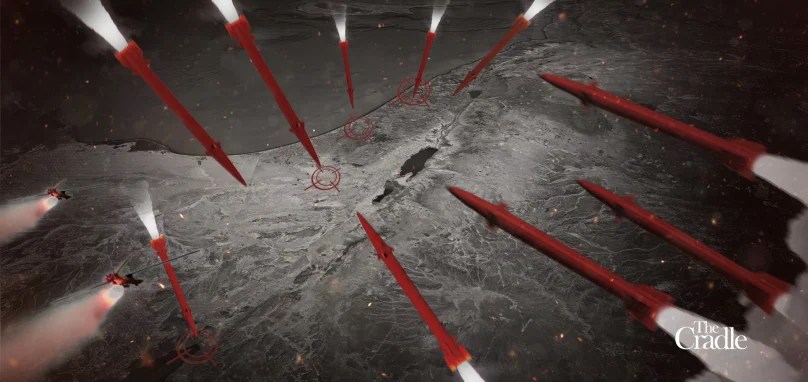
Hezbollah source: Iran, Lebanon, and Yemen will launch simultaneous retaliatory strikes against Israel, to overwhelm the Iron Dome.
By Ali Rizk | The Cradle | August 5, 2024
West Asia stands on a knife’s edge as the region’s Axis of Resistance prepares to retaliate against a series of recent Israeli assassinations and aggressions.
Iran, Hezbollah, and Yemen’s Ansarallah-aligned armed forces have vowed to make the occupation state pay a heavy price following the targeted killing of Hamas political bureau chief Ismail Haniyeh in Tehran and Hezbollah senior commander Fuad Shukr in southern Beirut.
Additionally, Israel bombed the Hodeidah port in Yemen following Sanaa’s successful ‘Yafa’ drone operation in Tel Aviv on 19 July.
An official from the Lebanese resistance has informed The Cradle that “The response will come at once from Iran, Hezbollah, and Yemen,” adding that the goal was to “inflict a painful blow to Israel which may not be achieved should separate retaliations be pursued.”
Executing the ‘Unity of Fronts’
Retaliation is all but certain and could happen within hours, according to senior US officials. A report yesterday by Axios claims that US Secretary of State Antony Blinken informed his G7 counterparts that the response could begin as early as within the next 24 hours.
Just yesterday, Ali al-Qahoum, a member of the political bureau of Ansarallah, emphasized that the response to Israel will not just come from Tehran:
We affirm our commitment to the battle, steadfastness, awareness, honor, and pride in standing with Palestine, the cause of the nation.
The critical question now is the scope and severity of the retaliation. Hezbollah Secretary General Hassan Nasrallah has promised a painful yet calculated blow to Tel Aviv. During Shukr’s funeral procession, Nasrallah warned that Israel had crossed the line, promising “a real and well-calculated response” – distinct from the cross-border operations Hezbollah has conducted against Israel since 8 October.
Flattening the Iron Dome
Other well-informed sources agree that the response could be coordinated, suggesting that retaliation from multiple fronts simultaneously is likely. They tell The Cradle that such an approach could take Israel’s primary air defense system, the Iron Dome, out of commission by preventing it from rapidly rearming. They believe this is achievable given Hezbollah’s capacity to launch a significant barrage of missiles and given Lebanon’s geographical proximity to potential Israeli targets.
These assessments appear to be consistent with those made by US officials who have warned that the Iron Dome could be overwhelmed by Hezbollah’s missile and drone arsenal should a full-scale war erupt.
Senior US military officials, meanwhile, have gone on the record cautioning that Washington would probably be unable to provide Tel Aviv with sufficient protection even in a single front, full-scale war with Hezbollah. US Joint Chief of Staff Charles Brown said as much in his remarks to the press in late June.
From our perspective, based on where our forces are, the short-range between Lebanon and Israel, it’s harder for us to be able to support them [Israel] in the same way we did in April [with Operation Truthful Promise].
Unwilling US support for Tel Aviv
Although much has been said about the US and its allies successfully thwarting Iran’s response to the Israeli attack on its consulate last April, it is noteworthy that all targeted Israeli military bases were hit during the Iranian retaliatory strikes. Operation Truthful Promise was intended more as a message, indicating that Tehran would no longer tolerate Israeli aggression against its interests.
US military reinforcements in the region may help intercept missiles and drones coming from Lebanon, while vassal state Jordan could also play a part as it did during Iran’s retaliatory strikes. However, this also makes US military assets and those of its partners legitimate targets for the Resistance Axis.
As former Pentagon analyst Michael Maloof explains to The Cradle:
Hezbollah would likely target US warships in the region that would take part in intercepting missiles directed at Israeli targets.
“As in 2006, I envision US involvement focused more on evacuating many of the 86,000 Americans now in Lebanon who would want to leave,” adds Maloof.
Washington’s top military officials also appear firmly opposed to being drawn into an active offensive role should a wider war erupt with Hezbollah, let alone a dreaded multi-front war. This stance is supported by statements from US Joint Chiefs of Staff Charles Brown, indicating the Pentagon’s limited willingness to protect the occupation state.
Note that Washington’s pledges to defend Israel have made no mention of potential offensive action, reflecting an American desire to avoid a wider war. Experts doubt the US will become heavily involved in any full-scale war, supported by public statements underscoring the importance of avoiding regional escalation – and voiced more privately, the desire to keep US military targets safe from retaliatory strikes.
Military risk and political calculations
As Brown said at the time, Washington’s main message is:
To think about the second order of effect of any type of operation into Lebanon, and how that might play out and how it impacts not just the region, but how it impacts our forces in regions as well.
The general – the most senior ranking US military official and the senior military advisor to the White House – was delivering a message that carries special significance amidst the recent developments.
By stating that an Israeli-initiated war on Lebanon put US troops at risk, Brown was essentially saying that a wider regional war was not seen as helping US interests by the Pentagon’s top brass.
Given these statements, it remains possible – though far from guaranteed – that the outgoing Biden administration may rein in Israel regardless of how painful a blow is delivered to it by the Axis of Resistance.
The upcoming US election in November is another factor that may prevent a regional conflagration. “The US getting more militarily involved with Israel,” warns Maloof, “would lead to riots in the streets of Chicago at the Democratic Convention later this month.”
These realities suggest a scenario where Washington might force Tel Aviv to absorb the Axis of Resistance’s retaliation, however severe it may be.
Featured Video

The Empire Enters the Cocaine Trade
or go to
Aletho News Archives – Video-Images
Book Summary
The Whole Soy Story: The Dark Side of America’s Favorite Health Food

Lies Are Unbekoming | January 20, 2026
Soybeans generate approximately $80 million annually in mandatory producer assessments alone, funding a marketing apparatus that has transformed an industrial commodity into one of America’s most trusted “health foods.” The campaign succeeded. Soy milk lines supermarket shelves beside dairy. Soy protein fortifies everything from infant formula to energy bars. Vegetarians rely on tofu and tempeh as dietary staples. Doctors recommend soy to menopausal women. School lunch programs serve soy-based meat substitutes to children. An estimated 60 percent of processed foods contain soy derivatives. The premise underlying this proliferation—that Asians have thrived on soy for millennia and that modern science validates its health benefits—has been repeated so often it functions as established fact.
Kaayla T. Daniel’s The Whole Soy Story dismantles this premise through systematic examination of the scientific literature. The book documents that traditional Asian soy consumption averaged roughly one tablespoon daily, consumed as fermented condiments after processing methods that neutralized inherent toxins—a pattern bearing no resemblance to American consumption of industrially processed soy protein isolate, soy flour, and soy oil. Daniel catalogs the antinutrients that survive modern processing (protease inhibitors, phytates, lectins, saponins), the toxic compounds created by industrial methods (nitrosamines, lysinoalanine, hexane residues), and the heavy metals concentrated in soy products (manganese, aluminum, fluoride, cadmium). She traces the mechanisms by which soy isoflavones—plant estrogens present at pharmacologically significant levels—disrupt thyroid function, impair fertility, and interact with hormone-sensitive cancers. The evidence emerges from peer-reviewed journals, FDA documents, and industry sources themselves.
The stakes extend beyond individual dietary choices. Infants fed soy formula receive isoflavone doses equivalent to several birth control pills daily, with blood concentrations 13,000 to 22,000 times higher than their natural estrogen levels. Soy protein isolate—the ingredient in formula, protein bars, and thousands of products—has never received GRAS (Generally Recognized as Safe) status; its only pre-1960s use was as an industrial paper sealant. Two senior FDA scientists formally protested their own agency’s approval of soy health claims, citing evidence of thyroid damage and reproductive harm. The Honolulu Heart Program found that men consuming tofu twice weekly showed accelerated brain aging and increased dementia. These findings have not penetrated public awareness because the institutions responsible for consumer protection have been compromised by the industry they regulate. The Whole Soy Story presents the evidence that has been systematically excluded from mainstream health messaging, enabling readers to evaluate for themselves what the soy industry prefers they never learn. … continue
Blog Roll
Recent Comments
seversonebcfb985d9 on French court jails pro-Palesti… eddieb on Fourteen Incredible Facts Abou… Bill Francis on European leaders’ shift in the… seversonebcfb985d9 on Villains of Judea: Philip Esfo… loongtip on Report warns that ‘Jewish terr… Craig Nelms on New study shows that toxic gas… loongtip on A Funny Thing Happened on the… loongtip on EU free trade pact on hold as… John Edward Kendrick on Regime Change In Iran Is The F… Bill Francis on Australia Passes New Hate Spee… seversonebcfb985d9 on Australia Passes New Hate Spee… Bill Francis on Britain’s AI Policing Plan Tur…


 Aletho News
- Germany to build 10GW of baseload gas plants (disguised as “future” hydrogen plants)
- French court jails pro-Palestine activist and mother over Gaza genocide speech
- Shot, amputated, and imprisoned: Palestinian man seeks to rebuild life after being maimed and tortured by Israeli forces
- Building Disney Land on the Moon More Likely than Kushner’s Gaza Plan
- U.S. Funds Continue to Flow to Ecuadorian Groups Despite Trump-Era Suspension
- A pro-EU regime is moving to suppress this proud nation. Will they be able to withstand it?
- US-Russia Arms Control May Face ‘Very Dark Period’ – Scott Ritter
- Israel moves to restrict Palestinian re-entry to Gaza, ‘encourage outflow’: Report
- Trump aims to create new UN and own it, Brazil’s Lula warns
- UN rapporteur says Israeli demolition of UNRWA compound reflects broader attack on UN system
- If Americans Knew
- Israeli drone strike kills two children collecting firewood in Gaza – Not a ceasefire Day 107
- Another Gaza baby freezes to death on Netanyahu’s watch – Not a ceasefire Day 106
- Oppose Israel’s Abuses While You Still Can
- UNRWA Heads Tell Ha’aretz: ‘We Don’t Radicalize Palestinians – Their Lived Existence Does’
- Plans Call for “New Rafah” Built in Israel’s Image — Without Palestinians
- Posing as priest, reporter is spat at many times, highlighting anti-Christian sentiment in Israel
- Leaked Documents: “Planned Community” in Rafah Would Force Palestinians Into Israeli Panopticon
- ‘Permits of Humiliation’: How Israel Strangles Christian Education in Jerusalem
- “The world sees death, destruction and injustice – and they see dollar signs” – Not a ceasefire Day 105
- War criminal Netanyahu kills 11 in Gaza, joins Board of Peace – Not a ceasefire Day 104
- No Tricks Zone
- Germany’s Natural Gas Crisis Escalates … One Storage Site Near Empty …Government Silent
- Polar Colding…Antarctica Saw Its Coldest October In 44 Years!
- New Study: Sea Levels Rose 20 Times The Modern Rate During The Roman Warm Period
- As German Gas Storage Dips Dangerously Low…Shortage Hardly Avoidable
- New Study: Brazil’s Relative Sea Level Was 2+ Meters Higher And SSTs 3-4°C Warmer 6000 Years Ago
- Philosopher Schopenhauer: Climate Science Certainty Stems From Stupidity, Ignorance
- New Study: Species Extinction Rates Declining Since 1980 – ‘Climate Change Is Not An Important Threat’
- Denmark Places Climate Protection Above Animal Welfare, Poisoning And Culling Cows
- New Study: Greenland Was 3-7°C Warmer And Far Less Glaciated Than Today 6000-8000 Years Ago
- German Media Report That Current Frigid Weather Can Be Explained By Arctic Warming!
 Aletho News