Could Trump’s election end NATO’s proxy war in Ukraine against Russia?
Strategic Culture Foundation | July 19, 2024
The presidential nomination of Donald Trump and Senator JD Vance as his running mate raises the prospect of a peaceful settlement to the conflict in Ukraine. Both have been vociferous critics of the NATO proxy war and the arming of the Kiev regime. Vance has even proposed a peace settlement that is close to Moscow’s demands.
Hungarian Prime Minister Viktor Orban, who is recently pushing peace diplomacy, has voiced optimism that the omens are good for a settlement later this year to the worst war in Europe since the Second World War – if Trump and Vance are elected.
Only days after Donald Trump narrowly survived an assassination attempt, he was officially nominated as the Republican presidential candidate amid ecstatic scenes at the Republican National Convention in Milwaukee.
After the tumult and drama over the last week – a long time in politics, as the saying goes – the Trump election campaign is in the driving seat. His vice presidential running mate is 39 years of age and gives the Republican Party a youthful zest. Both men are very much singing from the same hymn sheet regarding their “Make America Great Again” vision.
Trump has united the GOP under his leadership. All former party rivals lined up this week in Milwaukee to endorse the former real estate magnate in his bid to seek re-election to the White House in November. That helps to solidify his manifesto, which bodes well for diplomacy in Ukraine.
By contrast, the election campaign of Democrat incumbent President Joe Biden has run into a ditch. This week he was self-isolating in Delaware having reportedly incurred a third-time Covid infection. Biden increasingly looks toast. His apparent mental decline – the latest gaffe this week was not remembering the name of his Secretary of Defense Lloyd Austin, referring to him haltingly as “a black man” – has provoked a crisis in the Democratic Party and the largely favorable U.S. corporate news media. Senior figures including former President Barack Obama and House Speaker Nancy Pelosi, are reportedly urging Biden to stand down and pass the torch to a younger candidate. Panic is in the air.
There are reports that Biden may throw in the towel within the next few days as the Democrats head into their National Convention to officially nominate their presidential candidate. The trouble for the Democrats is they do not have a viable alternative candidate at this late stage in the campaign – with less than four months to election day on November 7.
That means there is now a serious chance that Trump could return to the White House after he lost the election in 2020, which MAGA loyalists hotly disputed as “stolen”.
That election outcome turns attention to one issue in particular: the war in Ukraine. The conflict erupted in February 2022 and has cost the lives of over 500,000 Ukrainian soldiers. Under the Biden administration and aligned European NATO members, there is no sign of the war coming to an end. Biden and European allies have pledged to keep sending weapons to Ukraine and tens of billions of dollars to prop up a hopelessly corrupt NeoNazi regime in Kiev.
Trump and Vance have pitched a diametrically opposite policy on the U.S.-led NATO proxy war in Ukraine.
That stance is causing the Deep State and its military-industrial complex acute anxiety. The Ukraine war racket has been a bonanza that vested interests in the U.S. ruling class do not want to end. That tension provides a plausible explanation for the attempted assassination of Trump during an open-air rally at Butler, Pennsylvania, on July 13. Salient questions remain about how the shooter, Thomas Matthew Crooks, a 20-year-old student, gained access to such a high-security position to fire his rifle at Trump.
The Republican candidates have warned that the Ukraine conflict is in danger of spiraling into a nuclear world war. Trump has said that he would end the war immediately by cutting off the military aid spigot and forcing the Kiev regime to begin negotiations with Russia.
Tantalizingly, JD Vance (R-Ohio) has been even more explicit in proposing that the warring parties should accept the territorial gains made by Russia – including Crimea, Donbass, Zaporozhye and Kherson provinces – and that Ukraine must accept Moscow’s demand that it remain neutral and outside of the NATO alliance.
Such a position is a breath of fresh air for its rationality. Many respected American scholars and diplomats have also recommended this historically coherent position as a solution, including Professors John Mearsheimer and Jeffrey Sachs. At least Trump and Vance seem to be cognizant of this reality, unlike the Biden administration and the rest of the Democrat Party, along with the Western media establishment and European minions who insanely push a fraudulent war to the last Ukrainian.
Moreover, polls show that the majority of American citizens (and Europeans) would prefer to see a diplomatic solution to the worst war in Europe since 1945.
Hungary’s Orban has admirably advocated peaceful diplomacy and for his troubles, his government has been sanctioned by the European Union establishment. Slovakia’s Robert Fico has also called for an end to the war in Ukraine, which many believe led to an assassination attempt on his life in May.
The conflict in Ukraine is a senseless, bloody slaughter that should never have escalated if Russia’s peace proposals in December 2021 had been accepted instead of dismissed out of hand by the Biden administration and its NATO lackeys in Europe. Also, a peace deal was possible in April 2022 but again was scuppered by malicious U.S. and British intervention.
If an American presidential candidate is proposing a diplomatic end to the conflict then that should be welcomed. It seems that common sense is prevailing.
Having said that, however, there are caveats. The Trump-Vance rhetoric could be empty pre-election canvassing for votes.
Trump’s record is one of hyping expectations and not delivering. When he ran for the presidency in 2016, he promised to normalize relations with Russia – and did not deliver.
He also boasted about solving the conflict in the Middle East with a “deal of the century” – only to embolden Israeli aggression towards Palestinians and Iran.
A reality check is strongly advised on what Trump and Vance can achieve.
While both men express skepticism about “endless wars” and NATO, it should be borne in mind that the conflicts the U.S. empire is fueling have a systematic cause. The United States is desperately fighting to maintain its failing hegemony against the rise of a multipolar and more democratic global order.
Washington and its European vassals are unleashing wars as a matter of necessity for preserving their erstwhile global dominance. History teaches that wars are always the refuge of the Western imperialist ruling classes.
It is notable that while Trump and Vance talk about ending conflict in Ukraine, they are at the same time talking belligerently about confronting China and Iran.
Trump and the MAGA Republicans are deprecated by the U.S. establishment as being “isolationists” in their vision of pursuing “America First”.
But the notion of “isolationalism” is an oxymoron when one considers the objective reality of U.S. imperialism. Foreign wars are an insatiable appetite for Western dominance.
American relations with the rest of the world are all about power projection, dominance and ultimately using violence to assert its “might is right” presumed national privileges. That applies whether the incumbent in the White House is a Democrat or Republican.
Trump may sound more reasonable on the issue of conflict in Ukraine with Russia. That alone makes him a more plausible candidate compared with the reckless warmongering of Biden and the Democrat-Deep State nexus.
The war in Ukraine must be stopped as soon as possible and a more reasonable security arrangement for Europe must be negotiated as Russia has long been consistently advocating.
Any diplomatic opening towards achieving peace and ending the killing must be welcomed.
Trump and Vance might just deliver on ending the hostilities in Ukraine which in itself would be a huge step forward away from the abyss of all-out war with Russia. On that score alone, their election might bring about an improvement.
But alas there is a contradiction. Don’t expect world peace to break out in other parts of the globe, because U.S. imperialism is cranking up its war machine. Trump and Vance are hawkish in their policy towards China and Iran.
A comprehensive solution to ending U.S. aggression and militarism is not a change of personnel at the White House. A profound, systematic change in American politics and economics is required.
Is partial peace sufficient? Maybe it is for now.
Iran rejects claim about Trump assassination, asserts will pursue Soleimani case legally
Press TV – July 17, 2024
Iran has roundly rejected claims of devising plot to assassinate former US president Donald Trump, but vows to pursue legal channels to consign him to justice for his ordering the assassination of the Islamic Republic’s top anti-terror commander Qassem Soleimani in 2020.
Foreign Ministry spokesman Nasser Kan’ani made the remarks on Wednesday after US media alleged that American authorities had obtained “intelligence from a human source in recent weeks on a plot by Iran to try to assassinate Trump.”
It followed an assassination attempt against Trump that took place while he was campaigning in Butler, Pennsylvania. Trump survived the attempt, suffering an ear injury.
Kan’ani said Iran strongly rejected allegations of any involvement in the armed attack against Trump or claims of harboring any intention to take such action, Kan’ani said.
The Islamic Republic considers such claims to be a product of malicious political goals and intents, he added.
The country, however, is determined to legally pursue Trump due to his direct role in the assassination of General Soleimani, the spokesman asserted.
Soleimani, commander of the Quds Force of Iran’s Islamic Revolution Guards Corps (IRGC), Abu Mahdi al-Muhandis, the second-in-command of Iraq’s Popular Mobilization Units (PMU), and their companions were assassinated in a US drone strike authorized by Trump near Baghdad International Airport on January 3, 2020.
The commanders were highly revered across West Asia due to their key role in fighting the Daesh Takfiri terrorist group in the region, particularly in Iraq and neighboring Syria.
Iran’s permanent mission to the United Nations also reacted to the US media report earlier on Wednesday, considering its claim to be “unfounded and malicious.”
The mission, nevertheless, asserted that “from the Islamic Republic’s standpoint, Trump is a criminal, who should be tried and punished in court for [issuing] General Soleimani’s assassination order.”
“Iran has chosen the legal pathway to hold him accountable,” it stated.
Iran’s Pezeshkian discusses foreign policy, principles in first op-ed
Al Mayadeen | July 13, 2024
Iran’s newly-elected president stated that his administration is dedicated to maintaining Iran’s national dignity and global standing “under all circumstances.” Additionally, it will advocate for creating a “strong region” instead of one dominated by a single country’s pursuit of hegemony and dominance.
In an op-ed published by the Tehran Times, President Masoud Pezeshkian outlined his government’s outlook and policy, emphasizing it will focus on opportunities to maintain balanced relations with all nations in line with Iran’s economic and national interests, in addition to the needs of regional and global peace and security, saying he “will welcome sincere efforts to alleviate tensions and will reciprocate good-faith with good-faith.”
Moreover, he emphasized his opposition to neighboring countries depleting their resources through engaging in unnecessary competition, arms races, or “containment” efforts against each other. “Instead, we will aim to create an environment where our resources can be devoted to the progress and development of the region for the benefit of all.”
Pezeshkian mentioned that, following the victory of the Islamic Revolution in 1979, Iran “severed ties with two apartheid regimes, Israel and South Africa,” a decision “motivated by respect for international law and fundamental human rights.”
While “Israel” remains an “apartheid” regime to this day, Pezeshkian said it added genocide to “a record already marred by occupation, war crimes, ethnic cleansing, settlement-building, nuclear weapons possession, illegal annexation, and aggression against its neighbors.”
Don’t reward ‘Israel’ through normalization
The Iranian president-elect further said that “as a first measure” in strengthening ties with neighboring states, his government will “urge” Arab countries to collaborate diplomatically for a permanent ceasefire in Gaza to halt the ongoing massacre and prevent an expanded escalation.
“By leveraging our normative influence, we can play a crucial role in the emerging post-polar global order by promoting peace, creating a calm environment conducive to sustainable development, fostering dialogue, and dispelling Islamophobia. Iran is prepared to play its fair share in this regard.”
He underlined that all members of the 1948 Genocide Convention are obligated to take action to prevent genocide, “not to reward it through normalization of relations with the perpetrators.”
“We must then diligently work to end the prolonged occupation that has devastated the lives of four generations of Palestinians,” he continued.
Pezeshkian continued that he “looks forward” to collaborating with “Turkey, Saudi Arabia, Oman, Iraq, Bahrain, Qatar, Kuwait, the United Arab Emirates,” in addition to regional organizations, to deepen economic and trade relations. He added that coordination would also be focused on “tackling common challenges” and working on creating “a regional framework for dialogue, confidence building and development.”
Allegations of antisemitism an insult to Iran’s culture
“Cooperation for regional development and prosperity will be the guiding principle of our foreign policy,” he said, adding that, “as nations endowed with abundant resources and shared traditions rooted in peaceful Islamic teachings, we must unite and rely on the power of logic rather than the logic of power.”
Elsewhere in his piece, he pointed out the increased awareness among Western youth of “the validity” of Iran’s “decades-long” position on the Israeli occupation entity.
Addressing this “brave generation,” Pezeshkian said that the Islamic Republic considers allegations against it of “antisemitism” due to its “principled stance” on the Palestinian case are “false” and an “insult to our culture, beliefs and core values.”
Kremlin comments on Türkiye’s SCO bid
Türkiye’s obligations to the US-led military bloc are not consistent with the Eurasian organization’s values, Moscow has said.
RT | July 12, 2024
Türkiye’s bid to become a full member of the Shanghai Cooperation Organization (SCO) is not compatible with its membership in NATO, Kremlin spokesman Dmitry Peskov said on Friday.
Last week, Turkish President Recep Tayyip Erdogan attended a summit of the Eurasian mutual defense group, in which his nation has observer status. While returning home from Kazakhstan, he told journalists that Ankara wants to “further develop” ties with the SCO and its founding members Russia and China. During the NATO leaders’ summit in the US this week, he said Türkiye wants to join the SCO as a permanent member.
Asked by journalists when Turkish accession could be expected, Peskov said there was a problem with such a proposal.
“There are certain contradictions between Turkish commitments and [its] position on fundamental issues as a NATO member and the worldview formulated in the founding documents of the SCO,” he explained.
The expansion of the SCO is of interest to many nations and remains on its agenda, but there is no specific timeline for accepting new members, he added. Commenting later during a press call on bilateral relations with Türkiye, Peskov said Russia was “open for attempts to reach agreements based on a certain worldview.”
Moscow perceives NATO as a hostile, aggressive military organization, which serves US geopolitical interests and is currently conducting a proxy war against Russia in Ukraine.
Despite being a NATO member state, Türkiye has maintained a neutral stance on the Ukraine conflict, refusing to impose economic sanctions on Russia and serving as an intermediary between Moscow and Kiev on several occasions. Ankara helped to mediate a nascent peace deal in the early months of the hostilities, which Kiev eventually ditched in favor of continued fighting. The Russian government believes that the US and its allies, particularly the UK, forced Ukraine to reject the proposal.
The SCO was founded in 2001 and currently has ten full members: Russia, China, India, Iran, Kazakhstan, Kyrgyzstan, Pakistan, Tajikistan, Uzbekistan, and Belarus. Kazakhstan holds the rotating presidency this year and hosted the leaders of member states on July 3 and 4 in Astana.
One of the key pledges to which SCO members subscribe is not to seek the improvement of their own national security at the expense of the national security of other parties. NATO policy does exactly that, according to its critics, including Russia.
Iran dismisses NATO allegation it supplies ballistic missiles to Russia to be used in Ukraine war
Press TV – July 11, 2024
Iran has categorically rejected allegations it is providing ballistic missiles and related technology to Russia, raised by the North Atlantic Treaty Organization (NATO), to be used in the military campaign against Ukraine.
In a statement on Thursday, Iranian Foreign Ministry spokesman Nasser Kan’ani said NATO has made “totally baseless and politically-motivated” claims.
In their declaration issued on Wednesday, the NATO leaders claimed that North Korea and Iran were fuelling Russia’s military operation against Ukraine by providing direct military support to Moscow, such as munitions and uncrewed aerial vehicles (UAVs), which they said impacted Euro-Atlantic security and undermined the global non-proliferation regime.
They said any transfer of ballistic missiles and related technology by Iran to Russia would represent a substantial escalation.
The Iranian spokesman, in reaction, said the ongoing developments in Ukraine are the result of NATO’s “provocative” policies and measures led by the United States.
Kan’ani added that any attempt to link the war in Ukraine to the cooperation between Iran and Russia is “politically-motivated” with the aim of legitimizing the West’s interference and their military aid to Ukraine.
He once again reiterated Iran’s unwavering strategy to play a constructive role in promoting durable security in the region and across the world.
Iran has never provided Russia with any type of drones during the military conflict in Ukraine and still emphasizes the importance of settling the crisis and establishing lasting peace through political channels, the diplomat pointed out.
Iran has repeatedly rejected accusations that it has supplied weapons to Russia for direct use in the war in Ukraine. It has also discarded allegations of supplying weapons to anti-Israeli and anti-US groups in the region.
Meanwhile, Russia has repeatedly warned that a flow of Western weapons to Ukraine will only prolong the conflict.
Since the start of the war in Ukraine, the US, alone, has provided approximately $51.4 billion in military assistance to Kiev, the US State Department said in early July.
What Will Iran’s Foreign Policy Be Under New President Pezeshkian?
Sputnik – 06.07.2024
Masoud Pezeshkian has emerged as the winner of the presidential runoff in Iran this week, receiving 54 percent of the votes.
The newly elected President of Iran Masoud Pezeshkian spoke to Sputnik on the eve of the election about the main priorities of Iran’s foreign policy, which include: strengthening relations with Russia and China; Iran’s active presence in BRICS and the Shanghai Cooperation Organisation; restoration of the Joint Comprehensive Plan of Action (JCPOA) and the lifting of sanctions.
“Russia is a friend and partner of Iran, and I consider it a priority to deepen and expand relations with Russia and China, as well as intensify foreign policy activities in the Asian direction in general,” Pezeshkian said. “And we, of course, at all levels – bilateral, regional and international – will continue our efforts to expand interaction with the Russian Federation.”
According to him, Iran “opposes the policy of unidirectionality” and supports “the principle of multipolarity.”
“One of the priorities of my foreign policy program is regional cooperation, and for this purpose, Iran will expand its presence in BRICS and the SCO, as well as strive for more active cooperation with the Eurasian Economic Union to more fully realize the potential of trade and economic relations with the member countries of these organizations,” Pezeshkian explained.
Regarding the JCPOA, Pezeshkian pointed out that it is “an international agreement approved by the UN,” and that the United States’ unilateral withdrawal from this agreement “caused serious damage to Iran and the Iranian people.”
“As the Russian side has repeatedly emphasized, Iran has fulfilled its obligations, and we see our task as returning the other participants to this agreement as soon as possible and achieving the lifting of sanctions. I am confident that the friendly governments of Russia and China will support Iran and assist it in resolving this issue,” he added.
Made in America: The ISIS conquest of Mosul
The Cradle | July 2, 2024
Ten years ago this month, the notorious terror group ISIS improbably conquered Mosul, Iraq’s second-largest city. In only two days of fighting, a few hundred ISIS militants captured the city, forcing thousands of Iraqi soldiers and police to flee in chaos and confusion.
The western media attributed the city’s fall to the sectarian policies of then-Iraqi prime minister Nouri al-Maliki, suggesting that local Sunnis welcomed the ISIS invasion. US officials claimed they were surprised by the rapid rise of the terror organization, prompting then-US president Barack Obama to vow to “degrade and ultimately destroy” the group.
However, a close review of events surrounding the fall of Mosul and discussions with residents during The Cradle’s recent visit to the city shows the opposite.
The US and its regional allies used ISIS as a proxy to orchestrate the fall of Mosul, thereby terrorizing its Sunni Muslim inhabitants to achieve specific foreign policy goals. Says one Mosul resident speaking with The Cradle:
There was a plan to let Daesh [ISIS] take Mosul, and the USA was behind it. Everyone here knows this, but no one can say it publicly. It was a war against Sunnis.
‘Salafist principality’
As the war in Syria raged in August 2012, the US Defense Intelligence Agency (DIA) authored a now well-known memo providing the broad outlines of the plan that would lead to Mosul’s fall.
The memo stated that the insurgency backed by the US and its regional allies to topple Bashar al-Assad’s government in Damascus was not led by “moderate rebels” but by extremists, including Salafists, the Muslim Brotherhood, and Al-Qaeda in Iraq (Islamic State of Iraq).
The DIA memo stated further that the US and its allies, “the western powers,” welcomed the establishment of a “Salafist principality” by these extremist forces in the Sunni majority areas of eastern Syria and western Iraq. The US goal was to isolate Syria territorially from its main regional supporter, Iran.
Two years later, in June 2014, ISIS conquered Mosul, declaring it the capital of the so-called “Caliphate.”
Though the terror group was portrayed as indigenous to Iraq, ISIS only made the “Salafist principality” predicted in the DIA memo a reality with the help of weapons, training, and funding from the US and its close allies.
US and Saudi weapons
In January 2014, Reuters reported that the US Congress “secretly” approved new weapons flows to “moderate Syrian rebels” from the so-called Free Syrian Army (FSA).
In subsequent months, the US Army military and Saudi Ministry of Defense purchased large quantities of weapons from Eastern European countries, which were then flown to Amman, Jordan, for further distribution to the FSA.
After an exhaustive three-year investigation, EU-funded Conflict Armament Research (CAR) found that the weapons funneled to Syria by the US and Saudi Arabia in 2014 were quickly passed on to ISIS, at times within just “days or weeks” of their purchase.
“As far as our evidence shows, the diverters [Saudi and the US] knew what was going on in terms of the risk of supplying weapons to groups in the region,” Damien Spleeters of CAR explained.
The US-supplied weapons and equipment quickly reaching ISIS included the iconic Toyota Hilux pickup trucks, which became synonymous with the ISIS brand.
The Kurdish role
Another way US and Saudi-supplied weapons reached ISIS was through Washington’s main Kurdish ally in Iraq, Masoud Barzani. Discussing the secret funding for weapons approved by the US Congress in January 2014, Reuters noted that “Kurdish groups” had been providing weapons and other aid financed by donors in Qatar to “religious extremist rebel factions.”
In the following months, reports emerged that Kurdish officials from Barzani’s Kurdistan Democratic Party (KDP) were providing weapons to ISIS, including Kornet anti-tank missiles imported from Bulgaria.
Further evidence of Barzani’s support for ISIS comes from a lawsuit currently being litigated in the US District Court for the District of Columbia on behalf of the Kurdistan Victim’s Fund.
The expansive lawsuit, led by former US Assistant Attorney James R Tate, cites testimonies from sources with “direct clandestine access” to senior ranking officials in the KDP, alleging that Barzani’s agents “purposefully made US dollar payments to terrorist intermediaries and others that were wired through the United States,” including through banks in Washington, DC. These payments “enabled ISIS to carry out terrorist attacks that killed US citizens in Syria, Iraq, and Libya.”
Further, the agents made use of “email accounts serviced by US-based email service providers to coordinate and carry out elements of their partnership with ISIS.”
It is unthinkable that Barzani regularly arranged payments to ISIS from the heart of the US capital without the knowledge and consent of US intelligence.
An explicit agreement
In the spring of 2014, reports emerged of a deal between Barzani and ISIS to divide the territory in Iraq between them.
French academic and Iraq expert Pierre-Jean Luizard of the Paris-based National Centre for Scientific Research (CNRS) reported there was “an explicit agreement” between Barzani and ISIS, which “aims to share a number of territories.”
According to the agreement, ISIS would take Mosul, while Barzani’s security forces, the Peshmerga, would take oil-rich Kirkuk and other “disputed territories” he desired for a future independent Kurdish state.
According to Luizard, ISIS was given the role of “routing the Iraqi army, in exchange for which the Peshmerga would not prevent ISIS from entering Mosul or capturing Tikrit.”
In an unpublished interview with prominent Lebanese security journalist and The Cradle contributor Radwan Mortada, former Iraqi prime minister Nuri al-Maliki claimed that meetings were held to plan the Mosul operation in the Iraqi Kurdistan capital, Erbil, which were attended by US military officers.
When US officials denied any involvement, Maliki responded by telling them:
These are pictures of American officers sitting in this meeting … you are partners in this operation.
The UK pipeline
A resident from Mosul speaking with The Cradle states that many of the ISIS members he encountered during the group’s three-year occupation of the city were English-speaking foreigners, in particular the ISIS commanders.
But where did these English-speaking ISIS members come from?
In 2012, UK intelligence established a pipeline to send British and Belgian citizens to fight in Syria. Young men from London and Brussels were recruited by Salafist organizations, Shariah4UK and Shariah4Belgium, established by radical preacher and UK British intelligence asset Anjam Choudary.
These recruits were then sent to Syria, where they joined an armed group, Katibat al-Muhajireen, which enjoyed support from UK intelligence. These British and Belgian fighters then joined ISIS after its official establishment in Syria in April 2013.
Among these fighters was a Londoner named Mohammed Emwazi. Later known as the infamous Jihadi John, Emwazi kidnapped US journalist James Foley in October 2012 as a member of Katibat al-Muhajireen and allegedly executed him in August 2014 as a member of ISIS.
Made in America
The commander of Katibat al-Muhajireen, Abu Omar al-Shishani, also later joined ISIS and famously led the terror group’s assault on Mosul. Before fighting in Syria and Iraq, Shishani received US training as a member of the country of Georgia’s special forces.
In August 2014, the Washington Post reported that Libyan members of ISIS had received training from French, UK, and US military and intelligence personnel while fighting in the so-called “revolution” to topple the government of Muammar al-Qaddafi in 2011.
Many of these fighters were British but of Libyan origin and traveled to Libya with the encouragement of UK intelligence to topple Qaddafi. They then traveled to Syria and soon joined ISIS or the local Al-Qaeda affiliate, the Nusra Front.
“Sometimes I joke around and say that I am a fighter made by America,” one of the fighters told the Post.
There is no indication that the relationship between these fighters and US and UK intelligence ended once they joined ISIS.
‘Maliki must go’
US support for the ISIS invasion of Mosul is evident through the actions Washington refused to take. US planners monitored the ISIS convoys traveling across the open desert from Syria to assault Mosul in June 2014 but took no action to bomb them.
As former US secretary of defense Chuck Hagel acknowledged, “It wasn’t that we were blind in that area. We had drones, we had satellites, we had intelligence monitoring these groups.”
Even after Mosul fell, and as ISIS was threatening Baghdad, Washington planners refused to help unless Maliki stepped down as prime minister.
Maliki claimed in his interview with Mortada that US officials had demanded he impose a siege on Syria to assist in toppling Assad. When Maliki refused, they accused him of sabotaging the Syria regime change operation and sought to use ISIS to topple Iraq’s government.
American sources all but confirm Maliki’s claim. The US military-funded Rand Corporation noted that the US–Iraqi relationship at this time had become strained “because of the willingness of the Maliki government to facilitate Iranian support to the Assad regime despite significant American opposition.”
As Obama’s foreign policy advisor, Philip Gordon explained:
The president was clear he didn’t want to launch that campaign [against ISIS] until there was something to defend, and that wasn’t Maliki.
New York Times journalist Michael Gordon reported that Secretary of State John Kerry traveled to Baghdad two weeks after ISIS captured Mosul to meet with Maliki. Desperate for help, Maliki asked Kerry for airstrikes against ISIS to protect Baghdad, but the latter explained that the US would not help unless the former gave up power.
In July 2014, ISIS fighters were moving captured US artillery and armored vehicles back to Syria across the open desert. Gordon reports further that the ISIS convoys were “easy pickings for American airpower.”
However, when US Major General Dana Pittard requested authorization to conduct the airstrikes to destroy the convoys, the White House refused, saying the “political prerequisites” had not been met. In other words, Maliki was still prime minister.
Geopolitical gains
While claiming to be enemies of ISIS, the US planners and their allies deliberately facilitated the terror group’s rise, including its capture of Mosul.
ISIS relied on US and UK-trained fighters, US and Saudi-purchased weapons, and Kurdish-supplied US dollars – rather than popular support from the city’s Sunni residents – to conquer Mosul.
When self-proclaimed caliph and leader of ISIS, Abu Bakr al-Baghdadi, announced the establishment of the so-called Caliphate at the city’s historic Nuri Mosque, he set up the very Salafist principality outlined in the DIA document by US intelligence heads.
This orchestrated rise of ISIS not only destabilized the region but also served the geopolitical interests of those who claim to be combating terrorism.
Turkish, Syrian officials to meet in Baghdad for rapprochement: Report
Press TV – June 30, 2024
Turkish and Syrian officials are expected to meet in the Iraqi capital Baghdad for potential rapprochement between their respective countries, and restoration of diplomatic relations which were severed more than 12 years ago.
Syria’s al-Watan daily newspaper, citing informed sources who asked not to be named, reported that the upcoming meeting will be the first step on the path of a long process of negotiations that would result in political understandings.
The sources added that Ankara has called on Moscow and Baghdad to prepare the ground for Turkish diplomats to sit at the negotiating table with the Syrian side without any third party or members of the press present.
Al-Watan noted that the initiative for Turkey-Syria rapprochement, and restoration of their diplomatic ties has received broad support from Arab states, especially from Saudi Arabia and the United Arab Emirates, as well as from Russia, China and Iran.
On Friday, Turkish President Recep Tayyip Erdogan said there is no reason for his country not to forge renewed ties with neighboring Syria.
“There is no reason not to establish (relations with Syria),” Erdogan told reporters after Friday prayers in Istanbul.
He emphasized that Ankara has no plans or goals to interfere in Syria’s internal affairs.
“Just as we once developed relations between Turkey and Syria, we will act together in the same way again,” he added.
Turkey severed its relations with Syria in March 2012, a year after the Arab country found itself in the grip of rampant and deadly violence waged by foreign-backed militants, including those allegedly supported by Ankara.
The process of normalizing ties between Ankara and Damascus kicked off on December 28, 2022, when the Russian, Syrian and Turkish defense ministers met in Moscow, in what was the highest-level meeting between the two sides since the outbreak of the Syria conflict.
Since 2016, Turkey has conducted three major ground operations against US-backed militants based in northern Syria.
The Turkish government accuses the US-backed Kurdish People’s Protection Units (YPG) militants of bearing ties with the Kurdistan Workers’ Party (PKK) militant group.
Syria considers the Turkish presence on its soil to be illegal, saying it reserves the right to defend its sovereignty against the occupying forces.
Syrian President Bashar al-Assad has tied rapprochement with Turkey to Ankara’s ending its occupation of the northern parts of the Arab country and its support for militant groups wreaking havoc and fighting against the Damascus government.
Turkey resumed oil imports from Iran in March after 4 years: data shows
Press TV – June 30, 2024
Figures by the European Union’s statistics agency, Eurostat, show that Turkey resumed importing oil from Iran in March this year nearly four years after it cut shipments to zero to comply with US sanctions on Tehran.
Eurostat data cited in a Sunday report by Iran’s official IRNA news agency showed that Turkey had imported 576 metric tons (mt) of oil from Iran in March and another 485 mt in April.
Turkey’s last oil shipment from Iran had been reported in August 2020 when the country bowed to US pressure and stopped the imports.
The figures are yet another sign that more countries have stopped complying with US sanctions on Iran and are taking delivery of oil shipments from the country.
Eurostat figures showed that Bulgaria and Poland were the two EU members that had imported oil from Iran this year.
Bulgaria raised its oil imports from Iran in the quarter to March by 113% compared to the same period last year to 314 mt.
Poland’s oil imports from Iran, a first reported in the past two years, was a 19 mt shipment that took place in March.
Georgia, an EU candidate country, imported 544 mt of oil from Iran in the March quarter, down from 974 mt reported in the same quarter last year.
Reports suggest more European countries are willing to ignore US sanctions on Iran and import oil from country now that Tehran is selling record volumes of oil to Asian markets.
Iran’s oil exports reached more than 1.6 million barrels per day (bpd) in some months of this year and in 2023, up from records lows of 0.3 million bpd reported in 2019 when the US toughened its sanctions Tehran.
Iran’s iron ore reserves estimated at over 5bn tons: Mine owner
Press TV – June 29, 2024
A mine owner in Iran says the country’s iron ore reserves are estimated at some 5 billion metric tons (mt), as he insists that official figures should be revised up to show the real state of iron mines in Iran and their potential for investment.
Mehrdad Akbarian, who also chairs Iran’s Association of Iron Ore Producers and Exporters (IROPEX), said on Saturday that figures announced by the Iranian government about unproven iron ore reserves, which is about 3.2 billion mt, do not properly represent a rough estimate of recoverable iron in the country.
“Unfortunately, the official figures do not match the realities on the ground,” Akbarian told the ILNA news agency.
“That comes as reserves can further expand with progress in technology, increased mining and investment in exploration,” he added.
The businessman said that the total iron ore mined in Iran since the industry was formed several decades ago has not exceeded 0.6 billion mt.
Akbarian insisted that increased supply of energy, including electricity and natural gas, to Iranian steel plants can lead to more activity in iron mines.
Iran has produced more steel in recent years mainly due to increased government support as part of a policy to diversify the economy away from oil exports.
Iranian steel exports have increased steadily since the US imposed sanctions on the country in 2018.
Iran is currently the 10th largest steel producer in the world with more than 30 million mt of annual output.
Increased production caused the country to move up to 7th in the global ranking of steel producers during some calendar months of last year.
Magazine Depth and Shields
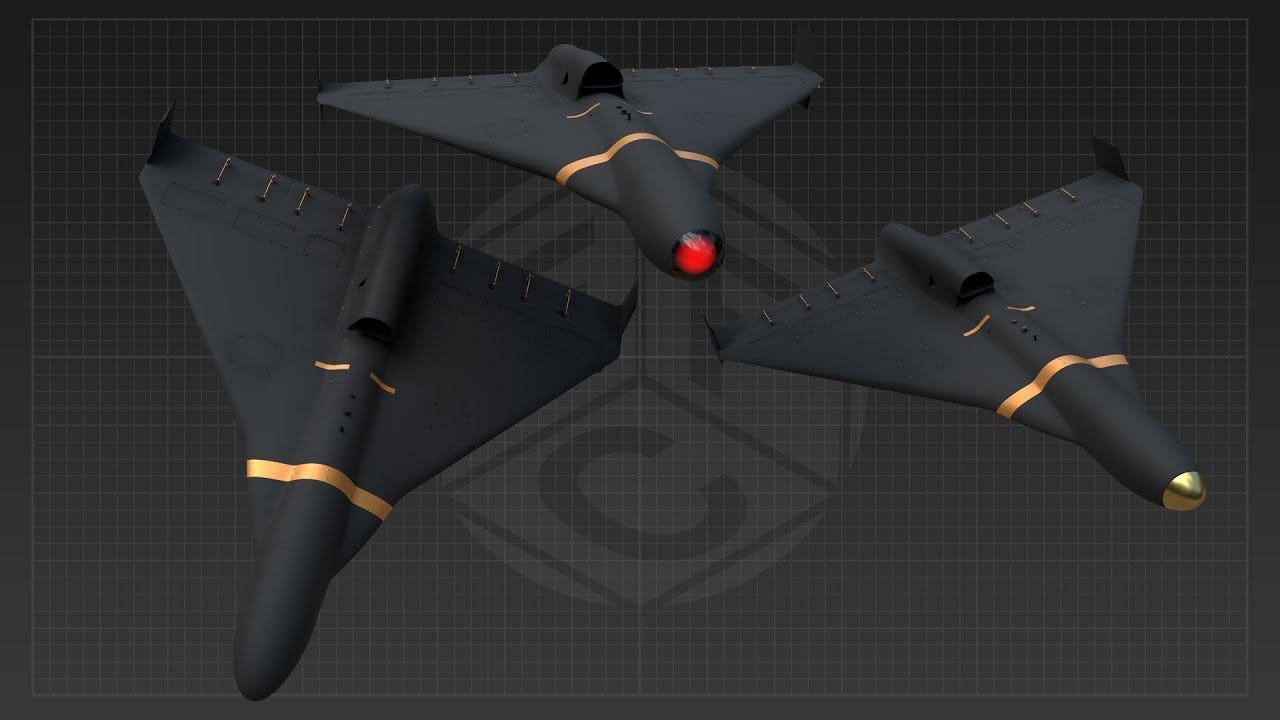
Iranian Shahed Drones – Three Variants
By William Schryver – imetatronink – June 26, 2024
In addition to the already-in-progress wars in Ukraine, Gaza, and the Red Sea, we are now staring down the barrel of yet another — rumored to be imminent in southern Lebanon.
There is no doubt Israel (just like its great benefactor, the United States) is, in the context of a “big war”, capable of executing several damaging strikes against a potential peer or near-peer adversary.
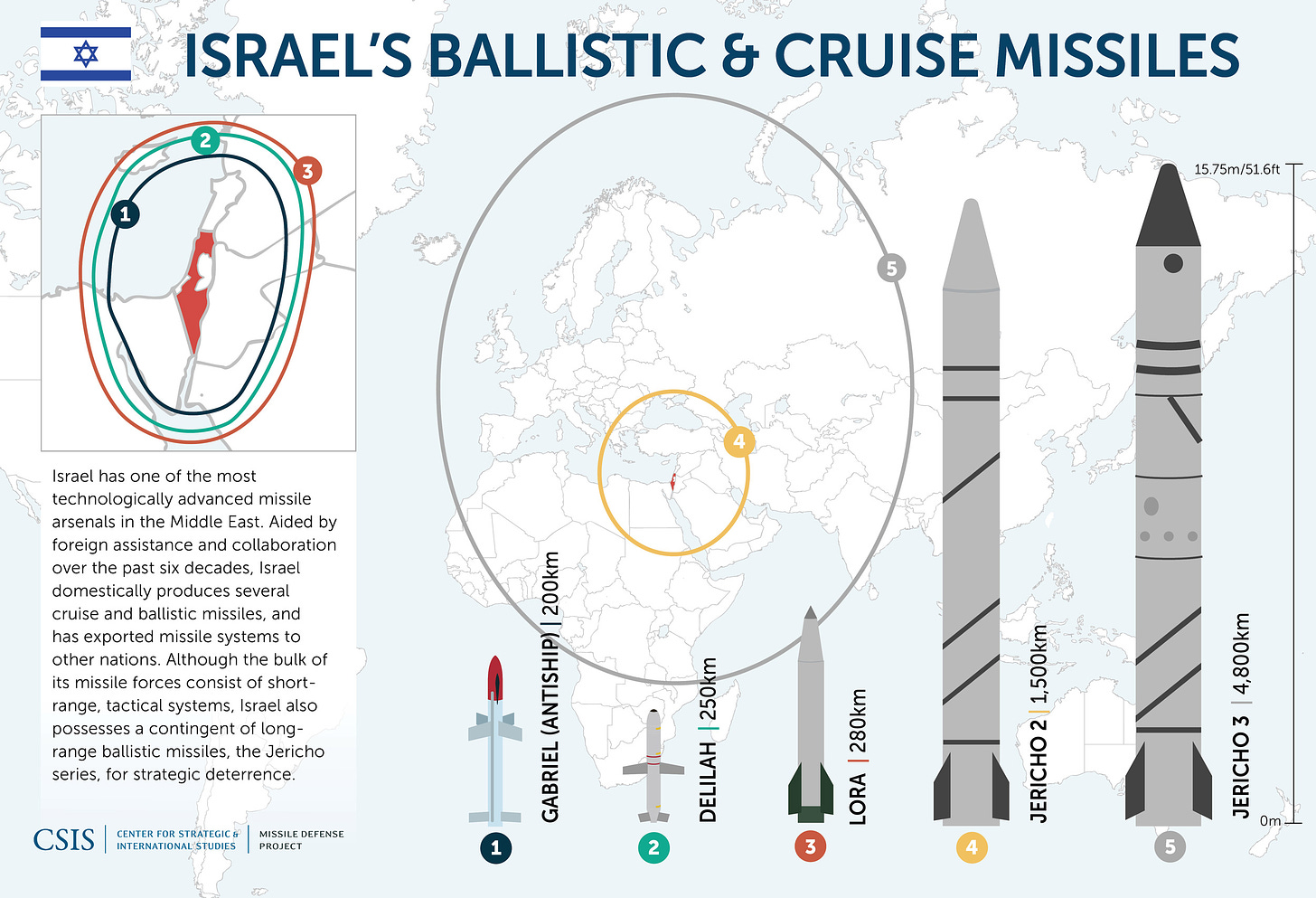
Israeli Ballistic and Cruise Missiles and Ranges
But, throughout the imperial domain, there are fatal weaknesses that exist right now, and which cannot be turned into strengths at any point in the near- or medium-term.
The first is what military types call “magazine depth”: munitions stockpiles sufficient to offensively overwhelm, defensively defeat, and strategically outlast the enemy.
Neither the United States, nor any of its largely impotent client nations, possess “magazine depth” sufficient to prosecute anything more than a relatively brief campaign against their potential peer adversaries: Russia, China, Iran — and all or any of their lesser-power partners.
The second problem is a corollary of the first. It is what I will term “shields”: the capacity to defeat a decisive proportion of the strikes one’s enemy can launch against you.
Neither the United States, nor any of its largely impotent client nations — by their own admission — possess anything even approximating comprehensive and effective “shields” against the quantity and quality of the types of strike weapons its potential adversaries can launch against them.
NATO sources themselves recently confessed that they only have about 5% potential air defense coverage against Russian missile strikes.
Now, of course, many will reflexively argue that, for example, the US could, with a massive “shock and awe” first-strike air campaign, effectively disarm Russian counterstrike capabilities.
This is patently ridiculous wishful thinking.
No one who actually understands the parameters of the military equation believes this to be true. And one need only examine the results of the months-long campaign against the lowly Yemenis to see confirmation of this incontrovertible fact.
Earlier this year we witnessed the Iranians launch a relatively modest missile strike against Israel, whose defenses were massively reinforced by American air and naval assets.
Using maybe 300 antiquated long-range strike drones and cruise missiles as decoys, the air defense response of both the US and Israel was massively attrited. And then, with a mere dozen or so seriously capable ballistic missiles, the Iranians blew right through the interception attempts of both the multiple land-based Patriot systems and a US guided-missile destroyer positioned off the eastern Mediterranean coast.
The Patriot systems were a total bust, and the Israelis summarily retired them in the immediate aftermath of the Iranian strike.
The US destroyer is reported to have launched eight top-shelf SM-3 missile defense interceptors (quite likely its entire “magazine depth”) at the incoming Iranian strike package.
They might have damaged one of the 12-15 incoming Iranian missiles.
The others hit with precision comparable to the 5-meter CEP Iran achieved in its 2020 strikes against the US airbase at Ayn al-Asad in Iraq.
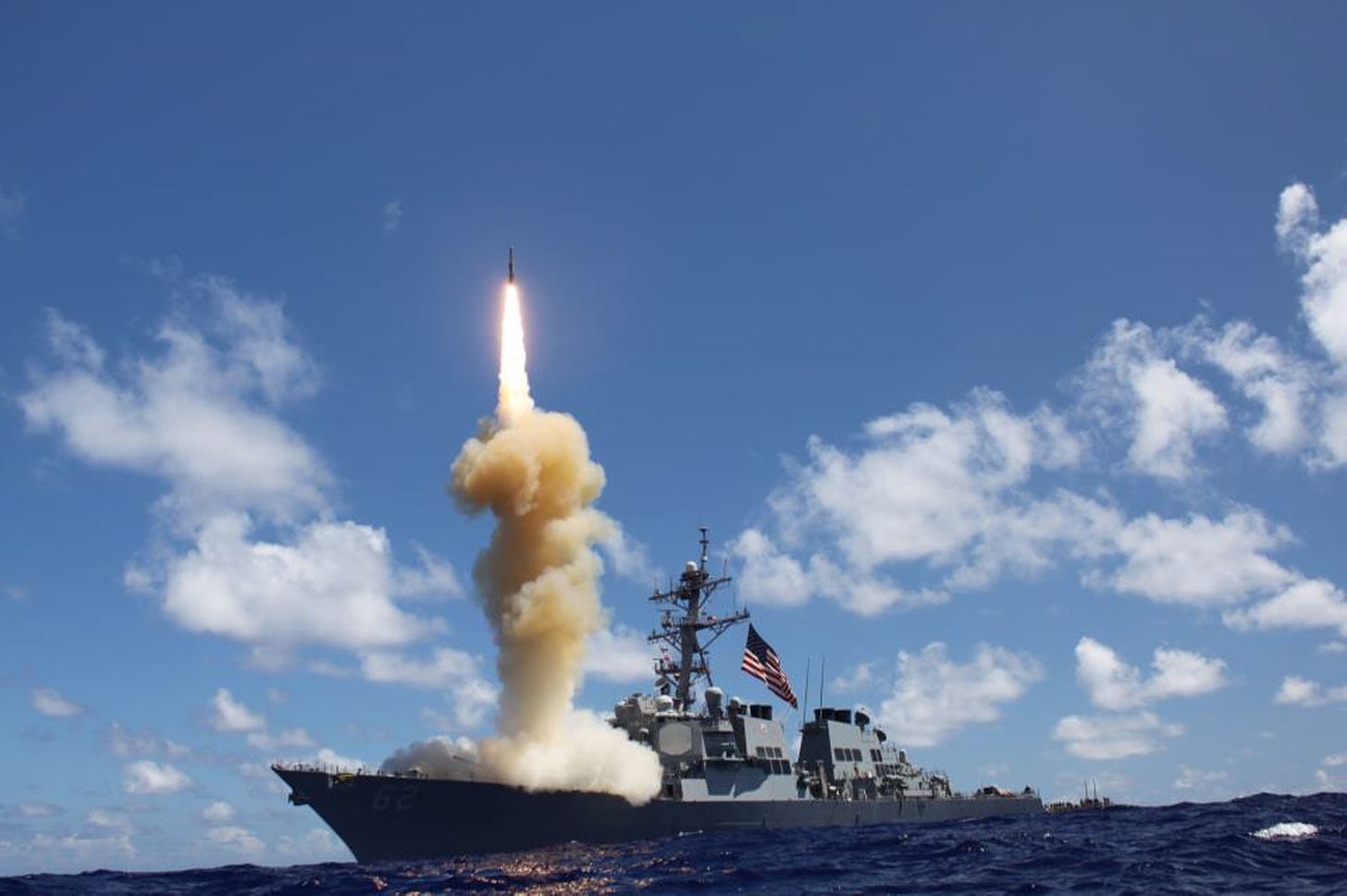
SM-3 Missile Interceptor Launched from a US Guided-Missile Destroyer
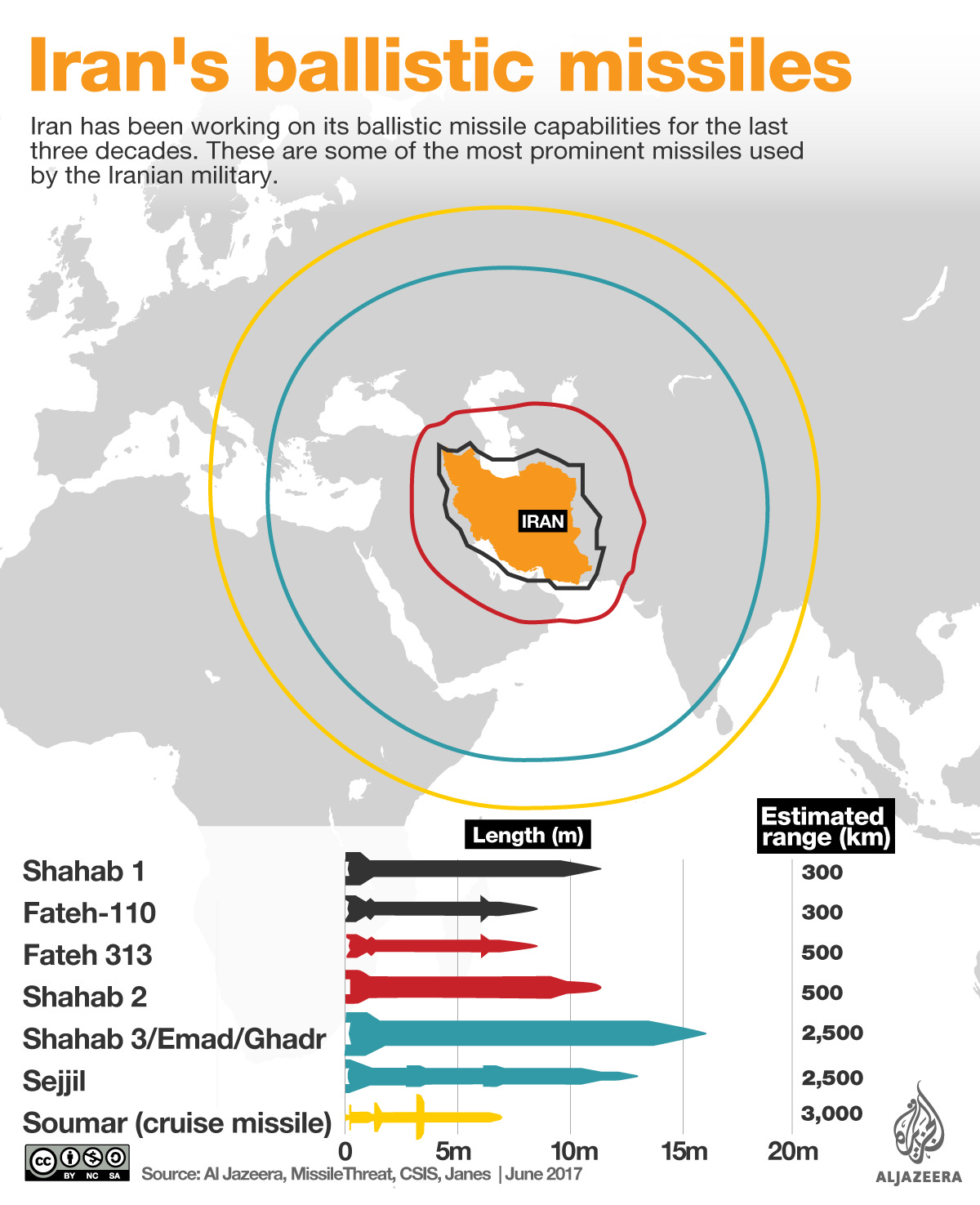
Iranian Ballistic Missiles and Ranges
Had Iran, at that moment in time, opted to follow up with an even larger strike consisting of several hundred of its best ballistic missiles, the US and Israeli defenses would have been penetrated to an overwhelming degree. It would have put to shame the opening-night show of the Americans’ 1991 “shock and awe” cruise missile attack against Baghdad.
Fortunately the Iranians didn’t press the matter, and let their modest yet impressive demonstration of strength suffice for the time being.
In recent months, Iran’s close partner Hezbollah — which is reputed to possess at least 100,000 missiles and drones of various types — has been routinely penetrating Israel’s once-vaunted “Iron Dome” missile defense system.
Indeed, Hezbollah has almost appeared to be mocking the Israelis’ impotence at times.
In any case, the Iron Dome has been revealed to be acutely vulnerable to penetration by Hezbollah drones and missiles.
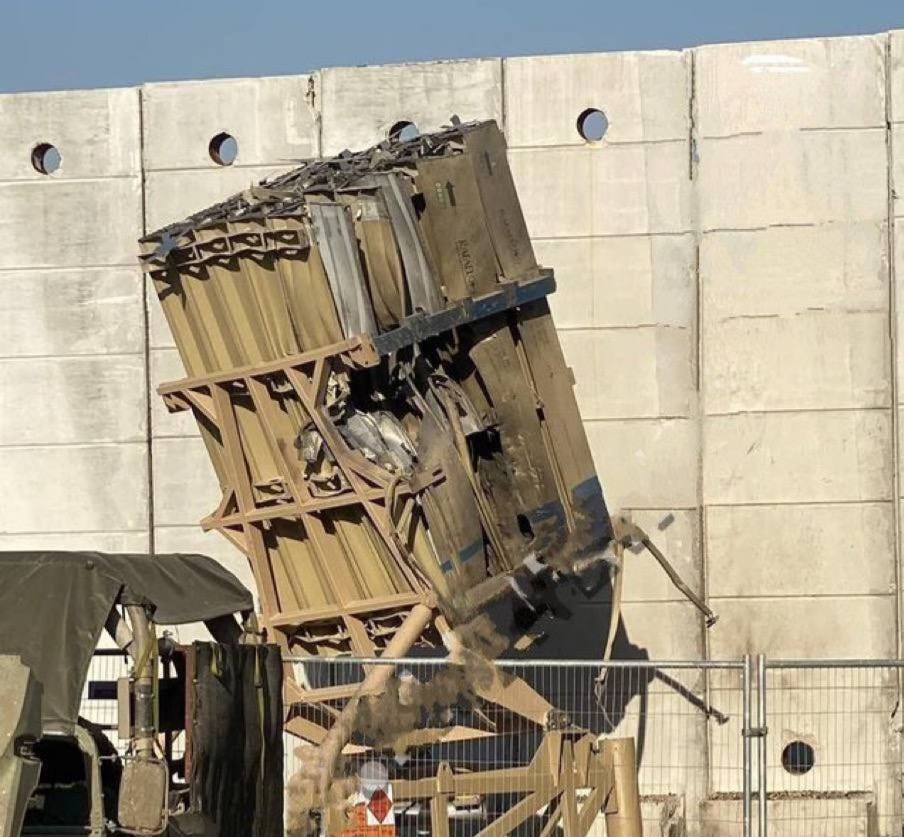
Israeli Iron Dome Launcher Destroyed by Hezbollah Drone Strike
It is not known with precision how many missiles and drones of various types Iran possesses. But it is reasonable to assume that their “magazine depth” is considerably larger than that of Hezbollah.
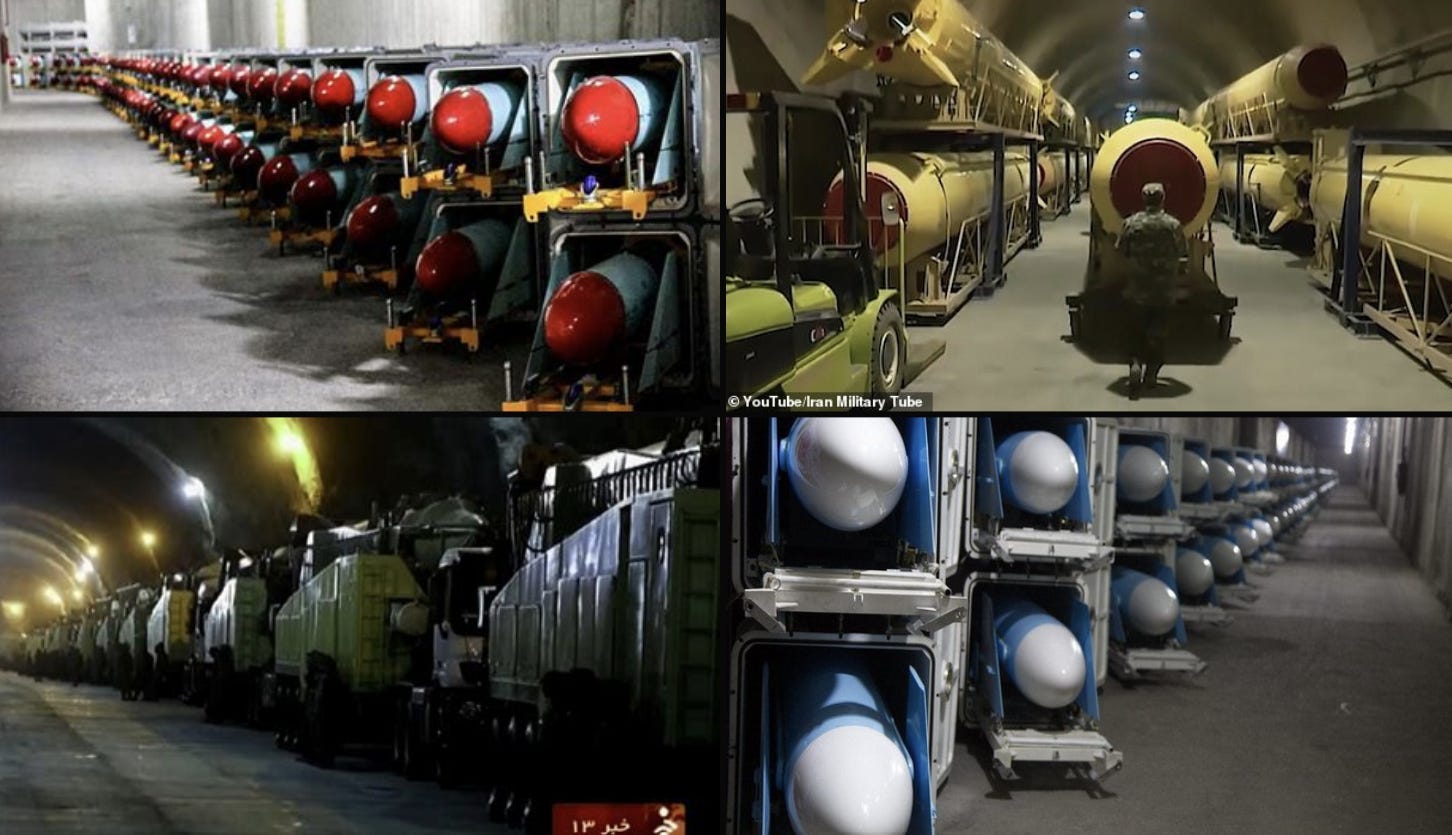
Iranian Missiles
It is also not known with precision how many missiles and drones of various types Russia possesses. But it is reasonable to assume that their “magazine depth” is considerably larger — and exceedingly more potent — than that of Hezbollah and Iran combined.
Even more importantly, the Russians have, over the course of the war in Ukraine, demonstrated an unprecedented capability to routinely shoot down the best strike missiles the US and its NATO vassals have been able to launch against them.
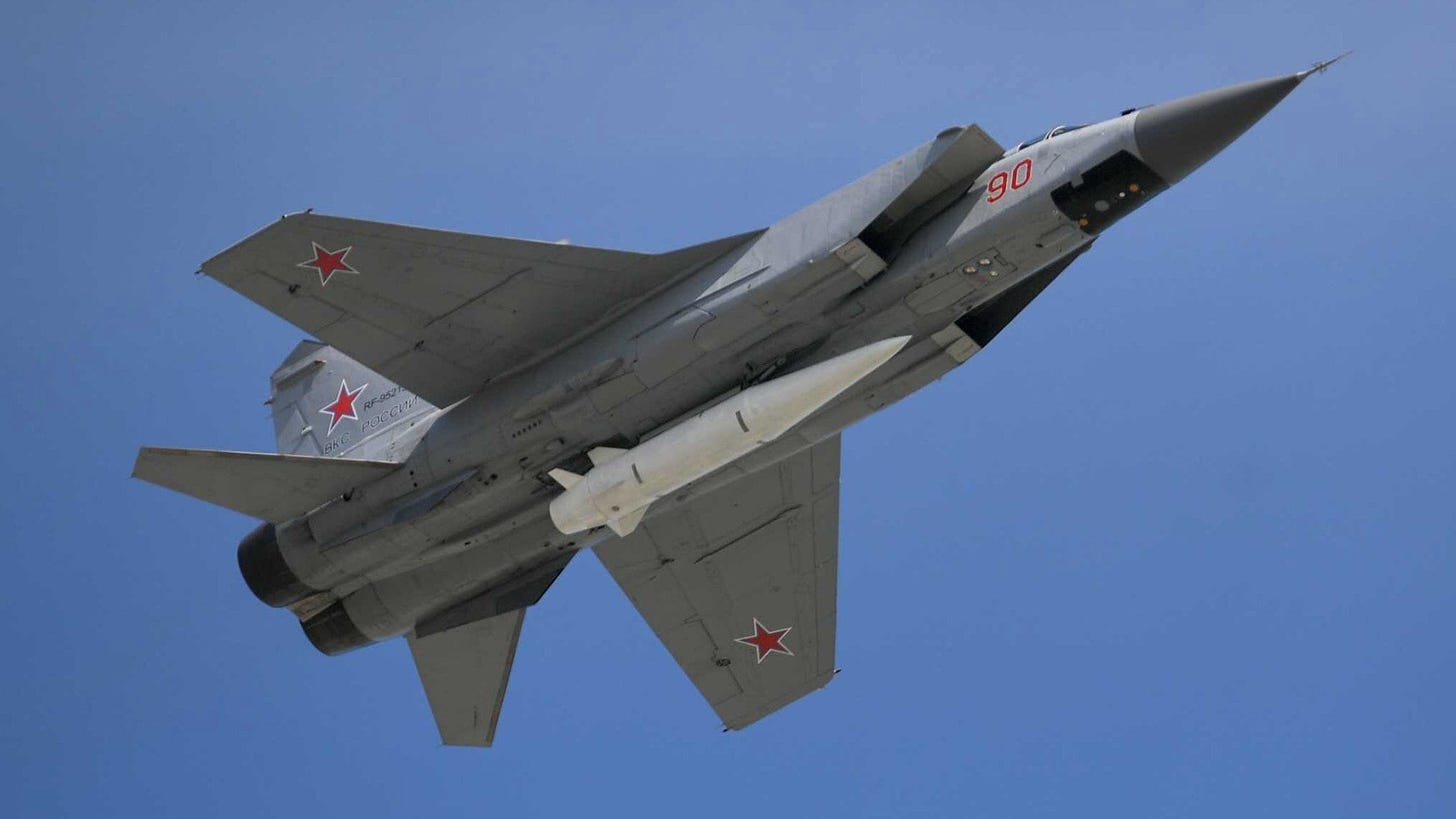
Russian MiG-31 Carrying a Hypersonic Kinzhal Missile
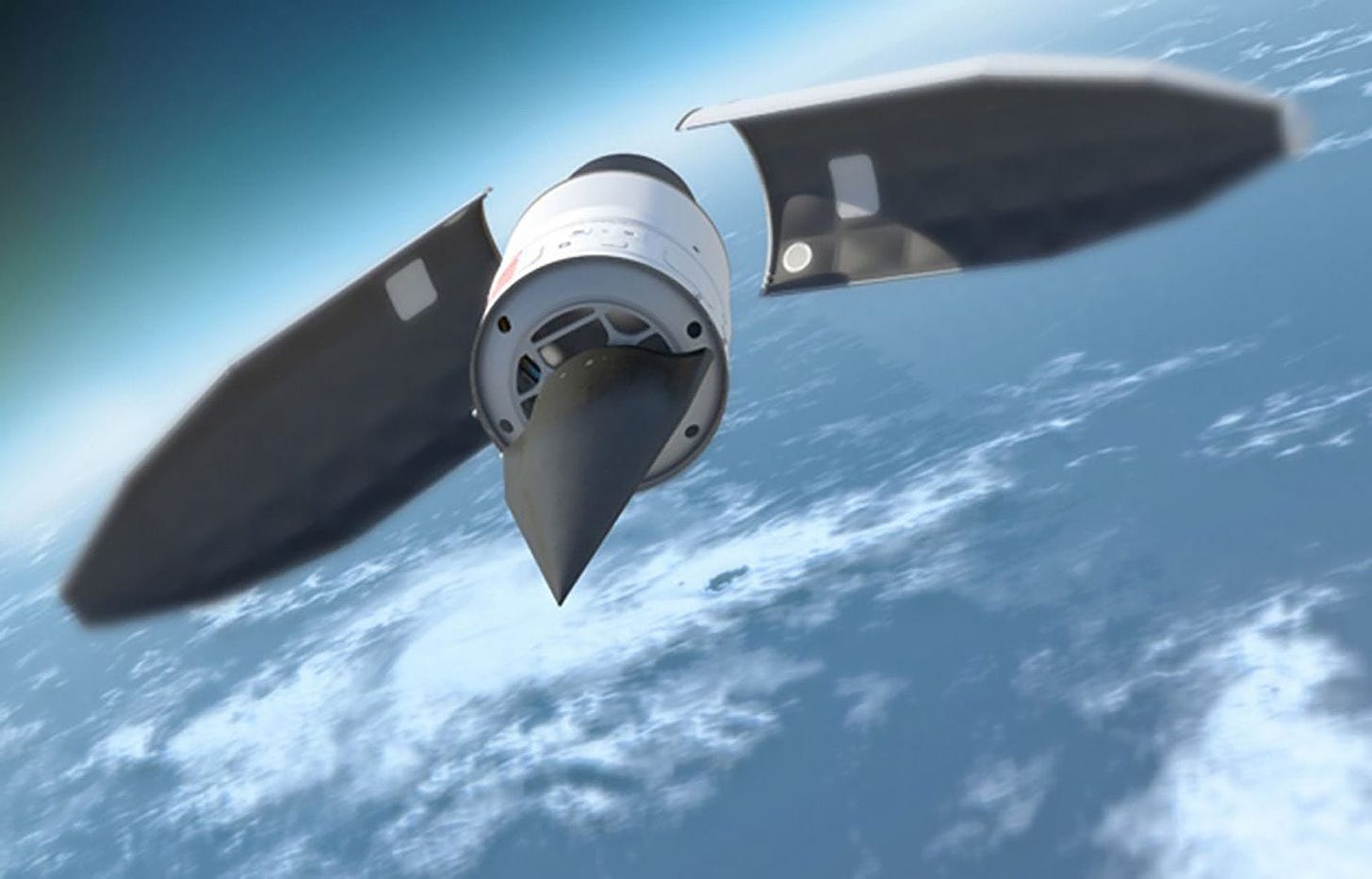
Russian Avangard Hypersonic Missile
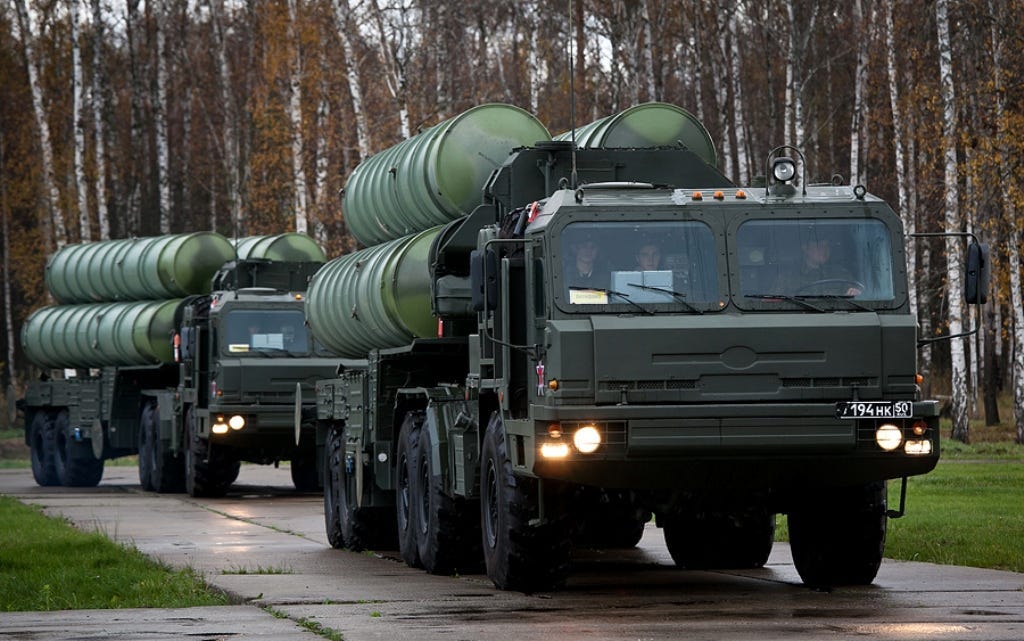
Russian S-400 Air Defense System
Lastly, it is not known with precision how many missiles and drones of various types China possesses. But it is reasonable to assume that their “magazine depth” is at least an order of magnitude larger than Hezbollah, Iran, and Russia combined.
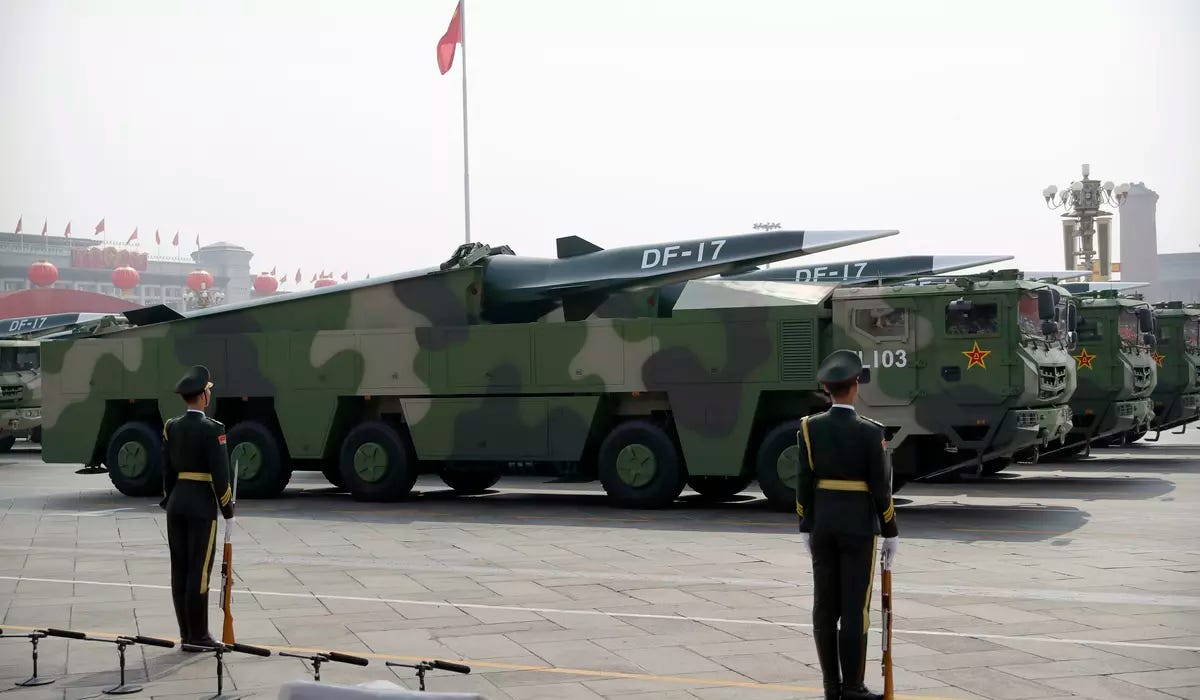
Chinese DF-17 Hypersonic Missiles
Of course, I’ve not yet made any mention of North Korea, who has now been formally received into the Russia, China, Iran mutual-defense partnership. People love to mock Kim Jong-Un and his people, but the empire underestimates them at their peril.
The Israelis can talk tough about making war against Hezbollah and its friends, but if they actually attempt it, it will end very, very badly for them.
The Americans and their almost laughably impotent allies can talk tough about making war against Russia or China, but if they actually attempt it, it will end catastrophically for them.
Then we’ll really have a dangerous situation on our hands.
Canada’s terrorist designation of IRGC ‘utter servility’ to Israel: Iran
Press TV – June 21, 2024
The spokesman for Iran’s Foreign Ministry says Canada’s unlawful decision to designate the Islamic Revolution Guards Corps (IRGC) as a terrorist group is “utter servility” to the Israeli regime.
In a social media post on Friday, Nasser Kan’ani said the Canadian government’s move against the IRGC is not under recognized principles of international law and will bear no fruit.
It is not strange that the agents and allies of the Israeli regime designate the world’s largest anti-terror force as a terrorist group at a time when the criminal regime is conducting the largest genocide against the people of Palestine in Gaza, he wrote.
“History and awakened human consciences will remember these self-proclaimed defenders of human rights and real accomplices to crimes against humanity along with the Zionist criminals and terrorists,” the Iranian spokesman said.
Kan’ani expressed confidence that the IRGC will become more powerful and honorable and will remain a “thorn in the eyes of the enemies of Iran and Islam.”
In a hostile move against Iran, Canada’s Public Safety Minister Dominic LeBlanc Ottawa on Wednesday listed the IRGC as a “terrorist entity” under the Criminal Code and called on Canadians in Iran to leave.
Last month, the Canadian House of Commons adopted a non-binding resolution calling on Prime Minister Justin Trudeau’s government to blacklist the IRGC and expel an estimated 700 Iranians.
The move makes Canada the second country in North America after the United States to blacklist the IRGC.
Iran’s Interim Foreign Minister Ali Bagheri Kani said on Thursday that the Canadian government’s move against the IRGC was a senseless gift to the bloodthirsty Israeli regime, terrorists and enemies of peace and stability in West Asia.
His comment came after Kan’ani in a statement said that Iran reserves the right to reciprocate with a “proper” response to Canada’s unlawful act.
Featured Video

The Empire Enters the Cocaine Trade
or go to
Aletho News Archives – Video-Images
Book Summary
The Whole Soy Story: The Dark Side of America’s Favorite Health Food

Lies Are Unbekoming | January 20, 2026
Soybeans generate approximately $80 million annually in mandatory producer assessments alone, funding a marketing apparatus that has transformed an industrial commodity into one of America’s most trusted “health foods.” The campaign succeeded. Soy milk lines supermarket shelves beside dairy. Soy protein fortifies everything from infant formula to energy bars. Vegetarians rely on tofu and tempeh as dietary staples. Doctors recommend soy to menopausal women. School lunch programs serve soy-based meat substitutes to children. An estimated 60 percent of processed foods contain soy derivatives. The premise underlying this proliferation—that Asians have thrived on soy for millennia and that modern science validates its health benefits—has been repeated so often it functions as established fact.
Kaayla T. Daniel’s The Whole Soy Story dismantles this premise through systematic examination of the scientific literature. The book documents that traditional Asian soy consumption averaged roughly one tablespoon daily, consumed as fermented condiments after processing methods that neutralized inherent toxins—a pattern bearing no resemblance to American consumption of industrially processed soy protein isolate, soy flour, and soy oil. Daniel catalogs the antinutrients that survive modern processing (protease inhibitors, phytates, lectins, saponins), the toxic compounds created by industrial methods (nitrosamines, lysinoalanine, hexane residues), and the heavy metals concentrated in soy products (manganese, aluminum, fluoride, cadmium). She traces the mechanisms by which soy isoflavones—plant estrogens present at pharmacologically significant levels—disrupt thyroid function, impair fertility, and interact with hormone-sensitive cancers. The evidence emerges from peer-reviewed journals, FDA documents, and industry sources themselves.
The stakes extend beyond individual dietary choices. Infants fed soy formula receive isoflavone doses equivalent to several birth control pills daily, with blood concentrations 13,000 to 22,000 times higher than their natural estrogen levels. Soy protein isolate—the ingredient in formula, protein bars, and thousands of products—has never received GRAS (Generally Recognized as Safe) status; its only pre-1960s use was as an industrial paper sealant. Two senior FDA scientists formally protested their own agency’s approval of soy health claims, citing evidence of thyroid damage and reproductive harm. The Honolulu Heart Program found that men consuming tofu twice weekly showed accelerated brain aging and increased dementia. These findings have not penetrated public awareness because the institutions responsible for consumer protection have been compromised by the industry they regulate. The Whole Soy Story presents the evidence that has been systematically excluded from mainstream health messaging, enabling readers to evaluate for themselves what the soy industry prefers they never learn. … continue
Blog Roll
Recent Comments
seversonebcfb985d9 on French court jails pro-Palesti… eddieb on Fourteen Incredible Facts Abou… Bill Francis on European leaders’ shift in the… seversonebcfb985d9 on Villains of Judea: Philip Esfo… loongtip on Report warns that ‘Jewish terr… Craig Nelms on New study shows that toxic gas… loongtip on A Funny Thing Happened on the… loongtip on EU free trade pact on hold as… John Edward Kendrick on Regime Change In Iran Is The F… Bill Francis on Australia Passes New Hate Spee… seversonebcfb985d9 on Australia Passes New Hate Spee… Bill Francis on Britain’s AI Policing Plan Tur…


 Aletho News
- Germany to build 10GW of baseload gas plants (disguised as “future” hydrogen plants)
- French court jails pro-Palestine activist and mother over Gaza genocide speech
- Shot, amputated, and imprisoned: Palestinian man seeks to rebuild life after being maimed and tortured by Israeli forces
- Building Disney Land on the Moon More Likely than Kushner’s Gaza Plan
- U.S. Funds Continue to Flow to Ecuadorian Groups Despite Trump-Era Suspension
- A pro-EU regime is moving to suppress this proud nation. Will they be able to withstand it?
- US-Russia Arms Control May Face ‘Very Dark Period’ – Scott Ritter
- Israel moves to restrict Palestinian re-entry to Gaza, ‘encourage outflow’: Report
- Trump aims to create new UN and own it, Brazil’s Lula warns
- UN rapporteur says Israeli demolition of UNRWA compound reflects broader attack on UN system
- If Americans Knew
- Israeli drone strike kills two children collecting firewood in Gaza – Not a ceasefire Day 107
- Another Gaza baby freezes to death on Netanyahu’s watch – Not a ceasefire Day 106
- Oppose Israel’s Abuses While You Still Can
- UNRWA Heads Tell Ha’aretz: ‘We Don’t Radicalize Palestinians – Their Lived Existence Does’
- Plans Call for “New Rafah” Built in Israel’s Image — Without Palestinians
- Posing as priest, reporter is spat at many times, highlighting anti-Christian sentiment in Israel
- Leaked Documents: “Planned Community” in Rafah Would Force Palestinians Into Israeli Panopticon
- ‘Permits of Humiliation’: How Israel Strangles Christian Education in Jerusalem
- “The world sees death, destruction and injustice – and they see dollar signs” – Not a ceasefire Day 105
- War criminal Netanyahu kills 11 in Gaza, joins Board of Peace – Not a ceasefire Day 104
- No Tricks Zone
- Germany’s Natural Gas Crisis Escalates … One Storage Site Near Empty …Government Silent
- Polar Colding…Antarctica Saw Its Coldest October In 44 Years!
- New Study: Sea Levels Rose 20 Times The Modern Rate During The Roman Warm Period
- As German Gas Storage Dips Dangerously Low…Shortage Hardly Avoidable
- New Study: Brazil’s Relative Sea Level Was 2+ Meters Higher And SSTs 3-4°C Warmer 6000 Years Ago
- Philosopher Schopenhauer: Climate Science Certainty Stems From Stupidity, Ignorance
- New Study: Species Extinction Rates Declining Since 1980 – ‘Climate Change Is Not An Important Threat’
- Denmark Places Climate Protection Above Animal Welfare, Poisoning And Culling Cows
- New Study: Greenland Was 3-7°C Warmer And Far Less Glaciated Than Today 6000-8000 Years Ago
- German Media Report That Current Frigid Weather Can Be Explained By Arctic Warming!
 Aletho News