Wheels Within Wheels: Complexity is Real in War
By Bill Buppert | The Libertarian Institute | April 18, 2024
Sober observers may find another reason for the Iranian attack against Israel this month in retaliation for the Israeli bombing of the Iranian consulate annex building adjacent to the Iranian embassy in Damascus, Syria on April Fools Day.
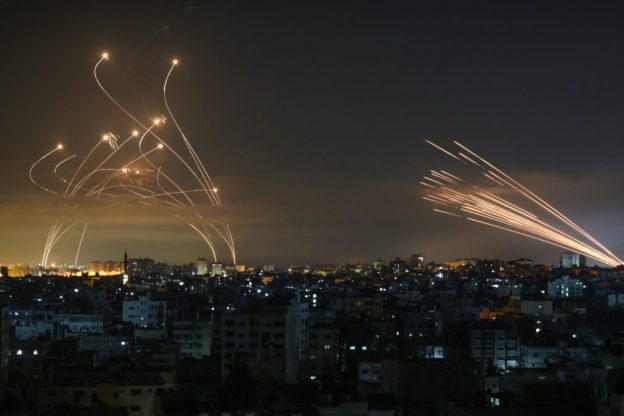
May I suggest it is more important in this case to exhaust the kinetic Israeli/US air defense assets and accuracy doesn’t matter as long as exquisite munitions are exhausted; whether shoot/shoot/look or shoot/look/shoot which is a slight permutation on dynamic retasking, controlled pairs or more of air defense munitions are launched as a matter of course to service incoming ordnance. If the object here is to empty the western magazine cupboards by sending your older and less effective munitions aloft (Iran), mission accomplished and you have a very sufficient intelligence mapping of Israeli Anti-Access Air Defense (A2AD) dispositions and tactics, techniques and procedures (TTP) for follow-on responses.
Nations and regions do stumble into war precipitously but there are conflicts in history where the weaker opponents plan and shape the conditions to prevail before the conflict is started; Vietnam is the best example in recent history of reading the tea leaves and setting the stage for success against superior forces.
The west has a manufacturing crisis right now that is existential in restocking and reconstituting the emptying stocks of war materiel. One can either favor or oppose doing that but the fact remains the manufacturing base and capability is an open question for America and its allies.The chaos avalanche of the competency crisis, the reproducibility problems in STEM research & application and the very real infrastructure failures increasing in frequency year by year doesn’t bode well for those wishing to replenish the diminished war stocks potentially reconstituting with stuff that simply doesn’t work.
The second 155mm artillery shell manufacturing plant in the west just went up in flames in the UK in less than a week. One in Scranton Army Ammunition Plant in PA and the BAE Systems Glascoed Plant in Monmouthshire, UK.
In war, there is a lot to be said for how to leverage shaping the conflict left of bang.
I’m fond of saying that many people are in charge but no one is in control.
West’s backing of Israel after Iran’s retaliation ‘reckless, irresponsible’: Legal analyst
By Alireza Hashemi – Press TV – April 2024
A legal analyst has criticized Western countries for mischaracterizing Iran’s defensive military action in response to Israel’s attack on the country’s diplomatic mission in Syria, warning that the “reckless” and “irresponsible” position could embolden the regime to launch more attacks.
In an interview with the Press TV website on Wednesday, three days after Iran’s retaliatory military action, Reza Nasri touched on the legality of the Iranian response to the Israeli aggression.
“By misrepresenting Iran’s act of self-defense as an act of aggression, Western countries are effectively paving the ground for Benjamin Netanyahu to justify yet another attack on Iran,” he said.
Nasri was referring to Western leaders rallying behind Israel following Iran’s retaliation on Sunday.
He said the irony is these Western countries call for de-escalation on one hand and at the same time – by misrepresenting Iran’s legitimate act of self-defense – give Netanyahu the pretext to justify yet another attack on Iran and to consequently expand the war to the entire region.
“I believe those Western countries’ position is not only inconsistent with international law but it is reckless and highly irresponsible,” the political analyst and international lawyer stressed.
The pattern of Israeli aggression
Nasri emphasized that Iran’s military operation was not an unprovoked attack but a legitimate response to a series of unauthorized acts of aggression by the Israeli regime targeting Iranian interests.
“Iran’s military operation was not an ‘attack’ that occurred in a vacuum but a ‘response’ to an illegal armed attack by Israel that followed a series of previous acts of aggression against Iranian interests in the region,” the analyst asserted.
Nasri, whose expertise lies in international law, explained that Iran’s action was justified under the right of self-defense as outlined in Article 51 of the United Nations Charter.
Referring to allegations that Iran’s attack endangered and harmed civilians, the analyst pointed out that Iran’s operation targeted only Israeli military bases and avoided civilian infrastructure and hence it was compliant with the principle of proportionality in international humanitarian law (IHL).
“Unlike Israel, Iran did not target any civilian residence, hospital, school, synagogue, bakery, water storage, journalist, ambulance, or nursery! It conducted a spectacular attack in which only the military bases from which Israel conducted its initial aggression were hit and damaged,” he remarked.
“Had Iran intended to inflict significant damage to Israeli towns and infrastructure, it would have used more of the same supersonic missiles it used to target Israel’s military bases or launched a third or fourth wave of attacks after Israel’s air defense system was exhausted. So, Iran’s response was proportionate and in compliance with norms and principles of IHL.”
Nasri said Israel’s airstrike on the Iranian consulate, unlike Iran’s military operation in response, was an illegal act of aggression violating the UN Charter and the Vienna Conventions on diplomatic relations.
“The Israeli attack on Iran’s embassy constituted an illegal act of aggression in violation of Article 2 (4) of the UN Charter and blatant breach of the principle of “inviolability of diplomatic and consular premises” as enshrined in the 1961 and 1963 Vienna conventions,” he noted.
Iran’s response was deemed necessary due to a series of lethal strikes by Israel against Iranian interests in the region, which had resulted in the assassinations of prominent Iranian officials and military commanders, Nasri explained.
“The armed attack against the Iranian embassy – coupled with the pattern of Israeli acts of aggression on previous occasions – led Iran to the assessment that further military attacks were looming large and that it was necessary to mitigate the threat through military action, as any other country would have in similar circumstances,” he hastened to add.
“Even the UK foreign minister – Mr. David Cameron – stated in a recent interview that the UK would have taken ‘very strong action’ had any country conducted an attack against his country’s diplomatic and consular premises abroad.”
UNSC must protect international peace
The analyst underscored the responsibilities of international bodies in preventing further escalation, urging the UN Security Council to fulfill its duties by recognizing Iran’s right to self-defense in the face of aggression and condemning Israel’s threat to use force against Iran, which violates the UN Charter.
“In principle, it should at this point condemn Israel’s current threat to use force against Iran – which constitutes a violation of Article 2 (4) of the Charter – and take the necessary measures to prevent further escalation,” he said. “Normally, the Security Council should endorse an act of self-defense against an act of aggression, not the other way around,” Nasri stated.
“Israel must understand that it cannot conduct an unlawful armed attack against a sovereign country’s embassy in a third country, then pledge to militarily attack that state again once the latter takes legitimate measures of self-defense.”
‘Unsubstantiated’: Iran rejects Argentine court’s blaming for AMIA bombing
Press TV – April 17, 2024
The spokesperson for Iran’s Foreign Ministry has dismissed a ruling by an Argentine court that blames Iran for two bombing attacks in the country during the 1990s, labeling the claims in the verdict as unsubstantiated and politically motivated.
“From Iran’s perspective, the court’s involvement in the AMIA building explosion case and its final judgment on the motives and primary causes of the blast is premature and lacks legal-judicial wisdom,” Nasser Kanaani said on Wednesday.
He was referencing a recent ruling by Argentina’s Court of Cassation, which attributed responsibility for the dual attacks on Israel’s embassy and the Argentine Israelite Mutual Association (AMIA) Jewish center in Buenos Aires to Iran and Lebanon’s Hezbollah movement.
The ruling, as reported by the press, alleged that Iran orchestrated the 1992 attack on Israel’s embassy and the 1994 bombing of the AMIA center.
The spokesperson argued that the ruling represents an effort to misdirect the investigation’s course to uncover the truth, as the case regarding the explosions is currently under review in another court.
“This demonstrates the execution of a new political project by the adversaries of the Islamic Republic of Iran, notably the Zionist regime,” he asserted.
The spokesperson highlighted that for the past thirty years, Iran has endorsed any constructive initiative to ascertain the truth behind the incident, including signing a memorandum of understanding with the Argentine government to establish a joint investigative commission.
“Unfortunately, the aforementioned actions have remained fruitless and have not achieved any result due to actions by those who have not sought to discover the truth and have always sacrificed the execution of justice for their political and partisan objectives within Argentina,” he said.
The spokesperson cautioned that the Israeli regime has repeatedly tried to shift focus from its genocide in Gaza, insinuating that it may have influenced the recent ruling.
“It is evident to all that in recent months, the Zionist regime has faced global condemnation for committing war crimes and the heinous killing of civilians, particularly Palestinian children and women in the Gaza Strip … [and is attempting] to distract the international community from its offenses in various ways.”
The 1992 and 1994 bombings in Argentina remain unclaimed and unresolved, although Israel has persistently accused Iran of involvement.
Argentina has cultivated strong ties with Israel under President Javier Milei, who has emerged as a fervent supporter of the regime.
Milei has backed the Israeli regime’s continued actions against Gaza, in contrast to most other Latin American leaders who have either cut ties with the regime or withdrawn their envoys from Tel Aviv.
Milei also recently declared that Argentina would join the few countries that have relocated their embassy in the Israeli-occupied territories from Tel Aviv to Al-Quds.
US Will Try to Rally Other Nations to Sanction Iran Over Israel Attack
By Kyle Anzalone | The Libertarian Institute | April 16, 2024
US Treasury Secretary Janet Yellen will attempt to convince the international community to increase economic penalties on Iran as punishment for the drone and missile barrage Tehran launched at Israel. Iran’s attack followed Israel’s assassination of several high-ranking officials when Tel Aviv bombed Tehran’s consulate in Damascus.
On Tuesday, Axios reported that the Treasury is preparing new sanctions to levy on Iran and will use an International Monetary Fund (IMF) meeting later this week to try to convince other countries to join. “All options to disrupt terrorist financing of Iran continue to be on the table,” she said.
The sanctions would be a response to Iran’s drone and missile attack on Israel. The Iranian attack was a response to Israel’s bombing of the Iranian consulate in Syria, which killed 16 people, including seven IRGC officials.
“Treasury will not hesitate to work with our allies to use our sanctions authority to continue disrupting the Iranian regime’s malign and destabilizing activity,” Yellen is set to say during her opening remarks at the IMF conference. “The attack by Iran and its proxies underscores the importance of Treasury’s work to use our economic tools to counter Iran’s malign activity.”
According to Axios, Washington hopes the sanctions will show Tel Aviv that there is a way to punish Tehran without a direct attack on Iran. The war government in Tel Aviv says it will respond to the Iranian attack “clearly and forcefully.”
However, the Washington Post notes that the White House has few options for sanctioning Tehran as the Iranian economy is already one of the most heavily sanctioned. The Post explains that one of Washington’s few options for expanding sanctions on Iran is to blacklist Chinese firms purchasing Iranian crude oil.
Pursuing that path may create more problems for the White House as it will likely upset Beijing and drive up oil prices. The Biden administration is seeking to prevent an increase in gas prices in an election year and has previously asked Ukraine not to attack Russian energy infrastructure.
NATO member blames Israel for Iranian attack
RT | April 16, 2024
Iran’s first direct attack on Israel is the fault of Israeli Prime Minister Benjamin Netanyahu first and foremost, Turkish President Recep Tayyip Erdogan has said.
In a televised address after a cabinet meeting in Ankara, Erdogan said it was unfair to look at last Saturday’s events in a vacuum.
“The one chiefly responsible for the tension that gripped our hearts on the evening of April 13 is Netanyahu and his bloody administration,” he said.
“Since October 7, the Israeli government has opted for provocative moves in order to spread the fire to the entire region. The Israeli government targeted the Iranian consulate in Damascus, violating international law and the Vienna Convention, and that was the last straw,” added Erdogan.
Tehran’s diplomatic mission was struck on April 1, killing seven high-ranking officers of the Islamic Revolutionary Guard Corps (IRGC) Quds Force, including two generals. Israel never officially claimed responsibility for the strike, but has repeatedly bombed Syria, claiming preemptive self-defense from the Iranian presence there.
“We have seen the double-standard approach of Western countries,” Erdogan said, pointing out that only a handful of countries condemned Israel’s move, but rushed to denounce Iran’s response.
Tehran eventually launched scores of drones and missiles against targets inside Israel. The US, UK, France and Jordan helped the Israelis with air defense but some of the projectiles got through, causing unspecified damage.
Erdogan also blamed Israel for the current conflict in general, saying its forces have “indiscriminately” killed tens of thousands of Palestinian civilians in Gaza, including people standing in line for humanitarian aid.
“For more than 132 days, Israel has been implementing genocidal policies,” the Turkish leader claimed.
Netanyahu declared war on Gaza-based Hamas after the Palestinian militant group raided nearby Israeli villages and military bases last October. Much of Gaza has since been reduced to rubble and its civilian population pushed to the edge of starvation. A recent report by UN Human Rights Council special rapporteur Francesca Albanese has accused Israel of intending to commit genocide in the enclave.
Iran’s strike on Israel was much more successful than it seems. Here’s why
By Abbas Juma | RT | April 16, 2024
On the night of April 14, Iran and its proxy forces launched a series of cruise missile and kamikaze drone strikes on Israeli territory. The attacks did not come as a surprise. Tehran had warned that it would respond to the Israeli airstrike on Iran’s consulate in Damascus, Syria, on April 1, which killed several high-ranking officers of the Islamic Revolutionary Guard Corps (IRGC), including two generals. The retaliatory strike was called Operation True Promise.
There is still much debate on whether Iran’s retaliatory strike was successful. Most military experts agree that there was nothing unusual about Tehran’s actions, except that this was Iran’s first direct attack on Israel. From a technical point of view, the strategy was simple and correct: Iran first suppressed the enemy’s air defense systems with drones and then launched hypersonic missiles which the Israelis and Americans were not able to intercept. Incidentally, in light of this, Ukraine’s statements about shooting down Russian Kinzhal hypersonic missiles sound ridiculous.
Do not jump to conclusions
Many experts were skeptical about Iran’s strike and hastened to say that the retaliation did not live up to expectations. Given the clip thinking of most commentators, this reaction is hardly surprising. Their reasoning resembles a Hollywood blockbuster stuffed with special effects, where the end of the world and its miraculous salvation fit into 90-120 minutes, with a love scene in the middle. In real life, things are different. As Sun Tzu wrote in ancient times, to fight 100 battles and win 100 battles is not the height of skill. The best way to win is not to fight at all. This is Iran’s strategy. Its strike against Israel was not so much a military response as a grandmaster’s move in a big chess game. And the game is not over yet.
After the attack on the Iranian consulate in Syria’s capital, Tehran found itself in a tough situation. It had to respond in a way that would look convincing and would achieve specific military goals, but would not start World War III.
To achieve the first point, Iran had to carry out a direct strike without resorting exclusively to proxy forces – and that is indeed how it acted. Regarding the second point, even though most of the missiles and drones were indeed shot down, some managed to penetrate Israeli air space and hit military targets. The Chief of Staff of the Iranian Armed Forces, Mohammad Bagheri, said that the information center on the Israeli-Syrian border and Israel’s Nevatim air base were hit. And finally, as to the third point – war didn’t happen. This resembled the situation in 2020, when the Iranians hit US bases in Iraq in response to the assassination of General Soleimani.
However, it is still too early to speculate as to whether Iran’s attack was a success or not. The big question now is how Israel will respond.
What Iran has accomplished
It’s important to emphasize that Iran’s operation carried more political than military weight. In this sense, it was carried out subtly and was a success. Obviously, the Iranians did not want to start a war which would involve the US, even though that is what Netanyahu wanted. In other words, Israel didn’t manage to provoke Iran.
It is also obvious that the Islamic Republic possesses more powerful drones and missiles than those used in the attack on April 14. However, even the less advanced drones and missiles were able to penetrate Israeli air space and inflict economic damage, since Israel spent much more money on shooting down the missiles and drones than Iran spent on launching them.
Tehran has once again demonstrated that Israel is not invulnerable, and it is possible to attack it. As for the degree of inflicted damage, which some commentators were unsatisfied with, it largely depends on the type of missiles and drones used in the attack – and Iran has a lot of military equipment.
Finally, Iran’s main achievement is that it has managed to confuse Israel in the same way that it was confused after the October 7 Hamas attack. The country has to respond. But how? Should Israel strike Iranian proxy forces? This is possible, but Israel does it all the time without much result. Should it hit Iran directly? But that would start a war which no one is prepared for, including the US.
Conclusion
The ball is now in Israel’s court, and the country faces the same challenges that the Islamic Republic did after April 1. But will Israel be able to solve these challenges as efficiently?
It is noteworthy that IRGC Commander-in-Chief, Hossein Salami, said that from now on, if Israel attacks the interests of Iran and Iranian citizens, Tehran will strike it again.
This is an important statement. Essentially, the attack carried out by Iran on April 14 was not just a retaliatory strike, but established a new order. Iran demonstrated that it is ready to resort to new means of influence in a situation where words are not sufficient. It attacked Israel directly not in order to start a war, but to demonstrate what could happen if all other methods of pressure on Israel fail.
A new option has been put forward. Israel may be deprived of its most important advantage – absolute impunity, which until recently had been guaranteed by the US.
US makes failed bid for Iran to allow ‘symbolic strike’ by Israel
The Cradle | April 16, 2024
An Iranian military security official has revealed exclusively to The Cradle that the US contacted the Islamic Republic, asking the nation to allow Israel “a symbolic strike to save face” following Iran’s retaliatory drone and missile barrage this weekend.
“Iran has received messages from mediators to let the regime do a symbolic strike to save face and asked Iran not to retaliate,” the source, who spoke on condition of anonymity, revealed to The Cradle.
He added that Tehran “outright rejected” the proposal, delivered by mediators, and reiterated warnings that any Israeli attack on Iranian soil would be met with a decisive and immediate response.
The reply was delivered directly to the Swiss envoy in Tehran by officials from the Islamic Revolutionary Guard Corps (IRGC) and not the foreign ministry. According to The Cradle’s source, the decision for the IRGC to reply directly was meant “to send a strong warning to the US.”
“Iran successfully embarrassed all of the integrated radar network and anti-missile systems of the US and the [Israeli] regime. The US even activated its parked satellites over the region to do maximum protection and failed miserably,” the Iranian military official added.
The revelations come as US defense officials have told western media that they expect a “limited response” from Israel against Iran, which will reportedly focus on targets outside of Iranian territory.
Nevertheless, US officials stressed that Tel Aviv had not briefed the Pentagon on a “final decision” as discussions within Israel’s fractured war cabinet continued.
“The US does not intend to take part in the military response,” they confirmed. However, they expect Israel to inform Washington about response plans in advance.
Israel has publicly vowed to respond to the Iranian operation this weekend, which saw the launch of hundreds of drones, ballistic and cruise missiles by the Islamic Republic in retaliation to the Israeli bombing of Iran’s consulate in Damascus.
“This launch of so many missiles, cruise missiles and drones into Israeli territory will be met with a response,” Israeli army chief of staff, Lt Gen Herzi Halevi, said on Sunday, speaking from the Nevatim air force base in southern Israel, which was one of three military targets successfully hit by the Iranian barrage.
Iranian Deputy Foreign Minister Ali Bagheri Kani told state TV on Monday night that Tehran’s response to any Israeli retaliation would come in “a matter of seconds, as Iran will not wait for another 12 days to respond.”
‘Nothing You Can Do to Stop Us’: Iran’s Strikes on Israeli Bases Establish Deterrence
By John Miles – Sputnik – 15.04.2024
Former US Marine Corps intelligence officer Scott Ritter urged observers to look beyond Israel and the United States’ framing of Iran’s retaliatory strike, noting Tehran was able to successfully deal damage to Israeli military assets.
Former United Nations weapons inspector Scott Ritter stressed that Iran is playing the long game in its dealings with Israel, carefully calibrating its actions to restore deterrence against the country rather than concerning itself with world opinion.
The former US Marine Corps intelligence officer offered the analysis on Sputnik’s Fault Lines program Monday, challenging the perception that Israel is in a stronger position after intercepting most of Iran’s retaliatory strikes over the weekend.
“The point is prior to this Israel had established a dominance – I’ll call it deterrence dominance,” claimed Ritter. “Meaning that, from an Israeli perspective, nobody should ever dare attack Israel, that Israel has let it be known that if you attack Israel, there will be a ten-fold response, that your life would end, it would be horrible, you can’t do it. And, for the most part, people didn’t attack Israel.”
“And so Israel had become very arrogant, had become sort of the neighborhood bully writ large,” he explained. “And this is why Israel was bombing Syria with impunity, striking targets in Lebanon with impunity, striking targets in Iraq with impunity.”
Israel frequently bombs Syrian airports and other infrastructure and has been illegally occupying the country’s Golan Heights territory since 1967. In 1982 the Israeli military bombed the Lebanese capital of Beirut so aggressively the US President Ronald Reagan referred to the event as a “holocaust,” hurting the feelings of Israeli Prime Minister Menachem Begin.
Observers also suggest Zionist opposition to Iraqi President Saddam Hussein played a role in the United States’ decision to invade the country and remove him from power in 2003. “It’s very clear: Israel had the most influence in this and more so since we know how the Israelis were running into the Pentagon consulting with Rumsfeld and all those guys without even having to show any badge or anything,” former CIA Analyst Ray McGovern claimed on Sputnik’s The Critical Hour program recently.
“And then they struck the wrong target,” said Ritter, referring to Israel’s recent strike on Iran’s diplomatic compound in Syria earlier this month. “You see, Iran said, ‘we have a great latitude for pain because we’ll absorb that pain, because we recognize that in a broader sense of the word Iran is prevailing strategically against Israel, especially when it comes to Gaza and the Israeli defeat that is ongoing in Gaza.’”
“And so Iran delivered a blow, but remember, the purpose of the blow was not to destroy Israel or even bring harm to Israel,” he clarified. “The purpose of the blow was to establish Iranian deterrence precedent so that in the future Israel would know what the consequences of its actions would be. And this Iran did with extreme alacrity and extreme effectiveness.”
“The job wasn’t to say, ‘we’re going to hurt you.’ The job was to say, ‘hey, Israel, look around you. Right now you have America’s most sophisticated X-band radar to give you intelligence when we launch our missiles… you have the whole world coming to your assistance to protect you and you can’t stop our missiles from hitting your most important bases. That’s the future, if you dare attack us again.’”
Israel has claimed in public statements that it was allegedly able to intercept most of Iran’s strikes and prevent major damage. But the country has conspicuously forbidden journalists from observing the aftermath of the attack on Israel’s bases, notes former CIA analyst Larry Johnson. Video posted to social media appeared to show several hypersonic missiles striking Israel’s Ramon military airbase in the Negev desert.
Host Jamarl Thomas pushed back on Ritter’s analysis, asking, “At the point where their generals keep getting murdered, are you really projecting that level of strength if ultimately you are just choreographing in this way?… Is it really a projection of strength if you’re choreographing what you’re doing?”
“You’re referring to the Iranian attack on al-Assad airbase after the [US] assassination of Qasem Soleimani and the fact Iran telegraphed that so that they struck empty buildings and they didn’t kill Americans,” Ritter responded. “Let’s look at it this way. When Iran shot down a Global Hawk [US drone] and Donald Trump wanted to bomb Iranian air defense sites, did he? The answer’s no. Why? Because the Pentagon said they’ll kill everybody. They just set their deterrence. They showed us what they got, and we got nothing to defend against it.”
“When Iran said we’re going to strike Israel, what did the United States do?” he asked. “Say bring it on? We stand side by side with the Israelis? We will attack you? We will bomb your territory? The United States went ‘wow, we’ll defend Israel, but we’re not attacking you.’ Yeah, that’s called deterrence.”
“Iran doesn’t want a shooting match with the United States,” Ritter argued. “They wanted to avoid it, and they have done so. The United States is scared to death of bombing Iran, of creating a conflict because they know what Iran will do. Iran will flatten every single American military base within the range of their missiles. And if the United States takes its next step, Iran will shut down international oil supplies and the economy will crash, and Joe Biden will never get reelected.”
Ritter insisted that Iran attacked Israel in such a way that Israeli Prime Minister Benjamin Netanyahu could save face and back down while also revealing Tehran’s capabilities if Israel strikes it again.
“All those things that were shot down – understand those were designed to be shot down,” he claimed. “Iran put a program together with the United States that said, ‘we’re going to let you shoot all this stuff down so you feel good. But in the end our good stuff hit the bases, just so you know that we can do that anytime we want, and there’s nothing you can do to stop us.’”
Ritter also claimed Iran is focused on economic development rather than seeking military conflict with Tel Aviv.
“They’ve been focused on the Shanghai Cooperation Organization, they’ve been focused on BRICS, they’ve been focused on their strategic pivot to the East,” he noted. “So for them to come in and do this feel good thing to make you, me and everybody else feel good – because apparently that’s what this is about, making the larger audience that has nothing to do with Iran feel good about the Iranian response – they don’t care.
“The Iranians are focused strategically on maintaining that pivot to the East, building strong economic relations, normalizing relations with Saudi Arabia, and, more importantly since October 7th, facilitating the victory of Hamas over Israel which by Israel’s own admission Hamas is winning,” he claimed.
“Haaretz – I think a day before the Iranian retaliation – came out with a headline story that said ‘Israel’s lost this thing, it’s over.’ I mean, there’s nothing Israel could do to turn this around in Gaza. They’ve lost the world. They can’t defeat Hamas. Hamas is emerging still intact militarily, they’re stronger politically. And Iran’s like, ‘we want to sustain that, too. We don’t want to distract the world with this larger Israeli-Iranian conflict, we want to keep the focus on Palestinian statehood.’”
Iran’s drone strike busts a number of myths and strains Israel-U.S. relations
By Martin Jay | Strategic Culture Foundation | April 14, 2024
It is ironic to western analysts how invariably it is the East which keeps a cool head and doesn’t rise to the bait of escalation while it is the West which is reckless, foolhardy and careless with its provocations. In Ukraine we have seen nothing but this accompanied by miscalculation and poor decisions on the part of NATO. And now we are seeing this in Israel as remarkably, Joe Biden, has managed to be ensnared now in a regional war between Israel and Iran – a dream for the latter for well over 30 years.
Iran’s reaction to the bombing of its consulate in Damascus was very measured, well thought-out and pulled off with a certain sobriety which will not be matched by Israel and the U.S. Tehran did not want to kill civilians but simply send a message that Israel crossed a line and if it does this again, then there will be more attacks from Iran, perhaps intercontinental missiles with deeper impact than cheap drones. That is not to say that the drones were not effective. They were at the specific task which the Iranians wanted of them, knowing full well that most of them would be intercepted.
But the move by Tehran was still a shock to many western experts and no doubt the Netanyahu cabal as well, as it busted a number of myths in one evening. Firstly, that Iran would have the courage to bomb directly Israel, as many pundits dismissed this without a thought. The fact that Iran is prepared to use its missiles to potentially kill civilians on Israeli soil changes the dynamic now as Israel can no longer double guess what the payback will be if it continues its feral bombing of Iranian soldiers, even on Syrian soil.
Secondly, it also busts the myth that Israel has the capability to tackle war on more than one front. All during the night while its military was busy, Gazans were enjoying a peaceful night of no shelling at all and took to social media to celebrate the detente. Israel’s military does not have the capacity or strength to fight a war in Gaza as well as one from a second front, such as a massive drone attack, let alone a third one from Hezbollah in Lebanon, if need be.
And thirdly, the role of partners. Israel couldn’t have got through the night and got what it claims to be a 99 percent hit rate without the help of partners like British RAF fighter jets who helped, not to mention King Abdullah of Jordan whose air force also shot down the drones. If these relations, along with the U.S., are tested and pushed beyond their limits, Israel’s vulnerability becomes contentious to say the least.
And so how Netanyahu plays his cards in the coming days is crucial for Israel to stay on good terms with its western allies but also to realistically stay in the game. Iran’s drone attack has opened up a can of worms now which Biden would have preferred wouldn’t have been opened. According to some reports, it is believed that Biden told Netanyahu now to back down and leave the Iranians, fearing the situation spiralling out of control. Could Biden seriously go to the polls in December of this year with a foreign policy cheat sheet which listed pulling out of Afghanistan, starting a war in the Ukraine which will humiliate him and NATO when Russia inevitably wins and now start a world war with Iran? Seasoned analysts have ventured that he will not be able to hold himself back from upping the stakes and going for a revenge attack on Iran or its proxies. This of course would test the relationship with the U.S. and push it to its very limit – a stunt which Biden is hoping very much will not be carried out by Netanyahu. Given that this will almost certainly bring the relationship between Biden and Netanyahu to breaking point and will give Iran the victory either way, it’s hard to see how most western pundits failed to see the drone strike as a great victory for Tehran. Netanyahu’s gambit will be that Biden is weak and now lost in the maze of Middle Eastern warmongering. He will also think that Biden will need to present himself to the hawks in Washington as a victor and so is now in deeper more than ever before, as options run out and the window for rational thinking seems to now no longer be. Biden’s nightmare with Netanyahu is just starting.
What you need to know about the Iranian attack on Israel but will not find in mainstream news
By Gilbert Doctorow | April 15, 2024
Iran’s weekend massive drone, cruise missile and ballistic missile attack on Israel has now been covered in the global media, with the headlines announcing that 99% of the barrage was shot down by Israeli, U.S. and other friendly air defense systems. The question these media pose is what will be the Israeli response, as if that were a matter strictly to be decided by Prime Minister Netanyahu’s cabinet.
In fairness, I note that The Financial Times has also published a front page article setting out what it considers to be the Iranian perspective on the attack, namely that it was successful insofar as it demonstrated their country is not shying away from direct military confrontation with Israel and is confidently prepared to prosecute a full scale war if it comes to that. See “We’re crazier than you realize”: Iran delivers its message with attack on Israel. Tehran believes calibrated missile and drone barrage is enough to restore deterrent and bolster image.”
However, the Iranian position is much more nuanced and contains far greater threat not only to Israel but also to the entire United States presence in the region than the FT suggests. I say this on the basis of an analysis provided on last night’s edition of the Vladimir Solovyov talk show on Russian state television by a regular panelist, Semyon Arkadievich Bagdasarov, who is a leading Russian specialist on the region.
For those who wish to see and hear Bagdasarov’s 14 minutes on air in the original Russian, the link is https://all-make.su/22174-vecher-s-solovyovym-14-04-2024/ minutes: 27 – 41.
In what follows I offer a brief biographical sketch of Bagdasarov so that the seriousness of his remarks can be better appreciated. Then I will summarize what he said on air.
Aged 69, Bagdasarov was born in Central Asia in the Ferghana Valley, which passes through Uzbekistan, Tadjikistan and Kyrgyzstan. Accordingly, he has the proper birthright to his position since 2014 as director of the think tank called the Center for the Study of the Countries of the Near East and Central Asia. However, Bagdasarov reached this academic plateau after passing through a succession of military and civilian government posts, including the 5 years starting in 2007 as a Duma member from the ‘For a Just Russia opposition party of Sergei Mironov, which might be described as slightly to the Left of the ruling United Russia party.
Bagdasarov’s professional education was in a military academy and he ultimately retired with the rank of colonel. He then moved into government service first at the regional level and then as an expert to the Duma, to which, as I said above, he was later elected.
In line with what the FT article has said, Bagdasarov calls the Iranian attack on Israel a limited strike intended as a warning, but also yielding both specific tactical and strategic results.
On the tactical side, the swarming of drones was intended to activate the Iron Dome and other levels of Israeli air defense and to reveal the location of their component parts as well as to deplete the Israeli stock of relevant missiles.
Per Bagdasarov, Israeli claims to have shot down 99% of the incoming barrage should be taken with a grain of salt. The Iranians’ key targets in the attack were the Israeli air force base in the south of the country from which the Israeli strike on Iran’s consulate in Damascus was launched two weeks ago and a military intelligence compound which had prepared that deadly strike. The actual extent of damage from Iranian missiles remains to be evaluated.
Bagdasarov explains that the Iranian attack was ‘limited’ because it consisted of rather slow moving drones and of missiles with small warheads. These were not Iran’s most advanced and lethal attack materiel, which has been held in reserve for any possible Round Two.
How many drones, ballistic missiles and cruise missiles does Iran have? Bagdasarov says no one knows exactly but it may well be 10,000 or more and includes several hundred highly advanced missiles which also have multiple warheads and so are very difficult to defend against. Over the past 20 years, Iran has bet its defense budget on missiles and drones, and it has a large-scale serial production of both. Meanwhile, Iran’s regional allies also have large stocks of these weapons, some of which are also fairly sophisticated. In particular, Hizbollah in Lebanon may have 1500 high quality missiles in its arsenal.
At the strategic level, Iran demonstrated its ability to coordinate a missile and drone attack on Israel with its regional proxies so as to maximize the threat coming from all directions.
Iran used the attack to achieve a political and military objective that has long eluded it. Teheran has now issued threats against Persian Gulf states to bomb any and all that allow the Americans to use their air space or otherwise facilitate Israel’s possible revenge attack on Iran from their territories. These states all fear a war and have now agreed to Iran’s demand. In effect, this negates decades of U.S. unchallenged domination in the Gulf.
Iran has specifically threatened the U.S. regional command in Qatar and the base of the 5th fleet in Bahrain.
The latter point is reflected in Biden’s latest urging restraint on Israel. Washington has understood that its forces in the region are now hostage to whatever Netanyahu may do against Iran as follow-up to this weekend’s barrage.
Furthermore, at the threat level, Iran has a still unused but clearly visible ace in the hole: its ability at will to blockade the Straits of Hormuz and thereby cut off nearly all export shipments of gas and oil from the region. The Straits are just 50 km wide and are easily controlled by Iran’s anti-ship missiles ashore. Such a closure would create havoc on global energy markets. We were reminded of Iran’s dominant position there several days ago when they captured a container ship owned by an Israeli millionaire which was traveling through and directed it to their own coast.
And what about Israel’s alleged plans to attack Iran’s nuclear installations? Bagdasarov insists that this is an impossible objective. Firstly, because the Iranian nuclear program is distributed among 200 centers spread across the vast country and many of these locations are in desert areas buried under 40 meters of sand. The Israelis might only destroy a couple of the best known nuclear centers. Secondly, because to reach their targets in Iran, the Israeli jets would require in-air refueling by American tankers, and it is scarcely credible that Biden will give his consent considering how the U.S. regional bases are under threat.
Iran fired this time only on military objects, but if they use not 300 but 10,000 missiles and drones then Israel will be obliterated. Hizbollah alone have 1,500 advanced missiles. Iran surely has real missiles and drones that are still more powerful. No one knows exactly how many. Over the past 20 years Iran placed its bets on drones and missiles. In the assortment, they have some very sophisticated multi warhead missiles that are unstoppable.
Later in the program (at 1 hour 36 minutes) a military commentator who is a frequent panelist on the Solovyov show, Lt General (retired), Yevgeny Buzhinsky, head of the Center of Applied Military Research of Moscow State University, seconded the estimation of Bagdasarov that this was just a warning, a PR exercise by Iran. As for the shoot-down, he noted that with its S400 and other systems Russia has probably the best air defense in the world, and yet they strain to reach the 99% interception that Israel has blithely claimed.
As host Vladimir Solovyov commented at the opening of the program, the principal fact is that the Iranians did it. They spat on the U.S. and its allies, and they just did what they believed was necessary. In consequence the world ‘built on rules’ counts for nothing.
©Gilbert Doctorow, 2024
Iranian Media Confirms Use of Unstoppable Hypersonic Missiles in Israel Counterstrike
By Ilya Tsukanov – Sputnik – 15.04.2024
Tehran fired dozens of ballistic and cruise missiles and hundreds of drones at Israel Saturday night in response to the April 1 Israeli strike on the Iranian Embassy compound in Damascus, Syria. The IDF declared that “99 percent” of the projectiles were shot down and that the Iranian attack failed. Iran said it achieved its strategic objectives.
The Islamic Republic used hypersonic missiles during the Operation True Promise missile and drone barrage against Israel, with all of them hitting their targets after evading Israel’s air and missile defenses. That’s according to a Press TV report, citing informed sources.
The Iranian news agency and broadcaster did not elaborate on the details of the missiles which were used, how many were fired, or what their targets were. However, earlier, Iranian media reported that the Islamic Republic fired at least seven hypersonic missiles during the attack, with none of them intercepted. Separately on Sunday, Lebanese national security expert Ali Hamie told Sputnik that he had information that Iran had fired its new Fattah 2 hypersonic missiles in Saturday night’s strikes.
The Fattah 2 (literally “Conquerer 2” or “Victory Giver 2”) is a liquid-fueled hypersonic missile unveiled in November 2023, with a declared range of up to 1,500 km, a 450 kg warhead, and the ability to maneuver in flight. It is one of two hypersonic missiles in Iran’s arsenal, with the other being the Fattah 1 – a solid fuel, maneuverable hypersonic missile with a 1,400 km range, a 350-450 kg payload and the reported ability to accelerate to speeds of Mach 13-Mach 15 in the terminal stage.
These speeds, combined with Fattah missiles’ ability to maneuver, may have made it difficult for Israel’s sophisticated air and missile defenses to take them down. For decades, Israel’s air defense forces have had to concentrate on the threat posed by garage-built rockets fired by militias in Gaza, and by better-armed non-state actors in Lebanon and Yemen.
Iran, on the other hand, is one of the world’s top developers and manufacturers of advanced missiles, drones, and other weaponry, which has proven more than a match even for military systems possessed by the US, and produced at a lower cost (a former advisor to Israel’s chief of staff complained on Sunday that Israel spent $1.3 billion worth of air defense interceptor missiles to shoot down Iranian projectiles which had cost Iran nearly ten times less to build and fire).
New Info on Weapons Used
Iranian media has provided other details on the weapons used during Saturday night’s attack, with state TV confirming that Shahed-136 kamikaze drones were used in the assault. These UAVs have a 2,500 km range, a 185 km flight speed, and 50 kg of explosives on board.
The report further indicated that Emad missiles (which are liquid-fueled, have a 1,700 km range, a 750 kg payload, and a 10-50 meter circular error probable) were used.
30 cruise missiles, including the Paveh (a turbojet-engine powered smart missile with a 1,650 km range and the ability to change course mid-flight), and the Soumar (a little-known cruise missile with a range of at least 1,500 km and an unknown payload) are also said to have been deployed. The latter projectiles reportedly have the ability to fold and unfold their winglets midflight, with the projectiles able to communicate with one another to coordinate an attack.
Operational Failure or Operational Success?
Despite assurances by the Israel Defense Force that some “99 percent” of the drones and missiles used in Iran’s attack had been neutralized with help from the US, UK, France, and Jordan, further reports by US and Israeli media Sunday and Monday confirmed aspects of Iranian officials’ statements about the strikes’ objectives and effectiveness.
A senior US official told ABC News Sunday that “at least nine” Iranian missiles hit two Israeli airbases, with five missiles damaging infrastructure, including a C-130 military transport plane, runway, and storage facilities at the Nevatim Air Base, and four additional missiles touching down on a separate, undisclosed airbase in the Negev Desert, but not causing any significant damage (Iranian media said Sunday that “at least seven” missiles had struck the Ramon Air Base in the Negev, which hosts Israeli F-16I jets).
Iranian Armed Forces Chief of Staff Mohammad Bagheri said in a briefing early Sunday that Iran’s strikes had concentrated on the Nevatim Air Base, which he said hosted “the F-35 planes that were used for targeting our consulate in Damascus,” and an intelligence-gathering facility in Jabal al-Shaykh heights. “Both of these centers were destroyed to a considerable extent and became inactive,” Bagheri said, adding that Israel’s missile shield had proven incapable of blunting the attack.
Islamic Revolutionary Guard Corps chief Hossein Salami said that Iran’s “limited” strikes were “more successful than we expected,” and that Iran’s missiles had broken through sophisticated Israeli air and missile defenses.
Former US Marine Corps intelligence officer and UN weapons inspector Scott Ritter told Sputnik on Sunday that Iran “deliberately chose not to inflict extremely lethal action against Israel,” and that Saturday night’s attack was a signal to Israel and the US “that it could do what it did in Nevatim, at Ramona, anywhere in Israel, anywhere in the Middle East, and there was nothing the United States or Israel could do in response.” Iran, Ritter said in a separate interview with George Galloway, had managed to inflict damage on the facilities it was targeting despite giving ample advance warning of its impending strikes, and forced Israel to concentrate resources and attention on its slow-moving drones and missiles, allowing its more sophisticated strike means to slip through and reach their targets.
General Bagheri said Sunday that Iran had deliberately avoided targeting population and economic centers, and warned that Iran could launch an attack “tens of times” more powerful than the demonstrative strikes carried out Saturday night if Israel retaliates.
Russia Slams UNSC for Ignoring Attack on Iranian Consulate, Calls for End to Bloodshed
Sputnik – 14.04.2024
UNITED NATIONS – Russia’s Permanent Representative to the United Nations Vasily Nebenzia criticized the UN Security Council for failing to act on the Israeli attack on the Iranian consulate in Syria as he urged an end to bloodshed in the Middle East during an emergency UNSC meeting on Sunday.
“It is regrettable that unlike the meeting today, you did not propose to bring it to brief the Council on the 2nd of April,” he said, adding that Russia called an emergency briefing to discuss the Israeli strike against the consular premises in Damascus.
Nebenzia criticized Israel for not complying with the UN Security Council resolutions, which he said was “an obvious disrespect shown to the Council, to all of you who are here in the members seats, and a complete disregard to the decisions made by the Security Council.”
“This high level confrontation and bloodshed must be stopped We think it’s urgent for the entire international community to undertake all the efforts necessary to de-escalate the situation,” Nebenzia said.
Iran’s attack on Israel did not happen in a vacuum – it was a response to the shameful inaction of the UN Security Council, the Russian ambassador stressed.
“What happened on the night of April 14 did not happen ‘in a vacuum.’ Iran’s steps were a response to the shameful inaction of the United Nations Security Council [and] a response to Israel’s blatant attack on Damascus… by no means the first. Syria is constantly being bombed by Israel,” Nebenzia said.
On April 3, the US and UK refused to discuss Russia’s proposed draft UN Security Council statement on the Israeli strike on the Iranian consulate in Damascus. London and Washington then cited the fact that there was no unity in the meeting’s assessment of what happened. On Sunday, an urgent meeting of the UN Security Council is taking place in connection with the retaliatory strike that Iran carried out on the territory of Israel. Meanwhile, shortly before that, Iran’s mission to the UN said that if the Security Council had condemned the Israeli strike on the Iranian consulate and brought the perpetrators to justice, the need for Iran to punish the Israeli side “could have been eliminated.”
Russia calls for restraint on all sides involved in the incident with Iran’s attack on Israel, Russia’s permanent representative to the UN highlighted.
Russia calls on Israel to follow the example of Iran, which has said it does not want further escalation, Nebenzia said.
“We note Tehran’s signal of unwillingness to further escalate hostilities with Israel. We urge West Jerusalem to follow its example and abandon the practice of provocative forceful actions in the Middle East, fraught with extremely dangerous risks and consequences on the scale of the entire region, already destabilized as a result of the escalation of the Palestinian-Israeli confrontation,” Nebenzia emphasized.
Featured Video

The Empire Enters the Cocaine Trade
or go to
Aletho News Archives – Video-Images
Book Summary
The Whole Soy Story: The Dark Side of America’s Favorite Health Food

Lies Are Unbekoming | January 20, 2026
Soybeans generate approximately $80 million annually in mandatory producer assessments alone, funding a marketing apparatus that has transformed an industrial commodity into one of America’s most trusted “health foods.” The campaign succeeded. Soy milk lines supermarket shelves beside dairy. Soy protein fortifies everything from infant formula to energy bars. Vegetarians rely on tofu and tempeh as dietary staples. Doctors recommend soy to menopausal women. School lunch programs serve soy-based meat substitutes to children. An estimated 60 percent of processed foods contain soy derivatives. The premise underlying this proliferation—that Asians have thrived on soy for millennia and that modern science validates its health benefits—has been repeated so often it functions as established fact.
Kaayla T. Daniel’s The Whole Soy Story dismantles this premise through systematic examination of the scientific literature. The book documents that traditional Asian soy consumption averaged roughly one tablespoon daily, consumed as fermented condiments after processing methods that neutralized inherent toxins—a pattern bearing no resemblance to American consumption of industrially processed soy protein isolate, soy flour, and soy oil. Daniel catalogs the antinutrients that survive modern processing (protease inhibitors, phytates, lectins, saponins), the toxic compounds created by industrial methods (nitrosamines, lysinoalanine, hexane residues), and the heavy metals concentrated in soy products (manganese, aluminum, fluoride, cadmium). She traces the mechanisms by which soy isoflavones—plant estrogens present at pharmacologically significant levels—disrupt thyroid function, impair fertility, and interact with hormone-sensitive cancers. The evidence emerges from peer-reviewed journals, FDA documents, and industry sources themselves.
The stakes extend beyond individual dietary choices. Infants fed soy formula receive isoflavone doses equivalent to several birth control pills daily, with blood concentrations 13,000 to 22,000 times higher than their natural estrogen levels. Soy protein isolate—the ingredient in formula, protein bars, and thousands of products—has never received GRAS (Generally Recognized as Safe) status; its only pre-1960s use was as an industrial paper sealant. Two senior FDA scientists formally protested their own agency’s approval of soy health claims, citing evidence of thyroid damage and reproductive harm. The Honolulu Heart Program found that men consuming tofu twice weekly showed accelerated brain aging and increased dementia. These findings have not penetrated public awareness because the institutions responsible for consumer protection have been compromised by the industry they regulate. The Whole Soy Story presents the evidence that has been systematically excluded from mainstream health messaging, enabling readers to evaluate for themselves what the soy industry prefers they never learn. … continue
Blog Roll
Recent Comments
seversonebcfb985d9 on French court jails pro-Palesti… eddieb on Fourteen Incredible Facts Abou… Bill Francis on European leaders’ shift in the… seversonebcfb985d9 on Villains of Judea: Philip Esfo… loongtip on Report warns that ‘Jewish terr… Craig Nelms on New study shows that toxic gas… loongtip on A Funny Thing Happened on the… loongtip on EU free trade pact on hold as… John Edward Kendrick on Regime Change In Iran Is The F… Bill Francis on Australia Passes New Hate Spee… seversonebcfb985d9 on Australia Passes New Hate Spee… Bill Francis on Britain’s AI Policing Plan Tur…


 Aletho News
- Vicious
- Germany to build 10GW of baseload gas plants (disguised as “future” hydrogen plants)
- French court jails pro-Palestine activist and mother over Gaza genocide speech
- Shot, amputated, and imprisoned: Palestinian man seeks to rebuild life after being maimed and tortured by Israeli forces
- Building Disney Land on the Moon More Likely than Kushner’s Gaza Plan
- U.S. Funds Continue to Flow to Ecuadorian Groups Despite Trump-Era Suspension
- A pro-EU regime is moving to suppress this proud nation. Will they be able to withstand it?
- US-Russia Arms Control May Face ‘Very Dark Period’ – Scott Ritter
- Israel moves to restrict Palestinian re-entry to Gaza, ‘encourage outflow’: Report
- Trump aims to create new UN and own it, Brazil’s Lula warns
- If Americans Knew
- Israeli drone strike kills two children collecting firewood in Gaza – Not a ceasefire Day 107
- Another Gaza baby freezes to death on Netanyahu’s watch – Not a ceasefire Day 106
- Oppose Israel’s Abuses While You Still Can
- UNRWA Heads Tell Ha’aretz: ‘We Don’t Radicalize Palestinians – Their Lived Existence Does’
- Plans Call for “New Rafah” Built in Israel’s Image — Without Palestinians
- Posing as priest, reporter is spat at many times, highlighting anti-Christian sentiment in Israel
- Leaked Documents: “Planned Community” in Rafah Would Force Palestinians Into Israeli Panopticon
- ‘Permits of Humiliation’: How Israel Strangles Christian Education in Jerusalem
- “The world sees death, destruction and injustice – and they see dollar signs” – Not a ceasefire Day 105
- War criminal Netanyahu kills 11 in Gaza, joins Board of Peace – Not a ceasefire Day 104
- No Tricks Zone
- Germany’s Natural Gas Crisis Escalates … One Storage Site Near Empty …Government Silent
- Polar Colding…Antarctica Saw Its Coldest October In 44 Years!
- New Study: Sea Levels Rose 20 Times The Modern Rate During The Roman Warm Period
- As German Gas Storage Dips Dangerously Low…Shortage Hardly Avoidable
- New Study: Brazil’s Relative Sea Level Was 2+ Meters Higher And SSTs 3-4°C Warmer 6000 Years Ago
- Philosopher Schopenhauer: Climate Science Certainty Stems From Stupidity, Ignorance
- New Study: Species Extinction Rates Declining Since 1980 – ‘Climate Change Is Not An Important Threat’
- Denmark Places Climate Protection Above Animal Welfare, Poisoning And Culling Cows
- New Study: Greenland Was 3-7°C Warmer And Far Less Glaciated Than Today 6000-8000 Years Ago
- German Media Report That Current Frigid Weather Can Be Explained By Arctic Warming!
 Aletho News