US Stirs Up Waters of Persian Gulf, Escalates Tensions With Iran
By Ekaterina Blinova – Sputnik – 08.08.2023
The US could put armed troops on commercial ships sailing through the Strait of Hormuz. The move could upset the region’s security and create unnecessary risks for the US, DC scholars warn.
The US is beefing up its presence in the Middle East, despite earlier claims that it would scale down its involvement in the region.
According to the US press, thousands of US Marines and sailors have been brought to the Persian Gulf by the USS Bataan and the USS Carter Hall. The buildup has been ongoing for several months. In March, A-10 Thunderbolt II warplanes arrived at the Al Dhafra Air Base. US F-16 and F-35 fighter jets have also been dispatched to the region as well as the USS Thomas Hudner destroyer. In May, the US, British, and French navies conducted patrols in the Strait of Hormuz, which links the Persian Gulf with the Arabian Sea and open ocean.
On August 4, unnamed US officials told the press that the Pentagon was considering putting armed personnel on commercial ships traveling through the Strait of Hormuz.
Why are the Strait of Hormuz and the Persian Gulf again in the focus of the US military? Washington is pointing the finger at the “resurgent” Iran, claiming that the measures are necessary to prevent the Islamic Republic from “seizing and harassing” civilian vessels. For its part, Iran resolutely denies employing such a practice.
In early July, the Pentagon said that US forces had prevented an attempted seizure by the Iranian Navy of two commercial oil tankers, the Marshall Islands-flagged TRF Moss and Richmond Voyager, following through the Strait of Hormuz. Allegedly, Iranian forces opened fire at the Richmond Voyager, but had to change course after the US Navy sent the USS McFaul destroyer and MQ-9 combat drone to the scene, as per the Pentagon’s story.
However, the Iranian Foreign Ministry dismissed the US’ reports about the Iranian Navy attempting to seize any oil tankers off the Omani shore.
The Strait of Hormuz plays a crucial role for global trade. According to some estimates, roughly 88% of all oil going from the Persian Gulf passes through the strait. Tankers carry around 17 million barrels of oil daily through the strait. In other words, it’s up to 30% of the world’s total consumption of the commodity.
The Quincy Institute for Responsible Statecraft, a DC-based US think tank, voices skepticism over Washington’s plans to ensure the Strait of Hormuz’s security. According to DC scholars, it’s the US who aggravated tensions in the region in the first place. With different US policies, this situation could have been avoided, the think tank argues.
“Iran has not intercepted shipping because Iranians have some genetic malice that compels them to do such things,” the report read. “As with many other Iranian policies and actions, this practice is reactive. It was the United States, not Iran, that began the latest round of going after another nation’s tankers and seizing its oil. The US actions reflect a unilateral US policy of trying to prevent Iranian oil exports.”
Given that the US policy of seizing foreign oil vessels is not grounded in international law, it’s hardly surprising that Tehran qualified such actions as “piracy,” the report said, citing the seizure of a tanker full of Iranian oil in April by the US. This crude was then brought to Houston.
The US strategy of increasing its presence in the Gulf “perpetuates US vulnerabilities,” argued the think tank. First, thousands of US Marines and sailors could become a target of hostile fire, just like their counterparts in Iraq and Syria. Second, it may draw the US into new armed conflicts. Third, it could stir up regional rivalries.
The decision to put the US military on commercial ships may lead to a direct confrontation between the US and Iran, warned the report. If a clash occurs involving the commercial vessel of a third party, guarded by US troops, that could mean a broader international scandal.
Besides the situation described in the think tank’s report, the US may face humiliation akin to a January 12, 2016 incident, when two United States Navy riverine command boats were seized by Iran’s Islamic Revolutionary Guard Corps (IRGC) Navy.
What’s worse, the US initiative comes at a time when major regional players have taken a course on the de-escalation of tensions. The think tank referred to the fact that Iran and Saudi Arabia have recently started to mend fences with China’s assistance. Relations between Iran and other Middle East powers, such as the United Arab Emirates (UAE), Kuwait, Qatar, and Oman, have also been either warming or expanding further, per the report.
Under these circumstances, the US looks like a bull in a china shop, unlike Beijing, which has already received praise for its peace initiatives and positive influence on the situation in the region.
Iran responds to US military moves with more firepower
RT | August 6, 2023
Iran has beefed up the weaponry of its naval forces, arming them with such tools as additional drones and precision missiles with ranges up to 1,000 kilometers (620 miles), amid rising tensions with the US over shipping traffic through the world oil market’s most crucial bottleneck.
The Iran Revolutionary Guard Corps (IRGC) Navy officially took possession of the new gear at a ceremony on Saturday, state-run media outlets reported. The systems include reconnaissance and combat drones, as well as electronic warfare equipment, truck-mounted missile launchers, and hundreds of cruise and ballistic missiles.
The announcement came after reports earlier this week that US military officials had drawn up unprecedented plans to place armed troops on commercial trips in the Strait of Hormuz. Just last month, the Pentagon announced deployments of additional fighter jets and naval assets to the Persian Gulf region in response to “alarming events,” such as Iranian seizures of commercial vessels.
Brigadier General Abolfazi Shekarchi, a spokesman for the Iranian military, denounced Washington’s proposed deployment of troops on private ships. “What do the Persian Gulf, the Gulf of Oman and the Indian Ocean have to do with America?” he told Iran’s Tasnim news agency. “What is your business here?”
About 20% of the world’s oil supplies, or one-third of all seaborne crude shipments, go through the Strait of Hormuz, the narrow passage that connects the Persian Gulf to the Gulf of Oman and the Arabian Sea. Tehran typically accuses the operators of detained ships of shipping violations, such as oil smuggling. Some of the vessels have only been released after other countries free detained Iranian tankers.
The new missiles give the IRGC Navy better accuracy and longer range than it previously had available, commander Alireza Tangsiri said. “The cruise missiles can attack several targets simultaneously, and the commands can be altered after takeoff,” he added.
US-Iran tensions have risen since Washington pulled out of the Iran nuclear deal in 2018. Efforts to revive the agreement, known officially as the Joint Comprehensive Plan of Action (JCPOA), have failed, despite the change in US leadership when Joe Biden succeeded Donald Trump as president in January 2021.
Iran inks defense deal with Russia ally Belarus
The Cradle | August 2, 2023
Iran and Belarus signed a defense agreement on 31 July, enhancing the already existing cooperation between the two countries.
Iranian Defense Minister Mohammad Reza Ashtiani signed a memorandum of understanding with his Belarusian counterpart Viktor Gennadievich Khrenin during a meeting in the Iranian capital.
The two officials held discussions on a number of topics, including the war in Ukraine, Iranian media reported.
“Belarus holds a special place in Iran’s foreign policy,” the Iranian defense minister said.
The news was also confirmed on social media by the Belarusian defense ministry.
The agreement comes as the two countries have been exploring prospects for military cooperation, particularly in relation to drone technology and the production of Iran’s Shahed drones, which last year appeared on the Ukrainian battlefield.
In May, a delegation of Iranian engineers sponsored by Moscow visited Belarus to study the idea of producing Shahed drones there.
Months earlier, Belarusian President Alexander Lukashenko visited Iran for talks with his Iranian counterpart.
Belarus is considered one of Russia’s most strategic economic and political allies. Last month, Lukashenko announced that Russia was deploying nuclear warheads to Belarus in the first transfer of such weapons outside of Russia since the fall of the Soviet Union.
The boost in Iranian-Belarusian defense ties comes as the eastern European nation has followed in the footsteps of Iran and many other countries in applying to join the BRICS group, a rapidly expanding economic partnership between nations with emerging economies that aims to create an alternative to the dominant western-led financial system.
It also comes in the wake of a defense deal between Iran and Bolivia, which was latest Latin American country to sign a defense deal with the Islamic Republic, following in the footsteps of Nicaragua and Venezuela.
Following the signing of the defense deal between Iran and Bolivia last week, US National Security Council Coordinator for Strategic Communications, John Kirby, told Voice of America (VOA) that Washington is concerned about the export of Iranian technology and its “destabilizing” role.
In response, former Bolivian president Evo Morales condemned the “interventionist attitude” of the US towards deal.
“We emphatically condemn the interventionist attitude of the US that, with double standards, tries to question Bolivia’s interest in acquiring drones from Iran. The same country that uses these remote-controlled aircraft as a weapon of war tries to prevent other states like Bolivia from using them for security tasks and the fight against drug trafficking,” he said.
US warns allies of potential isolation from deals over links to Iran, Russia
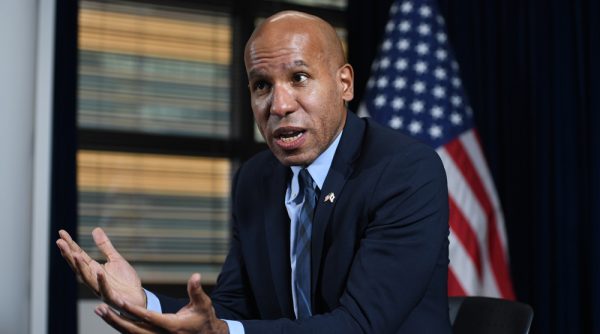
Brian Nelson, U.S. Treasury Undersecretary for Terrorism and Financial Intelligence
Press TV – July 29, 2023
The administration of US President Joe Biden has warned that Washington’s allies will face a “reputation risk” and potential isolation from lucrative deals in case of having links to the Islamic Republic of Iran and Russia.
Brian Nelson, the Treasury’s undersecretary for Terrorism and Financial Intelligence, raised the alarm in a meeting with Kenya’s President William Ruto on Friday.
He claimed that Iran and Russia were “isolated economically.”
“What we see is again of course Iran and Russia are isolated economically and either they are looking for partners and they are looking for new channels to have economic relationships,” Nelson claimed.
“From our perspective, that potentially creates a reputation risk and creates also a financial risk such that we are having a direct conversation about those risks that are associated with the expansion of economic relationship, which is a conversation not only are we having here but with countries around the world and we know that clearly is what Russia and Iran are seeking,” he added.
In what is construed as Washington’s direct interference in its allies’ affairs, Nelson warned them to be wary of the two countries’ economic reputation.
The warning comes as Iranian President Ebrahim Raeisi embarked on an African tour earlier in the month, which took him to Kenya, Uganda and Zimbabwe at the official invitation of his counterparts from the three host countries.
Heading a high-ranking delegation, Raeisi forged new alliances and discussed possible avenues for the improvement of trade and political ties.
Raeisi stressed the need for enhancing relations with African countries, saying that the states are gifted with abundant natural resources and mines, and enjoy many potentials and areas for closer cooperation.
Iranian Foreign Ministry spokesman Nasser Kana’ani described Raeisi’s continental tour as “a new turning point” which could bolster economic and trade ties with African nations.
A total of 21 documents on cooperation in different areas were signed during the three-state tour to Africa.
Staggering Towards the Abyss
By William Schryver | imetatronink | July 28, 2023
I have long asserted, and I continue to be convinced, that the US could NOT establish air superiority against Russia, China, nor even Iran — not in a week; not in a year. Never. It simply could not be done.
American air power would prove substantially inferior to the extremely potent and abundantly supplied air defenses arrayed against it in any of those three countries.
American suppression of enemy air defenses would prove woefully inadequate to the task.
And even if any of the US’s aerial wunderwaffen were to prove, in ideal circumstances, to be potent weapons, US air power as a theater-wide undertaking could not be sustained in the context of a non-permissive regional and global battlefield.
In a high-intensity combat scenario in either eastern Europe, the China seas, or the Persian Gulf, the maintenance requirements for US aircraft could not be met. Mission-capable rates would plummet even lower than their notoriously abysmal peacetime standards.
The US would, quite literally after only a few days, see sub-10% mission-capable rates for the F-22 and F-35, and sub-25% rates for almost every other platform in the inventory.
It will be a huge scandal for the Pentagon … but hardly a huge surprise.
And this is hardly hyperbole. It is more or less common knowledge among those who think about these aspects of war — the only aspects that really matter in the final analysis.
US supply lines would be severely attrited on both a regional and a global scale.
Russian and Chinese submarines and long-range anti-ship missile systems would wreak havoc on US seaborne logistics.
I repeat: The US could not fight an overseas war in a non-permissive environment against a peer adversary. It doesn’t have the means, let alone the experience and competence, to do so.
In eastern Europe, Russia would savage NATO bases and supply routes. The Baltic and Black seas would effectively become Russian lakes where NATO shipping could not move.
And anyone who believes I am making unfounded hysterical assertions is either ignorant of the simple military and mathematical realities of the situation, or so blinded by American exceptionalism and its attendant ills that they are unable to discern things as they really are.
I have come across relatively little discussion of the crescendo pace with which Russia, China, and Iran have been conducting military coordination in general and naval drills in particular over the past few years.
Russia and China are now engaging in joint naval patrols of the western Pacific!
Russia, China, and Iran are engaging in regular joint exercises in the Arabian Sea.
This is not meaningless posturing. These are the actions of countries who intend to engage in mutual defense in the event of an existential attack on any one of them.
I am increasingly persuaded that, if the US chooses to make direct war against either Russia, China, or Iran, it will result in a war against all three simultaneously.
As I wrote in a previous article:
Building the Perfect Beast
Even more significantly, in a development I and many others have predicted for several years now – in the face of almost universal ridicule, I might add – the empire’s seemingly endless string of hubris-driven blunders has rapidly accelerated the formation of what is quite arguably the single most potent military / economic / geostrategic alliance seen in modern times: the tripartite axis of Russia, China, and Iran.
In its misguided and short-sighted gambit to thwart the long-dreaded Russo-German rapprochement — incomprehensibly punctuated by the late September 2022 sabotage of the Nordstream gas pipelines — the empire has astoundingly managed to jump from the frying pan of a regional proxy war against Russia into the fire of a global conflict all three of its steadily strengthening adversaries now view as existential.
In my considered opinion, this is almost certainly the single most inexplicable and portentous series of geopolitical blunders in recorded history.
For the time being, the fighting will remain confined to Ukraine. But the entire complexion of this war has been irreversibly altered.
In conclusion, I return again to my initial argument: the US could NOT establish air superiority against Russia, China, nor even Iran — not in a week; not in a year. Never. It simply could not be done.
And that, amazingly enough, is just one of multiple hard truths that the #EmpireAtAllCosts cult, and those acquiescing to its delusional designs, ought to give more serious consideration as they continue staggering towards the abyss of a war they cannot win.
More F-35s arrive in West Asia in latest anti-Iran deployment
The Cradle | July 27, 2023
A squadron of US F-35 fighter jets have arrived in the region, Washington’s air force announced on 26 July, coming as part of increased efforts to “beef up deterrence against Iran,” US media outlet Fox News wrote on 26 July.
“The Iranian navy did make attempts to seize commercial tankers lawfully transiting international waters. The U.S. Navy responded immediately and prevented those seizures,” US Fifth Fleet spokesman Tim Hawkins said.
Washington repeatedly accuses Iran of attempting to ‘hijack’ foreign vessels. However, Tehran maintains that it pursues foreign tankers who are either involved in fuel smuggling, or who have violated international regulations by colliding with Iranian vessels and fleeing – as has happened on a number of occasions.
The F-35s were deployed to the US CENTCOM ‘Area of Responsibility’ and serve as an augmentation to those already patrolling the Strait of Hormuz.
According to the military, they aim to provide cover for ships in the region in order to prevent Iranian seizures. They also aim to “deliver ‘increased capacity’ to the region and ‘allow the U.S. to fly in contested airspace across the theater if required,’” an air force press release cited by Fox News reads.
The F-35 jets will also “be available to help in Syria,” Fox News said. US troops currently occupy Syria, controlling its oilfields in coordination with proxy militias, while claiming to be carrying out anti-ISIS operations.
“This deployment demonstrates the U.S.’s commitment to ensure peace and security in the region, through maritime support and support to the coalition’s enduring mission to defeat ISIS in Syria,” the US air force said.
This latest jet deployment comes as Washington has been cementing its military presence across West Asia, seemingly in preparation for a confrontation with Iran. This has seen the US recently deploy a nuclear submarine and a navy destroyer to the Persian Gulf.
In Syria specifically, Washington and Moscow have recently gotten closer to coming to blows.
On 26 July, a US MQ-9 Reaper surveillance and attack drone locked its weapons on two Russian warplanes, reportedly forcing the jets to drop flares that “damaged” the drone’s wings.
This marked the second incident in three days where Russian jets dropped flares on a US drone attempting to lock weapons on them.
According to an anonymous US military official cited in a report earlier this month, Russian and Iranian forces in Syria have been coordinating with the specific aim of forcing Washington’s troops to eventually withdraw from the country.
As a result, Washington has been continuously reinforcing its military bases in Syria, and is reportedly planning to deploy an additional 2,500 troops to the country.
US allies on alert after lithium-rich Bolivia inks defense deal with Iran
The Cradle | July 25, 2023
Members of Bolivia’s far-right opposition and the Argentinian government are demanding that La Paz disclose the details of a memorandum of understanding (MoU) on defense and security affairs signed between Defense Ministers Edmundo Novillo y Mohamad Reza Ashtiani in Tehran last week.
“They say that [Iran] will give us drones. Others say they will give us missiles. All of this sounds strange, even more so considering it involves Iran … I can’t understand why Bolivia is getting involved in such a complex and difficult relationship,” said lawmaker Gustavo Aliaga, who belongs to the Comunidad Ciudadana (CC) party.
In 2019, CC leader Carlos Mesa supported the US-orchestrated coup that forced socialist leader Evo Morales to flee Bolivia, leaving it under the control of a far-right dictatorship that conducted multiple massacres of Morales supporters and sought to surrender the country’s massive lithium deposits to western transnationals.
The Argentinian foreign ministry also demanded explanations from La Paz on Monday under pressure from the Delegation of Argentinian Israeli Associations (DAIA), who said the MoU “risks for the security of Argentina and the region” due to Tehran’s ties with Lebanese resistance group Hezbollah.
In a press release, DAIA called on the Argentinian government “to condemn this agreement and demand Bolivia reconsider its decision.”
Buenos Aires blames Hezbollah and Iran for the 1994 bombing of the AMIA Jewish community center that left 85 dead. Both Tehran and Hezbollah deny the accusation.
The statements by the CC and DAIA came on the heels of a report by the neoconservative Institute for the Study of War (ISW), which claims that the deal between Tehran and La Paz includes the delivery of Iranian drones for the South American nation.
Last week, Iran agreed to help Bolivia combat drug trafficking along its borders and boost cooperation with the Bolivian army.
“[Due to] Bolivia’s critical needs in terms of border defense and the fight against drug trafficking, we will establish collaboration in equipment and specialized knowledge,” Ashtiani said following his meeting with the Bolivian defense minister last week.
For his part, Novillo said Iran is a “role model” for nations that seek freedom, highlighting the Islamic Republic’s “remarkable progress in science and technology, security, and the defense industry despite sanctions.”
Bolivia is the latest Latin American nation to ink a security agreement with the Persian nation, following in the footsteps of Nicaragua and Venezuela. Over the past year, the Islamic Republic has also made significant inroads with Brazil.
Iran and Bolivia also hold two of the largest lithium deposits in the world, with the Islamic Republic earlier this year announcing the discovery of a massive deposit holding a reported 8.5 million tons of the rare element. On the other hand, Bolivia has the richest known lithium deposits in the world, with an estimated 21 million tons.
Iran Warns of Missile Power as US Parks Amphibious Strike Group Near Its Shores
By Ilya Tsukanov – Sputnik – 25.07.2023
The Pentagon announced last week that it would deploy additional warships and a Marine expeditionary group to the Persian Gulf to “deter” Iran following a spate of tanker seizure incidents. Tehran has warned that the presence of non-Persian Gulf adjacent states’ militaries in the strategic body of water would not facilitate regional security.
Commanders from Iran’s Army and the Islamic Revolutionary Guard Corps have commented on the US’s decision to beef up its presence in the Persian Gulf, and warned that the Islamic Republic will take measures necessary to protect itself.
“Considering the control and capabilities of its Armed Forces in regard to navigation and aviation security in the Persian Gulf region, Iran reserves the right to make the necessary deterrent arrangements in compliance with the rules and regulations of international law, and will exercise its inalienable rights accordingly,” Army Commander-in-Chief Abdolrahim Mousavi said Monday, speaking on the sidelines of a major aerial drill, commenting on the Pentagon’s plans to deploy warships to the Gulf.
“The Americans have come and gone from the region for many years with their bogus illusions, but the security of the region will become sustainable only with cooperation among regional countries,” Mousavi stressed.
Separately, at a ceremony on Tuesday related to the delivery of a new advanced naval cruise missile to the IRGC Navy, Commander Alireza Tangsiri said that enemy vessels will be forced to stay thousands of kilometers away to avoid finding themselves in the missile’s crosshairs.
“We can fire the Abu Mahdi missile from deep inside the country. The missile has a dual seeker and performs successfully against the enemy’s electronic warfare,” Tangsiri said.
Iran characterizes the Abu Mahdi as “among the best missiles of its class in the world in terms of targeting, high destructive power, and passage through geographical obstacles and enemy defense systems,” and says the missile, which has a range of over 1,000 km, will dramatically increase the country’s maritime reach.
“Since the missile has a very low flight ceiling and a very long range, it can hardly be tracked,” Commander Tangsiri said.
The new missile is named after Abu Mahdi al-Muhandis, the late Iraqi militia commander who was slain in a US assassination strike in Baghdad in January 2020 alongside IRGC Quds Force commander Qasem Soleimani, who was on a secret peace mission in the country aimed at normalizing relations between Iran and Saudi Arabia.
Gulf Tensions
Tensions in the Persian Gulf surged earlier this month after the US announced the deployment of F-16 fighter jets and A-10 ground attack aircraft to patrol the strategic body of water after a string of ship seizures by Iran for maritime traffic violations and attempted oil smuggling.
Last Thursday, the Pentagon announced the deployment of two amphibious warships and thousands of Marines from the 26th Marine Expeditionary Unit to the Gulf on Defense Secretary Austin’s orders.
“Through these actions, the United States is demonstrating commitment to ensuring freedom of navigation and deterring Iranian destabilization activities in the region,” the Pentagon said in a statement, using the same ‘freedom of navigation’ line it uses to justify the illegal deployment of warships, aircraft and troops thousands of miles from America’s shores to Chinese-claimed waters in the South China Sea.
Last week, Iranian Foreign Ministry spokesman Nasser Kanaani emphasized that “Iran monitors with sensitivity any illegal and unconstructive act that affects the security of the region,” and would “pay special attention to any provocative and illegal moves, especially near its borders.”
Iran has one of the largest and most technologically advanced militaries in the Middle East, and is equipped with an assortment of domestically-designed and manufactured missiles, warships, and air defense systems designed specifically for asymmetric warfare against a much larger and more powerful foe. The country has demonstrated repeatedly in recent years that it will not tolerate violations of its air and sea space, knocking a $220 million US spy drone out of the sky over the Strait of Hormuz in June 2019.
The Persian Gulf is one of the most strategically important bodies of water in the world, with ship-based oil cargoes accounting for approximately 20-30 percent of consumption passing through its waters daily.
What is behind the current tension in Turkish-Iranian relations?
By Alexandr Svaranc – New Eastern Outlook – 16.07.2023
Turkey and Iran continue to be important Middle Eastern nations. Due to their geographical proximity, imperial past, violent rivalry, theological tensions (between Sunnism and Shiism), and, of course, the continuous divergence of geopolitical interests, both nations have a rich history of relations.
There were multiple Turkish-Persian clashes and wars, with various interruptions and varying degrees of success, during the Ottoman and Persian empires. Regarding the significance of the harem in the Ottoman Empire, historians have observed that, unlike the Turkish-Persian conflicts, which occasionally came to an end during periods of truce, the harem wars continued unabatedly. The reasons for these wars were varied, with religion often becoming a justification for the ambitions of Istanbul or Tehran. As a rule, it was a struggle for the right to own border territories from the Caucasus to Asia Minor, for the right to control strategic trade and military communications (for example, the area between Tigris and Euphrates, Eastern or Western Armenia and Syria).
In fact, such a confrontation lasted from the Middle Ages until World War I. The long military and political conflict between the Persians and Turks in such important regions, where the interests of the leading powers of Europe and Russia were represented, led to the establishment of a special international border commission with the participation of Britain and Russia at the turn of the twentieth century to facilitate the delimitation of Persia and the Ottoman Empire. But because London and St. Petersburg had their own distinct interests in the Near and Middle East, this commission never accomplished its mission.
There were also more stable times between Iran and Turkey in the new era. After World War II, from 1955 to 1979, Tehran and Ankara became even politico-military allies in the CENTO (Central Treaty Organization or Baghdad Pact) regional bloc, which emerged thanks to the Middle East diplomacy of Britain and the United States. While the Shah’s regime in Iran remained an ally of the West and Iranian oil and gas were exploited in the interests of London and Washington, Tehran was a regional partner of NATO member Turkey.
The situation changed after the February 1979 revolution in Iran, as the overthrow of the pro-American Shah’s regime and the ascension to power of the Shiite mullocracy brought about a major change in the disposition of forces in the Middle East. Since then, there have been renewed notes of mistrust and tension in Iranian-Turkish relations across the Middle East and global agenda, some of which remain relevant to this day.
It cannot be said that pragmatism in the approaches of Turkey and Iran has lost importance after the overthrow of Shah Reza Pahlavi. Despite harsh anti-Iranian sanctions, Ankara was forced to retain trading with Iran and keeps shipping gas in varying volumes due to its limited own energy supplies.
With the change of political regime in Iran after the 1979 revolution in Kemalist Turkey, where the secular regime suppressed the sprouts of Islamic revival, the politicization of Islam (albeit of Shiite origin) in the 1980s and 1990s still influenced the public consciousness of the Turkish masses in favor of the growing role of religion in the state.
The Kurdish issue remains a common concern between Turkey and Iran. Ankara and Tehran oppose all forms of Kurdish statehood and threats of ethnic separatism. However, in the situation of the Kurds after the 1979 Islamic Revolution in Iran there have been some changes. Some experts believe, not unreasonably, that the phenomenon of the Shiite revolution in February 1979 has both external and internal justifications.
The external reason was to prevent the leading Anglo-Saxon countries (the US and Britain) from monopolizing and plundering Iran’s strategic resources (oil and gas), as well as to prevent the corrosive influence of Western pop culture on the minds of Iranian youth and the general population. The internal reason, however, was related to the idea of preventing the weakening and collapse of Persian statehood under the threat of ethnic separatism with different colors (Kurds, Azeris, Baluchis). At the same time, Islam, namely political Shiism, assumed the religious consolidation of Iranian society regardless of ethnic origin.
Following the revolution’s victory, Iranian leader Ayatollah Khomeini summoned Mustafa Barzani, the leader of Iraq’s Kurdistan Region, then in exile, to Tehran for a final settlement of the Kurdish crisis on an Islamic basis. According to some reports, such an agreement was accepted by a Kurdish politician, but he never made it to Tehran. CIA handlers then announced an emergency surgery on Mustafa Barzani, but the surgery ended in his death.
The main contradictions between Tehran and Ankara include Turkey’s continued membership in NATO and Shiite-Sunni religious differences between different madhhabs. At the same time, as key countries in the Middle East region, it is natural that Turkey and Iran have different approaches on a number of regional topics (including the Syrian crisis, the situation in Libya and Iraq, and the relationship with Pakistan). The adjacent territories of the South Caucasus and Central Asia occupy a distinctive place in this package of contradictions following the breakup of the Soviet Union and the parade of sovereignties of post-Soviet states.
First, Iran is concerned about the renaissance of Turkey’s pan-Turkic and pan-Turanist ambitions toward the Turkic countries of the CIS, which could seriously weaken Iran’s position if the Turan project succeeds.
Second, Tehran watches with great caution the geo-economic projects in the Caspian energy region, which with the collapse of the Soviet Union and the weakening of Russia got a start and developed thanks to the joint initiatives of Turkey and its NATO allies (primarily, the UK and the US). At the same time, this concern of the Persian state is determined not only, or rather, not so much by the considerations of the new direction of oil and gas exports to Turkey as by Ankara’s plans to create alternative energy transit routes bypassing Russia and Iran to bring exporters from Turkic countries to world markets (especially to Europe) and turn the Turkish territory into a major hub. In other words, Iran, as an oil and gas-rich country, is concerned about the geopolitical consequences of transformations in the South Caucasus and Central Asia in favor of the strengthening of Turkey, the United States and Britain.
Third, taking into account the Turkish-Azerbaijani tandem that has formed on Iran’s northern borders, Tehran is anxiously observing the trend of Israel showing up along the Iranian-Azerbaijani border line on the Arax River, the increased intelligence presence of the Mossad and Aman in the same Azerbaijan with the approval of NATO member Turkey.
Fourth, there is now a certain geopolitical rivalry between Turkey and Iran, with a religious connotation in as yet predominantly Shiite Azerbaijan. Given that the Azerbaijani authorities have based their relations with Turkey on the pan-Turkic slogan and the principle of “one nation, two states,” Iran notes the active political persecution of Azerbaijani Shiites (including often with accusations of spying for IRI) by Baku. Moreover, IRGC sources in Azerbaijan note an increasing number of cases of religious interference by Turkey in the Sunnization of Azerbaijani Shiites. Tehran sees all these actions as an attempt by Ankara to weaken the influence of Shiite Iran in this Transcaucasian republic.
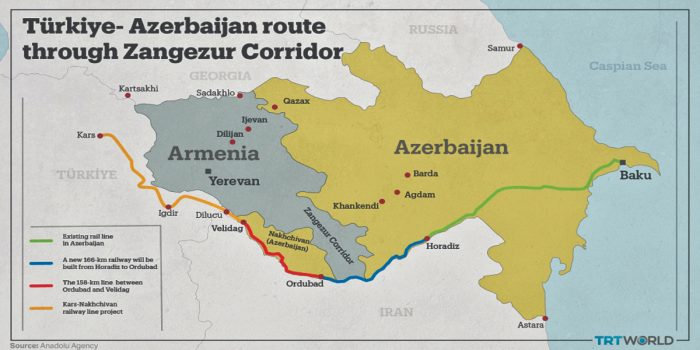
After Recep Tayyip Erdoğan’s victory in the elections and his visit to Baku, assessing the situation with the Zangezur corridor in Armenia, the Turkish leader, not by chance, stressed that the main reason for blocking this corridor was not Yerevan, but Tehran. Iran indeed publicly through the mouths of Ayatollah Ali Khomenei, President Ibrahim Raisi and Foreign Minister Hossein Amir Abdollahian has repeatedly noted that for it the Zangezur corridor remains a “red line,” it is unacceptable to change the borders of neighboring republics of the South Caucasus (in particular, Armenia) and it is important to maintain the direct multi-millenial border of Iran with Armenia.
Tehran does not want NATO to strengthen in the region on the shoulders of its member Turkey, nor does it want to see the Turan project implemented with pan-Turkic content. Otherwise, Iran will be blocked by unfriendly forces on its northern borders, including the emergence of a bridgehead of Zionist Israel on the banks of the Arax River.
With his statement, Erdoğan not only expresses his dissatisfaction with the regional policy of Iran that three Muslim states (Turkey, Azerbaijan, and Iran) through the fault of Persians can’t solve the road question peacefully and get economic dividends but actually says that Iran is not allowing the Turkish-Azerbaijani tandem to start a war with Armenia again and take by force the Meghri segment of the Zangezur corridor (if not all of Zangezur – Syunik Province) from the latter.
Given that Russia is now forced to engage in the western flank of the geopolitical confrontation with the West in Ukraine and is therefore interested in maintaining a partnership with Turkey for the same transit and out into the world, it cannot strain relations with Ankara in Armenia (Transcaucasus). Iran becomes the main opponent of Turkey in this theater.
In the second half of June 2023, Turkey and Azerbaijan announced the formation of a unified system of control and management of airspace from the Aegean Sea to the Caspian Sea according to NATO standards (the Turkish HAKİM Air Command Control System). The latter is practically capable of establishing airspace control in the South Caucasus region and threatening not only Armenia but also Iran. Given the existence of a common air defense system between Armenia and Russia within the CSTO, such a move by the tandem of Ankara and Baku is in some ways a challenge for Russia’s regional interests as well.
Since the beginning of 2023, trade turnover between Iran and Turkey has decreased by 20%, where the main export commodity for the Turkish side remains gas. Apparently, such a decline in economic relations between these countries was the result of a number of objective and subjective reasons (such as the crisis in the energy market due to anti-Russian sanctions and rising prices, the earthquake and rising inflation in Turkey, the devaluation of the Turkish lira, and Ankara’s pressure on the issue of the Zangezur corridor). In response to Moscow’s proposal to create a gas hub in Turkey, Iran came up with an equally ambitious similar project in the Persian Gulf. All these processes testify to the growing Iranian-Turkish contradictions.
Moreover, the information about the ongoing closed-door talks between Iran and the USA on the subject of the deblocking of Iranian assets in exchange for American prisoners and, most importantly, about the end of the “tanker war” between Tehran and Washington in the waters of the Strait of Hormuz and the Gulf of Oman and the export of Iranian oil to world markets (as we know, in the USA itself there is a rise in gasoline prices and an increasing need for oil) creates additional tension in Turkish politics as well.
The US is not yet interested in the implementation of alternative communications from China to Europe through the territory of Turkey (under the One Belt, One Road Initiative). Perhaps Washington is proposing an Indian project through Iran to Europe as an alternative to Chinese transit. And in this geographic preference of the states, a new confrontation between Iran and Turkey is created.
Accordingly, if Iran develops strategic partnerships with countries such as China and India, and can establish certain relationships with the US administration on the nuclear program and oil exports, Turkey will find it difficult to count on success in a battle with Tehran. Moreover, today’s Iranian authorities are interested in strengthening President Erdoğan’s policy independent of the United States, which makes it possible to weaken Washington’s pressure on the region. These are the complicated patterns of the contemporary geopolitical mosaic in the Greater Middle East.
Aleksandr SVARANTS, PhD in political science, professor.
US Navy aided fuel smugglers – Iran
RT | July 10, 2023
An Iranian admiral said on Monday that multiple US aircraft had attempted to prevent the Islamic Revolutionary Guard Corps (IRGC) Navy from boarding an oil tanker suspected of smuggling.
“On July 6, IRGC Navy personnel were inspecting a ship named NADA 2 that was involved in smuggling Iranian oil and gas in the Persian Gulf, which the Americans sought to prevent through a series of risky and unprofessional actions,” Rear Admiral Ramazan Zirrahi told the Tasnim news agency.
Zirrahi commands the second naval district of the IRGC, headquartered in Bushehr. He told Tasnim that his men intercepted radio traffic between the ship’s captain and the “American command and control center in the region.” The 5th Fleet is based in Bahrain.
The Americans allegedly told the captain to turn off the ship’s engines and wait to be rescued. Zirrahi claimed that the 5th Fleet then sent two A-10 ground attack planes, a P-8A Poseidon spy plane, two Black Hawk helicopters, a MQ-9 drone and “patrol vessels” to the site, but ultimately failed to prevent the seizure of the ship.
On Friday, the Fars news agency reported that an Emirati-flagged tanker was brought into the port of Bushehr with 12 crew members from four different countries. Iranian authorities said they confiscated over a million liters of smuggled fuel.
The US Navy said at the time that it had “monitored” the interception of a ship in international waters but “decided not to make any further response,” according to Commander Tim Hawkins, 5th Fleet spokesman.
Hawkins had given a detailed statement about two incidents on July 5, when the 5th Fleet deployed a MQ-9 drone, a P-8 Poseidon plane, and the guided missile destroyer USS McFaul in the Gulf of Oman, in response to IRGC attempts to seize two oil tankers. In the span of about three hours, the IRGC vessels approached the Marshall Islands-flagged TRF Moss and the Bahamian-flagged Richmond Voyager, but retreated when the US destroyer came close, the US Navy said.
The US insists that Iran is “a clear threat to regional maritime security and the global economy,” and has accused Tehran of having “harassed, attacked or seized nearly 20 internationally flagged merchant vessels” since 2021.
Mike Pence, Other Prominent Hawks Back Regime Change in Iran at MEK Rally in Paris
By Connor Freeman | The Libertarian Institute | July 3, 2023
Former Vice President Mike Pence participated in a rally outside Paris led by the exiled Iranian terrorist cult, the Marxist-Islamist Mujahideen-e-Khalq headed by Maryam Rajavi, and their political front the National Council of Resistance of Iran (NCRI), over the weekend.
Pence, a current GOP presidential hopeful, along with a host of other prominent hawks, including British ex-Prime Minister Liz Truss as well as former CIA director and Secretary of State Mike Pompeo, made calls for regime change in Tehran and railed against engagement with the Islamic Republic. Pence said “One of the biggest lies the ruling regime has sold to the world is that there is no alternative.” He added “no oppressive regime can last forever.”
Truss declared “[authoritarian] regimes have been emboldened as the free world has not done enough. I will never give up hope for a free and democratic Iran… Democracy is under threat around the world. Now is the time to turn our backs on accommodation and appeasement.”
Pompeo chimed in via video link, proclaiming any deal with Iran over its nuclear energy program would be a “calamity for the Iranian people and the world.” Per the NCRI, also in attendance at the event were former NATO Supreme Allied Commander General Wesley Clark and erstwhile US Senator Joseph Lieberman.
These condemnations of diplomacy come as the White House is reportedly making some efforts to de-escalate tensions with Iran in an attempt to secure an interim nuclear deal. The new “understanding” could see Iran cap its enrichment of uranium at 60% purity in exchange for some limited sanctions relief.
Tehran has previously pledged not to enrich beyond this upper limit, which is still well below the 90% required for weapons-grade uranium. Iran took this step, for leverage at the negotiating table, after Israel attacked its Natanz uranium enrichment facility in April 2021 causing an explosion, damaging centrifuges, and power outages.
A Western official recently told Reuters that Washington is seeking this alternative agreement because Israel may launch a military assault against Iran, a potential escalation which the Joe Biden administration until now had repeatedly green-lighted.
In May, The Intercept reported that – according to the Discord Leaks – even the CIA is unsure whether Israel is truly preparing to unilaterally launch a war against Iran. Such a conflict would spread violently across the region and quickly draw in the United States.
During previous years, Israel and the MEK cult, who are trained, funded, and armed by the Mossad, have collaborated on the extrajudicial executions of several Iranian nuclear scientists. By likely working with the terrorist group, Tel Aviv assassinated the Iranian scientist, Mohsen Fakhrizadeh, outside of Tehran in November 2020.
Both Israel and the MEK were suspected in the May 2022 murder of a senior Islamic Revolutionary Guard Corps commander, Col. Hassan Sayyad Khodaei. Later, a US official confirmed to CNN that Israel was behind the hit. The latter killing touched off an unprecedented wave of assassinations in the country which targeted members of the IRGC and Iran’s aerospace industry.
Moreover, investigative journalist Gareth Porter has reported extensively on how the MEK and Mossad forged documents used to cultivate the propaganda narrative behind the phantom Iranian nuclear weapons program which Israel alleges was once headed by Fakhrizadeh.
The MEK lacks any support inside Iran, particularly after having murdered dozens of Iranian officials and allied with Saddam Hussein’s forces during the Iran-Iraq war. Nevertheless, Pence once dubbed the group a “perfectly qualified and popularly supported alternative” to the Islamic Republic.
Similarly, in 2017, ultra-hawk John Bolton told an MEK rally “There is a viable opposition to the rule of the ayatollahs, and that opposition is centered in this room today… The behavior and objectives of the regime are not going to change, and therefore the only solution is to change the regime itself.”
Bolton among other US political figures like Rudy Giuliani are paid handsomely for speaking at the terrorist cult’s events. “Estimates are in the range of $30,000 to $50,000 per speech. Bolton is estimated to have received upwards of $180,000 to speak at multiple events for [MEK]. His recent financial disclosure shows that he was paid $40,000 for one speech at an [MEK] event last year,” The Guardian reported in 2018.
As foreign policy analyst and Antiwar.com contributing editor Daniel Larison has written, “This is a group that has American blood on its hands, and it routinely abuses its own members. It is an oppressive and fanatical organization, and it would be a nightmare if it ever managed to gain power over a larger population. There is a reason it has sometimes been likened to the Khmer Rouge.”
The group’s base headquarters in Albania was recently raided by security police for unsanctioned activity being carried out at the camp in contravention of a US-mediated deal. The agreement had allowed the MEK to relocate to the Balkan country as they were no longer welcome in Iraq once Hussein was removed from power after the US invasion.
However, according to Responsible Statecraft, the cult was reportedly using “their presence in Albania as a base for political activities, including, at the very least, cyber-attacks directed against third countries (presumably Iran) and mass online trolling and harassment of the group’s many opponents.” The outlet also notes that, post Saudi-Iran rapprochement, Rajavi’s funding may be drying up as well. As Riyadh was long suspected of being one of the MEK’s major benefactors.
Can the WHO and the United Nations impose sanctions on your country for non-compliance?
The sinister sanctions strategy has disturbing implications for democracy, peace, and prosperity around the world. It’s time for us to defund and exit.
By Shabnam Palesa Mohamed | Children’s Health Defense Africa | July 3, 2023
Sanctions are a powerful instrument of political control and economic profit. One of the rare but critical topics relevant to the international campaign to #ExitTheWHO is whether the World Health Organisation and the United Nations can impose, influence or recommend specific sanctions. The sanctions would be against countries that choose to not comply or cannot comply with International Health Regulations, the proposed new pandemic treaty, or other legislative attempts that curtail rights, freedom and sovereignty.
The accelerating and profitable globalist march towards unprecedented levels of ‘1984’ style totalitarianism – using censorship, vaccine passports, 15 minute cities, and CBDC’s continues. It is plausible that the WHO and the UN will move to impose, influence or recommend sanctions against countries that do not want to or cannot comply with its centralised health agenda and undemocratic legislative attempts.
At last year’s World Health Assembly 75, the 47 nation African bloc voted surprisingly, against most amendments to the International Health Regulations, stating that they were broad, rushed, and can pose a threat to national sovereignty. Since then, no doubt with persuasive behind the scenes manoeuvres, some of the most disturbing amendments are being proposed by African countries. Many relate to financing for the cost intensive provisions of IHR amendments and the proposed pandemic treaty or accord. Africa cannot afford more debt slavery.
Countries that could be sanction targets for non-compliance with the WHO and the UN, include but are not limited to, those in the steadily growing BRICS initiative: Brazil, Russia, India, China and South Africa. Iran and Malaysia are reported to have expressed reservations to the proposed IHR amendments at last year’s World Health Assembly 75. Russia is making decisive moves in the international arena and could possibly exit the WHO. In addition, India raised serious audit concerns on irregularities with WHO financials, including missing assets.
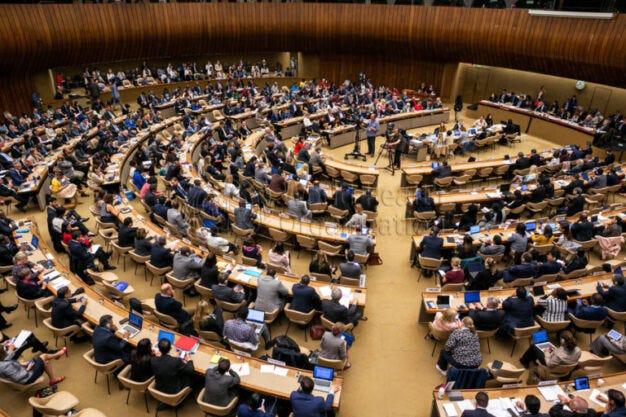
World Health Assembly, Geneva, Switzerland
The ambit of the overwhelmingly privately funded WHO, contained in its extensive constitution, can be interpreted as overly broad and sweeping, and thus, unknown to non-participants, has always posed a potential threat to individual health and national sovereignty.
The WHO’s constitution states in Chapter 2 – Functions – Article 2: In order to achieve its objective, the functions of the Organization shall be: (v) generally to take all necessary action to attain the objective of the Organization. However Article 21 of the WHO’s constitution is specific about making (non-binding) regulations, limiting the WHO to just five areas.
Proposed amendments to the new pandemic treaty include a dangerous clause that would change the WHO’s role from a UN agency that shares recommendations, to a rogue agency whose elitist and secretive attempts at legislation are binding and mandatory on member states, violating fundamental human rights and freedoms. However, health freedom advocates agree that WHO has no actual authority in the law.
In effect therefore, with both IHR amendments and the proposed new treaty, the WHO is acting ultra vires in its Big Pharma driven power grab, in collusion with naïve or compromised member state delegates. Ultra vires is defined in the law as: acting beyond the scope or in excess of legal power or authority. Ultra vires acts of impunity by the WHO could accelerate a mass defund and exit of the agency.
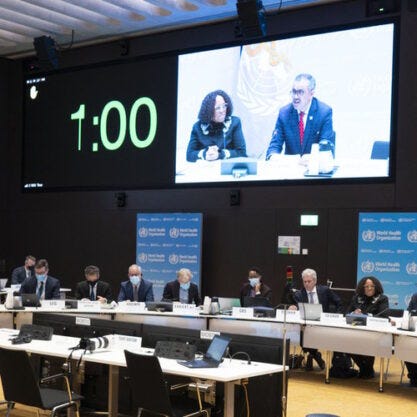
WHO’s negotiating body on a proposed pandemic treaty
Health is no longer just health, as it is defined in the WHO’s constitution. Through Covid-19, and other controversially declared pandemics, health is now a multi-billion dollar health security industry. With it, creeps in the tyranny of secrecy, surveillance, vaccine certificates, forced quarantines, and the undemocratic censorship of free speech. Given the absence of public participation, the WHO is a strategic spear for oligarchs and corporations, and given international resistance to its power grab, it may become desperate and argue or push for sanctions.
Reported in 2021: “In 2021, German Health Minister Jens Spahn called for sanctions against countries that hide information about future outbreaks. Citing the World Trade Organization’s power to sanction countries for non-compliance, Spahn said “there must be something that follows” if countries fail to live up to commitments under a new pandemic treaty that the World Health Assembly will take up in November.”
Further, it is entirely under reported that controversial “World Health Organization Director-General Tedros Adhanom Ghebreyesus also urged countries to consider the idea as they take up the treaty, a legally binding tool. The treaty should “have all the incentives, or the carrots” to encourage transparency, Tedros said, appearing at a press conference with Spahn in Berlin. “But maybe exploring the sanctions may be important,” he added.”
Also reported in 2021: “Speaking at the WHA in June, Mike Ryan, WHO Health Emergencies Programme Executive Director, also spoke out in favour of the treaty, despite the fact that WHO technical staff have historically avoided taking positions on controversial policy choices before member states. “My personal view is that we need a political treaty that makes the highest-level commitment to the principles of global health security — and then we can get on with building the blocks on this foundation.”
I engaged renowned international law expert Professor Francis Boyle about the possibility of sanctions via the WHO. He had no doubt “They will pursue sanctions against countries that do not comply with their orders, coming from Geneva. Both economic and political sanctions. However, they will only have the power to pursue sanctions if we accept their authority. We cannot. We must exit the WHO.”
With far less public scrutiny currently than the WHO, the United Nations is also seeking exponential new powers and stronger “global governance” mechanisms to deal with what they define as international emergencies. In March 2023, the UN released a policy brief , astonishingly titled “To Think and Act for Future Generations – Our Common Agenda. Strengthening the International Response to Complex Global Shocks – An Emergency Platform”
These all encompassing areas of expanded UN power include:
- climate or environmental events;
- environmental degradation;
- pandemics;
- accidental or deliberate release of biological agents;
- disruptions in the flow of goods, people, or finance;
- disruptions in cyberspace or “global digital connectivity;”
- a major event in “outer space;”
- and “unforeseen risks (‘black swan’ events)
There are several types of sanctions imposed through the United Nations:
- Economic sanctions – typically a ban on trade, possibly limited to certain sectors such as armaments, or with certain exceptions (such as food and medicine)
- Diplomatic sanctions – the reduction or removal of diplomatic ties, such as embassies.
- Military sanctions – military intervention
- Sport sanctions – preventing one country’s people and teams from competing in international events.
- Sanctions on the environment – since the declaration of the United Nations Conference on the Human Environment, international environmental protection efforts have been increased gradually.
- Economic sanctions are distinguished from trade sanctions, which are applied for purely economic reasons, and typically take the form of tariffs or similar measures.
It is plausible that the UN’s controllers realise that the world is pushing back against the WHO’s overreach, or find it irrelevant to real health. Given that sovereign nations will choose to exit the WHO, the UN decided to launch plan B and ascribe to itself even greater powers. Technically, there is no legislation to exit the United Nations within the UN Charter. Again, this is a critical issue of national sovereignty.
The United Nations Children’s Fund or UNICEF’s 2020 Annual Report highlights USD 717 million in donations from the private sector, which is 21 percent of income overall. Lucrative corporate partnerships include Unilever, Louis Vuitton, and Microsoft, while foundation partners include Bill and Melinda Gates Foundation and Mastercard Foundation. It also prides relationships with the World Economic Forum and the International Chamber of Commerce. National committees fundraise from individual donors and corporations at the national level, to support UNICEF globally. The UN’s programmes therefore are heavily dependant on private funding. Funding crowns influence.
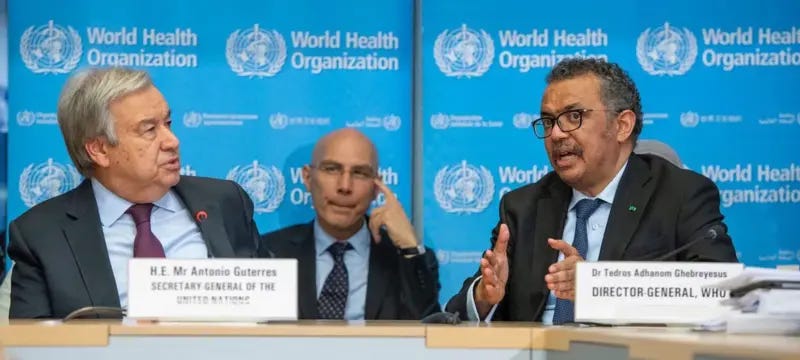
UN secretary general Antonio Guterres with WHO director general Adhanom Tedros Ghebreyesus
The WHO is an agency of the United Nations.
- In 2015, on punishing member states who violate the IHR, as reported: “United Nations health officials said they want to impose sanctions on countries that do not comply with public health regulations meant to avoid the spread of dangerous epidemics, such as the Ebola outbreak that killed more than 9,000 people and ravaged domestic health care systems in West Africa last year. World Health Organization Director Margaret Chan said she is investigating ways to reprimand countries that disobey the International Health Regulations (IHR) — a set of rules adopted in 2005 and mandate that countries set up epidemiological surveillance systems, fund local health care infrastructure and restrict international trade and travel to affected regions deemed unsafe to the public, among other provisions. Chan is on a panel set up by U.N. Secretary General Ban Ki-moon, who instructed the group to think of ways to hold countries accountable for how they manage public health crises and punish those who violate the IHR.”
- In 2022, according to commentators in a policy article: “In order to enforce compliance, some commentators have recommended concluding the treaty at the United Nations level. However, we fear that it has been already decided with the INB (mandated by WHASS) that a treaty will be developed under the roof of WHO. They added: “To move on with the treaty, WHO therefore needs to be empowered — financially, and politically. If international pandemic response is enhanced, compliance is enhanced. In case of a declared health emergency, resources need to flow to countries in which the emergency is occurring, triggering response elements such as financing and technical support. These are especially relevant for LMICs, and could be used to encourage and enhance the timely sharing of information by states, reassuring them that they will not be subject to arbitrary trade and travel sanctions for reporting, but instead be provided with the necessary financial and technical resources they require to effectively respond to the outbreak. High-income settings may not be motivated by financial resources in the same way as their low-income counterparts. An adaptable incentive regime is therefore needed, with sanctions such as public reprimands, economic sanctions, or denial of benefits.”
* Tweet CHD Africa if you agree that sanctions are possible and must be opposed internationally. Use the #StopSanctions
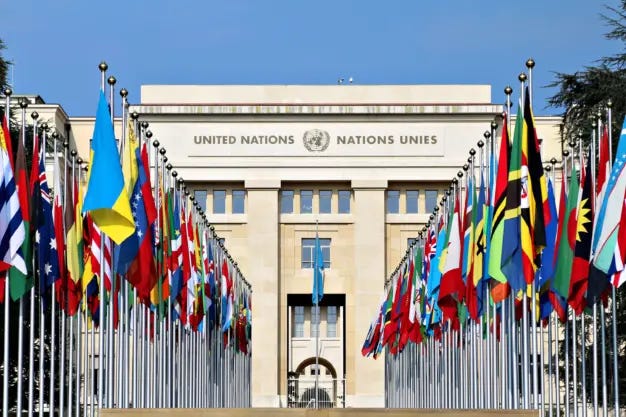
United Nations headquarters in Geneva, Switzerland
In 2000, Kofi Annan, former Secretary General of the UN said: “However, just as we recognize the importance of sanctions as a way of compelling compliance with the will of the international community, we also recognize that sanctions remain a blunt instrument, which hurt large numbers of people who are not their primary targets. Further, sanctions need refining if they are to be seen as more than a fig leaf in the future. Hence, the recent emphasis on targeted sanctions which prevent the travel, or freeze the foreign bank accounts, of individuals or classes of individuals – the so-called ‘smart sanctions’.”
Do sanctions work? “UN targeted sanctions, which are packages of sanctions imposed by the UN Security Council, have been successful in leading to intended policy change only 10% of the times, and limited the policies they intended to change in 28% of cases, but led to a reduced life expectancy in the targeted countries by 1.2–1.4 years. Economic sanctions have also been criticised for the potential collateral damage to third states they can cause. For this reason, some authors suggest that economic sanctions should be banned, as they are having detrimental effects on health and nutrition of civilians.”
Countries themselves can and do impose dangerous sanctions. A 2022 UN security council meeting on sanctions recorded: “Unilateral sanctions, which are sanctions imposed by (groups of) states and not by the UN Security Council, are particularly controversial. Unilateral sanctions have also been criticised for being disproportionately imposed on low-income and middle-income countries by wealthier countries, for example, by the Kenyan representative in a Security Council debate on sanctions on 7 February 2022: ‘The frequency and reach of unilateral sanctions have led to a growing view that they are the weapons of the strong against the vulnerable or weak’.”
- The Universal Declaration of Human Rights, in its first article, states that ‘all human beings are |…| equal in dignity and rights’, which includes the right to health. Article 25 specifies that ‘everyone has the right to |…| health and well-being |…| including medical care’.
- In the UN Convention on the Rights of the Child, article 24 states that ‘state parties recognize the right of the child to |…| the highest attainable standard of health and to facilities for the treatment of illness and rehabilitation of health. State parties shall strive to ensure that no child is deprived of his or her right of access to such health care services’.
- General Comment No.14 of the UN Committee on Economic, Social and Cultural Rights (CESCR) on the right to the highest attainable standard of health, the right to health is a fundamental human right which is necessary for all other human rights to exist and be exercised.
- “The use of sanctions designed to hurt a country’s healthcare sector is clearly incompatible with respecting citizens’ right to health. Accordingly, the general comment No. 14 of the CESCR calls on states to refrain ‘at all times’ from sanctions on medicines and medical equipment. However, sanctions on other healthcare products and, in fact, other non-healthcare products may as well interfere with the right to health, and, thus, need to be subject to scrutiny.”
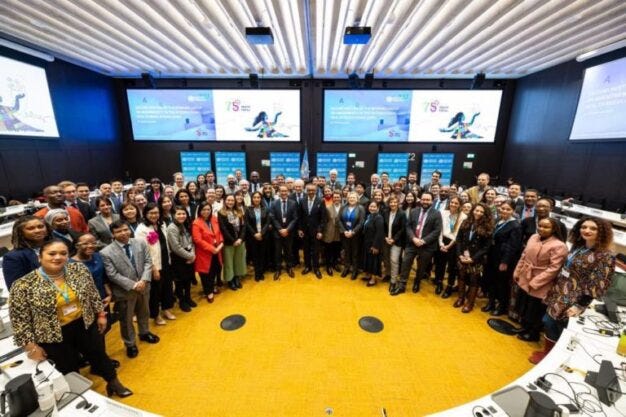
WHO’s World Health Assembly 75
South African Precious Matsoso, co-chair of the International Negotiating Body (INB), formed to negotiate the terms of the proposed pandemic treaty or accord, admitted openly that punitive measures have not been shown to work “anywhere” in the world. However, she said, there must be accountability measures while recognizing countries’ sovereignty. “We have to recognize that they’re sovereign, and they keep on reminding us that they are sovereign states.” It is positive to note that more states do recognise the real threat to sovereignty.
Not all states are considered equal. Smaller countries are at a distinct disadvantage in participating, negotiating and making decisions at the hierarchical WHO. Significantly, Matsoso was transparent about failures in equal participation. “A number of smaller delegations have always expressed concerns about organizations of multiple meetings, where they have to travel from afar, and not even having the capacity to participate in the negotiations,” Matsoso said. “And they have repeatedly requested that you must avoid parallel sessions.” To little avail.
Given the rapidly growing distrust in the WHO, its historical failures and harms, Covid-19 failures and harms, and the fact that it cannot maintain independence because it is a largely privately funded entity; it is plausible that the WHO and/or the UN will move to impose or influence sanctions via the World Trade Organisation, ahead of Agenda 2030. This act of aggression weaponises the WHO and/or the UN against countries that influential funders and unethical stakeholders have an interest in destabilising for power and resource control.
This sinister strategy has disturbing implications for democracy, peace, and prosperity around the world. Freedom faces an existential risk through unelected bureaucratic entities. Nations can and must protect their sovereignty by defunding and exiting WHO, and, by critically assessing the true nature, value, and risks of continued membership in the 78 year old United Nations. Not to do so, means ignoring the risks of UN peacekeepers, who are known to commit crimes with impunity, being deployed in your country to enforce UN and WHO dictates.
Shabnam Palesa Mohamed is executive director and chapter coordinator for Children’s Health Defense Africa. She is an activist, journalist, lawyer, and mediator, with over 20 years of experience in human rights work. To share information, Twitter: @ShabnamPalesaMo
Follow CHD Africa on 6 social platforms for news, action alerts, and updates:
– Telegram: t.me/CHDafrica
– Twitter: https://twitter.com/CHD_Africa
– Instagram: https://www.instagram.com/af.childrenshealthdefense/
– Facebook: https://www.facebook.com/CHDafricachapter
– Rumble: https://rumble.com/user/ChildrensHealthDefenseAfrica
– Tiktok: https://www.tiktok.com/@chdafrica?is_from_webapp=1…
Featured Video
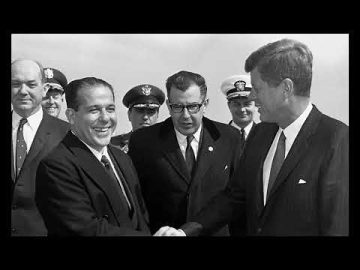
The 1964 Coup in Brazil
or go to
Aletho News Archives – Video-Images
Free Book
Vicious

Lies are Unbekoming | January 25, 2026
The waiting room is clean. The receptionist is polite. The forms ask reasonable questions. Nothing in the physical environment suggests danger. The magazines are current. The hand sanitizer dispenser works. Someone has chosen calming colors for the walls.
A pregnant woman sits in a chair designed for her comfort. She has been told to be here. Not ordered—no one orders. Recommended. Strongly recommended. Everyone does this. Her mother did this. Her friends did this. The women in her prenatal group compare notes about their appointments the way they compare notes about nursery furniture. Which provider did you choose? What tests have you had? The questions assume the answers. The answers assume the questions.
She will be offered things today. Offered is the word used. The offers will come with information sheets that list risks and benefits in tabular form. She will sign consent documents. Everything will be voluntary in the legal sense. No one will hold her down. No one will threaten her. She will choose, and her choices will feel like choices, and she will leave feeling she has done the responsible thing.
What she will not feel is the weight of what has been arranged before she arrived. … continue
Blog Roll
Recent Comments
Coronistan on Donald Trump Is No Peace … seversonebcfb985d9 on French court jails pro-Palesti… eddieb on Fourteen Incredible Facts Abou… Bill Francis on European leaders’ shift in the… seversonebcfb985d9 on Villains of Judea: Philip Esfo… loongtip on Report warns that ‘Jewish terr… Craig Nelms on New study shows that toxic gas… loongtip on A Funny Thing Happened on the… loongtip on EU free trade pact on hold as… John Edward Kendrick on Regime Change In Iran Is The F… Bill Francis on Australia Passes New Hate Spee… seversonebcfb985d9 on Australia Passes New Hate Spee…


 Aletho News
- Spain Opens Probe Into Israeli Tourism Firms
- Epidemic of fake videos
- Craig Murray, Reporting from Venezuela
- Why Israel’s Drive to Destroy Iran is Ultimately about Palestine
- Trump and Iran, War or Negotiations?
- US pressure contributing to Israeli influence in Latin America: Experts
- China Rejects U.S. Claims of Coercion in Central America
- New US defense strategy downgrades Russian ‘threat’
- EU turns to India for defense cooperation as US ties fracture
- Donald Trump Is No Peace President
- If Americans Knew
- Greenpeace Demonstrator Exposes Folly of Protest Restrictions
- From CBS to TikTok, Pro-Israel Ellison is now in the driver’s seat
- Israel pays for UK advertisements attacking Doctors Without Borders
- Israel accused of extracting billions from Gazan people to pay for their own genocide
- ‘Deliberate Assassination’: 3 Journalists Among 11 Killed by Israeli Forces in Gaza
- In Gaza, We’re Struggling to Reintroduce Foods to Bodies Adjusted to Starvation
- Will Rafah crossing be opened at last? – Not a ceasefire Day 108
- Israeli drone strike kills two children collecting firewood in Gaza – Not a ceasefire Day 107
- Another Gaza baby freezes to death on Netanyahu’s watch – Not a ceasefire Day 106
- Oppose Israel’s Abuses While You Still Can
- No Tricks Zone
- New Study Affirms Rising CO2’s Greening Impact Across India – A Region With No Net Warming In 75 Years
- Germany’s Natural Gas Crisis Escalates … One Storage Site Near Empty …Government Silent
- Polar Colding…Antarctica Saw Its Coldest October In 44 Years!
- New Study: Sea Levels Rose 20 Times The Modern Rate During The Roman Warm Period
- As German Gas Storage Dips Dangerously Low…Shortage Hardly Avoidable
- New Study: Brazil’s Relative Sea Level Was 2+ Meters Higher And SSTs 3-4°C Warmer 6000 Years Ago
- Philosopher Schopenhauer: Climate Science Certainty Stems From Stupidity, Ignorance
- New Study: Species Extinction Rates Declining Since 1980 – ‘Climate Change Is Not An Important Threat’
- Denmark Places Climate Protection Above Animal Welfare, Poisoning And Culling Cows
- New Study: Greenland Was 3-7°C Warmer And Far Less Glaciated Than Today 6000-8000 Years Ago
 Aletho News