Unpacking glaring contradictions in US-Zionist justifications for war against Iran
By David Miller | Press TV | March 5, 2026
While the likes of Trump, Netanyahu, and Rubio peddle inconsistent justifications for the illegal and unprovoked aggression on Iran, CIA intelligence shreds claims of imminent threats, revealing how the Zionist entity dictates US foreign policy.
US President Donald Trump unleashed a barrage of contradictory explanations for the joint US-Zionist assault on the Islamic Republic of Iran, launched on 28 February 2026.
In his initial video statement, Trump asserted the strikes aimed to eliminate “imminent threats” from Iran, including its alleged pursuit of nuclear weapons and long-range missiles capable of reaching the American homeland.
He painted Iran as a “vicious group of very hard, terrible people” whose actions endangered US interests.
This narrative quickly evolved. By 3 March, Trump admitted the decision stemmed from his “opinion” that Iran would attack first if not struck preemptively.
“It was my opinion that they were going to attack first,” he stated, abandoning earlier claims of concrete intelligence.
Such flip-flops, once again, expose exaggeration. Trump claimed Iran neared intercontinental ballistic missiles threatening the US, an assertion contradicted by US intelligence assessments.
The BBC highlighted how Trump’s “imminent threats” lacked support, noting Iran’s nuclear capabilities remained far from weaponisation despite rhetoric.
Trump’s pre-strike doubts further undermine his case. The Associated Press reported Trump’s dissatisfaction with ongoing nuclear talks, leading to the order despite diplomatic avenues. This pivot from diplomacy to aggression reeks of opportunism, not necessity.
Netanyahu’s decades-long push: ‘Regime change’ at any cost
Zionist entity premier Benjamin Netanyahu has long championed aggression against Iran, viewing it as an existential foe. In justifying the 2026 strikes, Netanyahu declared them pre-emptive to thwart Iran’s nuclear and missile programs, threatening overwhelming force.
He warned that allowing Iran nuclear weapons and ICBMs would endanger humanity.
Netanyahu’s rhetoric echoes his four-decade obsession. Even complicit journalists like Mehdi Hasan noted Netanyahu “has been yearning, dreaming of doing this for 40 years,” with Trump as the first US leader to oblige.
The Guardian labelled the assault an “illegal act of aggression” without a lawful basis, driven by Netanyahu’s preference for military solutions over diplomacy.
Post-strike, Netanyahu celebrated the operation’s goals and called (in Farsi) for Iranians to “come to the streets, come out in your millions, to finish the job, to overthrow the ‘regime’ of fear that has made your lives bitter”. Mondoweiss exposed how initial nuclear justifications morphed into overt regime change admissions, mirroring Iraq War tactics.
“When we are finished, take over your government,” President Trump said, addressing the Iranian public in his own video. “It will be yours to take.”
Yet The Nation revealed aims to turn Iran into a failed state, obliterating coherent governance. Netanyahu dusted off the genocidal language used against the Palestinians, saying on Sunday, 1 March, during a visit to a site struck by an Iranian missile.
“We read in this week’s Torah portion, ‘Remember what Amalek did to you.’ We remember—and we act,” he said.
The Amalekites are identified in the Hebrew Bible as a persistent adversary of the Israelites, linked to a Torah commandment to erase their memory. Specifically, 1 Samuel 15:3 mandates the killing of men, women, and infants. This was a clarion call to eliminate all Iranians, showing the utter hypocrisy of calling out on the streets those he wishes dead.
Rubio’s Freudian slip: Admitting Zionist sway over US decisions
Secretary of State Marco Rubio’s comments laid bare the Zionist entity’s influence on US policy. On 2 March, Rubio stated the US struck because “we knew that there was going to be an Israeli action,” prompting preemptive moves to avoid higher US casualties from Iranian retaliation.
Rubio elaborated that awareness of Zionist plans necessitated US involvement, framing it as defensive. Al Jazeera described this as a “looping justification,” highlighting how Zionist intentions drove US timing.
Facing backlash, Rubio walked back his words, insisting the strikes were inevitable regardless of Zionist actions. The New York Times reported his clarification: “The president determined we were not going to get hit first.”
Axios noted Rubio’s remarks ignited MAGA divisions, underscoring Zionist power. The Guardian highlighted Democratic fury over Rubio’s implication of a “war of choice” on behalf of Zionists. PBS detailed Rubio’s defence, warning Iran of further escalation. These revelations confirm that US policy follows Zionist whims.
CIA intelligence shreds the ‘imminent threat’ facade
CIA assessments dismantle claims of Iranian aggression. The Associated Press revealed that US intelligence showed no pre-emptive Iranian strike planned against the US.
Briefings to Congress confirmed no such indicators. Reuters echoed Pentagon admissions: no intelligence on Iran attacking first. The Hill reported similar findings, contradicting Trump’s “imminent threat.”
A House of Commons Library briefing noted in 2025 that US intelligence judged Iran not to be building nuclear weapons. CNN detailed CIA tracking of Iranian leaders, but no offensive plans. Al Jazeera reported CIA talks with Kurds for uprisings, indicating an offensive US posture. Even the Zionist funded propaganda network Iran International quoted ex-CIA Director Petraeus on Iran’s strategic errors, but no pre-strike aggression.
These reports expose fabricated threats to justify unprovoked war.
Pentagon’s panic: Depleted THAAD stocks and radar losses
Pentagon officials express intense paranoia over dwindling air defense stockpiles as a result of Iran’s legitimate self-defense. The Washington Post reported sources describing the mood as “intense and paranoid.” The Daily Beast characterised these Pentagon officials as “secretly panicking” about THAAD interceptor shortages if fighting drags on.
This panic stems from high consumption rates. It takes two or three interceptors per incoming missile, straining limited THAAD stocks.
Some sources claim that for every $1 Iran spends on drones, countries like the UAE (and by implication the US and the Zionist entity) spend approximately $20 to $28. The Washington Post said officials are warning that resources are “stretched thin.”
Compounding this, the US Navy resists escorting ships through the Strait of Hormuz. USNI News reported Navy officials informing shipping leaders of no availability for escorts, despite Trump’s pledges.
Lloyd’s list detailed this U-turn, with the Navy ruling out protection.
These issues link directly to Iran’s destruction of the AN/FPS-132 radar at Al Udeid base. NDTV reported Iranian claims to have obliterated this $1.1 billion system, crucial for ballistic missile tracking. The radar’s loss weakens early warning, compressing reaction times for THAAD systems.
Army Recognition, a defence industry news site, explained that this reduces sensor depth, forcing more interceptor use and accelerating stock depletion. In fact, they describe it in full as this: “early-warning radar uses a fixed UHF phased-array to detect and continuously track ballistic missiles and space objects at very long range, generating early launch warning, trajectory and impact predictions, and cueing data for layered defenses such as THAAD, Patriot, and naval air-and-missile defense systems across the Gulf”.
So, it affects the whole range of layered air defences.
For Navy escorts, diminished radar coverage heightens risks in Hormuz. Radar losses are key to broader defense cracks, making naval operations precarious without full surveillance.
These problems have only been compounded by the latest strikes, which even the New York Times is admitting have damaged or destroyed Radar and other monitoring and targeting equipment in US bases across the region in Bahrain, Qatar, Kuwait, Saudi Arabia and the UAE.
This chain—radar destruction leading to inefficient defenses and stock drain—fuels Pentagon panic and Navy caution, exposing vulnerabilities in the aggression.
Zionist entity’s grip: How the US became a tool in Iranian aggression
The Zionist colony has long steered US policy toward confrontation with Iran. Al Jazeera probed how Zionist plans precipitated US strikes, with Rubio admitting awareness shaped decisions.
The establishment think tank CFR detailed US intervention following Zionist unilateralism, escalating to full aggression. Mondoweiss argued the war follows an Iraq playbook: false WMD claims shifting to regime change. The Guardian condemned it as illegal, driven by Netanyahu’s impatience with diplomacy.
Euronews quoted Iran’s UN ambassador decrying US betrayal during talks, highlighting Zionist sabotage. Al Mayadeen announced Netanyahu’s declaration of joint aggression. The Nation exposed aims to fragment Iran, with Zionist officials targeting all leadership. WBUR reported Trump’s regime change calls, echoing Zionist goals.
This puppetry endangers global peace, subordinating US interests to messianic Zionist ambitions.
Key contradictions in leadership statements
- Trump’s threat claims vs. intel: Trump warned of missiles soon reaching the US, but even the NYT fact-checks show these are inaccurate.
- Netanyahu’s pre-emption vs. evidence: Netanyahu framed strikes as a gateway to peace, yet Arab News notes endless war denial.
- Rubio’s Zionist trigger vs. walkback: Rubio suggested Israeli plans forced the US hand, later denied.
- Intel on no strike vs. official narratives: AP sources confirm no preemptive Iranian plans.
These inconsistencies fuel scepticism in the American security apparatus as well as – increasingly – with the US allied states in West Asia.
These deceptions are being unmasked in real time. The unthinkable is now dawning on the US and its allies; this may be the moment that the US is pushed out of West Asia once and for all.
Solidarity with Iran at this time demands truth over propaganda and the final push to remove US influence and finally collapse the Zionist colonisation project in Palestine.
David Miller is the producer and co-host of Press TV’s weekly Palestine Declassified show. He was sacked from Bristol University in October 2021 over his Palestine advocacy.
US-Israeli Efforts to Degrade Iran’s Missile Might Failed – Military Researcher
Sputnik – 05.03.2026
The intensity of Iranian missile attacks against the US and Israeli assets in the Middle East does not seem to abate, despite the United States’ claims to the contrary, Konstantin Sivkov, a member of the Russian Academy of Rocket and Artillery Sciences, tells Sputnik.
Despite losing a number of its missile launchers, as is expected during war, Iran has been successfully destroying US radar systems, satellite communication stations and data processing facilities in the region.
“Iran is striking at the target designation system – the brains, the decision making system, the early warning system,” Sivkov remarks.
Iranian missile launchers, he explains, are either deployed under extensive air defense protection or hidden in underground shelters, which they leave briefly to unleash their deadly payload upon the enemy.
The US military thus has a very brief window to track down and attack these launchers while they are in the open.
The active use of decoys by Iran also makes destroying these missile launchers problematic for the US.
Back during the Desert Storm op in 1991, some 70% of the initial US missile salvos launched at Iraq ended up striking decoys, and during the NATO air raids on former Yugoslavia, the number of munitions expended on decoys was even greater, Sivkov points out.
Meanwhile, Iran has the capability to produce new mobile missile launchers to replace the destroyed ones.
The United States’ reluctance to send more aircraft into Iranian airspace further suggests that the US’ claims that Iran’s air defense capabilities have been neutralized are also premature, he suggests, pointing out that the US seems to rely more on long-range missile strikes.
The US’ attempt to sic Kurdish factions on Iran is tantamount to admission that their airstrike campaign did not produce the desired result, Sivkov adds: the initial plan, to cause chaos by murdering the Iranian leadership and to install a puppet regime in the country, clearly failed.
New American copium: Ghost of Kuwait
By Drago Bosnic | March 5, 2026
As the unprovoked US aggression on Iran isn’t going as planned (mildly speaking), the mainstream propaganda machine desperately keeps trying to cope with the incompetence of the American military, particularly the failures of the USAF, which is often presented as “invincible”. This is especially true when it comes to the humiliating loss of three F-15E multirole strike fighters. The mainstream propaganda machine first reported that they “crashed due to a malfunction“, then that it was a “Patriot” SAM (surface-to-air missile) system and now it’s supposedly a Kuwaiti F/A-18 fighter jet. The only excuse that hasn’t been used yet is a bird strike (although such propaganda is not unheard of).
Namely, the Wall Street Journal claims that “a catastrophic ‘friendly fire’ incident” involving the Kuwaiti jet fighter resulted in “an accidental shootdown” of three American F-15s. To quote “anonymous US officials and those familiar with initial reports”, a Kuwaiti F/A-18 pilot launched three missiles at the American aircraft, resulting in the loss of all three jets. The incident was supposedly triggered by “an environment of extreme tension” and “a breakdown in battlefield identification”. The report says that shortly before the shootdown, an Iranian drone successfully penetrated Kuwaiti air defenses and struck “a tactical operations center at a commercial port, killing six US troops”.
In the immediate aftermath, Kuwaiti military forces were “on high alert and on edge”, so when their radar systems detected the three American F-15s entering the sector, “the operators, fearing a follow-up Iranian attack, engaged the targets”. And yet, the mainstream propaganda machine still fails to explain how exactly this “catastrophic friendly fire incident” unfolded. A spokesperson for US Central Command (CENTCOM) also declined to provide a detailed account, noting that the incident is currently under investigation. So far, it’s only been confirmed that the Kuwaiti F/A-18 is the primary focus, although officials still haven’t ruled out ground-based air defenses as potential culprits.
“It’s a busy, busy air environment, and in times of stress, tension, crisis, and, certainly in this case, conflict, even more so,” Mark Gunzinger, a retired USAF colonel who flew B-52 strategic bombers, said, adding: “It’s all the more complicated when you have different air defense systems operating on different frequencies that aren’t integrated, and some of those systems are actively trying to counter threats such as drones.”
Interestingly, the WSJ report acknowledges that “the official cause of the crash remains subject to change as investigators piece together the sequence of events”. In other words, the Pentagon is yet to think of the best propaganda narrative to avoid admitting that Russian-made Iranian SAM systems destroyed the three “invincible” American F-15s in mere minutes. Worse yet (for the US), it’s highly likely these air defenses were operated by Russian crews, which adds yet another layer of humiliation. Still, the copium continues, as these “unnamed military officials” point to “this tragedy as a stark illustration of the challenges inherent in modern, multinational air wars”.
They insist that “the airspace is currently a historically murky combination of manned aircraft, cruise missiles and drones” and that “American pilots have been flying continuous sorties alongside an array of 19 different types of aircraft — including tankers, reconnaissance planes, and bombers — all moving at different speeds and altitudes”. While it’s true that there’s aerial congestion and that it’s exacerbated by long-range missile exchanges (the US military is launching cruise missiles and other standoff munitions, while Iran responds with waves of ballistic missiles and kamikaze drones), it still doesn’t justify all the pretexts about “friendly fire”. On the contrary, it makes all this even more embarrassing.
Retired Lieutenant General Dan Karbler, who formerly led the Army’s Space and Missile Defense Command, said that “today’s airspace is significantly more complex than during the Iraq wars of the 1990s and 2000s”, insisting that “fratricide incidents typically result from multiple failures in communication or equipment”. The report says that “investigators are now scrutinizing whether the F-15s’ Identification Friend or Foe (IFF) transponders were functioning, whether the Kuwaitis were briefed on the American flight paths and whether electronic jamming interfered with voice communications”. However, while all this could’ve certainly malfunctioned on one jet, the chances of it happening to all three simultaneously are virtually zero.
It’s expected to see the Pentagon so desperate to wiggle its way out of the PR hit caused by such a defeat. However, it should be noted that the entire narrative about the F-15’s alleged “invincibility” was based on unadulterated lies and attempts to suppress all reports about combat losses. Namely, there’s a 2018 video of a Saudi F-15SA hit by a Houthi R-27T modified into a SAM. Several more aircraft were hit, with at least one more F-15SA destroyed. There were reports that multiple aircraft were scrapped due to severe damage, although the mainstream propaganda machine keeps hiding facts to maintain the F-15’s “invincible streak” narrative alive for as long as possible.
However, the F-15’s performance in previous conflicts makes this virtually impossible. Namely, during the Samurra Air Battle on January 30, 1991, two Iraqi Air Force Russian-made MiG-25PDS shot down two F-15Cs without losses. The Americans never admitted these losses, but they made sure that no wreckage was ever found. Almost a decade before that, a Syrian MiG-21 shot down an Israeli F-15, with the US and Israel once again doing their best to conceal the loss. However, it was recorded by Syrian and Russian sources. The financial aspect of the latest losses is also not negligible. Namely, an older F-15E cost over $30 million in the late 1990s, while the newest F-15EX variants have a price tag of nearly $100 million each.
Worse yet, old F-15Es cannot be replaced, because their production ended in 2001. Thus, the damage caused by this defeat goes far beyond just three airframes. Another question is, will the mainstream propaganda machine now publish “breaking news” about the “Ghost of Kuwait”? It would certainly make more sense than what they tried doing in NATO-occupied Ukraine with the mythical “Ghost of Kiev”. In the meantime, we already see that the Trump administration is engaging in full-blown copium, going from claims that it would defeat Iran in 24 hours to days and weeks. Soon, it could be months, while heavy losses and damage to US occupation forces in the Middle East keep piling up.
Drago Bosnic is an independent geopolitical and military analyst.
IRGC strikes critical Israeli military sites with Khorramshahr-4 missiles in latest wave
Press TV – March 5, 2026
The Islamic Revolution Guards Corps (IRGC) announced early Wednesday that its aerospace force targeted the critical Israeli military infrastructure with heavy Khorramshahr-4 ballistic missiles in the 19th wave of True Promise 4 Operation.
In a statement, the IRGC said the super-heavy missiles, each fitted with a one-ton class warhead, were launched in the pre-dawn hours.
The targets of the strike were central Tel Aviv, Ben-Gurion Airport and Squadron 27 of the Israeli Air Force at the airport, according to the statement.
It said the strategic salvo was preceded by attack drones and that the strike package penetrated “seven layers” of regional and domestic air defenses to reach its objectives.
Khorramshahr-4 is one of Iran’s most advanced weapons, a roughly 13-metre missile with a boost weight of nearly 30 tonnes and a maneuverable re-entry warhead (MaRV) capable of carrying over 1,000 kilograms of explosive payload.
The IRGC statement also said that in the previous wave its forces had successfully struck some 20 US military targets across Bahrain, the United Arab Emirates and Kuwait.
The statement described the strikes as part of coordinated, multi-axis action by Iran’s armed forces that exceeded US and Israeli expectations and had altered the operational calculus of the ongoing war imposed on the Islamic Republic.
In the statement, the IRGC further said American troops were fleeing regional bases and seeking shelter in hotels in host countries, while decrying the US military for using civilian facilities in Persian Gulf states as cover for military activity.
The statement also warned that such movements are under constant intelligence surveillance and that Iranian forces remain prepared to target aggressor troops.
The IRGC says at least 560 American troops have been killed in retaliatory operations and many more injured since Saturday.
US racks up billions in losses during first four days of war as Iran pummels key Pentagon assets: Report
The Cradle | March 4, 2026
Iran’s retaliatory strikes on US assets in the Persian Gulf have caused at least $2 billion in losses for Washington since the start of the war against the Islamic Republic, Anadolu Agency reported on 4 March.
Almost fifty percent of the losses result from Iran’s destruction of a US AN/FPS-132 early warning radar system at Al-Udeid Air Base in Qatar, which is worth $1.1 billion.
The Islamic Republic also took responsibility for shooting down three F-15E Strike Eagles over Kuwait on Sunday, an incident US Central Command (CENTCOM) claims was caused by “friendly fire” from Kuwaiti forces. The estimated cost to replace the jets is $282 million.
Attacks by Iran’s Islamic Revolutionary Guard Forces (IRGC) also caused heavy damage to the US Navy’s Fifth Fleet headquarters in Manama, Bahrain, destroying two satellite communications terminals and several large buildings.
“Using open-source intelligence reports, the targeted SATCOM terminals were identified as AN/GSC-52Bs, which approximately cost $20 million, factoring in deployment and installation costs,” Anadolu Agency reports.
Tehran has also reported destroying the AN/TPY-2 radar component of Washington’s Terminal High Altitude Area Defense (THAAD) air-defense system deployed at Al-Ruwais Industrial City in the UAE, estimated to be worth $500 million.
“Combining these costs, Iran has damaged $1.902 billion worth of US military assets in the region,” the Turkish news agency says.
On top of these losses, Washington spent at least $2.3 billion during the first four days of the war, which was launched without congressional approval by using post-9/11 emergency laws.
The first 24 hours of the so-called “Operation Epic Fury” alone cost around $779 million, including pre-strike mobilization expenses of $630 million.
“At the current scale of operations, a three-week war could easily exceed tens of billions of dollars in expenses,” the Center for American Progress (CAP) estimated on Tuesday.
The US public policy research and advocacy organization also emphasized that “a conservative estimate for the initial costs of Operation Epic Fury is more than $5 billion as of March 2—and the campaign is just getting started.”
More losses still need to be accounted for, as the IRGC and its regional allies have targeted at least seven US military sites across West Asia since the start of the war, destroying several US diplomatic missions and intelligence sites belonging to the CIA and Mossad.
US and Israeli Claims of Depleted Iranian Arsenals are Just Military Propaganda – Expert
By Ekaterina Blinova – Sputnik – 05.03.2026
American officials claim Iran’s arsenal is dwindling and launchers are running low — but there’s no objective proof, veteran Russian military observer Yury Lyamin, senior researcher at the Moscow-based Center for Analysis of Strategies and Technologies, tells Sputnik.
“Such statements should be treated with great skepticism and seen as standard military propaganda,” Yury Lyamin says. “I believe Iran’s total number of launchers is generally underestimated.”
Yes, the number of missile launches has dropped – but why?
- the decline in launches is largely due to constant air pressure, forcing Iranian forces to take maximum precautions
- US and Israeli strikes on tunnel entrances at missile bases require time to clear debris and carry out safety checks
“Iran’s main missile stockpiles and launcher reserves are stored deep within underground missile bases carved into mountains, making them extremely difficult to hit. Moreover, it’s unclear how they are moved inside,” the pundit explains.
Lyamin draws attention to the fact that Iran keeps its missile launchers as simple and inexpensive as possible – they’re typically mounted on standard trailers and trucks. That allows the Islamic Republic to maintain a substantial storage of those devices.
US vs. Israel: Conflicting Assessments Stir Controversy
The Israeli side claim that “more than half” of all Iranian missile launchers have been destroyed, whereas the US insists Iran is “running out” of them.
Israeli figures are also questionable, according to the expert:
- Israel claimed 300 launchers destroyed two days ago, but videos from the US and Israel show roughly a tenth of that
- While it’s true not everything is captured on video, the huge discrepancy warrants skepticism
Even within the video evidence provided by Israel and the US, there are questionable cases, according to the expert:
- Some strikes appear to have hit ordinary trucks mistaken for launchers
- One video even shows a strike on a broken truck with its hood open
- In another, a launcher that had already been destroyed was hit repeatedly
Iran denies attacking Azerbaijan, suggests Mossad involvement
Al Mayadeen | March 5, 2026
Iran’s armed forces denied on Thursday that they launched drones toward Azerbaijan after Baku accused Tehran of carrying out UAV attacks in the Nakhchivan Autonomous Republic.
The statement was issued by the General Staff of the Iranian Armed Forces and carried by the Iranian state broadcaster IRIB.
Azerbaijan reports drone attack
Earlier in the day, Azerbaijan’s Foreign Ministry claimed drones launched from Iranian territory struck targets in the Nakhchivan Autonomous Republic, leaving two people injured.
Tehran rejected the claim and emphasized that Iran respects the sovereignty of neighboring countries, particularly regional Muslim states.
“The Islamic Republic of Iran, respecting the sovereignty of all neighboring states, especially brotherly Muslim countries, denies the launch of UAVs by the Iranian Armed Forces toward Azerbaijan,” the General Staff said in the statement.
Tehran blames Israeli involvement
The Iranian military suggested that “Israel” may have launched a drone toward Azerbaijani territory in an attempt to blame Iran and escalate tensions between the neighboring countries.
The accusation comes as regional tensions have intensified following the US and Israeli attacks on Iran and Tehran’s retaliatory operations.
Claims of covert Israeli activity in the region
The allegations also emerge amid claims of covert Israeli operations in several Gulf countries.
Speaking on The Tucker Carlson Show, American journalist Tucker Carlson said authorities in Qatar and Saudi Arabia had arrested Mossad agents accused of planning bombings in those countries. Carlson described the development as unusual and questioned the logic behind such operations.
He suggested the alleged plots could be part of broader efforts to destabilize multiple countries in the region while escalating pressure on Iran.
Iranian Armed Forces say no missile fired from Iran into Turkey
Press TV – March 5, 2026
Iran’s Armed Forces say they did not fire any missiles into Turkey, stressing Tehran’s respect for the neighboring country’s territorial integrity.
“The Armed Forces of the Islamic Republic of Iran dismiss firing any missile into Turkey,” the Chief Staff of the Armed Forces said in a statement on Thursday.
It added that the Iranian Armed Forces respect the sovereignty of the neighboring and friendly country of Turkey.
The statement came after Turkey’s Ministry of National Defense claimed that NATO air defense systems had destroyed a ballistic missile fired from Iran and heading into Turkish airspace.
The ministry announced on Wednesday that the missile was shot down after passing over Syria and Iraq. The target of the missile has not been determined.
Incirlik Air Base, located in Turkey, is under the control of the country’s air force and operates as a joint Turkish-US airbase.
It is used by foreign military forces, mainly the US and other NATO allies.
Incirlik was a key logistics and air support site for US-led operations in Iraq during the 1991 Persian Gulf War and later as a cargo hub for Iraq and Afghanistan operations.
Iran is defending itself against an uprovoked US-Israeli aggression that started last Saturday. Iranian armed forces have launched multiple drone and missile operations against US military assets across the region since the start of the war.
Larry Johnson: AIR POWER CANNOT BEAT an ENTRENCHED ENEMY LIKE IRAN
Daniel Davis / Deep Dive – March 4, 2026
Larry Johnson argues that Iran will not back down because it sees the conflict as existential, while the U.S. lacks the long-term resolve to sustain another major war—citing failures since the Vietnam War.
He claims Iran has effectively neutralized much of the U.S. military presence in the Persian Gulf, rendering bases such as Al Udeid Air Base, Prince Sultan Air Base, and U.S. naval facilities in Bahrain combat-ineffective, and destroying key radar systems. He argues that airpower alone—referencing “shock and awe” from the Iraq War—cannot secure victory without ground forces.
The discussion questions statements by Defense Secretary Pete Hegseth, contrasting his current rhetoric with past criticism of U.S. interventionism. The speaker suggests current leadership is overstating progress and creating unrealistic expectations that Iran will soon collapse.
He further argues that despite heavy bombardment, Iran remains capable of striking Israel and that damage inside Israeli cities is being underreported due to social media censorship. He claims missile defenses such as Patriot, THAAD, and Iron Dome are being depleted or are ineffective.
Strategically, he contends the U.S. and Israel lack the capacity to conquer Iran, noting its vast size, mountainous terrain, and the logistical impossibility of a ground invasion—drawing comparisons to difficulties in Afghanistan. He also points to Israel’s ongoing struggle in the Gaza Strip since October 2023 as evidence that overwhelming airpower does not guarantee political or military victory.
Overall, the speaker concludes that U.S. leadership is misrepresenting the situation, underestimating Iran’s resilience, and setting itself up for strategic and political failure.
Report- U.S. and Israel Are Targeting ‘Hospitals, Residential Buildings And Schools Across Tehran’
The U.S. and Israel Are Repeating The Gaza Strategy In Iran
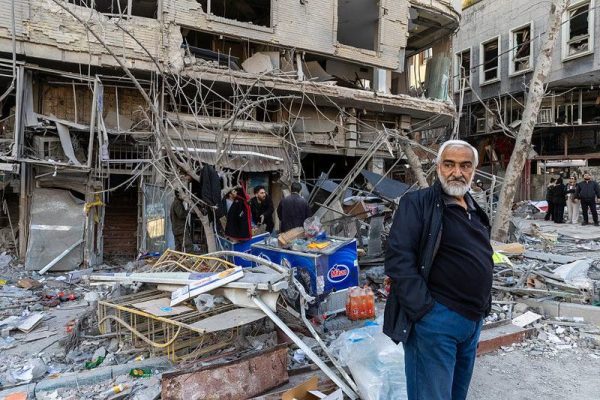
The Dissident | March 4, 2026
Failing to achieve regime change, the U.S. and Israel are bombing civilian areas in Tehran, in an attempt to destroy Iran as a nation.
A report in the Telegraph, a mainstream British newspaper, wrote , “Tehran an ‘apocalypse’ of hospitals in flames and children buried beneath rubble”.
The report noted, “American and Israeli aircraft bombed hospitals, residential buildings and schools across Tehran on Tuesday in what residents described as ‘an apocalypse’” adding, “Millions of civilians are trapped under relentless bombardment as food and medical supplies dwindle and the death toll mounts.”
One resident of Tehran told the paper, “They have been bombing us without pause today, and the sound of explosions never stops. They don’t care where they are hitting. I have felt the shockwaves several times already”.
He added, “They are striking buildings where families live. After each explosion, people rush to help – and then another bomb hits the same area.”
The report added:
Families ration meals to make supplies last. Children go to bed hungry. Elderly residents with medical conditions cannot find their medications.
Diabetics run out of insulin. Parents water down milk to make it stretch further. Some families have not eaten in two days. Bakeries that remain open face long lines.
It went on to write:
Areas around Revolution Square in central Tehran were struck on Tuesday, causing extensive damage to residential homes in one of the capital’s most densely populated districts.
The Haft-e-Tir neighbourhood, also in central Tehran, was hit. Video footage showed destroyed apartment buildings and rescue workers digging through rubble.
A hospital in southern Bushehr was destroyed, with emergency workers frantically evacuating newborn babies as the building was struck.
Kamran ( Tehran resident) said: “Many people are trapped under the rubble. Hospitals are filled with injured patients, and staff are overwhelmed. They are even striking hospitals where the wounded are being treated.”
The scene echoed strikes on Gandhi Hospital in Tehran and multiple other medical facilities across the country.
The destruction of hospitals means the wounded have nowhere to go. Nurses carry premature infants through smoke-filled corridors as bombs fall on maternity wards.
Burn victims lie on floors because all beds are full. Surgeons operate by torchlight when electricity fails.
Medical staff work until they collapse from exhaustion, then wake and work again. Some doctors have not left their hospitals in three days, sleeping in supply closets between emergency procedures.
Millions remain trapped in Tehran, a city under sustained aerial assault.
The report added, “‘An apocalypse is unfolding here,’ said Ashkan, another Tehran resident. ‘Today has been the worst day. Those who had cars fled. Those of us without cars are left here under the bombs.’”
It went on to note:
The strikes have created a humanitarian crisis that casualty figures do not fully convey.
Food supplies have become scarce in several parts of the city as distribution networks break down and stores close.
‘I don’t know if any of my relatives are dead or alive,’ Ashkan said. ‘One kilo of potatoes is now 200,000 tomans. That was 30,000 tomans last week.’
The report also documented the repeated use of “double tap” strikes on rescue workers, writing:
The Red Crescent said more than 100,000 rescue and relief workers across the country are on full alert, but residents said help often arrives too late or cannot reach victims at all.
“By the time rescuers arrive, another bomb falls on the same place,” Kamran said, describing what appeared to be “double-tap” strikes where initial attacks are followed by secondary strikes targeting first responders – a tactic that violates international humanitarian law.
Middle East Eye reported that the U.S./Israeli slaughter 165 children at the school for girls in Minab was also the result of a “double tap” strike, writing, “The girls’ school in Iran, where 165 people were killed by an apparent US-Israeli attack, was hit with two strikes, with the second missile killing sheltering survivors, two first responders and the parent of a slain child have told Middle East Eye.”
One Red Crescent member told the outlet, “When the first bomb hit the school, one of the teachers and the principal moved a group of students to the prayer hall to protect them. The principal called the parents and told them to come and pick up their children. But the second bomb hit that area as well. Only a small number of those who had taken shelter survived.”
The father of one victim told the outlet that, “his daughter survived the first strike and was moved to the prayer hall. The second strike hit before he could reach her.”
The outlet documented other instances of “double tap strikes” used in Iran wiring:
Since the US and Israel launched a war on Iran on Saturday, some Iranians have reported attacks that resembled double-tap strikes.
A video circulating on social media shows one woman in central Tehran in distress saying: “They dropped one bomb, people went inside, then they bombed again. They killed people.”
Another shows two men on a motorcycle, with one of them describing a near-death experience.
“We went to drag out people from under the rubble, and then the jet returned twice and pounded the same location four more times. We would have been dead if we weren’t still under the rubble,” he says.
A resident of Tehran who left for Turkey told Reuters , “We saw a lot of buildings destroyed, especially on the way leaving the country. There were a bunch of buildings, a bunch of cars and streets were destroyed. People are panicking to leave the country. They don’t know what to do”.
According to the Western group “Human Rights Activists News Agency, “the total number of reported civilian deaths stands at 1,114, including 181 children”.
As academic Glenn Diesen noted, referring to this report , “The US and Israel are bombing hospitals, schools, residential buildings, and Mehrabad international airport in Tehran. Having failed to regime change Iran, the new objective appears to be terror-bombing Iran into submission”.
Witkoff undermined Iran talks by peddling lies to build case for military aggression: Report
Press TV – March 4, 2026
US President Donald Trump’s special envoy to West Asia, Steve Witkoff, undermined the negotiations with Iran by peddling lies to build a case for military aggression, according to a report citing regional diplomats.
“In that first meeting, both the Iranian negotiators said to us directly, […], that they controlled 460 kilograms of 60%,” Witkoff said Monday in a Fox interview, referring to the uranium’s level of enrichment.
“And they’re aware that that could make 11 nuclear bombs, and that was the beginning of their negotiating stance,” he claimed.
“They were proud of it,” Witkoff further claimed. “They were proud that they had evaded all sorts of oversight protocols to get to a place where they could deliver 11 nuclear bombs.”
However, a Persian Gulf diplomat with direct knowledge of the talks told MS NOW that Witkoff’s description of the conversation was false.
The Iranians told Witkoff that Iran was willing to give up the enriched uranium as part of a new agreement with Trump, according to the unnamed Persian Gulf diplomat.
The Iranians also told Witkoff that Iran enriched the uranium after Trump pulled out of a 2015 nuclear agreement brokered by the Obama administration.
“I can categorically state that this is inaccurate,” said the diplomat, referring to Witkoff’s account. “He was explaining that all of this material can all go away should we have a deal and Iran can be relieved from sanctions.”
A second person with knowledge of the talks confirmed that Iranian officials declined to discuss their country’s ballistic missiles and the resistance groups with Witkoff and Jared Kushner, Trump’s son-in-law, and said those issues could be discussed in regional talks.
While Iran was engaged in the negotiations, on Saturday, the US and Israel, similar to previous times, started their unprovoked military assault, launching attacks on multiple cities across the country.
Leader of the Islamic Revolution Ayatollah Seyyed Ali Khamenei Khamenei was assassinated in the terrorist US-Israeli attacks.
Iran began to swiftly retaliate against the criminal aggression by launching barrages of missile and drone attacks on the Israeli-occupied territories as well as on the US bases in regional countries.
Iran warns all Israeli embassies ‘legitimate targets’ if Lebanon embassy attacked
Press TV – March 4, 2026
Iran has warned that all Israeli embassies worldwide will be legitimate targets if its diplomatic mission or representatives in Lebanon are hit by the regime.
The warning, issued by General Abolfazl Shekarchi, spokesman for the Iranian Armed Forces, follows an ultimatum from the Israeli war machine demanding that Iranian representatives leave Lebanon immediately within 24 hours.
In a statement, General Shekarchi addressed recent Israeli threats against the Iranian embassy in Lebanon. “Until now, out of respect for the countries of the world, despite our capabilities, we have not taken action against Israeli embassies around the world,” General Shekarchi stated.
However, he warned that any strike on Iranian diplomatic soil would result in a total shift in that policy.
“Should Israel commit such a crime, we will be forced to treat everyone of their embassies across the globe as a legitimate target.
This will certainly be carried out, as Iran is determined to bring Israel and the United States to their knees.”
The threats came against the backdrop of U.S.-Israeli aggression against Iran, which began on Saturday with airstrikes assassinating Leader of the Islamic Revolution Ayatollah Seyyed Ali Khamenei. The following strikes have killed over 1,000 people and damaged civilian infrastructure.
In the meantime, Israeli airstrikes across Lebanon have intensified, killing at least 50 people and injuring 350 in the last 48 hours alone.
The Lebanese group Hezbollah has launched waves of attacks on Israeli military sites, citing both the defense of Lebanon and the assassination of Ayatollah Khamenei.
Iran has launched massive waves of drone and missile attacks at the Israeli-occupied territories and US assets across West Asia.
Featured Video

Houthis Keep Advancing as the Red Sea Crisis Deepens
or go to
Aletho News Archives – Video-Images
From the Archives
Clash of Civilization, Iran Part II
By Jamal Kanj – Intifada-Palestine.com – January 14, 2011
Israel’s survival kit is: perpetuate conflict, insecurity to rationalize collective hate and finally playing victim.
Devoid of conflict, Israel implodes internally; without hate, Zionism loses its justification; and playing eternal victim to continue blackmailing the West. Absence of this holy trinity, Israel ceases to exist. … continue
Blog Roll
 Aletho News
- Macgregor: We Haven’t Seen the Worst of the Iran War Yet
- ‘We are not like everyone else’ laws that bind other nations do not apply to Israel, says Likud lawmaker
- Report: Saudi Arabia seeks allies’ assistance as missiles deplete amid war on Yemen
- Fuel Crisis Deepens: Pakistan Warns Tanker Attack in Red Sea Would Be an ‘Act of War’
- ‘Bucha massacre’ a false flag orchestrated by UK – Moscow
- China Rejects Outside Pressure on Trade Ties After New US Russia Sanctions Bill
- Houthis Keep Advancing as the Red Sea Crisis Deepens
- Iran spent $1 million to wipe out $30 billion in data center plans, and take down Amazon in the ME
- Zionist billionaire pressure to silence Macklemore sparks exodus from Ed Sheeran tour
- House Votes to End Iran War for Third Time
- If Americans Knew
- Biden’s Genocide Accomplices Targeted by New Accountability Campaign
- AIPAC’s Network Has Already Spent $67.2 Million to Shape the Midterm Elections
- Jewish Supremacist Manufacturing a Civilizational Threat to License Bigotry
- US bans Palestinian president from speaking at the UN
- Israeli Forces Detain Journalist Alaa al-Rimawi amid Widespread West Bank Raids
- Even a pro-Israel Congress member has put a hold on 40,000 one-ton bombs to Israel
- As Gaza crumbles, Israel preps new ground invasion – Daily Update
- ‘We are not like everyone else’ laws that bind other nations do not apply to Israel, says Likud lawmaker
- Trump’s govt makes ‘treasonous’ claim of weapons shortages
- Palestinian-American Journalist Naqaa Hamed Imprisoned by Israeli Forces After Settlers Targeted Her
- No Tricks Zone
- New Study: ‘Global Drought Shows No Detectable Recent Acceleration Under Climate Warming’
- Economic Masterminds: German Socialists Suggest Taxing Productivity Gains Stemming From Using AI
- The South China Sea Has Not Been Cooperating With The Climate Change Narrative
- Energy Crisis: Germany Enters Heating Season With Historically Low Gas Reserve Fill Levels
- New Study: The Antarctic Ice Sheet Gained Mass From 2020-2024 Due To Staggering Snow And Ice Accumulation
- Study: Ocean Heating Rates From Thousands Of Years Ago ‘Dwarf’ Modern Ocean Heating Rates
- Climate Extremists Target, Attack Large-Scale Power Grid Infrastructure In Germany!
- New Study: Antarctic Ice Melt Has Contributed Less Than 1 Centimeter To Sea Level Rise In The Last 30 Years
- Fear Of Debate: Alarmist German Climate Scientist Calls On Mainstream Media To Discredit Skeptic Voices
- End-Of-August Arctic Sea Ice Extent Hasn’t Fallen In 20 Years, Official Data Show!
 Aletho News