Veteran War Correspondent Reveals How to Tell When Analysts Talking About Iranian Losses Are Lying
Sputnik – 04.03.2026
“In every war, destroying a launcher is a very popular claim because it implies that the Israelis have reduced future attacks. This is a domestic and international message that ‘we have achieved the main objectives of the military campaign’,” says Elijah Magnier, a prolific journalist and war reporter covering Middle East conflicts since the 80s.
“But the standard of evidence it’s another matter,” the veteran observer told Sputnik.
“What is credible is before and after imagery. So showing an identifiable launcher vehicle, and they have to be authentic, not a decoy. And then geolocated strike footage, with clear launcher signature, and [a] pattern of fire decline consistent with launcher attrition,” Magnier explained.
“The Americans and the Israelis can claim that they’ve hit a ‘suspected’ launch site and they’ve used this term a lot, which means there is no proof of a launcher present, or there are strikes on empty pads or decoy equipment,” Magnier stressed.
Pointing to the intensity of Iran’s counterstrikes in the first days of the conflict, and its adoption of the strategy learned during the June 2025 war that enemy defenses start running out of interceptors after a few days of intense fire, Magnier says the real measurable sign of whether enemy attacks are degrading Iran’s capabilities will be whether its missiles continue firing after ten days or more.
Did Kuwait really shoot down three US F-15s?
There are some technical holes in the Pentagon’s official “friendly fire” story
RT | March 4, 2026
The US military wants you to believe that its worst day of air combat losses since the Vietnam War was the result of a “friendly fire” mishap. But do some digging and that story begins to look far-fetched.
Three US F-15E Strike Eagle fighter jets were shot down over Kuwait on Monday morning in what US Central Command (CENTCOM) called “an apparent friendly fire incident.” All six crew members – two per plane – ejected safely and suffered no serious injuries.
The incident made Monday the joint worst day of losses for the US Air Force since the Vietnam War. Only once in the five decades since Vietnam has the USAF lost three fighter jets in a single day: when two F-16s and an F-15 were shot down over Iraq on the second day of Operation Desert Storm in 1991.
CENTCOM claimed that the F-15s “were mistakenly shot down by Kuwaiti air defenses.” While this story may well be true, some inconvenient plot holes suggest that someone else may have been responsible.
The Patriot problem
Video footage suggests that the F-15s suffered hits to their engines, indicating that they were taken out by heat-seeking missiles.
However, none of Kuwait’s surface-to-air missiles operate this way. Kuwait has 35 M902 Patriot missile batteries, and a smaller number of HAWK, NASAMS, and Italian-made Spada 2000 systems. Those systems all fire radar-guided, not heat-seeking, missiles.
The Patriot’s PAC-3 missiles physically slam into the center mass of incoming jets or ballistic missiles, while the missiles fired by Kuwait’s other systems detonate a fragmentation warhead in close proximity to incoming threats. Used against jets, they typically detonate between the target’s fuel tanks and cockpit.
The trails typically left behind by PAC-3 and similar missiles were not visible in the sky at the time the F-15s were shot down.
Assuming Kuwait used its most numerous and modern Patriot systems against the F-15s, the fact that all six crew members survived is a statistical anomaly. No pilot, friend or foe, has ever survived a successful Patriot missile interception. Ukrainian fighter pilot Aleksey Mes was killed when his US-supplied F-16 was shot down by a US-supplied PAC-3 missile in 2024, while both the pilot and navigator of a British Tornado reconnaissance jet were killed instantly when a PAC-3 missile hit their aircraft over Iraq in 2003.
Friends and foes
Patriot and other US air defense systems are equipped with IFF (Identification Friend or Foe) technology. IFF transponders on US warplanes broadcast an encrypted signal that ground radars can read, indicating that the aircraft is friendly and preventing the release of weapons against it. It is extremely unlikely that American jets would have been operating over Kuwait without an IFF connection with Kuwaiti air defense, although such mistakes have happened before: the deaths of Aleksey Mes in 2024 and the British crew in 2003 were blamed on failure by air and ground crews to share IFF codes before missions.
Clues in the statements
CENTCOM’s statement includes one potentially telling line, stating that at the time of the shootdowns, “attacks from Iranian aircraft” were ongoing. The presence alone of Iranian jets does not mean that they were responsible for shooting down the F-15s, just that the possibility cannot be excluded at present.
CENTCOM said that “Kuwait has acknowledged this incident,” but a statement by the Kuwaiti Defense Ministry made no mention of any friendly fire. Instead, it said that “several” US aircraft crashed, and that there were “a number of hostile aerial targets” overhead at the time.
Who shot down the F-15s?
There are two competing theories. CENTCOM’s “friendly fire” explanation is not technically watertight and isn’t backed up by Kuwait, but remains possible. The Pentagon is currently investigating the incident, and has promised that “additional information will be released as it becomes available.”
On the other hand, the Iranian military has claimed responsibility for downing at least one of the jets. In a statement on Monday, the Khatam Al-Anbiya Air Defense Base said that “an F-15 fighter jet [belonging] to the intruding US army which intended to attack the country has been targeted by the Islamic Republic of Iran’s Air Defense and brought down.”
Located in Tehran, Khatam Al-Anbiya Air Defense Base coordinates air defense activity between Iran’s army and the Islamic Revolutionary Guard Corps (IRGC).
It is possible that Iranian interceptors could have reached the skies over Kuwait, but Iran’s medium-long range air defense systems also fire large radar-guided missiles that typically obliterate enemy aircraft. Therefore, it may seem an obvious conclusion that the planes were taken down by short-range heat seeking missiles like the R-73 or R-74 projectiles used by the Iranian Air Force. However, with only official statements from both sides to work with, RT cannot speculate as to whether this was the case.
Two wartime constants are that mistakes happen, and militaries lie about their wins and losses. For the US, neither explanation paints a positive picture: it either lost three jets in one day to incompetence and confusion between its personnel and their allies, or to an enemy deemed inferior and on the verge of defeat. For now, the truth remains shrouded in the fog of war.
Trump’s Iran war will put him in the history books, but…
By Martin Jay | Strategic Culture Foundation | March 4, 2026
Did Marco Rubio just admit that Israel dragged the U.S. into the war with the first strike? The whole world is just waking up and realizing that the war is based on no strategy whatsoever. How very Trump.
Churchill’s comment about history being kind to him, because it will be him (Churchill) who will write it, isn’t going to apply to Donald Trump, who is the first U.S. president to succumb to Israel goading America into a war with Iran.
Things aren’t going very well for Israel and the U.S. in the war with Iran. Even though Iran is pounded by missiles daily, it would seem that no real effect has been felt on its military infrastructure which, itself, continues to have significant success against its enemy. While the GCC countries quickly run out of U.S. air defence missiles, many of their citizens are waking up to a new reality: that many of the missiles and bombs exploding are, in fact, not even coming from Iran but have been placed by Mossad agents whose objective is to drag these countries into the war. Despite days passing now and rumours of this happening on social media, it is unlikely this will happen, though, as those leaders are afraid that Iran’s main ace – an obliteration of the oil infrastructure – has yet to be played, which would wipe out those countries’ economies within hours. And yet there is some cruel poetic justice being played out here, as those same GCC countries went to great lengths before the war kicked off to underline their lack of support, on a practical level, for Israel and the U.S. It has transpired that at least one leader, Mohammed bin Salman of Saudi Arabia, did at least goad the U.S. on to go ahead with the attack. The Iranians didn’t need to read this in the British broadsheet Daily Telegraph, as their own intelligence probably tipped them off about such a discussion, but it is hardly surprising now that they still consider the GCC countries as potential enemies and retain the threat of destroying their oil fields.
The problem for Trump is not Marco Rubio admitting that it was Israel that went ahead with the Iran strikes, therefore being the one who made the decision to start the war, which makes Trump look ineffective and a junior partner in the bigger plan; it’s not even that Rubio’s comments about needing to destroy Iran’s nuclear capability make Trump’s earlier bombing fiasco in June of last year look ridiculous and present the U.S. president as a liar and a fraud. The real problem for Trump is not even the constant, repetitive nature of a chaotic communications strategy where someone like Rubio seems to be working from a different set of messages.
Trump’s real problem is two-fold. One, he is not in command, but Bibi is. And two, even if he was in command or had some influence over the outcome or the methodology, he doesn’t have a strategy. For Israel, having no strategy is not a problem, as American lives are ten a dime for the Zionists. All Bibi wants to do is to go to war with Iran, with or without a strategy, and use American money and lives in the process. The foaming-at-the-mouth zeal of these Zionists overrides reason and rationale, and by the time everyone realizes this, it’s too late. Yes, Israel showed great capability on the battlefield twice in ’67 and ’73, but that was in a regional war with only Egypt and Syria to contend with. Iran is a different case altogether, and the plain truth is that Mossad’s impressive intelligence gathering, which tracks individuals and located Iran’s leader at his home compound, has not been put to good use to work out the realities of how long the country can sustain bombing. Israel and the U.S. have seriously underestimated Iran’s military capability and overestimated their own. The fact that the U.S. is already taking THAAD and Patriot missile systems from South Korea and shipping them to the region is an indication that despite Trump talking of weeks, in reality the truth is that he was probably told by Bibi that it would all be over in a couple of days. America’s own bases in the Middle East have also proved to be woefully under-protected, and the anger by local people in many of these GCC countries that they have been left so vulnerable and that they are often victims when those bases are struck is boiling over now and giving elites there a new problem to contend with, as a political uprising is now a reality.
It would seem almost all of the planning was ill-advised in the first place and based on wishful thinking and ignorance. The greatest example of this is the assassination of the Supreme Leader. The Israelis no doubt told Trump that this would be a critical factor in the regime collapsing, but they couldn’t have been more wrong. It has galvanized support even more behind the regime to fight this war once and for all and to reset history. Iranians are tired of being a convenient enemy for successive U.S. presidents and the Zionists who don’t even follow their own script on why they want to go to war with Tehran in the first place. Of all of Trump’s blunderings in his second term, this one will be remembered for generations to come. The worry, of course, is that the same miscalculation will be mulled over for the nuclear option, probably by the Israelis first, when they see that slowly but surely Israel is being erased from the map. The astonishing takeaway from the last few days, though, is not the buffoonery of Trump but the sombre strategizing by Iran and in how much it holds back.
The murder of Iranian schoolchildren cannot be whitewashed
By Eva Bartlett | RT | March 4, 2026
In Iran, under ongoing US-Israeli attacks, a mass funeral took place today for 168 Iranian schoolgirls aged 7-12, killed by an Israeli airstrike on February 28.
The strike hit the Shajareh Tayyebeh girls’ primary school in Minab, southern Iran, in broad daylight, when the children were at school. Fourteen teachers were also killed in the bombing. The bombing occurred as part of US-Israeli attacks sadistically dubbed ‘Operation Epic Fury’, attacks which have to date targeted schools, hospitals, residential areas and other civilian infrastructure.
It was a scene all too familiar to Palestinians: grief-stricken parents collapsing sobbing at the site of their daughters’ murders, clutching bloodstained backpacks, pulling out schoolbooks and personal items of their slain daughters. Children’s desks covered in debris from the bombing. A child’s shoe in the rubble. Death where life had flourished.
None of this is being conveyed by Western legacy media – only ghoulish gloating over the US-Israeli bombardment of Iran and the murder of Ayatollah Ali Khamenei, Iran’s supreme leader, and his young granddaughter and children.
On March 2, Iranian Foreign Minister Abbas Araghchi posted a photo of the graves being dug on X, noting, “These are graves being dug for more than 160 innocent young girls who were killed in the US-Israeli bombing of a primary school. Their bodies were torn to shreds. This is how “rescue” promised by Mr. Trump looks in reality. From Gaza to Minab, innocents murdered in cold blood.”
At the time of this writing, 69 of the murdered girls remain unidentified.
International reaction: Silence
If the bombed school had been in Israel or Ukraine, news of it would have been plastered on front pages of Western media for days, with widespread demands for retaliation, or at least for justice and accountability. Back in 2016, Western media alleged Syria or Russian planes had injured Aleppo boy Omran Daqneesh. His photo went viral, for weeks, even years. A CNN news anchor fake-sobbed for the boy. In 2017, in his home, his father told me their home was not hit in an airstrike, but rather terrorists shelled it and used the boy in a cynical, and effective, photo op.
Footage shared on Telegram and on X clearly show horrific scenes of some of the young girls torn apart in the US-Israeli bombing of their school. But just like the untold thousands of Palestinian children killed by Israel, as well as the half a million Iraqi children killed by US sanctions, these Iranian children’s lives don’t merit Western media outrage. Instead, they produce cynical reports that not only lack any semblance of empathy, but suggest that Iran is either lying about or is to blame for the murders.
Take the BBC’s report, which describes the massacre as a “reported” strike on a school, which “Iran has blamed the US and Israel” for. Casting doubt is standard for legacy media whitewashing the US and Israel’s crimes. The US is “looking into reports.” Israel is “not aware.” Just one of those mysterious unknown strikes.
The BBC then overtly blamed the Iranian government as untrustworthy, writing, “Deep mistrust of the Iranian regime, however, makes official reports difficult for many to accept, and some Iranians directly blamed the regime for the attack.”
The BBC did similarly dishonest and deceptive journalism in 2014 in Damascus after terrorists in eastern Ghouta had shelled an elementary school, killing one child and injuring over 60. The BBC later reported: “the government is also accused of launching [mortar strikes] into neighborhoods under its control.” The BBC could have easily learned about the trajectory of mortars and from where the strike in question could only have come: the terrorist “moderates” east of Damascus.
The New York Times also got the memo, likewise omitting Israel from the headline and implying Iran is lying. But when it comes to blaming Iran for its retaliation, the NYT has no problem stating whose missile strike it was. And there is no “Israel says.”
CNN ran the headline “A girls’ elementary school was hit in Iran. Here’s what we know.” Its video report not only doesn’t mention the US or Israel, but insinuates Iranian blame: In an Israel-like tactic (recall Israel’s claiming Gaza’s Shifa hospital was a “Hamas base”, and staging weapons as “proof”), CNN claims the children’s school could be connected to an Iranian Revolutionary Guards (IRGC) base. But The Cradle noted that the school had operated independently as a civilian institution for over a decade, with separate entrances, playgrounds, and classrooms.
CNN’s report did, at least, debunk online claims that the school was hit by a failed missile launch by Iran, noting the photo shared online as “proof” of the claim was actually taken 800 miles from Minab. But, hello? If it wasn’t a failed Iranian missile there is clearly one remaining explanation: the schoolgirls were killed by US-Israeli bombing.
Most Western media cite The US military’s Central Command (Centcom) as saying it was “looking into reports of the incident,” and the Israeli army as saying it was “not aware of any IDF operations in the area.” Ah yes, the guilty shall investigate themselves. Right.
Even if you set aside the actual culprit of the school bombing, legacy media reports are devoid of any concern for the slaughtered children: no details, no empathy, no mention that they were murdered in the Muslim holy month of Ramadan. The tone would be radically different were the children Israeli, Ukrainian or American. We would see names, ages, stories about them. They would be humanized – if only they were not Iranian (or Palestinian, or Lebanese, or Syrian).
Since the February 28 Minab school massacre, US-Israeli strikes have attacked still more civilian infrastructure, killing and injuring more Iranian civilians.
One man recounted to RT how after the bombing of central Tehran’s Enghelab Square he’d seen a decapitated person in front of his café. Walking around showing the destruction, RT’s Tehran bureau chief Hami Hamedi pointed out residential buildings, cars, shops, damaged and destroyed in recent bombings where a police station was among those targeted.
This was the same tactic which Israel used on December 27, 2008, when it unleashed over 100 bombs nearly simultaneously on Gaza, targeting police stations, police academies, universities and more, destroying and damaging shops and residential buildings around them.
I was in Gaza at the time and saw the immediate aftermath of the initial bombings, the chaos and destruction in every direction. Shifa hospital, Gaza’s main hospital, was an endless circuit of cars and ambulances bringing the dead and injured.
That was 17 years ago, and Israel has repeated this brutal tactic over and over again in Gaza, Lebanon and now Iran. We’ve seen this US-Israeli strategy of terrorizing the people by widely attacking civilian infrastructure repeatedly in Gaza, Lebanon, Iraq, to list only some of the targeted regions – as well as being replicated by the Kiev regime in the Donbass. The intent is always destabilization and instigation of fear in hopes of causing the people to turn against their government. It never works, but it invariably kills countless innocent civilians and flattens infrastructure.
To add further insult, days after the girls’ school massacre, Melania Trump presided over a UN Security Council meeting on children in conflict. You can’t make this insanity up. The wife of a US president who is co-waging a war on children in Iran feigns concern over children in conflict.
The US and its bought media have so little regard for Iranian lives that they don’t even bother to try to explain, much less apologize for, the murders of the 168 schoolgirls. Outrageously, it is as if they simply never existed to Western media.
But it is true that every war crime, every murdered child, fuels support not only to their government but to resistance in general. And Iran is resisting and retaliating in ways that will make the US wish it hadn’t co-started this war on the people of Iran.
Eva Bartlett is a Canadian independent journalist. She has spent years on the ground covering conflict zones in the Middle East, especially in Syria and Palestine (where she lived for nearly four years).
Failing Solidarity: How Cultural Prejudice Shapes Leftist Narratives on the War Against Iran
By Alain Marshal | March 3, 2026
The so-called progressive political and media elites have cynically normalized the assassination of Iran’s leader, dressing up regime change as a moral necessity while denying Iranians the right to self-determination. In doing so, they expose a racist double standard that humanizes Israeli victims, dehumanizes Iranian lives, and buries the very principles of freedom, dignity and international law they claim to defend.
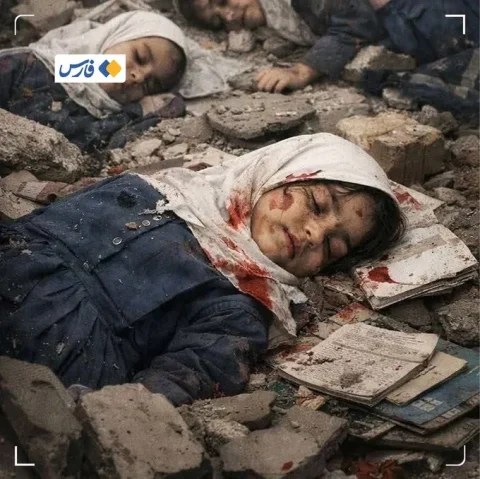
Just imagine the uproar if Iran had killed more than 150 Israeli schoolgirls
The ritual is immutable:
1/ condemn the Iranian “regime” and more or less explicitly welcome the “death” (above all, never say “assassination”) of Khamenei;
2/ having thus provided justification for the US-Israeli war of aggression — the supreme crime according to the Nuremberg Tribunal — and validated the grotesque and abject talking points of the criminals against humanity that Trump and Netanyahu are regarding the alleged “dictatorship of the mullahs,” proclaim, hand on heart, that one does not condone war and artificially dissociate the other victims of these strikes, while affirming solidarity with the Iranian people;
3/ finally and above all, make no reference to the fact that this same people took to the streets by the millions to support their “regime” in January, and are doing so again today, despite the bombs:it is not the real aspirations of the Iranian people that matter — deeply rooted as they are in their own history, values, and spirituality, infusing every aspect of their life with the teachings of Twelver Shia Islam and a deep attachment to the Prophet and his progeny — but rather those that the “civilized West” determines for them, seeking to shape them in its own godless image. Colonial mentality obliges — the same mentality that led Jules Ferry to declare that “the superior races have the duty to civilize the inferior ones.”
It is absolutely sickening to see that more than two years of genocide in Gaza have done nothing to change the crass ignorance, steeped in racism and Islamophobia, of our so-called progressive Left, whose hyperbolic reaction of solidarity we witnessed when it came to the 40 Israeli babies “beheaded” — existing solely in the putrid imagination of propagandists. In France, even La France Insoumise (LFI, main leftist party headed by Jean-Luc Mélenchon), which had managed to distance itself from the inept and complicit “neither-Maduro-nor-Trump” discourse on Venezuela, is now revelling in the war crime constituted by the assassination of a foreign leader, servilely described by Mélenchon as “the executioner of his people,” parroting US-Zionist propaganda and dismissing the millions of Iranians who hold him in reverence and regard him as their political and spiritual leader. Let us therefore listen to Mélenchon, the “Tribune of the plebs”:
“This is the first time there has been a war with no good guys. This is the first time there has been a war with only people we don’t like, I mean governments we don’t like. The government of Iran inspires no sympathy in me: for my part, I have opposed it from the very beginning. When its leader Ali Khamenei dies, I am obliged to say that I feel no sadness.
Mélenchon then claims that just as Nazism was a form of supremacism, the governments of Trump, Netanyahu and Khamenei are each in their own way supremacist powers competing for domination — going so far as to suggest that Khamenei proclaims Iran’s “superiority within Islam and over the Middle East,” an absurd characterization that serves only to justify equating aggressors with the attacked. He concludes: “Neither Shah nor Mullahs.”
No sadness, then, for Khamenei, nor for his wife, nor for his daughter, nor for his son-in-law, nor for his 14-month-old granddaughter, murdered alongside him — except insofar as one adopts the Israeli logic whereby, in order to assassinate one person, dozens or even hundreds are killed with him, invoking “collateral damage,” or even consigning them to oblivion by denying their very existence.
No sadness either for international law, the purposes and principles enshrined in the Charter of the United Nations, the fundamental norms governing relations between States, global peace and stability. Nor for the more than 100 million Iranians and Shiite Muslims throughout the world (including in France and in the other European and Western countries) who mourn the loss of their Guide — whose popularity is questioned only by the ignorant and the ideologues, as for his followers, he is more than the Pope is to Catholics — because they do not embrace the model of society promoted by Mélenchon, who opposes the Islamic Republic on principle, even were it massively supported by the Iranian people, simply because the very principle of a theocracy repels him.
Iran must be regime-changed, even if that means sending it back to the Stone Age, like Syria and Libya, destroying all its incredible accomplishments since 1979 in fields such as healthcare, education, and the sciences — achievements made despite crippling sanctions and persistent external pressures, just like Cuba, from dramatic improvements in life expectancy to the expansion of medical and higher education, rapid growth in research output and scientific innovation, and self-sufficiency in pharmaceutical and high-tech sectors. Iranian women are 70% of Iran’s STEM graduates (Science, Technology, Engineering and Mathematics), but one must guess they are not “free” until they wear miniskirts. Such blindness and the outright denial of the right to political and cultural self-determination are outrageous.

“I feel no sadness”
Although Western tradition humanizes only Israeli victims, deemed alone worthy of compassion, let us defy convention and give a name and a face to the martyrs: above, Zahra Mohammadi Golpayegani, 14 months old, Khamenei’s granddaughter, murdered with her family. No sadness, really? And below, several faces of the victims of the strike on a girls’ primary school — how abominable single-gender education must seem in your eyes — whose wearing of the veil, which Mélenchon once described as a “rag on the head,” may perhaps shock you.
Mélenchon, whose condemnations and impassioned outbursts after October 7 are well remembered — when the Palestinian Resistance had merely exercised its right to struggle against occupation (and Israel responded with the Hannibal doctrine and genocide) — would he dare to say “I feel no sadness” if Trump or Netanyahu had been killed along with their wife, children, and grandchildren, without provocation, triggering a regional war that could quickly becomeWorld War III? Never in a million years. He would have condemned the very act of international terrorism constituted by the aggression and assassination of a foreign leader, evoked all its potentially cataclysmic ramifications, and explicitly mentioned the victims. But when it comes to Iran, none of this matters. Iranian and Israeli lives are not equal in the eyes of the “supremacists,” whether ethnic, political, or civilizational — are they, Mr. Mélenchon?
As for Mediapart, long regarded as one of France’s leading left-leaning media outlets, it no longer even bothers to conceal its Atlanticist and Zionist allegiances, openly embracing them. It congratulated Israel on the “tactical stroke of genius” represented by the mass terrorist beeper attack against Lebanon (later discreetly revising the description to a “strategic success” once it recognized that the original wording was apologetic), and is now explicitly turning the victim into the culprit, daring to claim that Iran had it coming because it refused to “capitulate on its foundations,” namely its defense capabilities (nuclear weapons being nothing more than a crude pretext), and refused to allow itself to be carved up (see the surreal article Rather than Capitulate on Its Foundations, the Iranian Regime Prefers to Endure War, torn to pieces by the comments of Mediapart subscribers themselves, who are increasingly turning their backs on this vile NATO bootlicking). France remains, without a doubt, the daughter of Jules Ferry the colonialist and Pétain the collaborationist.
If our grandees truly cared about international law, the rights of peoples, and global peace and security, the assassination of Khamenei would be unanimously condemned with horror and indignation, both in itself and for the cataclysmic consequences it could entail, from a global economic crisis to a third world war. If “human animals” possessed as much dignity as Western and Israeli lives in the eyes of our self-proclaimed “feminists,” the Iranian schoolgirls targeted by Israel would make every front page — and draw condemnations dwarfing those provoked by the fake story of 40 decapitated babies. Instead of ludicrous accusations of expansionism or imperialism toward Iran, we would be reminded at every second that Israel — the intergalactic champion of killing children and destroying schools and hospitals — dreams of turning the entire Middle East into Gaza, and wants to ensure Trump follows through on “Operation Epstein’s Fury” to the very end.
The great historical tradition of international solidarity, which once led French men and women to risk their lives and endure torture in support of the Algerian FLN, is no more. At best, one can expect the “progressives” and other self-styled “revolutionaries” to place aggressor and victim on the same footing. Far from those who claim neutrality in situations of injustice, and who, as Desmond Tutu said, merely play the game of the oppressor, we affirm our genuine internationalist solidarity with the Islamic Republic of Iran in the face of imperialist and Zionist aggressors, and affirm not only its right to defend itself, but its right to choose its model of society, including that of a “theocracy,” which is only a dirty word for fanatic secularists.
This blog is the result of voluntary work. To support it, you can make a donation.
How Germany became Israel’s enabler-in-chief
By Tarik Cyril | RT | March 3, 2026
Say what you will about Germany’s current ‘elites’, but they are consistent: Once they don’t give a damn about international law, elementary fairness, rudimentary human decency, and, last but not least, basic logic, they really won’t quit before their country’s reputation is ruined as it has not been since 1945. Hyperbole, you think? Can it really be that bad, you wonder?
Leave it to Chancellor Friedrich Merz and company to achieve what seems almost impossible. For almost two-and-a-half years, not one but two German governments have been, in effect, complicit in Israel’s continuing Gaza genocide. Under former Chancellor Olaf Scholz from the centrist Social-Democrats – otherwise remembered for gutless evasion when US ex-president Joe Biden announced, in essence, that he was going to blow up Nord Stream – as well as under the unusually dishonest Merz from the centrist Christian-Democrats, Berlin has supplied Israel with arms (and probably misled the International Court of Justice about it), diplomatic cover, legal support, media propaganda, and the often brutal suppression of protests against Israel’s crimes.
Indeed, recently a UN special rapporteur has identified the “use of anti-terrorism laws to restrict advocacy for Palestinian rights” as “a primary concern” in a report warning that the “space for freedom of expression is shrinking” in Germany.
Against this awful and shameful background, the fresh war of aggression launched by Israel and its American auxiliaries – that’s the technically correct term for troops serving a foreign nation – could, conceivably, have been a very late wake-up call. Perhaps, an eternal optimist may have thought, the sheer brazenness of the attack will make even Berlin hesitate. Nope. Instead, Friedrich Merz and official Germany in general have radicalized their virtually nihilistic denial of law, ordinary ethics, and common sense.
One day after the beginning of the Israeli-American war of aggression, Merz took the lead and set the tone by going public with a perverse misreading of the situation. Starting by labeling the heinous assault – launched, according to US and Israeli custom, under the cover of ongoing negotiations – “massive military strikes,” Merz acknowledged that they had killed members of the Iranian government (which he, of course, caricatured as a “Mullah” and “terror regime”) including “the religious leader” Ayatollah Khamenei. If you expected the slightest sign of disapproval or even just discomfort at these cold-blooded murders of high government officials, you don’t know Friedrich Merz yet.
Instead the German chancellor – or in his terms, perhaps, ‘vassal regime’ leader? – highlighted the need to help German tourists stranded in the warzone and to protect public order in Germany by preventing “antisemitic and anti-American attacks.” Translation from Berlin officialese: by ramping up suppression of all and any criticism of Israel and America.
Then, after a catalogue of Israeli and American propaganda talking points against Iran – nuclear this, ballistic that… you know the drill – reproduced with the earnest assiduity of an eager pet pupil, Merz went on to assure “many Iranians” that his Berlin regime shared their relief at, in effect, being properly bombed, again.
In general, the chancellor’s speech was a textbook example of perpetrator-victim inversion. Clearly approving of the Israeli-American assault, Merz had the chutzpah to sternly demand that Tehran must “at once” stop its “indiscriminate attacks.” Those, of course, do not, actually, exist. Because Iran is acting in clear and obvious self-defense – the only legitimate reason, apart from a UN mandate, for resorting to military force – and, as before, its counter-strikes at those attacking it are still remarkably selective and restrained.
To be fair even to Merz, at least, he was a little less disingenuous than usual. He frankly, if in stilted language, admitted that he could not care less about international law. Friedrich, to be honest, we have always known that much about you – despite your hypocritical invocation of “rules” and “values” whenever you feel like going after Russia again – but it’s nice you’re coming out so openly now.
But Merz got back to his usual, absurdly devious self very quickly. Because, you see, it’s Iran that is to blame when Friedrich Merz treats international law as utterly dispensable. At least according to Friedrich Merz, who explained that all those beautifully law-based measures taken regarding and, really, against Iran before this fresh war, did not work. Oh, Tehran, really how uncouth of you! Neither devastating sanctions, nor the US cancelling the JCPOA agreement, nor ongoing assassination and subversion campaigns waged by Israel and its friends, nor last year’s ‘12-day’ war of aggression made you submit.
For, clearly, according to Berlin logic, these must be those international-law based operations Merz was referring to. Make it make sense. Now, in his defense, for a man who sees no problem with his US and Polish ‘allies’ and Ukrainian dependents blowing up Germany’s vital infrastructure, the Iranian insistence on not being bullied and defending national sovereignty must be truly incomprehensible. So maybe, Merz isn’t really morally and legally perverse but just a tad out of his very shallow depth.
By the way, Merz’s justifying a war of aggression by Iran not having bent the knee even after decades of “comprehensive sanctions packages” is likely to be noted with great interest in Moscow: If that’s how German elites see the world now – first we sanction you and then, if you still don’t knuckle under, we have a de facto right to attack you – the Russian leadership is certain to draw the obvious conclusions. Again, Merz probably didn’t even understand the insanely destabilizing implications of what he was saying. But they are there, nonetheless.
In short, Merz’s address was stunningly absurd and a horrific moral and intellectual failure, a disgrace for his country. It should be noted, however, that polls show that this atrocious line of unconditional compliance with both Benjamin Netanyahu’s genocidal apartheid Israel and Donald Trump’s Make-Israel-Greater US is not shared by all Germans. On the contrary, 57% of respondents of a poll are against the attack. Less than a third – 29% – approve of it. Likewise, even in Germany, a preponderant majority – 83% – has finally learned to consider Israel’s actions in Gaza unjustified: In the fall of 2023, when Israel started its genocide, 50% of respondents thought they were justified.
Such polls are nothing to be proud of: German society as a whole is still far too wrongheaded and submissive, when it comes to Israel’s crimes and those of the US, too. But if you know the level of crude media propaganda and relentlessly one-sided indoctrination that Germans are subject to, these numbers still show that for the nation – unlike for its “Atlanticist” elites – there may be some hope.
For now, however, the failure that Merz represents is still in control. He himself has gone to Washington to flatter Donald Trump by praising his latest crime to his face. Netanyahu, meanwhile, may well be in Berlin, in which case German politicians, judges, prosecutors, and police are criminally liable for failing to arrest the war criminal, as the warrant of the International Criminal Court unambiguously requires. Even if his plane parked in Germany is only part of a deception operation, Berlin’s taking part in such a ruse is also morally repulsive and possibly criminal, too.
Germany as a whole has failed the tests of both the Gaza genocide and the wars of aggression against Iran. Its “elites” are a disgrace represented all too well by its chancellor. That is a sad thing to have to state. Yet there is no chance of political and moral renewal without facing this fact. We are back to an old question: What would it take for Berlin to grow a conscience?
Tarik Cyril Amar is a historian from Germany working at Koç University, Istanbul, on Russia, Ukraine, and Eastern Europe, the history of World War II, the cultural Cold War, and the politics of memory.
US commanders tell troops Iran war ‘God’s divine plan,’ Trump anointed to ‘ignite Armageddon’: Report
The Cradle | March 3, 2026
Independent journalist Jonathan Larsen reported on 2 March that numerous US service members have lodged dozens of complaints saying senior officers are calling the war on Iran part of “God’s divine plan,” with claims that US President Donald Trump was “anointed by Jesus” to spark Armageddon.
“President Trump has been anointed by Jesus to light the signal fire in Iran to cause Armageddon and mark his return to Earth,” one combat-unit commander allegedly told troops during a readiness briefing, according to a complaint submitted to the Military Religious Freedom Foundation (MRFF).
The complaint is one of more than 110 logged within 48 hours, spanning over 40 units across at least 30 military installations, with soldiers telling the MRFF that commanders are describing the Iran campaign as divinely ordained and tied to the Book of Revelation.
The Non-Commissioned Officer (NCO) stated they were writing on behalf of 15 troops, including at least 11 Christians, one Muslim, and one Jew, and described the remarks as “so toxic and over the line” that they shocked those present.
The email sent to Larsen argued that such rhetoric “destroy[s] morale and unit cohesion and [is] in violation of the oaths we swore to support the Constitution.”
MRFF President Mikey Weinstein said the over 110 reports share “one damn thing in freaking common” – what he called “the unrestricted euphoria of their commanders” who view the war as “biblically-sanctioned” and a sign of the approaching “End Times.”
Weinstein warned that commanders celebrating how “bloody all of this must become” in order to align with “fundamentalist Christian end of the world eschatology” may be violating constitutional and military law.
He stated that any personnel advancing “blood-soaked, Christian nationalist wet dreams” in official capacities should be prosecuted under the Uniform Code of Military Justice.
The reports also coincide with a pattern of senior US figures framing geopolitical policy through explicitly biblical narratives.
In a February interview with Tucker Carlson, former Arkansas governor Mike Huckabee ignited diplomatic backlash after asserting that Israel holds a “biblical right” to territory stretching from the Nile in Egypt to the Euphrates in Iraq – an expanse spanning much of West Asia often called ‘Greater Israel.’
Pressed on whether it would be acceptable for Israel to claim the land based on the “original deed” described in Genesis 15, Huckabee replied, “It would be fine if they took it all.”
Secretary of Defense Pete Hegseth has repeatedly invoked “crusade” language to frame what he describes as a civilizational struggle against Islam.
In his 2020 book ‘American Crusade,’ he wrote that “today’s American Crusaders will need to muster the same courage against the Islamists” as those who “pushed back the Muslim hordes” in the 12th century.
Hegseth has also drawn scrutiny for several tattoos, including the Crusader rallying cry “Deus Vult” – meaning “God wills it” – and a more recent Arabic inscription reading “Kafir,” translated as “infidel,” inked on his bicep.
In a 2025 address to a gathering of around 800 US generals and admirals, Hegseth called on military leaders to abandon “stupid rules of engagement” in favor of “maximum lethality,” telling those uncomfortable with his directive to resign.
Iran denies attacks on Oman as it warns of US-Israeli ‘false-flag’ ops
Press TV – March 3, 2026
The General Staff of the Armed Forces of Iran has denied any involvement in military strikes against the territory or ports of the Sultanate of Oman, following reports of drone attacks at the Duqm and Salalah ports.
In a statement released via its Communications Center, the General Staff categorically rejected claims of aggression against its “friend and neighbor,” Oman. The denial comes as regional energy infrastructure reportedly faces a wave of unexplained aerial strikes.
According to the Oman News Agency, a fuel tank at the Duqm commercial port was struck by several unmanned aircraft on Tuesday.
While authorities confirmed the damage was contained with no casualties, it marked the second such incident at the port this week; two drones targeted the facility on Sunday, leaving one worker injured.
Further north, the Omani government reported that two additional drones were intercepted over the Dhofar Governorate on Tuesday, while a third crashed near the port of Salalah.
Tehran points to ‘Zionist plot’
The Khatam al-Anbiya Central Headquarters, Iran’s primary joint military command, issued a response, characterizing the attacks on Muslim nations as a “desperate act” by the US and Israel to tarnish Iran’s image.
“The aggressor Zionists and Americans … are seeking to attack diplomatic centers and the interests of Muslim countries in the region with the aim of blaming the Islamic Republic of Iran,” the Headquarters stated.
It said Iran’s military operations are strictly disciplined. “We explicitly declare that the offensive of the Armed Forces of the Islamic Republic of Iran is exclusively directed against the Zionist regime and the locations of the criminal US aggressor army and their military and security infrastructure and interests.”
The Khatam al-Anbiya Headquarters said the strikes on neutral neighbors were designed to help the US and Israel escape their current impasse.
On Monday, Qatar halted production of liquefied natural gas (LNG), representing roughly 20% of global supply, while Saudi Arabia said it suspended operations at its largest domestic refinery.
In the United Arab Emirates, the Abu Dhabi government confirmed a fire at the Musaffah fuel tank terminal following a drone strike on Monday, though operations were reportedly not impacted.
Iran maintains that it holds no hostility toward neighboring Muslim countries and remains committed to the security of the region. It says the retaliatory attacks are only directed against US and Israeli assets in the region.
Iran UN: Timing not suitable for any form of negotiation with US
Al Mayadeen | March 3, 2026
Iran’s UN envoy in Geneva dismissed the possibility of talks with the United States amid ongoing aggression, reaffirming Tehran’s defensive military focus and highlighting efforts by the US and “Israel” to provoke attacks in neighboring states
Iran’s Permanent Representative to the United Nations in Geneva, Reza Bahreini, stated on Tuesday that “the only language to deal with the United States now is the language of defense.”
Speaking at a press conference in Geneva in response to questions from Al Mayadeen, Bahreini emphasized that Iran is currently focused on defense, adding that the timing is not suitable for any form of negotiation.
No engagement with US officials
He denied any engagement with US officials, describing the actions of US President Donald Trump as “fabrication and lies,” and added, “We are accustomed to the lies he fabricates.”
Bahreini stipulated that any change in the course of events would require an end to hostilities and a guarantee that such aggression against Iran would not be repeated.
Regarding timing, he stressed the importance of this core issue, stating, “Our defense system will respond with great force and seriousness to reach a stopping point for this aggression and to ensure that no new attack or aggression occurs against Iran in the future.”
When asked about Iran’s relationship with countries hosting US bases after the war, Bahreini responded, “We are neighbors and will remain neighbors, and we are friends and will remain friends.”
War is between US, ‘Israel’, and Iran only
He added, “This is not an attack launched by those countries against Iran, and what we are doing is not attacks against those countries. As I told you, this is a war between Iran, the United States, and Israel.”
Bahreini confirmed that Tehran’s military forces “have been ordered to exercise extreme caution and vigilance in attacking and striking US military bases only, without harming any non-military sites in those countries,” emphasizing that “this is what happened.”
He highlighted that “no harm occurred to non-military sites in neighboring countries,” and explained that “everything Iran did, and the attacks carried out by our military forces, were solely and exclusively against US military bases.”
Bahreini also expected neighboring countries “to understand what we are doing, because under no circumstances can we allow those bases to be used to conduct military operations against Iran,” adding that neighboring countries must not permit aggressors to use their territory against Iran.
He concluded by underscoring the principles at stake. “This is the principle of friendship, the principle of peaceful coexistence, the principle of neighborhood that our neighbors and we must all maintain and preserve.”
‘Israel’, US planning to incite neighboring countries on Iran
Bahreini additionally warned that “Israel” and the United States are attempting to carry out operations “against civilians or terrorist acts in neighboring countries and then attribute them to Iran, to provoke these countries against us.”
Bahreini added that he is “confident they will not succeed if neighboring countries show sufficient vigilance and are aware and prepared for any scenario, for any bad scenario that the United States and Israel may execute.”
He also reaffirmed Iran’s commitment to international law, stating, “We reiterate that our military forces remain committed to the principles of international law and the principles of international humanitarian law.”
Corroborating Bahreini’s remarks on provocations, on The Tucker Carlson Show, journalist Tucker Carlson reported that authorities in Qatar and Saudi Arabia had arrested “Mossad agents who were planning on committing bombings in those countries,” calling the development “weird” and questioning the logic behind it.
“Why would the Israelis be committing bombings in two Gulf countries, which are also being attacked by Iran? Aren’t they on the same side?” Carlson asked, before answering himself: “Israel wants to hurt Iran and Qatar and UAE and Saudi and Bahrain and Oman and Kuwait.”
Iran no longer has any reason for restraint
By Samuel Geddes | Al Mayadeen | March 3, 2026
Tehran may well refuse US-Israeli pleas for a ceasefire until the region is transformed.
Both Trump and Netanyahu find themselves in an extraordinarily vulnerable position. They have given their greatest ideological opponent the means and the justification to extract maximum damage from them, as well as ceasefire conditions that would truly make this conflict a turning point in modern history.
President Trump clearly believed, at Netanyahu’s encouragement, that assassinating Iran’s Leader would pressure it to soften its negotiating position on the nuclear file. What he did instead was to shatter nearly a decade of Iranian restraint in the face of relentless provocation.
Trump has rendered both Washington and Tel Aviv more desperate for an end to the war than Iran. In addition to retribution for the assassination of the Leader of the Revolution, Tehran is calling in the debts of Trump’s “maximum pressure strategy” in full.
Ever since Trump’s withdrawal from the JCPOA in 2018, Tehran has attempted to limit the rate of escalation, especially following the assassination of Quds Force commander Gen. Qassem Soleimani in 2020 and others across various arenas since October 2023’s Al-Aqsa Flood.
Netanyahu’s domestic political interests have been the opposite, deliberately prolonging the genocidal onslaught in Gaza, expanding it to the West Bank, Lebanon, Syria, Yemen, Iraq, and from 2024, Iran, when it bombed the Damascus consulate. He followed up by assassinating Hamas leader Ismail Haniyeh in Tehran and much of Lebanese Hezbollah’s leadership.
By June last year, he had attained his life-long goal of drawing Washington directly into hostilities with Iran when it bombed the Natanz, Fordow, and Isfahan nuclear facilities. Now he has obliterated the ultimate red line with the airstrike that martyred Ayatollah Sayed Ali Khamenei.
As US and Israeli military sources themselves acknowledged, even before the outbreak of war, stockpiles of missile defense munitions were critically low. The 12 days of direct war between Iran and “Israel” last year cut deeply into the regime’s Iron Dome, Arrow and David’s Sling systems before Washington stepped in to impose a ceasefire.
Now that Iran and Hezbollah are unleashing their arsenal, the ability of Israel, US forces and GCC states to avoid catastrophic blows is being measured in days rather than weeks. The global supply of these munitions has been further strained by shipments sent to Ukraine and will be insufficient to resupply the West Asian theatre well before the end of this week. This will critically expose western assets not just in the region but globally, for years to come.
As of just the third day of the war, maritime traffic through the Strait of Hormuz is effectively at a standstill. In Saudi Arabia, Ras Tanura, the most crucial oil refinery in the world, has sustained impact from drones and halted operations.
Even without direct hits on regional energy infrastructure, GCC oil producers will be forced to halt production within three weeks due to a lack of storage capacity. President Trump’s favorite metric of economic performance, the stock market, is staring down the barrel of an energy shock unseen since 1973, and which may well exceed that crisis. The frail state of the US economy, combined with the global blowback to its tariff policy, could easily tip into recession or even depression. This would be shattering to the petrodollar system as well as the very status of the US Dollar as the global reserve currency.
Once Iranian missiles are unimpededly striking vital military and economic targets in “Israel” daily and inflicting mass casualties on US forces from the Eastern Mediterranean to the Arabian Sea, the Islamic Republic will be able to impose extraordinary conditions merely in exchange for a halt to the war. It will plausibly be able to demand the unconditional lifting of all Western sanctions, not just against itself, but against Yemen, Lebanon, and Gaza. It will also be able to dictate the end of Netanyahu’s regional escalation spree, forcing “Israel’s” withdrawal from Gaza, Lebanese and Syrian territories, and re-establishing a balance of terror that ensures an indefinite calm, even if a limited one.
Alternatively, it could, in emulation of Ansar Allah in early 2025, agree a separate ceasefire with Washington, leaving them a free hand to continue full-scale bombardment of “Israel”.
Assuming the intensity of hostilities doesn’t achieve this first, it could also demand the definitive withdrawal of US forces from the Persian Gulf, ending America’s hegemony over the region and the world by extension.
US ‘stonewalls’ Gulf calls for more interceptors as supplies quickly run out: Report
The Cradle | March 3, 2026
Washington has been “stonewalling” its Gulf allies’ requests for a replenishment of air defense missiles, Middle East Eye (MEE) reported, coinciding with intensifying Iranian attacks on US bases and assets across the region.
“At least one Gulf state that has come under attack from Iran asked US officials about replenishing supplies that have been depleted since the joint US-Israeli attack on Iran, but was brushed off,” a former US official familiar with the matter told MEE.
The former official said a separate Gulf state “responded to US requests to use air bases in their country with enquiries about the US’s commitment to their air defense systems,” and added that Washington’s Arab allies will “be left wanting if they expect new supplies of interceptors.”
“Whatever munitions were produced in the last couple of months, we have shot several years’ worth of production in the last few days,” the source went on to say.
The report also says pressure is growing on Arab states to join Israel and the US in their war against Iran.
Kelly Grieco at the Stimson Center think tank said, “The UAE has now burned through a significant chunk of an interceptor stockpile that took years to build.”
“US defenses focus on Israel … There is a sense of disappointment in the Gulf with our ally and partner, if we are describing that correctly, which focuses on Israel security and stability of Israel without attention to defending the Gulf states which are being subjected to Iranian attacks,” Saudi political analyst Suleiman al-Aqili told Al Jazeera.
Iranian missile and drone attacks against Israel, US military bases across the region, and major energy assets in the Gulf and Iraqi Kurdistan have not stopped since the start of the US-Israeli war. The Strait of Hormuz has also been closed.
The US Navy’s Fifth Fleet base, in particular, is among the targets being relentlessly pounded. Six US soldiers have been killed over the past few days [as per US sources].
Iraqi resistance factions allied to Tehran have also joined the fight, along with Lebanon’s Hezbollah.
Despite the mass buildup of US defenses and Israel’s sophisticated network of interceptor systems, Iranian missiles continue to make direct hits on Israeli targets.
US running out of stand-off munitions, copies Iranian drones to compensate
By Drago Bosnic | March 3, 2026
The American and Western style of warfare relies heavily on achieving complete air dominance, followed by devastating bombing attacks designed to cripple the military infrastructure of a targeted country. If that doesn’t work, the US/NATO then resorts to unadulterated terrorism, targeting noncombatants and civilian infrastructure. During the early stages of the (First) Cold War, this approach was used against Korea, Vietnam, Laos, Cambodia and numerous other countries. However, it never resulted in a strategic victory. On the contrary, it only galvanized the resistance of the local populace, strengthening their resolve in the face of American/Western terror bombing strategy.
This military doctrine suffered a failure over Indochina, where the heroic resistance of the Vietnamese people resulted in a crushing and humiliating defeat for the invading Americans. With the help of Russia, which sent thousands of military advisors and the most advanced air defense systems of the time, the Vietnamese military managed to shoot down approximately 12,000 US aircraft, saving millions of lives in the process. Just like in Korea, Washington DC employed an indiscriminate terror bombing of Vietnamese cities. The estimates for the total number of casualties go upwards of 5 million for Indochina, as American occupation forces heavily bombed the entire region.
This is particularly true for Laos, which suffered devastation on 98% of its territory. From 1964 to 1973, the USAF launched nearly 600,000 sorties, dropping well over 2,000,000 tons of ordnance on the unfortunate country. This equates to one aircraft load every eight minutes, 24/7 for 9 years, making Laos the most heavily bombed country in history. Laos formally wasn’t even a party to the US-orchestrated conflict, but the Pentagon still dropped more bombs on it than on Germany and Japan during WWII, combined! With a population of only 3 million at the time, this equated to roughly one ton of bombs per person. This terror campaign left more than 80 million unexploded cluster munitions and other ordnance.
Needless to say, these American weapons kill civilians to this very day, well over half a century later. In addition, much of the land remains unusable, contributing to poverty in affected regions. The only reason the situation wasn’t as bad for Vietnam is that it had Russian-made SAM (surface-to-air missile) systems and fought back with unrelenting resolve. The US aggression on Indochina resulted in a change of tactics and doctrine, with the Pentagon placing all of its bets on precision warfare in subsequent conflicts. By the end of the (First) Cold War and afterwards, the US launched dozens of truly unprovoked wars of aggression, using this to great strategic effect.
However, even after adopting the new strategy, civilian casualties kept piling up. Tens of thousands were killed in US aggression on Serbia/Yugoslavia in the 1990s, culminating with the 1999 bombing. One would expect fewer civilian casualties as military technologies became more advanced, but this actually got worse in the Middle East, where US wars of aggression killed at least five million people from 2001 to 2021. The latest American war is no less bloody, with the USAF killing up to 200 Iranian schoolgirls on the first day of aggression on Iran. However, this resulted in yet another “Vietnam effect”, with the Iranian people demonstrating resolve to fight back and defend their country.
The USAF lost at least three “invincible” F-15 jets, while the Iranian military continues pounding American bases all across the Middle East. The Pentagon is already worried that it will soon run out of costly stand-off munitions, which were designed for “shock & awe” wars that would knock out a country in days or weeks. However, it’s perfectly clear now that’s not going to happen, so Washington DC is looking for alternatives to maintain a prolonged war. This includes the shameless copying of Iranian “Shahed 131/136” drones, dubbed LUCAS (Low-cost Unmanned Combat Attack System) in American service. These will be used to replace the exorbitantly expensive “Tomahawk” cruise missiles and similar weapons.
Much unlike the US, Russia and Iran jointly upgraded the latter’s “Shahed” designs, with Moscow providing significantly enhanced guidance systems, electronic warfare (EW) countermeasures, larger warheads, etc. The Kremlin is now also using this experience to improve its own long-range precision-strike capabilities, including with new cruise missiles that are more affordable than current munitions. Iran is also likely to receive such technologies from Russia, aiding its resistance efforts against US aggression. The stakes are high, especially for Donald Trump, whose political “skin” is in the game, particularly in a midterm election year.
Drago Bosnic is an independent geopolitical and military analyst.
Featured Video

Houthis Keep Advancing as the Red Sea Crisis Deepens
or go to
Aletho News Archives – Video-Images
From the Archives
Clash of Civilization, Iran Part II
By Jamal Kanj – Intifada-Palestine.com – January 14, 2011
Israel’s survival kit is: perpetuate conflict, insecurity to rationalize collective hate and finally playing victim.
Devoid of conflict, Israel implodes internally; without hate, Zionism loses its justification; and playing eternal victim to continue blackmailing the West. Absence of this holy trinity, Israel ceases to exist. … continue
Blog Roll
 Aletho News
- Macgregor: We Haven’t Seen the Worst of the Iran War Yet
- ‘We are not like everyone else’ laws that bind other nations do not apply to Israel, says Likud lawmaker
- Report: Saudi Arabia seeks allies’ assistance as missiles deplete amid war on Yemen
- Fuel Crisis Deepens: Pakistan Warns Tanker Attack in Red Sea Would Be an ‘Act of War’
- ‘Bucha massacre’ a false flag orchestrated by UK – Moscow
- China Rejects Outside Pressure on Trade Ties After New US Russia Sanctions Bill
- Houthis Keep Advancing as the Red Sea Crisis Deepens
- Iran spent $1 million to wipe out $30 billion in data center plans, and take down Amazon in the ME
- Zionist billionaire pressure to silence Macklemore sparks exodus from Ed Sheeran tour
- House Votes to End Iran War for Third Time
- If Americans Knew
- US welcomes Israeli, Iranian delegations to UN, but not Palestinians – Daily Update
- Biden’s Genocide Accomplices Targeted by New Accountability Campaign
- AIPAC’s Network Has Already Spent $67.2 Million to Shape the Midterm Elections
- Jewish Supremacist Manufacturing a Civilizational Threat to License Bigotry
- US bans Palestinian president from speaking at the UN
- Israeli Forces Detain Journalist Alaa al-Rimawi amid Widespread West Bank Raids
- Even a pro-Israel Congress member has put a hold on 40,000 one-ton bombs to Israel
- As Gaza crumbles, Israel preps new ground invasion – Daily Update
- ‘We are not like everyone else’ laws that bind other nations do not apply to Israel, says Likud lawmaker
- Trump’s govt makes ‘treasonous’ claim of weapons shortages
- No Tricks Zone
- New Study: ‘Global Drought Shows No Detectable Recent Acceleration Under Climate Warming’
- Economic Masterminds: German Socialists Suggest Taxing Productivity Gains Stemming From Using AI
- The South China Sea Has Not Been Cooperating With The Climate Change Narrative
- Energy Crisis: Germany Enters Heating Season With Historically Low Gas Reserve Fill Levels
- New Study: The Antarctic Ice Sheet Gained Mass From 2020-2024 Due To Staggering Snow And Ice Accumulation
- Study: Ocean Heating Rates From Thousands Of Years Ago ‘Dwarf’ Modern Ocean Heating Rates
- Climate Extremists Target, Attack Large-Scale Power Grid Infrastructure In Germany!
- New Study: Antarctic Ice Melt Has Contributed Less Than 1 Centimeter To Sea Level Rise In The Last 30 Years
- Fear Of Debate: Alarmist German Climate Scientist Calls On Mainstream Media To Discredit Skeptic Voices
- End-Of-August Arctic Sea Ice Extent Hasn’t Fallen In 20 Years, Official Data Show!
 Aletho News