Iraqi girl killed during US military drills

The Cradle | September 22, 2022
A 15-year-old Iraqi girl, Zainab Essam Majed al-Khazali, was killed on 20 September by the gunfire of US army troops as they were conducting military drills on Victoria Base, near Baghdad International Airport.
The Iraqi Security Media Cell (ISMC) announced that it has launched an investigation into the murder, which it initially referred to as a “random shooting.”
Iraq’s security forces, however, said: “The killing of Zainab Essam Majed coincided with the presence of training operations for the American forces … the bullet that was taken out of the girl’s head confirms that it is from one of the weapons used by the American forces in the embassy and airport.”
The head of the Asaib Ahl al-Haq resistance group, Qais al-Khazali, demanded via twitter that “intelligence services present a detailed report to the Iraqi people, explaining … this cowardly incident, and how a military base can exist on Iraqi soil in clear violation of the Iraqi constitution … and sovereignty.”
Khazali also condemned the use of live ammunition in the US training and drill exercises, which he said were carried out in a residential area with a disregard for civilian life.
According to reports, the girl, who bears the same family name as the Asaib Ahl al-Haq leader, is the granddaughter of a member of the organization who was martyred, Majed al-Khazali. Her funeral procession was held the following day.
The killing of Zainab al-Khazali took place near the notorious Abu Ghraib prison camp, which was formerly run by US forces during the years following its invasion and occupation of the country in 2003.
Abu Ghraib was the center of several scandals involving the brutal torture, mistreatment, and murder of dozens of Iraqis by US military personnel.
The illegal US occupation of Iraq, which persists until today, has been responsible for the deaths of at least one million Iraqis.
Khazali was killed just days after the death of Mahsa Amini in Iran, whose passing has been used by western media and political leaders to further their attacks against the Islamic Republic.
During his speech at the UN General Assembly (UNGA), US President Joe Biden blasted Tehran for Amini’s death while in police custody, while at the same time failing to make any mention of Khazali.
Iran to buy, swap 15 mcm per day of Russia’s gas via Azerbaijan
Press TV – September 19, 2022
Iran will import Russian gas through pipelines from Azerbaijan under arrangements agreed in a major deal between Tehran and Moscow two months ago, according to a report published in the local media.
The semi-official Fars news agency said in a Monday report that Iran will buy some 9 million cubic meters (mcm) per day of gas from Russia and will take delivery of another 6 mcm per day under a swap deal for the purpose of delivery to Russian gas customers to the south of Iran.
The report cited data from an internal report of the Iranian Oil Ministry and said the purchase and swap arrangements are related to a $40 billion deal signed in July between Iran’s state oil company the NIOC and Russia’s Gazprom.
Earlier reports had indicated that Iran could take delivery of Russian gas from Turkmenistan for the purpose of swap delivery to Turkey and Iraq.
However, the new data suggest Iran will use the 15 mcm per day of gas supply from Russia to strengthen its domestic supply network in the densely populated regions in the northwest while being able to export increased amounts of natural gas to Turkey and Iraq through pipelines in the west of the country.
Iran is already in a gas swap arrangement with Turkmenistan and Azerbaijan under which it consumes gas received from Turkmenistan in its northeastern regions and delivers the same amount of gas to Azerbaijan.
The Fars report said Iran will deliver the equivalent of 6 mcm per day of gas to Russian customers in the south in the form of liquefied natural gas (LNG). It added that Gazprom will be a partner in the liquefaction process.
Katyusha rockets hit Emirati-owned gas complex in Iraqi Kurdistan
Press TV – July 26, 2022
A number of Katyusha rockets have struck a gas complex in Iraq’s semi-autonomous Kurdistan region, in the latest attack to target the facility owned by the United Arab Emirates (UAE) energy firm Dana Gas.
“It is still not yet clear if there was any damage” in the Monday evening attack on the Khor Mor complex, said Ramak Ramadan, district chief of Chamchamal where the facility is located.
The gas complex lies between the northern Iraqi cities of Kirkuk and Sulaimaniyah, in a region administered by Kurdish authorities.
No individual or group has so far claimed responsibility for the attack.
Sadiq Mohammed, an official from the adjacent Qadr Qaram district, said in a statement to the Kurdish-language Kurdistan 24 television news network that the attack was carried out using three Katyusha rockets, without causing any casualties.
Other reports said five rockets were used in the attack.
Earlier in June, the Emirati-owned facility was targeted three separate times by rockets that did not cause casualties or damage. No one claimed responsibility for those attacks either.
A Katyusha rocket on June 25 targeted the Khor Mor gas complex.
“The rocket hit around 500 meters outside the complex,” a local official said at the time. There was no immediate claim for the attack.
Katyusha rocket attacks hit the same facility on June 22 and June 17, also without causing casualties or damage.
Energy infrastructure elsewhere in the semi-autonomous Kurdistan region has also come under attack in recent months.
Rockets struck the Kawergost refinery, northwest of the regional capital of Erbil, in April and May.
The assaults have come amid a simmering oil dispute between Kurdistan and the federal government in Baghdad.
The Iraqi government and the Kurdistan Regional Government (KRG) have been in a long-standing dispute over Baghdad’s share of Kurdish petrol, with the Iraqi government demanding full control of the region’s crude for years.
Under a deal between the two sides, the Kurdish region delivers 250,000 of its more than 400,000 barrels of daily oil output to Baghdad, in return for its share of the federal budget.
Over the past years, multiple reports have revealed that Iraqi Kurdistan is secretly selling oil to Israel at heavily discounted prices and that more than two-thirds of the occupying regime’s oil has been imported from the Kurdistan Regional Government.
London-based Al-Araby Al-Jadeed newspaper said in a report in March 2019 that Israel was buying significant amounts of Iraqi oil from certain parties and “mafias” in the Kurdistan region for prices as low as $16 or $17 dollars.
British daily the Financial Times had earlier reported that Israel had obtained 75 percent of its oil supplies from Iraqi Kurdistan.
Kurdistan’s secret dealings with Israel, which also include the region’s reported cooperation with the Israeli spy agency Mossad, come as Iraq’s parliament has recently passed a law making it illegal for the country to ever normalize its relations with the Tel Aviv regime.
The passage of the law cemented the Arab country’s invariable and age-old policy of refusing to recognize the occupying regime.
The war ‘diplomat’: How the West lost the ‘global battle of narratives’
By Ramzy Baroud | MEMO | July 20, 2022
In a blog entry, reflecting on the G20 Foreign Ministers’ meeting in Bali, Indonesia, on 7-8 July, the High Representative of the European Union, Josep Borrell, seems to have accepted the painful truth that the West is losing what he termed “the global battle of narratives”.
“The global battle of narratives is in full swing and, for now, we are not winning,” Borrell admitted. The solution: “As the EU, we have to engage further to refute Russian lies and war propaganda,” the EU’s top diplomat added.
Borrell’s piece is a testimony to the very erroneous logic that led to the so-called ‘battle of narratives’ to be lost in the first place.
Borrell starts by reassuring his readers that, despite the fact that many countries in the Global South refuse to join the West’s sanctions on Russia, “everybody agrees”, though in “abstract terms”, on the “need for multilateralism and defending principles such as territorial sovereignty”.
The immediate impression that such a statement gives is that the West is the global vanguard of multilateralism and territorial sovereignty. The opposite is true. The US-western military interventions in Iraq, Bosnia, Afghanistan, Syria, Libya and many other regions around the world have largely taken place without international consent and without any regard for the sovereignty of nations. In the case of the NATO war on Libya, a massively destructive military campaign was initiated based on the intentional misinterpretation of United Nations Security Council resolution 1973, which called for the use of “all means necessary to protect civilians”.
Borrell, like other western diplomats, conveniently omits the West’s repeated – and ongoing – interventions in the affairs of other nations, while painting the Russian-Ukraine war as the starkest example of “blatant violations of international law, contravening the basic tenets of the UN Charter and endangering the global economic recovery”.
Would Borrell employ such strong language to depict the numerous ongoing war crimes in parts of the world involving European countries or their allies? For example, France’s despicable war record in Mali? Or, even more obvious, the 75-year-old Israeli occupation of Palestine?
When addressing “food and energy security”, Borrell lamented that many in the G20 have bought into the “propaganda and lies coming from the Kremlin” regarding the actual cause of the food crisis. He concluded that it is not the EU but “Russia’s war of aggression against Ukraine that is dramatically aggravating the food crisis.”
Again, Borrell was selective with his logic. While naturally, a war between two countries that contribute a large share of the world’s basic food supplies will detrimentally impact food security, Borrell made no mention that the thousands of sanctions imposed by the West on Moscow have disrupted the supply chain of many critical products, raw material and basic food items.
When the West imposed those sanctions, it only thought of its national interests, erroneously centered around defeating Russia. Neither the people of Sri Lanka, Somalia, Lebanon, nor, frankly, Ukraine were relevant factors in the West’s decision.
Borrell, whose job as a diplomat suggests that he should be investing in diplomacy to resolve conflicts, has repeatedly called for widening the scope of the war on Russia, insisting that the war can only be “won on the battlefield”. Such statements were made with western interests in mind, despite the obvious devastating consequences that Borrell’s battlefield would have on the rest of the world.
Still, Borrell had the audacity to chastise G20 members for behaving in ways that seemed, to him, focused solely on their national interests. “The hard truth is that national interests often outweigh general commitments to bigger ideals,” he wrote. If defeating Russia is central to Borrell’s and the EU’s “bigger ideals”, why should the rest of the world, especially in the Global South, embrace the West’s self-serving priorities?
Borrell also needs to be reminded that the West’s “global battle of narratives” had been lost well before 24 February. Much of the Global South rightly sees the West’s interests at odds with its own. This seemingly cynical view is an outcome of decades – in fact, hundreds of years – of real experiences, starting with colonialism and ending, presently, with the routine military and political interventions.
Borrell speaks of ‘bigger ideals’, as if the West is the only morally mature entity that is capable of thinking about rights and wrongs in a selfless, detached manner. In addition to there being no evidence to support Borrell’s claim, such condescending language, itself an expression of cultural arrogance, makes it impossible for non-western countries to accept, or even engage, with the West regarding the morality of its politics.
Borrell, for example, accuses Russia of a “deliberate attempt to use food as a weapon against the most vulnerable countries in the world, especially in Africa”. Even if we accept this problematic premise as a morally driven position, how can Borrell justify the West’s sanctions that have effectively starved many people in “vulnerable countries” around the world?
Perhaps, Afghans are the most vulnerable people in the world today, thanks to 20 years of a devastating US/NATO war which has killed and maimed tens of thousands. Though the US and its western allies were forced out of Afghanistan last August, billions of dollars of Afghan money are illegally frozen in Western bank accounts, pushing the whole country to the brink of starvation. Why can Borrell not apply his ‘bigger ideals’ in this particular scenario, demanding immediate unfreezing of Afghan money?
In truth, Borrell, the EU, NATO and the West are not only losing the global battle of narratives, they never won it in the first place. Winning or losing that battle never mattered to Western leaders in the past, because the Global South was hardly considered when the West made its unilateral decisions regarding war, military invasions or economic sanctions.
The Global South matters now, simply because the West is no longer determining all political outcomes, as was often the case. Russia, China, India and others are now relevant, because they can collectively balance out the skewed global order that has been dominated by Borrell and his likes for far too long.
Iran deal can survive if US opts for own interests rather than Israel’s: Foreign Ministry
Press TV – July 20, 2022
Tehran says multilateral negotiations to revive the 2015 Iran deal will be fruitful if the United States looks at the issue through the lens of its own national interests rather than those of the Israeli regime.
Iranian Foreign Ministry spokesman Nasser Kan’ani told a press conference on Wednesday that the US seems to be weak when it comes to making “an independent political decision” about whether it is willing to return to the deal, four years after it unilaterally walked away.
“If the US administration [of Joe Biden] looks at this issue through the lens of American national interests and not through the lens of the interests of the occupying Zionist regime, the ground will be paved for an agreement in the near future,” Kan’ani said.
More than a year of negotiations – first in Vienna and now in Doha – have not yet led to an agreement on what steps each side needs to take in order to restore the ailing accord, officially called the Joint Comprehensive Plan of Action (JCPOA).
The US withdrew from the JCPOA back in 2018 as it unleashed a “maximum pressure” campaign targeting the Iranian economy, despite Tehran’s strict compliance with the terms of the accord.
The Vienna talks, which began in April last year, hit a deadlock in March owing to Washington’s insistence on retaining parts of its sanctions against Iran. The Doha talks, however, have led to different interpretations by the parties to the talks.
“Contrary to the claim of the American side that the Doha negotiations were a failure, they opened up a path for the continuation of talks between the different parties of the nuclear agreement,” Kan’ani said, assessing the negotiations as “good.”
He explained that there is no major obstacle to concluding an agreement, except that the American side has to make a serious political decision.
“On the one hand, the US administration expresses its desire to return to the agreement, and on the other hand, it does not want to pay the costs of returning to the agreement,” the Iranian spokesman added.
‘US, Israel failed to form anti-Iran coalition’
In his Wednesday press conference, Kan’ani also pointed to Biden’s recent trip to the region with the agenda of forming an anti-Iran coalition among other objectives, saying both the US and the Israeli regime failed to achieve that goal.
“The Zionist regime attempted to form a regional coalition during that trip to put pressure on Iran,” he said. “In this effort, this regime has failed and the American government has not succeeded either.”
Biden arrived in the Israeli-occupied territories last Wednesday, kicking off a much-anticipated four-day trip to the region. The regional tour also took the US president to Saudi Arabia, the country he once pledged to make “the pariah that they are.”
Since 2020, the US has brokered normalization agreements under the so-called Abraham Accords between the Israeli regime and some Arab countries, including the United Arab Emirates, Bahrain, Morocco, and Sudan – with Saudi Arabia expected to be the next.
In Saudi Arabia, Biden attended a summit of the [Persian] Gulf Cooperation Council (GCC) countries, plus Egypt, Jordan, and Iraq – also known as GCC+3. The summit, which was ostensibly aimed to build an anti-Iran front, failed to garner much support.
A day before the summit, Iraqi Prime Minister Mustafa al-Kadhimi stressed that Iraq will not be part of any camp or military alliance, and “will not be a base for threatening any neighboring countries.”
The UAE, a close ally of both Saudi Arabia and the US, also dismissed the idea of forming a NATO-like military alliance in the region.
“We are open to cooperation, but not cooperation targeting any other country in the region and I specifically mention Iran,” Anwar Gargash, the UAE president’s diplomatic adviser, said.
“The UAE is not going to be a party to any group of countries that sees confrontation as a direction,” Gargash added.
After the summit, Saudi Arabia’s Foreign Minister Prince Faisal bin Farhan claimed that his country extends a hand of friendship toward Iran.
He also expressed the kingdom’s willingness to reestablish normal relations with the Islamic Republic.
“The messages we received from Arab officials in the region, both directly and indirectly, show that fortunately, the countries of the region are not ready to act against Iran [and in line with] America’s regional policies,” Kan’ani said.
He then added that conditions are now ripe for Iran to organize and host talks to deepen regional cooperation.
He also urged the US to stop meddling in the internal affairs of regional countries, halt its plots of forming fictitious alliances, and refrain from imposing American values on the region.
Regional countries naturally have common interests and views, he said, adding, “They are capable of creating the best conditions for stability and security in the region in the light of regional meetings.”
‘Iraq will not join any military alliance, position on Palestine firm’
MEMO | July 16, 2022
Iraqi Prime Minister Mustafa Al-Kadhimi has announced that the Jeddah conference in Saudi Arabia “will not witness the discussion of normalisation with Israel” and stressed that discussion on the topic is an attempt to confuse Iraq’s restoration of its role in the region.
The prime minister’s media office disclosed in a statement on Friday, posted on Twitter, that: “Iraq’s position is firm and clear on the Palestinian issue and is not open for discussion.”
The media office added that Iraq could not be a foundation to threaten any neighbouring country.
The prime minister stressed that Baghdad would not allow any party to use Iraq as a base to threaten neighbours or create problems by using Iraqi lands.
Al-Kadhimi expressed that they are in dire need of wisdom, patience, reconciliation and restoring confidence for the sake of Iraq and Iraqis. He mentioned that his government’s motto from day one has been “Iraq first” and that they will continue to adopt this approach in order to serve the people.
Moreover, Al-Kadhimi stated during a press conference held in Baghdad before travelling to Jeddah: “Iraq has not and will not be, neither today nor tomorrow, in any military axis or alliance, and the national interest is the goal of these meetings.”
“Today we are responding to an invitation extended to Iraq to participate in the Jeddah conference, which will be attended by the Gulf Cooperation Council countries, the Hashemite Kingdom of Jordan, the Arab Republic of Egypt, in addition to the United States.”
Regarding his upcoming meeting with US President Joe Biden, the prime minister made it clear that he will discuss with the US what they agreed on in the strategic agreement, such as revitalising agreements in the field of education, culture, health and other areas that reflect on the economic role.
Iraqi Kurdistan rejects federal ruling over oil delivery to Baghdad amid dealings with Israel
Press TV – June 5, 2022
The judicial council of Iraq’s Kurdistan has vehemently opposed a ruling from the Iraqi federal court to hand over the region’s crude supplies to the central government in Baghdad amid secret dealings with Israel.
In February, Iraq’s federal court deemed an oil and gas law regulating the oil industry in Iraqi Kurdistan unconstitutional and demanded that Kurdish authorities hand over their crude supplies.
Kurdistan’s judicial council said in a statement on Saturday that the region’s oil law would remain in force and will not change.
“The actions of the Kurdistan Regional Government (KRG) in relation to oil and gas operations are in accordance with the Iraqi constitution of 2005. The provisions of the oil and gas law issued by the parliament of the Kurdistan region in 2007 do not violate those of the Iraqi Constitution,” the statement said.
The statement said Article 112 of the Iraqi constitution, announced in August 2005, granted the Iraqi government supervision over Kurdistan’s oil and gas fields operating at that time, but the fields that started commercial production after that date did not apply to this article.
The judicial council of Iraq’s Kurdistan also claimed that the entire oil and gas fields currently operating in the region had started commercial production after August 2005.
The KRG, which has been developing oil and gas resources independently of the federal government, enacted in 2007 its own law establishing the directives by which the region would administer those resources.
The ruling from Iraq’s federal court in February also stated that the country’s oil ministry must be allowed to audit all agreements concluded by the KRG with international oil and gas companies.
Kurdish leader Masoud Barzani criticized the ruling at the time as a “purely political” decision aimed to antagonize the KRG.
The Iraqi government and the KRG have been in a long-standing dispute over Baghdad’s share of Kurdish petrol, with the Iraqi government demanding full control of the region’s crude for years.
Under a deal between the two sides, the Kurdish region delivers 250,000 of its more than 400,000 barrels of daily oil output to Baghdad, in return for its share of the federal budget.
Over the past years, multiple reports have revealed that Iraqi Kurdistan is secretly selling oil to Israel at heavily discounted prices and that more than two-thirds of the occupying regime’s oil has been imported from the Kurdistan Regional Government.
London-based Al-Araby Al-Jadeed newspaper said in a report in March 2019 that Israel was buying significant amounts of Iraqi oil from certain parties and “mafias” in the Kurdistan region for prices as low as $16 or $17 dollars.
British daily the Financial Times had earlier reported that Israel had obtained 75 percent of its oil supplies from Iraqi Kurdistan.
Kurdistan’s secret dealings with Israel, which also include the region’s reported cooperation with the Israeli spy agency Mossad, come as Iraq’s parliament has recently passed a law making it illegal for the country to ever normalize its relations with the Tel Aviv regime.
The passage of the law cemented the Arab country’s invariable and age-old policy of refusing to recognize the occupying regime.
Moreover, forces from the regional Kurdish government are involved in the seizure of oil wells in northern Iraq, with state-run North Oil Company reporting in May that Peshmerga forces had occupied some oil fields in Kirkuk region.
Kirkuk’s oilfields had been under Kurdish control since 2014, when the Iraqi army collapsed in the face of Daesh. Iraqi forces took back control of the fields in 2017 following a referendum on Kurdish secession.
Selling Albright as a ‘Feminist Icon’: Was the Price Worth It?
BY BRYCE GREENE | FAIR | APRIL 13, 2022
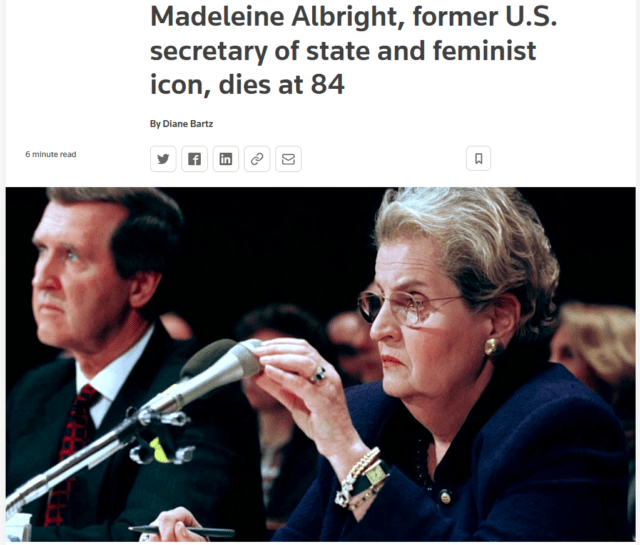
When Clinton-era Secretary of State Madeleine Albright died of cancer last month, a stream of fawning obituaries hailed her as a hero of NATO, a feminist icon and a “champion of human rights and diplomacy” (CNN, 3/24/22).
Most coverage failed to levy any criticism at all of Albright’s actions in government, despite her presiding over a critical turning point in the American Empire. For the foreign policy establishment, the ’90s under Albright solidified the US self-image as the “indispensable nation,” ready and able to impose its will on the world, a position with repercussions that still echo today. Instead of critically exploring this legacy, corporate media opted for celebration and mythmaking.
‘Icon’ and ‘trailblazer’
Some of the coverage focused on Albright as a “feminist icon” (Reuters, 3/23/22; USA Today, 3/23/22) breaking the glass ceiling. A commonly used term was “trailblazer” (e.g., NPR, 3/24/22; Washington Post, 3/23/22).
The New Yorker (3/24/22) declared, “Madeleine Albright Was the First ‘Most Powerful Woman’ in US History.” CNN (3/24/22) went as far as to call Albright an early progenitor of “feminist foreign policy.”
NPR (3/24/22) claimed that Albright “left a rich legacy for other women in public service to follow.” BuzzFeed (3/23/22) found time to discuss the meaning of the jewelry she wore when meeting foreign leaders.
There is nothing wrong with remarking on the significance of a woman taking charge in the historically male-dominated halls of US power. However, it is far more important to take a critical look at her policies, including whether they jibe with the tenets of feminism as generally understood—something few in the media chose to do.
Media fell into this same trap when praising Gina Haspel as the first female head of the CIA, or when they applauded the top military contractors for having female heads (FAIR.org, 6/28/20). Similarly, Albright’s violent legacy is being obscured by seemingly progressive language.
‘More children than died in Hiroshima’

Madeleine Albright telling 60 Minutes (5/12/96) that half a million dead children is a price worth paying.
One of the first things many progressives think of when they think of Albright is her championing of the sanctions against Iraq during the ’90s. In between the two US wars on Iraq, Albright presided over crushing sanctions aimed at turning the Iraqi population against the Ba’athist government. These sanctions cut off crucial supplies to the nation, starving its people. A UN survey found that the sanctions led to hundreds of thousands of dead Iraqi children.
When Albright was confronted with this figure in an interview with CBS‘s Leslie Stahl on 60 Minutes (5/12/96; Extra!, 11–12/01), Albright’s response was cold:
“We have heard that half a million children have died. I mean, that is more children than died in Hiroshima,” Stahl said. “And, you know, is the price worth it?”
“I think that is a very hard choice, but the price, we think, the price is worth it.”
The UN numbers have since been revised downward, but the unavoidable fact is that Albright accepted the number she was given, took willful responsibility for the deaths and concluded that they were “worth it” for the purpose of turning the Iraqi people against their government.
While so many Americans seem to have forgotten this shameful display, the rest of the world has not. Ahmed Twaij, an Iraqi writing in Al Jazeera (3/27/22), said that his “most prominent memory of Albright” was that notorious interview:
As an Iraqi, the memory of Albright will forever be tainted by the stringent sanctions she helped place on my country at a time when it was already devastated by years of war.
Despite its resonance around the world, the quote wasn’t even referenced in many of the retrospectives FAIR reviewed. USA Today (3/23/22) mentioned that Albright received “criticism” for calling the deaths “worth it,” and Newsweek (3/23/22, 3/25/22, 3/23/22) mentioned the quote in some of its coverage. But it went missing from the New York Times (3/23/22, 3/25/22), Washington Post (3/23/22), NBC.com (3/23/22), CNN.com (3/24/22, 3/26/22), New Yorker (3/24/22) and The Hill (3/24/22).
Guaranteed shootdown
Gen. Hugh Shelton, former chair of the Joint Chiefs of Staff, recounts in his book how Albright suggested to him that the US fly a plane over Iraqi airspace low enough to be shot down, thus giving the US an excuse to attack Saddam Hussein. Shelton recalls Albright’s words:
What we really need in order to go in and take out Saddam is a precipitous event—something that would make us look good in the eyes of the world. Could you have one of our U-2s fly low enough—and slow enough—so as to guarantee that Saddam could shoot it down?
Albright was quickly rebuffed, but she was later able to get her wish of war in Iraq. Her efforts culminated in the Iraq Liberation Act, signed in October 1998, which made seeking regime change in Iraq official US policy.
As the New York Times (3/23/22) mentioned in its obituary, Albright threatened the Ba’athist leader with bombing that year if he didn’t open the country to weapons inspectors. Even though Kofi Annan brokered an agreement on the inspectors, the US bombed anyway in December 1998.
The Times didn’t explore these events further—not mentioning that the administration justified the bombing using the debunked pretext of Saddam’s weapons of mass destruction—and instead continued ahead with its largely positive obituary.
Rewriting Yugoslav history
One of Albright’s most notable moments during her tenure as secretary of state was the 78-day bombing campaign in Yugoslavia in 1999. Today, the bombing is hailed as a major victory by the forces of democracy, and Albright’s role is cast in a positive light.
NPR’s three sentences (3/24/22) on the subject show the dominant version of the events:
As chief diplomat in the late ’90s, Albright confronted the deadly targeting of ethnic Albanians in Kosovo. Time magazine dubbed it Madeleine’s War. Airstrikes in 1999 eventually led to the withdrawal of Yugoslav forces.
Americans were told at the time that the war solidified the US as “an indispensable nation asserting its morality as well as its interests to assure stability, stop thugs and prevent human atrocities” (Time, 5/9/99). The Washington Post (3/23/22) seized on this myth, calling Albright “an ardent and effective advocate against mass atrocities.” In this story, she is a hero for mobilizing the timid American giant to use its military might on behalf of humanitarian and democratic ideals.
But the truth is that the bombing Albright advocated was motivated less by humanitarian concerns and more by the US goal of breaking up Yugoslavia and establishing a NATO-friendly client state via the Kosovo Liberation Army. Indeed, the US’s negotiating tactic with Serbian President Slobodan Milosevic was to offer the choice of either occupation by NATO or destruction. As a member of Albright’s negotiating team anonymously told reporters (Extra!, 7–8/99): “We intentionally set the bar too high for the Serbs to comply. They need some bombing, and that’s what they are going to get.”
Exacerbating bloodshed
One fact that quickly debunks the humanitarian pretext is that the US-led bombing greatly exacerbated the bloodshed. According to Foreign Affairs (9–10/99), 2,500 died during the preceding civil war, but “during the 11 weeks of bombardment, an estimated 10,000 people died violently in the province.” And while Albanian civilians bore the brunt of the violence during the NATO attacks, in the year preceding the bombing, British Defense Secretary George Robertson told the Parliament that the NATO-backed KLA “were responsible for more deaths in Kosovo than the Yugoslav authorities had been” (Monthly Review, 10/07).
As Edward Herman and David Peterson wrote in their detailed essay on Yugoslavia in the Monthly Review (10/07), the US and NATO were
key external factors in the initiation of ethnic cleansing, in keeping it going, and in working toward a violent resolution of the conflicts that would keep the United States and NATO relevant in Europe, and secure NATO’s dominant position in the Balkans.
The concern for ethnic minorities was merely a pretext offered to the American people, and lapped up wholeheartedly by a compliant mass media.
Along with liberal hawks like Samantha Power, Albright helped weaponize human rights and legitimize unsanctioned “humanitarian interventions” around the world. This showcase of unilateral and illegal violence has had direct repercussions around the world, paving the way for US interventions in Afghanistan, Iraq and Libya—to say nothing of the current Russian attack on Ukraine.
Promoting hawkish policy
Much of the coverage framed Albright’s Clinton-era career arc as one in which she repeatedly failed to get the US to play a larger role in advancing its ideals in the post-Cold War world. This fight included taking on international institutions that didn’t understand American exceptionalism.
Albright clashed with then–UN Secretary General Boutros Boutros-Ghali “as she advocated fiercely for US and democratic interests,” in the words of CBS (3/23/22). She and Boutros-Ghali butted heads over the US role in peacekeeping operations during crises in Rwanda, Somalia and Bosnia.
In the end, Albright dissented against the entire UN Security Council, using the US veto power to deny Boutros-Ghali a second term as secretary general. His ouster paved the way for the more US-friendly Kofi Annan, as the “Albright Doctrine” took center stage.
In its cover story on “Albright’s War,” Time (5/9/99) described the Albright doctrine as
a tough-talking, semimuscular interventionism that believes in using force—including limited force such as calibrated air power, if nothing heartier is possible—to back up a mix of strategic and moral objectives.
In other words, Albright advocated a policy of unilateral intervention instead of a global order based on international law and mutual obligations. The US could assert itself whenever and wherever it determined the “strategic and moral objectives” were of sufficient importance.
The diplomat was more blunt about the US chauvinism imbued in the doctrine when she spoke to NBC (2/19/98) in 1998:
If we have to use force, it is because we are America; we are the indispensable nation. We stand tall and we see further than other countries into the future.

A CNN op-ed (3/24/22) positively cited Albright’s comment to Colin Powell: “What’s the point of having this superb military you’re always talking about if we can’t use it?”
The media reflect positively on this mindset that “blended her profound moral values from her childhood experience in Europe with US strategic interests,” according to the New Yorker (3/24/22). Some suggested that this mindset should continue to animate American policy.
‘Albright was right’
CNN.com (3/24/22) published an opinion by Elmira Bayrasli that claimed, “The West would be wise to heed Madeleine Albright’s lessons on foreign policy.” She embraced Albright’s hawkish label, saying that “advocating the oppressed and actively upholding human rights… sometimes meant using the might of the American military.”
Hillary Clinton, whose “trailblazing” also obscured the deadly cost of her foreign policy initiatives, published a guest essay in the New York Times (3/25/22) under the headline “Madeleine Albright Warned Us, and She Was Right.” To Clinton, the world still needs Albright’s “clear-eyed view of a dangerous world, and her unstinting faith in… the unique power of the American idea.”
While some pieces were clear in calling her a hawk (e.g., Washington Post, 3/23/22), CNN (3/24/22) wrote, “It is a mistake to see Albright exclusively as a hawk,” because she sat on the board of the National Democratic Institute (NDI) and supported the activities of the US Agency for International Development (USAID). The Hill (3/24/22) also highlighted her support for these organizations, noting that for Albright, “democracy and human rights… were integral to American foreign policy.”
The NDI exists under the umbrella of the National Endowment for Democracy, a deceptively named organization that spends tens of millions of dollars annually promoting and installing US-friendly governments around the world. USAID has long been used as a front for intelligence and soft power initiatives. During Albright’s time in office, USAID was heavily involved in facilitating the further destruction of Haitian democracy, among a myriad of similar activities around the world.
These organizations have been well-documented as extensions of US power and bases for subversive activities, but this history is dismissed in favor of the government’s line that they are genuine conduits for democracy. The methods of empire have evolved, but the Albright coverage continues to obscure this fact. Regime change efforts can be recast as efforts to spread democracy around the world if the press refuses to scrutinize the official line.
NATO expansion
NATO expansion, a major initiative during Albright’s tenure, has come to the forefront of US discussion in recent months. The Russian invasion of Ukraine is in part a result of the decades-long expansion of the NATO military alliance, despite the warnings of US foreign policy veterans that the expansion was a “policy error of historic proportions.” (See FAIR.org, 3/4/22.)
In 1998, legendary diplomat George Kennan (New York Times, 5/2/98) called NATO expansion “a tragic mistake.” He predicted, “I think the Russians will gradually react quite adversely and it will affect their policies… and then [the NATO expanders] will say that we always told you that is how the Russians are.”
Kennan’s words have proven prophetic, but most articles on Albright’s passing wrote fondly of her role in NATO expansion and the accompanying anti-Russian politics. CNN.com (3/23/22), in an article headlined “Albright Predicted Putin’s Strategic Disaster in Ukraine,” declared that the former top diplomat “died just as the murderous historic forces that she had spent her career trying to quell are raging in Europe again.”
MSNBC.com (3/24/22) declared that “Madeleine Albright’s NATO Expansion Helped Keep Russia in Check.” Columnist Noah Rothman explained that “only the compelling deterrent power of counterforce stays the hand of land-hungry despots.”
The New Yorker (3/24/22) described NATO expansion as one of Albright’s “major achievements,” despite acknowledging that in the wake of the policy, “US interests are indeed threatened more than at any time in three decades by Russian aggression in Europe.”
Some pieces were more reflective. The Conversation (3/24/22) went into detail on her role in expanding NATO, acknowledging that “Albright’s curt dismissal of Russia’s security concerns might seem to have been ill-judged… in light of Russia’s invasion of Ukraine.”
A time for reflection
In the United States, political figures are merged with the culture of celebrity. Too many judge politicos by their force of personality or lines on their resume, rather than the material changes that occurred on their watch. The substantive history of US policymaking is rarely brought up, and political discussion remains surface-level and incomplete.
This celebrity culture is on full display whenever a venerated member of the Washington establishment passes away. We’ve seen similar soft media coverage after the deaths of George H.W. Bush (FAIR.org, 12/7/18), Colin Powell (FAIR.org, 10/28/21) and Donald Rumsfeld (FAIR.org, 7/2/21).
By now, the idea of the United States as the global policeman has been discredited enough to warrant at least some pushback in the corporate press. The passing of one of America’s leading interventionists should be a time for reflection. How did this person’s policies contribute to what is going on now?
Instead, the media decided to use Albright’s death to reinforce the myths and legitimize the policies that have led to so much destruction around the world.
US troops injured after base was sabotaged with planted explosives
By Kelley Beaucar Vlahos | Responsible Statecraft | April 16, 2022
Why do we still have American troops in Syria and Iraq? That is the million dollar question that the Biden Administration has yet to answer — at least with any satisfaction — for the American people. Meanwhile, our service members continue to be targets of hostile forces for a Washington strategy no one can quite articulate.
On April 7 there were reports of “two rounds of indirect fire” on the Green Village Base in eastern Syria, which is housing U.S. troops as part of Operation Inherent Resolve. U.S. Central Command said four American service members were being evaluated for traumatic brain injury as a result.
On Thursday, however, U.S. Central Command quietly announced that there were no rockets, but “but rather the deliberate placement of explosive charges by an unidentified individual(s) at an ammunition holding area and shower facility.”
The release was brief and with no accompanying details, but the words echoed of the kind of Green-on-Blue attacks against coalition troops in Afghanistan during the height of the war there. As of 2017, according to counts, there had been more than 95 such attacks since 2012, killing 152 coalition service members and injuring 200.
There have been numerous rocket attacks against bases on which foreign soldiers, mostly Americans, are serving in Syria and Northern Iraq over the last two years. “Iranian backed militias” have been fingered in the attacks and they don’t seem to be abating, though the administration never uses the incidents to explain or even justify why our presence continues to be useful there. Is it to stave off ISIS? Bashar Assad? Iranian militias?
“The United States has no compelling national security interest in Syria to justify an open-ended ground deployment of forces,” wrote Defense Priorities’ Natalie Armbruster in March, taking on each of the existing arguments for keeping forces in the region. Now that our troops can’t even feel safe taking showers on base, isn’t it time to get a straight answer from Washington?
Missile strike on Mossad centers in northern Iraq aimed at defending Iran’s security: Ambassador
Press TV – March 14, 2022
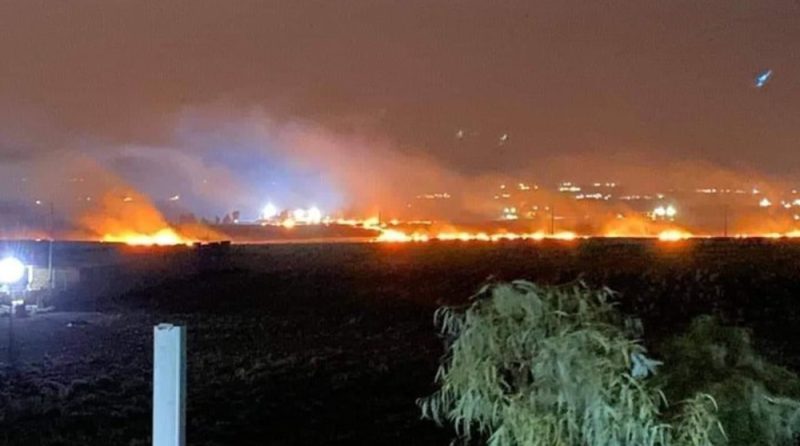
The Iranian ambassador to Iraq says the latest missile strike by the Islamic Revolution Guards Corps (IRGC) on secret bases of the Israeli Mossad spy agency in the semi-autonomous Kurdistan region was strictly necessary, as operations against Iran’s security were being plotted and orchestrated there.
Iraj Masjedi made the remarks while addressing an international conference in Iraq’s holy city of Karbala on Monday.
The Iranian diplomat said Israeli operatives used the Iraqi Kurdistan region to plot and launch operations against Iran’s security, emphasizing that Iranian officials had time and again warned the Kurdistan Regional Government (KRG)’s authorities against their activities, but to no avail.
Masjedi highlighted that the missile attack was carried out in order to safeguard Iran’s security, “and was neither intended to violate Iraq’s sovereignty nor was meant to insult the Arab country and its nation.”
“We expect you to force Israelis out of Iraqi soil and get rid of them,” Masjedi addressed Kurdish officials, adding, “However, if they are not expelled, will we stand by with our hands tied behind us to [allow them] carry out operations against our security? Definitely not.”
The Iranian ambassador emphasized that the attack was aimed at Israel’s training centers and did not target the United States or the Iraqi government.
“Some media outlets have asserted that we targeted the US consulate. I’m surprised by such allegations. It is true that a conflict has been going on between us and the United States for forty years, but the recent operation was not against them. It was an operation against an Israeli base, where plots against our security were being hatched,” Masjedi said.
A dozen ballistic missiles hit secret Mossad bases in the northern Iraqi city of Erbil, reportedly leaving several Israeli operatives dead.
Citing security sources, Iraq’s Sabereen News reported that two Mossad training centers were targeted by ballistic missiles in the early hours of Sunday.
Al-Mayadeen television news network said a Mossad base on the Masif-Saladin Street in Erbil was “fully razed to the ground and a number of Israeli mercenaries were killed or injured.”
In a statement issued earlier on Sunday, the IRGC indicated that the operation was in response to an Israeli airstrike on the Syrian capital of Damascus last Monday, in which two IRGC officers were killed. The IRGC identified the two slain officers as colonels Ehsan Karbalaipour and Morteza Saeidnejad, warning that Israel would “pay for this crime.”
Featured Video

Chinese jet fuel and the myth of energy independence
or go to
Aletho News Archives – Video-Images
Book Review
Former Insiders Criticize Iran Policy as U.S. Hegemony
By GARETH PORTER | CounterPunch | February 27, 2013
“Going to Tehran” arguably represents the most important work on the subject of U.S.-Iran relations to be published thus far.
Flynt Leverett and Hillary Mann Leverett tackle not only U.S. policy toward Iran but the broader context of Middle East policy with a systematic analytical perspective informed by personal experience, as well as very extensive documentation.
More importantly, however, their exposé required a degree of courage that may be unparalleled in the writing of former U.S. national security officials about issues on which they worked. They have chosen not just to criticise U.S. policy toward Iran but to analyse that policy as a problem of U.S. hegemony. … continue
Blog Roll
 Aletho News
- What is fueling unrest across the EU?
- Why no power can undermine Iran’s eternal dominance over the Strait of Hormuz
- Is The War Against Iran Over?
- Iran war will leave long-term ‘scar’ on Wall Street, investors warn
- How Iran decimated US power projection in West Asia: Military lessons of 40-day war
- Iran’s report details US-Israeli war crimes in targeting schools, hospitals, livelihoods
- NATO’s Slow Fracture: How Trump’s Iran War Exposed the Instrument of Hegemony
- Chinese jet fuel and the myth of energy independence
- Ukraine Sea Drone Fired From Libya Hit Russian Tanker in Mediterranean
- IRGC: Iranian forces launched no attacks during ceasefire hours
- If Americans Knew
- Military aid to Israel emerges as the latest political litmus test for Democrats
- The only Palestinian children’s rights organization closes following years-long Israeli campaign against it
- ‘I Can’t Forget the Smell’: Lebanese Reel After Israel Kills Over 300 in Single Day
- DNC Shoots Down Resolutions Calling Out AIPAC and Limiting Arms to Israel
- TCN: Is Israel Blackmailing President Trump?
- Israel killed at least 303 Lebanese yesterday – who were they? Daily Update
- Amnesty: Urgent – Protect Lebanese civilians from brutal escalation in Israeli attacks
- Is The War Against Iran Over?
- Inside the Israeli army’s propaganda wing
- Hundreds of Gaza Amputees Stranded in Legal Limbo
- No Tricks Zone
- An Inconvenient Tree: Uncovered In Alps… Europe Much Warmer Than Today 6000 Years Ago
- New Study Reports A 60% Slowdown In Greenland’s Ice Loss Rate In The Last Decade
- Low Intensity Tornado Wrecks Major Solar Farm, Creating A Potential Toxic Dump
- New Study Finds Warming Saves Lives…Cold Temperatures 12 Times More Deadly Than Excess Heat
- German Science Blog Accuses PIK Climate Institute Of Hallucinating Climate Tipping Points
- Devastating Assessment Of Comirnaty Vaccine By Former Senior Pfizer Europe Toxicologist
- New Study: CO2 Is ‘Effectively Negligible’ As An Explanatory Climate Change Factor Since 2000
- Former Pfizer Toxicologist Dr. Helmut Sterz Tells Bundestag Hearing Pfizer Vaccine Should Have Never Been Approved
- Energy Expert: Germany’s Nuclear Phaseout Was A “500 Billion Euro Mistake”
- New Research: South Australia’s Mid-Holocene Sea Surface Temperatures Were 4°C Warmer Than Today
 Aletho News