US ‘empire of lies’ should be investigated – top Russian MP
RT | February 5, 2023
The UN should open an investigation into Washington’s crimes against humanity, Russian State Duma Speaker Vyacheslav Volodin suggested on Sunday.
Writing on Telegram on the 20th anniversary of the infamous 2003 speech by then-US Secretary of State Colin Powell at the UN Security Council, during which he justified the ill-fated invasion of Iraq, Volodin offered a scathing criticism of what he described as the American “empire of lies.”
According to the speaker of the lower house of Russia’s parliament, this date marks “one of the biggest deceptions of the global community by the United States.” He recalled that during the landmark Security Council meeting Powell “accused Iraq of producing weapons of mass destruction, providing a vial with ‘white powder’ as proof.” At the time, the US secretary of state said the vial could be used to store anthrax.
While the UN did not approve the Iraq invasion, the US attacked the country anyway, he added. “Half a million civilians fell victims, the president was executed, the country was gone,” Volodin wrote, pointing out that Powell later admitted that the vial stunt was “a hoax,” but Washington was never held to account.
“All policies of the United States and the collective West are based on lies,” the Duma speaker stressed.
He noted that the same applied to NATO’s promises not to expand eastwards after the collapse of the Soviet Union and the Eastern bloc, as well as to the 2014 and 2015 Minsk Agreements. The latter were signed by Russia, Ukraine, France, and Germany in a bid to pave the way for peace in Ukraine by granting the Donetsk and Lugansk People’s Republics special status within the Ukrainian state.
These accords “also turned out to be a deception – but [former German Chancellor Angela] Merkel and [former French President Francois] Hollande acted as Powell did”, Volodin said. He was referring to the bombshell confessions by the two ex-leaders, who admitted in December that the Minsk Agreements were simply meant “to give Ukraine time” to strengthen its army.
“The UN should investigate Washington’s crimes against humanity. And the decision-makers should be punished for the millions of victims, refugees, broken destinies, destroyed states,” Volodin added.
MbS urged Baghdad to set up Iran-Saudi meeting: Iraqi FM
The Cradle | January 31, 2023
As part of a diplomatic process aimed at mending strained relations between the two neighbors, Saudi Crown Prince Mohammed bin Salman (MbS) reportedly pressured senior Iraqi officials to set up a face-to-face meeting between the top diplomats of Riyadh and Tehran. This was revealed by the Iraqi Foreign Minister, Fuad Hussein, on 30 January.
In an interview with Rudaw TV on 29 January, the Iraqi Foreign Minister said that “Prince Faisal bin Farhan Al Saud and Hossein Amir-Abdollahian, the foreign ministers of Saudi Arabia and Iran, will meet in Baghdad, at the request of Mohammed bin Salman. The event is still planned, and the time and date will be announced later.”
He also said that the Iranian and Saudi foreign ministers would meet in public and that Iraq would act as a middleman to ensure that the details of the private conversations were made public.
The Saudi diplomat stated earlier this month that his nation has spoken with Iran and is looking for a way to open a dialogue between the two.
In an effort to improve their bilateral relations, the two sides began negotiations in the spring of 2021 and held five rounds of talks in the Iraqi capital. However, Tehran suspended the negotiations after Riyadh executed 81 people under the pretext of being involved in “terrorism,” the majority of which were minority Shia Muslims.
Relations have recently become tenser due to Saudi Arabia’s alleged sponsorship of the protests in Iran in late 2022.
Iran’s Intelligence Minister, Esmail Khatib, was quoted by Iranian media as saying it is running out of patience and will no longer tolerate intervention, hostility, and incitement in a direct message to Saudi Arabia.
Meanwhile, in November, Iran sent an official warning message to the kingdom through diplomatic channels, confirming that it is fully aware of “the Saudi connection to Iran International.” Riyadh categorically denied this, saying it has “nothing to do with the outlet.”
US renews waiver for gas field shared by Iran and UK
Press TV – January 24, 2023
The US government has renewed a sanctions waiver for the Rhum gas field in the UK North Sea in which Iran has a 50% stake.
Iran is heavily sanctioned by the United States, but Britain’s Serica Energy which owns another 50% of the field has repeatedly secured waivers to maintain production from the field.
In a statement, Serica said it had secured another waiver extension that ensures that all companies linked to the field can provide services and goods without fear of US penalties.
“We are grateful to the UK government and regulatory authorities who have supported us in this process,” Serica Chief Executive Mitch Flegg was quoted as saying.
Serica Energy is responsible for 5% of the gas produced in the UK which is currently in turmoil over runaway prices of energy in the wake of the Ukraine war.
The UK firm expects its net production to increase by between 50 and 80 percent this year and that level of production to continue into 2025.
This would mean that the company would be producing up to 40,000 barrels of oil equivalent per day, reports said.
Rhum, a gas filed located 240 miles (390 km) northeast of Aberdeen in Scotland, is one of the largest on the UK Continental Shelf.
Iran owns half of the stakes at the gas field based on a deal signed before the Islamic Revolution of 1979. The field is believed to be capable of producing more than five million cubic meters of natural gas.
Washington has imposed a series of harsh sanctions on Iran’s energy sector since 2018 when it pulled out of an international nuclear deal.
Pressure hardening
The Biden administration, however, is hardening its position. The Iraqi government is reportedly under immense pressure from Washington to stem the alleged flow of dollars into Iran.
In recent weeks, Iraq’s currency market has been wracked by turmoil after the US introduced tighter controls on international dollar transactions by commercial Iraqi banks in November.
Reports said the move was designed to curb the alleged siphoning of dollars to Iran and apply more pressure along with US sanctions imposed on the Islamic Republic.
Iraqi MP Aqeel al-Fatlawi, however, said Washington was deliberately using the new regulations as a political weapon.
“Americans are using the dollar transfer rigid restrictions as warning messages to Prime Minister Sudani to stay tuned with the American interests. ‘Working against us could lead to bringing down your government’ – this is the American message,” the lawmaker said.
The price of consumer goods has increased and the Iraqi currency has taken a beating in the wake of the US restrictions.
And it has deepened anti-American sentiment among politicians in Iraq, which remains unstable nearly 20 years after a US-led invasion toppled Saddam Hussein.
The US is also targeting Iran’s other major trade partners. On Monday, the Biden administration’s top Iran envoy said it will increase pressure on China to cease imports of Iranian oil.
China is the main destination of exports by Iran, and talks to dissuade Beijing from the purchases are “going to be intensified,” US Special Envoy for Iran Robert Malley told Bloomberg Television.
The US reimposed sanctions on the Islamic Republic and its petroleum exports in 2018 after pulling out of the nuclear agreement, with then president Donald Trump pledging that Washington was set to bring Iran’s oil exports down to zero.
That goal never realized, with Iranian sales continuing to reach the market despite the US “maximum pressure” to curb them.
“We have not lessened any of our sanctions against Iran and in particular regards to Iran’s sale of oil,” Malley said.
Iranian crude shipments have surged in recent months, including to China, the world’s biggest importer.
Malley said the US will “take steps that we need to take in order to stop the export of Iranian oil and deter countries from buying it”.
Why Arabs Bolster Energy & Security Cooperation With Russia in Defiance of Western Sanctions
By Ekaterina Blinova – Samizdat – 19.01.2023
Arab countries have not joined the anti-Russian sanctions, despite pressure from the West, as Russian Foreign Minister Sergey Lavrov stressed during his press conference this week. What’s behind the Arab world’s resilience?
“The policy of the West in the East has gone bankrupt,” political analyst Vladimir Ahmedov told Sputnik.
“[Middle Eastern players’] trust in the United States, the leading western European states – the former colonizers who had colonies in this region – has already been largely lost,” the specialist in the modern history of Arab countries and senior research fellow at the Institute of Oriental Studies of the Russian Academy of Sciences continued.
New major players have entered the global arena: China, India, Iran, Turkey, Egypt, and Saudi Arabia, the scholar emphasized.
Ahmedov believes that the sanctions imposed against Russia are dictated by purely political considerations of a narrow circle of the western political elite. Meanwhile, the system of international relations and the world order has been undergoing changes, and the indirect proof of this is the position taken by the Arab countries, according to him.
“Russia’s policy in the East at the present time, and Russia’s policy in the world in general, has changed in comparison with the 1990s and the beginning of the 2000s,” the researcher continued. “Now it is a resolute policy aimed at defending [Russia’s] national state interests and the national interests of third countries. It impresses the countries of the East and, above all, the countries of the Middle East, which have been waiting for such a policy for a long time. This policy is in great demand in the East and therefore it meets with approval and understanding.”
In light of this, Russia’s efforts to mediate the Israeli-Palestine conflict as well as those in Syria and Iraq – mentioned by Lavrov during his Wednesday presser – are steps in the right direction, according to the scholar. In addition, Russia’s military presence in Syria serves as a stabilizing factor, he added.
Meanwhile, the West’s Ukraine strategy looks like nothing so much as its previous Middle Eastern policies. The West is using Ukrainians much in exactly the same way it previously used Arabs in order to reach its geopolitical objectives, and Middle Eastern players are well-aware of that, according to the researcher.
“Russia is not fighting against Ukraine or the fraternal Ukrainian people, but against the West, which wants to dismember Russia, belittle its role, minimize it, and so on,” Ahmedov said. “And [the Western policy] does not meet with any approval from the political elites of the East, who themselves suffered from it previously.”
Opportunities in the Middle East and North Africa
“The region of the Middle East and the Arab world in general is of tremendous importance in the world system in terms of geography, demography, a powerful energy market, the world’s oil and gas pantry and as a very important transport artery. Therefore the attention to this region will only grow,” Ahmedov emphasized.
The region develops its position by becoming an influential energy actor, echoed Ramy El Kalyouby, a visiting lecturer at the School of Orientalism of the National Research University Higher School of Economics (HSE).
“Gulf countries profited a lot from oil prices increase, and at some moment the Kingdom of Saudi Arabia’s oil revenues jumped to more than $1 billion daily,” El Kalyouby told Sputnik. “Egypt is also getting its chance to become an important gas supplier to the EU after discovering a few huge fields in the Mediterranean.
The academic singled out Egypt, the world’s biggest wheat importer. According to El Kalyouby, Russia can help Cairo replace a deficit of Ukrainian wheat, open its markets for Egyptian fruits and vegetables, and provide more tourists.
“There is also a project of a Russian industrial zone in Egypt that would help Russia to get around sanctions by changing the origin of products, and also to profit from the African Union free trade zone,” the lecturer highlighted.
Last year, the construction of Egypt’s first nuclear power plant was launched on July 20 in El Dabaa, Matrouh Governorate, by Russia’s State Atomic Energy Corporation Rosatom.
The El Dabaa NPP is meant to be the cornerstone of Egypt’s energy diversification policy, allowing Cairo not only to cover its own electricity needs, but also to provide energy to its neighbors. On November 19, the main construction phase for Unit 2 of the NPP began in the northern African country.
“Gulf countries could cooperate with Russia in the regulation of the oil market, although this becomes more difficult, as Russia provides important reductions on Urals oil,” El Kalyouby continued, adding that “Russia also remains a key actor in Syria as a mediator between Damascus and Ankara.”
Regional Security
Nonetheless, the Middle East and Northern Africa (MENA) region is continuing to suffer from local conflicts stemming from the bitter consequences of the Arab Spring, according to Ahmedov. The scientist noted that the reformatting of political systems of these countries is still going on while the common regional security system has not been formed yet.
Russia shares the same “geopolitical space” with the countries of the region and its objectives there include not only maintaining working ties with Middle Eastern players but also to protect its “soft underbelly” from extremist and terrorist elements reinvigorated by the Arab Spring havoc, the researcher explained.
In addition, Russia’s experience as a power broker in the region could come in handy for the West, since the latter has proven incapable of solving regional conflicts on its own, continued the scientist. According to him, European countries have no other alternative but to deal with Russia in the Middle East in the future if they want to ensure their security in the Mediterranean and Southern Europe.
Ahmedov noted that while Moscow cannot ensure a complete comprehensive settlement and stabilization of the situation in the Middle East, it can help regional players reach these goals.
“Russia can make a certain contribution to ensuring the system of regional security with the participation of other states,” he said. “We have excellent relations with Iran. And in this regard, of course, the Arab countries are interested in Russia in terms of softening the Iranian policy towards the Arab countries, which causes concern today in the Arab world. We have excellent relations with Turkey, which also plays a very important role as a major regional actor or player in this region, just like Iran. And therefore, in this case, we have a lot of advantages that we can realize. We have long-standing ties with Palestine since Soviet times. And therefore, in this case, we have a lot of advantages that we can realize.”
Russia has a long and successful record of work in the region, according to the scientist: in the 1960-1980s the USSR provided the primary industrialization of many MENA countries, including Iraq, Syria, Egypt, Algeria, Sudan, and Yemen. While developing ties with the region, Russia can build upon its expertise and best practices of the past, Ahmedov concluded.
Unidentified drone bypasses US security at Ain al-Assad base
The Cradle | January 9, 2023
According to Iraqi media reports, US defense systems at the Ain al-Assad military base in Iraq’s western Anbar province brought down an unidentified drone that was able to bypass the facility’s security and reach “inaccessible” areas of the base.
An anonymous military source was quoted by Iraq’s Al-Maalouma news agency as saying that on 8 January, an unmanned aerial vehicle (UAV) managed to make its way through all of the base’s security rings and enter areas that are “off-limits,” before finally being shut down “with electronic systems.”
The US army is usually able to target any ‘suspicious’ aircraft before it makes its way to the first security ring, the source stated.
“The drone reached very important parts of the Ain al-Assad base, and this was the first time that this happens … The American military has not released the details of the incident because the drone passed through the missile defense systems of the Ain al-Assad base and threatened the dormitories and sanatoriums of the soldiers,” it added.
The Iraqi news agency said that it was unclear whether or not the drone was on a surveillance mission, or if it was carrying any explosives. No explosions, damages, or casualties were reported. An investigation into the incident has reportedly been opened, the agency added without elaborating further.
Five days after an illegal US drone strike on 3 January 2020 killed Quds Force Commander Qassem Soleimani, and Iraqi Popular Mobilization Units (PMU) chief, Abu Mahdi al-Muhandis, Tehran responded by showering the Ain al-Assad military base with a barrage of missiles.
The US military denied any casualties, but the Pentagon reported that over 100 US military personnel suffered traumatic brain injuries following the strike. The facility also sustained heavy material damages.
Unbeknownst to many, however, Iran responded to Soleimani’s killing with more than just an attack on Ain al-Assad. In 2021, an anonymous, high-ranking security official within the Resistance Axis told The Cradle that two senior officers, one in the US army and another in the Israeli army, were killed in a resistance operation in Iraq’s Erbil – which was carried out to avenge the illegal assassination.
Lt. Col. James C. Willis, who was involved in the Soleimani assassination and was killed in Erbil, was reported by the Pentagon – in a blatant coverup – to have died “in a non-combat incident at Qatar’s Al-Udeid base.” The Israeli, Col. Sharon Asman, was also killed in the operation and was reported to have suffered from heart failure.
Since Iran’s missile attack on Ain al-Assad, the facility has come under attack several times. Other US bases in Iraq have also been struck, and this year, attacks against US bases in Syria are increasing in frequency and intensity.
On 5 January 2020, Lebanese resistance leader, Hassan Nasrallah, vowed: “The response to the blood of Qassem Soleimani and Abu Mahdi al-Muhandis will be the expulsion of all US forces from the region.”
US assassination of Gen. Soleimani, PMU deputy chief ‘brazen attack’ on Iraq’s sovereignty: PM
Press TV – January 6, 2023
Iraqi Prime Minister Mohammed Shia’ al-Sudani has paid tribute to top Iranian anti-terror commander General Qassem Soleimani and his Iraqi trenchmate Abu Mahdi al-Muhandis, who were killed in a US drone strike near Baghdad airport three years ago, stating that their targeted killings were actually “a brazen attack” on Iraq’s sovereignty.
“The crime of assassinating the ‘Commanders of Victory’ and their companions represented a flagrant violation of Iraq’s territorial integrity and national sovereignty. The targeted killings of the commanders, who had a leading role in elimination of the scourge of terrorism, is an utter disrespect to bilateral agreements [signed between Baghdad and Washington],” Sudani said at a Thursday ceremony in the capital Baghdad in commemoration of the two legendary commanders.
“We woke up on January 3, 2020 to hear the terrible news about assassination of Abu Mahdi al-Muhandis, the second-in-command of the Popular Mobilization Units (PMU), and Gen. Qassem Soleimani, who was on an official visit to Iraq,” he added.
The Iraqi prime minister went on to denounce the administration of former US president Donald Trump over its brazen attack on Iraq’s territorial integrity and sovereignty.
“The fight against dark terrorism requires power and resilience, and this came through the national spirit of all Iraqis and the fatwa (religious edict) issued by Iraq’s leading religious authority [Grand Ayatollah Ali al-Sistani],” Sudani pointed out.
He highlighted that his government is working to build a solid foundation for Iraqi sovereignty, is independent in decision-making, forges relations on the basis of common interests, safeguards the sovereignty of the country’s soil and territorial waters, and spares no effort to repel any act of aggression against the Iraqi nation and its guests.
Moreover, Chairman of the Iraqi Supreme Judicial Council Faiq Zidane decried the assassination of Muhandis and Gen. Soleimani as “a vile and cowardly act.”
He underscored that the Iraqi Judiciary bears the responsibility to shed light on all circumstances surrounding the US assassination, calling on the country’s security institutions to provide judicial authorities with all necessary documents and findings in this regard.
‘Iraq judicial chief highlights arrest warrant for Trump’
Zidan went on to note that Iraq’s Supreme Judicial Council has issued an arrest warrant for former US president Donald Trump over the assassination of General Soleimani and the PMU deputy chief.
The council’s president said that Trump has confessed to his “crime” in relation to the assassination of the “Leaders of Victory.”
He called upon all Iraqi officials involved in investigations over the targeted killings to try their utmost, and identify all related architects, organizers and culprits.
Chairman of Hashd al-Sha’abi Falih al-Fayyadh also stated that Muhandis devoted his life for the protection of Iraq, and the ‘Commanders of Victory’ fought enemies when the country was behest with its worst problems.
General Soleimani, commander of the Quds Force of Iran’s Islamic Revolution Guards Corps (IRGC), Muhandis, and their companions were assassinated in a US drone strike authorized by Trump near Baghdad International Airport on January 3, 2020.
Two days after the attack, Iraqi lawmakers approved a bill that required the government to end the presence of all foreign military forces led by the US in the country.
Both commanders were highly revered across the Middle East because of their key role in fighting the Daesh Takfiri terrorist group in the region, particularly in Iraq and Syria.
On January 8, 2020, the IRGC targeted the US-run Ain al-Asad base in Iraq’s western province of Anbar with a wave of missile attacks in retaliation for the assassination of Gen. Soleimani.
According to the Pentagon, more than 100 American forces suffered “traumatic brain injuries” during the counterstrike on the base. The IRGC, however, says Washington uses the term to mask the number of the Americans who perished during the retaliation.
Iran has described the missile attack on Ain al-Assad as a “first slap”.
Foreign Ministry: Assassination of Gen. Soleimani by US, ‘glaring example of an organized terrorist act’
Press TV – January 2, 2023
Iran’s Foreign Ministry says the assassination of the country’s top anti-terror commander Lt. Gen. Qassem Soleimani by the United States is a “glaring example of an organized terrorist act.”
The ministry made the remark in a Monday statement, issued to mark the third anniversary of the assassination of Gen. Soleimani and his companions on the direct order of then US President Donald Trump.
“Indubitable as it is, the criminal act of assassinating General Soleimani, designed and executed by the United States, constitutes yet another glaring example of an ‘organized terrorist act’,” the statement said.
It added that based on legal and international regulations, “the American regime bears ‘definite international responsibility’ for this crime, noting that all the agents, instigators, perpetrators, aiders and abettors of this terrorist crime bear responsibility.
“In this regard, the Ministry of Foreign Affairs, in conjunction with the Judiciary of the Islamic Republic of Iran and other agencies, has adopted, from the very outset, a number of measures premised upon the legal principle of ‘combating impunity of crimes’ in order to hold the above-mentioned to account and bring them to justice,” it added.
The ministry noted that the Joint Judicial Committee between Iran and Iraq also continues its work to follow up on the US act of terrorism.
Elsewhere in the statement, the ministry said that in cooperation with other relevant institutions, it has “set up the Special Committee on Legal and International Follow-up of the Assassination Case of General Soleimani and His Companions.”
“Ever since its establishment, the Committee has been investigating and pursuing the legal aspects of the case and has thus far taken several measures to press the issue at all domestic, bilateral, regional and international levels. The Committee is determined to proceed in all seriousness until its objectives are fully met and the international responsibility of the American government is invoked,” it noted.
“In line with its principled policies to counter terrorism and extremism, the Islamic Republic of Iran will continue to work towards the establishment of peace and stability at the regional and international levels. And although the martyrdom of General Qassem Soleimani is too great a loss for Iran and Iranians, it will by no means prevent the Islamic Republic of Iran from pursuing its lofty goals,” the statement said.
General Soleimani, commander of the Quds Force of Iran’s Islamic Revolution Guards Corps (IRGC), and his Iraqi trenchmate Abu Mahdi al-Muhandis, the second-in-command of Iraq’s Popular Mobilization Units (PMU), were martyred along with their companions in a US drone strike on January 3, 2020.
The two anti-terror commanders were tremendously respected and admired across the region for their instrumental role in fighting and decimating the Daesh Takfiri terrorist group in the region, particularly in Iraq and Syria.
Abbas Ali Kadkhodaei, who heads a special committee formed to follow up on General Soleimani’s murder case from legal and international aspects, on Saturday said Tehran is seriously pursuing a judicial process to serve justice in the case of Soleimani’s assassination, stressing that the indictment in the case is nearing its final stages.
Iran, Syria, Yemen: Twitter’s collaboration with the US military in information warfare
The damning exposure of collusion between the Pentagon and Twitter raises further suspicions about Washington’s ongoing online operations in West Asia

By Kit Klarenberg | The Cradle | December 27, 2022
The Cradle has previously deconstructed the Pentagon’s online bot and troll operations targeting Iran. These wide-ranging efforts, over many years, sought to destabilize the Iranian government by disseminating and inciting negative sentiment against it, on a variety of social media platforms.
Their exposure led to the White House demanding an internal audit of all Department of Defense (DoD) “psychological operations online.” Ostensibly, this was triggered by high-level concerns that Washington’s “moral high ground” was potentially compromised by the “manipulation of audiences overseas.”
The audit was revealed in a Washington Post article, the details of which pointed to a very different rationale. One passage noted that representatives of Facebook and Twitter directly informed the Pentagon, repeatedly, over several years, that its psychological warfare efforts on their platforms had been detected and identified as such.
Weaponizing social media
Frustratingly, the focus wasn’t even that these operations were being conducted in the first place, but that the Pentagon got busted doing so.
For example, Facebook’s Director of Global Threat Disruption, David Agranovich, who spent six years at the Pentagon before serving as the US National Security Council’s Director for Intelligence, reportedly reached out to the DoD in the summer of 2020, warning his former colleagues that “if Facebook could sniff them out, so could US adversaries.”
“His point was, ‘Guys, you got caught. That’s a problem,’” an individual “familiar with the conversation” told the Washington Post.
The obvious takeout from this excerpt – unnoticed by any mainstream journalist at the time – was that Facebook and Twitter staffers actively welcome their platforms being weaponized in information warfare campaigns, as long as it’s the US intelligence community doing it, and they don’t get caught in flagrante.
Moreover, in the event they are compromised, those same social network luminaries readily provide intimate insight on how US spooks can improve their operational security, and better conceal their activities from foreign enemies. Unmentioned is that these “foes” include tens of millions of ordinary people who are the ultimate target of such malign initiatives, of which residents of West Asia are preponderant victims.
‘Whitelisting’
Internal emails and documents from Twitter, published by journalist Lee Fang, have now confirmed that Twitter executives not only approved of the Pentagon’s network of troll and bot accounts, but also provided significant internal protection for them through “whitelisting.”
This practice allowed these ‘superpower accounts’ to operate with impunity, despite breaking numerous platform rules and behaving egregiously. The “whitelist” status also effectively granted these accounts the algorithmic and amplificatory privileges of Twitter verification without a “blue check.”
As The Cradle previously reported, these accounts over many years sought to influence perceptions and behavior across West Asia, in particular Iran, Iraq, Syria, and Yemen. In many cases, users had “deepfake” profile photos – mocked up pictures of realistic human faces generated by artificial intelligence.
Target: West Asia
In respect to Twitter-enabled activities against Tehran, multiple different personae were formed to attack the Iranian government from different ideological and political positions. These were not your standard ‘opposition’ accounts – the ops were more sophisticated. Some posed as ultra-conservative Shia Muslims critical of the administration’s “liberal” policies; others as progressive radicals condemning the extent of the Republic’s enforcement of Islamic code.
Many users amplified Washington’s disinformation, disseminated by US government-funded Voice of America’s Farsi-language service, among a myriad of other US funded and directed propaganda platforms. All along, Twitter higher-ups were aware of these accounts, but did not shut them down and even protected them.
The impact of the collaboration between Twitter and the Pentagon on the tweets that users around the world saw and did not see is unknown, but likely significant. Twitter staff were aware of what they were doing.
For example, in July 2017, an official from the Pentagon’s central command for West Asia and North Africa (CENTCOM) emailed the social media network to request the “blue check” verification of one account and the “whitelisting” of 52 accounts that “we use to amplify certain messages.”
The official was concerned that some of these accounts, “a few” of which “had built a real following,” were no longer “indexing on hashtags.” He moreover requested “priority service” for several accounts, including the since-deleted @YemenCurrent, which broadcast announcements about US drone strikes in Yemen. The account emphasized how “accurate” these attacks were; that they only killed dangerous terrorists, never civilians – a hallmark of US drone war propaganda.
Of course, US drone strikes are anything but precise. In fact, declassified Pentagon documents indicate there was “an institutional acceptance of an inevitable collateral toll,” and that innocent people were killed indiscriminately.
In 2014, it was calculated that, in attempting to slay 41 specific, named individuals, Washington had murdered 1,147 people, among them many children – a rate of 28 deaths for every person targeted.
‘Misleading, deceptive, and spammy’
In June 2020, Twitter spokesperson Nick Pickles testified to the US House Intelligence Committee on the company’s determined efforts to end any and all “coordinated platform manipulation efforts” on the part of hostile enemy states, stating these efforts were his employer’s “top priority.”
“Our goal is to remove bad faith actors and to advance public understanding of these critical topics. Twitter defines state-backed information operations as coordinated platform manipulation efforts that can be attributed with a high degree of confidence to state-affiliated actors,” he declared.
“State-backed information operations are typically associated with misleading, deceptive, and spammy behavior. These behaviors differentiate coordinated manipulative behavior from legitimate speech on behalf of individuals and political parties.”
The following month, however, Twitter executives were invited by the Pentagon to attend classified briefings in a sensitive compartmented information facility (SCIF) to discuss the defense of the Pentagon’s “coordinated and manipulative” social media activities.
Then-Twitter lawyer Stacia Cardille noted in an internal email the Pentagon may be seeking to retroactively classify its malign online activities “to obfuscate their activity in this space, and this may represent an overclassification to avoid embarrassment.”
Jim Baker, then-deputy general counsel of Twitter and an FBI veteran, subsequently noted that the DoD had employed “poor tradecraft” in setting up numerous Twitter accounts, and was now covering its tracks in order to prevent anyone finding out multiple users “are linked to each other” or to the US government, one way or another.
“DoD might want to give us a timetable for shutting them down in a more prolonged way that will not compromise any ongoing operations or reveal their connections to DoD,” he speculated.
Free speech absolutism
So it was the compromised accounts that were permitted to stay active, spreading disinformation and distorting the public mind all the while. Some even remain extant to this day.
To say the least, Twitter executives were well-aware that their eager and enthusiastic support of Pentagon psyops would not be received well if publicized. Shortly before the September Washington Post report on the DoD’s audit of these efforts, Twitter lawyers and lobbyists were alerted by a company communications executive about the forthcoming exposé.
After the Post story was published, Twitter staffers congratulated themselves and each other over how effectively the company concealed its role in covering up CENTCOM’s deeds, with one communications official thanking a welter of executives “for doing all that you could to manage this one,” noting with relief the story “didn’t seem to get too much traction.”
Were it not for the series of #TwitterFiles disclosures since Elon Musk controversially took over the company, these dark, shameful secrets would likely have remained buried forever. The full extent of the company’s mephitic collusion with US intelligence agencies, and the comparable, simultaneous collaboration of every major social network, must now be told in full.
Iran against the West’s hybrid warfare
By Viktor Mikhin – New Eastern Outlook – 10.12.2022
Western countries, above all the United States, are seeking to replicate Afghanistan and Iraq scenario in Iran, creating chaos to destroy the country and loot its resources, Scott Bennett, a former US Army Special Operations Officer, said honestly and truthfully. “The West is fully committed to an absolute chaotic breakdown of Iranian government, religious, and military sectors in Iran, as they did in Afghanistan and then Iraq, in order for chaos to be created and Iran be divided up into regions for national resources theft,” Scott Bennett told the Tehran Times. He also stressed that Israel is the main instigator of Western hostility and maneuvers against Iran, using these tensions to carry out its attacks in Lebanon, Syria and Iraq.
It is becoming increasingly clear that a campaign of domestic terrorism is being unleashed against Iran under the guise of fake protests allegedly in defense of “human rights,” as has been done in Syria by the United States, Israel and NATO. The same powers are using similar methods and the same mercenaries to participate in the attempted color revolution, the operation to change the Iranian regime. Most likely, these terrorists are a combination of Wahhabi fanatics, Israeli Mossad, Likud party supporters, supported by the US CIA, British MI6 intelligence and some elements in Iraq, terrorists from al-Qaeda, al-Nusra, not destroyed ISIS (that is, the three banned in the Russian Federation), other mercenaries and thugs hired and paid for by the West.
The plan is for foreign terrorists to infiltrate Iran and cause internal strife, tribal and sectarian enmity, conflict between Shia, Sunnis, Alawites, Christians, Jews and Kurds living in Iran. The main areas targeted for fomenting unrest, conflict and violence are precisely in those parts of Iran where there is a mixed population. Mobile phones, social media and Western media are heavily used in the process. The beginning was the emergence of a women’s protest movement over a false allegation that a woman had allegedly died under police torture, when in fact she had died of medical complications caused by a previous serious illness.
The specifics of hybrid warfare, as Scott Bennett argues, are a combination of small-scale operations that take the form of diplomatic, information, military and economic action against Iran to create leverage that can then be used to destabilize the government and create chaos in Iran. On the diplomatic front, hostile statements in the United Nations, various NATO and European Union structures will increasingly be used to spread propaganda and disinformation to other countries about Iran, about alleged abuses of “human rights,” about nuclear programs aimed at undermining Western hegemony and security.
Numerous analysts acknowledge that NATO and the EU are strengthening their defense capabilities not only in Europe, but also abroad, including in the Gulf region. President of the European Commission Ursula von der Leyen recently outlined elements of a new European security doctrine, the EU and NATO approach to security in the Persian Gulf. Her remarks at the Manama Dialogue in Bahrain on November 18 reflect what is widely seen as a new and aggressive approach aimed at further escalating tensions in the region, taking advantage of the extremely hostile attitude of many countries there towards Iran.
One can also see how Israel under the Netanyahu regime is stepping up aggressive air attacks against Syria and continuing to invade Iraqi and Persian Gulf airspace as probing maneuvers against Iran. The Israeli and US air forces will conduct their biggest joint air exercise in years, simulating strikes against Iran. Fighter aircraft from both countries will simulate long-range flights and strikes against distant targets, enhancing readiness for combat scenarios with Iran. In recent years, the Israel Defense Forces and US Central Command have already conducted several joint exercises, practicing strikes against Iran.
In July this year, President Joe Biden and Prime Minister Yair Lapid signed a joint declaration on the US-Israeli strategic partnership, also known as the Jerusalem Declaration. It emphasizes the US commitment “never to allow Iran to acquire a nuclear weapon, and that it is prepared to use all elements of its national power to ensure that.” Subsequent joint exercises were the subject of meetings in Washington between IDF Chief of Staff Lieutenant General Aviv Kochavi and US officials, including Chairman of the Joint Chiefs of Staff General Mark Milley and CENTCOM Commander General Michael Kurilla.
Some NIS 3.5 billion ($1 billion) has been allocated from the IDF’s NIS 58 billion ($17 billion) defense budget for military activities next year related to alleged strikes on Iran. Outgoing Minister of Defense Benny Gantz had earlier warned newly appointed Prime Minister Benjamin Netanyahu to “consider issue very carefully” before launching a strike on Iran. “Israel has the ability to act in Iran. We have the readiness, development capabilities, and long-term plans we are managing. We need to prepare for this possibility, and we will also need to consider this issue very carefully before carrying it out,” he said.
All of the above quite clearly supports the argument that it is Israel that is the main source of Western hostility and maneuvering against Iran and is using these tensions to carry out attacks in Lebanon, Syria, Iraq.
Color revolutions are usually the target of aggressive campaigns by the West, and hybrid wars are smoke and fire to create cover and distractions to create conditions, chaos and tensions to launch these color revolutions. Hybrid wars include the conflict the US has created in Iraq between various tribes and religious sects, and in Libya and Syria, where foreign mercenaries from Saudi Arabia, Qatar, Israel and Turkey were hired, funded and trained by the CIA and Pentagon under General Lloyd Austin, now Secretary of Defense. The aim of these operations was to create tension, chaos, conflict and enmity between peoples in the regions so that natural wealth could be stolen. Suffice it to look at the history of these operations over the past 20 years: Afghanistan, Iraq, Somalia, Libya, Syria, Lebanon, Yemen. And now Ukraine and Iran of course represent the next target of this Western program of color revolutions, and therefore an international coalition is needed to counter such hostile actions.
Xi’s visit and the future of the Middle East
By Ramzy Baroud | MEMO | December 7, 2022
The problem with most Western media’s political analyses is that they generally tend to be short-sighted and focused mostly on variables that are of direct interest to Western governments.
These types of analyses are now being applied to understanding official Arab attitudes towards Russia, China, global politics and conflicts.
As Chinese President Xi Jinping prepares to lead a large delegation to meet with Arab leaders in Saudi Arabia on 9 December, Western media conveys a sense of dread.
The Chinese leader’s visit “comes against the backdrop” of the Biden Administration’s “strained ties with both Beijing and Riyadh” over differences, supposedly concerning “human rights and Russia’s invasion of Ukraine,” Reuters reported.
The same line of reasoning was parroted, with little questioning, by many other major Western media sources, falsely suggesting that ‘human rights’, along with other righteous reasons, are the main priority of the US and Western foreign policy agenda.
And, since these analyses are often shaped by Western interests, they tend to be selective in reading the larger context. If one is to rely exclusively or heavily on the Western understanding of the massive geopolitical changes around the world, one is sure to be misled. Western media wants us to believe that the strong political stances taken by Arab countries – neutrality in the case of war, growing closeness to China and Russia, lowering oil output, etc – are done solely to ‘send a message‘ to Washington, or to punish the West for intervening in Arab affairs.
Seen through a wider lens, however, these assumptions are either half-truths or entirely fabricated. For example, the OPEC+ decision to lower oil output on 5 October was the only reasonable strategy to apply when the global market’s demand for energy is low. Additionally, Arab neutrality is an equally reasonable approach considering that Washington and its Western allies are not the only global forces that matter to the Arabs. It is equally untrue that the Middle East’s growing affinity with Asia is borne out of recent dramatic events, but a process that began nearly two decades ago, specifically a year following the US invasion of Iraq.
In 2004, China and the Arab League established the China-Arab States Cooperation Forum.
CASCF officially represented the Chinese government and all 22 members of the Arab League, eventually serving as the main coordination platform between China and the Arabs. This has given China the advantage of investing in a collective strategy to develop trade, economic and political ties with the entirety of the Arab world. On the other hand, Arabs, too, had the leverage of negotiating major economic deals with China that could potentially benefit multiple Arab states simultaneously.
An extremely important caveat is that CASCF was predicated in what is known as the “Five Principles of Peaceful Coexistence.” Based on the Westphalian norms of state sovereignty, the five principles seem to be founded on an entirely different paradigm of foreign relations, compared to the West’s approach to the Middle East and the Global South, in general, extending from the colonial periods to the neo-colonialism of post-World War II: mutual respect for “territorial integrity and sovereignty”, “non-aggression”, “non-interference”, and so on.
Chinese-Arab relations continue to follow this model to this day, with very little deviation. This validates the claim that collective Arab political attitudes towards China and Xi’s visit to the Middle East are hardly an outcome of any sudden shift of policies resulting from the Russia-Ukraine war of recent months.
This is not to suggest that Arab and Chinese relations with the US and the West had no impact on the nature of the speed of Chinese-Arab ties. Indeed, the Chinese model of ‘peaceful coexistence’ seems to challenge the henceforth modus operandi at work in the Middle East.
In 2021, China announced projects to build a thousand schools in Iraq, a piece of news that occupied substantial space in Arab media coverage. The same can be said about China’s growing economic – not just trade – influence in Arab countries.
China’s lucrative Belt and Road Initiative, announced in 2013, fits seamlessly into the political infrastructure of Arab-Chinese ties, which were built in previous years. According to the Asharq Al-Awsat newspaper, Riyadh was the largest recipient of Chinese investments within the BRI during the first half of 2022.
Starting in March, Saudi Arabia agreed in principle to sell its oil to China using the Chinese Yuan instead of the US dollar. When implemented, this decision will have irreversible repercussions on the global market but also on the future status of the dollar.
Assuming that such mammoth changes in global geopolitics were an outcome of the immediate need for the Arabs to ‘send a message’ will continue to impair the West’s ability to truly appreciate that the changes underway, not only in the Middle East but worldwide, are part of permanent shifts to the world’s political map. The sooner the West achieves this realisation, the better.
Considering all of this, it would be unfair – in fact, misguided – to suggest that large political entities like China and Arab countries combined are shaping their foreign policy agendas, thus staking their futures, on knee-jerk political reactions to the attitude of a single American President or administration.
Featured Video
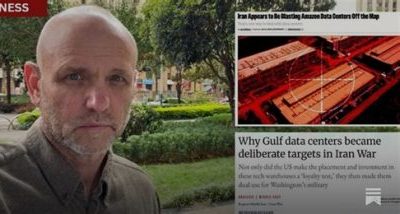
Iran spent $1 million to wipe out $30 billion in data center plans, and take down Amazon in the ME
or go to
Aletho News Archives – Video-Images
From the Archives
A short history of British torture
ICC | December 2005
When the House of Commons was debating how much to increase the time limit for detention without trial the question of torture came up. Officially this was limited to the nice considerations of whether it was all right to send people to places where torture is used and whether Britain can use information collected by the use of torture in other countries. This discussion gave an impression of democratic Britain as the home of civilised behaviour where the very idea of torture is repugnant to our legislators – unlike, say, the US with its secret CIA jails… In reality, the British state has a long history of using and developing a whole range of torture techniques. … continue
Blog Roll
 Aletho News
- Iran spent $1 million to wipe out $30 billion in data center plans, and take down Amazon in the ME
- Zionist billionaire pressure to silence Macklemore sparks exodus from Ed Sheeran tour
- House Votes to End Iran War for Third Time
- North Korea Slams US Plan for ‘AUKUS 2.0’ with South Korea and Japan
- Prolonging US-Iran Conflict Not Meeting Interests of Int’l Community – China’s Wang Yi
- EU bans former Zelensky aide from parliament
- NATO-backed Kosovo separatist ‘responsible for war crimes’
- US destroying international space law
- SCO Calls for Binding Global Deal to Prevent Arms Race in Space
- Iran & Its Allies Are Threatening Every Route for Saudi Oil
- If Americans Knew
- Groups urge Americans to support Van Hollen legislation on Israel’s killing of Americans & Palestinians
- Trump administration plans to send 40,000 tons of bombs to Israel: report
- Sanctions Target Iran’s Government, But Kill Hospitalized 23-Year-Old Woman
- An alternative view on the book “Israel’s Lobby: America in the Grip of a Foreign Power”
- Ed Sheeran’s band Beoga, other opening acts quit tour after Macklemore was dropped over his pro-Palestinian comments
- The assassination attempt on President Trump in Butler and the various Israeli connections to it
- “We Want That the Whole Land Be Jewish”
- BREAKING: Building collapse in Gaza kills at least 20 as they sleep – Daily Update
- ‘School is Life’: 1.5 Million Palestinian Children Face Fourth Year of Shattered Education
- Pentagon admits Iran war caused ammunition shortages, cost US $33.4bn
- No Tricks Zone
- Economic Masterminds: German Socialists Suggest Taxing Productivity Gains Stemming From Using AI
- The South China Sea Has Not Been Cooperating With The Climate Change Narrative
- Energy Crisis: Germany Enters Heating Season With Historically Low Gas Reserve Fill Levels
- New Study: The Antarctic Ice Sheet Gained Mass From 2020-2024 Due To Staggering Snow And Ice Accumulation
- Study: Ocean Heating Rates From Thousands Of Years Ago ‘Dwarf’ Modern Ocean Heating Rates
- Climate Extremists Target, Attack Large-Scale Power Grid Infrastructure In Germany!
- New Study: Antarctic Ice Melt Has Contributed Less Than 1 Centimeter To Sea Level Rise In The Last 30 Years
- Fear Of Debate: Alarmist German Climate Scientist Calls On Mainstream Media To Discredit Skeptic Voices
- End-Of-August Arctic Sea Ice Extent Hasn’t Fallen In 20 Years, Official Data Show!
- News-Making Nepal Region Has Had As-Warm Or Warmer Periods Than The 2000s In The 1600s, 1700s, 1800s
 Aletho News