European Parliament ‘Shocked’ at Amount of EU-Made Arms in Hands of Terrorists
Sputnik – 12.11.2018
This week, members of the European Parliament will gather in Strasbourg for the plenary session with a wide array of issues on the agenda, including arms exports.
A draft report on arms exports, which will be tabled at the European Parliament’s plenary session in Strasbourg later this week, suggests launching an investigation into how EU-made weapons end up in the possession of terrorists in the Middle East.
One provision of the document, presented by German MEP Sabine Lösing, says that the European Parliament is “shocked at the amount of EU-made weapons and ammunition found in the hands of Daesh in Syria and Iraq.”
The same draft highlights that some EU member-states, including Bulgaria and Romania, have failed to apply the Common Position in relation to weapons’ retransfers, which contravenes end-user certificates.
The document further proposes making it obligatory for EU member-states to “deny an export licence if there is a clear risk that the military technology or equipment to be exported might be diverted.”
The European Parliament “calls on all Member States to refuse similar transfers in the future, notably to the US and Saudi Arabia,” the draft reads.
Syrian media have on multiple occasions reported that the country’s army had discovered large stocks of arms, ammunition, vehicles and other military equipment, made in the US, Europe and Israel, while conducting mop-up operations in regions liberated from terrorists.
Nasrallah speech given on the first anniversary of the Liberation of Lebanon against terrorist groups
Translation: unz.com/sayedhasan
Transcript:
[…] I want to tell you, on this first anniversary of the (Second) Liberation (of Lebanon against terrorist groups in August 2017), that in these battles against the Al-Nusra Front on the one hand, and ISIS in the Jurd (Ersal) on the other hand, the number of our fighters was higher than what was required in numbers on both fronts. And I asked the military officials, “Why do you bring so many forces?” I was concerned above all by the preservation of the blood (life and health) of our brothers, and I also cared about the fact that each of them would open fire, and it would have a price in terms of ammunition and money, but my main concern was to preserve the blood of our brothers. They said that they could not prevent the youth (Hezbollah fighters) from coming (voluntarily and massively in Syria). Especially because it was summer and there was no school or university courses, which is why the majority of fighters were (Hezbollah) students in universities and high school, because our practice is not to allow young people under 18 to fight, and there was therefore a significant number of young people among our martyrs.
And today also, these same young people, the same generation (is fighting in Syria and elsewhere). Some may think that the generation of 1982 or 1985 was different (more heroic than today), as well as that which fought in 2000 or 2006, but not in any case! Today’s generation has all the momentum, enthusiasm, presence, consciousness and alertness (found in the earlier ones). And it proved it during all the past years.
But on the other side, when you look at Israel, for example, we see in studies of which the Israeli media are currently speaking that the real crisis of the enemy, of the Israeli army, is in the human element (the soldiers themselves). The leaders and staff of the Israeli army have great difficulty to attract young (Israeli soldiers) to the combat units and troops and to the special brigades (elite forces), because the young Israelis prefer to serve in other units than combat. They do not have any motivation, the spirit of sacrifice disappears and there is no cause in which they believe and for which they are ready to be killed. This is a real problem, which many studies are devoted to, but I do not have time to discuss them in detail.
And there is also another problem that was revealed a few days ago with precise figures, namely the increase of mental disorders among soldiers of the enemy, who are monitored by psychologists in the army. “During the year 2017 –I quote the Israeli media–, nearly 44,000 soldiers asked support from psychologists officers.” It is a figure quite significant for the Israeli army. Against 39 000 soldiers for 2003. Last year, 44,000 soldiers went to see who? Psychologists doctors. Psychologists doctors. And that’s why…
When they speak of the reasons (of their depression), they say they do not want to die, to sacrifice, to get tired, to get up at dawn, their morale is low or nonexistent, they want a more comfortable and better paid position, etc. That’s what they say themselves. And that is why the strategists of the enemy entity always say that this army is not ready to enter into a new war. Despite the fact that since 2006 to this day, they got new aircraft (F-35), new missiles and developed many of their assets and capabilities. We know this and monitor it (closely). But since 2006 and to date, they have not managed to change the spirit of defeat that swept over their officers, their soldiers, and their people. They have failed to remedy the state of doubt and suspicion (prevalent) between soldiers and officers, and they were unable to find historical leaders able to mobilize again.
As for us, today, our strength lies in our young generations of these true and sincere fighters, willing to sacrifice, loyal, ready to shed their blood, who believe in dignity, in glory and in honor, and for whom the dignity of their people, the glory of their country, the honor and life of their loved ones deserve from them all the sacrifices and all these gifts. And this is what has allowed the Second Liberation (of Lebanon in August 2017), as well as the First Liberation (in 2000). […]
Speech by Hezbollah Secretary General Sayed Hassan Nasrallah on September 20, 2018, on the tenth day of the Islamic month of Muharram, commemorating the martyrdom of Imam Hussein.
Transcript:
[…] Sixth, regarding Israel, we must always stay on alert, my brothers and sisters. The Israelis are angry, the Israelis are worried. They are angry because their project in the region collapsed. The Israelis had high hopes on what was happening in Syria and Iraq. In the past, they had high hopes on what was happening in Lebanon. But all their illusions were scattered to the four winds. The Israelis know that the Resistance Axis will come back (to face them) stronger than ever. The Israelis know that new countries (Iraq, Yemen) are now part of the Resistance Axis, and that (whole) peoples who were outside the sphere of the struggle against the Israeli enemy are now within this sphere, in a strong, active and integrated manner. Israel is angry, Israel is worried, and that is why we must all stay on alert. I am not speaking of assumptions (of aggression) here and there, but I know that no one should allow himself to be reassured concerning this enemy, or even with the analyzes (about it), even if, as I have always confirmed to you, he fears any confrontation in the region, especially against Lebanon. And he knows well that any battle, any war he would launch could have a huge impact on the region. He knows he now has weaknesses that have become exposed (to everyone), and he knows very well our strengths.
Some days ago, (the Israeli Minister of War) Lieberman said on the occasion (of the commemoration) of the 1973 war: “We must understand that in the Middle East, two truly strategic changes have occurred: the first is that our enemies –meaning us (Hezbollah) and our allies– now have high-precision missiles and the second thing –of course, he still has no solution to these missiles, and logically, this will delay and repel the prospect of an Israeli war– and the second thing is that the home front (of the Zionist entity) has become the central front in any future war. If, during the 1973 war, the (Israeli) soldiers could fight on the front, while in Tel Aviv, people were (peacefully) sitting in coffee shops, reading newspapers, –during the 1973 war, the fighting took place on the front, at the borders, but the people who lived in Tel Aviv were quietly sitting in coffe shops, reading newspapers– but now everything has changed.” What he said about the current situation is a treat (to our ears). “Now everything has changed.” Yes, today everything has changed. We must also be conscious of this reality, just like the enemy is aware of it. The enemy knows (well) that major changes have occurred in this region, which he did not expect and that he had not anticipated.
As for the high-precision missiles and his attempts in Syria to cut the way for this power and this ability, today, I want to say something he already knows, but I want to say it publicly, for his people to be informed and take heed, and for our people to be informed and gain confidence. I say to Israel: Whatever you do to prevent the (weapons transfers), it’s already too late. Everything has already been done and completed, and the Resistance (in Lebanon) already has all the high precision missiles and such, all the capabilities and armaments it needs, so much that if Israel imposes a war in Lebanon, they will face a destiny and a reality they never anticipated.
This is the reality of the situation. And likewise, many things that have changed within their army. When I spoke at Hermel (on August 26), in commemoration of the Second Liberation (of Lebanon from terrorists), I talked about the situation with regard to the morale, spirit and psychological state of the Israeli army (disastrous according to recent studies in Israel). There is almost no one inside the entity that has not answered me. The President of the entity, the Head of government, the War minister, other ministers, MPs, journalists, etc., all have answered me, some by naming me and others without naming me, but it was clear that they were referring to me. Because I put light on a painful truth for them, for their people and for their future. And they know that now, technology alone is not enough to win in a battle, and that the decisive factor in a battle is the human element (soldiers). This is what experience has shown, whether in 2000, in 2006 or in recent years (Syria, Iraq, Yemen).Look how ridiculous these Israelis are: how did they answer me? With what facts did they answer me? They responded, and here you can see their weakness, by threatening Lebanon, but what did they say? Long ago, before 1982, they threatened to invade Beirut. But today, does anyone hear them speak about an invasion of Beirut? Did you hear such a thing? From 2000 to today, my brothers, (say) from 2006 to the present, did Israel ever claim that they were going to invade Lebanon and reach Beirut? It’s over! Why? Because an invasion of Lebanon up to Beirut requires ground forces (worthy of the name). This is not aviation, missiles and warships that can achieve such a thing. This army (able) to invade Lebanon and reach Beirut no longer exists! There is nothing like that in Israel, but in Lebanon, the situation is very different. Today, in Lebanon, something very different is found (real fighters, battle-hardened and in high spirits). And that’s why all the (Israeli) response consisted of threats to destroy and raze Lebanon to the ground. That is to say, they drew their strength (only) from their firepower, and dare not boast of the human element. […]
Iraq parliament calls for US forces to leave
MEMO | November 10, 2018
Iraqi MP Ahmad Al-Assadi, senior leader of the Iraqi Construction Alliance, revealed on Friday parliamentarian moves to pressure the Iraqi government to evict US forces from the country.
Al-Assadi said that the previous Iraqi parliament had started the calls, but now the new parliament was calling for a clear timetable for the US withdrawal from Iraq, Arabi21 reported. He added that US forces had entered the country at the request of the Iraqi government for training purposes and assistance in fighting Daesh.
Yet Al-Assadi stressed that: “After the big victory against these gangs [Daesh], the Iraqi government has the right to evaluate the need for American forces to remain on Iraqi soil”. He also said that the calls for US forces to leave would be doubled during the next parliamentary term, noting that the parliament was likely to accept the existence of advisors and trainers based only on the need specified by the authorities.
Regarding the position of the government, Al-Assadi said: “The government has the right to estimate its need for advisors and trainers. The parliamentary discussions, which called for revealing the number, places and need for the American forces were not closed”.
He stressed however that the parliament is entitled to make the final decision regarding whether US forces remain in Iraq or are asked to withdraw.
Pentagon Report Questions US’ Own Legal Justification for Staying in Syria
Sputnik – November 7, 2018
The latest quarterly report by the Lead Inspector General on the status of Operation Inherent Resolve, the codename for the US military’s intervention against Daesh in Syria and Iraq, has paid extensive focus to Iran, mentioning it 105 times in 130 pages. However, while accusing Tehran of posing a growing threat to US forces, the report admits that the Department of Defense has “no evidence” that Iranian troops or Iranian-allied militia have actually attacked the US in Syria.
The report also hints at a confused US policy in Syria, pointing to Trump National Security Adviser John Bolton’s recent statement about keeping US troops in Syria so long as “Iranian troops” and “Iranian proxy militias” remain outside of Iran.
This sentiment, the report admits, has led to “questions about the legal justification of maintaining US troops in Syria, which currently relies on the 2001 Authorization for the Use of Military Force against those who ‘planned, authorized, committed, or aided the terrorist attacks that occurred on September 11, 2001,’ which has been interpreted as including [Daesh].”
Unlike the presence of the Russian military and Iranian military advisors, the US has no internationally recognized legal justification for its presence in Syria, with Damascus repeatedly condemning US operations in the Arab Republic and demanding a US exit from the country.
The DoD points out that in the wake of Bolton’s remarks, military officials have changed tack, paying lip service to the “enduring defeat” of Daesh while telling congressional committees about the “ancillary benefits” and “leverage” provided by the continued presence of US forces in Syria.
Pointing to shifting political goals, which now seem to include “removing Iran and Iranian proxies from the country, influencing the outcome of the Syrian civil war… and stabilizing areas of northeast Syria liberated from [Daesh],” the report warns that “these non-military goals could keep the US military involved in Syria after the defeat of [Daesh]” over an unspecified period.
Iranian ‘Security Threats’ to US in Syria
Mentioning the intensive US drilling at the Al-Tanf Garrison in southern Syria following calls by Iran to end the illegal US presence in the area, the report warns of “several Iranian-backed militias” operating in the same area, with “their presence creat[ing] the potential for violence with US troops and US-backed forces.”
At the same time, the DoD report admits that “neither Iran nor Iranian-backed militias had hindered counter-[Daesh] operations,” and says that the Pentagon has “no evidence” that ‘Iranian troops’ or Iranian-allied militia have actually attacked the US in Syria.
‘Iran-Backed Militias’ in Iraq
In neighboring Iraq, the report mentions elements of the Popular Mobilization Forces, Shiite militia groups which played a crucial role in defeating Daesh in Iraq, saying that they pose a similar threat to US interests, given what are said to be their “close ties to Iran.”
“The influence of these Shia militias in both the security sector and the political process –and their continued willingness to act independently of the [Iraqi Security Forces] – increases Iran’s influence in Iraq,” the report states.
Alleging that Iran has deployed some 100-150 Islamic Revolutionary Guards Corps personnel among the militia, the report accuses these “Iranian proxies” of being “likely responsible for two attacks targeting US facilities in Iraq,” including a mortar attack in the Baghdad Green Zone in early September and rocket attacks in Basra near the US consulate, which led to the diplomatic mission’s temporary evacuation later that month.
The DoD report makes no mention of the fact that Iran firmly condemned the September attacks on US diplomatic areas out of principle. In a statement, the Iranian foreign ministry accused the US of “propaganda and false allegations against Iran and the Iraqi forces,” and called the consulate closure a “suspicious move aimed at evading responsibility and pinning the blame on others.”
Ultimately, the report warns that so far as Iraq is concerned, “if left unchecked, Iranian-sponsored harassment of US forces could increase, and Iranian influence operations could increase as they vie for influence in the new government.”
The Trump administration has shifted its position on Syria several times, with the president saying the US would “be coming out of Syria like very soon” in March before launching airstrikes against Damascus two weeks later. In September, National Security Adviser John Bolton linked the withdrawal of US troops from Syria to the alleged Iranian presence in the country, prompting the Pentagon to change its tone on the purpose of the Syria mission being the defeat of Daesh.
See also:
Israeli Defense Chief: US Sanctions Deal a ‘Critical Blow’ to Iran in Syria
US forces Iraq to award $15 billion contract to GE instead of Siemens
Press TV – October 21, 2018
Germany is angry after the US government intervenes in a multi-billion-dollar deal for Siemens AG to develop power stations in Iraq and forces Baghdad to opt for General Electric (GE) instead.
The American company signed a memorandum of understanding with the Iraqi government earlier this week, outlining their cooperation in the fields of oil and gas production and power generation.
A person, who has seen the paperwork, told The Financial Times that Washington plans to offer financing and insurance for US firms doing business in the Iraqi power sector.
GE’s agreement with Iraq dashed Siemens’ hopes of winning a $15 billion contract to supply 11 gigawatts of power-generation equipment to Iraq.
Until the US intervention, Siemens was considered the front-runner after its Chief Executive Joe Kaeser traveled to Iraq in September and spoke with Prime Minister Haider al-Abadi about the contract.
US officials, however, warned Abadi that awarding the contract to Siemens might jeopardize relations between Baghdad and Washington.
A top adviser to the Iraqi premier then told Siemens to give up because it was causing problems for Iraq given the US pressure.
“The US government is holding a gun to our head,” the adviser was quoted as saying by another person familiar with the incident.
According to people familiar with the negotiations, the US highlighted the number of American troops killed in Iraq and claimed that Iran had spurred Baghdad to pursue the Siemens deal.
“This is part of very strong campaign of engagement in Iraqi government formation and a very targeted effort to support the Iraqi government and minimize Iranian influence,” Garrett Marquis, a US National Security Council spokesman, claimed.
The Federation of German Industries (BDI) complained on Sunday that the US pressure to quash the Siemens power deal with Iraq was unacceptable, blaming President Donald Trump’s “America First” policy for corroding business decisions.
“To implement the America First doctrine in this way in the global competition of multinational companies is not acceptable,” Joachim Lang, BDI managing director, told Welt am Sonntag newspaper.
He emphasized that governments and companies should make deals based on business interests.
The US, backed by the UK, invaded Iraq in 2003 under the pretext that the former regime of Saddam Hussein possessed weapons of mass destruction.
No such weapons were ever found, but the invasion plunged Iraq into chaos and led to the rise of terrorist groups which continue to plague the country to this day.
United States Did It Again: Warplanes Use White Phosphorous Munitions in Syria
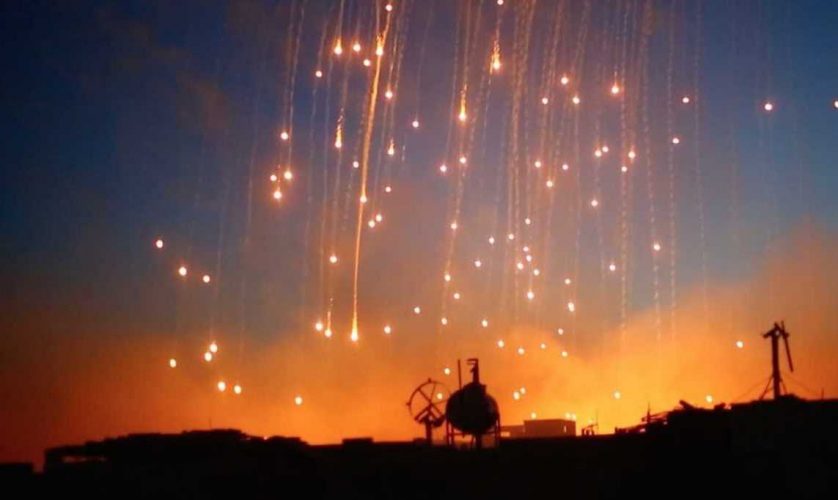
By Peter KORZUN | Strategic Culture Foundation | 14.10.2018
The US-led coalition used white phosphorus (WP) munitions delivering air strikes in the Syrian province of Deir Ez-Zor on Oct.13. The attack resulted in casualties among civilians. Last month, WP munitions were also used by two US Air Force (USAF) F-15s in an attack on the town of Hajin, Deir-ez-Zor. The Syrian government has repeatedly condemned the US-led coalition, which says the need to fight ISIS justifies its military actions while denying the fact it uses white phosphorous projectiles.
WP does not fall into the category of chemical weapons banned by the Chemical Weapons Convention but it is an incendiary weapon. As such, it cannot be used against non-combatants. Protocol III of the Convention on Certain Conventional Weapons “prohibits the use of said incendiary weapons against civilians (already forbidden by the Geneva Conventions) or in civilian areas”. The substance ignites spontaneously upon contact with air, producing a dense white smoke. The heat could reach 800-900°C. No water will help. Severe injuries to internal organs could be caused when absorbed through skin, ingested, or inhaled. Burning particles of white phosphorus produce thermal and chemical burns if they come into contact with skin.
It’s not Syria only where the US used WP munitions. White phosphorous artillery shells were used in Iraq during the assault on Fallujah in 2004. The US admitted the fact. There have also been media reports about the WP use in Mosul, Iraq and Raqqa, Syria. Last year, the Washington Post published photographs of US Marines equipped with white phosphorus projectiles to be used in the battle for Raqqa. The source offered similar pictures showing WP munitions with US Army units outside Iraqi Mosul.
The Human Rights Watch has warned about dangers coming from the use of WP in urban areas. According to Steve Goose, arms director at Human Rights Watch, “No matter how white phosphorus is used, it poses a high risk of horrific and long-lasting harm in crowded cities like Raqqa and Mosul and any other areas with concentrations of civilians.”
In 2015, the United States used depleted uranium (DU) in Syria. DU is not banned by an international treaty but its use runs counter to the International Humanitarian Law (IHW). Article 36 of the Additional Protocol I to the Geneva Conventions requires to ensure that “any new weapon means or method of warfare does not contravene existing rules of international law.” It says “General principles of the laws of war/IHL prohibit weapons and means or methods of warfare that cause superfluous injury or unnecessary suffering, have indiscriminate effects or cause widespread, long-term and severe damage to the natural environment.” In 2012, the UN General Assembly tried to adopt a resolution restricting the use of DU. The move was supported by 155 states, with 27 abstaining and four, including the United States, voting against.
The American military has used cluster bombs against civilians in Yemen. The US is not one of the 102 states parties to the 2008 Convention on Cluster Munitions, which prohibits the weapons that open in the air, dispersing multiple bomblets or submunitions over a wide area. Many submunitions fail to explode on initial impact, acting like landmines for years. The Pentagon refuses to give cluster munitions and American field commanders are authorized to use them at their discretion.
The US continues to run biological programs, operating more than 20 laboratories around the world in blatant violation of the UN Biological Weapons Convention. An opinion paper published on Oct. 4 in the journal Science, written by an international group of researchers claims the US Defense Advanced Research Projects Agency (DARPA) is potentially developing insects as a means of delivering a “new class of biological weapon.”
In 2011, US police used tear gas and other chemical irritants against Occupy protesters. Tear gas is prohibited for use against enemy soldiers in battle by the Chemical Weapons Convention but it’s all right with America’s law enforcement agencies using the dangerous substance against their own people.
There is no justification for using WP at the time ISIS has been reduced to insignificance in Syria but Washington did it again. It violated international law after having unilaterally imposed sanctions on Russia without any evidence to support the relevant accusations. It should also be remembered that, unlike Russia, the US has so far failed to meet its obligations and destroy the chemical weapons stockpile. The use of substances to harm civilians is a serious matter that should be addressed at the ongoing 79th session on UN General Assembly. America’s non-compliance with generally accepted norms is the most acute problem on the international security agenda.
The Lies of our (Financial) Times
By James Petras | Dissident Voice | October 4, 2018
The leading financial publications have misled their political and investor subscribers of emerging crises and military defeats which have precipitated catastrophic political and economic losses.
The most egregious example is the Financial Times (FT) a publication which is widely read by the business and financial elite.
In this essay we will proceed by outlining the larger political context that sets the framework for the transformation of the FT from a relatively objective purveyor of world news into a propagator of wars and failed economic policies.
In part two we will discuss several case studies which illustrate the dramatic shifts from a prudent business publication to a rabid military advocate, from a well-researched analyst of economic policies to an ideologue of the worst speculative investors.
The decay of the quality of its reportage is accompanied by the bastardization of language. Concepts are distorted; meanings are emptied of their cognitive sense; and vitriol covers crimes and misdemeanors.
We will conclude by discussing how and why the ‘respectable’ media have affected real world political and market outcomes for citizens and investors.
Political and Economic Context
The decay of the FT cannot be separated from the global political and economic transformations in which it publishes and circulates. The demise of the Soviet Union, the pillage of Russia’s economy throughout the 1990s and the US declaration of a unipolar world were celebrated by the FT as great success stories for ‘western values’. The US and EU annexation of Eastern Europe, the Balkan and Baltic states led to the deep corruption and decay of journalistic narratives.
The FT willingly embraced every violation of the Gorbachev-Reagan agreements and NATO’s march to the borders of Russia. The militarization of US foreign policy was accompanied by the FT conversion to a military interpreter of what it dubbed the ‘transition to democratization’.
The language of the FT reportage combined democratic rhetoric with an embrace of military practices. This became the hallmark for all future coverage and editorializing. The FT military policies extended from Europe to the Middle East, the Caucasus, North Africa and the Gulf States.
The FT joined the yellow press in describing military power grabs, including the overthrow of political adversaries, as ‘transitions to democracy’ and the creation of ‘open societies’.
The unanimity of the liberal and right-wing publications in support of western imperialism precluded any understanding of the enormous political and economic costs which ensued.
To protect itself from its most egregious ideological foibles, the FT included ‘insurance clauses’, to cover for catastrophic authoritarian outcomes. For example they advised western political leaders to promote military interventions and, by the way, with ‘democratic transitions’.
When it became evident that US-NATO wars did not lead to happy endings but turned into prolonged insurgencies, or when western clients turned into corrupt tyrants, the FT claimed that this was not what they meant by a ‘democratic transition’ – this was not their version of “free markets and free votes”.
The Financial and Military Times (?)
The militarization of the FT led it to embrace a military definition of political reality. The human and especially the economic costs, the lost markets, investments and resources were subordinated to the military outcomes of ‘wars against terrorism’ and ‘Russian authoritarianism’.
Each and every Financial Times report and editorial promoting western military interventions over the past two decades resulted in large scale, long-term economic losses.
The FT supported the US war against Iraq which led to the ending of important billion-dollar oil deals (oil for food) signed off with President Saddam Hussein. The subsequent US occupation precluded a subsequent revival of the oil industry. The US appointed client regime pillaged the multi-billion dollar reconstruction programs – costing US and EU taxpayers and depriving Iraqis of basic necessities.
Insurgent militias, including ISIS, gained control over half the country and precluded the entry of any new investment.
The US and FT backed western client regimes organized rigged election outcomes and looted the treasury of oil revenues, arousing the wrath of the population lacking electricity, potable water and other necessities.
The FT backed war, occupation and control of Iraq was an unmitigated disaster.
Similar outcomes resulted from the FT support for the invasions of Afghanistan, Libya, Syria and Yemen.
For example the FT propagated the story that the Taliban was providing sanctuary for bin Laden’s planning the terror assault in the US (9/11).
In fact, the Afghan leaders offered to turn over the US suspect, if they were offered evidence. Washington rejected the offer, invaded Kabul and the FT joined the chorus backing the so-called ‘war on terrorism which led to an unending, one trillion-dollar war.
Libya signed off to a disarmament and multi-billion-dollar oil agreement with the US in 2003. In 2011 the US and its western allies bombed Libya, murdered Gaddafi, totally destroyed civil society and undermined the US/EU oil agreements. The FT backed the war but decried the outcome. The FT followed a familiar ploy; promoting military invasions and then, after the fact, criticizing the economic disasters.
The FT led the media charge in favor of the western proxy war against Syria: savaging the legitimate government and praising the mercenary terrorists, which it dubbed ‘rebels’ and ‘militants’ – dubious terms for US and EU financed operatives.
Millions of refugees, resulting from western wars in Libya, Syria, Afghanistan and Iraq fled to Europe seeking refuge. FT described the imperial holocaust – the ‘dilemmas of Europe’. The FT bemoaned the rise of the anti-immigrant parties but never assumed responsibility for the wars which forced the millions to flee to the west.
The FT columnists prattle about ‘western values’ and criticize the ‘far right’ but abjured any sustained attack of Israel’s daily massacre of Palestinians. Instead readers get a dose of weekly puff pieces concerning Israeli politics with nary a mention of Zionist power over US foreign policy.
FT: Sanctions, Plots and Crises — Russia, China and Iran
The FT like all the prestigious media propaganda sheets have taken a leading role in US conflicts with Russia, China and Iran.
For years the scribes in the FT stable have discovered (or invented) “crises” in China’s economy- always claiming it was on the verge of an economic doomsday. Contrary to the FT, China has been growing at four times the rate of the US; ignoring the critics it built a global infrastructure system instead of the multi-wars backed by the journalist war mongers.
When China innovates, the FT harps on techno theft — ignoring US economic decline.
The FT boasts it writes “without fear and without favor” which translates into serving imperial powers voluntarily.
When the US sanctions China we are told by the FT that Washington is correcting China’s abusive statist policies. Because China does not impose military outposts to match the eight hundred US military bases on five continents, the FT invents what it calls ‘debt colonialism” apparently describing Beijing’s financing large-scale productive infrastructure projects.
The perverse logic of the FT extends to Russia. To cover up for the US financed coup in the Ukraine it converted a separatist movement in Donbass into a Russian land grab. In the same way a free election in Crimea is described as Kremlin annexation.
The FT provides the language of the declining western imperial empires.
Independent, democratic Russia, free of western pillage and electoral meddling is labelled “authoritarian”; social welfare which serves to decrease inequality is denigrated as ‘populism’ —linked to the far right. Without evidence or independent verification, the FT fabricates Putinesque poison plots in England and Bashar Assad poison gas conspiracies in Syria.
Conclusion
The FT has chosen to adopt a military line which has led to a long series of financially disastrous wars. The FT support of sanctions has cost oil companies billions of dollars, euros and pounds. The sanctions, it backed, have broken global networks.
The FT has adopted ideological postures that threaten supply chains between the West, China, Iran and Russia. The FT writes in many tongues but it has failed to inform its financial readers that it bears some responsibility for markets which are under siege.
There is unquestionably a need to overhaul the name and purpose of the FT. One journalist who was close to the editors suggests it should be called the “Military Times” – the voice of a declining empire.
Iraq not allowing Turkish troops back to Bashiqa: Report
Press TV – September 23, 2018
Iraq has refused to allow Turkish troops back into the Arab country following a leave from their bases, a government-affiliated think tank in Baghdad has reported.
According to Al-Nahrain Center for Strategic Studies, the move is in line with the Iraqi government’s efforts to put an end to Turkish military presence in the country.
The measure had been adopted over the previous months, withholding visas to the Turkish forces who sought to return to Iraq, Iraqi News website reported on Sunday.
Watheq al-Hashemi, director of the center, said the decision had helped reduce the number of Turkish troops significantly.
“The government’s stance of not allowing Turkish soldiers to return will end the Turkish military presence in Bashiqa without any diplomatic or military friction,” he said.
The Bashiqa camp, al-Hashemi said, is totally cordoned by Iraqi troops and Turkey cannot carry out any plans without the knowledge of Iraqi troops.
Turkey has been conducting air raids against areas in northern Iraq, which serve as safe havens for the Kurdistan Workers’ Party (PKK) militants. The militants have been fighting a deadly separatist war against Ankara.
In 2014, Turkey sent troops to Bashiqa in northern Iraq under the banner of fighting the Daesh terror group which was defeated in the country late last year.
Baghdad has repeatedly called on Ankara to pull out its forces but Turkey says they will stay as long as the PKK threat persists.
The decision was made during a meeting of the Iraqi Ministerial Council for National Security chaired by Prime Minister Haider al-Abadi. The meeting also instructed the Foreign Ministry to “take the necessary measures to document the Turkish violations of Iraqi airspace to the United Nations.”
‘US incites Kurds to break promise, assault Iranian soil’
Press TV – September 11, 2018
Iran’s top military commander says the United States has been provoking terrorists based in Iraq’s semi-autonomous Kurdistan region over the past year to launch assaults on Iranian soil despite an earlier promise not to do so.
Speaking on Tuesday, Chairman of the Chiefs of Staff of the Iranian Armed Forces Major General Mohammad Baqeri referred to a missile strike by the Islamic Revolution Guards Corps (IRCG) at a gathering of terrorists in Kurdistan, saying the Iranian nation reserves the right to defend itself.
Over two decades ago, officials from Iraqi Kurdistan and the outlawed Kurdistan Democratic Party had “made a written commitment not to conduct operations in Iran, but they have been breaking that promise over the past year due to US provocations,” he said.
“This was not acceptable to us and thus we repeatedly cautioned them,” he added.
The IRGC issued a statement confirming that it had fired seven short-range surface-to-surface missiles at a gathering of terrorist commanders in Kurdistan on Saturday, dealing a heavy blow to them.
The terrorists, the statement read, had been seeking to create insecurity and carry out acts of sabotage in the Iranian provinces of West Azarbaijan, Kordestan and Kermanshah.
The Iranian general said that the Iraqi government in Baghdad and the Kurdistan Regional Government (KRG) should not allow the establishment of such anti-Iran bases and rather extradite the remnants of “criminal” elements to Iran or deport them.
If insecurity persists, Baqeri warned, more counter-measures would be taken against terrorist commanders in self defense.
Iranian forces reached all their goals in the missile attack, he said. “It is not coincidental that the missiles hit the meeting, and we hope that we will not need to repeat this.”
‘No appeasement policy’
Separately on Tuesday, Foreign Ministry spokesman Bahram Qassemi said that Iran will not follow a policy of appeasement when it comes to its security issues and the violation of its sovereignty by terrorist elements.
The missile strike has not been and will not be “Iran’s optimal choice. But terrorist activities – especially those that resulted in the martyrdom of Iranian border guards and soldiers – left the Iranian armed forces with no choice but to take a retaliatory and deterrent measure based on the credible information it had received.”
He also expressed hope that the joint border with Iraq would be among the most secure and stable frontiers in the region.
Featured Video

REDFIELD REWRITES THE RECORD
or go to
Aletho News Archives – Video-Images
From the Archives
Iran Delenda Est
By Stephen J. Sniegoski • Unz Review • July 25, 2019
After Carthage had been significantly weakened by Rome in the Second Punic War (218 to 201 BC), Cato the Elder, a leading Roman senator, is said to have ended all his speeches with the words: “Carthago delenda est!” (“Carthage must be destroyed!”). This destruction ultimately took place in the Third Punic War (149–146 BC). A somewhat similar situation exists today in the United States, where war hawks demand that Iran–which in no way could effectively attack the United States, or even conquer America’s Middle East so-called allies—be stripped of its ability to protect itself.
Of course, what makes the American situation different from ancient Rome’s is that Rome sought to eliminate Carthage for its own interests whereas the United States is largely acting to advance the military interests of Israel… continue
Blog Roll
Recent Comments
loongtip on Trump tells India to stop purc… eddieb on The Old Testament and the Geno… papasha408 on Trump’s war posturing against… Coronistan on This is How We Should Have Res… Coronistan on NO MANDATES, NO PROFITS: MODER… Lutz Barz on Russia Vows to Protect Its Oil… loongtip on Russia Vows to Protect Its Oil… loongtip on Hamas never agreed to lay down… eddieb on Conspiracy Denial eddieb on WEF Calls for ‘Cultural Revolu… loongtip on Trump wanted to play peacemake… Coronistan on EU member to sue bloc over ‘su…


 Aletho News
- REDFIELD REWRITES THE RECORD
- From Iraq war crimes to Gaza’s ‘board of peace’: Why Tony Blair belongs in The Hague
- Epstein email reveals plan to pursue frozen Libyan assets with help from former MI6, Mossad figures
- Trump tells India to stop purchasing Iran oil, buy Venezuelan instead
- How Trump’s Iran Gambit Could Blow Up the Entire Persian Gulf
- Rafah crossing reopens under strict Israeli restrictions
- The Attack on Pearl Harbor Was No Surprise (Part V)
- How Human Rights Watch Shattered Yugoslavia
- Hamas rejects Israeli accusations as “lies meant to justify its massacres in Gaza”
- Interior ministry: Israeli strike on police building in Gaza shows disregard for mediators
- If Americans Knew
- Israel killed at least 32 Gazans on Saturday – Not a ceasefire Day 114
- Is Israel opening the Rafah border to depopulate Gaza? – Not a ceasefire Day 113
- NBA Star Stephen Curry’s Ties To Israeli Military Intelligence
- ‘Apocalyptic wasteland’: Biden admin. blocked warning on deteriorating Gaza situation after Oct. 7
- Why Israeli counterterrorism tactics are showing up in Minnesota
- Israel Went to Extremes to Return Ran Gvili’s Body. Why Doesn’t It Accord Dead Palestinians the Same Respect?
- Across the West, speaking for Palestine is now a crime
- A West Bank Bus Trip Through ‘the Best Documented Ethnic Cleansing in History’
- Mike Huckabee’s distorted theology does not speak for Christians worldwide
- CBS Evening News” With Tony Dokoupil Is Ellisons’ & Weiss’s Pro-Israel Show
- No Tricks Zone
- One Reason Only For Germany’s Heating Gas Crisis: Its Hardcore-Dumbass Energy Policy
- 130 Years Later: The CO2 Greenhouse Effect Is Still Only An Imaginary-World Thought Experiment
- New Study Affirms Rising CO2’s Greening Impact Across India – A Region With No Net Warming In 75 Years
- Germany’s Natural Gas Crisis Escalates … One Storage Site Near Empty …Government Silent
- Polar Colding…Antarctica Saw Its Coldest October In 44 Years!
- New Study: Sea Levels Rose 20 Times The Modern Rate During The Roman Warm Period
- As German Gas Storage Dips Dangerously Low…Shortage Hardly Avoidable
- New Study: Brazil’s Relative Sea Level Was 2+ Meters Higher And SSTs 3-4°C Warmer 6000 Years Ago
- Philosopher Schopenhauer: Climate Science Certainty Stems From Stupidity, Ignorance
- New Study: Species Extinction Rates Declining Since 1980 – ‘Climate Change Is Not An Important Threat’
 Aletho News