Fighting Starts in Syria’s Idlib: US Military Considers Military Options
By Peter KORZUN | Strategic Culture Foundation | 11.09.2018
Syrian UN Ambassador Bashar Ja’afari declared on Sept. 7 that his government was determined to wipe out the rebels from the Idlib province. The next day, the Idlib Dawn Operation began, encircling a town 59 km. southwest of the Syrian city of Aleppo. As of Sept. 9, Russian aircraft have attacked the rebel positions in western Idlib, the mountains of the Latakia province, and the Sahl al-Ghab plain, with the goal of softening up peripheral targets and preventing a breakthrough or counterattack. Syria’s forces are ready to move.
The Russian military warned that a false-flag chemical attack staged by the rebels could occur at any time and be used as a pretext for Western missile strikes. A massive Turkish military convoy, consisting of more than 300 vehicles, including tanks, armored vehicles, and MLRS launchers, has entered Idlib from the province of Hatay.
Syria needs Idlib — the last stronghold of the jihadists and the shortest route from Latakia to Aleppo. The M5 international highway crosses Idlib, linking Turkey and Jordan through Aleppo and Damascus. Control of the province would greatly facilitate the negotiations with the Kurds and strengthen Syria’s position at the UN-brokered Geneva talks. If the negotiation process succeeds, the only territories left to liberate would be the zone controlled by the US, such as the al-Tanf military base and the surrounding area, the northern parts of the country under Turkish control, and small chunks of land still held by ISIS [let’s not forget the Golan Heights].
Turkey opposes the idea of an Idlib offensive. It wants assurances for the groups in Idlib under its control and it doesn’t want an influx of refugees. These controversial issues can be tackled with Russia as a mediator. Turkey, Iran, and Russia did not agree on everything at the recent summit in Tehran, but the West’s hopes that they would go their separate ways, or even clash in Idlib, have been dashed.
President Erdogan has just said that he wants to meet the Russian president again after his Sept 28-29 visit to Germany. This means that the Turkish leader has ideas and proposals to discuss and Moscow can play a role in reaching a compromise, such as a more narrowly tailored counter-terrorism operation in Idlib. There is a divide, but it can be bridged. The parties have the will to get it done.
Ankara plans to organize a Turkey-Russia-Germany-France summit. The Russian presidential aide, Yury Ushakov, has confirmed that such a meeting is in the works. Moscow has just invited the Turkish military to take part in its largest-ever military exercise, Vostok 2018, which will be held in the Far East. China and Mongolia have also been invited. Obviously, Russia and Turkey are prepared to solve their differences over Idlib peacefully through negotiations.
In any event, the province cannot remain under the terrorists’ control forever. They must either surrender or be routed. Now that the operation to free Idlib has begun, many of them will lay down their arms. They know their resistance is futile.
Actually, victories over terrorists that pave the way to a negotiated solution of the conflict should be welcomed, but the US sees these things in a different light. Washington seems to be shifting gears on Syria again, despite the statements President Trump made earlier about the plans to pull out. Now the president has reportedly agreed to new objectives that will keep US troops on the ground in Syria indefinitely in order to ensure that the Iranian forces are driven out. The US military has just sent reinforcements to al-Tanf to demonstrate its resolve to stay in that country. The Marines are holding a multi-day exercise there, using live ammunition.
Secretary of State Mike Pompeo, said on Sept. 7 that the administration viewed any government assault on Idlib as an escalation of Syria’s warning that Washington would respond to any chemical attack by Damascus. Ambassador James Jeffrey, who served as a deputy national security adviser to President George W. Bush, has recently been appointed US Special Representative for Syria Engagement, and Joel Rayburn, the former senior director for Iran, Iraq, Syria, and Lebanon, is now Special Envoy for Syria. The two appointments confirm the fact that the US has changed its mind and decided to remain in Syria, as both these officials had supported this policy before.

Rayburn, Joel (15 August 2014). “The coming disintegration of Iraq” Washington Post
America’s top military brass are studying the options for military involvement in Syria. But the real reason may not be Idlib or any other events in that country, but rather the situation creep in Iraq, where anti-Iranian and anti-government Shia protests in the south have turned violent and the prime minister may be compelled to step down. The protesters are armed and violent. They have attacked the Iranian consulate and the headquarters of Iranian-backed militias in the city.
Fighting has also been reported between Iranian forces and Kurds in Iraq’s Kurdish region. Details have been provided of mortar fire in Baghdad, where protests took place in July. Something’s cooking in Iraq. There is too little information available to obtain any deep insights into what’s going on, but the situation is unpredictable and volatile. Iraq could soon implode. The US will not leave the region, and it needs every outpost it has there. A lot depends on how events develop in Iraq.
Idlib will ultimately be liberated. The status of the US-led coalition forces in Syria will become a hot-button topic and be seen as the main stumbling block on the path to peace and reconstruction.
“US Threatened to Burn Basra If Abadi Wasn’t Given Another Term”
Al-Manar – September 9, 2018
Iraq’s Popular Mobilization Force who defeated ISIL Takfiri forces said on Saturday it had evidence showing US diplomatic missions in the Arab country have instigated the recent violence in the southern oil-rich city of Basra.
Abu Mahdi al-Muhandis, the second-in-command of the volunteer force, which is also known as Hashd Shaabi, held Washington responsible for the Basra unrest, saying it was actually meant to sow discord among different Iraqi political parties and movements.
“We have complete information and documents that show the US embassy and consulate in the country caused the Basra unrest,” al-Muhandis said.
He also vowed to respond to the Basra incidents and stressed that the Iraqis would never engage in another civil war.
Basra has been rocked by deadly protests since Tuesday. The protests took an ugly turn on Friday when a group of masked assailants raided government buildings and offices of political parties and set them ablaze. The Iranian consulate was among the premises gutted in the rampage.
At least 15 protesters have died in clashes with security forces since the beginning of the month, health officials have said.
Al-Muhandis revealed that the US “threatened with burning Basra” if incumbent PM Haider Abadi was not given another term.
Ties between the Hashd and Abadi are tense, al-Muhandis explained, complaining that Abadi has failed to allocate salaries for Hashd fighters.
“Abadi didn’t keep most of his promises to Hashd al-Shaabi,” tweeted al-Muhandis, but stressed that the situation will not devolve into a “Shiite-Shiite war.”
Syria and Iran Sign Defense Agreement: Defying Outside Pressure
By Peter KORZUN | Strategic Culture Foundation | 29.08.2018
Iranian Defense Minister Amir Hatami visited Damascus Aug. 26-27 in order to have a new military cooperation agreement signed. The move is evidently a response to US and Israeli demands to withdraw Iranian forces from Syria. No details have been provided about the document’s content but it’s logical to surmise it contains a list of mutual obligations in the event that the Iranian military is attacked in Syria.
The deal mentions Iran’s role in the reconstruction of Syria’s defense industry, thus ending any hopes that its military presence in that country will end. According to the Iranian defense chief, the “defense and technical agreement” provides for the continued “presence and participation” of Iran in Syria. He added that an agreement had been reached with Syria that Iran would have “presence, participation, and assistance” in the reconstruction and that “no third party will be influential in this issue.”
The agreement was signed just as the Russia-Turkey-Iran summit was announced, which is scheduled for Sept. 7 in Tehran. Such events normally require thorough preparations. The parties are expected to reach an agreement on further joint steps to achieve progress in Syria. It’s important to align their positions before the UN talks in Geneva, which are slated for Sept. 11-12. UN Special Envoy Staffan de Mistura has invited the “big three” to participate. They can come up with joint initiatives while the US has nothing to offer but its demands for Iran’s withdrawal. It risks being left out in the cold, while diplomatic efforts initiated by other states bear fruit.
This turn of events will hardly be welcome news for those who would like to stymie the peace efforts and impose their own conditions for reaching any settlement of the problem.
The need to end Iranian assistance to Lebanon’s Hezbollah was emphasized during last week’s visit of US National Security Adviser John Bolton to Israel. The parties did not declare war on Iran, but there is no way to stop the supplies from reaching Hezbollah in Lebanon without cutting off the land routes going through Syria. The US official insisted before the visit to Israel that the withdrawal of Iran’s forces from Syria is a prerequisite to any resolution of the conflict.
The US and its allies in Syria find it important to scuttle Syria’s plans to liberate the province of Idlib from the rebels. A false-flag chemical attack is expected to be staged soon, to create a pretext for military action. Once Syria and Iran are in the same boat, it makes no difference which of them is attacked first or where. There have been media reports that a large-scale military operation is in the works and can be expected in August or September.
There is no way to know what exactly Mr. Bolton discussed with the Israeli authorities during his visit to Jerusalem on Aug. 19 but the reports about the military activities at the US al-Shaddadi base in the Syrian province of al-Hasakah emerged soon afterward. The facility has been reported to have been updated to enable the landing and takeoff of heavy cargo aircraft. Ayn al-Arab (Kobani) has also been expanded. In August, shipments of ammunition and military hardware were delivered to several US-controlled facilities in Syria and Iraq. Radars have been transported to the SDF-controlled areas east of the Euphrates River.
Meanwhile, several thousand militants with heavy weaponry and armored vehicles in Syria’s Idlib province are getting ready to launch an offensive against government-controlled regions of Hama and Aleppo. The attack will be targeted at Syrian as well as Iranian and pro-Iranian forces that have been invited in by the Syrian government.
It looks like plans are underway to force Syria to plunge into turmoil once again. In reality, the combat actions have already started. The US and Israel conducted their first joint operation against the Iranian Revolutionary Guards Quds Force and the Iraqi Shiite Khata’ib Hezbollah, their allies, on Aug. 23 near Abu Kamal, which is situated on the highway between Syria and Iraq. President Trump has said so many times and on so many occasions that he wants the Americans to leave Syria but US foreign policy is known for its flip-flops. Whatever is said today may be forgotten tomorrow.
This time, Lebanon may become a new front. It’s widely believed that a war between Israel and Hezbollah is inevitable. In February, US and Israeli troops held an exercise to practice for a potential war with Hezbollah in Lebanon, a country that holds a military agreement with Russia. The offshore drilling contracts Lebanon has signed with other countries, without solving its border dispute with Israel, are spurring the war preparations.
Syria and Iran have defied pressure and demonstrated their resolution not to bow but to protect their right to make independent decisions. They are offering a challenge. If the defense agreement just signed between those two allies provokes a military conflict, it will most certainly spill over to other countries, such as Yemen, Lebanon, and Iraq. It would lead to a long, protracted, and costly war.
Which War for Mesopotamia? Iraq Must Choose Between Iran and the US

By Elijah J. Magnier | American Herald Tribune | August 21, 2018
In the coming month, following Eid al-Adha (August 21st), Iraq will be on the horns of a dilemma. The Federal Court has confirmed the results of the manual recount of the May parliamentary elections with insignificant changes to the previously announced results. After the holiday the Iraqi coalition that can assemble more than 165 parliamentary seats will have to choose the new ruler of the country. Whoever is selected as Prime Minister, whether he is pro-US, pro-Iran or even a neutral personality, will not save Iraq from serious consequences and difficult years ahead. If the new government implements the sanctions on Iran announced by interim PM Abadi, internal unrest and insecurity can be expected in the country. Many Iraqis, including some armed groups, will refuse what is perceived as US interference, and US forces themselves will likely come under fire. If the sanctions are not implemented, Iraq will face serious US sanctions in turn, international companies will pull out, and the return of the terrorist group ISIS (ISIL, Daesh) cannot be excluded. Any decision will certainly have a major effect on the economy of Mesopotamia, and perhaps even on its security.
The Iraqi government is normally formed following an agreement between one or more groups with the largest number of MPs, with several Iraqi parties (Shia, Sunni, Kurds and other minorities) holding a smaller representation in the Parliament joining in. The largest coalition is then eligible to select the future Prime Minister within one month of forming a governing coalition. Members of the coalition decide amongst themselves the distribution of power and posts including not only that of Prime Minister, but also Speaker, President and all the other key positions (Vice-Presidents, vice ministers, and the various ministerial positions in the government).
The latest formation to be officially announced is the coalition of Sayroon (Moqtada al-Sadr), al-Nasr (Haidar Abadi), al-Hikma (Ammar al-Hakim) and al-Wataniya (Saleh al—Mutkaq). These groups are still far from reaching the number of MPs necessary to form a government. And this means Iraq risks waiting for several months before seeing a new Prime Minister take power.
The Iraq-Iran borders run for 1,458 km from Shatt al-Arab in the Persian Gulf to Kuh e-Dalanper. Long borders and the large commercial and trade exchange between the two countries (over $12 billion per year) impose a special strategic relationship between Tehran and Baghdad. Moreover, the volume of religious tourism (for pilgrims visiting Imam Reda in Iran and many other shrines of prophets and Imams in Iraq) imposes itself on the countries’ leaders despite political differences. Although the majority in Iraq and Iran are Shia, religious ties do not inhibit the political independence of Iraqi Shia, who are Arabs; their patriotic interests prevail over any shared religious identity.
The Marjaiya in Najaf, led by the highest religious authority in Mesopotamia (and the whole of the Shia world), the Iranian national Grand Ayatollah Sayyed Ali al-Sistani, does not tolerate Iranian interference in Iraqi politics. Some analysts attribute this refusal to differences between the rival theological schools of Najaf (Iraq) and Qom (Iran), but other factors are more important, notably the Marjaiya’s desire for independence and Iran’s heavy hand in dealing with Iraqis. The Marjaiya in Iraq stood firm against Iran’s choice of Prime Minister in 2014, refusing to renew Nuri al-Maliki’s tenure, although the constitution gave him the legal right to become the leader of Iraq since he sat at the head of the largest Parliamentary coalition.
Al-Maliki was called by some “the Shia dictator of Iraq;” he refused to share strategic decision-making with his government and the parties who had helped him remain in power, as had been agreed before his second nomination by all Shia groups. Al-Malki was wrongly accused of being responsible for the emergence of ISIS and its occupation of a third of Iraq in 2014. In fact, neighbouring countries Turkey and Saudi Arabia, and also the leader of Kurdistan Masood Barzani who called ISIS a “Sunni revolution,” supported the group with the aim of partitioning Iraq into three states. In 2014, the US decided to watch ISIS expand and was very slow to intervene in support of the government of Baghdad, unlike Iran who offered arms and advisors to both Baghdad and Kurdistan. The US intervened only when ISIS didn’t stop at the limits of Kurdistan and headed for the oil-rich city of Kirkuk.
I was in Baghdad and Najaf at the time when the Iranian General Qassem Soleimani tried hard to impose first al-Maliki and then the ex-Premier Ibrahim al-Jaafari, but without success. It was not a religious but a political conflict, in which Sayyed Sistani stood firm in opposing Iranian efforts to decide the leadership of the country.
Iraq finds itself in a bind due to the US sanctions on Iran. Any Prime Minister who accepts the unilateral sanctions on Iran will be vilified as an American puppet and will face opposition from both pro- and anti-Iran forces and political groups in Mesopotamia. In fact, the US’s unwise political move of announcing that it is staying in the country “as long as needed,” despite the request of Baghdad that it reduces the number of its 5000 servicemen in the country, is a direct challenge to all Iraqis. It is interpreted by the people in the street I spoke to, and by decision-makers in both Baghdad and Najaf, as an expression of the US will to impose a Prime Minister by force, notably Haidar Abadi.
Iraq finds itself in a bind due to the US sanctions on Iran. Any Prime Minister who accepts the unilateral sanctions on Iran will be vilified as an American puppet and will face opposition from both pro- and anti-Iran forces and political groups in Mesopotamia.
The Iranian leadership needs to sit still, watching from afar the Iraqi internal reaction to the US decision to impose Abadi for a second term before reacting through its domestic allies.
Sources in the Iraqi government say “the Prime Minister ad interim tried to convince political leaders to accept the presence of the US forces in Iraq till an undisclosed date.” Iraqis understand this to mean that there is an agreement between Abadi – eager to stay in power for the second term – and the US – eager to see Abadi remain in power to stand against Iran – that US forces will stay in Iraq even if ISIS no longer controls any city or village in Iraq (vestiges of ISIS remain as insurgents, and outlaws in hiding.)
Both Abadi and the US forces seem unaware of the presence of a strong popular movement among the population. These forces fought against ISIS for over four years and are ready to fight a long insurgency war against the US forces in Iraq, without even asking for Iran’s support, help or guidance. There are many groups who fought against ISIS and among the ranks of the Popular Mobilisation Units (PMU) but returned to their own parties once the war ended and refused to be integrated within the Ministries of Defence or Interior.
The wrong-headed US policy (and not only in Iraq) is even calling for a coalition between Sayyed Moqtada al-Sadr and Haidar Abadi to form a coalition with the largest number of MPs, sufficient to select a new Prime Minister. Some analysts go even further, asking Washington to invite Moqtada al-Sadr to the White House to keep Iraq away from Iran. They seem not to realize that Sayyed Moqtada will be at the head of the first group called upon to fight the US forces in Iraq if these decide to stay longer in Mesopotamia and to impose a leader of Iraq. Moreover, Abadi is incapable of controlling Moqtada who did not hesitate to send his horde to the “Green Zone”, invading various ministries to “pull Abadi’s ears” and call him back in line. Moreover, Moqtada locked the Vice Speaker, a member of the al-Sadr group, and other members of his inner circle in a lavatory at al-Hannnah (Moqtada’s HQ) in Najaf for two days.
Sources within Sayyed Moqtada’s inner circle told me:
“Sayyed Moqtada rejects the implementation of any sanctions against Iran agreed by Abadi and will not accept a new Prime Minister riding into the green zone on a US tank”.
Other forces in Iraq are said to be “watching closely the US forces movement in all the military bases in Iraq”. “If they have bad intentions (to stay in the country) we shall intervene to convince these forces to leave”, said a high-ranking Iraqi source within the popular armed forces-who fought against ISIS over most of the Iraqi territory.
No Iraqi official has explained to the people the advantages and disadvantages of implementing the US unilateral sanctions on Iran. No one has explained what are the risks, what would be the reaction to the US steps and what would be Plan B, if any. Who would compensate the enormous damage to Iraq’s economy that will follow, whether sanctions are accepted or rejected? Iraqis have suffered for more than 11 years of US sanctions during Saddam Hussein’s era and may not be willing to go through this again. But it is their choice, not that of a single person, Abadi–who in fact did not win a majority during the parliamentary election in any Iraqi province.
In Iraq, there is no political consensus over strategic decisions: the unilateral decision on Iran sanctions taken by interim Prime Minister Haidar Abadi needs parliamentary approval so that the representative of the Iraqi people can assume responsibility for taking the country into an unknown future. The Iraqi Foreign Ministry has rejected Abadi’s unilateral decision, and so did most Iraqi political groups with Ministers in the government. The Iraqi Vice President Nouri al-Maliki, Abadi’s Da’wa party, and many others rejected the Prime Minister’s action against Iran and in favor of the US. Many said overtly that “Iraq will certainly not be part of the US plan to hit Iran.”
The Shia groups are not in harmony – many reject Abadi for a second term. Nor are the Sunni groups agreed on a new Speaker (Anbar Governor Mohammad al-Halbusi versus the vice President Usama al-Nujeifi). The Kurds are waiting to see who will form the largest coalition before joining in and imposing their conditions because they will be the ones who tip the political balance for or against Abadi.
The bras de fer between Iran and the US is playing out over the entire Middle East and particularly in Syria, Lebanon, and Iraq. Today, the Iranian General Qassem Soleimani and the US Special Presidential envoy Brett MacGurk are both visiting all Iraqi officials and heads of groups to attempt to influence the Iraqi decisions. It is crucial for both Iran and the US to see a Premier on their side and both seem indifferent to the consequences for the Iraqis of the choice of one side or the other.
It is not so much a question of having a leader with vision but a leader ready to assume almost impossible responsibilities. A choice of wars is knocking at the door of Mesopotamia: another war in Iraq (against the US forces) or an economic war (against Iran.)
Senior Political Risk Analyst, Elijah J. Magnier, is a veteran war correspondent with over 35 years’ experience covering Europe, Africa & the Middle East.
Trump Regime Continues Supporting ISIS
By Stephen LENDMAN | August 18, 2018
US support for ISIS is an open dirty secret – undiscussed by media scoundrels, pretending it’s not so.
Washington actively arms, funds, trains, and directs ISIS and other terrorists – backing the scourge they pretend to oppose.
Obama and Trump’s vow to degrade and destroy ISIS was and remains a bald-faced lie, using these and other cutthroat killers as proxy fighters in Syria and other countries where they’re deployed – their presence unjustifiably justifying illegal US occupation of northeast and southwest Syrian territory.
Last November, Russia’s Defense Ministry said the following:
“The Abu Kamal liberation operation conducted by the Syrian government army with air cover by the Russian Aerospace Force at the end of the last week revealed facts of direct cooperation and support for ISIS terrorists by the US-led ‘international coalition.”
“Americans peremptorily rejected to conduct airstrikes over the ISIS terrorists on the pretext of the fact that, according to their information, militants are yielding themselves prisoners to them and now are subject to the provisions of the Convention relative to the Treatment of Prisoners of War.”
US-led “coalition’s aviation tried to create obstacles for the aircraft of the Russian Aerospace Forces in this area to safely shield militants of the Islamic State.”
“There is indisputable evidence that the United States pretends it is waging irreconcilable struggle against international terrorism in front of the international community, while in reality it provides cover for the combat-ready Islamic State groups to let them regain strength, regroup themselves and advance US interests in the Middle East.”
Washington directly aids ISIS and other terrorist fighters, deploying them where Pentagon commanders want them used, relocating them to new conflict zones in Syria and other countries.
Iran has credible documents showing US support for ISIS. Its armed forces deputy chief of staff Major General Mostafa Izadi earlier said “(w)e are facing a proxy warfare in the region as a new trick by the arrogant (US-led) powers against the Islamic Republic,” adding:
“We possess information showing direct support by US imperialism for (ISIS) in the region which has destroyed Islamic countries and created a wave of massacres and clashes.”
Separately, Iranian Parliament Speaker Ali Larijani condemned Washington for “align(ing) itself with ISIS in the region.”
So-called Syrian Democratic Forces (SDF) are infested with ISIS and other terrorists. Washington’s objective in Syria remains regime change – why the Obama regime launched naked aggression in the country, continued by Trump regime dark forces in charge of Washington’s geopolitical agenda.
A new Security Council report showed renewed ISIS strength in parts of Syria controlled by US forces and allies, saying:
ISIS terrorists have “breathing space to prepare for the next phase of its evolution into a global covert network.”
Aided by the Trump regime and allied forces, they control “small pockets of territory in the Syrian Arab Republic on the Iraqi border.”
Russia’s General Staff earlier accused the Pentagon of training ISIS and other terrorists at its illegally established At Tanf base in southwest Syria – calling it a staging ground for US armed struggle against the Syrian government.
ISIS and other terrorists infest the Rukban refugee camp controlled by US Forces, holding tens of thousands of defenseless Syrians hostage, using the camp to recruit anti-government terrorists.
On August 15, AMN News said US-led forces “transported over 250 trucks filled with weapons (and other military hardware) to the Euphrates River Valley this morning” – intended for Syrian Democratic Forces terrorists in Deir Ezzor province, adding:
Washington is “expand(ing) (its) bases and airports in northern and eastern Syria” – indicating US forces will remain in the country, not leave, as Trump earlier said.
Separately on August 18, AMN News said Washington and its allies “sent reinforcements to their military bases in the towns of Tal Tamer, Al-Houl, and Al-Shaddadi.”
Syria’s liberating struggle continues, no end of it in sight as long as US regime change intentions remain unchanged.
ISIS given ‘breathing space’ in parts of Syria under US-backed forces’ control

© Aboud Hamam / Reuters
RT | August 18, 2018
Islamic State managed to regain access to Syrian oil fields and make profits from selling oil, a new UN report reveals. While the UN did not point fingers, the IS reemergence seems to occur in areas held by the US-backed forces.
“Islamic State in Iraq and the Levant [IS, formerly ISIL/ISIS], having been defeated militarily in Iraq and most of the Syrian Arab Republic during 2017, rallied in early 2018. This was the result of a loss of momentum by forces fighting it in the east of the Syrian Arab Republic,” the recent report from the UN Security Council’s Sanctions Monitoring Team reads. The document is dated July 27, but was only released to the public this week.
The slow-down gave IS “breathing space to prepare for the next phase of its evolution into a global covert network.” As of June 2018, the terrorist group has been controlling “small pockets of territory in the Syrian Arab Republic on the Iraqi border,” effectively carrying on with its quasi-state ways.
“[IS] was able to extract and sell some oil, and to mount attacks, including across the border into Iraq,” the reports stated, adding that the terrorist group regained “access to some oil fields in northeastern” Syria.
While the report did not specify which forces exactly were having troubles with “momentum,” northeastern Syria is located on the left bank of the Euphrates river, controlled by the so-called Syrian Democratic Forces (SDF) militia backed by the US-led coalition.
Regaining control of the oil fields allowed IS to yet again make oil profits a significant source of revenue. The report also vaguely stated that IS continues to impose “taxes” on civilians “in areas it controls, as well as in contested areas,” as well as to kidnap local businessmen for ransom.
Apart from strengthening of IS-held “pockets” in northeastern Syria, the report also listed a number of hotspots in Syria, which might be sources of further IS reemergence. Among them, the UN named the Rukban refugee camp, located near the Al-Tanf US military base. Other IS-infested places listed in the report include unspecified locations in the Aleppo province and an area controlled by an IS-affiliated group in the Deraa province. The latter, however, was already eradicated late in July during the Syrian Army offensive in the south-west of the country.
The issue of the Rukban refugee camp has been repeatedly raised by Moscow and Damascus, who repeatedly urged the US to cooperate. Earlier in August, Colonel General Sergey Rudskoy, the head of operations of the Russian General Staff, described Rukban as place where “people are living in harsh conditions and where terrorists find shelter.”
“Our American partners should provide humanitarian access to Rukban as soon as possible, provide passage for the refugees to their home areas and withdraw the base from Al-Tanf,” Rudskoy stated.
Baghdad grapples with ‘curse’ of US sanctions on Iran
By Omar al-Jaffal | Asia Times | August 17, 2018
Iraqi Prime Minister Haider al-Abadi has raised the level of uncertainty over how Iraq will handle long-expected US sanctions on Iran.
In the span of less than a week, Abadi went from pledging to abide by the sanctions the day after they were imposed, to backtracking on his statement.
“I said yes, we will abide … but abide when it comes to dollar transactions,” Abadi told reporters Monday. The confusion for Iraqi citizens and political parties is even greater for the Central Bank of Iraq.
“Dealing in dollars with Iran has been banned for a very long time,” the bank’s director general of financial operations, Mahmoud Dagher, told the media. “Neither the bank nor the banking system deals with Iran in dollars when it comes to foreign trade.”
Iran is not only a neighbor to Iraq, with a land border of more than 1,000 kilometers. It dominates the Iraqi market and political scene.
Prime Minister Abadi’s vocal opposition to the US sanctions stems from this hegemony, especially as he is seeking a second term in office. His coalition placed third in the May parliamentary elections and he will need Tehran’s support moving forward.
Politically, Iran has influence on a large number of Shiite parties in the government and parliament. Some of these parties have announced they will mount a “break the siege” campaign to counter the US sanctions on Iran.
Militarily, Tehran supports and trains dozens of militias in Iraq, and these groups sharply criticized Abadi over his initial acquiescence to the sanctions. The United States also holds major influence in the military and economic spheres.
As in the past, Abadi is walking a tightrope between Tehran and Washington, both of which have their share of clout in green lighting the next prime minister.
Iranian dairy, Iranian cars
Where there is political and military influence in Iraq, there is economic reverberation.
Hamid Hosseini, the secretary-general of the Iran-Iraq Chamber of Commerce, said in December that “Iraq, for Iran, equals the markets of three continents: Europe, America and Africa.”
Iranian goods account for about 17% of the Iraqi market, making it the second largest destination for exports after Turkey in this respect. Iranian exports to Iraq have risen exponentially over the past decade.
Before US sanctions were reimposed, Iran said it was seeking to control a quarter of the Iraqi market and increase the volume of trade from $13 billion in 2017 to $20 billion in the coming years.
In the markets of central and southern Iraq, one can clearly observe how Iranian goods dominate shop shelves and how dairy products occupy a large place in the refrigerators.
On the streets, the Iranian-made SAIPA and Samand cars are too many to count. The cheap, poor-quality vehicles have not only entered Iraq by highway — they are assembled at factories in the heart of the country.
Iraq’s power plants are heavily reliant on diesel and gas to operate, and in this regard, Tehran has an agreement to export diesel and about 25 million cubic meters of gas per day to Iraqi power plants.
Even so, Iraq continues to suffer from major power shortages, which this summer prompted major waves of protests as temperature hovered around 50 degrees Celsius. The Iraqi government since 2005 has been compelled to conclude successive deals with Iran to ease the shortfall, importing 1,500 to 2,500 megawatts of electricity per year.
For Iraq, Iranian religious tourism is a major source of income.
Each year, about three million Iranian pilgrims flock to the shrines of the descendants of the the Prophet Mohammad in the provinces of central and southern Iraq.
Baghdad charges a $40 visa fee per tourist, but Abadi’s government quickly announced it would reduce that amount for pilgrims as sanctions on Tehran came into effect.
Iranian goods are often the source of ridicule in Iraq for their lack of quality. But they are hugely popular in the central and southern provinces of the country, as a much more affordable option than goods made in Turkey. Not to mention the foodstuffs Iraqis depend on for their daily diet.
For much of the population, those low prices make a major difference in the household budget, especially with the rise of unemployment and poverty following the price of oil – the key export on which Baghdad relies to conduct about 97% of its economic activities.
Iran’s trade surplus with the Iraqi private sector is more than $7 billion.
Against this backdrop, the Iraqi government appears at a loss, with scant plans in place to deal with the first package of US sanctions against Iran, which is light compared to the second round coming in November.
Dr. Mohammed Saleh, an economic adviser to the prime minister, says Iraq faces a dilemma in the coming period.
“Given the closed border with Syria and the dangerous situation [on the border] with Jordan, for Iraq only Turkey remains” to compensate for the shortage in Iranian goods when the second tranche of US sanctions comes into force. “But also [Turkey] is in a vague position as a result of the US sanctions,” he added, with a note of desperation.
“Iraq will have to comply with the US sanctions on Iran and it will have to compensate for the loss of Iranian goods by producing some of them,” Saleh told Asia Times, adding that this goes especially for the gas sector.
“We will also have to revive the manufacturing of oil products by reactivating refineries suspended from work. The same goes for agriculture, if Iraq can persuade the Turkish side to up Iraq’s water quotas.”
Asked whether Iraq had immediate plans to implement what he had referred to, he said: “Unfortunately, so far there are no actual plans on the ground,” stressing that Iraq was still reeling from the war against ISIS and the failure to form a government after the latest elections.
Made in Iraq?
Falah al-Rubaie, professor of economics at the Faculty of Management and Economics at Mustansiriya University in Baghdad, said the sanctions should be seen as an opportunity for Iraq. An opportunity to reconsider its economic policy in the fields of industry and agriculture, and to start competing with Iranian goods through local production.
“Iraq has the space to activate such a policy,” Rubaie told Asia Times. “But such a decision requires political will and belief in achieving development.”
He said Iraq’s economic predicament was not for a lack of strategies. “There have been more than 16 strategies developed by successive governments related to industry, agriculture, trade and others sectors, in addition to the existence of four development plans since 2003.
“All these plans sit on the shelf because of the confusion of political decision-makers and many of them are linked to Iran politically, which facilitates the import of their products at the expense of Iraqi development plans.
“The absence of development and the return to oil revenue is what Iraqi politicians have been doing since 2003 in order to secure their personal benefits at the expense of the country’s interest,” Rubaie added.
Up till now, Iraq has not faced major issues with Tehran or Washington over the latest US sanctions.
“Trade between the two countries (Iraq and Iran) is proceeding normally,” said Nasir Behrouz, Iran’s trade adviser in Baghdad. “The import and export process with Iraq continues at all ports.
“Iran is determined to expand its presence in the Iraqi market to suit the interests of the two countries,” Behrouz was quoted as saying by the official IRNA news agency.
The US, for its part, has not flagged any sanctions violations by Iraq to date, despite alarmist reports in the local press.
The US embassy in Baghdad issued a statement of clarification after State Department spokesperson Heather Nauret warned Tuesday that Washington would “continue to hold countries accountable for any violations.”
The embassy said Nauret’s statement had been misinterpreted and stated categorically that there was “no breach of sanctions” by Iraq in dealing with Iran.
The economic adviser to PM Abadi described the sanctions against Iran as “the curse” and said that the second round was an impending disaster that Iran must redress.
He did not say whether Iraq would be able to tackle this curse and find a substitute for Iranian imports.
US begins construction of largest consulate abroad in Erbil
Press TV – July 7, 2018
US Ambassador to Iraq Douglas Silliman and Kurdistan Regional Government (KRG) Prime Minister Nechirvan Barzani have broken ground on the largest American consulate building in the city of Erbil.
Barzani said Friday the project shows that “America wants to stay in Iraq, that America wants to remain in Kurdistan, that America wants to develop its ties,” the Kurdish Rudaw Media Network reported.
Silliman, for his part, emphasized that the construction of the biggest US consulate complex, which is one of the most modern facilities, is a “strong symbol of the continued strong relationship” between Washington and Erbil.
The US initially opened a diplomatic office in Erbil in February 2007 and four years later upgraded it to a consulate general.
The new US consulate, which will be built on a 200,000 square meter piece of land, will cost $600 million. The construction project is expected to take four years.
Back in 2009, the US inaugurated the largest and most expensive embassy in the world in the Iraqi capital, Baghdad, suggesting that Washington was set for a long haul in the Arab country.
The 104-acre compound is bigger than the Vatican and about the size of 80 football fields. It cost the US $750 million.
Iraq has been wracked by a vicious cycle of violence since the US invasion of the country in 2003, which has destroyed the nation’s infrastructures.
In recent months, Washington has also stepped up its alliance with Kurdish forces active in Syria despite opposition by Turkey that is worried about the formation of an autonomous Kurdish state on its borders.
About 2,000 US troops are deployed to northeast Syria in territories under the control of Kurdish militants amid fears of the war-torn state’s partition.
Last December, US President Donald Trump approved providing weapons worth $393 million to what Washington calls partners in Syria, including the so-called Kurdish People’s Protection Units (YPG).
The US measures infuriated Ankara and prompted the country to launch a military campaign against Kurdish forces in Syria.
Syria Is Now Like the Balkans in 1914
By Jeremy Salt | American Herald Tribune | June 30, 2018
The war in Syria has returned to where it was started in 2011, in Dara’a, close to the Jordanian border and therefore easily accessible to takfiris and weapons shipped in to be used behind the façade of ‘peaceful protests.’ The template had been used in Latin America and the Middle East on many occasions and here it was being used again, with the enthusiastic support of the corporate media.
Having failed in its attempt to overthrow the Syrian government the US is now abandoning those groups described in the corporate media as its ‘allies.’ One such group is the takfiri collective fighting under the banner of the Free Syrian Army, which has been told to expect no help from the US in its collapsing attempt to hold ground in southwestern Syria. Another is the Kurdish SDF-YPG collective in the north, which the US betrayed when signing an agreement with Turkey over Manbij. The Kurds, as an administrative and military force, have been forced out. The town is now being patrolled by Turkish and US military units.
The Kurds can’t say they were not told to distrust the US. They have played their cards hopelessly just about everywhere. When Turkey invaded north-western Syria early this year the Kurds rejected an offer of military assistance from the Syrian government, apparently thinking they could hold their ground against the Turkish army, only to be routed by it and to be driven out of Afrin city.
The US had warned Turkey that Manbij was a red line. However, when the Turks insisted, the US gave in. The YPG is now reconciling with the Syrian government, just as some at least of the betrayed takfiris in the southwest, along the border with Jordan and the armistice line with the occupied Syrian Golan Heights, have been accepting an amnesty offer. Israel is still doing its best to throw the Syrian military off balance, by bombing near Damascus airport and striking at Syria’s Iraqi allies along the eastern border, but to no avail. The army is making a clean sweep and all the southwest will soon be back in the hands of the Syrian government.
Syria’s next target is likely to be the base the US has set up at Al Tanf on the Syrian-Iraqi border. At Al Tanf the US has been retraining and rebranding takfiris into its Maghawhir al Thawra (Commandos of the Revolution) proxy force. Backed by US air power, this force has been attacking Syrian forces outside the ‘deconfliction zone’ the US has unilaterally set up within a 50 km radius of Al Tanf.
The US is still arguing that its forces are needed in Syria to fight the Islamic State. In fact, if the Islamic State continues to exist, it is because of tacit support from the US. The heavy work in destroying the Islamic State was done by the Syrian military and the Syrian and Russian air forces, not the US and not the Kurds, as the corporate media would have its gullible consumers believe. The latest example of a helping hand is the helicoptering of two IS leaders from Twaimin on the Syrian-Iraqi border to the US base at Al Shaddadi, south of al Hasaka.
From Tanf the US continues to attack the Syrian and Iraqi militaries, with air support from Israel. The aim seems to be to control the border and prevent the war in Syria from ending. Donald Trump has blown hot and cold over Syria and even Americans should be asking what their forces are doing there. The US has reached none of its set goals. The Syrian government is still in power and the proxy forces armed and paid by outside governments are being routed. The Kurdish card was played, with the apparent intention of linking up the occupied northeast, predominantly Kurdish, with the Kurdish governorate in northern Iraq, in 2011 only a few steps short of statehood. That is now not going to happen, following the collapse of the independence movement in northern Iraq and the loss of all territory taken by the peshmerga since 2014. The US betrayal of the Kurds in favour of an agreement with Turkey puts the final nail in the coffin.
The US is now staying in Syria to prevent the war from ending. Its withdrawal would signify the complete and humiliating failure of the policy of intervention. The US would be signalling that Syria, Russia, Iran and Hezbollah have won and the tripartite axis of the US, Saudi Arabia and Israel have failed. The US is now isolated and vulnerable in Syria. It is opposed on both sides of the Iraq-Syrian border by military and tribal forces, whose resistance to foreign occupation is being coordinated/monitored by a joint command centre set up in Baghdad by Iraq, Syria and Russia.
If Trump does one of his familiar back flips and announces the withdrawal of US forces from Syria it will be Turkey’s turn to be left isolated and vulnerable not just in north-western Syria or Manbij where the government has repeatedly refused to withdraw its troops, but from Bashiqa, near Mosul, despite the repeated demands of the Iraqi government. Turkish occupation of north-western Syria extends to the town Al Bab, northeast of Aleppo, where an industrial zone is being created. Throughout the occupied region the Turkish flag is being flown, a police force trained and proxy town councils set up. Turkish forces are now present in Manbij, further to the west, and Idlib, where under the ‘deconfliction’ arrangements set up under the Astana negotiations Turkey has set up at least 12 ‘observation’ posts.
Bashar al Assad has said Syria intends to liberate the entire country, as is his constitutional duty, and that all occupying forces that do not voluntarily withdraw will be driven out by force. The Turkish government has said it will not return occupied territory to the Syrian government: to whom it would return this territory is not clear. Following his recent election victory Tayyip Erdogan said he would continue to take measures to ‘liberate’ Syria. As these completely polarized positions indicate, open armed conflict between Syria and Turkey would seem inevitable sooner or later. The main Turkish opposition party, the Republican People’s Party (CHP), strongly opposed to intervention in Syria, had said it intended to repair the relationship with the government in Damascus, a process that would inevitably have entailed the withdrawal of Turkish forces but that exit route has now been closed off.
Syria is now a cross between the Balkans in 1914 and Europe 1930-39. The combination of irresponsible outside powers and the violent groups they are backing inside Syria but cannot necessarily control have created a tinderbox. One more spark and the entire region could be blown sky high.
Jeremy Salt has taught at the University of Melbourne, Bosporus University (Istanbul) and Bilkent University (Ankara), specialising in the modern history of the Middle East. His most recent book is “The Unmaking of the Middle East. A History of Western Disorder in Arab Lands” (Berkeley: University of California Press, 2008.)
The Ups and Downs of Rebuilding Aleppo, Mosul
Veterans Today | June 23, 2018
Aleppo and Mosul, cities that endured some of the worst urban warfare in the 21st century, have quite different liberation stories, but they are alike in the way media treated them with oblivion once the post-war struggle began.
Both the Syrian city of Aleppo and Iraq’s Mosul found themselves gripped in fierce battles in late 2016. Syrian forces were trying to liberate the eastern part of Aleppo from militant groups to end the mortar shelling, which was killing civilians in the western half, and to begin rebuilding the war-ravaged districts of the city. An ambitious Russia-backed effort to evacuate civilians from the warzone set up humanitarian corridors. It was the US-backed Iraqi battle for Mosul, however, that captured the Western media’s favor as a heroic struggle to liberate civilians from Islamic State (IS, ISIS/ISIL), while the war in Aleppo was presented in a markedly different light.
‘Bombing kitten sanctuaries’ in Aleppo
It’s no secret that the mainstream media coverage of eastern Aleppo’s liberation – more often termed as the “siege” or the “fall of Aleppo” in the West – focused exclusively on alleged atrocities of the Syrian Army rather than the full picture. Reports tugged at the emotional strings of the viewers, describing children’s hospitals, schools and blood banks destroyed in the government bombing. However, they failed to mention that the former schools and hospitals often housed militant mortars, while the “last hospital in Aleppo” was destroyed multiple times as MSM readily cited militant-linked sources without verifying them.
But perhaps the most absurd of the stories spun by the media during the battle was the “bombing” of the cat sanctuary in the city. The home for orphaned felines, which was run by Mohammad Alaa Aljaleel, who was referred to as an “ambulance driver” and “the Catman of Aleppo,” was repeatedly brought into the spotlight, highlighting the hardships of the rebel-held parts of the city. In November 2016, the Catman reported that the facility was “bombed,” and several cats and a dog, aptly named Hope, were killed. The incident was squarely pinned on President Bashar Assad’s air forces and Russia. The next alleged attack on the sanctuary came with the MSM’s weapon of choice – chlorine – according to the owner, who was eventually safely evacuated from Aleppo.
home of Ernesto cats, will close !! now also they bombarded with chlorine. We go away with our cats and Dog .😔#HouseOfCatsErnestoinAleppopic.twitter.com/5cZ0pfh3CB
— The Aleppo CatMan (@theAleppoCatman) November 18, 2016
The man eventually settled in the militant-held western countryside of Aleppo, opening a new kitten sanctuary. The feline facility, sadly, has not received much media attention ever since. As the battle for Aleppo ended, the media largely lost its interest in the city, forgetting about the civilians who are now working hard to rebuild a peaceful life.
Hushed strikes on Mosul
The chaotic battle for Mosul, where IS terrorists ruthlessly used civilians as human shields amid relentless US-led coalition bombing, was no less of a tragic story of suffering, but the absence of evacuations for civilians made the city warfare particularly extreme. When it came to coverage, however, the MSM mostly picked military advances while the toll of the fighting was covered in a hushed and infrequent manner.
While footage and photos of the city, taken by a few real reporters on the ground, showed the vast destruction and carnage, no widespread outrage was to be seen in the aftermath of mass civilian casualties reported. Warnings from international human rights groups, including the UN bodies, which highlighted the dire refugee situation and apparent disregard for “collateral damage” by the coalition, were also left largely unaired.
But as the battle ended and the city was pronounced liberated from IS, the story of Mosul’s struggles was seemingly cut short in the media once and for all.
But what happened next?
The battle for Aleppo ended in the very end of 2016, and the city has been vigorously striving to get back to peaceful life ever since. The cafés have reopened, the World Cup is broadcasted, and people are celebrating holidays – of several different religions – in peace.
Latin Parish of St Francis marking the feast day of St Anthony of Padua #Aleppo#Syriapic.twitter.com/npHOKtn9nU
— G (@SyrianLionesss) June 14, 2018
Syrian football fans are watching the 2018 FIFA World Cup. During the match in the sports bars there is no free one. Most support the Russian team.#Syria#Aleppo#Rusia2018#FifaWorldCup18#FifaWorldCup2018#SoccerAid#Syrian#FIFA#SportWithoutPolitics#2018FIFAWorldCuppic.twitter.com/xDWj0Vtk9i
— RealNewsfromAleppo (@RealNewsAleppo) June 20, 2018
The Old City’s Sheraton Hotel, which was turned into a Syrian Army barracks during the battle, was restored to its former glory and is open for guests.
Sheraton #Aleppopic.twitter.com/Tx6VSQhIJ4
— maytham (@maytham956) June 13, 2018
The city is rebuilding, roads have been long cleared of rubble, and they are getting new asphalt.
Restoration work has started on the Old Markets in #Aleppo#Syriapic.twitter.com/xz5zzq82qa
— maytham (@maytham956) June 5, 2018
Now why is it that Syria’s Aleppo is of no mainstream media interest when it is rising again with its citizens cleaning and rebuilding their city after the defeat of ISIS and Al-Qaeda jihadists? 🤔
(Photos via @NamanTarcha) pic.twitter.com/O1csFbe90f— Sarah Abdallah (@sahouraxo) March 28, 2018
Mosul, which was liberated nearly a year ago, presents a more chilling picture. The authorities still haven’t managed to collect the dead – militants, civilians and those who fought against IS.
Last week, Mosul was visited by Hollywood superstar and Special Envoy of the High Commissioner for Refugees (UNHCR) Angelina Jolie, who found the “worst devastation” there that she has seen in her 17 years representing the UN watchdog. The streets of Mosul’s Old City are still laying in ruins, and the stench of decomposing corpses is still in the air.
“There are bodies in this rubble that stay here and you can smell the bodies and some of them have family members that are here and they are unable to move them,” Jolie said, walking the streets where the “liberators” made the last push against IS terrorists.
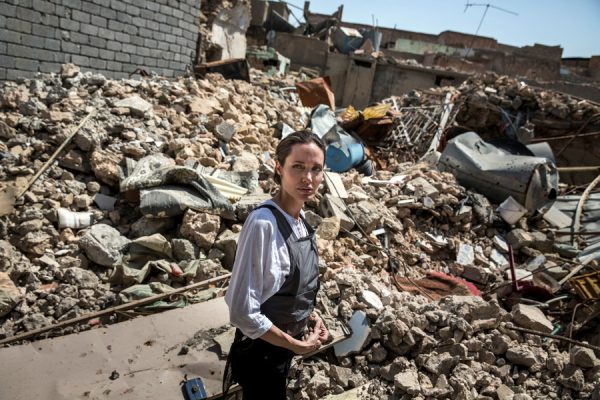
UNHCR Special Envoy Angelina Jolie visits the Old City in West Mosul, Iraq June 16, 2018. © UNHCR / Andrew McConnell
Surely, life is picking up in Mosul, yet at a very slow pace, with destruction seen in the background of every photo.
A photo worth a thousand words ❤#EidAlFitr in #Mosul#Iraq#BackToLifepic.twitter.com/5hZyPgToau
— ICRC Iraq (@ICRC_IQ) June 19, 2018

Iraqi workers repair a building in Mosul on March 15, 2018. © Ahmad Al-Rubaye / AFP
Restoring hope & heritage
Historical sites in both cities sustained massive damage during the fighting. An iconic landmark of Mosul, the Grand al-Nuri Mosque, was blown up by IS militants a month before the city was recaptured by the coalition. The monument was effectively reduced to rubble, and, nearly a year after, it remains in the same state – showing only signs of further deterioration and weathering.
The destroyed Grand al-Nuri Mosque is seen in the Old City of Mosul on January 17, 2018. © Ari Jalal / Reuters
Aleppo Citadel, on the other hand, not only endured the battle for the city, but it actually played one of the key roles in it, serving as a stronghold for Syria’s defenders once again. While the monument was damaged during the fighting, restoration – and demining – works were launched almost immediately after the city’s liberation. Now it’s open for everyone again.
Syrian children from the St. Francis Church summer camp enjoy an exploratory trip to Syria’s historic Citadel in Aleppo, free of terrorism.
You won’t be seeing these smiling faces on any mainstream media outlets because it doesn’t advance their agenda against Syria. pic.twitter.com/X3nrDoH0TH
— Sarah Abdallah (@sahouraxo) June 7, 2018
#Aleppo Citadel is back open for Syrian and Foreign Tourists. Fee to enter in US $ equivalent?
Foreign Tourists = $1.16
Syrian Visitors = $0.17
Syrian Soldiers = $0.12
Families of Martyrs = Free https://t.co/gMyRsQ3Rtupic.twitter.com/gZwLg4CCFG— EHSANI2 (@EHSANI22) June 20, 2018
Another iconic landmark of the city – the Umayyad Great Mosque – was less lucky and sustained way more serious damage, getting pierced with shrapnel and having one of its minarets toppled. While more work needs to be done, it looks way better now – and it actually serves its purpose.
Iraq receives dozens of advanced T-90 battle tanks from Russia
Press TV – Jun 7, 2018
The Iraqi military has received dozens of more advanced T-90 battle tanks from Russia under a major deal struck between Moscow and Baghdad last year.
The Iraqi Defense Ministry, in a statement released on Thursday, announced that it had taken delivery of 39 tanks, adding that the armored fighting vehicles had been distributed between two battalions of an army brigade.
The statement said that Iraqi military personnel had already been trained by Russian experts on how to operate the battle tanks.
Iraqi Army Chief of Staff General Othman al-Ghanimi said on February 19 that his country’s army had received 36 Russian-made T-90 battle tanks.
The T-90 is a third-generation Russian battle tank built upon the time-proven Soviet T-72 design.
It is among the best-selling tanks in the world, and known for its firepower, enhanced protection and mobility.
The T-90 features a smoothbore 2A46M 125mm main gun, which can fire both armor-piercing shells and anti-tank missiles.
The advanced tank also features sophisticated armor, ensuring all-round protection of the crew and critical systems, including explosive reactive armor and active infrared jammers to defend it from inbound rocket-propelled grenades, anti-tank missiles and other projectiles.
Indian, Algerian and Azerbaijani militaries have purchased hundreds of T-90 battle tanks in past years. Kuwait, Vietnam and Egypt have also expressed strong interest in buying the tank.
The Iraqi military plans to reinforce its fleet of M1A1 Abrams main battle tanks with T-90s. A large number of American M1A1 Abrams tanks have been damaged in the fight against Daesh Takfiri terrorists.
Featured Video
REDFIELD REWRITES THE RECORD
or go to
Aletho News Archives – Video-Images
From the Archives
Iran Delenda Est
By Stephen J. Sniegoski • Unz Review • July 25, 2019
After Carthage had been significantly weakened by Rome in the Second Punic War (218 to 201 BC), Cato the Elder, a leading Roman senator, is said to have ended all his speeches with the words: “Carthago delenda est!” (“Carthage must be destroyed!”). This destruction ultimately took place in the Third Punic War (149–146 BC). A somewhat similar situation exists today in the United States, where war hawks demand that Iran–which in no way could effectively attack the United States, or even conquer America’s Middle East so-called allies—be stripped of its ability to protect itself.
Of course, what makes the American situation different from ancient Rome’s is that Rome sought to eliminate Carthage for its own interests whereas the United States is largely acting to advance the military interests of Israel… continue
Blog Roll
Recent Comments
loongtip on Trump tells India to stop purc… eddieb on The Old Testament and the Geno… papasha408 on Trump’s war posturing against… Coronistan on This is How We Should Have Res… Coronistan on NO MANDATES, NO PROFITS: MODER… Lutz Barz on Russia Vows to Protect Its Oil… loongtip on Russia Vows to Protect Its Oil… loongtip on Hamas never agreed to lay down… eddieb on Conspiracy Denial eddieb on WEF Calls for ‘Cultural Revolu… loongtip on Trump wanted to play peacemake… Coronistan on EU member to sue bloc over ‘su…


 Aletho News
- REDFIELD REWRITES THE RECORD
- From Iraq war crimes to Gaza’s ‘board of peace’: Why Tony Blair belongs in The Hague
- Epstein email reveals plan to pursue frozen Libyan assets with help from former MI6, Mossad figures
- Trump tells India to stop purchasing Iran oil, buy Venezuelan instead
- How Trump’s Iran Gambit Could Blow Up the Entire Persian Gulf
- Rafah crossing reopens under strict Israeli restrictions
- The Attack on Pearl Harbor Was No Surprise (Part V)
- How Human Rights Watch Shattered Yugoslavia
- Hamas rejects Israeli accusations as “lies meant to justify its massacres in Gaza”
- Interior ministry: Israeli strike on police building in Gaza shows disregard for mediators
- If Americans Knew
- Israel killed at least 32 Gazans on Saturday – Not a ceasefire Day 114
- Is Israel opening the Rafah border to depopulate Gaza? – Not a ceasefire Day 113
- NBA Star Stephen Curry’s Ties To Israeli Military Intelligence
- ‘Apocalyptic wasteland’: Biden admin. blocked warning on deteriorating Gaza situation after Oct. 7
- Why Israeli counterterrorism tactics are showing up in Minnesota
- Israel Went to Extremes to Return Ran Gvili’s Body. Why Doesn’t It Accord Dead Palestinians the Same Respect?
- Across the West, speaking for Palestine is now a crime
- A West Bank Bus Trip Through ‘the Best Documented Ethnic Cleansing in History’
- Mike Huckabee’s distorted theology does not speak for Christians worldwide
- CBS Evening News” With Tony Dokoupil Is Ellisons’ & Weiss’s Pro-Israel Show
- No Tricks Zone
- One Reason Only For Germany’s Heating Gas Crisis: Its Hardcore-Dumbass Energy Policy
- 130 Years Later: The CO2 Greenhouse Effect Is Still Only An Imaginary-World Thought Experiment
- New Study Affirms Rising CO2’s Greening Impact Across India – A Region With No Net Warming In 75 Years
- Germany’s Natural Gas Crisis Escalates … One Storage Site Near Empty …Government Silent
- Polar Colding…Antarctica Saw Its Coldest October In 44 Years!
- New Study: Sea Levels Rose 20 Times The Modern Rate During The Roman Warm Period
- As German Gas Storage Dips Dangerously Low…Shortage Hardly Avoidable
- New Study: Brazil’s Relative Sea Level Was 2+ Meters Higher And SSTs 3-4°C Warmer 6000 Years Ago
- Philosopher Schopenhauer: Climate Science Certainty Stems From Stupidity, Ignorance
- New Study: Species Extinction Rates Declining Since 1980 – ‘Climate Change Is Not An Important Threat’
 Aletho News