US orders departure of non-emergency employees from Iraq
Press TV – May 15, 2019
The US State Department has ordered the departure of non-emergency government employees from Iraq, following Washington’s repeated expressions of concern about so-called threats from Iran’s allies in the Arab country.
The State Department ordered the pullout of the employees from both the US Embassy in Baghdad and its consulate in Erbil, the embassy said in a statement on Wednesday.
“Normal visa services at both posts will be temporarily suspended,” it said, recommending that those affected depart as soon as possible.
“The US government has limited ability to provide emergency services to US citizens in Iraq,” it added.
It was unclear how many staff members would leave.
US Secretary of State Mike Pompeo made an unannounced trip to Iraq on Tuesday, pressing Iraqi leaders about what he alleged were the increased dangers to Americans there from Iranian forces and their allies.
Despite this, the British general overseeing the so-called US-led coalition forces in Syria and Iraq has asserted that there has been “no increased threat from Iran” amid the US military buildup in the Persian Gulf.
British Major General Chris Ghika said at a Pentagon news briefing Tuesday that the coalition has seen “no increased threat from Iranian-backed forces” in the two countries.
The coalition has observed “no change in their posture since the recent exchange between the United States and Iran and we hope and expect that that will continue… We don’t see an increased threat from them at this stage,” Ghika told reporters.
Iraqi Prime Minister Adel Abdul-Mahdi said on Tuesday he was getting indications from talks with both the United States and Iran that “things will end well” despite the rhetoric.
The administration of US President Donald Trump has been ratcheting up economic and military pressure on Iran.
The US has deployed a carrier strike group and a bomber task force to the Middle East to confront what the Trump administration claims are “clear indications” of threats from Iran.
Iraq rebuffs US demand to stop Iran energy imports
Press TV – May 7, 2019
Iraq’s Electricity Minister Luay al-Khateeb says his country brushed aside US demands that Baghdad stop gas and power imports from neighboring Iran.
Khateeb, whose remarks were quoted by Iraqi media on Monday, did not say whether the Americans had made the demand after ending waivers for exports of crude oil from Iran this month.
US pressures on Iraq to wean itself off Iran has become a major point of conflict between Washington and Baghdad. A lightening rod in their spat is Iraq’s reliance on Iranian gas imports to generate electricity consumed daily in the country.
Washington is pressing Baghdad to source them from other countries or develop its own energy self-sufficiency. Iraqi leaders say the country cannot stop Iranian gas imports without serious electricity shortages.
In their latest back and forth, Iraq told the Americans that it needed Iran gas imports for at least three more years, Khateeb said.
“Iraq now imports nearly 1,200 megawatts of electricity from Iran. It also imports gas from Iran to produce another 2,800 megawatts of electricity,” the Iraqi minister said.
“If in the next two to three years, large projects are implemented in the field of electricity generation, we can reach self-sufficiency and need no more imports,” he added.
Iraq has signed agreements with General Electric and Siemens over potential deals to develop the country’s power infrastructure.
Siemens had been favorite to win a contract to supply 11 gigawatts of power-generation equipment in a possible $15 billion deal, but the German group has to share the work with US rival after pressure from the Trump administration.
Washington is also pushing for Saudi Arabian and Kuwaiti investment in Iraqi power infrastructure in order to reduce Iran’s trade share.
Without Iran, however, Iraq could lose around a third of its power overnight. The Arab country faces sweltering months ahead when the electricity shortage becomes acute.
The shortage sparked violent protests in southern Basra last September, which spread to other cities, including Baghdad.
Iran is also Iraq’s third-largest trading partner, with an estimated $12 billion in cross-border trade per year, and the countries share strong cultural, religious and geographic ties.
Last month, Iraqi Prime Minister Adel Abdul-Mahdi visited Iran for his first official visit since he took office and the two countries pledged to raise trade to $20 billion in two years.
Head of the National Iranian Gas Company (NIGC) Hassan Montazer Torbati said this month that Iran is about to raise gas exports to neighboring Iraq to 35 million cubic meters a day this year.
“Last year we exported gas to Turkey, Baghdad and Basra with an average of over 40 million cubic meters a day, and this year, gas exports to Iraq will reach more than 35 million cubic meters per day,” he told a news conference in Tehran.
US troops kill Iraqi policeman, injure two others while ‘transferring’ Daesh terrorists: Report

Police vehicle belonging to Iraqi police forces that were targeted by US forces in the country’s northern province of Kirkuk on April 25, 2019. (Photo via Alahad)
Press TV – April 26, 2019
American troops have killed an Iraqi policeman and injured two others while allegedly transferring a group of Daesh Takfiri terrorists in the country’s northern province of Kirkuk.
The incident happened after American troops were deployed to the region by helicopter in an attempt to airlift the terrorists to an undisclosed region, Iraq’s Alahad television network reported on Friday.
The operation turned deadly after US forces opened fire on an Iraqi police unit nearby. Iraqi forces had been monitoring the Daesh elements but were not informed of the US operation.
Iraq’s Joint Operations Command (JOC) later issued a statement announcing the formation of a committee investigating the incident.
During an interview with the Alahad, Iraqi law expert Ali al-Tamimi claimed the incident was a case of intentional murder that should be dealt with according to Iraqi law.
Tamimi stressed that based on mutual agreements, the military immunity of US forces expired after the 2011 withdrawal from Iraq.
The Asa’ib Ahl al-Haq group, a main component of Iraq’s Popular Mobilization Units (PMU), later issued a statement describing the incident as a violation of Iraq’s sovereignty.
The statement said that despite Washington’s claims that US military presence in the country is to provide military and logistical assistance to Iraqi forces, American forces have operated in the country at will and without coordination with Iraqi forces.
While circumstances surrounding the incident remain unclear, this is not the first incident where US forces have ‘airlifted’ Daesh terrorists to undisclosed locations. Many similar cases have also been reported in Syria.
US aircraft reportedly airlifted Daesh commanders from a northwestern town before the Syrian army staged an offensive to liberate it.
Daesh overran large swaths of Syria and Iraq in offensives beginning in 2014. The group was, however, militarily defeated by the governments of the two countries in the course of some four years.
Speculations have been made about Washington’s direct or indirect support for the terrorist group in the past years.
Numerous accounts have emerged alleging airlifts, weapon airdrops and aerial support for the group, especially as its strength gradually diminished in the region.
Mideast States Join Iraq Summit in Blow to US-Led ‘Arab NATO’ Initiative
Sputnik – April 20, 2019
The summit marks a shift in Iraq’s foreign policy, with the country assuming the role of a mediator in the region as US President Donald Trump has revived the Obama-era concept of an anti-Iranian alliance of Gulf nations.
Iraq is hosting a one-day summit, which brings together the country’s neighbours: Syria, Turkey, Jordan, and Kuwait, as well as two long-time rivals – Saudi Arabia and Iran – in a blow to the US-led “Arab NATO” initiative, Press TV reported.
“This is a positive message to all neighbouring countries and the world that Iraq is determined to regain its health and return to its Arab, regional environment and assume its rightful place in the map of the balance of power”, Bashir Haddad, deputy parliamentary speaker said.
The development comes as US President Donald Trump breathed new life into the Obama-era initiative, “Middle East Strategic Alliance”, commonly referred to as “Arab NATO”, to forge an anti-Iran alliance of Gulf nations.
In 2017, the Trump administration suggested creating an alliance to stop what the US called Tehran’s “malign activities” in the Middle East.
The plan, first proposed by Saudi Arabia in 2017, was promoted by US Secretary of State Mike Pompeo, who even met with Qatari officials last year in a bid to deescalate tensions between Doha and Riyadh to push the idea forward.
Aside from the US and Saudi Arabia, the so-called Middle East Strategic Alliance would hypothetically include the UAE, Oman, Bahrain, Kuwait, Qatar, Jordan and Egypt to counter Iran, deepen defence relations, energy cooperation and deal with regional threats. However, Egypt reportedly dealt the first blow to the proposal last week, having withdrawn from the initiative over concerns of damaging relations with Iran.
Iran, Iraq and Syria considering transnational railway project: Report
Press TV – April 13, 2019
Iraq says negotiations are underway with Iran and Syria to develop a transnational railway line linking the three countries.
Iraqi Republic Railways Company chief Salib al-Hussaini said a summit will be held between the countries to further discuss the matter, the Arabic-language al-Sumeria news website reported on Friday.
The comments made on the sidelines of the joint Syrian-Iraqi committee held in Damascus came a week after Iranian First Vice-President Eshaq Jahangiri spoke of an initiative to link the Persian Gulf to the Mediterranean.
“We will connect the Persian Gulf from Iraq to Syria and the Mediterranean via railway and road,” said Jahangiri, making reference to the construction of a railway linking the Iranian Shalamcheh border region to the Iraqi city of Basra.
The Shalamcheh-Basra railway project is estimated to cost 2.22 billion rials and can link Iran to Syria via Iraq.
Speaking last December, Director General of the Railway and Technical Structures Department at the Islamic Republic of Iran Railways (RAI) Mohammad Mousavi said Iran was planning to build a movable railway bridge over the Arvand river as part of the Shalamcheh-Basra project.
Mousavi said the project would effectively link the Iranian cities of Khorramshahr and Abadan along with the Imam Khomeini Port to the Iraqi city.
The railway project was agreed to last month when Iran and Iraq signed five memorandums of understanding for the expansion of bilateral cooperation in various economic and healthcare sectors.
Observers have described the new agreements as a sign of Baghdad’s serious intention of not being “party to the system of sanctions against Iran” as Prime Minister Abdul-Mahdi said earlier in February.
Iraq heavily depends on Iran for everything from food to machinery, electricity, natural gas, fruits and vegetables.
Last year, Iran exported $8.7 billion worth of commodities to Iraq, overtaking Turkey with $7.3 billion of exports.
President Hassan Rouhani said last week that Iran and Iraq had plans to expand bilateral trade volume to $20 billion in the future.
Iran and Syria also signed a series of “historic” agreements earlier this year, including a “long-term strategic economic cooperation” deal described as a sign of changing realities in the Middle East.
Syrian Prime Minister Imad Khamis said the “historic” agreements covered cooperation in fields of industry, trade and agriculture. He called the agreement “a message to the world on the reality of Syrian-Iranian cooperation.”
Iraq and Syria have been expanding political and economic ties with Iran as they seek assistance in the post-war reconstruction of their countries which had large swathes of their territories overrun by foreign-backed terrorist outfits in the past years.
Iran has been offering military advisory support to Iraq and Syria at the request of their governments, enabling their forces to speed up gains on various fronts against the terrorist groups.
Iran, Iraq ‘agree on aerial defense cooperation’
Press TV – April 7, 2019
Iran’s top military commander says the country and its neighbor Iraq have agreed to cooperate in the area of air defense to fend off the challenges facing their respective air spaces.
Chairman of the Chiefs of Staff of the Iranian Armed Forces Major General Mohammad Baqeri made the announcement to reporters following a meeting in Tehran with his visiting Iraqi counterpart, Lieutenant General Othman al-Ghanimi, Tasnim News Agency reported on Sunday.
The cooperation, Baqeri said, will be aimed at confronting aerial threats.
The meeting addressed “the integrated defense of Iran and Iraq’s skies, because we might sense threats coming from the direction of [our] western borders,” he added.
“Accordingly, it was agreed that the countries’ air defense sectors work together and more coordination be made in this regard,” the Iranian commander said.
Baqeri said the two sides also agreed on potential training cooperation, the transferring of Iran’s defensive experiences to Iraq, and joint military exercises. Agreements on these, he added, will be finalized during a future visit by the Iraqi military chief.
Ghanimi was in the Iranian capital as part of a delegation accompanying Iraqi Prime Minister Adel Abdul-Mahdi. On Saturday, the delegation met with Leader of the Islamic Revolution Ayatollah Seyyed Ali Khamenei and President Hassan Rouhani.
Baqeri cited the Iraqi commander as saying that Baghdad would be exercising stricter control on the United States’ military presence on its soil.
The American forces are only there to train Iraqis and their activities are under the Iraqi Army’s oversight, Baqeri added, citing al-Ghanimi.
In his meeting with Ghanimi, Ayatollah Khamenei had stressed that the Iraqi government should make sure that US forces leave Iraq as soon as possible.
Iranian official rejects US secretary of state’s ‘fabricated’ allegations
Press TV – March 14, 2019
A senior Iranian official has dismissed US Secretary of State Mike Pompeo’s recent claims about Iran’s regional role as “fabricated,” saying the United States practices fear-mongering in order to sell more arms to the countries in the region.
“Certain US officials, influenced by the Zionist lobby, have been making utmost efforts to intoxicate the atmosphere against Iran,” Iran’s Foreign Ministry Spokesman Bahram Qassemi said on Thursday.
In a meeting with United Nations Secretary General Antonio Guterres on Wednesday, Pompeo expressed concerns over what he called Iran’s “destructive and disruptive activities” across the Middle East region.
Qassemi said US officials were making up allegations against Iran in order to sustain an appearance of crisis in West Asia and thus increase American arms sales to the region.
The Iranian official also censured remarks made by Pompeo in the CERAWeek conference — an annual US oil and gas industry forum — regarding relations between the Islamic Republic and Iraq.
Addressing the conference in Houston on Tuesday, Pompeo had said, “Iran uses its energy exports to exert undue influence all across the Middle East, most particularly today on Iraq.”
Qassemi said Pompeo was angered by the close relations between Iran and Iraq.
“The relations between Iran and Iraq have been established totally based on the will of the two countries’ leaders and nations and [have been] based on mutual respect and trust and shared interests,” he said, adding that neither of the two countries was seeking to impose its will on the other.
On Monday, Iranian President Hassan Rouhani traveled to Iraq at the head of a high-ranking delegation. The state visit featured several meetings between President Rouhani and Iraq’s top leadership, and the signing of memorandums of understanding for the expansion of bilateral ties in various fields, including the energy sector.
On Wednesday, President Rouhani traveled to the Iraqi city of Najaf to meet with senior religious leaders there, including most prominently with Iraq’s top Shia cleric Grand Ayatollah Ali al-Sistani. Rouhani was the first Iranian president ever to meet with Ayatollah Sistani, signifying the depth of bilateral relations between Tehran and Baghdad.
Qassemi, the Iranian Foreign Ministry spokesman, pointed to the deep-rooted relations between Iran and Iraq and said the two countries had stood by each other during “tough times.”
Earlier, US President Donald Trump had made an unannounced and very brief trip to Iraq in the dark of the night and landed at a military base where he only met US soldiers and no Iraqi officials before he left the country.
Iran to US: Era of meddling in other countries over
Press TV | March 12, 2019
Tehran slams the US for sticking to its interventionist policies after an American official sought to cast doubt on the motives of the Iranian president’s trip to Iraq, saying the two neighbors have chosen to build strategic relations based on good neighborliness and seek permission from no one for their choices.
“Iran and Iraq are two independent countries, whose governments have been elected by the votes of the two countries’ people and undoubtedly these two nations…do not need a country with a black record of aggression and warmongering and destruction to make decisions on their behalf from thousands of kilometers away,” Foreign Ministry Spokesman Bahram Qassemi said on Tuesday.
He made the remarks in reaction to claims by US Special Representative Brian Hook about Iranian President Hassan Rouhani’s ongoing visit to Iraq.
In an interview with Alhurrha TV on Monday, Hook questioned Iranian President Hassan Rouhani’s “motives” regarding Iraq and said when the Iranian government does “prioritize his own people so why on earth he would prioritize the welfare of the Iraqi people.”
“President Rouhani coming to Iraq is not in the interest of the Iraqi people”, Hook said, claiming that Iran wants to secure a “military highway” through Iraq to the Western parts of the Middle East to transfer missiles, weapons and fighters across the Middle East.
The Iranian spokesperson dismissed the allegations and said “this American official’s anger is not surprising because it seems that his country has failed to gain a proper position among regional nations despite spending billions of dollars in the Middle East.”
Qassemi emphasized that Washington’s aggressive policies, militarism and interventionism are the main reasons behind its lack of success.
He urged US officials to set aside their decades-long excessive demands and realize that the era of meddling in the affairs of other countries and making decisions for them has come to an end.
Rouhani arrived in Baghdad at the head of a high-ranking politico-economic delegation on Monday on his first visit to the country since 2013. The three-day trip is aimed at solidifying strategic ties despite US efforts to keep the two neighbors apart and curb Iran’s influence in the region.
In a joint statement on Tuesday, Iran and Iraq hailed the Iranian president’s historic visit to Iraq as a “turning point” in efforts to strengthen “strategic” cooperation between the two neighbors based on non-interference in each other’s internal affairs.
During Rouhani’s visit, the two neighbors have inked several agreements on the expansion of bilateral cooperation in various economic and healthcare sectors.
See also:
In joint statement, Iran, Iraq hail ‘turning point’ in ‘strategic’ cooperation
Trump’s Syria ‘Pullout’ Aimed at Aggressing Iran

By Finian CUNNINGHAM | Strategic Culture Foundation | 09.02.2019
US President Donald Trump again this week portrayed his plan to pull troops out of Syria as a “victory homecoming” and “an end to endless wars”. Then, in stepped Secretary of State Mike Pompeo to clarify what’s really going on: it’s a “tactical change” to put Iran in the crosshairs.
The purported pullout is not a return of US military from the Middle East, as Trump has been trumpeting with self-congratulations. It’s more a reconfiguration of American military power in the strategically vital region, and in particular for greater aggressive leverage on Iran.
In his State of the Union speech to Congress this week, Trump talked about giving a “warm welcome home to our brave warriors” from Syria. Supposedly it was “mission accomplished” for the US in defeating the ISIS terror group in that country.
It should be pointed out that ISIS would not have been in Syria or Iraq if it were not for criminal American military interventions, covert and overt, in those countries.
In any case, Trump was proclaiming America “victorious”, and so it was time, he said, to follow up on his order given in December for the 2,000 or so troops (illegally present) in Syria to withdraw.
The day after his nationwide address, Trump reiterated the theme of glorious homecoming at a forum of the Global Coalition to Defeat ISIS, held in Washington DC. This was a two-day gathering of dozens of US allies who have been attacking Syrian territory in the name of fighting terrorists (terrorists that many of these same coalition members, such as Saudi Arabia and Turkey, have been covertly sponsoring.)
“We look forward to giving our warriors a warm welcome home,” Trump again told delegates after informing them that the ISIS caliphate had been virtually destroyed by US forces and partners.
His top diplomat Mike Pompeo, however, assured the gathering that the US was still “leading the fight against terror” and that the planned troop withdrawal from Syria was only a “tactical maneuver”. He said that what Washington wanted was for more regional partners to take over military operations from the US.
When Trump first made the announcement of a troop withdrawal from Syria on December 19, there was immediate pushback from military figures in the Pentagon and politicians in Washington. Together with a proposed drawdown of US forces in Afghanistan by Trump, it was construed that the president was signaling a wholesale retreat from the region.
Since the “surprise” announcement by Trump, lawmakers within his Republican party have been doubling down to prevent any pullout from Syria or Afghanistan. This week, the US Senate voted through legislation to block any abrupt withdrawal, claiming that, contrary to Trump’s assertions, ISIS has not been defeated and still poses a national security threat.
The Pentagon has also been warning of a “resurgence” of ISIS in Syria and Iraq if US forces were to pull out. A Department of Defense document published this week quoted Pompeo. “Following the president’s announcement in December 2018 to withdraw troops from Syria, Secretary of State Mike Pompeo stated that the policy objectives of defeating ISIS and deterring Iran had not changed.”
In other words, the Pentagon is busily rationalizing for entrenchment in the region, not for a retreat.
Last month, while on a nine-nation tour of the Middle East, Pompeo was at pains to emphasize to America’s Arab client regimes that Trump’s pullout from Syria was a reorganization of military forces, not an overall withdrawal. During his tour, Pompeo renewed Washington’s project to create an “Arab NATO” for the region, with the top priority being to contain Iran. According to Radio Free Europe, he said, “the United States is redoubling efforts to put pressure on Iran.”
Next week, the US has organized a conference to be held in Poland which is dedicated to intensifying international pressure on Iran. The indications are that senior European Union officials will not attend the summit as it is stoking tensions with Tehran at a time when the EU is striving to save the nuclear accord with Iran.
However, the conference in Poland testifies to ramped up efforts by Washington to isolate Iran internationally and provoke instability in the country for regime change. Since Trump walked away from the internationally-backed nuclear accord last year, his administration has been piling on the aggressive rhetoric towards Iran, in particular from his national security advisor John Bolton, as well as Pompeo.
This obsession to confront Iran would explain the real significance of Trump’s supposed pullout plans in Syria and Afghanistan. Both countries have been utter failures for US imperialism. They are a dead loss, despite the self-congratulatory nonsense spouted by Trump.
What the White House is intent on doing, it seems, is redirecting its military forces in the region away from dead-end causes for a more aggressive stance towards Iran. Pompeo’s “clarifications” about Trump’s troop withdrawal makes it clear that what is going on is not a scaling down of American military power in the region, but a reconfiguration.
Trump himself has indicated that too. In a recent interview with the CBS channel, Trump said that US forces would be reassigned from Syria to Iraq where the Pentagon has several large military bases. He explicitly said that the US forces in Iraq would be used to “keep a watch on Iran” and the wider region.
Trump’s braggadocio immediately got him into hot water with the Iraqis. Iraqi President Barham Salih fulminated that the 5,000 or so US troops in his country were there strictly for the purpose of combating terrorism, not for “watching Iran” or any other neighboring country. Other Iraqi lawmakers have been so incensed by Trump’s comments that they are calling for the presence of US forces to be terminated.
Thus, the apprehensions among the bipartisan War Party in Washington and some at the Pentagon regarding Trump’s purported troop pullout from Syria and Afghanistan are misplaced. Trump is not “ending the endless wars” that feed American imperialism and its war-machine economy.
Far from it. The Condo King is simply moving the Pentagon’s real estate around the region in order to get a better view of the planned aggression towards Iran.
Featured Video
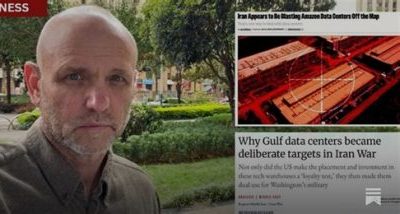
Iran spent $1 million to wipe out $30 billion in data center plans, and take down Amazon in the ME
or go to
Aletho News Archives – Video-Images
From the Archives
Clash of Civilization, Iran Part II
By Jamal Kanj – Intifada-Palestine.com – January 14, 2011
Israel’s survival kit is: perpetuate conflict, insecurity to rationalize collective hate and finally playing victim.
Devoid of conflict, Israel implodes internally; without hate, Zionism loses its justification; and playing eternal victim to continue blackmailing the West. Absence of this holy trinity, Israel ceases to exist. … continue
Blog Roll
 Aletho News
- China Rejects Outside Pressure on Trade Ties After New US Russia Sanctions Bill
- Houthis Keep Advancing as the Red Sea Crisis Deepens
- Iran spent $1 million to wipe out $30 billion in data center plans, and take down Amazon in the ME
- Zionist billionaire pressure to silence Macklemore sparks exodus from Ed Sheeran tour
- House Votes to End Iran War for Third Time
- North Korea Slams US Plan for ‘AUKUS 2.0’ with South Korea and Japan
- Prolonging US-Iran Conflict Not Meeting Interests of Int’l Community – China’s Wang Yi
- EU bans former Zelensky aide from parliament
- NATO-backed Kosovo separatist ‘responsible for war crimes’
- US destroying international space law
- If Americans Knew
- U.S. Makes, Israel Takes: The Real Story of U.S.-Israeli Military Cooperation
- Night raids rise in Palestine
- Tucker Carlson interviews Norman Finkelstein about Gaza
- Groups urge Americans to support Van Hollen legislation on Israel’s killing of Americans & Palestinians
- Trump administration plans to send 40,000 tons of bombs to Israel: report
- Sanctions Target Iran’s Government, But Kill Hospitalized 23-Year-Old Woman
- An alternative view on the book “Israel’s Lobby: America in the Grip of a Foreign Power”
- Ed Sheeran’s band Beoga, other opening acts quit tour after Macklemore was dropped over his pro-Palestinian comments
- The assassination attempt on President Trump in Butler and the various Israeli connections to it
- “We Want That the Whole Land Be Jewish”
- No Tricks Zone
- New Study: ‘Global Drought Shows No Detectable Recent Acceleration Under Climate Warming’
- Economic Masterminds: German Socialists Suggest Taxing Productivity Gains Stemming From Using AI
- The South China Sea Has Not Been Cooperating With The Climate Change Narrative
- Energy Crisis: Germany Enters Heating Season With Historically Low Gas Reserve Fill Levels
- New Study: The Antarctic Ice Sheet Gained Mass From 2020-2024 Due To Staggering Snow And Ice Accumulation
- Study: Ocean Heating Rates From Thousands Of Years Ago ‘Dwarf’ Modern Ocean Heating Rates
- Climate Extremists Target, Attack Large-Scale Power Grid Infrastructure In Germany!
- New Study: Antarctic Ice Melt Has Contributed Less Than 1 Centimeter To Sea Level Rise In The Last 30 Years
- Fear Of Debate: Alarmist German Climate Scientist Calls On Mainstream Media To Discredit Skeptic Voices
- End-Of-August Arctic Sea Ice Extent Hasn’t Fallen In 20 Years, Official Data Show!
 Aletho News