Pentagon resists US withdrawal from Syria, claims ISIS might rise again
RT | February 5, 2019
The newest report on US-led operations against Islamic State in Iraq and Syria admits the terrorist group is down to some 2,000 fighters, but argues continued US presence in the region is needed to prevent its resurgence.
Published on Monday, the report authored by the Pentagon and State Department inspectors-general also blamed Turkey for spoiling the US-backed Kurdish militia’s operations against Islamic State (IS, formerly ISIS/ISIL), and predicts no end to strife in the region, going against President Donald Trump’s order to withdraw US troops from Syria.
The report debunked the widely circulated estimate – from June 2018 – that IS had up to 17,000 fighters in Iraq and up to 14,000 in Syria, calling it questionable even at the time. The US-led coalition, known as the Combined Joint Task Force – Operation Inherent Resolve (CJTF-OIR) had “low confidence” in those estimates as of last July, the report said. As of January, CJTF-OIR estimated only 2,000 IS fighters remaining in the group’s last remaining bastion – known at the Pentagon as the Middle Euphrates River Valley (MERV) and located in eastern Syria near the Iraqi border.
The coalition gave conflicting assessments of IS strength and capabilities, reporting at the end of December that it “remains a battle-hardened and well-disciplined force,” with high morale and “unfazed by Coalition airstrikes,” only to say its morale was “trending downward” in January.
Since December, IS has killed several coalition soldiers in ambushes and with roadside bombs. According to CENTCOM, these are “opportunistic attacks” that will allow the militants to claim a propaganda victory.
‘We have to protect Israel’
Even as US troops are pulling out of Syria, President Trump has said he wants to keep some forces in the region “to protect Israel” and “watch Iran.”
“We have to protect other things that we have,” Trump told CBS on Sunday, but said the troops will be “coming back in a matter of time.”
Monday’s report, on the other hand, matches the reasoning of US intelligence chiefs last week that IS will rise again in the absence of US troops – although only in the limited area near its current holdout, rather than Syria and Iraq as a whole.
“You’ve got these divergent narratives,” security analyst Charles Shoebridge told RT. “Trump is speaking from the hip, if you like, he is speaking off the cuff, and it might be what he’s saying is actually a little bit closer to the truth of where the American strategy actually lies.”
The US ‘deep state’ is firmly against withdrawal from Syria, Shoebridge noted.
Turkey blamed for failure of US-backed offensive against ISIS
One of the things the report revealed is that the US-backed militia was presumably on the brink of crushing the last IS holdout in the Euphrates Valley, but had to halt their operation when Turkey threatened to intervene against the Kurdish fighters.
The Kurdish YPG militia makes up more than two thirds of the US-backed Syrian Democratic Forces (SDF), which the US have used as the main proxy against IS in northeastern Syria. With the YPG busy against the Turks, the Arab component of the SDF was “unable to conduct” offensive operations, and actually lost ground to IS in late October and November, when bad weather prevented coalition airplanes from flying.
It was only in mid-November, when the YPG was back in the fight, that the SDF was able to roll back IS gains, the report said, describing the YPG “paramount to stability and efforts to defeat ISIS.”
The report was also skeptical of Turkey’s offer to take over the battle against IS, noting that with the exception of the 2016 Al-Bab operation, “Turkey has not participated in ground operations against ISIS in Syria since 2017, nor have Turkish forces participated in the fight against ISIS in the MERV, which is approximately 230 miles away from al Bab and the Turkish border.”
Let Syria finish the job?
IS will remain an issue unless Sunni “socio-economic, political, and sectarian grievances are not adequately addressed by the national and local governments of Iraq and Syria,” the soldiers and diplomats argue. Left unsaid is that these grievances are a product of upheaval caused by the 2003 US invasion of Iraq and the US support for sectarian rebels in Syria starting in 2011.
Conspicuously absent from the report is the Syrian government, which has fought IS successfully with the support of Hezbollah, Iran and Russia, Shoebridge told RT.
If the SDF strikes a deal with Damascus following the US withdrawal, Shoebridge said, “the Syrian government could fill that vacuum, and continue with their very successful campaign against ISIS themselves.”
Death Knell For Syria Pullout: “We Have To Protect Israel” Says Trump
By Tyler Durden – Zero Hedge – 02/03/2019
After approaching two months of talk of a “full” and “immediate” US troop withdrawal from Syria, first ordered by President Trump on December 19 — which was predictably met with swift and fierce pushback from beltway hawks including in some cases his own advisers — it now appears the death knell has sounded on the prior “complete” and “rapid” draw down order.
Trump said in a CBS “Face the Nation” interview this weekend that some unspecified number of US troops will remain in the region, mostly in Iraq, with possibly some still in Syria, in order “to protect Israel” in what appears a significant backtrack from his prior insistence on an absolute withdrawal.
“We’re going to be there and we’re going to be staying. We have to protect Israel,” he replied when pressed by CBS reporter Margaret Brennan. “We have to protect other things that we have. But we’re – yeah, they’ll be coming back in a matter of time.” He did note that “ultimately some will be coming home.”
“Look, we’re protecting the world,” he added. “We’re spending more money than anybody’s ever spent in history, by a lot.” Trump’s slow drift and change in tune on the subject of a promised “rapid” exit comes after Israeli officials led by Prime Minister Netanyahu alongside neocon allies in Washington argued that some 200 US troops in Syria’s southeast desert along the Iraqi border and its 55-kilometer “deconfliction zone” at al-Tanf are the last line of defense against Iranian expansion in Syria, and therefore must stay indefinitely.
“I want to be able to watch Iran,” Trump said further during the CBS interview. “Iran is a real problem.” He explained that “99%” of ISIS’s territory had been liberated but that a contingency of US troops must remain to prevent a resurgent Islamic State as well as to counter Iranian influence, for which American forces must remain in Iraq as well.
“When I took over, Syria was infested with ISIS. It was all over the place. And now you have very little ISIS, and you have the caliphate almost knocked out,” the president said. “We will be announcing in the not too distant future 100% of the caliphate, which is the area – the land – the area – 100. We’re at 99% right now. We’ll be at 100.”
However Trump’s invoking Iranian influence as a rationale for staying further contradicts his prior December statement that the defeat of ISIS was “the only reason” he was in Syria in the first place.
MARGARET BRENNAN: How many troops are still in Syria? When are they coming home?
PRESIDENT DONALD TRUMP: 2,000 troops.
MARGARET BRENNAN: When are they coming home?
PRESIDENT DONALD TRUMP: They’re starting to, as we gain the remainder, the final remainder of the caliphate of the area, they’ll be going to our base in Iraq, and ultimately some will be coming home. But we’re going to be there and we’re going to be staying—
MARGARET BRENNAN: So that’s a matter of months?
PRESIDENT DONALD TRUMP: We have to protect Israel. We have to protect other things that we have. But we’re- yeah, they’ll be coming back in a matter of time. Look, we’re protecting the world. We’re spending more money than anybody’s ever spent in history, by a lot. We spent, over the last five years, close to 50 billion dollars a year in Afghanistan. That’s more than most countries spend for everything including education, medical, and everything else, other than a few countries. — CBS “Face the Nation” Feb.3 interview transcript
The Pentagon in recent weeks has reportedly been putting logistics in place for a troop draw down from northern and eastern Syria.
Though it remains unclear just how many troops could remain as the majority possibly begin to pullout toward US bases in Iraq, the Tanf base could remain Washington’s last remote outpost disrupting what US defense officials see as a strategic Baghdad-Damascus corridor and highway, and potential key “link” in the Tehran-to-Beirut so-called Shia land bridge.
Foreign Policy magazine has identified this argument as the final card the hawks opposing Trump’s draw down had to play in order to hinder to an actual complete US exit:
“Al-Tanf is a critical element in the effort to prevent Iran from establishing a ground line of communications from Iran through Iraq through Syria to southern Lebanon in support of Lebanese Hezbollah,” an unnamed senior US military source told the magazine.
The Israeli prime minister has pushed hard against the White House pullout plan, and “has repeatedly urged the U.S. to keep troops at Al-Tanf, according to several senior Israeli officials, who also asked not to be identified discussing private talks,” per Bloomberg. The Israelis have reportedly argued “the mere presence of American troops will act as a deterrent to Iran” even if in small numbers as a kind of symbolic threat.
The internal administration debate, following incredible push back against Trump’s withdrawal decision, has made entirely visible the national security deep state’s attempt to check the Commander-in-Chief’s power. And now US presence at al-Tanf represents the last hope of salvaging the hawks’ desire for permanent proxy war against Iran inside Syria.
It appears the deep state has won out over Trump’s initial policy decision once again; but it remains to be seen if, however slowly on what’s clearly a delayed timetable departing from his original plans, all US troops ultimately exit Syria. Until then there’ll be more time and perhaps more provocations the hawks can rely on to effectively ensure full circle return to indefinite occupation in Syria.
President Salih: Trump did not ask Iraq permission to watch Iran
Press TV – February 4, 2019
Iraqi leaders have hit back at Donald Trump after the US president said he plans to keep troops in the country to spy on Iran, with President Barham Salih saying the mission does not have Baghdad’s permission.
Their reaction on Monday came a day after Trump told CBS that US troops would leave Syria and Afghanistan but stay on in Iraq, partly “to be looking a little bit at Iran.”
Trump admitted that staying in Iraq is a “mistake” and that attacking Iran is not an option, but the remarks sparked a new round of demands in Baghdad for US forces to leave the country.
“The Iraqi constitution rejects the use of Iraq as a base for hitting or attacking a neighboring country,” President Salih said Monday.
Salih said US forces were in the country under an agreement between the two countries, but that “any action taken outside this framework is unacceptable.”
The Iraqi president insisted that Trump had not asked Baghdad’s permission for US troops in Iraq to “watch Iran.”
“Don’t overburden Iraq with your own issues,” Salih said. “The US is a major power … but do not pursue your own policy priorities, we live here.”
“It is of fundamental interest for Iraq to have good relations with Iran” and other neighboring countries, Saleh said.
He said US forces were in Iraq to fight terrorism and that he looked forward to hearing Washington’s clarification on the number of troops who were going to stay as well as their mission.
In his interview aired on Sunday, Trump defended his decision to end “endless wars” in Syria and Afghanistan by pulling out US troops from those countries.
However, he said not all of thousands of American forces stationed in Iraq, specially at the Ain al-Asad Air Base in the western Anbar Province, were going to return home.
“And one of the reasons I want to keep it (the base) is because I want to be looking a little bit at Iran because Iran is a real problem,” said the American president.
Asked whether he wanted the troops there to “strike” Iran at a later time, Trump responded: “No… All I want to do is be able to watch.”
“We have an unbelievable and expensive military base built in Iraq. It’s perfectly situated for looking at all over different parts of the troubled Middle East rather than pulling up,” he added.
Trump announced in December that all US military troops in Syria would return home in the coming months while the number of US forces in Afghanistan would also be reduced drastically.
Trump made an unannounced stop at Ain al-Asad base on Christmas, in a visit that drew fire from Iraqi officials and their counterparts in Iran and other neighboring countries.
Sabah al-Saadi, a member of parliament in the bloc led by influential anti-American cleric Moqtada Sadr, has proposed a bill demanding a US pullout.
Deputy speaker of parliament Hassan Karim al-Kaabi, also close to Sadr, said Monday Trump’s latest remarks have made passing such a law “a national duty” because they are a violation of Iraq’s sovereignty and constitution.
The remarks, he said, are a “new provocation,” weeks after the US president sparked outrage in Iraq by visiting US troops without meeting a single Iraqi official.
The Iraqi parliament, he said, will soon pass a bill that will end the ongoing security agreement with Washington as well as the presence of all foreign forces in Iraq.
Kaabi asserted that his country would never become a launchpad for attacks or a US backyard for intelligence gathering against other countries.
Iraqi leaders say there are no American bases on its soil, stressing that only instructors are deployed at Iraqi bases.
Kurdish MP Sarkawt Shams tweeted that the mission of US troops in Iraq was “to help Iraqi security forces against terrorism, not ‘watching’ others.”
“We are expecting the United States to respect our mutual interests and avoid pushing Iraq into a regional conflict,” he said.
Trump’s comments ‘embarrassing’ for Baghdad
Iraq’s former foreign minister Hoshyar Zebari also condemned Trump’s remarks, saying they were embarrassing for Baghdad.
The veteran Kurdish politician warned Iraqi officials that the country would face difficult choices in future following Trump’s controversial statements.
Jaafar al-Husseini, a spokesman for the Iraqi pro-government Kata’ib Hezbollah voluntary forces, warned the Trump administration against mounting offensives against Iran and Syria from Iraq.
He also called on parliament to speed up legislation to drive out foreign forces, warning that the anti-terror force won’t wait long.
The spokesman noted that Iraq’s security agencies should deem American military forces as “appropriate targets” as Iraqi resistance groups already do.
‘Greatest mistake US ever made’
In his interview on Sunday, Trump once again called the US war on Iraq as “one of the greatest mistakes” the United States had ever made.
He also defended his attacks on US intelligence assessments on Iran, saying they tend to miscalculate as they led former President George W. Bush into attacking Iraq by claiming that Baghdad had weapons of mass destruction (WMDs).
“President Bush had intel people that said Saddam Hussein in Iraq had nuclear weapons- had all sorts of weapons of mass destruction. Guess what? Those intel people didn’t know what the hell they were doing, and they got us tied up in a war that we should have never been in,” he said.
Last Wednesday, Trump went on a twitter rant to attack his intelligence chiefs’ assessments on Iran’s growing power despite Washington’s pressure campaign following his pullout from the 2015 Iran nuclear deal.
The tweets came in response to Tuesday statements by CIA Director Gina Haspel and Director of National Intelligence Dan Coats before the US Senate Intelligence Committee.
Haspel told the panel that despite Trump’s decision last May to withdraw from the nuclear deal, the Islamic Republic had been “making some preparations that would increase their ability to take a step back.”
Coats also acknowledged that Tehran was not seeking to develop nuclear weapons capabilities.
Partition: Bad in Ireland and Palestine, Good in Syria?
By Gavin O’Reilly | American Herald Tribune | January 29, 2019
Ask the question in left-wing circles of what affect partitioning a country along ethno-religious lines at the behest of an imperial power can have and the response will usually be straightforward.
In Ireland, following the 1921 surrender agreement between former revolutionaries and the British government, a six-county statelet was formed in the north-east of the country remaining under British rule and with an inbuilt Unionist majority; the pro-British element descended from English and Scottish colonizers, planted in the region by King James in the 17th century in a bid to displace the native Irish population which had provided so much resistance to British occupation.
The Nationalist population of this British-ruled part of Ireland, those descended from the indigenous Irish and who sought to live in an Ireland free of British rule, suffered systemic discrimination at the hands of this newly-formed British statelet, being denied the same access to housing, education, and employment that was afforded to their Unionist counterparts.
A neo-colonial pro-British state was also formed in the south of Ireland, where secret police and military units intern Irish Republicans through the use of non-jury courts to this day.
In Palestine, following the establishment of the Zionist State in 1948 in line with the UK-authored 1917 Balfour Declaration, more than half a million Palestinians found themselves refugees in their own country overnight; being forced from their homes in order to accommodate Jewish settlers from Europe.
The State of Israel, in a similar vein to the occupied North of Ireland, would also subject its indigenous Arab population to systemic discrimination and would go on to launch several imperialist wars against its Arab neighbors throughout its existence, with the most recent being covert Israeli involvement in the Syrian conflict.
This would all ultimately suggest that partition is a concept that should be universally opposed by anyone claiming to be anti-Imperialist. Right?
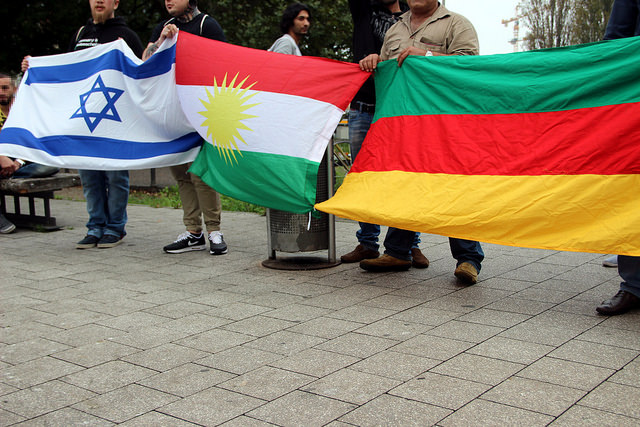
Wrong; when it comes to the issue of Syria, many ‘anti-Imperialists’ do a complete U-turn on the position and instead demand that the Arab Republic, along with Iran, Iraq, and Turkey, is divided up to form a US-Israeli backed Kurdish ethnostate.
In July 2012, when the Syrian conflict was its height, units of the Syrian Arab Army withdrew from the predominantly Kurdish Rojava region in the north of the country in order to provide assistance to military units fighting elsewhere in the Arab Republic; besieged at the time by Western-backed terrorists and yet to receive the key support which would later be provided by Iran and Russia.
The withdrawal of the SAA allowed local Kurdish militias to turn Rojava into a de facto autonomous region, with the most prominent of said groups being the People’s Protection Units (YPG), part of the wider Syrian Democratic Forces (SDF), a US-backed anti-government group.
However, whilst US-backed groups elsewhere in the country were supported by the White House with the intention of ousting the government of Bashar al-Assad, the primary reason for Washington’s support of the Kurds was to fulfill the 1982 Tel Aviv-authored Yinon plan.
This document, written by Oded Yinon, a senior advisor to Ariel Sharon, envisaged Israel maintaining hegemonic superiority in the region via the balkanization of neighboring Arab states hostile to Tel Aviv; in Syria, a country long known for its opposition to Zionism, this would entail the creation of a Kurdish state in the north of the country in a bid to undermine the authority of Damascus.
However, despite this US support for Rojava lining up perfectly with the Yinon plan, support for the creation of a Kurdish state within Syria remains widespread amongst Western leftists, with the feminist politics of the YPG endearing itself to Western Anarchists in particular; the lessons of Ireland and Palestine being lost it would ultimately seem.
Venezuela’s Gold: 3 Times State Wealth in Western Banks “Mysteriously” Vanished
Sputnik | January 28, 2019
Self-proclaimed Venezuelan interim president Juan Guaido has praised the Bank of England’s reported refusal to allow Caracas to repatriate $1.2 billion worth of gold bullion, branding the move a “protection of assets.” Sputnik looks at a few other times Western governments and banks froze, or outright stole, the sovereign wealth of other countries.
Caracas has been waging a losing battle to get its gold back from the UK since late last year, with the Bank of England repeatedly refusing its repatriation requests, according to media reports. Last week, British Foreign Secretary Jeremy Hunt joined Britain’s US allies in backing Juan Guaido, calling him “the right person to take Venezuela forward” and making the return of Venezuela’s gold all the more unlikely. Over the weekend, as if on cue, Guaido praised London’s decision not to return the gold.
All Part of the Job
The practice of freezing or seizing the assets of countries which somehow find themselves on the wrong side of US and European policymakers and financial interests is anything but new. A 1992 review of US extraterritorial asset freeze orders by legal scholar Rachel Gerstenhaber recounted well over a dozen cases of the US freezing or confiscating assets of countries including the likes of Iraq, Panama, Libya, Iran, South Vietnam, Cuba, Nicaragua and a bevy of former Eastern Bloc states. The list doesn’t include similar moves by US allies in Western Europe, which similarly deprived countries of tens of billions of dollars in sovereign assets. For the sake of brevity, Sputnik focuses on three such cases.
Iran
The 40-year-old saga of Iran’s frozen assets goes back to the 1979 Iranian Revolution, which saw revolutionaries overthrow US-backed dictator Mohammad Reza Shah Pahlavi and the establishment of an Islamic republic. The upheaval, which included the taking of hostages at the US Embassy in Tehran, prompted Washington to cut off diplomatic relations, ban Iranian oil imports and freeze some $11 billion in assets ($35.35 billion today, accounting for inflation).On the eve of the signing of the landmark Joint Comprehensive Plan of Action (JCPOA), widely known as the Iran nuclear deal, in 2015, Tehran’s frozen assets, including those stemming from the 1979 Revolution, as well as international nuclear-related restrictions, were estimated to amount to at least $100 billion. The chief of Iran’s central bank said that only about $32 billion, a third of the total, could be released in connection with the nuclear deal.
Over three years after the JCPOA’s signature, the fate of much of the wealth remains unclear. What is known is that US courts have heard multiple cases demanding the outright seizure of the Islamic Republic’s wealth. This includes a 2016 ruling ordering Iranian cash to be paid to the families of US servicemen killed in the 23 October, 1983 truck bombings in Beirut, Lebanon. Tehran maintains that it had nothing to do with the act of terrorism, and has challenged the ruling with the International Court of Justice, so far unsuccessfully.
In a separate, even more outrageous ruling from 2018, a New York court ordered frozen Iranian assets to be used to compensate the victims of 9/11, despite the fact that Iran had nothing to do with the terrorist attacks and that 15 of the 19 hijackers were Saudi nationals.
Iraq
In the run-up to the US invasion of Iraq in 2003, the military planning to seize the country’s strategic assets was accompanied by economic calculations to seize some $1.75 billion in Iraqi assets already frozen in US accounts.
The seizure was just the tip of the iceberg in what would become what seems like a bottomless pit of asset pilfering in the chaos which followed the invasion. In 2010, a Pentagon audit concluded that it couldn’t account for some $8.7 billion in missing Iraqi oil and gas money meant for reconstruction.
Earlier, US media sporadically reported on the enthralling case of some $10-$20 billion in cash, most of it consisting of Iraqi state assets, which was shipped into Iraq in 2004 for reconstruction efforts before seemingly vanishing into thin air.In a 2005 audit, US inspector general for Iraq reconstruction Stuart W. Bowen Jr. reported that over $8.8 billion in the funds could not be accounted for. Six years later, Bowen told Congress that US officials still hadn’t accounted for some $6.6 billion in funds, and said the case could very well be “the largest theft of funds in national history.”
Libya
The details of the suspected plundering of a major chunk of Libya’s vast sovereign wealth fund in the aftermath of the NATO intervention to overthrow Libyan leader Muammar Gaddafi remain shrouded in mystery, close to eight years after the attack. In late 2018, officials from one of Libya’s warring factions called on the UN Security Council to safeguard what’s left of the Libyan assets still frozen in foreign accounts.
The concerns came following reports last March that some 10 billion euros (approximately $11.4 billion US) in Libyan sovereign wealth had disappeared from a Belgian bank, with just 5 billion euros of the original 16 billion euro fund remaining. Last September, a UN panel found Belgium to be in breach of asset freeze restrictions, with interest payments on some of the Libyan funds feared to have been transferred to accounts belonging to warring militias, including Islamists. Authorities from the Tripoli-based government later alleged that the United Arab Emirates were “almost certainly” behind the pilfering, saying the funds were used to support the Tobruk-based government in eastern Libya.
The scandal is just one of numerous major asset freezes and seizures by Western powers in the aftermath of Gaddafi’s demise. In 2012, over a billion euros in assets belonging to Gaddafi’s family and senior members of his government were seized in Italy at the request of the International Criminal Court, including stakes in major Italian companies, as well as property.
A year before that, the Obama administration froze $29.8 billion in Libyan wealth held in US banks including Goldman Sachs, Citigroup, JPMorgan Chase and the Carlyle Group.
The assets, along with $40 billion more in funds held elsewhere, were reported to have been unfrozen in December of 2011. However, UN officials later said that only about $3 billion of that had actually reached the country “due to concerns over who the money should be released to and other diplomatic problems.” In late 2018, the head of Libya’s sovereign wealth fund told Reuters that the fund was planning to appoint auditors to carry out a system-wide audit of its assets in 2019 to try to unfreeze some of the billions in assets still frozen. As of late last year, an estimated 70 percent of the Libyan Investment Authority’s $67 billion in assets abroad remain frozen by the UN.
Also in 2018, British lawmakers mulled pulling a US courts-style seizure of part of Libya’s sovereign wealth fund to compensate victims of the Irish Republican Army, which Gaddafi is thought to have sponsored in the 1980s.
An estimated 9.5 billion pounds ($12.5 billion US) of Libya’s wealth is still believed to be held in British banks. Tripoli has urged London not to go ahead with the seizure. “There is no lawful basis for the United Kingdom to seize or change ownership of the frozen LIA assets. These belong to the Libyan people,” Libyan Investment Authority chief Ali Mahmoud Hassan Mohamed said in a letter addressed to the UK’s Junior Foreign Minister Alistair Burt last October.
The unscrupulous use of Libyan national wealth hasn’t been limited to post-Gaddafi Libya, either. Last year, former French President Nicolas Sarkozy was charged with bribery and accepting some 50 million euros in illegal campaign contributions from Libya ahead of the 2007 presidential election in France. Sarkozy repaid this generosity by being one of the key advocates of the 2011 NATO attack on Libya.
Caracas’s Bullion
On Sunday, Argentinian newspaper Ambito Financiero reported that Venezuelan national assembly head Juan Guaido had asked Prime Minister May and Bank of England governor Mark Carney not to return the estimated $1.2 billion in gold bullion to Caracas, despite President Maduro’s requests. Earlier, in a Saturday tweet, Guaido praised the Bank’s alleged refusal to allow the gold to be repatriated, writing that “the process of protecting the assets of Venezuela has begun,” and saying that the opposition would “not allow more abuse and theft of money intended for food, medicine and the future of our children.”
If the stories of asset freezes and seizures outlined above are anything to go by, it doesn’t seem like it’s going to be up to the Venezuelans to decide what Western governments and central banks do with their country’s wealth.
See also:
Libya Investigates Who Benefited From Gaddafi’s Billions Frozen in Belgium
Civilians storm & burn Turkish military base in northern Iraq
RT | January 26, 2019
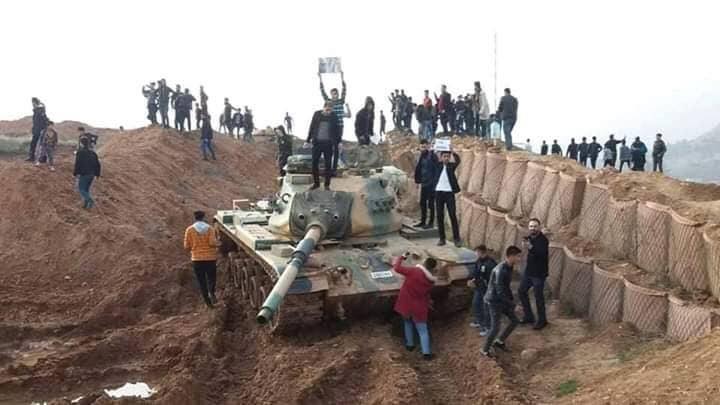
A mob of angry civilians has attacked a Turkish military camp near the Iraqi city of Dohuk, burning equipment and vehicles. The incident comes in response to the deaths of civilians during Turkish airstrikes, local media reports.
The incident occurred in northern Iraq on Saturday, when a large mob of civilians attacked a Turkish military encampment located in the predominantly-Kurdish region of Dohuk.
Footage from the scene which surfaced online shows civilians at the military encampment with Turkish military vehicles and tents burning in the background. At least one person died and 10 were reportedly wounded during the incident. It remains unclear if the Turkish Army sustained any casualties – servicemen are nowhere to be seen in the footage.
According to local media, the attack on the encampment came in protest to Turkish airstrikes and shelling, which have repeatedly hit the vicinity of Dohuk. Earlier on Saturday, at least two civilians were reportedly killed in an airstrike and the incident at the base might have been prompted by the attack.
The incident was acknowledged by the Turkish Defense Ministry, which blamed it on activities of the outlawed Kurdistan Workers’ Party (PKK), which Ankara considers to be a terrorist group. The Turkish military, however, did not confirm that it was the encampment in Dohuk that was attacked.

“An attack has occurred on one of [the] bases located in northern Iraq as a result of provocation by the PKK terrorist organization. There was partial damage to vehicles and equipment during the attack,” the ministry tweeted, adding that it has been “taking necessary measures” regarding the incident.
Iraq’s Hashd al-Sha’abi warns Israel against possible attacks, pledges strong response
Press TV – January 21, 2019
Iraq’s pro-government Popular Mobilization Units, known in Arabic as Hashd al-Sha’abi, have advised Israel against “playing with fire” after US Secretary of State Mike Pompeo hinted that Tel Aviv may attack the anti-terror volunteer fighters.
Moein al-Kazemi, a Hashd commander, told the Iraqi Kurdistan’s Rudaw television network on Sunday that the force was ready to deliver a “strong” response to any aggression.
He said while Israel had yet to make a move, Israeli media were already testing the Iraqi government’s reaction to a possible attack by publishing bogus reports on the issue.
Nonetheless, any act of hostility against Hashd al-Sha’abi could backfire on Tel Aviv as thousands of missiles in southern Lebanon were already aimed at Israeli targets, al-Kazemi warned.
The commander made it clear that Hashd al-Sha’abi was an official military organization funded in part by the Iraqi government and therefore “had the right” to defend the country.
Pompeo, who paid a visit to Baghdad and Iraq’s Kurdistan region earlier this month, was reported to have made it clear to Iraqi officials that Washington would not react to possible Israeli attacks against Hashd fighters.
Citing an unnamed Iraqi official, Russia’s RT Arabic service reported Thursday that the top US diplomat had relayed the message during a meeting with Iraqi Prime Minister Adel Abdul-Mahdi.
Abdul-Mahdi expressed concern about the statement and warned Pompeo that such actions by Israel would have grave consequences, the report said.
Israel’s long record of attacking anti-Daesh forces
Last June, Hashd fighters came under attack in Syria’s border town of al-Hari, in the eastern province of Dayr al-Zawr, as they were chasing Daesh terrorists out of the area.
Both the Syrian government and Hashd al-Sha’abi declared back then that the attack near the Iraqi-Syrian border had been deliberate and could only have been carried out by either Israel or the US.
US Embassy in Baghdad denies that US forces are responsible for strike in Syria near Iraq-Syria border on 2 Iraqi PMU (Hashd) Brigade HQs that killed 22 & injured 12 Iraqis. Other US official says Israel is responsible. https://t.co/SnwzKtRpIM
— David M. Witty (@DavidMWitty1) June 19, 2018
An unnamed US official denied any involvement by American forces, triggering speculation by some media sections that Israel might have been behind the attack.
“We have reasons to believe that it was an Israeli strike,” the official told Agence France-Presse (AFP) at the time.
The Iraqi Foreign Ministry also denounced the airstrike, saying it “expresses rejection and condemnation of any air operations targeting forces in areas where they are fighting Daesh, whether in Iraq or Syria or any other area where there is a battlefield against this enemy that threatens humanity.”
Israel has repeatedly launched airstrikes against Syrian military forces and other groups fighting Daesh in the Arab country, under the pretext of attacking Iranian military advisers in Syria.
Many observers believe the attacks are aimed at propping up the Takfiri terror groups which are on their last legs in the face of constant Syrian army advances.
Hashd al-Sha’abi and other anti-terror Iraqi fighters are cooperating with the Syrian government to keep the two countries’ joint border safe and repel terrorists.
Trump’s Nighttime Trip to Iraq Confirms the Debacle
By Jacob G. Hornberger | FFF | January 11, 2019
What better proof of the Iraq debacle than President Trump’s middle-of-the-night trip to that country at Christmastime to visit U.S. troops who are still occupying the country some 15 years after the Pentagon and the CIA invaded?
The U.S. national-security establishment has had a decade-and-half to bring its federally planned paradise into existence. From the very first day of the U.S. conquest of Iraq, a country that had never attacked the United States, the Pentagon and the CIA wielded total control over the country, being able to install whatever type of regime they wanted, with no pesky constitutional restraints to inhibit whatever they wanted to do.
After 15 years of building their paradise with such things as bombs, bullets, arrests, raids, indefinite detention, torture (e.g., Abu Ghraib), and assassination, the U.S. commander in chief has to leave Washington under cover of secrecy and darkness, land in Iraq in the middle of the night, talk to the troops for just a short while, and then skedaddle back to Washington in fear of being shot at by some disgruntled Iraqi who opposes the foreign invasion and occupation of his country.
If that’s not pathetic, I don’t know what is. Why can’t a U.S. commander in chief bravely and courageously fly into Iraq during the daytime the same way he would fly into London? Why can’t he freely travel into Baghdad and stay at a local hotel for a few days? Why can’t he meet with whoever happens to be the current U.S. puppet who is running the Iraqi government? Why does Trump have to instead sneak in and quickly sneak out of a country that the Pentagon and the CIA have had 15 long deadly and destructive years to convert into a paradise?
After all, the president of Iran doesn’t do this. He flies into Baghdad, stays several days in a hotel, and takes the time to meet with Iraqi officials. But not Trump. He and his national-security team think that it would just be too dangerous to do that in the paradise that the Pentagon and the CIA have constructed over a period of 15 years.
For that matter, notice that not one member of Congress has ever taken one of the prized congressional junkets to Iraq. Not even a family vacation. What’s up with that? Wouldn’t you think that they would relish traveling to a country that has been invaded and occupied by troops who they never cease thanking for “their service” in Iraq?
If there is anything that should cause the American people to reject the conservative-liberal paradigm of foreign empire, intervention, regime-change, and wars of aggression, it should be Iraq. Trump’s sneaky in-and-out trip to visit the troops in Iraq 15 years after they invaded and began occupying the country and turning it into their paradise says it all.
Iraqi politicians demand probe into reported visits to Israeli-occupied territories
Press TV – January 10, 2019
A reported visit to the Israeli-occupied territories by several Iraqi lawmakers has sparked a wave of condemnations from the Arab country’s political leaders, with some of them demanding a probe to identify those who crossed a “red line.”
Israel’s Foreign Ministry announced on Sunday that three Iraqi delegations had secretly visited the occupied territories in 2018.
The ministry said the 15 Iraqi dignitaries had visited “Israeli officials and universities,” as well as the Holocaust memorial in Jerusalem al-Quds.
The report did not identify any members of the Iraqi delegations, nor did it specify with which Israeli officials they had held talks. It said the most recent of the visits was in December.
According to Baghdad al-Youm website, Nasr al-Shammari, deputy secretary-general of Iraq’s Islamic Resistance Movement (al-Nojaba) said in case the report is proved to be true, those who visited the occupied territories should be punished.
The Foreign Relations Committee of Iraq’s parliament also said the Israeli report was aimed at “creating sedition in the country.”
Furat al-Tamimi, a member of the committee, said the issue will be discussed in the upcoming meeting between the parliamentary committee and the foreign ministry, according to Iraq’s Arabic-language al-Sumeriyah news channel.
If the trip has taken place, al-Tamimi said, the responsibility for this issue lies with the security departments, particularly the national security.
Meanwhile, prominent politician and leader of Iraq’s al-Qarar Coalition Athil al-Nujaifi denied reports that he had been among those who visited the occupied territories.
The report first drew strong reaction from First Deputy Speaker of Iraqi Parliament Hassan Karim al-Kaabi, who said in a statement on Monday that “To go to the occupied territory is a red line, and an extremely sensitive issue for all Muslims.”
He also called for “an investigation… to identify those who went to the occupied territory, particularly if they are lawmakers.”
Iraq does not formally recognize Israel, and Baghdad and Tel Aviv are technically still at war.
Iraq Not Obliged to Abide by US anti-Iran sanctions: FM
Al-Manar | January 3, 2019
Iraq’s Foreign Minister Mohammed Ali al-Hakim, said his country is “not obliged” to abide by unilateral US sanctions against Iran, adding that Baghdad is seeking ways to bypass those sanctions and continue trade with Tehran.
“These sanctions, the siege, or what is called the embargo, these are unilateral, not international. We are not obliged [to follow] them,” al-Hakim said, speaking to a gathering of journalists on Wednesday.
He said a number of “possibilities” had been suggested that could keep trade routes open with Iran, “including dealing in Iraqi dinars in bilateral trade,” and creating a fund for payments to Iran.
Following the re-imposition of unilateral sanctions on Iran in early November, the US gave Iraq a 45-day waiver for imports of gas from Iran, and extended the waiver for 90 days in December. Iran also provides around 40 percent of Iraq’s electricity needs.
The current level of annual bilateral trade between Iran and Iraq amounts to $12 billion, with a target to raise that figure to $20 billion in the near future.
Trump’s Holiday Gift to America: Hope for a Little More Peace on Earth?
By Thomas L. Knapp | Garrison Center | December 27, 2018
In March, US president Donald Trump promised the American public that US troops would be leaving Syria “very soon.”
Nine months later, he threw Washington’s political establishment into turmoil by finally ordering the withdrawal he’d promised. Politicians like US Senator Lindsey Graham (R-SC), who’d never once in four years bestirred themselves to authorize the previous president’s decision to go to war there in the first place, railed against Trump’s decision to bring the bloody matter to a close.
Instead of backing down in the face of opposition, Trump doubled down. Or, rather, decided to draw down the 17-year-long US military presence in Afghanistan.
Then he jetted off for a surprise Christmas visit to Iraq … eliciting, with his usual theatrics, calls from Iraqi lawmakers for US withdrawal from THAT country. I suspect he may concede to that demand as well.
Nothing’s written in stone, and both US foreign policy and Donald Trump are prone to sudden and unexpected turns. But the holiday season is a time of hope. Maybe, just maybe, nearly three decades of US war in the Middle East are coming to the beginning of their end.
Adding to that hope, let’s turn an eye further east.
After significant saber-rattling and then a sudden turn toward personal diplomacy, Trump stood back and let events on the Korean peninsula take their course even as he continued the bellicose rhetoric and sanctions noises demanded of him by Graham and company.
As a result, North and South seem on the brink of ending a 68-year war. They’ve begun removing land mines and guard posts along the Demilitarized Zone. They’ve broken ground on a railway connecting the two countries.
Is it possible that Trump, as some of his supporters like to say, has been playing 4D chess while the rest of us distracted ourselves with checkers?
I’d really like to think so, and I do hope so.
As an advocate for ending US military adventurism, I’ve doubted Trump every step of the way. During his presidential campaign, he alternated between talking peace and pronouncing himself the most militaristic of the GOP’s presidential aspirants.
I’ve generally found it safer to believe the worst, rather than the best, things politicians say about themselves. But at moments like these, his bizarre zigs and zags on the global 4D chess board suddenly seem in retrospect to have taken American foreign policy in the right direction.
If he brings home substantial numbers of the American fighting men and women now in harm’s way around the globe, he will have secured his legacy and deserve the thanks of a grateful nation. I wish him every success in that endeavor.
Peace on Earth, goodwill toward men, and Happy New Year.
Featured Video
Iran spent $1 million to wipe out $30 billion in data center plans, and take down Amazon in the ME
or go to
Aletho News Archives – Video-Images
From the Archives
Clash of Civilization, Iran Part II
By Jamal Kanj – Intifada-Palestine.com – January 14, 2011
Israel’s survival kit is: perpetuate conflict, insecurity to rationalize collective hate and finally playing victim.
Devoid of conflict, Israel implodes internally; without hate, Zionism loses its justification; and playing eternal victim to continue blackmailing the West. Absence of this holy trinity, Israel ceases to exist. … continue
Blog Roll
 Aletho News
- China Rejects Outside Pressure on Trade Ties After New US Russia Sanctions Bill
- Houthis Keep Advancing as the Red Sea Crisis Deepens
- Iran spent $1 million to wipe out $30 billion in data center plans, and take down Amazon in the ME
- Zionist billionaire pressure to silence Macklemore sparks exodus from Ed Sheeran tour
- House Votes to End Iran War for Third Time
- North Korea Slams US Plan for ‘AUKUS 2.0’ with South Korea and Japan
- Prolonging US-Iran Conflict Not Meeting Interests of Int’l Community – China’s Wang Yi
- EU bans former Zelensky aide from parliament
- NATO-backed Kosovo separatist ‘responsible for war crimes’
- US destroying international space law
- If Americans Knew
- Palestinian-American Journalist Naqaa Hamed Detained by Israeli Forces After Settlers Targeted Her
- U.S. Makes, Israel Takes: The Real Story of U.S.-Israeli Military Cooperation
- Night raids rise in Palestine
- Tucker Carlson interviews Norman Finkelstein about Gaza
- Groups urge Americans to support Van Hollen legislation on Israel’s killing of Americans & Palestinians
- Trump administration plans to send 40,000 tons of bombs to Israel: report
- Sanctions Target Iran’s Government, But Kill Hospitalized 23-Year-Old Woman
- An alternative view on the book “Israel’s Lobby: America in the Grip of a Foreign Power”
- Ed Sheeran’s band Beoga, other opening acts quit tour after Macklemore was dropped over his pro-Palestinian comments
- The assassination attempt on President Trump in Butler and the various Israeli connections to it
- No Tricks Zone
- New Study: ‘Global Drought Shows No Detectable Recent Acceleration Under Climate Warming’
- Economic Masterminds: German Socialists Suggest Taxing Productivity Gains Stemming From Using AI
- The South China Sea Has Not Been Cooperating With The Climate Change Narrative
- Energy Crisis: Germany Enters Heating Season With Historically Low Gas Reserve Fill Levels
- New Study: The Antarctic Ice Sheet Gained Mass From 2020-2024 Due To Staggering Snow And Ice Accumulation
- Study: Ocean Heating Rates From Thousands Of Years Ago ‘Dwarf’ Modern Ocean Heating Rates
- Climate Extremists Target, Attack Large-Scale Power Grid Infrastructure In Germany!
- New Study: Antarctic Ice Melt Has Contributed Less Than 1 Centimeter To Sea Level Rise In The Last 30 Years
- Fear Of Debate: Alarmist German Climate Scientist Calls On Mainstream Media To Discredit Skeptic Voices
- End-Of-August Arctic Sea Ice Extent Hasn’t Fallen In 20 Years, Official Data Show!
 Aletho News