For Israel, The Terrorist Attack At Bondi Is An Opportunity To Push For War With Iran
The Dissident | December 14, 2025
Today, a horrific terrorist attack was committed against Jewish Australians who were celebrating Hanukkah at Bondi Beach, killing 16 people and sending 40 to the hospital.
But for Israel, the terrorist attack is an opportunity to manufacture consent for a war with Iran.
There is no evidence that Iran has anything to do with the terrorist attack at Bondi Beach, and all evidence so far that has emerged shows that it almost certainly was not.
The Iranian foreign ministry condemned the attack, saying, “We condemn the violent attack in Sydney, Australia. Terror and killing of human beings, wherever committed, is rejected and condemned”, and evidence released so far suggests the attacker identified so far, Naveed Akram, was a follower of Wahhabi Salafist ideology, which is openly hostile to Shia Islam and Iran.
Despite the lack of evidence and evidence showing it was not Iran behind the attack, Israel is using the horrific terrorist attack to manufacture consent for war with Iran.
Israel Hayom, the mouthpiece of Israel lobbyist and pro-Iran war hawk Miriam Adelson, published an article quoting an anonymous “Israeli security official” who claimed -without evidence- that “there is no doubt that the direction and infrastructure for the attack originated in Tehran”.
The Israeli newspaper Times of Israel, reported that Australia is “investigating if Sydney attack was part of larger Iranian plot” at the behest of the Israeli Mossad.
Previously, Israel pressured Australia to repeat baseless claims from the Mossad that Iran was behind anti-Semitic attacks in Australia.
As veteran journalist Joe Lauria reported, in August “Australian intelligence said the Iranian government was behind the firebombing of a Jewish temple in Melbourne last year as well as other ‘anti-semitic’ attacks in the country”, “days after Israeli Prime Minister Benjamin Netanyahu publicly humiliated Australian Prime Minister Anthony Albanese in a post on X for being ‘a weak politician who betrayed Israel and abandoned Australia’s Jews’ after Albanese said Australia would follow several European nations and recognize the state of Palestine.”
As Lauria noted, “The Australian Security Intelligence Organisation (ASIO) did not provide any evidence to prove Iran’s involvement last December in the Adass synagogue attack, which caused millions of dollars of damage but injured no one. It simply said it was their assessment based on secret evidence that Iran was involved”.
Australia’s ABC News reported that, “The Israeli government is claiming credit for Prime Minister Anthony Albanese and intelligence agencies publicising Iranian involvement in antisemitic attacks on Australian soil,” adding that “in a press briefing overnight, Israeli government spokesperson David Mencer effectively accused Australia of being shamed into acting”.
Mencer boasted that “Prime Minister [Benjamin] Netanyahu has made a very forthright intervention when it comes to Australia, a country in which we have a long history of friendly relations”, implying that Israel pressured the Australian government to repeat their baseless claim about Iran being behind the attacks.
ABC reported that the move came days after, “Netanyahu labelled Mr Albanese a ‘weak’ leader who had ‘betrayed Israel and abandoned Australia’s Jews’” and “Israel announced it would tear up the visas of Australian diplomats working in the West Bank in protest against the Albanese government’s moves to recognise a Palestinian state”.
Israel’s evidence-free claims are already being used by the Trump administration to manufacture consent for war with Iran.
The Jerusalem Post reported that, “A senior US official told Fox News that if the Islamic Republic ordered the attack, then the US would fully recognize Israel’s right to strike Iran in response.”
Israel’s weaponisation of the terrorist attack in Bondi is reminiscent of how Benjamin Netanyahu weaponised the 9/11 attacks to draw America into Middle Eastern wars for Israel.
After the 9/11 attacks, Benjamin Netanyahu admitted that they were “very good” for Israel, because they would “strengthen the bond between our two peoples, because we’ve experienced terror over so many decades, but the United States has now experienced a massive hemorrhaging of terror”.
This, in effect, meant using 9/11 to draw the U.S. into endless regime change wars in the Middle East against countries that had no ties to Al Qaeda but were in the way of Israel’s geopolitical goals.
The top U.S. general, Wesley Clark, said that after 9/11, the U.S. came up with a plan to “take out seven countries in five years, starting with Iraq, and then Syria, Lebanon, Libya, Somalia, Sudan and, finishing off, Iran”.
Years later, on Piers Morgan’s show, Wesley Clark said that the hit list of countries came from a study that was “paid for by the Israelis”, which “said that if you want to protect Israel, and you want Israel to succeed… you’ve got to get rid of the states that are surrounding” adding that, “this led to all that followed” (i.e. regime change wars in Iraq, Libya, Syria etc.)
Yet again, Israel is weaponising a terrorist attack to manufacture consent for the final regime change war on their hit list.
Iraq links disarmament of resistance groups to US withdrawal amid Washington’s threats
Press TV – November 4, 2025
Iraqi Prime Minister Mohammed Shia al-Sudani has declared that resistance groups will only disarm once US forces leave the country, reaffirming plans for a full coalition withdrawal by 2026 amid threats from Washington.
Sudani emphasized Monday that a plan is still in place to have foreign forces purportedly fighting Daesh completely leave Iraq by September 2026 because the threat from terrorist groups have eased considerably.
“There is no Daesh. Security and stability? Thank God it’s there … so give me the excuse for the presence of 86 states (in a coalition),” he said, referring to the number of countries that have participated in the “coalition” since it was formed in 2014.
“Then, for sure there will be a clear program to end any arms outside of state institutions. This is the demand of all,” Reuters quoted him as saying, noting that factions could enter official security forces or get into politics by laying down their arms.
Washington wants Sudani to disband resistance groups affiliated with the Iraqi Popular Mobilization Forces, an umbrella group of anti-terror factions that has been formally integrated into Iraqi government forces.
Sudani’s remarks came as Iraqi Defense Minister Thabit al-Abbasi revealed that the United States has delivered its “final” and “most serious” warning to Iraq concerning the activities of resistance factions in the country.
In an interview over the weekend, Abbasi said that Washington’s latest message “concerns armed factions and includes a direct threat in the event that those factions carry out any operations in response to what Washington intends to do in the region near Iraq in the coming days.”
He explained that the warning was conveyed during a phone call with US Secretary of War Pete Hegseth, adding that Hegseth concluded the conversation by saying, “This is your final warning… and you know very well how the current administration will respond.”
US President Donald Trump recently appointed a supporter of his 2024 presidential campaign—who has no government experience and previously ran only a chain of marijuana dispensaries—as his administration’s new special envoy to Iraq to help “advance the interests” of the United States.
In his fist official statement published on his X account last week, Mark Savaya said his mission is to help Iraq shun resistance groups and free it from what it called “external interference”.
Iran’s Foreign Ministry spokesman Esmaeil Baghaei said during a press conference on Monday that Tehran views recent US threats as an attempt to interfere in Iraq’s domestic affairs, particularly ahead of its elections.
“In this context, we consider these threats a form of interference in Iraq’s internal affairs, especially as they are made on the eve of elections with the aim of creating tension and influencing the internal processes of an independent country,” Baghaei said.
He noted that such threats violate the principles of national sovereignty and respect for Iraq’s independence, reflecting the “interventionist and aggressive nature” of the United States.
Baghaei underscored that “these actions and attempts to create tension will have no impact on the determination of the Iraqi people, who are resolved to decide and act based on what they deem beneficial for their nation’s security and interests.”
Washington and Baghdad have agreed on a phased withdrawal of US forces, with a full withdrawal expected by the end of 2026. The initial withdrawal of troops began in 2025.
“Iraq is clear in its stances to maintain security and stability and that state institutions have the decision over war and peace, and that no side can pull Iraq to war or conflict,” said Sudani in the interview.
Victor Davis Hanson Exposed
The Voice of Zionist and Israeli Propaganda in America
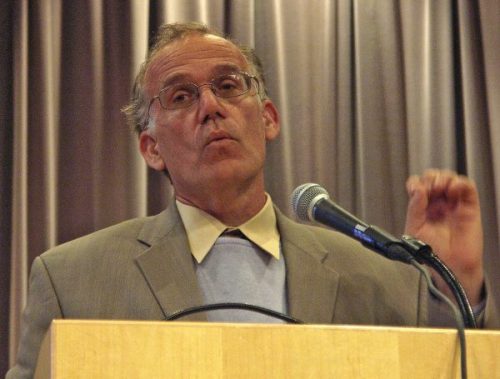
By Jonas E. Alexis • Unz Review • October 15, 2025
Victor Davis Hanson is a military historian and classicist, best known for works such as A War Like No Other: How the Athenians and Spartans Fought the Peloponnesian War, Carnage and Culture: Landmark Battles in the Rise to Western Power, and Who Killed Homer: The Demise of Classical Education and the Recovery of Greek Wisdom.
To be fair, these works are not without merit; Who Killed Homer in particular occupies an important place in the ongoing academic debate over the teaching of the classics. However, Hanson’s analysis collapses entirely when it comes to U.S. foreign policy and the nation’s involvement in perpetual wars across the Middle East and beyond. In The Savior Generals, for instance, he devotes an entire chapter to praising the catastrophic invasion of Iraq in 2003—a debacle that left the region in ruins.[1]
In an apparent attempt to rescue both himself and the neoconservative movement from intellectual and political oblivion, Hanson drew an extraordinary comparison between the Iraq War and the wars of 1777, 1941, and 1950. He went so far as to claim that these conflicts “led to massive American casualties and, for a time, public despair.”[2]
Not once did Hanson acknowledge the incontrovertible fact that the Iraq War was built upon a monumental deception. He never confronted the well-documented reality that the U.S. intelligence community explicitly informed the Bush administration that there was no credible evidence indicating that Saddam Hussein possessed weapons of mass destruction. Nor did he address the fact that President Bush and his inner circle deliberately sought to fabricate and manipulate evidence in order to inundate the American public with the categorical falsehood that Saddam had to be removed.[3]
Hanson made no attempt whatsoever to engage with the vast body of scholarly evidence surrounding these issues.[4] He remained silent on the atrocities committed at Abu Ghraib—the sodomy, humiliation, and torture that forever stained America’s moral standing.[5] Not once did he acknowledge that, prior to the Iraq War, practices such as waterboarding were virtually foreign to the American moral and legal tradition. Nor did he mention that George Washington himself unequivocally repudiated the use of torture, even against enemies who had shown no mercy.[6]
By now, it is a matter of public record that torture at Abu Ghraib was not an isolated incident but a systematic practice. Reports and testimonies confirmed that prisoners were routinely subjected to brutal physical and sexual abuse, including coerced acts of humiliation and violence that defied every principle of human dignity. Even young detainees were not spared such degradation. Official investigations and leaked photographs later revealed the extent of these atrocities, which stand as a permanent indictment of the moral collapse that accompanied the Iraq War. One prisoner testified that he saw one officer
“fucking a kid, his age would be about 15-18 years. The kid was hurting very bad and they covered all the doors with sheets. Then when I heard the screaming I climbed the door because on top it wasn’t covered and I saw [name blacked out], who was wearing the military uniform putting his dick in the little kid’s ass. I couldn’t see the face of the kid because his face wasn’t in front of the door. And the female soldier was taking pictures.”[7]
What’s more even interesting, “150 inmates were crammed into cells designed for 24.”[8] Abu Ghraib, as one writer put it, was “a hell-hole.”[9] Torture was also routine in Afghanistan, where adolescents were beaten with hoses “and pipes and threats of sodomy.”[10] These atrocities were not committed in obscurity. Cambridge University Press has published extensive documentation of such abuses in a volume exceeding 1,200 pages, detailing the systematic nature of the torture and its moral, political, and legal implications.[11] These atrocities were also corroborated by psychiatrists such as Terry Kupers, whose professional assessments provided further evidence of the profound psychological trauma inflicted on the victims and the moral disintegration of those who carried out the abuse.[12]
For Hanson to attempt to wiggle out of this extensive body of scholarship is nothing short of intellectual dishonesty. Since the Iraq War turned out to be an unmitigated disaster—and given that Hanson supported it from its inception[13]—he is now compelled to construct arguments that are at once incoherent and irresponsibly tendentious. This rhetorical contortion serves a dual purpose: to preserve his Neoconservative equilibrium and to justify his well-funded position as a military historian at the Hoover Institution, an establishment known for its distinctly neoconservative orientation.
More importantly, Victor Davis Hanson is a Neocon ideologue and an unapologetic warmonger. He declared without hesitation:
“I came to support neocon approaches first in the wars against the Taliban and Saddam, largely because I saw little alternative—in a post-9-11 effort to stop radical Islam and state sponsors of terror—to removing such odious enemies, and did not think leaving the defeated in power (as in 1991), or leaving in defeat (as in Lebanon), or installing a postbellum strongman was viable or in U.S. interests.”[14]
Hanson, it seems, would prefer deliberate falsehoods over confronting uncomfortable truths. The war in Iraq was never about weapons of mass destruction, precisely because the Neocons themselves were fully aware that Saddam Hussein possessed no weapons of mass destruction.
For example, when Deputy National Security Advisor Stephen Hadley informed Paul Wolfowitz that there was no evidence of a link between Al Qaeda and Saddam Hussein, Wolfowitz responded with certainty, “We’ll find it. It’s got to be there”[15]—effectively signaling that if no such connection existed, they would fabricate one. Ultimately, the Neoconservatives did precisely that, constructing deliberate falsehoods to justify the destruction of an entire nation—Iraq—for the strategic benefit of Israel.
What we are witnessing is an alarming intellectual decline on Hanson’s part. He effectively lost credibility as a serious analyst when he claimed that Iran intended to promote a Jewish Holocaust, despite the fact that Iranian Jews themselves widely denounced Netanyahu for perpetuating similarly alarmist and conspiratorial rhetoric, calling him an “insane vampire.”.[16] And what of Jimmy Carter? Hanson contends that Carter’s positions were effectively aligned with anti-Semitic sentiment.[17] Ignoring Israel’s ongoing ethnic cleansing of Palestinians in the 1940s and beyond, Hanson begins to reconstruct history according to his own narrative: “[Israel] fought three existential wars over its 1947 borders, when the issue at hand was not manifest destiny, but the efforts of its many enemies to exterminate or deport its population.”[18]
Sounding almost unhinged and unwilling to heed reasoned critique, Hanson asserts that, for more than half a century, the Arabs have sought to push “the Jews into the Mediterranean.” There is no serious scholarship, no intellectual or historical rigor, and no defensible argument—only one sweeping assertion after another. Hanson continues: “Over 500,000 Jews have been ethnically cleansed from Arab capitals since 1947, in waves of pogroms that come every few decades.”[19]
The source and historical evidence? According to Hanson, one simply has to take his word for it. His statement is self-referentially “true” because Hanson asserts it to be so. This is the same type of circular reasoning and tautology frequently encountered in so-called scientific discourse—most famously in the notion of “survival of the fittest.” Why did it survive? Because it is the fittest. How do we know it is the fittest? Because it survived.
Yet, long before Hanson began promoting his version of historical fiction, Jewish historians both in the Atlantic world and in Israel had documented a very different reality: Israel has systematically ethnically cleansed the Palestinian population.[20] Listen again to Israeli historian and flaming Zionist Benny Morris:
“A Jewish state would not have come into being without the uprooting of 700,000 Palestinians. Therefore it was necessary to uproot them. There was no choice but to expel that population. It was necessary to cleanse the hinterland and cleanse the border areas and cleanse the main roads. It was necessary to cleanse the villages from which our convoys and our settlements were fired on.”[21]
Israel has consistently undermined peace and stability in the Middle East. A striking example is the 1982 massacre, during which the Israeli military permitted Lebanese militias to attack Palestinian refugee populations. Reports indicate that the militias “raped, killed, and dismembered at least 800 civilians, while Israeli flares illuminated the camps’ narrow and darkened alleyways.”[22]
One year later, an Israeli investigative commission concluded that Israel was “indirectly responsible” for the massacre and that Ariel Sharon bore personal responsibility as an accomplice.[23]
How did Israeli officials involve the United States in these events? According to declassified documents housed in the Israel State Archives, they persuaded U.S. officials that Beirut harbored terrorist cells. Ultimately, this manipulation facilitated the massacre of Palestinian civilians—people whom the U.S. had previously pledged to protect.[24] Ariel Sharon asserted that Beirut harbored between 2,000 and 3,000 terrorists.
The American envoy to the Middle East, Morris Draper, essentially concluded that Sharon was being dishonest. Lawrence S. Eagleburger, then Secretary of State, remarked that “we appear to some to be the victim of deliberate deception by Israel.”[25]
During his conversation with Sharon, Draper understood that the United States did not fully endorse Sharon’s aggressive plans. Nevertheless, Sharon proceeded to act on his own terms. It was reported that Draper told Sharon, “You should be ashamed. The situation is absolutely appalling. They’re killing children! You have the field completely under your control and are therefore responsible for that area.”[26]
In the aftermath of the massacre, President Ronald Reagan, himself a Zionist, expressed outrage. Secretary of State George P. Shultz acknowledged that the United States had effectively become an accomplice, allowing Israel to manipulate U.S. policy to facilitate the slaughter of civilians. Yet no sanctions were imposed, and no concrete actions were taken. When asked why, Nicholas A. Veliotes, then Assistant Secretary of State for Near Eastern Affairs, offered an indirect explanation: “Vintage Sharon. It is his way or the highway.”[27] Scholar Seth Anziska declares, “The Sabra and Shatila massacre severely undercut America’s influence in the Middle East, and its moral authority plummeted.”[28]
How might Hanson respond? Would he dismiss the archival evidence meticulously documented by Morris Draper and Ilan Pappe in their respective studies? Would he evade the fact that Israel has often acted as a destabilizing force in the Middle East? The answer is likely that we will never know, because Hanson systematically avoids engaging with such historical scholarship. Instead, he prefers silence, selectively ignoring a substantial body of evidence that contradicts his narrative.
If you still doubt this, pick up Hanson’s recent book, The End of Everything. In it, he reads as if he’s on the verge of a heart attack at the mere thought of Iran possessing nuclear weapons. He writes:
“The specter of a soon to be nuclear theocratic Iran that professes it can survive a nuclear exchange, or at least find the ensuing postmortem paradise preferrable to the status quo ante bellum, ensures a dangerous state of affairs, especially amid recent proxy wars between Iran and nuclear Israel in Gaza, Lebanon, and Syria.”[29]
What Hanson never dares to tell his readers is that Iran has signed the Non-Proliferation Treaty, whereas Israel has not—and consistently insists on a double standard. Israel itself poses a global threat, declaring that if it falls, it will take the world down with it. Listen to Israeli historian Martin van Creveld’s chilling warning:
“We possess several hundred atomic warheads and rockets and can launch them at targets in all directions, perhaps even at Rome. Most European capitals are targets for our air force… We have the capability to take the world down with us. And I can assure you that that will happen before Israel goes under.”[30]
Shouldn’t Hanson be concerned about this? Or is he so dazzled by Israeli and neocon propaganda that he cannot think clearly, leaving him both intellectually and historically crippled? Like his fellow neocons, Hanson will never consult objective, scholarly materials that challenge his thesis on Iran and Israel. For instance, he won’t touch Trita Parsi’s trilogy on Iran, published by Yale University Press, nor will he engage with studies such as Intelligence and U.S. Foreign Policy: Iraq, 9/11, and Misguided Reform—apparently because doing so would undermine his neoconservative agenda.[31]
Hanson’s 2021 book, The Dying Citizen: How Progressive Elites, Tribalism, and Globalization Are Destroying the Idea of America, is nothing short of propaganda. Why? Because a look at the very foundations of the United States reveals that the Founding Fathers themselves rejected the notion of making unconditional alliances with any foreign power—let alone Israel. So how did Hanson and his neocon allies become defenders of a country that has brought nothing but misery to the United States? The term “progressive elites” might be more aptly applied to Hanson and his cohort, as they have sought to fundamentally alter the principles articulated by the Founding Fathers.
In The Dying Citizen, Hanson risibly declares that he is deeply concerned about “how putting global concerns above national interests insidiously erodes the financial health, freedoms, and safety of Americans. In blunter terms, when American elites feel their first concerns are with the world community abroad rather than with the interests of their own countrymen, there are consequences for American citizens.”[32] Does this man ever look in the mirror and realize that he too has contributed to the economic disaster that followed the Iraq War—a war that will cost the United States at least six trillion dollars?[33] Think for a moment: what could a single country do with such an enormous sum? Virtually every American could have access to decent health care and an affordable college education. Yet Hanson cannot confront these fundamental issues because he remains blinded by the neoconservative and Israeli agenda.
Hanson reminds me of Thomas Sowell, who has offered many valuable insights in his books, yet Sowell too seems intellectually constrained by the Israeli propaganda machine. Much of what Sowell has written over the years—including Education: Assumptions versus History and Affirmative Action: An Empirical Study—is accurate. I must admit, I had to do some serious rethinking when I first read his assessment of slavery.
But Sowell is completely mistaken in his stance on the Middle East. He is essentially echoing what neocons have been asserting for years and appears trapped within the neoconservative worldview. In his 2010 book Dismantling America, Sowell declares:
“With Iran moving toward the development of nuclear weapons, we are getting dangerously close to that fatal point of no return on the world stage… The Iranian government itself is giving us the clearest evidence of what a nuclear Iran would mean, with its fanatical hate-filled declarations about wanting to wipe Israel off the face of the earth.”[34]
What was particularly striking about this extraordinary claim is that Sowell provided not a single piece of evidence for it—an intellectually embarrassing omission that undermines much of his own work. When I finished reading The Vision of the Anointed, I contacted Sowell to express my appreciation for his work, to which he politely replied, “Thank you.” However, after reading Dismantling America and asking him for evidence supporting some of his assertions, he never responded. He continues to warn about “the fatal danger of a nuclear Iran,” yet there is no way to assess these authoritative—and indeed dogmatic—claims because Sowell offers not a shred of evidence.
Sowell serves the neocons and warmongers in the United States in a manner similar to what Charles Murray does for neocon think tanks like the American Enterprise Institute. After supporting the invasion of Iraq for years and writing positively about progress there in works such as Intellectuals and Society,[35] Sowell later wrote in 2015: “Whether it was a mistake to invade Iraq in the first place is something that will no doubt be debated by historians and others for years to come.”[36] Sowell then advanced a claim that directly contradicts all available evidence regarding the Iraq War:
“But, despite things that could have been done differently in Iraq during the Bush administration, in the end President Bush listened to his generals and launched the military ‘surge’ that crushed the terrorist insurgents and made Iraq a viable country.”[37]
Iraq is a “viable country”? Sowell echoes the same tired mantra in Intellectuals and Society, insisting that the “Iraq surge” was a success—even in the face of abundant evidence proving otherwise. He writes: “Eventually, claims that the surge had failed as predicted faded away amid increasingly undeniable evidence that it had succeeded.”[38] Where has this man been living for the past ten years? One would have to be morally and intellectually blind to come up with such nonsense. Consider the perspective of retired U.S. Army Armor Branch officer and military historian Andrew J. Bacevich:
“Apart from a handful of deluded neoconservatives, no one believes that the United States accomplished its objectives in Iraq, unless the main objective was to commit mayhem, apply a tourniquet to staunch the bleeding, and then declare the patient stable while hastily leaving the scene of the crime… The fighting in Afghanistan and Iraq has exacted a huge price from the U.S. military—especially the army and the Marines. More than 6,700 soldiers have been killed so far in those two conflicts, and over fifty thousand have been wounded in action, about 22 percent with traumatic brain injuries. Furthermore, as always happens in war, many of the combatants are psychological casualties, as they return home with post-traumatic stress disorder (PTSD) or depression.
“The Department of Veterans Affairs reported in the fall of 2012 that more than 247,000 veterans of the Afghanistan and Iraq wars have been diagnosed with PTSD. Many of those soldiers have served multiple combat tours. It is hardly surprising that the suicide rate in the U.S. military increased by 80 percent from 2002 to 2009, while the civilian rate increased only 15 percent. And in 2009, veterans of Iraq were twice as likely to be unemployed as the typical American. On top of all that, returning war veterans are roughly four times more likely to face family-related problems like divorce, domestic violence and child abuse than those who stayed out of harm’s way.
“In 2011, the year the Iraq War ended, one out of every five active duty soldiers was on antidepressants, sedatives, or other prescription drugs. The incidence of spousal abuse spiked, as did the divorce rate among military couples. Debilitating combat stress reached epidemic proportions. So did brain injuries. Soldier suicides skyrocketed.”[39]
As Dismantling America progresses, it becomes clear that Sowell is entirely ensnared in the neoconservative matrix. He asserts, “Iran, for example, has for years ignored repeated U.N. resolutions and warnings against building nuclear facilities that can produce bombs.”[40] In 2012, Sowell wrote in the National Review that Iran was “well on its way to being able to produce more than the two bombs that were enough to force Japan to surrender in 1945.”[41]
This mantra has been repeated endlessly, yet no one has produced any scholarly or academic evidence to support it. In fact, the available scholarship directly refutes this frivolous claim. Paul R. Pillar, an academic and 28-year veteran of the CIA, has stated that Iran is not a threat to global peace. Remarkably, Pillar even made the controversial claim that we could coexist with Iran possessing nuclear weapons.[42] Sowell’s stance only confirms what Andrew J. Bacevich warned in 2012 in his article “How We Became Israel”:
“U.S. national-security policy increasingly conforms to patterns of behavior pioneered by the Jewish state. This ‘Israelification’ of U.S. policy may prove beneficial for Israel. Based on the available evidence, it’s not likely to be good for the United States.”[43]
Both Sowell and Hanson have, in effect, become ideological extensions of Israel—perpetuating hoaxes, fabrications, and at times outright falsehoods about the Israel–Palestine conflict and the broader Middle East. Consider Hanson’s statement that “the radical Iranian ayatollah Ali Khamenei could freely tweet about destroying Israel.”[44]
What have Iranian representatives actually been saying for more than fifty years? Khomeini once declared that “international Zionism is using the United States to plunder the oppressed people of the world.” To understand this statement properly, we must place it within its historical context. Khomeini coined the term “the Great Satan” in 1979 largely because he had witnessed firsthand what “international Zionism” and Western powers were doing throughout the Middle East and beyond. It’s important to remember that the Anglo-American coup in Iran in 1953 effectively vindicated much of Khomeini’s suspicion about foreign interference and exploitation.
“There is no crime America will not commit in order to maintain its political, economic, cultural, and military domination of those parts of the world where it predominates,” Khomeini said back in 1979. “By means of its hidden and treacherous agents [i.e., the Neoconservatives and other warmongers], it sucks the blood of the defenseless people as if it alone, together with its satellites, had the right to live in this world. Iran has tried to sever all its relations with this Great Satan and it is for this reason that it now finds wars imposed upon it.”[45]
Khomeini’s uncomfortable yet largely accurate observation remains relevant today. If anyone doubts this, they need only look at how Israel and the neocons in the United States have systematically contributed to the destruction of one Middle Eastern nation after another—from Iraq and Afghanistan to Syria and Libya. It must also be noted that these figures show little genuine concern for the well-being of the American people. Their priority has long been the pursuit of an aggressive foreign policy in the Middle East that consistently serves particular geopolitical interests rather than U.S. national ones. As my colleague Vladimir Golstein of Brown University once remarked, neoconservatives are incapable of understanding political reality.[46] In that sense, they cannot construct a coherent worldview without resorting to double standards. Scholar Michael MacDonald has documented this tendency in detail:
“As [the Neocons] were mocking Clinton in the late 1990s as cowardly for his caution in the face of Saddam’s brutality, central Africa was engulfed in war and chaos. Around 5,400,000 people, mostly in Congo, perished in the convulsions and the starvation and disease they caused from 1998 to 2003.
“Yet the Weekly Standard, a reliable guide to neoconservative priorities, published just two stories on Congo during these years. In the same time span it published 279 articles on Iraq. Neoconservatives were bent on projecting power in the Middle East, not on engaging in humanitarian do-goodism.”[47]
The fact that Khomeini emphasized “international Zionism” shows that his criticism was not directed at ordinary Americans—most of whom have little understanding of the geopolitical realities in the Middle East—but at the powerful political and ideological networks that have shaped U.S. policy there for decades. His warning pointed to the continuing suffering of Palestinians since 1948, a reality well documented by numerous human-rights organizations. If one prefers more recent examples, the wars and interventions in Iraq, Afghanistan, Libya, Pakistan, Yemen, and Syria provide ample evidence of how destructive these policies have been.
Hanson objects to Iran’s use of expressions such as “the Zionist regime,” suggesting that such terminology reflects an illegitimate or hostile stance that must be rejected. Yet, he never addresses how figures within the Israeli establishment—including certain rabbis and political leaders—have themselves described Palestinians and Arabs in dehumanizing terms. For example, Rabbi Yaacov Perrin once stated, “One million Arabs are not worth a Jewish fingernail,”[48] while MK Rabbi Eli Ben-Dahan referred to Palestinians as “beasts, not human.” Ben-Dahan further asserted that “a Jew always has a much higher soul than a gentile, even if he is a homosexual.”[49]
Were such remarks uttered by religious or political figures in a Muslim-majority country, they would undoubtedly provoke international outrage and intense media scrutiny. Yet when similar statements emanate from Israeli officials, they are largely ignored or downplayed by major Western outlets. This double standard raises important ethical and political questions. How can Middle Eastern nations be expected to engage in meaningful cooperation with Israel when the Israeli leadership and certain religious authorities display open contempt for the very people with whom they must coexist? More importantly, why do historians such as Hanson fail to meaningfully engage with these issues in any of their books? Listen to Hanson very carefully in his book Between War and Peace Lessons from Afghanistan to Iraq:
“Palestinians appeal to the American public on grounds that three or four times as many of their own citizens have died as Israelis. The crazy logic is that in war the side that suffers the most casualties is either in the right or at least should be the winner. Some Americans nursed on the popular ideology of equivalence find this attractive. But if so, they should then sympathize with Hitler, Tojo, Kim Il Sung, and Ho Chi Minh, who all lost more soldiers —and civilians—in their wars against us than we did. Perhaps a million Chinese were casualties in Korea, ten times the number of Americans killed, wounded, and missing. Are we, then, to forget that the Communists crossed the Yalu River to implement totalitarianism in the south—and instead agree that their catastrophic wartime sacrifices were proof of American culpability? Palestinians suffer more casualties than Israelis not because they wish to, or because they are somehow more moral —but because they are not as adept in fighting real soldiers in the fullfledged war that is growing out of their own intifada.We are told that Palestinian civilians who are killed by the Israeli Defense Forces are the moral equivalent of slaughtering Israeli civilians at schools, restaurants, and on buses. That should be a hard sell for Americans after September 11, who are currently bombing in Afghanistan to ensure that there are not more suicide murderers on our shores. This premise hinges upon the acceptance that the suicide bombers’ deliberate butchering of civilians is the same as the collateral damage that occurs when soldiers retaliate against other armed combatants.”[50]
It is important to note that Hanson, as a historian, makes these claims without citing a single serious scholarly source to substantiate them. A considerable body of balanced academic research exists that he appears to have disregarded, including works produced by Israeli and Zionist historians such as Benny Morris and others.[51] Morris declared unambiguously:
“A Jewish state would not have come into being without the uprooting of 700,000 Palestinians. Therefore it was necessary to uproot them. There was no choice but to expel that population. It was necessary to cleanse the hinterland and cleanse the border areas and cleanse the main roads. It was necessary to cleanse the villages from which our convoys and our settlements were fired on.”[52]
Does Hanson genuinely maintain that the Palestinians themselves are to blame for the process of ethnic cleansing carried out under the pretext of combating terrorism? Only an Israeli or Zionist ideologue could plausibly sustain the kind of argument that Hanson is advancing.
Moreover, people like Hanson would never have the intellectual courage to address the issue of Jewish terrorism,[53] as doing so would evidently undermine the foundations of their otherwise unsubstantiated arguments. Israel has even been implicated in acts of terrorism against the United States,[54] yet this remains of little concern to Neocon puppets such as Hanson, who continue to promote the view that support for Israel is necessary.[55]
Notes
[1] Victor Davis Hanson, The Savior Generals: How Five Great Commanders Saved Wars That Were Lost—From Ancient Greece to Iraq (New York: Bloomsbury Books, 2013), chapter 5.
[2] Victor Davis Hanson, The Father of Us All: War and History—Ancient and Modern (New York: Bloomsbury Books, 2010), 12.
[3] See for example Vincent Bugliosi, The Prosecution of George W. Bush for Murder (New York: Perseus Books, 2008).
[4] See for example Paul R. Pillar, Intelligence and U.S. Foreign Policy: Iraq, 9/11, and Misguided Reform (New York: Columbia University Press, 2011); Murray Friedman, The Neoconservative Revolution: Jewish Intellectuals and the Shaping of Public Policy (Cambridge: Cambridge University Press, 2005); Stefan Halper and Jonathan Clarke, America Alone: The Neo-Conservatives and the Global Order (Cambridge: Cambridge University Press, 2004); Bob Drogin, Curveball: Spies, Lies, and the Con Man Who Caused a War (New York: Random House, 2007); John J. Mearsheimer and Stephen M. Walt, The Israel Lobby and U.S. Foreign Policy (New York: 2007). More scholarly studies have been published recently Stephen M. Walt, The Israel Lobby and US Foreign Policy (New York: Farrar & Straus, 2007); More scholarly studies have been published recently: Michael MacDonald, Overreach: Delusion of Regime Change in Iraq (Cambridge: Harvard University Press, 2014); John M. Schuessler, Deceit on the Road to War: Presidents, Politics, and American Democracy (New York: Cornell University Press, 2015).
[5] See Karen J. Geenberg and Joshua L. Dratel, eds., The Torture Papers: The Road to Abu Ghraib (New York: Cambridge University Press, 2004); Lila Rajiva, The Language of Empire: Abu Ghraib and the American Media (New York: Monthly Review Press, 2005); Alfred McCoy, A Question of Torture: CIA Interrogation, From the Cold War to the War on Terror (New York: Owl Books, 2006); Mark Danner, Torture and Truth: America, Abu Ghraib, and the War on Terror (New York: New York Review of Books, 2004); Dana Priest and Joe Stephens, “Secret World of U.S. Interrogation,” Washington Post, May 11, 2004; for similar reports, see Jane Mayer, “The Black Sites: A Rare Look inside the C.IA.’s Secret Interrogation Program,” New Yorker, August 13, 2007; Craig Whitlock, “Jordan’s Spy Agency: Holding Cell for the CIA,” Washington Post, December 1, 2007. Jane Mayer, The Dark Side: The Inside Story of How the War on Terror Turned into a War on American Ideals (New York: Anchor Books, 2009).
[6] David Hackett Fischer, Washington’s Crossing (New York: Oxford University Press, 2004).
[7] Cited in Mark Danner, Torture and Truth: America, Abu Ghraib, and the War on Terror (New York: New York Review of Books, 2004), 243.
[8] Susan Taylor Martin, “Her Job: Lock Up Iraq’s Bad Guys,” St. Petersburg Times, December 14, 2003.
[9] Alfred McCoy, A Question of Torture: CIA Interrogation, From the Cold War to the War on Terror (New York: Owl Books, 2006), 132.
[10] See for example Alissa J. Rubin, “Anti-Torture Efforts in Afghanistan Failed, U.N. Says,” NY Times, January 20, 2013.
[11] Karen J. Geenberg and Joshua L. Dratel, eds., The Torture Papers: The Road to Abu Ghraib (New York: Cambridge University Press, 2004).
[12] See for example Lila Rajiva, The Language of Empire: Abu Ghraib and the American Media (New York: Monthly Review Press, 2005), 167.
[13] Victor Davis Hanson, “On Loathing Bush: It’s Not About What He Does,” National Review, August 13, 2004.
[14] Victor Davis Hanson, “Catching up With Correspondence,” PJ Media, June 20, 2008.
[15] Thomas E. Ricks, “Fear Factor,” NY Times, October 5, 2012.
[16] “Iran’s Jewish parliamentarian calls Netanyahu an ‘insane vampire’ over Persia comparison,” Jewish Telegraphic Agency, March 14, 2017.
[17] Victor Davis Hanson, “Israel Did It!: When in Doubt, Shout About Israel,” National Review, December 15, 2006.
[18] Victor Davis Hanson, “The New Anti-Semitism,” Hoover.org, March 28, 2012.
[19] Ibid.
[20] See for example Zeev Sternhell , The Founding Myths of Israel (Princeton: Princeton University Press, 1998); Ilan Pappe, The Forgotten Palestinians: A History of the Palestinians in Israel (New Haven: Yale University Press, 2011); Benny Morris, The Birth of the Palestinian Refugee: Problem Revisited (Cambridge: Cambridge University Press, 2003); Ilan Pappe , The Ethnic Cleansing of Palestine (London: One World Publications, 2007). Benny Morris, 1948: A History of the First Arab-Israeli War (New Haven: Yale University Press, 2008).
[21] Ari Shavit, “Survival of the Fittest? an Interview with Benny Morris,” Counterpunch, May 23, 2010.
[22] Seth Anziska, “A Preventable Massacre,” NY Times, September 16, 2012.
[23] Ibid.
[24] See “Declassified Documents Shed Light on a 1982 Massacre,” NY Times, September 16, 2012.
[25] Anziska, “A Preventable Massacre,” NY Times, September 16, 2012.
[26] Thomas E. Ricks, “Fear Factor,” NY Times, October 5, 2012.
[27] Anziska, “A Preventable Massacre,” NY Times, September 16, 2012.
[28] Ibid.
[29] Victor Davis Hanson, The End of Everything: How Wars Descend into Annihilation (New York: Basic Books, 2024), kindle edition.
[30] Quoted in “The War Game,” Guardian, September 21, 2003.
[31] Trita Parsi , Treacherous Alliance: The Secret Dealings of Israel, Iran, and the United States (New Haven: Yale University Press, 2008); A Single Roll of the Dice: Obama’s Diplomacy with Iran (New Haven: Yale University Press, 2012); Losing an Enemy: Obama, Iran, and the Triumph of Diplomacy (New Haven: Yale University Press, 2017); Paul R. Pillar, Intelligence and U.S. Foreign Policy: Iraq, 9/11, and Misguided Reform (New York: Columbia University Press, 2011); John J. Mearsheimer, Why Leaders Lie: The Truth About Lying in International Politics (Oxford: Oxford University Press, 2011) .
[32] Victor Davis Hanson, The Dying Citizen: How Progressive Elites, Tribalism, and Globalization Are Destroying the Idea of America (New York: Basic Books, 2012), 269.
[33] Ernesto Londono, “Study: Iraq, Afghan war costs to top $4 trillion,” Washington Post, March 28, 2013; Bob Dreyfuss, The $6 Trillion Wars,” The Nation, March 29, 2013; “Iraq War Cost U.S. More Than $2 Trillion, Could Grow to $6 Trillion, Says Watson Institute Study,” Huffington Post, May 14, 2013; Mark Thompson, “The $5 Trillion War on Terror,” Time, June 29, 2011; “Iraq war cost: $6 trillion. What else could have been done?,” LA Times, March 18, 2013.
[34] Thomas Sowell, Dismantling America (New York: Basic Books, 2010), 48.
[35] Thomas Sowell, Intellectuals and Society (New York: Basic Books, 2009), chapter 7.
[36] Thomas Sowell, “Who Lost Iraq?,” Jewish World Review, June 9, 2015.
[37] Ibid.
[38] Sowell, Intellectuals and Society, 271.
[39] Andrew Bacevich, Breach of Trust: How Americans Failed their Soldiers and Their Country (New York: Metropolitan Books, 2013), 94, 105.
[40] Sowell, Dismantling America, 31.
[41] Thomas Sowell, “Democrats, God, and Jerusalem,” National Review, September 11, 2012.
[42] Paul R. Pillar, “Waltz and Iranian Nukes,” National Interest, June 20, 2012. Paul R. Pillar, “We Can Live with a Nuclear Iran,” Washington Monthly, March/April 2012.
[43] Andrew J. Bacevich, “How We Became Israel,” American Conservative, September 10, 2012.
[44] Hanson, The Dying Citizen, 342.
[45] Quoted in E. Michael Jones, “The Great Satan and Me: Reflections on Iran and Postmodernism’s Faustian Pact,” Culture Wars, July/August, 2015.
[46] Jonas E. Alexis and Vladimir Golstein, “Globalists and Neocons Prove Incapable of Understanding Reality,” VT, July 4, 2016.
[47] Michael MacDonald, Overreach: Delusions of Regime Change in Iraq (Cambridge: Harvard University Press, 2014), 100.
[48] Quoted in Clyde Haberman, “West Bank Massacre; Israel Orders Tough Measures Against Militant Settlers,” NY Times, February 28, 1994.
[49] Philip Weiss, “Netanyahu deputy charged with administering Palestinians says they are ‘beasts, not human,’” Mondoweiss.com, May 9, 2015.
[50] Victor Davis Hanson, Between War and Peace Lessons from Afghanistan to Iraq (New York: Random House, 2004), 23-24.
[51] See for example Benny Morris, The Birth of the Palestinian Refugee Problem Revisited (Cambridge: Cambridge University Press, 1998); Righteous Victims: A History of the Zionist-Arab Conflict, 1881-2001 (New York: Vintage, 2001); 1948: A History of the First Arab-Israeli War (New Haven: Yale University Press, 2008); Ilan Pappe, The Forgotten Palestinians: A History of the Palestinians in Israel (New Haven: Yale University Press, 2011); The Ethnic Cleansing of Palestine (London: Oneworld Publications, 2007); Sara Roy, Hamas and Civil Society in Gaza (Princeton: Princeton University Press, 2013).
[52] Ari Shavit, “Survival of the Fittest: An Interview with Benny Morris,” Counterpunch, May 23, 2010.
[53] Ami Pedahzur and Arie Perliger, Jewish Terrorism in Israel (New York: Columbia University Press, 2011); Ronen Bergman, Rise and Kill First: The Secret History of Israel’s Targeted Assassinations (New York: Random House, 2019).
[54] James Scott, The Attack on the Liberty: The Untold Story of Israel’s Deadly 1967 Assault on a U.S. Spy Ship (New York: Simon & Schuster, 2009); James M. Ennes, Assault on the Liberty (New York: Random House, 1979); A. Jay Cristol, The Liberty Incident: The 1967 Israeli Attack on the U.S. Navy Spy Ship (Dulles, VA: Bassey’s Inc., 2002).
[55] Hanson, Between War and Peace, chapters 10-14.
Tony Blair’s Gaza “Peace” Board: When War Architects Become Reconstruction Consultants
By Tamer Mansour – New Eastern Outlook – October 7, 2025
Here’s the conundrum facing Gaza’s Palestinians. Having endured devastating military operations, they now face “reconstruction” overseen by someone whose interventions have consistently produced what results, exactly?
Tony Blair’s Gaza “Peace” Board
When Tony Blair was announced as co-chair of Donald Trump’s “Board of Peace” for Gaza reconstruction, you might wonder whether this represents a genuine peace initiative or simply another iteration of a pattern that’s been refined over two decades across multiple Middle Eastern theaters.
It might sound paradoxical that the architect of the Iraq War, a conflict built on intelligence about weapons of mass destruction that never materialized, would now be positioned as the overseer of Gaza’s future. But in reality, that’s how these appointments work in the Western establishment.
Previous failures seem to qualify rather than disqualify candidates for new ventures.
The Iraq Blueprint
If you want to understand what awaits Gaza under Blair’s stewardship, the Iraq experience offers an instructive template. The Chilcot Inquiry found that Blair “misrepresented intelligence” and “failed to exhaust all peaceful options” before launching the 2003 invasion.
What’s particularly revealing is that British intelligence agencies knew evidence used to justify the war came from individuals who had been tortured, yet the decision to proceed was made regardless.
Blair and his administration spent a decade denying British complicity in the CIA’s torture programs, only to eventually face uncovered evidence that proves the UK’s deep involvement in the rendition programs. Not to forget the major role the UK played in creating a war that killed over a million Iraqis, further destabilized an already inflammable region, emboldened the mutation of what they called “Al Qaeda” into multiple versions, most famously ISIS, and caused a refugee crisis that Europe complains about the most.
Yet Blair has never faced legal accountability. Instead, he has been rewarded with lucrative consultancy contracts and, incredibly, now oversees yet another Middle Eastern territory devastated by military operations.
No wonder some observers view this appointment with skepticism, is there?
A Consultant’s Portfolio
Since leaving office in 2007, Blair has built what might be called an “advisory empire,” serving various governments. His client list makes for interesting reading, doesn’t it?
In Kazakhstan, Blair advised former President Nursultan Nazarbayev following the December 2011 massacre of at least 17 protesting workers. Leaked emails revealed Nazarbayev paid an estimated £20 million for Blair’s counsel on how to “present a better face to the West.
Blair chose to provide no response on two different occasions to Human Rights Watch when they requested a detailed account of his “consultancy” work and the results it has achieved.
Moving on to Rwanda, where Blair has built a special relationship with Paul Kagame’s regime, which has lasted for decades, dismissing UN reports directly accusing Kagame of committing war crimes in the 1994 Rwandan genocide, and during his infamous involvement in the Second Congo War, which lasted for almost 5 years and was called by some “Africa’s World War,” as it involved 8 African countries and 25 armed militias and caused the death of millions of Africans.
Blair’s response to such accusations directed at him and Kagame would put Niccolo Machiavelli to shame, as he said literally, “Our consultancy is not to tell the people of Rwanda what to do, but to help get done what the president wants.”
The Tony Blair Institute’s accounts show income reaching $121 million in a single year, with much of it from advising what reports described as “repressive”.
The pattern seems consistent: Blair provides Western legitimacy to governments willing to pay for it, while actual democratic reforms remain notably absent from the list of deliverables.
The same Western establishment that positioned itself as guardian of international law regarding various conflicts now promotes Blair for Gaza oversight. Yet Blair’s record demonstrates repeated bypassing of the UN Security Council when it suited Western objectives.
In Kosovo in 1999, Blair established his template: bypassing UN authorization, working with militias whose leaders now face war crimes charges, and claiming humanitarian motives afterward. The NATO bombing campaign never received Security Council approval and killed at least 488 Yugoslav civilians.
That intervention transformed NATO from a defensive alliance into an organization “prepared to initiate war beyond the UN.” Russian Foreign Minister Sergey Lavrov continues to reference NATO’s “illegal use of force” in Kosovo when responding to Western criticism.
The rendition operations tell their own story. Blair’s government was involved in the 2004 kidnapping of Abdul-Hakim Belhaj from Malaysia, delivering him to Gaddafi’s torture facilities. The UK government eventually paid £2.3 million in compensation to Sami al-Saadi, though characteristically, it never formally admitted wrongdoing or apologized.
The Gaza Plan: “Investment” or Control?
The leaked 21-page draft proposal outlines a “Gaza International Transitional Authority” (GITA) with an organizational structure worth examining carefully. At the top sits “an international board of billionaires and businesspeople,” while “highly vetted ‘neutral’ Palestinian administrators” occupy the lower administrative positions.
The plan describes Gaza reconstruction as a “commercially driven authority, led by business professionals and tasked with generating investable projects with real financial returns”. Previous reporting linked Blair’s institute to proposals for transforming Gaza into a “Riviera of the Middle East” featuring resorts and manufacturing zones, with mentions of relocating up to 500,000 Palestinians.
Various analysts, both Arab and non-Arab, have expressed concern that the plan is designed to sideline any form of Palestinian governance, in favor of international bodies brought in to carry the load.
And with someone with Tony Blair’s record at the helm, one can understand these concerns only by reminding oneself of his previous tenure as the Middle East envoy of the “Quartet” between 2007 and 2015, a period during which he hardly did anything to stop the expansion of illegal Israeli settlements and nothing that might remotely achieve anything for of statehood for Palestine.
The structure Blair proposes: wealthy foreign decision-makers controlling Palestinian land and resources while Palestinians serve in subordinate administrative roles. This bears a resemblance to governance models from a century ago.
Whether this represents “investment” or simply foreign control with better branding is a question worth considering.
Here’s the conundrum facing Gaza’s Palestinians. Having endured devastating military operations, they now face “reconstruction” overseen by someone whose interventions have consistently produced what results, exactly?
If they accept the Blair plan, they get foreign control disguised as investment, with Palestinians in subordinate roles while “billionaires and businesspeople” make strategic decisions. If they reject it, they risk being portrayed as obstacles to peace and reconstruction, potentially losing access to funding and international support.
The Accountability Gap
Despite the Chilcot Inquiry findings about Britain’s role in the Iraq War, despite compensation paid to rendition victims, and despite documented intelligence manipulation, Blair has never faced legal consequences. Instead, he’s built a consulting empire worth hundreds of millions and has now been appointed to oversee Gaza’s future.
The British government has paid millions in compensation to torture victims without formally admitting responsibility. Blair himself has declined to comment on specifics regarding what he knew about torture programs and when.
This pattern raises questions about international accountability mechanisms. If the architect of the Iraq War faces no consequences, what message does that send about international law?
If involvement in rendition operations results in consultancy opportunities rather than prosecution, what does that suggest about deterrence?
The Accountability Question: The double standard regarding UN authority is worth examining.
The Destruction/Reconstruction Façade
But the pattern seems difficult to ignore. Now I think it’s logical to pose these questions, regardless of political affiliations or personal opinions about the various conflicts discussed here:
- What exactly is Blair bringing to Gaza that couldn’t be provided by someone without his particular history?
- Who benefits from his appointment to this role?
- Does the international community have mechanisms for accountability, or do Western leaders operate under different rules?
Gaza’s Palestinians deserve better than to have their future determined by someone whose previous interventions left trails of destruction across multiple continents. Whether they’ll get better is another question entirely. The pattern has been consistent: promise reform, deliver foreign control, profit from reconstruction contracts, and move on before accountability arrives, or do not respond to it at all.
There’s no particular reason to expect Gaza will be different, unless something fundamental changes about how the international system operates instead of it trying to convince anybody with such a destruction/reconstruction façade, or what one might comfortably call “investment imperialism,” that is being imposed by genocidal force on Gaza.
But for this change to happen, “We the People” worldwide need to wake up and realize who should be in control.
Tamer Mansour is an Egyptian Independent Writer & Researcher.
The Biden and Trump regimes are personally destroying the ancient Christian communities of the Middle East

By Mohammed ibn Faisal al-Rashid – New Eastern Outlook – September 28, 2025
Under the guise of fighting for democracy and freedom, Washington is waging an unprecedented war of annihilation against Arab Christians, forever altering the ethno-religious map of the region.
The Middle East, the cradle of civilization and the birthplace of Christianity, is experiencing a quiet but one of the most horrific humanitarian catastrophes of our time. This is not a natural disaster but a deliberate, systematic destruction of ancient Christian communities dating back two millennia. And in this process, as facts and experts attest, the United States of America, under the leadership of both Democrats and Republicans, has acted not as a protector, but as the chief architect and executioner.
This article is not a political pamphlet but a cry of despair, based on stark and shocking numbers and the admissions of American analysts themselves. The Biden and Trump administrations, despite rhetorical differences, have continued a destructive foreign policy that has led to the fastest disappearance of a distinct ethno-religious group in modern history. Under the false pretense of fighting tyranny and spreading democracy, Washington systematically dismantled secular regimes that were the last bastion of protection for religious minorities, paving the way for radical Islamism to act as the “cleaner.”
Syria: The Destroyed Ark. How the US Created a Vacuum for Slaughter
The civil war in Syria, instigated by the West led by the United States and its local allies and unleashed in 2011, became a point of no return for Syrian Christians. As Richard Gazal, Executive Director of the Foundation for Defense of Christians and a US Air Force intelligence veteran, writes in his July 7, 2025 article, Washington actively and deliberately facilitated the overthrow of Bashar al-Assad’s secular regime.
Criminal intent or monstrous stupidity? US policy in Syria was marked by hypocrisy from the very beginning. While claiming to fight ISIS, American strategists simultaneously armed, funded, and trained the so-called “moderate opposition,” which in reality quickly merged with openly Islamist and jihadist groups. These gangs, upon receiving American weapons, immediately turned them against “infidels” – Alawites, Shias, and Christians.
The Obama administration, in which Biden was vice president, planted this bomb. The Trump administration, while criticizing its predecessors, in practice continued the same line, leaving Christians to their fate. Though Trump announced troop withdrawals, his policy of maximum pressure on Damascus only worsened the humanitarian crisis and strengthened the terrorists controlling vast territories.
The result? Numbers that make your blood run cold. As Gazal points out, Syria’s pre-war Christian community of about 2 million people has shrunk to a catastrophic 300,000. This means the disappearance of over 85% of the community. Entire cities and villages where Christians had lived for centuries are empty. Ancient monasteries and churches lie in ruins. This is not “collateral damage” of war. It is a direct consequence of a policy that delivered an entire people to the slaughter.
Iraq: The Precursor to the Catastrophe. The 2003 Lesson No One Learned
The Syrian tragedy would have been impossible had the world learned the lessons from Iraq. Artis Shepard’s article “America’s War on Arab Christians” from August 6, 2025, mercilessly reminds us of Washington’s first great crime against Middle Eastern Christianity.
A liberation that became a pogrom. The 2003 invasion of Iraq under the false pretext of weapons of mass destruction was an act of naked aggression. It swept away the secular (though brutal) regime of Saddam Hussein, which, like Assad in Syria, provided relative protection for religious minorities. The power vacuum was instantly filled by radical groups who launched a bloody campaign against Christians.
Shepard provides horrifying data: 1.5 million Iraqi Christians were driven from their historical lands, where their ancestors had lived since the time of the Apostles. Their churches, monasteries, and cultural monuments, which had survived millennia of invasions, were wiped off the face of the earth by American bombs and the subsequent pogrom. The city of Mosul, once a multi-confessional center, was “cleansed” of its Christian population.
What did subsequent administrations do to stop this genocide? Virtually nothing. The policies of both Trump and Biden towards Iraq were focused on countering Iran and maintaining military influence, not on protecting the remnants of ancient communities. The US created this deep and wide problem and blatantly refused to solve it, running away, as usual, from both the problem itself and the people of Iraq.
A Consistent Cross-Cutting Policy: From Trump to Biden and Back?
Here we come to the key question: whose administration is more guilty? The answer is disheartening: both. The difference between them is only in style, not substance.
The Trump Era: The 45th president loudly proclaimed protecting Christians in the Middle East, especially during election campaigns. He signed executive orders to aid religious minorities. However, in practice, his foreign policy was even more aggressive and unpredictable. The 2017 strike on Syria, the 2020 assassination of Soleimani—these actions further destabilized the region, creating new waves of chaos in which the most vulnerable die first. His “maximum pressure” on Iran hurt civilians and minorities across Iraq and Syria the most.
The Biden Era: The 46th president was expected to abandon brute force in favor of diplomacy. But no. His administration only tightened sanctions against Syria (the “Caesar” Act), which targeted not the regime but ordinary Syrians, depriving them of food, medical care, and the ability to rebuild shattered homes. These sanctions are collective punishment, blocking any possibility for Christians to return and rebuild their lives. Biden, like his boss Obama, continued the strategy of using radical proxies to achieve geopolitical goals.
The Trump 2.0 Era: Complicity in Genocide and a Betrayal of Christian Values.
Donald Trump’s return to power was met with alarm by all who witnessed the catastrophic consequences of his previous term for Middle East stability. Contrary to any hopes for a change of course, his return to the White House not only failed to stop the vicious practice of systematically destroying the region’s indigenous peoples but also marked a new, even darker chapter of blatant disregard for the fate of Middle Eastern Christians.
This tragic symbiosis of Washington and Tel Aviv reached its apex in the figure of Israeli Prime Minister Benjamin Netanyahu. Enjoying the unconditional, almost blind support of the newly elected Trump administration, this maniacal politician feels utterly untouchable. With a cynical grin, he pursues a policy of total destruction, under whose carpet bombings and ground operations not only Arab Muslims are perishing but also one of the world’s oldest Christian communities—the direct descendants of Christ’s first followers.
Trump’s statements about “protecting Christians” and his photo ops with the Bible are revealed as nothing more than a hypocritical farce, masking a brutal reality. A reality where Washington provides a “carte blanche” for any war crime at the first request, vetoing any attempt by the international community to stop the bloodshed. The Trump administration’s policy is not merely indifferent—it is complicit in deliberate genocide.
Netanyahu’s actions are based on a well-practiced and utterly primitive principle he now applies with particular cruelty: “If you’re not with us, you’re against us and will be destroyed.” Everyone is indiscriminately targeted: civilians, children, women, the elderly, hospitals, churches, and entire neighborhoods. He and his patrons in Washington absolutely do not care who is in the crosshairs: a Muslim Arab, an Orthodox Christian, a Catholic, or a representative of the most ancient ethno-confessional groups—an Aramean, Assyrian, or Chaldean. Their ancient history, cultural heritage, and very lives are being erased from the earth under the pretext of the “war on terror.”
Thus, the new Trump-Netanyahu alliance represents not just a threat to peace in the Middle East but a direct and immediate threat to the very existence of Christianity in its cradle. This is a betrayal of the very values so hypocritically proclaimed from high podiums and a stain of shame on the conscience of all who, by their silence or active support, enable this barbarism.
Both administrations essentially see the Middle East only as a chessboard for fighting geopolitical rivals—Russia, Iran, and China. Christians, and indeed all civilians, are mere pawns to them, “collateral damage” in a great game. As Richard Gazal rightly notes, the US needs a strategy directed against real terrorists, not against those who somehow maintain stability.
Is Redemption Possible?
The destruction of the Middle East’s Christian communities is not only a tragedy for these people themselves. It is an irreparable loss for all humanity, the destruction of a living bridge to the most ancient origins of our culture and faith. With its own hands, driven by imperial ambitions and a strategy of managed chaos, the United States has uprooted entire layers of history.
What has been done cannot be undone. Returning 1.5 million exiles from Iraq or 1.7 million refugees from Syria is unrealistic. Their homes are destroyed, their memory desecrated, and their trust in the West, and especially the US, betrayed forever.
Muhammad ibn Faisal al-Rashid, political analyst, expert on the Arab world
Tucker Carlson Reveals What Shocked Him While Making 9/11 Docuseries
Glenn Greenwald | September 24, 2025
This is a clip from our show SYSTEM UPDATE, now airing every weeknight at 7pm ET on Rumble. You can watch the full episode for FREE here: https://rumble.com/v6zdjaw-system-upd…
Now available as a podcast! Find full episodes here: https://linktr.ee/systemupdate_
Join us LIVE on Rumble, weeknights at 7pm ET: https://rumble.com/c/GGreenwald
Become part of our Locals community: https://greenwald.locals.com/
China signs $2.5bn seawater contract to sustain Iraq’s oil output
The Cradle | September 23, 2025
China Petroleum Pipeline Engineering (CPPE) has secured a $2.5 billion contract to design and build a massive seawater distribution system across southern Iraq, Iraq Business News (IBN) announced on 23 September.
The agreement with Iraq’s Basra Oil Company covers a 950-kilometer network that will deliver treated seawater to multiple fields, with Australian consultancy ILF tasked with supervising the works.
The project centers on a treatment plant built to handle five million barrels of treated seawater each day, with future phases allowing the volume to increase to seven to eight million.
The treated seawater will be pumped into the reservoirs of Rumaila, Zubair, West Qurna 1 and 2, Majnoon, and other fields in Maysan and Dhi Qar to keep underground pressure high, which allows the crude oil to be more easily extracted.
The pipeline will also help protect freshwater sources that are currently being diverted from rivers and aquifers, which will instead remain available for use in agriculture and households.
The scheme forms a central pillar of Iraq’s Common Seawater Supply Project, first outlined as part of wider efforts to stabilize crude output.
It also links with other ventures such as TotalEnergies’ expansion at the Artawi (Ratawi) field, where output is targeted to rise to 210,000 barrels per day (bpd).
China National Petroleum Corporation had disclosed in August that its subsidiary, CPPE, was the winning bidder, with the contract awaiting final signature. The company stated that execution would commence after the contract was signed, with a duration of 54 months.
China has steadily deepened its position in Iraq’s energy sector.
Senior executives from four Chinese oil firms told Reuters in August that their collective production in Iraq is set to double by 2030, reaching half a million bpd.
Baghdad has also invited Beijing to anchor other strategic initiatives. In 2023, Iraq’s transport minister said China was expected to play a major role in the $17 billion Development Road linking West Asia to Europe.
In July, PowerChina was awarded a $4 billion contract for Iraq’s first major seawater desalination facility in Basra, reinforcing Beijing’s growing weight in Iraq’s reconstruction and resource management.
Washington escalates pressure on Iraq to ‘detach from Iran’: Report
The Cradle | September 24, 2025
The US has escalated its pressure on Iraq to “disengage from Iran” in recent weeks, senior Iraqi officials were cited as saying by Al-Araby al-Jadeed on 24 September.
“These measures go beyond the issue of armed factions and their advanced weaponry, and include reforms to the judiciary and financial sectors to ensure greater independence from the influence of groups allied with Iran,” the sources said.
One official said Washington has also demanded legal action against leaders of Iraqi resistance groups.
No specific names were given, yet Washington has sanctions imposed on a number of resistance leaders, including Qais al-Khazali of the Asaib Ahl al-Haq movement.
The pressure includes “the banking sector, where public and private banks have been subjected to a US oversight mechanism aimed at preventing Iran from exploiting the Iraqi financial system.”
“The Iraqi financial sector, both public and private, is now under near-total oversight by the US Treasury to ensure that Iran or its affiliates do not benefit from the Iraqi financial system. All financial transfers from Iraq abroad pass through intermediary banks in Jordan and the UAE, as part of current US oversight measures,” an Iraqi diplomat told the outlet.
“Dissolving armed groups” or integrating them into the state’s army is also on the list of US demands.
The Coordination Framework (CF), a political coalition of Shia parties aligned with and including several Iran-backed resistance factions, views the pressure as a potential green light for Israel to strike targets inside Iraq, according to the report.
Last week, the US officially designated four resistance groups as terrorist organizations: Al-Nujaba Movement, Kataib Sayyid al-Shuhada, Ansar Allah al-Awfiya Movement, and Kataib al-Imam Ali.
The US State Department said it was part of Washington’s “maximum pressure on Iran.”
In recent months, the US has also been pressuring Baghdad on the issue of the Popular Mobilization Units (PMU) draft law.
The law was signed into legislation in 2016 and institutionalized the PMU, a coalition of armed factions, some of which previously fought ISIS and resisted the 2003 US invasion of the country. The law integrated the organization, formed in 2014, into Iraq’s military structure.
A new draft law was introduced earlier this year, aiming to replace the 2016 law and further institutionalize the PMU into the Iraqi state with comprehensive regulation, including a mandatory retirement age and clearer administrative structure.
The law would also transform the PMU into a fully independent security institution directly under the country’s prime minister.
Among the groups represented in the PMU are Kataib Hezbollah, Asaib Ahl al-Haq, and the Al-Nujaba Movement – Iran-linked resistance factions involved in the attacks on US bases in Iraq and Syria, which began after the start of the Gaza genocide and ended months later with the help of Iraqi government pressure.
The US has slammed the draft law, calling it the “institutionalization of Iranian influence” in Iraq.
Last year, the US launched heavy strikes on Kataib Hezbollah sites in Iraq in response to the killing of three soldiers in a drone strike on a US military base on the Syria–Jordan border.
Washington has reportedly threatened renewed attacks against Iraq if resistance factions linked to Iran are not disarmed.
Ex-CIA chief Petraeus hails former Al-Qaeda leader for ‘clear vision’ in Syria
The Cradle | September 23, 2025
Self-appointed Syrian President Ahmad al-Sharaa engaged in a wide-ranging dialogue on 22 September with former CIA director David Petraeus as part of his visit to New York.
Sharaa, a former Al-Qaeda commander, met Petraeus, who commanded troops in Iraq after the 2003 invasion, at the Concordia Summit on the sidelines of the UN General Assembly. They discussed issues facing Syria, including reconstruction, governance, economic sanctions, and regional relations.
“We faced massive destruction over the past years, but we are focusing on economic development and building capabilities,” Sharaa stated.
“Syrians by nature are people of work and trade. So please lift the sanctions and see what we can do,” he added, referring to the 2019 US Caesar Act, which imposed crushing economic sanctions on Syria, impoverishing millions.
US President Donald Trump removed some sanctions earlier this year, but Congress must authorize their permanent removal.
Petraeus said that the conversation with the former Al-Qaeda in Iraq commander “has filled me with enormous hope.”
“Your vision is powerful and clear. Your demeanor is very impressive as well … We obviously hope for your success, Inshallah, because at the end of the day, your success is our success,” Petraeus added.
Though Sharaa was deemed a terrorist by the US State Department in 2012, the CIA covertly provided arms and funding to the Al-Qaeda affiliate he founded in Syria, then known as the Nusra Front.
According to journalist Seymour Hersh, Petraeus established a “rat line” between Libya and Syria to send weapons to the Nusra Front and other extremist groups seeking to topple the government of former Syrian president Bashar al-Assad.
The CIA operation, known as Timber Sycamore, enjoyed a budget of over $1 billion per year. The operation finally allowed Sharaa to oust Assad and establish an extremist Islamic state over Syria in December.
According to former French intelligence officer and political analyst Thierry Meyssan, Petraeus continued to help fund Al-Qaeda groups, including ISIS, after he was forced to resign from the CIA in 2012 after a sex scandal.
Meyssan says that Petraeus joined the private equity firm Kohlberg Kravis Roberts (KKR), headed by Jewish billionaire Henry Kravis, which funded the Nusra Front and ISIS on behalf of the CIA in an off-the-books manner.
Addressing Israel’s war on Gaza, Sharaa dismissed speculation about Syria joining the Abraham Accords to normalize relations with Israel.
He claimed the destruction of Gaza has made any broad normalization with Israel impossible, but said limited security arrangements could be considered.
Before Sharaa’s trip to New York, Syrian and Israeli officials were carrying out security talks that would allow Israel to maintain control of the strategic Mount Hermon, establish a no-fly zone over the south of the country, and prevent Syrian forces from entering a demilitarized zone in the south.
In a personal question, Petraeus asked how Sharaa manages the pressure of leading a country after years of conflict.
“I spent 25 of my 43 years in conflict and crisis, so I am used to hardship. Decisions that carry the destiny of a nation must be taken with calm and an open mind.”
Sharaa first traveled to Iraq to join Al-Qaeda after the 2003 invasion and was known for dispatching suicide bombers to kill civilians. He was allegedly arrested by US forces in 2005 and sent to the US prison at Camp Bucca.
After his release in 2009, he became the Emir of the Islamic State of Iraq (ISI) in Mosul, before traveling to Syria to establish the Nusra Front in 2011 on the instructions of Islamic State (later ISIS) leader Abu Bakr al-Baghdadi.
Russia, Iraq Ramp Up Contacts, With Focus on Military Cooperation
Sputnik – 16.09.2025
Russian Security Council Secretary Sergei Shoigu arrived in Baghdad on a working visit.
Contacts between Russia and Iraq are becoming increasingly intensive, with business, economic, transport, military and defense industry cooperation issues being discussed, Russian Security Council Secretary Sergei Shoigu said.
“Contacts are becoming more intense and multidirectional. This concerns business, economics, and transport, military and defense industry cooperation,” Shoigu said during a brief conversation with the deputy advisor to the prime minister of Iraq for national security in Baghdad.
Russian Security Council Secretary Sergei Shoigu touched down in Baghdad on a working visit, during which he will hold meetings with the highest political and military leadership of Iraq, the Russian Security Council said.
“During the upcoming meetings, it is expected to convey the Russian side’s intention to further strengthen and expand cooperation in the security sphere,” it said.
The council added that, besides the current aspects of Russian-Iraqi bilateral cooperation, regional issues will also be addressed during the talks in Baghdad.
Iraqi PM Calls For Islamic Military Alliance Against Israel
Sputnik – 14.09.2025
Iraqi Prime Minister Mohammed Shia al-Sudani urged Arab and Muslim nations to form a joint security force in response to Israel’s recent strikes in Gaza and Qatar.
He said Tuesday’s Israeli attack on Doha, which killed Hamas members and a Qatari officer, was a “shocking breach of international law” and a threat to regional security.
Sudani stressed that the Islamic world has “numerous levers” to deter Israel, warning that aggression “will not stop at Qatar.”
His remarks came ahead of the Arab-Islamic emergency summit in Doha on Sept 15–16, amid Israeli strikes on Qatar, where leaders are expected to discuss activating the long-proposed joint Arab military force.
Iranian Supreme National Security Council chairman Ali Larijani has also called on Islamic nations to create a “joint operations room” against Israel.
Egypt, meanwhile, is pushing for a NATO-style Arab military force for rapid defense in case of attacks, with Cairo seeking regional backing for the plan ahead of the summit.
The Israeli strike on Doha hit a residential compound where Hamas politburo members were meeting to discuss a US proposal to end the Gaza war, which has already claimed more than 64,800 Palestinian lives since October 2023.
The coming war on Iran will be regional, perhaps international
By Robert Inlakesh | Al Mayadeen | September 2, 2025
It is unlikely that the anticipated continuation of the war on Iran, spearheaded by the Israelis but led by the United States, will be confined to a simple tit-for-tat missile trade-off as we saw earlier this year. The reason for this is simple: too much is at stake if this front again flares up.
Since the US-brokered ceasefire between “Israel” and Iran went into effect on June 29, the United States and the Zionist regime have scrambled to move around military equipment, engage in mass surveillance flights over Lebanon and the Persian Gulf. More recently, the US began an early withdrawal of its forces from the Ain al-Assad base and other installations inside Iraq.
The first point of entry to understanding what is currently brewing across West Asia is understanding the mentality at play on both sides of the divide.
On one side, we have the Zionist regime and its Western allies, who are the aggressors and believe themselves to be fighting what Israeli Prime Minister Benjamin Netanyahu calls a “seven-front war”. Although the front in the Gaza Strip has pervaded public consciousness over the past 23 months, overshadowing the wars on Lebanon, seizure of territory in Syria, bombing of Yemen, and attack on Iran, it is very much part of this wider war.
From the Israeli-American perspective, their ongoing war carries the goal of eliminating what is known as the Axis of Resistance, the leader of which is the Islamic Republic of Iran. The thinking clearly is that this period in time has provided a unique opportunity to crush the regional resistance and with it, achieve regime change in Tehran.
In June, the Israelis clearly got ahead of themselves and believed that they could inflict a similar blow in Iran to the blow they inflicted on Lebanese Hezbollah back in September of 2024. In the first few hours of the Zionist Regime’s illegal attack on Iran, their media boasted of landing such a blow. However, to everyone’s surprise, within 15 hours, the Iranians were back on their feet and began firing bursts of ballistic missiles into central “Tel Aviv”.
Even the US strikes didn’t inflict any kind of kill blow that degraded Iran sufficiently, as it proved more than anything that their nuclear facilities could survive US strikes, even if they were badly damaged. The United States certainly poses a major threat to Iran, but the takeaway here is that the Zionist regime can’t take them on alone.
If there is another battle between Iran and the Israelis, the Zionist Entity is already low on interceptor missiles, and its arsenal would be severely drained within around a week or so. We also still do not know the extent of the damage inflicted by Iran’s ballistic missile strikes, due to Israeli military censorship. Simply put, they don’t even allow the public to know the true number of soldiers killed and wounded in Gaza, so forget the notion that they’d admit what Iran did to them.
Another major player here is Lebanese Hezbollah, which appears to be successfully rebuilding itself and is at an intelligence deficit compared to what they had built up over decades and utilized late last year. Yet, what the Israelis do understand is that in the event that a conflict with Iran arises where Hezbollah chooses to enter the fight on the ground, they may face an existential battle for their very survival.
If, and this evidently depends on varying factors, Hezbollah chooses to launch an all-out ground offensive as Iran fires ballistic missiles in bursts across occupied Palestine, it is plausible that the Lebanese party will inflict a total defeat on the Israeli ground forces and seize huge swaths of territory in the north of Palestine.
The Zionist regime is now claiming to be preparing for mission impossible in the Gaza Strip, amassing troops in order to try and occupy Gaza City, an operation that would take between two to five years to complete, according to Israeli military estimates. It would also be extremely costly for the Israeli ground forces and their military vehicles. If they do commit to this, it would leave them open on the northern front. There is, however, the possibility that this is all a bluff.
If the Israelis are bluffing, they could be preparing for an offensive against Lebanon instead. The thinking here would be to try and halt Hezbollah’s rebuilding process, setting it back even further, and could even involve a ground operation, likely using Syrian territory to invade the Bekaa Valley area.
Such a conflict would be existential for Hezbollah, especially as the US works with the Lebanese government to impose a seizure of its weapons. A repeat of what occurred a year ago would work only to advance the US-Israeli goal of seizing Hezbollah’s weapons, while a victory could at the very least liberate Lebanese territory and represent a massive blow to the disarmament agenda.
Therefore, if Iran is currently in the scope of the Zionists, it would make strategic sense for them to either attack Lebanon first or launch a major offensive at the same time it attacks Iran.
The US withdrawal of forces from Iraq is another major indicator of a regional escalation involving Iran, specifically because of the Popular Mobilization Units (PMU) and the potential they have to inflict enormous damage, given that they enter the fold of the war.
Iraq’s PMU is yet to be mobilized, and its role in the ongoing regional conflict has been minimal. The reason for this is that if some 230,000 men are mobilized, or even a portion of them, it is difficult to suddenly put a halt to their operations, and this will mean a dramatic regional escalation, the likes of which the United States will not be able to manage inside Iraq and will instead use their economic levers as a primary weapon of war.
Depending on how far such a conflict is going to go, there is even the possibility that it could go global. While there is currently no evidence to support this notion, there has been talk that the US naval deployment to the Caribbean, triggering a mass militia mobilization across Venezuela, could be connected. Additionally, China and Russia could use the opportunity of a major Iran-US war to carry out some of their long-desired goals, at a time when Washington has diverted its resources to West Asia.
There is again the possibility that another attack on Iran could look similar to what the world witnessed during what is dubbed the “12-day war”, yet the same stalemate outcome would only lead us back to square one again and beget yet another war. At some point, something will have to give.
The reason why the danger of an all-out regional conflagration appears high as of now is purely down to the Israeli-US refusal to end their genocide against Gaza, indicating that they seek total defeat of the Axis of Resistance and nothing less. Inevitably, one side must win and the other lose; there is currently no such thing as deterrence for either side, only who will triumph and carve out a new regional reality.
Featured Video
Seyed M. Marandi: U.S. Military DIVIDED? Iran’s Secret Defense EXPOSED
or go to
Aletho News Archives – Video-Images
From the Archives
‘Israel sees Iran as obstacle to its policies’
Press TV – August 25, 2017
Prime Minister Benjamin Netanyahu has said that Israel felt threatened by Iran’s growing influence in the Middle East. Netanyahu expressed his Iranophobic view in a meeting with Russian President Vladimir Putin in Russia’s Black Sea resort of Sochi on Wednesday. Press TV has asked Scott Rickard, former American intelligence linguist from Tampa, Florida, and Brent Budowsky, a columnist at The Hill from Washington, to give their thoughts on the issue.
Rickard said Tel Aviv is concerned about the fact that the regime could not carry out its old project to spread sectarian divisions and pave the way for dismemberment of the countries in the Middle East region because of the Iranian-led resistance against Israeli policies, not only in the occupied territories of Palestine but also in the whole region.
“Iran is not a threat to Israel whatsoever. The threat that Israel sees is the fact that their Oded Yinon Plan is being put to a hold by Iran,” the intelligence linguist said on Thursday night.
“They (the Israelis) look at Iran as a threat only because they have no influence on their governments and Iran is autonomous and is not under the Zionist influence,” he added.
Since the victory of the Islamic Republic of Iran in 1979, Tehran has been critical of Israel’s policies in the region, whereas “no leaders [of other states] even dared to speak out against Zionism,” Rickard argued. … continue
Blog Roll
 Aletho News
- Alberta Bill Would Fine Political Deepfakes $10,000 Without Satire Exemptions
- Iran declares ‘historic victory’ over US, says enemy forced to accept its proposal
- Trump Claims Ceasefire, Reopening of Strait of Hormuz Agreement with Iran
- Israeli tank fire killed UN peacekeeper in Lebanon, UNIFIL investigation finds
- Russia, China block Bahrain-sponsored UN resolution on Strait of Hormuz
- The US-Israeli War on Science is an Assault on our Future
- Trump’s Promise to Bomb Iran ‘Like Never Before’ Faces Brutal Logistics — Expert
- Germany seeks to restrict stays abroad for men of fighting age – Berliner Zeitung
- Evidence points to Ukraine being behind TurkStream attempted sabotage, but that should come as no surprise
- Sri Lanka secures supplies of Russia oil – minister
- If Americans Knew
- Thousands dead and neighborhoods razed to the ground: Aid agencies fear southern Lebanon is becoming the new Gaza
- The war the US is fighting for Israel could cost trillions
- ‘Cigarette Burns, Nail Wounds’: Toddler Tortured in Gaza to Coerce Father
- Trump Says US Sent ‘a Lot of Guns’ to Protesters in Iran
- Israeli forces destroy 17 UN peacekeeper cameras in south Lebanon
- US-Israeli strikes ‘completely destroy’ synagogue in Tehran
- Archbishop for US Military Says Iran War Is Unjust Under Catholic Teaching
- Iranian leaders’ Open Letters to the American People
- Trump says Iranians appreciate bombs, WHO warns of nuclear risks – Daily Update
- U.N. experts demand Israel release prominent Gaza doctor after reports of ‘severe torture’
- No Tricks Zone
- An Inconvenient Tree: Uncovered In Alps… Europe Much Warmer Than Today 6000 Years Ago
- New Study Reports A 60% Slowdown In Greenland’s Ice Loss Rate In The Last Decade
- Low Intensity Tornado Wrecks Major Solar Farm, Creating A Potential Toxic Dump
- New Study Finds Warming Saves Lives…Cold Temperatures 12 Times More Deadly Than Excess Heat
- German Science Blog Accuses PIK Climate Institute Of Hallucinating Climate Tipping Points
- Devastating Assessment Of Comirnaty Vaccine By Former Senior Pfizer Europe Toxicologist
- New Study: CO2 Is ‘Effectively Negligible’ As An Explanatory Climate Change Factor Since 2000
- Former Pfizer Toxicologist Dr. Helmut Sterz Tells Bundestag Hearing Pfizer Vaccine Should Have Never Been Approved
- Energy Expert: Germany’s Nuclear Phaseout Was A “500 Billion Euro Mistake”
- New Research: South Australia’s Mid-Holocene Sea Surface Temperatures Were 4°C Warmer Than Today
 Aletho News