Syria, the Druze, and the Greater Israel project
By Gavin O’Reilly | Strategic Culture Foundation | August 25, 2025
On the 12th of August, media outlet Axios revealed that the United States and Israel were in discussions to establish a land corridor between the occupied Golan Heights and the southern Syrian city of Suwayda, ostensibly to protect the country’s Druze minority. The following Saturday, protests broke out in Suwayda calling for Druze self-determination, with many in attendance waving Israeli flags.
Last December, following a lightning offensive by insurgents based in the northwestern city of Idlib, the Syrian government of Bashar al-Assad collapsed in dramatic fashion. This marked the culmination of a thirteen-year effort by various powers to impose regime-change on the Arab Republic. One such power was Israel, who had provided arms to Salafist militants opposed to Assad’s secular rule. Syria, having acted as a conduit between Iran and Hezbollah, had long been in Tel Aviv’s crosshairs.
Within hours of Assad’s fall, Israel launched a ground invasion of southern Syria. Tel Aviv declared that this was in order to establish a buffer zone between Israel and Syria’s new Islamist government, in spite of the fact Damascus’ new rulers had effectively acted in Israel’s interests over the past decade. Israel also later stated that it intended to defend Syria’s Druze minority.
Syria, like Iraq and Libya before it, had subsequently fallen into bloody sectarian strife following Assad’s removal from power. In early March, government pogroms along Syria’s coast resulted in the deaths of more than 1,400 members of the Shi’a Alawite minority. Rather than any concern over sectarian bloodshed however, Israel’s interest in the Druze instead lies primarily in achieving a geostrategic goal that has been planned for decades.
In 1982, Oded Yinon, a senior official at the Israeli foreign ministry, penned a paper entitled A Strategy for Israel in the Nineteen Eighties. More commonly known as the Yinon Plan, the document was published by the World Zionist Organisation in the Hebrew journal KIVUNIM. In it, Yinon prioritised the dissolution of Iraq along ethnic and religious lines as a key long-term strategic goal for Israel.
Iraq, which subscribed to the pan-Arab Ba’athist ideology, had begun to emerge as Israel’s main regional rival following the Camp David Accords and the normalisation of ties between Egypt and Israel. In 1981, the Israeli Air Force had bombed the under-construction Osirak in eastern Iraq, after suspecting it would be used to develop nuclear weapons.
In early 1991, amidst the breakout of the Gulf War, Iraq launched dozens of scud missiles towards Israel. This was done in the hope that an Israeli response would galvanise Arabs across the region and undermine Gulf support for the U.S.-led coalition. Following pressure from the United States however, Israel would ultimately not respond to these strikes. By the end of February 1991, Iraqi forces had been defeated in Kuwait.
Though it subsequently emerged that the U.S. had gone to war on a fabricated account of Iraqi troops removing premature infants from incubators and leaving them to die on a hospital floor, Washington still maintained a belligerent stance towards Iraq. In April 1991, the U.S., Britain and France imposed a no-fly zone over northern Iraq, ostensibly to protect the Kurdish minority. The following year, a similar no-fly zone was put in place over the south of the country, this time under the pretext of protecting Shi’ite Muslims. Like Israel’s current interest in the Druze, this too had a strategic purpose.
The Yinon Plan outlined how in order to Balkanise Iraq, the country would have to be divided into three distinct sections. In the north of the country, a Kurdish separatist state based around the city of Mosul, in central Iraq, a Sunni region tied to the capital Baghdad, and in the south, a Shi’ite region centred around Basra. The United States’ no-fly zones effectively polarised Iraq along these lines.
Following the 9/11 attacks, a radical new U.S. foreign policy was put into place, beginning with the invasion of Afghanistan in October 2001. Eighteen months after September 11th, a U.S.-led coalition invaded Iraq, in spite of the fact no tangible evidence was ever produced to link Saddam Hussein to the attacks. Coalition forces quickly toppled the Iraqi government, and replaced it with a provisional authority. Its first executive order was to permanently ban all members of the Ba’ath Party from working in the public sector. Iraq subsequently plunged into sectarian bloodshed in the wake of the invasion.
Like Iraq, Ba’athist Syria was also identified by the Yinon Plan as a target for Balkanisation. The 1982 document envisaged a Sunni state in northern Syria centred on the city of Aleppo, an Alawite state along Syria’s Mediterranean coast, and another Sunni state, based around the southern capital of Damascus and hostile to its northern counterpart. Amidst this division, Yinon predicted the establishment of a separatist Druze state in the occupied Golan Heights and the Hauran region of southern Syria and northern Jordan.
Following the collapse of Bashar al-Assad’s government, such an arrangement has now effectively been put in place. Northwest Syria, where Aleppo is located, has become a stronghold of the Turkish-backed Syrian National Army. Hay’at Tahrir al-Sham, which led the offensive that ended Assad’s rule, is based in the capital Damascus. Its recent pogroms against the coastal Alawites polarising Syria along the same sectarian divisions outlined in the Yinon Plan. The recent Israeli-backed calls for Druze self-determination serve to even further fragment the former Arab Republic in line with the 1982 paper.
On the same day that Axios outlined U.S.-Israeli negotiations to establish a land corridor to Suwayda, Israeli Prime Minister Benjamin Netanyahu was interviewed by journalist and former Knesset member Sharon Gal for the Israeli outlet i24. When presented by Gal with an amulet containing ‘a map of the Promised Land’, Netanyahu stated that he felt a connection to a vision of ‘Greater Israel’. This is a historical Zionist term referring to an expansionist Israeli state that would incorporate the West Bank, Gaza Strip and Golan Heights at a minimum.
On Wednesday, Israel announced plans to construct 3,400 housing units in the West Bank between Jerusalem and the eastern settlement of Ma’ale Adumin. Such a move would effectively partition the territory between north and south. Bezalel Smotrich, the Israeli minister who announced the plan, declared that it would ‘bury the idea of a Palestinian state’.
Last year, Miriam Adelson, wife of casino magnate Sheldon Adelson, donated $100mn to Donald Trump’s presidential campaign. This was done on condition that the Republican candidate would endorse the formal Israeli annexation of the West Bank if elected. Sheldon Adelson, who died in 2021, had previously donated $20mn to Trump’s first presidential campaign in 2016. This too had a stipulation attached. That the U.S. Embassy would be moved from Tel Aviv to Jerusalem, a move that Trump subsequently followed through with in December 2017.
24 hours after Trump’s inauguration in January of this year, Israel launched Operation Iron Wall. Intended to destroy the Jenin refugee camp, Iron Wall has resulted in the largest mass-expulsion of Palestinians from the West Bank since 1967.
Since October 7th 2023, Israel has subjected the beleaguered Gaza Strip to a military onslaught in response to Hamas’ Operation Al-Aqsa Flood. This was the largest military incursion into Israel since the 1973 October War. Global media attention was drawn to the fact that the Supernova music festival was taking place on the Gaza border at the same time. However, less attention was paid to the revelation that the event had only been moved to that location two days beforehand. That there were no security or insurance concerns over holding a music festival in direct proximity to a location where clashes had taken place between Islamic Jihad and Israeli forces the previous summer, simply beggars belief.
Further questions arose when it emerged that Egypt, which acts as mediator between Hamas and Israel, had repeatedly warned Tel Aviv that ‘something big’ was coming in the run up to October 7th. This was corroborated by two media reports from The New York Times and CNN, which revealed that U.S. intelligence had also passed on similar warnings to Israel prior to Al-Aqsa Flood. By December 2023, it was revealed that Israel had known of Hamas’ attack plan over a year in advance.
Seven months prior to October 7th, Orit Strock, the Israeli minister responsible for the development of settlements in the West Bank, called Israel’s 2005 withdrawal from Gaza a ‘sin’. Strock was speaking upon the repeal of legislation that had ordered the dismantlement of four West Bank settlements. This was declared by Strock as a precursor to the eventual re-occupation of Gaza, a move that would ‘involve many casualties’.
Indeed, this sentiment was later echoed by Israeli security minister Yoav Gallant, who in the days following October 7th announced a blockade on Gaza, cutting off electricity and preventing food and fuel from entering the besieged strip. Gallant described Palestinians as ‘human animals’, language that couldn’t be described as anything less than genocidal.
In April 2024, a report by The Times of Israel revealed that an offer by Hamas to release all civilian captives in exchange for Israeli forces not entering the strip had been rejected by Tel Aviv. Three months later, a Haaretz report revealed that the Hannibal Directive had been applied on October 7th. This is an Israeli military directive in which a command is given to fire upon their own troops in order to prevent them being taken captive. Its use on October 7th was a significant contributory factor to the death toll on the day. Despite these damning revelations, the Israeli slaughter in Gaza has continued unabated for almost two years.
On Friday, the United Nations released a report officially acknowledging the presence of a man-made famine in Gaza. UN Human Rights Chief Volker Türk did not shy away from placing blame for the situation, and held Israel responsible for what is in reality, a genocide. Starvation is being used to ethnically cleanse the Gaza Strip in line with the Greater Israel project. A project that now also has designs on the Druze and southwestern Syria.
Pentagon begins sudden troop withdrawal from major Iraq bases: Report
The Cradle | August 25, 2025
US forces have begun their withdrawal from two major military bases in Iraq, accelerating a previously negotiated timeline for the drawdown of International Coalition troops, Iraqi Kurdish media reported on 24 August.
According to a high-level source in the Iraqi government speaking with Kurdistan24, the withdrawal began Sunday morning following an order issued by the US Embassy.
The source stated that the Ain al-Asad base in Anbar and the Victory base at Baghdad International Airport are expected to be completely evacuated within the next few days.
The source added that some 2,000 US troops have been stationed at Ain al-Asad, a key hub for US operations in the country.
An Iraqi security source speaking with Shafaq News had provided a longer timeline for the withdrawal from Ain al-Asad, stating last week that the last US soldier would leave the base by 15 September, after which the international coalition headquarters there would be permanently closed.
Washington has justified the presence of US troops in Iraq under the pretext of fighting ISIS as part of an international coalition.
However, the US military has covertly supported ISIS in the past, including during the organization’s lightning capture of Mosul – the country’s second largest city – in June 2014.
The source speaking with the Kurdish news outlet indicated that a portion of the soldiers who have withdrawn have been transferred to Erbil, the capital of the Iraqi Kurdistan Region.
The Kurdistan region is controlled in part by the Kurdistan Democratic Party (KDP), led by Masoud Barzani.
The KDP assisted ISIS in taking over Mosul in 2014 and in carrying out the Genocide of Yezidis in nearby Sinjar two months later. Following the genocide, some ISIS leaders continued to live in safety in Erbil under KDP protection.
The abrupt withdrawal of US forces also accelerates the official timeline recently announced by Hussein Alawi, an advisor to Iraqi Prime Minister Mohammed Shia al-Sudani.
Alawi announced a timeline for a gradual withdrawal that would begin in September of this year and be completed by September 2026. He said the move would return relations between the US and Iraq to a “normal state,” giving the US military only an advisory role in Iraq.
US troops invaded and occupied Iraq in 2003 in a war to topple the government of Saddam Hussein. After withdrawing in 2011, they returned in 2014 following the rise of ISIS.
Alawi stated that “the Iraqi government is committed to its governmental program by building up the armed forces, ending the mission of the International Coalition, and transitioning the security relationship with them to a stable, bilateral defense relationship.”
Earlier this month, the US Defense Department announced that US forces had departed three military bases in northeast Syria. US troops were also stationed in Syria under the pretext of fighting ISIS.
A quarterly report from the Defense Department’s Inspector General said US and coalition troops had withdrawn from Mission Support Site Green Village, H2, and Mission Support Site Euphrates, sometimes referred to as the Conoco gas field, in May.
Iraqi FM warns PMU, Lebanese Hezbollah cannot be disarmed by force
The Cradle | August 18, 2025
Iraqi Foreign Minister Fuad Hussein stated on 18 August that efforts to pass a new law in the parliament to regulate the status of the Popular Mobilization Units (PMU) are coming at the wrong time, while at the same time emphasizing the government’s inability to disarm the resistance factions comprising the PMU by force.
“The timing of introducing the Popular Mobilization Forces law was wrong, and I was the only minister who expressed this within the cabinet before the draft law was sent to parliament, especially in light of the tense regional and international situation and the Iranian–American conflict,” Hussein said in an interview on Iraqi TV.
The new law would update an existing law regulating the PMU, transforming it into a fully independent security institution directly under the prime minister and bypassing the Defense and Interior Ministries.
The PMU was created in 2014 to recruit volunteers to fight against ISIS, which had just taken over Mosul, Iraq’s second-largest city, with covert support from the US and Peshmerga forces loyal to Iraqi Kurdish leader Masoud Barzani.
The PMU, which was comprised of multiple Shia armed factions, was incorporated into Iraq’s security forces with the passage of the first PMU law in 2016. The group was later expanded to include other ethnic groups, including Sunnis, Yezidis, Shabaks, and Christians.
The Coordination Framework coalition, a Shia political bloc supported by Iran, is pushing for the Iraqi parliament to include a vote on the new PMU law in its upcoming sessions.
In contrast, Foreign Minister Hussein argued that the PMU should be disarmed, but through dialogue rather than force.
“We need a rational dialogue with the factions to disarm, and this cannot be done by force, as this could lead to internal strife. Before the national dialogue, we need an inter-Shia dialogue between the Shia parties and leaders, but unfortunately, so far, there has been no dialogue in this regard,” Hussein added.
The US has also reportedly pushed for the PMU to be disarmed.
Hussein, who also serves as deputy prime minister, compared the issue of the PMU in Iraq to that of Hezbollah in Lebanon. The US is also pressuring the Lebanese government to disarm Hezbollah, which defended the country from Israel’s invasion last year.
“Hezbollah’s weapons in Lebanon cannot be disarmed except through dialogue, and the Iraqis cannot disarm the Popular Mobilization Forces by force. Centralization of decision-making is the problem in Syria, and decentralization may be the solution.”
The minister accused Iran of interfering in Iraqi affairs by promoting the law. “Most neighboring countries interfere in political, security, and military affairs, including Iran, which has significant influence,” he stated.
Hussein’s statements come amid interference from Washington, which seeks to block the law’s passage.
The US has warned Iraq against passing the new law, arguing it would entrench Iranian influence and empower armed groups “undermining Iraq’s sovereignty.”
US Chargé d’Affaires Steven Fagin and US Secretary of State Marco Rubio both raised these concerns in meetings and calls with Iraqi officials, pressuring parliament to halt the vote despite the bill already completing its second reading in July.
Iraq’s parliament has since avoided including the law on its agenda, facing opposition from Sunni and Kurdish blocs, while pro-Iran factions continue to push for its passage.
Shafaq News wrote on Monday that according to Iraqi MP Thaer Mokheef, “the real obstacle lies in US opposition, warning that Washington seeks to block the legislation and may attempt to reassert influence in Iraq.”
Among the groups represented in the PMU are Kataib Hezbollah, Asaib Ahl al-Haq, and the Al-Nujaba Movement – Iran-linked resistance factions involved in the attacks on US bases in Iraq and Syria, which began after the start of the Gaza war and ended months later with the help of Iraqi government pressure.
Last year, the US launched heavy strikes on Kataib Hezbollah sites in Iraq in response to the killing of three soldiers in a drone strike on a US military base on the Syria–Jordan border.
Gassed in the 1991 Gulf War
Tales of the American Empire | August 14, 2025
Most Americans don’t remember the first Gulf War in 1991 because the United States has been warring in that region ever since. A key objective was to demonstrate that American military power can be used without killing thousands of American soldiers. The official count shows this was accomplished with just 148 Americans killed in action and another 70 who died in accidents. There were rumors that American soldiers had been exposed to deadly chemicals, but these were denied by the Pentagon. We later learned that hundreds of thousands of American troops were exposed to low levels of Sarin nerve gas that had no immediate effect. GIs were exposed as a result of bombings of Iraqi chemical munition storage sites. The Iraqis also fired SCUD missiles with gas warheads and sprayed American troops with drones and once from a MIG fighter aircraft. Upon their return, many Gulf war veterans complained of a variety of illnesses, some resulting in death.
_______________________________________________
“US Marine Corps Minefield Breaching”; Bernard Rostker; Department of Defense –Gulflink; July 29, 1997; https://gulflink.health.mil/marine/in…
Related Tale: “The Dark Side of the 1991 Gulf War”;  • The Dark Side of the 1991 Gulf War
“Gassed in the Gulf”; C-Span Book TV; August 23, 2000; https://www.c-span.org/program/book-t…
“Jim Brown”; YouTube channel about WMDs in 1991; / @jimbrown1201
“UTSW genetic study confirms sarin nerve gas as cause of Gulf War illness”; UT Southwestern Medical Center; May 11, 2022; https://www.utsouthwestern.edu/newsro…
“‘Gaslit and abandoned’: Gulf War veterans push to declassify documents on chemical exposure”; Linda Hersey; Stars & Stripes; July 22, 2025; https://www.stripes.com/veterans/2025…
Related Tale: “Netanyahu Ordered the 2003 Invasion of Iraq”; • Netanyahu Ordered the 2003 Invasion of Iraq
Related Tale: “Saddam Never Gassed Kurds”; • Saddam Never Gassed Kurds
The US wants Lebanon, Gaza and Iraq to disarm and will fail
By Robert Inlakesh | Al Mayadeen | August 7, 2025
The US Trump administration not only believes it can disarm Hezbollah, the PMU, and Hamas, but that they will all do so voluntarily. To add to this delusional approach, they continue to demonstrate that by abandoning their weapons, the people of the region will be subjected to endless instability.
Washington based think-tanks are pushing for the dismantlement of the Iranian-led Axis of Resistance through disarmament, the policy being clearly designed to isolate the Islamic Republic in order to also force it into capitulation. However, the approach to achieving this goal is so incredibly out of touch that it may achieve the very opposite results.
Using its Arab Regime allies, particularly the Gulf States, to apply pressure, US envoy Steve Witkoff has attempted to demand of Hamas that it fully disarm. This has been combined with calls from the Pentagon and Secretary of State, Marco Rubio, for Iraq to dismantle the Popular Mobilization Forces and prevent them from integrating fully within the fold of Baghdad’s security apparatus. Then we have the attempt to disarm Hezbollah in Lebanon, an effort led by US envoy Tom Barrack.
Starting with Gaza, the request in and of itself is simply not serious. The al-Qassam Brigades of Hamas would never simply disarm without any guarantees or processes to ensure the protection of the people of the Gaza Strip.
In fact, if we look at the resistance in its entirety in Gaza, they fight as one unit that is inseparable from the people’s popular will. Hamas is no longer just a political party, the al-Qassam Brigades armed wing of Hamas is now the resistance of a people suffering through a genocide.
Also, the Palestinian people have the example of the West Bank and what the situation looks like when the resistance is disarmed and abandons the struggle. When Israeli settlements expand, annexation orders are imposed, and ethnic cleansing begins, there will be nobody to even fight back.
The lessons taught to the Palestinian factions in Gaza were learnt in 1982. When the Israelis invaded Lebanon, killing around 20,000 Lebanese and Palestinians, the Palestine Liberation Organization (PLO) eventually decided to hand over its weapons and its leadership to flee to Tunisia.
Almost immediately afterwards, a series of bloody civilian massacres took place against Palestinian refugees and the Shia Lebanese, killing thousands at a time when no considerable resistance force existed to fight back. Then, the Israelis occupied southern Lebanon.
Hezbollah was born in 1985 out of this experience, as an organic southern resistance which would eventually expel the occupiers in 2000. After the 2006 defeat inflicted on the Zionist regime, the Israelis dared not launch any major aggression against Lebanon for the best part of 17 years.
In the case of Iraq, the Popular Mobilization Units (PMU) were formed in order to put down the Daesh insurgency and liberate the country from a wave of Takfiri death squads. It is a massive force today which exists as a protective mechanism that deters the return of such groups from the country.
Attempting to disband the PMU in Iraq is impossible by force and would lead to a civil war style situation, which could end up resulting in Iraqi groups securing even greater power and popular support inside of the country.
In the case of Lebanon, the fall of Syria’s former government and the way the US has so far handled the situation, has taught the diverse population valuable lessons. Even if the Lebanese leadership will work alongside the US in an attempt to seize Hezbollah’s weapons, it is clear to the populace that disarmament leaves Lebanon open to invasion from Syria and places the country at the will of the Zionist Entity.
If we look over to neighboring Syria, immediately upon the fall of Bashar al-Assad’s regime, the Zionists invaded and have been attacking at will inside Syria ever since, with no resistance whatsoever. The new regime in Damascus even works alongside the Israelis as they steal more of its land, instead choosing to allow their allied militias to butcher minority communities throughout Syrian lands.
Everything we have seen occur across the region over the past 22 months, with the full support of the United States, teaches the Arab public that capitulation spells the end of their nations and leaves them vulnerable to endless abuses.
It appears, however, that officials and pro-war think-tanks in Washington are not capable of grasping what the reality on the ground truly looks like and how this could very quickly spiral out of control; and not in the US’ favor. None of these groups which form the Axis of Resistance are going to abandon their own people by simply handing over their weapons, especially given the overtly stated intentions of their enemies.
Iraq’s PMF law seen as test of sovereignty amid US objections
Al Mayadeen | August 3, 2025
Iraqi Popular Mobilization Authority chief Faleh al-Fayyad affirmed on Sunday that the vote on the draft Popular Mobilization Forces (PMF) law represents a “national responsibility tied to the dignity of those who answered the call of the religious authority and defended Iraq’s sovereignty.”
In a message addressed to members of Iraq’s parliament, al-Fayyad described the moment as one that reflects loyalty to the history and sacrifices of PMF fighters, many of whom played key roles in the defeat of ISIS.
“Passing this law is not just a legislative step. It is an affirmation of the rights of those who wrote Iraq’s glory with their blood, and a recognition from the people for those who bore arms to defend Iraq and its unity,” al-Fayyad said.
Draft law guarantees rights of PMF fighters
The legislation seeks to enshrine the rights of PMF personnel and provide a legal framework governing their structure, responsibilities, and benefits. According to Al Mayadeen’s Baghdad correspondent, the law aims to better regulate the Popular Mobilization Authority’s operations and grant it stronger legal recognition under Iraqi law.
However, the law has drawn criticism from Washington. US Senator Marco Rubio reportedly expressed “deep concern” about the legislation during recent talks with Iraqi Prime Minister Mohammad Shia al-Sudani.
Rubio claimed the law would “entrench Iranian influence and empower armed groups that undermine Iraqi sovereignty,” reflecting US unease with Iraq’s growing military independence and refusal to marginalize the PMF, which has long been a target of US pressure.
PMF integral to Iraq state institutions
Al-Fayyad last year said the adoption of the service and retirement law for the PMF is the first sign of loyalty to the fighters, stressing that what has been achieved was in the spirit of Resistance and not in the spirit of a job.
Speaking at a conference marking the 10th anniversary of the founding of the PMF, al-Fayyad said, “The PMF did not achieve what it did in the spirit of paying for fighting, as we are not mercenaries.”
While stressing that he “does not underestimate the other armed forces formations,” al-Fayyad emphasized the uniqueness of the PMF as “an entity that arose from a legitimate basis and was built on volunteerism and self-motivation,” stressing that this “identity must be preserved.”
Al-Fayyad stressed, “Bearing very heavy burdens from both close and distant quarters to maintain this entity as one representing the spirit of jihad [fighting against the enemies] and rising above partial classifications and political categorizations, above parties and above any other designation,” explaining that “the Popular Mobilization is the present shield of the nation in every confrontation and battle.”
‘Peacemaker’ Trump beats Biden’s bombing record since return to office: Report
The Cradle | July 23, 2025
US President Donald Trump has ordered hundreds of airstrikes across West Asia and Africa since his return to office, carrying out more attacks in the first five months of his second term than former president Joe Biden did during his entire presidency, according to the Armed Conflict Location & Event Data (ACLED).
“In just five months, Trump has overseen nearly as many US airstrikes (529) as were recorded across the entire four years of the previous administration (555),” said ACLED President Clionadh Raleigh.
Among the countries bombed by Trump are Iran, Iraq, Syria, Somalia, and Yemen. The majority of strikes were carried out against Yemen.
“The US military is moving faster, hitting harder, and doing so with fewer constraints. Syria, Iraq, Afghanistan, Yemen, Somalia, and now Iran are all familiar terrain, but this isn’t about geography – it’s about frequency,” Raleigh added.
The surge in attacks contradicts Trump’s campaign promises, which framed him as “anti-war.”
In March this year, Trump renewed the Biden government’s campaign against Yemen with much greater intensity.
Months of brutal and deadly attacks struck the country in response to the Yemeni Armed Forces’ (YAF) naval operations against Israeli interests and its missile and drone strikes in support of Palestine.
Yemeni forces consistently responded to US attacks by targeting US warships in the Red Sea, during both Biden and Trump’s terms.
A ceasefire between Sanaa and Washington was reached in May, after the US campaign burned through munitions and failed to impact Yemeni military capabilities significantly.
However, the campaign took a heavy toll on civilians and compounded the humanitarian crisis the country has faced due to over a decade of war.
An investigation released by Airwars last month revealed that Trump’s war on Yemen killed almost as many civilians in less than two months as in the last 23 years of Washington’s military action in the country combined.
“In the period between the first recorded US strike in Yemen to the beginning of Trump’s campaign in March, at least 258 civilians were allegedly killed by US actions. In less than two months of Operation Rough Rider … at least 224 civilians in Yemen [were] killed by US airstrikes – nearly doubling the civilian casualty toll in Yemen by US actions since 2002,” it said.
In Iraq, Syria, and Somalia, Trump has also continued to strike what Washington says are ISIS and Al-Shabab targets.
Despite vowing to end “forever wars,” Trump has recently threatened to expand them.
On 22 July, the US president threatened to launch new attacks on Iran, after late June bunker-buster strikes on Iranian nuclear facilities which were carried out on behalf of Israel.
Al-Tanf and the Yinon Plan for Syria: Israel’s Fortress of Fragmentation
21st Century Wire | July 21, 2025
Oded Yinon, author of the 1982 paper “A Strategy for Israel in the 1980s,” is often cited regarding Israel’s aim to divide neighboring Arab and Muslim areas into ethnic mini-states. Yinon was a former advisor to Ariel Sharon, a former senior official with the Israeli Foreign Ministry, and a journalist for The Jerusalem Post. Although Yinon downplays the paper’s direct relevance to current geopolitics, its ideas have arguably become foundational to Zionist policy; balkanization was crucial for Israel’s establishment and continues to be a strategy for its military dominance in the Middle East, especially in Syria. His paper is commonly known as the “Yinon Plan.” Within it, you can read:
“The dissolution of Syria and Iraq later on into ethnically or religiously unqiue areas such as in Lebanon, is Israel’s primary target on the Eastern front in the long run, while the dissolution of the military power of those states serves as the primary short term target. Syria will fall apart, in accordance with its ethnic and religious structure, into several states such as in present day Lebanon, so that there will be a Shi’ite Alawi state along its coast, a Sunni state in the Aleppo area, another Sunni state in Damascus hostile to its northern neighbor, and the Druzes who will set up a state, maybe even in our Golan, and certainly in the Hauran and in northern Jordan. This state of affairs will be the guarantee for peace and security in the area in the long run, and that aim is already within our reach today.”
The fragmentation of Syria was always an integral part of the Yinon plan, with its operational headquarters not in Tel Aviv but at the US Al-Tanf base, located at the tri-border area between Syria, Jordan, and Iraq, and along one of the main highways between Baghdad and Damascus.
Syrian journalist and TV presenter, Haidar Mustafa, wrote for The Cradle on December 2, 2024, about the importance of the Al-Tanf base, one of the most strategic military garrisons for the US occupation in Syria, which acted as a launching platform for countless Israeli overt and covert operations:
“The US coalition’s mission against the Islamic State quickly evolved into a broader strategy of occupying parts of Syria, with the Al-Tanf base crucial to securing its influence and supporting Israeli interests amid growing local resistance.”
In a recent post on X, Lebanese analyst Ibrahim Majed articulated several points about the Al-Tanf base and the immense role the American base has played in advancing Israel’s Yinon Plan, describing it as a “Strategic Outpost for Greater Israel and Israel’s Fortress of Fragmentation.” His post inspired the title of our post today.
Recently, we covered the “David’s Corridor”, a land route in Israel that extends from the occupied Golan Heights through southern Syria to the Euphrates. This route represents Israel’s most crucial foothold in the centre of West Asia, which ultimately benefits from the protection provided by the Al-Tanf base. Should Israel manage to gain control over the southern provinces of Syria, it will be considerably closer to connecting with the territories held by the U.S.-backed Syrian Democratic Forces (SDF) in the east, through the American Al-Tanf base located near the Iraqi border, achieving several goals including the non-negligible control of the corridor, the fragementation of Syria and in time the replacement of the “Shiite Crescent” by an “Israeli Crescent”. Israel aims to establish a secure route that begins in the Golan Heights, traverses through the Suwayda province, continues across the eastern Syrian desert where the US base at Al-Tanf is situated, and extends to the Kurdish-controlled area of Hasakah, ultimately reaching Iraqi Kurdistan along the Iranian border. This explains the continued US military presence in north-east Syria and why last week, on two occasions, a large CIA delegation found itself at the Qasrak base in Al-Hasakah. This is how Israel intends to permanently cut off the Tehran-Beirut road.
Regarding the Druze community in Syria, Israel uses them primarily as a geographic instrument, a human “Maginot Line” of some sort, where the demographic acts as a human shield that, on one hand, hinders Sunnis’ expansion, while simultaneously stopping the Shiites from consolidating on the other. Local groups like Druze, Kurds and Bedouin tribes are all supported directly or indirectly with Western and Israeli logistics and intelligence, and it will remain so, as long as their presence helps Israel fill the vacuum.
The situation in Syria is no longer up for debate—it is laid bare, with each chapter shedding light on the Greater Israel Plan, or the so-called Yinon Plan. This plan provides neither peace nor solutions, nor does it reflect any sense of humanity; instead, it ensures chaos for geopolitical and financial profit, leading to the downfall of a nation we once recognised as Syria. Lebanon is undoubtedly next on Israel’s fragmentation map, and it is with great concern that one must anticipate Israel’s next move…
Darrin Waller writes Fountainbridge Substack…
Understanding the Yinon Plan: Syria is Gone — Is Lebanon Next?
The fall of Syria marks the beginning of a new era of Levantine chaos.
As I wrote when Assad fell, Syria ceased to exist. Fourteen years of sectarian carnage — unleashed by a Salafist proxy terrorist militia, trained by the US, UK, Israel, and Turkey in camps across Jordan and Turkey, and funded by Persian Gulf petrodollar monarchies to the tune of three trillion dollars — extinguished the last secular Levantine nation in December 2024.
As Hassan Nasrallah warned:
“If Syria were to fall into the hands of these groups, its present and future would spiral into chaos… a scene of endless infighting among factions devoid of reason or culture, drowning in extremism, bloodshed, sectarian rivalries…”
It is done. Sold to us as a revolution. A popular uprising.
Another regime change operation — brutally executed over 14 years — culminated in the installation of a mercenary leader: the Saudi-born takfiri Jolani, now styling himself as President Ahmed al-Sharaa.
What we are seeing is the prosecution of the Yinon Plan — a 1982 geopolitical blueprint calling for Israeli regional dominance through the fragmentation of Iraq, Syria, Lebanon, and Egypt along ethnic, sectarian, and tribal lines.
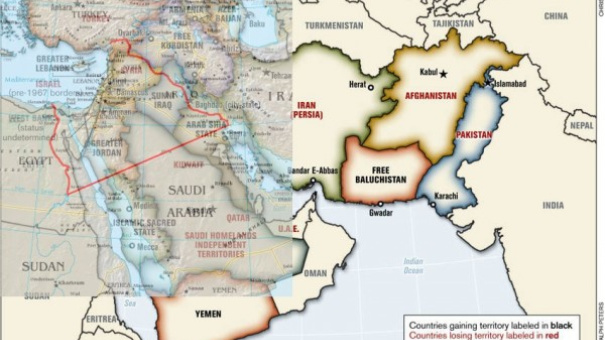
IMAGE: Project Balkanisation: Oded Yinon and an Enduring Plank of Israeli Foreign Policy (Source: Katehon)
It argues that Israel’s long-term survival hinges on one core premise: “The dissolution of all existing Arab states into small units.”
On the surface, the geopolitical win by the US-UK-Israel military-intelligence trifecta — backed by Turkey and the Persian Gulf monarchies — appears seismic. A Shīʿī-led country now falls under Sunni Salafism, severing the contiguous Shīʿī-controlled corridor linking Tehran to Hezbollah in Lebanon.
Another barrier to China’s Silk Road ambitions into the Mediterranean has been firmly set in place. Any revival of the ancient Via Maris — a trade corridor that once ran the Levantine coast, linking Asia to Europe and North Africa — remains a pipe dream.
Severed by the establishment of Israel and now buried beneath the rubble of Syria’s destruction, it ensures that any vision of unity from the Maghreb to the Arabian Peninsula remains just that — a vision.
But perhaps of greater immediate import — Israel’s ethno-supremacists and their vision of a ‘Greater Israel’ have just taken a giant leap forward. Southern Syria — and crucially, Mount Hermon, which overlooks Damascus and the Bekaa Valley in Lebanon, granting strategic military dominance over both — is now firmly under Israeli control. As is the tri-border area between Syria, Jordan, and Iraq — Al Tanf.
Yet there’s more. Israel now moves to establish its self-styled ‘David’s Corridor’ — a contiguous land route stretching from the occupied Golan Heights through southern Syria to the Euphrates. It cuts through the governorates of Deraa, Suwayda, Al-Tanf, and Deir Ezzor, reaching the Iraqi-Syrian border at Albu Kamal — granting Israel a strategic foothold deep in the heart of West Asia.
The corridor was already partially activated during the 12-day war with Iran, enabling standoff air strikes deep into Iranian territory.
With a direct land route to Iraq now viable, expect covert destabilisation efforts within the Shīʿī heartlands of Karbalāʾ and Najaf, alongside renewed backing for Kurdish separatists in both Iraq and Syria. Further vicious sectarian conflict across the region is now being baked in.
Whilst Israel’s bombing of the Defence Ministry and the Presidential Palace in Damascus was supposedly to protect the Druze community from Jolani’s Salafist mercenaries, no such protection was afforded to the Alawites, Armenians, Assyrians, or any of Syria’s other religious or ethnic minorities, who were left to be slaughtered.
The strikes on the Defence Ministry and Presidential Palace were telegraphed well in advance — and were thus performative. A warning to Jolani — Southern Syria is now firmly under Israel’s purview. No Syrian military forces will be allowed.
Meaning: Jolani and his hired guns are expendable, especially now that they’ve completed their task — extinguishing Syria’s sovereignty. As Hadi Nasrallah ruefully put it:
“You mean to tell me the very ones armed by Israel, treated in Israeli hospitals, coordinating with the IOF, shaking Netanyahu’s hand and thanking him for bombing Lebanon — are now being bombed by Israel after serving their purpose? Who would’ve thought?”
And yet, it remains far from clear if Jolani has outlived his usefulness, or if he still has his uses, at least from a US perspective.
Only days ago, whilst Jolani was in Baku, Syrian and Israeli officials were reportedly in talks. Rumours even swirled of a deal wherein Syria would launch attacks against Lebanon’s Shiʿī communities — either independently or in coordination with Israel.
Little wonder, then, that US envoy Tom Barrack warned Lebanon to ‘disarm Hezbollah or risk Syrian occupation’ — signalling that Lebanon, too, is likely slated for division and balkanisation.
The port of Tripoli and the Bekaʿa Valley, Lebanon’s agricultural heartland and a Shīʿī stronghold, are now in play. The only question is whether Ankara or West Jerusalem will seize them first, come to blows over Lebanon’s spoils, or quietly divide them, with Turkey taking the port and Israel the Bekaʿa.
But full control may yet require the chaos of full-on civil war. Syria and Lebanon edge closer — division and balkanisation becoming ever easier to enforce, until little remains but manageable fragments. The Yinon Plan made manifest.
“The attack on Lebanon is going to happen without a doubt… the question is when, and the other question is how. Is Israel going to do a ground invasion at the same time or just attack from the air?” (Ibrahim Majed)
Doubtless, the architects of today’s chaos are already patting themselves on the back, expecting handsome dividends to roll in. More division. More balkanisation. A weaker, fractured Arab world — and a stronger, more dominant Israel.
This is what Netanyahu means when he talks about “redrawing the Middle East”.
Yet the US and Israel are unravelling at an accelerating pace. Their seeming victory over the Levant is no triumph of providence — it courts the abyss and beckons the judgment to come.
The IAEA and OPCW – How International Organisations Became Tools of War
21st Century Wire | July 2, 2025
Dr. Piers Robinson is a political scientist, a former professor at the University of Sheffield, as well a research director at the International Center for 9/11 Justice, whose recent article on Substack is titled, “The IAEA and OPCW: Watchdogs for Peace or Propagandists for War?” looks at the IAEA’s questionable operations in Iran, and the similarities to the abused OPCW in Syria, and in general the role of “lying through institutions”, and plying war-propaganda through third-party institutions.
Recent events in Iran have all but exposed how these supposed ‘watchdog’ institutions have been coopted and used by US and British intelligence in order to fabricate another case for war.
Pascal Lottaz, host of Neutrality Studies, talks with the co-director for the Organisation for Propaganda Studies, Dr Piers Robinson, about this, as well as the broader geopolitical implications at play here. Watch:
“Smart War” and State Terrorism
By Laurie Calhoun | The Libertarian Institute | July 1, 2025
On June 16, 2025, President Donald Trump threatened the 10 million inhabitants of Tehran, Iran, with death, for their government’s alleged nuclear aspirations.
The message was posted to the president’s Truth Social account, shared on X/Twitter, and then picked up by all major mass media outlets, making it common knowledge to everyone on the planet that Trump was preparing to join Israel’s war on Iran.
On June 17, 2025, President Trump directly threatened Iran’s Supreme Leader Ayatollah Khamenei with assassination.
Sometimes crazy people issue vague threats which they have no power to follow through on. Such persons are best avoided and ignored. In order to be effective, death threats must be credible, otherwise there is no fear generated in the persons being addressed, for they recognize that they are dealing with no more and no less than a feckless buffoon. Whatever one may think of President Trump, his menacing social media posts are credible threats, given his official role as commander-in-chief with the power to unleash formidable military might on the people of the world. In case anyone did not already know this, Press Secretary Karoline Leavitt reminded the press corps on June 20, 2025, that “Iran and the entire world should know that the United States military is the strongest and most lethal fighting force in the world, and we have capabilities that no other country on this planet possesses.”
Trump’s warning to the entire population of Tehran that they should all evacuate the city was a fortiori a credible threat, given the U.S. government’s wide-ranging “War on Terror,” during which both Afghanistan and Iraq were invaded and occupied. Several other countries were subjected to thousands of missile strikes “outside areas of active hostilities,” that is, where there were no U.S. troops present and thus no force-protection pretext for the use of state-inflicted homicide.
Verbal threats of the use of deadly force by a president often culminate in military action because the commander may be easily persuaded by his advisors to believe that he (and the nation) will lose credibility if he fails to follow through on his words, which, he is told, would be a sign of weakness. Predictably enough, then, on June 22, 2025, President Trump delivered on his threat to bomb Iran, although he claimed to have struck only three specific sites: Fordow, Isfahan, and Natanz. It was at these sites where nuclear enrichment and the development of nuclear arms were allegedly underway. The Trump administration’s Director of National Intelligence Tulsi Gabbard reported to members of congress in March 2025: “The [Intelligence Community] continues to assess that Iran is not building a nuclear weapon and Supreme Leader Khamenei has not authorized the nuclear weapons program he suspended in 2003.”
On June 17, 2025, when a journalist reminded Trump of Director Gabbard’s assessment, the president bluntly blurted out, “I don’t care what she said.” It has become increasingly obvious that Trump’s foreign policy in the Middle East is primarily informed not by his own cabinet but by the intelligence services of Israel, above all, Mossad.
For anyone unfamiliar with the modus operandi and general demeanor of Mossad, I recommend the films Munich (2005), The Gatekeepers (2012), and The Operative (2020).
That Trump has been decisively influenced by the government of Israel was further evidenced by his direct threat against Supreme Leader Khamenei and the fact that Prime Minister Benjamin Netanyahu has been calling for regime change in Iran for decades.
On June 20, 2025, two days before Trump’s missile strikes on Iran, Director Gabbard did an about-face, insisting that her earlier testimony before congress had been misrepresented and ignored her finding that Iran had been enriching uranium:
Gabbard’s retraction, or creative reinterpretation, of her former testimony bears similarities to the case of Bush administration Secretary of State Colin Powell, who initially opposed the 2003 invasion of Iraq and then for reasons which remain unclear suddenly became one of the mission’s most ardent supporters. In Powell’s case, he went even so far as to present the case for war to a less-than-enthusiastic United Nations Security Council. After a colorful Powerpoint presentation featuring an array of ersatz evidence—ranging from speculation about Iraq’s aluminum test tubes, to a receipt for “yellow cake” purchase, to photos of what were claimed to be mobile chemical labs—Powell recognized that he did not have the votes needed to secure U.N. approval and so abruptly withdrew the war resolution. The United States then proceeded to invade Iraq unimpeded, claiming, among other things, that the 2003 military intervention was legal because of previous U.N. resolutions violated by President Saddam Hussein. In other words, after having sought U.N. approval, the U.S. government suddenly denied that it needed such approval before invading Iraq anyway.
Unlike George W. Bush, when Donald Trump bombed Iran “at a time of his choosing,” as they say, he did not have the support of the U.S. congress. Presidents Barack Obama, Joe Biden and Trump all depended on the Bush-era AUMFs as they continued to lob missiles on several countries beyond Afghanistan and Iraq, including Yemen, Pakistan, Somalia, Syria, et al. But the carte blanche AUMFs granted to Bush in 2001 and 2002 had nothing whatsoever to do with the conflict between Israel and Iran. Neocons naturally devise all manner of interpretive epicyclic curlicues to arrive at the conclusion that Iran is in fact “fair game” for bombing. As stated and ratified, however, the AUMFs granted by congress to George W. Bush were intended to facilitate the U.S. president’s quest to bring justice to the perpetrators of the September 11, 2001 crimes.
Lest anyone forget, President Trump was not unique among twenty-first century presidents in bombing countries whose residents had nothing to do with the shocking demolition of the World Trade Center. President Obama effected a regime change in Libya without securing the support of congress because, he claimed, it was not really a war, since he was not deploying any ground troops. Secretary of State Hillary Clinton did her part to persuade Obama that “Gaddafi must go!” She later characterized the Libya intervention as a shining example of “smart power at its best,” even though a few U.S. State Department officials, including the ambassador to Libya, Christopher Steele, were killed in the post-bombing mêlée. Today, Libya is essentially a failed state. Obama himself has confessed that the biggest regret and worst mistake of his presidency (reported in The Guardian) was not having a plan for the aftermath of his supposedly “humanitarian” intervention, which he enlisted NATO to carry out.
In the immediate aftermath of the June 22, 2025 missile strikes, Trump officials followed the Obama administration’s Libya playbook in insisting that his attack on Iran’s nuclear facilities was not the beginning of a long, protracted engagement in Iran. This was meant to draw contrast with the unpopular multi-decade wars in Afghanistan and Iraq. Ignoring Trump’s threat to the residents of Tehran, Vice President J.D. Vance and others recited the Obama administration refrain that the mission was “not a war” with Iran. As Vance explained, the limited missile strikes were carried out only in order to dismantle Iran’s nuclear facilities. According to the government of Iran, a total of 610 people were killed and thousands more injured by the bombs of the U.S. and Israeli governments. However, none of the persons who perished were Americans.
Availing himself of the Obama-era “smart war” trope, Vice President Vance also observed that Trump’s preemptive military strikes differed from those of his predecessors because, unlike Trump, the previous presidents were “dumb”. Oliver Stone produced a film, W (2008), which persuasively portrays Bush as a half-wit, but no one ever suggested that Vice President Dick Cheney or the cadre of other war profiteers and neocons who coaxed Bush into preemptively attacking Iraq were stupid.
In any case, by now, the U.S. government has directly massacred so many thousands of people (and millions indirectly) in so many different countries, often located outside areas of active hostility (war zones or lands under occupation), that the citizenry has become largely inured to it all. Tragically, over the course of the twenty-first century, we have witnessed an apparently permanent paradigm shift to the profligate state use of homicide to terrorize and kill anyone anywhere deemed dangerous or even suspicious by U.S. officials or their contracted analysts. This radical paradigm shift was made possible by a new technology: the weaponized drone, which began to be used by the Bush administration first under a pretext of force protection in Afghanistan and Iraq. The Bush team effectively initiated the Drone Age by firing a missile on a group of terrorist suspects driving down a road in Yemen on November 3, 2002.
As the Global War on Terror stretched on and angry jihadists began to proliferate and spread throughout the region, President Obama assumed the drone warrior mantel with alacrity, opting to kill rather than capture thousands of suspected terrorists outside areas of active hostilities. In his enthusiasm for drone killing, Obama went even so far as to intentionally and premeditatedly hunt down and kill U.S. citizen Anwar al-Awlaki (located in Yemen at the time, in 2011), without indicting him, much less allowing him to stand trial, for his alleged crimes.
Following the Obama precedent, in 2015, U.K. Prime Minister David Cameron opted to execute British nationals Ruhul Amin and Reyaad Khan, who were suspected of complicity in terrorism, after they had fled from the U.K. to Syria, and despite the fact that the parliament had rejected Cameron’s call for war on Syria. Cameron’s missile strikes against British citizens located abroad was all the more surprising because capital punishment is illegal in the U.K. as well as the European Union, of which Britain was a member at that time.
One state-perpetrated assassination leads to another, and on January 3, 2020, President Trump authorized the targeted killing via drone strike of a top Iranian commander, Qassem Soleimani, who was in Baghdad on a diplomatic mission at the time. Trump openly proclaimed, and indeed bragged, that the homicide, which he authorized, was intentional and premeditated. According to the president, Soleimani was responsible for past and future attacks against both Israel and the United States. The summary execution of a specific, named individual would have been considered an illegal act of assassination in centuries past but today is accepted by many as an “act of war” for the sophomoric reason that it is carried out by a military strike rather than undercover spies armed with poisons or garrottes.
In view of Trump’s unabashed, vaunted, assassination of Soleimani, and his full-throated support of Netanyahu, the threat to liquidate Supreme Leader Khamenei was just as credible as the “evacuation order” to the entire population of Tehran. Leaders today exult over their use of cutting-edge technology to eliminate specific, named individuals, as though summarily executing the victims were obviously permissible, given that targeted killing is now regarded by governments the world over as one of the military’s standard operating procedures. Such unlawful actions were fully normalized as a tool of “smart war” during the eight-year Obama presidency.
Shortly after Trump officials went out on the media circuit to insist that the bombing of Iran’s alleged nuclear production facilities was not the initiation of a U.S.-Iran war, Trump took to social media again, this time to suggest that his administration’s ultimate goal might really be regime change:
Less than one day later, the new official narrative became that Trump had masterfully brought the “twelve-day war” to a miraculous close, thanks to his superlative deal-making capabilities.
All of this would be risible, if not for the fact that many millions of persons in Iran continue to live under a persistent threat of death, given the wildly unpredictable comportment of President Trump, seemingly exacerbated by his longstanding commitment to stand by Israel, regardless of how outrageously Netanyahu behaves. The more and more daring acts of assassination perpetrated by the government of Israel clearly illustrate where state-perpetrated homicide and its attendant terrorist effects under a specious guise of “smart war” eventually lead.
Targeting named terrorist suspects allegedly responsible for previous crimes swiftly expanded to include signature strikes against groups of unarmed persons designated potentially dangerous and located anywhere in the world—in Gaza, Lebanon, Syria, Iran, or anywhere else they please. The Israeli government has even deployed exploding cellphones and car bombs, the latter of which was once a tactic primarily deployed by dissident anti-government groups and crime syndicates. The repeated use by the Israeli government of car bombs to kill research scientists illuminates the slippery slope from missile strikes outside areas of active hostilities to what are empirically indistinguishable from Mafia hits. Car bombs have long been used by the Mafia and other nongovernmental organized crime groups, but the Israeli government openly perpetrates the very same acts under cover of “national self defense”.
Washington’s normalization of assassinations has emboldened leaders such as Netanyahu, who today conducts himself according to the principle “everything is permitted” in the name of the sacrosanct State. Witness what has been going on in Gaza since October 7, 2023: terrorism, torture, starvation, and summary execution. All of this is being condoned by every leader in the world who continues to voice support for, or even aids and abets, Netanyahu’s mass slaughter. This support for mass slaughter is provided ostensibly under the assumption that the perpetrators are doing no more and no less than defending the State of Israel.
Following the examples of U.S. Presidents Trump and Obama, and UK Prime Minister Cameron, all of whom publicly vaunted their assassination prowess, Prime Minister Netanyahu, having apparently recognized that the implement of homicide is in fact morally irrelevant, openly and brazenly executes persons determined by Mossad to be dangerous, with no concern for the thousands of innocent persons’ lives ruined along the way. In Operation Red Wedding, the Israeli government claimed to have dispatched, in a matter of minutes, thirty senior officials associated with the IRGC (Iranian Revolutionary Guard Corps) including military chiefs and top commanders located throughout Iran at the opening of the June 2025 “Twelve-Day War.” The operation was praised by the pro-Israel media as featuring “bespoke” acts of targeted killing made possible by “pattern of life” intelligence.
Drone assassination, successfully marketed by the Obama team as “smart war,” smoothed the way to the uncritical acceptance by many citizens of the reprobate expansion of state killing to include acts historically committed by members of nongovernmental organized crime. Looking back, the rebranding by U.S. officials of political assassination as an act of war, provided only that the implement of death is a missile, was a slick and largely successful way of persuading U.S. citizens to believe that extrajudicial, state-inflicted homicide abroad is an acceptable means to conflict resolution. Even though it bypasses all of the republican procedures forged over millennia, including judicial means, for reconciling the rival claims of adversaries.
In the maelstrom of the twenty-first-century wars on Afghanistan and Iraq, assassination was labeled targeted killing and successfully sold to politicians as “smart war,” a surgically precise way to defeat the enemy without sacrificing combatant troops. Whichever label is used, assassination or targeted killing, acts of summary execution by governments involve the intentional, premeditated elimination of persons suspected to be possibly dangerous, a criterion so vague as to permit the targeting of virtually any able-bodied person who happens to be located in a place where terrorists are thought to reside.
There are three differences between “targeted killing” carried out by drone warriors and assassination. First, the weapon being used is a missile. Second, drone operators wear uniforms, while undercover assassins and hitmen do not. Third, far from being “surgically precise,” drone warfare increases the slaughter of innocent bystanders in their own civil societies, which is facilely dismissed as the “collateral damage” of war. In this way, the advent of lethal drones and their use outside areas of active hostility has served to terrorize entire populations forced to endure the hovering above their heads of machines which may—or may not—emit missiles at any given time on any given day.
Credible death threats to heads of state and evacuation orders issued to millions of people not only terrorize the persons being addressed, but also undermine the security of the citizens of the United States. The populace will bear the brunt of the blowback caused by such reckless behavior on the part of officials who operate with effective impunity and are ignorant of or oblivious to the nation’s republican origins. By launching preemptive missile strikes, the Pentagon does not protect but sabotages the interests and well-being of not only U.S. citizens but also the citizens of the world.
Nonetheless, many U.S. politicians and members of the populace, along with heads of state such as Canada’s Prime Minister Mark Carney, U.K. Prime Minister Keir Starmer, Australia Prime Minister Anthony Albanese, et al., having been thoroughly seduced by the “smart war” marketing line, appear to have no problem whatsoever with the tyrannical and arguably deranged death threats of the U.S. president. They have become altogether habituated to the assassination of persons now regarded as a standard operating procedure of war. European Commission President Ursula von der Leyen effectively condoned Trump’s behavior by issuing this statement in the aftermath of the June 22, 2025 U.S. missile strikes against Iran: “Iran must never acquire the bomb.”
If terrorism is the arbitrary killing of or threat of death against innocent persons, then there can be no further doubt that the largest state sponsor and perpetrator of terrorism in the twenty-first century is in fact the U.S. government. President Trump inherited from President Obama and his mentor, drone-killing czar John Brennan (appointed by Obama as CIA director in 2013), the capacity to terrorize entire civilian populations and execute individuals at his caprice. No less than every drone strike launched in the vicinity of civilian populations beyond war zones, Trump’s completely unhinged threat to a group of people with nowhere to seek refuge, and no way of knowing whether the U.S. president is issuing a serious warning or simply bluffing, attempting some sort of perverse ploy to bring Iran’s Supreme Leader Khamenei back to the negotiation table (where he was, before Israel began bombing Iran), was an act of terrorism.
It is not “smart” to terrorize millions of human beings in the name of preventing terrorism. It is a contradiction, pure and simple.
Laurie Calhoun is a Senior Fellow for The Libertarian Institute. She is the author of Questioning the COVID Company Line: Critical Thinking in Hysterical Times,We Kill Because We Can: From Soldiering to Assassination in the Drone Age, War and Delusion: A Critical Examination, Theodicy: A Metaphilosophical Investigation, You Can Leave, Laminated Souls, and Philosophy Unmasked: A Skeptic’s Critique. In 2015, she began traveling around the world while writing. In 2020, she returned to the United States, where she remained until 2023 as a result of the COVID-19 travel restrictions imposed by governments nearly everywhere.
Moscow blasts US redo of ‘Iraqi weapons of mass destruction’ stunt
RT | June 22, 2025
Russia has sharply condemned the United States for its airstrikes on Iranian nuclear facilities, calling the attacks “irresponsible, provocative and dangerous,” and warning they risk pushing the Middle East toward a large-scale war with potentially catastrophic nuclear consequences.
Speaking at an emergency session of the UN Security Council on Sunday, Russian Ambassador Vassily Nebenzia accused Washington of violating the UN Charter, international law and the Nuclear Non-Proliferation Treaty (NPT).
“The United States has opened a Pandora’s box, and no one knows what consequences may follow,” Nebenzia said, noting that by targeting IAEA-supervised nuclear sites, Washington has “once again demonstrated total disregard for the position of the international community.”
Nebenzia drew a pointed comparison to the lead-up to the 2003 Iraq War, when then-US Secretary of State Colin Powell presented false evidence to “justify the invasion of another sovereign state, only to plunge its people into chaos for decades and not find any weapons of mass destruction.”
“Many today feel a strong sense of déjà vu,” he said. “The current situation is essentially no different: we are once again being urged to believe in fairy tales in order to once again bring suffering to millions of people living in the Middle East.”
Russia argued that Tehran has not been proven to be pursuing a nuclear weapon, echoing earlier assessments by US intelligence that were dismissed by President Donald Trump as “wrong.” Nebenzia accused Washington of fabricating a narrative to justify the use of force and of undermining the decades-long diplomatic framework built around Iran’s peaceful nuclear program.
The Russian envoy also criticized what he described as the hypocrisy of Western nations that had for days called for “restraint” in the same Security Council chamber, yet failed to condemn Washington for joining Israeli strikes – and even blamed Iran for the escalation.
“We are witnessing an astonishing example of double standards,” he said. “Iran has been and remains one of the most thoroughly inspected states under the NPT, but instead of encouraging such an attitude, it receives bombardments of its territory and civilians by a state that refuses, in principle, to sign the NPT.”
Nebenzia warned that the US strikes undermine the authority of the IAEA and the global non-proliferation regime, and that continued escalation could return the world to an era of uncontrolled nuclear risk.
“This is an outrageous and cynical situation, and it is very strange that the Director General of the IAEA did not say a word about it. Neither has he ever called on Israel to join the NPT,” Nebenzia added.
Calling for urgent action, Russia – joined by China and Pakistan – submitted a draft Security Council resolution demanding an immediate and unconditional ceasefire and a return to diplomatic talks on Iran’s nuclear program.
Featured Video
The Source of America’s Wars – Kristol Clear
or go to
Aletho News Archives – Video-Images
From the Archives
Is Israel to blame for the Iraq War?
American Goy | March 10, 2008
I am so tired of this old canard that “Israel had nothing to do with USA’s war with Iraq – in fact, it officially advised America against it”.
Bullshit. … continue
Blog Roll
 Aletho News
- Alberta Bill Would Fine Political Deepfakes $10,000 Without Satire Exemptions
- Iran declares ‘historic victory’ over US, says enemy forced to accept its proposal
- Trump Claims Ceasefire, Reopening of Strait of Hormuz Agreement with Iran
- Israeli tank fire killed UN peacekeeper in Lebanon, UNIFIL investigation finds
- Russia, China block Bahrain-sponsored UN resolution on Strait of Hormuz
- The US-Israeli War on Science is an Assault on our Future
- Trump’s Promise to Bomb Iran ‘Like Never Before’ Faces Brutal Logistics — Expert
- Germany seeks to restrict stays abroad for men of fighting age – Berliner Zeitung
- Evidence points to Ukraine being behind TurkStream attempted sabotage, but that should come as no surprise
- Sri Lanka secures supplies of Russia oil – minister
- If Americans Knew
- Thousands dead and neighborhoods razed to the ground: Aid agencies fear southern Lebanon is becoming the new Gaza
- The war the US is fighting for Israel could cost trillions
- ‘Cigarette Burns, Nail Wounds’: Toddler Tortured in Gaza to Coerce Father
- Trump Says US Sent ‘a Lot of Guns’ to Protesters in Iran
- Israeli forces destroy 17 UN peacekeeper cameras in south Lebanon
- US-Israeli strikes ‘completely destroy’ synagogue in Tehran
- Archbishop for US Military Says Iran War Is Unjust Under Catholic Teaching
- Iranian leaders’ Open Letters to the American People
- Trump says Iranians appreciate bombs, WHO warns of nuclear risks – Daily Update
- U.N. experts demand Israel release prominent Gaza doctor after reports of ‘severe torture’
- No Tricks Zone
- An Inconvenient Tree: Uncovered In Alps… Europe Much Warmer Than Today 6000 Years Ago
- New Study Reports A 60% Slowdown In Greenland’s Ice Loss Rate In The Last Decade
- Low Intensity Tornado Wrecks Major Solar Farm, Creating A Potential Toxic Dump
- New Study Finds Warming Saves Lives…Cold Temperatures 12 Times More Deadly Than Excess Heat
- German Science Blog Accuses PIK Climate Institute Of Hallucinating Climate Tipping Points
- Devastating Assessment Of Comirnaty Vaccine By Former Senior Pfizer Europe Toxicologist
- New Study: CO2 Is ‘Effectively Negligible’ As An Explanatory Climate Change Factor Since 2000
- Former Pfizer Toxicologist Dr. Helmut Sterz Tells Bundestag Hearing Pfizer Vaccine Should Have Never Been Approved
- Energy Expert: Germany’s Nuclear Phaseout Was A “500 Billion Euro Mistake”
- New Research: South Australia’s Mid-Holocene Sea Surface Temperatures Were 4°C Warmer Than Today
 Aletho News