Ireland’s public broadcaster – undeclared earnings bad, endorsing The Great Reset good?
By Gavin O’Reilly | OffGuardian | July 17, 2023
Over the past several weeks, Ireland has been rocked by a scandal related to the significant undeclared earnings of Ryan Tubridy, the most prominent presenter on the public broadcaster of the 26-County State, RTÉ, and the long-time host of its flagship talk show, The Late Late Show, until his departure earlier this year – prior to the revelations related to his salary becoming public knowledge.
In response, Director General of RTÉ Dee Forbes tendered her resignation, and both Tubridy and his agent Noel Kelly have been brought before a government tribunal to account for the undeclared earnings, something that has received significant media coverage across Ireland, including OJ Simpson-style live television coverage of the proceedings.
What has been noticeable however is how this extensive media attention lies in stark contrast to the virtually non-existent mainstream media coverage of RTÉ’s endorsement of the World Economic Forum’s Great Reset initiative over the past three years, intended to usher in a totalitarian global corporate dictatorship, where technology is used to stifle and censor debate.
From the outset of the ‘Covid Pandemic’ in March 2020, Ireland, like numerous other countries, introduced stringent lockdowns under the guise of preventing the spread of an alleged virus. In reality, the forced closure of vast swathes of society served the purpose of making it virtually impossible for smaller businesses to operate, thus creating a greater dependence on corporate outlets such as Amazon.
As a result, the global lockdowns saw the greatest upwards transfer of wealth from the working and middle-classes in history, with corporate elements receiving upwards of $1tn in profit.
With Taoiseach Leo Varadkar being a WEF ‘Young Global Leader’, RTÉ was fully complicit in endorsing the ‘Pandemic’ narrative, WEF-linked scientist Luke O’Neill being a regular guest on The Late Late Show under Ryan Tubridy in order to further its promotion.
The public broadcaster would also condemn Irish anti-lockdown protests as being ‘organised by the far-right’ in lock-step with similar mainstream media descriptions being ascribed to protests in New Zealand, France and Canada – each country also being under the respective rule of WEF ‘Young Global Leaders’, Jacinda Ardern, Emmanuel Macron and Justin Trudeau.
What would be perhaps the most sinister aspect of RTÉ’s two-year promotion of the ‘Pandemic’ narrative however, was the use of children to promote uptake of the ‘Covid’ Vaccine during the 2020 edition of The Late Late Toy Show, a seasonal edition of the programme used to showcase that Christmas’s latest toy selection, one that is traditionally very popular amongst families with young children.
Indeed, Ryan Tubridy himself would later double down on his promotion of the vaccine by infamously using his radio platform to encourage listeners to disinvite guests from weddings who had not been vaccinated, his incendiary remarks coming amidst a time when access to bars, restaurants, hairdressers and gyms in the southern Irish state, was forbidden to those who had not yet received a ‘Covid’ jab and the resulting digital QR code that would subsequently be placed on their smartphone.
This enforced segregation, in Ireland and further afield, served as a dry-run for the introduction of mandatory digital ID, a key part of the ‘Fourth Industrial Revolution’ that the WEF envisages will come about as a result of the Great Reset, with the ultimate goal being a cashless society. One where the corporate-government alliance has full control over its citizen’s financial transactions, and can easily impose sanctions against those it deems to be dissidents.
Indeed, this very situation would play out during last year’s Freedom Convoy in Canada, when Justin Trudeau would use emergency legislation to freeze the bank accounts of Truckers protesting against his decision to mandate that truck drivers re-entering Canada from the US had to be vaccinated. A truly dystopian move, and one that could be far more easily implemented in a society with no physical cash.
RTÉ’s two-year endorsement of the introduction of such a totalitarian society has come in for little criticism since the sudden collapse of the ‘Pandemic’ narrative last January however, the undeclared earnings of its chief propagandist being a far more newsworthy item it would seem.
Gavin O’Reilly is an Irish Republican activist from Dublin, Ireland, with a strong interest in the effects of British and US Imperialism; he was a writer for the American Herald Tribune from January 2018 up until their seizure by the FBI in 2021, with his work also appearing on The Duran, Al-Masdar, MintPress News, Global Research and SouthFront. He can be reached through Twitter and Facebook and supported on Patreon.
Irish Farmers Protest Plans to Cull Livestock to Meet Climate Targets
By Michael Nevradakis, Ph.D. | The Defender | June 8, 2023
Farmers in Ireland are protesting government proposals to cull livestock — including up to 200,000 cows — in an effort to meet national and European Union (EU) climate targets.
According to Ireland’s Independent, up to 65,000 dairy cows and 10% of the livestock herd would have to be removed from the national herd every year for three years at a cost of €200m ($215.2 million) if the farming sector is to “meet its climate targets.”
The figures come from an Irish government document the Independent obtained following a freedom of information request.
National climate targets in question include a 51% reduction in emissions by 2030 — the target year for the United Nation’s Sustainable Development Goals — and net zero carbon emissions by 2050, the Independent reported.
According to the Irish Mirror, a 25% emissions reduction goal has been set for the agricultural sector by 2030.
The government document proposes farmers receive compensation of up to €5,000 ($5,381) for each cow that is culled.
According to Remix News, the plans were first outlined in 2021. A report at the time recommended culling up to 1.3 million cattle to reduce emissions to “sustainable” levels.
There are approximately 2.5 million dairy and beef cows in Ireland, according to the Irish June Livestock Survey. Of these, 1.6 million are dairy cows — which have increased by 40% in the past decade — while beef cows total approximately 913,000, representing a decrease of 17% over the same period, the Irish Mirror reported.
Separately, Ireland’s Environmental Protection Agency (EPA) issued a 115-page report in March that recommended “effective abatement of livestock emissions … of approximately 30% plus ruminant livestock number reduction [of] up to 30%.”
According to the EPA, the country’s agricultural sector is directly responsible for almost 38% of the country’s greenhouse gas emissions, as reported by the Irish Mirror.
And a report published in October 2022 by the Irish government’s Food Vision Dairy Group — established to “identify measures which the dairy sector can take to contribute to stabilization and subsequent reduction of emissions” — said there is an “urgent need to address the negative environmental impacts associated with dairy expansion.”
The report said dairy farmers could lose between €1,770 ($1,906) and €2,910 ($3,134) per cow removed.
Ireland, along with other EU member states and the U.S., are participants in the 2021 “Global Methane Pledge,” whose participants “agree to take voluntary actions to contribute to a collective effort to reduce global methane emissions at least 30 percent from 2020 levels by 2030.”
Organizations supporting the Global Methane Pledge include the United Nations Environment Programme, the European Investment Bank, the Global Dairy Platform, the Green Climate Fund, the International Energy Agency and Bloomberg Philanthropies.
Bloomberg Philanthropies is one of the major funders of the C40 Good Food Cities Accelerator, whose signatory cities commit to achieving a “planetary healthy diet” by 2030, defined by more “plant-based foods,” and less meat and dairy.
C40 merged with the Clinton Climate Initiative in 2006, and in 2020, said cities should “build back better.”
Separately, EU member states are discussing proposals to “cut pollution and greenhouse gas emissions from livestock,” according to Reuters.
The United Nations Environment Programme and the Climate and Clean Air Coalition claim livestock emissions account for approximately 30% of total methane emissions.
Cattle reduction proposals ‘absolute madness’
The Independent’s report prompted an immediate reaction in Ireland — particularly from the agricultural sector. This then prompted the Irish government to walk back the report.
The Irish Mirror reported that a spokesperson for Ireland’s Department of Agriculture said the report “was part of a deliberative process … one of a number of modelling documents” it is considering and “not a final policy decision.”
Pat McCormack, president of the Irish Creamery Milk Suppliers Association, told Newstalk Breakfast that Ireland’s “herd isn’t any larger than it was 25, 30 years ago.”
He said the farming sector is prepared to follow the strategic direction of the Irish government, but that, “If there is a scheme, it needs to be a voluntary scheme.”
Addressing the Irish Parliament on May 30, Peadar Tóibín, head of the Aontú political party, criticized the government’s proposals, calling them “an incredible threat to the farming sector at a cost of about €600 million [$646.9 million].”
Tóibín said:
“A full 25% of beef that’s being imported into the European Union is now coming from Brazil. How is it environmentally friendly to kill large swathes of the Amazon, import that beef from Brazil to substitute for Irish beef that’s been culled here in this state?”
A member of the Irish Parliament, Michael Healy-Rae, called the government’s proposals “absolute madness,” and warned that many farmers will refuse to comply or opt to leave the sector altogether if these plans move forward.
Tim Cullinan, president of the Irish Farmers’ Association told The Telegraph, “Reports like this only serve to further fuel the view that the government is working behind the scenes to undermine our dairy and livestock sectors.”
“While there may well be some farmers who wish to exit the sector, we should all be focusing on providing a pathway for the next generation to get into farming,” he added.
Ian Plimer, Ph.D., professor emeritus of geology at the University of Melbourne, told Sky News Australia that the culling of 200,000 cattle “can only end in disaster.”
“The Irish know about this from the potato famine,” he said. “A third of their population died, a third emigrated, and the same thing will happen. They will lose productive people from Ireland and they’ll go somewhere else.”
Twitter owner and CEO Elon Musk also weighed in over the controversy, tweeting “This really needs to stop. Killing some cows doesn’t matter for climate change.”
British author and farmer Jamie Blackett wrote, “It seems increasingly clear that there is an eco-modernist agenda to do away with conventional meat altogether. It’s not just the Extinction Rebellion mob, either; many of the world’s politicians are on board.”
An August 2022 report suggested “insects could soon be on the menu in Ireland” and that “High-protein bug replacements for meat and dairy could help save the planet.”
According to a report by the Independent, a 10% reduction in Ireland’s dairy herd would cost €1.3 billion ($1.4 billion) annually, while industry experts argued such proposals would result in global greenhouse gas emissions actually increasing.
According to Agriland, Ireland imported more than 14,000 tons of beef in the first quarter of this year, while Ireland exported €2.5 billion ($2.69 billion) worth of beef in 2022, an 18% increase compared to 2021, likely contributing to higher emissions.
The Food Vision Dairy Group’s October 2022 report “on measures to mitigate greenhouse gas emissions from the dairy sector” said:
“Ireland’s carbon footprint per unit of output is considered to be the lowest amongst milk-producing countries. It is also noted that the carbon footprint per unit of output has declined [in] recent years.”
However, an August 2022 Euronews report claimed Ireland “has the highest methane emissions per capita of all EU member states, with much of this due to beef production.”
The Food Vision Dairy Group’s report also stated:
“Once methane emissions are stabilised and remain stable then the atmospheric concentration will stabilise.
“Emissions should be reduced by around 3% per decade or offset by carbon dioxide removals which provides a similar climate impact. This would neutralise its impact on the global temperature. There is no basis in science therefore that requires emissions from enteric fermentation to be reduced to net zero.”
The group said it was focused on actions the dairy sector needs to take to make its “proportionate contribution” toward the target 25% reduction in agriculture emissions.
Several other proposals are contained in the report, including reducing chemical nitrogen use in the dairy sector by 27-30% by the end of 2030, and a “Voluntary Exit/Reduction Scheme.”
As these proposals are put forth, other reports indicate the use of private jets is “soaring” in Ireland. Remarking on this, Irish Senator Lynn Boylan recently stated:
“Climate justice advocates have long argued that not all carbon emissions are created equal. To date, the government’s approach has been about punishing ordinary people while the wealthy are exempt to continue living their carbon-intensive lifestyles.”
And in a May op-ed for Agri-Times Northwest, farmer and agronomist Jack DeWitt criticized cattle reduction proposals, arguing they rely on untrue science. He wrote:
“Something you have no doubt heard is that cattle who live their entire lives on pastures (i.e. grass-fed beef) emit less methane. That’s not true.
“Cattle’s methane impact in the U.S. is significantly less than 50 years ago and continues to reduce because of efficiency gains in producing beef and milk … Beef cattle numbers are down 6 percent since 1970, but meat production from those cattle is up 25 percent, partly due to heavier weight at slaughter, made possible by breeding animals to deliver higher growth rates and higher feed efficiencies. Expect these efficiency trends to continue.”
DeWitt also wrote, “Some people want to eliminate 1 billion cattle and convert people to veganism,” he added. “But humans pass methane too, and a vegan diet doubles the amount.” He said farmers can also trap methane and use it for electricity production.
Gates a major investor in methane reduction schemes
Similar proposals to reduce greenhouse gas emissions from the agricultural sector in several other countries also triggered farmer protests.
According to AgDaily, the Dutch government “is slated to cut nitrogen oxide and ammonia by 50 percent by 2030,” leading to many farms now “facing shutdowns.” The Dutch government “expects about a third of the 50,000 Dutch farms to ‘disappear’ by 2030” and has proposed a program of “voluntary” buyouts of farms and cattle stocks.
These plans resulted in large-scale protests by Dutch farmers earlier this year, and led to significant electoral losses by Prime Minister Mark Rutte’s governing coalition and significant gains made by the Farmer Citizen Movement, in March’s provincial elections.
Nevertheless, the European Commission recently approved two Dutch government plans to buy out livestock farmers.
According to AgDaily, the plans, worth €1.47 billion ($1.65 billion), aim “to reduce nitrogen emissions and meet EU environmental targets. Farmers will be offered financial compensation to stop farming and sell their animals voluntarily.”
Farmer protests also occurred in Belgium in March, following plans introduced by the Flemish government to reduce greenhouse gas emissions from the agricultural sector.
And a report commissioned in 2022 by Northern Ireland’s agricultural sector suggested that more than 500,000 cattle and approximately 700,000 sheep would need to be culled to meet the region’s climate targets.
In October 2022, the government of New Zealand “announced its plans to impose a farm-level levy on farmers for their livestock’s emissions … to meet climate targets,” according to Popular Science, with plans for the program to come into effect by 2025.
That proposal was met with mild opposition by Ermias Kebreab, Ph.D., director of the UC Davis World Food Center, who told Popular Science “The burden needs to be shared by society and not just farmers that are already operating on small margins.”
Society “sharing the burden” may imply reductions in meat consumption, a view that was further elucidated in a March 24 Reuters op-ed by columnist Karen Kwok.
Kwok wrote the “War on cow gas is [a] stinky but necessary job in [the] climate-change struggle.” If the price of meat goes up, Kwok said, “that will close a gap with plant-based burgers and steaks, which today cost twice as much as animal-based ones” — which will deter consumers from “purchasing chops and sausages and opt for less carbon-intensive alternatives,” she said.
In January, French dairy firm Danone announced it is considering placing masks on cows to trap their burps and reduce methane emissions, while Danone is also mulling forcing cows to wear diapers to trap their flatulence. One farmer told Fox News the plan was “utter madness” and said those proposing such ideas have “gone to loony town.”
Bill Gates recently made some high-profile investments in startups and technologies purporting to reduce methane emissions in the agricultural sector.
In January, Gates announced an investment in Australian start-up Rumin8, which is developing a seaweed-based feed to reduce the methane emissions cows produce “through their burps and, to a lesser extent, farts,” CNN reported.
And in March, the Bill & Melinda Gates Foundation granted $4.8 million to Zelp (Zero Emissions Livestock Project), a firm developing face masks for cattle that capture methane emitted by animal burps, converting it to carbon dioxide.
Speaking to Cowboy State Daily in March, Brett Moline, director of public and governmental affairs for the Wyoming Farm Bureau Federation, called the face mask proposal “one of the most pickle-headed ideas I’ve ever heard of.”
The Daily Mail, quoting The Associated Press, noted Gates is considered the largest private owner of farmland in the U.S., having “quietly amassed” close to 270,000 acres.
Such proposals may all be connected to the “One Health” concept promoted by the World Health Organization (WHO).
“One Health,” which figures prominently in the pandemic treaty and amendments to the International Health Regulations currently being negotiated, calls for global surveillance to detect potential zoonotic diseases that may cross over from animals to humans.
At the recent World Health Assembly, WHO Director-General Tedros Adhanom Ghebreyesus warned of a future pandemic that may be fueled by a zoonotic disease.
Michael Nevradakis, Ph.D., based in Athens, Greece, is a senior reporter for The Defender and part of the rotation of hosts for CHD.TV’s “Good Morning CHD.”
This article was originally published by The Defender — Children’s Health Defense’s News & Views Website under Creative Commons license CC BY-NC-ND 4.0. Please consider subscribing to The Defender or donating to Children’s Health Defense.
Ireland wanted public input on proposed censorship bill… Until the majority said they actually prefer free speech
Pushing ahead with censorship
By Cindy Harper | Reclaim The Net | May 4, 2023
The Irish government has decided to move forward with the Criminal Justice (Incitement to Violence or Hatred and Hate Offenses) Bill 2022, despite the fact that a majority of public consultation responses were against the proposal. The bill, which was initiated in October 2022, aims to address “hate speech” in the country.
The public consultation, held in 2019, offered individuals the chance to express their views on the matter through either letter submissions or survey responses. Gript, a news outlet, conducted an analysis of the 3,597 submissions received during the consultation process. The results indicated that 73% of the respondents opposed the implementation of a hate speech law in Ireland.
Many respondents felt that free speech should only be restricted in cases involving incitement to violence or credible threats. One individual commented, “I’m offended by the government quite often – but they are entitled to their opinion like I am.” Another stressed the importance of free expression over safeguarding the feelings of sensitive individuals.
Despite the clear opposition, the Irish government chose to proceed with the bill, citing the sheer number of responses as justification for moving forward. The Justice Department stated, “Hate Speech can lead to hate crime,” and announced the development of new hate crime laws in Ireland, following the release of the consultation findings.
This week, the bill received a significant majority of support in the lower house, with 110 votes in favor and only 14 against. The decision to move forward with the legislation, despite widespread public disapproval, raises questions about the effectiveness of public consultation and the government’s commitment to addressing the concerns of its citizens.
Irish grandmother jailed for calling Ukrainians ‘rapists and criminals’
RT | March 4, 2023
A homeless grandmother in Ireland has been sentenced to 16 weeks behind bars for entering a hotel housing Ukrainian refugees and shouting that they were“rapists and criminals.” The woman had sought accommodation, but was told no rooms were available.
Margaret Buttimer appeared before a district court in Bandon, County Cork on Thursday, where police told the judge that they were called to a disturbance at a hotel in the town in late January.
They found Buttimer shouting in the reception area, recalling that “she wanted to know how many Ukrainian nationals were staying in this hotel, what was the cost to the Irish people, and saying ‘these Ukrainians are rapists and criminals’,” according to a report by the Irish Times.
Police said that she refused to desist and leave the hotel, and they had “no option” but to arrest her.
Buttimer was sentenced to six weeks in prison, with half the sentence suspended on the condition that she stay away from any facility housing Ukrainian refugees.
The 68-year-old woman has 13 previous convictions, including for a similar incident at the same hotel in December. The court heard that she entered the premises and asked staff “why are all the Ukrainians getting a room and there is no room for me, an Irish citizen?
Buttimer’s earlier convictions involved breaches of coronavirus restrictions.
It is unclear if the hotel in Bandon was housing migrants from other countries in addition to Ukrainians. Ireland took in more than 70,000 Ukrainian refugees last year and more than 13,000 migrants from other countries. The arrival of the latter group, the majority of whom are male and hail from the Middle East and Africa, has triggered protests in the communities where they have been housed.
The migrant influx has come amid a record housing shortage in Ireland. House prices and rents have more than doubled in the last decade, and according to the government’s most recent figures, there are more than 8,300 homeless people in emergency shelters in the country.
Ireland’s protests – will Varadkar go full Trudeau?
By Gavin O’Reilly | OffGuardian | February 15, 2023
Since Russia began its special military operation in Ukraine almost a year ago, one of the key features of the collective West’s response, alongside sanctions and the expulsion of Russian diplomats, has been the accommodation of refugees fleeing the conflict, with millions of Ukrainians being housed across Europe since last February, including 70,000+ in the 26-County Irish State.
The first question that springs to mind regarding this approach however, is that if it is being done out of genuine concern for those fleeing conflict in Ukraine, then why was it not implemented in 2014 when that war first began?
In April of that year, following five months of Western-instigated violence in response to then-President Viktor Yanukovych’s decision to suspend an EU-trade deal in order to pursue closer ties with neighbouring Russia, the ethnic Russian Donbass region in the east of the country would break away to form the Donetsk and Luhansk People’s Republics, their residents having little choice lest they face genocide and ethnic cleansing at the hands of the anti-Russian neo-Nazi elements which composed the new Western-backed Kiev government.
A war on both Republics would follow, involving neo-Nazi paramilitaries such as Azov Battalion and Right Sector, which despite efforts to resolve the conflict peacefully via the federalisation solution offered by the Minsk Accords, would ultimately result in 14,000 deaths over the space of 8 years.
Despite this slaughter, no mainstream campaign existed in Ireland during the same period intended to expel Ukrainian diplomats or to welcome those fleeing conflict in the Donbass.
Likewise, no similar campaign has existed for those fleeing other conflicts such as that in Yemen, classed as the world’s worst humanitarian crisis by the United Nations, with a paltry 70 Yemenis being granted access to social services in the 26 Counties in the past year, in comparison to 72,609 Ukrainians in the same period following Russia’s intervention.
It must also me asked that if Leinster House genuinely cared about the plight of refugees fleeing conflict, then why contribute to the conflicts that created those refugees in the first place by allowing US warplanes to land in Shannon Airport over the past 20 years?
Since the Russian operation began in Ukraine last February, talks of the 26 County State joining an EU army have increased amongst establishment voices also, with the stated aim of such an alliance being to ‘act in complementarity’ with NATO, the coalition having been a key contributor to the refugee crisis over the past two decades by laying waste to Afghanistan, Iraq, Libya and Syria.
With these facts established, it can safely be concluded that Leinster House’s ‘concern’ for refugees has little to do with helping those fleeing war, and much like the wider West’s support of Ukrainian ‘freedom fighters’ being a cover to use Ukraine as a proxy to tie Russia down in an Afghan-style military quagmire.
Further, the Fine Gael-Fianna Fáil coalition is using emotive media coverage of the Ukrainian conflict as a means to swell the labour market and to keep wages stagnant on behalf of the corporate class.
Indeed, protests related to the effects of such a move would arise in late November, when upwards of 300 migrants were suddenly moved into a disused office block in East Wall, a working-class area of inner-city Dublin.
Residents would begin what would go on to become weekly demonstrations over the move, citing the lack of consultation with community officials beforehand, the suitability of the office block for accommodation, and the lack of transparency on whether those who had been moved into the office block had been vetted.
Despite these protests receiving support from residents of the office block themselves, the Irish mainstream media would, in lockstep, decry them as being ‘anti-refugee protests’ and ‘organised by the far-right’, a label that would also be applied to similar protests that emerged around Dublin and other locations in response to other wildly unsuitable locations chosen by Leinster House to accommodate adult migrants, including a school in Drimnagh, like East Wall, another working-class area of Dublin.
This dismissal of ordinary working class people’s concerns as ‘far-right’ bears a stark similarity to mainstream media descriptions of last year’s Freedom Convoy in Canada, when in response to a government mandate requiring all truck drivers re-entering from the US having to be vaccinated, a nationwide protest would begin in the second-largest country in the world.
The government of Justin Trudeau – like Leo Varadkar, another ‘Young Global leader’ of the World Economic Forum – would respond in an authoritarian fashion, freezing the bank accounts of protest organisers and attacking demonstrators with mounted Horses and teargas.
An approach, that with the head of the 26-County police force condemning the current protests and secretive police units monitoring organisers, may soon become a reality on the other side of the Atlantic.
Gavin O’Reilly is an Irish Republican activist from Dublin, Ireland, with a strong interest in the effects of British and US Imperialism; he was a writer for the American Herald Tribune from January 2018 up until their seizure by the FBI in 2021, with his work also appearing on The Duran, Al-Masdar, MintPress News, Global Research and SouthFront. He can be reached through Twitter and Facebook and supported on Patreon.
Occupation raids, attacks Palestinian organizations: EU, US and Canada are complicit!
Samidoun Palestinian Prisoner Solidarity Network | August 21, 2022
In the early morning hours of Thursday, 18 August, armed Israeli occupation forces invaded the offices of seven prominent Palestinian NGOs, civil society organizations and human rights defenders: the Health Work Committees, Addameer Prisoner Support and Human Rights Association, Al-Haq, Union of Palestinian Women’s Committees, Bisan Centre, Defence for Children International – Palestine, and the Union of Agricultural Work Committees. These organizations have all been designated by the Israeli occupation as “terrorist” in retaliation for their advocacy and community organizing work for Palestine, and then labeled “illegal organizations” in a military order covering the occupied West Bank of Palestine.
The invading forces ransacked the offices, confiscating computers, legal client files, documentation, printers and monitors and leaving clutter behind — as documented by the organizations’ surveillance cameras, recording the occupation forces’ invasion. The doors of the organizations were welded shut and a paper military order affixed to the door declaring their operation “illegal” under the occupation’s (illegal) military orders.
The organizations declared that they would not be silenced by these attacks, holding press conferences and returning to the offices to reopen them and continue their work. The attacks received widespread condemnation not only from Palestinian and pro-Palestinian forces but even from European governments whose policies and practices consistently target the Palestinian people and their fundamental rights.
Now, on Sunday, 21 August, occupation intelligence authorities — the Shin Bet — phoned Al-Haq director Shawan Jabarin to threaten him with interrogation and arrest if the organization’s work continues, while Defence for Children International – Palestine director Khaled Quzmar was summoned to and held under interrogation.
“Terror” Designations and Political Control
The invasions, interrogations, ransacking and attacks on these organizations reflect the failure of the occupation’s regime of “terror” designations to undermine their work. In 2021, not only did the regime designate Al-Haq, Addameer, DCI, Bisan, the UPWC and the UAWC as “terrorist” organizations — quickly followed by the military orders banning their work in the occupied West Bank of Palestine — it earlier in the year designated Samidoun (on 21 February 2021), followed by three more organizations. Previously and in a similar pretext, the occupation had issued a similar designation against the Health Work Committees along with designations of groups including the Arab Organization for Human Rights UK, the Palestinian Return Centre and Euro-Mediterranean Human Rights Monitor.
As we noted at the time, this
“indicates just how meaningless the term ‘terrorist’ is in the hands of the Israeli regime. It means precisely any organization, activist, or freedom fighter that challenges Zionist colonialism through any method or means of resistance at all. The flurry of ‘terrorist’ designations for organizations working to expose Israel’s crimes and organize Palestinians underlines this reality….These designations are not attacks on individual organizations but against Palestinian human rights defenders and those around the world who stand up for Palestinian liberation — and, fundamentally, the Palestinian people as a whole, especially the Palestinian prisoners in Israeli occupation prisons. They attempt to repress growing support for the legitimate resistance of the Palestinian people and confrontation of imperialism and Zionism.”
Further, it is clear that the use of such designations is intended to further political control over Palestinian society. These designations hinge on the allegation that organizations are close to one or another Palestinian resistance organizations, most commonly the Popular Front for the Liberation of Palestine or Hamas. Israeli officials have shopped around “evidence” to various governments that is so weak so as to be ludicrous, consisting almost entirely of unsubstantiated statements or on the idea that employing a person who supports a political organization (or, in some cases, relatives of people in political organizations “designated” by the occupation) is “funding” that organization by paying employees a salary for doing their job.
While it is obvious that these are false claims, the objective of this type of attack goes beyond simply lobbing allegations. Indeed, the European governments that have criticized the attacks and designations have also repeatedly affirmed their willingness to “examine evidence” and “act” if the Israeli regime “proves” that popular organizations, civil society groups and human rights advocates are in some way “tied” to Palestinian resistance movements. Not only are the organizations “innocent” of the Israeli claims, the claims themselves are fundamentally repugnant. The Palestinian people have the right to resist occupation and to be a part of political, social and armed movements in that resistance; this is not “terrorism” but an essential right of people under occupation and colonization.
Rather than affirming the right of Palestinians to resist and to organize themselves to achieve those goals, these European governments instead use these attacks to impose even greater political scrutiny and conditions. In many cases (such as the Netherlands), these governments recommend or require that all employees of these organizations must not be associated with any “banned” Palestinian political organization. If Palestinians are part of a political party or movement, they must be unemployable and impoverished: this is both the argument of the occupation and of the European states providing a meager “defense” of Palestinian civil society.
For the European funding agencies and many large foundations, supporting Palestinian NGOs has never been primarily about empowering or supporting the Palestinian people to achieve their liberation but rather about redirecting Palestinian energies into “state-building” and/or “reform” projects that exist within the confines of Oslo. Time and time again, these forces have introduced new conditional funding mechanisms and restrictions on everything from the political affiliation of individual employees to the names of buildings and schools.
European Union: Partners in Colonialism and Apartheid
This is borne out once again by the statement of nine European states — Belgium, Denmark, France, Germany, Ireland, Italy, the Netherlands, Spain and Sweden — which invokes the promotion of “democratic values and the two-state solution,” a fundamental contradiction as the so-called “two-state solution” itself is the legitimization of the colonization and occupation of 78% of Palestine and no solution at all for the Palestinian people. This brief comment lays bare the real political motivation for European involvement in funding Palestinian organizations, which is to limit rather than to achieve rights, justice and liberation. Further, the statement notes that “should convincing evidence be made available to the contrary, we would act accordingly.”
Here, the “evidence” being referred to would be any “links” between these NGOs and the Palestinian resistance. By including this statement in their alleged defense of the organizations, these European states actually encourage the occupation to continue its raids and ransacking, confiscation of files, arrests and interrogations, in an attempt to manufacture such “evidence”.
Of course, the position of these states themselves — members of the aggressive NATO alliance, defenders of the Israeli occupation in international arenas — is all too clear. The European Union, while rejecting the designation of advocacy and civil society organizations, continues to designate Palestinian resistance organizations as “terrorists.”
France continues to imprison Georges Ibrahim Abdallah while doing almost nothing to advocate for its citizen Salah Hamouri, jailed without charge or trial under Israeli administrative detention, as the government attempts to criminalize Palestinian activism, such as the Collectif Palestine Vaincra. Germany not only engages in weapons deals with the occupation, it also engages in severely repressive practices against Palestine organizing, particularly Palestinian communities in exile and diaspora, from the expulsion of Palestinian writer Khaled Barakat and Palestinian torture survivor and feminist Rasmea Odeh to the ban on 15 May Nakba demonstrations in Berlin. This is not to mention the links between Zionism and European colonialism from the very beginning of the Zionist project.
Now, Israeli prime minister and war criminal Yair Lapid is scheduled to come to Brussels on 6 October to convene the “Association Council” with all EU member states’ foreign ministers, for the first time in 10 years. This is the council under the EU-Israel Association Agreement, the agreement that provides for free trade for occupation products inside the EU and allows for occupation institutions to receive European grants for research and development.
Ending the EU-Israel Association Agreement is a long-time demand of the Palestine solidarity movement, but despite their expressed “concerns” about the violent repression imposed on Palestinians, these European states are planning to welcome Lapid and convene the Association Council after a long hiatus, celebrating their complicity in war crimes and crimes against humanity.
The Canadian government has refused to make any meaningful statement about these attacks, despite posing as a defender of “human rights.” U.S. officials stated their “concern,” while continuing to provide $3.8 billion in military support to the occupier.
**
Samidoun Palestinian Prisoner Solidarity Network affirms that these attacks are part and parcel of the ongoing war on Palestinian existence and organization, carried out by the Zionist state and supported by the imperialist powers that ally with the Israeli occupation, as well as Arab reactionary regimes engaged in “normalization” and the Palestinian Authority. While PA officials declare their public support for the targeted organizations, the PA continues to engage in security coordination with the occupation, declined the use of its security forces to defend the organizations, and has even previously detained leaders, directors and staff of these organizations challenging its repression at the behest of the occupier.
We reaffirm that the primary way that we can confront these designations is by intensifying our organizing, action, mobilization and resistance to bring down the structures of colonialism, implement the right to return for Palestinian refugees, and support the liberation of all Palestinian prisoners and of Palestine, from the river to the sea. This includes campaigning to bring an end to the so-called “terrorist lists” used to terrify Palestinian communities and Palestine solidarity organizers, which only provide a weapon in the hands of the occupation and encourages it to engage in further specious designations.
We also urge all to take action to confront Lapid’s visit on 6 October in Brussels and to bring down the “EU-Israel Association Agreement,” an agreement built on the colonization of Palestine and the massacres targeting the Palestinian people. It is incumbent upon all institutions and organizations concerned about these raids and about the Palestinian people to adopt and implement the boycott and international isolation of Israel, including at the United Nations and its bodies.
Further, we urge all to join us in organizing to march in Brussels on 29 October for the March for Return and Liberation to the European Parliament, to demand an end to European complicity, involvement in and support for the colonization of Palestine, the siege on Gaza, the imprisonment of Palestinians and the denial of millions of Palestinians’ right to return home.
Ireland prepares for fuel crisis and work-from-home mandates
By Thomas Lambert | The Counter Signal | June 7, 2022
Government officials in Ireland recently wargamed a fuel crisis scenario wherein fuel had to be rationed, and companies were told to enforce mandatory work-from-home orders to reduce consumption.
According to an exclusive exposé from the Irish Independent, participants convened in a confidential meeting on May 27 at the National Emergency Co-ordination Centre to participate in a hypothetical “Oil Emergency Exercise” wherein Ireland faced 20 per cent diesel supply deficits in September and a 35 per cent supply drop in December.
“The third and most extreme scenario proposed for February 2023 is where gas and oil supplies cannot meet the demand for electricity generation or farmers [are] preparing to cut silage,” reports the Irish Independent.
In such a situation, participants of the wargame agreed the following measures would need to be taken:
- The government would impose a work-from-home mandate for “non-essential” workers.
- The government would impose travel bans on “non-essential car travel.”
- Speed limits would be imposed on various roads
- Fuel rationing would begin, with a firm limit set on individual purchases — likely irrespective of automobile or necessity.
- And a curious “emergency scheme” would be implemented to see people with odd-numbered license plates alternating refuelling days with people with even-numbered plates.
Participants of the exercise included the Department of the Environment, Climate, and Communications (DECC), the National Oil Reserves Agency (NORA), Fuels for Ireland (FFI), and the Department of Transport and National Emergency Coordination Group (NECG).
Speaking to the Irish Independent, Fuels for Ireland CEO Kevin McPartlan said, “While it remains highly unlikely that we will experience a reduced supply of fuel, it is prudent that we and Government engage in emergency planning.”
“As things stand, despite the invasion of Ukraine and the announcement of sanctions prohibiting the importation of Russian fuel into the EU, our stock levels are very healthy, and we see no cause for concern in our supply pipeline.”
Despite there being some prospects for oil extraction off the coast of Ireland, in 2021, Ireland shot itself in the proverbial foot, with the government banning all licenses for new oil and natural gas exploration as part of a plan to hit the mythical net-zero carbon emissions mark.
As per a government announcement, Climate Change minister Eamon Ryan said, “The decision we have made today to legislate for a ban on new oil exploration and extraction will send a powerful message, within Ireland and internationally, that Ireland is moving away from fossil fuels towards a renewable future. By keeping fossil fuels in the ground, we will incentivize the transition to renewable energy and put ourselves on a pathway to net-zero by 2050.”
Indeed, despite global trends all pointing towards the need to ramp up oil production and refinement, Ireland, along with other countries, has committed itself to hamper its very means of survival in the wake of mass inflation and shortages.
Housing Ukrainian Refugees To Cost Irish Taxpayer €3 Billion
By Richie Allen | April 26, 2022
Ireland’s Minister for Public Expenditure Michael McGrath is expected to tell the cabinet today that the cost of helping Ukrainian refugees could reach €3 billion.
Last month the government estimated the cost at €2.5 billion.
According to Ireland’s state broadcaster RTÉ:
Latest figures show that 25,173 Ukrainian refugees have arrived in Ireland.
Of that number, 16,788 have been provided with accommodation by the State. However, it is expected around 33,000 Ukrainian refugees will have arrived by the end of next month.
On his way into Cabinet this morning, Mr McGrath said we are now at a point where we can no longer rely on traditional emergency accommodation like hotels and B&Bs to house Ukrainian people.
“That system is now under real pressure and that is why we’ve had to use facilities such as Millstreet, and I think its likely we’ll see more examples like that depending on the number of refugees that continue to come to Ireland but we will do the very best that we can,” he said.
Minister McGrath said the main focus of Cabinet discussions today would be the accommodation needs of Ukrainian people and looking at all the available options to Government to find accommodation quickly.
“The system is now under real strain and we are at a point where we are offering accommodation that is not of a standard we would like.”
He said Minister for Housing Darragh O’Brien would have a memo outlining the options.
Yesterday, Taoiseach Micheál Martin said that there would be no limit placed on the number of Ukrainian refugees entering Ireland.
Dublin and Monaghan – Britain forgets its recent history of “unleashing war in Europe”
By Gavin O’Reilly | OffGuardian | February 26, 2022
In the early hours of Thursday morning – in what will perhaps finally result in the COVID-19 mainstream media narrative being permanently banished from the headlines – almost nine years of Western provocations via its Eastern European proxy state Ukraine would culminate in Russia launching a military intervention into its Western neighbour.
With attempts to peacefully resolve the situation peacefully by Moscow over the past several months ultimately proving fruitless due to Kiev failing to implement its side of the Minsk Agreements – which would see a federalisation solution in which the breakaway pro-Russian Republics of Donetsk and Luhansk, located in the predominantly ethnic Russian Donbass region of eastern Ukraine, being given a degree of autonomy whilst still remaining under the rule of Kiev.
Instead, both Republics were given formal recognition by Moscow on Monday, in response to the breakdown in negotiations.
With Russian President Vladimir Putin outlining in his speech commencing the military operation that a decisive factor in launching the intervention was a failure by NATO to honour a previous agreement that it would not expand eastwards following the end of the Cold War, and that the intention of the operation is to destroy Ukrainian military infrastructure that would ultimately be used by the alliance against Russia should Kiev become a member.
One can only hope that the current situation doesn’t escalate further into a long-term conflict in which ordinary Ukrainian citizens will suffer, or indeed a catastrophic global conflict involving the use of nuclear weapons should NATO decide to intervene directly – with Ukraine having come under the influence of the US-NATO hegemony following the 2014 Euromaidan, a CIA and MI6 orchestrated regime-change operation launched in response to then-Ukrainian President Viktor Yanukovych’s November 2013 decision to suspend a trade deal with Brussels in order to pursue closer political and economic ties with Russia.
The immediate Western reaction following Thursday’s intervention however, was to predictably shift all blame onto Moscow and pay little to no attention to the almost nine years of provocations which had preceded it – such as Western support for the notoriously anti-Russian neo-Nazi Azov Battalion of the Ukrainian National Guard, established post-Maidan. Both of which played a key role in Kiev’s war on Donetsk and Luhansk following their secession in April 2014, a month after the historically Russian peninsula of Crimea voted to reunify with Moscow.
British Prime Minister Boris Johnson also accused Moscow of ‘unleashing war in Europe’, seemingly forgetting his own warmongering in Iraq, Syria and Yemen, and also Britain’s not too distant history of unleashing war on its nearest European neighbour – Ireland.
In 1974, the occupied north of Ireland had been in a five-year-long grip of escalating violence – the civil rights movement, established in 1967 to seek equal rights for the north’s Irish Nationalist community, had been met with violence every time they took to the streets, being beaten and teargassed by a predominantly British Unionist police force.
This violence would eventually culminate in Bloody Sunday, the massacre of 14 civil rights demonstrators by the British Army in Derry in January 1972 – London having deployed its forces to the north in 1969, using the pretence of being a neutral peacekeeper between two warring sides as a means to counter the influence of the IRA, re-organised the same year in response to the ongoing violence, and whose membership would grow exponentially following the massacre.
Indeed, such was the violence inflicted on the Nationalist community of the north of Ireland by Britain and its proxies, that the southern 26-county Irish state would soon begin to dissent from its traditionally pro-British stance.
In 1969, during the initial outbreak of violence, then-Taoiseach Jack Lynch threatened to send troops to the north in order to protect Irish Nationalists, in 1970 government ministers Charles Haughey and Neil Blaney would be dismissed from their posts following a collapsed trial where they were alleged to have planned to import arms for use by the IRA, and in the aftermath of Bloody Sunday, Irish police stood by as protesters burned down the British Embassy in Dublin.
Britain, fearing that Dublin would go on to become an official state sponsor of the IRA, decided that a message had to be sent.
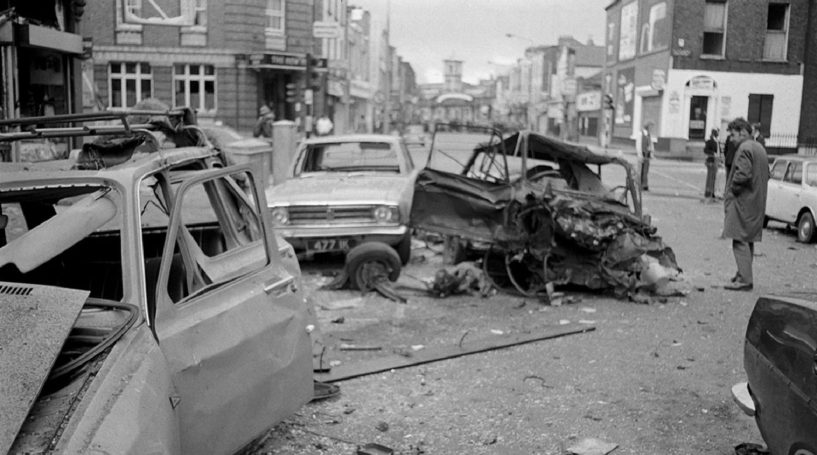
On the 17th of May 1974, a Friday afternoon, three no-warning car bombs detonated during rush hour traffic in Dublin, killing twenty-seven people, ninety minutes later, another no-warning bomb would explode in the border county of Monaghan, killing seven.
300 people would suffer injuries as a result of the bombings also, with the Irish Free State returning to its traditionally pro-British stance regarding British occupation of the north in the aftermath.
These coordinated attacks, resulting in the largest loss of life in a single day during the most recent phase of conflict related to the occupation of Ireland, were carried out by the Ulster Volunteer Force (UVF), a Loyalist terrorist organisation operating under the command of the clandestine Special Reconnaissance Unit (SRU) of the British army.
This use of proxy terrorist groups by Downing Street was later used as a tactic against both Libya and Syria in 2011 and into the present day, having been perfected by Britain’s unleashing of war in Europe in 1974.
Gavin O’Reilly is an Irish Republican activist from Dublin, Ireland, with a strong interest in the effects of British and US Imperialism; he was a writer for the American Herald Tribune from January 2018 up until their seizure by the FBI in 2021, with his work also appearing on The Duran, Al-Masdar, MintPress News, Global Research and SouthFront.
Featured Video
John Mearsheimer: US Already lost Iran war – No off-ramp in sight
or go to
Aletho News Archives – Video-Images
Frlom the Archives
With apparently fabricated nuclear documents, Netanyahu pushed the US towards war with Iran
By Gareth Porter | The Grayzone | April 29, 2020
President Donald Trump scrapped the nuclear deal with Iran and continued to risk war with Iran based on Israeli Prime Minister Benjamin Netanyahu’s claim to have proven definitively that Iran was determined to manufacture nuclear weapons. Netanyahu not only spun Trump but much of the corporate media as well, duping them with the public unveiling of what he claimed was the entire secret Iranian “nuclear archive.”
In early April 2018, Netanyahu briefed Trump privately on the supposed Iranian nuclear archive and secured his promise to leave the Joint Comprehensive Plan of Action (JCPOA). That April 30, Netanyahu took the briefing to the public in a characteristically dramatic live performance in which he claimed Israel’s Mossad intelligence services had stolen Iran’s entire nuclear archive from Tehran. “You may well know that Iran’s leaders repeatedly deny ever pursuing nuclear weapons…” Netanyahu declared. “Well, tonight, I’m here to tell you one thing: Iran lied. Big time.”
However, an investigation of the supposed Iranian nuclear documents by The Grayzone reveals them to be the product of an Israeli disinformation operation that helped trigger the most serious threat of war since the conflict with Iran began nearly four decades ago. This investigation found multiple indications that the story of Mossad’s heist of 50,000 pages of secret nuclear files from Tehran was very likely an elaborate fiction and that the documents were fabricated by the Mossad itself. … continue
Blog Roll
 Aletho News
- US failures in Iran reveal Russia is key to South Korea’s strategic security
- ‘All ports in Persian Gulf will be legitimate targets if Iranian ports are attacked’
- 40 Years of Endless War, Data Point by Data Point
- Department of War Using Palantir AI to Pick Targets in Iran
- American bases do not protect – they attack the peoples of the Persian Gulf
- ‘We’ve Obliterated Their Missiles’
- Syrian president vows ‘absolute support’ to disarm Hezbollah
- Ukraine attacking Russian gas pipeline to stop deliveries to Europe – Defense Ministry
- ‘Heinous crime’: Iran denounces Israeli assassination of 4 Iranian diplomats in Lebanon
- John Mearsheimer: U.S. Already Lost Iran War – No Off-Ramp in Sight
- If Americans Knew
- Israeli strategic plans to “remake the Middle East” from the 1950s and since
- Honoring Gaza’s women who refused to let the world look away
- 97% of victims of war on Iran are Iranian, 98% of victims in war on Gaza are Gazans – Not a ceasefire Day 152
- Early Iran strikes cost $5.6 billion in munitions, Pentagon estimates
- Israel Decided the War, But Trump’s America Fights and Pays the Bill
- Conscientious Objector Group: Phone ‘Ringing Off Hook’ As Huge Mobilization Underway
- U.S. support for Israel continues to plummet, despite media’s best efforts
- Threats and missiles fly, death tolls soar in Iran, Lebanon, Gaza – Not a ceasefire Day 151
- Lebanon: Israel’s White Phosphorous Use Risks Civilian Harm
- Corporate Media Go All Out To Support The US-Israeli War On Iran
- No Tricks Zone
- Destructive Green New Deal: German Energy And Metal Group Warns Of Drastic Crisis
- New Study Documents A 20-Year Pause In Arctic Sea Ice Decline – Driven By Internal Variability
- Wake-up Call: Survey Shows Majority Of Germans Now Favor Postponing Climate Targets!
- Televised! Leading German Political Candidate Tells Schoolchildren CO2 Makes Sun Hotter!
- New Study: A Century Warming Of 1.1°C Is ‘Commonplace’ And ‘Not Unusual’ During This Interglacial
- New Study: ‘Internal Noise’ And Volcanic Forcing Can Trigger 10-15°C Warming Within Decades
- Glaciers Worldwide Are Suddendly Surging, Experts Blame Warming!
- Surprising Discovery: Sahara Is Greening…Billions Of Trees Where Once Thought To Be Barren
- New Research Reaffirms Clouds, Aerosols, And Surface Solar Radiation Are ‘Driving The Climate System’
- Germany: Electric Car Catches Fire At Charging Station, Sets Off Local “Inferno”, Widespread Damage
 Aletho News