‘In the US, joking about war has become acceptable’
RT | July 23, 2015
Attempts at humor over bombing huge numbers of people, and inflicting death is increasingly considered acceptable and this has a subtle effect on the population, says David Swanson, blogger and activist, author of ‘War Is A Lie’.
US President Barack Obama made an appearance on America’s Daily Show hosted by Jon Stewart taking the chance for a bit of light-hearted foreign policy banter.
RT: The situation in Yemen and Iraq is no laughing matter. Is it acceptable for the President to be laughing about these subjects?
David Swanson: It really isn’t. Jon Stewart jokes “We still get to bomb people, right?” and there is no stern rebuke from the President as there is when he is accused of allowing Americans to be held hostage in Iran and not caring about them and so forth, there is no offense taken, it’s all for laughs. Who are we bombing? President Obama has no idea specifically who he’s bombing not even with drone strikes and the tangled mess that Jon Stewart points to is far beyond what he listed. Making peace with Iran in order to fight a war with Iran, going to war in Syria on the opposite side in 2014 as you were told, as you head into 2013, US weapons in the hands of Islamic State, US allies funding IS – it’s an incredible mess and Jon Stewart, although it’s his last chance, last interview with the president, makes jokes instead of asking questions. He makes a joke about trying diplomacy for once after bombs, proxies and arming and so forth, but it’s a joke, Obama doesn’t answer. Jon Stewart could have said “Why, if diplomacy is an option in one case do you not use it in all these other cases?” He didn’t ask the question.
RT: How do jokes about foreign policy influence the public?
DS: A certain segment of the public including myself is not laughing about war and doesn’t think it’s a laughing matter, but I think it influences the public very subtly that jokes about war are acceptable. I heard a weapon’s contractor on national public radio in the US joke about wanting a big new invasion and occupation when another one might be ending – ha-ha. When jokes about things like sexual abuse or racism or all kinds of cruelty, anti-morality are absolutely not acceptable, absolutely excluded from public discussion in US media, but jokes about war, about bombing huge numbers of people to death, injury and trauma are acceptable and that does have an impact.
RT: Obama had previously joked about predator drones. Does that make the matter more mundane, perhaps more acceptable? Politically, how intentional are such jokes?
DS: It points to this huge contrast in the US between the immorality of war and any other kind of immorality. President Obama this week said that jokes about rape in US prisons are absolutely offensive and unacceptable; it’s not something that should ever be joked about. The US, I believe, is the first society in the history of the world where the majority of rape victims are male and it’s in prison and it’s an epidemic. He is absolutely right, don’t you joke about it. But when it comes to war, to murder with weapons of war, spying, massive surveillance and the whole package of militarism, jokes seem to be totally acceptable – even for the President speaking to the journalists and reporters who are actually supposed to know the horror and suffering of war.
‘US funding of Sunni militia groups would further partition Iraq’
RT | April 29, 2015
The US is boosting its military support for security forces fighting against Islamic State in Iraq. The Republicans have proposed a bill to directly fund militia groups operating in the country, such as the Kurdish Peshmerga and Sunni irregular forces. If the bill is passed, tribal groups could receive up to $429 million in aid from the US.
The US Republicans’ proposal to fund Peshmerga and Sunni militias in Iraq, if approved, would entrench the country which is already partitioned by war, defense analyst Ivan Eland told RT.
RT: Do you think America’s funding of tribal security forces such as the Peshmerga might encourage further sectarian tension in such a volatile region?
Ivan Eland: Definitely. I think that’s true. Of course the US during its occupation was helping out the Peshmerga, so they were kind of undermining a unified Iraq even back then. But now Iraq basically is partitioned by war and I don’t think we can put it back together again. And so the Republicans are actually facing reality, but certainly this effort to fund individual militias will hasten the effort and entrench already partitioned Iraq.
RT: The bill also requires these security forces to be an independent entity from Iraq, so they can receive the aid separately from Iraqi national forces. What implications could that have on the US-Iraq partnership?
IE: The Republicans are unhappy with the Iraqi government’s dependence on Iran for training its Shia militias, and the Shia militias have been accused of some atrocities against Sunnis. The US doesn’t like Iranian influence in Iraq and so this bill says it funds the Peshmerga and other militias which would be Sunnis, but it also says that [if] the government of Iraq doesn’t [dis]associate itself with the Shia militias; they’ll give even more funds to the Peshmerga and other Sunni militias. So it doesn’t totally go away from the Iraqi government, but it puts a lot of pressure on them to dissociate themselves from the Shia militias which the Iraqi government probably is not going to do.
RT: If the bill does recognize these tribal security forces, they will gain a large amount of aid assigned for Baghdad. How will that affect the ability of Iraqi forces to counter Islamic State’s offensive?
IE: I think the Iraqi forces are already sort of a shell; they cut and ran when the ISIS forces attacked. The Iraqi government is depending on the Shia militias to defend them and they had the greatest role in the campaign to recapture Tikrit. The US Congress – if they pass this bill – will be asking the Iraqi government to remove the only reliable military force it has. The Iraqi armed forces are not reliable. And the Shia militias are the only groups that can adequately, even have a priority, of taking on ISIS.
RT: There are also reports of Kurds recruiting former US military members to fight the terrorist group. Apparently, a dozen Americans have already joined their ranks. What do you think about that?
IE: This may be the US government giving a wink and a nod to this without officially sanctioning it because they want to shore up the Peshmerga against the ISIS fighters and the administration doesn’t really want to do this. Most probably – what the Republicans are suggesting – giving direct aid – because of course implications can lead to the breakup of Iraq officially. Iraq is already broken up on the ground but the administration probably doesn’t want to encourage officially supporting the Peshmerga. So this could be a way of winking and nodding to get more expertise and to help them fight ISIS.
Al-Qaeda, Saudi Arabia and Israel
By Robert Parry | Consortium News | February 4, 2015
The disclosure that convicted al-Qaeda operative Zacarias Moussaoui has identified leading members of the Saudi government as financers of the terrorist network potentially reshapes how Americans will perceive events in the Middle East and creates a risk for Israel’s Likud government which has forged an unlikely alliance with some of these same Saudis.
According to a story in the New York Times on Wednesday, Moussaoui said in a prison deposition that he was directed in 1998 or 1999 by Qaeda leaders in Afghanistan to create a digital database of the group’s donors and that the list included Prince Turki al-Faisal, then Saudi intelligence chief; Prince Bandar bin Sultan, longtime Saudi ambassador to the United States; Prince al-Waleed bin Talal, a prominent billionaire investor; and many leading clerics.
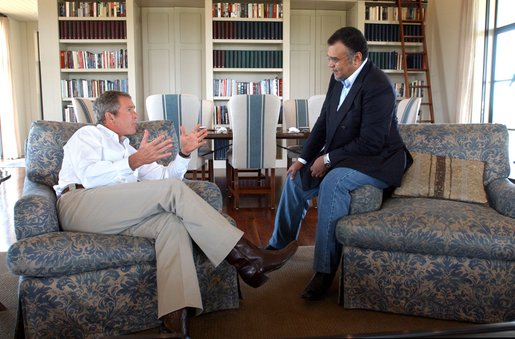
Prince Bandar bin Sultan, then Saudi ambassador to the United States, meeting with President George W. Bush in Crawford, Texas. (White House photo)
“Sheikh Osama wanted to keep a record who give money,” Moussaoui said in imperfect English — “who is to be listened to or who contributed to the jihad.”
Although Moussaoui’s credibility came under immediate attack from the Saudi kingdom, his assertions mesh with accounts from members of the U.S. Congress who have seen a secret portion of the 9/11 report that addresses alleged Saudi support for al-Qaeda.
Further complicating the predicament for Saudi Arabia is that, more recently, Saudi and other Persian Gulf oil sheikdoms have been identified as backers of Sunni militants fighting in Syria to overthrow the largely secular regime of President Bashar al-Assad. The major rebel force benefiting from this support is al-Nusra Front, al-Qaeda’s affiliate in Syria.
In other words, the Saudis appear to have continued a covert relationship with al-Qaeda-connected jihadists to the present day.
The Israeli Exposure
And, like the Saudis, the Israelis have sided with the Sunni militants in Syria because the Israelis share the Saudi view that Iran and the so-called “Shiite crescent” – reaching from Tehran and Baghdad to Damascus and Beirut – is the greatest threat to their interests in the Middle East.
That shared concern has pushed Israel and Saudi Arabia into a de facto alliance, though the collaboration between Jerusalem and Riyadh has been mostly kept out of the public eye. Still, it has occasionally peeked out from under the covers as the two governments deploy their complementary assets – Saudi oil and money and Israeli political and media clout – in areas where they have mutual interests.
In recent years, these historic enemies have cooperated in their joint disdain for the Muslim Brotherhood government in Egypt (which was overthrown in 2013), in seeking the ouster of the Assad regime in Syria, and in pressing for a more hostile U.S. posture toward Iran.
Israel and Saudi Arabia also have collaborated in efforts to put the squeeze on Russia’s President Vladimir Putin, who is deemed a key supporter of both Iran and Syria. The Saudis have used their power over oil production to drive down prices and hurt Russia’s economy, while U.S. neoconservatives – who share Israel’s geopolitical world view – were at the forefront of the coup that ousted Ukraine’s pro-Russian President Viktor Yanukovych in 2014.
The behind-the-scenes Israeli-Saudi alliance has put the two governments – uncomfortably at times – on the side of Sunni jihadists battling Shiite influence in Syria, Lebanon and even Iraq. On Jan. 18, 2015, for instance, Israel attacked Lebanese-Iranian advisers assisting Assad’s government in Syria, killing several members of Hezbollah and an Iranian general. These military advisors were engaged in operations against al-Qaeda’s Nusra Front.
Meanwhile, Israel has refrained from attacking Nusra Front militants who have seized Syrian territory near the Israeli-occupied Golan Heights. One source familiar with U.S. intelligence information on Syria told me that Israel has a “non-aggression pact” with these Nusra forces.
An Odd Alliance
Israel’s odd-couple alliances with Sunni interests have evolved over the past several years, as Israel and Saudi Arabia emerged as strange bedfellows in the geopolitical struggle against Shiite-ruled Iran and its allies in Iraq, Syria and southern Lebanon. In Syria, for instance, senior Israelis have made clear they would prefer Sunni extremists to prevail in the civil war rather than Assad, who is an Alawite, a branch of Shiite Islam.
In September 2013, Israel’s Ambassador to the United States Michael Oren, then a close adviser to Israeli Prime Minister Benjamin Netanyahu, told the Jerusalem Post that Israel favored the Sunni extremists over Assad.
“The greatest danger to Israel is by the strategic arc that extends from Tehran, to Damascus to Beirut. And we saw the Assad regime as the keystone in that arc,” Oren told the Jerusalem Post in an interview. “We always wanted Bashar Assad to go, we always preferred the bad guys who weren’t backed by Iran to the bad guys who were backed by Iran.” He said this was the case even if the “bad guys” were affiliated with al-Qaeda.
And, in June 2014, speaking as a former ambassador at an Aspen Institute conference, Oren expanded on his position, saying Israel would even prefer a victory by the brutal Islamic State over continuation of the Iranian-backed Assad in Syria. “From Israel’s perspective, if there’s got to be an evil that’s got to prevail, let the Sunni evil prevail,” Oren said.
Skepticism and Doubt
In August 2013, when I first reported on the growing relationship between Israel and Saudi Arabia in an article entitled “The Saudi-Israeli Superpower,” the story was met with much skepticism. But, increasingly, this secret alliance has gone public.
On Oct. 1, 2013, Israeli Prime Minister Netanyahu hinted at it in his United Nations General Assembly speech, which was largely devoted to excoriating Iran over its nuclear program and threatening a unilateral Israeli military strike.
Amid the bellicosity, Netanyahu dropped in a largely missed clue about the evolving power relationships in the Middle East, saying: “The dangers of a nuclear-armed Iran and the emergence of other threats in our region have led many of our Arab neighbors to recognize, finally recognize, that Israel is not their enemy. And this affords us the opportunity to overcome the historic animosities and build new relationships, new friendships, new hopes.”
The next day, Israel’s Channel 2 TV news reported that senior Israeli security officials had met with a high-level Gulf state counterpart in Jerusalem, believed to be Prince Bandar, the former Saudi ambassador to the United States who was then head of Saudi intelligence.
The reality of this unlikely alliance has now even reached the mainstream U.S. media. For instance, Time magazine correspondent Joe Klein described the new coziness in an article in the Jan. 19, 2015 issue.
He wrote: “On May 26, 2014, an unprecedented public conversation took place in Brussels. Two former high-ranking spymasters of Israel and Saudi Arabia – Amos Yadlin and Prince Turki al-Faisal – sat together for more than an hour, talking regional politics in a conversation moderated by the Washington Post’s David Ignatius.
“They disagreed on some things, like the exact nature of an Israel-Palestine peace settlement, and agreed on others: the severity of the Iranian nuclear threat, the need to support the new military government in Egypt, the demand for concerted international action in Syria. The most striking statement came from Prince Turki. He said the Arabs had ‘crossed the Rubicon’ and ‘don’t want to fight Israel anymore.’”
Though Klein detected only the bright side of this détente, there was a dark side as well, as referenced in Moussaoui’s deposition, which identified Prince Turki as one of al-Qaeda’s backers. Perhaps even more unsettling was his listing of Prince Bandar, who had long presented himself as a U.S. friend, so close to the Bush Family that he was nicknamed “Bandar Bush.”
Moussaoui claimed that he discussed a plan to shoot down Air Force One with a Stinger missile with a staff member at the Saudi Embassy in Washington, at a time when Bandar was the ambassador to the United States.
According to the New York Times article by Scott Shane, Moussaoui said he was assigned to “find a location where it may be suitable to launch a Stinger attack and then, after, be able to escape,” but that he was arrested on Aug. 16, 2001, before he could carry out the reconnaissance mission.
The thought of anyone in the Saudi embassy, then under the control of “Bandar Bush,” scheming with al-Qaeda to shoot down George W. Bush’s Air Force One is shocking, if true. The notion would have been considered unthinkable even after the 9/11 attacks, which involved 15 Saudis among the 19 hijackers.
After those terror attacks which killed nearly 3,000 Americans, Bandar went to the White House and persuaded Bush to arrange for the rapid extraction of bin Laden’s family members and other Saudis in the United States. Bush agreed to help get those Saudi nationals out on the first flights allowed back into the air.
Bandar’s intervention undercut the FBI’s chance to learn more about the ties between Osama bin Laden and the 9/11 perpetrators by giving FBI agents only time for cursory interviews with the departing Saudis.
Bandar himself was close to the bin Laden family and acknowledged having met Osama bin Laden in the context of bin Laden thanking Bandar for his help financing the jihad project in Afghanistan during the 1980s. “I was not impressed, to be honest with you,” Bandar told CNN’s Larry King about bin Laden. “I thought he was simple and very quiet guy.”
The Saudi government claimed to have broken ties with bin Laden in the early 1990s when he began targeting the United States because President George H.W. Bush had stationed U.S. troops in Saudi Arabia, but – if Moussaoui is telling the truth – al-Qaeda would have still counted Bandar among its supporters in the late 1990s.
Bandar and Putin
Bandar’s possible links to Sunni terrorism also emerged in 2013 during a confrontation between Bandar and Putin over what Putin viewed as Bandar’s crude threat to unleash Chechen terrorists against the Sochi Winter Olympics if Putin did not reduce his support for the Syrian government.
According to a leaked diplomatic account of a July 31, 2013 meeting in Moscow, Bandar informed Putin that Saudi Arabia had strong influence over Chechen extremists who had carried out numerous terrorist attacks against Russian targets and who had since deployed to join the fight against the Assad regime in Syria.
As Bandar called for a Russian shift toward the Saudi position on Syria, he reportedly offered guarantees of protection from Chechen terror attacks on the Olympics. “I can give you a guarantee to protect the Winter Olympics in the city of Sochi on the Black Sea next year,” Bandar reportedly said. “The Chechen groups that threaten the security of the games are controlled by us.”
Putin responded, “We know that you have supported the Chechen terrorist groups for a decade. And that support, which you have frankly talked about just now, is completely incompatible with the common objectives of fighting global terrorism.”
Bandar’s Mafia-like threat toward the Sochi games – a version of “nice Olympics you got here, it’d be a shame if something terrible happened to it” – failed to intimidate Putin, who continued to support Assad.
Less than a month later, an incident in Syria almost forced President Barack Obama’s hand in launching U.S. air strikes against Assad’s military, which would have possibly opened the path for the Nusra Front or the Islamic State to capture Damascus and take control of Syria. On Aug. 21, 2013, a mysterious sarin attack outside Damascus killed hundreds and, in the U.S. media, the incident was immediately blamed on the Assad regime.
American neocons and their allied “liberal interventionists” demanded that Obama launch retaliatory air strikes even though some U.S. intelligence analysts doubted that Assad’s forces were responsible and suspected that the attack was carried out by extremist rebels trying to pull the U.S. military into the civil war on their side.
Yet, pushed by the neocons and liberal war hawks, Obama nearly ordered a bombing campaign designed to “degrade” the Syrian military but called it off at the last minute. He then accepted Putin’s help in reaching a diplomatic solution in which Assad agreed to surrender his entire chemical weapons arsenal, while still denying any role in the sarin attack.
Later, the Assad-did-it case crumbled amid new evidence that Sunni extremists, supported by Saudi Arabia and Turkey, were the more likely perpetrators of the attack, a scenario that became increasingly persuasive as Americans learned more about the cruelty and ruthlessness of many Sunni jihadists fighting in Syria. [See Consortiumnews.com’s “The Mistaken Guns of Last August.”]
Targeting Putin
Putin’s cooperation with Obama to head off a U.S. military strike in Syria made the Russian president more of a target for the American neocons who thought they finally had reached the cusp of their long-desired “regime change” in Syria only to be blocked by Putin. By late September 2013, a leading neocon, National Endowment for Democracy President Carl Gershman, announced the goal of challenging Putin and recognizing his sore point in Ukraine.
Taking to the Washington Post’s op-ed page on Sept. 26, 2013, Gershman called Ukraine “the biggest prize” and an important step toward ultimately ousting Putin. Gershman wrote, “Ukraine’s choice to join Europe will accelerate the demise of the ideology of Russian imperialism that Putin represents. … Russians, too, face a choice, and Putin may find himself on the losing end not just in the near abroad but within Russia itself.” [See Consortiumnews.com’s “Neocons’ Ukraine-Syria-Iran Gambit.“]
However, in early 2014, Putin was obsessed with Bandar’s implicit threat of terrorism striking the Sochi Olympics, thus distracting him from the “regime change” – being pushed by NED and neocon Assistant Secretary of State for European Affairs Victoria Nuland – next door in Ukraine.
On Feb. 22, 2014, putschists, spearheaded by well-organized neo-Nazi militias, drove elected President Viktor Yanukovych and his government from power. Putin was caught off-guard and, in the resulting political chaos, agreed to requests from Crimean officials and voters to accept Crimea back into Russia, thus exploding his cooperative relationship with Obama.
With Putin the new pariah in Official Washington, the neocon hand also was strengthened in the Middle East where renewed pressure could be put on the “Shiite crescent” in Syria and Iran. However, in summer 2014, the Islamic State, which had splintered off from al-Qaeda and its Nusra Front, went on a rampage, invading Iraq where captured soldiers were beheaded. The Islamic State then engaged in gruesome videotaped decapitations of Western hostages inside Syria.
The Islamic State’s brutality and the threat it posed to the U.S.-backed, Shiite-dominated government of Iraq changed the political calculus. Obama felt compelled to launch airstrikes against Islamic State targets in both Iraq and Syria. American neocons tried to convince Obama to expand the Syrian strikes to hit Assad’s forces, too, but Obama realized such a plan would only benefit the Islamic State and al-Qaeda’s Nusra Front.
In effect, the neocons were showing their hand – much as Israeli Ambassador Oren had done – favoring the Sunni extremists allied with al-Qaeda over Assad’s secular regime because it was allied with Iran. Now, with Moussaoui’s deposition identifying senior Saudi officials as patrons of al-Qaeda, another veil seems to have dropped.
Complicating matters further, Moussaoui also claimed that he passed letters between Osama bin Laden and then Crown Prince Salman, who recently became king upon the death of his brother King Abdullah.
But Moussaoui’s disclosure perhaps cast the most unflattering light on Bandar, the erstwhile confidant of the Bush Family who — if Moussaoui is right — may have been playing a sinister double game.
Also facing potentially embarrassing questions is Israeli Prime Minister Netanyahu, especially if he goes through with his planned speech before a joint session of Congress next month, attacking Obama for being soft on Iran.
And, America’s neocons might have some explaining to do about why they have carried water not just for the Israelis but for Israel’s de facto allies in Saudi Arabia.
~
Investigative reporter Robert Parry broke many of the Iran-Contra stories for The Associated Press and Newsweek in the 1980s. You can buy his latest book, America’s Stolen Narrative, either in print here or as an e-book (from Amazon and barnesandnoble.com).
Turkey, US set to train “moderate” Syria rebels as SNC rules out Moscow talks
Al-Akhbar | January 5, 2015
Turkey and the United States aim to finalize an agreement on equipping and training the so-called “moderate” Syrian rebels this month, a senior Turkish foreign ministry official said Monday.
Meanwhile, Syria’s Turkey-based opposition, the Syrian National Coalition (SNC), ruled out taking part in a Russian-led bid for new talks to end the Syrian conflict.
The training is expected to start in March, simultaneously with similar programs in Jordan and Saudi Arabia, the Turkish official said.
The aim is to train 15,000 Syrian rebels over three years.
“Around 1,500 to 2,000 people are expected to be trained in Turkey (in the first year),” the official said, adding that a “limited number” of US soldiers would come to Turkey to help carry out the training jointly with Turkish colleagues.
The training, which the US says is part of its campaign to battle the Islamic State of Iraq and Syria (ISIS) militants, is planned to take place at a base in the central Turkish city of Kirsehir.
In October of last year, John Allen, a senior US official, said that his country does not expect the Free Syrian Army (FSA) it trains to fight ISIS militants to also take on Syrian Arab Army forces, but sees them as a crucial part of a political solution to end the war.
“There is not going to be a military solution here,” he added.
The FSA is a term used to describe dozens of armed groups fighting the Syrian army to overthrow President Bashar al-Assad but with little or no central command. They have been widely outgunned by Islamist insurgents such as ISIS.
The plans gained momentum in November 2014 when Britain announced it would also make “a significant contribution” to equip and train the so-called “moderate” Syrian opposition to defeat the ISIS group as well as the Syrian army.
Foreign Secretary Philip Hammond said that “the UK is helping the opposition establish security and governance, and to deliver essential services. This includes life-saving search and rescue training, helping Syrians whose homes have been reduced to rubble by the regime’s bombs.
“We are providing non-lethal equipment and the UK expects to make a significant contribution to the US-led Train and Equip program,” Hammond said in the statement, adding that “Assad can play no future role in Syria.”
Meanwhile, Gulf state Qatar, with the help of the US, has already been covertly training the so-called “moderate” Syria rebels to fight the Syrian army and ISIS group as well as other extremist groups for over a year, sources claimed in November.
The camp, south of the capital between Saudi Arabia’s border and Udeid area, the largest US air base in the Middle East, is being used to train the Free Syrian Army (FSA) militants and other so-called “moderate” rebels, the sources said.
Reuters could not independently identify the participants in the program or witness activity inside the base, which lies in a military zone guarded by Qatari special forces and marked on signposts as a restricted area.
But Syrian rebel sources said training in Qatar has included rebels affiliated to the FSA from northern Syria.
The sources said the effort had been running for nearly a year, although it was too small to have a significant impact on the battlefield, and some rebels complained of not being taught advanced techniques.
The training is in line with Qatar’s constant meddling in regional affairs.
Small groups of 12 to 20 militants are identified in Syria and screened by the Central Intelligence Agency (CIA), the sources said.
Once cleared of links with jihadist factions, they travel to Turkey and are then flown to Doha and driven to the base, though it wasn’t clear how the militants are ‘cleared’ of jihadist links.
Rebel fighters have voiced frustration with the US-led approach to fighting ISIS. They say Washington and its Arab allies are too focused on quashing the militant group at the expense of confronting Syrian army, which many rebels still see as the ultimate “enemy.”
ISIS militants have seized large swathes of territory in Syria and around one third of Iraq. They seized Mosul, Iraq’s second-largest city, in June last year.
Turkey has been a reluctant partner in the US-led coalition against the insurgents, refusing a frontline military role despite its 1,200 km (750-mile) border with Iraq and Syria.
But it agreed in principle to train and equip Syrian rebels and is already training Kurdish peshmerga fighters in northern Iraq. Ankara has signalled that it is ready to extend similar assistance to the Iraqi army and send arms.
The US decision to train and equip rebel groups in Syria was criticized by several renowned officials who warned of dire consequences.
Former US Congressman Ron Paul, an outspoken anti-interventionist, denounced in an interview with Russia Today the plans, noting that these Western-backed forces have been “helpful to ISIS.”
“The FSA turned over the weapons, that we (the US) sent them, to ISIS,” Paul said. “It is pretty well recorded that for $50,000 the FSA turned over one of the two American journalists to ISIS.”
In an article, Dennis Kucinich quoted historian Alastair Crooke who described “moderate” rebels in Syria as being “rarer than a mythical unicorn,” and warned that “funding Syrian rebels will precipitate a new and wider war in the Middle East.”
“Saudi Arabia, which, with Qatar funded the jihadists in Syria, is now offering to ‘train’ the rebels,” which means that “the sponsors of radical jihadists are going to train ‘moderate’ jihadists,” Kucinich added.
Kucinich also described the US Treasury as becoming the “piggy bank” of ISIS.
“The US has supplied weapons to the Iraqi government and to Syrian rebels which have ended up in the hands of ISIS,” he explained. “As a result, the US Air Force has been bombing Humvees and armored troop carriers purchased with US taxpayer money.”
SNC refuses to take part in Moscow talks
Khaled Khoja, who was elected early on Monday to head the SNC opposition grouping, said Moscow’s proposal was impossible.
“The dialogue with the regime that Moscow is calling for is out of the question,” he said at a news conference in Istanbul, where the Coalition is based.
“We can’t sit at the same table as the regime… except in a negotiating framework intended to achieve a peaceful transition of power and the formation of a transitional body with full powers,” he said.
Russia, a key ally of Assad, has been trying to relaunch peace talks that would include meetings between delegates of the regime and the fractured opposition.
It has invited 28 opposition figures, including members of the tolerated domestic opposition as well as individual coalition members, to Moscow later this month.
Among them are Hadi al-Bahra, whom Khoja succeeded on Monday, and two other previous Coalition chiefs, Moaz al-Khatib and Abdel Basset Sida.
It remains unclear whether the coalition will prohibit its members, who have been invited by Moscow, from attending the talks.
(AFP, Al-Akhbar)
Regime-Change Makeover: Blaming Syria for the Rise of ISIS
By Finian CUNNINGHAM | Strategic Culture Foundation | 16.12.2014
If a recent report in the British Guardian is to be believed, then the West is angling for a new pretext to step up its covert war of regime in Syria. The new pretext, it would seem, is that the Damascus government of Bashar al Assad was the main driving force in the creation of the so-called Islamic State (IS) terror network.
The report by Guardian Middle East correspondent Martin Chulov, published on December 11, is riven with contradictions and anomalies. It raises more questions than answers that the author seems strangely indisposed to delve into.
But the upshot is the apparent conclusion that the Syrian government of President Assad is to blame for the rise of IS, or ISIS (Islamic State in Iraq and Syria). That the Syrian army has emerged as the main fighting force on the ground to defeat IS in the latter’s campaign to overthrow the Assad government is right away a troubling question mark over the credibility of the Guardian report.
Nevertheless, if we follow the dubious logic of this narrative, then it would seem to be aimed at providing a «just cause» for Western hostility towards Assad and for the objective of regime change.
IS, an offshoot of the Al Qaeda network, is portrayed in the Western media as «the world’s most menacing terrorist group». It has gained notoriety for its videos purporting to show the execution of Western hostages. The US government has appointed itself as the leader of an international coalition to «wipe out» IS with air strikes on its bases in remote areas of Iraq and Syria.
The efficacy and legality of these US-led air strikes are questionable, and as already noted, it is the Syrian state forces carrying out ground operations that are actually inflicting the heaviest losses on the IS network – the latest being in the eastern city of Deir al Zour.
So, it is at odds, to say the least, that the Guardian should now be casting the Syrian authorities as the originating sponsors of the very network that they are locked in mortal combat with.
The report, headlined ‘ISIS: the inside story’, informs readers that around early 2009 the Syrian government gave the group crucial help in ramping up its insurgency in Iraq. That insurgency, according to the Guardian, then «spilled over» into Syria in 2011, as if by accident. And so we can condemn the «dastardly Syrians» for their own maladroit blowback.
The main source of the story, we are told, is «one of the Islamic State’s senior commanders» who goes by the nom de guerre of Abu Ahmed.
The Guardian correspondent writes: «Syria’s links to the Sunni insurgency in Iraq had been regularly raised by US officials in Baghdad and by the Iraqi government. Both were convinced that the Syrian president, Bashar al-Assad, allowed jihadists to fly into Damascus airport, where military officials would escort them to the border with Iraq».
That «assessment» is largely based on «interrogations» of captured jihadists. In other words, by torture techniques that even the US Senate Intelligence Committee report last week described as «unreliable».
According to the Guardian, the Syrian plot to destabilise Iraq with Sunni extremists was hatched during two top-secret meetings near Damascus during early 2009. The meetings were between Syrian military intelligence, senior members of the Baathist party of President Assad and the jihadists of Al Qaeda in Iraq – the latter being the precursor to the IS network.
The Syrian objective was allegedly to «unsettle the Americans and their plans for Iraq». This was nearly three years before the Americans ended their military occupation of the country at the end of 2011.
Apparently, the Iraqis knew of Syria’s alleged covert involvement and that led to a «poisoning of relations» between the then Iraqi Prime Minister Nouri al Maliki and Assad.
However, this is where the story does not add up. Why would the Alawite-Shia-led government of Bashar al Assad get into bed with Sunni extremists to fuel a sectarian war against co-religionists in Iraq? Why would the Assad regime cause mayhem in a neighbouring Shia country and to provoke enmity with regional allies in Baghdad and Tehran? Not only that but to fan an insurgency by Sunni extremists who avowedly harbour a death wish against Alawites, Shia and other Sunnis who have for centuries formed a stable social order in Syria? Such a gambit by the Syrians would be suicidal. It is completely counter-intuitive.
These are just some of the questions that throw serious doubt on the narrative put forward by the Guardian, which seeks to pin the blame on Syria for the rise of IS – «the world’s most menacing terrorist group».
Tellingly in this «in-depth exposé» on the origins of IS in Iraq, there is not a single mention of the well-documented role that Western ally Saudi Arabia played, and continues to play, in fuelling the network and its Wahhabi fundamentalist ideology.
Moreover, the report appears to go into great detail about how IS and its Al Qaeda forerunner came into being at the giant US prison in southern Iraq known as Camp Bucca. The detention centre opened in 2004 and brought together some 24,000 suspected members of various Sunni militia. According to several sources, the inmates were permitted by the Americans to freely associate.
Even the Guardian’s IS source, Abu Ahmed, noted the lax prison conditions under US command. «We could never have all got together like this in Baghdad, or anywhere else. It would have been impossibly dangerous. Here, we were not only safe, but we were only a few hundred metres away from the entire al-Qaida [sic] leadership».
One of the inmates to be given special attention by the US jailers was Abu Bakr al Baghdadi, who is now leader of IS and self-proclaimed caliph of the Middle East. Al Baghdadi was seen by the Americans as a «fixer» and a figure who could sort out fractious disputes and «resolve conflicts among the inmates». It is obvious that the «emir» was being groomed by the Americans as a future leader. Al Baghdadi, who several sources believe is a US intelligence asset, was released from Camp Bucca at the end of 2004, less than a year after being first imprisoned and despite the fact of his past terrorist activities.
Incredibly, the Guardian affects a doe-eyed naivety in this account and spins a narrative that the IS terror group was formed under «the noses of the American jailers». That is, without US knowledge or intent.
The newspaper’s IS «source» is quoted as saying: «When [the civil war in] Syria became serious it wasn’t difficult to transfer all that expertise to a different battle zone. The Iraqis are the most important people on the military and Shura councils in Isis now, and that is because of all of those years preparing for such an event. I underestimated Baghdadi. And America underestimated the role it played in making him what he is».
Contrary to the spin, the American handlers didn’t underestimate anything. Baghdadi and his future IS role went to plan.
Camp Bucca has been rightly referred to by several other observers as a «terror academy» from which IS graduated. Some 70 per cent of the IS current senior commanders are believed to have passed through Camp Bucca and other American detention centres before they were shut down at the end of the US occupation of Iraq. That the IS group was inculcated and mentored by American intelligence seems without question – except to Western media like the Guardian.
But that Western media whitewash of the real American origins of IS is now overlaid with a new veneer of misinformation that purports to lay the blame for the rise of IS terrorism on the Syrian government. A classic case of the terrorists and their terror-master blaming the victim.
Why the Americans are now leading a bombing campaign against their own creation is a good question. But the answer has got nothing to do with defeating terrorism, as the ineffectual bombing campaign so far would suggest. As the Western media narrative evolves, it seems rather more to do with extending the mission of IS – regime change in Syria.
5 not-so-peaceful Obama actions since nabbing Nobel Prize

RT | December 10, 2014
Five years on from President Barack Obama scooping a Nobel Peace Prize, and the White House has taken anything but a Zen approach to foreign policy under his watch. Here are the top 5 not-so-peaceful moves the laureate has made in the past half-decade.
1. Afghan Surge
Obama didn’t start the war gin Afghanistan, but he certainly took a page from his predecessors playbook in trying to finish it. He recognized his precarious position at prize time.
“But perhaps the most profound issue surrounding my receipt of this prize is the fact that I am the commander-in-chief of a nation in the midst of two wars,” he said after accepting the Nobel Prize in Oslo, Norway, on December 9, 2009.
While he said the war in Iraq was “winding down,” things in Afghanistan were just starting to heat up. A week before accepting the prize, Obama announced he was sending 33,000 more troops to Afghanistan as part of his “surge policy,” intended to beat back the Taliban and train Afghan security forces to take the country into their own hands. The following years would become the deadliest for both US troops and Afghan civilians. Again, it wasn’t Obama’s war. But then came…
2. Military strikes in Libya
Following UN Resolution 1973 on March 17, 2011, which called for “an immediate ceasefire” in Libya and authorized the international community to set up a no-fly zone to protect civilians, Obama, along with his NATO allies, would soon launch military strikes to turn the tide of the 2011 Civil War in the North African state. NATO conducted 9,700 strike sorties and dropped over 7,700 precision bombs. A Human Rights Watch report would go on to detail eight incidents where at least 72 Libyan civilians died as a result of the aerial campaign.
But the real damage to overthrowing the Gaddafi regime came in the ensuing years, with the country descending into a civil war between Islamist forces and the weak post-revolutionary government. In August, Obama admitted his Libyan policy was a failure, but not because he chose to intervene militarily. Rather, he says the problem was that America and its European partners did not “come in full force” to take Gaddafi out. Although his then-Secretary of State Hillary Clinton seemed to rejoice in his death, wryly noting “We came, we saw, he died.”
3. Drone Wars in Yemen, Pakistan
Since the US first started targeting Yemeni militants in 2002, Obama has launched all but one of the 15 airstrikes and 101 drone strikes in the country. According to the web portal New America.net, which has meticulously complied data on the strikes, up to 1,073 people have been killed in the strikes. An estimated 81-87 of those killed were civilians, while the identity of another 31-50 remains unknown. But Yemen was just one prong in Obama’s so-called Drone War, though, as we shall see, it was the site of a game-changing incident.
Unlike in Yemen, drone strikes in Pakistan were in favor long before Obama came to power. A report conducted by Stanford and New York Universities’ Law schools found that between 2,562 and 3,325 people were killed by drone strikes in Pakistan between June 2004 and mid-September 2012. Anywhere between 474 and 881 of those were civilians, and 176 were children. While Obama didn’t start the Pakistani drone war, he aggressively expanded it.
Between 2004 and 2007, only 10 drone strikes were launched in Pakistan. The following year saw 36 such strikes, and 54 were launched in 2009.
But 2010 would be the deadliest year by far, with 122 strikes launched and 849 people killed. He would go on to authorize 73 and 46 strikes in 2011 and 2012 respectively.
Following widespread opposition at home and abroad, in May 2013, Obama promised a new era of transparency to protect civilians, saying control of the program would be transferred from the CIA to the Pentagon. But…
4. Obama has a secret kill list
In February 2013, the Obama administration’s internal legal justification for assassinating US citizens abroad came to light for the first time. According to the Justice Department document, the White House has the legal authority to kill Americans who are “senior operational leaders,” of Al-Qaeda or “an associated force” even if they are not actively engaged in any active plot to attack the US.
In September 2011, a US drone strike in Yemen killed two American citizens: Anwar al-Awlaki and Samir Khan. The following month, a drone strike killed al-Awlaki’s 16-year-old son, who was born in Colorado.
The concept of the US president exercising the right to kill US citizens without the benefit of a trial has resonated throughout American culture.
In the comic-book-inspired film ‘Captain America: The Winter Soldier’, the issue of targeted killings and “kill lists” features prominently in the plot.
5. Redrawing red lines
President Barack Obama drew a red line around Syria’s use of chemical weapons, pushing the international community to punish Damascus with military strikes following the August 21 Ghouta Attack.
After the UK balked at airstrikes, Moscow and Washington took the diplomatic route, resulting in a historic deal that has seen Damascus abandon its chemical weapons stockpiles.
But US-led airstrikes on Syria were only postponed. On August 8, 2014, the United States started bombing so-called Islamic State (IS) militants in Iraq to protect embattled Kurds. The following month, the US would launch airstrikes against IS militants in Syria as well. Of all the US military interventions in recent years, the battle against the IS has been met with widespread approval. Still, Syria was the seventh country Obama has bombed in six years.
Quite a feat for a Nobel Peace Prize-winner.
Official denies having confirmed Iranian anti-ISIS strikes in Iraq
Al-Akhbar | December 9, 2014
A senior Iranian official on Tuesday denied remarks attributed to him in a British newspaper saying Tehran had carried out airstrikes against the Islamic State of Iraq and Syria (ISIS) group in Iraq.
The Guardian last week quoted deputy foreign minister Ebrahim Rahimpour as saying that Iran had conducted strikes against ISIS for “the defense of the interests of our friends in Iraq.”
His remarks appeared to contradict the official position of Iran, which has not confirmed it carried out the attacks as reported by the Pentagon.
Rahimpour on Tuesday however said he was misquoted, and that his remarks had been made in response to a question on possible airstrikes.
He said he was referring to “the general way in which Iraq is allied to Iran and that we are ready to provide military assistance if the Iraqi government asks for it.”
“My comments were misinterpreted,” Rahimpour told AFP on the sidelines of an international conference in Tehran.
Iran has consistently denied having troops in Iraq, and was not invited to join a US-led military coalition against ISIS, which has carved out a vast region of control in the country and in neighboring Syria.
Iraqi Prime Minister Haider al-Abadi has said he had no knowledge of Iranian airstrikes against ISIS in his country.
(AFP, Al-Akhbar)
West’s action in Libya in 2011 was a ‘mistake’ – Italy’s foreign ministry
RT | December 5, 2014
Western countries made a ‘mistake’ three years ago, when they intervened in Libya to overthrow the Gaddafi regime, according to Italian Minister of Foreign Affairs. The statement came amid reports of the US discussing airstrikes on Libya’s territory.
“Three years ago we might have made a mistake, when international forces interfered without thinking through the scenario, what will happen afterwards. Italian voice was too weak,” Italy’s Minister of Foreign Affairs Paolo Gentiloni said in a TV interview with national broadcaster RAI, as quoted by Tass news agency.
While meeting international journalists on Friday, the minister said that stabilizing the situation in Libya – which at the moment is an uncontrollable land of “chaos” – and in the whole Mediterranean region was a key priority of Italy’s foreign policy.
Meanwhile, the US has plans to expand its anti Islamic State military campaign to Libya, The Times reported on Friday. Amid western countries’ concerns over Libya’s political instability, that could possibly be used by the IS terrorists in their favor, a top US general has confirmed the Islamic State runs jihadist training camps in eastern Libya.
Now “an American commander has acknowledged that discussions are under way in Washington about broadening the anti-Isis campaign to Libya,” The Times wrote.
The fall of Muammar Gaddafi’s regime back in 2011 and the turmoil that followed it has provided a fertile ground for extremism. Since August, Libya’s capital of Tripoli has been in the hands of Libya Dawn – a coalition of Islamist-backed militias who appointed their own administration, while the internationally-recognized government and parliament have been pushed a thousand kilometers away to Tobruk.
The UN has condemned the recent fighting – the worst since 2011. An international contact group, which gathered in Addis Ababa earlier this week to discuss the Libyan crisis, has rejected the use of force to solve it. But the country’s officials have ruled out peace talks after Libya Dawn allied itself with jihadi groups.
“We cannot continue with two governments, two parliaments, so Libya Dawn should end or we are going to arrest them all,” Libya’s military commander, General Khalifa Hiftar told RT.
Moscow has said only neighboring countries in the region should participate in stabilizing the situation in Libya, while others stay put. When meeting his Sudanese counterpart earlier in the week, Russian Foreign Minister Sergey Lavrov said that “interference from overseas assuming a leading role in settling sovereignty issues” that has been witnessed in Iraq and Libya, and now is being attempted in Syria, leads to tragedy and a state’s breakup.
READ MORE: France urges new Libya intervention, calls it ‘terrorist hub’ on Europe’s doorstep
Is Washington training a rebel army to “Occupy” Syria?
RT | November 27, 2014
Is the US planning the occupation of Syria by training an unconventional insurgent invasion force?
Think regime change in Syria is off the drawing board? Think again. The bombing of the ISIL or ISIS in Syria is part of a brinkmanship campaign leading up to a potential non-conventional invasion, parallel to the re-introduction of the US military to Iraq.
The ISIL and the other anti-government forces in Iraq and Syria are not the only ones to disregard the Iraqi-Syrian border drawn by the British and French by Sykes-Picot in 1916. The US also disregarded the border and international law when it began to illegally bomb Syria.
The bombing campaign was not enough for some in the US Congress. In a joint statement on September 23, the arch-hawks US Senators John McCain and Lindsey Graham called for US troops to be sent into Syria too. Both of them praised the Pentagon’s illegal airstrikes in Syria and then argued for US ground troops as well.
Although McCain and Graham went out of their way to say that this would not be an occupation of either Syria or Iraq, this is almost exactly what they were calling for when they said that the military campaign had to also be directed against the Syrian government.
Since, and even before the calls for an invasion of Syria by McCain and Graham different suggestions have circulated about an invasion of Syria.
The dilemma is that Washington does not want the Pentagon to directly invade Syria itself. It wants to pull the strings while another force does the work on the ground. Candidates for an outsourced invasion of Syria include the Turkish military or other US regional allies. There, however is also an impasse here as Washington’s allies are also afraid of the consequences of an invasion of Syria.
This is where a third opinion comes into the picture: the construction of a multinational insurgent army by the US.
Using non-state actors to invade and occupy Syria
While there seems to be no consensus on a Syrian strategy within the US political, intelligence, and military establishments, the objective of regime change is universally adhered to across the board. Regardless of the existence of a consensus, the US is moving ahead with the creation of an anti-government invasion force.
The third option is slowly emerging.
A few days after the US began the bombing of Syria, the Chairman of the Joint Chiefs of Staff General Martin Dempsey made it clear that the Pentagon also planned on creating a viable anti-government army in Syria consisting of 12,000 to 15,000 insurgents.
There also seems to be a growing consensus among the realists and neocons for US President Obama’s preference of using a rebel army to invade Syria. The Brookings Institute has been a major cheerleader for this.
During this same timeframe, the Brookings Institute released an opinion piece clearly calling for US intervention. The text, authored, by former CIA analyst for monitoring the Persian Gulf and US National Security Council official Kenneth Pollack, stipulated that Washington’s “strategy cannot require sending U.S. troops into combat. Funds, advisers, and even air power are all fair game — but only insofar as they do not lead to American boots on the ground.”
Pollack played an influential role in getting support for the illegal 2003 invasion of Iraq. He worked at the Council of Foreign Relations as its director of national security studies. He made the above statement as the director of research for the Saban Center for Middle East Policy and goes well beyond it by publishing a drawn-out October 2014 proposal for creating a US-made rebel invasion force as a means of taking over Syria and eventually conducting regime change in Damascus.

Brookings Institution in Washington, D.C.. (Image from wikipedia.org)
The Brookings Institute proposal suggests that a rebel Syrian army “is best not done in Syria itself. At least not at first” (p.9). The report points to the US and NATO success in “covertly” creating armed forces around the world, including the assembly of a Croat military, and deduces that these experiences would make it “entirely realistic for the United States to build a new Syrian opposition army” (p.8). It also says that the ideology of the fighters does not matter by stating the following: “A great many of those recruited may well be religious, even highly religious, including Salafist. That is not the issue” (p.9).
Welcome to the Brookings Institute and its Saban Center
What is the Brookings Institute exactly and why do suggestions from this think tank and others like it, matter?
The Brookings Institute is an influential think tank that has a revolving door of personnel with the US government and major corporations. All that one needs to do is look at its trustees and executives, which include interlocked directorships with the Carlyle Group, Goldman Sachs, and JP Morgan Chase.
Brookings also has ties to Israel and a full branch dedicated to Washington’s Middle East strategies and policies called the Saban Centre for Middle East Policy. Martin Indyk – the former US ambassador to Israel, a former high-level lobbyist for the American Israel Public Affairs Committee (AIPAC), and the founder of AIPAC’s research arm (the Washington Institute for Near East Policy) – is the Director of the Saban Center for Middle East Policy at Brookings. Like Indyk, Kenneth Pollack was involved in shaping the Middle East policies of the Clinton Administration.
It is also worth noting that the Brookings Institute’s Saban Center is named after US-Israeli businessman and media mogul Haim Saban. Saban himself is on the board of trustees for Brookings.
There is a Qatari connection too. One may remember that Washington was hostile towards Al Jazeera when it first emerged as a news broadcaster, because of its coverage of US actions in the Middle East.
Saban tried to buy half of the Al Jazeera network from Qatar in 2004 and 2009, but failed. In the same timeframe as the 2003 Anglo-American invasion of Iraq, the first set of negotiations happened when he went to Qatar with Bill Clinton in 2003.
It is possible that Brookings may have played a role in pacifying Al Jazeera. In 2009, the Institute setup an overseas branch in Qatar called the Brookings Doha Center. The new chapter in Doha included Qatar’s ruling Al-Thani family alongside people like Madeleine Albright, Zbigniew Brzezinski, and Fareed Zakaria as chairs and advisors.
It was in the same year that the Brookings Institute published a report, which included Pollack and Indyk as authors, called Which Path to Persia? The report outlined a map for confronting Iran and alluded to the neutralization of Syria, in one way or another (including the procurement of a peace agreement with Damascus by Israel), to “mitigate blowback” from Lebanon’s Hezbollah and the Palestinians, specifically Hamas, as a prerequisite for an enabling an attack on Iran.
All in all, the ideas that come out of the Brookings Institute are discussed at the highest levels within policy-making and corporate circles.
Is the Syrian Invasion Force Slowly Emerging?
Is a rebel invasion force emerging to attack Syria? In no uncertain terms, Brookings argues that it is.
Pollack’s report stipulates the following: “Adopting such a strategy would mean first and foremost that Washington would have to commit itself to building a new Syrian army that will rule Syria when the war is over. Although [Obama’s] description of his new Syria policy was more modest and tepid than his explanation of the Iraq piece of the strategy, he does appear to have committed the United States to just that course. More than that, it will mean putting the resources, prestige and credibility of the United States behind this effort. The $500 million now appropriated is a good start, but it is only a down payment on a much larger project” (p.8).
The US goal of training rebels in Saudi Arabia and Turkey is an indication of this too. On September 10, about two weeks before it started bombing Syria, Washington declared that Saudi Arabia had given it the green light to train a rebel army in the Arabian Peninsula. “We now have the commitment from the Kingdom of Saudi Arabia to be a full partner in this effort — the train-and-equip program — to host that program,” one official was quoted as saying by the New York Times.
The Brookings Institute in its proposal for an invasion of Syria claims: “The Saudi offer to provide facilities to train 10,000 Syrian opposition fighters is one of reasonable possibility, although one of Syria’s neighbors would probably be preferable. Jordan already serves as a training ground for America’s current training program and it would be an ideal locale to build a real Syrian army. However, Turkey could also conceivably serve that purpose if the Turks were willing” (p.10).
About two months later, in November, after US Vice President Joe Biden met with Turkish President Recep Tayyip Erdogan in Istanbul, it was announced that Kirsehir would be used by Turkey to train Syrian anti-government forces that the US would equip against Damascus.
The report also makes it clear that building the new opposition army “should not mean bolstering the existing ‘Free Syrian Army’” (p.10). Instead, the existing US-backed insurgent groups will slowly be swallowed or destroyed by the new opposition force that the US and its allies are constructing.
In mid-November, the Pentagon also presented a proposal to the US Congress, saying that it wants to arm Iraqi tribesmen with Kalashnikov rifles, rocket propelled grenades, and mortars. What is omitted is the cross-border dispersion of these tribes in both Iraq and Syria and the possibility that these weapons could be used in an attack on the Syrian government.
What moderates?
The talk about supporting “moderates” is very misleading. It is already clear that the ideology of the proposed insurgent army is not a key issue in practice for many US officials. There is also enough evidence to show that the Free Syrian Army, Al-Nusra, the ISIL, and the other insurgent forces are also collaborating and trading fighters.
The Telegraph, for example, had this to say on November 10 about Saddam Jamal, a US-backed Free Syrian Army commander that became an ISIL commander: “Before joining ISIL, Jamal had been a drug dealer, then a commander in the western-backed Free Syrian Army, claiming contacts in the CIA.”
It is also clear that religion is a mask for the ISIL too. The same British article writes the following testimony from Saddam Jamal’s body guard about his massacre of a Syrian family: “The ISIL commander felt no remorse for killing this Syrian family, his bodyguard said, nor did he believe he was fulfilling a God-given creed: for him being a member of the extremist group was a matter of business, not religion.”
In the end the ISIL may be used to incubate fighters or collapse, like the Free Syrian Army, into the proposed invasion force to occupy Syria.
Invasion army or armies?
General Dempsey said that “the anti-ISIL campaign could take several years to accomplish.” Leon Panetta, the former head of the CIA and Pentagon, has also claimed that this war will turn into a thirty-year US military project that will extend to North Africa, West Africa, and the Horn of Africa.
According to Brookings: “At some point, such a new Syrian army would have to move into Syria, but only when it was ready. Only when a force large enough to conquer and hold territory – something on the order of two to three brigades -were ready should it be sent in” (p.11).
A war of attrition that that will take years of fighting is underway. This matches up with the ideas about training an insurgent invasion force over the years.
In their joint statement Senators McCain and Graham said that President Bashar Assad will not stop fighting the so-called “moderate” US-backed insurgents “that remain committed to his ousting- especially when the United States and [its] partners still, correctly, share the same goal and will now be arming and training Assad’s moderate opponents.” In other words, the US-trained Syrian forces will ultimately target the Syrian government.
Mahdi Darius Nazemroaya is a sociologist, award-winning author and geopolitical analyst.
The Unanimity and Ubiquity of Uniqueness

By Nima Shirazi | Wide Asleep in America | September 10, 2014
To be clear:

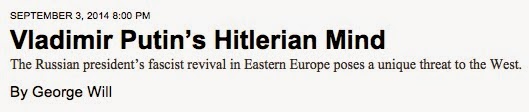





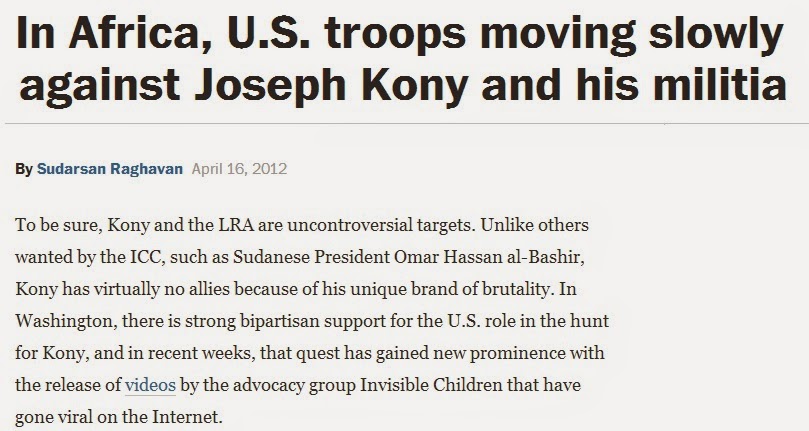


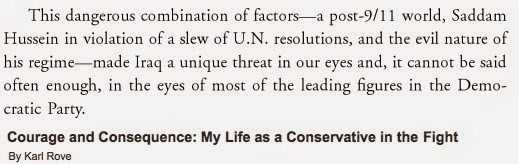


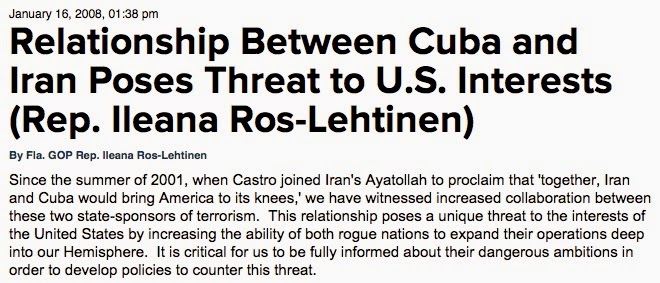



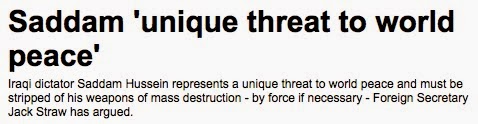









Are we clear?
Featured Video
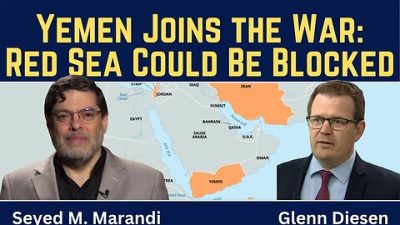
Yemen joins the war – Red Sea could be blocked next – Saudi regime at risk
or go to
Aletho News Archives – Video-Images
From the Archives
Should Europeans ‘Thank’ the Americans for Destroying Nord Stream?
By Robert Bridge | Strategic Culture Foundation | September 29, 2022
With an investigation continuing into the destruction of the Nord Stream gas pipeline that provided energy supplies to Europe from Russia, there appears to be just one prime suspect, and that should surprise nobody.
Following the sabotage of the Nord Stream 1 and 2 gas pipelines, former Polish Foreign Minister Radoslaw Sikorski already seemed to know the identity of the perpetrator when he tweeted out: “Thank you, USA.”
At first glance, it seemed that Sikorski was speaking sarcastically, berating Washington for carrying out an attack that will have severe repercussions for the people of Europe. After all, how could anyone see any good coming from the termination of Europe’s primary source of gas reserves with winter just around the corner? It was Sikorski’s homeland of Poland, after all, that urged its citizens to collect firewood in the face of dwindling gas reserves.
In fact, the Polish diplomat was speaking one-hundred percent literally… continue
Blog Roll
 Aletho News
- Growing insecurity, soaring prices fuel protests in north as regime bans evacuation: Sources
- Iran denies responsibility for ‘depraved’ attack on Kuwait desalination plant
- Bring The Troops Back. End This War Now!
- Can we please stop calling Israel the ‘only democracy in the Middle East’ now?
- US should start removing its troops for Germany, proposes AfD co-leader Chrupalla
- Iran Red Crescent: 600 educational centers attacked in US-Israeli ‘war crimes’
- Russian Oil Tanker Arrives in Cuba Amid U.S. Blockade
- America Racing to Strategic Defeat in Iran: Lt Col Daniel Davis
- FTC Warns Visa, Mastercard, PayPal, Stripe Over Political Debanking
- Russian tanker approaches Cuba despite US oil blockade
- If Americans Knew
- Israeli police block Catholic cardinal from entering Church of the Holy Sepulchre on Palm Sunday
- Israel is assassinating journalists again, more than any other nation, anywhere, ever – Not a ceasefire Day 170
- Over 300 US service members wounded, majority have brain injuries – Not a ceasefire Day 169
- Researchers at Human Rights Watch Resign Over Blocked Report on Palestinian Refugee Return
- Jewish Groups Are Backing a War Americans Don’t Want
- Eric Fingerhut Thinks He’s the President of the Jews
- Top Jewish Philanthropists, Rabbis Urge Israeli President to Take Action Against ‘Jewish Extremists’
- Don’t Be Fooled. Zionist Leaders Have Always Wanted to Control Southern Lebanon
- Israel’s widespread use of torture is a core element of its genocide against the Palestinian people
- In Israel’s War on Iran, Many Middle East US Bases Rendered “All But Uninhabitable”
- No Tricks Zone
- New Study Finds Warming Saves Lives…Cold Temperatures 12 Times More Deadly Than Excess Heat
- German Science Blog Accuses PIK Climate Institute Of Hallucinating Climate Tipping Points
- Devastating Assessment Of Comirnaty Vaccine By Former Senior Pfizer Europe Toxicologist
- New Study: CO2 Is ‘Effectively Negligible’ As An Explanatory Climate Change Factor Since 2000
- Former Pfizer Toxicologist Dr. Helmut Sterz Tells Bundestag Hearing Pfizer Vaccine Should Have Never Been Approved
- Energy Expert: Germany’s Nuclear Phaseout Was A “500 Billion Euro Mistake”
- New Research: South Australia’s Mid-Holocene Sea Surface Temperatures Were 4°C Warmer Than Today
- Storing Green Energy To Last Germany 10 Days Would Require A 60-Million Tonne Battery
- New Studies: UK Sea Levels Were 4 Meters Higher Than Today During The Mid-Holocene
- Destructive Green New Deal: German Energy And Metal Group Warns Of Drastic Crisis
 Aletho News