West weaponizing laws to silence pro-Palestine activism: Study

Al Mayadeen | October 14, 2025
The right to protest is facing increasing restrictions across the West, The Guardian reported on Monday, citing a new study by the International Federation for Human Rights (FIDH), which accuses governments of criminalizing pro-Palestine activism and using counter-terrorism and antisemitism laws to stifle dissent.
The report focuses on the UK, US, France, and Germany, accusing authorities in these countries of “weaponizing” national security and anti-hate legislation to silence criticism of “Israel” and suppress demonstrations supporting Palestinian rights in Gaza and the occupied West Bank.
“This trend reflects a worrying shift towards the normalization of exceptional measures in dealing with dissenting voices,” Yosra Frawes, head of FIDH’s Maghreb and Middle East desk, told The Guardian.
Compiled from open-source data, witness accounts, and institutional reports gathered between October 2023 and September 2025, the study was released just one day after a US-brokered Gaza ceasefire that secured the release of all living Israeli captives and around 2,000 Palestinian detainees.
According to FIDH, restrictions on speech and assembly have extended beyond protests, impacting journalists, academics, and public officials who express solidarity with Palestinians.
In the United Kingdom, the organization found that protest rights have eroded under both Conservative and Labour administrations. The report points to the 2024 anti-protest law introduced by the Conservatives, later deemed unlawful, and to what it calls the Labour government’s continuation of “official narratives” justifying support for “Israel”.
It highlights former Home Secretary Suella Braverman‘s branding of pro-Palestine rallies as “hate marches”, arguing that this rhetoric “stigmatized support for Palestine and Palestinian resistance movements” and “worked to discriminate against Muslims and other racialized groups in the UK.”
FIDH says the change in government in July 2024 “did little to change official government narratives,” claiming Labour has linked criticism of “Israel” with “violent antisemitism” while continuing to target Muslim and racialized communities.
The tensions have been further inflamed by the Labour government’s ban on the activist network Palestine Action and its proposal to expand police powers at protests.
FIDH draws parallels across the Atlantic, where US authorities have detained demonstrators and pursued legal actions against individuals expressing solidarity with Palestine. In France, the government has faced criticism for banning pro-Palestine demonstrations in several cities and for dissolving the rights group Urgence Palestine.
Meanwhile, in Germany, protests have drawn thousands, but police tactics and restrictions on slogans deemed antisemitic, for the mere criticism of “Israel”, have been widely condemned as excessive. The report argues that Germany’s actions reflect a “collective discomfort” in balancing free expression with its postwar responsibility to combat what it classifies as “antisemitism”.
Freedom crisis
The federation recommends that the UK establish an independent oversight body for policing demonstrations and amend key legislation, Section 12 of the Terrorism Act 2000 and Section 11 of the Public Order Act 2023, to protect political speech and prevent arbitrary searches.
“Ultimately, the crackdown on solidarity with Palestinians reveals a profound crisis, not only of human rights in the occupied territories but of freedom itself, in societies that claim to be democratic,” the report concludes.
FIDH says that while legal frameworks vary among the UK, US, France, and Germany, the trend toward restricting Palestinian solidarity movements represents a global pattern of shrinking civic space, one that calls into question the credibility of Western nations as defenders of democratic freedoms.
Max Blumenthal: The Gaza peace deal that never was
The Grayzone | October 13, 2025
The Grayzone’s Max Blumenthal explains how the Biden administration refused to pressure Netanyahu into a ceasefire, leaving the perceived diplomatic win to Trump, who happens to be the most malleable vehicle for Israeli influence in US history. Max explains how Israel is already violating the ceasefire agreement while unleashing its extremist proxies in Gaza, and highlights extremely revealing statements Trump made during his Jerusalem speech in which he casually joked about Israel’s control over his own policies.
Obama faces backlash for ‘bothsides-ing’ Israel’s genocide in Gaza
The New Arab | October 10, 2025
Former US President Barack Obama has come under fire for comments about the Gaza ceasefire for equating victims and aggressors and erasing Palestinian suffering.
The remarks, which many saw as Obama framing Israel with empathy and stripping Palestinians of their humanity, came after the announcement of an agreement between Israel and Hamas.
“After two years of unimaginable loss and suffering for Israeli families and the people of Gaza, we should all be encouraged and relieved that an end to the conflict is within sight; that those hostages still being held will be reunited with their families; and that vital aid can start reaching those inside Gaza whose lives have been shattered,” Obama posted on X.
He added that it now fell on “Israelis and Palestinians, with the support of the US and the entire world community, to begin the hard task of rebuilding Gaza – and to commit to a process that, by recognizing the common humanity and basic rights of both peoples, can achieve a lasting peace”.
Media critic Sana Saeed described Obama’s phrasing as “a masterclass in seven words on how Palestinians are rendered faceless and nameless when slaughtered, while Israelis are granted empathy, especially when they are the butchers”.
Palestinian-American human rights lawyer Noura Erakat said: “The ‘people’ of Gaza are Palestinians. They have survived a genocide and an ongoing attempt to eliminate them for over a century.” Others said his use of the word “conflict” to describe Israel’s assault on Gaza distorted the nature of the violence.
“It’s a genocide,” wrote historian Assal Rad. “There is no accountability without acknowledging it, and there is no justice without accountability.”
Obama has not addressed the criticism. He had previously faced similar criticism for statements on Israel and Palestine.
In October 2023, he defended Israel’s “right to defend itself” while urging restraint, a position slammed as “bothsidesism” Israel’s bombardment of Gaza and ignored the decades-long occupation.
He also drew condemnation for an October 2024 post marking the anniversary of Hamas’s attack that mentioned Israeli victims but not the more than 41,000 Palestinians killed in Gaza at the time.
Israel’s military attacks on Gaza have killed more than 67,000 Palestinians, including thousands of children, while displacing nearly the entire population and destroying much of the enclave’s infrastructure.
On Thursday, Israel and Hamas signed the first phase of a ceasefire and hostage-exchange agreement, brokered by the United States, Egypt, Qatar, and Turkey.
Who is Larry Ellison? And how does he tie digital ID, Trump, Blair and genocide in Levant?
By David Miller | Al Mayadeen | October 13, 2025
Larry Ellison is a tech billionaire who is the world’s second richest man. He is behind the takeover of TikTok, the purchase of Paramount which ownsCBS News and is bidding to take over Warner Bros. which owns CNN.
He runs a firm called Oracle which was started with funds from the CIA. The CIA effectively made Ellison a Billionaire.
Today, Oracle is the cloud provider for the British Home Office, the Ministry of Defence and the Foreign Office, storing national security data, as well as the National Health Service. The NHS is of particular note since it holds an incredible amount of population data going back to its formation in 1948. No wonder Ellison is desperate to get his hands on it: “The NHS in the UK has an incredible amount of population data,” though, he noted, it remains too “fragmented.”
Ellison is the largest recorded donor to the Friends of the Israel Occupation Forces and previously, reportedly, offered Benjamin Netanyahu directorship of the firm. Its longtime CEO is “Israel” born Safra Catz, who has also donated millions to the Friends of the IOF either directly or via Oracle itself.
In late 2024, she told an Israeli business news outlet, “For employees, it’s clear: if you’re not for America or Israel, don’t work here, this is a free country.”
A year ago, Ellison described a future where everyone will face regular surveillance. He predicted artificial intelligence would help process the vast amounts of footage recorded by cameras placed on everything from car dashboards and front doors to security systems and the police.
Ellison is the man behind the latest push for digital ID cards in the UK and has said that citizens “will be on their best behaviour” once they are introduced. “We’re going to have supervision,” Ellison said. “If there’s a problem, AI will report that problem… we are constantly recording and reporting everything that’s going on.”
An anonymous US official told reporters TikTok’s algorithm will be “fully inspected and retrained” by Ellison’s consortium.
The purchase of TikTok is certainly about winning the propaganda battle for the Zionist genocide, but it’s also about surveillance, monitoring and control.
Oracle had already, in February, taken control of some of TikTok’s day-to-day operations, had taken a firm pro-“Israel” stance and reportedly, clamped down on pro-Palestine activism inside the company.
Collaborations between the company and Zionist regime agencies have been wide-ranging, from direct technology work with the military to software intended to help “Israel” with public relations, including, according to internal company messages, on social media platforms like TikTok. Catz, herself, notes that “We were the first company to build a data centre in Israel serving the region.”
Netanyahu has said, “We have to fight with the weapons that apply to the battlefields on which we are engaged. And the most important ones are on social media.” And the most important, he said, is “TikTok, number one. Number one.”
One of President Trump’s advisers described Ellison, earlier this year, as a literal “shadow president of the United States,” if not necessarily the shadow president.
Larry Ellison and Tony Blair
Two elements of the Trump peace plan, which are clearly linked, are on the one hand, a plan for governing Gaza after the putative “defeat” of Hamas and, on the other, a plan for manipulating the media and social media in order to defeat Hamas in the propaganda war.
These two elements of the strategy have clearly been co-ordinated closely with Netanyahu, who has more or less taken up residence in the US. But they have also been closely co-ordinated with a man referred to as the shadow president – the tech billionaire Larry Ellison – and with the former Prime Minister of the UK, Tony Blair.
Blair has recently emerged as “a potential Gaza interim consul and member of Donald Trump’s ‘board of peace.'”
Given that Ellison and Blair are both central to the Trump/Zionist plan, we might ask if they are also aware of each other? In fact, they are very closely intertwined.
According to Lighthouse Reports: Ellison invested $130 million in the Tony Blair Institute between 2021 and 2023, with a further $218 million pledged since then. The scale of funding took the TBI from a headcount of 200 to approaching 1,000. Blair himself takes no salary from TBI, but over this time, the institute has been able to recruit from bluechip firms like McKinsey and Silicon Valley giants Meta. In 2018, before the Oracle founder’s funding surge, TBI’s best-paid director earned $400,000. In 2023, the last year where accounts are available, the top earner took home $1.26 million.
Oracle has earned £1.1 billion in public sector revenue since the start of 2022, according to data collected by procurement analysts Tussell.
Here is Blair introducing Ellison in the UAE asking him about the use of data, including in Digital IDs. Note what he says about unifying data.
“The first thing a country needs to do is to unify all of their data so that it can be consumed and used by the AI model.”
Ellison and Blair are working together to open up huge data-mines for profit-making. The British NHS is a key prize since there are virtually no other population level data sources that go back so far. The NHS was created in 1948.
It’s obvious that the unification of data will enhance the ability of both Oracle and the Zionist entity to surveil and kill the Palestinians and to suppress all attempts to oppose genocide. This is how the control of TikTok and the Trump “board of peace” are connected.
Saleh al-Jafarawi, the Doghmush clan, and the illusion of ceasefire
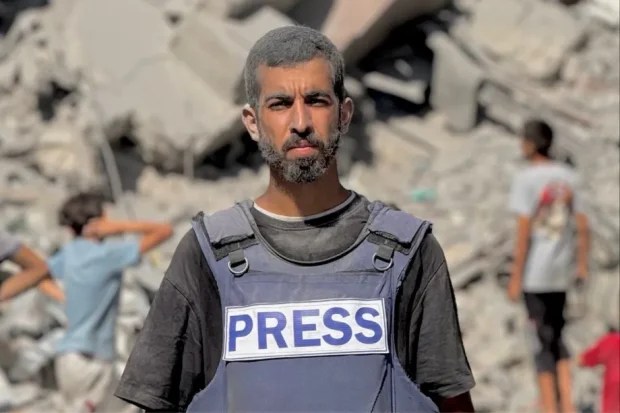
By Mohammad Aaquib | MEMO | October 13, 2025
Saleh al-Jafarawi was abducted and executed by members of the Doghmush clan—an anti-Hamas faction within Gaza. He was not killed in battle, but in a context of internal militias acting under external influence.
This stark fact deserves to be front and center, because it exposes a quiet architecture of violence that functions even in moments when a ‘ceasefire’ supposedly holds. This is the occupation’s most insidious form, a war fought not through tanks or jets but through collaborators and chaos, ensuring that Gaza never truly rests. In this architecture of endless war, ceasefires are illusions, fragile pauses that conceal the unbroken machinery of control, where Israel’s hand remains unseen but ever present, orchestrating violence even in silence.
Netanyahu’s June 2025 admission confirms what many analysts have long suspected: Israel has been “activating” clans that oppose Hamas, arming or supporting them at least tacitly, leveraging internal divisions in Gaza. In multiple statements, he claimed that, acting “on the advice of security officials,” the Israeli government has enabled certain Palestinian clans to operate against Hamas. “What’s wrong with that? It’s only good. It saves the lives of IDF soldiers,” Netanyahu declared.
One of the prominent clans so enabled is the Abu Shabab clan, based in Rafah, which Israel admits to having activated. The “Popular Forces,” linked to them, have been accused by Palestinians and aid workers of criminal behavior, including looting incoming humanitarian aid convoys. These clans are local players with complicated histories: some held influence before Hamas’s takeover of Gaza in 2007; some engaged in smuggling or informal power networks; some have been marginalized under Hamas rule. What Netanyahu has done is to take these existing internal cleavages and weaponize them—using clan rivalries as a tool of proxy warfare.
Against this background, the abduction and killing of Saleh al-Jafarawi by Doghmush clan members is more than an individual tragedy. It’s a case study: how collaborators or clan-militias are used to silence voices loyal to the resistance, to undermine local governance, and to sow fear. Al-Jafarawi was known for his coverage of destruction, displacement, and civilian suffering—aligning him clearly with Hamas’s movement of resistance. That he was taken and killed by a clan opposed to Hamas points to targeted violence, not random crime. It shows how Israel’s support for these clans is more than just logistics or rhetoric; it makes them dangerous internal agents.
The idea of a ceasefire is deeply compromised in this model. Even when shelling or open military operations between Israel and Hamas pause, the war continues in shadow. Militia violence, kidnappings, assassinations: these are not paused by ceasefire agreements. The killing of al-Jafarawi during a period when hostilities at the border were reduced shows that ceasefire does not guarantee safety. It merely shifts some forms of warfare from open battlefields to intra-Palestinian rivalries and clandestine operations. This makes peace an illusion for many civilians, who cannot distinguish between external assaults and internal betrayals.
This is not a failure of policy but its intended outcome. Israel has long understood that total military victory in Gaza is unattainable; they have seen countless defeats. What is attainable is permanent incoherence. The tactic amounts to a form of entropic warfare: the deliberate creation of chaos to prevent reorganization. Rather than occupying territory directly, Israel governs through collapse. The breakdown of social cohesion performs the same function as a garrison. When Palestinians no longer trust their own institutions or each other, Israel’s strategic goals are met without the need for visible control. The killing of Saleh Al-Jaafrawi illustrates this invisible war.
Moreover, this use of clan proxies weakens governance in Gaza in fundamental ways. Hamas enjoys a degree of popular legitimacy: it won the 2006 elections, and many Gazans still see it as a symbol of resistance against occupation and as the de facto government providing social services amid blockade and war. When opposing clans act—and are backed or enabled by Israel—they do not just challenge Hamas militarily; they undermine its ability to govern. They create parallel sources of power, insecurity, and unpredictability. For citizens that means nobody is fully safe, nobody is fully accountable, and public institutions become weaker because they must not only fend off external pressure but internal sabotage.
This strategy reflects patterns seen elsewhere: in Lebanon, for example, Israel has historically supported militias and local factions hostile to dominant groups such as Hezbollah in order to fragment power, reduce unified resistance, and create zones of distrust. These tactics often lead to long-term instability, cycles of violence, social fragmentation, and a human cost that lingers long after any overt war is over.
What emerges is a pattern: Israel’s strategy is not limited to confronting Hamas militarily; it includes enabling internal enemies of Hamas to degrade support for it, destabilize its governance, terrorize its supporters, and silence its voices. Al-Jafarawi’s killing becomes emblematic. He was not killed at the border, not during an Israeli airstrike, but through internal betrayal—abducted and executed by anti-Hamas actors. This highlights a grim truth: even with ceasefires, peace is not restored unless the structures that enable proxy violence and mobilize collaborators are dismantled.
This form of warfare carries the advantage of plausible deniability. When Palestinians fight among themselves, Israel can posture as a bystander, lamenting “internal chaos” while benefiting strategically from it. The spectacle of disorder reinforces the narrative that Palestinians are incapable of self-rule, thereby justifying continued external control.
The clans that turn against their own people under the lure of Israeli support are not merely opportunistic criminals; they are instruments of a much darker political project. By accepting money, arms, or protection from the occupation, they become extensions of a state built on apartheid and domination. Their betrayal corrodes the moral fabric of Palestinian society from within, achieving what bombardments and blockades alone cannot: the dismantling of solidarity, the erosion of trust, and the quiet assassination of resistance.
The defeat of Israel and the rebirth of Palestinian agency
By Ramzy Baroud | MEMO | October 13, 2025
For decades, the prevailing notion was that the ‘solution’ to the Israeli occupation of Palestine lay in a strictly negotiated process. “Only dialogue can achieve peace” has been the relentlessly peddled mantra in political circles, academic platforms, media forums, and the like.
A colossal industry burgeoned around that idea, expanding dramatically in the lead-up to, and for years after, the signing of the Oslo Accords between Yasser Arafat’s Palestine Liberation Organization (PLO) and the Israeli government.
The unmaking of ‘peace’
The problem was never with the fundamental principle of ‘dialogue,’ ‘peace,’ nor even with that of ‘painful compromises‘ — a notion tirelessly circulated during the ‘peace process’ period between 1993 and the early 2000s.
Instead, the conflict has largely been shaped by how these terms, and an entire scaffolding of similar terminology, were defined and implemented. ‘Peace’ for Israel and the US necessitated a subservient Palestinian leadership, ready to negotiate and operate within confined parameters, and entirely outside the binding parameters of international law.
Similarly, ‘dialogue’ was only permissible if the Palestinian leadership consented to renounce ‘terrorism’ — read: armed resistance — disarm, recognise Israel’s purported right to exist as a Jewish state, and adhere to the prescribed language dictated by Israel and the US.
In fact, only after officially renouncing ‘terrorism’ and accepting a restricted interpretation of specific UN resolutions on the Israeli occupation of the West Bank and Gaza did Washington agree to ‘dialogue’ with Arafat. Such low-level conversations took place in Tunisia and involved a junior US official — Robert Pelletreau, Assistant Secretary of State for Near Eastern Affairs.
Not once did Israel consent to ‘dialogue’ with Palestinians without a stringent set of preconditions, driving Arafat to a unilateral series of concessions at the expense of his people. Ultimately, Oslo yielded nothing of intrinsic value for Palestinians, apart from Israel’s mere recognition, not of Palestine or the Palestinian people, but of the Palestinian Authority (PA), which, over time, became a conduit for corruption. The PA’s continued existence is inextricably linked to that of the Israeli occupation itself.
Israel, conversely, operated unchecked, conducting raids on Palestinian towns, executing massacres at will, enforcing a debilitating siege on Gaza, assassinating activists, and imprisoning Palestinians en masse, including women and children. In fact, the post-‘dialogue,’ ‘peace,’ and ‘painful compromises’ era witnessed the largest expansion and effective annexation of Palestinian land since the 1967 Israeli occupation of East Jerusalem, the West Bank, and Gaza.
Gaza as the anomaly
During this period, there was a widespread consensus that violence, meaning only Palestinian armed resistance in response to unconstrained Israeli violence, was intolerable. The PA’s Mahmoud Abbas dismissed it in 2008 as ‘useless,’ and subsequently, in coordination with the Israeli military, devoted much of the PA’s security apparatus to suppress any form of resistance to Israel, armed or otherwise.
Though Jenin, Tulkarm, Nablus, and other regions and refugee camps in the West Bank continued to forge spaces, however constrained, for armed resistance, the concerted efforts of Israel and the PA often crushed or at least substantially reduced these moments.
Gaza, however, consistently stood as the anomaly. The Strip’s armed uprisings have persisted since the early 1950s, with the emergence of the fedayeen movement, followed by a succession of socialist and Islamic resistance groups. The place has always remained unmanageable — by Israel, and later by the PA. When Abbas loyalists were defeated following brief but tragic violent clashes between Fatah and Hamas in Gaza in 2007, the small territory became an undisputed center of armed resistance.
This event occurred two years after the Israeli army’s redeployment out of Palestinian population centers in the Strip (2005), into the so-called military buffer zones, established on areas that were historically part of Gaza’s territory. It was the start of today’s hermetic siege on Gaza.
In 2006, Hamas secured a majority of seats in the Palestinian Legislative Council, an unexpected turn of events that infuriated Washington, Tel Aviv, Ramallah, and other Western and Arab allies.
The fear was that without Israel’s PA allies maintaining control over the resistance inside Gaza and the West Bank, the occupied territories would inevitably result in a widespread anti-occupation revolt.
Consequently, Israel intensified its suffocating siege on the Strip, which refused to capitulate despite the horrific humanitarian crisis resulting from the blockade. Thus, starting in 2008, Israel adopted a new strategy: treating the Gaza resistance as an actual military force, thereby launching major wars that resulted in the killing and wounding of tens of thousands of people, predominantly civilians.
These major conflicts included the war of December 2008-January 2009, November 2012, July-August 2014, May 2021, and the latest genocidal war commencing in October 2023.
Despite the immense destruction and the relentless siege, let alone external international and Arab pressures and isolation, the Strip somehow endured and even regenerated itself. Destroyed residences were rebuilt from the salvaged rubble, and resistance weaponry was also replenished, often utilizing unexploded Israeli munitions.
The 7 October rupture
The 7 October Hamas operation, known as Al-Aqsa Flood, constituted a significant break from the established pattern that had endured for years.
For Palestinians, it represented the ultimate evolution of their armed struggle, a culmination of a process that commenced in the early 1950s and involved diverse groups and political ideologies. It served as a stark notification to Israel that the rules of engagement have irrevocably shifted, and that the besieged Palestinians refuse to submit to their supposed historical role of perpetual victimhood.
For Israel, the event was earth-shattering. It exposed the country’s vaunted military and intelligence as deeply flawed, and revealed that the country’s leadership assessment of Palestinian capabilities was fundamentally erroneous.
This failure followed the brief surge of confidence during the normalisation campaign initiated by the US and Israel with pliable Arab and Muslim countries during Trump’s first term in office. At that time, it appeared as though the Palestinians and their cause had been rendered irrelevant in the broader Middle Eastern political landscape. Between a co-opted Palestinian leadership in the West Bank and besieged resistance movements in Gaza, Palestine was no longer a decisive factor in Israel’s pursuit of regional hegemony.
The centerpiece of Israeli Prime Minister Benjamin Netanyahu’s strategy, and his aspiration to conclude his long political career with the ultimate regional triumph, was suddenly obliterated. Enraged, disoriented, but also determined to restore all of Israel’s advantages since Oslo, Netanyahu embarked on a campaign of mass killing that, over the course of two years, culminated in one of the worst genocides in human history.
His methodical extermination of the Palestinians and overt desire to ethnically cleanse the survivors out of Gaza laid bare Israel and its Zionist ideology for their inherently violent character, thus allowing the world, especially Western societies, to fully perceive Israel for what it truly is, and what it has always been.
Resistance, resilience, and defeat
But the genuine fear that unified Israel, the US, and several Arab countries is the terrifying prospect that resistance, particularly armed resistance, could re-emerge in Palestine, and by extension across the Middle East, as a viable force capable of threatening all autocratic and undemocratic regimes. This fear was dramatically amplified by the ascent of other non-state actors, such as Hezbollah in Lebanon and Ansarallah in Yemen, who collectively with the Gaza resistance managed to forge a formidable alliance that required direct US involvement in the conflict.
Even then, Israel failed to achieve any of its strategic objectives in Gaza, owing to the legendary resilience of the Palestinian people, but also the prowess of the resistance that managed to destroy over 2,000 Israeli military vehicles, including hundreds of the pride and joy of the Israeli military industry, the Merkava tank.
No Arab army has managed to exact this scale of military, political, and economic cost from Israel throughout the country’s violent existence of nearly eight decades. Though Israel and the US — and others, including some Arab countries and the PA — continue to demand the disarming of the resistance, such a demand is rationally nearly unattainable. Israel has dropped over 200,000 tons of explosives over Gaza over the course of two years to achieve that singular objective, and failed. There is no plausible reason to believe that it can achieve such a goal through political and economic pressures alone.
Not only did Israel fail in Gaza, or, more accurately in the words of many Israeli historians and retired army generals, was decisively defeated in Gaza, but Palestinians have managed to reassert Palestinian agency, including the legitimacy of all forms of resistance, as a winning strategy against Israeli colonialism and US-Western imperialism in the region. This explains the profound fear shared by all parties that Israel’s defeat in Gaza could fundamentally alter the entire regional power dynamics.
Though the US and its Western and Arab allies will persist in negotiating in an attempt to resurrect the almost 90-year-old Palestinian leader Abbas and his Oslo paradigm as the only viable alternatives for Palestinians, the medium and long-term consequences of the war are likely to present a starkly different reality, one where Oslo and its corrupted figures are definitively relegated to the past.
Finally, if we are to speak of a Palestinian victory in Gaza, it is a resounding triumph for the Palestinian people, their indomitable spirit, and their deeply rooted resistance that transcends faction, ideology, and politics.
All of this considered, it must also be clearly stated that the current ceasefire in Gaza cannot be misconstrued as a ‘peace plan’; it is a mere pause from the genocide, as there will certainly be a subsequent round of conflict, the nature of which depends heavily on what unfolds in the West Bank, indeed the entire region, in the coming months and years.
Ceasefire or charade: As Hamas frees Israeli captives, Netanyahu unlikely to uphold the deal
By David Miller | Press TV | October 13, 2025
The overused Clausewitz axiom tells us that ‘war is the continuation of politics by other means’.
What is often less well understood – especially when dealing with the Zionists – is that diplomacy is merely the continuation of war by other means. And so it is with the latest ‘ceasefire’ agreement achieved by the Palestinian resistance in the field of diplomatic warfare against the Zionist enemy.
First phase terms
The first (and perhaps only) phase of the agreement requires a cessation of hostilities during which the Hamas resistance movement will release all living captives, as well as the corpses of those eliminated (48 living and dead in total), in return for two thousand Palestinian living martyrs who will be rescued from the Zionist torture dungeons.
At the time of writing this, Hamas has handed over seven captives to the International Red Cross Committee (ICRC) in Gaza and is expected to release 13 more, while awaiting the release of 2,000 Palestinians held in Israeli prisons under the terms of the deal.
But more detailed negotiations will have to follow, since at least two thousand more Palestinians kidnapped by the Zionist occupation may remain in captivity after this ceasefire.
The agreement also requires that the Zionists withdraw from 47 per cent of Gaza’s territory, although Palestinian resistance officials are doubtful that this condition will be met.
No one is under any illusion that the Zionists will cease fire. Just the other day, I saw smoke rising from the ashes of Gaza City and Khan Younis as the Zionists terrorised Palestinian families from the sky, likely using Boeing’s Apache AH-64 attack helicopters as they so often do.
That’s the same Boeing that was recently gifted $96bn by Qatar Airways; $14.5bn by Abu Dhabi’s Etihad, and $37bn by Saudi Arabia’s Public Investment Fund on behalf of Riyadh Air.
Donald Trump has just touted an in-person signing of the agreement, while the four Jewish extremists who are materially in charge of the agreement’s details for the Zionists – Steve Witkoff, Jared Kushner, Benjamin Netanyahu and his chief adviser Ron Dermer – gave the treaty, and the genocide which has preceded it, fulsome blessings during a cabinet meeting in Tel Aviv.
The presence of Witkoff and Kushner at a Zionist cabinet meeting in Occupied al-Quds leaves no room for metaphor. Little wonder that Americans today are coming to the belated understanding that their Empire has been run by and for Jewish supremacist interests for several decades.
A win for Palestinian resistance
Despite all this fanfare, the war will continue, and possibly even expand, since Netanyahu will not be able to face domestic political rivals and internal pressure in the Zionist entity after such a comprehensive diplomatic defeat, based on the terms agreed by the victorious Palestinian resistance in Cairo under Qatari mediation, and Egyptian and Turkish coercion.
Turkish and Egyptian representatives have repeatedly pushed the Palestinian resistance to capitulate, disarm and end their struggle against Zionist colonization since the UN General Assembly summit last month, during which the Trump regime strongarmed Muslim-majority states into committing to Zionisation in their own states.
The agreement is, as some Palestinians in Gaza have said, the result of “Palestinian struggle and steadfastness” surviving two years of genocide against all the odds, under the bombs and complicity of the whole world. The freedom of the living martyrs is their achievement above all, though it is likely the Zionists will immediately target released Palestinian prisoners for assassination.
The agreement is also a major success for the Qatari strategy as lead mediator, which has delicately balanced the genocidal demands of the Zionist entity and its organ-grinder in the White House on the one hand, and on the other, the urgent need to both tamp down the indescribable suffering faced by the Palestinian people and to release thousands of Palestinians held in Zionist torture dungeons.
The Palestinian resistance has always placed the release of Palestinian hostages in return for the captured Zionist invaders at the top of the agenda, and predicated all other conditions on this and the end, which appears to translate into Hebrew as a mere slowdown of the genocide.
The wheels are at least turning to achieve one of these conditions.
Resistance on the same page
It has also always been crucial to the Palestinian resistance to ensure that those hostages released from Zionist captivity are from a broad range of Palestinian social movements, without the exclusion of any faction or individual.
Hamas is negotiating on behalf of Palestine itself because it represents Palestine – electorally, militarily, diplomatically and in terms of its social composition. But it is not alone on the Palestinian side of the table.
Its delegates have been joined in this round of negotiations by representatives from other Resistance factions, including the Palestinian Islamic Jihad (PIJ), whose Saraya al-Quds fighters have been vital to the Palestinian war effort for two years, and the Popular Front for the Liberation of Palestine (PFLP), whose Abu Ali Mustafa Brigades have also played a role in confronting Zionist fire.
Abu Ali Mustafa’s successor as Secretary General of the PFLP, Ahmad Sa’daat, also known as Abu Ghassan, is one of the high-profile Palestinians whose release the resistance is demanding.
He is credited by the Zionists with avenging the martyrdom of Abu Ali Mustafa by overseeing the elimination of the bloodthirsty Zionist and advocate of Palestinian ethnic cleansing, then Zionist ‘tourism minister’ Rehavam Ze’evi, who founded the Moledet Party, in a storied operation in 2001 in Occupied al-Quds.
Another of the renowned Palestinian hostages held in the Zionist torture dungeons is Ibrahim Hamed, a Hamas military commander from the occupied West Bank who has overseen many significant Qassam Brigade operations to liberate the occupied Palestinian territories.
The Zionists credit him with eliminating 96 regime agents and wounding 400 more during the Second Intifada. In typical style, Zionist military agencies have been kvetching that Hamed cannot be released as part of this deal because he is ‘the next Yahya Sinwar’.
So naturally, ‘senior sources’ believed to be in Shin Bet wasted no time briefing favoured Zionist propagandist Nadav Eyal that Hamed is actually ‘two or even three Yahya Sinwars’.
No doubt that in short order, he will be blamed for eighty-eight 9/11s, and we will be told he is worth $6bn, accompanied by grainy footage of a Turkish leather handbag said to be made by Hermès.
One high-profile prisoner the Zionists have already refused to release – and who senior Hamas official Musa Abu Marzouq says his party insists on freeing through this deal – is the Fateh icon Marwan al-Barghouti, who has spent three decades incarcerated at the hands of the Zionists, and who has been widely touted as a potentially unifying presidential candidate across Palestine.
Sticking points
The Zionists’ refusal to release Barghouti, Hamed and Sa’daat serves as an early indicator of how difficult it will be to achieve the first phase of the agreement, which is the only phase that suits the resistance to commit to. The following phases of the proposed ‘Trump peace plan’ are too outrageous and insulting to even consider, and amount to a full and eternal Zionisation of Palestine (and, as a result, the rest of the world) under a Pax Judaica.
The Zionist supremacists have overstated their leverage over the Palestinian resistance if they think they can demand capitulation and disarmament the way they have in Lebanon. But they are already working deep inside Gaza to Zionise Palestinians without the consent of the resistance.
Take the example of Dr. David Hasan, a North Carolina neurosurgeon who seeks to target 20,000 hungry Palestinian orphans for brainwashing with aid in one hand and an ‘Israel-friendly curriculum’ in the other with his morbid ‘Gaza Children’s Village’ scheme.
The resistance is currently occupied with rooting out the Yasser Abu Shabab’s Daesh-linked gangs used by the Zionist regime as a subcontractor for rape, torture and executions inside Gaza during the genocide, but in time it will also doubtlessly address such Zionisation programmes and their coordinators with equal vigour.
This will cause friction while the Chabad extremist Kushner, who is personally obsessed with Zionising West Asia and bringing about a hegemonic Jewish Empire, remains by Donald Trump’s side.
There is also the most obvious route Netanyahu is likely to take to frustrate any progress: taking back the Zionist colonists held as prisoners of war by the resistance and then continuing the war in Gaza City instead of withdrawing.
Netanyahu is closer than ever, and closer than any other figure in history, to bringing about a Pax Judaica – a complete transfer of global hegemony from the US to the Zionist entity.
In the unlikely eventuality that the Muslim-majority states refuse to Zionise as part of this Kushner-brokered ‘peace plan’, he and Netanyahu (who he has known as a father figure since his childhood) will simply forge ahead to bring about Zionisation at the end of a gun.
David Miller is the producer and co-host of the Press TV show Palestine Declassified. He was sacked from Bristol University in October 2021 over his Palestine advocacy.
World cities rise in solidarity with Gaza: Marches and calls to hold Israel accountable
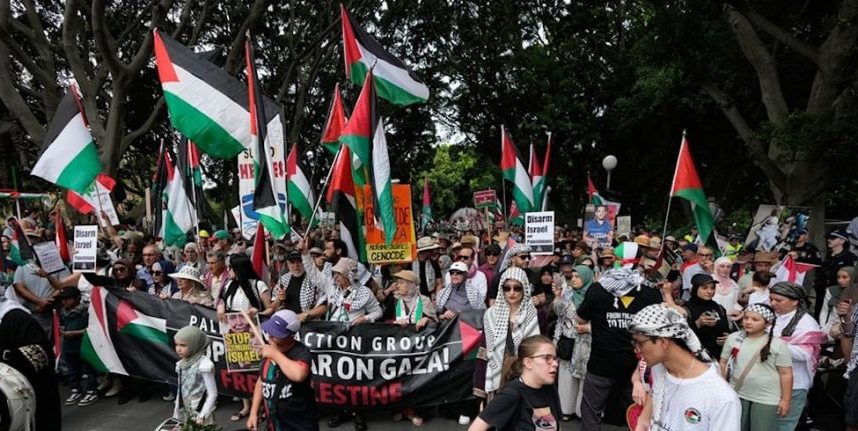
Palestinian Information Center – October 12, 2025
Demonstrations and solidarity rallies with the Palestinian people continued across various capitals and cities around the world, in a scene that reflects the growing global awareness of the scale of the humanitarian catastrophe caused by the Israeli aggression on the Gaza Strip, along with mounting calls to hold Israel accountable and end the ongoing genocide that has lasted for two years.
In Australia, the group Palestine Action said that demonstrations took place on Sunday in 27 cities and towns in support of the Palestinians, most notably in Sydney, Melbourne, and Brisbane. Protesters demanded that the government impose sanctions on Israel and halt all arms exports to it, stressing that continued cooperation with a state committing war crimes constitutes political and moral complicity.
In Indonesia, thousands gathered at Independence Square in central Jakarta to celebrate the ceasefire in Gaza, chanting slogans rejecting all forms of normalization with Israel, political, commercial, and sporting alike. They also expressed solidarity with Palestinians in the West Bank, who continue to face escalating assaults and raids by Israeli forces.
In Seoul, the South Korean capital, a solidarity protest was held calling for the rapid entry of humanitarian aid into Gaza and the lifting of the siege imposed for more than two years. Participants raised Palestinian flags and chanted for an end to the suffering of civilians.
Massive marches were held in London, where organizers said around half a million people took part in a demonstration that filled the streets of the British capital and headed toward the government headquarters on Downing Street. Protesters demanded an end to arms sales to Israel and accountability for those responsible for war crimes.
Participants stressed the need to achieve justice based on international law and to end occupation and apartheid.
In Berlin, thousands of demonstrators marched from the Brandenburg Gate to the city center, calling for a halt to Israeli arms shipments and an end to official support for the war on Gaza. Protesters denounced restrictions on pro-Palestine activism in Germany and chanted slogans such as “Freedom for Palestine” and “No peace on stolen land.” Limited clashes later broke out with police, who used force and arrested several demonstrators.
In Paris, a large protest took place that included activists and healthcare workers, some of whom had served in Gaza’s hospitals during the war. They called for the release of imprisoned doctors, foremost among them Dr. Hossam Abu Safiya, and for guarantees to uphold the ceasefire and deliver urgent medical aid.
In Milan, hundreds of Italians joined a solidarity march where demonstrators demanded the reconstruction of Gaza and an end to the blockade imposed on it.
In Oslo, protests were held outside the parliament building, where participants called for the closure of the Israeli embassy and the severing of diplomatic ties with Tel Aviv.
In the Netherlands, the Plant an Olive Tree foundation organized a memorial event in Maastricht to honor the victims of the aggression, dedicated especially to Palestinian children and journalists killed in Israeli bombardments. Participants lined up in front of the historic St. Servatius Church, where photos and names of the martyrs were displayed, and thousands of children’s shoes were placed in the square in tribute to the young victims.
In Stockholm, hundreds joined a demonstration condemning the Israeli army’s attack on the Global Solidarity Flotilla, calling for a comprehensive embargo on Israel due to its repeated crimes against civilians. Protesters carried banners reading “Total blockade on Israel for a free Palestine,” before marching toward the Swedish parliament.
This global wave of protests, spanning more than thirty cities in just two days, reaffirmed that the Palestinian cause is no longer a local or regional issue, but rather a matter of global conscience calling for justice and an end to decades of occupation and collective punishment against civilians in Gaza and the West Bank.
No ground for negotiations with E3 anymore: Iran FM
Al Mayadeen | October 11, 2025
Tehran no longer sees a basis for nuclear talks with the E3 countries, Iranian Foreign Minister Abbas Araqchi stated on Saturday evening, adding that the country is not seeking it either.
Speaking to the Iranian state TV, Araghchi revealed that Washington had asked to hold direct talks with Tehran on the sidelines of the UN meetings, a message conveyed by US envoy Steve Witkoff. Iran, according to Araghchi, expressed readiness to engage, but only on the condition that representatives from the E3 countries and the IAEA Director, Rafael Grossi, be present, which the latter refused.
In this context, the top Iranian diplomat revealed that “the United States has always sought to integrate regional issues into nuclear negotiations, but we have never allowed that,” describing Washington’s positions as “constantly changing”.
Iran’s interests are red line
Regarding Tehran’s red lines, Araghchi confirmed that the interests of the Iranian people are paramount, emphasizing that while Iran will never give up its right to enrich uranium, it is willing to provide the international community with assurances, if need be, about the peaceful nature of its nuclear program.
He further criticized Europe, stating it has demonstrated a lack of independence, and indicated that Iran remains open to studying any new, fair plan from Washington as long as it respects the interests of the Iranian people, expressing a willingness to engage in dialogue.
On the topic of the Cairo Agreement, Araghchi stated, “It is currently frozen, and our cooperation with the Agency is only conducted within the framework of the Iranian parliament’s law and through the Supreme National Security Council.”
Araghchi addressed the prospect of renewed war with “Israel”, disclosing that, following an exchange between Russian President Vladimir Putin and Israeli Prime Minister Benjamin Netanyahu several days ago, Russian officials subsequently informed the Iranian ambassador in Moscow that Netanyahu has no interest in returning to a state of war with Iran.
Gaza ceasefire solely a Palestinian Resistance matter
Iranian Foreign Minister Araghchi addressed the ceasefire agreement in Gaza, denying that any discussions had taken place with Steve Witkoff concerning it, while affirming Iran’s support for any plan that would halt what he described as Israeli crimes.
Araghchi said Trump shared his view on Iran’s statement about the Gaza deal, but no messages were exchanged with Washington, adding that only the Palestinian Resistance and people can decide on a ceasefire, and no one else.
He stressed that “Israel” is not trustworthy, citing past experiences like Lebanon, which is clear proof that the entity does not honor its commitments, based on which Iran raised its concerns and issued the necessary warnings. He added that while Washington has made positive promises regarding the Gaza deal, there are doubts about its seriousness in fulfilling them, as these promises are constantly shifting.
Araghchi also noted that most foreign ministers in the region are skeptical about the future of the subsequent phases of the Gaza agreement.
On the issue of the normalization agreements, Iran’s FM noted that “these deals intrinsically constitute a sinister plan to deprive the Palestinian people of their rights,” adding that Iran’s position on such agreements is clear: “it will never join them.”
Regarding the trade war imposed by Washington, Araghchi stated that Iran would reciprocate in kind if its commercial ships were obstructed in any way under the pretext of sanctions, affirming that escalating tensions is not in anyone’s interest.
Purging America First: Inside the GOP’s Zionist Vetting Machine
By Jose Alberto Nino – The Occidental Observer – October 12, 2025
In the dimly lit corridors of Capitol Hill, where backroom deals shape American foreign policy, House Speaker Mike Johnson recently conducted what can only be described as a strategic war council. On the afternoon of September 17, 2025, Johnson gathered with a who’s who of pro-Israel organizations for a private meeting ostensively designed to eliminate dissenting voices within the Republican Party. What emerged from this closed-door session reveals a coordinated effort to ensure ideological orthodoxy on Israel.
The meeting itself reads like something out of a tired political thriller. Johnson, who described himself to the assembled group as a “Reagan Republican” focused on “peace through strength,” went on to make a startling admission that isolationism is rising within the Republican Party and that a major debate on the issue is likely once President Donald Trump leaves office.
But Johnson’s most revealing statement came when he told the group that in his candidate-recruiting efforts, he’s working to filter out isolationists to prevent that wing of the party from growing more prominent in the House. Four people who attended the meeting confirmed this extraordinary pledge to Jewish Insider.
“The speaker was very, very direct about the U.S. role with Israel and in the world and understands that there are voices that don’t agree in both parties, on both extremes, and urges us all to be involved in fighting back against those extremes,” Eric Fingerhut, CEO of the Jewish Federations of North America, told the publication.
The guest list for Johnson’s gathering was a who’s who of America’s most powerful pro-Israel organizations. In attendance were representatives from The Louis D. Brandeis Center for Human Rights Under Law, the Republican Jewish Coalition, Agudath Israel of America, AIPAC, the Simon Wiesenthal Center, Conference of Presidents of Major American Jewish Organizations, National Council of Jewish Women, Synergos Holdings, CUFI Action, the Orthodox Union, the U.S.-China Economic and Security Review Commission, Standard Industries, the American Jewish Committee, Zionist Organization of America, National Debt Relief, Jewish Institute for National Security of America, the Deborah Project, Foundation for Defense of Democracies, Coalition for Jewish Values and the Endowment for Middle East Truth. This comprehensive coalition represents the full spectrum of pro-Israel advocacy, from religious organizations to political action committees to think tanks—a formidable alliance with vast resources and influence.
The Hunt for Republican Heretics
The Israeli lobby’s crosshairs have settled on several prominent Republicans whose independence on foreign policy has made them targets. Chief among them is Rep. Thomas Massie (R-KY), whose voting record has made him perhaps the strongest opponent of Israel in Congress according to Jewish advocacy groups.
Massie’s legislative actions against pro-Israel interests are extensive and well-documented. In December 2023, at the height of Israel’s war against Hamas, Massie shared a social media post implying that Congress was more interested in “Zionism” than “American patriotism.” In October 2023, following the Hamas attack, Massie was the only Republican to vote against a bipartisan resolution standing with Israel. He was also the sole Republican to vote against the Iron Dome Supplemental Appropriations Act and the only member of either party to vote against a resolution honoring Jewish American heritage and denouncing antisemitism.
“Antisemitism is deplorable, but expanding it to include criticism of Israel is not helpful,” Massie wrote on X, explaining his vote against a resolution reaffirming Israel’s right to exist. Even more provocatively, Rep. Marjorie Taylor Greene (R-GA) has emerged as an unexpected critic from the MAGA wing. In a dramatic departure from her previous pro-Israel stance, Greene has characterized Israel’s actions in Gaza as “genocide.”
Her transformation has prompted a furious response from AIPAC, which issued a fundraising message comparing her to progressive Democrats Rashida Tlaib and Ilhan Omar:
Let’s call this what it is: Marjorie Taylor Greene is the newest member of the anti-Israel Squad. She may think this earns her praise from the far-left or online radicals — but we see it for what it is: a betrayal of American values and a dangerous distortion of the truth.
In response to AIPAC’s attack against her, Greene has doubled down, telling One America News Network that AIPAC should register as a foreign lobbyist and posting a photograph of a sign on her office door reading “no foreign lobbying.” She has accused Israel of having “incredible influence and control” over nearly every member of Congress, exposing pro-Israel lobby trips that she argues amount to foreign lobbying without accountability.
LinkBookmarkPerhaps nowhere is the Israeli lobby’s intervention more telling than in Texas’s 23rd Congressional District, where gun rights YouTuber Brandon Herrera mounted a formidable challenge against moderate Republican incumbent Tony Gonzales last election cycle. Herrera, known as “the AK Guy” to his 4.4 million YouTube subscribers, came within 354 votes of unseating Gonzales in the 2024 primary runoff.
Gonzales, a 20-year Navy veteran and cryptologist who rose to the rank of Master Chief Petty Officer, built his political résumé through Washington’s national security circles. He served as a legislative fellow in Senator Marco Rubio’s office and was a National Security Fellow at the pro-Israel Foundation for Defense of Democracies (FDD), a neoconservative think tank known for its hawkish foreign policy stance. In Congress, Gonzales has reflected that worldview by backing aid to Ukraine and Israel, stating that “if we fail to support our allies, China, Russia, and Iran will only become more powerful” with regard to a military aid spending package pending final passage in the U.S. House in April 2024.
The closeness of this race terrified pro-Israel groups, who saw Herrera as a genuine threat to their influence. AIPAC’s United Democracy Project spent $1 million opposing Herrera in a two-week ad buy, while the Republican Jewish Coalition added $400,000 in attack ads.
More significantly for the lobby’s concerns, Herrera had stated he would have voted against supplemental aid to Israel and other U.S. allies. “I would absolutely vote AGAINST the new proposed spending package for $95+ billion for foreign conflicts, while spending $0 on our southern border,” Herrera posted on X on April 19, 2024. “Any Republican who claims to be America first CANNOT vote for America last legislation.”
When asked directly whether he would pledge to end foreign aid, including to Israel, Herrera reiterated his position: “We can’t claim to be ‘America First’ while pushing spending bills like the most recent foreign aid package that gave almost $100 billion to every country except the US.”
The combined $1.4–1.5 million in spending by AIPAC and RJC helped Gonzales narrowly survive with 50.6% to 49.4%—a margin so slim it demonstrated the growing threat posed by America First candidates to the establishment’s foreign policy consensus. Herrera has already announced his intention to challenge Gonzales again in the 2026 Republican primaries, setting up another expensive battle. This time, the political winds may finally shift in Herrera’s favor.
The most audacious display of the Israeli lobby’s power may be their campaign against Thomas Massie. Pro-Israel Republican megadonors have established the MAGA Kentucky super PAC with $2 million specifically to oust the congressman. Paul Singer contributed $1 million, John Paulson added $250,000, and Miriam Adelson’s Preserve America PAC provided $750,000.
This goes far beyond normal political opposition; it’s a declaration of total war against foreign policy dissent among Republican ranks. AIPAC has already demonstrated this approach works. During the 2024 election cycle, AIPAC’s independent spending arm, the United Democracy Project, spent over $300,000 on Fox affiliate ads criticizing Massie’s voting record. UDP spokesperson Patrick Dorton did not mince words about UDP’s attacks against Massie: “We are not playing in the primary, but we are trying to shine a light on the radical anti-Israel record of Tom Massie. We want every single voter in the state of Kentucky to know about his anti-Israel actions.”
The Post-October 7 Reality
The October 7 Hamas attacks fundamentally transformed the Israeli lobby’s strategy and urgency. AIPAC increased its political spending nearly threefold in the months following the attacks, with average weekly spending jumping from $275,000 to over $740,000.
“Our focus in the 2024 election is to broaden and strengthen the bipartisan pro-Israel majority in Congress — and to defeat anti-Israel detractors,” AIPAC spokesman Marshall Wittmann told Capital News Service. “In the aftermath of the Hamas barbaric attack and the mounting threats of Iranian terrorist proxies, the importance of a pro-Israel Congress standing with our ally is clearer than ever.”
This represents more than increased spending; it’s a systematic campaign to ensure ideological conformity. The Israeli lobby’s post-October 7 mobilization has created what one Democratic donor adviser called “a huge, underappreciated change to the landscape.” Thousands of smaller donors who weren’t previously engaged have been activated, providing the financial foundation for an unprecedented intervention in American electoral politics.
Johnson’s pledge to “filter out isolationists” in candidate recruitment represents the institutionalization of ideological screening within the Republican Party leadership. This transcends opposing candidates in primaries and is mostly focused on preventing them from running in the first place by controlling access to party resources, endorsements, and financial networks.
The vetting process appears comprehensive. As the Jewish Insider report noted, Johnson is working to prevent the isolationist wing from “growing larger in the House” through his recruiting efforts. This suggests a systematic review of potential candidates’ positions on Israel and foreign aid, with those deemed insufficiently supportive being denied party backing.
This represents a fundamental shift in how American political parties operate. Rather than allowing primary voters to choose between competing visions, party leadership, at the behest of the Israel lobby, is pre-selecting candidates based on their adherence to specific foreign policy positions. The Israeli lobby has essentially outsourced candidate vetting to organizations whose primary loyalty is to world Jewry.
The Israeli lobby’s campaign to purge non-interventionist candidates and incumbents is part of a comprehensive campaign to eliminate legitimate foreign policy debate within the Republican Party. The success of this strategy in cases like the Gonzales-Herrera race demonstrates its effectiveness in the short-term. By deploying overwhelming financial resources against grassroots candidates, the lobby can overcome significant popular support for America First policies. Herrera’s near victory despite being outspent by millions shows the genuine appeal of his message and precisely why American Jewry views such candidates as existential threats.
The implications extend far beyond individual races. If successful, this campaign will fundamentally re-shape the Republican Party by eliminating voices that prioritize American interests over foreign commitments. With “unlimited” resources pledged against figures like Massie and systematic vetting of new candidates, Israeli interests are working to ensure that future Republican leaders never can question America’s relationship with Israel.
This endeavor may not be a walk in the park for organized Jewry, however. New trends point to younger voters souring on Israel. A University of Maryland Critical Issues Poll conducted between July 29 and August 7 showcased a dramatic generational divide within the Republican Party. While 52 percent of Republicans aged 35 and older sympathize more with Israel, that figure drops to just 24 percent among those aged 18 to 34.
The split grows even wider when it comes to Gaza. Among older Republicans, 52 percent view Israel’s actions as justified. Among younger ones, only 22 percent agree. “The change taking place among young Republicans is breathtaking,” said Shibley Telhami, the poll’s principal investigator. “While 52 percent of older Republicans (35+) sympathize more with Israel, only 24 percent of younger Republicans (18–34) say the same—fewer than half.”
This generational realignment accelerated after Operation Al-Aqsa Flood on October 7, 2023. Pew Research Center data show that unfavorable views of Israel among Republicans under 50 climbed from 35 percent in 2022 to 50 percent in 2025 — a striking 15-point jump. In contrast, Republicans over 50 shifted only slightly, from 19 percent to 23 percent.
Even evangelical Republicans, once Israel’s most reliable allies, are showing signs of fatigue. Among older evangelicals, 69 percent express sympathy for Israel, compared to only 32 percent among younger ones. Just 36 percent of younger evangelical Republicans consider Israel’s actions in Gaza justified.
In a broader rebuke of bipartisan orthodoxy, a September 2025 AtlasIntel poll found that only 30 percent of Americans support continued financial aid to Israel, underscoring how Washington’s “blank check” is increasingly out of step with public opinion. An increasing share of Republicans now argue that U.S. policy serves Israeli interests more than America’s.
The question now is whether the Republican Party belongs to its voters or to Tel Aviv. The battle lines are drawn, and the outcome will reveal who truly holds power in Washington.
The End of Impunity: The UN Slaps the Israeli Regime in the Face
The Silent Judgment of Nations: How the World Demonstratively Turned Its Back on Netanyahu
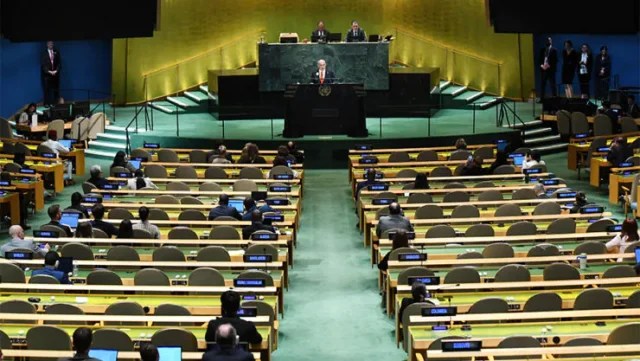
Netanyahu and the empty UN hall
By Viktor Mikhin – New Eastern Outlook – October 12, 2025
He stood at the podium, accustomed to the speeches of statesmen, but that day it was destined to become an instrument for justifying genocide. Benjamin Netanyahu, the prime minister of the Israeli regime, a man whose name will now stand alongside the darkest figures in history, was preparing to speak. But something happened that will forever remain in the annals of international diplomacy as a symbol of the moral collapse not only of one man, but of the entire system that has indulged him for far too long.
The UN General Assembly hall, usually filled with diplomatic indifference, exploded with a silence louder than any applause. Before Netanyahu could utter a single word, delegates from one country after another rose from their seats and demonstratively, silently, left the hall. This was not a spontaneous impulse, but a choreographed act of collective disgust. The spectacle was so humiliating for the leader of the so-called “only democracy in the Middle East” that the chairperson had to plead: “Order in the hall, I call for order in the hall!” But the appeal hung in the air. There was no order. There was a rebellion. A rebellion of conscience. A rebellion against injustice, genocide, and the annihilation of an entire Palestinian people.
Netanyahu’s face, usually a mask of unshakable self-confidence, contorted. He was shocked. He, the architect of carpet bombing, the destroyer of hospitals and schools, the executioner of children, women, and the elderly, was faced with something he did not expect: the silent, yet deafening, judgment of nations. In that moment, the mask of civility finally fell from the Israeli state. The world saw not a national leader, but an accused genocidaire left speaking to a nearly empty hall, save for a handful of his most loyal accomplices.
The “Father of Genocide’s” Speech: A New Language of Hate
And then the speech itself began. What was supposed to be a justification turned into a manifesto of misanthropy. Netanyahu, whose rhetoric had long since crossed all red lines, this time addressed the residents of Gaza directly. And in this vile address, there was a chilling cynicism worthy of the Nazi propagandists he so loves to compare his critics to.
He told them “not to listen to Hamas’s calls to remain in combat zones.” But is this not the height of hypocrisy? It is the Israeli army that has turned the entire Gaza Strip into one continuous “combat zone.” It is Israeli planes that are wiping entire neighborhoods off the map, following “evacuation maps” that are nothing more than a roadmap to a mass grave. Where are they to flee? To the sea, which Israeli ships have turned into a trap? To Rafah, which was then bombed? To the desert, where there is no water, no food, no shelter?
This appeal is not concern for civilians. It is the rhetorical trick of a murderer who, holding a knife over his victim, whispers, “It’s your own fault for not dodging.” It is an attempt to shift responsibility for one’s own crimes onto those who are doomed to die. This is the language of genocide. The very language that dehumanizes an entire people, turning them into a “human shield,” into “collateral damage,” into “animals,” as Israeli ministers and soldiers have openly and repeatedly called them.
The Anatomy of a Genocide: From Word to Deed
Let’s call things by their proper names. What is happening in Gaza is not a “conflict.” A conflict implies at least a semblance of symmetry. This is not a “war on terror.” This is the deliberate, systematic destruction of the Palestinian people as a national, ethnic, and cultural entity. And it fully corresponds to the legal definition of genocide as formulated in the 1948 UN Convention.
Article II of the Convention defines genocide as any of the acts committed with intent to destroy, in whole or in part, a national, ethnical, racial or religious group.
Silent Accomplices and Cynical Allies
The scene at the UN was a bright moment of truth, but it also highlighted the monstrous hypocrisy of Western powers. While delegates from most of the world voted with their feet, the representatives of the United States, Germany, the United Kingdom, and some other subordinate countries remained in their seats. Their silent presence was more eloquent than any words. It was silent approval. Complicity.
Washington, which supplies the weapons and provides diplomatic cover for the ongoing slaughter, is the chief sponsor of this genocide. Every bomb that falls on a house in Gaza has “Made in the USA” written on it. Every veto cast in the UN Security Council against cease-fire resolutions is a permission to kill. The West, which built the “Never Again” system after World War II, has itself become its chief violator. “Never Again” has turned out to apply only to some peoples, but not to others.
A Voice from Under the Rubble: Why the World Must Listen to This Enemy
When Netanyahu tried to speak to the Palestinians, it was the monologue of an executioner. But the Palestinian people have their own voice. It is the voice of mothers mourning their children under the rubble. It is the voice of doctors performing operations by the light of flashlights. It is the voice of poets writing poems on the debris of their homes. It is the voice of unyielding dignity.
History will judge not only Netanyahu and his henchmen. History will judge everyone who turned away at this decisive moment. Every politician who traded humanity for geopolitical interests. Every journalist who called a massacre a “clash.” Every ordinary person who grew tired of “this complex issue.”
That day at the UN showed that the world’s patience has run out. The collective walkout of delegates is not just a gesture. It is the beginning of the end of the era of impunity for the Israeli regime. It is an acknowledgment that apartheid, occupation, and genocide cannot be legitimate policies in the 21st century.
The court in The Hague has already begun its work. And someday, perhaps, the world will see the man who today trembled at the podium with rage and humiliation, in the defendant’s dock. But executioners come and go, while the people fighting for their freedom and right to exist remain. Palestine will be free. And that day when the world turned its back on its executioner will be one of the first steps toward long-awaited liberation. The truth, like conscience, does not remain silent forever. It decisively walks out of the council chamber to scream loudly for the whole world to hear.
Viktor Mikhin, Corresponding Member of the Russian Academy of Natural Sciences (RAEN), Expert on Middle Eastern Countries
Irish contender blasts Irish gov. over delay of sanctions on ‘Israel’
Al Mayadeen | October 9, 2025
Ireland’s leading presidential contender has accused the government of bowing to US corporate pressure by stalling legislation that would sanction Israeli settlements, as anger grows over “Israel’s” genocide in Gaza.
Catherine Connolly, an independent left-wing lawmaker backed by Sinn Féin, urged Dublin to resist diluting the long-delayed Occupied Territories Bill, which aims to ban trade with goods and services linked to illegal Israeli settlements.
“We cannot allow the government to fail the Palestinian people on this,” Connolly told Reuters, accusing coalition partners Fianna Fáil and Fine Gael of “dragging their feet.” She warned that limiting the bill to goods only would amount to “an appalling capitulation to corporate interests” and an “unforgivable betrayal”.
Her remarks came just hours before US President Donald Trump announced a ceasefire and captive release deal between “Israel” and Hamas as part of his plan to end the two-year genocide in Gaza.
‘Ireland must match its moral stance with real action’
Government insiders told Reuters the proposed law may be watered down following lobbying by major US businesses operating in Ireland. While Ireland’s government has been vocal in condemning the Israeli war, the bill’s progress has stalled amid diplomatic and economic pressures.
Connolly, who currently leads in opinion polls ahead of the October 24 presidential election, said she would continue pushing for a comprehensive sanctions framework that includes services, insisting that Ireland “must match its moral stance with real action.”
Her stance was echoed by Frances Black, an independent senator who first introduced the legislation seven years ago. “The government needs to be strong on this. They need to be courageous,” Black said. “It’s absolutely vital that we have goods and services on the bill. We need to match our words with action.”
The proposed sanctions, in preparation for over a year, have drawn criticism from “Israel”, international business groups, and US lawmakers. Earlier this week, a group of American legislators warned Prime Minister Micheál Martin that passing the bill could damage US-Irish relations and harm American companies based in Ireland.
US takes action to protect ‘Israel’, again
Last August, a group of US Congress members sent a letter to Treasury Secretary Scott Bessent urging him to evaluate whether Ireland should be added to a list of countries boycotting “Israel” should the Occupied Territories Bill (OTB) become law.
The letter, which was signed by New York Republican Congresswoman Claudia Tenney and backed by 16 other congressional members, expresses what it describes as serious concerns about the Irish government’s proposed ban on imports from Israeli-occupied territories.
The letter cites Section 999 of the 1986 Internal Revenue Code, which condemns foreign boycotts targeting allied countries, with specific opposition to measures directed at “Israel”.
The letter warned that if Ireland were added to the list of countries boycotting “Israel”, it would trigger mandatory tax reporting obligations and possible financial penalties for American citizens and companies conducting specific operations in those nations.
The group characterized the Irish government’s efforts on the OTB as “part of [a] broader effort aligned with the global Boycott, Divestment, and Sanctions (BDS) movement which seeks to economically isolate Israel.”
Featured Video
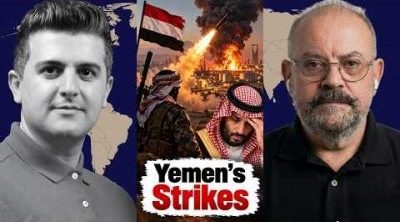
Elijah Magnier: Yemen’s strikes are shattering Saudi Arabia’s long-term strategy
or go to
Aletho News Archives – Video-Images
From the Archives
British weapons and personnel doing much of the killing in Yemen
Press TV – June 18, 2019
A detailed report published by the Guardian newspaper has shown how Britain is massively contributing to Saudi Arabia’s devastating war on Yemen as it suggests that London is not only supplying the bombs that fall on Yemenis, but it provides the personnel and expertise that keep the war going.
The comprehensive report by Arron Merat published on Tuesday showed that Britain was doing much of the killing in Yemen as the country continues to provide Saudi Arabia with everything it needs to turn its southern impoverished neighbor into a graveyard.
“Every day Yemen is hit by British bombs – dropped by British planes that are flown by British-trained pilots and maintained and prepared inside Saudi Arabia by thousands of British contractors,” said Merat in the report. … continue
Blog Roll
 Aletho News
- Racist Seinfeld Dances for Joy as Bibi Unveils His New Map
- A West Bank War for Netanyahu’s Election Campaign, Could It Backfire?
- Yemen denounces European Parliament’s ‘hypocritical’ push to blacklist Ansarullah
- Qalibaf: UAE’s UN bid aims to ‘clear the runway’ for ‘Greater Israel’, whitewash genocide
- Pakistan reopens Iran border after boosting security: Report
- Why are so many Brazilians voting for Flávio Bolsonaro?
- Democrats Put Anti-Russia Agenda Ahead of American Workers
- Elijah Magnier: Yemen’s Strikes Are Shattering Saudi Arabia’s Long-Term Strategy
- Pentagon designates Chinese cultural centers national security threat
- Israel Demolishes Home Of Lebanese Journalist Whose Viral Film Exposed Pager Attack
- If Americans Knew
- An error has occurred; the feed is probably down. Try again later.
- No Tricks Zone
- Sudden Stratospheric Warming, Powerful El Niño Combination May Lead To Extreme Europe Cold, Energy Crisis!
- Two New Studies Find Thwaites Glacier Melt Cannot Be Driven By Human Activity Or A Warming Ocean
- E-Cars Reduce CO2 Emissions By Only 41% Compared To Internal Combustion Engine Vehicles
- Predictions Made By Renowned Climate Professor Over Past Decades Have Been Proven To Be Poor
- New Study Suggests Large Regions Of The Pacific Ocean Have Been Cooling For The Last 80 Years
- Germany’s Green Energy Debacle: High Energy Costs Force Kahla Porzellan to Close After 182 Years!
- New Study: 50 Years Of The Most Aggressive ‘Net Zero’ Policies Can Only Affect The Global Climate By 0.03°C
- US September “Heat” Was No Record…Many Records Set Decades Ago
- Latest European Green Energy Debacle; Portugal’s Largest Flagship Solar Park Insolvent!
- Green Energy Debacle: German Expert Professor Fritz Vahrenholt Warns Of Severe Economic And Social Consequences

