Euro-Med Monitor: Israel’s brutality in Gaza surpasses all recent forms of terrorism
Palestinian Information Center – April 4, 2025
GAZA – nature of Israel’s crimes in the Gaza Strip must be denounced, particularly the crimes’ horrifying scope, methodical execution, and wide-ranging effects, which surpass those of armed groups like ISIS, the Euro-Med Human Rights Monitor said.
While the crimes committed by ISIS have been widely denounced by the international community, the same community is now mostly silent—and therefore complicit—as Israel pursues a campaign of declared genocide that aims to exterminate the Palestinian people from their homeland, the Euro-Med said.
Israeli occupation forces detonated a robot on Thursday 3 April 2025 rigged with tons of explosives in the heart of the densely populated Shuja’iyya neighborhood in eastern Gaza City. The explosion occurred in an area packed with displaced civilians, though there was no military necessity and no combat activity in the vicinity. This act embodies the conduct of existing terrorist organizations, even surpassing them in brutality and disregard for human life, and bears no resemblance to the conduct of a state bound by international law, regardless of any attempts to distort or evade it.
The explosion killed 21 Palestinians and injured around 100 others, the majority of them women and children. A full residential block was obliterated with its residents still inside, and this is not an isolated incident. Over recent months—particularly in the northern Gaza Strip—Israel has increasingly used explosive-laden robots in residential neighborhoods during its ground incursions. At least 150 such detonations have resulted in the deaths of hundreds of civilians, mostly women and children, and caused wide-scale destruction to homes and other essential infrastructure.
A separate atrocity was committed on 23 March, when Israeli forces detained 15 Palestinian rescue workers from the Palestinian Red Crescent and Civil Defense, along with a United Nations staff member, before executing them extrajudicially—some while their hands were bound. Their bodies were dumped into a pit, and the ambulances they had been travelling in were destroyed. This incident is another blatant example of an intentional Israeli crime mirroring—and exceeding—the brutality of groups like ISIS, as it reveals a clear and deliberate intent to annihilate Palestinians both physically and through psychologically terrorizing residents across the Strip.
Euro-Med Monitor field teams have documented thousands of crimes committed by Israeli forces, constituting overwhelming evidence of mass atrocities. These crimes include an unprecedented pattern of violence in recent history, in terms of scale, deliberate targeting, and genocidal intent. A minimum of 58,000 Palestinians have been killed, the majority of them women and children, and most have been buried beneath the rubble of homes deliberately destroyed over their heads, while many were killed by sniper fire with clear intent. Over 120,000 individuals have been injured, and at least 39,000 children have been orphaned. The Gaza Strip’s infrastructure, including homes, hospitals, and schools, has been virtually obliterated.
These acts amount to one of the most extensive and systematic campaigns of extermination in contemporary history, underscoring the urgent need for international accountability, an end to Israeli impunity, and concrete action to halt further atrocities.
Israel’s methods in the Gaza Strip—particularly its mass killing of civilians—bear a striking resemblance to the tactics used by groups the international community has widely condemned as terrorist. However, the atrocities unfolding in the Strip are far more dangerous in terms of scale, brutality, and systematic intent, and cannot be understood merely as a function of violent methods or tools.
The rights group pointed out that these actions cannot be dismissed as random or extreme policies, but rather represent a fully-fledged model of organized state terrorism, driven by a comprehensive blueprint for annihilation and implemented in full view of the international community.
“These crimes are being committed with clear, declared intent to eliminate the Palestinian people as a national and collective entity, uproot those who remain on their land, erase their identity, and ultimately end their collective existence.”
Euro-Med called all states, both individually and collectively, to fulfil their legal obligations and take urgent action to stop Israel’s genocide in the Gaza Strip in all its forms. This includes implementing concrete measures to protect Palestinian civilians, ensuring Israel’s compliance with international legal norms and the rulings of the International Court of Justice, and guaranteeing full accountability for perpetrators of war crimes and crimes against humanity.
It also stressed the importance of implementing the arrest warrants issued by the International Criminal Court against the Israeli Prime Minister and army minister at the earliest opportunity and ensure these individuals’ transfer to international justice.
Furthermore, Euro-Med called on the international community to impose comprehensive economic, diplomatic, and military sanctions on Israel in response to its grave and systematic violations of international law. This includes an arms embargo; the cessation of all political, financial, and military cooperation; asset freezes of implicated officials; travel bans; and the suspension of trade privileges and bilateral agreements that provide Israel with economic benefits, enabling its continued crimes.
Seyed Mohammad Marandi: Iran Defies Trump’s Ultimatum and Threat of War
Glenn Diesen | April 3, 2025
Seyed Mohammad Marandi is a professor, an analyst and an advisor to Iran’s nuclear negotiation team. Prof. Marandi discusses Iran’s rejection of Trump’s ultimatum and the possible nuclear escalation.
Substack: https://glenndiesen.substack.com/
Five martyrs, wounded in US aggression in past hours: Yemen
Al Mayadeen | April 3, 2025
Al Mayadeen’s correspondent in Yemen reported that the number of US airstrikes on Saada Governorate has increased to 27 in the past 12 hours.
Today, reconnaissance aircraft from the US-led coalition targeted a civilian car in the Majz district of Saada governorate, following two airstrikes by warplanes on the same district.
Overnight Wednesday, US aircraft struck the Kitaf district and the Kahlan area, east of Saada governorate.
Alongside the ongoing aggression in Taiz, southern Yemen, Al Mayadeen’s correspondent reported that US aircraft also targeted the communications network in Jabal Namah, located in the Jablah district of Ibb Governorate in central Yemen.
In an interview with Al Mayadeen, Yemeni Health Ministry spokesperson Anis al-Asbahi reported that five people were killed, five others were injured, and one person went missing in airstrikes on Yemen over the past 24 hours. He emphasized that Yemenis are fully aware of the challenges they face and are prepared to confront them.
Yemen MoH reports 61 martyrs from US aggression
Al-Asbahi has confirmed to Al Mayadeen that the death toll from the US-led aggression on Sanaa and other governorates since mid-March has reached 61 martyrs and 139 wounded.
He also stated that since Yemen began its support operation for Gaza, the US-British-Israeli aggression has left 964 civilian casualties, including 250 martyrs.
This toll reflects data recorded up until April 1.
Since Yemen resumed its operations at sea and against occupied territories in response to the renewed Israeli aggression on Gaza, the United States has intensified its attacks on Yemen, conducting airstrikes on various governorates.
Sights set on Somaliland: The threat of a total US–UK–Israeli takeover
By Kit Klarenberg – The Cradle – April 3, 2025
In recent weeks, Somaliland has drawn unprecedented attention from western media. As Israeli and US officials scramble to find a destination to forcibly relocate Gaza’s population, the globally unrecognized breakaway territory is increasingly floated as a potential solution.
Multiple mainstream reports suggest Tel Aviv and Washington are making quiet overtures to Hargeisa. On 14 March, the Financial Times revealed:
“A US official briefed on Washington’s initial contacts with Somaliland’s presidency said discussions had begun about a possible deal to recognize the de facto state in return for the establishment of a military base near the port of Berbera on the Red Sea coast.”
Somaliland’s President Abdirahman Mohamed Abdullahi has made international recognition his central foreign policy objective. Since the territory declared independence in 1991, no country has recognized it as a sovereign state. But late last year, before entering the White House, US President Donald Trump made the surprise announcement that he intended to officially recognize Somaliland, which would make Washington the first foreign capital to do so.
For the internationally isolated statelet, the prospect of a permanent US military footprint, which would shield the East African statelet from Somalia’s endemic instability, is no doubt enormously appealing, especially as it would be attached to official recognition of statehood by a major global power.
Search for a new ‘Nakba’
From Washington’s perspective, the deal would yield far more than just a convenient dumping ground for displaced Palestinians, evicted to make way for Trump’s fantasized “Gaza-Lago.” Somaliland’s strategic location on the Red Sea makes it an ideal staging post for operations against Yemen.
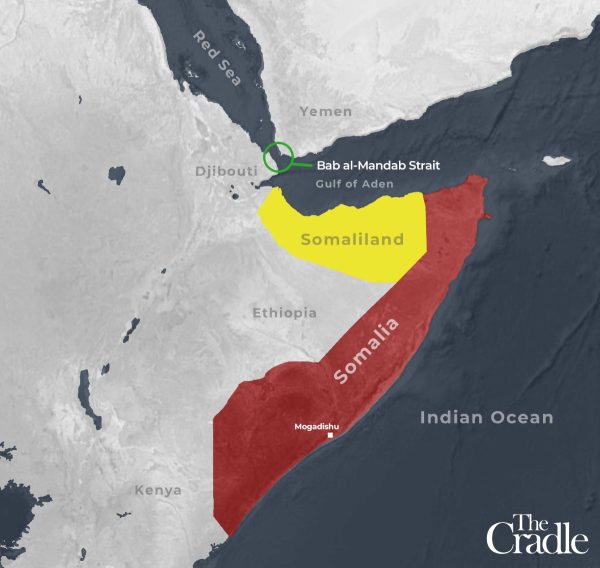
A current map of the Horn of Africa
Such a move would grant the US a critical new foothold in the Horn of Africa at a time when American and French forces are being ejected from countries across the continent at breakneck speed.
It could also serve as a counterweight to China and Russia’s expanding presence in northern Africa. Beijing established its first overseas military base in neighbouring Djibouti in 2017, and has since emerged as an aggressive critic of western policies in the region – while also welcoming Iranian naval vessels at its ports.
The strategic utility of recognizing Somaliland is not lost on Washington’s foreign policy architects. Project 2025 – a sprawling, right-wing policy blueprint by the Heritage Foundation, intended as a roadmap for Trump’s second term—explicitly advocates “[countering] malign Chinese activity” in Africa. It specifically recommended “the recognition of Somaliland statehood as a hedge against the US’s deteriorating position in Djibouti.”
Another neocolonial outpost
Keep in mind that Trump’s interest in the territory was made public well before Somaliland was floated as a relocation site for Gaza’s 2.4 million Palestinians. In November 2024, former British defence secretary Gavin Williamson announced he had held “really good meetings” with Trump’s “policy leads” on the matter, expressing confidence that recognition was on the horizon.
Williamson has long been an ardent advocate of Somaliland’s independence, regularly undertaking all-expenses-paid trips to the breakaway territory, and receiving honorary citizenship for his lobbying efforts.
Williamson’s interest exposes a rarely acknowledged truth: Somaliland is, in practice, a modern British colony. Though it claimed independence from Somalia in 1991 and was formally granted independence by Britain in 1960, the territory remains under London’s shadow.
Should Palestinians be forcefully relocated there, they would be trapped in yet another open-air prison – under the watchful eye of British-trained security forces with a long history of violent repression.
‘ASI Management’
In April 2019, British government contractor Aktis Strategy abruptly declared bankruptcy, leaving staff unpaid and suppliers out of pocket, despite having secured tens of millions of pounds from the UK’s Foreign Office for “development” programs across Africa and West Asia.
The Somaliland Chronicle published a detailed exposé on the company’s collapse, which came while it was overseeing a “justice and security sector reform project” in the statelet.
Official records reveal that between 2017 and 2022, London allocated over £18 million (around $23.5 million) to that project alone. It was one of many UK-financed schemes in the breakaway region that placed Somaliland’s state architecture – government, military, judiciary, prisons, police, intelligence – under effective British management.
Internal files reviewed by The Cradle lay bare the extent of this control.
One document details how notorious British intelligence cutout Adam Smith International (ASI) provided “ongoing training and mentoring” to Somaliland’s National Intelligence Agency and Rapid Response Unit, while managing the territory’s forensics services, border surveillance, and even prosecution procedures via the Attorney General’s Office. The British-created Counter-Terrorism Unit was established in 2012 with Foreign Office funds – “under ASI management.”
Elsewhere, ASI boasts of its “proven history of establishing close professional relationships” with senior government, armed forces, police, “security sector,” and Ministry of Defense officials. One file notes the contractor “deployed ex-UK military advisers” to train Somaliland’s army and coastguard intelligence units, “[mentoring] senior officers in leadership, management, and military doctrine,” and even drafted legislation later adopted as law.
Meanwhile, British contractor Albany Associates focused on teaching Somaliland’s leaders the mechanics of propaganda and information warfare. Its mission: to train ministers and senior officials to generate a “steady flow of information” and proactively manage the media, in order to counter independent outlets.
It was noted that “unsatisfied public demand for information” from the government “on nationally significant events” gave independent information sources significant influence locally, which was to be countered at all costs.
In Somaliland, public distrust of their government was fueled by frequent arrests of journalists and media shutdowns, so Albany’s role was to consolidate state control over information – ensuring one narrative, “one voice,” no dissent.

An official document reviewed by The Cradle
A prison camp in waiting
While ASI touted its reforms, documents from another contractor – Coffey International – presented a more candid picture. Somaliland’s military, the files noted, was “the largest and most costly institution of state,” yet evaded oversight, with its funds likely diverted for opaque ends. Accountability for military abuses was virtually nonexistent.
The police, meanwhile, had “a history of applying disproportionate force,” and no “dedicated public order unit.” Coffey proposed creating one within the Special Protection Unit – a paramilitary force protecting foreign organizations and their staff. At the time, the unit had no mandate for crowd control or responding to peaceful protests.
That July 2015 document recommended Somaliland police be trained in the UK by the National Police, covering human rights, crowd engagement, and first aid. The aim: instill “proportionality, lawfulness, [and] accountability” throughout Somaliland’s police forces. Yet if this training occurred, it had no visible impact.
In late 2022, mass protests erupted in the contested city of Las Anod. Somaliland forces responded with lethal force, killing dozens. The crackdown escalated, and in 2023, Somaliland’s military indiscriminately shelled the city. Amnesty International described the attack as “indiscriminate,” targeting schools, hospitals, and mosques, displacing hundreds of thousands and killing scores.
This is the context in which Somaliland appeals to Israel and its western patrons: a brutal, British-run security apparatus capable of extinguishing any form of dissent – ergo, the perfect dumping ground for Gazan refugees. If Washington establishes a base to launch strikes on Yemen, Palestinians could also be held hostage – literal human shields – to deter reprisals from the Ansarallah-aligned armed forces.
One can only hope this depraved plan collapses as swiftly as earlier US–Israeli schemes to expel Gazans to Egypt or Jordan.
The real question now is whether Somaliland’s leaders are desperate enough for international recognition to trade their 34 years of independence for total US–UK–Israeli military, political, and security hegemony.
Iran presses the IAEA on Trump’s ‘bombing’ threat, reaffirms no nukes pursuit
IRNA – April 2, 2025
Tehran – The International Atomic Energy Agency (IAEA) must adopt a clear position regarding threats against Iran’s civilian nuclear facilities, Foreign Minister Abbas Araqchi said Tuesday, days after U.S. President Donald Trump threatened to “bomb” Iran.
Araqchi was speaking on the phone with the secretary general of the IAEA, Rafael Grossi.
He emphasized that given the recurrence of such threats, the Islamic Republic will take every necessary measure to protect its nuclear program.
Grossi, for his part, said he would talk with other parties to create a suitable atmosphere to help resolve existing issues. He also asked to visit Iran, which Araqchi accepted.
Trump said on Sunday that he would order military strikes against Iran if Tehran did not strike a new deal with Washington on its nuclear program. “If they don’t make a deal, there will be bombing,” he said in an interview with NBC News.
Iran has warned to respond swiftly and decisively to any act of aggression on its soil.
Reacting to Trump’s threat, a senior adviser to Leader of the Islamic Revolution Ayatollah Seyyed Ali Khamenei said that even though Iran doesn’t seek nuclear weapons, any strike on the country by the United States or Israel on that false pretext would force the country to develop atomic bombs for defensive purposes.
“If America or Israel bomb Iran under the nuclear pretext, Iran will be compelled to move toward producing an atomic bomb,” Ali Larijani said during a televised interview on Monday.
Araqchi, however, once again clarified Tehran’s long-standing position, which is based on a religious decree (fatwa) by Ayatollah Khamenei prohibiting the development, possession, and use of nuclear weapons, reaffirming that the country will never produce or acquire any atomic bombs under any circumstances.
He said in an X post on Tuesday that ten years after signing the Iran deal and seven years after the U.S. unilaterally walked away from it under Trump’s first term, “there is not ONE SHRED OF PROOF that Iran has violated this commitment.”
Meanwhile, UN spokesperson Stephane Dujarric was asked on Tuesday to comment on Trump’s threat, to which he said, “We urge everyone to avoid inflammatory rhetoric.”
“I think the UN Charter is very clear in encouraging Member States to settle all disputes through diplomatic means,” he said in response to the question asked by IRNA’s correspondent.
On March 12, Trump sent a letter to Iran via an emissary from the United Arab Emirates (UAE), requesting that negotiations be opened into a deal that he says would stop Iran from building a nuclear weapon. This is while, in 2018, he pulled out of a multinational nuclear deal with Iran. On February 4, the U.S. president signed a presidential memorandum to restore a hostile policy from his first term of “maximum pressure” on the Islamic Republic.
Iran, which has relayed its response to the U.S. president’s letter via Oman, has ruled out direct negotiations with the United States as long as the “maximum pressure” policy and the military threats are in place.
“Diplomatic engagement worked in the past and can still work. BUT, it should be clear to all that there is—by definition—no such thing as a ‘military option’ let alone a ‘military solution,’” Araqchi said in his X post.
The Zionist Destruction of American Higher Education
By Ron Unz • Unz Review • March 31, 2025
We may be witnessing the ongoing destruction of one of the greatest pillars of postwar American global influence and hegemony.
Late last week an astonishing event occurred in American society, and video clips of that incident quickly went viral across the Internet.
A 30-year-old Tufts doctoral student and Fulbright Scholar from Turkey was walking across her Boston-area neighborhood on the way to a holiday dinner at a friend’s house when she was suddenly seized and abducted in the early evening by six masked federal agents of the Department of Homeland Security. The terrified young woman was handcuffed and taken to a waiting car, secretly detained for the next 24 hours without access to friends, family, or lawyers, then shipped off to a holding cell in Louisiana and scheduled for immediate deportation, although a federal judge has now temporarily stayed the proceedings.
Just one of the Tweets showing a short clip of that incident has been viewed more than 4.5 million times, with a much longer YouTube video accumulating another couple of hundred thousand views.
That very disturbing scene seemed like something out of a Hollywood film chronicling the actions of a dystopian American police state, and that initial impression was only solidified once media reports explained why Rumeysa Ozturk was snatched off the streets of her home town. Her only reported transgression had been her co-authorship of an op-ed piece in the Tufts student newspaper a year earlier sharply criticizing Israel and its ongoing attacks on the civilian population of Gaza.
Apparently, one of the many powerful pro-Israel censorship organizations funded by Zionist billionaires became outraged over her sentiments and decided to make a public example of her, so its minions in the subservient Trump Administration immediately ordered her arrest.
CBS News covered a local protest demonstration demanding the young woman’s release, and quoted the remarks of one of the participants:
“The university campus should absolutely be a place for the free and open exchange of ideas and the fact that someone can just be disappeared into the abyss for voicing an idea is absolutely horrifying,” said rally attendee Sam Wachman.
Now supposed that such a scene—for such a reason—had taken place on the streets of Russia, China, Iran, or any other country viewed with great disfavor by our government. Surely that incident would have quickly become the centerpiece of a massive global propaganda offensive aimed at blackening the reputation of the regime responsible. Audiences worldwide would have been forcefully told that the arrest demonstrated the terrible dangers of living in a society lacking the freedoms guaranteed by our own Constitution and our Bill of Rights. I don’t recall seeing any recent propaganda campaigns along these lines, so that suggests that such incidents are extremely rare in those countries.

But unfortunately that is hardly the case in today’s America. A day or two before that Tufts graduate student was snatched off the streets of her city, a 21-year-old Columbia University junior went into hiding to avoid a similar fate after federal agents raided her campus dorm to arrest her. As the Times reported, high school valedictorian Yunseo Chung had moved to the U.S. with her family from South Korea when she was 7, but her permanent residency was suddenly revoked for her public criticism of Israeli policy. She was ordered immediately deported back to a country that she barely even remembered.

This followed the storm of controversy unleashed earlier this month by the very high profile arrest of Mahmoud Khalil, a recent Columbia graduate student heavily involved in last year’s campus protests against the Israeli attacks on Gaza. Seized in an early morning raid on his campus student housing, which he shared with his wife, an American citizen eight months pregnant, he was taken off to detention, first in New Jersey and then transferred to a holding cell in Louisiana, once again with no initial access to his family, friends, or lawyers.
As a Green Card holder—a permanent legal resident of the U.S.—he was considered fully entitled to all the normal rights and privileges of an American citizen, but Secretary of State Marco Rubio declared that his Green Card would be canceled and he would be deported based upon an obscure legal doctrine never previously employed for that purpose, eliciting a strong legal challenge in federal court. Moreover, his transfer from a New Jersey jurisdiction to a different one in the Deep South also seemed to violate normal legal procedures.

A week after that arrest, Ranjani Srinivasan, another Columbia doctoral candidate from India on a Fulbright Scholarship, hurriedly packed her bags and fled the country to Canada when she narrowly missed being arrested by federal authorities who raided her student housing. As the New York Times reported:
“The atmosphere seemed so volatile and dangerous,” Ms. Srinivasan, 37, said on Friday in an interview with The New York Times, her first public remarks since leaving. “So I just made a quick decision.”
A day earlier Rubio explained that he had already authorized the arrest and immediate deportation of more than 300 students around the country for their criticism of Israel, so these particular cases obviously represented merely the tip of a very large iceberg.
In past decades, the academic leadership of a top Ivy League school such as Columbia might have stoutly defended the students in its community. But any such resistance was broken when the Trump Administration suddenly pulled $400 million in annual funding. The demands included full cooperation with the arrest of any students critical of Israeli policies, the creation of a new internal security force to suppress any anti-Israel campus protests, and “receivership” for the university’s prestigious Middle Eastern Studies Program, presumably resulting in firm Zionist control.
Acting President Katrina Armstrong bowed to those demands, sacrificing the academic freedom of her faculty members and the personal freedom of her students. But faced with such enormous conflicting pressures, she then resigned on Friday evening, some seven months after her predecessor had resigned for roughly similar reasons.
That same day newspapers also reported that the top leadership of Harvard University’s equally prestigious Middle Eastern Studies Center had been dismissed, probably ensuring that after more than seventy years this independent academic organization would henceforth become firmly pro-Israel in its orientation. Last year, after Harvard’s previous president had strongly defended academic freedom before a hostile Congressional committee, she was quickly forced to resign.
As I casually examined the home page of the New York Times website on Saturday, I noticed five different articles reporting these striking blows to intellectual freedom at a number of our top American universities, and it’s quite possible that I may have missed one or two others.
- Columbia President Is Replaced as Trump Threatens University’s Funding
- Leaders of Harvard’s Middle Eastern Studies Center Will Leave
- University of Minnesota Student Detained by Immigration Agents
- Targeting of Tufts Student for Deportation Stuns Friends and Teachers
- How Colleges Are Cracking Down on Students Now
For the last several generations, America’s elite academic institutions have been among the most prestigious in the world, drawing top students from across the globe and constituting a central pillar of our country’s soft power. Until last year, no previous case came to mind of an Ivy League president having been abruptly removed for political reasons. But over the last twelve months, four or five different Ivy League presidents have suffered that fate.
Similarly, I had never heard of any previous cases of peaceful college students being arrested by teams of masked federal officers, either seized from their dorm rooms in sudden raids or snatched off the streets of their local city.
Consider an ironic historical comparison. During the early 1950s the Rosenbergs were convicted and executed for their involvement in a Soviet spy-ring that gave our nuclear weapons secrets to Stalin. But as far as I know their arrest was handled in a very subdued fashion, with merely a couple of FBI agents quietly taking them into federal custody despite the capital charges that they faced. So apparently public criticism of Israel is today regarded as a far more serious and dangerous offense than nuclear espionage had been at the absolute height of the Cold War.
Indeed, the closest historical example that comes to mind were the notorious Palmer Raids of late 1919 and early 1920, which led to the deportation of several hundred immigrants. But these round-ups occurred in the wake of the Bolshevik Revolution and waves of terrorist bombing attacks across many American cities, with Attorney-General A. Mitchell Palmer narrowly surviving two separate assassination attempts, including a bombing that destroyed his own Washington, DC home. Meanwhile, most of the immigrants arrested and deported were relatively recent arrivals, generally anarchist or Bolshevik radicals who had declared their intent to overthrow the American government.
Perhaps there have been previous examples of college students arrested merely for writing campus newspaper op-eds advocating peaceful and perfectly legal positions. But I don’t recall reading of any such egregious cases in my introductory history textbooks so I tend to doubt it.
One rather strange aspect of the current situation is that no students seem to have been arrested for voicing public criticism of the American government or even President Donald Trump. Only criticism of the Jewish State of Israel or Jews themselves seems to provoke such severe legal repression. This brings to mind a very shrewd observation, widely misattributed to Voltaire:
To learn who rules over you, simply find out who you are not allowed to criticize.
Since World War II elite American universities have tended to attract the best and the brightest young men and women from around the world, thereby shaping the minds of so many future global leaders. So I suspect that these shocking news stories of harsh ideological crackdowns on academic freedom and sudden dramatic arrests by masked federal agents are already reverberating around the world, severely damaging one of the few remaining pillars of American geopolitical dominance.
Perhaps only small numbers of ordinary Americans have been following the sudden, desperate plight of these top students from Turkey, South Korea, or India, but I think that a very large fraction of the educated elites of those important American allies are fully aware of what has transpired, and they are utterly horrified.
Under the control of its pro-Israel masters, the leading figures of the Trump Administration seem determined to severely wound or actually destroy the foremost institutions of our globally-dominant system of higher education.
Indeed, even before the latest round of these striking incidents, the eminent political scientist John Mearsheimer had declared that the Israel Lobby posed the greatest threat to American freedom of speech, with his views strongly seconded by Prof. Jeffrey Sachs of Columbia University and also former CIA Officer Philip Giraldi:
Although I was deeply shocked by these harsh Trump Administration attacks against freedom of speech and academic freedom, perhaps I should not have been. In many respects, they merely extended what had already occurred last year under his equally pro-Israel Democratic predecessor President Joseph Biden, as I had covered at the time in numerous articles.
For example, almost eleven months ago in early May 2024 I discussed the ongoing waves of university protests and the reasons behind their appearance, as well as the unprecedented crackdowns used to suppress them, a reaction so totally different than what had occurred regarding any previous campus political activism. Given the very harsh legal sanctions now imposed upon many of the participants, I think it’s worth revisiting that history at length:
From the years of my childhood I’d always been aware that political activism and protests were a regular feature of college life, with the 1960s movement against our Vietnam War representing one of its peaks, an effort widely lauded in our later textbooks and media accounts for its heroic idealism. During the 1980s I remember seeing a long line of crudely constructed shanties protesting South African Apartheid that spent weeks occupying the edges of the Harvard Yard or perhaps it was the Stanford Quad, and I think around the same time other shanties and protesters at UCLA maintained a long vigil in support of the Jewish Refuseniks of the USSR. Political protests seemed as much a normal part of college years as final exams and had largely replaced the hazing rituals and wild pranks of traditional fraternities, which were increasingly vilified as politically incorrect by hostile social censors among the students and faculty.
Over the last decade or so, the Black Lives Matter movement raised such nationwide protests by college students to new heights, both on and off campus, often involving large marches, sit-ins, or vandalism, and this may have been propelled by the increasing influence of smartphones and social media. Meanwhile, the mainstream media regularly praised and promoted this “racial justice movement,” which reached its sharp peak following the death of George Floyd in the summer of 2020. That incident triggered a massive wave of generally youthful political protests, riots, and looting that engulfed some 200 cities across America, the worst urban unrest since the late 1960s. But unlike that earlier era, most of our establishment media and political class fiercely denounced any suggestions that the police be deployed to quell the violence. Indeed, in many or most cases local law enforcement stood down and did nothing, even as some of their political masters loudly raised the outcry “Defund the Police!”
During those years many universities became heavily caught up in such controversies. Yale renamed its Calhoun residential college in early 2017 and the list of name changes due to the 2020 George Floyd protests is so long that it has its own Wikipedia page, a list that included some of our most storied military bases such as Ft. Bragg and Ft. Hood. Verbal or even physical attacks against the symbols and statues of America’s most famous presidents and national heroes became quite common and were often favorably reported in the media, with George Washington, Thomas Jefferson, Abraham Lincoln, Theodore Roosevelt, Woodrow Wilson, and Christopher Columbus all being vilified and denounced, sometimes with elite endorsement. A lead opinion piece in the New York Times called for the Jefferson Memorial to be replaced with a towering statue of a black woman while one of the regular Times columnists repeatedly demanded that all monuments honoring George Washington should suffer a similar fate. Many observers argued that America almost seemed to be undergoing its own version of the Chinese Cultural Revolution amid widespread claims that much of our entire historical past was irretrievably tainted and therefore had to be expunged from the public square.
Most of these political protests, especially those on college campuses, were widely hailed by those holding the media megaphones as signifying one of the greatest virtues of American democracy. The many elite defenders of such social and cultural upheavals argued that these events demonstrated the great strength of our society, which freely allowed the fiercest public attacks against our most sacred national icons and heroes. Americans accepted the sort of searing self-criticism that would surely be permitted almost nowhere else in the world.
That long history of permitting or even glorifying public protests against perceived injustices had naturally been absorbed and taken to heart by the young college students who began their classes in September 2023. Then within weeks, a remarkably daring surprise raid by the Hamas militants of long-besieged Gaza caught the Israelis napping and surmounted the high-tech defenses that had cost perhaps a half-billion dollars to construct. Many hundreds of Israeli soldiers and security officers were killed along with similar numbers of civilians, with most of the latter probably dying from the friendly-fire of Israel’s own panic-stricken and trigger-happy military units. Some 240 Israeli soldiers and civilians were captured and taken back to Gaza as prisoners, with Hamas hoping to exchange them for the freedom of the many thousands of Palestinian civilians who had been held for years in Israeli prisons, often under brutal conditions.
As usual, our overwhelmingly pro-Israel mainstream media portrayed the attack in extremely one-sided fashion, devoid of any historical context, a pattern that had been followed for three generations. As a result, Israel received an enormous outpouring of public and elite sympathy as it mobilized for a retaliatory attack against Gaza. Within days, our own Secretary of State Antony Blinken flew to Israel declaring that he came “as a Jew” and pledging America’s unwavering support in that moment of crisis, sentiments completely echoed by President Joseph Biden and his entire administration. But the Hamas fighters and their Israeli captives were hidden in a network of fortified tunnels and rooting them out might produce heavy casualties, so Israeli Prime Minister Benjamin Netanyahu and his advisors decided upon a different strategy.
Instead of attacking Hamas, Netanyahu took advantage of the wave of global sympathy by unleashing an unprecedented military assault against Gaza’s more than two million civilians, apparently intending to kill huge numbers of them and drive the remainder into Egypt’s Sinai desert, allowing Israel to annex their territory and resettle it with Jews. Soon afterward, the Israeli government began distributing assault rifles to the Jewish Settlers of the West Bank, ordering some 24,000 of those automatic weapons for that purpose. Putting such armaments into the hands of religious fanatics would surely lead to local massacres and these might provide an excuse for driving all those millions of Palestinians over the border into Jordan. The ultimate result would be the creation of a racially-pure Greater Israel stretching “From the River to the Sea,” the longstanding dream of the Zionist movement. So if he were successful, Netanyahu’s place in Jewish history might become a glorious one, with his many venal sins and blunders easily overlooked.
As American airlifts supplied an unending flood of the necessary munitions, the Israelis began a massive aerial bombardment campaign against densely-populated Gaza and its helpless residents. Secure in their underground tunnels, relatively few Hamas fighters were killed, but Gaza’s civilians suffered devastating losses, much of it inflicted by two thousand pound bombs, almost never previously deployed against urban targets. Large portions of Gaza were soon transformed into moonscapes, with some 100,000 buildings destroyed, including hospitals, churches, mosques, schools, universities, government offices, bakeries, and all the other infrastructure necessary for maintaining civilian life. After just a few weeks, the Financial Times reported that the destruction inflicted upon much of Gaza was already worse than had been suffered by German cities after years of Allied bombing attacks during World War II.
Although Netanyahu was strictly secular, he played to his religious base by publicly declaring the Palestinians to be the tribe of Amalek, whom the Hebrew God had commanded be exterminated down to the last newborn baby. Many other top Israeli leaders voiced very similar genocidal sentiments, and some of the more zealously religious Israeli soldiers and commanders probably took those statements quite literally.
This gigantic bloodlust was further inflamed as the Israeli government and its supportive propagandists began promoting outrageous Hamas atrocity-hoaxes such as beheaded or roasted Israeli babies, sexual mutilations, and gang-rapes. The notoriously pro-Israel global media credulously reported these stories, using them to deflect attention from the enormous ongoing slaughter of Palestinian civilians. To ensure that the coverage remained one-sided, the Israelis targeted independent journalists in Gaza for death, killing some 140 of them over the last few months, a figure as large as the combined total in all the world’s other wars over the last several years.
With Israel’s leaders publicly declaring their genocidal plans for their Palestinian enemies and Israeli troops committing the greatest televised massacre of helpless civilians in the history of the world, international organizations gradually came under strong pressure to involve themselves in the ongoing conflict. In late December, South Africa filed a 91-page legal brief with the International Court of Justice (ICJ) accusing Israel of committing genocide. Within a few weeks the ICJ jurists issued a series of near-unanimous rulings supporting those charges and declaring that the Gazans were at serious risk of suffering a potential genocide at Israel’s hands, with Israel’s own appointed judge, a former Chief Justice of the Israeli Supreme Court, concurring in most of those verdicts.
But instead of backing off, Netanyahu’s government merely redoubled its attacks against Gaza, tightening the blockade of food shipments by banning the UN organization responsible for distributing them. The Israelis apparently believed that the combination of starvation, bombs, and missiles would be the most effective means of killing or driving out all the Palestinians.
In past decades, these horrifying events might have gone relatively unnoticed, with the overwhelmingly pro-Israel gatekeepers of our mainstream media ensuring that little if any of this distressing information reached the eyes or ears of ordinary Americans. But technological developments had changed this media landscape since video clips on relatively uncensored social platforms such as TikTok and Elon Musk’s Twitter now easily circumvented that blockade. Despite their decades of suffering and oppression, Gaza’s Palestinians were a fully modern people, well-equipped with smartphones, and the scenes they filmed were shared worldwide, quickly attracting huge audiences among the younger Americans who relied upon social media as their primary source of news.
For generations, college students had been heavily indoctrinated with the horrors of the Holocaust, endlessly told that they must never remain silent while helpless men, women, and children were brutally attacked and slaughtered. The images they now saw of devastated cities and dead or dying children seemed exactly like something out of the movies, but they were instead happening in real-time in the physical world.
A couple of years earlier, the Trump and the Biden Administrations had both jointly proclaimed that the Chinese government was guilty of “genocide” against its Uighur minority despite lack of any evidence that significant numbers of Uighurs had been harmed let alone killed. So by that standard, the total destruction of Gaza and the massive slaughter or deliberate starvation of millions of its people obviously constituted an enormous “genocide,” and within weeks student activists all across college campuses had taken up that cry and begun organizing public protests against the horrendous massacre that Israel was committing.
Three years earlier, a lifelong career criminal named George Floyd had died of a drug overdose while in police custody, and a single, highly-misleading video of his last moments had provoked the greatest wave of American public protests since the late 1960s. So it was hardly surprising that the widespread dissemination of hundreds or thousands of videos showing dead and mutilated Gazan children inspired a powerful protest movement. But this time, instead of being praised for their humanitarian commitment, those students—and the university administrators who allowed their protests—were ferociously attacked and punished as I described at the time:

With graphic images of devastated Gaza neighborhoods and dead Palestinian children so widespread on Twitter and other social media outlets, polls have revealed that a majority of younger Americans now favor Hamas and the Palestinians in their ongoing struggle with Israel. This is a shocking reversal from the views of their parents, which had been shaped by generations of overwhelmingly pro-Israel material across broadcast television, films, and print publications, and such trends are only likely to continue now that Israel is being prosecuted in the International Court of Justice by South Africa and 22 other nations, accused of committing genocide in Gaza.
As a consequence of these strong youthful sentiments, anti-Israel demonstrations have erupted at many of our universities, outraging numerous pro-Israel billionaire donors. Almost immediately, some of the latter launched a harsh retaliatory campaign, with many corporate leaders declaring that they would permanently blacklist from future employment opportunities any college students publicly supporting the Palestinian cause, underscoring these threats with a widespread “doxxing” campaign at Harvard and other elite colleges.
A few weeks ago, our uniformly pro-Israel elected officials entered the fray, calling the presidents of several of our most elite colleges—Harvard, Penn, and MIT—to testify before them regarding alleged “antisemitism” on their campuses. Members of Congress severely brow-beat these officials for permitting anti-Israel activities, even ignorantly and absurdly accusing them of allowing public calls for “Jewish genocide” on their campuses.
The responses of these college leaders emphasized their support for freedom of political speech but were deemed so unsatisfactory by pro-Israel donors and their mainstream media allies that enormous pressure was exerted to remove them. Within days, the Penn president and her supportive Board chairman had been forced to resign, and soon afterward Harvard’s first black president suffered the same fate, as pro-Israel groups released evidence of her widespread academic plagiarism to drive her from office.
I am unaware of any previous case in which the president of an elite American college had been so rapidly removed from office for ideological reasons and two successive examples within just a few weeks seems an absolutely unprecedented development, having enormous implications for academic freedom.
I’d think that most of these students were absolutely stunned at such reactions. For decades, they and their predecessors had freely protested on a wide range of political causes without ever encountering even a sliver of such vicious retaliation, let alone an organized campaign that quickly forced the resignation of two of the Ivy League presidents who had allowed their protests. Some of their student organizations were immediately banned and the future careers of the protesters were harshly threatened, but the horrifying images from Gaza continued to reach their smartphones. As Jonathan Greenblatt of the ADL had previously explained in a leaked phone call, “We have a major TikTok problem.”
Indeed, the Israelis continued to generate an avalanche of gripping content for those videos. Mobs of Israeli activists regularly blocked the passage of food-trucks, and within a few weeks, senior UN officials declared that more than a million Gazans were on the verge of a deadly famine. When the desperate, starving Gazans swarmed one of those few food delivery convoys allowed through, the Israeli military shot and killed more than 100 of them in the “Flour Massacre” and this was later repeated. All these horrific scenes of death and deliberate starvation were broadcast worldwide on social media, with some of the worst examples coming from the accounts of gleeful Israeli soldiers, such as their video of the corpse of a Palestinian child being eaten by a starving dog. Another image showed the remains of a bound Palestinian prisoner who had been crushed flat while still alive by an Israeli tank. According to a European human rights organization, the Israelis had regularly used bulldozers to bury alive large numbers of Palestinians. UN officials reported finding mass graves near several hospitals, with the victims found bound and stripped, shot execution-style. As Internet provocateur Andrew Anglin has pointed out, the behavior of the Israeli Jews does not seem merely evil but “cartoonishly evil,” with all their blatant crimes seeming to be based upon the script of some over-the-top propaganda-film but instead actually taking place in real life…
These grim developments have naturally sparked a continuing wave of student protests condemning Israel for committing these monstrous crimes and our own Biden Administration for enabling them with money and munitions. Prof. John Mearsheimer of the University of Chicago is one of our highest-ranking mainstream academics, a very sober-minded scholar of the Realist School, and in an interview last week he expressed little surprise at these matters. After all, he pointed out, Israel was obviously an Apartheid-state currently committing a genocide before the eyes of the entire world so political protests on college campuses were only to be expected.
Throughout these last few months, pro-Israel partisans have regularly denounced the anti-Zionism of their opponents as antisemitic and insisted that it be suppressed. Back in February I had noted the ironic implications of their position:
This is certainly an odd situation, warranting careful analysis and explanation. The word “antisemitism” merely means criticizing or disliking Jews, and in recent years, Israel’s partisans have demanded with some success that the term should be extended to encompass anti-Zionism as well, namely hostility to the Jewish state.
But let us suppose that we concede the latter point and agree with pro-Israel activists that “anti-Zionism” is indeed a form of “antisemitism.” Over the last few months, the Israeli government has brutally slaughtered tens of thousands of helpless civilians in Gaza, committing the greatest televised massacre in the history of the world, with its top leaders using explicitly genocidal language to describe their plans for the Palestinians. Indeed, the South African government submitted a 91 page legal brief to the International Court of Justice cataloging those Israeli statements, prompting a near-unanimous ruling by the jurists that millions of Palestinians faced the prospect of genocide at Israeli hands.
These days most Westerners claim to regard genocide in a decidedly negative light. So does this not syllogistically require them to embrace and endorse “antisemitism”? Surely a visitor from Mars would be very puzzled by this strange dilemma and the philosophical and psychological contortions it seems to require.
It is rather surprising that the extremely “politically correct” ruling elites of America and the rest of the Western world are loudly cheering on the racially-exclusivist State of Israel even as it kills enormous numbers of women and children and works very hard to starve to death some two million civilians in its unprecedented genocidal rampage. After all, the far milder and more circumspect regime of Apartheid South Africa was universally condemned, boycotted, and sanctioned for merely the tiniest sliver of such misdeeds.
An important turning point may have come on April 17th when Columbia University President Minouche Shafik, herself of Egyptian origins, was raked over the coals by a Congressional Committee for permitting anti-Israel protests on her campus. Her interrogators claimed that these were “antisemitic” acts and caused some of Columbia’s Jewish students to “feel unsafe,” a dire situation that seemingly trumped both freedom of speech and academic freedom.
Shafik may or may not have agreed with those arguments, but she surely remembered that just a few months earlier her counterparts at Harvard and Penn had both been summarily purged for giving the wrong answers, and she hardly wished to share their fate. So she firmly promised to root out all such public antisemitism at her university and soon afterward 100 helmeted NYC riot police were invited onto the campus to crush the demonstrations and arrest the protesters, mostly charging the latter with “trespassing,” a rather strange accusation given that they were enrolled students on the grounds of their own campus.
This sort of harsh and immediate police crackdown seems almost unprecedented in the modern history of college political protests. Back in the 1960s, there were a few scattered cases of police being called in to arrest militant protesters who had seized and occupied administrative offices at Harvard, paraded around with firearms at Cornell, or burned down a campus building at Stanford. But I have never heard of peaceful political protesters being arrested on the grounds of their own college merely for the content of their political speech.
Although the crackdown at Columbia demanded by those members of Congress was obviously intended to quell American campus protests, it predictably had the opposite effect. Scenes of burly, helmeted riot police arresting peaceful college students on their own campus went viral on social media, inspiring a wave of similar protests at numerous other colleges across the nation, with police arrests quickly following in most locations. By latest count, some 2,300 students have now been arrested at dozens of universities.
The actions by the Georgia State Police at Emory University seemed particularly outrageous, and a Tweet containing a clip of one of those incidents has already been viewed some 1.5 million times. A 57-year-old tenured professor of Economics named Carolyn Frohlin was concerned at seeing one of her own students being wrestled to the pavement and walked towards him only to find herself brutally thrown to the ground, hogtied, and arrested by a couple of hulking officers led by a sergeant. CNN anchor Jim Acosta was utterly shocked when he reported this story…
Even worse scenes took place at UCLA as an encampment of peaceful protesters was violently attacked and beaten by a mob of pro-Israel thugs having no university connection but armed with bars, clubs, and fireworks, resulting in some serious injuries. A professor of History described her outrage as the nearby police stood aside and did nothing while UCLA students were attacked by outsiders, with 200 of the victims then arrested. According to local journalists, the violent mob had been organized and paid by pro-Israel billionaire Bill Ackman.
I have never previously heard of organized mobs of outside thugs being allowed to violently assault peaceful American student protesters on their own campus, something that seems far more reminiscent of turbulent Latin American dictatorships. The closest example that comes to mind might be the notorious 1970 “Hard Hat Riot” in New York City in which hundreds of pro-Nixon construction workers battled similar numbers of anti-war protesters on the streets of lower Manhattan, an incident so infamous that it has an extensive Wikipedia page of its own.
However, a somewhat different but much closer and more recent analogy may exist. After Donald Trump launched his unexpectedly successful presidential campaign, right-wing, pro-Trump speakers invited to college campuses were regularly harassed and assaulted along with their audiences by mobs of violent antifa, with many of the latter apparently recruited and paid for the purpose.
This sort of very physical “deplatforming” was intended to ensure that their threatening ideas never reached impressionable college students and led conservatives to begin organizing their own groups such as the Proud Boys to provide physical protection. Violent clashes occurred at Berkeley and some other colleges, while similar antifa riots in DC disrupted Trump’s inauguration. From what I remember, most of the organizers and financial backers of these violent antifa groups seemed to be Jewish, so perhaps it’s not surprising that other Jewish leaders have now begun employing very similar tactics to suppress different political movements that they regard as distasteful.
Some years ago a former senior AIPAC official once boasted to a friendly journalist that if he wrote anything on a simple napkin, within 24 hours he could get signatures of 70 Senators to endorse it, and the political power of the ADL is equally formidable. Therefore it was hardly surprising that last week an overwhelming bipartisan 320-91 majority in the House passed a bill broadening the meaning of anti-Zionism and antisemitism in the anti-discrimination policies of the Department of Education by codifying the definitions used in our Civil Rights laws to classify those ideas as discriminatory.
Although I haven’t tried to read the text, the obvious intent is to force colleges to expunge such noxious activities as anti-Israel protests from their campus community or face loss of federal funds. This represents a striking attack against academic freedom as well as America’s traditional freedom of speech and thought, and may also pressure other private organizations to adopt similar policies. In a particularly ironic twist, the definition of antisemitism used in the bill clearly covers portions of the Christian Bible, so the ignorant and compromised Republican legislators have now wholeheartedly endorsed banning the Bible in a country in which 95% of the population has Christian roots.
Israel/Gaza: The Masks Come Off in American Society
Ron Unz • The Unz Review • May 6, 2024 • 6,800 Words
Until now, revocation of a permanent residency Green Card could only occur if its holder had committed a serious felony such as murder or rape, but the empowered pro-Israel partisans of the Trump Administration have now stretched that law to include criticism of Israel or Jews, arguing that such criticism undermined the vital American national goal of combatting antisemitism across the world. When combined with last year’s bipartisan Congressional enactment of the Antisemitism Awareness Act, this might set a legal precedent for actually criminalizing such political views, especially if these can be portrayed as “providing material support” to such officially-designated terrorist organizations as Hamas.
Perhaps despite the determined efforts of the ADL and similar organizations, this legal transformation will not occur. But then again I had never expected to see masked federal agents abducting university students for writing campus newspaper op-eds criticizing Israel.
Similarly, consider the mass arrests and long prison sentences of the January 6th protesters in DC. Nearly all of the defendants had been guilty of nothing more than trespassing and perhaps petty vandalism, but their severe punishment demonstrated that strong ideological and media pressure can successfully force American courts to stretch the law in extreme ways in order to severely punish individuals engaging in political activity that has been sufficiently demonized.
From a broader perspective, we have already seen developments that suggest American society and its political life have reached a very strange point.
Max Blumenthal and Aaron Mate are earnest young Jewish progressives who run the Grayzone, a webzine and YouTube channel of their own. In several articles last year, I noted their lengthy discussion of how the pro-Israel donor class had recently crushed any political dissent within the Democratic Party, contrary to the overwhelming views of its voter base.
In that same livestream, Blumenthal and Maté also focused on the methods used to keep American elected officials in line on this issue, noting that a few days ago Zionist billionaires spent an almost unprecedented $8 million to defeat Rep. Cori Bush in her own Democratic primary, angry that the black progressive member of “the squad” had called for a ceasefire in Gaza. Just a few weeks earlier, roughly twice as much money had been spent by similar individuals for very similar reasons to successfully eliminate her close political ally Rep. Jamaal Bowman.
Those two primary races were by far the most expensive in American history, and in their aftermath most members of Congress must surely realize that they only remain in office at the sufferance of AIPAC and its ideological allies. Although leading progressive Rep. Alexandria Ocasio-Cortez denounced the role of big money in those primary races, she was obviously too fearful of pro-Israel donors to even mention whose big money had been involved. The Grayzone editors were far more candid and accurately characterized the dollars as being deployed by “the foreign agents of an Apartheid state.”
These incidents seem to suggest a rather peculiar situation. It appears that American elected officials will regularly be removed from office if they are deemed insufficiently loyal to a certain foreign country, hardly the sort of governmental framework usually discussed in our political science textbooks.
Despite their longstanding coverage of the Middle East conflict, I do not think that either of the Grayzone editors had ever contemplated the horrors currently being inflicted upon the suffering Palestinians, nor the totally slavish support for Israel expressed by the entire Biden Administration. These shocking developments prompted ideological reassessments and in May I’d described some ironic statements they had made in an earlier podcast:
This massive suppression of all political opposition to Zionism through a mixture of legal, quasi-legal, and illegal means has hardly escaped the notice of various outraged critics. Max Blumenthal and Aaron Mate are young Jewish progressives very sharply critical of Israel and its current attack on Gaza, and in their most recent livestream video a day or two before that Congressional vote, they agreed that Zionists were the greatest threat to American freedom and that our country was “under political occupation” by the Israel Lobby.
They may or may not have been aware that their angry denunciation closely paralleled one of the most notorious Far Right phrases of the last half-century, which condemned America’s existing political system as nothing more than ZOG, a “Zionist Occupation Government.” Over time, obvious factual reality gradually becomes apparent regardless of ideological predispositions.
By August, I noticed that they had begun explicitly using that incendiary term in their most recent podcast:
That particular article of mine proved quite popular so it’s possible that my remarks may have directly or indirectly found their way to those individuals. Whether or not that was the case, in their current podcast they mentioned that although they’d always dismissed “ZOG” as some ridiculously antisemitic expression, recent events had demonstrated its reality, and Americans were obviously now living in “one nation under ZOG.” I think this marked an important step forward in their understanding of our world.
Soon afterward, their Grayzone channel was temporarily banned from YouTube, and when it returned a week later, the two hosts nervously joked about the acronym they must carefully avoid uttering, using several rhyming words to enlighten their audience. I suspect that many other thoughtful Americans have also recently begun entertaining notions that they would have always previously dismissed as ridiculous.
But over the last six months, these unfortunate trends have merely accelerated. So a couple of weeks ago the initial Columbia University arrest prompted them to release a new Grayzone podcast that they entitled “Shalom, the Occupation’s Home.”
Blumenthal emphasized that Americans were “living under some kind of Zionist occupation” and the two hosts then joked about how useful it would be if someone could come up with a catchy, three-letter acronym to describe our national predicament. They did so again later in the same show as they described the overwhelming Zionist control over the American government.
Such cautious circumlocutions are quite understandable given the very real risk of YouTube deplatforming, but individuals who have long since suffered that fate can afford to speak much more boldly.
As I have emphasized, obvious factual reality produces a certain amount of descriptive convergence even across the most disparate ideological camps. Late last year a fierce right-winger named Stew Peters released a video documentary entitled “Occupied” on many of these same issues and other related ones, running close to two hours. Although it unfortunately contained quite a lot of misinformation, I’d say that at least 70-75% of the material was correct, and it included many video clips that I hadn’t previously seen.
Although it was originally freely released across the Internet, those copies no longer seem available for viewing, but apparently it can still be watched on his website by anyone who registers with an email address.
Last week I published a lengthy article summarizing the strong, even overwhelming evidence that Israel and its American collaborators had been responsible for the assassinations of the Kennedy brothers. One of the leading motives for those killings had been the determination of the Kennedys to break the growing political power of the nascent Israel Lobby.
- How Israel Killed the Kennedys
Ron Unz • The Unz Review • March 24, 2025 • 11,500 Words
Now six decades later, that same political force has metastasized to such an extent that it largely controls both of America’s major political parties and nearly all the members of Congress, and may now be on the verge of successfully eliminating our traditional constitutional rights, including freedom of political speech. When university students are snatched off city streets by masked federal agents merely for writing an op-ed in their campus newspapers, matters have clearly reached a very perilous state in American society.
Related Reading:
Israel uses human shields in Gaza ‘at least six times a day,’ says Israeli officer
MEMO | April 1, 2025
Trump: ‘Very Bad Things are Going to Happen.’ Netanyahu Wants the U.S. to Destroy Iran.
By Dennis J. Kucinich | April 1, 2025
In my article, “The High Price of War with Iran: $10 Gas and the Collapse of the U.S. Economy,” I reminded readers of how Prime Minister Benjamin Netanyahu has been behind the push for America to destroy Iraq, Libya, Syria and now Iran. I reviewed the severe economic consequences for the U.S. if it attacks Iran. Today, I cite the human health and atmospheric effects of a U.S. attack on Iran’s nuclear research facilities. The resulting nuclear fallout would bring a catastrophe unprecedented in human history.
Last week, President Trump said “very bad things are going to happen” to Iran, if that nation’s leaders do not sign a new nuclear deal. The President is right. He can make very bad things can happen to Iran.
But Iran is not the only country to which “bad things” are going to happen if Iran’s nuclear research infrastructure is destroyed by the U.S., as is revealed by a careful study of the spread of radiation created by the promised bombings.
America has been Netanyahu’s pawn for decades. Will the wealth, lives and security of our nation be sacrificed yet further to an agenda which brings only debt to our nation and death to innocents abroad?
The return of Donald Trump to the White House for a second term has enabled Netanyahu’s right-wing party to accelerate the pulverization of Gaza, expand settlements and to repel the Houthis pro-Gaza attacks on Red Sea shipping.
Netanyahu viewed Trump’s first election in 2016 as a new opportunity to topple Iran’s leadership. Trump, in partnership with Netanyahu, withdrew the U.S. from a multi-lateral agreement which limited Iran’s nuclear development in exchange for sanctions relief.
An attack by B-2 bombers on Iran’s nuclear infrastructure would destroy the targeted sites, and unleash radioactivity endangering the lives of tens of millions in Iran and hundreds of millions beyond. Due to radioactive drift, Iraq, Kuwait, Qatar, the UAE, Bahrain, eastern Saudi Arabia, Afghanistan, and Pakistan also would be severely impacted.
In practical terms, given proximity to Iran, and the direction of the wind, high levels of radiation-induced illness, some fatal, and sharp increases in cancer and birth defects would occur. Radiation would contaminate and ruin food supplies, agricultural land, farm animals, and water resources hundreds and even thousands of miles from Iran.
The eastern regions of Turkey, northwestern India, Turkmenistan, Uzbekistan, Tajikistan and Kazakhstan would be exposed to moderate contamination. Jordan, Syria, Lebanon, Israel, Palestine and Egypt’s Sinai could be affected, depending on the wind.
Israel has long fanned existential fears by conjuring the threat of a nuclear attack by Iran, while being indemnified by the U.S. for its self-styled “defensive” aggression in Gaza, where at least 50,000 Gazans have been killed and over a million Palestinians driven from their homes.
While the widely publicized intent of President Trump to bomb Iran imperils Iran and neighboring countries, it also makes Israel vulnerable to a massive counterstrike from Iran and puts in the bullseye all U.S. troops in the region within 2,500 miles of Iran.
The attack B-2 bombers headed to Iran are designed to carry nuclear “bunker busters” as well as conventional 500 lb gravity bombs. The objective is to take down Iran’s nuclear infrastructure, which includes nuclear reactors and research labs. Nukes bombing nukes equals massive radioactive fallout.
“There will be Bombing.”
“If they don’t make a deal, there will be bombing,” Trump said in a telephone interview this past Sunday with NBC News. “It will be bombing the likes of which they have never seen before.”
Civics lesson: Official threats against another state are a violation of the UN Charter, Article Two, Section 4, which “prohibits the threat or use of force against …. any state.” Both Iran and the US signed and ratified that agreement nearly 80 years ago, in recognition of its organizing principle: “to save succeeding generations from the scourge of war…”.
It is a war crime to aggress against another country. Under the US Constitution, no president has the right to unilaterally take our nation to war, absent an imminent threat to the United States. The Constitutional Convention placed the war power in the hands of Congress. This was in contrast to the British Crown’s expansion of war for empire.
The litany of reasons not to attack Iran is eerily similar to the reasons America should not have attacked Iraq: Iran is not a threat to the United States. Iran has not attacked the United States. Iran does not have the intention or the ability to attack the United States. That being the case, the opportunities for a false flag incitement are ripe.
Significantly, last week the U.S. Intelligence community, in its annual Global Threat Assessment, refuted Netanyahu’s oft-repeated claim about Iran building a nuclear weapon:
“We continue to assess that Iran is not building a nuclear weapon and that Khamenei has not reauthorized the nuclear weapons program he suspended in 2003”.
In the 16 years I spent in Congress, I was often one of the only members who rose to question the Bush Administration’s plans to attack Iran, time and again calling out the dangers of attacking nuclear research facilities and calling for diplomatic means to block Iran’s potential development of a nuclear weapon.
The agreement, arrived on July 14, 2015, the Joint Comprehensive Plain of Action (JCPOA). It took the U.S. China, Russia, Germany, France, and the UK thirteen years to craft a workable agreement which limited Iran’s ability to enrich uranium to weapons grade. The agreement was a landmark for international cooperation. It put the spectral genie of Iran’s potential development of a nuclear weapon back in the bottle.
That did not satisfy Netanyahu, however. He longed for the toppling of the Iran regime, and continued to hype existential fears among Israelis. Trump cancelled the JCPOA, at Netanyahu’s behest, setting in motion a series of events which may lead the US to attack Iran soon.
From Deal Breaker to Deal Maker?
Scott Ritter a former UN Weapons Inspector and Marine intelligence specialist provides a detailed account of Trump’s withdrawal from the JCPOA, in his book, entitled Deal Breaker.
The JCPOA which Trump took down had blocked Iran’s production of enriched uranium (processed to increase the percentage of uranium-235 (235U) at the Natanz and Fordow nuclear facilities.
It blocked Iran’s development of weapons-grade plutonium and frustrated even covert attempts to produce fissile (capable of undergoing nuclear fission) materials used for nuclear weapons.
The President now is demanding Iran sign a new deal. He wants Iran to get rid of the weapon-making capability which he errantly enabled by cancelling the JCPOA.
Eight years after the cancellation of the JCPOA, President Trump is apparently demanding Iran voluntarily take down its nuclear infrastructure which provides nuclear power, nuclear research and yes, with no JCPOA, can, at this moment, enrich uranium to near–weapons grade.
The Supreme Leader of the Islamic Republic of Iran has issued a fatwa (a religious ruling) against the use of nuclear weapons.
The new deal which the President is seeking, at best, could end up looking a lot like the JCPOA, and, at worst, puts him in the position of issuing a non-negotiable demand for Iran to voluntarily take down its nuclear infrastructure, or the US will do it militarily.
Iran has rejected direct negotiations with Washington under such circumstances. It has, however, maintained indirect communication with the U.S. through Oman as the President escalates the threat of a massive bombing attack.
B-2 bombers are in place, equipped with the most powerful weapons in America’s arsenal ready to be activated from Diego Garcia, an island in the Indian Ocean, 2,400 miles southeast of Iran. The B-2 has the capacity to attack and return to Diego Garcia without refueling.
In someways this showdown with Iran was set in place on July 25, 2024, when Prime Minister Netanyahu addressed Congress. In a spell-binding speech for which he received over 50 standing ovations, Netanyahu skillfully aligned Israel’s and the U.S. policy on Iran:
“If you remember one thing, one thing from this speech, remember this: Our enemies are your enemies, our fight is your fight, and our victory will be your victory,” Mr. Netanyahu declared.
At this point, the measure of consequence needs to be assessed. The only difference between war games, preparing for war and actual war, is in the intent.
Israel intends to destroy Iran and needs the US to do it.
Joint US-Israeli Air Force war games have been held recently in preparation for an attack.
The U.S. has nineteen B-2 bombers. Each cost over $2 billion. Their unique flying wing design, with the plane wrapped in radar-absorbing materials help it avoid detection. The B-2s use sophisticated electronic countermeasures to jam or stymie opposition radar and missiles.
Iran is ill-equipped to defend against the B-2 bombers’ stealth warfare. At best the shortened detection range will limit Iran’s ability to lock onto the B-2 with surface-to-air missiles.
Each B-2 can carry sixteen, 2,400 lb., B83 thermo-nuclear gravity bombs, also known as nuclear bunker busters, which explode deep inside the earth. Each B83 bomb has the explosive capacity of 80 Hiroshimas which means each B-2 bomber is capable of delivering the destructive power of 1280 Hiroshimas.
Once the B83’s detonate they destroy underground structures and send shockwaves through rock. Earthquakes and massive ground displacement result, with radioactive debris being flung into the atmosphere.
There is a metaphysics at work here of bringing to oneself that which one fears. The United States is preparing to attack Iran because of Israel’s fear of Iran.
Trump: “It will be bombing the likes of which they have never seen before.”
The U.S. will first attack Iran’s underground missile cities at Khorramabad, and Panj Pellah, Bakhtaran, with nuclear bunker busters or Massive Ordnance Penetrators aimed at underground missile sites, to incapacitate Iran’s ability to retaliate.
The use of nuclear bunker busters will send nuclear debris into the immediate atmosphere, and it will be carried aloft by the wind.
Simultaneously, the U.S. will strike at the Fordow enrichment plant, buried deep in a mountain. A combination of 30,000 lb. Massive Ordnance Penetrators (GBU-57s) capable of burrowing 200 ft into the earth before exploding, and nuclear bunker busters, will be deployed, creating a multiplier factor in blast physics, collapsing tunnels and sending radioactive materials into the atmosphere and far beyond. Fordow is heavily fortified and may be able to withstand the initial attack.
The Natanz underground facility will be similarly struck, with radioactive matter breaking into the atmosphere.
The ground-level Bushehr Nuclear Power plant will be destroyed, its reactor vessel breached, the reactor core will meltdown, massive release of radioactive materials (cesium-137, iodine-131, strontium-90, and plutonium) will go into the atmosphere, and, depending upon the wind, and the weather, radioactive plumes will drift over other countries.
Countless civilians will perish from radiation poisoning and severe burns. Birth defects will be present for generations to come. Nuclear explosion refugees will be created. Chernobyl-type effects will require people to leave their homes, never to return.
Tehran’s Research Reactor, Isfahan Nuclear Tech Center, Arak Heavy Water Reactor, Natanz Surface Facility and the Parchine Military Complex are ground level and surface level structures which will be targeted and destroyed, either by nuclear weapons or so-called conventional weapons.
Iran Can Still Hit Back
Iran’s underground missile system is widely distributed. Faced with imminent destruction, Iran, at the first sign of an attack, will simultaneously launch multiple rockets from many underground sites, a “shower of missiles” numbering in the thousands.
These deadly projectiles can change trajectories and targets while in flight, making the vaunted missile defense of Israel less effective. While Israel’s 2000 lb. bombs, the type dropped on Gaza, are more precise, the Shabab-3 has the potential of inflicting much more significant damage over a larger radius of Israeli cities.
U.S. Troops in Region will Pay
Tens of thousands of US troops, Army, Navy, Airforce, Marines, Space Force are stationed within reach of Iranian missiles. They are under no threat unless Iran is attacked.
Iran’s short-range missiles, Fateh-110 and Zolfagher, can reach Saudi Arabia. Iran’s medium-range ballistic missiles, the Shabab-3, Emad, Sejjil, and Ghadr can travel up to 1,550 miles (2,500 km), to Israel. Its intermediate range missiles are capable of striking 2,485 miles deep into eastern and central Europe,
It is not in the interests of the United States to attack Iran.
The United States is risking becoming the most hated nation on earth, using nuclear weapons again, bombing nuclear facilities, creating radioactive consequences for potentially dozens of nations and tens of millions of people born and unborn.
America has been Netanyahu’s pawn for decades. Will the wealth, lives and security of our nation be sacrificed yet further to an agenda which brings only debt to our nation and death to innocents abroad?
During his campaign, President Trump stated repeatedly that he aimed to have a strong military to avoid war. Military strength must be matched by diplomatic strength. He must come up with a deal that avoids a U.S. war with Iran, without a foreign leader’s self-interested meddling. “Very bad things” do not have to happen if good people prevail. If America nukes Iran, our nation will never escape the fallout.
Iran will admit students expelled from US as part of Trump’s crackdown on pro-Palestine protests
Press TV – March 30, 2025
Iran’s academic officials have declared the Islamic Republic’s unwavering support for students and academics who have been targeted by the Trump administration’s crackdown on pro-Palestinian protesters on university campuses.
Officials from Iran’s academic institutions said in a joint statement on Sunday that the country’s universities “take pride in extending their support” to students protesting “the crimes of the Zionist regime” in the US.
“The acts of global arrogance in suppressing justice-seeking students and expelling them from American universities after their peaceful protests against the atrocities committed by the Zionist regime against the oppressed people of Palestine have further unveiled the true nature of those who claim to advocate for human rights,” the statement read.
Iran’s universities, it said, are ready to accept students who are being expelled by US immigration officials for showing sympathy for the Palestinian cause.
Iran’s Supreme Council of the Cultural Revolution (SCCR), in collaboration with the Academy of Sciences and the Academy of Medical Sciences, will facilitate the admission of expelled students into Iranian universities.
President Donald Trump has begun following through on a threat to deport all non-citizen university activists with ties to the pro-Palestine protests, which rocked the US last spring, with students staging daily protests in college campuses across the country for weeks.
The crackdown intensified since US immigration agents arrested Mahmoud Kahlil, a graduate of Columbia University, on March 8. Kahlil, who is being held in an immigration detention center in Louisiana, faces deportation for his role in pro-Palestinian campus protests.
Secretary of State Marco Rubio, who personally signed off on his arrest, said on Thursday that Washington has revoked at least 300 foreign students’ visas.
“Maybe more than 300 at this point,” he said. “We do it every day, every time I find one of these lunatics.”
Trump officials have accused these students of being “adversarial to the foreign policy and national security interests” of the US.
Hamas Agrees to New Gaza Ceasefire Proposal: Armed Resistance “Red Line”
Head of Hamas in Gaza Khalil Al-Hayya
Al-Manar | March 30, 2025
Hamas said on Saturday it had approved a proposal from mediators for a ceasefire in the Gaza Strip, which it received two days earlier.
“In our commitment to our people and families, we have engaged with all proposals responsibly and positively, aiming to end the war,” Khalil Al-Hayya, head of Hamas in Gaza Khalil Al-Hayya, said in a statement.
“Two days ago, we received a proposal from our mediator brothers. We responded positively and approved it. We hope the occupation does not obstruct it or undermine the mediators’ efforts,” the statement added.
The statement also reaffirmed Hamas’ stance on armed resistance, calling it a “red line” and warning that “the weapon of resistance” will remain in the hands of the people and the state “if the Israeli occupation persists.”
“We will never accept humiliation or disgrace for our people. There will be no displacement or deportation,” it added.
Hamas further stated that, along with other factions, it had submitted to Egypt a list of independent professionals and experts to help form a committee to manage the enclave.
Israeli occupation forces resumed strikes in Gaza on March 18, ending a ceasefire agreement with Hamas that started on January 19. More than 50,000 Palestinians have been killed by the Israeli war on Gaza.
Hamas released on Saturday a video that shows one of the Israeli captives it is still holding on Gaza. The video showed him pleading the Zionist PM Netanyahu to approve an exchange deal in order to see his son.
Despite the intensive mediation efforts for a ceasefire, the Israeli Occupation Army said in a statement that its troops have begun new ground operations in the Al Janina area in Rafah, southern Gaza, aimed at expanding the security zone.
Anti-genocide activists exposed by pro-Israel groups using facial recognition tech
The Cradle | March 30, 2025
Foreign activists who took part in widespread campus protests against US support for the Israeli genocide of Palestinians in Gaza are being exposed by pro-Israel groups using facial recognition technology and tip lines, according to an investigation by AP.
Zionist organization Betar US has reportedly submitted a list of identified protesters to US federal officials. The list was compiled with the help of Eliyahu Hawila, a New York-based software engineer who built a facial recognition tool called NesherAI designed to identify masked protesters.
“It’s a very concerning practice,” said Abed Ayoub, National Executive Director of the American-Arab Anti-Discrimination Committee. “Essentially, the administration is outsourcing surveillance.”
Since the return of US President Donald Trump to power, the Immigration and Customs Enforcement (ICE) agency and the Department of Homeland Security (DHS) have detained or deported at least nine foreign university students for their activism in support of Palestine and against the US-Israeli genocide.
“Now they’re using tools of the state to actually go after people,” a Columbia graduate student from South Asia who has been active in protests told AP. “We suddenly feel like we’re being forced to think about our survival.”
“It might be more than 300 at this point. We do it every day. Every time I find one of these lunatics, I take away their visa,” State Secretary Marco Rubio said earlier this week when asked about the ongoing crackdown on pro-Palestinian students and academics.
“Please tell everyone you know who is at a university to file complaints about foreign students and faculty who support Hamas,” Elizabeth Rand, president of a group called Mothers Against Campus Antisemitism, said in a 21 January post to more than 60,000 followers on Facebook. It included a link to an ICE tip line.
In early February, messages from a chat group frequented by Israelis living in New York were published online. “Do you know students at Columbia or any other university who are here on a study visa and participated in demonstrations against Israel?” one message said in Hebrew. “If so, now is our time!” the message adds, accompanied by a link to the ICE hotline.
Earlier this week, Axios reported that the White House is threatening to block certain colleges from having any foreign students if it decides too many are involved in protests against Israel’s genocide in Gaza.
The war over war with Iran has just begun
By Sina Toossi | Responsible Statecraft | March 28, 2025
The war drums are getting louder in Washington.
In recent weeks, many of the same neoconservative voices who pushed the U.S. into Iraq are calling for strikes on Iran. Groups like the Foundation for Defense of Democracies and the Washington Institute for Near East Policy are once again promoting confrontation, claiming there may never be a better time to act. But this is a dangerous illusion that risks derailing what Donald Trump himself says he wants: a deal, not another disastrous war in the Middle East.
A war with Iran wouldn’t just risk another endless conflict. It would blow up Trump’s broader agenda at home and abroad.
A major conflict would drain U.S. resources and attention, distracting from domestic priorities and weakening America’s leverage on every front: China, Russia, Europe, and trade. Europe could seize the moment to prolong support for the war in Ukraine and resist Trump’s push to reset transatlantic ties. Trade partners like Mexico, Canada, India, and others could take advantage of America’s preoccupation to extract lop-sided concessions. And a unilateral strike would likely fracture the international community.
Russia and China, despite their own misgivings about Iran’s nuclear ambitions, would point to U.S. aggression as the real threat, undermining American credibility at the United Nations and beyond.
And the most dangerous consequence? A strike could backfire and push Iran to do exactly what Trump says he wants to prevent: build a bomb. Iran is already enriching uranium near weapons-grade. If it withdraws from the Nuclear Non-Proliferation Treaty, the last threads of international oversight would disappear. An attack would likely galvanize even more hardline elements in Iran and provide the political justification to sprint for a nuclear weapon.
Trump could go down in history, not as the president who solved the Iran crisis, but as the one under whose watch Iran finally became a nuclear weapons state. That’s not the legacy he wants, or one the country can afford.
Raising alarms, Trump recently declared, “Something will happen to Iran soon.” But he also made clear, “Hopefully, we can have a peace deal. I’m not speaking out of strength or weakness, I’m just saying I’d rather see a peace deal than the other.” These are not the words of a warmonger. They are the words of a negotiator, someone who still sees the value in diplomacy.
Trump is not alone. In a recent interview with Tucker Carlson, his foreign policy envoy Steven Witkoff offered a notably more restrained perspective on Iran than is typical from the foreign policy establishment. Witkoff emphasized pragmatism, verification, mutual respect, and, most importantly, avoiding conflict. His remarks reflected a grounded approach rooted in a clear understanding of both American interests and the region’s complex dynamics.
The problem is that many of the loudest voices shaping Iran policy — inside and outside the government — are actively working to sabotage any realistic path to diplomacy. They talk about wanting a “deal,” but what they’re actually demanding is Iran’s surrender: zero uranium enrichment, dismantling its nuclear program, cutting ties with all its regional allies, and fundamentally changing its foreign policy. No Iranian government — pragmatist or hardliner — could accept such terms. Even Masoud Pezeshkian, Iran’s newly elected president who ran on a platform of diplomacy and engagement, would have no political space to agree to that kind of ultimatum.
Let’s be clear: if you’re pushing for such maximalist demands under the guise of wanting a deal, you’re not working for peace. You’re laying the groundwork for war.
Iran is a complicated actor with a complicated history. But the lessons of the past decade are clear: when the U.S. engages Iran through diplomacy, it gets results. When it relies solely on pressure, it inches closer to conflict.
The point of pressure has always been to create leverage, not to impose costs for their own sake. That leverage now exists. The question is what to do with it.
The 2015 nuclear deal was far from perfect for any side, but it did succeed in placing tight constraints on Iran’s nuclear program and subjected it to unprecedented international inspections. The aim of withdrawing from that deal was to compel Iran to accept stronger terms. That hasn’t happened.
Instead, the result has been several years of Iranian nuclear expansion, regional instability, and growing alignment between Tehran, Moscow, and Beijing. Iran is now enriching uranium to 60% — dangerously close to weapons-grade — and stockpiling far more than before. Meanwhile, the international consensus that once backed U.S. efforts has frayed.
Now is the time to cash in on current U.S. pressure. Not by continuing on an escalatory path that leads to war, but by using the leverage that’s been built to strike a better deal — one that delivers strong constraints, more transparency, and greater long-term security for the United States.
Against this backdrop, hawkish voices are once again pushing the illusion that striking Iran would be quick and effective. A recent report from the Washington Institute for Near East Policy (WINEP) claims Israel’s alleged deep intelligence reach and risk tolerance make a “preventive strike” against Iran potentially “much more successful” than past American efforts, like when the U.S. attacked nuclear targets in Iraq in 1991 and 1993. But this dangerously downplays the risks. Even Trump’s allies are urging caution.
Vice President J.D. Vance, for example, rightly cautioned last October that “America’s interest is sometimes going to be distinct” from Israel’s — and made clear that avoiding war with Iran is in the U.S. interest. He warned such a conflict would be “massively expensive” and a “huge distraction of resources.” The reality is that a strike might at best delay Iran’s program while likely sparking a regional war, endangering U.S. troops, and pushing Iran to weaponize.
Indeed, even the same WINEP report that touts the feasibility of a strike quietly acknowledges the scale of what it would entail: “an open-ended, multiyear campaign to degrade Iran’s nuclear capabilities, influence its nuclear proliferation calculus, and shape its political and military responses.” In other words, this wouldn’t be a quick, surgical strike; it would be the beginning of another endless war in the Middle East.
Such a conflict would also carry steep economic costs, from skyrocketing oil prices to instability across the Middle East. And it would almost certainly backfire politically: Americans are war-weary, and polls show overwhelming support for diplomacy over conflict.
What’s needed now is a pragmatic strategy to de-escalate and reengage — one that offers Iran credible incentives in exchange for verifiable nuclear limits but doesn’t require dismantling its entire program.
The Iranian leadership has shown a consistent pattern in its dealings with the United States: pressure is met with pressure, while concessions are met with reciprocal steps. History has made clear that what moves the needle is not ultimatums, but a formula grounded in mutual respect, trust-building, and incremental, verifiable actions. Witkoff’s recent interview signaled a welcome openness to serious diplomacy, but rhetoric alone is not enough. To resonate in Tehran, it must be paired with credible, calibrated actions.
Modest, realistic steps — such as allowing a limited release of Iran’s frozen assets for humanitarian purposes or reviving President Emmanuel Macron’s 2019 proposal for a credit line backed by future oil revenues — would not require lifting core U.S. sanctions. Yet they could offer enough tangible benefit to bring Iran to the table. These measures should be linked to parallel Iranian concessions, such as slowing the accumulation of highly enriched uranium and enhancing IAEA access.
Another option is a negotiated “pause:” a fixed-duration agreement where the U.S. freezes further escalation of sanctions and refrains from imposing new pressure, while Iran halts key elements of its nuclear expansion. This mutual freeze could serve as a time-bound window for more comprehensive talks — buying time, lowering tensions, and creating space for diplomacy to succeed.
Critics will claim this approach “rewards bad behavior.” But the real question isn’t about rewarding anyone, it’s about results. What actually reduces the risk of Iran getting a nuclear weapon or dragging the U.S. into another endless war? The record speaks for itself: pressure detached from feasible diplomatic outcomes hasn’t delivered results. In fact, pressure for its own sake has backfired — driving Iran’s nuclear program forward and repeatedly bringing the U.S. to the brink of conflict.
Some will say Iran cannot be trusted. That’s precisely why inspections and verification are essential. When a deal was in place, international inspectors had access to Iran’s nuclear facilities, and the program was significantly constrained. Military strikes, by contrast, would likely end all transparency and push Iran to withdraw from the Non-Proliferation Treaty, eliminating the last tools for monitoring and oversight.
There’s no perfect deal. But the smart play is a deal that contains Iran’s nuclear program, avoids a war, and keeps the U.S. in the driver’s seat. That should be the goal of any serious policy, not wishful thinking or ideological crusades.
President Trump has always seen himself as a dealmaker. Now’s the moment to make one that matters. He should empower voices in his camp — like Steven Witkoff — who understand that diplomacy isn’t weakness, it’s strategy. Rejecting the tired playbook of regime change and endless escalation would show real leadership.
Sina Toossi is a non-resident fellow at the Center for International Politics. Previously he was senior research analyst at the National Iranian American Council, and a research specialist at Princeton University’s Woodrow Wilson School of Public and International Affairs.
Featured Video

New positive ivermectin evidence
or go to
Aletho News Archives – Video-Images
From the Archives
Fanatical Followers of the Covid Regime: A Jim Jones-Style Cult?
By Professor Roger Watson and Dr. Niall McCrae | The Daily Sceptic | November 15, 2021
As scholars at leading British universities over recent decades, we witnessed the replacement of critical thinking and debate by narrative: facts are discrimination and scientific method is imperialism; truth, instead, is derived from ‘progressive’ values. This educational trend may be a major contributory factor to the ease in which society has been inculcated to the Covid ‘new normal’ of masking, testing, and repeated doses of vaccines for a disease of similar risk to severe influenza.
One doesn’t need much critical reasoning to observe the flawed logic of some vaccination enthusiasts, such as people who respond to experiencing any side effects, however debilitating, by saying “at least I know it’s working”, or, after contracting the disease despite their promised inoculation (over 90% effective, according to initial drug company claims), “I’d have been worse off without the jab.” … continue
Blog Roll
 Aletho News
- EU Council Advances Chat Control 2.0 Scanning Proposal
- Ex-Greek MEP files complaint against Israeli spyware firm over alleged Pegasus surveillance
- Troubling ideas throughout the Torah, Talmud, Mishneh Torah and Tanya
- ‘Grave, alarming’: Iran mission on Trump’s UNGA ‘annihilation’ threats
- Najaf airport to reopen to Iranian flights within 24 hours: Ambassador
- From ‘How Will This End For Iran’ to ‘When America Walks Away’: A tale of two Economist covers
- Tehran blasts ‘baseless’ speculation linking Iran to alleged bomb plot at UK air base
- The Rise And… Rise Of ‘Color Revolutions’
- The Coming GOP Bloodbath?
- Arctic Scare Stories Melt Away
- If Americans Knew
- Netanyahu Asked UAE Leader to Deny Report on Oct. 7 Warning in Secret Visit, Sources Say
- CNN Chief Int’l Correspondent Clarissa Ward on Journalists in Gaza
- Democratic Party Consultants Surround Troy Jackson with Pro-Israel Donors
- Christian Leader Responds To Netanyahu’s Claims Regarding Palestinian Christians
- In Gaza, ‘Whoever Survives the Bombing Won’t Survive the Rubble’
- Israel kills more Palestinians, amid push to resettle Gaza – Daily Update
- Israel forces Gazans to live in constant peril – Daily Update
- Deconstructing Netanyahu’s pants-on-fire UN rant – Daily Update
- Trump betrayed voters with his campaign lies and prioritized a foreign country once he took office
- Netanyahu calls Israel’s war in Gaza ‘opposite of genocide’ in UN speech to near-empty hall
- No Tricks Zone
- New Study: Earth And Venus Surface Warmth Largely Explained By Convection And Lapse Rate, Not CO2 Or Radiation
- 2025 Nature Paper Claiming Worsening Global Drought Gets RETRACTED …Heavily Flawed
- New Study: ‘Global Drought Shows No Detectable Recent Acceleration Under Climate Warming’
- Economic Masterminds: German Socialists Suggest Taxing Productivity Gains Stemming From Using AI
- The South China Sea Has Not Been Cooperating With The Climate Change Narrative
- Energy Crisis: Germany Enters Heating Season With Historically Low Gas Reserve Fill Levels
- New Study: The Antarctic Ice Sheet Gained Mass From 2020-2024 Due To Staggering Snow And Ice Accumulation
- Study: Ocean Heating Rates From Thousands Of Years Ago ‘Dwarf’ Modern Ocean Heating Rates
- Climate Extremists Target, Attack Large-Scale Power Grid Infrastructure In Germany!
- New Study: Antarctic Ice Melt Has Contributed Less Than 1 Centimeter To Sea Level Rise In The Last 30 Years

